

Status of Children (Parentage Testing) Regulations 2007
I, the Governor in and over the State of Tasmania and its Dependencies in the Commonwealth of Australia, acting with the advice of the Executive Council, make the following regulations under the Status of Children Act 1974 .
25 June 2007W. J. E. COX
Governor
By His Excellency's Command,
STEVEN KONS
Minister for Justice and Workplace Relations
PART 1 - Preliminary
These regulations may be cited as the Status of Children (Parentage Testing) Regulations 2007 .
These regulations take effect on 2 July 2007.
In these regulations, unless the contrary intention appears –Act means the Status of Children Act 1974 ;bodily sample is not limited to a sample of blood;DNA means deoxyribonucleic acid;donor means the person providing a bodily sample for the purposes of a parentage testing procedure;guardian means a guardian as defined in the Guardianship and Administration Act 1995 ;HLA means human leucocyte antigen;medical practitioner means a registered medical practitioner as defined in the Medical Practitioners Registration Act 1996 ;NATA means the National Association of Testing Authorities, Australia;nominated reporter means the person nominated by a laboratory to prepare a report relating to the information obtained as a result of carrying out a parentage testing procedure at that laboratory;report means a report in accordance with regulation 16 ;sample means a sample taken from a donor for the purposes of a parentage testing procedure;sampler means a person who takes a bodily sample from a donor for the purposes of a parentage testing procedure;testing means the implementation, or any part of the implementation, of a parentage testing procedure.
These regulations apply to a parentage testing procedure required to be carried out on a person under a parentage testing order made by the court under section 13 of the Act.
5. Prescribed overseas jurisdictions
For the purposes of the definition of "prescribed court" in section 2 of the Act, New Zealand and the United Kingdom are prescribed overseas jurisdictions.
6. Parentage testing procedures
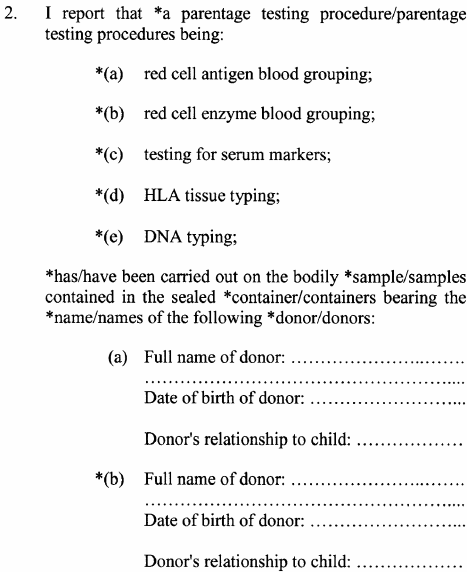
For the purposes of the definition of "parentage testing procedure" in section 11 of the Act, the following medical procedures are prescribed medical procedures when carried out in accordance with these regulations:(a) red cell antigen blood grouping;(b) red cell enzyme blood grouping;(c) HLA tissue typing;(d) testing for serum markers;(e) DNA typing.
7. Compliance with regulations
A parentage testing procedure is taken to be carried out in accordance with these regulations if –(a) the bodily sample is taken in accordance with Part 2 ; and(b) it is carried out –(i) in compliance with Part 2 ; and(ii) at a laboratory that is accredited by NATA for the purpose of carrying out parentage testing procedures; and(iii) in accordance with standards of practice that entitle the laboratory to be so accredited; and(c) it is supplemented by a report.
PART 2 - Collection, Storage and Testing of Samples
A person must not take a bodily sample from a donor for the purposes of a parentage testing procedure unless he or she is –(a) a medical practitioner; or(b) employed by a hospital, pathology practice, parentage testing practice or medical practitioner for the purpose of taking a bodily sample from a donor.
9. Provision of information by donors
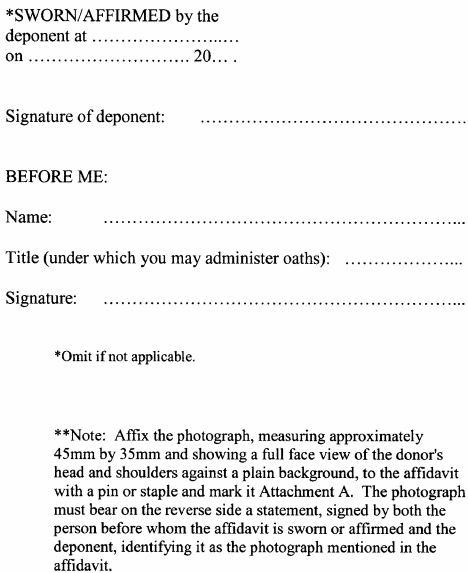
(1) A sampler must not take a bodily sample from a donor unless –(a) immediately before the sampler takes the bodily sample, the donor has completed an affidavit in accordance with Form 1 in Schedule 1 to which is attached a recent photograph of the donor; and(b) the donor provides the sampler with –(i) the completed affidavit which has attached to it the recent photograph; and(ii) an additional copy of that recent photograph.(2) For the purposes of subregulation (1)(a) and (b) , the recent photograph of the donor must measure approximately 45 millimetres by 35 millimetres, and must show a full face view of the donor's head and shoulders against a plain background.(3) If the donor is a child under the age of 18 years, the affidavit referred to in subregulation (1)(a) is to be completed by the person who is responsible for the long-term care, welfare and development of the child.(4) If the donor is a person who, by reason of disability, is unable to make reasonable judgments in relation to his or her personal circumstances, the affidavit referred to in subregulation (1)(a) is to be completed by –(a) a person who is a guardian, manager, administrator or attorney of the donor under a law of –(i) the State that applies to the donor; or(ii) another State or a Territory that applies to the donor; or(b) a person who is responsible for the care, welfare and development of the donor.
10. Collection of blood samples
(1) A sampler must not take a sample of blood from a donor with a needle or syringe, unless the needle or syringe –(a) has not been used previously for any purpose; and(b) has been sterilised; and(c) is disposable.(2) Before taking a sample of blood from a donor, the sampler is to ensure that the area of the donor's skin into which the needle is to be inserted to withdraw the blood has been cleaned with an antiseptic.
11. Collection of bodily samples for DNA typing
(1) This regulation applies to the taking of a bodily sample (except a sample of blood) from a donor for the purposes of a parentage testing procedure that is DNA typing.(2) A sampler must not take a bodily sample from a donor with a swab, unless the swab –(a) has not been used previously for any purpose; and(b) has been sterilised.(3) A sampler must not take a skin scraping or a hair root from a donor with an implement unless the implement has been sterilised.
12. Containers to be sealed and labelled
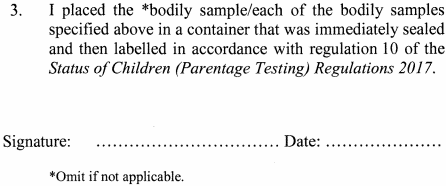
(1) If a sampler takes a bodily sample from a donor, the sampler must ensure that the sample is placed in a container that complies with subregulation (2) –(a) immediately after the bodily sample is taken; and(b) subject to subregulations (4) and (5) , in the presence of the donor.(2) For the purposes of subregulation (1) , a container –(a) must not have been previously used for any purpose; and(b) must be sealed in a way that, if it were opened after being sealed, that fact would be evident on inspection of the container; and(c) must have a label, on which the following information is written in ink, securely attached to it:(i) the full name of the donor;(ii) the date of birth of the donor;(iii) the sex of the donor;(iv) the date and time at which the bodily sample was taken; and(d) must be labelled in a way that, if the writing on the label was obscured, altered or erased, that fact would be evident on inspection of the label.(3) After the label referred to in subregulation (2)(c) is completed and attached to the container it must be signed, in ink, by the sampler and, subject to subregulations (4) and (5) , the donor.(4) If the donor is a child under the age of 18 years –(a) the sampler is to comply with subregulation (1) in the presence of the person who is responsible for the long-term care, welfare and development of the child; and(b) for the purposes of subregulation (3) , the person who is responsible for the long-term care, welfare and development of the child is to sign the label instead of the donor.(5) If the donor is a person who, by reason of disability, is unable to make reasonable judgments in relation to his or her personal circumstances –(a) the sampler is to comply with subregulation (1) in the presence of –(i) a person who is a guardian, manager, administrator or attorney of the donor under a law of the State that applies to the donor; or(ii) a person who is a guardian, manager, administrator or attorney of the donor under a law of another State or a Territory that applies to the donor; or(iii) a person who is responsible for the care, welfare and development of the donor; and(b) for the purposes of subregulation (3) , one of the following persons is to sign the label instead of the donor:(i) a person who is a guardian, manager, administrator or attorney of the donor under a law of the State that applies to the donor;(ii) a person who is a guardian, manager, administrator or attorney of the donor under a law of another State or a Territory that applies to the donor;(iii) a person who is responsible for the care, welfare and development of the donor.
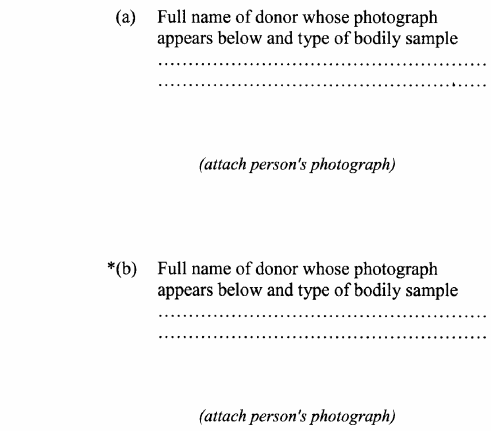
After taking a bodily sample from a donor, the sampler must –(a) complete a statement in accordance with Form 2 in Schedule 1 ; and(b) affix the photograph of the donor, in the sampler's possession under regulation 9(1)(b)(ii) , to the statement; and(c) sign his or her name partly on the photograph and partly on the statement in a way that, if the photograph were later removed from the statement, the removal would be evident from inspection of the statement.
14. Packing and storage requirements
(1) A sampler must ensure that a bodily sample is packed, stored and transported to a laboratory for testing in a manner that –(a) will preserve the integrity of the sample; and(b) will ensure that the testing of the sample will produce the same results as would have been obtained if the sample had been tested immediately after collection.(2) A sampler must ensure that the following documents are sent to the laboratory with a sample:(a) the affidavit in his or her possession in accordance with regulation 9(1)(a) ;(c) the statement completed under regulation 13 .
(1) A laboratory to which a bodily sample has been sent for testing is to ensure that the testing is completed –(a) if the proposed procedure is red cell antigen blood grouping, red cell enzyme blood grouping or testing for serum markers, within 6 days after the sample is taken; or(b) if the proposed procedure is HLA tissue typing, within 3 days after the sample is taken; or(c) if the proposed procedure is DNA typing, within a reasonable time after the sample is taken.(2) If the proposed procedure is red cell enzyme blood grouping or testing for serum markers, subregulation (1)(a) is complied with if –(a) the testing is completed within 6 days after the sample is taken from the donor; or(b) a dried sample of the bodily sample to be tested is prepared within those 6 days.
PART 3 - Reports
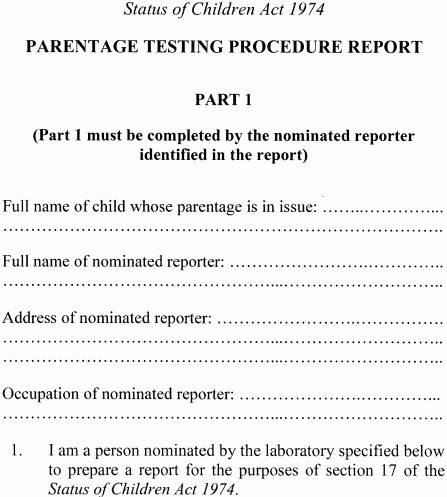
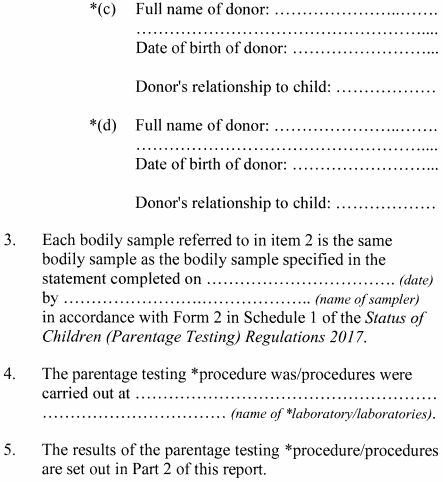
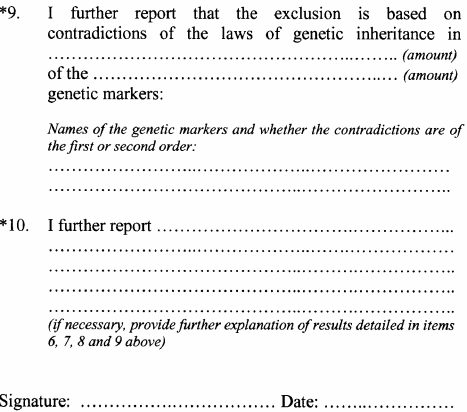
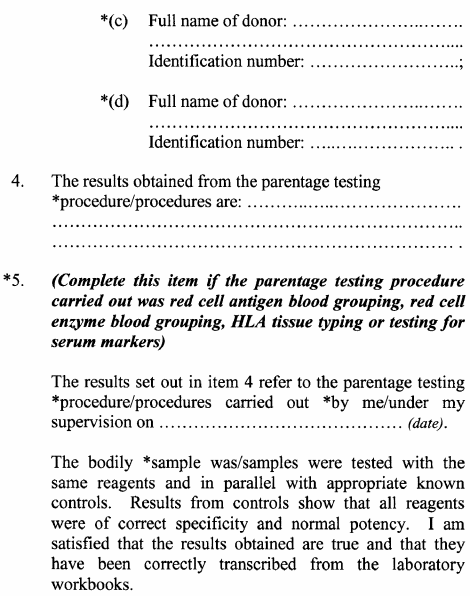
(1) A report under section 17 of the Act is to be in accordance with Form 3 in Schedule 1 .(2) Part 1 of the report is to be completed by the nominated reporter identified in the report.(3) Part 2 of the report is to be completed by –(a) the person who carried out the parentage testing procedure; or(b) the person under whose supervision the parentage testing procedure was carried out.(4) If a report is not completed in accordance with this regulation it is of no effect.
SCHEDULE 1 - Forms
Form 1
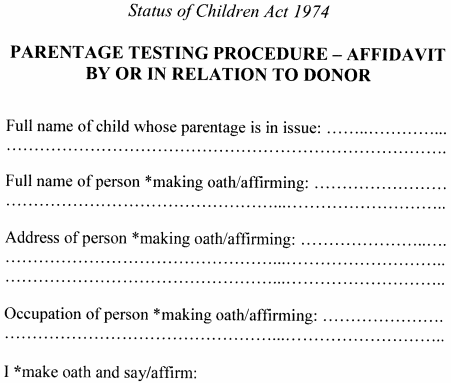
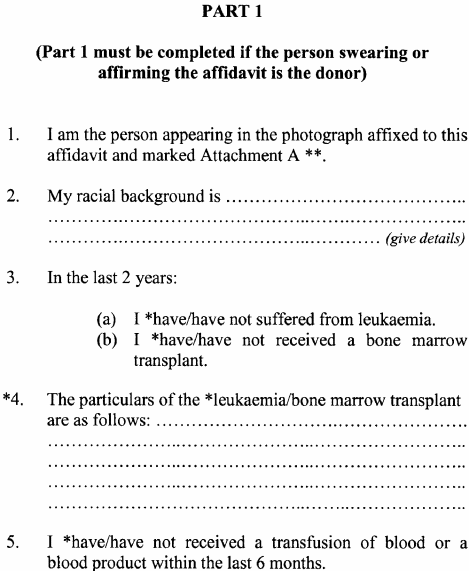
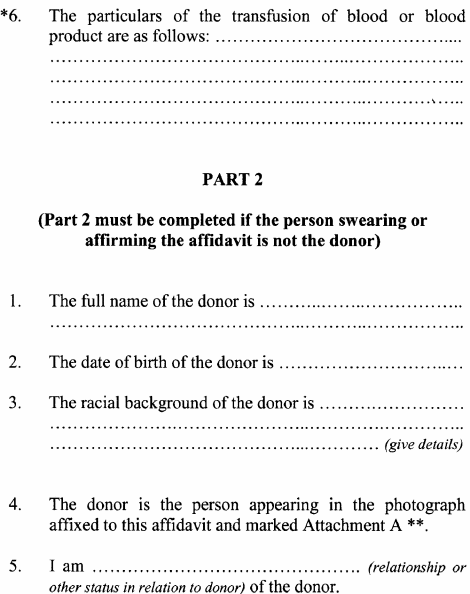
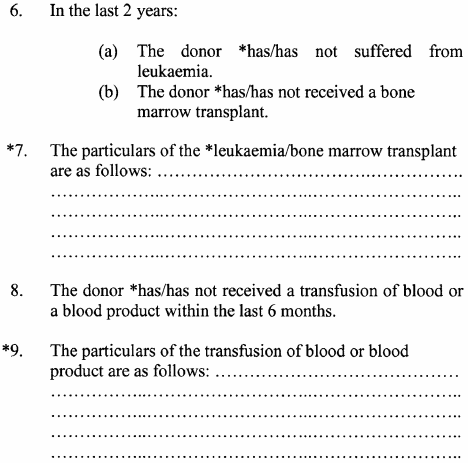
Form 2

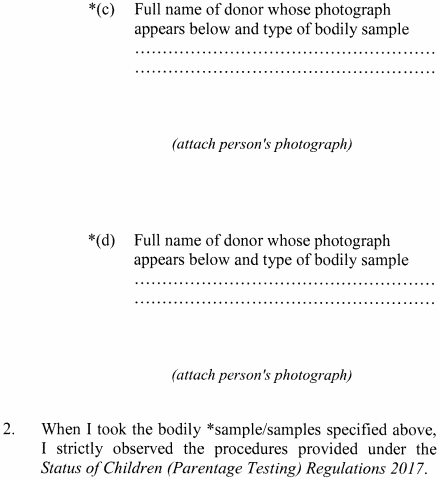
Form 3



Displayed and numbered in accordance with the Rules Publication Act 1953.
Notified in the Gazette on 28 June 2007
These regulations are administered in the Department of Justice.
EXPLANATORY NOTE
(This note is not part of the regulation)
These regulations –(a) specify the prescribed medical procedures that are parentage testing procedures; and(b) provide for the collection of bodily samples; and(c) provide for the carrying out of parentage testing procedures; and(d) are made consequentially on the repeal of the Status of Children (Parentage Testing) Regulations 1997 under section 11 of the Subordinate Legislation Act 1992 .