

Road Amendment Rules 2026
I, the Governor in and over the State of Tasmania and its Dependencies in the Commonwealth of Australia, acting with the advice of the Executive Council, make the following rules under the Traffic Act 1925 .
29 September 2026CAROLINE WELLS
Governor
By Her Excellency's Command,
K. J. VINCENT
Minister for Infrastructure and Transport
These rules may be cited as the Road Amendment Rules 2026 .
These rules take effect on the day on which their making is notified in the Gazette.
In these rules, the Road Rules 2019 are referred to as the Principal Rules.
4. Rule 44 amended (Division does not apply to entering or leaving a roundabout, lane filtering or repositioning)
Rule 44(c) of the Principal Rules is amended by omitting "motorbike" and substituting "motor bike".
5. Rule 62 amended (Giving way when turning at an intersection with traffic lights)
Rule 62(1) of the Principal Rules is amended as follows:(a) by inserting in paragraph (a) "or rider of a bicycle" after "pedestrian";(b) by omitting from paragraph (b)(ii) "at or near the intersection who is on" and substituting "or rider of a bicycle at or near the intersection who is crossing".
6. Rule 64 amended (Giving way at a flashing yellow traffic arrow at an intersection)
Rule 64(b) of the Principal Rules is amended by inserting "or rider of a bicycle" after "pedestrian".
7. Rule 67 amended (Stopping and giving way at a stop sign or stop line at an intersection without traffic lights)
Rule 67(4) of the Principal Rules is amended by inserting "or rider of a bicycle" after "any pedestrian".
8. Rule 69 amended (Giving way at a give way sign or give way line at an intersection (except a roundabout))
Rule 69 of the Principal Rules is amended as follows:(a) by inserting in subrule (2A)(b) "or entering" after "on";(b) by inserting in subrule (3) "or rider of a bicycle" after "any pedestrian".
9. Rule 72 amended (Giving way at an intersection (except a T-intersection or roundabout))
Rule 72 of the Principal Rules is amended as follows:(a) by inserting in subrule (3)(b) "or rider of a bicycle" after "pedestrian";(b) by inserting in subrule (4)(b) "or rider of a bicycle" after "pedestrian";(c) by inserting in subrule (4A) "or rider of a bicycle" after "pedestrian";(d) by inserting in subrule (5)(c) "or rider of a bicycle" after "pedestrian".
10. Rule 73 amended (Giving way at a T-intersection)
Rule 73 of the Principal Rules is amended as follows:(a) by inserting in subrule (2)(b) "or rider of a bicycle" after "pedestrian";(b) by omitting from subrule (3)(b) "on" and substituting "or rider of a bicycle on or entering";(c) by inserting in subrule (4) "or rider of a bicycle" after "any pedestrian";(d) by inserting in subrule (5)(b) "or rider of a bicycle" after "pedestrian";(e) by inserting the following example after paragraph (b) in subrule (5) :ExampleDriver turning left using a slip lane giving way to a vehicle that is turning right into the road the driver is entering.(f) by inserting in subrule (5A) "or rider of a bicycle" after "pedestrian";(g) by inserting in subrule (6)(b) "or rider of a bicycle" after "pedestrian".
.gif)
11. Rule 74 amended (Giving way when entering a road from a road-related area or adjacent land)
Rule 74(1)(d)(i) of the Principal Rules is amended by inserting "or rider of a bicycle" after "pedestrian".
12. Rule 75A amended (Avoiding off-road collisions and dangers)
Rule 75A(1) of the Principal Rules is amended by omitting "his or her" and substituting "the driver’s".
13. Rule 79A amended (Speed-limit approaching and passing stationary or slow-moving police, emergency, enforcement, roadside assistance service and escort vehicles)
Rule 79A(9) of the Principal Rules is amended by omitting "light vehicle" from the definition of roadside assistance service vehicle and substituting "vehicle".
14. Rule 111 amended (Entering a roundabout from a multi-lane road or a road with 2 or more lines of traffic travelling in the same direction)
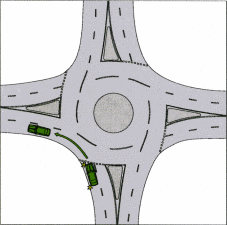
Rule 111 of the Principal Rules is amended as follows:(a) by omitting subrule (2) and substituting the following subrule:(2) If the driver is to leave the roundabout less than halfway around it, the driver must enter the roundabout –(a) from the left marked lane; or(b) if the road is not a multi-lane road – as near as practicable to the left side of the road.Example Leaving a roundabout less than halfway around itNoteMarked lane is defined in the dictionary.(b) by inserting the following subrule after subrule (5) :(5A) Subrule (2)(b) does not apply to the rider of a bicycle.NoteBicycle is defined in the dictionary.
15. Rule 115 amended (Driving in a roundabout)
Rule 115(1)(c) of the Principal Rules is amended by inserting "the left of" after "practicable to".
16. Rule 129 amended (Keeping to the far left side of a road)
Rule 129 of the Principal Rules is amended by omitting subrule (2) and substituting the following subrule:(2) This rule does not apply to –(a) the rider of a motor bike; or(b) the rider of a bicycle when approaching, entering or riding in a roundabout.NoteApproaching, bicycle, motor bike and roundabout are defined in the dictionary.
17. Rule 187 amended (Stopping in a bicycle lane, bus lane, bus only lane, tram lane, tramway, transit lane, truck lane or on tram tracks)
Rule 187 of the Principal Rules is amended by omitting subrule (4) and substituting the following subrule:(4) A driver must not stop in a bus only lane unless the driver is driving a public bus and is dropping off, or picking up, passengers.Penalty: Fine not exceeding 2 penalty units.NoteBus only lane is defined in rule 154A.
18. Rule 189 amended (Double parking)
Rule 189(1) of the Principal Rules is amended by omitting "he or she" and substituting "the driver".
19. Rule 200 amended (Stopping on roads: heavy and long vehicles)
Rule 200(3) of the Principal Rules is amended by omitting the definition of heavy vehicle .
20. Rule 206 amended (Time extension for people with disabilities)
Rule 206(2) of the Principal Rules is amended by omitting "his or her" and substituting "the driver’s".
21. Rule 221 amended (Using hazard warning lights)
Rule 221 of the Principal Rules is amended by omitting subrule (2) .
22. Rule 225 amended (Using radar detectors and similar devices)
Rule 225(2) of the Principal Rules is amended by omitting "his or her" and substituting "the person’s".
23. Rule 232 amended (Crossing a road at traffic lights)
Rule 232 of the Principal Rules is amended by inserting after subrule (3) the following subrule:(3A) Despite subrule (3), in the circumstances set out in that subrule the pedestrian may instead return to the side of the road, or to the safety area, that the pedestrian has just left, but only if –(a) at the time the lights change, that side or safety area is closer to the pedestrian than the side or safety area (whichever is the closer) to which the pedestrian was heading at that time; and(b) the pedestrian does not stay on the road for longer than is necessary to return to that side or safety area.
24. Rule 233 amended (Crossing a road to or from a tram)
Rule 233(4)(b) of the Principal Rules is amended by omitting "his or her" and substituting "the employee’s".
25. Rule 234 amended (Crossing a road on or near a crossing for pedestrians)
Rule 234 of the Principal Rules is amended as follows:(a) by inserting the following subrule after subrule (1) :(1A) However, a PMD user does not contravene subrule (1) if the PMD user crosses a road, or part of a road, using a bicycle crossing that is within 20 metres of a crossing for pedestrians.NotePMD user is defined in rule 244D.(b) by inserting the following definition before the definition of crossing in subrule (4) :bicycle crossing has the same meaning as in rule 174 ;
26. Rule 235 amended (Crossing a level crossing)
Rule 235(2A) of the Principal Rules is amended by omitting "he or she" and substituting "the pedestrian".
27. Rule 235A amended (Crossing a pedestrian level crossing that has a red pedestrian light)
Rule 235A of the Principal Rules is amended as follows:(a) by omitting from subrule (2) "he or she" and substituting "the pedestrian";(b) by omitting from subrule (3) "he or she" and substituting "the pedestrian".
28. Rule 244B amended (Wearing of helmets by users of motorised scooters)
Rule 244B(1) of the Principal Rules is amended by omitting "his or her head, unless he or she" and substituting "the person’s head, unless the person".
29. Rule 248 substituted
Rule 248 of the Principal Rules is rescinded and the following rule is substituted:(1) A rider of a bicycle riding across a road, or part of a road, on a children’s crossing, marked foot crossing or pedestrian crossing must –(a) keep to the left of the crossing unless it is impracticable to do so; and(b) give way to any pedestrians on the crossing.Penalty: Fine not exceeding 2 penalty units.NoteChildren’s crossing is defined in rule 80, marked foot crossing is defined in the dictionary and pedestrian crossing is defined in rule 81.(2) This rule does not apply if another law of this jurisdiction prohibits a rider of a bicycle from riding on a children’s crossing, marked foot crossing or pedestrian crossing.(3) In this rule –pedestrian does not include a person in or on a personal mobility device.NotePersonal mobility device is defined in the dictionary.
30. Rule 262 amended (Proceeding when bicycle crossing at intersection or another place on a road)
Rule 262 of the Principal Rules is amended by inserting after subrule (2) the following subrule:(2A) Despite subrule (2), in the circumstances set out in that subrule the rider may instead return to the side of the road, or to the safety area, that the rider has just left, but only if –(a) at the time the lights change, that side or safety area is closer to the rider than the side or safety area (whichever is the closer) to which the rider was heading at that time; and(b) the rider does not stay on the road for longer than is necessary to return to that side or safety area.
31. Part 16, Division 1: Heading inserted
Part 16 of the Principal Rules is amended by inserting the following heading before rule 263 :Application of Part
32. Part 16, Division 2: Heading inserted
Part 16 of the Principal Rules is amended by inserting the following heading after rule 263 :Wearing of seatbelts by drivers and passengers 16 years old or older
33. Rule 264 amended (Wearing of seatbelts by drivers)
Rule 264 of the Principal Rules is amended by omitting paragraph (c) and substituting the following paragraph:(c) must wear the seatbelt properly adjusted and fastened, unless the driver is reversing the vehicle or exempt from wearing a seatbelt under rule 267.
Examples of seatbelts being properly adjusted and fastened
1.
A lap and sash seatbelt is properly adjusted and fastened for a driver if –
(a) the seatbelt is secured in the buckle with the lap portion of the belt sitting low and firmly over the driver’s hips; and
(b) the sash portion of the belt is positioned firmly over the driver’s shoulder and not under the driver’s arm furthest from the secured buckle or behind the driver’s back.
2.
A lap belt is properly adjusted and fastened for a driver if the seatbelt is secured in the buckle with the belt sitting low and firmly over the driver’s hips.
34. Rule 265 amended (Wearing of seatbelts by passengers 16 years old or older)
Rule 265 of the Principal Rules is amended as follows:(a) by omitting from subrule (1) "he or she" and substituting "the passenger";(b) by omitting paragraph (c) from subrule (2) and substituting the following paragraph:(c) must wear the seatbelt properly adjusted and fastened.
Examples of seatbelts being properly adjusted and fastened
1.
A lap and sash seatbelt is properly adjusted and fastened for a passenger if –
(a) the seatbelt is secured in the buckle with the lap portion of the belt sitting low and firmly over the passenger’s hips; and
(b) the sash portion of the belt is positioned firmly over the passenger’s shoulder and not under the passenger’s arm furthest from the secured buckle or behind the passenger’s back.
2.
A lap belt is properly adjusted and fastened for a passenger if the seatbelt is secured in the buckle with the belt sitting low and firmly over the passenger’s hips.
(c) by omitting from subrule (4) "his or her" and substituting "the passenger’s".
35. Rule 266 substituted
Rule 266 of the Principal Rules is rescinded and the following Division is substituted:Division 3 - Wearing of seatbelts by passengers under 16 years oldSubdivision 1 - Preliminary266. References in Division to child restraints and seatbelts
(1) For this Division –(a) an approved child restraint is available in the motor vehicle for a passenger if it is fitted in the vehicle and is not occupied by another person; and(b) an approved child restraint or approved seatbelt is suitable for a passenger if it is suitable for restraining, or to be worn by, the passenger.(2) Also, for this Division, a child restraint that is properly fastened and adjusted –(a) is forward facing if, once it restrains a passenger, the passenger’s head is closer to the rear of the vehicle than the passenger’s feet; and(b) is rearward facing if, once it restrains a passenger, the passenger’s feet are closer to the rear of the vehicle than the passenger’s head.266A. Division does not apply to driver of particular vehicles
This Division does not apply to the driver of a correctional vehicle or juvenile justice vehicle.NoteCorrectional vehicle and juvenile justice vehicle are defined in the dictionary.Subdivision 2 - Requirements about wearing of seatbelts and seating positions266B. Compliance with Division
A driver of a motor vehicle (except a bus or motor bike) that is moving, or is stationary but not parked, must ensure that this Division is complied with for each passenger in or on the vehicle who is under 16 years old.Penalty: Fine not exceeding 10 penalty units.NoteBus, motor bike, motor vehicle and park are defined in the dictionary.266C. Wearing of seatbelts by passengers less than 6 months old
(1) If a passenger is less than 6 months old, the passenger must be restrained in a suitable and properly fastened and adjusted rearward facing approved child restraint.NoteApproved child restraint is defined in the dictionary and rearward facing is defined in rule 266.(2) However, if the passenger cannot safely be restrained under subrule (1) because of the passenger’s height or weight, the passenger must be restrained as if rule 266D(1) applied to the passenger.(3) Also, if the passenger cannot safely be restrained under subrule (2) because of the passenger’s height or weight, the passenger must be restrained as if rule 266E(1) applied to the passenger.(4) Further, if the passenger cannot safely be restrained under subrule (3) because of the passenger’s height or weight, the passenger must be restrained as if rule 266I applied to the passenger.(5) This rule does not apply if the passenger is exempt from wearing a seatbelt under rule 267.(6) This rule applies subject to rules 266F and 266K.266D. Wearing of seatbelts by passengers 6 months old or older but less than 4 years old
(1) If a passenger is 6 months old or older, but is less than 4 years old, the passenger must be restrained in –(a) a suitable and properly fastened and adjusted rearward facing approved child restraint; or(b) a suitable and properly fastened and adjusted forward facing approved child restraint that has an inbuilt harness.NoteApproved child restraint is defined in the dictionary and forward facing and rearward facing are defined in rule 266.(2) However, if the passenger cannot safely be restrained under subrule (1) because of the passenger’s height or weight, the passenger must be restrained as if rule 266E(1) applied to the passenger.(3) Also, if the passenger cannot safely be restrained under subrule (2) because of the passenger’s height or weight, the passenger must be restrained as if rule 266I applied to the passenger.(4) This rule does not apply if the passenger is exempt from wearing a seatbelt under rule 267.(5) This rule applies subject to rules 266F and 266K.266E. Wearing of seatbelts by passengers 4 years old or older but less than 7 years old
(1) If a passenger is 4 years old or older, but is less than 7 years old, the passenger must –(a) be restrained in a suitable and properly fastened and adjusted forward facing approved child restraint that has an inbuilt harness; or(b) be placed on a properly positioned approved booster seat and be restrained by either a suitable lap and sash type approved seatbelt that is properly adjusted and fastened, or by a suitable approved child safety harness that is properly adjusted and fastened; or(c) if the passenger is seated in a seating position in a part of the vehicle that is designed primarily for the carriage of goods –(i) be restrained by a suitable lap and sash type seatbelt that is properly adjusted and fastened; or(ii) have the midsection of the passenger’s body restrained by a suitable lap type seatbelt that is properly adjusted and fastened, and have the passenger’s upper body restrained by an approved child safety harness that is properly adjusted and fastened.Note 1Approved child restraint, approved child safety harness and approved seatbelt are defined in the dictionary and forward facing is defined in rule 266.Note 2In relation to paragraph (b), rule 266J permits an approved child safety harness to be worn instead of the sash part of a lap and sash seatbelt.Note 3In relation to paragraph (c), under rule 268(2), a person may only occupy a seating position in a part of a vehicle that is designed primarily for the carriage of goods if that position is suitable for the size and weight of the person.(2) However, if the passenger cannot safely be restrained under subrule (1) because of the passenger’s height or weight, the passenger must be restrained as if rule 266I applied to the passenger.(3) This rule does not apply if the passenger is exempt from wearing a seatbelt under rule 267.(4) This rule applies subject to rules 266F and 266K.(5) In this rule –approved booster seat means a booster seat approved, for the Road Rules, under another law of this jurisdiction.266F. Exemption for driver because of passenger’s medical condition etc
(1) A driver does not have to ensure that rule 266C, 266D or 266E is complied with for a passenger if –(a) the driver is carrying a medical certificate that states a medical practitioner believes the passenger should not be restrained in any of the ways described in those rules because of a medical condition or disability that the passenger has; and(b) the passenger is properly restrained in a child restraint that has been designed for, and is suitable for use by, the passenger or a person with the same medical condition or disability as the passenger; and(c) the driver is complying with any conditions stated in the medical certificate; and(d) no other law of this jurisdiction states that this rule does not apply.NoteMedical certificate and medical practitioner are defined in the dictionary.(2) However, the driver is exempt under subrule (1) only if the driver immediately produces the medical certificate when an authorised person or police officer asks to see the certificate.NoteAuthorised person and police officer are defined in the dictionary.266G. Seating position for passenger less than 4 years old
(1) If a passenger is less than 4 years old, and the motor vehicle has 2 or more rows of seats, the passenger must not be in the front row of seats.(2) A driver does not have to comply with subrule (1) if –(a) the driver is carrying a medical certificate that states a medical practitioner believes the passenger should be in the front row of the vehicle because of a medical condition or disability that the passenger has; and(b) the driver is complying with any conditions stated in the medical certificate; and(c) no other law of this jurisdiction states that this subrule does not apply.NoteMedical certificate and medical practitioner are defined in the dictionary.(3) However, the driver is exempt under subrule (2) only if the driver immediately produces the medical certificate when an authorised person or police officer asks to see the certificate.NoteAuthorised person and police officer are defined in the dictionary.266H. Seating position for passenger 4 years old or older but less than 7 years old
(1) A passenger who is 4 years old or older, but is less than 7 years old, must not be in the front row of a motor vehicle that has 2 or more rows of seats unless, in the row or rows behind the front row –(a) all of the other seats are occupied by passengers who are also less than 7 years old; or(b) there is no empty seating position in which the passenger can sit in accordance with this rule.ExampleThis rule would permit a 6-year-old to sit in the front row of a vehicle that has 2 rows of seats if 2 occupied approved child restraints in the back row encroached on an empty seating position between them in a way that made it impossible for another approved child restraint or booster seat to be placed in that position.(2) A driver does not have to comply with subrule (1) if –(a) the driver is carrying a medical certificate that states a medical practitioner believes the passenger should be in the front row of the vehicle because of a medical condition or disability that the passenger has; and(b) the driver is complying with any conditions stated in the medical certificate; and(c) no other law of this jurisdiction states that this subrule does not apply.NoteMedical certificate and medical practitioner are defined in the dictionary.(3) However, the driver is exempt under subrule (2) only if the driver immediately produces the medical certificate when an authorised person or police officer asks to see the certificate.NoteAuthorised person and police officer are defined in the dictionary.266I. Seating position for passenger 7 years old or older but less than 16 years old
If a passenger is 7 years old or older, but is less than 16 years old –(a) the passenger must be restrained in a suitable approved child restraint that is properly adjusted and fastened; or(b) the passenger –(i) must occupy a seating position that is fitted with a suitable approved seatbelt; and(ii) must not occupy the same seating position as another passenger (whether or not the other passenger is exempt from wearing a seatbelt under rule 267); and(iii) must wear the seatbelt properly adjusted and fastened.NoteIn relation to paragraph (b)(iii), rule 266J permits an approved child safety harness to be worn instead of the sash part of a lap and sash seatbelt.266J. Passenger sitting in seating position fitted with particular seatbelt
(1) This rule applies in relation to a passenger sitting in a seating position that is fitted with a lap and sash type seatbelt.(2) It is sufficient compliance with rule 266E(1)(b) or 266I(b)(iii), as the case may be, if, instead of using the sash part of the seatbelt, an approved child safety harness that is properly adjusted and fastened is used to restrain the upper body of the passenger.NoteApproved child safety harness is defined in the dictionary.266K. Exemptions for driver of taxi or tow truck
(1) The driver of a taxi is exempt from rules 266C, 266D and 266E in relation to a passenger if –(a) there is no suitable approved child restraint available in the taxi for the passenger; and(b) if the taxi has 2 or more rows of seats – the passenger is not in the front row of seats; and(c) there is not another law of this jurisdiction requiring all passengers in a taxi who are the same age as the passenger to be restrained in an approved child restraint.Note 1Taxi is defined in the dictionary.Note 2Despite the exemption provided by this subrule, in order to comply with subrule (2) the driver of a taxi must ensure that passengers who are one year old or older, but less than 7 years old, wear an approved seatbelt.(2) If the exemption set out in subrule (1) applies to a driver in relation to a passenger who is one year old or older, but less than 7 years old, and who is not exempt from wearing a seatbelt under rule 267, the passenger must wear an approved seatbelt that is properly adjusted and fastened to the best extent that is possible given the height and weight of the passenger.(3) The driver of a taxi or tow truck is exempt from rules 266C and 266D in relation to a passenger who is under one year old if –(a) there is no suitable approved child restraint available in the taxi or tow truck for the passenger; and(b) the taxi or tow truck has 2 or more rows of seats; and(c) the passenger is not in the front row of seats; and(d) the passenger is seated in the lap of another passenger who is at least 16 years old; and(e) in the case of a tow truck, the tow truck is towing another vehicle, in which the passenger was travelling, because the other vehicle broke down or was involved in a crash.
36. Part 16, Division 4: Heading inserted
Part 16 of the Principal Rules is amended by inserting the following heading after rule 266K :Exemptions from wearing seatbelts
37. Rule 267 amended (Exemptions from wearing seatbelts)
Rule 267 of the Principal Rules is amended as follows:(a) by omitting from subrule (1A)(a) "he or she" and substituting "the person";(b) by omitting from subrule (1C) "rule 266(3) or (3A)" and substituting "rule 266G(1) or 266H(1)";(c) by omitting from subrule (6) "he or she" and substituting "the person";(d) by omitting from subrule (7) "he or she" and substituting "the driver".
38. Part 16, Division 5: Heading inserted
Part 16 of the Principal Rules is amended by inserting the following heading after rule 267 :Other rules for persons travelling in or on vehicles
39. Rule 268 amended (How persons must travel in or on a motor vehicle)
Rule 268(2)(b) of the Principal Rules is amended by omitting "he or she" and substituting "the person".
40. Rule 271 amended (Riding on motor bikes and quad bikes)
Rule 271(5B) of the Principal Rules is amended by omitting "motorbike" and substituting "motor bike".
41. Rule 280 amended (Application of Division)
Rule 280 of the Principal Rules is amended as follows:(a) by inserting in subrule (1) "or bus only lane" after "lane";(b) by inserting in subrule (2)(b) "or bus only lane" after "lane".
42. Rule 292A substituted
Rule 292A of the Principal Rules is rescinded and the following rule is substituted:292A. Restricting movement of load
(1) A driver must not drive or tow a vehicle carrying a load unless the load is restrained by a load restraint system that –(a) prevents the load from moving in relation to the vehicle (other than movement allowed under subrule (2)) in the circumstances mentioned in subrule (3); and(b) at a minimum, is capable of withstanding the forces that would result in the circumstances mentioned in subrule (3).Penalty: Fine not exceeding 20 penalty units.(2) A load may move in relation to the vehicle if –(a) the vehicle’s stability and weight distribution are not adversely affected by the movement; and(b) the load does not become dislodged from the vehicle.
Examples of load movement that may be permitted under subrule (2)
1.
A load contained within the sides or enclosure of the vehicle that is restrained from moving horizontally may be able to move vertically.
2.
A load of very light objects, or a loose bulk load, that is contained within the sides or enclosure of the vehicle may be able to move horizontally and vertically.
3.
A bulk liquid load contained within the sides or enclosure of the vehicle.
(3) For subrule (1)(b), the circumstances are that the vehicle is subject to –(a) any of the following, separately:(i) 0.8g deceleration in a forwards direction;(ii) 0.5g deceleration in a rearwards direction;(iii) 0.5g acceleration in a lateral direction; and(b) if friction or limited vertical displacement is relied on to comply with paragraph (a) – 0.2g acceleration in a vertical direction relative to the load.(4) In this rule –g means gravitational acceleration or 9.81m/s2.
43. Rule 307 amended (Stopping and parking exemption for police and emergency vehicles and authorised persons)
Rule 307(2) of the Principal Rules is amended by omitting "his or her" and substituting "the driver’s".
44. Rule 308 amended (Exemption for police officers and emergency workers in or on a personal mobility device or on foot)
Rule 308 of the Principal Rules is amended by omitting "his or her" and substituting "the police officer’s or emergency worker’s".
45. Rule 313B amended (Exemption for breakdown vehicles)
Rule 313B of the Principal Rules is amended as follows:(a) by omitting from subrule (1)(a) "his or her" and substituting "the person’s";(b) by omitting "his or her" from paragraph (b) of the definition of breakdown vehicle in subrule (3) and substituting "the person’s".
46. Rule 363 amended (Turning left or right at traffic lights)
Rule 363(2) of the Principal Rules is amended by omitting "he or she" and substituting "the driver".
47. Rule 377 amended (Rule 268: Mode of travelling exemptions)
Rule 377(a) of the Principal Rules is amended by omitting "his or her" and substituting "the person’s".
48. Rule 379 amended (Exemption for transport inspector)
Rule 379(1) of the Principal Rules is amended by omitting "his or her" and substituting "the inspector’s".
49. Rule 380 amended (Exemption for school crossing patrol officer)
Rule 380(1) of the Principal Rules is amended by omitting "his or her" and substituting "the officer’s".
50. Rule 381 amended (Exemption for railway employee)
Rule 381(1) of the Principal Rules is amended by omitting "his or her" and substituting "the railway employee’s".
51. Schedule 5 amended (Dictionary)
Clause 1 of Schedule 5 to the Principal Rules is amended as follows:(a) by omitting the definition of alcohol interlock device and substituting the following definition:alcohol interlock device means a device in a vehicle that is designed to prevent the vehicle from being started or driven unless the device is supplied with a breath sample that contains either no alcohol or less than a certain concentration of alcohol;(b) by inserting the following definitions after the definition of approved bicycle helmet :approved child restraint means a child restraint approved, for the Road Rules, under another law of this jurisdiction;approved child safety harness means a child safety harness approved, for the Road Rules, under another law of this jurisdiction;(c) by omitting the definition of correctional vehicle and substituting the following definition:correctional vehicle, for a provision of the Road Rules, means any vehicle driven by a person who is –(a) a correctional worker for the provision; and(b) driving the vehicle in the course of the person’s duties as a correctional worker;
Note
Correctional worker is defined in this dictionary.
(d) by omitting "his or her duty" from paragraph (b) of the definition of emergency vehicle and substituting "the person’s duties";(e) by omitting the definition of juvenile justice vehicle and substituting the following definition:juvenile justice vehicle, for a provision of the Road Rules, means any vehicle driven by a person who is –(a) a youth justice worker for the provision; and(b) driving the vehicle in the course of the person’s duties as a youth justice worker;
Note
Youth justice worker is defined in this dictionary.
(f) by omitting "his or her" from paragraph (b) of the definition of police vehicle and substituting "the person’s";(g) by omitting "his or her" from paragraph (b) of the definition of postal vehicle and substituting "the person’s".
52. Schedule 6 amended (Jurisdictional qualifications)
Schedule 6 to the Principal Rules is amended as follows:(a) by omitting from clause 4(1)(a) of Part 1 "his or her" and substituting "the worker’s";(b) by omitting from clause 6(a) of Part 1 "he or she" and substituting "the driver";(c) by omitting from clause 8(a)(i) of Part 1 "his or her" and substituting "the driver’s";(d) by omitting from clause 8(a)(ii) of Part 1 "his or her" and substituting "the worker’s";(e) by omitting from clause 12 of Division 1 of Part 2 "his or her" and substituting "the person’s".
Displayed and numbered in accordance with the Rules Publication Act 1953.
Notified in the Gazette on 7 October 2026
These rules are administered in Building Tasmania.
EXPLANATORY NOTE
(This note is not part of the rule)
These rules amend the Road Rules 2019 as follows:(a) to extend the application of certain give way rules to require drivers to give way to cyclists in addition to pedestrians;(b) to clarify when a driver is required to give way to a vehicle or pedestrian entering a slip lane;(c) to extend the application of a speed limit rule for drivers approaching or passing roadside assistance service vehicles to include heavy roadside assistance service vehicles in addition to light vehicles;(d) to enable cyclists to approach, enter and ride in a roundabout in the centre of, rather than as near as practicable to the left side of, the road;(e) to require a driver driving a large vehicle over a central traffic island in a roundabout to drive as near as practicable to the left of the centre of the island;(f) to allow users of personal mobility devices to cross a road using a bike crossing within 20 metres of a crossing for pedestrians;(g) to allow a cyclist to ride across a children's crossing, marked foot crossing or pedestrian crossing, without stopping, provided the cyclist keeps to the left and gives way to pedestrians;(h) to provide examples of when seatbelts are properly adjusted and fastened;(i) to clarify seatbelt and seating position rules for passengers who have not attained the age of 16 years;(j) to extend the application of certain B light rules for drivers of public buses to include bus only lanes in addition to bus lanes;(k) to clarify load restraint requirements;(l) to make grammatical, mechanical and gender-neutral language amendments.