

Legal Profession (Disciplinary Tribunal) Rules 2010
The Disciplinary Tribunal makes the following rules under section 615(5) of the Legal Profession Act 2007 .
These rules may be cited as the Legal Profession (Disciplinary Tribunal) Rules 2010 .
These rules take effect on the day on which their making is notified in the Gazette.
In these rules –Act means the Legal Profession Act 2007 ;application means –(a) an application in respect of a determination under section 458 of the Act; or(b) an application for the hearing and determination of a complaint under section 464 of the Act;notice of hearing means a notice served under section 467(1) of the Act;relevant party means –(a) in relation to an application under section 458 of the Act, the applicant and the practitioner against whom the applicant has made the complaint; and(b) in relation to an application under section 464 of the Act, the applicant and the respondent;Secretary means the Secretary to the Tribunal appointed under section 616 of the Act.
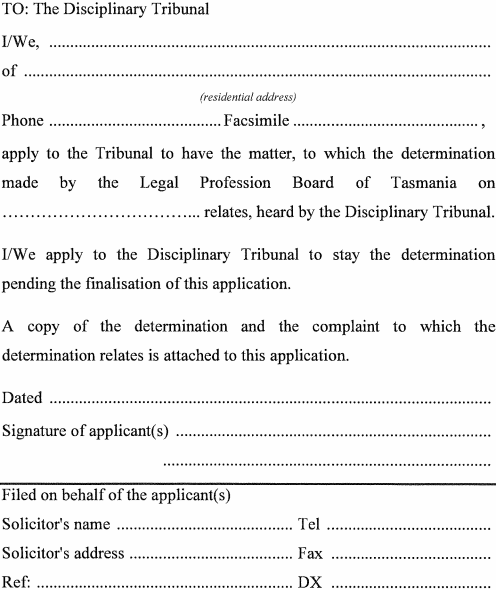
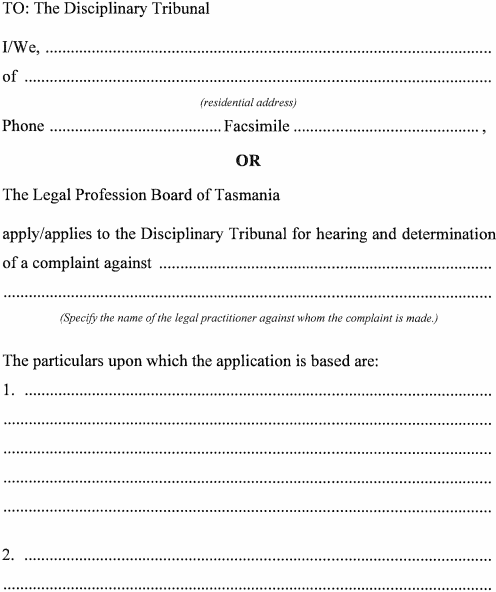
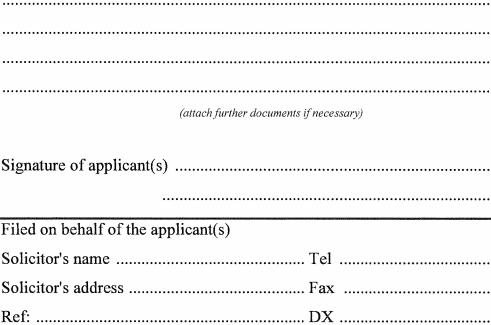
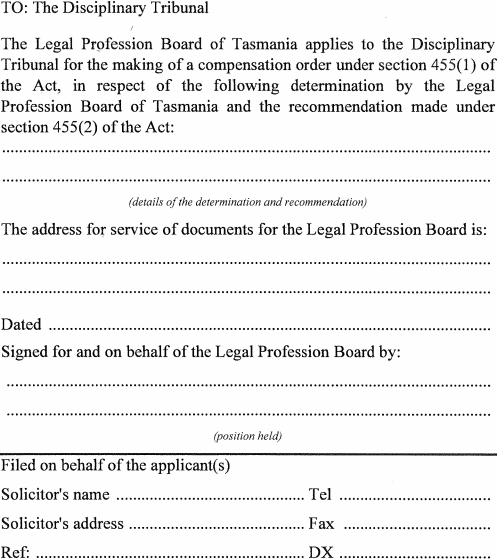
(1) An application in respect of a determination under section 458 of the Act is to be in accordance with Form 1 in Schedule 1 .(2) An application to hear and determine a complaint under section 464(1) of the Act is to be in accordance with Form 2 in Schedule 1 .(3) An application for the making of a compensation order under section 464(2) of the Act is to be in accordance with Form 3 in Schedule 1 .
5. Notice of address for service
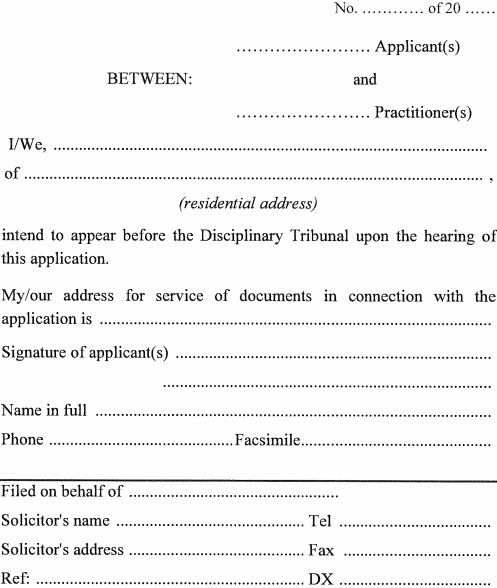
(1) A person who is served with a copy of an application and intends to take part in the proceedings to which the application relates is to lodge with the Secretary a notice of address for service within 8 days of being served with the copy of the application.(2) The notice of address for service is to be in accordance with Form 4 in Schedule 1 .
(1) The Tribunal may give any directions or make any orders it considers appropriate –(a) in respect of –(i) the preparation of an application for hearing; or(ii) the fair and just determination of an application; and(b) at any stage of the application process; and(c) either of its own motion or at the request of a relevant party.(2) The Tribunal may give directions as to the manner in which a directions hearing is to be conducted or held and the persons who are to attend it.(3) The Tribunal may hold a directions hearing for the purpose of giving directions or making orders under subrule (1) .(4) A relevant party may make a request under subrule (1) by –(a) lodging with the Secretary a notice setting out the directions or orders sought and the grounds for seeking those directions or orders; and(b) providing a copy of the notice to all other relevant parties.(5) Without affecting the generality of subrule (1) , the Tribunal may give directions, or make an order, in respect of any one or more of the following:(a) the simplification of, or more adequate definition of, issues;(b) the amendment of an application or any document connected to the application and the terms of such an amendment;(c) admissions of fact and documents;(d) discovery, listing, inspection and proof of documents;(e) any matter which may reduce the costs of a witness attending a hearing;(f) limiting the number of expert witnesses;(g) the preparation and service of affidavits;(h) a timetable for taking any step or complying with any order or direction in the proceeding;(i) the determination of an issue of fact before any other issue;(j) the determination of a point of law before a hearing;(k) the preparation and settlement of issues;(l) the revocation or variation of a previous order made under this rule.
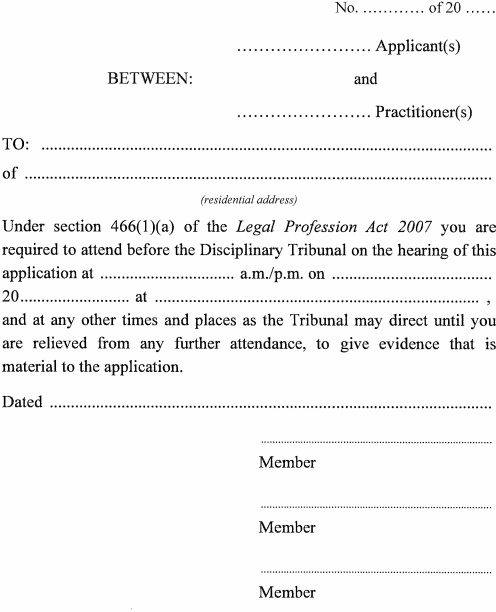
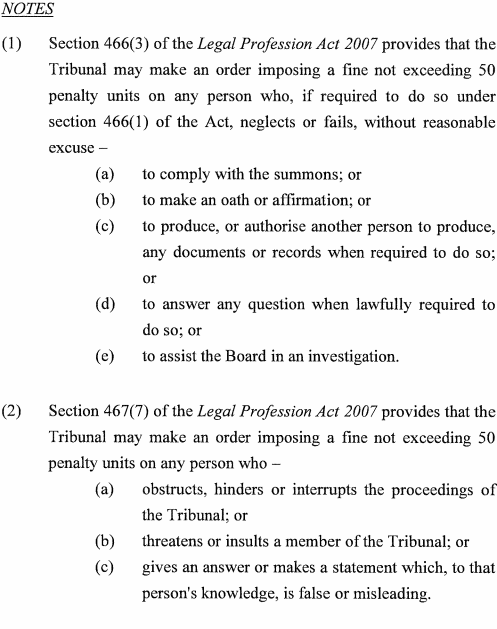
(1) A relevant party may request, in writing, that the Tribunal issue a summons under section 466(1)(a) of the Act.(2) A written request under subrule (1) is to include a draft of the summons requested.(3) The draft summons is to be in accordance with Form 5 in Schedule 1 .(4) A party at whose request a summons under section 466(1)(a) of the Act is issued is to serve a copy of the summons on the person who is the subject of the summons.
(1) The Tribunal may –(a) direct that evidence be taken by affidavit, including cross-affidavit; and(b) specify a timetable for the lodgment and serving of any affidavit and any notice to cross-examine the deponent of the affidavit.(2) The Tribunal is to serve all relevant parties with notice of any directions given under subrule (1) .(3) A party wishing to cross-examine a deponent of an affidavit must serve on the party who lodged the affidavit a notice requiring the deponent to attend the hearing for cross-examination.(4) If the Tribunal does not specify a time for service of a notice requiring the deponent to attend the hearing, the notice must be served a reasonable time before the deponent is required to attend.(5) An affidavit must not be used in evidence unless –(a) the deponent attends in accordance with any notice under subrule (3) ; or(b) the Tribunal makes an order exempting the deponent from cross-examination.
(1) An affidavit is to –(a) be sworn in accordance with rule 11 ; and(b) state –(i) the title of the application in respect of which the affidavit is sworn; and(ii) the address and occupation, or if no occupation then a description, of the deponent; and(c) be expressed in the first person; and(d) be divided in consecutively numbered paragraphs each of which is to contain a distinct part of the subject; and(e) use only figures when referring to money or numbers; and(f) contain a jurat that states the day on which, and the place at which, the affidavit was sworn; and(g) be signed on each page by the person before whom the affidavit is sworn; and(h) identify each annexure or exhibit by a certificate annexed to it or endorsed on it that –(i) states the short title of the application to which it relates; and(ii) is signed by the person before whom the affidavit is sworn.(2) The Tribunal may accept an affidavit despite any defect or irregularity in its form.(3) If the Tribunal believes an affidavit contains information that is not relevant to the application, the Tribunal may order –(a) that the affidavit be amended; or(b) that the affidavit be removed from the file.
(1) An affidavit, other than an answering affidavit or affidavit in reply, is not to be used during the hearing of an application unless –(a) it has been lodged with the Secretary; and(b) a copy has been served on each party concerned at least 7 days, or such other period as determined by the Tribunal at a directions hearing in respect of the application, before the time appointed for the hearing of the application.(2) An answering affidavit or an affidavit in reply is not to be used during the hearing of an application unless it has been lodged and a copy has been served on each party concerned as soon as practicable.(3) If subrule (1) or (2) is not complied with, the Tribunal may –(a) permit the affidavit to be used on any terms as may be proper, despite the non-compliance; or(b) adjourn the application on any terms as may be proper and allow the affidavit to be read on the adjourned hearing.
(1) An affidavit sworn in the State is to be sworn before any one of the following:(a) a Judge or Associate Judge of the Supreme Court;(b) the Registrar, Deputy Registrar, Assistant Deputy Registrar or a district registrar of the Supreme Court;(c) a commissioner appointed under the Supreme Court Civil Procedure Act 1932 ;(d) an officer empowered by statute to administer oaths;(e) a magistrate;(f) a justice;(g) an Australian legal practitioner.(2) An affidavit sworn in any place out of the State may be sworn in accordance with the Supreme Court Rules 2000 .(3) An affidavit is not sufficient if it is sworn before –(a) an Australian legal practitioner acting on behalf of the party on whose behalf the affidavit is being made; or(b) the agent of such a practitioner; or(c) a member of the firm of such a practitioner or agent; or(d) a solicitor or clerk employed by such a practitioner, agent or firm; or(e) a party to the proceedings.
The Tribunal –(a) is not bound by the rules of evidence; and(b) may inform itself in any manner it thinks fit of any matter relevant to determining the accepted standards of practice and behaviour within the legal profession.
(1) The Secretary is to cause an audio recording to be made of every hearing before the Tribunal, other than a directions hearing.(2) The Tribunal may direct the Secretary to cause an audio recording to be made of a directions hearing.(3) The Secretary is to make a transcript of the audio recording of the hearing available to a relevant party –(a) on the request of the party; and(b) on payment of the cost of production of the transcript.
14. Request for Tribunal to act
(1) A relevant party may request the Tribunal to exercise its powers under section 466(1)(a) , (e) , (g) or (h) of the Act.(2) The Tribunal may require a party making a request under subrule (1) to undertake to pay the reasonable costs incurred by any person in complying with –(a) a summons issued under section 466(1)(a) of the Act as a result of the request; or(b) any requirement of the Tribunal made under section 466(1)(e) , (g) or (h) of the Act as a result of the request.(3) A party at whose request a requirement under section 466(1)(e) of the Act is made is to serve a copy of the requirement on the person who is the subject of the requirement.
15. Tribunal may dispense with requirements
If it appears to the Tribunal to be just to do so, the Tribunal may –(a) dispense with a requirement of these rules relating to any form, notice, affidavit, document, service, procedure or time; and(b) vary or rescind any order or direction it has given in relation to any of those matters.
SCHEDULE 1 - Forms
Form 1 - APPLICATION TO HEAR MATTER DETERMINED BY BOARD
Form 2 - APPLICATION TO HEAR AND DETERMINE COMPLAINT
Form 3 - APPLICATION FOR COMPENSATION
Form 4 - NOTICE OF ADDRESS FOR SERVICE
Form 5 - SUMMONS TO GIVE EVIDENCE
These rules were made by the Disciplinary Tribunal at a meeting held on 24 June 2010.
DARYL COATES
Chairperson
SIMON BROWN
Deputy Chairperson
PAUL J. COOK
Member
Displayed and numbered in accordance with the Rules Publication Act 1953.
Notified in the Gazette on 30 June 2010
These rules are administered in the Department of Justice.
EXPLANATORY NOTE
(This note is not part of the rule)
These rules regulate the making, hearing and determining of applications to the Disciplinary Tribunal under the Legal Profession Act 2007 .