

Traffic (Road Rules) Amendment Regulations 2004
I, the Governor in and over the State of Tasmania and its Dependencies in the Commonwealth of Australia, acting with the advice of the Executive Council, make the following regulations under the Traffic Act 1925 .
22 December 2004W. J. E. Cox
Governor
By His Excellency's Command,
Bryan Green
Minister for Infrastructure, Energy and Resources
These regulations may be cited as the Traffic (Road Rules) Amendment Regulations 2004 .
These regulations take effect on 1 March 2005.
In these regulations, the Traffic (Road Rules) Regulations 1999 are referred to as the Principal Regulations.
4. Regulation 29 amended (Making a left turn as indicated by a road marking)
Regulation 29 of the Principal Regulations is amended by omitting "road marking." and substituting "road marking unless the driver is turning, at B lights or traffic arrows, in accordance with Division 2 of Part 17 .".
5. Regulation 33 amended (Making a right turn)
Regulation 33(1) of the Principal Regulations is amended by omitting "this rule." and substituting "this rule unless the driver is turning, at B lights or traffic arrows, in accordance with Division 2 of Part 17 .".
6. Regulation 48 amended (Giving a right change of direction signal)
Regulation 48 of the Principal Regulations is amended by inserting after subregulation (3) the following subregulation:(3A) Subrule (3) does not apply to the rider of a bicycle that is stopped in traffic but not parked.
7. Regulation 56 amended (Stopping for a red traffic light or arrow)
Regulation 56 of the Principal Regulations is amended as follows:(a) by omitting paragraph (c) from subregulation (1) and substituting the following :and must not proceed past the stop line, stop here on red signal sign or nearest or only traffic lights (as the case may be) until the traffic lights show a green or flashing yellow traffic light or no traffic light.(c) if there is no stop line or stop here on red signal sign at or near the traffic lights – as near as practicable to, but before reaching, the nearest or only traffic lights –
Penalty: Fine not exceeding 10 penalty units.
Note: Red traffic light and stop line are defined in the dictionary.
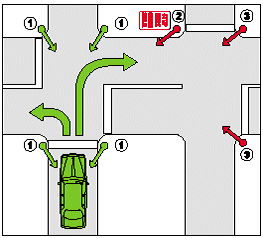
Example for subrule (1)(b)
Example 1 –
Stopping at a stop here on red signal sign
In this example the driver may go straight ahead, or turn right or left, if there is a green traffic light showing at 1. However, the driver must not go beyond the stop here on red signal sign at 2 if there is a red traffic light showing on the road the driver is entering (see 2 and 3)
(b) by inserting the following subregulation after subregulation (1) :(1A) However, if the traffic lights are at an intersection with a left turn on red after stopping sign and the driver is turning left at the intersection, the driver may turn left after stopping.NoteRule 62 deals with the give way rules applying to a driver turning left at an intersection after stopping at a left turn on red after stopping sign.(c) by omitting from subregulation (2)(c) "nearest or only traffic arrows." and substituting "nearest or only traffic arrows –";(d) by inserting the following after paragraph (c) in subregulation (2) :and must not proceed past the stop line, stop here on red arrow sign or nearest or only traffic arrows (as the case may be) until the traffic arrows show a green or flashing yellow traffic arrow or no traffic arrow.
8. Regulation 57 substituted
Regulation 57 of the Principal Regulations is rescinded and the following regulation is substituted:57. Stopping for a yellow traffic light or arrow
(1) A driver approaching or at traffic lights showing a yellow traffic light must stop –and must not proceed past the stop line or nearest or only traffic lights, or into the intersection (as the case may be), until the traffic lights show a green or flashing yellow traffic light or no traffic light.(a) if there is a stop line at or near the traffic lights and the driver can stop safely before reaching the stop line – as near as practicable to, but before reaching, the stop line; or(b) if there is no stop line at or near the traffic lights and the driver can stop safely before reaching the traffic lights – as near as practicable to, but before reaching, the nearest or only traffic lights; or(c) if the traffic lights are at an intersection and the driver cannot stop safely in accordance with paragraph (a) or (b) , but can stop safely before entering the intersection – before entering the intersection –
Penalty: Fine not exceeding 5 penalty units.
Note : Enter, intersection, stop line and yellow traffic light are defined in the dictionary.
(2) A driver approaching or at traffic arrows showing a yellow traffic arrow who is turning in the direction indicated by the arrow must stop –and must proceed past the stop line or nearest or only traffic arrows, or into the intersection (as the case may be), until the traffic arrows show a green or flashing yellow traffic arrow or no traffic arrow.(a) if there is a stop line at or near the traffic arrows and the driver can stop safely before reaching the stop line – as near as practicable to, but before reaching, the stop line; or(b) if there is no stop line at or near the traffic arrows and the driver can stop safely before reaching the traffic arrows – as near as practicable to, but before reaching, the nearest or only traffic arrows; or(c) if the traffic arrows are at an intersection and the driver cannot stop safely in accordance with paragraph (a) or (b) , but can stop safely before entering the intersection – before entering the intersection –
Penalty: Fine not exceeding 5 penalty units.
Note : Enter, intersection, stop line and yellow traffic arrow are defined in the dictionary.
(3) If the traffic lights or traffic arrows (as the case may be) are at an intersection and the driver is not able to stop safely under subrule (1) or (2) (as the case may be) and enters the intersection, the driver must leave the intersection as soon as the driver can do so safely.
Penalty: Fine not exceeding 5 penalty units.
Note 1 : Intersection does not include a road-related area - see the definition in the dictionary.
Note 2 : This rule applies to a driver turning left using a slip lane only if the yellow traffic light or yellow traffic arrow (as the case may be) applies to the slip lane – see Part 20 , Divisions 2 and 3 , especially rules 330 and 345 .
Note 3 : Rule 58 deals with when a driver does not have to stop at a yellow traffic light.
9. Regulation 59 amended (Proceeding through a red traffic light)
Regulation 59 of the Principal Regulations is amended by omitting subregulation (1) and substituting the following subregulation:(1) If traffic lights at an intersection or marked foot crossing are showing a red traffic light, a driver must not enter the intersection or marked foot crossing.
Penalty: Fine not exceeding 10 penalty units.
Note 1: Enter, intersection, marked foot crossing and red traffic light are defined in the dictionary.
Note 2: Rules 56 and 57 deal with stopping for a red or yellow traffic light, and proceeding while the light remains red or yellow. Rule 60 deals with proceeding through a red traffic arrow.
10. Regulation 61 amended (Proceeding when traffic lights or arrows at an intersection change to yellow or red)
Regulation 61 of the Principal Regulations is amended as follows:(a) by omitting from subregulation (2) "traffic lights or arrows" and substituting "traffic lights or traffic arrows (as the case may be)";(b) by omitting from subregulation (5) "traffic lights or arrows" and substituting "traffic lights or traffic arrows (as the case may be)".
11. Regulation 69 amended (Giving way at a give way sign or give way line at an intersection (except a roundabout))
Regulation 69 of the Principal Regulations is amended as follows:(a) by omitting subregulation (1) and substituting the following subregulation:(1) A driver at an intersection (except a roundabout) with a give way sign or give way line must give way in accordance with this rule.
Penalty: Fine not exceeding 5 penalty units.
Note 1 : Give way line and intersection are defined in the dictionary, and roundabout is defined in rule 109 . This rule also applies to T-intersections – see the definition of intersection.
Note 2 : For this rule, give way means the driver must slow down and, if necessary, stop to avoid a collision – see the definition in the dictionary.
(b) by omitting from subregulation (2) "The driver" and substituting "Unless the driver is turning left using a slip lane, the driver";(c) by inserting the following subregulation after subregulation (2) :(2A) If the driver is turning left using a slip lane, the driver must give way to –(a) any vehicle on the road the driver is entering, or turning right at the intersection into the road the driver is entering (except a vehicle making a U-turn at the intersection); and(b) any other vehicle or pedestrian on the slip lane.
12. Regulation 74 amended (Giving way when entering a road from a road-related area or adjacent land)
Regulation 74(1) of the Principal Regulations is amended by omitting paragraph (d) and substituting the following paragraph:(d) for a driver entering the road from a road-related area –(i) any pedestrian on the road-related area; and(ii) any other vehicle ahead of the driver's vehicle or approaching from the left or right.
Penalty: Fine not exceeding 10 penalty units.
Note 1 : Adjacent land, give way line, stop line and traffic lights are defined in the dictionary, and road-related area is defined in rule 13 .
Note 2 : Adjacent land or a road-related area can include a driveway, service station or shopping centre – see the definitions of adjacent land and road-related area. Some shopping centres may include roads - see the definition of road in rule 12 .
Note 3 : Part 6 applies to the driver if there are traffic lights. Rule 68 applies to the driver if there is a stop sign or stop line, and rule 71 applies to the driver if there is a give way sign or give way line.
Note 4 : For this rule, give way means the driver must slow down and, if necessary, stop to avoid a collision – see the definition in the dictionary.
13. Regulation 77 amended (Giving way to buses)
Regulation 77(1) of the Principal Regulations is amended by inserting "or in a bicycle lane on the far left side of the road," after "left line of traffic,".
14. Regulation 91 amended (No left turn and no right turn signs)
Regulation 91 of the Principal Regulations is amended by omitting subregulation (2) and substituting the following subregulations:(2) If there is a no right turn sign at an intersection, a driver must not turn right or make a U-turn at the intersection.Penalty: Fine not exceeding 10 penalty units.(3) However, a driver may make a U-turn at the intersection if there is a U-turn permitted sign at the intersection.
No left turn signs
No left turn sign (Standard sign)
No left turn sign (Variable illuminated message sign)
No right turn signs
No right turn sign (Standard sign)
No right turn sign (Variable illuminated message sign)
Note for diagrams : There is another permitted version of each of the no left turn signs and a number of other permitted versions of the no right turn signs – see the diagrams in Schedule 3 .


15. Regulation 104 amended (No trucks signs)
Regulation 104 of the Principal Regulations is amended by omitting subregulation (3) and substituting the following subregulations:(3) The driver of a truck must not drive past a no trucks sign that has no information on or with it indicating a mass or length, unless the driver is permitted to drive the truck on a route passing the sign under another law of this jurisdiction.(4) However, a driver may drive a truck on a road past a no trucks sign if the destination of the truck lies beyond that sign and –(a) there is no other route by which the truck could reach that destination; or(b) any other route by which the truck could reach that destination would require the truck to pass another no trucks sign.
Penalty: Fine not exceeding 10 penalty units.
Note : Truck is defined in the dictionary.
No trucks sign

16. Regulation 109 amended (What is a roundabout)
Regulation 109 of the Principal Regulations is amended by omitting paragraph (a) from the definition of roundabout and substituting:(a) either –(i) one or more marked lanes, all of which are for the use of vehicles travelling in the same direction around a central traffic island; or(ii) room for one or more lines of traffic travelling in the same direction around a central traffic island; and
17. Regulation 111 amended (Entering a roundabout from a multi-lane road or a road with 2 or more lines of traffic travelling in the same direction)
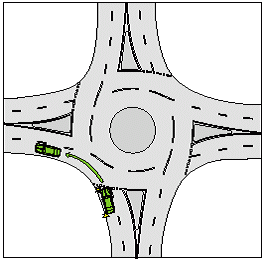
Regulation 111 of the Principal Regulations is amended as follows:(a) by omitting from subregulation (1) "2 or more lines of traffic" and substituting "room for 2 or more lines of traffic (other than motor bikes, bicycles, motorised wheelchairs or animals)";(b) by omitting from subregulation (2) "or left line of traffic." and substituting "or, if the road is not a multi-lane road, as near as practicable to the left side of the road.";(c) by omitting Example No. 1 from subregulation (2) and substituting the following image:Example 1 –
Leaving a roundabout less than halfway around it
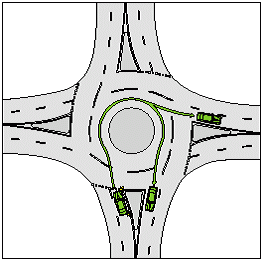
(d) by omitting from subregulation (3) "or right line of traffic." and substituting "or, if the road is not a multi-lane road, from the left of, parallel to, and as near as practicable to, the dividing line or median strip.";(e) by omitting Example No. 2 from subregulation (3) and substituting the following image:Example 2 –
Leaving a roundabout more than halfway around it
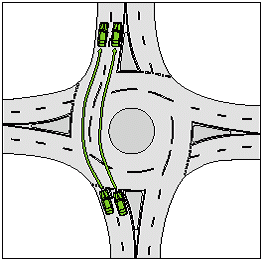
(f) by omitting from subregulation (4) "or line of traffic." and substituting "or, if the road is not a multi-lane road, anywhere on the part of the road on which vehicles travelling in the same direction as the driver may travel.";(g) by omitting Example No. 3 from subregulation (4) and substituting the following image:Example 3 –
Leaving a roundabout halfway around it
(h) by inserting in the table in subregulation (5)(b) afterthe following item:
Note : Traffic-lane arrows is defined in the dictionary.
Examples
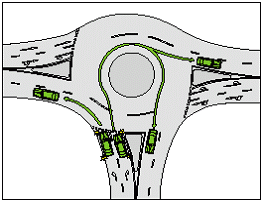
(i) by inserting the following images after the table in subregulation (5)(b) :Example 4 –
Roundabout with 3 entry points
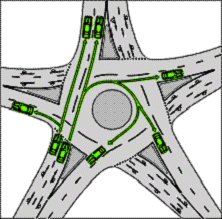
Example 5 –
Roundabout with 5 entry points
(j) by inserting the following notes after paragraph (b) in subregulation (5) :Note 1for examples 4 and 5 : Rule 116 requires a driver to obey traffic lane arrows when driving in or leaving a roundabout.Note 2for examples 4 and 5 : The rules in Part 11 about driving in marked lanes, and moving from one marked lane or line of traffic to another marked lane or line of traffic, apply to a driver driving in a roundabout – see rules 146 to 148.(k) by omitting subregulation (7) and substituting the following subregulations:(7) Subrule (5) does not apply to the rider of a bicycle or animal if the rider is to leave the roundabout more than halfway around it.(8) Despite subrule (2) , a driver may approach and enter the roundabout from the marked lane next to the left lane as well as, or instead of, the left lane if –(a) the driver's vehicle, together with any load or projection, is 7.5 metres long, or longer; and(b) the vehicle displays a do not overtake turning vehicle sign; and(c) any part of the vehicle is within 50 metres of the nearest point of the roundabout; and(d) it is not practicable for the driver to leave the roundabout less than halfway around it from within the left lane; and(e) the driver can safely occupy the next marked lane and can safely leave the roundabout less than halfway around it by occupying the next marked lane, or both lanes.(9) Despite subrule (3) , a driver may approach and enter the roundabout from the marked lane next to the right lane as well as, or instead of, the right lane if –(a) the driver's vehicle, together with any load or projection, is 7.5 metres long, or longer; and(b) the vehicle displays a do not overtake turning vehicle sign; and(c) any part of the vehicle is within 50 metres of the nearest point of the roundabout; and(d) it is not practicable for the driver to leave the roundabout more than halfway around it from within the right lane; and(e) the driver can safely occupy the next marked lane and can safely leave the roundabout more than halfway around it by occupying the next marked lane, or both lanes.(10) In this rule –left lane means –(a) the marked lane nearest to the far left side of the road; or(b) if there is an obstruction (for example, a parked car or roadworks) in that marked lane – the marked lane nearest to that marked lane that is not obstructed;marked lane, for a driver, does not include a special purpose lane in which the driver is not permitted to drive;right lane means –(a) the marked lane nearest to the dividing line or median strip on the road; or(b) if there is an obstruction (for example, a parked car or roadworks) in that marked lane – the marked lane nearest to that marked lane that is not obstructed.
18. Regulation 117 amended (Giving a change of direction signal when changing marked lanes or lines of traffic in a roundabout)
Regulation 117 of the Principal Regulations is amended as follows:(a) by omitting from subregulation (1) "a line of traffic" and substituting "a part of the roundabout where there is room for another line of traffic";(b) by omitting from subregulation (2) "a line of traffic" and substituting "a part of the roundabout where there is room for another line of traffic".
19. Regulation 119 amended (Giving way by the rider of a bicycle or animal to a vehicle leaving a roundabout)
Regulation 119 of the Principal Regulations is amended by omitting "2 or more lines of traffic," and substituting "room for 2 or more lines of traffic (other than motor bikes, bicycles, motorised wheelchairs or animals),".
20. Regulation 128A inserted
After regulation 128 of the Principal Regulations , the following regulation is inserted in Division 1:128A. Entering blocked crossings
A driver must not enter a children's crossing, marked foot crossing or pedestrian crossing if the driver cannot drive through the crossing because the crossing, or a road beyond the crossing, is blocked.
Penalty: Fine not exceeding 5 penalty units.
Examples
The crossing, or a road beyond the crossing, may be blocked by congested traffic, a disabled vehicle, a collision between vehicles or between a vehicle and a pedestrian, or by a fallen load on the road.
Note : Children's crossing, enter, marked foot crossing and pedestrian crossing are defined in the dictionary.
21. Regulation 129 amended (Keeping to the far left side of a road)
Regulation 129(1) of the Principal Regulations is amended by omitting "(except a multi-lane road or a road with 2 or more lines of traffic travelling in the same direction as the driver)" and substituting "(except a multi-lane road)".
22. Regulation 134 amended (Exceptions to keeping to the left of a dividing line)
Regulation 134 of the Principal Regulations is amended by omitting subregulation (2) and substituting the following subregulation:(2) If the dividing line is a broken dividing line only, or a broken dividing line to the left of a single continuous dividing line, the driver may drive to the right of the dividing line –(a) to overtake another driver; or(b) to perform a U-turn, unless another rule would prohibit the driver performing the U-turn.
Note 1 : Overtake is defined the dictionary.
Note 2 : A driver must not overtake another driver unless the driver has a clear view of any approaching traffic, and it is safe to overtake the other driver – see rule 140 .
23. Regulation 136 substituted
Regulation 136 of the Principal Regulations is rescinded and the following regulation is substituted:136. Driving on a one-way service road
A driver on the part of the road that is a service road (except a service road to which a two-way sign applies) must drive in the same direction as a vehicle travelling on the part of the road closest to the service road is required to travel.
Penalty: Fine not exceeding 10 penalty units.
Note : Service road is defined in the dictionary.
Two-way sign
Note for diagram : There is another permitted version of the two-way sign - see the diagram in Schedule 3 .

24. Regulation 138 amended (Keeping off a painted island)
Regulation 138(2) of the Principal Regulations is amended by omitting "island –" and substituting "island for up to 50 metres –".
25. Regulation 141 amended (No overtaking, &c., to the left of a vehicle)
Regulation 141(1) of the Principal Regulations is amended by omitting paragraph (b) and substituting the following paragraphs:(b) the vehicle is turning right, or making a U-turn from the centre of the road, and is giving a right change of direction signal; or(c) the vehicle is stationary and it is safe to overtake to the left of the vehicle.
Penalty: Fine not exceeding 10 penalty units.
Note : Bicycle, centre of the road, marked lane, multi-lane road, overtake, right change of direction signal and U-turn are defined in the dictionary.
26. Regulation 148 amended (Giving way when moving from one marked lane or line of traffic to another marked lane or line of traffic)
Regulation 148 of the Principal Regulations is amended as follows:(a) by omitting subregulation (1) and substituting the following subregulation:(1) A driver on a multi-lane road who is moving from one marked lane (whether or not the lane is ending) to another marked lane must give way to any vehicle travelling in the same direction as the driver in the marked lane to which the driver is moving.
Penalty: Fine not exceeding 10 penalty units.
Note 1 : Marked lane and multi-lane road are defined in the dictionary.
Note 2 : For this rule, give way means the driver must slow down and, if necessary, stop to avoid a collision – see the definition in the dictionary.
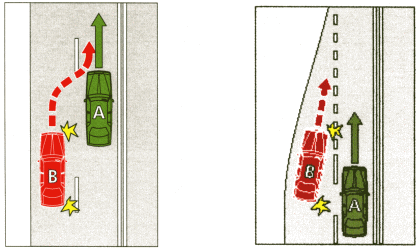
Examples
Giving way when moving from one marked lane to another marked lane
Example 1
Example 2
In these examples, vehicle B must give way to vehicle A
(b) by omitting from subregulation (2) "(whether or not the line of traffic is ending)".
27. Regulation 150 amended (Driving on or across a continuous white edge line)
Regulation 150 of the Principal Regulations is amended by inserting after subregulation (2) the following subregulation:(3) For this rule, a driver drives over a continuous white edge line on a road if –(a) for a line on the far left side of the road – the driver's vehicle is wholly or partly to the left of the line; or(b) for a line on the far right side of the road – the driver's vehicle is wholly or partly to the right of the line.
28. Regulation 158 amended (Exceptions to driving in special purpose lanes, &c.)
Regulation 158(1)(d) of the Principal Regulations is amended by omitting "or a line of traffic," and substituting "or part of the road where there is room for a line of traffic (other than motor bikes, bicycles, motorised wheelchairs or animals),".
29. Regulation 160 amended (Passing or overtaking a tram that is not at or near the left side of a road)
Regulation 160(2) of the Principal Regulations is amended by omitting "tram." and substituting "tram, unless the driver is permitted to do so by a traffic sign or road marking.".
30. Regulations 163 and 164 substituted
Regulations 163 and 164 of the Principal Regulations are rescinded and the following regulations are substituted:163. Driving past the rear of a stopped tram at a tram stop
(1) A driver must comply with this rule if –(a) the driver is driving behind the rear of a tram travelling in the same direction as the driver; and(b) the tram stops at a tram stop, except at the far left side of the road; and(c) there is no safety zone, dividing strip or traffic island between the tram and the part of the road where the driver is driving.
Penalty: Fine not exceeding 5 penalty units.
Note :Dividing strip, traffic island and tram stop are defined in the dictionary, and safety zone is defined in rule 162 .
(2) The driver must stop before passing the rear of the tram.(3) After stopping in accordance with subrule (2) , the driver must not proceed if –(a) the tram doors are open; or(b) a pedestrian is entering or crossing the road between the tram tracks and the far left side of the road.(4) After stopping in accordance with subrule (2) , if the tram remains at the tram stop and subrules (3)(a) and (b) do not apply, the driver must not proceed past the tram at a speed greater than 10 kilometres per hour.(5) However, subrules (2) , (3) and (4) do not apply if the driver is directed to drive past the tram by an authorised person.(6) In this rule –tram includes a bus travelling along tram tracks.164. Stopping beside a stopped tram at a tram stop
(1) A driver must comply with this rule if –(a) the driver is driving alongside, or overtaking, a tram travelling in the same direction as the driver; and(b) the tram stops at a tram stop, except at the far left side of the road; and(c) there is no safety zone, dividing strip or traffic island between the tram and the part of the road where the driver is driving.
Penalty: Fine not exceeding 5 penalty units.
Note :Dividing strip, traffic island and tram stop are defined in the dictionary, and safety zone is defined in rule 162 .
(2) The driver must stop.(3) After stopping in accordance with subrule (2) , the driver must not proceed if –(a) the tram doors are open; or(b) a pedestrian is entering or crossing the road between the tram tracks and the far left side of the road.(4) After stopping in accordance with subrule (2) , if the tram remains at the tram stop and subrules (3)(a) and (b) do not apply, the driver must not proceed past the tram at a speed greater than 10 kilometres per hour.(5) However, subrules (2) , (3) and (4) do not apply if the driver is directed to drive past the tram by an authorised person.(6) In this rule –tram includes a bus travelling along tram tracks.
31. Regulation 165 amended (Stopping in an emergency, &c., or to comply with another rule)
Regulation 165 of the Principal Regulations is amended as follows:(a) by inserting in paragraph (c) "or to assist a disabled vehicle," after "emergency,";(b) by omitting the table from paragraph (e) and substituting the following table:
32. Regulation 170 amended (Stopping in or near an intersection)
Regulation 170 of the Principal Regulations is amended by omitting subregulation (1) and substituting the following subregulation:(1) A driver must not stop in an intersection unless –(a) the driver is permitted to stop at that place under the Road Rules; or(b) the intersection is a T-intersection without traffic lights and the driver stops along the continuous side of the continuing road at the intersection.
Penalty: Fine not exceeding 5 penalty units.
Note : Continuing road, intersection and T-intersection are defined in the dictionary.
33. Regulation 176 amended (Stopping on a clearway)
Regulation 176 of the Principal Regulations is amended by inserting after subregulation (1) the following subregulation:(1A) In subrule (1) –road does not include a road-related area.
Note : Road-related area is defined in rule 13 .
34. Regulation 179 amended (Stopping in a loading zone)
Regulation 179(2) of the Principal Regulations is amended by omitting paragraph (b) and substituting the following paragraphs:(b) if information on or with the loading zone signs applying to the loading zone indicates another time – the indicated time; or(c) for a driver who is permitted to stop in the loading zone under another law of this jurisdiction that provides for a shorter period – that period.
Penalty: Fine not exceeding 2 penalty units.
Note : With is defined in the dictionary.
35. Regulation 198 amended (Obstructing access to and from a footpath, driveway, &c.)
Regulation 198 of the Principal Regulations is amended as follows:(a) by omitting paragraph (a) from subregulation (2) and substituting the following paragraph:(a) the driver –(i) is dropping off, or picking up, passengers; and(ii) does not leave the vehicle unattended; and(iii) completes the dropping off, or picking up, of the passengers, and drives on, as soon as possible and, in any case, within 2 minutes after stopping; or(b) by inserting the following subregulation after subregulation (2) :(3) For this rule, a driver leaves a vehicle unattended if the driver leaves the vehicle so that the driver is over 3 metres from the closest point of the vehicle.
36. Regulation 200 amended (Stopping on roads: heavy and long vehicles)
Regulation 200 of the Principal Regulations is amended as follows:(a) by inserting in subregulation (2) " subrule (2A) or" after "under";(b) by inserting the following subregulation after subregulation (2) :(2A) The driver of a heavy vehicle, or long vehicle, other than a bus, is permitted to stop on a length of road in a built up area for longer than one hour if, throughout the period when the vehicle is stopped on the length of road, the driver is engaged in dropping off, or picking up, goods.
37. Regulation 203A inserted
After regulation 203 of the Principal Regulations , the following regulation is inserted in Division 6:A driver must not stop in a slip lane unless –(a) a parking control sign applies to the place where the driver stops; and(b) the driver is permitted to stop at that place under the Road Rules.
Penalty: Fine not exceeding 5 penalty units.
Note : Parking control sign and slip lane are defined in the dictionary.
38. Regulation 205 substituted
Regulation 205 of the Principal Regulations is rescinded and the following regulation is substituted:205. Parking for longer than indicated
(1) A driver must not park continuously on a length of road, or in an area, to which a permissive parking sign applies for longer than the period indicated by information on or with the sign or, if rule 206 applies to the driver, the period allowed under that rule.
Penalty: Fine not exceeding 2 penalty units.
Note : With is defined in the dictionary.
(2) For subrule (1) , a driver parks continuously on a length of road, or in an area, to which a permissive parking sign applies, from the time when the driver parks on the length of road, or in the area, until the driver, or another driver, moves the vehicle off the length of road, or out of the area, to which the permissive parking sign applies.
39. Regulation 208 amended (Parallel parking on a road (except in a median strip parking area))
Regulation 208 of the Principal Regulations is amended by omitting subregulation (2) and substituting the following subregulation:(2) The driver must position the vehicle to face –(a) in the direction of travel of vehicles in the marked lane or line of traffic on, or next to, the part of the road where the driver parks; or(b) if there is no traffic on, or next to, that part of the road – in the direction in which vehicles could lawfully travel on that part of the road.
Note : Marked lane is defined in the dictionary.
40. Regulation 209 amended (Parallel parking in a median strip parking area)
Regulation 209(2) of the Principal Regulations is amended by omitting paragraph (a) and substituting the following paragraph:(a) to face –(i) in the direction of travel of vehicles in the marked lane or line of traffic to the left of the driver; or(ii) if there is no traffic to the left of the driver – in the direction in which vehicles could lawfully travel on that part of the road; and
41. Regulation 210 amended (Angle parking)
Regulation 210 of the Principal Regulations is amended as follows:(a) by omitting subregulations (1) and (2) and substituting the following subregulations:(1) If a driver parks in a parking area on the side of a road, or in a median strip parking area –the driver must position the driver’s vehicle in accordance with subrules (2) to (4) .(a) to which a parking control sign with the words ‘angle parking’ or ‘angle’ applies; or(b) to which a road marking indicating an angle applies –
Penalty: Fine not exceeding 2 penalty units.
Note 1 : Driver’s vehicle, median strip parking area, parking area, parking control sign, road marking and with are defined in the dictionary.
Note 2 : Rule 212 deals with whether a driver enters a median strip parking area forwards or in reverse.
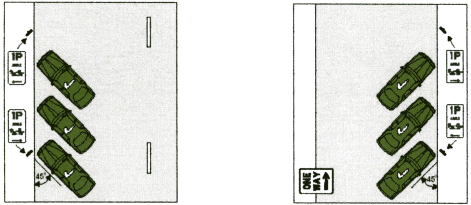
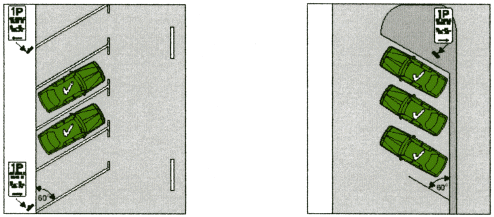
(2) If the parking control sign or road marking indicates that the vehicle must be positioned at a specified angle (other than 90 degrees), the driver must position the vehicle –(a) so that the vehicle is at an angle as near as practicable to the specified angle; and(b) if the vehicle is parked on the side of the road – with the rear of the vehicle nearest to the centre of the road.(2A) If the parking control sign or road marking does not indicate the angle at which the vehicle must be positioned, the driver must position the vehicle –(a) so that the vehicle is at an angle as near as practicable to 45 degrees, as shown in example 1 or 2; and(b) if the vehicle is parked on the side of the road – with the rear of the vehicle nearest to the centre of the road.
Examples
Example 1
Example 2
Parking at 45o at the side of a two-way road
Parking at 45o at the side of a one-way road
(2B) Subrules (2) and (2A) do not apply if the road marking, or information on the parking control sign, includes the words ‘rear in’ or similar words.(b) by omitting from subregulation (3) "information on or with";(c) by omitting paragraph (b) from subregulation (3) and substituting the following paragraph:(b) if the vehicle is parked on the side of the road –(i) if the road marking, or information on the parking control sign, includes the words ‘rear in’ or ‘front in’, or similar words – must position the vehicle so that the front of the vehicle is nearest the centre of the road, or the rear of the vehicle is nearest the centre of the road, in accordance with the road marking or sign; or(ii) otherwise – may position the vehicle either way around.
Examples
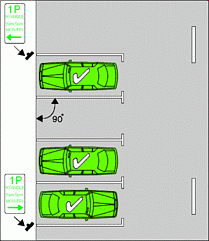
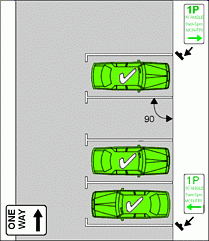
Example 3
Parking at 90 degrees at the side of a two-way road
Example 4
Parking at 90 degrees at the right side of a one-way road
(d) by omitting subregulation (4) and substituting the following subregulations:(4) If the road marking, or information on the parking control sign, includes the words ‘rear in’, or similar words, the driver must position the driver’s vehicle –(a) so the vehicle is at an angle as near as practicable to –(i) the angle indicated by the road marking or parking control sign; or(ii) if the road marking or parking control sign does not indicate an angle – 45 degrees; and(b) if the vehicle is parked on the side of the road – with the front of the vehicle nearest to the centre of the road.(4A) Subrule (4) does not apply if the parking control sign or road marking indicates that the vehicle must be positioned at an angle of 90 degrees.
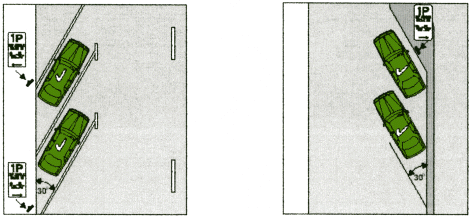
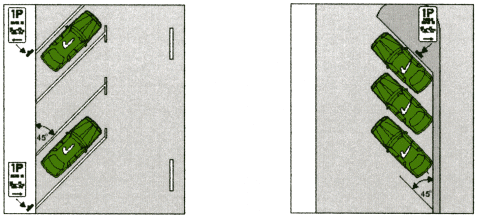
Examples for subrule (4)
Example 5
Example 6
Parking 'rear in' at 30o at the side of the road
Parking 'rear in' at 30o in a median strip parking area
Example 7
Example 8
Parking 'rear in' at 45o at the side of the road
Parking 'rear in' at 45o in a median strip parking area
Example 9
Example 10
Parking 'rear in' at 60o at the side of the road
Parking 'rear in' at 60o in a median strip parking area
42. Regulation 213 substituted
Regulation 213 of the Principal Regulations is rescinded and the following regulation is substituted:213. Making a motor vehicle secure
(1) This rule applies to the driver of a motor vehicle who stops and leaves the vehicle on a road, except so far as the driver is exempt from this rule under another law of this jurisdiction.
Note : Motor vehicle is defined in the dictionary.
(2) Before leaving the vehicle, the driver must apply the parking brake effectively or, if weather conditions (for example, snow) would prevent the effective operation of the parking brake, effectively restrain the motor vehicle's movement in another way.Penalty: Fine not exceeding 5 penalty units.(3) If the driver will be over 3 metres from the closest part of the vehicle, the driver must switch off the engine before leaving the vehicle.Penalty: Fine not exceeding 5 penalty units.(4) If the driver will be over 3 metres from the closest part of the vehicle, and –the driver must remove the ignition key before leaving the vehicle.(a) there is no-one left in the vehicle; or(b) there is only a child or children under 16 years old left in the vehicle –Penalty: Fine not exceeding 2 penalty units.(5) If –the driver must also lock the doors of the vehicle immediately after leaving the vehicle.(a) the driver will be over 3 metres from the closest part of the vehicle; and(b) there is no-one left in the vehicle; and(c) the doors of the vehicle can be locked –Penalty: Fine not exceeding 2 penalty units.
43. Regulation 236 amended (Pedestrians not to cause a traffic hazard or obstruction)
Regulation 236 of the Principal Regulations is amended by inserting after subregulation (3) the following subregulations:(4) A pedestrian must not stand on, or move onto, a road to –(a) solicit contributions, employment or business from an occupant of a vehicle; or(b) [this paragraph is intentionally left blank]; or(c) display an advertisement; or(d) sell or offer articles for sale; or(e) wash or clean, or offer to wash or clean, the windscreen of a vehicle.Penalty: Fine not exceeding 2 penalty units.NoteParagraph (b) is intentionally blank for Tasmania's road rules. The equivalent paragraph in the Australian road rules refers to hitchhiking but hitchhicking does not constitute part of the offence in Tasmania.(5) A person in a vehicle must not buy, or offer to buy, an article or service from a person standing on a road.Penalty: Fine not exceeding 2 penalty units.(6) Subrules (4) and (5) do not apply to the carrying on of an activity permitted by another law of this jurisdiction.(7) In this rule –road includes any shoulder of the road, and any median strip, painted island or traffic island, but does not include any other road-related area.
44. Regulation 240 amended (Wheeled recreational devices and toys not to be used on certain roads)
Regulation 240 of the Principal Regulations is amended by omitting subregulation (1) and substituting the following subregulation:(1) A person must not travel in or on a wheeled recreational device or wheeled toy on –(a) a road with a dividing line or median strip; or(b) a road on which the speed-limit is greater than 50 kilometres per hour; or(c) a one-way road with more than one marked lane.
Penalty : Fine not exceeding 5 penalty units.
Note: Dividing line, marked lane, median strip and one-way road are defined in the dictionary.
45. Regulation 242 amended (Travelling in or on a wheeled recreational device or toy on a footpath or shared path)
Regulation 242 of the Principal Regulations is amended as follows:(a) by inserting in subregulation (2) "or shared path road marking" after "a shared path sign";(b) by inserting in subregulation (2)(a) "or end shared path road marking" after "end shared path sign";(c) by inserting in subregulation (2)(c) "or bicycle path road marking" after "sign";(d) by omitting the first table from subregulation (2)(e) and substituting the following table:(e) by inserting the following subregulation after subregulation (2) :(3) In this rule –end shared path road marking means a shared path road marking with the word ‘end’;shared path road marking means a road marking consisting of a pedestrian symbol above a bicycle symbol.
46. Regulation 244 substituted
Regulation 244 of the Principal Regulations is rescinded and the following regulation is substituted:244. Wheeled recreational devices or wheeled toys being towed, &c.
(1) A person must not travel in or on a wheeled recreational device or wheeled toy that is being towed by a vehicle.Penalty: Fine not exceeding 5 penalty units.(2) A person travelling in or on a wheeled recreational device or wheeled toy must not hold onto a vehicle while the vehicle is moving.Penalty: Fine not exceeding 5 penalty units.(3) A person travelling in or on a wheeled recreational device or wheeled toy must not travel within 2 metres of the rear of a moving motor vehicle continuously for more than 200 metres.
Penalty: Fine not exceeding 5 penalty units.
Note : Vehicle is defined in rule 15 .
47. Regulation 246 amended (Carrying people on a bicycle)
Regulation 246 of the Principal Regulations is amended by omitting the penalty and substituting the following :Penalty: Fine not exceeding 5 penalty units.ExampleA single-seat bicycle with a child's seat attached is designed to carry 2 people, one on the bicycle seat and one on the attached child's seat.
48. Regulation 248 substituted
Regulation 248 of the Principal Regulations is rescinded and the following regulation is substituted:248. No riding across a road on a crossing
(1) The rider of a bicycle must not ride across a road, or part of a road, on a children’s crossing or pedestrian crossing.(2) The rider of a bicycle must not ride across a road, or part of a road, on a marked foot crossing, unless there are bicycle crossing lights at the crossing showing a green bicycle crossing light.
Penalty: Fine not exceeding 2 penalty units.
Note : Marked foot crossing is defined in the dictionary.
49. Regulation 268 amended (How persons must travel in or on a motor vehicle)
Regulation 268 of the Principal Regulations is amended by inserting after subregulation (4) the following subregulations:(4A) The driver of a motor vehicle must not drive with a passenger who is under 16 years old in or on a part of the vehicle that is not a part designed primarily for the carriage of passengers or goods.Penalty: Fine not exceeding 10 penalty units.(4B) The driver of a motor vehicle must not drive with a passenger who is under 16 years old in or on a part of the vehicle that is a part designed primarily for the carriage of goods if the part is –(a) not enclosed; or(b) declared under another law of this jurisdiction to be a part of the vehicle in or on which persons must not be carried.Penalty: Fine not exceeding 10 penalty units.
50. Regulation 270 amended (Wearing motor bike helmets)
Regulation 270(3) of the Principal Regulations is amended by omitting the definition of passenger and substituting the following definition:passenger, of a motor bike, includes a person on a passenger seat of the motor bike (including the pillion seat), or in a sidecar.
51. Regulation 271 amended (Riding on motor bikes)
Regulation 271 of the Principal Regulations is amended as follows:(a) by omitting from subregulation (2) "sidecar)" and substituting "sidecar or on a seat designed for a passenger, other than a pillion seat)";(b) by omitting from subregulation (3) "sidecar)" and substituting "sidecar or other seat designed for a passenger)";(c) by omitting from subregulation (4) "sidecar)" and substituting "sidecar or other seat designed for a passenger, other than a pillion seat)";(d) by omitting subregulation (5) and substituting the following subregulation:(5) The rider of a motor bike must not ride with more passengers in a sidecar, or on a seat designed for a passenger, than the sidecar, or seat, is designed to carry.Penalty: Fine not exceeding 10 penalty units.
52. Regulation 287 amended (Duties of a driver involved in a crash)
Regulation 287 of the Principal Regulations is amended as follows:(a) by omitting from subregulation (2) "(or the driver’s representative) must give" and substituting "must stop at the scene of the crash and give";(b) by omitting from subregulation (3) "(or the driver’s representative)".
53. Regulation 313A inserted
After regulation 313 of the Principal Regulations , the following regulation is inserted in Part 19:313A. Exemption for garbage truck drivers, &c.
Another law of this jurisdiction may provide that a provision of the Road Rules that is specified in the other law does not apply to the driver of a garbage or waste disposal truck while –(a) the driver is engaged in the collection of waste or garbage; and(b) the driver is unable to comply with the provision; and(c) the garbage or waste disposal truck is displaying a flashing light; and(d) the driver is acting safely.
54. Regulation 322 amended (References to traffic control devices and traffic-related items on a road, &c.)
Regulation 322(1) of the Principal Regulations is amended by omitting the table and substituting the following table:
Examples
1. A speed-limit sign erected on a post at the side of a road is taken to be a speed-limit sign on the road.
2. A traffic lane arrow on a structure immediately above the road is taken to be a traffic lane arrow on the road.
3. A do not overtake turning vehicle sign attached to a vehicle on a road is taken to be a do not overtake turning vehicle sign on the road.
55. Regulation 334 amended (How parking control signs apply to a length of road)
Regulation 334(1) of the Principal Regulations is amended as follows:(a) by omitting "parking control sign" first occurring and substituting "permissive parking sign, bicycle parking sign or motor bike parking sign, or a zone sign mentioned in Division 5 of Part 12 ,";(b) by omitting the table and substituting the following table:
56. Regulation 341 amended (Road markings)
Regulation 341 of the Principal Regulations is amended by omitting the table and substituting the following table:
Examples
1. If a driver is driving on a road that is not a multi-lane road or one-way road, a marking to the right of the centre of the road does not apply to the driver.
2. If a driver is driving in a marked lane of a multi-lane road, a road marking in another marked lane does not apply to the driver.
3. At an intersection, or on a roundabout, road markings indicating the edge of a marked lane for use by traffic coming from another direction do not apply to the driver.
Note : Road marking is defined in the dictionary.
57. Regulation 371D rescinded
Regulation 371D of the Principal Regulations is rescinded.
58. Regulation 390 rescinded
Regulation 390 of the Principal Regulations is rescinded.
59. Schedule 3 amended (Other permitted traffic signs)
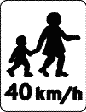
Schedule 3 to the Principal Regulations is amended as follows:(a) by inserting the following before the separated footpath sign :School zone sign (rule 23)
(b) by omitting the speed limit sign (rule 21) .
60. Schedule 5 amended (Dictionary)
Clause 1 of Schedule 5 to the Principal Regulations is amended as follows:(a) by omitting paragraph (b) from the definition of intersection and substituting the following paragraph:(b) the place where any slip lane between the roads meets the road into which traffic on the slip lane may turn –(b) by inserting the following definition after the definition of level crossing :line of traffic means –(a) 2 or more vehicles travelling in line along a road (whether or not the vehicles are actually moving, but not including vehicles in a marked lane); or(b) a single vehicle, other than a vehicle that is part of a line of traffic under paragraph (a) , that is travelling along a road (whether or not the vehicle is actually moving, but not including a vehicle in a marked lane).
Examples
1. A vehicle travelling along a road (except in a marked lane) in line behind another vehicle (the leading vehicle) forms part of a line of traffic with the leading vehicle.
2. A vehicle travelling along a road (except in a marked lane) with no other vehicles in the vicinity constitutes a line of traffic by itself.
3. Two vehicles travelling in the same direction on a road (except in a marked lane), but not in line, are 2 lines of traffic.
(c) by omitting paragraph (b) from the definition of overtake and substituting the following paragraph:(b) moving into an adjacent marked lane or part of the road on which there is room for a line of traffic (whether or not the lane or part of the road is for drivers travelling in the same direction); and(d) by inserting ", other than a roundabout," after "intersection" in the definition of T-intersection ;(e) by inserting the following definition after the definition of tram lane :tram stop means a portion of a road that is designated by a public transport operator as a tram stop, and near which is erected a sign inscribed with the words ‘tram stop’ or ‘hail trams here’, or words to similar effect;(f) by omitting the definition of wheeled recreational device and substituting the following definition:wheeled recreational device means a wheeled device, built to transport a person, propelled by human power or gravity, and ordinarily used for recreation or play, and –(a) includes rollerblades, rollerskates, a skateboard, scooter, unicycle or similar wheeled device; but(b) does not include a golf buggy, pram, stroller or trolley, a motor-assisted device (whether or not the motor is operating), or a bicycle, wheelchair or wheeled toy;
Note: Bicycle, trolley, wheelchair and wheeled toy are defined in this dictionary.
Displayed and numbered in accordance with the Rules Publication Act 1953.
Notified in the Gazette on 29 December 2004
These regulations are administered in the Department of Infrastructure, Energy and Resources.
EXPLANATORY NOTE
(This note is not part of the regulation)
These regulations amend Tasmania's road rules in line with recent, nationally agreed, changes to the Australian road rules. The regulations also amend some of Tasmania's local road rules.