

Proclamation under the Consumer Credit (Tasmania) Act 1996
I, the Governor in and over the State of Tasmania and its Dependencies in the Commonwealth of Australia, acting with the advice of the Executive Council, by this my proclamation made under section 6(2) of the Consumer Credit (Tasmania) Act 1996 declare that –
14 April 2003(a) the Consumer Credit (Tasmania) Regulations are amended as provided by Schedule 1 to this proclamation; and(b) this proclamation takes effect on 1 July 2003.
G. S. M. GREEN
Governor
By His Excellency's Command,
JUDY JACKSON
Minister for Justice and Industrial Relations
SCHEDULE 1 - Amendments to Consumer Credit (Tasmania) Regulations
1. ObjectThe object of this Schedule is to amend the Consumer Credit (Tasmania) Regulations in conformity with the Consumer Credit Amendment Regulation (No. 1) 2003 of Queensland.
2. InterpretationIn this Schedule, "Consumer Credit (Tasmania) Regulations" means the provisions applying under section 6 of the Consumer Credit (Tasmania) Act 1996 .
3. Amendment of s 12 (Comparison Rate)(1) Section 12 –
insert –
(1A) Subsections (1)(b), (9) and (11) have no effect while Part 8A is in force.
(2) Section 12(3), definition "Cj", '(j is taken to be zero for any such fee or charge payable before the time of the first amount of credit provided)' –
omit –
(3) Section 12(3), definition "Cj", 'credit fee or charge that is ascertainable when the comparison rate is disclosed' –
omit, insert –
'credit fee or charge (other than a government fee, charge or duty) that is ascertainable when the comparison rate is disclosed (whether or not the credit fee or charge is payable if the credit is not provided)'.
(4) Section 12(10) –
omit, insert –
(10) At the time that the debtor is informed of the comparison rate under section 14(3) of the Code, the debtor must be given a warning by the credit provider that is in writing in the following form –
WARNING: This comparison rate applies only to the example or examples given. Different amounts and terms will result in different comparison rates. Costs such as redraw fees or early repayment fees, and cost savings such as fee waivers, are not included in the comparison rate but may influence the cost of the loan.
4. Insertion of new pt 8AAfter section 33 –
insert –
PART 8A - MATTERS PRESCRIBED FOR THE PURPOSES OF PART 9A OF THE CODE (COMPARISON RATES)
33A Relevant comparison rate where annual percentage rate stated
For the purposes of section 146F(2) of the Code, the designated amounts and terms for which a comparison rate is to be calculated are as follows –
(a) $250 for a term of 2 weeks;
(b) $1 000 for a term of 6 months;
(c) $2 500 for a term of 2 years;
(d) $10 000 for a term of 3 years;
(e) $30 000 for a term of 5 years;
(f) $150 000 for a term of 25 years.
33B Information about whether comparison rate relates to secured loan
For the purposes of section 146G(2) of the Code, the following amounts are prescribed as amounts for which a statement must be made as to whether a comparison rate is for a secured loan or an unsecured loan –
(a) $10 000;
(b) $30 000.
33C Warnings about comparison rate
(1) For the purposes of sections 146H(1) and 146O(1) of the Code, the warning about the accuracy of a comparison rate in a credit advertisement or in a comparison rate schedule is to be in writing in the following form –
WARNING: This comparison rate applies only to the example or examples given. Different amounts and terms will result in different comparison rates. Costs such as redraw fees or early repayment fees, and cost savings such as fee waivers, are not included in the comparison rate but may influence the cost of the loan.
(2) A warning may also contain a statement that the credit provider does not provide credit for an amount, or a term, or both, specified in a credit advertisement or comparison rate schedule.
33D Relevant comparison rate schedules
For the purposes of section 146M(2) of the Code, the designated amounts of credit and terms for which a comparison rate is required to be listed in a comparison rate schedule are as follows –
(a) $250 for a term of 2 weeks;
(b) $600 for a term of 8 weeks;
(c) $1 000 for a term of 6 months;
(d) $1 500 for a term of 1 year;
(e) $2 500 for a term of 2 years;
(f) $5 000 for a term of 2 years;
(g) $10 000 for a term of 3 years;
(h) $15 000 for a term of 4 years;
(i) $20 000 for a term of 4 years;
(j) $25 000 for a term of 5 years;
(k) $30 000 for a term of 5 years;
(l) $50 000 for a term of 7 years;
(m) $70 000 for a term of 25 years;
(n) $100 000 for a term of 25 years;
(o) $130 000 for a term of 25 years;
(p) $150 000 for a term of 25 years;
(q) $200 000 for a term of 25 years;
(r) $225 000 for a term of 25 years;
(s) $250 000 for a term of 25 years;
(t) $275 000 for a term of 30 years;
(u) $300 000 for a term of 30 years.
33E Information about whether comparison rate relates to secured loan
For the purposes of section 146M(4) of the Code, amounts of not less than $10 000 and not more than $30 000 are prescribed as amounts for which a statement must be made as to whether a comparison rate in a comparison rate schedule is for a secured loan or an unsecured loan.
33F Calculation of comparison rates
(1) For the purposes of this part, comparison rates are to be calculated in accordance with this section.
(2) The comparison rate must be calculated as a nominal rate per annum, together with the compounding frequency, in accordance with this section.
(3) The comparison rate is given by the following formula –
i = n x r x 100%
where –
"n" is the number of repayments per annum to be made under the credit contract (annualised if the term of the contract is less than 12 months), except that –
(i) if repayments are to be made weekly or fortnightly - n is to be 52.18 or 26.09, respectively; and
(ii) if the contract does not provide for a constant interval between repayments - n is to be derived from the interval selected for the purposes of the definition of j mentioned below.
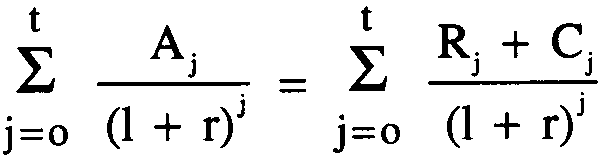
"r" is the solution of the following –
where –
"j" is the time, measured as a multiple (not necessarily integral) of the interval between contractual repayments that will have elapsed since the first amount of credit is provided under the credit contract, except that if the contract does not provide for a constant interval between repayments an interval of any kind is to be selected by the credit provider as the unit of time.
"t" is the time, measured as a multiple of the interval between contractual repayments (or other interval so selected) that will elapse between the time when the first amount of credit is provided and the time when the last repayment is to be made under the contract.
"Aj" is the amount of credit to be provided under the contract at time j (the value of j for the provision of the first amount of credit is taken to be zero).
"Rj" is the repayment to be made at time j.
"Cj" is the fee or charge (if any) payable by the debtor at time j in addition to the repayments Rj, being a credit fee or charge (other than a government fee, charge or duty) that is ascertainable when the comparison rate is disclosed (whether or not the credit fee or charge is payable if the credit is not provided).
(4) The comparison rate must be correct to at least the nearest one hundredth of 1% per annum.
(5) In the application of the above formulae, reasonable approximations may be made if it would be impractical or unreasonably onerous to make a precise calculation. For example, if repayments are to be made on a fixed day each month, it may be assumed that repayments will be made on that day each month even though the credit contract provides for payment on the preceding or succeeding business day when the due date is not a business day.
(6) The tolerances and assumptions under sections 158 to 160 of the Code apply to the calculation of the comparison rate.
(7) The comparison rate must be accompanied by a statement of the amount of credit on which it is based and the term for which credit is provided.
33G Exemption of certain premises
A credit provider is exempt from section 146K(1) of the Code in relation to premises of the credit provider if the use of the premises relating to the provision of credit is limited to 1 or more of the following –
(a) the display or provision of credit advertisements that do not, or information that does not, contain an annual percentage rate;
(b) the distribution, or collection, or both, of credit applications.
33H Exemptions in relation to comparison rate schedules
(1) A finance broker is exempt from section 146L of the Code in relation to any consumer credit product if the finance broker does not deal with that product.
(2) A supplier of goods or services is exempt from section 146L of the Code in relation to any consumer credit product of a linked credit provider of the supplier that is not available for the purposes of providing credit relating to the supply of the goods or services.
33I Expiry of part
This part expires on the expiry of part 9A of the Code.
Displayed and numbered in accordance with the Rules Publication Act 1953.
Notified in the Gazette on 23 April 2003
This proclamation is administered in the Department of Justice and Industrial Relations.
EXPLANATORY NOTE
(This note is not part of the proclamation)
This proclamation amends the Consumer Credit (Tasmania) Regulations to reflect amendments to the Consumer Credit Regulation 1995 of Queensland.