

Mineral Resources Amendment Regulations 2001
I, the Governor in and over the State of Tasmania and its Dependencies in the Commonwealth of Australia, acting with the advice of the Executive Council, make the following regulations under the Mineral Resources Development Act 1995 .
24 September 2001G. S. M. GREEN
Governor
By His Excellency's Command,
P. A. LENNON
Minister for Infrastructure, Energy and Resources
These regulations may be cited as the Mineral Resources Amendment Regulations 2001 .
These regulations take effect on the day on which their making is notified in the Gazette.
In these regulations, the Mineral Resources Regulations 1996 are referred to as the Principal Regulations.
4. Regulation 3 amended (Interpretation)
Regulation 3 of the Principal Regulations is amended as follows:(a) by inserting the following definition after the definition of Act :amount received means the amount received from an arm's length transaction based on a world price contract at the value of the Australian dollar at the time the amount was received, excluding any hedging gains or losses;(b) by inserting the following definitions after the definition of datum post :gold dore means an alloy of gold and silver resulting from the treatment of gold-bearing minerals;metal means a metallic mineral specified in Part 1 of Schedule 4 refined to an elemental state;(c) by inserting ", as calculated in a royalty return submitted under regulation 11E " after "costs" in the definition of net sale ;(d) by inserting the following definition after the definition of quarter :reference rate means the 30 Day Bank Bill Swap Reference Rate published daily by the Australian Financial Markets Association;(e) by omitting the definition of sale costs and substituting the following definition:sale costs includes –(a) any costs incurred by the lessee or the licensee in transporting a mineral outside the mineral tenement to the point of sale; and(b) any costs incurred by the lessee or the licensee in refining a mineral outside the mineral tenement before sale; and(c) any other costs approved by the Minister;(f) by omitting "purposes." from the definition of year and substituting "purposes;";(g) by inserting the following definition after the definition of year :yearly profit means the yearly profit as calculated in a royalty return submitted under regulation 11E .
5. Regulation 8 substituted
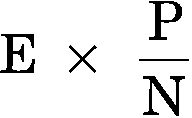
Regulation 8 of the Principal Regulations is rescinded and the following regulations are substituted:(1) For the purpose of section 102(1) of the Act, the prescribed rate of royalty payable by a lessee in respect of a mineral specified in Schedule 1 is specified in that Schedule.(2) For the purpose of section 102(1A) of the Act, the prescribed rate of royalty payable by a licensee in respect of a mineral specified in Schedule 1 is specified in that Schedule.(3) For the purpose of section 102(2)(b) of the Act, royalty is payable for each financial year within 30 days after the end of that financial year.(4) For the purpose of section 102(10) of the Act, the prescribed rate of royalty payable by a lessee or a licensee in respect of a mineral not specified in Schedule 1 and sold on or after 1 July 1996 is to be calculated in accordance with the following formula:where –R is the royalty;ADV is the ad valorem percentage rate specified in subregulation (5) ;N is the yearly net sales of the mineral for the immediately preceding year;P is the yearly profit, if any, for the immediately preceding year;C is the product ofwhere,E is the exponential rate specified in subregulation (6) .(5) For the purpose of subregulation (4) , the ad valorem percentage rate is as follows:(a) 1.2% for a period of 12 months ending at any time in the period 1 July 1996 to 30 June 1997 inclusive;(b) 1.4% for a period of 12 months ending at any time in the period 1 July 1997 to 30 June 1998 inclusive;(c) 1.5% for a period of 12 months ending at any time in the period 1 July 1998 to 30 June 1999 inclusive;(d) 1.6% for a period of 12 months ending on or at any time after 1 July 1999.(6) For the purpose of subregulation (4), the exponential rate is as follows:(a) 0.30 up to and including 30 June 1998;(b) 0.35 from 1 July 1998 up to and including 30 June 2000;(c) 0.40 on and after 1 July 2000.(7) For the purpose of section 102(11) of the Act, the prescribed maximum rate of royalty payable for a mineral not specified in Schedule 1 and sold on or after 1 July 1996 is equivalent to 5% of net sales.(8) If the value of the net sales of a mineral not specified in Schedule 1 is less than $100 000 for a year, royalty is to be paid on the ad valorem percentage rate only.(9) If the value of the net sales of a mineral not specified in Schedule 1 is at least $100 000 and less than $600 000 for a year, royalty, excluding the ad valorem percentage rate specified in subregulation (5), is to be assessed and paid on an annual basis.(1) For the purpose of section 102A(2) of the Act, a rebate on royalty payable is 20% for a metal, other than gold dore, produced in Tasmania from a mineral mined in Tasmania.(2) Subregulation (1) does not apply to the primary treatment of a mineral to produce a concentrate for sale or transportation.(3) For the purpose of section 102A(2) of the Act, a rebate on royalty payable is 10% for gold dore produced in Tasmania from a mineral mined in Tasmania.(4) The Minister, after consultation with the Treasurer, may increase a rebate under subregulation (3) to 20% having regard to the following:(a) the size of a new investment and additional employment arising from the production of gold dore;(b) any benefit to the Tasmanian economy from the new investment producing gold dore.

6. Regulation 9 substituted
Regulation 9 of the Principal Regulations is rescinded and the following regulation is substituted:9. Estimation of yearly profit
The Director may allow the holder of a mineral tenement to estimate yearly profit or loss if –(a) the Director is satisfied that insufficient data is available to enable the holder to determine yearly profit or loss; and(b) the holder supplies the Director with –(i) a reconciled statement of accounts within 30 days after the end of the holder's financial year; and(ii) the full amount of any royalty payable.
7. Regulation 11 amended (Payment by instalments)
Regulation 11 of the Principal Regulations is amended by omitting "Minister" twice occurring and substituting "Director".
8. Regulations 11B , 11C , 11D and 11E inserted
After regulation 11A of the Principal Regulations , the following regulations are inserted in Part 3:Interest not paid by the due date is payable at twice the reference rate as published on the due date.(1) The holder of a mineral tenement is to keep a record of the following:(a) the quantity of minerals obtained during mining under the mineral tenement;(b) the quantity of mineral products produced from the treatment of ores;(c) the quantity of mineral products sold;(d) the amount received from the sale of mineral products;(e) details of any deductions used to determine yearly profits.(2) The Director may request the holder of a mineral tenement to supply –(a) copies of all records kept under subregulation (1) ; and(b) any other information necessary to enable the amount of royalty payable by that person to be assessed.(3) The Director, or any other person authorised in writing by the Director, may examine –(a) the records kept under subregulation (1) ; and(b) any information requested under subregulation (2)(b) .11D. Production and sales report
(1) A lessee, irrespective of whether or not minerals have been produced or sold during a quarter, is to prepare a report within 30 days after the end of each quarter containing details of the production and sales of minerals for that quarter.(2) A licensee who has sold minerals during a quarter is to prepare a report within 30 days after the end of each quarter containing details of the production and sales of minerals for that quarter.(3) A report is to be in an approved form.(1) The holder of a mineral tenement required to pay royalty who has sold minerals during a quarter is to submit a royalty return to the Director within 30 days after the end of that quarter.(2) A royalty return is to –(a) be in a form approved by the Minister; and(b) contain any details, calculations or information the Minister determines are appropriate.(3) An approval under subregulation (2)(a) and a determination under subregulation (2)(b) may be made generally or for the purpose of a particular case.(4) If a mineral not specified in Schedule 1 is sold at a price less than the market price, the Minister may determine the amount of yearly profit in respect of that mineral up to an amount not exceeding the amount of yearly profit that would have been likely if the mineral had been sold at the market price.
9. Schedule 1 amended (Royalties)
Schedule 1 to the Principal Regulations is amended by inserting after paragraph (m) in item 2 the following items:
(n) magnesite for chemical and metallurgical use –
a tonne
$1.20 or 5% of value, whichever is the greater
a cubic metre
$2.40 or 5% of value, whichever is the greater
(o) magnesite for other uses –
a tonne
$0.60
a cubic metre
$1.20
10. Schedule 4 amended (Prescribed minerals)
Schedule 4 to the Principal Regulations is amended by omitting Parts 1 and 2 and substituting:PART 1 - Metallic mineralsThe following are minerals prescribed as metallic minerals:1. aluminium2. antimony3. arsenic4. beryllium5. bismuth6. cadmium7. caesium8. cobalt9. copper10. gallium11. germanium12. gold13. hafnium14. indium15. iridium16. iron17. lead18. lithium19. magnesium20. manganese21. mercury22. molybdenum23. monazite24. nickel25. niobium26. osmium27. palladium28. platinoid minerals29. platinum30. rare earth metals31. rhobium32. rubidium33. ruthenium34. selenium35. silver36. tantalum37. tellurium38. tin39. titanium40. tungsten (including scheelite and wolframite)41. vanadium42. zinc43. zirconium44. ores of any of the above mineralsPART 2 - Industrial MineralsThe following are minerals prescribed as industrial minerals:1. alum2. alunite3. apatite4. asbestos5. attapulgite6. barite7. bentonite8. beryl9. borates10. calcite11. chromite12. corundum (for industrial use)13. diamond14. diatomaceous earth15. dolomite for metallurgical use16. feldspar17. fluorite18. garnet19. graphite20. gypsum21. halite (including solar salt)22. halloysite23. ilmenite24. iron oxide (used as a mineral for industrial purposes)25. kaolinite26. leucoxene27. limestone28. magnesite (used as a mineral for industrial purposes)29. magnetite (used as a mineral for industrial purposes)30. marble31. mica32. mineral pigments33. monazite34. montmorillonite35. olivine36. perlite37. phosphates38. pyrophyllite39. quartz40. rare earth minerals41. rutile42. silica43. syenite44. talc45. vermiculite46. wollastonite47. zeolites48. zircon
Displayed and numbered in accordance with the Rules Publication Act 1953.
Notified in the Gazette on 3 October 2001
These regulations are administered in the Department of Infrastructure, Energy and Resources.
EXPLANATORY NOTE
(This note is not part of the regulation)
These regulations –(a) make further provision relating to the calculation of royalty payable; and(b) prescribe metallic and industrial metals.