

Rules of the Supreme Court (Corporations Law) Amendment Rules (No. 2) 200121 June 2001
We, the Honourable William John Ellis Cox, Companion of the Order of Australia, Chief Justice, and the Honourable Peter George Underwood, the Honourable Ewan Charles Crawford and the Honourable Peter Ethrington Evans, Puisne Judges of the Supreme Court of Tasmania, on the recommendation of the Rule Committee, make the following Rules of Court under the Supreme Court Civil Procedure Act 1932 .
These Rules of Court may be cited as the Rules of the Supreme Court (Corporations Law) Amendment Rules (No. 2) 2001 .
These Rules of Court take effect on 30 June 2001.
In these Rules of Court, the Rules of the Supreme Court (Corporations Law) 2000 are referred to as the Principal Rules.
4. Rule 14 amended (Supporting affidavits)
Rule 14(2) of the Principal Rules is amended by omitting "An" and substituting "Subject to rule 14A , an".
5. Rule 14A inserted
After rule 14 of the Principal Rules , the following rule is inserted in Part 2:14A. Application for order setting aside statutory demand (s 459G of the Law)
(1) This rule applies, and rule 14(2) does not apply, to an application by a company under section 459G of the Law for an order setting aside a statutory demand served on the company.(2) The plaintiff may file with the originating process seeking the order a copy of the statutory demand and a copy of any affidavit that accompanied the statutory demand.(3) The plaintiff must –(a) no earlier than 7 days before the originating process is filed, and no later than the day before the hearing of the application, carry out a search of the records maintained by the Commission in relation to the plaintiff; and(b) either –(i) annex the record of the search to the affidavit in support of the originating process; or(ii) file the record of the search before or tender it on the hearing of the application.
6. Rule 28 substituted
Rule 28 of the Principal Rules is rescinded and the following rule is substituted:28. Order for meetings to identify proposed scheme
(1) An order under subsection 411(1) or (1A) of the Law ordering a meeting or meetings in relation to a proposed compromise or arrangement must set out in a schedule, or otherwise identify, a copy of the proposed compromise or arrangement.(2) Unless the Court otherwise orders, a meeting of members ordered under section 411 of the Law must be convened, held and conducted in accordance with –(a) the provisions of Part 2G.2 of the Law that apply to the members of a company; and(b) the provisions of the plaintiff's constitution that apply in relation to meetings of members and are not inconsistent with Part 2G.2 of the Law.(3) Unless the Court otherwise orders, a meeting of a class of holders of convertible securities ordered under section 411 of the Law must be convened, held and conducted as if –but in accordance with, and subject to, the applicable provisions of the instrument under which the securities were issued.(a) the holders were a separate class of members; and(b) the meeting were a meeting of members convened, held and conducted under subrule (2) –
7. Rule 68 amended (Application for examination or investigation under s 411(9)(b), s 423 or s 536 (3) of the Law)
Rule 68 of the Principal Rules is amended by omitting subrule (2) and substituting the following subrule:(2) The application may be made without notice to any person.
8. Rule 69 amended (Application for examination summons (s 596A, s 596B of the Law) — Form 17)
Rule 69 of the Principal Rules is amended by omitting subrule (2) and substituting the following subrule:(2) The application may be made without notice to any person.
9. Schedule 1 amended (Forms)
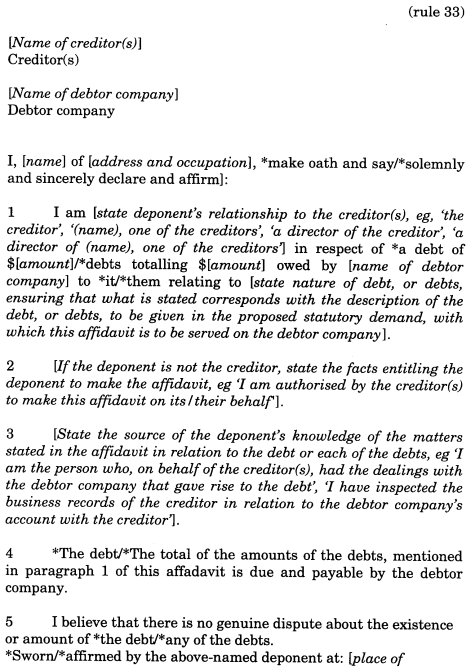
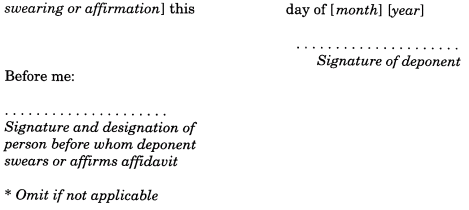
Schedule 1 to the Principal Rules is amended by omitting Form 7 and substituting:Form 7 - Affidavit accompanying statutory demand
W. J. E. COX
Chief Justice
P. G. UNDERWOOD
Puisne Judge
E. C. CRAWFORD
Puisne Judge
P. E. EVANS
Puisne Judge
Countersigned,
I. G. RITCHARD
Registrar
Displayed and numbered in accordance with the Rules Publication Act 1953.
Notified in the Gazette on 27 June 2001
These Rules of Court are administered in the Department of Justice and Industrial Relations.
EXPLANATORY NOTE
(This note is not part of the rule)
These Rules of Court amend the Rules of the Supreme Court (Corporations Law) 2000 with respect to the following matters:(a) affidavits supporting originating processes and interlocutory processes;(b) applications for orders setting aside statutory demands;(c) meetings in relation to proposed compromises or arrangements;(d) the form for an affidavit accompanying a statutory demand;(e) applications for orders for examination or investigation under section 411, 423 or 536(3) of the Corporations Law;(f) applications for examination summonses.