

Trade Measurement (Pre-packed Articles) Regulations 2000
I, the Governor in and over the State of Tasmania and its Dependencies in the Commonwealth of Australia, acting with the advice of the Executive Council, make the following regulations under the Trade Measurement Act 1999 .
28 August 2000g. s. m. green
Governor
By His Excellency's Command,
p. patmore
Minister for Justice and Industrial Relations
PART 1 - Preliminary
1. Short title and commencement
(1) These regulations may be cited as the Trade Measurement (Pre-packed Articles) Regulations 2000 .(2) These regulations take effect on the day on which their making is notified in the Gazette.
In these regulations –Act means the Trade Measurement Act 1999 ;approved printing device means a printing device that conforms to a pattern in relation to which there is in force under the National Measurement Regulations 1999 of the Commonwealth a certificate that approves the use of the device for trade;characters includes letters, figures and symbols;main display part, in relation to a package, means –(a) if the name or brand appears on the package once only, the part of the package on which it appears; or(b) if the name or brand appears on more than one part of the package with equal prominence in each case, any one of those parts; or(c) if the name or brand appears on more than one part of the package but not always with equal prominence, the part of the package on which it is more prominent or any part of the package on which it is most prominent; or(d) if the name or brand of the article in the package does not appear on the package, that part of the package which will be most prominent when the package is exposed for sale in the manner in which it is likely to be exposed for sale;measurement marking means the marking of measurement required by these regulations to be made on the package containing a pre-packed article.
3. Definitions – packaged articles
In these regulations, unless the contrary intention appears –cheese and cheese products does not include articles for sale as processed cheese or cheese spreads;compressed or liquefied gas does not include liquefied petroleum gas;cream does not include clotted cream or sour (cultured) cream;dried or dehydrated fruit includes glace and crystallised fruit and fruit peel;dried or dehydrated mixed fruit includes any such fruit mixed with nuts;garden landscape material means soil, pebbles, crushed tile, crushed white quartz, Grawin gravel, crushed western red, crushed snowflake, New Zealand lava scoria, Pacific coral, river stones, crushed material mix and any like substance for use in gardens;ice-cream includes any form of frozen confection containing ice-cream, flavoured ice, fruit-ice, water-ice or a substitute for ice-cream;liquid chemicals includes solvents packed for sale for pharmaceutical, laboratory or industrial use;paint includes enamel but does not include a 2-pack paint, artist's paint or powder coatings;poultry means any kind of bird used for human consumption, whether it is cooked or uncooked or consists of poultry pieces;poultry piece means a leg, wing, breast or other part detached from a poultry carcase and any division of a poultry carcase;resins includes natural resins, synthetic resins and polymeric materials other than paint;therapeutic goods means goods for therapeutic use under the meaning of the Therapeutic Goods Act 1989 of the Commonwealth as amended and in force for the time being;tobacco includes plug tobacco.
4. Exemptions from marking requirements (name, address, measurement)
(1) A package containing an article specified in Schedule 1 is exempt from the operation of Parts 2 and 3 in the circumstances specified in that Schedule in relation to the article or, if no circumstances are specified, in all circumstances.(2) A package is not exempt from the operation of Parts 2 and 3 merely because it contains 2 or more packages each of which would be exempt under subregulation (1) as separate packages.(3) However, if an exempt package has a name and address or measurement marked on it, the way the name and address or measurement is marked on the package must comply with these regulations.(4) It is not to be assumed that an article described in item 1 under the heading "Textile goods" or "Hardware goods" in Schedule 1 has been packed for sale by measurement merely because it has been packed for sale –(a) as a single item; or(b) as a set (except in the case of identical automotive parts); or(c) as a pair, or as one of a pair, if it is an article ordinarily described by pairs, or as one of a pair.(5) An article is not excluded from the description "General goods" in Schedule 1 merely because it could be included in some other description of goods in that Schedule.
5. Exemptions for packages containing paper
(1) A package containing paper that is a package to which this regulation applies –(a) is exempt from regulations 8 and 10 ; and(b) is permitted to be marked with the expression "gross mass" or any other expression that has a similar meaning to that expression.(2) This regulation applies to a package containing paper if –(a) it was packed at the factory at which the paper was produced; or(b) it is packed in a quantity of more than 5kg; or(c) it contains at least 500 sheets and is marked with the number of sheets and the dimensions of each sheet.
6. Requirements applicable to both inner and outer packages
A requirement of these regulations as to the marking of a package containing a pre-packed article applies to both the immediate package containing the article and any other package containing that package (whether or not with other packages) unless the provision that imposes the requirement otherwise provides.
7. Exemptions for certain inner and outer packages
A requirement of these regulations as to the marking of a package does not apply to –(a) any immediate package ordinarily sold only in an outer package that is marked in accordance with the requirement; or(b) any outer package in which the immediate package is packed only for the purposes of transportation.
PART 2 - Marking of name and address
8. Marking of name and address on packages
(1) When a pre-packed article is packed or sold, the package containing the article must be marked with the name and address of the person who packed the article or on whose behalf it was packed.(2) That marking must be –(a) readily visible and legible; and(b) such as to enable the person named to be identified and located.(3) The address marked must be an address in a State or internal Territory at which, under a law in force in that State or Territory, notices or legal process may be served on the person named.
9. Exemption for packaged seed
(1) Regulation 8 does not apply to –(a) public-bred agricultural seed that is of a prescribed variety and is packed in a quantity of 10kg or more; or(b) public-bred agricultural seed that is not of a prescribed variety and is packed in a quantity of 25kg or more; or(c) non-proprietary varieties of horticultural seed packed in a quantity of 25kg or more.(2) In this regulation,prescribed variety means agricultural seed for the following:(a) Rhodes grass;(b) Molasses grass;(c) Buffalo grass;(d) Veldt grass;(e) Brachiaria species;(f) Guinea grass;(g) Hamil grass;(h) Gamba grass;(i) Mitchell grass;(j) Creeping Bluegrass;(k) Indian Bluegrass.
PART 3 - Marking of measurement
Division 1 - General requirements for measurement marking
10. Requirement to mark measurement
(1) When a pre-packed article is packed or sold, the package containing the article must be marked with a statement of the measurement of the article.(2) The statement must be such as will be clear, conspicuous, readily seen and easily read when the article is exposed for sale in the manner in which it is likely to be exposed for sale.
11. General position of measurement marking
(1) The measurement marking on a package must be made –(a) on the main display part of the package; and(b) if another part of the package is, or other parts of the package are, likely to be displayed instead of the main display part when the article is exposed for sale, on that other part or one of those other parts.(2) Subregulation (1) does not apply in the case of –(a) automotive parts; or(b) any other package if –(i) the administering authority, by notice published in the Gazette, exempts the package from the operation of this regulation; and(ii) any conditions or restrictions specified in the notice are complied with.
12. Set-out and form of measurement marking
(1) The required measurement marking must –(a) be close to, and be marked to be read in the same direction as, any name or brand of the article to which it relates; and(b) be at least 2mm from the limits of the package and separated by at least 2mm in all directions from other graphic matter or copy; and(c) be in a form in which units of measurement under the metric system are ordinarily written in the English language; and(d) in the case of a decimal sub-multiple, be preceded by a zero or another numeral.(2) If a package is entirely or substantially cylindrical, spheroidal, conical or of oval cross-section, the measurement marking must, in addition to complying with subregulation (1) , be positioned so that no part of the marking is further than one-sixth of the circumference of the package from the line that vertically bisects that part of the package on which the marking is required to be made.(3) For the purposes of subregulation (2) , the circumference of a package is the circumference where the measurement marking is made.
13. Size, &c., of characters in measurement marking
(1) The characters used in a measurement marking must be clear and –(a) stamped or printed in a colour that provides a distinct contrast with the colour of the background and be of at least the minimum height required by subregulation (2) ; or(b) stamped or embossed and be of at least 3 times the minimum height required by subregulation (2) ; or(c) marked by an approved printing device in characters at least 3mm high; or(d) legibly handwritten, if permitted by subregulation (3) .(2) The minimum height for the characters in a measurement marking is the height specified in Column 2 of the Table to this regulation opposite the maximum dimension of the package specified in Column 1 of that Table.(3) A measurement marking may be legibly handwritten in the following cases:(a) when the article is packed to be sold on the premises on which it is packed;(b) when the package contains cake or is one to which regulation 27 applies;(c) when the package contains a roll of ribbon, lace or elastic or other article of haberdashery;(d) when the article is, by notice published in the Gazette by the administering authority, declared to be an article to which this regulation applies and any conditions applicable to the packaging of the article and specified in the notice are complied with.Table
Column 1
Column 2
Maximum dimension of package
Minimum character height
120mm or under
2.0mm
Over 120mm but not over 230mm
2.5mm
Over 230mm but not over 360mm
3.3mm
Over 360mm
4.8mm
For the purposes of this Table, the maximum dimension of a package is –
(a) if the package is rectangular, the measurement of the breadth, height or length of the package, whichever is the greatest; or
(b) if the package is cylindrical, spheroidal, conical or of oval cross-section, the height, length or maximum diameter of the package, whichever is the greatest.
14. Unit, &c., of measurement to be used
(1) Except for an article specifically provided for by subregulation (2) , the measurement marking of an article must be expressed as follows:(a) if the article is ordinarily sold by number, by reference to number;(b) if the article is ordinarily sold by linear or superficial measurement, by reference to that kind of measurement;(c) if the article is a liquid, by reference to volume;(d) if the article is solid (including in the form of powder or flakes), semi-solid or partly solid and partly liquid, and is not included in paragraph (a) , by reference to mass.(2) The measurement marking of an article of a kind described in Column 1 of Schedule 2 must be expressed by reference to the kind of measurement specified in Column 2 of that Schedule opposite the description of the article.(3) A measurement marking (other than in terms of number) must be expressed in terms of a unit of measurement permissible as specified in Schedule 3 .(4) In this regulation,ordinarily sold, of an article sold by number, linear or superficial measurement, means the majority of the merchants selling the article in Australia ordinarily sell it by number, linear or superficial measurement.
15. Fractions and significant figures
(1) If a measurement marking includes a fraction of a unit of measurement, it must be expressed as a decimal sub-multiple of the unit.(2) Whether a measurement marking is a whole multiple or a sub-multiple, or a combination of both, it must express a degree of accuracy to not more than 3 significant figures.
16. Special provision marking by approved printing device
If a measurement marking is made by an approved printing device –(a) the measurement marking may express a degree of accuracy to more than 3 significant figures if the certificate of approval approves use of the device to measure the degree of accuracy expressed; and(b) a measurement marking in terms of mass made by use of the device in accordance with the certificate of approval may be expressed in terms of grams.
17. Marking by reference to minimum measurement
(1) A marking on the package containing a pre-packed article of the measurement of the article (whether or not for the purposes of these regulations) must not be made by reference to minimum measurement unless –(a) permitted by this regulation (or required by regulation 18 in the case of eggs); and(b) the reference to minimum measurement is marked in the same way as the required measurement marking.(2) Pre-packed dressed poultry (other than poultry pieces) may be marked with a measurement in terms of minimum mass if –(a) the mass stated is a whole number multiple of 100g; and(b) (except in the case of cooked poultry) the package is also marked, in characters not less than 10mm in height, with a size number calculated by dividing the stated minimum mass by 100.(3) Pre-packed preserved sausage may be marked with a measurement in terms of minimum mass.
Division 2 - Special provision for measurement marking of certain articles
The measurement marking of a pre-packed article containing eggs must be made –(a) by reference to the number of eggs in the package; and(b) by reference to the minimum mass of each egg.
Pre-packed aluminium foil, facial tissues, toilet paper and waxed paper are articles that do not require a measurement marking on the package if the number of useable sheets of specified dimensions is marked on the package as if the number and dimensions marked were a measurement marking.
20. Number of pre-packed articles comprising 1 tonne
If 45 or fewer packages of an article that is ordinarily sold by mass have a total mass of 1 tonne, the measurement marking of the mass of the article may be made on each package by referring to the number of packages to the tonne in such a manner as to imply that the mass of each package is 1 tonne divided by that number.
21. Bedsheets, tarpaulins, &c.
(1) The measurement marking relating to –(a) bedsheets (not designed as fitted or semi-fitted bedsheets) or other sheets of hemmed fabric material; or(b) tarpaulins, must be expressed in terms of the finished size of the article.(2) The measurement marking relating to –must be expressed in terms of the suitability of its finished size to fit a mattress of specified dimensions expressed as length by width by depth.(a) a mattress protector; or(b) a bedsheet designed as a fitted or semi-fitted bedsheet –
The measurement marking relating to window curtains designed to cross over when hung in pairs must be expressed in terms of the finished size of the maximum width, and the maximum drop, of each curtain.
23. Marking of width or thickness if it directly affects price
If a measurement marking may be made in terms of the length of an article, the marking is to include any measurement of the thickness or width of the article, or both, that bears a direct relationship to the price of the article.
Division 3 - Special provisions concerning measurement marking of outer packages
24. Package containing packages of articles of the same kind and measurement
(1) This regulation applies to 2 or more pre-packed articles of the same kind and apparently with the same measurement –(a) each of which is separately packed in its own package (an "inner package"); and(b) all of which are also packed together in another package (the "outer package").(2) The measurement marking on the outer package may –(a) state the total measurement of all the articles in the outer package; or(b) state (as if it were a measurement marking) the number of packages in the outer package and the measurement of each of them.(3) A measurement marking need not be marked on the outer package if –(a) the outer package contains not more than 8 inner packages; and(b) the inner packages are ordinarily sold only while in the outer package; and(c) the whole or part of the outer package is transparent and the measurement marking on each of the inner packages is clearly visible through the packaging of the outer package.
25. Inner and outer packages of single article
(1) This regulation applies to a pre-packed article consisting of an article contained in a package (the "inner package") that is contained in another package (the "outer package").(2) A measurement marking need not be marked on the outer package if –(a) the inner package is ordinarily sold only while in the outer package; and(b) the whole or part of the outer package is transparent and the measurement marking on the inner package is clearly visible through the packaging of the outer package.
26. Package containing articles of different kinds or different measurements
(1) This regulation applies to a pre-packed article consisting of a package (the "outer package") containing at least 2 articles of which at least one is a pre-packed article, but does not apply in a case to which regulation 24 applies.(2) None of the articles in the outer package is required to be marked with a measurement marking if –(a) all the articles in the outer package are ordinarily sold only while in the outer package; and(b) the outer package is marked in the same way as a measurement marking with a description of each article in the outer package and a statement of its measurement.(3) The provisions of regulation 11 as to the position of a measurement marking do not apply to a marking referred to in subregulation (2)(b) if the packaging of the outer package is transparent and all the articles it contains are clearly visible through it.
Division 4 - Other markings concerning measurement
27. Unit price marking – retail sales of certain foods by mass
(1) This regulation applies to the following pre-packed articles:except when the package is a rigid container.(a) fruit;(b) dried or dehydrated fruit and dried or dehydrated mixed fruit;(c) cheese and cheese products;(d) dressed poultry not marked in terms of minimum mass in accordance with regulation 17 ;(e) fish (including crustaceans);(f) mushrooms;(g) vegetables;(h) meat;(i) smallgoods (including bacon, corned beef and ham) –(2) When a pre-packed article to which this regulation applies is sold (except for the purpose of being resold) the package containing the article must (in addition to being marked with the measurement of the article) be marked with its total price and price per kilogram unless –(a) the total price and price per kilogram are adequately displayed at the time of sale, as provided by subregulation (4) ; or(b) the article is described in Column 1 of the Table to this regulation and is packed in a quantity specified in Column 2 of that Table opposite the description.(3) The marking on a package required by this regulation must be made as if it were a measurement marking.(4) The total price and price per kilogram are adequately displayed if displayed on or immediately adjacent to the receptacle in or on which the article is exposed for sale, in characters not less than 10mm high and in such a manner as to be readily seen and easily read.Table
Column 1
Column 2
Cheese and cheese products
100g, 125g, 200g, 250g, 375g, 500g, 750g, 1kg, integral multiples of 500g
Dressed poultry and meat
100g, 125g, 200g, 250g, 500g, 1kg, integral multiples of 1kg
Dried or dehydrated fruit, and dried or dehydrated mixed fruit
100g, 125g, 150g, 200g, 250g, 375g, 500g, 750g, 1kg, 1.5kg, integral multiples of 1kg
Fruit, fish (including crustaceans), mushrooms and vegetables
15g, 20g, 25g, 50g, 75g, 100g, 125g, 150g, 200g, 250g, 375g, 500g, 750g, 1kg, 1.25kg, 1.5kg, 2.5kg, integral multiples of 1kg
Smallgoods (including bacon, corned beef and ham)
50g, 125g, 175g, 250g, 375g, 500g, integral multiples of 500g
PART 4 - Prohibited and restricted expressions
28. Marking of "mass when packed"
(1) This regulation applies to bar soaps, cotton wool, flax, glauber salts, jute, manila, fresh mushrooms, oven-baked animal biscuits, personal deodorant tablets, personal soap tablets (medicinal or toilet), sisal, soap flakes, soap powder (excluding detergent powders), tobacco, washing soda and whole hams.(2) Pre-packed articles of the kind to which this regulation applies that are not packed in a hermetically sealed package may be marked "mass when packed", or with other words that have a similar meaning to those words, if they are marked in the same way as the appropriate measurement marking.
29. Marking of "mass at standard condition"
A package containing pre-packed yarn or cotton wool that is not an hermetically sealed package may be marked with the words "mass at standard condition" or with other words that have a similar meaning to those words if –(a) the words are marked in the same way as the appropriate measurement marking; and(b) when the yarn or cotton wool is composed of a mixture of fibres, the package is also marked in the same way as the appropriate measurement marking with a correct statement of the proportion by mass of each of the kinds of fibre of which the yarn or cotton wool is composed.
30. Restrictions on use of "gross mass"
(1) For the purposes of section 30 of the Act, the expression "gross mass" and any other expression that has a similar meaning to that expression are restricted expressions.(2) A package may be marked with such an expression only if permitted by regulation 5 or if –(a) the package is used only for the purpose of transporting an article; and(b) the expression is immediately followed by the words "for transport purposes only" and a statement of the appropriate quantity; and(c) immediately below or following the expression the net mass is marked and designated as such or stated as a net amount in words that correspond to those used to express the gross amount.
For the purposes of section 30 of the Act, the following are prohibited expressions:(a) any expression (other than a marking required or permitted by the Act or these regulations) that directly or indirectly relates to or qualifies a measurement marked on the package;(b) a statement that directly or indirectly relates or refers to the measurement of the article or any ingredient or component of the article, or of any source from which the article is derived, if the statement cannot be tested for truth by testing the article.
PART 5 - Short measure
32. Extent of deficiency necessary to constitute short measure
(1) This Part makes provision for the deficiency in actual measurement and average measurement of pre-packed articles permitted under section 33 of the Act before the actual measurement of a pre-packed article is to be regarded as being less than the measurement marked on the package.(2) In this Part –permissible actual deficiency means the deficiency in actual measurement permitted for the purposes of section 33(1)(a) of the Act;permissible average deficiency means the deficiency in the average of the actual measurements of a number of like articles permitted for the purposes of section 33(1)(b) of the Act.
33. Articles marked "mass when packed", &c.
If the package containing a pre-packed article is, in accordance with regulation 28 , marked "mass when packed" or with other words that have a similar meaning to those words –(a) the permissible actual deficiency, if measured on the day the article is packed, is a deficiency of 5%; and(b) the permissible average deficiency, if measured on the day the article is packed, is nil; and(c) the permissible actual deficiency, if measured after the day the article is packed, is the deficiency specified in Column 2 of the Table to this regulation opposite the description of the article in Column 1 of that Table; and(d) the permissible average deficiency, if measured after the day the article is packed, is the deficiency specified in Column 3 of the Table to this regulation opposite the description of the article in Column 1 of that Table.Permissible deficiencies after day of packing
Column 1
Column 2
Column 3
Description of article
Permissible actual deficiency (%)
Permissible average deficiency (%)
Bar soaps
21
16
Cotton wool
7
2
Flax
8
3
Glauber salts
7
2
Jute
9
4
Manila
8
3
Mushrooms (fresh)
18
13
Oven-baked animal biscuits
9
4
Personal deodorant tablets
12
7
Personal soap tablets (medicinal or toilet)
11
6
Sisal
8
3
Soap flakes
10
5
Soap powder (excluding detergent powders)
15
10
Tobacco
10
5
Washing soda
7
2
Whole hams
7
2
34. Articles marked "mass at standard condition"
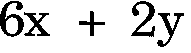
(1) If the package containing a pre-packed article is, in accordance with these regulations, marked "mass at standard condition" or with other words that have a similar meaning –(a) the permissible actual deficiency is the deficiency specified in Column 2 of the Table to this regulation opposite the description of the class of article in Column 1 of that Table; and(b) the permissible average deficiency is the deficiency specified in Column 3 of the Table to this regulation opposite the description of the class of article in Column 1 of that Table.(2) If the article consists of a mixture of any 2 or more of class A, B or C fibres (as described in Column 1 of the Table to this regulation) –(a) the permissible actual deficiency is the deficiency, expressed as a percentage, calculated in accordance with the formula –where –x is the proportion that the mass of all class A fibre (if any) in the article bears to the total mass of the article; andy is the proportion that the mass of all class B fibre (if any) in the article bears to the total mass of the article; and(b) the permissible average deficiency is the deficiency, expressed as a percentage, calculated in accordance with the formula –where –x is the proportion that the mass of all class A fibre (if any) in the article bears to the total mass of the article; andy is the proportion that the mass of all class B fibre (if any) in the article bears to the total mass of the article.Table
Column 1
Column 2
Column 3
Class of article
Permissible actual deficiency (%)
Permissible average deficiency (%)
Class A fibre (wool or other animal fibre, viscose or cuprammonium rayon, or a mixture of any 2 or more of them)
11
6
Class B fibre (silk, cotton or cellulose acetate or a mixture of any 2 or more of them)
7
2
Class C fibre (a fibre, or a mixture of fibres, that is not a Class A or Class B fibre)
5
0

If the package containing a pre-packed article is not one to which regulation 33 or 34 applies –(a) the permissible actual deficiency is 5%; and(b) the permissible average deficiency is nil.
36. Method of determining average measurement ( section 33 of the Act)
(1) For the purposes of this Part, the average of the actual measurements of a number of like articles is to be determined by calculating the average of the measurements of the contents of at least 12 packages or, if less than 12 are available, of such number (not less than 6) as are available.(2) If more than 12 packages are available, the actual number to be tested is to be as determined by an inspector.(3) Each of the packages measured must be of the same kind and have the same measurement marking and must be selected by an inspector without having been measured by an inspector.
PART 6 - Miscellaneous
37. Mass of frozen pre-packed scallops
For the purposes of the Act and these regulations, the mass of frozen scallops packed as a pre-packed article is to be determined as follows:(a) measure and record the mass of an appropriate perforated container;(b) place the entire contents of the package into a suitable impermeable bag;(c) suspend or immerse the bag in running water until the contents have thawed;(d) empty contents into the perforated container;(e) drain the perforated container and the contents until minimal drip loss is recorded;(f) measure and record the mass of the perforated container plus contents;(g) subtract the mass of the perforated container from the mass of the perforated container and contents to obtain the net mass of the contents.
38. Application for permit to sell certain articles
An application for a permit under section 38 of the Act for the sale of an article must –(a) be made to the administering authority in writing signed by or on behalf of the applicant; and(b) specify the grounds in section 39 of the Act that are relied on by the applicant; and(c) give particulars of the facts justifying reliance on those grounds.
SCHEDULE 1 - Exemptions from marking
PART 1 - Textile goods
1. Textile, wearing apparel and other similar articles that are not packed for sale by measurement and are not ordinarily so sold.
2. Textiles that are –(a) packed for sale by mass and are sold in packages each containing more than 4kg; or(b) packed for sale by length and are sold in packages each containing more than 25m; or(c) packed for sale by area and are sold in packages each containing more than 25m2.
PART 2 - Food goods
1. Any agricultural produce grown and packed on the same property by the grower and sold by mass in sacks of more than 25kg gross mass.
2. Confectionery, nuts, popcorn, potato crisps and savouries that are –(a) packed on premises for sale on those premises if the package is displayed for sale on those premises in a receptacle that bears a statement that can be readily seen and easily read in characters not less than 10mm high of the mass and of the price of the contents of the package and if the mass of the contents does not exceed 200g; or(b) packed in or with another article if the value of the combined articles is substantially represented by that other article.
3. Confectionery packed singly in a novelty shape and an Easter egg packed singly.
4. Honey in the comb in original frames.
5. Hay.
6. Ice-cream packed in a quantity less than 200mL.
7. Kippers.
8. Pies or pasties made for use as an individual serve of which the mass is less than 250g.
9. Cakes, puddings and sponges packed singly in a quantity less than 125g.
10. Alcoholic liquors packed in a quantity more than 10L.
PART 3 - Medicinal and toilet goods
1. Therapeutic goods, being goods the sale or supply of which to the public is prohibited by law except on the written prescription of a person recognised by law as competent to prescribe them.
2. A toilet preparation in a compact and a refill of such a preparation.
3. Single application hair dyes or hair bleaches or single application home permanent hair-waving kits.
4. Vaccine packed in a quantity less than 25mL or a single dose of any substance packed in a vial or ampoule for sale for use as an injection.
PART 4 - Hardware goods
1. Articles of hardware that are not packed for sale by measurement and are not ordinarily so sold.
2. Tinters or colouring agents for use in paint that are packed in a quantity less than 100g or 100mL.
3. Colouring material in a package on which is marked directions for mixing it, or a specified quantity of it, with a specified type and volume of paint, if the quantity of the material to be mixed does not exceed 10% of the volume of the paint with which it is to be mixed.
PART 5 - General goods
1. Articles ordinarily sold by number that are packed in a quantity of less than 9 in a package made wholly or partly of transparent material so that when the package is exposed for sale the number of articles contained in the package is readily apparent to a purchaser.
2. An article of which the mass exceeds 75kg or the volume exceeds 150L.
3. An article packed in a quantity less than 15g or 15mL other than adhesives, dried vegetables and freeze-dried vegetables, herbs, instant tea, pepper and other spices, therapeutic goods and tobacco.
4. Fire extinguisher refills.
5. Photographic film and photographic printing paper.
6. A bag of clay.
7. Fish bait.
8. garden landscape material, including pine-bark feature mix, pine-bark nuggets, pre-planted mushroom spawn, tree bark, any article that is or contains compost, farmyard manure, garden peat, leaf mould, peat moss, sphagnum moss, tan bark or other like substance.
9. Artist's paint packed in a quantity less than 100g.
10. Candles.
11. Legume seed inoculants.
12. A pre-packed article sold as authorised by Division 2 of Part 5 of the Act.
SCHEDULE 2 - Expression of measurement marking
Column 1 | Column 2 | (Description of article) | (Kind of measurement permissible) | Acids in liquid form | mass or volume | Aerosol products | mass | Compressed or liquefied gases | mass or equivalent volume (cubic metres or litres) at stated temperature and pressure | Cream and cream substitutes | volume | Fencing wire | length | Flavouring essences | mass or volume, if the quantity is not less than 500g | Heavy residual fuel oil, industrial diesel fuel and furnace oil | mass or volume | Honey, malt extract, golden syrup and treacle | mass | Ice-cream | volume | Linseed oil and other vegetable oils | volume if the quantity is not more than 5L, mass or volume if the quantity is more than 5L | Liquefied petroleum gas | mass | Liquid chemicals | mass or volume | Paint (other than paste paint), varnish and varnish stains | volume | Paste paint | mass | Perfume compounds | mass or volume, if the quantity is not less than 500g | Perlite | mass or volume | Resins | mass or volume | Rope, cord and line | (a) of a diameter less than 1.5mm; or | length and mass per specified length | (b) of a diameter of 1.5mm or more | length and diameter | Skin cream in jars | mass or volume | Tomato sauce | volume | Toothpaste | mass | Twines, twists and lashings | length and mass per specified length | Yoghurt | mass |
SCHEDULE 3 - Permissible units of measurement
PART 1 - Mass
1. If the measurement marking is to be expressed in terms of mass, the permissible units of measurement are as follows:(a) kilogram, in all cases;(b) gram, if the mass does not exceed 1 000 grams;(c) milligram, if the mass does not exceed 1 000 milligrams.
PART 2 - Volume
1. If the measurement marking is to be expressed in terms of volume, the permissible units of measurement are as follows:(a) litre, decilitre or centilitre, for liquids in all cases;(b) cubic metre, for solids in all cases;(c) millilitre, in the case of a liquid if the volume does not exceed 1 000 millilitres;(d) cubic centimetre, in the case of a solid if the volume does not exceed 1 000 cubic centimetres.
PART 3 - Linear measurement
1. If the measurement marking is to be expressed in terms of linear measurement, the permissible units of measurement are as follows:(a) metre, in all cases;(b) centimetre, if the length does not exceed 100 centimetres;(c) millimetre, if the length does not exceed 1 000 millimetres;(d) millimetre, in the case of paper lengths not exceeding 10 000 millimetres, building material in sheet form and coated abrasive belts;(e) millimetre, in the case of an article if it was customary before these regulations commenced to express the linear measurement of the article in millimetres.
PART 4 - Superficial measurement
1. If the measurement marking is to be expressed in terms of superficial measurement, any unit of superficial measurement is permissible.
PART 5 - Mass per specified length
1. If the measurement marking is to be expressed in terms of mass per specified length, the permissible units of measurement are grams for mass and kilometres for length.
Displayed and numbered in accordance with the Rules Publication Act 1953.
Notified in the Gazette on 6 September 2000
These regulations are administered in the Department of Justice and Industrial Relations.
EXPLANATORY NOTE
(This note is not part of the regulation)
These regulations prescribe as part of a national scheme –(a) the requirements for the packing and marking of pre-packed articles; and(b) the manner in which certain pre-packed articles may be sold.