

Taxi Industry Amendment (Public Vehicles Reform) Regulations 2000
I, the Governor in and over the State of Tasmania and its Dependencies in the Commonwealth of Australia, acting with the advice of the Executive Council, make the following regulations under the Taxi and Luxury Hire Car Industries Act 1995.
13 June 2000G. S. M. GREEN
Governor
By His Excellency's Command,
P. A. LENNON
Minister for Infrastructure, Energy and Resources
These regulations may be cited as the Taxi Industry Amendment (Public Vehicles Reform) Regulations 2000 .
These regulations take effect immediately after the Passenger Transport Act 1997 commences.
In these regulations, the Taxi Industry Regulations 1996 are referred to as the Principal Regulations.
4. Regulation 3 amended (Interpretation)
Regulation 3 of the Principal Regulations is amended as follows:(a) by omitting the definition of Act and substituting the following definition:Act means the Taxi and Luxury Hire Car Industries Act 1995 ;(b) by omitting the definition of compliance plate and substituting the following definition:compliance plate means an identification plate approved to be placed on a vehicle, or taken to have been placed on a vehicle, under the Motor Vehicle Standards Act 1989 of the Commonwealth;(c) by omitting the definition of fare agreement and substituting the following definition:fare agreement means an agreement between the Commission and an accredited taxi group or person permitting the charging of fares other than those prescribed in Schedule 4 ;(d) by inserting the following definitions after the definition of licensee :luxury hire car means a luxury hire car within the meaning of Part 4A of the Act;luxury vehicle means a luxury vehicle within the meaning of Part 4A of the Act;metropolitan taxi area means any of the following taxi areas:(a) Hobart taxi area;(b) Launceston taxi area;(c) Devonport taxi area;(d) Burnie taxi area;permit of substitution means a permit under section 22 of the Act;(e) by omitting the definition of public vehicle stand ;(f) by omitting the definitions of standard fare and taxi and substituting the following definitions:standard fare means the fare for the hire of a taxi as prescribed in Schedule 4 ;taxi means a vehicle that is licensed and operated as a taxi under the Act;taxi area means a taxi area specified in the Taxi Industry (Taxi Areas) Regulations 1996 for the purposes of the Act;(g) by omitting the definition of taxi zone and substituting the following definition:taxi zone means a taxi zone within the meaning of rule 182 of the Road Rules.
5. Regulation 5 rescinded
Regulation 5 of the Principal Regulations is rescinded.
6. Regulation 8 amended (Perpetual taxi licences)
Regulation 8(1)(e) of the Principal Regulations is amended by omitting "application" and substituting "appropriate".
7. Regulation 9 amended (Temporary taxi licences)
Regulation 9(2)(d) of the Principal Regulations is amended by inserting "appropriate" after "the".
8. Regulation 13 amended (Replacement vehicles)
Regulation 13(3) of the Principal Regulations is amended by omitting "fee specified in Schedule 3 to the Traffic Act 1925 ." and substituting "appropriate fee specified in Schedule 1 .".
9. Regulation 13A inserted
After regulation 13 of the Principal Regulations , the following regulation is inserted in Part 2:(1) The power of the Commission under section 22 of the Act is to be exercised on the application of the licensee or responsible operator of the vehicle (in this regulation referred to as the "unavailable vehicle") that has ceased to be available.(2) The application is to –(a) be lodged with the Commission; and(b) identify the unavailable vehicle and the other vehicle (in this regulation referred to as the "substitute vehicle") that is proposed to be used in place of the unavailable vehicle; and(c) give reasons for the proposed substitution and specify the period for which the substitution is required; and(d) be supported by such evidence or other information as the Commission may require.(3) The Commission is not to issue a permit of substitution unless the substitute vehicle has been inspected by the Commission or an authorised officer and approved for use as a taxi.(4) A permit of substitution may be issued unconditionally or subject to conditions.(5) A permit of substitution is to be in such form and contain such information as the Commission determines but it must at least –(a) identify the substitute vehicle; and(b) specify the perpetual taxi licence to which the permit relates; and(c) specify the area of operation of the substitute vehicle as a taxi; and(d) specify the period of duration of the permit; and(e) specify any conditions of the permit.(6) A permit of substitution may be issued for any period not exceeding 4 weeks.(7) The Commission may, on the application of the permit-holder and if satisfied that there are reasonable grounds for so doing, extend the duration of the permit for one further period not exceeding 4 weeks.(8) A person who holds a permit of substitution must not contravene or fail to comply with a condition of the permit.Penalty: Fine not exceeding 10 penalty units.(9) A person who holds a permit of substitution must –(a) affix the taxi licence number plate of the unavailable vehicle to the substitute vehicle specified in the permit; and(b) keep that taxi licence number plate affixed to that vehicle until the permit expires; and(c) remove that taxi licence number plate from that vehicle as soon as the permit expires.Penalty: Fine not exceeding 10 penalty units.(10) A person must not use a vehicle as a taxi, or cause or allow a vehicle to be used as a taxi, if another vehicle is being used as a taxi in place of that vehicle under a permit of substitution.Penalty: Fine not exceeding 10 penalty units.
10. Regulation 16 amended (Taxi standards: vehicles suitable to be licensed as taxis)
Regulation 16 of the Principal Regulations is amended by omitting subregulations (2) and (3) and substituting the following subregulations:(2) The Commission must not allow a vehicle to operate as a taxi for the first time unless the Commission determines that the vehicle is suitable for that use and the vehicle is –(a) not more than 5 years of age if it is proposed to operate the vehicle under a licence that relates to a metropolitan taxi area; or(b) not more than 7 years of age if it is proposed to operate the vehicle under a licence that relates to a taxi area other than a metropolitan taxi area.(3) Except as provided by subregulation (4) , the Commission must not allow a vehicle to operate as a taxi at any time if the Commission determines that the vehicle is not suitable for that use or the vehicle is –(a) more than 8 years of age if it has been operating under a licence that relates to a metropolitan taxi area; or(b) more than 10 years of age if it has been operating under a licence that relates to a taxi area other than a metropolitan taxi area.(4) The Commission may allow a vehicle that has previously operated as a taxi to continue operating as such notwithstanding that it exceeds the applicable maximum age specified in subregulation (3) if the Commission is satisfied that –(a) the vehicle is still suitable for that use; and(b) the vehicle does not exceed the applicable maximum age by more than 6 months; and(c) by reason of an emergency or other special circumstances, it is necessary to allow the continued operation of the vehicle as a taxi to ensure that the relevant taxi area has an adequate taxi service.
11. Regulation 21 substituted
Regulation 21 of the Principal Regulations is rescinded and the following regulations are substituted:21. Standard fares and charges
(1) The standard fares and extra charges for the hire of a taxi are as set out in Schedule 4 .(1) In this regulation –fare includes extra charges;passenger means a person hiring a taxi;standard fare includes extra charges allowable under regulation 21 ;special agreement means a taxi hiring agreement entered into between an intending passenger and one or more of the following:(a) a driver;(b) a responsible operator;(c) an accredited taxi group.(2) A driver must not charge a passenger more than the standard fare for a hiring unless –(a) a higher fare is authorised by a fare agreement; or(b) a higher fare is authorised by a special agreement entered into, and approved by the Commission, before the hiring.Penalty: Fine not exceeding 10 penalty units.(3) A driver operating under a fare agreement must not charge a passenger more for a hiring than the fare authorised by that agreement.Penalty: Fine not exceeding 10 penalty units.(4) A driver must not charge a passenger for any period during which the taxi is delayed because of any of the following causes:(a) a lack of fuel for the taxi;(b) a mechanical breakdown of the taxi;(c) a traffic accident involving the taxi;(d) the lawful closure of a road or bridge, being a closure that was publicly notified in a newspaper before the hiring;(e) the directions or other actions of a police officer or authorised officer who is investigating the commission or possible commission of an offence involving the driver or taxi;(f) an event that the driver, with reasonable foresight, could have prevented or avoided.Penalty: Fine not exceeding 10 penalty units.(5) A driver may, before accepting any hiring, request the payment of a deposit not exceeding the expected cost of the hiring.
12. Regulation 22 amended (Duties of responsible operators and drivers)
Regulation 22 of the Principal Regulations is amended by inserting after subregulation (2) the following subregulation:(3) A driver who accepts a hiring must travel by –(a) the route nominated by the passenger; or(b) if no route is nominated, the most direct route that may reasonably be used from the point at which the taxi was hired to the destination stated by the passenger.Penalty: Fine not exceeding 10 penalty units.
13. Regulation 24 amended (Use of taxis)
Regulation 24 of the Principal Regulations is amended as follows:(a) by omitting from subregulation (1) "Subject to subregulation (3) , a driver must not" and substituting "A driver must not, without lawful excuse,";(b) by omitting from subregulation (1) "public vehicle stand or";(c) by omitting from subregulation (2) " subregulation (3) " and substituting " subregulations (3) and (4) ";(d) by omitting from subregulation (2)(b) "stop" and substituting "must stop";(e) by inserting the following subregulations after subregulation (3) :(4) Subregulation (2) does not apply to a taxi that is being used to provide a limited passenger service in accordance with section 15A of the Passenger Transport Act 1997 .(5) A driver must not stand a taxi in a public street when the taxi is not being used for the carriage of passengers under the authority of a licence unless –(a) the place where the taxi is standing is a taxi zone within the taxi area for which the taxi is licensed; or(b) in any other case, a sign with the words "not for hire" is prominently displayed on the taxi and neither the driver nor any person known to the driver solicits or accepts any immediate hiring of the taxi.Penalty: Fine not exceeding 10 penalty units.(6) A driver must not –(a) refuse to accept a hiring while the driver's taxi is in a taxi zone; or(b) permit a person to ride in or on the driver's taxi without the consent of the hirer of the taxi; or(c) when the driver's taxi is in a taxi zone, fail to stand the taxi in the foremost vacant space within that zone.Penalty: Fine not exceeding 10 penalty units.(7) It is a defence in proceedings under subregulation (6)(a) for the defendant to show that he or she had reasonable grounds for believing that the intending hirer –(a) would not be able to pay for the hiring; or(b) represented a real or potential threat to the defendant's physical safety or to the safe operation of the defendant's taxi.(8) The responsible operator or driver of a taxi must not solicit, in a public place, a person to hire that taxi.(9) The responsible operator or driver of a taxi must not cause or permit a person to solicit, in a public place, another person to hire that taxi.(10) Nothing in subregulation (8) or (9) is to be taken as preventing a taxi from being hired when it is standing for hire on a taxi zone, or from being hailed.
14. Regulation 25 amended (Approval, testing and setting of taximeters)
Regulation 25 of the Principal Regulations is amended as follows:(a) by omitting from subregulation (1)(d) "Schedule 2 to the Traffic (Public Vehicles) Regulations 1967 " and substituting " Schedule 4 ";(b) by inserting the following subregulation after subregulation (2) :(3) Where in respect of the use of a taxi it is desired to calculate fares on more than one tariff specified in Schedule 4 , the taxi's taximeter is to be adjusted so that each position on the meter operates as follows:(a) the first position is to be used for the first tariff;(b) the second position is to be used for the second tariff;(c) the third position, if any, is to be used for the purpose of holding the reading on the taximeter constant at the conclusion of a hiring at the first tariff where that tariff has applied to the last part of the journey;(d) the fourth position, if any, is to be used for the purpose of holding the reading on the taximeter constant at the conclusion of a hiring at the second tariff where that tariff has applied to the last part of the journey;(e) the fifth position, if any, is to be used to record extra charges.
15. Regulation 27 amended (Testing and sealing of taximeters)
Regulation 27(4) of the Principal Regulations is amended by omitting "fee specified in Regulation 40(4) of the Traffic (Public Vehicles) Regulations 1967 " and substituting "appropriate fee specified in Schedule 1 ".
16. Regulation 30 rescinded
Regulation 30 of the Principal Regulations is rescinded.
17. Regulation 31 amended (Lost property)
After regulation 31 of the Principal Regulations , the following penalty is inserted:Penalty: Fine not exceeding 2 penalty units.
18. Regulation 33A inserted
After regulation 33 of the Principal Regulations , the following regulation is inserted in Part 6:In any proceedings for an offence against these regulations –(a) proof that one external tariff light was illuminated at a particular time or place is evidence that the taximeter was operating at the first tariff at that time or place; and(b) proof that both external tariff lights were illuminated at a particular time or place is evidence that the taximeter was operating at the second tariff at that time or place.
19. Regulation 35 rescinded
Regulation 35 of the Principal Regulations is rescinded.
20. Schedule 1 amended (Fees)
Schedule 1 to the Principal Regulations is amended by inserting afterthe following items:
Notification of transfer of ownership
10
Application for transfer of licence in respect of one vehicle to another vehicle
10
Testing of taximeter
10
21. Schedule 3 amended (Forms)
Schedule 3 to the Principal Regulations is amended by omitting Form 4 and substituting:Form 4
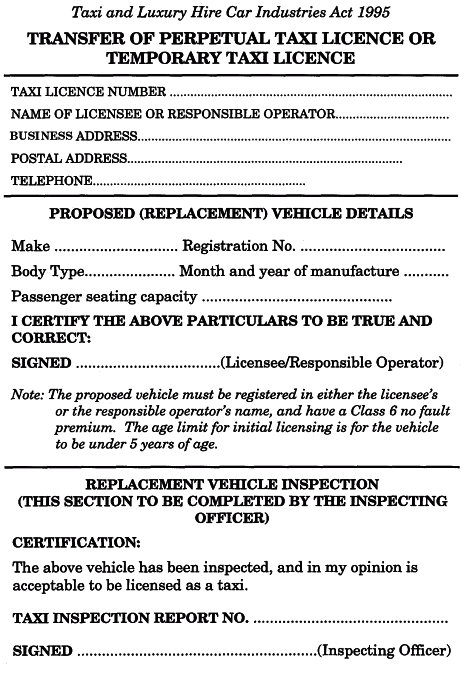
22. Schedule 4 inserted
After Schedule 3 to the Principal Regulations , the following Schedule is inserted:SCHEDULE 4 - Standard taxi faresRegulations 3 , 21 and 25
1. Standard taxi fares for places other than King Island and Flinders Island(1) First tariff: Between the hours of 6 a.m. and 8 p.m. on any weekday that is not a public holiday in the place where the taxi is hired, the following tariff (called the first tariff) is to be charged:(a) the amount recorded on the taximeter, that meter being calibrated to record –(i) the sum of $2.40 on the taxi being set in motion; and(ii) the sum of 10 cents for the first 48.9 m travelled, or the first 9 seconds of time elapsed, whichever occurs first; and(iii) after the distance travelled or, alternatively, time elapsed as specified in subparagraph (ii) , the sum of 10 cents for each complete 97.7 m travelled or each 18 seconds of time elapsed, whichever is the greater.(2) Second tariff: During the times when the first tariff does not apply, the following tariff (called the second tariff) is to be charged:(a) the amount recorded on the taximeter, that meter being calibrated to record –(i) the sum of $2.40 on the taxi being set in motion; and(ii) the sum of 10 cents for the first 40.7 m travelled, or the first 9 seconds of time elapsed, whichever occurs first; and(iii) after the distance travelled or, alternatively, time elapsed as specified in subparagraph (ii) , the sum of 10 cents for each complete 81.4 m travelled or each 18 seconds of time elapsed, whichever is the greater.2. Standard taxi fares for King Island and Flinders Island(1) First tariff: Between the hours of 6 a.m. and 8 p.m. on any weekday that is not a public holiday in the place where the taxi is hired, the following tariff (called the first tariff) is to be charged:(a) the amount recorded on the taximeter, that meter being calibrated to record –(i) the sum of $3.70 on the taxi being set in motion; and(ii) the sum of 10 cents for the first 43.1 m travelled, or the first 9 seconds of time elapsed, whichever occurs first; and(iii) after the distance travelled or, alternatively, time elapsed as specified in subparagraph (ii) , the sum of 10 cents for each complete 86.2 m travelled or each 18 seconds of time elapsed, whichever is the greater.(2) Second tariff: During the times when the first tariff does not apply, the following tariff (called the second tariff) is to be charged:(a) the amount recorded on the taximeter, that meter being calibrated to record –(i) the sum of $3.70 on the taxi being set in motion; and(ii) the sum of 10 cents for the first 35.9 m travelled, or the first 9 seconds of time elapsed, whichever occurs first; and(iii) after the distance travelled or, alternatively, time elapsed as specified in subparagraph (ii) , the sum of 10 cents for each complete 71.8 m travelled or each 18 seconds of time elapsed, whichever is the greater.3. Extra charges(1) In the case of trips originating outside the Burnie, Devonport, Hobart or Launceston taxi area as described in Schedule 1 to the Taxi Industry (Taxi Areas) Regulations 1996 between the hours of 12.30 a.m. and 5.00 a.m., a surcharge of $2.50 is to apply.(2) In the case where credit arrangements have been made with the hirer, an accounting fee not exceeding 10% of the metered fare may be charged.
Displayed and numbered in accordance with the Rules Publication Act 1953.
Notified in the Gazette on 21 June 2000
These regulations are administered in the Department of Infrastructure, Energy and Resources.
EXPLANATORY NOTE
(This note is not part of the regulation)
These regulations preserve, in modified form, the more important of the regulatory controls relating to the operation of taxis that were formerly contained in the Traffic (Public Vehicles) Regulations 1967 in force under the Traffic Act 1925 . Those regulations have now been rescinded consequent on the public vehicle reforms effected by the Passenger Transport Act 1997 and related legislation.