

Guardianship and Administration Amendment Act 2023
An Act to amend the Guardianship and Administration Act 1995 , the Tasmanian Civil and Administrative Tribunal Act 2020 and the Disability Services Act 2011
Be it enacted by Her Excellency the Governor of Tasmania, by and with the advice and consent of the Legislative Council and House of Assembly, in Parliament assembled, as follows:
PART 1 - Preliminary
This Act may be cited as the Guardianship and Administration Amendment Act 2023 .
The provisions of this Act commence on a day or days to be proclaimed.
PART 2 - Guardianship and Administration Act 1995 Amended
In this Part, the Guardianship and Administration Act 1995 is referred to as the Principal Act.
4. Long title amended
The Principal Act is amended as follows:(a) by omitting from the long title "a disability" first occurring and substituting "impaired decision-making ability";(b) by inserting in the long title ", to provide a process for obtaining consent for persons with impaired decision-making ability to participate in health and medical research projects" after "directives";(c) by omitting from the long title "with a disability" second occurring and substituting "who are unable to consent to such treatment".
5. Section 3 amended (Interpretation)
Section 3 of the Principal Act is amended as follows:(a) by omitting the definition of administration order from subsection (1) and substituting the following definition:administration order means an order of the Tribunal appointing a person as administrator;(b) by inserting the following definition after the definition of administrator in subsection (1) :adult means a person who has attained the age of 18 years;(c) by inserting the following definitions after the definition of appointor in subsection (1) :child means a person who has not attained the age of 18 years;close family member, in relation to a person, means any of the following persons who is in a close and continuing relationship with that person:(a) a spouse of the person;(b) a parent of the person;(c) a person who has one or both parents in common with the person;(d) a child of the person;(e) a child of, or a parent of, the spouse of the person;(f) a grandparent of the person;(g) an aunt or uncle of the person;(h) an adult of Aboriginal or Torres Strait Islander descent who is related to the person according to Aboriginal kinship rules or Torres Strait Islander kinship rules (as the case requires);(i) any other carer or close friend who provides on-going personal support to the person, whether or not the other person is biologically related to the person;close friend, in relation to a person, means another person who has a close personal relationship with the person and a personal interest in the person’s welfare;(d) by inserting the following definitions after the definition of contravene in subsection (1) :Convention on the Rights of Persons with Disabilities means the United Nations Convention on the Rights of Persons with Disabilities, done at New York on 13 December 2006, as in force for Australia;decision-making ability – see section 11 ;(e) by omitting the definition of disability from subsection (1) and substituting the following definition:disability includes a long-term physical, mental, intellectual or sensory impairment which, in interaction with various barriers, may hinder a person’s full and effective participation in society on an equal basis with others;(f) by inserting the following definition after the definition of enduring guardian in subsection (1) :financial matter, in relation to a person, means any matter relating to the estate of the person including the income, assets, debts, liabilities, real property, personal property and financial affairs of the person, and includes any legal matter that relates to the property or finances of the person;(g) by omitting the definition of impaired decision making ability from subsection (1) and substituting the following definitions:health and medical research – see section 6 ;health practitioner means the following:(a) a health practitioner within the meaning of the Health Practitioner Regulation National Law (Tasmania) (other than a student);(b) any other professional who is prescribed as a health practitioner for the purposes of this definition;impaired decision-making ability – see section 11 ;(h) by inserting the following definition after the definition of intimate forensic procedure in subsection (1) :legal matter, in relation to a person, includes –(a) the use of legal services for the person’s benefit; and(b) bringing or defending a legal proceeding or hearing in a court, tribunal or other body on behalf of the person, including settling a claim before or after a legal proceeding or hearing starts;(i) by inserting the following definition after the definition of parent in subsection (1) :personal matter, in relation to a person, means a matter relating to the personal affairs or lifestyle of the person, including, but not limited to, the following matters:(a) where and with whom the person lives, whether permanently or temporarily;(b) who may contact (whether by post, telephone, or electronic or other means) or visit the person, including –(i) restrictions on contact with the person or visits to the person that are necessary to promote the personal and social well-being of the person; and(ii) the prohibition on contact with, or visits to, the person by any person if that contact or those visits would have an adverse effect on the person;(c) the provision of care services to the person;(d) what education, training or work the person undertakes;(e) except as provided under Parts 5A and 6 , consenting to or refusing or withdrawing consent to the provision of health care or medical or dental treatment to the person;(f) except as provided under Part 6A, consenting to or refusing or withdrawing consent to the conduct of health and medical research in relation to the person;(g) any legal matter that relates to the personal affairs of the person;(j) by inserting the following definition after the definition of person responsible in subsection (1) :pharmaceutical drug includes any substance specified in the Poisons List, within the meaning of the Poisons Act 1971;(k) by inserting the following definition after the definition of Public Guardian in subsection (1) :registered health practitioner means a person who is registered under the Health Practitioner Regulation National Law (Tasmania) to practise a health profession (other than as a student);(l) by omitting paragraph (b) from the definition of represented person in subsection (1) and substituting the following paragraph:(b) who appoints an enduring guardian and who, by reason of impaired decision-making ability, becomes unable to make decisions in relation to personal matters;(m) by omitting " Part 6 " from paragraph (d) of the definition of special treatment in subsection (1) and substituting "this Act";(n) by inserting the following definition after the definition of State authority in subsection (1) :support, in relation to the making of a decision by a person, includes, but is not limited to, the following:(a) the use of information or formats tailored to the particular needs of the person making the decision;(b) assistance to communicate the decision of the person making the decision;(c) the giving of additional time to the person making the decision;(d) the use of technology to alleviate the effects of any disability of the person making the decision;(o) by omitting from subsection (2) "section 20(6)" and substituting " section 20(4) ".
6. Section 4 amended (Meaning of person responsible)
Section 4 of the Principal Act is amended as follows:(a) by omitting subparagraphs (i) and (ii) from subsection (1)(c) and substituting the following subparagraphs:(i) the other person's guardian, if the order or instrument appointing the guardian provides authority for the guardian to make the relevant decision;(ii) the other person’s spouse;(b) by omitting subparagraph (iv) from subsection (1)(c) and substituting the following subparagraph:(iv) a close family member of the other person; or(c) by omitting from subsection (1A)(b) "would be in the best interests of the person" and substituting "is necessary in the circumstances";(d) by omitting from subsection (1B)(c) "in the best interests of the person" and substituting "appropriate in the circumstances";(e) by omitting from subsection (5)(b) "close friend or relative" and substituting "close family member";(f) by inserting the following paragraph after paragraph (b) in subsection (5) :(ba) where more than one person would qualify as a spouse, spouse means only the last person to so qualify; and(g) by omitting from subsection (5)(c) "close friend or relative" and substituting "close family member";(h) by omitting from subsection (5)(e) "close friend or relative" and substituting "close family member".
7. Sections 5 and 6 substituted
Sections 5 and 6 of the Principal Act are repealed and the following sections are substituted:5. Meaning of promoting a person's personal and social well-being
For the purposes of this Act, and without limiting the ways in which this may occur, the personal and social well-being of a person is promoted by –(a) respecting the inherent dignity of the person and the person’s individual autonomy, including the freedom to make their own choices and their right to independence; and(b) respecting and promoting the person’s own decision-making ability; and(c) ensuring that the person is free from neglect, abuse, exploitation and other forms of harm; and(d) the importance of preserving the dignity of risk of a person with impaired decision-making ability in respect of decisions is to be recognised and to inform those decisions; and(e) respecting the right of the person to be treated without discrimination; and(f) respecting the person's individuality, including personal or lifestyle activities that provide pleasure, purpose and fulfilment to the person; and(g) having regard to the person's existing supportive relationships, religion, values, gender identity, gender expression, sexual orientation and cultural and linguistic environment; and(h) respecting the right of Aboriginal and Torres Strait Islander people to enjoy their culture, including with other people who share that culture; and(i) respecting the person's right to privacy and to have contact with and correspond privately with others; and(j) recognising the importance of, and facilitating access to, the provision of supports that enable the person to exercise the person's autonomy; and(k) recognising the importance to the person of any companion animal that the person has and having regard to the benefits that may be obtained from the person having a companion animal.6. Meaning of health and medical research
(1) Subject to subsection (3), in this Act, health and medical research –(a) means research conducted with or about individuals, or their data or tissue, in the field of medicine or health; and(b) includes an activity undertaken for the purposes of that research.(2) Without limiting subsection (1), health and medical research includes the following:(a) the administration of pharmaceutical drugs, biologicals or placebos;(b) the use of equipment or a device;(c) providing health care that has not yet gained the support of a substantial number of practitioners in that field of health care;(d) providing health care to which paragraph (c) does not apply to carry out a comparative assessment referred to in paragraph (e);(e) carrying out a comparative assessment of the health care provided under paragraphs (c) and (d);(f) taking samples from an individual, including –(i) a blood sample; and(ii) a sample of tissue or fluid from the body, including the mouth, nose, nasal cavity, eyes and ears;(g) conducting medical imaging of an individual, including the use of computed tomography, magnetic resonance imaging, x-ray and ultrasound;(h) taking photographs, films or audio or visual recordings of an individual;(i) any non-intrusive examination, including –(i) a visual examination of the mouth, throat, nasal cavity, eyes or ears; and(ii) the measuring of an individual’s height, weight or vision;(j) observing an individual;(k) undertaking a survey, interview or focus group;(l) collecting, using or disclosing information, including personal information in accordance with the provisions of the Personal Information Protection Act 2004;(m) considering or evaluating samples or information taken under an activity listed in this subsection;(n) any other activity prescribed to be health and medical research for the purposes of this Act.(3) In this Act, health and medical research does not include any of the following:(a) research conducted with or about individuals, or their data or tissue, in the field of medicine or health that –(i) only involves analysing data about the individuals; and(ii) does not result in the disclosure or publication of personal information;(b) special treatment;(c) any treatment or procedure that would otherwise require the consent of the Tribunal or any other person or body under law;(d) any other activity prescribed not to be health and medical research for the purposes of this Act.(4) In this section –biological has the same meaning as in section 32A of the Therapeutic Goods Act 1989 of the Commonwealth.(1) The objects of this Act are to protect and promote the rights and dignity of persons who have impaired decision-making ability by –(a) applying the principles of the Convention on the Rights of Persons with Disabilities, including recognising the need to support persons with impaired decision-making ability to make, participate in and implement decisions that affect their lives; and(b) enabling the making of guardianship orders and administration orders; and(c) recognising the giving of advance care directives; and(d) making provision for the authorisation and approval of medical and dental treatment for persons with impaired decision-making ability; and(e) providing for arrangements for the conduct of health and medical research involving persons with impaired decision-making ability; and(f) setting out principles and procedures to be observed by persons when performing a function under the Act, including making decisions for or on behalf of a represented person; and(g) ensuring that persons with impaired decision-making ability and their families are informed of, and make use of, the provisions of this Act.(1) A person performing a function under this Act is to observe the following principles:(a) a person’s decision-making ability is to be respected and promoted;(b) a person who requires support in decision making is to be provided with access to the support necessary to enable the person, as far as is practicable in the circumstances –(i) to make and participate in decisions affecting the person; and(ii) to express the person’s will and preferences; and(iii) to develop the person’s decision-making ability;(c) the views, wishes and preferences of a person with impaired decision-making ability in respect of decisions are to be respected and used to inform those decisions;(d) the role of close family members, carers and other significant persons in the life of a person with impaired decision-making ability in respect of decisions is to be recognised;(e) the importance of preserving the cultural and linguistic environment of the person is to be recognised;(f) the personal and social well-being of a person with impaired decision-making ability in respect of decisions is to be promoted;(g) the means which is the least restrictive of a person’s freedom of decision and action as possible in the circumstances is to be adopted.(2) In addition to the principles set out in subsection (1), if a function is to be performed under this Act by a person in relation to a child, that function is to be performed so that –(a) as far as is practicable the best interests of the child are paramount; and(b) full consideration is given to the following needs:(i) to protect the child from harm;(ii) to promote the child’s development;(iii) to strengthen, preserve and promote positive relationships between the child and the child’s parents, family members and other people who are significant in the life of the child.(3) Persons providing assistance on an informal basis to a person with impaired decision-making ability in respect of a decision are encouraged to apply and promote the principles in this section in providing that assistance.(1) In this section –serious harm, to a person, means any harm that has a significant impact on the health, welfare, property or financial situation of the person, including as a consequence of abuse, exploitation, neglect or self-neglect;substitute decision-maker means a person with authority under this Act to make decisions for or on behalf of a person with impaired decision-making ability.(2) A substitute decision-maker is to have regard to the following in determining whether to make a decision for or on behalf of a person with impaired decision-making ability in respect of that decision:(a) whether the person has made an advance care directive in respect of that decision;(b) whether the person is likely to regain decision-making ability in respect of that decision and, if so, whether the decision can be postponed without the delay causing harm.(3) If a substitute decision-maker is satisfied that there is a need to make a decision for or on behalf of another person, the substitute decision-maker –(a) is to give effect, as far as practicable, to the views, wishes and preferences of the person with impaired decision-making ability, if known (including those expressed in an advance care directive); and(b) if the substitute decision-maker is not able to determine the views, wishes and preferences of the person with impaired decision-making ability, is to –(i) give effect as far as practicable to what the substitute decision-maker reasonably believes those views, wishes and preferences are, based on all the information available; and(ii) act in a manner that promotes the personal and social well-being of the person with impaired decision-making ability and is the least restrictive of the person's human rights.(4) For the purposes of subsection (3)(b)(i), information available includes information obtained by consulting with close family members, carers and other significant people in the life of the person with impaired decision-making ability whom the substitute decision-maker reasonably believes the person with impaired decision-making ability would want to be consulted.(5) The views, wishes and preferences of the person with impaired decision-making ability should only be overridden by a substitute-decision maker for that person to the extent that –(a) it is necessary to prevent serious harm, or the risk of serious harm, to the person or another person; or(b) the implementation of the decision would be unlawful; or(c) the implementation of the decision would be inconsistent with the terms of any determinations made by the Tribunal under this Act.(6) If a substitute decision-maker overrides the views, wishes and preferences of a person with impaired decision-making ability, the substitute decision-maker is to, as far as is reasonably practicable, provide the person with information as to why they have overridden the person’s views, wishes and preferences in a way that is appropriate to the person’s circumstances.
8. Part 2 inserted
After section 9 of the Principal Act , the following Part is inserted:PART 2 - Decision-making ability(1) In this Part –information, relevant to a decision, includes information on the consequences of –(a) making the decision one way or the other; and(b) deferring the making of the decision; and(c) failing to make the decision.(1) For the purposes of this Act, an adult is taken to have decision-making ability in respect of a decision unless a person or body responsible for assessing that decision-making ability under this Act is satisfied that the adult has impaired decision-making ability in respect of that decision.(2) For the purposes of this Act, an adult has impaired decision-making ability in respect of a decision if the adult is unable, even with the provision of access to practicable and appropriate support, to –(a) understand information relevant to the decision; or(b) retain information relevant to the decision for a sufficient time to make and consistently communicate the decision; or(c) use or weigh information relevant to the decision; or(d) communicate the decision (whether by speech, gesture or other means).(3) For the purposes of this Act, a child is taken to have impaired decision-making ability in respect of a decision unless a registered health practitioner is satisfied that the child has decision-making ability in respect of that decision.(4) For the purposes of this Act, a child has decision-making ability in respect of a decision if the child –(a) is sufficiently mature to make the decision; and(b) is able to –(i) understand information relevant to the decision; and(ii) retain information relevant to the decision for a sufficient time to make and consistently communicate the decision; and(iii) use or weigh information relevant to the decision; and(iv) communicate the decision (whether by speech, gesture or other means), including with the provision of support.(5) For the purposes of this Act –(a) a person may be taken to understand information relevant to a decision if it reasonably appears, to the person assessing that person’s decision-making ability, that the person is able to understand an explanation, of the nature and consequences of the decision, given in a way that is appropriate to the person’s circumstances (whether by words, signs or other means); and(b) a person may fluctuate between having impaired decision-making ability and decision-making ability in respect of a decision.12. Limits on finding of impaired decision-making ability
(1) For the purposes of this Act, a person’s decision-making ability in respect of a decision is not to be assessed as impaired merely because –(a) the person is not able to understand matters of a technical or trivial nature; or(b) the person does not have a particular level of literacy or education; or(c) the person can only retain information relevant to the decision for a limited time; or(d) the person has decision-making ability to make some decisions and not others; or(e) a decision made by the person results, or may result, in an adverse outcome for the person; or(f) a decision made by the person is unwise in the opinion of other persons; or(g) the person makes a decision because –(i) of current or past cultural or religious practices or beliefs; or(ii) of a failure or refusal to adhere to particular cultural or religious practices or beliefs; or(h) subject to section 11(3), of the age of the person; or(i) of the person’s appearance; or(j) the person is perceived to be eccentric; or(k) the person has engaged in illegal or immoral conduct; or(l) of the person’s current or past expression of, or failure or refusal to express, a particular gender identity, gender expression or sexual orientation; or(m) the person has a disability, illness or other medical condition (whether physical or mental).(2) A person is not to be assessed under this Act as having impaired decision-making ability in respect of a decision unless reasonable steps have been taken to provide that person with access to the practicable and appropriate support needed to make and communicate the decision.13. Formal assessment of decision-making ability
(1) If a health practitioner or other person is responsible for conducting an assessment of a person’s decision-making ability for the purposes of a hearing or determination of the Tribunal, that person is to take reasonable steps to –(a) inform the person whose decision-making ability is being assessed of the nature and purpose of the assessment; and(b) provide information to the person or the person responsible for that person about the nature of any conclusions made during the assessment and the basis for those conclusions; and(c) provide the person or the person responsible for that person with an opportunity to ask questions about the findings of the assessment; and(d) comply with such other requirements in relation to the assessment, if any, as may be prescribed.(2) Where the assessment of a person’s decision-making ability is being undertaken for the purposes of an application to the Tribunal under this Act, the person making that application is to take reasonable steps to –(a) inform the person and the person responsible for that person that an application is being considered; and(b) identify the matter or matters in relation to which the application is being considered; and(c) assist the person or the person responsible for that person to identify any less restrictive alternatives to making the application; and(d) advise the person and the person responsible for that person of the right to seek legal representation or advocacy support; and(e) provide information about access to legal representation and advocacy support; and(f) comply with any other prescribed requirements.(3) A person must not intentionally or recklessly interfere with, or affect, the assessment of another person’s decision-making ability under this Act.Penalty: Fine not exceeding 20 penalty units.
9. Section 15 amended (Functions and powers of Public Guardian)
Section 15(1) of the Principal Act is amended as follows:(a) by omitting from paragraph (a) "a disability" and substituting "impaired decision-making ability in respect of decisions";(b) by omitting paragraph (f) ;(c) by omitting from paragraph (j) "a disability" and substituting "impaired decision-making ability in respect of decisions".
10. Section 19 amended (Application for guardianship order)
Section 19 of the Principal Act is amended by omitting subsection (1) and substituting the following subsection:(1) A person may apply to the Tribunal for an order appointing a guardian for a person who has impaired decision-making ability in respect of decisions relating to one or more personal matters.
11. Sections 20 and 21 substituted
Sections 20 and 21 of the Principal Act are repealed and the following sections are substituted:(1) The Tribunal, after a hearing, may make an order appointing a guardian for a person in respect of one or more personal matters if –(a) an application for an order appointing a guardian, or for an order appointing an administrator, has been made to the Tribunal in respect of the person; and(b) the Tribunal is satisfied that the person –(i) has impaired decision-making ability in respect of decisions relating to those personal matters; and(ii) is in need of a guardian; and(c) the Tribunal is satisfied that the order will promote the person's personal and social well-being.(2) For the purposes of subsection (1)(b)(ii), in determining whether a person is in need of a guardian, the Tribunal must consider the following:(a) the wishes and preferences of the person, as far as they can be ascertained;(b) whether the needs of the person could be met by other means less restrictive of that person’s freedom of decision and action;(c) the wishes and preferences of any close family members, carers and other significant persons in the life of the person who are present at the hearing and are entitled to be heard at that hearing.(3) If the Tribunal makes a guardianship order under subsection (1), the order –(a) is to specify the personal matters for which a guardian is required; and(b) may be subject to such conditions or restrictions as the Tribunal considers necessary.(4) Two or more guardians for a person, each with authority in respect of different personal matters, may be appointed for that person under one or more guardianship orders.(5) An order made under this section may be expressed to take effect when the represented person attains the age of 18 years.21. Persons eligible to be appointed as guardian
(1) The Tribunal may only appoint as a guardian for a proposed represented person –(a) a person who is eligible for appointment under subsection (2); or(b) if the Tribunal is satisfied that no person is eligible for appointment as a guardian for the proposed represented person under subsection (2), the Public Guardian.(2) A person who is of or over the age of 18 years is eligible for appointment as a guardian for a proposed represented person if –(a) the person consents to act as a guardian; and(b) in the Tribunal’s opinion, the person –(i) understands their obligations and duties and will act in accordance with the requirements of this Act; and(ii) is a suitable person to act as a guardian for the proposed represented person in respect of the personal matters specified in the guardianship order under section 20(3)(a).(3) For the purposes of subsection (2)(a), a person consents to act as guardian if the person gives to the Tribunal a written declaration, in a form approved by the Tribunal, that states the following:(a) that the person consents to act as a guardian for the represented person;(b) that the person understands the person’s obligations and duties under this Act;(c) that the person understands the consequences of failing to comply with the person’s obligations and duties under this Act;(d) that the person undertakes to act in accordance with this Act;(e) such other information, if any, as may be prescribed.(4) For the purposes of subsection (2)(b)(ii), in determining whether a person is a suitable person to act as a guardian for a represented person, the Tribunal must take into account the following:(a) the wishes and preferences of the proposed represented person, so far as they can be ascertained;(b) the desirability of preserving existing relationships that are important to the proposed represented person;(c) the compatibility of the person proposed as guardian with the proposed represented person and with the administrator (if any) for the proposed represented person;(d) the extent to which the person’s interests may conflict with the interests of the proposed represented person;(e) the desirability of appointing a person who has a personal relationship with the proposed represented person, rather than a person without such a relationship;(f) whether the person will be available to act as the proposed represented person's guardian;(g) whether the person has the requisite skills and access to appropriate support to competently perform the role.(5) For the purposes of subsection (4)(d) –(a) the fact that the person is a close family member of the proposed represented person does not, of itself, mean that the person’s interests are likely to conflict with the interests of the proposed represented person; and(b) the fact that the person may be a beneficiary of the proposed represented person’s estate on the proposed represented person’s death does not, of itself, mean that the person’s interests are likely to conflict with the interests of the proposed represented person; and(c) the fact that the person is in conflict with a close family member of the proposed represented person does not, of itself, mean that the person’s interests are likely to conflict with the interests of the proposed represented person.21A. Duty to notify Tribunal of change in circumstances
If there has been a change in circumstances that means that a guardian for a represented person may no longer be eligible to be appointed as a guardian for that represented person under section 21, that guardian must inform the Tribunal of that change as soon as practicable after its occurrence.
12. Section 22 amended (Alternative guardians)
Section 22 of the Principal Act is amended as follows:(a) by omitting from subsection (1) "of" and substituting "for";(b) by omitting from subsection (2) "of" second occurring and substituting "for".
13. Section 23 repealed
Section 23 of the Principal Act is repealed.
14. Section 24 substituted
Section 24 of the Principal Act is repealed and the following section is substituted:24. Expiration of guardianship orders
(1) A guardianship order has effect for 3 years, or such shorter period as the Tribunal may specify in the order, unless the order is continued under section 68 .(2) In determining the duration of an order, the Tribunal must take into account the following:(a) the likelihood of improvements to the represented person’s decision-making ability;(b) the prospect that changes to circumstances, including interventions to establish support arrangements, will mitigate the need for a guardian;(c) the requirement that the order to be made be that which is the least restrictive of the person’s freedom of decision and action as is possible in the circumstances.
15. Sections 25 , 26 and 27 substituted
Sections 25 , 26 and 27 of the Principal Act are repealed and the following sections are substituted:(1) Subject to this Act, a guardianship order confers, on the person appointed as guardian, power to make decisions in relation to such of the represented person’s personal matters as are specified in the order.(2) Where a decision is made, action taken, consent given, or act done, by a guardian for a represented person, the decision, action, consent or act has effect as if it had been made, taken, given, or done, by the represented person and the represented person had the legal capacity to do so.(3) A guardian may, on behalf of a represented person, sign documents and do all such things as are necessary to give effect to any power or duty vested in the guardian by the guardianship order.26. Exercise of authority by guardian
(1) A guardian under this Act must –(a) promote the personal and social well-being of the person under guardianship; and(b) act in accordance with the principles set out in section 8 ; and(c) have regard to the decision-making process set out in section 9 ; and(d) act honestly, diligently and in good faith; and(e) treat the person under guardianship with respect and dignity; and(f) communicate with the person under guardianship by means that the person will be best able to understand; and(g) keep the person under guardianship informed about decisions made, information obtained and steps taken by the guardian, as appropriate in the circumstances; and(h) regularly consult with any other guardian or administrator of the person under guardianship and keep them informed about substantial decisions or actions, subject to the terms of the guardian’s appointment; and(i) act as an advocate for the person under guardianship where possible; and(j) encourage and support the person under guardianship to develop the person's decision-making ability in respect of decisions where possible; and(k) protect the person under guardianship from violence, neglect, abuse and exploitation.(2) A guardian must make reasonable efforts –(a) to ascertain whether the person under guardianship has given an advance care directive; and(b) if the person under guardianship has given an advance care directive, to obtain a copy of that advance care directive.27. Right of guardian to information
A guardian has a right to all information to which the represented person is entitled, if the information is reasonably required for the purposes of performing a function as guardian.(1) A guardian for a represented person must keep an accurate record of all dealings and transactions made by the person as guardian.Penalty: Fine not exceeding 20 penalty units.(2) A person who has ceased to be a guardian (the former guardian) for a person must retain the records required to be kept under subsection (1) in relation to that person for at least 7 years after so ceasing.Penalty: Fine not exceeding 20 penalty units.(3) The former guardian for a person may give a copy of the records required to be retained under subsection (2) in relation to that person to the following persons:(a) a guardian for that person;(b) if the person has ceased to be a represented person, that person;(c) if the person has died, the legal representative of that person;(d) if the person responsible for that person is required to make decisions in relation to the person’s health care, the person responsible for that person.(4) The former guardian for a person must, on request, give a copy of the records required to be retained under subsection (2) in relation to that person to a person referred to in subsection (3)(a) , (b) , or (c) within 14 days after receipt of the request.Penalty: Fine not exceeding 20 penalty units.
16. Section 28 amended (Power to enforce guardianship order)
Section 28 of the Principal Act is amended as follows:(a) by omitting from subsection (1) "section 25 or 26" and substituting " section 25 ";(b) by omitting from subsection (1) "full or limited" twice occurring;(c) by inserting the following subsection after subsection (1) :(1A) Measures or actions specified in a guardianship order under subsection (1) may be subject to such conditions or limitations as the Tribunal considers necessary.(d) by omitting from subsection (2)(a) "in the best interests of the represented person" and substituting "required to comply with the order".
17. Section 29 amended (Urgent powers in case of unlawful detention of persons in need of a guardian)
Section 29 of the Principal Act is amended as follows:(a) by omitting from subsection (1) "with a disability" first occurring and substituting "who appears to be in need of a guardian";(b) by omitting from subsection (1) "with a disability" second occurring;(c) by omitting from subsection (2) "with a disability" and substituting "in need of a guardian";(d) by omitting from subsection (3) "with a disability" and substituting "in need of a guardian".
18. Section 30 amended (Removal of persons to place of safety)
Section 30(1) of the Principal Act is amended by omitting "with a disability".
19. Section 32 amended (Appointment of enduring guardian)
Section 32 of the Principal Act is amended as follows:(a) by inserting the following paragraph before paragraph (a) in subsection (2) :(aa) the appointor understands the nature and effect of the instrument; and(b) by omitting paragraph (c) from subsection (2) and substituting the following paragraph:(c) it is signed by the appointor with that signature attested by the signature of two witnesses neither of whom is a party to it nor a close family member of a party to it and each of whom has witnessed it in the presence of the appointor and each other; and(c) by inserting the following subsection after subsection (2) :(2A) For the purposes of subsection (2)(aa), an appointor is taken to understand the nature and effect of the instrument only if the appointor understands the following matters:(a) that the appointor may, in the instrument of appointment of an enduring guardian, specify or limit the power to be given to an enduring guardian and provide instructions to the enduring guardian about the exercise of the power;(b) when the powers contained in the instrument of appointment of an enduring guardian may be exercised;(c) that, once the powers contained in the instrument may be exercised, the enduring guardian has power to make decisions on behalf of the appointor, subject to the terms or information about exercising the power in the instrument and in accordance with the duties and responsibilities under this Act;(d) that the appointor may revoke the instrument of appointment of an enduring guardian at any time if the appointor has the decision-making ability to do so;(e) that the power that the appointor has given continues even if the appointor subsequently loses decision-making ability;(f) that the appointor is unable to oversee the use of the power if the appointor subsequently loses decision-making ability.(d) by omitting from subsection (3) "he or she" and substituting "the person";(e) by omitting from subsection (4) "he or she" and substituting "the person";(f) by omitting subsection (5) and substituting the following subsection:(5) Subject to any conditions specified in the instrument, an instrument appointing an enduring guardian confers, on each appointee, power to make decisions in relation to the appointor’s personal matters if the appointor subsequently is unable, by reason of impaired decision-making ability, to make decisions in relation to those personal matters.(g) by omitting subsection (7) and substituting the following subsection:(7) Subject to any conditions specified in the instrument, section 25(2) and (3) apply to an enduring guardian as if the enduring guardian were a guardian appointed under section 20.
20. Section 32B amended (Right of enduring guardian to information)
Section 32B of the Principal Act is amended as follows:(a) by omitting paragraph (b) from subsection (1) and substituting the following paragraph:(b) if the appointor is unable, by reason of impaired decision-making ability, to make decisions in relation to personal matters, to all information to which the appointor would have been entitled but for the impaired decision-making ability –(b) by omitting subsection (2) and substituting the following subsection:(2) An enduring guardian has, if the appointor is unable, by reason of impaired decision-making ability, to make decisions in relation to the appointor's personal matters, a right to obtain, from a person who has possession of a will of the appointor, a copy, of the will, that is certified by the person.
21. Section 34 amended (Revocation or amendment of appointment by Tribunal)
Section 34 of the Principal Act is amended by omitting subsections (1) and (1A) and substituting the following subsections:(1) The Tribunal may, on an application under this section or on its own motion and after a hearing –(a) revoke or amend an instrument of appointment of an enduring guardian if –(i) the enduring guardian seeks revocation of the appointment; or(ii) the Tribunal is satisfied that the enduring guardian is not willing or able to act in that capacity; or(iii) the Tribunal is satisfied that the enduring guardian has, in that capacity –(A) not acted to promote the personal and social well-being of the appointor; or(B) acted in an incompetent or negligent manner or contrary to the provisions of this Act; or(iv) the Tribunal is satisfied that the circumstances of the appointor have changed to the extent that it is appropriate to revoke or amend the instrument; and(b) if the Tribunal thinks fit, and is satisfied of the matters specified in 20(1)(b) and (c), appoint a guardian for the appointor of the enduring guardian.(1A) The Tribunal may, on an application under this section or on its own motion and after a hearing –(a) declare that an instrument of appointment of an enduring guardian or an instrument revoking the appointment of an enduring guardian is invalid if the Tribunal is satisfied that –(i) the appointor did not have decision-making ability in respect of the making or revoking of the instrument; or(ii) the instrument is contrary to the provisions of this Act; or(iii) the appointor was induced to make the instrument by reason of dishonesty or undue influence; and(b) if the Tribunal thinks fit, and if satisfied of the matters specified in 20(1)(b) and (c), appoint a guardian for the appointor of the enduring guardian.(1B) An appointment of a person as a guardian under subsections (1)(b) or (1A)(b) has the same effect as if it had been made under Part 4.
22. Section 35A amended (Objects of Part)
Section 35A of the Principal Act is amended as follows:(a) by omitting from paragraph (a) "decision making" and substituting "decision-making";(b) by omitting from paragraph (b) "decision making" and substituting "decision-making".
23. Section 35B amended (Principles to be taken into account)
Section 35B of the Principal Act is amended as follows:(a) by omitting "The" and substituting "In addition to the principles set out in section 8 , the";(b) by omitting from paragraph (a) "decision making" and substituting "decision-making";(c) by omitting from paragraph (b) "decision making" and substituting "decision-making";(d) by omitting from paragraph (c) "decision making" and substituting "decision-making";(e) by omitting from paragraph (f) "he or she had decision making" and substituting "the person had decision-making";(f) by omitting from paragraph (g)(iii) "United Nations".
24. Section 35C amended (Interpretation of Part)
Section 35C(1) of the Principal Act is amended as follows:(a) by inserting the following definition after the definition of binding provision :health care – see section 35E ;(b) by omitting the definition of health practitioner ;(c) by omitting the definition of medical research procedure ;(d) by omitting the definition of registered health practitioner .
25. Section 35D repealed
Section 35D of the Principal Act is repealed.
26. Section 35E amended (Meaning of health care)
Section 35E(1) of the Principal Act is amended by omitting paragraph (c) and substituting the following paragraph:(c) the conduct of health and medical research;
27. Section 35F repealed
Section 35F of the Principal Act is repealed.
28. Section 35G amended (Giving an advance care directive)
Section 35G(2) of the Principal Act is amended by omitting paragraph (a) and substituting the following paragraph:(a) has decision-making ability in respect of health care decisions; and
29. Section 35I amended (Witnessing of advance care directive)
Section 35I of the Principal Act is amended as follows:(a) by omitting subsection (1) ;(b) by omitting from subsection (5)(a) "close relative" and substituting "close family member";(c) by omitting paragraph (g) from subsection (5) and substituting the following paragraph:(g) if the person has been appointed as a guardian for the person giving the advance care directive; or
30. Section 35O amended (Requirement to make reasonable inquiries as to advance care directive)
Section 35O(2) of the Principal Act is amended by omitting "decision making" and substituting "decision-making".
31. Section 35Q amended (Consent given or refused in advance care directive)
Section 35Q(1)(a) of the Principal Act is amended by omitting "decision making" and substituting "decision-making".
32. Section 35R amended (Consent given or refused by authorised decision maker for person who has given an advance care directive)
Section 35R(1)(a) of the Principal Act is amended by omitting "decision making" and substituting "decision-making".
33. Section 35T amended (Health practitioners to give effect to advance care directives)
Section 35T(1) of the Principal Act is amended by omitting "decision making" and substituting "decision-making".
34. Section 35Y amended (Revoking advance care directive where person has decision-making ability)
Section 35Y(1) of the Principal Act is amended by omitting "he or she has decision making ability" and substituting "the person has decision-making ability in respect of that decision".
35. Section 35Z amended (Revoking or varying advance care directive where person has impaired decision-making ability)
Section 35Z(1)(a) of the Principal Act is amended by omitting "decision making ability" and substituting "decision-making ability in respect of decisions relating to the advance care directive".
36. Section 35ZK amended (Resolution of matters by Tribunal)
Section 35ZK(7)(b) of the Principal Act is amended as follows:(a) by omitting from subparagraph (i) "decision making" and substituting "decision-making";(b) by omitting from subparagraph (ii) "decision making" and substituting "decision-making".
37. Section 36 amended (Application of Part 6)
Section 36 of the Principal Act is amended by omitting subsection (1) and substituting the following subsection:(1) This Part applies to a person who –whether or not that person is a represented person.(a) has impaired decision-making ability in respect of decisions relating to the carrying out of medical or dental treatment on that person; and(b) is incapable of indicating whether or not the person consents or refuses to consent to the carrying out of that treatment –
38. Section 39 amended (Persons authorized to consent to medical or dental treatment)
Section 39(2) of the Principal Act is amended by omitting "of" first occurring and substituting "for".
39. Section 41 amended (Medical or dental treatment without consent)
Section 41(3)(a) of the Principal Act is amended by omitting "wellbeing" and substituting "well-being".
40. Section 43 amended (Consent by persons responsible)
Section 43 of the Principal Act is amended as follows:(a) by omitting subsection (1) and substituting the following subsection:(1) A person responsible for a person to whom this Part applies may consent to the carrying out of medical or dental treatment, other than special treatment, on that person if the person responsible –(a) is satisfied that the person to whom this Part applies is incapable of giving consent; and(b) is satisfied that the medical or dental treatment would promote the personal and social well-being of that person; and(c) in making that decision, takes into account the matters specified in subsection (2).(b) by omitting from subsection (2) "Subject to subsection (3) , for the purposes of determining whether any medical or dental treatment would be in the best interests of a person to whom this Part applies," and substituting "For the purposes of subsection (1)(c),";(c) by omitting from subsection (2)(e) "that" first occurring and substituting "subject to subsection (3), that";(d) by omitting from subsection (2)(e) "wellbeing" and substituting "well-being".
41. Section 45 amended (Consent of Tribunal)
Section 45 of the Principal Act is amended as follows:(a) by omitting subsection (1) and substituting the following subsection:(1) On hearing an application for its consent to the carrying out of medical or dental treatment on a person, the Tribunal may consent to the carrying out of the medical or dental treatment if the Tribunal –(a) is satisfied that the medical or dental treatment is otherwise lawful; and(b) is satisfied that the person is incapable of giving consent; and(c) is satisfied that the medical or dental treatment would promote the personal and social well-being of the person; and(d) in making that decision, takes into account the matters specified in subsection (2).(b) by omitting from subsection (2) "determining whether any medical or dental treatment would be in the best interests of a person to whom this Part applies," and substituting "subsection (1)(d),".
42. Section 46 amended (Consent to continuing or further special treatment by guardian with authority of Tribunal)
Section 46(1) of the Principal Act is amended by omitting "of" second occurring and substituting "for".
43. Section 46A amended (Power to make guardianship order or administration order)
Section 46A of the Principal Act is amended by omitting "section 20(1) or section 51(1)" and substituting " section 20(1)(b) and (c) or section 51(1)(b) and (c) ".
44. Part 6A inserted
After section 48A of the Principal Act , the following Part is inserted:PART 6A - Health and medical researchDivision 1 - Preliminary(1) Subject to subsection (2), this Part applies to a person who –whether or not that person is a represented person.(a) is of or over the age of 18 years; and(b) has impaired decision-making ability in respect of decisions relating to the conduct of health and medical research in relation to that person; and(c) is incapable of indicating whether or not they consent or refuse to consent to the conduct of health and medical research in relation to that person –(2) For the purposes of subsection (1), a person is incapable of giving consent to the conduct of health and medical research in relation to that person if the person is –(a) incapable of understanding the general nature and effect of the conduct of the proposed health and medical research in relation to that person; or(b) incapable of indicating whether or not the person consents or does not consent to the conduct of health and medical research in relation to that person.In this Part –health and medical research practitioner means the following persons:(a) a lead health and medical researcher;(b) a person who conducts, or assists with the conduct of, health and medical research under the authority and direction of a lead health and medical researcher;(c) any other category or class of persons prescribed for the purposes of this definition;human research ethics committee means a human research ethics committee established in accordance with the requirements of –(a) the National Statement on Ethical Conduct in Human Research published by the National Health and Medical Research Council, as in force from time to time; or(b) any superseding document of the statement referred to in paragraph (a) published by the National Health and Medical Research Council, that covers the same subject matter, issued under the National Health and Medical Research Council Act 1992 of the Commonwealth;lead health and medical researcher, in relation to a relevant research project, means –(a) a health practitioner who has sole or joint overall responsibility for the relevant research project; or(b) any other category of persons prescribed for the purpose of this definition;relevant research project, in relation to the conduct of health and medical research, means the research project for the purposes of which the health and medical research is conducted.48D. Requirement if recovery of decision-making ability likely
(1) If a person to whom this Part applies is likely to recover decision-making ability within a reasonable time to make a decision in relation to the conduct of health and medical research relating to that person, a health and medical research practitioner must not conduct health and medical research in relation to that person under this Part.(2) For the purposes of subsection (1), a reasonable time is the time by which, given the nature of the relevant research project, the health and medical research would need to be conducted, having regard to the following:(a) the medical or physical condition of the person;(b) the stage of treatment or care;(c) other circumstances specific to the person.48E. Requirement to ascertain existence of advance care directive
Before a health and medical research practitioner conducts health and medical research in relation to a person to whom this Part applies, the health and medical research practitioner must make reasonable efforts –(a) to ascertain if the person has given an advance care directive; and(b) if the person has given an advance care directive, to obtain a copy of that advance care directive.Division 2 - Approval and consent48F. Health and medical research to be conducted in accordance with approval
Any health and medical research conducted in relation to a person under this Part must –(a) have been approved by the relevant human research ethics committee; and(b) be conducted in accordance with that approval, including any conditions of that approval.48G. Approval to conduct health and medical research
(1) Subject to subsection (2), a health and medical research practitioner may conduct health and medical research in relation to a person to whom this Part applies in the following circumstances:(a) the person has given an advance care directive that authorises the conduct of the health and medical research in relation to the person;(b) there is no advance care directive under paragraph (a) and the person responsible for that person has consented to the conduct of the health and medical research in relation to that person;(c) the health and medical research is authorised under section 48K and there is no –(i) advance care directive under paragraph (a); or(ii) person responsible for that person who is available or able to give or refuse consent to the conduct of the research.(2) A health and medical research practitioner must not conduct health and medical research in relation to a person to whom this Part applies if the person has given an advance care directive that provides a clear and unambiguous refusal to the conduct of health and medical research in relation to that person.48H. Urgent medical and dental treatment
For the avoidance of doubt, nothing in this Part prevents the carrying out of medical or dental treatment that is part of a research project on a person without that person’s consent if section 40 of this Act authorises the carrying out of that treatment on that person.Division 3 - Health and medical research with consent of person responsible48I. Consent of person responsible
(1) The person responsible for a person to whom this Part applies may consent to the conduct of health and medical research in relation to that person if the person responsible reasonably believes that the person would have consented to the conduct of that health and medical research if the person had decision-making ability.(2) For the purposes of subsection (1), in determining whether a person would have consented to the conduct of the health and medical research, the person responsible is to have regard to –(a) any relevant directions, values or preferences outlined in an advance care directive given by the person in relation to whom the proposed health and medical research is to be conducted; and(b) if the person has not given any relevant directions, values or preferences in an advance care directive, the views, wishes and preferences expressed by the person other than by way of an advance care directive; and(c) if the person has not expressed any views, wishes or preferences, what the person responsible reasonably believes the views, wishes and preferences of the person are likely to be, based on all the information available including the values of the person inferred from the person’s life; and(d) whether consent to the conduct of the health and medical research will promote the person’s personal and social well-being; and(e) the likely effects and consequences of the health and medical research, including the likely effectiveness of the health and medical research, and whether these are consistent with the person’s preferences and values; and(f) the likely effects and consequences of the conduct of the health and medical research in relation to that person including –(i) the known risks of the conduct of the health and medical research; and(ii) any risks to the person that are greater than the risk that is inherent in the person’s condition and in standard medical treatment or health care; and(g) whether there are any alternatives, including refusing the conduct of the health and medical research.(3) For the purposes of subsection (2), the lead health and medical researcher for a relevant research project is to provide, or cause to be provided, to the person responsible for a person under this Part –(a) the following information:(i) a clear and candid explanation of the relevant research project, including information about the associated risk or any common or expected side effects of any activities proposed to be undertaken for the purposes of the research;(ii) a clear and candid explanation of any treatment or health care that may be available, including information about the associated advantages and disadvantages of any treatment given as part of a health or medical research trial as an alternative to, or in addition to, that treatment or health care;(iii) any other information that is considered by the lead health and medical researcher to be of relevant importance and likely to influence the person’s decision-making with regard to the relevant research project; and(b) an opportunity to ask questions regarding the research project and to receive clear and candid answers to those questions; and(c) a reasonable opportunity to –(i) obtain independent medical or other advice; and(ii) consider the advantages and disadvantages of giving consent.(4) Consent given under this section must be consistent with any requirements for consent specified in the relevant human research ethics committee approval for the relevant research project or the conditions of that approval.(5) Consent given by a responsible person under this section may be withdrawn by that responsible person at any time.(6) Where consent under this section is withdrawn, the lead health and medical researcher for the relevant research project is to ensure that the necessary arrangements are made to withdraw the person in respect of whom the consent is withdrawn from future participation in the relevant research project without compromising the person’s ability to receive any available standard medical treatment or health care.(7) If a person in respect of whom consent has been given under this section regains decision-making ability in relation to decisions related to the conduct of health and medical research in relation to that person, the lead health and medical researcher is to, as soon as is reasonably practicable, ensure –(a) that the person is informed of the person’s inclusion in the relevant research project; and(b) that the consent of the person to the person’s continued participation in the research project is sought; and(c) where consent is refused, that the necessary arrangements are made to withdraw the person from future participation in the research project without compromising the person’s ability to receive any available standard medical treatment or health care.48J. Basis for conducting health and medical research to be included in clinical records
Before, or as soon as practicable after, conducting health and medical research in relation to a person to whom this Part applies, the health and medical research practitioner must include, or cause to be included, in the person's clinical records relating to the conduct of the health and medical research, a written statement –(a) that the lead health and medical researcher for the relevant research project was satisfied that –(i) the person has impaired decision-making ability in respect of decisions relating to the conduct of the health and medical research; and(ii) the person was not likely to recover decision-making ability within a reasonable time; and(b) the reason or reasons for being so satisfied; and(c) the name and contact details of the person who provided consent to the conduct of the health and medical research.Division 4 - Health and medical research without prior consent48K. Conducting health and medical research without prior consent of person responsible
(1) A health and medical research practitioner is authorised, for the purposes of section 48G, to conduct health and medical research in relation to a person to whom this Part applies without the prior consent of the person responsible for that person if –(a) the relevant human research ethics committee has approved the participation of persons in the health and medical research without the prior consent of those persons or the person responsible for those persons; and(b) the health and medical research conducted involves –(i) only observing the person or carrying out a non-invasive examination, treatment or procedure on the person; or(ii) interventions or procedures other than those referred to in subparagraph (i) and the health and medical researcher believes on reasonable grounds that –(A) the research supports a reasonable possibility of benefit over standard care for the person; and(B) any risk or burden of the intervention to the person is justified by its potential benefits to the person; and(C) the conduct of the research is not contrary to the personal and social well-being of the person; and(D) the person does not object (whether by speech, gesture or other means) to the procedure or intervention.(2) A health and medical research practitioner must continue to take reasonable steps to identify and contact the person responsible for a person to whom this Division applies to seek consent to the continuation of the conduct of health and medical research in relation to the person.48L. Basis for conducting health and medical research without prior consent to be included in clinical records
If health and medical research is conducted under this Division, the lead health and medical researcher responsible for that research must include, or cause to be included, in the person’s clinical records relating to the conduct of the health and medical research, a written statement –(a) that the lead health and medical researcher is satisfied that –(i) the person has impaired decision-making ability in respect of decisions relating to the conduct of the health and medical research; and(ii) the person was not likely to recover decision-making ability within a reasonable time; and(iii) the reason or reasons for being so satisfied; and(b) providing details of –(i) the nature of the risk presented in the person’s condition; and(ii) the grounds on which the lead health and medical researcher formed the view that the conduct of the research would be likely to benefit the person as compared to the standard medical treatment; and(iii) the relevant human research ethics committee’s approval for the person to participate in the health and medical research without prior consent; and(c) confirming that –(i) no advance care directive has been located for the person; and(ii) no person responsible for that person is available or able to give or refuse consent to the conduct of the research in relation to that person.48M. Arrangements for continuing participation in research of person who regains decision-making ability
(1) If a person to whom this Part applies regains decision-making ability in relation to decisions related to the conduct of health and medical research in relation to that person, the lead health and medical researcher for the relevant research project is to, as soon as is reasonably practicable, ensure that –(a) the person is informed of their participation in the relevant research project; and(b) the consent of the person is obtained to their continued participation in the research project where the relevant research project is ongoing; and(c) the person is provided with a clear and candid explanation of –(i) the relevant research project, including information about the associated risk or any common or expected side effects of any activities undertaken for the purposes of the research; and(ii) any treatment or health care that may be available, including information about the advantages and disadvantages of any treatment given as part of a health or medical research trial as an alternative to, or in addition to, that treatment or health care; and(d) the person is provided with any other information that is considered by the lead health and medical researcher to be of relevant importance and likely to influence the person’s decision-making with regard to continuing participation in the relevant research project; and(e) the person is provided with an opportunity to ask questions regarding the research project and to receive clear and candid answers to those questions; and(f) the person is given a reasonable opportunity to –(i) obtain independent medical or other advice; and(ii) consider the advantages and disadvantages of giving consent.(2) If a person who has regained decision-making ability does not consent to their continued participation under subsection (1)(b), the lead health and medical researcher for the relevant research project is to ensure that the necessary arrangements are made to withdraw the person from future participation in the research project without compromising the person’s ability to receive any available standard medical treatment or health care.48N. Arrangements for consent to continuing participation in research by person responsible
(1) If a person to whom this Part applies does not regain decision-making ability in relation to decisions related to the conduct of health and medical research in relation to that person and a person responsible is identified, the lead health and medical researcher for the relevant research project is to, as soon as is reasonably practicable, ensure that the person responsible is –(a) informed of the inclusion of the person with impaired decision-making ability in the relevant research project; and(b) requested to provide consent to the person’s continued participation in the research project where the relevant research project is ongoing; and(c) provided with a clear and candid explanation of the relevant research project, including information about the associated risk or any common or expected side effects of any activities undertaken for the purposes of the research; and(d) provided with a clear and candid explanation of any treatment or health care that may be available, including information about the advantages and disadvantages of any treatment given as part of a health or medical research trial as an alternative to, or in addition to, that treatment or health care; and(e) provided with any other information that is considered by the lead health and medical researcher to be of relevant importance and likely to influence the person responsible’s decision-making with regard to the person’s continuing participation in the relevant research project; and(f) provided with an opportunity to ask questions regarding the research project and to receive clear and candid answers to those questions; and(g) given a reasonable opportunity to –(i) obtain independent medical or other advice; and(ii) consider the advantages and disadvantages of giving consent.(2) If the person responsible for a person with impaired decision-making ability does not provide consent to the person’s continued participation in the relevant research project following a request under subsection (1)(b), the lead health and medical researcher for the relevant research project is to ensure that the necessary arrangements are made to withdraw the person from future participation in the research project without compromising the person’s ability to receive any available standard medical treatment or health care.(3) In circumstances where, after reasonable efforts by the lead health and medical researcher for the relevant research project, a person responsible is unable to be identified, the lead health and medical researcher may seek advice and direction from the Tribunal under section 48O.Division 5 - Applications to Tribunal(1) Each of the following persons may apply to the Tribunal in relation to any matter, question or dispute under this Part relating to the conduct of health and medical research in relation to a person:(a) the person responsible for the person;(b) a person who the Tribunal is satisfied has a proper interest in the matter, including a health and medical research practitioner.(2) Despite subsection (1)(b), a health and medical research practitioner who is involved in the relevant research project is not entitled to apply to the Tribunal under this Act in relation to –(a) the refusal by a person to consent to the conduct of health and medical research in relation to a person to whom this Part applies; or(b) the withdrawal of consent by a person to the conduct of health and medical research in relation to a person to whom this Part applies.(3) If an application is made under subsection (1), the person in relation to whom the health and medical research is being conducted is a party to the proceeding.(4) The registrar must give notice of an application, of the hearing of the application and of any order of the Tribunal in respect of the application to –(a) the Public Guardian; and(b) any other person who the Tribunal considers has a proper interest in the matter.(5) On an application under subsection (1), the Tribunal may make a determination doing any one or more of the following:(a) declaring that the conduct of any proposed health and medical research is or is not contrary to any known preferences and values of the person in relation to whom the health and medical research is to be conducted, whether –(i) expressed within an advance care directive or otherwise; or(ii) inferred from the person's life;(b) if the person's preferences and values are not known, declaring that the conduct of any proposed health and medical research is or is not contrary to promoting the personal and social well-being of the person, having regard to the need to respect the person's individuality;(c) providing advice or directions in relation to the scope or exercise of the authority of the person responsible for the person;(d) giving such advice or direction or making any order that it considers necessary in the circumstances.(6) A person must not contravene a direction given to that person by the Tribunal under this section.Penalty: Fine not exceeding 20 penalty units.Division 6 - Miscellaneous48P. Protection of health and medical research practitioner
(1) A health and medical research practitioner who conducts health and medical research in relation to a person under this Part does not incur any civil or criminal liability for the conduct of that health and medical research if it is done in good faith, without negligence and in the belief on reasonable grounds that the requirements of this Part are being complied with.(2) For the purposes of this section, a reference to the civil liability of a health and medical research practitioner includes a reference to liability arising under disciplinary, regulatory, administrative or similar proceedings.(3) Nothing in this section affects any duty of care owed by a health and medical research practitioner to a person.48Q. Offence to conduct unapproved health and medical research
A health and medical research practitioner must not conduct health and medical research in relation to a person to whom this Part applies unless the relevant research project has been approved by the relevant human research ethics committee.Penalty: Fine not exceeding 40 penalty units.48R. Offence to conduct health and medical research without consent or authorisation
A health and medical research practitioner must not conduct health and medical research in relation to a person to whom this Part applies unless –(a) the person has consented in an advance care directive to the health and medical research being conducted; or(b) the person responsible for the person or any body or authority responsible for providing consent to the conduct of the health and medical research has consented to the health and medical research being conducted; or(c) the conduct of the health and medical research is authorised under Division 4 or otherwise by law.Penalty: Fine not exceeding 40 penalty units or imprisonment for a term not exceeding 2 years or both.
45. Section 49 amended (Objects of Part 7)
Section 49 of the Principal Act is amended by omitting "the estates of" and substituting "financial matters for".
46. Section 50 amended (Application for administration order)
Section 50 of the Principal Act is amended by omitting subsections (1) and (2) and substituting the following subsections:(1) A person may apply to the Tribunal for an order appointing an administrator for a person who has impaired decision-making ability in respect of decisions relating to financial matters.(2) If a person with impaired decision-making ability does not reside in Tasmania but has financial matters the whole or part of which are in Tasmania, a person may apply to the Tribunal for an administration order in respect of so much of the financial matters as are in Tasmania.
47. Sections 51 and 52 substituted
Sections 51 and 52 of the Principal Act are repealed and the following sections are substituted:(1) The Tribunal, after a hearing, may make an order appointing an administrator for a person in respect of the person’s financial matters if –(a) an application for an order appointing an administrator, or for an order appointing a guardian, has been made to the Tribunal in respect of the person; and(b) the Tribunal is satisfied that the person –(i) is a person with impaired decision-making ability in respect of decisions relating to those financial matters; and(ii) is in need of an administrator; and(c) the Tribunal is satisfied that the order will promote the person's personal and social well-being.(2) For the purposes of subsection (1)(b)(ii), in determining whether a person is in need of an administrator, the Tribunal must consider the following:(a) the wishes and preferences of the person as far as they can be ascertained;(b) whether the needs of the person could be met by other means that are less restrictive of that person’s freedom of decision and action;(c) the wishes and preferences of any close family members, carers and other significant persons in the life of the person who are present at the hearing and are entitled to be heard at that hearing.(3) If the Tribunal makes an administration order under subsection (1), the order may be subject to such conditions or restrictions as the Tribunal considers necessary.(4) The Tribunal must not make an order appointing an administrator for a person in respect of the person’s financial matters unless the Tribunal is satisfied that the administrator is eligible to be appointed in respect of that matter under section 54.(5) An order made under this section may be expressed to take effect when the represented person attains the age of 18 years.(6) The Tribunal may exercise its powers under this section on an application under Part 4 of the Powers of Attorney Act 2000 .52. Expiration of administration orders
(1) An administration order has effect for 3 years, or such shorter period as the Tribunal may specify in the order, unless the order is continued in effect under section 68.(2) In determining the duration of an order, the Tribunal must take into account the following:(a) the likelihood of improvements to the represented person’s decision-making ability;(b) the prospect that changes to circumstances, including interventions to establish support arrangements, will mitigate the need for a guardian or administrator (or both);(c) the requirement that the order is the least restrictive to the person’s freedom of decision and action as is possible in the circumstances.
48. Section 53 amended (Administration order may not be made if enduring power of attorney is in force)
Section 53 of the Principal Act is amended as follows:(a) by omitting from subsection (1) "his or her estate" and substituting "the proposed represented person’s financial matters";(b) by omitting subsection (2) and substituting the following subsection:(2) If any such enduring power of attorney relates to only some financial matters for the proposed represented person, the Tribunal may make an administration order for the proposed represented person in respect of the financial matters that are not subject to the enduring power of attorney.(c) by omitting from subsection (3) "he or she" and substituting "the person".
49. Section 54 substituted
Section 54 of the Principal Act is repealed and the following sections are substituted:54. Persons eligible to be appointed as administrators
(1) The Tribunal may only appoint the following persons as an administrator for a proposed represented person in respect of financial matters:(a) a person, including the guardian for the proposed represented person, who is eligible for appointment under subsection (2);(b) if no person is eligible for appointment under subsection (2) –(i) a trustee company within the meaning of the Trustee Companies Act 1953 ; or(ii) The Public Trustee; or(iii) the Public Guardian.(2) A person who is an adult is eligible for appointment as an administrator for a proposed represented person in respect of financial matters if –(a) the person consents to act as administrator; and(b) the Tribunal is satisfied that the person –(i) understands their obligations and duties and will act in accordance with the requirements of the Act; and(ii) is a suitable person to act as administrator for the proposed represented person in respect of those financial matters.(3) For the purposes of subsection (2)(a), a person consents to act as an administrator if the person gives to the Tribunal a written declaration, in a form approved by the Tribunal, that states the following:(a) that the person consents to act as the administrator for the represented person in respect of that person’s financial matters;(b) that the person understands their obligations and duties under this Act;(c) that the person understands the consequences of failing to comply with their obligations and duties under this Act;(d) that the person undertakes to act in accordance with this Act;(e) such other information as may be prescribed.(4) For the purposes of subsection (2)(b)(ii), in determining whether a person is a suitable person to act as the administrator for a proposed represented person in respect of financial matters, the Tribunal must take into account the following:(a) the wishes and preferences of the proposed represented person (so far as they can be ascertained);(b) the desirability of preserving existing relationships that are important to the proposed represented person;(c) the compatibility of the person proposed as administrator with the proposed represented person and with the proposed represented person’s guardian, if any;(d) the extent to which the person’s interests may conflict with the interests of the proposed represented person;(e) the desirability of appointing a person who has a personal relationship with the proposed represented person, rather than a person without such a relationship;(f) whether the person will be available to act as administrator for the proposed represented person in respect of those financial matters;(g) whether the person has the requisite skills or access to appropriate support to perform the role competently.(5) For the purposes of subsection (4)(d) –(a) the fact that the person is a close family member of the proposed represented person does not, of itself, mean that the person’s interests are likely to conflict with the interests of the proposed represented person; and(b) the fact that the person may be a beneficiary of any part of the proposed represented person’s estate on the proposed represented person’s death does not, of itself, mean that the person’s interests are likely to conflict with the interests of the proposed represented person; and(c) the fact that the person is in conflict with a close family member of the proposed represented person does not, of itself, mean that the person’s interests are likely to conflict with the interests of the proposed represented person.54A. Duty to notify Tribunal of change in circumstances
If there has been a change in circumstances that means that a person appointed as an administrator for a represented person in respect of financial matters may no longer be eligible to be appointed under section 54 as an administrator in respect of those financial matters, that administrator must inform the Tribunal of that change as soon as practicable after its occurrence.
50. Section 56 amended (Powers and duties of administrator)
Section 56 of the Principal Act is amended as follows:(a) by omitting subsection (1) and substituting the following subsection:(1) Subject to and in accordance with this Act and the relevant administration order, a person appointed as an administrator –(a) has general care and management in respect of financial matters for the represented person; and(b) has the duty to take possession and care of, recover, collect and administer financial matters for the represented person and generally to manage the represented person’s affairs with the exercise of all rights, statutory or otherwise, in respect of financial matters; and(c) in the name of, and on behalf of, the represented person, may generally do all acts and exercise all powers that the administrator is authorised to do or exercise in respect of financial matters for the represented person with the same effect and in the same manner as the represented person could have done if that person were not subject to the administration order.(b) by omitting from subsection (2)(c) "he or she thinks fit, but not for a term exceeding 5 years without the consent of the Tribunal" and substituting "the administrator thinks fit";(c) by inserting in subsection (2)(p) "insurance," after "the";(d) by inserting in subsection (2)(s) "or property" after "money";(e) by omitting from subsection (2)(t) "otherwise." and substituting "otherwise; and";(f) by inserting the following paragraphs after paragraph (t) in subsection (2) :(u) exercise any power of the represented person in respect of any superannuation of the represented person; and(v) renounce on behalf of the represented person, the represented person’s right to apply for a grant of probate in respect of an estate of which the represented person has been appointed as executor; and(w) renounce, on behalf of the represented person, the donor’s right to a grant of letters of administration; and(x) use legal services for a represented person’s benefit; and(y) bring or defend a legal proceeding or hearing in a court, tribunal or other body on behalf of the represented person.(g) by omitting from subsection (3) "his or her property or estate" and substituting "the represented person’s financial matters";(h) by omitting from subsection (6) "of that person's estate".
51. Section 57 substituted
Section 57 of the Principal Act is repealed and the following sections are substituted:57. Exercise of power by administrator
An administrator under this Act must –(a) promote the personal and social well-being of the represented person; and(b) act in accordance with the principles set out in section 8; and(c) have regard to the decision-making process set out in section 9; and(d) act honestly, diligently and in good faith; and(e) treat the represented person with respect and dignity; and(f) communicate with the represented person by means that the represented person will be able to understand best; and(g) keep the represented person informed about decisions made, information obtained and steps taken by the administrator, as appropriate in the circumstances; and(h) consult regularly with any guardian for the represented person and keep the guardian informed about substantial decisions or actions, subject to the terms of the administrator’s appointment; and(i) act as an advocate for the represented person where possible; and(j) encourage and support the represented person to develop decision-making ability in respect of decisions where possible; and(k) protect the represented person from violence, neglect, abuse and exploitation.57A. Right of administrator to information
An administrator has a right to all information to which the represented person is entitled, if the information is reasonably required for the purposes of performing a function as administrator.
52. Section 58 amended (Settlements and gifts)
Section 58 of the Principal Act is amended as follows:(a) by omitting "on the application" and substituting "at the request";(b) by omitting from paragraph (b) "he or she were not a person with a disability" and substituting "the represented person were not a person with impaired decision-making ability".
53. Section 60 amended (Preservation of interests in represented person's property)
Section 60 of the Principal Act is amended as follows:(a) by omitting from subsection (1)(b) "his or her" and substituting "the represented person’s";(b) by omitting from subsection (4) "his or her" and substituting "the represented person’s".
54. Section 61 amended (Application by administrator for advice, &c.)
Section 61(3)(c) of the Principal Act is amended by omitting "the estate" and substituting "financial matters for the represented person".
55. Section 62 amended (Power of administrator to act until notice of discharge)
Section 62 of the Principal Act is amended as follows:(a) by omitting subsection (2) and substituting the following subsection:(2) Unless the administrator knows that a person has ceased to be a represented person or has died, the administrator may exercise all or any of the powers given to the administrator by the Tribunal in respect of financial matters for the represented person.(b) by omitting from subsection (3) "his or her" and substituting "the represented person’s";(c) by omitting from subsection (3) "he or she" and substituting "the represented person".
56. Section 62A inserted
After section 62 of the Principal Act , the following section is inserted in Division 4:(1) The administrator for a represented person must keep an accurate record of all dealings and transactions made by the person as administrator.Penalty: Fine not exceeding 20 penalty units.(2) A person who has ceased to be an administrator (the former administrator) for a person in respect of financial matters must retain the records required to be kept under subsection (1) in relation to those financial matters for at least 7 years after so ceasing.Penalty: Fine not exceeding 20 penalty units.(3) The former administrator for a person may give a copy of the records required to be retained under subsection (2) in relation to that person’s financial matters to the following persons:(a) if another person is appointed as an administrator in respect of financial matters for the person, that person;(b) if the person has ceased to be a represented person, to that person;(c) if the person has died, the legal representative of that person.(4) The former administrator for a person must, on request, give a copy of the records required to be retained under subsection (2) in relation to the person’s financial matters to a person referred to in subsection (3)(a) , (b) or (c) within 14 days after receipt of the request.Penalty: Fine not exceeding 20 penalty units.
57. Section 63 amended (Reporting requirements for administrators)
Section 63 of the Principal Act is amended as follows:(a) by omitting subsection (1) and substituting the following subsection:(1) An administrator appointed for a represented person in respect of financial matters must furnish the Tribunal, at such times as the Tribunal determines, with a statement of the accounts in respect of those financial matters, specifying –(a) the assets and liabilities relating to the financial matters; and(b) the income and expenditure relating to the financial matters over a specified period; and(c) such other particulars relating to the financial matters as the Tribunal may require.(b) by omitting from subsection (2)(b) "verified by statutory declaration signed by the administrator and";(c) by omitting from subsection (2)(b) "other";(d) by omitting from subsection (3)(a) "of his or her estate" and substituting "appointed for the represented person in respect of financial matters";(e) by omitting from subsection (3)(b) "of the estate" and substituting "relating to the financial matters".
58. Section 65 substituted
Section 65 of the Principal Act is repealed and the following section is substituted:(1) For the purposes of this section, a person is in immediate risk of harm if there is an immediate risk of harm to the health, welfare, property or financial situation of the person, including because of the risk of abuse, exploitation or neglect of the person, or self-neglect.(2) If the Tribunal considers a represented person is in immediate risk of harm, the Tribunal may, on an application and after a hearing, make any interlocutory order or give such advice or direction in respect of the represented person as the Tribunal considers appropriate.(3) If the Tribunal considers that a person who is not a represented person is in immediate risk of harm and that there may be grounds for making a guardianship order or an administration order in respect of that person, the Tribunal may, on an application under section 20 or 51 and after a hearing, do either or both of the following:(a) make an interlocutory order appointing –(i) the Public Guardian as the person's guardian; or(ii) The Public Trustee as administrator in respect of the financial matters of the person;(b) make such other interlocutory orders or give such advice or direction in respect of the person as the Tribunal considers appropriate to manage the immediate risk of harm.(4) The Tribunal may, in holding a hearing under this section –if the Tribunal is of the opinion that there is an immediate risk of harm to the person's health, welfare, property or financial situation if such a variation or dispensation were not made, including because of a risk of abuse, exploitation, neglect of the person, or self-neglect.(a) vary the requirement to give notice of the hearing under clause 5 of Part 4 of Schedule 3 to the Tasmanian Civil and Administrative Tribunal Act 2020; or(b) vary or dispense with a requirement for an application to contain prescribed information –(5) In the exercise of its powers under this section the Tribunal may make –if that person is an adult who has granted an enduring power of attorney that is in force under Part 4 of the Powers of Attorney Act 2000.(a) an administration order in respect of a person’s financial matters; or(b) a guardianship order in respect of one or more of a person’s personal matters –(6) An interlocutory order under this section –(a) remains in effect for such period specified in the order as the Tribunal determines but not exceeding 28 days; and(b) may only be renewed once for a further period not exceeding 28 days.(7) An interlocutory order under this section may be subject to such conditions or restrictions as the Tribunal considers necessary.
59. Sections 67 and 68 substituted
Sections 67 and 68 of the Principal Act are repealed and the following sections are substituted:The Tribunal may at any time –hold a hearing to review a guardianship order or administration order.(a) of its own motion; or(b) on application by, or on behalf of, a represented person; or(c) on application by a guardian or administrator; or(d) on the application of any interested person –(1) On a review under section 67, the Tribunal may –(a) vary or continue, for a period not exceeding 3 years, a guardianship order or administration order subject to any conditions or requirements that it considers necessary; or(b) revoke the guardianship order or administration order.(2) The Tribunal may only continue a guardianship order under subsection (1)(a) in respect of a represented person if satisfied of the matters specified in section 20(1)(b) and (c).(3) The Tribunal may only continue an administration order for the proposed represented person in respect of financial matters under subsection (1)(a) if satisfied of the matters specified in section 51(1)(b) and (c).(4) The Tribunal may make such further orders as it considers necessary in order to give effect to a decision made under subsection (1).
60. Part 10 – Divisions 1 and 2 inserted
At the start of Part 10 of the Principal Act , the following Divisions are inserted:Division 1 - Resolution of matters by Public Guardian69. Assistance by Public Guardian in resolution of disputes
(1) If there is conflict in relation to the actions or proposed actions of a guardian or administrator appointed for a represented person, the Public Guardian may, on application, provide preliminary assistance in resolving the matter, including by –(a) ensuring that the parties to the matter are fully aware of their rights and obligations; and(b) identifying any issues that are in dispute between parties to the matter; and(c) canvassing options that may obviate the need for further proceedings; and(d) where appropriate, facilitating full and open communication between the parties to a dispute; and(e) seeking to resolve differences between persons in relation to the matter.(2) Subsection (1) does not apply where the guardian or administrator appointed for the represented person is the Public Guardian or The Public Trustee.(3) An application under this section –(a) may be made by the represented person or any other person who the Public Guardian is satisfied has a proper interest in the matter; and(b) must be made in a manner and form determined by the Public Guardian; and(c) must be accompanied by such information as the Public Guardian may reasonably require.(4) The Public Guardian may, in providing preliminary assistance under subsection (1), arrange a mediation between parties to a dispute if all parties to the dispute agree to such a mediation.(5) If a matter under this section is resolved by mediation –(a) the parties must sign an agreement setting out the terms of the settlement; and(b) the Public Guardian must cause a copy of the signed agreement to be provided to each of the parties; and(c) the Public Guardian must cause a copy of the signed agreement to be provided to the Tribunal.(6) The Public Guardian may bring a mediation to an end at any time –(a) if, in the opinion of the Public Guardian, it is more appropriate that the matter be dealt with by the Tribunal; or(b) at the request of a party to the mediation.(7) Evidence of anything said or done in the course of a mediation under this section is not admissible in subsequent proceedings except by consent of all parties to the proceedings.(8) The Public Guardian may refuse to provide preliminary assistance in resolving a matter under this section if, in the opinion of the Public Guardian –(a) it is more appropriate that the matter be dealt with by the Tribunal; or(b) the application is frivolous, vexatious, misconceived, lacking substance or is otherwise an abuse of process.(9) If a matter cannot be resolved under this section, the Public Guardian or any party to the dispute may make an application to the Tribunal for a review of the relevant guardianship or administration order under section 67.(1) The Public Guardian is to –(a) establish procedures for the handling of complaints that are applicable in circumstances where the Public Guardian is appointed as a guardian for a represented person; and(b) by electronic means and any other means that the Public Guardian considers necessary, ensure that the procedures established under paragraph (a) are publicly available.(2) The Public Trustee is to –(a) establish procedures for the handling of complaints that are applicable in circumstances where The Public Trustee is appointed as an administrator; and(b) by electronic means and any other means that The Public Trustee considers necessary, ensure that the procedures established under paragraph (a) are publicly available.(3) Procedures for the handling of complaints established by the Public Guardian or The Public Trustee under this section are to meet the minimum complaint resolution standards prescribed by the regulations.Division 2 - Appeals to Supreme CourtNo order for costs is to be made against an applicant on an appeal under section 136(6A) of the Tasmanian Civil and Administrative Tribunal Act 2020 if the applicant is the person to whom the decision that is appealed against relates.
61. Section 81 amended (Recognition of orders made in other States, &c.)
Section 81 of the Principal Act is amended as follows:(a) by omitting from subsection (2)(a) "of" first occurring and substituting "for";(b) by omitting from subsection (2)(a) "of the estate of" and substituting "in respect of financial matters for";(c) by omitting from subsection (3)(b) "of the estate of" and substituting "in respect of financial matters for".
62. Section 86 amended (Confidentiality of information)
Section 86 of the Principal Act is amended by omitting subsections (1) and (2) and substituting the following subsections:(1) In this section –information includes –(a) information that identifies a person; and(b) information that deals with the personal history or records of a person;protected information, in relation to a person, means information obtained in relation to that person by the Tribunal or the Public Guardian under this Act, or under the Tasmanian Civil and Administrative Tribunal Act 2020 ;protected person means the following persons:(a) a represented person;(b) a proposed represented person;(c) a person to whom Part 5A , Part 6 or Part 6A applies.(2) Subject to this section, a person must not disclose any protected information relating to a protected person except –(a) at a hearing under the Tasmanian Civil and Administrative Tribunal Act 2020 ; or(b) where, in the opinion of the Tribunal or the Public Guardian, the disclosure of the protected information would promote the personal and social well-being of the protected person; or(c) where the disclosure of the protected information is made by a person authorised in writing, either generally or in a particular case, by the President.(2A) Subsection (2) does not prevent the disclosure of information as required or permitted by any law if, in the case of information relating to another person, that other person has given consent in writing.(2B) A person may disclose protected information relating to a protected person if that disclosure –(a) has been consented to by, and with the full understanding of, the protected person; and(b) the disclosure of the protected information does not involve the disclosure of information relating to another person, unless the other person has consented to the disclosure of that information.
63. Section 88 amended (Power to open wills)
Section 88 of the Principal Act is amended as follows:(a) by omitting from subsection (2) "An" and substituting "A guardian or an";(b) by inserting the following subsections after subsection (3) :(4) For the purposes of subsections (1) and (3), the Tribunal has a right to obtain a copy of a will, from a person who has possession of the will of a represented person or a person in respect of whom an application for a guardianship order or an administration order has been made.(5) A person who has custody or control of a will, to which the Tribunal has a right under subsection (4), must, at the request of the Tribunal, provide to the Tribunal a copy, of the will, that is certified by the person.Penalty: Fine not exceeding 20 penalty units.(6) In this section –will includes any paper or writing that is a will, part of a will, a revoked will, a purported will or a copy of a will.
64. Section 88A inserted
After section 88 of the Principal Act , the following section is inserted in Division 6:(1) Unless the contrary intention appears, this Act is in addition to, and does not derogate from, any other law of the State.(2) Nothing in this Act affects the inherent jurisdiction of the Supreme Court.
65. Section 90 amended (Regulations)
Section 90 of the Principal Act is amended by inserting after subsection (2) the following subsection:(2A) The regulations may adopt, either wholly or in part and with or without modification, and either specifically or by reference, any standards, rules, codes, guidelines or other documents (whether published or issued before or after the commencement of a provision of this Act).
66. Section 90BA inserted
After section 90B of the Principal Act , the following section is inserted in Division 6:90BA. Transitional provisions consequent on enactment of Guardianship and Administration Amendment Act 2023
(1) In this section –amendment Act means the Guardianship and Administration Amendment Act 2023;commencement day means the day on which section 15 of the amendment Act commences;full guardianship order means an order under this Act appointing a full guardian that is in effect immediately before the commencement day;limited guardianship order means an order under this Act appointing a limited guardian that is –(a) in effect immediately before the commencement day; or(b) made as a consequence of an application referred to in subsections (4) or (5);old administration order means an order appointing an administrator that is –(a) in effect immediately before the commencement day; or(b) made as a consequence of an application referred to in subsections (4) or (5).(2) For the purposes of this Act –(a) a full guardianship order is taken to specify that the guardian may make decisions in respect of all of the represented person’s personal matters; and(b) a limited guardianship order is taken to specify that the guardian may make decisions in respect of such personal matters as are consistent with the terms of the limited guardianship order; and(c) a reference in an old administration order to a represented person’s estate is taken to be a reference to the represented person’s financial matters.(3) Subsection (2) is subject to such terms and conditions as are specified in the relevant order.(4) Any applications made, or proceedings instituted, under this Act and not determined before the commencement day are to be, on or after the commencement day, determined under this Act as in force immediately before the commencement day.(5) The Tribunal may, on or after the commencement day, accept an application that has not been made in accordance with the requirements of this Act if –(a) the application is made within 2 months after the commencement day; and(b) the application is made in accordance with the requirements of this Act as in force immediately before the commencement day.(6) An application under subsection (5) is to be determined by the Tribunal under the provisions of this Act as in force immediately before the commencement day.(7) The amendments to section 25, Part 5 and Schedule 3 made by the amendment Act do not apply in relation to –(a) an instrument appointing an enduring guardian that was in effect immediately before the commencement day; or(b) an instrument appointing an enduring guardian that had been signed by the appointor before the commencement day but has not, immediately before the commencement day, been registered with the Tribunal.(8) For the avoidance of doubt, and unless otherwise specified in the amendment Act, nothing in the amendment Act affects the validity of any document, instrument or application made, direction issued, or order made, before the commencement day under this Act.(9) The Governor may make regulations of a savings and transitional nature consequent on the enactment of the amendment Act.(10) A regulation referred to in subsection (9) may take effect on a day on which a provision of the amendment Act commences or on a later day specified in the regulations, whether the day so specified is before, on or after the day on which the regulations are made.
67. Schedule 3 amended (Instruments Relating to Enduring Guardians)
Schedule 3 to the Principal Act is amended by omitting Form 1 and substituting:Form 1 - Appointment of Enduring Guardian
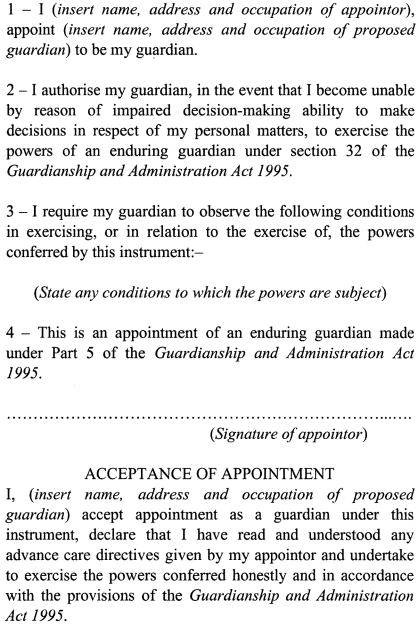
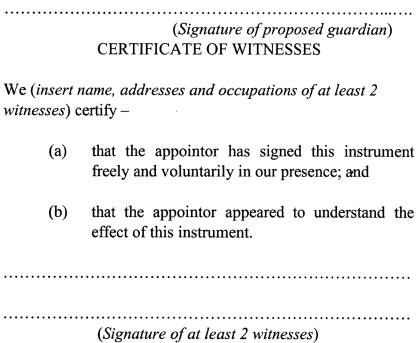
68. Schedule 4 amended (Savings and Transitional Provisions)
Schedule 4 to the Principal Act is amended as follows:(a) by omitting from clause 4 "full";(b) by omitting from clause 5(b) "of the estate of" and substituting "in respect of financial matters for";(c) by omitting from clause 6(b) "of the estate of" and substituting "in respect of financial matters for".
PART 3 - Tasmanian Civil and Administrative Tribunal Act 2020 Amended
In this Part, the Tasmanian Civil and Administrative Tribunal Act 2020 is referred to as the Principal Act.
70. Section 123 amended (Reports of proceedings and giving of information in relation to Guardianship stream proceedings)
Section 123 of the Principal Act is amended by inserting after subsection (1) the following subsection:(1A) Subsection (1) does not apply in respect of information that may be disclosed or published under section 86(2A) or (2B) of the Guardianship and Administration Act 1995.
71. Section 136 amended (Appeals to Supreme Court)
Section 136 of the Principal Act is amended as follows:(a) by omitting from subsection (6) "the Guardianship and Administration Act 1995 or";(b) by inserting the following subsection after subsection (6) :(6A) If the Tribunal makes a decision under the Guardianship and Administration Act 1995, a person who –(a) appeared, or was entitled to appear, before the Tribunal at a hearing for the purposes of that Act at which the decision was made; or(b) with the leave of the Tribunal, would have been entitled to appear before the Tribunal at a hearing for the purposes of that Act at which the decision was made; or(c) in respect of whom the decision was made –may appeal to the Supreme Court –(d) on a question of law or fact, against an order of the Tribunal under sections 20, 51 or 68 of that Act; or(e) on a question of law or fact, against a decision of the Tribunal under section 34 of that Act; or(f) on a question of law, as of right, or with the leave of the Supreme Court, on a question of fact against any other decision by the Tribunal under that Act.
72. Schedule 3 amended (Protective Division)
Part 4 of Schedule 3 to the Principal Act is amended as follows:(a) by inserting the following definition after the definition of service provider in clause 1 :spouse, in relation to a person, includes the person who is in a significant relationship, within the meaning of the Relationships Act 2003, with that person;(b) by omitting from clause 5(2) "The" and substituting "Subject to subclause (7), the";(c) by inserting the following paragraph after paragraph (e) in clause 5(2) :(ea) if the person has a spouse, the spouse; and(d) by inserting the following paragraph after paragraph (fa) in clause 5(2) :(fb) if the matter relates to the conduct of health and medical research in relation to a person with impaired decision-making ability –(i) the health and medical research practitioner, within the meaning of Part 6A of the Guardianship and Administration Act 1995, proposing to conduct the health and medical research; and(ii) the lead health and medical researcher, within the meaning of Part 6A of the Guardianship and Administration Act 1995, in relation to the health and medical research; and(e) by inserting the following subclauses after subclause (6) in clause 5 :(7) Subject to subclause (8), the Tribunal may vary the required period to give notice of a hearing under subclause (2) in accordance with any Tribunal rules made under section 115.(8) The Tribunal –(a) may only reduce the required period to give notice under subclause (7) if the Tribunal is satisfied that it is proper to do so; and(b) must endeavour to give reasonable notice to all parties to a hearing if it reduces the required period to give notice of that hearing under subclause (7).(f) by omitting from clause 8(1) "If" and substituting "Subject to subclause (4), if";(g) by inserting the following subclause after subclause (3) in clause 8 :(4) If the Tribunal adjourns the hearing of an application in Guardianship stream proceedings, the Tribunal may not extend an interlocutory order made under section 65 of the Guardianship and Administration Act 1995.(h) by omitting subclause (1) from clause 9 and substituting the following subclause:(1) The following persons may, by notice in writing given to the Tribunal within 30 days after the making of a determination of the Tribunal in Guardianship stream proceedings, request the Tribunal to give to the person a statement in writing of reasons for the determination:(a) those persons that are entitled to appeal against the determination;(b) any other person who the Tribunal is satisfied has a proper interest in the matter.
PART 4 - Disability Services Act 2011 Amended
In this Part, the Disability Services Act 2011 is referred to as the Principal Act.
74. Section 42 amended (Approvals to carry out restrictive interventions)
Section 42(7)(b) of the Principal Act is amended by omitting "full or limited".
PART 5 - Repeal of Act
This Act is repealed on the first anniversary of the day on which the last uncommenced provision of this Act commenced.
[Second reading presentation speech made in:
House of Assembly on 10 AUGUST 2023
Legislative Council on 24 AUGUST 2023]