

Criminal Code (Miscellaneous Amendments) Act 2003
An Act to amend the Criminal Code Act 1924
[Royal Assent 15 December 2003]
Be it enacted by His Excellency the Governor of Tasmania, by and with the advice and consent of the Legislative Council and House of Assembly, in Parliament assembled, as follows:
This Act may be cited as the Criminal Code (Miscellaneous Amendments) Act 2003 .
This Act commences on the day on which this Act receives the Royal Assent.
In this Act, the Criminal Code Act 1924 is referred to as the Principal Act.
4. Schedule 1 amended (Criminal Code)
Schedule 1 to the Principal Act is amended as follows:(a) by inserting the following definition after the definition of criminally responsible in section 1 :Crown means –(a) the Crown in right of Tasmania; or(b) the State of Tasmania;(b) by inserting the following section after section 162 :162A. Failing to report the killing of a person
(1) In this section,proper authority means any of the following:(a) a police officer;(b) a correctional officer within the meaning of the Corrections Act 1997 ;(c) a probation officer within the meaning of the Corrections Act 1997 ;(d) a Crown Law Officer.(2) A person is guilty of a crime if he or she –(a) discovers that another person has been killed; and(b) fails without reasonable excuse to report that discovery to a proper authority as soon as practicable.Charge: Failing to report the killing of a person.(3) A person is guilty of a crime if he or she –(a) discovers that another person is being subjected to conduct that, if repeated or continued, is reasonably likely to result in that other person being killed; and(b) fails without reasonable excuse to report that discovery to a proper authority as soon as practicable.Charge: Failing to report the impending killing of a person.(4) A person is guilty of a crime if he or she –(a) discovers that the killing of another person is being planned; and(b) fails without reasonable excuse to report that discovery to a proper authority as soon as practicable.Charge: Failing to report the planned killing of a person.(5) Without limiting the matters that may constitute a reasonable excuse for the purposes of subsection (2) , (3) or (4) , a person is excused from reporting a discovery to a proper authority under this section if –(a) the person knows or reasonably suspects that –(i) another person has already reported the discovery to a proper authority; or(ii) a proper authority has already made the same discovery; or(b) reporting the discovery would disclose information that is privileged on the ground of legal professional privilege.(c) by omitting section 361A and substituting the following section:361A. Argument before jury is sworn
(1) After an accused person has been called upon to plead as provided in section 351 (1) , all or any of the following may occur before a jury is sworn if the court thinks fit:(a) the accused person may make admissions under section 184 of the Evidence Act 2001 ;(b) the court may determine any question of law or procedure that has arisen or is expected to arise in the trial;(c) the court may determine any question of fact that may lawfully be determined by a judge alone without a jury;(d) the court may determine any other question that it considers necessary or convenient to determine in order to ensure that the trial will be conducted fairly and expeditiously;(e) the court may give such directions as it thinks fit in order to resolve any issue or matter that it considers necessary or convenient to resolve before a jury is sworn.(2) If –the admission, determination or direction has the same status for the purposes of the new trial as if it had been made or given, between the arraignment of the accused and the empanelment of the jury, during that new trial.(a) an admission, determination or direction is made or given under subsection (1) ; and(b) a new trial of the indictment is had at the same or any future sittings of the court, whether before the same or a different judge –(d) by inserting in Appendix A afterthe following item:
Severing with intent to steal.
Robbery.
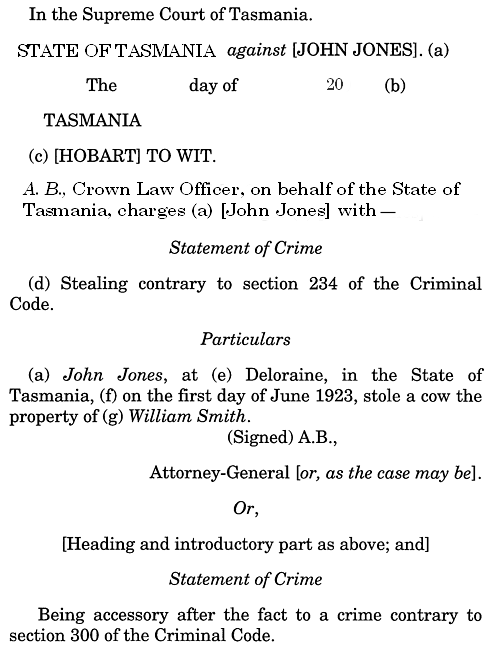
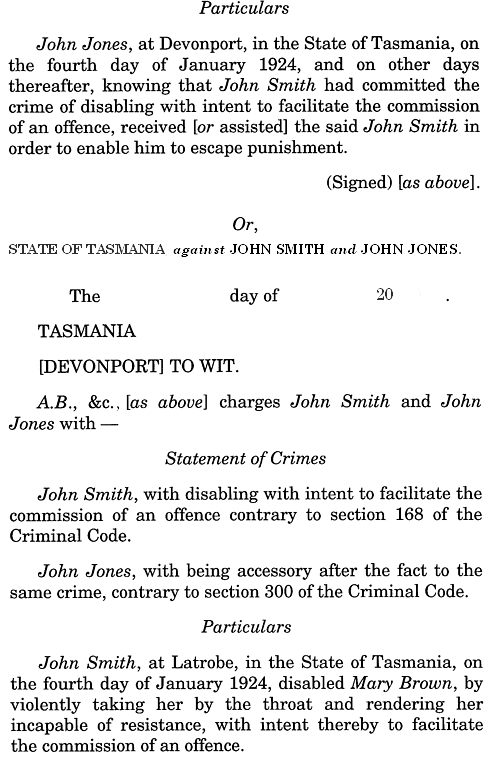
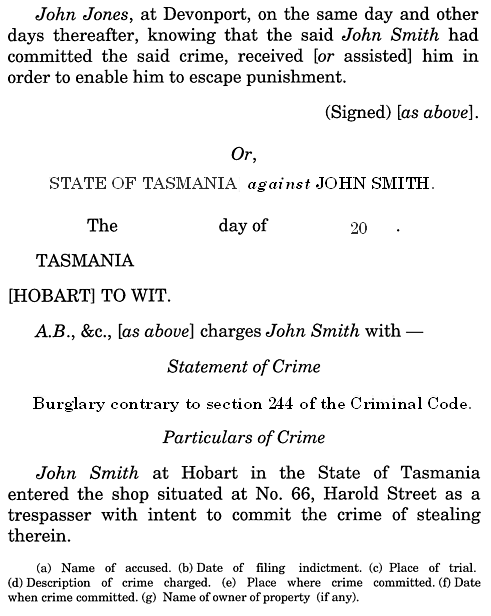
(e) by omitting Appendix C and substituting the following Appendix:APPENDIX C - Forms of IndictmentForm
[Second reading presentation speech made in:
House of Assembly on 30 SEPTEMBER 2003
Legislative Council on 26 NOVEMBER 2003]