

Pollution of Waters by Oil and Noxious Substances Amendment Act 2000
An Act to amend the Pollution of Waters by Oil and Noxious Substances Act 1987
Be it enacted by His Excellency the Governor of Tasmania, by and with the advice and consent of the Legislative Council and House of Assembly, in Parliament assembled, as follows:
This Act may be cited as the Pollution of Waters by Oil and Noxious Substances Amendment Act 2000 .
This Act commences on the day on which this Act receives the Royal Assent.
In this Act, the Pollution of Waters by Oil and Noxious Substances Act 1987 is referred to as the Principal Act.
4. Section 3 amended (Interpretation)
Section 3 of the Principal Act is amended as follows:(a) by inserting the following definitions after the definition of Convention in subsection (1) :costs includes expenses;crew, in relation to a ship, includes its master;(b) by omitting "within the meaning of the Marine and Safety Authority Act 1997 " from paragraph (a) of the definition of harbour master in subsection (1) ;(c) by inserting the following definition after the definition of harbour master in subsection (1) :livestock includes fish reared commercially in marine farms;(d) by inserting the following definition after the definition of Marine and Safety Authority in subsection (1) :marine pollutant means any one, or any combination, of the following substances (whether in bulk, packaged or another form):(a) oil within the meaning of Annex I to the Convention;(b) a mixture that contains any oil within the meaning of Annex I to the Convention;(c) a noxious liquid substance within the meaning of Annex II to the Convention;(d) a mixture that contains any noxious liquid substance within the meaning of Annex II to the Convention;(e) a harmful substance within the meaning of Annex III to the Convention;(f) garbage within the meaning of Annex V to the Convention;(e) by inserting the following definition after the definition of marine pollution in subsection (1) :maritime casualty includes, but is not limited to, any one or any combination of the following:(a) a collision between ships;(b) the collision of a ship with a bridge, breakwater or wharf;(c) the stranding of a ship;(d) the breaking-up, capsizing or foundering of a ship;(e) an explosion or fire on a ship;(f) the abandonment or evacuation of a ship by its crew;(g) the failure of a pipeline or other apparatus used for transferring fuel between ships or between a ship and a shore facility;(f) by inserting the following definition after the definition of Navigation Act in subsection (1) :physical environment includes the wildlife and livestock that live in the physical environment;(g) by inserting the following definition after the definition of pleasure vessel in subsection (1) :port operator means a port operator within the meaning of the Marine and Safety Authority Act 1997 ;(h) by omitting " Annexes III , IV , and V " from the definition of the 1973 Convention in subsection (1) and substituting "Annexes IV and VI";(i) by omitting subsection (6) .
5. Section 3A inserted
After section 3 of the Principal Act , the following section is inserted in Part 1:3A. Discharges that enter State waters taken to be discharges into State waters
(1) For the purposes of this Act –(a) the discharge of a marine pollutant outside State waters is, if the marine pollutant later enters State waters, taken to be a discharge of the marine pollutant into State waters; and(b) the discharge of a marine pollutant onto or into waters or a structure or thing is, if the marine pollutant later enters State waters, taken to be a discharge of the marine pollutant into State waters.(2) In either case, the discharge of the marine pollutant is taken to occur when it enters State waters.
6. Section 4A inserted
After section 4 of the Principal Act , the following section is inserted in Part 1:4A. Warships, &c., are exempt from Act
Notwithstanding section 4 , this Act does not apply to –(a) a ship under the control of the Australian Defence Force; or(b) a warship, naval auxiliary or other ship engaged exclusively in the non-commercial government service of a foreign country.
7. Section 6 substituted
Section 6 of the Principal Act is repealed and the following section is substituted:(1) The Minister may delegate any of the Minister's powers or functions under this Act other than this power of delegation.(2) A harbour master may delegate any of the harbour master's powers or functions as an authorized officer under this Act other than this power of delegation.
8. Section 8 amended (Prohibition of discharge of oil or oily mixtures into State waters)
Section 8(1) of the Principal Act is amended as follows:(a) by omitting "a fine not exceeding";(b) by omitting from paragraph (a) "500 penalty units" and substituting "a fine not exceeding 2 500 penalty units or imprisonment for a term not exceeding 4 years";(c) by omitting from paragraph (b) "1 000 penalty units." and substituting "a fine not exceeding 10 000 penalty units".
9. Section 9 amended (Oil residues)
Section 9(1) of the Principal Act is amended as follows:(a) by omitting "a fine not exceeding";(b) by omitting from paragraph (a) "500 penalty units" and substituting "a fine not exceeding 2 500 penalty units or imprisonment for a term not exceeding 4 years";(c) by omitting from paragraph (b) "1 000 penalty units." and substituting "a fine not exceeding 10 000 penalty units.".
10. Section 10 repealed
Section 10 of the Principal Act is repealed.
11. Section 11 amended (Oil record book)
Section 11 of the Principal Act is amended as follows:(a) by omitting from subsection (4)(b) "100 penalty units." and substituting "1 000 penalty units.";(b) by omitting from subsection (8) "50 penalty units." and substituting "500 penalty units.".
12. Section 12 repealed
Section 12 of the Principal Act is repealed.
13. Section 13 amended (Oil record book to be retained)
Section 13(2)(b) of the Principal Act is amended by omitting "100 penalty units." and substituting "1 000 penalty units.".
14. Section 15 amended (Restriction on transfer of oil at night)
Section 15 of the Principal Act is amended as follows:(a) by omitting from subsection (3) "a fine not exceeding";(b) by omitting from subsection (3)(c) "50 penalty units" and substituting "a fine not exceeding 1 250 penalty units or imprisonment for a term not exceeding 2 years";(c) by omitting from subsection (3)(d) "100 penalty units." and substituting "a fine not exceeding 5 000 penalty units.";(d) by omitting from subsection (4) "Board" and substituting "port operator".
15. Section 20 amended (Prohibition of discharge of substances into State waters)
Section 20(1) of the Principal Act is amended as follows:(a) by omitting "a fine not exceeding";(b) by omitting from paragraph (a) "500 penalty units" and substituting "a fine not exceeding 2 500 penalty units or imprisonment for a term not exceeding 4 years";(c) by omitting from paragraph (b) "1 000 penalty units." and substituting "a fine not exceeding 10 000 penalty units.".
16. Section 22 repealed
Section 22 of the Principal Act is repealed.
17. Section 23 amended (Cargo record book)
Section 23(4)(b) of the Principal Act is amended by omitting "100 penalty units" and substituting "1 000 penalty units".
18. Section 24 repealed
Section 24 of the Principal Act is repealed.
19. Section 25 amended (Cargo record book to be retained)
Section 25 of the Principal Act is amended as follows:(a) by omitting from subsection (2)(b) "100 penalty units." and substituting "1 000 penalty units.";(b) by omitting from subsection (4)(b) "100 penalty units." and substituting "1 000 penalty units.".
20. Divisions 2A and 2B inserted
After section 25 of the Principal Act , the following Divisions are inserted in Part II:Division 2A - Pollution by packaged harmful substances25A. Interpretation of Division
Unless the contrary intention appears, an expression that is used in this Division and in Annex III to the Convention (whether or not a particular meaning is assigned to the expression in that Annex) has the same meaning in this Division as in that Annex.(1) The regulations made under this Part may declare that a substance specified in the regulations is, for the purposes of this Act and notwithstanding Annex III to the Convention, taken to be a harmful substance within the meaning of that Annex.(2) The regulations made under this Part may declare that a substance specified in the regulations is, for the purposes of this Act and notwithstanding Annex III to the Convention, taken not to be a harmful substance within the meaning of that Annex.25C. Discharge of packaged harmful substances into State waters prohibited
(1) If a harmful substance carried as cargo in packaged form is jettisoned from a ship into State waters, the master and the owner of the ship are each guilty of an offence and are each liable on summary conviction to –(a) if the offender is a natural person – a fine not exceeding 2 500 penalty units or imprisonment for a term not exceeding 4 years; or(b) if the offender is a body corporate – a fine not exceeding 10 000 penalty units.(2) Subsection (1) does not apply to the jettisoning of a harmful substance carried as cargo in packaged form from a ship –(a) for the purposes of securing the safety of the ship or saving life at sea; or(b) if the harmful substance escaped from the ship in consequence of damage, other than intentional damage, to the ship or its equipment, and all reasonable precautions were taken after the occurrence of the damage or the discovery of the jettisoning for the purpose of preventing or minimising the escape of the harmful substance; or(c) if the jettisoning was for the purpose of combating specific pollution incidents in order to minimise the damage from pollution and was approved by a prescribed officer.(3) For the purpose of subsection (2) , damage to a ship or to its equipment is to be taken to be intentional damage if, and only if, the damage arose in circumstances in which the master or owner of the ship –(a) acted with intent to cause the damage; or(b) acted recklessly and with knowledge that damage would probably result.Division 2B - Pollution by garbage25D. Interpretation of Division
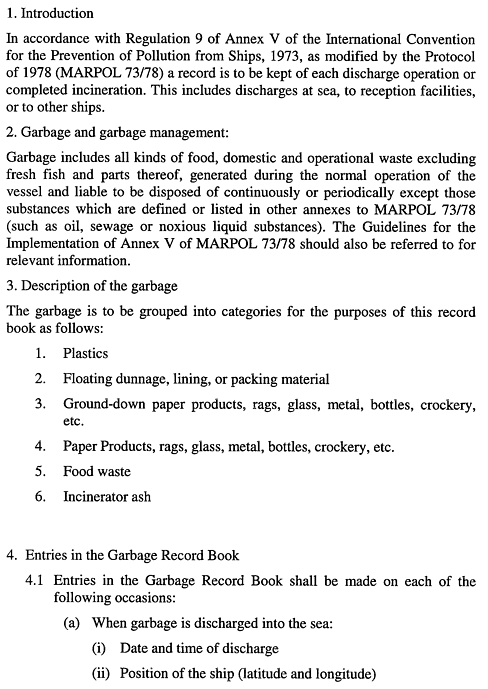
(1) Unless the contrary intention appears, an expression that is used in this Division and in Annex V to the Convention (whether or not a particular meaning is assigned to the expression in that Annex) has the same meaning in this Division as in that Annex.(2) In this Division,garbage includes plastics.(1) The regulations made under this Part may declare that a substance specified in the regulations is, for the purposes of this Act and notwithstanding Annex V to the Convention, taken to be garbage within the meaning of that Annex.(2) The regulations made under this Part may declare that a substance specified in the regulations is, for the purposes of this Act and notwithstanding Annex V to the Convention, taken not to be garbage within the meaning of that Annex.25F. Disposal of garbage into State waters prohibited
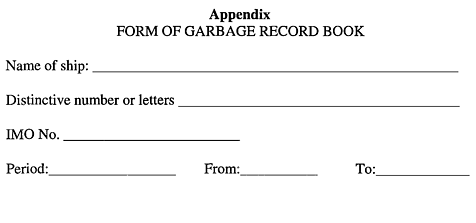
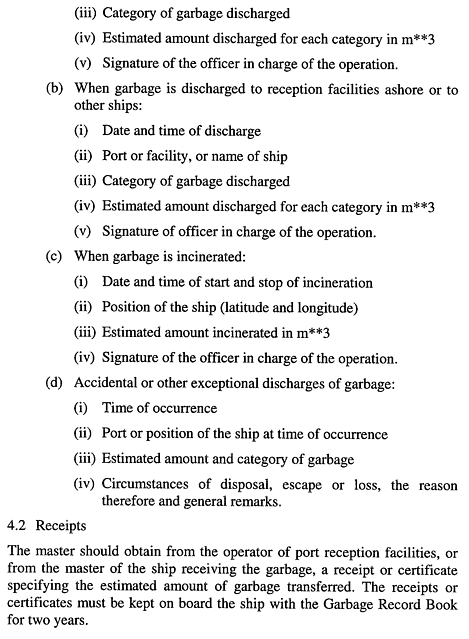
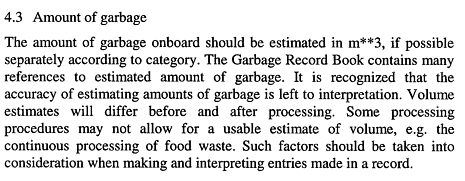
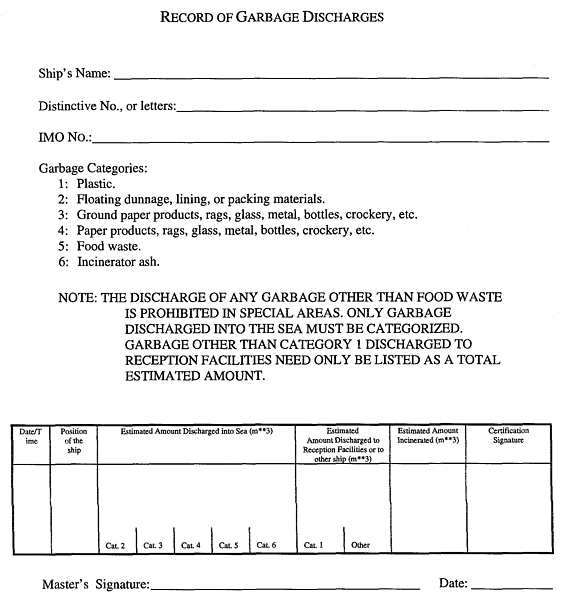
(1) If garbage is disposed of from a ship into State waters, the master and the owner of the ship are each guilty of an offence and are each liable on summary conviction to –(a) if the offender is a natural person – a fine not exceeding 2 500 penalty units; or(b) if the offender is a body corporate – a fine not exceeding 10 000 penalty units.(2) Subsection (1) does not apply to the disposal of garbage from a ship –(a) for the purposes of securing the safety of the ship or saving life at sea; or(b) if the garbage escaped from the ship in consequence of damage, other than intentional damage, to the ship or its equipment, and all reasonable precautions were taken after the occurrence of the damage or the discovery of the disposal for the purpose of preventing or minimising the escape of the garbage; or(c) if the disposal was for the purpose of combating specific pollution incidents in order to minimise the damage from pollution and was approved by a prescribed officer.(3) For the purpose of subsection (2) , damage to a ship or to its equipment is to be taken to be intentional damage if, and only if, the damage arose in circumstances in which the master or owner of the ship –(a) acted with intent to cause the damage; or(b) acted recklessly and with knowledge that damage would probably result.(1) This section applies to the following ships:(a) vessels that have a gross tonnage of 400 or more;(b) vessels that are certified to carry 15 or more persons;(c) fixed or floating platforms that are engaged in exploration and exploitation of the sea-bed.(2) A garbage record book must be carried in every ship to which this section applies.(3) A garbage record book must be in accordance with the prescribed form with provision made for a signature, in accordance with subsection (7) , in relation to each entry made in it and for a signature, in accordance with subsection (8) , on each page of it.(4) If a ship to which this section applies does not carry a garbage record book as required by this section, the master and the owner of the ship are each guilty of an offence and are each liable on summary conviction to a fine not exceeding –(a) if the offender is a natural person – 500 penalty units; or(b) if the offender is a body corporate – 1 000 penalty units.(5) When a prescribed operation or occurrence is carried out or occurs in or in relation to a ship to which this section applies, the master of the ship must, without delay –(a) make appropriate entries in accordance with subsection (7) in the ship's garbage record book; or(b) cause appropriate entries in accordance with subsection (7) to be made in the ship's garbage record book.(6) An authorized officer who has inspected a ship to which this section applies must make appropriate entries in accordance with subsection (7) in the ship's garbage record book without delay.(7) An entry in a ship's garbage record book must –(a) be made in the English language; and(b) in the case of an entry made in relation to a prescribed operation, be signed by the officer or other person in charge of the operation.(8) When a page of a ship's garbage record book is completed, the master of the ship must sign the page without delay.(9) A person who fails to comply with subsection (5) , (7) or (8) is guilty of an offence and is liable on summary conviction to a fine not exceeding 500 penalty units.(10) For the purposes of this section, a fixed or floating platform that is engaged in exploration and exploitation of the sea-bed is taken to be a ship.25H. Garbage record book to be retained
(1) A garbage record book must be retained in the ship to which it applies for 2 years after the day on which the last entry was made in it and be readily available for inspection at all reasonable times.(2) If a garbage record book is not retained in a ship in accordance with subsection (1) , the master and the owner of the ship are each guilty of an offence and are each liable on summary conviction to a fine not exceeding –(a) if the offender is a natural person – 500 penalty units; or(b) if the offender is a body corporate – 1 000 penalty units.(3) On the expiration of the 2 year period referred to in subsection (1) , a garbage record book must be retained for one further year in the ship to which it applies, or at the registered office in the State of the owner of the ship, and be readily available for inspection at all reasonable times.(4) If a garbage record book of a ship is not retained in accordance with subsection (3) , the owner of the ship is guilty of an offence and is liable on summary conviction to a fine not exceeding –(a) if the offender is a natural person – 500 penalty units; or(b) if the offender is a body corporate – 1 000 penalty units.(5) The owner of a ship to which section 25G applies who resides in the State, or has an office or agent in the State, may from time to time furnish to a prescribed officer notice, in writing, of an address, being the address of –and the place or office of which an address is furnished for the time being under this subsection is the registered office in the State of the owner of the ship for the purposes of subsection (3) .(a) the place in the State at which he or she resides; or(b) his or her office in the State or, if the owner has more than one office in the State, the principal office in the State; or(c) the office or place of residence in the State of an agent or, if the agent has more than one office in the State, the principal office in the State of the agent –(6) If the owner of a ship to which section 25G applies does not reside in the State and does not have an office or agent in the State, the owner may deposit a garbage record book of the ship with a prescribed officer and the book, while so deposited, is taken for the purposes of subsection (3) to be retained at the registered office in the State of the owner.
21. Sections 25I and 25J inserted
Before section 26 of the Principal Act , the following sections are inserted in Division 3:(1) If an incident in relation to a ship occurs in State waters, the master of the ship must notify a prescribed officer of the incident in the prescribed manner without delay.Penalty: Fine not exceeding 500 penalty units.(2) In proceedings for an offence under subsection (1) it is a defence for the defendant to prove that he or she was unable to comply with that subsection in relation to the relevant incident.(3) If an incident in relation to a ship occurs in State waters and –the owner, charterer, manager or operator of the ship or an agent of the owner, charterer, manager or operator of the ship must notify a prescribed officer of the incident in the prescribed manner without delay and, if a prescribed officer is not so notified, each of those persons is guilty of an offence and liable on summary conviction to a fine not exceeding 500 penalty units.(a) the master of the ship is unable to comply with subsection (1) in relation to the incident; or(b) the incident occurs in circumstances in which the ship is abandoned –(4) In proceedings for an offence under subsection (3) , it is a defence for the defendant to prove –(a) that the defendant was not aware of the relevant incident; or(b) in the case of an incident to which subsection (3)(a) applies, that the defendant neither knew nor suspected that the master of the ship was unable to comply with subsection (1) in relation to the relevant incident.(5) Subsection (4) is not to be taken as limiting by implication any defence that would, but for that subsection, be available to a person charged with an offence against subsection (3) .(6) A master of a ship who has complied with subsection (1) must, if requested to do so by a prescribed officer, furnish a report of the relevant incident to a prescribed officer in the prescribed form and within the prescribed time.Penalty: Fine not exceeding 500 penalty units.(7) Where subsection (3) applies in relation to an incident, a person who has complied with that subsection must, if requested to do so by a prescribed officer, furnish a report of the relevant incident to a prescribed officer in the prescribed form and within the prescribed time.Penalty: Fine not exceeding 500 penalty units.(8) A person must not, in a notice given to a prescribed officer pursuant to subsection (1) or (3) or in a report furnished to a prescribed officer pursuant to subsection (6) or (7) , make a statement that is false or misleading in a material particular.Penalty: Fine not exceeding 500 penalty units.(9) A notice given to a prescribed officer pursuant to subsection (1) or (3) , or a report furnished to a prescribed officer pursuant to subsection (6) or (7) , is not admissible in evidence in a prosecution for an offence against section 8 (1) , section 20(1) , section 25C(1) or section 25F(1) without the consent of the defendant.(10) In this section,incident in relation to a ship means any one, or any combination of, the following:(a) the discharge from the ship of oil or an oily mixture contrary to section 8(1) , other than a discharge to which section 8 (4) applies;(b) an incident involving the probable discharge from the ship of oil or an oily mixture contrary to section 8(1) , other than a discharge to which section 8 (4) would apply;(c) the discharge from the ship of a liquid substance, or a mixture containing a liquid substance, carried as cargo or part cargo in bulk contrary to section 20(1) , other than a discharge to which section 20(4) , (5) , (6) , (7) , (8) , (9) , (10) , (11) or (12) applies;(d) an incident involving the probable discharge from the ship of a liquid substance, or a mixture containing a liquid substance, carried as cargo or part cargo in bulk contrary to section 20(1) , other than a discharge to which section 20(4) , (5) , (6) , (7) , (8) , (9) , (10) , (11) or (12) would apply;(e) the jettisoning from the ship of a harmful substance carried as cargo in packaged form contrary to section 25C(1) ;(f) an incident involving the probable jettisoning from the ship of a harmful substance carried as cargo in packaged form contrary to section 25C(1) ;(g) the disposal of garbage from the ship contrary to section 25F(1) ;(h) an incident involving the probable disposal of garbage from the ship contrary to section 25F(1) .(1) The Minister may, by emergency declaration, declare that a State law is of no effect to such extent (either as to scope or area or both) and for such period (not exceeding 14 days) as is specified in the declaration if the Minister is satisfied on reasonable grounds that –(a) a maritime casualty, or other incident, involving the actual or imminent discharge of a marine pollutant into State waters has occurred; and(b) the incident, by its nature or magnitude, constitutes a grave and imminent threat to –(i) State waters, the coastline or another part of the State's physical environment; or(ii) the related interests of the State; and(c) urgent action must be taken to deal with the incident; and(d) the State law is inconsistent with, or would impede, the taking of that action.(2) The Minister is not required to engage in consultation about the declaration.(3) The declaration must identify the incident and describe the nature of the emergency.(4) The declaration has effect according to its terms.(5) The declaration expires 14 days after it is gazetted unless it is sooner revoked by the Minister.(6) The Minister must revoke the declaration before its date of expiry if the Minister is satisfied that the emergency has passed, or abated to such an extent that the declaration is no longer warranted.(7) The declaration, and notice of the revocation of the declaration under subsection (6) –(a) must be published in the Gazette; and(b) may be published in such other ways as the Minister sees fit.(8) The Minister must cause a copy of the declaration to be laid before each House of Parliament within the first 3 sitting days of that House after the declaration is gazetted, whether or not the declaration has expired or been revoked.(9) Either House of Parliament may pass a motion to disallow the declaration if it has not already expired or been revoked.(10) Disallowance of the declaration under subsection (9) renders it void but does not affect the validity of anything done under the declaration before the passing of the motion of disallowance.(11) If a House of Parliament passes a motion to disallow the declaration, the Clerk of the House must cause notice of the motion to be –(a) given to the Minister immediately; and(b) published in the Gazette as soon as practicable.(12) In this section,State law means a law of the State, or a council by-law, relating to the State's physical environment.
22. Section 26 amended (Powers of authorized officers)
Section 26(11) of the Principal Act is amended by omitting "20 penalty units." and substituting "200 penalty units.".
23. Sections 26A and 26B inserted
After section 26 of the Principal Act , the following sections are inserted in Division 3:26A. Serious maritime casualties: emergency powers of authorized officers
(1) If an authorized officer is satisfied on reasonable grounds that –the authorized officer may assume control of the ship, boarding it if necessary with or without assistants and equipment, and take or attempt to take the action in accordance with this section.(a) a maritime casualty, or other incident, involving the actual or imminent discharge of a marine pollutant into State waters has occurred; and(b) the incident, by its nature or magnitude, constitutes a grave and imminent threat to –(i) State waters, the coastline or another part of the State's physical environment; or(ii) the related interests of the State; and(c) an urgent critical action needs to be taken in respect of a ship involved in the incident in order to counter the threat; and(d) it appears that the action is practicable but is not being taken or attempted by its crew, either at all or within the necessary time –(2) If the action involves the destruction of the ship or part of the ship, or the jettisoning or destruction of all or part of its cargo, the authorized officer must first, if it is practicable to do so, make a reasonable attempt to obtain approval from the Minister or Director for the action to be taken.(3) The provisions of subsections (3) , (4) , (5) , (6) , (7) and (8) of section 26 have the same application to the exercise of an authorized officer's powers under this section as those provisions have to the exercise of an authorized officer's powers under that section.(4) Unless it has been abandoned or evacuated by its crew, an authorized officer is taken to have assumed control of a ship under the power conferred by this section as soon as the officer has –(a) produced, if the officer is not a member of the police force, the officer's written authority under section 26(7) to the master; and(b) subject to subsection (5) , given the master written notice that the officer is exercising the power.(5) If it is not practicable for the notice to be in writing it may be given orally and confirmed in writing as soon as practicable.(6) An authorized officer who has taken control of a ship has power to do all the things that may be necessary or expedient for the purposes of exercising that control.(7) An authorized officer who has assumed control of a ship under this section must, if it is possible and safe to do so, relinquish that control to its master as soon as practicable after taking, or making a reasonable attempt to take, the critical action.(8) A person must not –(a) prevent an authorized officer from exercising power under this section; or(b) hinder, threaten or endanger an authorized officer in the exercise of a power under this section; or(c) disobey an order or signal given by an authorized officer who is in control of a ship pursuant to this section.Penalty: Fine not exceeding 500 penalty units.(9) In this section –critical action includes, but is not limited to, any one or any combination of the following:(a) moving a ship;(b) moving cargo within a ship or removing (other than by jettisoning) cargo from a ship;(c) jettisoning or destroying all or part of a ship's cargo;(d) sinking or destroying all or part of a ship;(e) taking on, moving or discharging a ship's ballast;(f) taking emergency measures in respect of a fire, gas or marine pollutant;(g) evacuating people or animals from a ship;master does not include an authorized officer in control of a ship;ship includes the ship's cargo.26B. False entries in record books
(1) In this section,record book means –(a) an oil record book required to be kept under Division 1 ; or(b) a cargo record book required to be kept under Division 2 ; or(c) a garbage record book required to be kept under Division 2B .(2) A person must not, in a record book, make an entry that is false or misleading in a material particular.Penalty: Fine not exceeding 1 000 penalty units.
24. Section 27A inserted
After section 27 of the Principal Act , the following section is inserted in Division 3:27A. Liability for simultaneous discharges may be joint and several if unidentifiable
(1) Where there is a simultaneous discharge of a marine pollutant into State waters from 2 or more ships and it is not possible or reasonably practicable to identify the discharge from a particular ship, all of the marine pollutant may, for the purposes of this Act, be taken to have been discharged from each of the ships.(2) If subsection (1) is applied, a person may be charged with and convicted of an offence in respect of the discharge from one ship whether or not any person is charged with or convicted of an offence in respect of the discharge from another ship.(3) For the purposes of this section, events are taken to be simultaneous if they happen within 24 hours of each other.
25. Section 28 amended (Service of summonses)
Section 28 of the Principal Act is amended by omitting subsection (3) .
26. Section 32 amended (Regulations)
Section 32(1)(f)(i) of the Principal Act is amended by omitting "20 penalty units" and substituting "100 penalty units".
27. Section 35 amended (Constitution of State Marine Pollution Committee)
Section 35 of the Principal Act is amended as follows:(a) by omitting from subparagraph (viii) of subsection (2)(c) "Association." and substituting "Association;";(b) by inserting the following subparagraphs after subparagraph (viii) of subsection (2)(c):(ix) the Marine and Safety Authority;(x) the responsible Department in relation to the National Parks and Wildlife Act 1970 .(c) by omitting from subsection (5)(c) "subsection (2) of section 37" and substituting "section 37".
28. Section 36 amended (Meetings of the Committee)
Section 36(2) of the Principal Act is amended by omitting "Five" and substituting "Six".
29. Sections 37, 38 and 39 substituted and section 39A inserted
Sections 37, 38 and 39 of the Principal Act are repealed and the following sections are substituted:37. Procedure for spill incidents
(1) In this section –incident controller means the person having the immediate responsibility, on behalf of the State, for the management of operations in response to an actual or potential spill;spill means a discharge of a marine pollutant into State waters.(2) The Director must immediately convene a meeting of the Committee if a spill occurs, or appears likely to occur, from –(a) a ship; or(b) other waters; or(c) a place on land, including a platform; or(d) a pipeline or other apparatus used for transferring a marine pollutant to or from a ship.(3) The Committee has the following functions in relation to the spill:(a) to make recommendations to the Director, the incident controller and authorized officers;(b) to coordinate the provision of advice to the State government and, as necessary, other levels of government;(c) to monitor the implementation of decisions taken by the State government and, as necessary, make recommendations to the incident controller or other persons for remedial or further action;(d) to facilitate communication between governments and persons involved in dealing with the spill, including, in particular, the communications to and from the incident controller and authorized officers.38. Cost of incidents: recovery
(1) The costs incurred by or on behalf of a Government department, State authority, council or port operator in dealing with either of the following incidents are taken to be costs incurred on behalf of the Crown:(a) a maritime casualty or other incident involving the actual or potential discharge of a marine pollutant into State waters from a ship;(b) a maritime casualty or other incident involving the actual or potential discharge of a marine pollutant into State waters from a pipeline or other apparatus used for transferring a marine pollutant between a ship and a shore facility, where the incident is caused by the negligence of the person who owns or operates the shore facility or by an employee or agent of that person.(2) The Director, on behalf of the Crown, may recover the costs from –(a) if subsection (1)(a) applies, the owner or master of the ship; or(b) if subsection (1)(b) applies, the owner or operator of the shore facility.(3) The costs may –(a) be awarded to the Crown in the course of proceedings for an offence against this Act in respect of the relevant discharge, whether or not the person against whom those proceedings are brought is convicted of the offence; or(b) be recovered in a court of competent jurisdiction as a debt due to the Crown, notwithstanding that proceedings have not been taken for an offence against this Act in respect of the relevant discharge.(4) The Director, if unable to recover the whole or any part of the costs as provided by subsection (2) or section 39 , must take such action as is necessary to obtain recompense from the Commonwealth under the National Plan to Combat Pollution of the Sea by Oil and other Noxious and Hazardous Substances.(5) Subsection (4) does not apply if the marine pollutant referred to in subsection (1)(a) or (b) is garbage.(6) For the purposes of this section, a cost is taken to have been incurred in dealing with an actual or potential discharge of a marine pollutant into State waters if the cost is attributable to any one or more of the following activities:(a) planning, coordinating and generally implementing the response to the actual or potential discharge;(b) stopping, reducing, containing, dispersing or removing the actual discharge or preventing the potential discharge;(c) taking measures to safeguard human life;(d) taking measures to safeguard, or mitigate damage done to, the physical environment;(e) taking measures to move, safeguard or salvage a ship or its cargo;(f) taking control of or sinking or destroying a ship, including any part of a broken-up ship;(g) cleaning up and otherwise rehabilitating the physical environment or anything else that may have been damaged because of the actual or potential discharge;(h) procuring and deploying machinery, equipment or material to deal with the actual or potential discharge or with its effects or probable effects;(i) procuring and deploying expertise, labour or other human resources to deal with the actual or potential discharge or with its effects or probable effects.39. Costs of incidents: power of detention
(1) Where a person has been convicted of an offence under section 8 , 20 or 25C and the Crown, pursuant to section 38 , is awarded or recovers any of the costs that it has incurred in relation to the incident constituting the offence, those costs are taken to be a charge on the ship from which the offence was committed.(2) If the ship is in State waters, the Director may detain it on behalf of the Crown until –(a) the costs are paid; or(b) security for the costs is provided to the satisfaction of the Director.(3) If the ship leaves State waters without the written permission of the Director or an authorized officer before it is released from detention, the master and the owner of the ship are each guilty of an offence and are each liable on summary conviction to –(a) if the offender is a natural person – 500 penalty units and a further fine not exceeding 50 penalty units for each full day that the ship remains outside State waters; or(b) if the offender is a body corporate – 1 000 penalty units and, in the case of a continuing offence, a further fine not exceeding 100 penalty units for each full day that the ship remains outside State waters.(4) A ship is taken to have been detained or released from detention for the purposes of this section when the Director, on behalf of the Crown, serves written notice of the detention or release on the master, or on an owner, of the ship.39A. Right to claim damages, &c., not affected by Act
(1) Nothing in this Act affects or qualifies the right of an appropriate authority or of any other person to claim or recover damages in respect of the consequences of a discharge of a marine pollutant into State waters, whether from a ship or otherwise.(2) In subsection (1) ,appropriate authority means –(a) in relation to the area of a port as determined under an Act, the body that is responsible for constructing, improving, managing, regulating or maintaining the port; or(b) in relation to an area not within a port, the Government department or State authority having jurisdiction over the area.
30. Section 44 amended (Alteration, &c., of construction of ships and cancellation of certificates)
Section 44 of the Principal Act is amended as follows:(a) by omitting from subsection (1)(a) "5 penalty units" and substituting "50 penalty units";(b) by omitting from subsection (1)(b) "10 penalty units" and substituting "100 penalty units";(c) by omitting from subsection (2)(c)(i) "5 penalty units" and substituting "50 penalty units";(d) by omitting from subsection (2)(c)(ii) "10 penalty units" and substituting "100 penalty units".
31. Section 45 amended (Ships to be surveyed periodically)
Section 45(2) of the Principal Act is amended as follows:(a) by omitting from paragraph (a) "20 penalty units" and substituting "2 000 penalty units";(b) by omitting from paragraph (b) "50 penalty units." and substituting "5 000 penalty units.".
32. Section 46 amended (Requirement for ship construction certificates)
Section 46 of the Principal Act is amended as follows:(a) by omitting from subsection (3) "100 penalty units" and substituting "1 000 penalty units";(b) by omitting from subsection (3) ", or both";(c) by omitting from subsection (5)(a) "100 penalty units" and substituting "1 000 penalty units";(d) by omitting from subsection (5)(a) ", or both";(e) by omitting from subsection (5)(b) "400 penalty units." and substituting "4 000 penalty units.";(f) by omitting from subsection (9) "2 penalty units." and substituting "20 penalty units.".
33. Section 50 amended (Alteration, &c., of construction of ships and cancellation of certificates)
Section 50 of the Principal Act is amended as follows:(a) by omitting from subsection (1)(a) "5 penalty units" and substituting "50 penalty units";(b) by omitting from subsection (1)(b) "10 penalty units." and substituting "100 penalty units.";(c) by omitting from subsection (2)(c)(i) "5 penalty units" and substituting "50 penalty units";(d) by omitting from subsection (2)(c)(ii) "10 penalty units." and substituting "100 penalty units.".
34. Section 51 amended (Ships to be surveyed periodically)
Section 51(2) of the Principal Act is amended as follows:(a) by omitting from paragraph (a) "20 penalty units" and substituting "200 penalty units";(b) by omitting from paragraph (b) "50 penalty units." and substituting "500 penalty units.".
35. Section 52 amended (Requirement for chemical tanker construction certificates)
Section 52 of the Principal Act is amended as follows:(a) by omitting from subsection (2)(a) "100 penalty units" and substituting "1 000 penalty units";(b) by omitting from subsection (2)(a) ", or both";(c) by omitting from subsection (2)(b) "400 penalty units." and substituting "4 000 penalty units.";(d) by omitting from subsection (5) "2 penalty units" and substituting "20 penalty units".
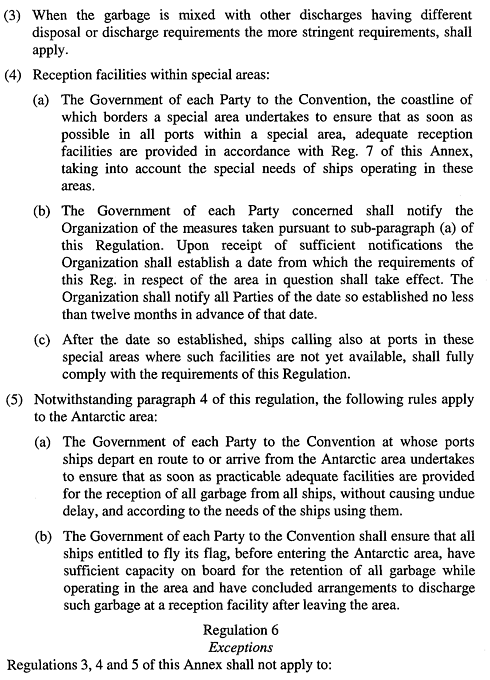
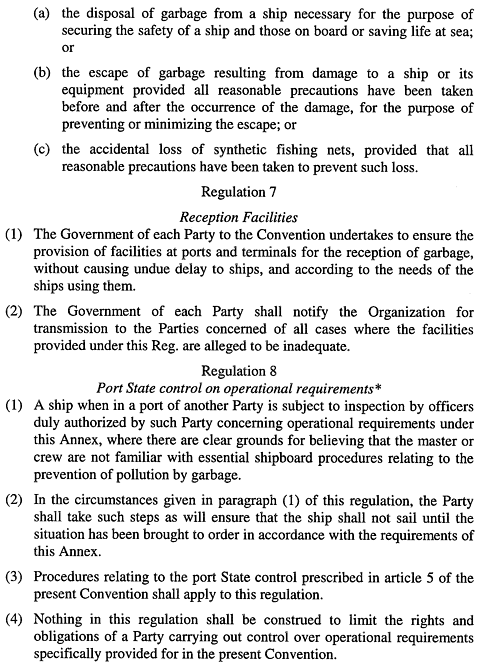
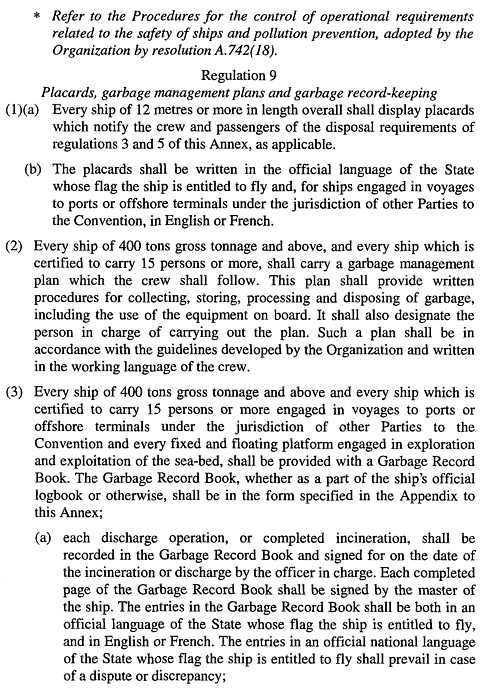
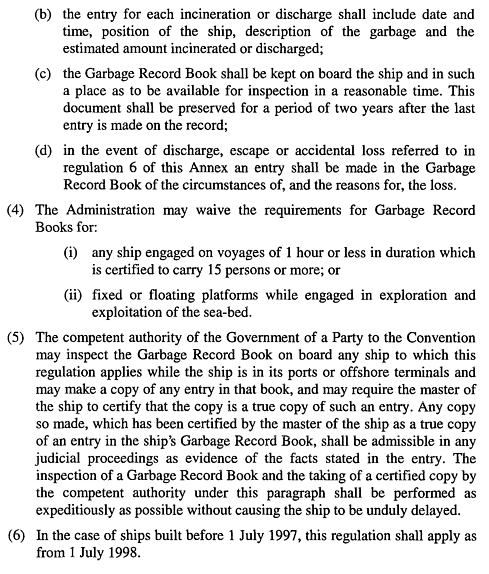
Schedule 1 to the Principal Act is amended by inserting, after Annex II to the Convention set out in the Schedule, the following Annexures:
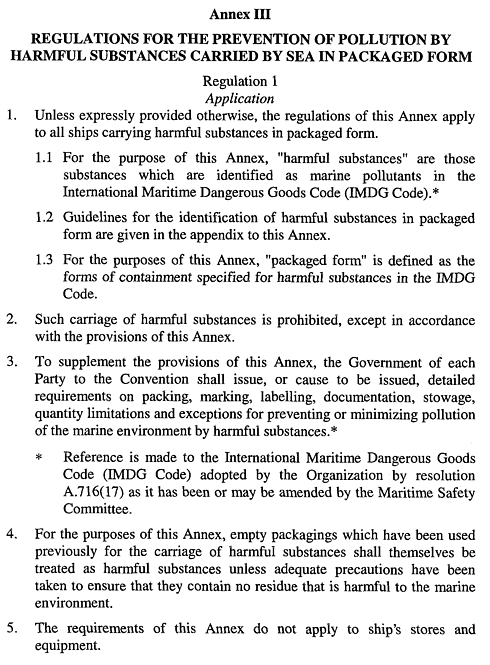
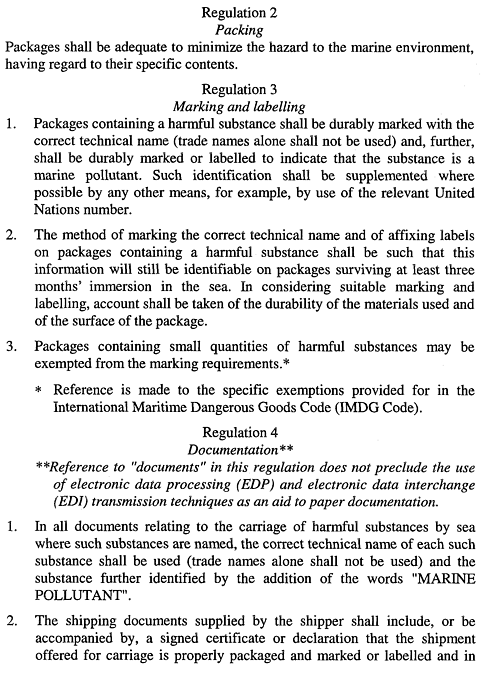
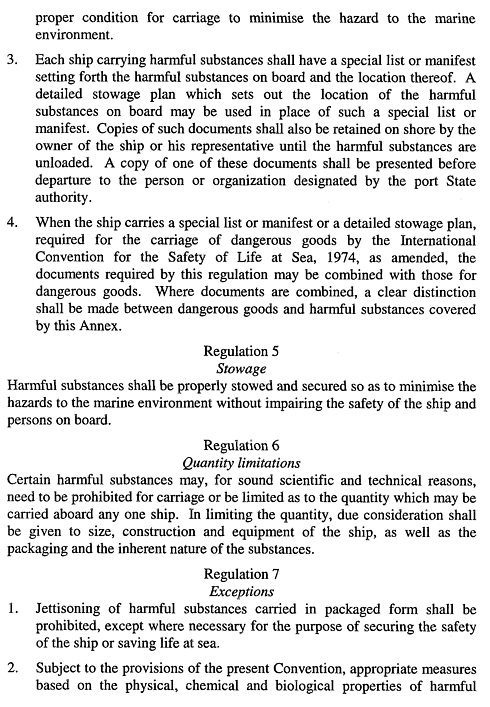
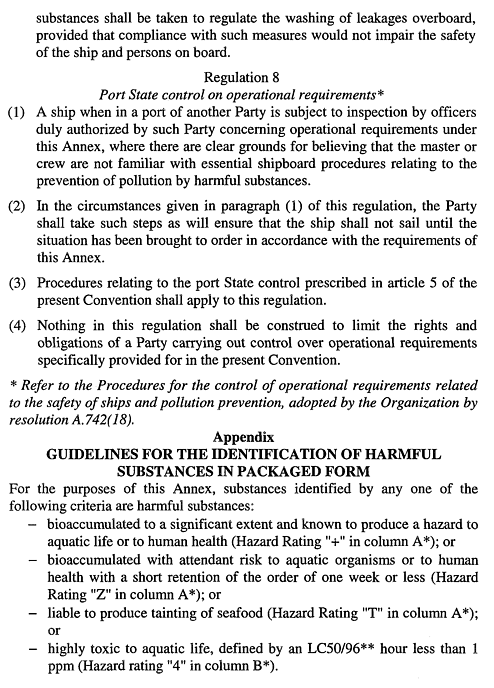
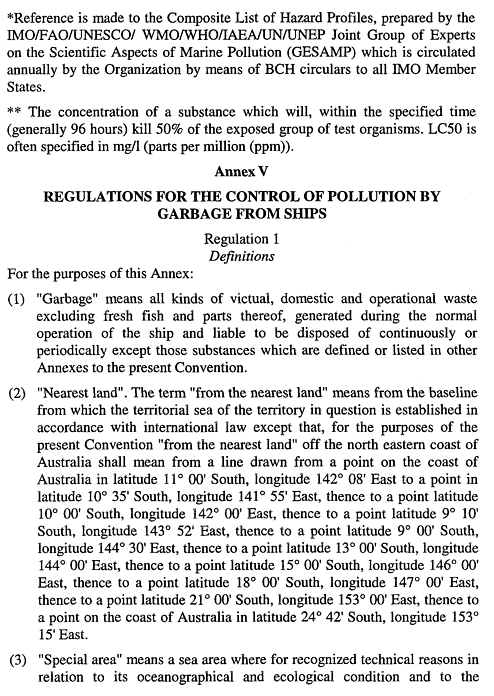
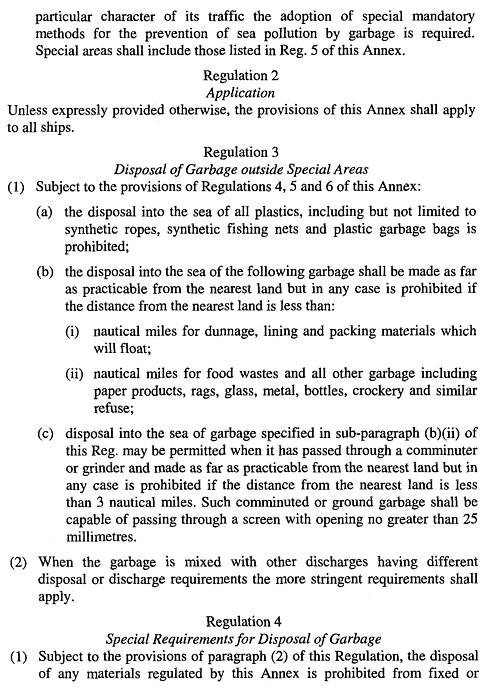
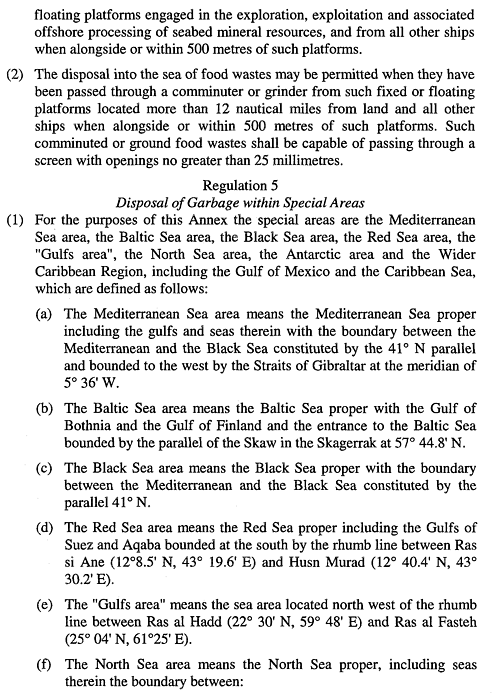
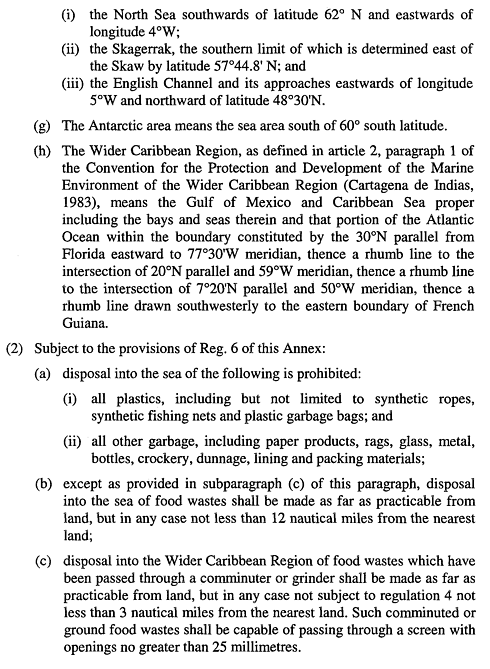
Each of the provisions of the Principal Act specified in Column 1 of Schedule 1 is amended by omitting "50 penalty units" on the number of occurrences specified in Column 2 of that Schedule and substituting "500 penalty units".
SCHEDULE 1 - Substitutions
Column 1 Provision amended | Column 2 Number of occurrences | 1 | 1 | 1 | 1 | 1 | 1 | 1 |
[Second reading presentation speech made in:
House of Assembly on 18 OCTOBER 2000
Legislative Council on 23 NOVEMBER 2000]