

Road Rules 2019
I, the Governor in and over the State of Tasmania and its Dependencies in the Commonwealth of Australia, acting with the advice of the Executive Council, make the following rules under the Traffic Act 1925 .
23 September 2019C. WARNER
Governor
By Her Excellency's Command,
MICHAEL DARREL JOSEPH FERGUSON
Minister for Infrastructure and Transport
PART 1 - Introduction
Division 1 - Road Rules
These rules may be cited as the Road Rules 2019 or the Road Rules.
(1) Except as provided for in this rule, these rules take effect on 25 November 2019.(2) Rule 79A takes effect on 1 December 2019.
The objects or the Road Rules are to –(a) provide road rules in this jurisdiction that are essentially uniform with road rules elsewhere in Australia for all road users; and(b) specify behaviour for all road users that supports the safe and efficient use of roads in Australia.
Division 2 - Some features of the Road Rules
4. Definitions: the dictionary, &c.
(1) The dictionary towards the end of the Road Rules defines certain words and expressions, and includes references to certain words and expressions defined elsewhere in the Rules (signpost definitions).Example 1The signpost definition "road-related area see rule 13" means that the expression road-related area is defined in rule 13 of the Road Rules.Note 1The dictionary only includes a signpost definition for a word or expression if the word or expression is used in 2 or more rules of the Road Rules.(2) The dictionary is part of the Road Rules.(3) A definition in the Road Rules applies to each use of the word or expression in the Rules, unless the contrary intention appears.
A diagram in the Road Rules is part of the Rules.Note 1If a diagram of a traffic control device, traffic-related item or symbol is in black and white in a rule of the Road Rules, the diagram may be a black and white version of the device, item or symbol – see rule 314. If so, the colour version of the device, item or symbol will be in Schedule 2 or 4.Note 2A diagram may be an example – see rule 6(1) .
(1) An example (whether or not in the form of a diagram) in the Road Rules is part of the Rules.(2) If the Road Rules includes an example of the operation of a provision of the Rules –(a) the example is not exhaustive; and(b) the example does not limit, but may extend, the meaning of the provision.
A heading to a Part, Division, Schedule, rule or any other provision of the Road Rules is part of the Rules.
A note in the Road Rules is explanatory and is not part of the Rules.
Any Reader’s Guide attached to the Road Rules is not part of the Rules.
(1) The word "Penalty" in a rule of the Road Rules (or, if the rule has 2 or more subrules, in a subrule) indicates that a contravention of the rule (or subrule) is an offence.(2) The penalty for an offence is the penalty specified after that word.
PART 2 - Application of the Road Rules
Division 1 - Roads and road-related areas
11. Road Rules apply to vehicles and road users on roads and road-related areas
(1) The Road Rules apply to vehicles and road users on roads and road-related areas.Note Road is defined in rule 12, road-related area is defined in rule 13, road user is defined in rule 14 and vehicle is defined in rule 15.(2) Each reference in the Road Rules (except in this Division) to a road includes a reference to a road-related area, unless otherwise expressly stated in the Rules.
Examples for subrule (2)
1.
A reference in rule 146 (which deals with driving within a single marked lane or line of traffic) to the road includes a reference to the road-related area of the road.
2.
A reference in rule 200(1) (which deals with certain heavy or long vehicles stopping on roads) to a length of road includes a reference to the road-related area of the length of road.
3.
A reference in rule 31 (which deals with starting a right turn from a road, except a multi-lane road) to a road does not include a reference to a road-related area, because of the definition in subrule (5) of that rule.
(1) A road is an area that is open to or used by the public and is developed for, or has as one of its main uses, the driving or riding of motor vehicles.Note Motor vehicle is defined in the dictionary.(2) However, unless the contrary intention appears, a reference in the Road Rules (except in this Division) to a road does not include a reference to –(a) an area so far as the area is declared, under another law of this jurisdiction, not to be a road for the Road Rules; or(b) any shoulder of the road.(3) The shoulder of the road includes any part of the road that is not designed to be used by motor vehicles in travelling along the road, and includes –but does not include a bicycle path, footpath or shared path.(a) for a kerbed road – any part of the kerb; and(b) for a sealed road – any unsealed part of the road, and any sealed part of the road outside an edge line on the road –NoteBicycle path is defined in rule 239, edge line and footpath are defined in the dictionary, and shared path is defined in rule 242.
13. What is a road-related area
(1) A road-related area is any of the following:(a) an area that divides a road;(b) a footpath or nature strip adjacent to a road;(c) an area that is not a road and that is open to the public and designated for use by cyclists or animals;(d) an area that is not a road and that is open to or used by the public for driving, riding or parking vehicles.NoteVehicle is defined in rule 15.(2) However, unless the contrary intention appears, a reference in the Road Rules (except in this Division) to a road-related area includes a reference to –but does not include a reference to an area so far as the area is declared, under another law of this jurisdiction, not to be a road-related area for the Road Rules.Note Shoulder is defined in rule 12.(a) an area so far as the area is declared, under another law of this jurisdiction, to be a road-related area for the Road Rules; or(b) any shoulder of a road; or(c) any other area that is a footpath or nature strip as defined in the dictionary –
Division 2 - Road users and vehicles
A road user is a driver, rider, passenger or pedestrian.Note Driver is defined in rule 16, pedestrian is defined in rule 18, and rider is defined in rule 17.
[Rule 15 Amended by S.R. 2021, No. 100, Applied:01 Dec 2021] A vehicle includes –but does not include another kind of wheelchair, a personal mobility device, a train, or a wheeled recreational device or wheeled toy.Note Various terms mentioned in this rule are defined in the dictionary.(a) a motor vehicle, trailer and tram; and(b) a bicycle; and(c) an animal-drawn vehicle, and an animal that is being ridden or drawing a vehicle; and(d) a combination; and(e) a motorised wheelchair that can travel at over 10 kilometres per hour (on level ground) –
(1) [Rule 16 Subrule (1) amended by S.R. 2021, No. 128, Applied:22 Dec 2021] A driver is the person who is driving a vehicle (except a motor bike, quad bike, bicycle, animal or animal-drawn vehicle).Note 1 [Rule 16 Subrule (1) amended by S.R. 2021, No. 128, Applied:22 Dec 2021] Bicycle, motor bike and quad bike are defined in the dictionary, and vehicle is defined in rule 15.Note 2 Drive includes be in control of – see the definition in the dictionary.Note 3 [Rule 16 Subrule (1) amended by S.R. 2021, No. 128, Applied:22 Dec 2021] Subrule (1) has been amended to include quad bikes and is no longer uniform with the model road rules of Australia.(2) However, a driver does not include a person pushing a motorised wheelchair.Note Wheelchair is defined in the dictionary.
(1) [Rule 17 Subrule (1) amended by S.R. 2021, No. 128, Applied:22 Dec 2021] A rider is the person who is riding a motor bike, quad bike, bicycle, animal or animal-drawn vehicle.Note 1 [Rule 17 Subrule (1) amended by S.R. 2021, No. 128, Applied:22 Dec 2021] Bicycle, motor bike and quad bike are defined in the dictionary.Note 2 [Rule 17 Subrule (1) amended by S.R. 2021, No. 128, Applied:22 Dec 2021] Ride, for the rider of a motor bike, quad bike or animal-drawn vehicle, includes be in control of – see the definition in the dictionary.Note 3 [Rule 17 Subrule (1) amended by S.R. 2021, No. 128, Applied:22 Dec 2021] Subrule (1) has been amended to include quad bikes and is no longer uniform with the model road rules of Australia.(2) A rider does not include –(a) a passenger; or(b) a person walking beside and pushing a bicycle.
A pedestrian includes –Note [Rule 18 Amended by S.R. 2021, No. 100, Applied:01 Dec 2021] Personal mobility device, wheelchair, wheeled recreational device and wheeled toy are defined in the dictionary.(a) a person driving a motorised wheelchair that cannot travel at over 10 kilometres per hour (on level ground); and(b) a person in a non-motorised wheelchair; and(c) a person pushing a motorised or non-motorised wheelchair; and(d) [Rule 18 Amended by S.R. 2021, No. 100, Applied:01 Dec 2021] a person in or on a wheeled recreational device or wheeled toy; and(e) [Rule 18 Amended by S.R. 2021, No. 100, Applied:01 Dec 2021] a person in or on a personal mobility device, unless otherwise expressly stated.
19. References to driver includes rider, &c.
Unless otherwise expressly stated in the Road Rules, each reference in the Rules (except in this Division) to a driver includes a reference to a rider, and each reference in the Rules (except in this Division) to driving includes a reference to riding.
PART 3 - Speed-limits
A driver must not drive at a speed over the speed-limit applying to the driver for the length of road where the driver is driving.Penalty: Fine not exceeding 20 penalty units.Note 1 The rules about speed-limits are as follows:
rule 21 – speed-limit where a speed-limit sign applies
rule 22 – speed-limit in a speed-limited area
rule 23 – speed-limit in a school zone
rule 24 – speed-limit in a shared zone
rule 25 – speed-limit elsewhere
rule 79A – speed-limit near certain stationary or slow-moving vehicles.Note 2 Road includes a road-related area – see rule 11(2).Note 3 Length of road includes a marked lane, a part of a marked lane, or another part of a length of road – see the definition in the dictionary.Note 4 Division 2 of Part 20 deals with the way in which a traffic sign applies to a length of road. Division 3 of Part 20 deals with the way in which the traffic sign applies to drivers driving on the length of road.Note 5 If a driver contravenes this rule by driving at a speed that is 38km/h or more in excess of the applicable speed-limit, additional penalties may apply – see Division 3A of Part 3 of the Vehicle and Traffic Act 1999.
21. Speed-limit where a speed-limit sign applies
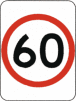
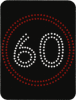
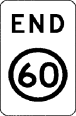
(1) The speed-limit applying to a driver for a length of road to which a speed-limit sign applies is the number of kilometres per hour indicated by the number on the sign.Note Length of road is defined in the dictionary.(2) However, if the number on the speed-limit sign is over 100 and the driver is driving a bus with a GVM over 5 tonnes, or another vehicle with a GVM over 12 tonnes, the speed-limit applying to the driver for the length of road is 100 kilometres per hour.Note 1 Bus and GVM are defined in the dictionary and vehicle is defined in rule 15.Note 2 Five tonnes is specified for the definition of heavy omnibus in the Australian Design Rules issued under the Motor Vehicle Standards Act 1989, or the Road Vehicle Standards Act 2018, of the Commonwealth.Note 3 If the vehicle is an oversize or overmass vehicle, the vehicle may be restricted to a lower speed-limit under another law of this jurisdiction.(3) A speed-limit sign on a road applies to the length of road beginning at the sign and ending at the nearest of the following:Note 1 T-intersection is defined in the dictionary.Note 2 Rule 322(1) and (2) deal with the meaning of a traffic sign on a road.(a) a speed-limit sign on the road with a different number on the sign;(b) an end speed-limit sign or speed derestriction sign on the road;(c) if the road ends at a T-intersection or dead end – the end of the road.
Speed-limit signs
Speed limit sign (Standard)
Speed limit sign (Variable illuminated message sign)
Other signs
Note 3 There is another permitted version of the speed-limit sign and the end speed-limit sign – see the diagrams in Schedule 3.Note 4 A speed-limit sign or end speed-limit sign may have a different number on the sign – see rule 316(4).
Speed derestriction sign

22. Speed-limit in a speed-limited area
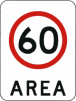
(1) The speed-limit applying to a driver for any length of road in a speed-limited area is the number of kilometres per hour indicated by the number on the area speed-limit sign on a road into the area, unless another speed-limit applies to the driver for the length of road under another rule of this Part.Note Length of road is defined in the dictionary.
Examples of another speed limit
Although an area speed-limit sign on a road into a speed-limited area may indicate a speed-limit of 60 kilometres per hour, a particular length of road in the area may have a school zone sign indicating a 40 kilometres per hour speed-limit for that length of road.
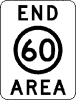
(2) A speed-limited area is the network of roads in an area with –(a) an area speed-limit sign on each road into the area, indicating the same number; and(b) an end area speed-limit sign on each road out of the area.(3) In subrule (2)(a) and (b) –road does not include a road-related area.Note 2 There are a number of other permitted versions of each of these signs – see the diagrams in Schedule 3.Note 3 An area speed-limit sign or end area speed-limit sign may have a different number on the sign – see rule 316(4).NoteRoad-related area is defined in rule 13.
Area speed-limit sign
End area speed-limit sign
23. Speed-limit in a school zone
(1) The speed-limit applying to a driver for any length of road in a school zone is the number of kilometres per hour indicated by the number on the school zone sign on a road, or the road, into the zone.Note 1 Length of road is defined in the dictionary.Note 2 A school zone sign may indicate that it applies only at certain times, on certain days or in certain circumstances – see rules 317 and 318.Note 3 This subrule applies to road-related areas in the school zone – see rule 11(2).(2) A school zone is –Note Intersection is defined in the dictionary.(a) if there is a school zone sign and an end school zone sign, or a speed-limit sign with a different number on the sign, on a road and there is no intersection on the length of road between the signs – that length of road; or(b) if there is a school zone sign on a road that ends in a dead end and there is no intersection, nor a sign mentioned in paragraph (a), on the length of road beginning at the sign and ending at the dead end – that length of road; or(c) in any other case – the network of roads in an area with –(i) a school zone sign on each road into the area, indicating the same number; and(ii) an end school zone sign, or a speed-limit sign indicating a different number, on each road out of the area.(3) In subrule (2)(c)(i) and (ii) –road does not include a road-related area.Note 1 Road-related area is defined in rule 13.
School zone sign
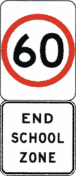
Note 2 There are a number of other permitted versions of each of these signs – see the diagrams in Schedule 3.Note 3 A school zone sign or end school zone sign may have a different number on the sign – see rule 316(4).
End school zone sign

24. Speed-limit in a shared zone
(1) The speed-limit applying to a driver for any length of road in a shared zone is the number of kilometres per hour indicated by the number on the shared zone sign on a road, or the road into the zone.Note A driver driving in a shared zone must give way to any pedestrian in the zone – see rule 83.(2) A shared zone is –Note Intersection is defined in the dictionary.(a) if there is a shared zone sign and an end shared zone sign on a road and there is no intersection on the length of road between the signs – that length of road; or(b) if there is a shared zone sign on a road that ends in a dead end and there is no intersection on the length of road beginning at the sign and ending at the dead end – that length of road; or(c) a network of roads in an area with –(i) a shared zone sign on each road into the area, indicating the same number; and(ii) an end shared zone sign on each road out of the area; or(d) a road-related area that is between a shared zone sign that relates to the area and an end shared zone sign that relates to the area.(3) In subrule (2)(c)(i) and (ii),road does not include a road-related area.Note 1 Road-related area is defined in rule 13.
Shared zone sign
Note 2 There are a number of other permitted versions of each of these signs – see the diagrams in Schedule 3.Note 3 A shared zone sign may have a different number on the sign – see rule 316(4).
End shared zone sign


(1) If a speed-limit sign does not apply to a length of road and the length of road is not in a speed-limited area, school zone or shared zone, the speed-limit applying to a driver for the length of road is the default speed-limit.Note Length of road is defined in the dictionary, school zone is defined in rule 23, shared zone is defined in rule 24, and speed-limited area is defined in rule 22.(2) The default speed-limit applying to a driver for a length of road in a built-up area is 50 kilometres per hour.Note Built-up area is defined in the dictionary.(3) The default speed-limit applying to a driver for any other length of road is –(a) 100 kilometres per hour on a sealed length of road; and(b) 80 kilometres per hour on an unsealed length of road.NoteSubrule (3) has been amended and is no longer uniform with the model road rules of Australia.(4) In this rule –sealed length of road means a length of road that is paved with bitumen, concrete or another smooth, bonded, weather-resistant material;unsealed length of road includes a length of road with a compacted, or loose, gravel surface.
PART 4 - Making Turns
Division 1 - Left turns
26. Application of Division to roundabouts, road-related areas and adjacent land
(1) This Division does not apply to a driver entering or leaving a roundabout.Note 1Roundabout is defined in rule 109.Note 2Part 9 deals with entering and leaving a roundabout.(2) This Division applies to a driver turning left from a road into a road-related area or adjacent land, or from a road-related area into a road, as if the driver were turning left at an intersection.Note 1Adjacent land and intersection are defined in the dictionary and road-related area is defined in rule 13. Adjacent land or a road-related area can include a driveway, service station or shopping centre – see the definitions.Note 2Rule 74 deals with the give way rules applying to a driver entering a road from a road-related area or adjacent land, and rule 75 deals with the give way rules applying to a driver entering a road-related area or adjacent land from a road. Rule 212 deals with a driver entering and leaving a median strip parking area.Note 3For the meaning of left, see rule 351(1).(3) In this rule –road does not include a road-related area.NoteA road-related area includes the shoulder of a road – see rule 13.
27. Starting a left turn from a road (except a multi-lane road)
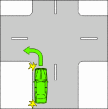
(1) A driver turning left at an intersection from a road (except a multi-lane road) must approach and enter the intersection from as near as practicable to the far left side of the road.Penalty: Fine not exceeding 10 penalty units.(1A) Subrule (1) also applies to a rider of a bicycle who approaches and enters an intersection from a bicycle storage area.NoteBicycle storage area is defined in the dictionary.(1B) Despite subrule (1), if there is space in a bicycle storage area for 2 riders of bicycles to be next to each other, the rider on the right may approach and enter the intersection as near as practicable to the right side of the other rider, but only if that other rider approaches and enters the intersection in accordance with this rule.(2) In this rule –road does not include a road-related area.Note 1Intersection and multi-lane road are defined in the dictionary.Note 2Road-related area includes any shoulder of a road – see rule 13.Example 1Starting a left turn from a road (except a multi-lane road)
28. Starting a left turn from a multi-lane road
(1) A driver turning left at an intersection from a multi-lane road must approach and enter the intersection from within the left lane unless –(a) the driver is required or permitted to approach and enter the intersection from within another marked lane under rule 88(1), rule 92 or rule 159; or(b) the driver is turning, at B lights or traffic arrows, in accordance with Division 2 of Part 17; or(c) [Rule 28 Subrule (1) amended by S.R. 2022, No. 43, Applied:13 Jul 2022] subrule (1A) or (2) applies to the driver; or(d) [Rule 28 Subrule (1) amended by S.R. 2022, No. 43, Applied:13 Jul 2022] the lane is a bus only lane.Penalty: Fine not exceeding 5 penalty units.Note 1[Rule 28 Subrule (1) amended by S.R. 2022, No. 43, Applied:13 Jul 2022] B lights, intersection, marked lane, multi-lane road, public bus and traffic arrows are defined in the dictionary, left lane is defined in subrule (3) and bus only lane is defined in rule 154A.Note 2Rule 88(1) deals with left turn only signs, rule 92 deals with traffic lane arrows, and rule 159 deals with traffic signs requiring particular kinds of vehicles to drive in an indicated marked lane.Note 3Division 2 of Part 17 provides for priority to be given to public buses at intersections with B lights or a white traffic arrow.
Example for subrule (1)(a)
Starting a left turn on a multi-lane road with traffic lane arrows as required or permitted under rule 92
(1A) A driver turning left at an intersection from a multi-lane road that has a slip lane must approach and enter the intersection –(a) from within the slip lane; or(b) if there is an obstruction that prevents the driver from entering the intersection from within the slip lane – from within the left lane.Penalty: Fine not exceeding 5 penalty units.NoteObstruction and slip lane are defined in the dictionary.(2) A driver may approach and enter the intersection from the marked lane next to the left lane as well as, or instead of, the left lane if –(a) the driver’s vehicle, together with any load or projection, is 7.5 metres long, or longer; and(b) the vehicle displays a do not overtake turning vehicle sign; and(c) any part of the vehicle is within 50 metres of the nearest point of the intersection; and(d) it is not practicable for the driver to turn left from within the left lane; and(e) the driver can safely occupy the next marked lane and can safely turn left at the intersection by occupying the next marked lane, or both lanes.Note 1Driver's vehicle is defined in the dictionary.Note 2Vehicle includes a combination – see rule 15(d).Note 3Under the law of this jurisdiction, only certain long vehicles may display a do not overtake turning vehicle sign.Example 1Long vehicle turning left from the left lane and next marked lane.(2A) If there is a bicycle storage area before an intersection that extends across one or more marked lanes of a multi-lane road, a rider of a bicycle turning left must approach and enter the intersection from within the part of the bicycle storage area that is directly in front of the left marked lane or of a bicycle lane that is on the left side of the road.Penalty: Fine not exceeding 2 penalty units.NoteBicycle storage area is defined in the dictionary.(3) In this rule –left lane means –(a) the marked lane nearest to the far left side of the road; or(b) if there is an obstruction (for example, a parked car or roadworks) in that marked lane – the marked lane nearest to that marked lane that is not obstructed;marked lane, for a driver, does not include a special purpose lane in which the driver is not permitted to drive.Note 1Special purpose lane is defined in the dictionary.Note 2Rule 95 deals with driving in an emergency stopping lane and Division 6 of Part 11 deals with driving in other special purpose lanes.
Do not overtake turning vehicle sign
Do not overtake turning vehicle sign
Note for diagram
These signs are displayed on certain long vehicles.
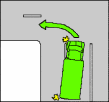


29. Making a left turn as indicated by a turn line
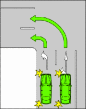
(1) If a driver is turning left at an intersection and there is a turn line indicating how the turn is required to be made, the driver must make the turn as indicated by the turn line unless –(a) the driver is turning, at B lights or traffic arrows, in accordance with Division 2 of Part 17; or(b) subrule (2) applies to the driver.Penalty: Fine not exceeding 10 penalty units.Example Making a left turn as indicated by a turn line.NoteB lights, intersection, traffic arrows and turn line are defined in the dictionary.(2) A driver may turn left at an intersection other than as indicated by a turn line if –(a) the driver’s vehicle, together with any load or projection, is 7.5 metres long, or longer; and(b) the vehicle displays a do not overtake turning vehicle sign; and(c) it is not practicable for the driver to turn left as indicated by the turn line; and(d) the driver can safely turn left other than as indicated by the turn line.Note 1Driver's vehicle is defined in the dictionary.Note 2Vehicle includes a combination – see rule 15(d).Note 3Under the law of this jurisdiction, only certain long vehicles may display a do not overtake turning vehicle sign.
Do not overtake turning vehicle sign
Do not overtake turning vehicle sign
Note for diagram
These signs are displayed on certain long vehicles.
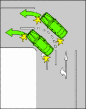
Division 2 - Right turns
30. Application of Division to certain right turns
(1) This Division does not apply to –(a) a driver turning right at an intersection where there is a hook turn only sign; or(b) the rider of a bicycle making a hook turn under Division 3; or(c) a driver making a U-turn; or(d) a driver entering or leaving a roundabout.Note 1Bicycle, intersection and U-turn are defined in the dictionary and roundabout is defined in rule 109.Note 2Division 3 of this Part deals with hook turns, Division 4 deals with U-turns and Part 9 deals with entering and leaving a roundabout.Note 3For the meaning of right, see rule 351(2).(2) This Division applies to a driver turning right from a road into a road-related area or adjacent land, or from a road-related area into a road, as if the driver were turning right at an intersection.Note 1Adjacent land is defined in the dictionary and road-related area is defined in rule 13. Adjacent land or a road-related area can include a driveway, service station or shopping centre – see the definitions.Note 2Rule 74 deals with the give way rules applying to a driver entering a road from a road-related area or adjacent land, and rule 75 deals with the give way rules applying to a driver entering a road-related area or adjacent land from a road. Rule 212 deals with a driver entering and leaving a median strip parking area.(3) In this rule –road does not include a road-related area.NoteA road-related area includes the shoulder of a road – see rule 13.
31. Starting a right turn from a road (except a multi-lane road)
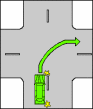
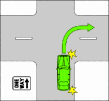
(1) A driver turning right at an intersection from a road (except a multi-lane road) must approach and enter the intersection in accordance with this rule.Penalty: Fine not exceeding 10 penalty units.NoteIntersection and multi-lane road are defined in the dictionary.(2) If the road has a dividing line or median strip, the driver must approach and enter the intersection from the left of, parallel to, and as near as practicable to, the dividing line or median strip.NoteDividing line and median strip are defined in the dictionary.(3) If the road does not have a dividing line or median strip and is not a one-way road, the driver must approach and enter the intersection from the left of, parallel to, and as near as practicable to, the centre of the road.NoteCentre of the road and one-way road are defined in the dictionary.(4) If the road is a one-way road, the driver must approach and enter the intersection from as near as practicable to the far right side of the road.(4A) Subrules (2), (3) and (4) also apply to a rider of a bicycle who approaches and enters an intersection from a bicycle storage area.NoteBicycle storage area is defined in the dictionary.(4B) Despite subrules (2), (3) and (4), if there is space in a bicycle storage area for 2 riders of bicycles to be next to each other, the rider on the left may approach and enter the intersection as near as practicable to the left side of the other rider, but only if that other rider approaches and enters the intersection in accordance with this rule.(5) In this rule –road does not include a road-related area.Note 1Road-related area includes any shoulder of a road – see rule 13.
ExamplesExample 1Starting a right turn from a road with a dividing line.Example 2Starting a right turn from a one-way road.
32. Starting a right turn from a multi-lane road
(1) A driver turning right at an intersection from a multi-lane road must approach and enter the intersection from within the right lane unless –(a) the driver is required or permitted to approach and enter the intersection from within another marked lane in accordance with rule 89(1) or rule 92 or rule 159; or(b) the driver is turning, at B lights or traffic arrows, in accordance with Division 2 of Part 17; or(c) [Rule 32 Subrule (1) amended by S.R. 2022, No. 43, Applied:13 Jul 2022] subrule (2) applies to the driver; or(d) [Rule 32 Subrule (1) amended by S.R. 2022, No. 43, Applied:13 Jul 2022] the lane is a bus only lane.Penalty: Fine not exceeding 10 penalty units.Note 1 [Rule 32 Subrule (1) amended by S.R. 2022, No. 43, Applied:13 Jul 2022] B lights, intersection, marked lane, multi-lane road, public bus and traffic arrows are defined in the dictionary, right lane is defined in subrule (3) and bus only lane is defined in rule 154A.Note 2 Rule 89(1) deals with right turn only signs, rule 92 deals with traffic lane arrows, and rule 159 deals with traffic signs requiring particular kinds of vehicles to drive in an indicated marked lane.Note 3 Division 2 of Part 17 provides for priority to be given to public buses at intersections with B lights or a white traffic arrow.
Example for subrule (1)(a)Starting a right turn on a multi-lane road with traffic lane arrows as required or permitted under rule 92(2) A driver may approach and enter the intersection from the marked lane next to the right lane as well as, or instead of, the right lane if –Note 1 Driver's vehicle is defined in the dictionary.Note 2 Vehicle includes a combination – see rule 15(d).Note 3 Under the law of this jurisdiction, only certain long vehicles may display a do not overtake turning vehicle sign.(a) the driver’s vehicle, together with any load or projection, is 7.5 metres long, or longer; and(b) the vehicle displays a do not overtake turning vehicle sign; and(c) any part of the vehicle is within 50 metres of the nearest point of the intersection; and(d) it is not practicable for the driver to turn right from within the right lane; and(e) the driver can safely occupy the next marked lane and can safely turn right at the intersection by occupying the next marked lane, or both lanes.(2A) If there is a bicycle storage area before an intersection that extends across one or more marked lanes of a multi-lane road, a rider of a bicycle turning right (but not making a hook turn) must approach and enter the intersection from within the part of the bicycle storage area that is directly in front of the right marked lane or of a bicycle lane that is on the right side of the road.Penalty: Fine not exceeding 10 penalty units.Note Bicycle storage area is defined in the dictionary.(3) In this rule –marked lane, for a driver, does not include a special purpose lane in which the driver is not permitted to drive;right lane means –(a) the marked lane nearest to the dividing line or median strip on the road; or(b) if there is an obstruction (for example, a parked car or roadworks) in that marked lane – the marked lane nearest to that marked lane that is not obstructed.Note 1Dividing line, median strip, obstruction and special purpose lane are defined in the dictionary.Note 2Rule 95 deals with driving in an emergency stopping lane and Division 6 of Part 11 deals with driving in other special purpose lanes.
Do not overtake turning vehicle sign
Do not overtake turning vehicle sign
Note for diagram
These signs are displayed on certain long vehicles.

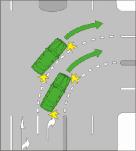
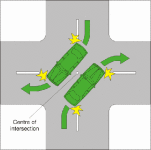
(1) A driver turning right at an intersection must make the turn in accordance with this rule unless –(a) the driver is turning, at B lights or traffic arrows, in accordance with Division 2 of Part 17; or(b) subrule (4) applies to the driver.Penalty: Fine not exceeding 10 penalty units.NoteB lights, intersection and traffic arrows are defined in the dictionary.(2) If there is a turn line indicating how the turn is required to be made, the driver must make the turn as indicated by the turn line.NoteTurn line is defined in the dictionary.(3) If there is no turn line indicating how the turn is required to be made, the driver must make the turn so the driver –(a) passes as near as practicable to the right of the centre of the intersection; and(b) turns into the left of the centre of the road the driver is entering, unless the driver is entering a one-way road.Example 1 Making a right turn as indicated by turn lines.NoteCentre of the road is defined in the dictionary.
ExamplesExample 2 Making a right turn from a road with no turn lines indicating how to make the turn.(4) A driver may turn right other than as indicated by a turn line if –(a) the driver’s vehicle, together with any load or projection, is 7.5 metres long, or longer; and(b) the vehicle displays a do not overtake turning vehicle sign; and(c) it is not practicable for the driver to turn right as indicated by the turn line; and(d) the driver can safely make the turn other than as indicated by the turn line.Note 1Driver’s vehicle is defined in the dictionary.Note 2Vehicle includes a combination – see rule 15(d).Note 3Under the law of this jurisdiction, only certain long vehicles may display a do not overtake turning vehicle sign.
Do not overtake turning vehicle sign
Do not overtake turning vehicle sign
Note for diagram
These signs are displayed on certain long vehicles.
Division 3 - Hook turns at intersections
34. Making a hook turn at a hook turn only sign
(1) A driver turning right at an intersection with traffic lights and a hook turn only sign must turn right by making a hook turn in accordance with this rule.Penalty: Fine not exceeding 5 penalty units.NoteIntersection and traffic lights are defined in the dictionary.(2) To make a hook turn, the driver must take, in sequence, each of the following steps:
1. Approach and enter the intersection from as near as practicable to the far left side of the road that the driver is leaving.
2. Move forward, keeping as near as practicable to the left of the intersection and clear of any marked foot crossing, until the driver is as near as practicable to the far side of the road that the driver is entering.
3. Remain at the position reached under step 2 until the traffic lights on the road that the driver is entering change to green.
4. Turn right into that road.
NoteMarked foot crossing is defined in the dictionary.(3) In this rule –road does not include a road-related area.NoteRoad-related area is defined in rule 13.
Hook turn only
Example
Making a hook turn at a hook turn only sign


35. Optional hook turn by a bicycle rider
(1) The rider of a bicycle turning right at an intersection without a hook turn only sign, or a no hook turn by bicycles sign, may turn right at the intersection by making a right turn under Division 2 or a hook turn under this rule.Note Bicycle and intersection are defined in the dictionary.(2) The rider must make a hook turn under this rule in accordance with subrule (3).Penalty: Fine not exceeding 5 penalty units.(3) To make a hook turn under this rule, the rider must take, in sequence, each of the following steps:Note Approaching and marked foot crossing are defined in the dictionary.
1. Approach and enter the intersection from as near as practicable to the far left side of the road that the rider is leaving.
2. Move forward –
(a) keeping as near as practicable to the far left side of the intersection; and
(b) keeping clear of any marked foot crossing; and
(c) keeping clear, as far as practicable, of any driver turning left from the left of the intersection –
until the rider is as near as practicable to the far side of the road that the rider is entering.
3. If there are traffic lights at the intersection, remain at the position reached under step 2 until the traffic lights on the road that the rider is entering change to green.
4. If there are no traffic lights at the intersection, remain at the position reached under step 2 until the rider has given way to approaching drivers on the road that the rider is leaving.
5. Turn right into the road that the rider is entering.
(4) To make a hook turn under this rule at an intersection that has a bicycle hook turn storage area on the left side of the intersection as the rider approaches the intersection, the rider must take the following initial 2 steps instead of the initial 2 steps listed in subrule (3):
1. Approach the intersection from the far left side of the road the rider is leaving and enter the intersection by moving into the bicycle hook turn storage area, keeping clear of any marked foot crossing.
2. Move forward in the bicycle hook turn storage area until the rider is as near as practicable to the far side of the road that the rider is entering.
NoteBicycle hook turn storage area is defined in the dictionary.
Example
Bicycle rider making a hook turn at an intersection without traffic lightsBicycle rider making a hook turn at an intersection without traffic lights


36. Bicycle rider making a hook turn contrary to no hook turn by bicycles sign
The rider of a bicycle must not make a hook turn at an intersection that has a no hook turn by bicycles sign.Penalty: Fine not exceeding 5 penalty units.Note Bicycle and intersection are defined in the dictionary.
No hook turn by bicycles sign

Division 4 - U-turns
NoteU-turn is defined in the dictionary.
A driver must not begin a U-turn unless –(a) the driver has a clear view of any approaching traffic; and(b) the driver can safely make the U-turn without unreasonably obstructing the free movement of traffic.Penalty: Fine not exceeding 10 penalty units.Note 1 Approaching traffic means traffic approaching from any direction – see the definition in the dictionary.Note 2 Traffic is defined in the dictionary.
38. Giving way when making a U-turn
[Rule 38 Substituted by S.R. 2022, No. 43, Applied:13 Jul 2022](1) A driver making a U-turn must give way to all vehicles and pedestrians.Penalty: Fine not exceeding 10 penalty units.Note For this rule, give way means the driver must slow down and, if necessary, stop to avoid a collision – see the definition in the dictionary.(2) Despite subrule (1), a driver does not have to give way to a driver entering the road from a road-related area or adjacent land.Note Adjacent land is defined in the dictionary and road-related area is defined in rule 13.(3) In this rule –road does not include a road-related area.Note A road-related area includes any shoulder of a road – see rule 13.
39. Making a U-turn contrary to a no U-turn sign
(1) A driver must not make a U-turn at a break in a dividing strip on a road if there is a no U-turn sign at the break in the dividing strip.Penalty: Fine not exceeding 5 penalty units.Note 1Dividing strip is defined in the dictionary.Note 2Rule 322(5) and (6) deal with the meaning of a traffic sign at a break in a dividing strip.(2) A driver must not make a U-turn on a length of road to which a no U-turn sign applies.Penalty: Fine not exceeding 5 penalty units.NoteLength of road is defined in the dictionary.(3) A no U-turn sign on a road (except a no U-turn sign at an intersection or at a break in a dividing strip) applies to the length of road beginning at the sign and ending at the nearer of the following:(a) the next intersection on the road;(b) if the road ends at a T-intersection or dead end – the end of the road.Note 1Intersection and T-intersection are defined in the dictionary.Note 2Rule 322(1) and (2) deal with the meaning of a traffic sign on a road.
No U-turn signs
No U-turn sign (Standard sign)
No U-turn sign (Variable illuminated message sign)
Note for diagram
There is another permitted version of each of these no U-turn signs – see the diagrams in Schedule 3.


40. Making a U-turn at an intersection with traffic lights
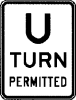
A driver must not make a U-turn at an intersection with traffic lights unless there is a U-turn permitted sign at the intersection.Penalty: Fine not exceeding 5 penalty units.Note Intersection and traffic lights are defined in the dictionary.
U-turn permitted sign
41. Making a U-turn at an intersection without traffic lights
A driver must not make a U-turn at an intersection without traffic lights if there is a no U-turn sign at the intersection.Penalty: Fine not exceeding 5 penalty units.Note 1 Intersection and traffic lights are defined in the dictionary.Note 2 U-turns are permitted at intersections without traffic lights unless there is a no U-turn sign, even though traffic lane arrows indicate that the driver must or may turn right – see rule 92.
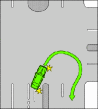
42. Starting a U-turn at an intersection
A driver making a U-turn at an intersection must start the U-turn –(a) if the road where the driver is turning has a dividing line or median strip – from the marked lane nearest, or as near as practicable, to the dividing line or median strip; or(b) in any other case – from the left of the centre of the road.Penalty: Fine not exceeding 5 penalty units.Note 1Centre of the road, dividing line, intersection, marked lane and median strip are defined in the dictionary.Example 1Starting a U-turn on a road with a median strip
43. Making a U-turn at certain crossings
[Rule 43 Substituted by S.R. 2022, No. 43, Applied:13 Jul 2022] A driver must not make a U-turn at any of the following crossings, with or without traffic lights, unless there is a U-turn permitted sign at the crossing:(a) children’s crossing;(b) level crossing;(c) marked foot crossing;(d) pedestrian crossing.Penalty: Fine not exceeding 5 penalty units.Note Children’s crossing is defined in rule 80, level crossing is defined in rule 120, pedestrian crossing is defined in rule 81 and marked foot crossing and traffic lights are defined in the dictionary.
43A. Making a U-turn on a road-related area with traffic lights
[Rule 43A Inserted by S.R. 2022, No. 43, Applied:13 Jul 2022] A driver must not make a U-turn at a place with traffic lights where a road and road-related area intersect unless there is a U-turn permitted sign at the place.Penalty: Fine not exceeding 5 penalty units.Note 1 Road includes a road-related area - see rule 11 (2).Note 2 Traffic lights is defined in the dictionary and road-related area is defined in rule 13.
PART 5 - Change of Direction and Stop Signals
Division 1 - Change of direction signals
44. Division does not apply to entering or leaving a roundabout, lane filtering or repositioning
This Division does not apply to –(a) a driver entering, in or leaving a roundabout; or(b) [Rule 44 Amended by S.R. 2022, No. 43, Applied:13 Jul 2022] the rider of a motor bike who is lane filtering in accordance with rule 151A; or(c) [Rule 44 Amended by S.R. 2022, No. 43, Applied:13 Jul 2022] [Rule 44 Amended by S.R. 2026, No. 80, Applied:07 Oct 2026] the rider of a motor bike while repositioning the motor bike within the same lane in order to avoid a hazard or reduce the risk of a crash.Note 1Part 9 deals with giving change of direction signals when entering or leaving a roundabout.Note 2Lane filtering is defined in rule 151A.Note 3Rider is defined in rule 17.Note 4Motor bike is defined in the dictionary.
45. What is changing direction
(1) A driver changes direction if the driver changes direction to the left or the driver changes direction to the right.(2) A driver changes direction to the left by doing any of the following:(a) turning left;(b) changing marked lanes to the left;(c) diverging to the left;(d) entering a marked lane, or a line of traffic, to the left;(e) moving to the left to, or from, a stationary position;(f) turning left into a marked lane, or a line of traffic, from a median strip parking area;(g) at a T-intersection where the continuing road curves to the right – leaving the continuing road to proceed straight ahead onto the terminating road.Note 1Marked lane and median strip parking area are defined in the dictionary.Note 2For the meaning of left, see rule 351(1).(3) A driver changes direction to the right by doing any of the following:(a) turning right;(b) changing marked lanes to the right;(c) diverging to the right;(d) entering a marked lane, or a line of traffic, to the right;(e) moving to the right to, or from, a stationary position;(f) turning right into a marked lane, or a line of traffic, from a median strip parking area;(g) making a U-turn;(h) at a T-intersection where the continuing road curves to the left – leaving the continuing road to proceed straight ahead onto the terminating road.Note 1U-turn is defined in the dictionary.Note 2For the meaning of right, see rule 351(2).
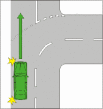
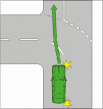
Examples for subrules (2)(g) and (3)(h)
Example 1Driver indicating change of direction at a T-intersection where the continuing road curves to the right and the driver is proceeding straight ahead onto the terminating road.
Example 2Driver indicating change of direction at a T-intersection where the continuing road curves to the left and the driver is proceeding straight ahead onto the terminating road.
46. Giving a left change of direction signal
(1) Before a driver changes direction to the left, the driver must give a left change of direction signal in accordance with rule 47 for long enough to comply with subrule (2) and, if subrule (3) applies to the driver, that subrule.Penalty: Fine not exceeding 5 penalty units.NoteChanges direction to the left is defined in rule 45(2).(2) The driver must give the change of direction signal for long enough to give sufficient warning to other drivers and pedestrians.(3) If the driver is about to change direction by moving from a stationary position at the side of the road or in a median strip parking area, the driver must give the change of direction signal for at least 5 seconds before the driver changes direction.NoteMedian strip parking area is defined in the dictionary.(4) The driver must stop giving the change of direction signal as soon as the driver completes the change of direction.Penalty: Fine not exceeding 5 penalty units.(5) This rule does not apply to a driver if the driver’s vehicle is not fitted with direction indicator lights.NoteDriver's vehicle is defined in the dictionary.
47. How to give a left change of direction signal
The driver of a vehicle must give a left change of direction signal by operating the vehicle’s left direction indicator lights.
48. Giving a right change of direction signal
(1) Before a driver changes direction to the right, the driver must give a right change of direction signal in accordance with rule 49 for long enough to comply with subrule (2) and, if subrule (3) applies to the driver, that subrule.Penalty: Fine not exceeding 5 penalty units.NoteChanges direction to the right is defined in rule 45(3).(2) The driver must give the change of direction signal for long enough to give sufficient warning to other drivers and pedestrians.(3) If the driver is about to change direction by moving from a stationary position at the side of the road or in a median strip parking area, the driver must give the change of direction signal for at least 5 seconds before the driver changes direction.NoteMedian strip parking area is defined in the dictionary.(3A) Subrule (3) does not apply to the rider of a bicycle that is stopped in traffic but not parked.(4) The driver must stop giving the change of direction signal as soon as the driver completes the change of direction.Penalty: Fine not exceeding 5 penalty units.(5) This rule does not apply to –(a) the driver of a tram that is not fitted with direction indicator lights; or(b) the rider of a bicycle making a hook turn.Note 1Bicycle and tram are defined in the dictionary.Note 2Rules 34 and 35 deal with bicycles making hook turns.
49. How to give a right change of direction signal
(1) The driver of a vehicle must give a right change of direction signal by operating the vehicle’s right direction indicator lights.(2) However, if the vehicle’s direction indicator lights are not in working order or are not clearly visible, or the vehicle is not fitted with direction indicator lights, the driver must give the change of direction signal by giving a hand signal in accordance with rule 50, or using a mechanical signalling device fitted to the vehicle.Note Mechanical signalling device is defined in the dictionary.
50. How to give a right change of direction signal by giving a hand signal
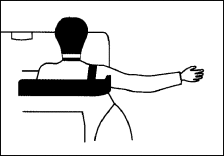
To give a hand signal for changing direction to the right, the driver must extend the right arm and hand horizontally and at right angles from the right side of the vehicle, with the hand open and the palm facing the direction of travel.Example Giving a hand signal for changing direction to the right.
51. When use of direction indicator lights permitted
The driver of a vehicle must not operate a direction indicator light except –(a) to give a change of direction signal when the driver is required to give the signal under the Road Rules; or(b) as part of the vehicle’s hazard warning lights.Penalty: Fine not exceeding 5 penalty units.Note Rule 221 deals with the use of hazard warning lights.
Division 2 - Stop signals
52. Division does not apply to bicycle riders or certain tram drivers
This Division does not apply to the rider of a bicycle, or the driver of a tram that is not fitted with brake lights.Note Bicycle and tram are defined in the dictionary.
(1) A driver must give a stop signal in accordance with rule 54 before stopping or when suddenly slowing.Penalty: Fine not exceeding 5 penalty units.(2) If the driver is stopping, the driver must give the stop signal for long enough to give sufficient warning to other road users.Penalty: Fine not exceeding 5 penalty units.(3) If the driver is slowing suddenly, the driver must give the stop signal while slowing.Penalty: Fine not exceeding 5 penalty units.
(1) The driver of a vehicle must give a stop signal by means of the vehicle’s brake lights.(2) However, if the vehicle’s brake lights are not in working order or are not clearly visible, or the vehicle is not fitted with brake lights, the driver must give the stop signal by giving a hand signal in accordance with rule 55, or using a mechanical signalling device fitted to the vehicle.Note Mechanical signalling device is defined in the dictionary.
55. How to give a stop signal by giving a hand signal
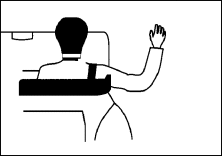
(1) To give a hand signal for stopping or suddenly slowing, the driver must extend the right arm and hand at right angles from the right side of the vehicle, with the upper arm horizontal and the forearm and hand pointing upwards, and with the hand open and the palm facing the direction of travel.(2) [Rule 55 Subrule (2) amended by S.R. 2021, No. 128, Applied:22 Dec 2021] However, the rider of a motor bike or quad bike may give the hand signal by extending the left arm and hand at right angles from the left side of the bike, with the upper arm horizontal and the forearm and hand pointing upwards, and with the hand open and the palm facing the direction of travel.Note 1Motor bike is defined in the dictionary.Example 1Giving a hand signal for stopping or suddenly slowing.
PART 6 - Traffic Lights, Traffic Arrows and Twin Red Lights
Division 1 - Obeying traffic lights and traffic arrows
Note 1Traffic arrows and traffic lights are defined in the dictionary. Traffic arrows are a traffic control device designed to show a traffic arrow, or 2 or more traffic arrows at different times – see the definition in the dictionary.
Note 2A reference in a rule of this Part to a green, yellow or red traffic light or traffic arrow is a reference to a steady green, yellow or red traffic light or traffic arrow, unless otherwise stated in the rule – see rule 323.
Note 3The rules dealing with T lights and B lights, which apply to drivers of trams and public buses, are in Part 17.
56. Stopping for a red traffic light or arrow
(1) A driver approaching or at traffic lights showing a red traffic light must stop –and must not proceed past the stop line, stop here on red signal sign or nearest or only traffic lights (as the case may be) until the traffic lights show a green or flashing yellow traffic light or no traffic light.(a) if there is a stop line at or near the traffic lights – as near as practicable to, but before reaching, the stop line; or(b) if there is a stop here on red signal sign at or near the traffic lights, but no stop line – as near as practicable to, but before reaching, the sign; or(c) if there is no stop line or stop here on red signal sign at or near the traffic lights – as near as practicable to, but before reaching, the nearest or only traffic lights –Penalty: Fine not exceeding 10 penalty units.Example Stopping at a stop here on red signal sign on a road the driver is enteringNoteRed traffic light and stop line are defined in the dictionary.
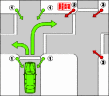
Example for subrule (1)(b)In this example the driver may go straight ahead, or turn right or left, if there is a green traffic light showing at 1. However, the driver must not go beyond the stop here on red signal sign at 2 if there is a red traffic light showing on the road the driver is entering (see 2 and 3).(1A) However, if the traffic lights are at an intersection with a left turn on red after stopping sign and the driver is turning left at the intersection, the driver may turn left after stopping.NoteRule 62 deals with the give way rules applying to a driver turning left at an intersection after stopping at a left turn on red after stopping sign.(2) A driver approaching or at traffic arrows showing a red traffic arrow who is turning in the direction indicated by the arrow must stop –and must not proceed past the stop line, stop here on red arrow sign or nearest or only traffic arrows (as the case may be) until the traffic arrows show a green or flashing yellow traffic arrow or no traffic arrow.(a) if there is a stop line at or near the traffic arrows – as near as practicable to, but before reaching, the stop line; or(b) if there is a stop here on red arrow sign at or near the traffic arrows, but no stop line – as near as practicable to, but before reaching, the sign; or(c) if there is no stop line or stop here on red arrow sign at or near the traffic arrows – as near as practicable to, but before reaching, the nearest or only traffic arrows –Penalty: Fine not exceeding 10 penalty units.Note 1Red traffic arrow is defined in the dictionary.Note 2This rule only applies to a driver turning left using a slip lane if the red traffic light or red traffic arrow applies to the slip lane – see Divisions 2 and 3 of Part 20, especially rules 330 and 345.Note 3Rule 58 deals with when a driver does not have to stop for a red traffic light.Note 4The driver of a tram or a public bus does not have to stop at traffic lights showing a red traffic light if a white T light (for trams) or a white B light (for public buses) is also showing, or a white traffic arrow is showing and the driver is turning in the direction indicated by the arrow – see rules 278 and 285.Example 5Stop here on red signal signExample 6Stop here on red arrow sign
Note for diagram
There is another permitted version of the stop here on red signal sign – see the diagram in Schedule 3.
(3) If there is a bicycle storage area before any traffic lights referred to in subrule (1) or (2), a reference to the stop line in subrule (1)(a) or (2)(a) –(a) in the case of a driver of a motor vehicle, is a reference to the first stop line that the driver comes, or came, to in approaching the lights; or(b) in the case of a rider of a bicycle, is a reference to the stop line that is nearest to the intersection.NoteBicycle storage area is defined in the dictionary.


57. Stopping for a yellow traffic light or arrow
(1) A driver approaching or at traffic lights showing a yellow traffic light must stop –and must not proceed past the stop line or nearest or only traffic lights, or into the intersection (as the case may be), until the traffic lights show a green or flashing yellow traffic light or no traffic light.(a) if there is a stop line at or near the traffic lights and the driver can stop safely before reaching the stop line – as near as practicable to, but before reaching, the stop line; or(b) if there is no stop line at or near the traffic lights and the driver can stop safely before reaching the traffic lights – as near as practicable to, but before reaching, the nearest or only traffic lights; or(c) if the traffic lights are at an intersection and the driver cannot stop safely in accordance with paragraph (a) or (b), but can stop safely before entering the intersection – before entering the intersection –Penalty: Fine not exceeding 5 penalty units.NoteEnter, intersection, stop line and yellow traffic light are defined in the dictionary.(2) A driver approaching or at traffic arrows showing a yellow traffic arrow who is turning in the direction indicated by the arrow must stop –and must not proceed past the stop line or nearest or only traffic arrows, or into the intersection (as the case may be), until the traffic arrows show a green or flashing yellow traffic arrow or no traffic arrow.(a) if there is a stop line at or near the traffic arrows and the driver can stop safely before reaching the stop line – as near as practicable to, but before reaching, the stop line; or(b) if there is no stop line at or near the traffic arrows and the driver can stop safely before reaching the traffic arrows – as near as practicable to, but before reaching, the nearest or only traffic arrows; or(c) if the traffic arrows are at an intersection and the driver cannot stop safely in accordance with paragraph (a) or (b), but can stop safely before entering the intersection – before entering the intersection –Penalty: Fine not exceeding 5 penalty units.NoteEnter, intersection, stop line and yellow traffic arrow are defined in the dictionary.(3) If the traffic lights or traffic arrows (as the case may be) are at an intersection and the driver is not able to stop safely under subrule (1) or (2) (as the case may be) and enters the intersection, the driver must leave the intersection as soon as the driver can do so safely.Penalty: Fine not exceeding 5 penalty units.Note 1Intersection does not include a road-related area – see the definition in the dictionary.Note 2This rule applies to a driver turning left using a slip lane only if the yellow traffic light or yellow traffic arrow (as the case may be) applies to the slip lane – see Division 2 and 3 of Part 20, especially rules 330 and 345.Note 3Rule 58 deals with when a driver does not have to stop at a yellow traffic light.(4) If there is a bicycle storage area before any traffic lights referred to in subrule (1) or (2), a reference to the stop line in subrule (1)(a) or (2)(a) –(a) in the case of a driver of a motor vehicle, is a reference to the first stop line that the driver comes, or came, to in approaching the lights;(b) in the case of a rider of a bicycle, is a reference to the stop line that is nearest to the intersection.NoteBicycle storage area is defined in the dictionary.
58. Exceptions to stopping for a red or yellow traffic light
(1) A driver approaching or at traffic lights showing a red or yellow traffic light does not have to stop if a green traffic arrow is also showing and the driver is turning in the direction indicated by the arrow.NoteGreen traffic arrow, red traffic light and yellow traffic light are defined in the dictionary.(2) A driver turning at an intersection with traffic lights who approaches or is at a red traffic light on the road that the driver is entering does not have to stop for that traffic light if there is no stop line or stop here on red signal sign at or near the traffic light.NoteIntersection and stop line are defined in the dictionary.
59. Proceeding through a red traffic light
(1) If traffic lights at an intersection or marked foot crossing are showing a red traffic light, a driver must not enter the intersection or marked foot crossing.Penalty: Fine not exceeding 10 penalty units.Note 1Enter, intersection, marked foot crossing and red traffic light are defined in the dictionary.Note 2Rules 56 and 57 deal with stopping for a red or yellow traffic light, and proceeding while the light remains red or yellow. Rule 60 deals with proceeding through a red traffic arrow.(2) However, if the traffic lights are at an intersection with a left turn on red after stopping sign and the driver is turning left at the intersection, the driver may turn left after stopping.NoteRule 62 deals with the give way rules applying to a driver turning left at an intersection after stopping at a left turn on red after stopping sign.(3) Also, subrule (1) does not apply to a driver if rule 58(1) applies to the driver.NoteRule 58 deals with when a driver does not have to stop for a red traffic light.
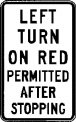
Left turn on red after stopping sign
60. Proceeding through a red traffic arrow
If traffic arrows at an intersection or marked foot crossing are showing a red traffic arrow, and a driver is turning in the direction indicated by the arrow, the driver must not enter the intersection or marked foot crossing.Penalty: Fine not exceeding 10 penalty units.Note 1Enter, intersection, marked foot crossing and red traffic arrow are defined in the dictionary.Note 2Rules 56 and 57 deal with stopping for a red or yellow traffic arrow.
60A. Proceeding through a bicycle storage area before a red traffic light or arrow
(1) If there is a bicycle storage area before traffic lights that are showing a red traffic light, a driver of a motor vehicle must not allow any part of the vehicle to enter the bicycle storage area.Penalty: Fine not exceeding 5 penalty units.NoteBicycle storage area, red traffic light and motor vehicle are defined in the dictionary.(2) If there is a bicycle storage area before traffic arrows that are showing a red traffic arrow, and a driver of a motor vehicle is turning in the direction indicated by the arrow, the driver must not allow any part of the vehicle to enter the bicycle storage area.Penalty: Fine not exceeding 5 penalty units.NoteRed traffic arrow is defined in the dictionary.
61. Proceeding when traffic lights or arrows at an intersection change to yellow or red
(1) This rule applies to –(a) a driver at an intersection with traffic lights showing a green traffic light who has stopped after the stop line, stop here on red signal sign, or nearest or only traffic lights, at the intersection and is not making a hook turn at the intersection; or(b) a driver at an intersection with traffic arrows showing a green traffic arrow who is turning in the direction indicated by the arrow and has stopped after the stop line, stop here on red arrow sign, or nearest or only traffic arrows, at the intersection.Example 1A driver may stop after the stop line at an intersection with traffic lights showing a green traffic light, and not proceed through the intersection, because traffic is congested.Note 1Green traffic arrow, green traffic light, intersection and stop line are defined in the dictionary.Note 2Hook turns are dealt with in rules 34 and 35.(2) If the traffic lights or traffic arrows (as the case may be) change to yellow or red while the driver is stopped and the driver has not entered the intersection, the driver must not enter the intersection.Penalty: Fine not exceeding 10 penalty units.NoteEnter is defined in the dictionary.(3) However, if the traffic lights are at an intersection with a left turn on red after stopping sign and the driver is turning left at the intersection, the driver may turn left after stopping.NoteRule 62 deals with the give way rules applying to a driver turning left at an intersection after stopping at a left turn on red after stopping sign.(4) Also, subrule (2) does not apply to a driver if rule 58(1) applies to the driver.NoteRule 58 deals with when a driver does not have to stop for a red traffic light.(5) If the traffic lights or traffic arrows (as the case may be) change to yellow or red while the driver is stopped and the driver has entered the intersection, the driver must leave the intersection as soon as the driver can do so safely.Penalty: Fine not exceeding 5 penalty units.NoteIntersection does not include a road-related area – see the definition in the dictionary.
Division 2 - Giving way at traffic lights and traffic arrows
NoteTraffic lights is defined in the dictionary.
62. Giving way when turning at an intersection with traffic lights
(1) A driver turning at an intersection with traffic lights must give way to –(a) [Rule 62 Subrule (1) amended by S.R. 2026, No. 80, Applied:07 Oct 2026] any pedestrian or rider of a bicycle at or near the intersection who is crossing the road the driver is entering; and(b) if the driver is turning left at a left turn on red after stopping sign at the intersection –(i) any vehicle approaching from the right, turning right at the intersection into the road the driver is entering or making a U-turn; and(ii) [Rule 62 Subrule (1) amended by S.R. 2026, No. 80, Applied:07 Oct 2026] any pedestrian or rider of a bicycle at or near the intersection who is crossing the road the driver is leaving; and(c) if the driver is turning right – any oncoming vehicle that is going straight ahead or turning left at the intersection (except a vehicle turning left using a slip lane).Penalty: Fine not exceeding 10 penalty units.Note 1[Rule 62 Subrule (1) amended by S.R. 2026, No. 80, Applied:07 Oct 2026] Bicycle, intersection, oncoming vehicle, slip lane, straight ahead and U-turn are defined in the dictionary.Note 2For this rule, give way means the driver must remain stationary until it is safe to proceed – see the definition in the dictionary.Note 3Rule 322(3) and (4) deal with the meaning of a traffic sign at an intersection.Note 4A driver turning left at a left turn on red after stopping sign, at an intersection with traffic lights showing a red traffic light, must stop in accordance with rule 56(1) before making the turn.Note 5In relation to paragraph (a), rule 353(1) specifies that a driver is not required to give way to a pedestrian who is crossing the road that the driver is leaving, and rule 353(2) provides that a pedestrian who is only crossing a part of a road is considered to be crossing the road.(2) However, a driver who is turning at an intersection with traffic arrows showing a green traffic arrow need not give way to an oncoming vehicle if the driver is turning in the direction indicated by the green traffic arrow.Note 1Green traffic arrow is defined in the dictionary.
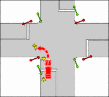
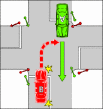
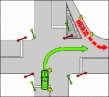
ExamplesExample 1Giving way to a pedestrian on the road the driver is entering. The vehicle must give way to the pedestrian.Example 2Driver turning right giving way to an oncoming vehicle going straight ahead. Vehicle B must give way to vehicle A.Example 3Driver turning right does not have to give way to an oncoming vehicle that is turning left into the road the driver is entering using a slip lane. Vehicle B must give way to vehicle A.
63. Giving way at an intersection with traffic lights not operating or only partly operating
(1) This rule applies to a driver at an intersection if traffic lights at the intersection are not operating, or the traffic lights are showing only a flashing yellow traffic light.NoteIntersection and yellow traffic light are defined in the dictionary.(2) If there is a traffic light-stop sign at the intersection, the driver must comply with rule 67 as if the sign were a stop sign at an intersection without traffic lights.Penalty: Fine not exceeding 10 penalty units.Note 1Rule 322(3) and (4) deal with the meaning of a traffic sign at an intersection.Note 2Rule 67 deals with stopping and giving way at a stop sign or stop line at an intersection without traffic lights.Note 3There is no requirement under Division 1 of this Part for a driver to stop for a flashing yellow traffic light or traffic lights that are not operating.(3) If there is no traffic light-stop sign at the intersection, the driver must give way to vehicles and pedestrians at or near the intersection in accordance with rule 72 or 73 as if the intersection were an intersection without traffic lights or a stop sign, stop line, give way sign or give way line.Penalty: Fine not exceeding 10 penalty units.Note 1Give way line and stop line are defined in the dictionary.Note 2Rules 72 and 73 deal with giving way at an intersection (except a roundabout) without traffic lights, or a stop sign, stop line, give way sign or give way line applying to the driver.Example 3Traffic light-stop sign(4) Subrule (3) does not apply if the intersection is a roundabout.Note 1Roundabout is defined in the dictionary.Note 2Rule 114 requires a driver entering a roundabout to give way to any vehicle in the roundabout and to any tram that is entering or approaching the roundabout.

64. Giving way at a flashing yellow traffic arrow at an intersection
A driver turning in the direction indicated by a flashing yellow traffic arrow at an intersection with traffic lights must give way to –(a) any vehicle travelling on the road the driver is entering; and(b) [Rule 64 Amended by S.R. 2026, No. 80, Applied:07 Oct 2026] any pedestrian or rider of a bicycle at or near the intersection who is crossing the road the driver is entering; and(c) if the driver is turning right – any oncoming vehicle that is going straight ahead or turning left at the intersection (except a vehicle turning left using a slip lane).Penalty: Fine not exceeding 10 penalty units.Note 1[Rule 64 Amended by S.R. 2026, No. 80, Applied:07 Oct 2026] Bicycle, intersection, oncoming vehicle, slip lane, straight ahead and yellow traffic arrow are defined in the dictionary.Note 2For this rule, give way means the driver must slow down and, if necessary, stop to avoid a collision – see the definition in the dictionary.Note 3There is no requirement under Division 1 of this Part for a driver to stop for a flashing yellow traffic arrow.Note 4In relation to paragraph (b), rule 353(1) specifies that a driver is not required to give way to a pedestrian who is crossing the road that the driver is leaving, and rule 353(2) provides that a pedestrian who is only crossing a part of a road is considered to be crossing the road.
65. Giving way at a marked foot crossing (except at an intersection) with a flashing yellow traffic light
(1) This rule applies to a driver approaching or at a marked foot crossing (except at or near an intersection) with a flashing yellow traffic light at the crossing.NoteIntersection, marked foot crossing and yellow traffic light are defined in the dictionary.(2) The driver must –(a) give way to any pedestrian or rider of a bicycle on or entering the crossing; and(b) not obstruct any pedestrian or rider of a bicycle on or entering the crossing; and(c) not overtake or pass a vehicle that is travelling in the same direction as the driver and is stopping, or has stopped, to give way at the crossing.Penalty: Fine not exceeding 15 penalty units.Note 1Overtake is defined in the dictionary.Note 2For subrule (2), give way means the driver must slow down and, if necessary, stop to avoid a collision – see the definition in the dictionary.(3) If there is no pedestrian or rider of a bicycle on the crossing, and no other vehicle travelling in the same direction as the driver that is stopping, or has stopped, to give way at the crossing, the driver may proceed through the crossing.
Division 3 - Twin red lights (except at level crossings)
66. Stopping for twin red lights (except at level crossings)
(1) A driver approaching or at twin red lights on a road (except at a level crossing) must stop in accordance with subrules (2) and (3).Penalty: Fine not exceeding 10 penalty units.Note 1Level crossing is defined in rule 120, and twin red lights is defined in the dictionary.Note 2Rule 322(1) and (2) deal with the meaning of a traffic control device on a road.Note 3Twin red lights are generally erected at bridges, ambulance stations, fire stations or level crossings. The rules about stopping at level crossings are in Part 10.(2) If there is a stop line at or near the lights and the driver can stop safely before reaching the stop line, the driver must stop as near as practicable to, but before reaching, the stop line.NoteStop line is defined in the dictionary.(3) If there is no stop line at or near the lights and the driver can stop safely before reaching the lights, the driver must stop as near as practicable to, but before reaching, the lights.(4) If the driver stops for the lights, the driver must not proceed until the lights are not showing.Penalty: Fine not exceeding 10 penalty units.
PART 7 - Giving Way
Note 1The rules in this Part deal with giving way in most situations. In addition, other rules requiring a driver to give way include:(a) making a U-turn – rule 38(b) turning at traffic lights at an intersection – rule 62(c) at an intersection with traffic lights that are not operating or only partly operating – rule 63(d) turning at a flashing yellow traffic arrow at an intersection – rule 64(e) at a marked foot crossing with a flashing yellow traffic light – rule 65(f) entering and driving in a roundabout – rule 114(g) by the rider of a bicycle or animal to a vehicle leaving a roundabout – rule 119(h) at a stop sign at a level crossing – rule 121(i) at a give way sign or give way line at a level crossing – rule 122(j) moving from one marked lane to another marked lane, or from one line of traffic to another line of traffic – rule 148(k) when lines of traffic merge into a single line of traffic – rule 149(l) for pedestrians crossing the road near a stopped tram – rule 164.
Note 2For the meaning of left and right, see rule 351(1) and (2).
Division 1 - Giving way at a stop sign, stop line, give way sign or give way line applying to the driver
NoteFor a driver, a reference in a rule in this Division to a traffic sign or road marking is a reference to a traffic sign or road marking applying to the driver – see rules 338 to 341.
67. Stopping and giving way at a stop sign or stop line at an intersection without traffic lights
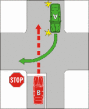
(1) A driver at an intersection with a stop sign or stop line, but without traffic lights, must stop and give way in accordance with this rule.Penalty: Fine not exceeding 10 penalty units.Note 1Intersection and stop line are defined in the dictionary. This rule applies also to T-intersections – see the definition of intersection.Note 2For this rule, give way means the driver must remain stationary until it is safe for the driver to proceed – see the definition in the dictionary.Note 3Part 6 deals with stopping and giving way at an intersection with traffic lights.Note 4This rule only applies to a driver turning left using a slip lane if the stop sign or stop line applies to the slip lane – see Divisions 2 and 3 of Part 20, especially rules 330 and 345.(2) The driver must stop as near as practicable to, but before reaching –(a) the stop line; or(b) if there is no stop line – the intersection.(3) The driver must give way to a vehicle in, entering or approaching the intersection except –(a) an oncoming vehicle turning right at the intersection if a stop sign, stop line, give way sign or give way line applies to the driver of the oncoming vehicle; or(b) a vehicle turning left at the intersection using a slip lane; or(c) a vehicle making a U-turn.NoteEnter, give way line, oncoming vehicle, slip lane and U-turn are defined in the dictionary.(4) [Rule 67 Subrule (4) amended by S.R. 2026, No. 80, Applied:07 Oct 2026] If the driver is turning left or right or making a U-turn, the driver must also give way to any pedestrian or rider of a bicycle at or near the intersection who is crossing the road, or part of the road, the driver is entering.Note 1[Rule 67 Subrule (4) amended by S.R. 2026, No. 80, Applied:07 Oct 2026] Bicycle is defined in the dictionary.Note 2[Rule 67 Subrule (4) amended by S.R. 2026, No. 80, Applied:07 Oct 2026] Rule 353(1) specifies that a driver is not required to give way to a pedestrian who is crossing the road the driver is leaving, and rule 353(2) provides that a pedestrian who is only crossing a part of a road is considered to be crossing the road.(5) For this rule, an oncoming vehicle travelling through a T-intersection on the continuing road is taken not to be turning.
Stop sign
Examples
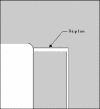
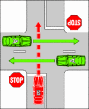
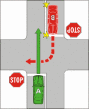
Example 1Stop lineExample 2Stopping and giving way at a stop sign to vehicles on the left and right. Vehicle B must stop and give way to each vehicle A.Example 3Stopping and giving way at a stop sign to an oncoming vehicle at a stop sign. Vehicle B must stop and give way to vehicle A.Example 4Stopping and giving way at a stop sign to an oncoming vehicle that is not at a stop sign or give way sign. Vehicle B must stop and give way to vehicle A.

68. Stopping and giving way at a stop sign or stop line at other places
(1) A driver approaching or at a place with a stop sign or stop line must stop and give way in accordance with this rule, unless the place is –(a) an intersection; or(b) a children's crossing; or(c) an area of a road that is not a children's crossing only because it does not have –(i) children crossing flags; or(ii) children's crossing signs and twin yellow lights; or(d) a level crossing; or(e) a place with twin red lights.Penalty: Fine not exceeding 10 penalty units.
Examples
1.
A stop sign at a break in a dividing strip dividing the part of the road used by the main body of moving vehicles from a service road.
2.
A stop sign on an exit from a carpark where the exit joins the road.
Note 1Children’s crossing is defined in rule 80, intersection, stop line and twin red lights are defined in the dictionary, and level crossing is defined in rule 120.Note 2For this rule, give way means the driver must remain stationary until it is safe for the driver to proceed – see the definition in the dictionary.Note 3For the stopping and giving way rules applying to a driver at an intersection or level crossing with a stop sign or stop line, see rule 67 (intersections) and rule 121 (level crossings). Rule 80 deals with stopping at a stop line at a children’s crossing.(2) The driver must stop as near as practicable to, but before reaching –(a) the stop line; or(b) if there is no stop line – the stop sign.(3) The driver must give way to any vehicle or pedestrian at or near the stop line or stop sign.
Examples
Example 1Stopping and giving way at a stop sign at a break on a dividing strip. Vehicle B must stop and give way to vehicle A.Example 2Stopping and giving way at a stop sign where a carpark exit joins a road. Vehicle B must stop and give way to vehicle A.

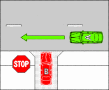
69. Giving way at a give way sign or give way line at an intersection (except a roundabout)
(1) A driver at an intersection (except a roundabout) with a give way sign or give way line must give way in accordance with this rule.Penalty: Fine not exceeding 5 penalty units.Note 1Give way line and intersection are defined in the dictionary, and roundabout is defined in rule 109. This rule also applies to T-intersections – see the definition of intersection.Note 2For this rule, give way means the driver must slow down and, if necessary, stop to avoid a collision – see the definition in the dictionary.(2) Unless the driver is turning left using a slip lane, the driver must give way to a vehicle in, entering or approaching the intersection except –(a) an oncoming vehicle turning right at the intersection if a stop sign, stop line, give way sign or give way line applies to the driver of the oncoming vehicle; or(b) a vehicle turning left at the intersection using a slip lane; or(c) a vehicle making a U-turn.NoteEnter, oncoming vehicle, slip lane, stop line and U-turn are defined in the dictionary.(2A) If the driver is turning left using a slip lane, the driver must give way to –(a) any vehicle on the road the driver is entering, or turning right at the intersection into the road the driver is entering (except a vehicle making a U-turn at the intersection); and(b) [Rule 69 Subrule (2A) amended by S.R. 2026, No. 80, Applied:07 Oct 2026] any other vehicle or pedestrian on or entering the slip lane.(3) [Rule 69 Subrule (3) amended by S.R. 2026, No. 80, Applied:07 Oct 2026] If the driver is turning left or right or making a U-turn, the driver must also give way to any pedestrian or rider of a bicycle at or near the intersection who is crossing the road, or part of the road, the driver is entering.Note 1[Rule 69 Subrule (3) amended by S.R. 2026, No. 80, Applied:07 Oct 2026] Bicycle is defined in the dictionary.Note 2[Rule 69 Subrule (3) amended by S.R. 2026, No. 80, Applied:07 Oct 2026] Rule 353(1) specifies that a driver is not required to give way to a pedestrian who is crossing the road the driver is leaving, and rule 353(2) provides that a pedestrian who is only crossing a part of a road is considered to be crossing the road.(4) For this rule, an oncoming vehicle travelling through a T-intersection on the continuing road is taken not to be turning.
Give way sign
Examples
Example 1Give way lineExample 2Giving way at a give way sign to vehicles on the left and right. Vehicle B must give way to each vehicle A.Example 3Giving way at a give way sign to an oncoming vehicle at a give way sign. Vehicle B must give way to vehicle A.Example 4Giving way at a give way sign to an oncoming vehicle that is not at a stop sign or give way sign. Vehicle B must give way to vehicle A.Example 5Driver turning right at a give way line does not have to give way to a vehicle turning left using a slip lane. Vehicle B must give way to vehicle A.

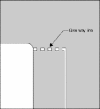
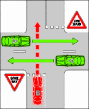
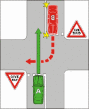
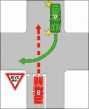
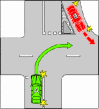
70. Giving way at a give way sign at a bridge or length of narrow road
A driver approaching a bridge or length of narrow road with a give way sign must give way to any oncoming vehicle that is on, or approaching, the bridge or length of road when the driver reaches the sign.Penalty: Fine not exceeding 10 penalty units.Note 1Oncoming vehicle is defined in the dictionary.Note 2For this rule, give way means the driver must slow down and, if necessary, stop to avoid a collision– see the definition in the dictionary.
ExamplesExample 1Giving way at a bridge. Vehicle B must give way to vehicle A.Example 2Giving way at a length of narrow road. Vehicle B must give way to vehicle A.
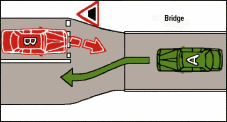
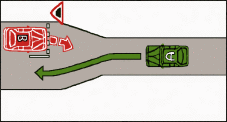
71. Giving way at a give way sign or give way line at other places
(1) A driver approaching or at a place (except an intersection, bridge or length of narrow road, level crossing, or a place with twin red lights) with a give way sign or give way line must give way in accordance with this rule.Penalty: Fine not exceeding 10 penalty units.
Examples
1.
A give way sign at a break in a dividing strip dividing the part of the road used by the main body of moving vehicles from a service road.
2.
A give way sign on a road at a place where a bicycle path meets the road.
Note 1Give way line, intersection and twin red lights are defined in the dictionary, and level crossing is defined in rule 120.Note 2For this rule, give way means the driver must slow down and, if necessary, stop to avoid a collision – see the definition in the dictionary.Note 3For the give way rules applying to a driver at an intersection, bridge or length of narrow road, or level crossing with a give way sign or give way line, see rule 69 (intersections), rule 70 (bridges and lengths of narrow road) and rule 122 (level crossings).(2) The driver must give way to any vehicle or pedestrian at or near the give way sign or give way line.
Examples
Example 1Giving way at a give way sign at a break in a dividing strip. Vehicle B must give way to vehicle A.Example 2Giving way at a give way sign where a bicycle path meets a road. The motor vehicle must give way to the bicycle.

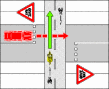
Division 2 - Giving way at an intersection without traffic lights or a stop sign, stop line, give way sign or give way line applying to the driver
NoteFor a driver, a reference in a rule in this Division to a traffic sign or road marking is a reference to a traffic sign or road marking applying to the driver – see rules 338 to 341.
72. Giving way at an intersection (except a T-intersection or roundabout)
(1) A driver at an intersection (except a T-intersection or roundabout) without traffic lights or a stop sign, stop line, give way sign or give way line, must give way in accordance with this rule.Penalty: Fine not exceeding 10 penalty units.Note 1Give way line, intersection, stop line, T-intersection and traffic lights are defined in the dictionary, and roundabout is defined in rule 109.Note 2For this rule, give way means the driver must slow down and, if necessary, stop to avoid a collision – see the definition in the dictionary.(2) If the driver is going straight ahead, the driver must give way to any vehicle approaching from the right, unless a stop sign, stop line, give way sign or give way line applies to the driver of the approaching vehicle.
Examples
Example 1Driver going straight ahead giving way to a vehicle on the right that is going straight ahead. Vehicle B must give way to vehicle A.Example 2Driver going straight ahead giving way to a vehicle on the right that is turning right. Vehicle B must give way to vehicle A.Note 1Straight ahead is defined in the dictionary.(3) If the driver is turning left (except if the driver is using a slip lane), the driver must give way to –(a) any vehicle approaching from the right, unless a stop sign, stop line, give way sign or give way line applies to the driver of the approaching vehicle; and(b) [Rule 72 Subrule (3) amended by S.R. 2026, No. 80, Applied:07 Oct 2026] any pedestrian or rider of a bicycle at or near the intersection who is crossing the road the driver is entering.
Examples
Example 1Driver turning left giving way to a vehicle on the right that is going straight ahead. Vehicle B must give way to vehicle A.Note 1 [Rule 72 Subrule (3) amended by S.R. 2026, No. 80, Applied:07 Oct 2026] Bicycle and slip lane are defined in the dictionary.Note 2 In relation to paragraph (b), rule 353(1) specifies that a driver is not required to give way to a pedestrian who is crossing the road that the driver is leaving, and rule 353(2) provides that a pedestrian who is only crossing a part of a road is considered to be crossing the road.Example 2Driver turning left giving way to a pedestrian on the road the driver is entering. The vehicle must give way to the pedestrian.(4) If the driver is turning left using a slip lane, the driver must give way to –(a) any vehicle approaching from the right or turning right at the intersection into the road the driver is entering (except a vehicle making a U-turn at the intersection); and(b) [Rule 72 Subrule (4) amended by S.R. 2026, No. 80, Applied:07 Oct 2026] any pedestrian or rider of a bicycle on, or entering, the slip lane.ExampleDriver turning left using a slip lane giving way to a vehicle that is turning right into the road the driver is entering. Vehicle B must give way to vehicle A.(4A) [Rule 72 Subrule (4A) amended by S.R. 2026, No. 80, Applied:07 Oct 2026] Subrule (4)(b) does not apply if another law of this jurisdiction states a driver who is turning left using a slip lane is not required to give way to a pedestrian or rider of a bicycle on, or entering, the slip lane.(5) If the driver is turning right, the driver must give way to –(a) any vehicle approaching from the right, unless a stop sign, stop line, give way sign or give way line applies to the driver of the approaching vehicle; and(b) any oncoming vehicle that is going straight ahead or turning left at the intersection unless –(i) a stop sign, stop line, give way sign or give way line applies to the driver of the oncoming vehicle; or(ii) the oncoming vehicle is turning left using a slip lane; and(c) [Rule 72 Subrule (5) amended by S.R. 2026, No. 80, Applied:07 Oct 2026] any pedestrian or rider of a bicycle at or near the intersection who is crossing the road the driver is entering.Note 1Oncoming vehicle is defined in the dictionary.Note 2In relation to paragraph (c), rule 353(1) specifies that a driver is not required to give way to a pedestrian who is crossing the road that the driver is leaving, and rule 353(2) provides that a pedestrian who is only crossing a part of a road is considered to be crossing the road.
ExamplesExample 1Driver turning right giving way to a vehicle on the right that is turning right into the road the driver is leaving. Vehicle B must give way to vehicle A.Example 2Driver turning right giving way to an oncoming vehicle that is going straight ahead on the road the driver is leaving. Vehicle B must give way to vehicle A.Example 3Driver turning right giving way to an oncoming vehicle that is turning left into the road the driver is entering. Vehicle B must give way to vehicle A.Example 4Driver turning right giving way to a pedestrian on the road the driver is entering. Vehicle must give way to pedestrian.


73. Giving way at a T-intersection
(1) A driver at a T-intersection without traffic lights or a stop sign, stop line, give way sign or give way line, must give way in accordance with this rule.Penalty: Fine not exceeding 10 penalty units.Note 1Give way line, stop line, T-intersection and traffic lights are defined in the dictionary.Note 2For this rule, give way means the driver must slow down and, if necessary, stop to avoid a collision – see the definition in the dictionary.Note 3Rule 75(1)(d) requires a driver at a T-intersection to give way when crossing the continuing road to enter a road-related area or adjacent land.(2) If the driver is turning left (except if the driver is using a slip lane) or right from the terminating road into the continuing road, the driver must give way to –(a) any vehicle travelling on the continuing road (except a vehicle making a U-turn on the continuing road at the T-intersection); and(b) [Rule 73 Subrule (2) amended by S.R. 2026, No. 80, Applied:07 Oct 2026] any pedestrian or rider of a bicycle who is crossing the continuing road at or near the intersection.Note 1[Rule 73 Subrule (2) amended by S.R. 2026, No. 80, Applied:07 Oct 2026] Bicycle, continuing road, slip lane and terminating road are defined in the dictionary.Example 1 Driver turning right from the terminating road giving way to a vehicle on the continuing road. Vehicle B must give way to vehicle A.Note 2In relation to paragraph (b), rule 353(1) specifies that a driver is not required to give way to a pedestrian who is crossing the terminating road, and rule 353(2) provides that a pedestrian who is only crossing a part of a road is considered to be crossing the road.
ExamplesExample 2 Driver turning left (except if the driver is using a slip lane) from the terminating road giving way to a pedestrian on the continuing road. Vehicle must give way to the pedestrian.(3) If the driver is turning left from the terminating road into the continuing road using a slip lane, the driver must give way to –(a) any vehicle travelling on the continuing road (except a vehicle making a U-turn on the continuing road at the T-intersection); and(b) [Rule 73 Subrule (3) amended by S.R. 2026, No. 80, Applied:07 Oct 2026] any pedestrian or rider of a bicycle on or entering the slip lane.(4) [Rule 73 Subrule (4) amended by S.R. 2026, No. 80, Applied:07 Oct 2026] If the driver is turning left (except if the driver is using a slip lane) from the continuing road into the terminating road, the driver must give way to any pedestrian or rider of a bicycle who is crossing the terminating road at or near the intersection.Example 1Driver turning left (except if the driver is using a slip lane) from the continuing road giving way to a pedestrian on the terminating road. Vehicle must give way to pedestrian.Note 1Rule 353(1) specifies that a driver is not required to give way to a pedestrian who is crossing the continuing road, and rule 353(2) provides that a pedestrian who is only crossing a part of a road is considered to be crossing the road.(5) If the driver is turning from the continuing road into the terminating road using a slip lane, the driver must give way to –Example [Rule 73 Subrule (5) amended by S.R. 2026, No. 80, Applied:07 Oct 2026] Driver turning left using a slip lane giving way to a vehicle that is turning right into the road the driver is entering.(a) any vehicle approaching from the right (except a vehicle making a U-turn from the terminating road at the T-intersection); and(b) [Rule 73 Subrule (5) amended by S.R. 2026, No. 80, Applied:07 Oct 2026] any pedestrian or rider of a bicycle on, or entering, the slip lane.(5A) [Rule 73 Subrule (5A) amended by S.R. 2026, No. 80, Applied:07 Oct 2026] Subrule (5)(b) does not apply if another law of this jurisdiction does not require a driver who is turning from a continuing road into a terminating road using a slip lane to give way to a pedestrian or rider of a bicycle on, or entering, a slip lane.(6) If the driver is turning right from the continuing road into the terminating road, the driver must give way to –(a) any oncoming vehicle that is travelling through the intersection on the continuing road or turning left at the intersection; and(b) [Rule 73 Subrule (6) amended by S.R. 2026, No. 80, Applied:07 Oct 2026] any pedestrian or rider of a bicycle who is crossing the terminating road at or near the intersection.Note 1Oncoming vehicle is defined in the dictionary.Note 2In relation to paragraph (b), rule 353(1) specifies that a driver is not required to give way to a pedestrian who is crossing the continuing road, and rule 353(2) provides that a pedestrian who is only crossing a part of a road is considered to be crossing the road.(7) In this rule –turning left from the continuing road into the terminating road, for a driver, includes, where the continuing road curves to the right at a T-intersection, leaving the continuing road to proceed straight ahead onto the terminating road;turning right from the continuing road into the terminating road, for a driver, includes, where the continuing road curves to the left at a T-intersection, leaving the continuing road to proceed straight ahead onto the terminating road.Note 1Straight ahead is defined in the dictionary.
ExamplesExample 1Driver turning right from the continuing road giving way to an oncoming vehicle travelling through the intersection on the continuing road. Vehicle B must give way to vehicle A.Example 2Driver leaving the continuing road to proceed straight ahead on the terminating road giving way to a vehicle travelling through the intersection on the continuing road. Vehicle B must give way to vehicle A. Example shows a T-intersection where the continuing road (which is marked with broken white lines) goes around a corner. Vehicle B is leaving the continuing road to enter the terminating road.Example 3Driver turning right from the continuing road giving way to an oncoming vehicle turning left from the continuing road. Vehicle B must give way to vehicle AExample 4Driver turning right from the continuing road giving way to a pedestrian on the terminating road. Vehicle must give way to pedestrian.


.gif)


Division 3 - Entering or leaving road-related areas and adjacent land and driving in road-related areas
74. Giving way when entering a road from a road-related area or adjacent land
(1) A driver entering a road from a road-related area, or adjacent land, without traffic lights or a stop sign, stop line, give way sign or give way line must give way to –(a) any vehicle travelling on the road or turning into the road (except a vehicle turning right into the road from a road-related area or adjacent land); and(aa) [Rule 74 Subrule (1) amended by S.R. 2022, No. 43, Applied:13 Jul 2022] a driver making a U-turn on the road; and(b) any pedestrian on the road; and(c) any vehicle or pedestrian on any road-related area that the driver crosses to enter the road; and(d) for a driver entering the road from a road-related area –(i) [Rule 74 Subrule (1) amended by S.R. 2026, No. 80, Applied:07 Oct 2026] any pedestrian or rider of a bicycle on the road-related area; and(ii) any other vehicle ahead of the driver's vehicle or approaching from the left or right.Penalty: Fine not exceeding 10 penalty units.Note 1[Rule 74 Subrule (1) amended by S.R. 2026, No. 80, Applied:07 Oct 2026] Adjacent land, bicycle, give way line, stop line, traffic lights and U-turn are defined in the dictionary and road-related area is defined in rule 13.Note 2Adjacent land or a road-related area can include a driveway, service station or shopping centre – see the definitions of adjacent land and road-related area. Some shopping centres may include roads – see the definition of road in rule 12.Note 3Part 6 applies to the driver if there are traffic lights. Rule 68 applies to the driver if there is a stop sign or stop line, and rule 71 applies to the driver if there is a give way sign or give way line.Note 4For this rule, give way means the driver must slow down and, if necessary, stop to avoid a collision – see the definition in the dictionary.(2) In this rule –road does not include a road-related area.Note 1A road-related area includes any shoulder of a road – see rule 13.Example 1Driver entering a road from a road-related area giving way to a pedestrian on the footpath and a vehicle on the road. Vehicle B must give way to the pedestrian on the footpath and to vehicle A.
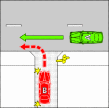
75. Giving way when entering a road-related area or adjacent land from a road
(1) A driver entering a road-related area or adjacent land from a place on a road without traffic lights or a stop sign, stop line, give way sign or give way line must give way to –(a) any pedestrian on the road; and(b) any vehicle or pedestrian on any road-related area that the driver crosses or enters; and(c) if the driver is turning right from the road – any oncoming vehicle on the road that is going straight ahead or turning left; and(d) if the road the driver is leaving ends at a T-intersection opposite the road-related area or adjacent land and the driver is crossing the continuing road – any vehicle on the continuing road.Penalty: Fine not exceeding 10 penalty units.Note 1Adjacent land, continuing road, give way line, oncoming vehicle, stop line, straight ahead, T-intersection and traffic lights are defined in the dictionary, and road-related area is defined in rule 13.Note 2Adjacent land or a road-related area can include a driveway, service station or shopping centre – see the definitions of adjacent land and road-related area. Some shopping centres may include roads – see the definition of road in rule 12.Note 3For this rule, give way means the driver must slow down and, if necessary, stop to avoid a collision – see the definition in the dictionary.Note 4Part 6 applies to the driver if there are traffic lights. Rule 68 applies to the driver if there is a stop sign or stop line, and rule 71 applies to the driver if there is a give way sign or give way line.(2) In this rule –road does not include a road-related area.Note 1A road-related area includes any shoulder of a road – see rule 13.
ExamplesExample 1Driver turning right from a road into a road-related area giving way to an oncoming vehicle that is going straight ahead and to a pedestrian on the footpath. Vehicle B must give way to vehicle A and to the pedestrian on the footpath.Example 2Driver crossing a continuing road at a T-intersection to enter a road-related area giving way to a vehicle on the continuing road. Vehicle B must give way to vehicle A.
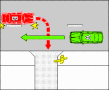

75A. Avoiding off-road collisions and dangers
(1) [Rule 75A Subrule (1) amended by S.R. 2026, No. 80, Applied:07 Oct 2026] If 2 or more drivers are converging on the same place at such speed and in such manner that there is a reasonable likelihood that their vehicles would collide or create a dangerous situation if the drivers were to proceed to that place at that speed and in that manner, a driver having a converging vehicle on the driver’s right must give way to that vehicle.Penalty: Fine not exceeding 10 penalty units.(2) This rule applies only in a road-related area and does not apply to trams.NoteGive way is defined in the dictionary, road-related area is defined in rule 13.
Division 4 - Keeping clear of and giving way to particular vehicles
76. Keeping clear of trams travelling in tram lanes, &c.
(1) A driver must not move into the path of an approaching tram travelling in a tram lane, or on tram tracks marked along the left side of the tracks by a broken or continuous yellow line parallel to the tracks.Penalty: Fine not exceeding 5 penalty units.NoteApproaching, left, tram and tram tracks are defined in the dictionary, and tram lane is defined in rule 155.(2) If a driver is in the path of an approaching tram travelling in a tram lane, or on tram tracks marked along the left side of the tracks by a broken or continuous yellow line parallel to the tracks, the driver must move out of the path of the tram as soon as the driver can do so safely.Penalty: Fine not exceeding 5 penalty units.(3) In this rule –tram includes a bus travelling along tram tracks.NoteBus and travelling along tram tracks are defined in the dictionary.
(1) A driver driving on a length of road in a built-up area, in the left lane or left line of traffic, or in a bicycle lane on the far left side of the road, must give way to a bus in front of the driver if –(a) the bus has stopped, or is moving slowly, at the far left side of the road, on a shoulder of the road, or in a bus-stop bay; and(b) the bus displays a give way to buses sign and the right direction indicator lights of the bus are operating; and(c) the bus is about to enter or proceed in the lane or line of traffic in which the driver is driving.Penalty: Fine not exceeding 5 penalty units.Note 1Built-up area, bus and length of road are defined in the dictionary, left lane and left line of traffic are defined in subrule (2), and shoulder is defined in rule 12.Note 2For this rule, give way means the driver must slow down and, if necessary, stop to avoid a collision – see the definition in the dictionary.Note 3The driver of the bus must give the change of direction signal for long enough to give sufficient warning to other drivers and pedestrians – see rule 48(2) and (3).Note 4Under rule 87(1), a driver entering a marked lane, or a line of traffic, from the side of the road must give way to any vehicle travelling in the lane or line of traffic. However, the driver of a public bus does not have to give way to a vehicle if the vehicle is required to give way to the bus under this rule and it is safe for the bus to enter the lane, or line of traffic, in which the other vehicle is travelling – see rule 87(2).(2) In this rule –left lane, of a road, means –(a) the marked lane nearest to the far left side of the road (the first lane) or, if the first lane is a bicycle lane, the marked lane next to the first lane; or(b) if there is an obstruction in the first lane (for example, a parked car or roadworks) and the first lane is not a bicycle lane – the marked lane next to the first lane;left line of traffic, for a road, means the line of traffic nearest to the far left side of the road.Note 1Marked lane and obstruction are defined in the dictionary, and bicycle lane is defined in rule 153.Example 1Give way to buses sign
Note for diagram
This sign is displayed on buses.

78. Keeping clear of police, emergency, enforcement and escort vehicles
(1) A driver must not move into the path of an approaching police vehicle, emergency vehicle, or enforcement vehicle or escort vehicle, that is displaying a flashing blue, red or magenta light (whether or not it is also displaying other lights) or sounding an alarm.Penalty: Fine not exceeding 15 penalty units.NoteApproaching, emergency vehicle, enforcement vehicle, escort vehicle and police vehicle are defined in the dictionary.(2) If a driver is in the path of an approaching police vehicle, emergency vehicle, or enforcement vehicle or escort vehicle, that is displaying a flashing blue, red or magenta light (whether or not it is also displaying other lights) or sounding an alarm, the driver must move out of the path of the vehicle as soon as the driver can do so safely.Penalty: Fine not exceeding 15 penalty units.(3) This rule applies to the driver despite any other rule of the Road Rules.
79. Giving way to police, emergency, enforcement and escort vehicles
(1) A driver must give way to a police vehicle, emergency vehicle, or enforcement vehicle or escort vehicle, that is displaying a flashing blue, red or magenta light (whether or not it is also displaying other lights) or sounding an alarm.Penalty: Fine not exceeding 15 penalty units.Note 1Emergency vehicle, enforcement vehicle, escort vehicle and police vehicle are defined in the dictionary.Note 2For this rule, give way means –– see the definition in the dictionary.(a) if the driver is stopped – remain stationary until it is safe to proceed; or(b) in any other case – slow down and, if necessary, stop to avoid a collision;(2) This rule applies to the driver despite any other rule of the Road Rules that would otherwise require the driver of a police vehicle, emergency vehicle, enforcement vehicle or escort vehicle to give way to the driver.
79A. Speed-limit approaching and passing stationary or slow-moving police, emergency, enforcement, roadside assistance service and escort vehicles
[Rule 79A Substituted by S.R. 2022, No. 51, Applied:01 Aug 2022](1) A driver approaching a stationary or slow-moving police vehicle, emergency vehicle, enforcement vehicle, roadside assistance service vehicle or escort vehicle that is displaying a flashing blue, red, yellow or magenta light (whether or not it is also displaying other lights) or sounding an alarm must drive at a speed at which the driver can, if necessary, stop safely before passing the vehicle.Penalty: Fine not exceeding 20 penalty units.NoteApproaching, emergency vehicle, enforcement vehicle, escort vehicle and police vehicle are defined in the dictionary.(2) A driver approaching a stationary or slow-moving police vehicle, emergency vehicle, enforcement vehicle, roadside assistance service vehicle or escort vehicle that is displaying a flashing blue, red, yellow or magenta light (whether or not it is also displaying other lights) or sounding an alarm must give way to any police officer, emergency worker, enforcement vehicle worker, roadside assistance worker or escort vehicle worker on foot in the immediate vicinity of the vehicle.Penalty: Fine not exceeding 20 penalty units.NoteEmergency worker, enforcement vehicle worker, escort vehicle worker, give way and police officer are defined in the dictionary.(3) A driver must not drive past, or overtake, a stationary or slow-moving police vehicle, emergency vehicle, enforcement vehicle, roadside assistance service vehicle or escort vehicle, that is displaying a flashing blue, red, yellow or magenta light (whether or not it is also displaying other lights) or sounding an alarm, at a speed greater than 40 kilometres per hour.Penalty: Fine not exceeding 20 penalty units.NoteOvertake is defined in the dictionary.(4) Subrule (3) does not apply to a driver of a vehicle if –(a) the driver is driving the vehicle past, or overtaking, a stationary or slow-moving vehicle, referred to in that subrule, on a road with a speed limit of greater than 80 kilometres per hour; and(b) at the time the driver becomes aware of the stationary or slow-moving vehicle referred to in that subrule, there is not sufficient time to safely reduce the speed of the driver's vehicle as required under that subrule; and(c) while the driver is driving the driver’s vehicle past, or overtaking, a stationary or slow-moving vehicle, referred to in that subrule, the driver reduces the speed of the driver’s vehicle to the extent that it is safe to do so.(5) A driver who drives past, or overtakes, a stationary or slow-moving police vehicle, emergency vehicle, enforcement vehicle, roadside assistance service vehicle or escort vehicle that is displaying a flashing blue, red, yellow or magenta light (whether or not it is also displaying other lights) or sounding an alarm must not increase speed until the driver is at a sufficient distance from the vehicle so as not to cause a danger to any police officers, emergency workers, enforcement vehicle workers, roadside assistance workers or escort vehicle workers in the immediate vicinity of the vehicle.Penalty: Fine not exceeding 20 penalty units.(6) Subrules (1) , (2) , (3) and (5) do not apply if the driver is driving on a road that is divided by a median strip and the police vehicle, emergency vehicle, enforcement vehicle, roadside assistance service vehicle or escort vehicle is on the other side of the road beyond the median strip.NoteMedian strip is defined in the dictionary.(7) This rule applies to a driver despite any other rule of the Road Rules.(8) A reference in subrules (1) , (2) , (3) and (5) to a flashing yellow light does not include a direction indicator light.(9) In this rule –[Rule 79A Subrule (9) amended by S.R. 2026, No. 80, Applied:07 Oct 2026] roadside assistance service vehicle means a vehicle built, fitted or used to provide aid or assistance to other vehicles, or drivers, on a public street;roadside assistance worker means the driver of, or passenger in, a roadside assistance service vehicle while the person is in, or in the immediate vicinity of, that vehicle.
Division 5 - Crossings and shared zones
80. Stopping at a children’s crossing
(1) A driver approaching a children’s crossing must drive at a speed at which the driver can, if necessary, stop safely before the crossing.Penalty: Fine not exceeding 15 penalty units.NoteChildren’s crossing is defined in subrule (6).(2) A driver approaching or at a children’s crossing must stop as near as practicable to, but before reaching, the stop line at the crossing if –(a) a hand-held stop sign is displayed at the crossing; or(b) a pedestrian or rider of a bicycle is on or entering the crossing.Penalty: Fine not exceeding 15 penalty units.Note 1Stop line is defined in the dictionary.Note 2Rule 322(3) and (4) deal with the meaning of a traffic control device at a place.(3) If a driver stops at a children’s crossing for a hand-held stop sign, the driver must not proceed until there is no pedestrian or rider of a bicycle on or entering the crossing and the holder of the sign –(a) no longer displays the sign towards the driver; or(b) otherwise indicates that the driver may proceed.Penalty: Fine not exceeding 15 penalty units.(4) If a driver stops at a children’s crossing for a pedestrian or rider of a bicycle, the driver must not proceed until there is no pedestrian or rider of a bicycle on or entering the crossing.Penalty: Fine not exceeding 15 penalty units.(5) For this rule, if a children’s crossing extends across a road with a dividing strip, the part of the children’s crossing on each side of the dividing strip is taken to be a separate children’s crossing.NoteDividing strip is defined in the dictionary.(6) A children's crossing is an area of a road –(a) at a place with stop lines marked on the road, and –(i) children crossing flags; or(ii) children’s crossing signs and twin yellow lights; and(b) indicated by –(i) 2 red and white posts erected on each side of the road; or(ii) 2 parallel continuous or broken lines on the road surface from one side of the road completely or partly across the road; and(c) extending across the road between the posts or lines.Example 1 Driver stopped at stop line for pedestrians on a children's crossing with children crossing flagsNoteTwin yellow lights is defined in the dictionary.
Children crossing flag
Children crossing sign
Hand-held stop sign
Hand-held stop sign
Note 1 for diagrams
There is another permitted version of the children’s crossing sign and a number of other permitted versions of the hand-held stop signs – see the diagrams in Schedule 3.
Note 2 for diagrams
A children’s crossing sign may have a different number on the sign – see rule 316(4).
Examples
Driver must stop at the stop line because there are pedestrians on the children's crossingExample 2 Driver stopped at stop line for pedestrians on a children's crossing with children's crossing signs and twin yellow lights.
Driver must stop at the stop line because there are pedestrians on the children's crossing.

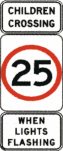


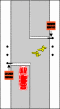
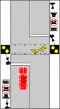
81. Giving way at a pedestrian crossing
(1) A driver approaching a pedestrian crossing must drive at a speed at which the driver can, if necessary, stop safely before the crossing.Penalty: Fine not exceeding 15 penalty units.NotePedestrian crossing is defined in subrule (3).(2) A driver must give way to any pedestrian or rider of a bicycle on or entering a pedestrian crossing.Penalty: Fine not exceeding 15 penalty units.NoteFor this rule, give way means the driver must slow down and, if necessary, stop to avoid a collision – see the definition in the dictionary.(3) A pedestrian crossing is an area of a road –(a) at a place with white stripes on the road surface that –(i) run lengthwise along the road; and(ii) are of approximately the same length; and(iii) are approximately parallel to each other; and(iv) are in a row that extends completely, or partly, across the road; and(b) with or without either or both of the following:(i) a pedestrian crossing sign;(ii) alternating flashing twin yellow lights.Note 1Twin yellow lights is defined in the dictionary.Example 1 Giving way to a pedestrian on a pedestrian crossing. Driver must give way to the pedestrian on the crossing.Note 2Rule 322(3) and (4) deal with the meaning of a traffic sign at a place.Examples
Pedestrian crossing sign
Example 2 Giving way to a pedestrian on a pedestrian crossing at a slip lane. Driver must give way to the pedestrian on the crossing.

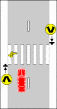
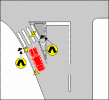
82. Overtaking or passing a vehicle at a children’s crossing or pedestrian crossing
A driver approaching a children’s crossing, or pedestrian crossing, must not overtake or pass a vehicle that is travelling in the same direction as the driver and is stopping, or has stopped, to give way to a pedestrian or rider of a bicycle at the crossing.Penalty: Fine not exceeding 15 penalty units.Example 2 Driver not passing a vehicle that has stopped to give way to a pedestrian at a pedestrian crossing. Vehicle A has stopped to give way to a pedestrian on the crossing. Vehicle B must not overtake or pass vehicle A.NoteChildren’s crossing is defined in rule 80, overtake is defined in the dictionary, and pedestrian crossing is defined in rule 81.
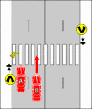
83. Giving way to pedestrians in a shared zone
A driver driving in a shared zone must give way to any pedestrian in the