

Conveyancing and Law of Property Regulations 2012
I, the Governor in and over the State of Tasmania and its Dependencies in the Commonwealth of Australia, acting with the advice of the Executive Council, make the following regulations under the Conveyancing and Law of Property Act 1884 .
19 November 2012PETER G. UNDERWOOD
Governor
By His Excellency's Command,
BRYAN GREEN
Minister for Primary Industries and Water
PART 1 - Preliminary
These regulations may be cited as the Conveyancing and Law of Property Regulations 2012 .
These regulations take effect on 4 December 2012.
(1) In these regulations –Act means the Conveyancing and Law of Property Act 1884 ;application means an application under section 84B , 84C or 84D of the Act;lodge means lodge with the Recorder;Recorder means the Recorder of Titles under the Land Titles Act 1980 ;seal means seal with the Recorder's seal of office.(2) In these regulations, a reference to a form by number is a reference to the form of that number in Schedule 1 .
PART 2 - Determination and Variation of Certain Interests Affecting User of Land
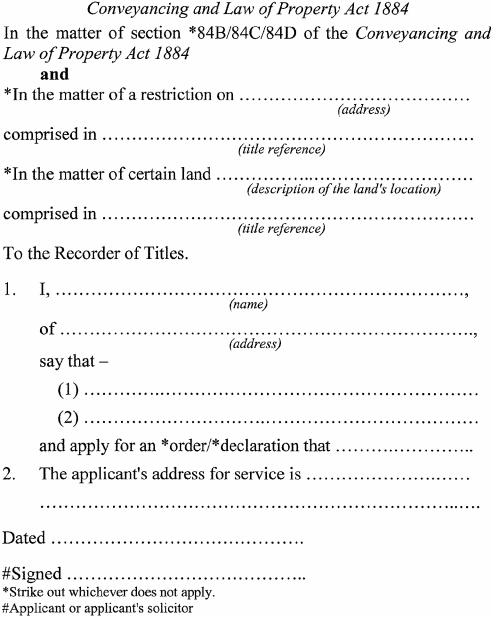
(1) An application is to be in accordance with Form 1 .(2) The Recorder may, by requisition sent to the applicant's address for service shown in the application, require the applicant to give the Recorder further information about the application.(3) If the applicant does not give the Recorder the further information within 21 days after being sent the requisition or such further time as the Recorder allows, the Recorder is not required to take any further action in respect of the application.
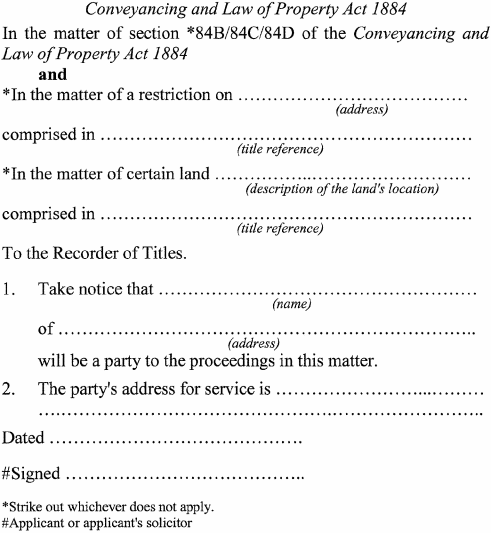
(1) A person who proposes to become a party to the proceedings on an application may, at the times specified in regulation 9 of the Land Titles Regulations 2002 , inspect the application and all other information lodged in respect of the matter.(2) To become a party to the proceedings on the application, a person must lodge a notice in accordance with Form 2 within –(a) if notice of the application was given by way of an advertisement under section 84E(4) of the Act, the time fixed by the advertisement or such further time as the Recorder allows; or(b) in any other case, 21 days after the day on which the person was given notice of the application under section 84E(2) of the Act or such further time as the Recorder allows.
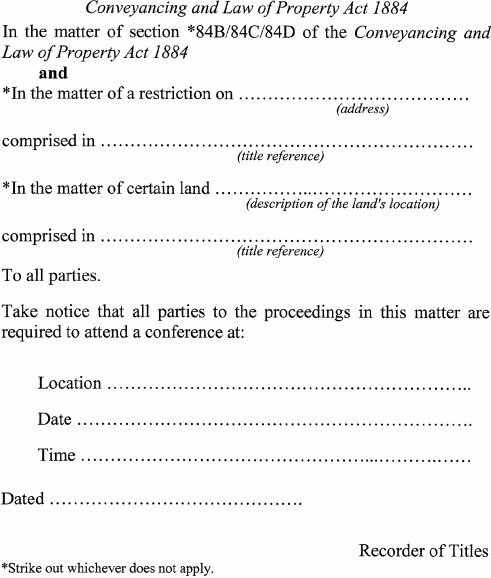
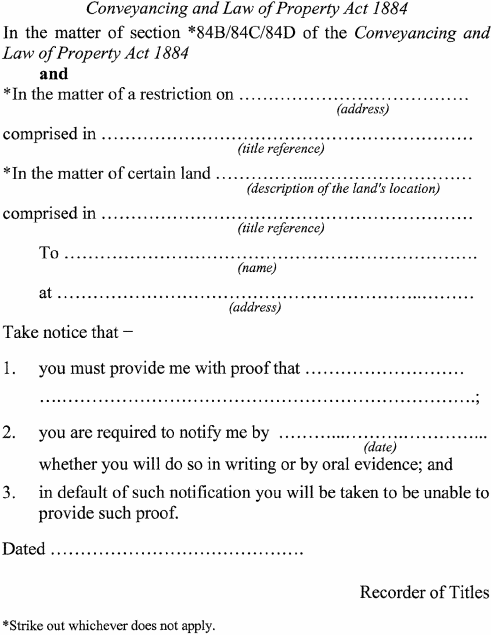
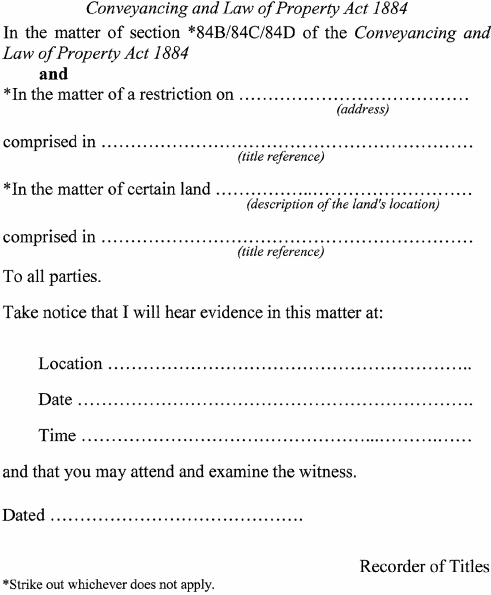
(1) The Recorder may, by notice in accordance with Form 3 , summon a conference of parties to the proceedings on an application.(2) At a conference, the parties may do all or any of the following:(a) reach agreement on as many matters as possible;(b) discuss the possibility of settlement of the proceedings;(c) consider the simplification of the issues arising from the application;(d) consider the necessity or desirability of amendments to the application;(e) consider the possibility of obtaining admissions of fact and of documents that will avoid unnecessary proof;(f) consider the limitation of the numbers of expert witnesses;(g) consider whether an order should be made under regulation 10 ;(h) consider any other matter that may aid in the speedy disposition of the proceedings.(3) The Recorder may make such orders relating to the matters specified in subregulation (2) as the Recorder thinks just and may specify which matters require proof.(4) If the Recorder considers that a conference of the parties is unnecessary, he or she may, by notice in accordance with Form 4 , state the matters for which he or she requires proof.(5) A party who wishes to prove a matter to the Recorder may –(a) give evidence on oath; or(b) examine witnesses summoned in accordance with regulation 7 ; or(c) submit a statutory declaration made by the party or by other persons; or(d) submit statutory declarations obtained in accordance with regulation 8 .(6) If, otherwise than at a hearing, proof is produced to the Recorder orally in the proceedings on an application that evidence is to be given after notice to attend, in accordance with Form 5 , is given to all parties, then any party attending may cross-examine the witness.(7) If, otherwise than at a hearing, proof is produced to the Recorder in writing in the proceedings on an application, a copy of the writing is to be sent to each party at the address for service on his or her notice of appearance under regulation 5 .
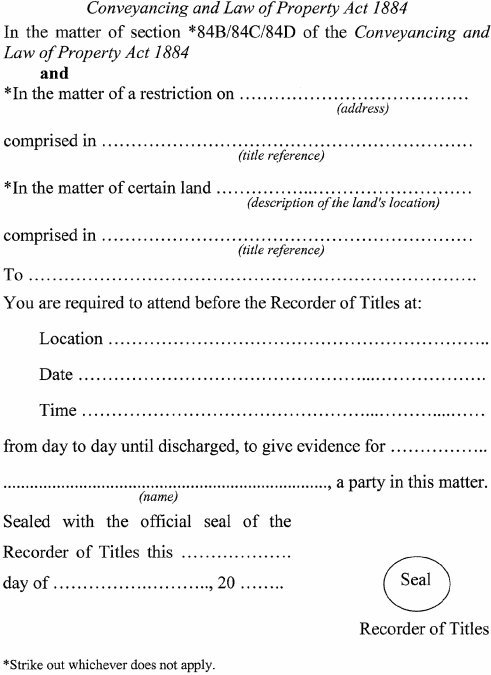
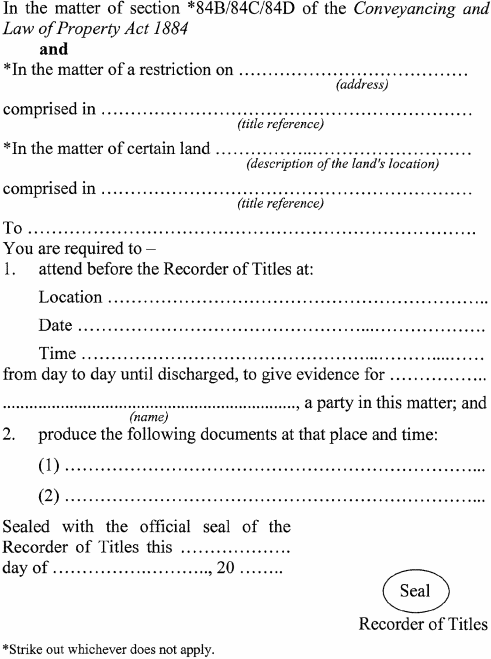
(1) A party to the proceedings on an application who wishes to summon a witness may prepare a summons in accordance with Form 6 or 7 , as the case requires.(2) The Recorder must, on payment of the fee prescribed under the Act, seal the summons.(3) The party wishing to summon the witness must serve the sealed summons on the witness as if it were a writ of subpoena.
8. Obtaining statutory declarations
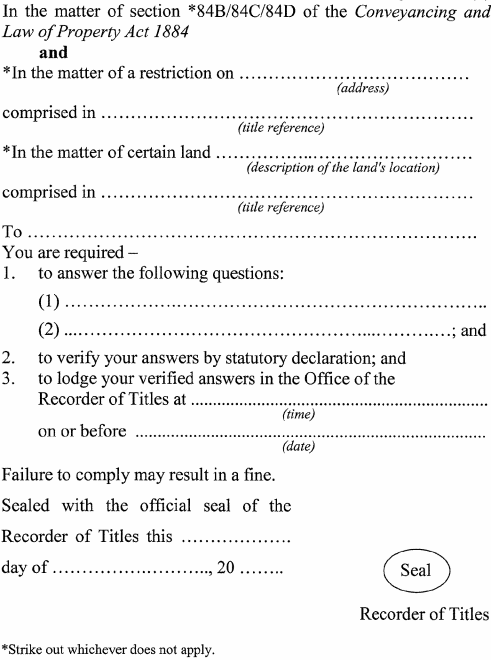
(1) A party to the proceedings on an application who wishes to obtain a statutory declaration may prepare a list of questions to be answered and a requisition in accordance with Form 8 .(2) The Recorder must, on payment of the fee prescribed under the Act, seal the requisition.(3) The party wishing to obtain the statutory declaration must serve the sealed requisition on the proposed declarant as if it were a writ of subpoena.(4) A person who is served with a requisition under subregulation (3) must –(a) answer the questions set out in the requisition to the best of his or her ability; and(b) verify those answers by statutory declaration; and(c) lodge the answers and declaration in accordance with Form 9 .Penalty: Fine not exceeding 20 penalty units.(5) The answers and declaration so lodged may be inspected and copied by any party to the same proceedings free of charge.(6) A person does not commit an offence under subregulation (4)(a) by failing to answer any questions that he or she would not be compelled to answer if they were asked of the person as a witness in the Supreme Court in proceedings based on an application.
If the Recorder wishes to hear evidence or argument in the proceedings on an application, he or she must give notice to all parties in accordance with Form 10 unless the place, date and time have been notified to all parties at an earlier conference or hearing.
(1) The Recorder, in determining an application for an order pursuant to section 84F of the Act, may –(a) exercise any power of a judge under rules 184 , 295 , 296 , 303 , 304 , 606 and 798 of the Supreme Court Rules 2000 as if the proceedings on the application were an action in the nature of an equity suit; and(b) exercise any power of a judge under rules 427 , 431 and 435 of those Rules as if the application were a pleading; and(c) if the application is one in which a question of compensation may arise, hear the matter with an assessor and, for that purpose, exercise the powers of a judge under rule 560 of those Rules; and(d) if no person has a legal right to represent a person under a disability who is, or in the opinion of the Recorder should be, a party to the proceedings, order that an appropriate person is to do so.(2) If the Recorder provides for the costs of a party, he or she must award –(a) a specified amount; or(b) costs to be taxed.(3) If the Recorder awards costs to be taxed –(a) the party awarded the costs must submit a bill of costs to the Recorder; and(b) the Recorder must tax and allow that bill of costs as if he or she were the taxing officer of the Supreme Court acting under a judgment of that Court.
If the proceedings on an application are removed into the Supreme Court under section 84G of the Act, the Court has all the powers of the Recorder under this Part.
PART 3 - Miscellaneous
(1) A document is taken to be lodged under these regulations if it is delivered to the Recorder, together with –(a) a printed lodgment form (in triplicate) approved by the Recorder; and(b) the fee prescribed under the Act, if any.(2) Despite subregulation (1) , the Recorder may accept for lodgment a document that has been sent to the Recorder by postal or electronic means if the Recorder considers it reasonable to do so.
A document is effectively given or sent to a person under these regulations if –(a) in the case of a natural person, it is –(i) handed to the person; or(ii) left at, or sent by post to, the person's postal or residential address, place or address of business or employment last known to the giver or sender of the document or any address nominated by the person; or(iii) faxed to the person's fax number; or(iv) emailed to the person's email address; and(b) in the case of any other person, it is –(i) left at, or sent by post to, the person's principal or registered office or principal place of business or any address nominated by the person; or(ii) faxed to the person's fax number; or(iii) emailed to the person's email address.
SCHEDULE 1 - Forms
Form 1 - APPLICATION
Form 2 - NOTICE OF APPEARANCE
Form 3 - NOTICE OF CONFERENCE
Form 4 - NOTICE TO PROVE
Form 5 - NOTICE OF EVIDENCE
Form 6 - SUMMONS TO WITNESS
Form 7 - SUMMONS TO WITNESS TO PRODUCE DOCUMENTS
Form 8 - REQUISITION
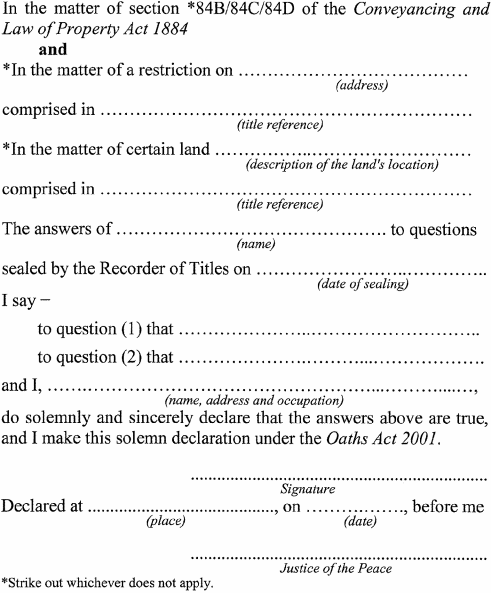
Form 9 - ANSWERS TO REQUISITIONS
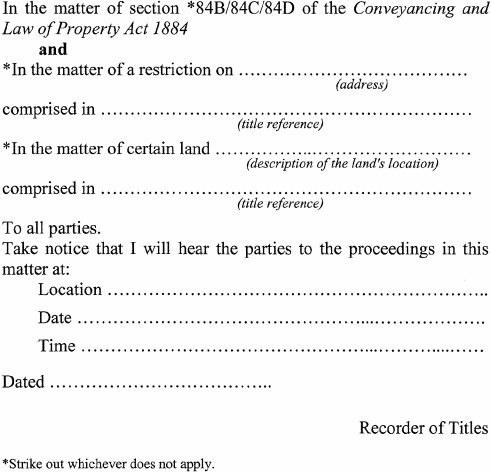
Form 10 - NOTICE OF HEARING
Displayed and numbered in accordance with the Rules Publication Act 1953.
Notified in the Gazette on 28 November 2012
These regulations are administered in the Department of Primary Industries, Parks, Water and Environment .