

Fisheries Rules 2009
I make the following rules under the Living Marine Resources Management Act 1995 .
21 October 2009D. E. LLEWELLYN
Minister for Primary Industries and Water
PART 1 - Preliminary
These rules may be cited as the Fisheries Rules 2009 .
These rules take effect on 1 December 2009.
In these rules –abalone means fish of the genus Haliotis;Act means the Living Marine Resources Management Act 1995 ;approved location means a location approved by a fisheries officer for the purposes of Part 3 ;automatic location communicator means an automatic location communicator of an approved make, model or type;[Rule 3 Amended by No. 31 of 2013, s. 13, Applied:02 Sep 2013] [Rule 3 Amended by S.R. 2015, No. 103, Applied:24 Dec 2015][Rule 3 Amended by S.R. 2015, No. 103, Applied:24 Dec 2015] auxiliary vessel means a dinghy, tender or other vessel that is –(a) part of the equipment of a fishing vessel; and(b) transported with, capable of being carried on, and operates solely from, the fishing vessel; and(c) not operated further than 2 nautical miles from the fishing vessel;base port means a port referred to in rule 29 ;closed season means a season or period during which all or part of a fishery is closed for fishing;Commonwealth authority means a licence, permit, right or other authority relating to a specific fishery granted under the Commonwealth Act;Commonwealth waters means waters within the Australian fishing zone that are –(a) outside State waters; and(b) outside the coastal waters of another State;distinguishing mark means a mark allotted under rule 18 ;fish merchant means –(a) the holder of any licence other than a recreational fishing licence; or(b) a person who sells fish;Grade 1 penalty means the penalty specified in regulation 5 of the Fisheries Penalties Regulations 2001 ;Grade 2 penalty means the penalty specified in regulation 6 of the Fisheries Penalties Regulations 2001 ;Grade 3 penalty means the penalty specified in regulation 7 of the Fisheries Penalties Regulations 2001 ;Great Oyster Bay means the waters enclosed north of an imaginary straight line extending from the southern extremity of Freycinet Peninsula to Seaford Point;marine nature reserve means the following areas of land:(a) Governor Island Marine Nature Reserve;(b) Ninepin Point Marine Nature Reserve;(c) Tinderbox Marine Nature Reserve;(d) Kent Group National Park;(e) Maria Island National Park;(f) Southwest National Park;(g) Macquarie Island Nature Reserve;marine plant includes any seagrass, seaweed and other aquatic vascular plants, algae, diatoms and euglenoids;mullet net means a single-mesh net that –(a) has a loaded bottom line; and(b) is intended to be set with its bottom line on the seabed or riverbed; and(c) has a mesh size of not less than 60 millimetres and not more than 70 millimetres;mussel means molluscan bivalve of the family Mytilidae;mussel spat means a mussel the shell of which is less than 40 millimetres in length;mussel spat collector means –(a) any rope, tape or other device used for collecting or taking mussel spat; and(b) any associated floats, ropes or moorings;[Rule 3 Amended by No. 31 of 2013, s. 13, Applied:02 Sep 2013] National Law has the same meaning as in the Marine and Safety Authority Act 1997 ;native marine plant means a marine plant other than a noxious fish;octopus means fish of the genus Octopus;offshore waters means State waters that are not –(a) coastal waters; or(b) within the limits of the State;open season means a season or period during which all or part of a fishery is open for fishing;operating, in relation to an automatic location communicator, means that the communicator is capable of –(a) transmitting the position of the fishing vessel as required; and(b) receiving and accurately responding to electronic data;processed, in relation to Undaria, means –(a) dried naturally or artificially; or(b) treated by a boiling or salting process; or(c) any other approved method;processing premises means a place, vessel or vehicle for which a fish processing licence is in force;quantity, in relation to Undaria, means a quantity as measured by wet weight;recreational fishing licence means any fishing licence referred to in rule 7(k) ;restricted fishing means the following types of fishing:(a) taking abalone by diving;(b) taking rock lobster by –(i) diving; or(ii) rock lobster pots; or(iii) rock lobster rings;(c) taking scalefish by –(i) trolling; or(ii) line fishing with 5 or less hooks;[Rule 3 Amended by S.R. 2015, No. 103, Applied:24 Dec 2015] rock lobster means rock lobster of the genus Jasus or Sagmariasus;rock lobster pot means –(a) a basket, trap, cage or other contrivance (other than a rock lobster ring) that is designed for use, or is capable of being used, for or in connection with the taking of rock lobster; or(b) a component part of such a basket, trap, cage or other contrivance;rock lobster ring means a net that –(a) consists only of a single fixed ring or hoop to which a mesh of string or twine is attached; and(b) is designed for use, or is capable of being used, for or in connection with the taking of rock lobster;satellite communication system means any communication system that receives and transmits data via satellites;scallop means fish of the species –(a) Equichlamys bifrons (commonly known as queen scallop); or(b) Pecten fumatus (commonly known as commercial scallop); or(c) Mimachlamys asperrimus (commonly known as doughboy scallop);scallop spat – see Schedule 3 ;scallop spat collector means –(a) a frame, cage or other device used for collecting or taking scallop spat; and(b) any associated floats, ropes or moorings;set means to place in State waters;sporophyll means that part of an algal stem containing or producing spores;system, in relation to a vessel monitoring system, includes component subsystems of –(a) power supply; and(b) communication hardware and software; and(c) communication service providers;Taroona waters means the waters of the River Derwent within 800 metres of the shore at Crayfish Point, Taroona bounded by a line that –(a) commences at a point on the high-water mark on the River Derwent at the prolongation of Nubeena Crescent; and(b) continues south-easterly for a distance of approximately 800 metres; and(c) continues from there by a southerly and south-westerly line parallel to and distant 800 metres from that high-water mark to a point on a line joining Piersons Point with the public boat ramp on the foreshore at Taroona; and(d) continues from that ramp by the high-water mark to the point of commencement;Undaria means –(a) exotic marine alga Undaria pinnatifida (commonly known as wakame); and(b) sporophyll of that alga;vessel monitoring system means a satellite-based tracking system that monitors the location of vessels and includes an automatic location communicator;wild, in relation to the location of any species or kind of fish, means State waters other than those to which a marine farming licence specifying that species or kind of fish relates.
These rules apply to all fishing in State waters.
These rules continue in force for a period of 10 years.
The Minister is to consult with the appropriate advisory committee established in relation to the fisheries referred to in these rules in respect of any changes relating to –(a) any area where fishing may occur; and(b) any matter relating to the characteristics of fish; and(c) any opening and closing of the fisheries; and(d) apparatus; and(e) limits on taking and possessing fish.
7. Classes of fishing licences
For the purpose of these rules, a fishing licence is one of the following classes:(a) class abalone, fishing licence (abalone dive);(b) class commercial dive, fishing licence (commercial dive);(c) class Danish seine –(i) [Rule 7 Amended by S.R. 2015, No. 103, Applied:24 Dec 2015] fishing licence (Danish seine); or(ii) [Rule 7 Amended by S.R. 2015, No. 103, Applied:24 Dec 2015] fishing licence (limited Danish seine);(d) class giant crab, fishing licence (giant crab);(e) class handling, fish handling licence;(f) class marine farm, marine farming licence;(g) class marine plant –(i) fishing licence (marine plant); or(ii) fishing licence (Undaria);(h) class mussel spat collection, fishing licence (mussel spat collection);(i) class personal, fishing licence (personal);(j) class processing, fish processing licence;(k) class recreational –(i) fishing licence (recreational abalone); or(ii) fishing licence (recreational beach seine net); or(iii) fishing licence (recreational graball net); or(iv) fishing licence (recreational mullet net); or(v) fishing licence (recreational rock lobster dive); or(vi) fishing licence (recreational rock lobster pot); or(vii) fishing licence (recreational rock lobster ring); or(viii) fishing licence (recreational scallop); or(ix) fishing licence (recreational set line); or(x) fishing licence (recreational special rock lobster);(l) class rock lobster, fishing licence (rock lobster);(m) class scalefish –(i) fishing licence (scalefish A); or(ii) fishing licence (scalefish B); or(iii) fishing licence (scalefish C);(n) class scallop, fishing licence (scallop);(o) class scallop spat collection, fishing licence (scallop spat collection);(p) class seine –(i) fishing licence (beach seine A); or(ii) fishing licence (beach seine B); or(iii) fishing licence (purse seine net);(q) class shellfish –(i) fishing licence (clam – Georges Bay North); or(ii) fishing licence (clam – Georges Bay South); or(iii) fishing licence (cockle – Ansons Bay); or(iv) fishing licence (native oyster – Georges Bay); or(v) fishing licence (Pacific oyster);(r) class small-mesh gillnet, fishing licence (small-mesh gillnet);(s) class species –(i) fishing licence (Australian salmon); or(ii) fishing licence (banded morwong); or(iii) fishing licence (southern calamari); or(iv) [Rule 7 Amended by S.R. 2015, No. 103, Applied:24 Dec 2015] fishing licence (wrasse); or(v) [Rule 7 Amended by S.R. 2015, No. 103, Applied:24 Dec 2015] fishing licence (octopus);(t) class squid, fishing licence (automatic squid jig);(u) class vessel, fishing licence (vessel).
PART 2 - General Provisions
Division 1 - Taking or possessing fish
8. Using vessel without fishing licence (vessel)
(1) Subject to subrules (2) , (3) and (4) , a person, in State waters, must not use for commercial purposes a vessel for fishing or carrying fish unless the vessel is specified in a fishing licence (vessel) –(a) held by that person; or(b) for which that person is the supervisor under the Act.Penalty: Grade 2 penalty.(2) [Rule 8 Subrule (2) amended by No. 31 of 2013, s. 14, Applied:02 Sep 2013] Subrule (1) does not apply to a person using an auxiliary vessel in accordance with rule 19 .(3) Subrule (1) does not apply to the holder of a marine farming licence, or a person acting with the authority of that holder, who uses a fishing vessel –(a) within the waters to which the licence relates; or(b) for any purpose or activity carried out under the licence; or(c) for the purpose of taking mussel spat from the wild under a fishing licence (mussel spat collection); or(d) for the purpose of taking scallop spat from the wild under a fishing licence (scallop spat collection).(4) Subrule (1) does not apply to the holder of a fishing licence (abalone dive) or fishing licence (commercial dive) if the holder is diving from a fishing vessel that is specified in a fishing licence (vessel).(5) A person must not take fish for commercial purposes using a fishing vessel unless the fish are taken under an authorisation to do so, other than a recreational fishing licence.Penalty: Grade 2 penalty.
9. Taking fish without fishing licence (personal)
(1) Subject to subrule (2) , a person must not take fish for sale unless the person is the holder of a fishing licence (personal).Penalty: Grade 2 penalty.(2) Subrule (1) does not apply to a person taking fish in accordance with a fishing licence (marine plant).(3) A person who is not the holder of a fishing licence (personal) must not –(a) supervise a fishing licence other than –(i) a recreational fishing licence; or(ii) a fishing licence (marine plant); or(b) sell fish taken by that person under the authority of a permit issued under section 14 of the Act.Penalty: Grade 2 penalty.
10. Authority of fishing licence (personal)
A fishing licence (personal) only authorises the holder to supervise a fishing licence, other than a recreational fishing licence, in relation to –(a) taking and possessing fish; and(b) selling or disposing of fish for commercial purposes.
11. Restrictions on use of apparatus
A person must not use apparatus to take fish unless the person –(a) is authorised to use that apparatus under a licence or authority; or(b) is otherwise authorised under the Act.Penalty: [Rule 11 Amended by S.R. 2015, No. 103, Applied:24 Dec 2015] Grade 3 penalty.
12. Fishing in offshore waters
(1) Subject to subrule (2) , a person who is the holder of a fishing licence (personal) must not undertake any fishing in offshore waters unless the person is the holder of a Commonwealth authority using only the apparatus authorised under that authority.Penalty: Grade 3 penalty.(2) Subrule (1) does not apply to the following:(a) the holder of a fishing licence (scallop) while taking scallop;(b) the holder of a fishing licence (abalone dive) while taking abalone;(c) the holder of a fishing licence (giant crab) while taking giant crab;(d) the holder of a fishing licence (rock lobster) while taking rock lobster;(e) [Rule 12 Subrule (2) amended by S.R. 2015, No. 103, Applied:24 Dec 2015] the holder of a fishing licence (rock lobster) using not more than the apparatus permitted to be used under the Fisheries (Scalefish) Rules 2015 to take fish of the Superclass Pisces;(f) [Rule 12 Subrule (2) amended by S.R. 2015, No. 103, Applied:24 Dec 2015] the holder of a fishing licence (octopus) while taking octopus.
(1) The Minister, by public notice, may determine –(a) the dates of the closed season for a specified fishery or specified part of a fishery; and(b) the dates of the open season for a specified fishery or specified part of a fishery.(2) A person must not take any kind or species of fish from State waters during a closed season for the fishery in respect of that kind or species of fish.Penalty: Grade 2 penalty.(3) A person must not buy, sell or have possession of any kind or species of fish taken from State waters during a closed season for the fishery in respect of that kind or species of fish.Penalty: Grade 2 penalty.(4) It is a defence in proceedings for an offence under subrule (2) or (3) if the defendant establishes that the fish were –(a) taken, bought, sold or in his or her possession during an open season for the fishery in respect of the fish; or(b) scallop spat taken under a fishing licence (scallop spat collection); or(c) taken from a marine farm by, or with the authority of, the holder of a marine farming licence or permit relating to marine farming.
14. Taking fish in certain waters
A person, in Taroona waters, must not –(a) take fish by diving or swimming; or(b) have possession of any abalone or rock lobster.Penalty: Grade 3 penalty.
(1) Subject to subrules (2) , (3) and (4) , a person must not –(a) take any fish or marine plant from State waters within a marine nature reserve; or(b) have possession of any fish or marine plant so taken.Penalty: Grade 3 penalty.(2) Subrule (1) does not apply to State waters within the Maria Island National Park that lie to the east of a line between Cape Boullanger and Cape Bougainville.(3) Subrule (1) does not apply to restricted fishing within –(a) the restricted take zone for the Kent Group National Park as specified in Part 1 of Schedule 1 ; or(b) the restricted take zone for the Southwest National Park as specified in Part 1 of Schedule 2 .(4) Subrule (1) does not apply if the person –(a) is the holder of a fishing licence (personal) that is endorsed under subrule (5) ; and(b) is acting in accordance with that endorsement.(5) The Minister may endorse a fishing licence (personal) to allow the holder of the licence to –(a) use the apparatus specified on the licence in specified State waters within a marine nature reserve; and(b) take species or types of fish specified on the licence from specified State waters within a marine nature reserve; and(c) possess or sell the fish taken in accordance with the endorsement.(6) In determining whether or not to endorse a fishing licence (personal) under subrule (5) , the Minister is to have regard to the environmental impact of the apparatus specified on the licence.(7) The Minister may endorse a licence under subrule (5) subject to such conditions as the Minister considers appropriate and as are specified in the endorsement.(8) The Minister is not to endorse a fishing licence (personal) under subrule (5) to allow the holder of the licence to use the apparatus specified on the licence within a no take zone.(9) In this rule –no take zone means an area within a marine nature reserve that is identified as being a no take zone on a plan in the Central Plan Register.
16. Receipt for purchase of fish for sale or resale
(1) Subject to subrule (3) , a person who obtains fish for the purpose of sale or purchases fish from a fish merchant for the purpose of resale must –(a) obtain a signed receipt containing the information specified in subrule (2) ; and(b) keep the receipt on the premises where the fish are held until sold; and(c) retain that receipt in good condition for a period of not less than 5 years after the date of obtaining it; and(d) if required to do so by a fisheries officer, produce that receipt for examination within the specified period.Penalty: Grade 2 penalty.(2) A receipt must contain the following information:(a) the name and business address of the person from whom the fish were obtained or who sold the fish;(b) the date of sale of the fish or the date the fish were received;(c) the species or a recognised common name of the fish;(d) the quantity or weight of each species of fish;(e) the name and distinguishing mark of the fishing vessel used to take the fish;(f) the name and address of the purchaser.(3) Subrule (1) does not apply to abalone purchased from the holder of a fishing licence (abalone dive).(4) Subject to subrule (5) , a person who is not authorised to take a kind or species of fish for sale must not have possession of that kind or species of fish for the purpose of sale or resale unless the person has a receipt referred to in subrule (1) .Penalty: Grade 2 penalty.(5) Subrule (4) does not apply to the following:(a) rock lobster in the possession of the holder of –(i) a fishing licence (rock lobster); or(ii) a handling licence; or(iii) a fish processing licence endorsed to process rock lobster;(b) giant crab in the possession of the holder of –(i) a fishing licence (giant crab); or(ii) a fishing licence (rock lobster); or(iii) a fish processing licence endorsed to process giant crab if the giant crab are received from the holder of a fishing licence (giant crab);(c) abalone in the possession of the holder of a fishing licence (abalone dive) or a person who purchases those abalone from the holder of that licence;(d) scallops in the possession of the holder of –(i) a fishing licence (scallop); or(ii) a fish processing licence endorsed to process scallops;(e) fish of any other kind or species in the possession of the holder of a fishing licence (personal);(f) fish bred, reared, grown or taken under a marine farming licence or permit relating to marine farming and in the possession of the holder of that licence or permit.(6) It is a defence in proceedings for an offence under subrule (4) if the defendant establishes that the fish were obtained directly from a person who carries on the business of selling fish outside Tasmania.
(1) A fish merchant must supply a person with a receipt –(a) [Rule 17 Subrule (1) amended by S.R. 2015, No. 103, Applied:24 Dec 2015] if the fish merchant sells to the person –(i) a rock lobster; or(ii) a giant crab; or(iii) an abalone; or(iv) a scallop; or(v) more than 5 kilograms of any other species or combination of any other species; or(b) at the request of the person, if the fish merchant has sold the person any fish.Penalty: Grade 2 penalty.(2) A fish merchant must –(a) retain a copy of the receipt in good condition for a period of not less than 5 years after supplying it; and(b) if required to do so by a fisheries officer, produce that copy for examination.Penalty: Grade 2 penalty.
17A. Prohibition on sale of certain fish
[Rule 17A Inserted by S.R. 2015, No. 103, Applied:24 Dec 2015](1) A person must not sell fish of any kind or species taken by –(a) the holder of a recreational fishing licence, under that licence; or(b) a person who is fishing for recreational purposes and is not required to be licensed for that fishing activity under a management plan; or(c) an Aborigine who is engaged in an Aboriginal activity.Penalty: Grade 3 penalty.(2) Subrule (1) does not apply to an Aborigine who engaged in an Aboriginal activity who sells the kind or type of fish prescribed in Schedule 3A to the Fisheries (General and Fees) Regulations 2006 .
Division 2 - Marks and measurement
18. Fishing vessel distinguishing marks
(1) A person may apply to the Secretary for the allocation of a vessel distinguishing mark in respect of a fishing vessel.(2) The Secretary is to –(a) allocate a distinguishing mark in respect of the fishing vessel; and(b) advise the holder of the licence of that mark.(3) The Secretary is not to allocate a distinguishing mark that has previously been allocated to another vessel.(4) The holder of a fishing licence (vessel) must cause the distinguishing mark to be painted or displayed in distinct and legible characters –(a) [Rule 18 Subrule (4) amended by No. 31 of 2013, s. 15, Applied:02 Sep 2013] on or to each side of the hull of the fishing vessel and any auxiliary vessel used in conjunction with the fishing vessel, above the waterline; and(b) if the fishing vessel has a wheelhouse or deck, on or to the topside of the wheelhouse or deck so as to be visible from the air.Penalty: Grade 1 penalty.(5) A distinguishing mark –(a) consists of any combination of letters, or letters and numerals, the Secretary determines; and(b) subject to subrule (6) , is to be painted or displayed –(i) [Rule 18 Subrule (5) amended by No. 31 of 2013, s. 15, Applied:02 Sep 2013] in the case of a distinguishing mark on the side of the hull of a fishing vessel or auxiliary vessel, in white characters on a dark ground, or in dark characters on a white ground, not less than 150 millimetres high and not less than 25 millimetres wide; and(ii) in the case of the distinguishing mark on the wheelhouse or deck of a fishing vessel, in black characters, on an orange ground surrounded by a black border, not less than 900 millimetres high, not less than 75 millimetres wide and spaced 100 millimetres apart; and(c) in the case of the distinguishing mark on the wheelhouse or deck of a fishing vessel, is to be painted or displayed from port to starboard, and from forward to aft, of the boat; and(d) during the currency of the licence in respect of which it is allotted, is to be maintained in a clean condition and kept unobscured.(6) If it is impractical for the distinguishing mark on the wheelhouse or deck of a fishing vessel to be marked in accordance with subrule (5) , the Secretary may, by notice in writing, authorise a person to display a smaller distinguishing mark on a vessel.
(1) [Rule 19 Subrule (1) amended by No. 31 of 2013, s. 16, Applied:02 Sep 2013] The holder of a fishing licence (vessel) may use not more than 2 auxiliary vessels from the fishing vessel specified in the licence.Penalty: Grade 2 penalty.(2) [Rule 19 Subrule (2) amended by No. 31 of 2013, s. 16, Applied:02 Sep 2013] The holder of a fishing licence (vessel) must cause to be displayed on each side of the hull of the auxiliary vessels the letter "D" above or forward of the distinguishing mark of the fishing vessel.Penalty: Grade 2 penalty.(3) [Rule 19 Subrule (3) substituted by No. 31 of 2013, s. 16, Applied:02 Sep 2013] [Rule 19 Subrule (3) omitted by S.R. 2015, No. 103, Applied:24 Dec 2015] . . . . . . . .
The Minister, by public notice, may determine the following:(a) the limits for taking or possessing fish for recreational fishing;(b) the manner in which fish containers, receptacles and packages are to be marked, tagged, labelled and notified;(c) the type, volume and marking of containers and receptacles containing fish;(d) the marking and tagging of fish.
(1) A person must not set and use any apparatus that requires being marked with a buoy unless the buoy –(a) is spherical in shape; and(b) has a diameter of not less than 195 millimetres; and(c) is specifically designed as a buoy; and(d) floats on the surface of the water.Penalty: Grade 1 penalty.(2) The holder of an authorisation must not, in State waters, have possession of any device designed to conceal a buoy under the surface unless authorised by the Secretary.Penalty: Grade 2 penalty.
(1) The mesh size of a net, or part of a net, is to be taken to be the average measurement of 10 adjoining meshes in the net or part of the net.(2) The measurement of a mesh in a net, or part of a net, is the longest distance between the inside surface of diagonally opposite knots of the mesh, measured when –(a) the mesh is held taut; and(b) the other 2 diagonally opposite knots are touching each other.
Division 3 - Matters relating to vessels
(1) The categories of vessel lengths are as follows:(a) less than 6 metres;(b) less than 10 metres;(c) less than 20 metres;(d) unlimited.(2) The category of vessel length is to be stated on the fishing licence (vessel).
24. Use of fishing licence (vessel)
A person must not operate under a fishing licence (vessel) on a vessel the length of which does not conform with the category stated on the licence unless otherwise authorised.Penalty: Grade 2 penalty.
25. Cancellation of fishing licence (vessel)
A fishing licence (vessel) that is not transferable is cancelled if –(a) the licence holder surrenders the licence; or(b) the licence holder dies.
26. Supervising fishing licence (vessel)
A person must not supervise more than one fishing licence (vessel) at the same time.Penalty: Grade 2 penalty.
PART 3 - Vessel Monitoring
27. Approval of vessel monitoring system
The Secretary may determine that a vessel monitoring system is required to be used in a fishery –(a) if there is a management plan for the fishery and the management plan provides for a vessel monitoring system to be used; or(b) for any other reason.
28. Fitting of automatic location communicator
(1) The Secretary, by notice in writing served on a supervisor of a fishing licence (vessel), may direct the supervisor to fit an automatic location communicator to a fishing vessel if the Secretary determines that a vessel monitoring system is required to be used in a fishery under rule 27 .(2) The supervisor of a fishing licence (vessel) directed to fit an automatic location communicator must –(a) comply with any instructions of the Secretary and manufacturer relating to the installation, service and use of the automatic location communicator; and(b) fit an automatic location communicator of a type that is approved by the Secretary; and(c) ensure the automatic location communicator is not removed from the fishing vessel without the written approval of a fisheries officer; and(d) have the automatic location communicator operating at all times.Penalty: Grade 3 penalty.(3) If instructions of the manufacturer are inconsistent with instructions of the Secretary, the instructions of the Secretary prevail to the extent of that inconsistency.(4) An automatic location communicator ceases to operate if it is unable to be programmed on demand through a satellite communication system.(5) A person who is not a fisheries officer must not –(a) cause or allow any alteration to any programming of an automatic location communicator; or(b) operate a fishing vessel required to be fitted with an automatic location communicator without the automatic location communicator operating; or(c) cause or allow any interference with the automatic location communicator or its installation without the written approval of a fisheries officer.Penalty: Grade 3 penalty.
The supervisor of a fishing licence (vessel) directed to fit an automatic location communicator, within 7 days of the date of the direction, must nominate to the Secretary in writing a port location as the port at which the vessel is based for the purposes of vessel monitoring.Penalty: Grade 3 penalty.
(1) The supervisor of a fishing licence (vessel) directed to fit an automatic location communicator must ensure that –(a) there is on the fishing vessel a means of instantaneous electronic communication, other than the automatic location communicator, capable of providing communication between the crew of the vessel and a fisheries officer when the vessel is at sea; and(b) the Secretary is notified of the call sign or other identifier that enables the vessel's crew to be contacted by that means of communication; and(c) the Secretary is provided with the name, address and contact details of a person that the Secretary may contact if the Secretary considers that the automatic location communicator has ceased to operate or the vessel cannot be contacted directly by a fisheries officer; and(d) the means of communication is turned on at all times; and(e) any direction given by a fisheries officer in respect of the means of communication is complied with.Penalty: Grade 3 penalty.(2) The supervisor of a fishing licence (vessel) to which an automatic location communicator is fitted must ensure that –(a) there is on the fishing vessel a means of instantaneous electronic communication, other than the automatic location communicator, capable of providing communication between the crew of the vessel and the person named under subrule (1)(c) when the vessel is at sea; and(b) the means of communication is turned on at all times.Penalty: Grade 3 penalty.(3) If the Secretary considers that an automatic location communicator has ceased to operate and the Secretary is unable to contact the vessel's crew, the Secretary may notify the person named under subrule (1)(c) that the automatic location communicator is not operating.(4) A person notified under subrule (3) must immediately advise the holder or supervisor of the fishing licence (vessel) by means of instantaneous electronic communication that the automatic location communicator is not operating.Penalty: Grade 3 penalty.(5) It is a defence in proceedings for an offence under subrule (4) if the defendant establishes that instantaneous electronic communication was not able to be carried out because of a systems failure beyond the control of any person.
The Secretary may determine measures to test an automatic location communicator.
32. Effective operation of vessel monitoring system
(1) The supervisor of a fishing licence (vessel) directed to fit an automatic location communicator must take reasonable measures to ensure that he or she is made aware if the automatic location communicator fitted to the vessel ceases to operate.Penalty: Grade 3 penalty.(2) A supervisor of a fishing licence (vessel) who is aware that an automatic location communicator fitted to the vessel has ceased to operate must ensure that –(a) the Secretary is immediately notified that the automatic location communicator has ceased to operate; and(b) all fishing undertaken from the fishing vessel stops and all apparatus is stowed until the Secretary authorises fishing to continue; and(c) the fishing vessel is taken promptly to its base port or another location specified by a fisheries officer.Penalty: Grade 3 penalty.
33. Irregular position data transmission
(1) Unless the Secretary determines otherwise, the supervisor of a fishing licence (vessel) directed to fit an automatic location communicator may place the automatic location communicator in sleep mode when the vessel is at a base port or an approved location in any of the following circumstances:(a) during any intervals the Secretary specifies;(b) during a closed season for the fishery for which a vessel monitoring system is required, if a vessel monitoring system is not required in another fishery;(c) while the fishing boat is undergoing maintenance;(d) during the period from 4 hours after the fishing vessel enters a base port or arrives at an approved location until 4 hours before the vessel next leaves the base port or approved location.(2) The Secretary may give approval for the supervisor of a fishing licence (vessel) directed to fit an automatic location communicator to cease to operate the automatic location communicator for a specified period of time when the vessel is at an approved location in any of the following circumstances:(a) during a closed season for the fishery for which a vessel monitoring system is required, if a vessel monitoring system is not required in another fishery;(b) while the fishing vessel or automatic location communicator is undergoing maintenance;(c) while the fishing vessel remains at an approved location for more than 14 days and is not being used for any fishing;(d) in any other circumstances the Secretary determines.(3) In this rule –sleep mode, in relation to an automatic location communicator on a vessel, means a mode in which the communicator transmits positional data at reduced intervals when the vessel is at a base port or other approved location.
34. Exclusion zones for vessels with automatic location communicators
(1) The Secretary, by notice in writing served on the supervisor of a fishing licence (vessel) directed to fit an automatic location communicator, may direct the supervisor to keep the vessel clear of any area of State waters –(a) if there is a management plan for the fishery that provides –(i) for a vessel monitoring system to be used; and(ii) that the area is closed to fishing; or(b) if the area is closed to fishing under rule 13 ; or(c) for any other reason the Secretary determines.(2) The supervisor of a fishing licence (vessel) directed to fit an automatic location communicator must not operate a fishing vessel fitted with an automatic location communicator in any area that the Secretary has directed the vessel be kept clear of.Penalty: Grade 3 penalty.(3) It is a defence in proceedings for an offence under subrule (2) if the defendant establishes that compliance with that subrule is likely to endanger any person or the fishing vessel.
PART 4 - Shellfish Fishery
Division 1 - Scallop spat collection fishery
35. Taking and possessing scallop spat
(1) Subject to subrule (2) , a person must not set scallop spat collectors or take or have possession of scallop spat unless –(a) the scallop spat is taken for the purposes of scallop farming; and(b) the person is the holder of a fishing licence (scallop spat collection); and(c) the person has the written approval of the Secretary to set scallop spat collectors in a specified area for that purpose.Penalty: Grade 2 penalty.(2) A person may set scallop spat collectors if –(a) the scallop spat collectors are set within the area of a marine farm lease; and(b) the marine farming licence relating to that area authorises the farming of scallops.
36. Authority of fishing licence (scallop spat collection)
A fishing licence (scallop spat collection) only authorises the holder to –(a) set scallop spat collectors in State waters; and(b) take or have possession of scallop spat.
37. Selling and buying scallop spat
(1) A person must not sell or give scallop spat to a person who is not the holder of a marine farming licence in respect of scallop farming.Penalty: Grade 2 penalty.(2) A person must not buy or receive scallop spat from a person who is not –(a) the holder of a marine farming licence in respect of scallop farming; or(b) the holder of a fishing licence (scallop spat collection).Penalty: Grade 2 penalty.
Division 2 - Mussel spat collection fishery
38. Taking and possessing mussel spat
(1) Subject to subrule (2) , a person must not set mussel spat collectors or take or have possession of mussel spat unless –(a) the mussel spat is taken for the purposes of mussel farming; and(b) the person is the holder of a fishing licence (mussel spat collection); and(c) the person has the written approval of the Secretary to set mussel spat collectors in a specified area for that purpose.Penalty: Grade 2 penalty.(2) A person may set mussel spat collectors if –(a) the mussel spat collectors are set within the area of a marine farm lease; and(b) the marine farming licence relating to that area authorises the farming of mussels.
39. Authority of fishing licence (mussel spat collection)
A fishing licence (mussel spat collection) only authorises the holder to –(a) set mussel spat collectors in State waters; and(b) take or have possession of mussel spat.
40. Selling and buying mussel spat
(1) A person must not sell or give mussel spat to a person who is not the holder of a marine farming licence in respect of mussel farming.Penalty: Grade 2 penalty.(2) A person must not buy or receive mussel spat from a person who is not –(a) the holder of a marine farming licence in respect of mussel farming; or(b) the holder of a fishing licence (mussel spat collection).Penalty: Grade 2 penalty.
Division 3 - General[Rule 41 Rescinded by S.R. 2015, No. 103, Applied:24 Dec 2015] . . . . . . . .
PART 5 - Marine Plant Fishery
42. Taking native marine plants
(1) Subject to subrule (3) , a person must not take a native marine plant in State waters unless the person is the holder of –(a) a fishing licence (marine plant); and(b) a fishing licence (commercial dive), if the native marine plant is taken by means of diving or swimming.Penalty: Grade 2 penalty.(2) A person must not take a native marine plant that is attached to the seafloor unless authorised under a licence or permit.Penalty: Grade 2 penalty.(3) Subrule (1) does not apply to –(a) a species of native marine plant in State waters that is grown in a marine farm under a marine farming licence that specifies that species; or(b) a person who collects cast seaweed for non-commercial purposes if –(i) the cast seaweed is not in water; and(ii) the person collects no more than 100 kilograms of cast seaweed per day.
(1) A person must not take Undaria in State waters unless it is taken under the authority of –(a) a fishing licence (Undaria); and(b) a fish processing licence that specifies that Undaria may be processed under that licence.Penalty: Grade 2 penalty.(2) The Secretary may approve a person to take Undaria on behalf of the holder of a fishing licence (Undaria).(3) A person must not take Undaria in State waters on behalf of the holder of a fishing licence (Undaria) without the approval of the Secretary.Penalty: Grade 2 penalty.(4) The holder of a fishing licence (Undaria) must advise the Secretary, by notice in writing, within 7 days after ceasing to employ a person approved under subrule (2) to take Undaria under that licence.Penalty: Grade 1 penalty.
44. Authority of fishing licence (marine plant)
A fishing licence (marine plant) only authorises the holder to take and sell marine plants specified in the licence.
45. Authority of fishing licence (Undaria)
A fishing licence (Undaria) only authorises the holder to take Undaria in State waters in accordance with the licence.
46. Restrictions on fishing licence (marine plant)
The holder of a fishing licence (marine plant) must not take –(a) any species or kind of native marine plant except the species or kind specified in the licence; or(b) any native marine plant except during any period and in any area of State waters and in the quantity specified in the licence; or(c) a native marine plant except by the method specified in the licence in respect of that native marine plant.Penalty: Grade 2 penalty.
47. Restrictions on fishing licence (Undaria)
The holder of a fishing licence (Undaria) must not –(a) take any marine plant other than Undaria under the licence; or(b) take Undaria under the licence except during any period and in any area of State waters and in the quantity specified in the licence; or(c) take Undaria, or cause Undaria to be taken, except by the method specified in the licence; or(d) direct or permit any person who is not approved by the Secretary to take Undaria under the licence.Penalty: Grade 2 penalty.
48. Preventing spread of Undaria
(1) A person must not knowingly place or release Undaria or take any action that is likely to result in the spread of any Undaria –(a) in State waters; or(b) on any land or in any waters from where the Undaria is likely, as a result of natural forces, to later reach and enter State waters.Penalty: Grade 2 penalty.(2) A person who removes any Undaria from State waters must not return it to those waters.Penalty: Grade 2 penalty.
PART 6 - Miscellaneous
48A. Infringement notice offences and penalties
[Rule 48A Inserted by S.R. 2015, No. 103, Applied:24 Dec 2015] For the purposes of section 42(2) of the Act –(a) an offence against a provision of these rules specified in column 2 of Schedule 3A is a prescribed offence; and(b) the penalty specified in column 3 of that Schedule opposite that offence is the prescribed penalty for that offence.
(1) A public notice under the former rules that had force and effect immediately before the commencement day is taken to be a public notice under and for the purposes of these rules, having force and effect according to its terms until whichever of the following first occurs:(a) the public notice is rescinded;(b) the public notice is spent in its application.(2) In this rule –former rules means the Fisheries Rules 1999 ;commencement day means the day on which these rules take effect.
The legislation specified in Schedule 4 is rescinded.
SCHEDULE 1 - Kent Group National Park
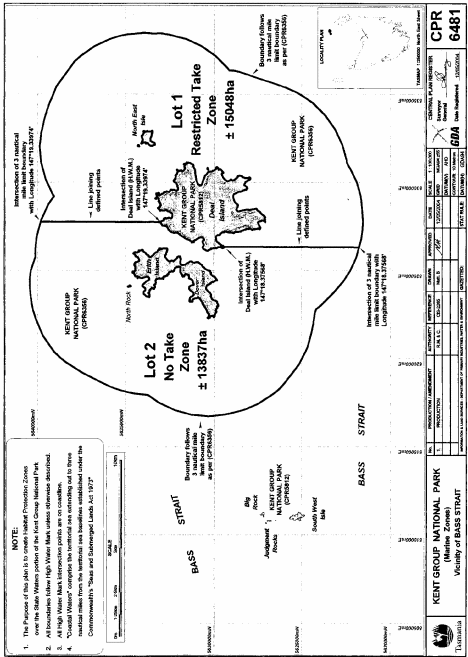
PART 1 - Restricted take zone for Kent Group National ParkThe restricted take zone for the Kent Group National Park is the area of water comprising approximately 15 048 hectares, shown as Lot 1 with coordinates expressed using Geocentric Datum of Australia and bounded by a heavy black line on Plan 6481 in the Central Plan Register, a reduced copy of which is set out, by way of illustration only, in Part 2 of this Schedule.
PART 2 - Plan
SCHEDULE 2 - Southwest National Park
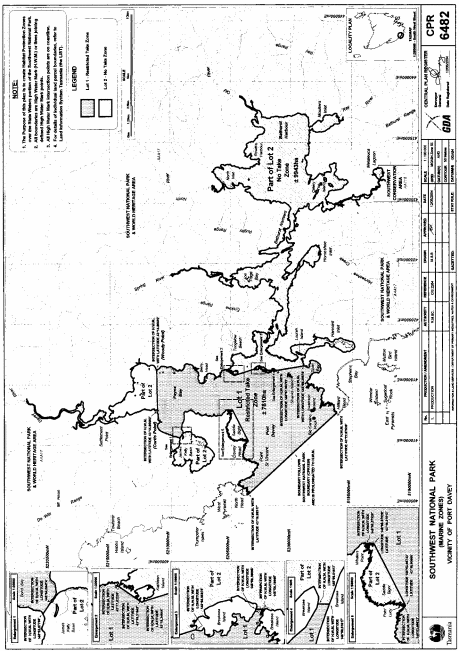
PART 1 - Restricted take zone for Southwest National ParkThe restricted take zone for the Southwest National Park is the area of water comprising approximately 7 810 hectares, shown as Lot 1 with coordinates expressed using Geocentric Datum of Australia and bounded by a heavy black line on Plan 6482 in the Central Plan Register, a reduced copy of which is set out, by way of illustration only, in Part 2 of this Schedule.
PART 2 - Plan
SCHEDULE 3 - Scallop spat measurements
PART 1 - MEANING OF SCALLOP SPAT
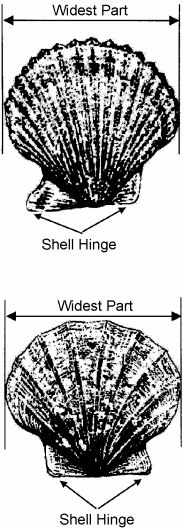
1. Meaning of scallop spatIn this rule –scallop spat means a scallop that is less than 40 millimetres at its widest part.
2. Meaning of widest part of scallopFor the purpose of clause 1 , the widest part of a scallop is taken to be the measurement along a straight line, generally parallel with the shell hinge, representing the widest part of the body of the shell, as shown in the diagrams which are set out, by way of illustration only, in Part 2 of this Schedule.
PART 2 - Scallop diagrams
SCHEDULE 3A - Infringement Notice Offences and Penalties[Schedule 3A Inserted by S.R. 2015, No. 103, Applied:24 Dec 2015]
Column 1 | Column 2 | Column 3 | Rule | Penalty units | 1. | Rule 8(1) | 5 | 2. | Rule 8(5) | 10 | 3. | Rule 9(1) | 10 | 4. | Rule 9(3) | 5 | 5. | Rule 11 | 5 | 6. | Rule 12(1) | 10 | 7. | Rule 13(2) | 10 | 8. | Rule 13(3) | 10 | 9. | Rule 14 | 10 | 10. | Rule 15(1) | 10 | 11. | Rule 16(1) | 5 | 12. | Rule 16(4) | 5 | 13. | Rule 17(1) | 5 | 14. | Rule 17(2) | 3 | 15. | Rule 17A(1) | 10 | 16. | Rule 18(4) | 2 | 17. | Rule 19(1) | 10 | 18. | Rule 19(2) | 2 | 19. | Rule 21(1) | 1 | 20. | Rule 21(2) | 5 | 21. | Rule 24 | 5 | 22. | Rule 26 | 5 | 23. | Rule 28(2) | 5 | 24. | Rule 28(5) | 5 | 25. | Rule 29 | 5 | 26. | Rule 30(1) | 5 | 27. | Rule 30(2) | 5 | 28. | Rule 30(4) | 5 | 29. | Rule 32(1) | 5 | 30. | Rule 32(2) | 5 | 31. | Rule 34(2) | 5 | 32. | Rule 35(1) | 3 | 33. | Rule 37(1) | 3 | 34. | Rule 37(2) | 3 | 35. | Rule 38(1) | 3 | 36. | Rule 40(1) | 3 | 37. | Rule 40(2) | 3 | 38. | Rule 42(1) | 3 | 39. | Rule 42(2) | 3 | 40. | Rule 43(1) | 3 | 41. | Rule 43(3) | 3 | 42. | Rule 43(4) | 1 | 43. | Rule 46 | 3 | 44. | Rule 47 | 3 | 45. | Rule 48(1) | 3 | 46. | Rule 48(2) | 3 |
SCHEDULE 4 - Legislation rescinded
Fisheries Rules 1999 (No. 158 of 1999) |
Displayed and numbered in accordance with the Rules Publication Act 1953.
Notified in the Gazette on 28 October 2009
These rules are administered in the Department of Primary Industries, Parks, Water and Environment.