

Vehicle and Traffic (Vehicle Standards) Regulations 2001
I, the Governor in and over the State of Tasmania and its Dependencies in the Commonwealth of Australia, acting with the advice of the Executive Council, make the following regulations under the Vehicle and Traffic Act 1999 .
15 October 2001G. S. M. Green
Governor
By His Excellency's Command,
P. A. Lennon
Minister for Infrastructure, Energy and Resources
PART 1 - Introductory
Division 1 - Short title and commencement
(1) These regulations may be cited as the Vehicle and Traffic (Vehicle Standards) Regulations 2001 .(2) Subregulation (1) is qualified by regulation 3 .
These regulations take effect on the day on which the Vehicle and Traffic Amendment (Vehicle Standards) Act 2001 commences.
Division 2 - Vehicle standards and offences
These regulations –(a) prescribe vehicle standards for Tasmania; and(b) are referred to, collectively, within these regulations as the Vehicle Standards; and(c) may, despite regulation 1(1) , be referred to for any other purpose as the Vehicle Standards in addition to, or instead of, the name provided for under that regulation.
Note The Vehicle Standards set standards that vehicles must comply with to be driven on public streets.
The Australian Design Rules (ADRs) - see Division 1 of Part 3 - are rules for designing and building vehicles. Imported vehicles must also comply with the ADRs.
The Vehicle Standards require a vehicle that is subject to an ADR when built or imported to continue to comply with the ADR.
The Vehicle Standards also apply certain other standards (adopted standards) that are intended to complement the ADRs.
The ADRs do not cover:
vehicles built before 1969
combinations of vehicles of any age
every safety feature for vehicles built between 1969 and 1988.
Those matters are covered by the Vehicle Standards and dimension limits for vehicles are set out in the Vehicle and Traffic (Vehicle Operations) Regulations 2001 .
In most cases, if a vehicle complies with the Vehicle Standards and the Vehicle and Traffic (Vehicle Operations) Regulations 2001 it is suitable for use on public streets.
(1) Except as provided by this regulation, a person must not use, or cause or permit the use of, a vehicle or combination on a public street unless –(a) the vehicle or combination complies with each provision of the Vehicle Standards applying to the vehicle or combination; and(b) the vehicle or combination, and each part of the vehicle or combination and its equipment, is in a safe and roadworthy condition; and(c) each light, reflector, sign, writing, colouring or band required to be fitted, lit or displayed on the vehicle or combination under the Vehicle Standards is clean and unobscured.Penalty: Fine not exceeding 20 penalty units.(2) Subregulation (1)(a) does not apply to a vehicle or combination if –(a) it is used on a public street under one of the following authorisations:(i) [Regulation 4 Subregulation (2) amended by S.R. 2002, No. 112, Applied:02 Oct 2002] a permit issued by the Commission or Registrar, either singly or jointly, under regulation 3 of the Vehicle and Traffic (Vehicle Operations) Regulations 2001 ;(ii) [Regulation 4 Subregulation (2) amended by S.R. 2010, No. 88, Applied:18 Aug 2010] a short term unregistered vehicle permit issued under the Vehicle and Traffic (Driver Licensing and Vehicle Registration) Regulations 2010 ;(iii) [Regulation 4 Subregulation (2) amended by S.R. 2010, No. 88, Applied:18 Aug 2010] a conditional registration under the Vehicle and Traffic (Driver Licensing and Vehicle Registration) Regulations 2010 ;(iv) an exemption under section 28 or 29 of the Vehicle and Traffic Act 1999 ;(v) an exemption, approval or determination issued by the Registrar under the Vehicle and Traffic Act 1999 ; and(b) the authorisation excuses or has the effect of excusing the vehicle or combination from having to comply with the applicable provision of the Vehicle Standards; and(c) the vehicle or combination is being used in accordance with the authorisation.(3) Subregulation (1)(a) does not apply to or in relation to the failure of a motor vehicle's emission control system to comply with applicable provisions of the Vehicle Standards if, despite the non-compliance, the system is continuing to operate essentially in accordance with its original design.(4) It is a defence in proceedings under subregulation (1)(a) to show that, at the relevant time, the vehicle or combination failing to comply with an applicable provision of the Vehicle Standards was –(a) being repaired, or being tested in the course of being repaired, so that it would comply with the Vehicle Standards; and(b) not endangering its occupants or other road users while being so repaired or tested.
Division 3 - Some features of the Vehicle Standards
5. Definitions and the dictionary
(1) The dictionary in Part 16 defines certain words and expressions, and includes signpost definitions to words and expressions defined elsewhere in the Vehicle Standards.(2) A definition in the Vehicle Standards applies to each use of the word or expression in the standards, unless the contrary intention appears.
(1) A diagram in the Vehicle Standards is part of the standards.(2) A diagram of something, except the essential diagram in regulation 152 , is an illustrative example of the thing in black and white, but does not represent its dimensions or the dimensions of any part of it.
Note The essential diagram in regulation 152 provides the dimensions required for a 75 millimetre kingpin used in a B-double.
A note in the Vehicle Standards is explanatory and is not part of the standards.
(1) An example, whether or not in the form of a diagram, in the Vehicle Standards is part of the standards.(2) If the Vehicle Standards includes an example of the operation of a provision of the standards –(a) the example is not exhaustive; and(b) the example does not limit, and may extend, the meaning of the provision; and(c) the example and the provision are to be read in the context of each other and of the other provisions of the standards, but, if the example and the provision as so read are inconsistent, the provision prevails.
PART 2 - Application of the Vehicle Standards
9. Application to vehicles and combinations on public streets
The Vehicle Standards apply to motor vehicles, trailers and combinations on public streets.
10. Vehicles to which the Vehicle Standards do not apply
The Vehicle Standards do not apply to a vehicle designed to be controlled by a person walking next to it.
Note Also, the Vehicle Standards do not apply to vehicles that are specifically excluded from the definitions of "motor vehicle" and "trailer" in section 3(1) of the Vehicle and Traffic Act 1999 .
11. Non-application of Vehicle Standards: exemption under other laws
(1) A provision of the Vehicle Standards does not apply to a vehicle or combination if the vehicle or combination is exempt from –(a) the provision under another law of this jurisdiction; or(b) the corresponding provision of the law of another jurisdiction.(2) However, the vehicle or combination is exempt only if all conditions of the exemption, if any, are being complied with.
12. Non-application of Vehicle Standards: inconsistent ADR requirements
A provision of Parts 5 to 14 of the Vehicle Standards does not apply to a vehicle if –(a) the provision is inconsistent with a requirement of a second or third edition ADR applying to the vehicle; and(b) the vehicle complies with the requirement.
13. Non-application of Vehicle Standards: Motor Vehicle Standards Act approvals
A provision of Parts 5 to 14 of the Vehicle Standards does not apply to a vehicle if –(a) the vehicle does not comply with a requirement of an ADR applying to the vehicle; and(b) the provision of the standards corresponds to the requirement of the ADR; and(c) despite the non-compliance, approval has been given, under section 10A(2) or (3) of the Motor Vehicle Standards Act 1989 of the Commonwealth, to place identification plates on vehicles of that type; and(d) the vehicle complies with the approval conditions, if any.
Note 1 Section 10A(2) of the Motor Vehicle Standards Act 1989 of the Commonwealth deals with vehicles that do not comply with an ADR, but the non-compliance is only in minor and inconsequential respects.
Note 2 Section 10A(3) of that Act deals with vehicles that do not comply with an ADR, and the non-compliance is not minor and inconsequential, but the vehicle will be safe to use if conditions are complied with.
PART 3 - Australian Design Rules
Note 1This Part applies the second and third edition ADRs to various vehicles.
Note 2Under this Part, a vehicle that is subject to ADRs when it is built generally remains subject to the ADRs throughout its life. However, a vehicle need not comply with a standard if the standard is replaced by, or is inconsistent with, a later standard and the vehicle complies with the later standard. Older vehicles may, therefore, be fitted with any equipment allowed on newer vehicles.
Note 3Vehicles that are modified must continue to comply with the Vehicle Standards. Modifications to a heavy vehicle must be undertaken in accordance with Vehicle Standards Bulletin 6 (VSB 6). For guidelines for modifications to light vehicles, see Vehicle Standards Bulletin 14 (VSB 14).
Note 4The following provisions of the Vehicle Standards extend the application of particular second or third edition ADRs to vehicles to which the ADRs are not expressed to apply:
regulation 125 (braking system design for prime movers in B-doubles)
regulation 126 (braking system design for trailers in B-doubles)
regulation 143 (speed limiting)
Note 5The following provisions of the Vehicle Standards apply to a vehicle instead of the corresponding ADR requirement:
regulation 45(5) (window tinting)
regulations 52 and 53 (tyre speed category requirements)
regulation 105 (warning lights and signs on buses carrying schoolchildren)
regulation 108(4) (display of certain lights and reflectors)
Division 1 - Interpretation
AnADR (Australian Design Rule) is a national standard.
15. What is a national standard
Anational standard is a national standard under the Motor Vehicle Standards Act 1989 of the Commonwealth.
16. References to national standards
Unless the contrary intention appears, a reference in the Vehicle Standards to a national standard is a reference to the national standard as in force from time to time.
17. What is a second edition ADR
Asecond edition ADR is a national standard incorporated in the document described as the Australian Design Rules for Motor Vehicle Safety, Second Edition originally published by the then Commonwealth Department of Transport.
18. What is a third edition ADR
Athird edition ADR is a national standard incorporated in the document described as the Australian Design Rules for Motor Vehicles and Trailers, Third Edition published by the Federal Office of Road Safety of the Commonwealth Department of Transport and Regional Development.
Division 2 - Compliance with ADRs
19. Compliance with second edition ADRs
(1) If a second edition ADR recommends that the ADR should apply to the design and construction of a vehicle, the vehicle must comply with the ADR.(2) If a second edition ADR contains a requirement for a type of equipment fitted to a vehicle built on or after a stated time, any equipment of the same type fitted to the vehicle after it is built must comply with –(a) the requirement as in force when the vehicle was built; or(b) if the requirement is amended after the vehicle is built and before the equipment is fitted, the requirement as in force –(i) when the vehicle was built; or(ii) when the equipment was fitted; or(iii) at any time between when the vehicle was built and the equipment was fitted.(3) However, a vehicle, or equipment fitted to a vehicle, need not comply with a recommendation or requirement of a second edition ADR if –(a) the recommendation or requirement is replaced by, or is inconsistent with, a requirement of a third edition ADR applying to the vehicle or equipment; and(b) the vehicle or equipment complies with the requirement of the third edition ADR.(4) If a second edition ADR allows a vehicle built on or after a stated time to be fitted with equipment, a vehicle built before the time may also be fitted with the equipment.
20. Compliance with third edition ADRs
(1) If a third edition ADR applies to the design and construction of a vehicle, the vehicle must comply with the ADR.(2) If a third edition ADR contains a requirement for a type of equipment fitted to a vehicle built on or after a stated time, any equipment of the same type fitted to the vehicle after it is built must comply with –(a) the requirement as in force when the vehicle was built; or(b) if the requirement is amended after the vehicle is built and before the equipment is fitted, the requirement as in force –(i) when the vehicle was built; or(ii) when the equipment was fitted; or(iii) at any time between when the vehicle was built and the equipment was fitted.(3) However, a vehicle, or equipment fitted to a vehicle, need not comply with a requirement of a third edition ADR if –(a) the requirement is replaced by, or is inconsistent with, a requirement of a later version of the ADR applying to the vehicle or equipment; and(b) the vehicle or equipment complies with the requirement of the later version.(4) If a third edition ADR allows a vehicle built on or after a stated time to be fitted with equipment, a vehicle built before the time may also be fitted with the equipment.
21. Exception to compliance with ADRs: vehicles that are not road vehicles
A vehicle need not comply with an ADR applied by regulation 19(1) or regulation 20(1) if a determination or declaration under section 5B of the Motor Vehicle Standards Act 1989 of the Commonwealth provides that the vehicle is not a road vehicle for that Act.
22. Exception to compliance with ADRs: Motor Vehicle Standards Act
(1) A vehicle need not comply with an ADR applied by regulation 19(1) or regulation 20(1) if –(a) despite non-compliance with the ADR, approval has been given, under section 10A(2) or (3) of the Motor Vehicle Standards Act 1989 of the Commonwealth, to place identification plates on vehicles of that type; and(b) the vehicle complies with the approval conditions, if any.
Note See notes to regulation 13 .
(2) A vehicle need not comply with an ADR applied by regulation 19(1) or regulation 20(1) if –(a) the vehicle may be supplied to the market under subsection 14A(1) of the Motor Vehicle Standards Act 1989 of the Commonwealth; and(b) for a vehicle for which an approval has been given under that subsection, the vehicle complies with the approval conditions, if any.(3) A vehicle need not comply with an ADR applied by regulation 19(1) or regulation 20(1) if –(a) the vehicle may be used in transport in Australia under subsection 15(2) of the Motor Vehicle Standards Act 1989 of the Commonwealth; and(b) for a vehicle for which an approval has been given under that subsection, the vehicle complies with the approval conditions, if any.
23. Partial exception to compliance with ADRs: personally imported vehicles
(1) In this regulation,personally imported vehicle means a vehicle built after 1968 that is imported into Australia by a person who –(a) owned and used the vehicle for a continuous period of at least 12 months before it was imported into Australia; and(b) when the vehicle was imported into Australia, was –(i) an Australian citizen or permanent resident or a person who had applied to become an Australian citizen or permanent resident; and(ii) old enough to hold a licence or permit to drive the vehicle; and(c) within the previous year, had not imported into Australia another vehicle owned by the person.(2) A personally imported vehicle must be fitted with –(a) seatbelts that are as effective as seatbelts that meet an Australian Standard or British Standard for seatbelts as in force when this regulation commenced; and(b) seatbelt anchorages that meet the number and location requirements of second or third edition ADR 5; and(c) child restraint anchorages that meet the number, location, accessibility, thread size and form requirements of second edition ADR 34 or third edition ADR 5 or 34; and(d) head restraints that meet the number, location and size requirements of second or third edition ADR 22.(3) However, a personally imported vehicle need only meet the requirements of an ADR mentioned in subregulation (2) if the ADR recommends that it should apply, or applies, to a vehicle of the same type.(4) A personally imported vehicle need not otherwise comply with an ADR applied by regulation 19(1) or regulation 20(1) .
PART 4 - Adopted Standards
24. What is an adopted standard
Anadopted standard is a standard, except a national standard, that is applied, adopted or incorporated by the Vehicle Standards.
25. Reference to adopted standards
Unless the contrary intention appears, a reference in a regulation or subregulation to an adopted standard is a reference to the standard as in force when the regulation or subregulation commenced.
26. Exception to compliance with adopted standards
A vehicle need not comply with an adopted standard if –(a) the standard is replaced by, or is inconsistent with, a later version of the standard; and(b) the vehicle complies with the later version of the standard.
PART 5 - General Safety Requirements
Note 1For a vehicle to be operated safely, it needs to be properly designed to minimise the potential for accidents and harm to its occupants and other road users.
Note 2This Part sets out various requirements covering the driver's view from a vehicle, the driver's control of a vehicle, protection of its occupants and other road users, and other general safety features.
Division 1 - All vehicles
(1) A motor vehicle with a GVM over 4.5 tonnes must have a right-hand drive.(2) A motor vehicle with a GVM not over 4.5 tonnes must have a right-hand drive if it is less than 30 years old.(3) A motor vehicle has a right-hand drive if the centre of at least one steering control of the vehicle is to the right of, or in line with, the centre of the vehicle.(4) A component of the steering system of a motor vehicle that is essential for effective steering of the vehicle must be built to transmit energy by mechanical means only.(5) Failure of a non-mechanical component of the steering system must not prevent effective steering of the vehicle.(6) [Regulation 27 Subregulation (6) amended by S.R. 2008, No. 165, Applied:17 Dec 2008] This regulation does not apply to a vehicle if it is built mainly for a purpose other than the transport of goods or people by road.
(1) A motor vehicle must be able to turn in a circle not over 25 metres in diameter, measured by the outer edge of the tyre track at ground level.(2) The vehicle must be able to comply with subregulation (1) whether it turns to the left or to the right.
29. Ability to travel backwards and forwards
A motor vehicle with an unloaded mass over 450 kilograms must be able to be driven both backwards and forwards when the driver is in the normal driving position.
(1) A vehicle must be designed, built and maintained in a way that minimises the likelihood of injury to a person making contact with the vehicle.(2) An object fitted to a vehicle must be designed, built, fitted to and maintained on the vehicle in a way that minimises the likelihood of injury to a person making contact with the vehicle.(3) However, subregulation (2) does not apply to an object fitted to a vehicle if –(a) the vehicle was designed before 1965 and the object was part of the design of the vehicle; or(b) the object was fitted to the vehicle before 1965 in accordance with the law of the place where the object was fitted.
31. Driver's view and vehicle controls
A motor vehicle must be built –(a) to allow the driver a view of the road and of traffic to the front and sides of the vehicle so the driver can drive the vehicle safely; and(b) with its controls located so the driver can drive the vehicle safely.
(1) A seat for a driver or passenger in a vehicle must be securely attached to the vehicle.(2) A motor vehicle must be fitted with seatbelts in accordance with any ADR applying to that motor vehicle.
33. Mudguards and spray suppression
(1) A vehicle must have firmly fitted –(a) a mudguard for each wheel or for adjacent wheels; and(b) for each axle group and single axle on a vehicle that is part of a B-double, spray suppression devices complying with Parts 1 and 2 of British Standard AU200-1984 Spray Reducing Devices for Heavy Goods Vehicle.(2) However, subregulation (1)(a) does not apply to a vehicle if –(a) the construction or use of the vehicle makes the fitting of mudguards unnecessary or impracticable; or(b) the body or part of the body of the vehicle acts as a mudguard.
Examples for subregulation (2)(a):
Most road-making plant.
Some agricultural equipment.
(3) A mudguard fitted to a vehicle with a GVM over 4.5 tonnes must, when the wheels of the vehicle are in position to move straight ahead –(a) reduce the danger of a person contacting the moving wheels; and(b) for the rear wheels –(i) cover the overall tyre width of the wheel or wheels to which it is fitted; and(ii) be fitted so the height above ground level of the lowest edge of the rear of the mudguard is not over one-third of the horizontal distance between the edge and the centre of the rearmost axle.(4) However, a mudguard may be up to –(a) 230 millimetres above ground level; or(b) on a vehicle built to be used off-road, 300 millimetres above ground level.(5) The outside of a rear mudguard, except a mudflap, of a vehicle that can be seen from the rear of the vehicle must be coloured white or silver if the vehicle –(a) is at least 2.2 metres wide; and(b) has a body the vertical measurement of which is under 300 millimetres at the rear, measured from the lowest point of the body above ground level to the highest point; and(c) is not fitted with rear marking plates in accordance with regulation 109 .(6) For subregulation (5)(a) , the width of a vehicle is measured disregarding any anti-skid device mounted on wheels, central tyre inflation systems, lights, mirrors, reflectors, signalling devices and tyre pressure gauges.
34. Prevention of dripping oil, &c.
A vehicle, including its fittings, must be built and maintained so as to prevent oil, grease, fuel, brake fluid or hydraulic fluid dripping onto the street surface from any part of the vehicle.
(1) A motor vehicle must be fitted with at least one horn or other device that can give sufficient audible warning to other road users of the approach or position of the vehicle.(2) [Regulation 35 Subregulation (2) amended by S.R. 2008, No. 165, Applied:17 Dec 2008] A motor vehicle must not be fitted with a device that can make a sound like the sound of a siren, exhaust whistle, compression whistle or repeater horn.(2A) [Regulation 35 Subregulation (2A) inserted by S.R. 2008, No. 165, Applied:17 Dec 2008] An ADR which corresponds to subregulation (2) does not apply to the extent that it is inconsistent with subregulation (2) .(3) However, subregulation (2) does not apply to –(a) a police vehicle; or(b) an ambulance; or(c) an Australian Defence Force vehicle; or(d) a vehicle operated, approved or authorised under the Fire Service Act 1979 ; or(e) a transport enforcement vehicle; or(f) an Australian Protective Service vehicle; or(g) an Australian Customs Service vehicle; or(h) an Airservices Australia vehicle; or(i) a vehicle at least 25 years old that is fitted as a police or emergency vehicle if it is –(i) used for exhibition purposes; or(ii) part of a collection of former police or emergency vehicles; or(j) an anti-theft alarm if the alarm cannot be operated while the vehicle's ignition is on.(4) A motor vehicle may be fitted with a device that emits a regular, intermittent sound while the vehicle is reversing or in reverse gear but that sound must not be louder than is necessary to enable the driver, and persons near the vehicle, to hear the device when it is operating.
(1) A rear vision mirror or mirrors must be fitted to a motor vehicle as required by this regulation so that a driver of the vehicle can clearly see by reflection the road behind the vehicle and any following or overtaking vehicle.(2) At least one rear vision mirror must be fitted to –(a) a car; and(b) a motor trike with 2 front wheels; and(c) a motor bike, or motor trike with one front wheel, built before July 1975.(3) At least one rear vision mirror must be fitted to each side of –(a) a motor vehicle with a GVM over 3.5 tonnes; and(b) a motor bike, or motor trike with one front wheel, built after June 1975; and(c) a motor vehicle having any side or rear glazing of a luminous transmittance of less than 70%; and(d) a bus.(4) A motor vehicle with a GVM not over 3.5 tonnes, except a motor vehicle mentioned in subregulation (2) or (3) , must be fitted with –(a) at least one rear vision mirror on the right side of the vehicle; and(b) at least one rear vision mirror on the left side of the vehicle or inside the vehicle.(5) A rear vision mirror fitted to a motor vehicle with a GVM over 3.5 tonnes must not project beyond 150 millimetres of the widest part, excluding lights, signalling devices and reflectors, of the vehicle or combination.(6) However, the rear vision mirror may project up to 230 millimetres beyond the widest part of the vehicle or combination if it can fold to project no more than 150 millimetres beyond the widest part.(7) A bus must be fitted with an interior mirror so that a driver of the bus, in the normal driving position, can clearly see by reflection the whole interior of the bus behind that driving position.
37. Rear vision mirrors: surfaces
(1) A rear vision mirror required to be fitted to the side of a motor vehicle with a GVM over 3.5 tonnes must have a reflecting surface of at least 150 square centimetres.(2) A rear vision mirror required to be fitted to the right side of a motor vehicle with a GVM over 3.5 tonnes must have a flat reflecting surface if –(a) the motor vehicle has only one steering control; and(b) the centre of the steering control is to the right of, or in line with, the centre of the motor vehicle.(3) The reflecting surface of the rear vision mirrors that are required to be fitted to a motor bike or moped must –(a) each be of the same curvature; and(b) if convex, be part of a notional sphere with a radius of at least 1.2 metres.
38. Additional rear vision mirrors
A motor vehicle may be fitted with additional rear vision mirrors or mirror surfaces that are flat or convex or a combination of flat and convex surfaces.
(1) A motor vehicle fitted with an automatic transmission must have an engine starter mechanism that cannot operate when the transmission control is in a position to drive the vehicle.(2) A motor vehicle built after 1975 that is fitted with an automatic transmission must have an indicator in the driver's compartment showing the transmission control position.(3) Subregulations (1) and (2) do not apply to a motor vehicle with less than 4 wheels.
A motor vehicle propelled by a compression ignition engine, commonly known as a diesel engine, must be fitted with a device preventing the engine from being started accidentally or inadvertently.
(1) A motor vehicle with a moveable body panel forward of the windscreen that covers an engine or luggage storage or battery compartment must have a device to secure the panel.(2) However, if the panel opens from the front in a way that partly or completely obstructs the driver's forward view through the windscreen, the panel must have primary and secondary devices to secure the panel.
42. Electrical wiring, components, connections and installations
(1) The wiring of electrical equipment of a vehicle, except the high tension ignition wiring, must –(a) be supported at intervals of not over 600 millimetres, unless the vehicle is a pole-type trailer with a pole with an adjustable length, or an extendible trailer; and(b) be insulated at each of its joints; and(c) be located where it cannot –(i) become overheated; or(ii) contact moving parts; or(iii) come near enough to the fuel system to be a fire hazard; and(d) be protected from chafing.(1A) [Regulation 42 Subregulation (1A) inserted by S.R. 2008, No. 165, Applied:17 Dec 2008] The electrical components of a vehicle must be securely mounted.(2) The electrical connectors between motor vehicles and trailers, for operation of the vehicle lights required by the Vehicle Standards, must comply with Australian Standard AS 2513-1982 Electrical Connections for Trailer Vehicles.(3) A trailer must be equipped with an electrical conductor, independent of the trailer coupling, that provides a return path between the electrical circuits of the trailer and towing vehicle.(4) Wires carrying electrical current on a bus must be fitted so that any current first passes through a fuse box or circuit-breaker.(5) If the battery of the electrical system of a bus is fitted in the interior of the bus, it must be so protected that fumes or acid cannot come into contact with passengers or goods.
43. Television receivers and visual display units
(1) A television receiver or visual display unit must not be installed in a vehicle so any part of the image on the screen is visible to the driver from the normal driving position.(2) However, subregulation (1) does not apply to –(a) a television receiver or visual display unit that cannot be operated when the vehicle is moving; or(b) a driver's aid in any vehicle or destination sign in a bus.
Examples of driver's aids:
Closed-circuit television security cameras.
Dispatch systems.
Navigational or intelligent highway and vehicle system equipment.
Rearview screens.
Ticket-issuing machines.
Vehicle monitoring devices.
(3) A television receiver, or visual display unit, and its associated equipment in a vehicle must be securely mounted in a position that –(a) does not obscure the driver's view of the road; and(b) does not impede the movement of a person in the vehicle.
43A. Requirement for windscreen to be fitted
[Regulation 43A Inserted by S.R. 2008, No. 165, Applied:17 Dec 2008] A motor vehicle (other than a motor bike, motor trike or moped) must be fitted with a windscreen if it is manufactured or designed to have a windscreen.
(1) Transparent material used in a windscreen, window, or an interior partition, of a motor vehicle must be of approved material if –(a) the vehicle was built after June 1953; or(b) the material was first fitted to the vehicle after June 1953.(2) A window on a bus must be –(a) sound and properly fitted; and(b) if movable, fitted with a suitable device for opening and closing.(3) Unless a bus is adequately ventilated by means of a fan-forced "jet air" or fan-forced airconditioning system, part of the glass in at least half of its window frames must be capable of being opened.(4) A bus must have ventilation additional to that provided by its windows.(5) In this regulation –approved material means material with the same characteristics as material mentioned in any of the following standards:(a) Australian Standard AS R1-1965 Safety Glass for Land Transport;(b) Australian Standard AS R1-1968 Safety Glass for Land Transport;(c) Australian Standard AS 2080-1977 Safety Glass for Vehicles;(d) British Standard BS 857:1967 Specification for Safety Glass for Land Transport;(e) British Standard BS 5282:1975 Road Vehicle Safety Glass;(f) British Standard BS AU178:1980 Road Vehicle Safety Glass;(g) Japanese Industrial Standard JIS R3211-1979 Safety Glasses for Road Vehicles;(h) American National Standard ANSI Z26.1-1980 Safety Code for Safety Glazing Materials for Glazing Motor Vehicles Operating on Land Highway;transparent material does not include any coating added to the windscreen, window or partition after its manufacture.
(1) Glazing used in a windscreen of a motor vehicle must have a luminous transmittance of at least –(a) for a motor vehicle built after 1971, 75%; or(b) for another motor vehicle, 70%.(2) Windscreen glazing of a motor vehicle must not be coated in a way that reduces its luminous transmittance.(3) However, subregulations (1) and (2) do not apply to the greater of the following areas of a windscreen:(a) the area above the highest point of the windscreen that is swept by a windscreen wiper;(b) the upper 10% of the windscreen.(4) Glazing used in an interior partition or window of a motor vehicle must have a luminous transmittance of at least 70%.(5) Glazing used in an interior partition or window of a motor vehicle, other than the windscreen, may be coated to achieve a luminous transmittance of not less than 35%.(6) Subregulation (5) does not apply to –(a) glazing or coating fitted before 1 October 1996 behind the rear of the driver's seat of a vehicle; or(b) glazing or coating behind the rear of the driver's seat of a bus, stretch limousine, ambulance or hearse; or(c) glazing or coating adjacent to the rear of an area of a motor vehicle designed and built to carry goods.
Examples for paragraph (c):
The area without seats behind the rear seat of a station wagon.
The tray of a utility, van or truck.
(7) Glazing that has been coated to reduce its luminous transmittance must not have a reflectance of over 10%.(8) The luminous transmittance requirements in subregulation (5) apply to a vehicle instead of the corresponding requirements of the relevant ADR.
46. Windscreen wipers and washers
(1) A motor vehicle with 3 or more wheels that is fitted with a windscreen must be fitted with at least one windscreen wiper unless a driver in a normal driving position can obtain an adequate view of the road ahead of the motor vehicle without looking through the windscreen.(2) At least one windscreen wiper fitted to the motor vehicle must –(a) be able to remove moisture from the part of the windscreen in front of the driver to allow the driver an adequate view of the road ahead of the motor vehicle when the windscreen is wet; and(b) be able to be operated from a normal driving position; and(c) for a motor vehicle built after 1934, continue to operate until the wiper is switched off; and(d) for a motor vehicle built after 1959 the driving position of which is nearer one side of the vehicle than the other –(i) be able to remove moisture from the part of the windscreen in front of the driver, and a corresponding part of the windscreen on the other side of the centre of the motor vehicle, to allow the driver an adequate view of the road ahead of the motor vehicle when the windscreen is wet; and(ii) if the windscreen wipers are operated by engine manifold vacuum, be provided with a vacuum reservoir or pump to maintain the efficient operation of the wiper or wipers while the vehicle is in motion.(3) If the motor vehicle was built after 1982 and has a GVM over 4.5 tonnes, it must also be fitted with a windscreen washer that can direct water onto the windscreen within the area swept by a windscreen wiper so the wiper can spread the water to all of the area swept by the wiper.
Note The ADRs require certain vehicles with a GVM not over 4.5 tonnes to be fitted with a windscreen washer.
(4) The windscreen washer must be able to be operated from a normal driving position.
47. Wheels and tyres: size and capacity
The wheels and tyres fitted to an axle of a vehicle must be of sufficient size and capacity to carry the part of the vehicle's gross mass transmitted to the ground through the axle.
A vehicle built after 1932 must be fitted with pneumatic tyres.
49. Pneumatic tyres: carcass construction
(1) A vehicle with a GVM not over 4.5 tonnes must not have pneumatic tyres of different carcass construction fitted to the same axle, but the tyres may have different cord materials and a different number of plies.(2) However, subregulation (1) does not apply to a tyre being used in an emergency as a temporary replacement for a tyre complying with the subregulation.
50. Pneumatic tyres: size and capacity
The size and capacity of a pneumatic tyre to be fitted to a vehicle must be decided using a cold inflation pressure that is not more than the lesser of –(a) the pressure recommended by the tyre manufacturer; and(b) a pressure of –(i) for a radial ply tyre, 825 kilopascals; or(ii) for another tyre, 700 kilopascals.
Note The maximum permissible tyre inflation pressures are prescribed in the Vehicle and Traffic (Vehicle Operations) Regulations 2001 .
A tyre fitted to a vehicle must be free of any apparent defect that could make the vehicle unsafe.
52. Tyres for use on vehicles with a GVM over 4.5 tonnes
(1) A tyre fitted to a vehicle with a GVM over 4.5 tonnes must be suitable for road use at the lesser of –(a) 100 kilometres an hour; and(b) the vehicle's top speed.(2) This regulation applies to a vehicle instead of the tyre speed category requirements in the relevant ADR.
53. Tyres: manufacturer's rating
(1) This regulation applies to a motor vehicle if it –(a) has 4 or more wheels; and(b) was built after 1972; and(c) has a GVM not over 4.5 tonnes.(2) However, this regulation does not apply to a tyre if it –(a) is recommended by the vehicle's builder as suitable for limited use on the vehicle in special circumstances at a speed less than the speed applying to the vehicle under subregulation (3) ; or(b) is being used in an emergency as a temporary replacement for a tyre complying with this regulation.(3) A tyre fitted to a motor vehicle must, when first manufactured, have been rated by the tyre manufacturer as suitable for road use at the lesser of –(a) a speed of at least –(i) for a car with special features for off-road use, 140 kilometres an hour; or(ii) for another car, 180 kilometres an hour; or(iii) for another motor vehicle, 120 kilometres an hour; and(b) the vehicle's top speed.
Example for paragraph (a)(i):
4-wheel drive vehicle.
(4) This regulation applies to a vehicle instead of the tyre speed category requirements in the relevant ADR.
(1) A tyre that is retreaded before the commencement of this regulation must not be used on a vehicle if –(a) Australian Standard AS 1973-1976 Retreaded Pneumatic Passenger Car and Light Truck Tyre or Australian Standard AS 1973-1985 Retreaded Pneumatic Passenger and Light Truck Tyre applies to the tyre; and(b) the tyre was retreaded after publication of the Australian Standard; and(c) the tyre was not retreaded in accordance with Australian Standard AS 1973-1976 Retreaded Pneumatic Passenger Car and Light Truck Tyre, Australian Standard AS 1973-1985 Retreaded Pneumatic Passenger and Light Truck Tyre or Australian Standard AS 1973-1993 Pneumatic Tyres — Passenger Car, Light Truck and Truck/Bus — Retreading and Repair Processes.(2) A tyre that is retreaded after the commencement of this regulation must not be used on a vehicle if –(a) Australian Standard AS 1973-1993 Pneumatic Tyres — Passenger Car, Light Truck and Truck/Bus — Retreading and Repair Processes applies to the tyre; and(b) the tyre was not retreaded in accordance with the Australian Standard.
Note The Australian Standards mentioned in this regulation require various markings on retreaded tyres. These may include a speed rating less than the rating originally marked on the tyre.
(1) A tyre on a vehicle must not have cleats or other gripping devices that could damage road surfaces.(2) Except at tread wear indicators, a tyre fitted to the vehicle must have a tread pattern at least 1.5 millimetres deep in a band that runs continuously –(a) across –(i) for a vehicle with a GVM over 4.5 tonnes, at least 75% of the tyre width that normally comes into contact with the road; or(ii) for another vehicle, the tyre width that normally comes into contact with the road; and(b) around the whole circumference of the tyre.(3) A vehicle must not be fitted with a tyre that has been treated by recutting or regrooving the tread rubber, unless the tyre was –(a) constructed with an extra thickness of rubber designed for recutting or regrooving; and(b) labelled to indicate the construction.(4) Subregulations (2) and (3) do not apply to a vehicle designed mainly for use in a specialised activity such as agriculture or road construction.
Examples for subregulation (4):
Multi-tyred rollers (self-propelled or towed).
Bitumen-laying machines.
Mowing equipment (self-propelled or towed).
Division 2 - Additional requirements for motor bikes
56. Steering gear and handlebars
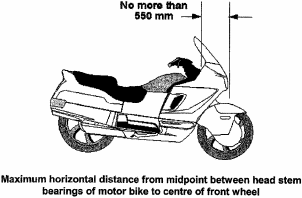
(1) The handlebars on a motor bike must extend at least 250 millimetres, but not over 450 millimetres, on each side of the centre line of the motor bike.(2) In taking a measurement for subregulation (1) , mirrors and lights mounted on the handlebars of the motor bike are disregarded.(3) The lowest part of the hand grip on the handlebars must not be higher than 380 millimetres above the attachment point of the handlebars to the motor bike.(4) Hand grips on the handlebars must be fitted symmetrically.(5) If a motor bike has the head stem as the steering pivot point, the horizontal distance from the midpoint between the head stem bearings to the centre of the front wheel must not be over 550 millimetres.
A motor bike must be fitted with foot rests for the driver, and for any passenger for whom a seating position is provided.
(1) If the engine power of a motor bike is transmitted to the rear wheel by a chain, the driver and any passenger must be protected from the front sprocket and at least the upper part of the chain by –(a) the frame or equipment of the motor bike; or(b) a chain guard.(2) A chain guard must cover the chain to a point –(a) at least 300 millimetres to the rear of the rearmost foot rest; or(b) above the centre of the rear drive sprocket.
PART 6 - Vehicle marking
NoteThis Part contains requirements for a vehicle that help to identify it and for markings that help to warn other motorists.
59. Vehicle and engine identification numbers
(1) In this regulation,number includes letter.(2) A motor vehicle must have an individual engine identification number clearly stamped, embossed or otherwise permanently marked on it.(3) A motor vehicle built after 1930 must have the engine identification number on its engine block or the main component of its engine.(4) A vehicle must have an individual vehicle identification number clearly stamped, embossed or otherwise permanently marked on a substantial part of its frame or chassis.(5) A vehicle or engine identification number must be located where a person can read it easily without having to use tools to remove a part of the vehicle that would otherwise obstruct the person's view.
60. White or silver band on certain vehicles
(1) This regulation applies to a vehicle that –(a) is at least 2.2 metres wide; and(b) has a body with a vertical measurement under 300 millimetres at the rear, measured from the lowest point of the body above ground level to the highest point; and(c) is not fitted with rear marking plates in accordance with regulation 109 .(2) For subregulation (1)(a) , the width of a vehicle is measured disregarding any anti-skid device mounted on wheels, central tyre inflation systems, lights, mirrors, reflectors, signalling devices and tyre pressure gauges.(3) The vehicle must have a white or silver band at least 75 millimetres high across the full width of the rearmost part of the body of the vehicle.
(1) This regulation applies to a motor vehicle with a GVM over 4.5 tonnes that has the centre of a steering control to the left of the centre of the vehicle.(2) The vehicle must display the words "left hand drive" on the rear of the vehicle.(3) The words must be in letters at least 75 millimetres high in a colour contrasting with the background to the words.
PART 7 - Vehicle configuration
Note 1This Part sets out various requirements covering the axle configuration on vehicles and combinations of vehicles, so that they can be operated safely with other traffic and without damaging the road and structures on the road.
Note 2Specific requirements relating to vehicle dimensions and mass may be found in the Vehicle and Traffic (Vehicle Operations) Regulations 2001 .
(1) A motor vehicle, except an articulated bus, must have only –(a) one axle group, or single axle, towards the front of the vehicle; and(b) one axle group, or single axle, towards the rear of the vehicle.(2) An articulated bus must have –(a) on its front section –(i) only one axle group, or single axle, towards the front of the section; and(ii) only one axle group, or single axle, towards the rear of the section; and(b) on another section, only one axle group or single axle.(3) A trailer must have only –(a) one axle group or single axle; or(b) 2 axle groups, 2 single axles, or one axle group and single axle, in the following configuration:(i) one axle group, or single axle, towards the front of the vehicle, with all the wheels on the axle group or single axle connected to the steering mechanism for that part of the trailer;(ii) one axle group, or single axle, towards the rear of the vehicle.(4) A semi-trailer that is extendible, or is fitted with sliding axles, must –(a) have a securing device that –(i) can securely fix the extendible part or sliding axles to the rest of the vehicle in any position of adjustment provided; and(ii) is located in a position that can prevent accidental or inadvertent release, if the device is mounted on the chassis of the vehicle; and(iii) is fitted with a visible or audible warning system to indicate to a person standing beside the vehicle that the device is not engaged; and(iv) is fitted with a way of preventing loss of air from the air brake supply, if the device uses air from the brake system and fails in a way allowing air to escape; and(v) is held in the applied position by direct mechanical action without the intervention of an electric, hydraulic or pneumatic device; and(b) be built so the adjustable parts of the vehicle remain connected if the securing device fails.
63. Relation between axles in axle group
(1) The axles in an axle group, except a twinsteer axle group, fitted to a vehicle with a GVM over 4.5 tonnes must relate to each other through a load-sharing suspension system.(2) In this regulation,load-sharing suspension system means an axle group suspension system that –(a) is built to divide the load between the tyres on the group so that no tyre carries a mass over 10% more than the mass that it would carry if the load were divided equally; and(b) has effective damping characteristics on all axles of the group.
PART 8 - Lights and reflectors
Note 1This Part deals with how the lights on a vehicle must be fitted and work so that the driver can see the road, pedestrians and other vehicles at night, and can signal to others.
Note 2Other laws provide for when certain lights must be switched on.
Note 3In this Part, the description "yellow" is used as a more modern term, instead of the description "amber" which is used in earlier legislation and some ADRs.
Division 1 - General requirements for lights
64. Certain requirements apply only at night
The requirements of this Part for a light, except a brake or direction indicator light, to be visible over a stated distance apply only at night.
A light, except a high-beam headlight, fitted to a vehicle must be built and adjusted to provide the necessary amount of light, without dazzling the driver of another vehicle approaching, or being approached by, the vehicle.
(1) If lights are required under the Vehicle Standards to be fitted to a vehicle in pairs –(a) a light must be fitted on each side of the longitudinal axis of the vehicle; and(b) the centre of each light in a pair must be the same distance from the longitudinal axis of the vehicle; and(c) the centre of each light in a pair must be at the same height above ground level; and(d) each light in a pair must project approximately the same amount of light of the same colour.(2) Subregulation (1) applies to a motor bike with an attached sidecar as if the sidecar were not attached.
Division 2 - Headlights
67. Headlights to be fitted to vehicles
(1) A motor vehicle must be fitted with –(a) one low-beam headlight if it is a moped, motor bike or motor trike with one front wheel; or(b) a pair of low-beam headlights if it has 4 or more wheels or is a motor trike, except a moped, with 2 front wheels.(2) If a motor vehicle built after 1934 can travel at over 60 kilometres an hour –(a) each low-beam headlight mentioned in subregulation (1) must be able to work in the high-beam position; or(b) the vehicle must be fitted with –(i) one headlight that can work in the high-beam position if the vehicle is required to have one low-beam headlight; or(ii) a pair of headlights that can work in the high-beam position.(3) A motor bike may be equipped with a headlight modulation system that –(a) varies the brightness of its high-beam headlight or low-beam headlight, but not both, at a rate of at least 200 and at most 280 flashes a minute; and(b) is designed to operate only in daylight.(4) Additional headlights may be fitted to a motor bike or motor trike, or a motor vehicle with 4 or more wheels that was built before 1970.(5) Additional pairs of headlights may be fitted to a motor vehicle with 4 or more wheels that was built after 1969.
68. How headlights are to be fitted
(1) The centres of low-beam headlights fitted as a pair on a motor vehicle with 4 or more wheels must be at least 600 millimetres apart.(2) However, subregulation (1) does not apply to a motor vehicle built before 1970 if the centres of its low-beam headlights –(a) were under 600 millimetres apart when the vehicle was built; and(b) are not nearer than they were when the vehicle was built.(3) Each low-beam headlight of a pair on a motor trike, except a moped, with 2 front wheels must not be over 400 millimetres from the nearer side of the vehicle.(4) The centre of a low-beam headlight fitted to a motor vehicle built after June 1953 must be –(a) at least 500 millimetres above ground level; and(b) not over 1.4 metres above ground level.
69. How single headlights are to be fitted
(1) A motor bike or motor trike with a single headlight fitted must have the light fitted in the centre.(2) Subregulation (1) applies to a motor bike with an attached sidecar as if the sidecar were not attached.
70. How additional headlights are to be fitted
If 2 or more additional headlights are fitted to a motor vehicle with 4 or more wheels, the additional headlights must as far as possible be fitted in pairs.
(1) When on, a headlight or additional headlight fitted to a motor vehicle must –(a) show only white light; and(b) project its main beam of light ahead of the vehicle.(2) Headlights must be fitted to a motor vehicle so their light does not reflect off the vehicle into the driver's eyes.
72. Effective range of headlights
(1) This regulation applies to a headlight that is on at night.(2) A low-beam headlight must illuminate the road ahead of the motor vehicle for at least 25 metres.(3) A high-beam headlight must illuminate the road ahead of the motor vehicle for at least 50 metres.(4) However, a low-beam headlight fitted to a motor vehicle built before 1931, or to a moped, need only illuminate the road ahead of the vehicle for 12 metres.
73. Changing headlights from high-beam to low-beam position
(1) A motor vehicle built after 1934 that can travel at over 60 kilometres an hour must be fitted with –(a) a dipping device enabling the driver in the normal driving position –(i) to change the headlights from the high-beam position to the low-beam position; or(ii) simultaneously to switch off a high-beam headlight and switch on a low-beam headlight; and(b) for a vehicle built after June 1953, a device to indicate to the driver that the headlights are in the high-beam position.(2) A headlight fitted to a motor vehicle not fitted with a dipping device mentioned in subregulation (1)(a) must operate in the low-beam position.(3) When a headlight fitted to a motor vehicle is switched to the low-beam position, any other headlight on the vehicle must operate only in the low-beam position or be off.
Division 3 - Parking lights
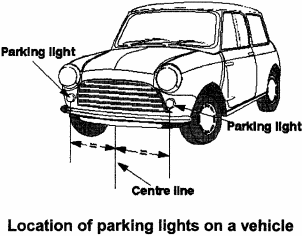
(1) A motor vehicle built after June 1953 must be fitted with –(a) a pair of parking lights if it is a motor trike with 2 front wheels, except a moped, or a motor vehicle with 4 or more wheels; or(b) at least one parking light if it is a motor bike with an attached sidecar, or a motor trike with one front wheel, except a moped.(2) A pair of parking lights fitted to a motor vehicle with 4 or more wheels must be fitted with the centre of each light –(a) at least 600 millimetres from the centre of the other light; and(b) not over 510 millimetres from the nearer side of the vehicle.(3) However, a pair of parking lights fitted to a motor vehicle under 1.3 metres wide may be fitted with the centre of each light not under 400 millimetres from the centre of the other light.(4) A parking light fitted to a motor trike with 2 front wheels must not be over 400 millimetres from the nearer side of the vehicle.(5) A parking light fitted to a motor bike with a sidecar must be fitted not over 150 millimetres from the side of the sidecar furthest from the motor bike.(6) When on, a parking light must –(a) show a white or yellow light visible 200 metres from the front of the vehicle; and(b) not use over 7 watts power.(7) A parking light fitted to a motor vehicle built after 1969 must be wired so the parking light is on when a headlight on the vehicle is on.(8) A parking light fitted to a sidecar attached to a motor bike must be wired to operate when a headlight, tail light or parking light on the motor bike is on.(9) For subregulation (3) , the width of a vehicle is measured disregarding any anti-skid device mounted on wheels, central tyre inflation systems, lights, mirrors, reflectors, signalling devices and tyre pressure gauges.
Division 4 - Daytime running lights
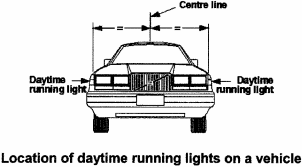
(1) A pair of daytime running lights may be fitted to a motor vehicle.(2) A pair of daytime running lights fitted to a vehicle with 4 or more wheels must be fitted with the centre of each light –(a) at least 600 millimetres from the centre of the other light; and(b) not over 510 millimetres from the nearer side of the vehicle.(3) However, a pair of daytime running lights fitted to a motor vehicle under 1.3 metres wide may be fitted with the centre of each light not under 400 millimetres from the centre of the other light.(4) When on, a daytime running light must –(a) show a white or yellow light visible from the front of the vehicle; and(b) not use over 25 watts power.
Note The third edition ADRs only allow white daytime running lights.
(5) Daytime running lights must be wired so they are off when a headlight, except a headlight being used as a flashing signal, is on.(6) For subregulation (3) , the width of a vehicle is measured disregarding any anti-skid device mounted on wheels, central tyre inflation systems, lights, mirrors, reflectors, signalling devices and tyre pressure gauges.
Division 5 - Tail lights
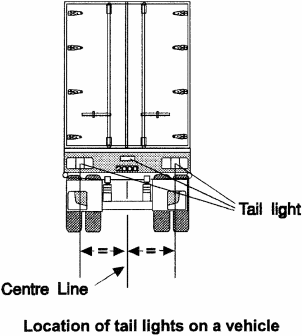
(1) A vehicle must have at least one tail light fitted on or towards the rear of the vehicle.(2) A motor trike with 2 rear wheels, or a motor vehicle with 4 or more wheels, built after 1959 must have at least one tail light fitted on or towards each side of the rear of the vehicle.(3) A trailer built after June 1973 must have at least one tail light fitted on or towards each side of the rear of the vehicle.(4) The centre of a tail light mentioned in subregulation (1) , (2) or (3) must not be over –(a) 1.5 metres above ground level; or(b) if it is not practicable to fit the light lower, 2.1 metres above ground level.(5) A vehicle may have one or more additional tail lights at any height above ground level.
77. Pattern of fitting tail lights
(1) If only one tail light is fitted to a vehicle, it must be fitted in the centre or to the right of the centre of the vehicle's rear.(2) Subregulation (1) applies to a motor bike with an attached sidecar as if the sidecar were not attached.(3) If 2 or more tail lights are fitted to a vehicle, at least 2 must be fitted as a pair.(4) Tail lights fitted in accordance with this Division may also serve as rear clearance lights if they are fitted to a vehicle in accordance with regulation 83(3) .
78. Performance of tail lights
(1) When on, a tail light of a vehicle must –(a) show a red light visible 200 metres from the rear of the vehicle; and(b) not use over 7 watts power.(2) A tail light fitted to a street rod vehicle may incorporate a blue lens not over 20 millimetres in diameter.
A tail light of a motor vehicle must be wired to come on, and stay on, when a parking light or headlight on the vehicle is on, unless an external switch is fitted to operate the tail light.
Division 6 - Number plate lights
(1) At least one number plate light must be fitted to the rear of a vehicle.(2) When on, the number plate light or lights must illuminate a number plate on the rear of the vehicle with white light, so the characters on the number plate can be read at night 20 metres from the rear of the vehicle.(3) A number plate light –(a) may be combined with another light; and(b) must not project white light to the rear of the vehicle except by reflection; and(c) must not obscure the characters on the number plate; and(d) must be wired to come on, and stay on, when a parking light, headlight or tail light on the vehicle is on.
Division 7 - Clearance lights
(1) Front clearance lights may only be fitted to a vehicle that is at least 1.8 metres wide.(2) A pair of front clearance lights must be fitted to a motor vehicle that is at least 2.2 metres wide, or a prime mover.(3) The centre of a front clearance light must be –(a) not over 400 millimetres from the nearer side of the vehicle; and(b) if the vehicle was built after June 1953 –(i) at least 750 millimetres higher than the centre of any low-beam headlight fitted to the vehicle; or(ii) not lower than the top of the windscreen.(4) However, a front clearance light may be mounted on an external rear vision mirror or a mirror support if, when the mirror is correctly adjusted, no part of the lens of the clearance light is visible to a person in the normal driving position.(5) When on, a front clearance light must –(a) show a yellow or white light visible 200 metres from the front of the vehicle; and(b) not use over 7 watts power.
(1) A motor vehicle fitted with front clearance lights may also have additional forward-facing lights on or above the roof of its cabin.(2) The additional forward-facing lights must be spaced evenly between the front clearance lights, with their centres at least 120 millimetres apart.(3) When on, an additional forward-facing light must –(a) show a yellow or white light; and(b) not use over 7 watts power.
(1) Rear clearance lights may only be fitted to a vehicle that is at least 1.8 metres wide.(2) A pair of rear clearance lights must be fitted to the rear of a vehicle that is at least 2.2 metres wide.(3) The centre of a rear clearance light must be –(a) not over 400 millimetres from the nearer side of the vehicle; and(b) if practicable, at least 600 millimetres above ground level.(4) When on, a rear clearance light must –(a) show a red light visible 200 metres from the rear of the vehicle; and(b) not use over 7 watts power.
Division 8 - Side marker lights
84. Vehicles needing side marker lights
(1) A pair of side marker lights must be fitted towards the rear of the sides of a motor vehicle that is over 7.5 metres long and at least 2.2 metres wide.(2) A pole-type trailer, and a motor vehicle built to tow a pole-type trailer, with at least one cross-bar or bolster must have a side marker light fitted to each side of the back or only cross-bar or bolster.(3) A pole-type trailer with 2 or more cross-bars or bolsters may also have a side marker light fitted to each side of the front cross-bar or bolster.(4) At least 2 side marker lights must be fitted to each side of –(a) a trailer, except a pole-type trailer, that is at least 2.2 metres wide and not over 7.5 metres long; and(b) a semi-trailer that is not over 7.5 metres long.(5) At least 3 side marker lights must be fitted to each side of –(a) a trailer, except a pole-type trailer, that is at least 2.2 metres wide and over 7.5 metres long; and(b) a semi-trailer that is over 7.5 metres long.(6) For subregulations (1) , (4) and (5) , the width of a vehicle is measured disregarding any anti-skid device mounted on wheels, central tyre inflation systems, lights, mirrors, reflectors, signalling devices and tyre pressure gauges.
85. Location of side marker lights
(1) The centre of a side marker light must not be over 150 millimetres from the nearer side of the vehicle.(2) A front side marker light fitted to a motor vehicle must be towards the front of the side of the vehicle with no part of the lens visible to the driver.(3) The centre of a front side marker light fitted to a trailer must be –(a) within 300 millimetres of the front of the side of the trailer; or(b) if the construction of the trailer makes it impracticable to comply with paragraph (a) , as near as practicable to the front of the trailer.(4) The centre of a rear side marker light fitted to a vehicle must be –(a) within 300 millimetres of the rear of the side of the vehicle; or(b) if the construction of the vehicle makes it impracticable to comply with paragraph (a) , as near as practicable to the rear of the vehicle.(5) Side marker lights fitted to a vehicle must, as far as practicable, be evenly spaced along the side of the vehicle.(6) Subregulations (2) , (3) , (4) and (5) do not apply to side marker lights fitted to a cross-bar or bolster of a pole-type trailer.(7) Only the side marker lights nearest to the rear need be fitted if complying with subregulations (3) and (4) would result in the front and rear side marker lights being under 2.5 metres apart.(8) A side marker light fitted to a vehicle must be fitted so –(a) its centre is not over –(i) 1.5 metres above ground level; or(ii) if it is not practicable to fit it lower, 2.1 metres above ground level; and(b) its centre is at least 600 millimetres above ground level; and(c) it is, as far as practicable, in a row of side marker lights along the side of the vehicle.(9) Subregulation (8)(a) does not apply to a side marker light that is not required to be fitted to the vehicle by regulation 84 .
86. Performance of side marker lights
(1) When on, a side marker light fitted to a vehicle must –(a) show a light visible 200 metres from the vehicle; and(b) not use over 7 watts power.(2) When on, a side marker light fitted to a vehicle must show –(a) to the front of the vehicle, a yellow light; and(b) to the rear of the vehicle –(i) if the light also operates as a rear light or reflector, a red light; and(ii) in any other case, a red or yellow light.(3) However, if a pole-type trailer with 2 or more cross-bars or bolsters has the side marker lights permitted by regulation 84(3) –(a) the side marker lights fitted to the front cross-bar or bolster may comply with subregulation (2)(a) only; and(b) the side marker lights fitted to the back cross-bar or bolster may comply with subregulation (2)(b) only.
87. Side marker lights and rear clearance lights
The side marker light nearest to the rear of a vehicle may also be a rear clearance light for regulation 83 .
Division 9 - Brake lights
(1) A brake light must be fitted to the rear of a vehicle built after 1934.(2) A pair of brake lights must be fitted to the rear of –(a) a motor vehicle built after 1959 that has 4 or more wheels; and(b) a motor trike built after 1959 that has 2 rear wheels; and(c) a trailer built after June 1973.(3) The centre of a brake light must be –(a) at least 350 millimetres above ground level; and(b) not over –(i) 1.5 metres above ground level; or(ii) if it is not practicable to fit the light lower, 2.1 metres above ground level.(4) A vehicle may be fitted with one or more additional brake lights.(5) The centre of an additional brake light must be at least 350 millimetres above ground level.(6) If only one brake light is fitted to a vehicle, it must be fitted in the centre or to the right of the centre of the vehicle's rear.(7) Subregulation (6) applies to a motor bike with an attached sidecar as if the sidecar were not attached.
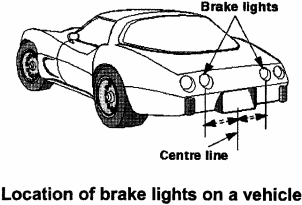
89. Performance and operation of brake lights
(1) When on, a brake light must show a red light visible 30 metres from the rear of the vehicle.(2) A brake light fitted to a street rod vehicle may incorporate a blue lens not over 20 millimetres in diameter.(3) A brake light fitted to a motor vehicle must come on, if it is not already on, when –(a) for a vehicle with 4 or more wheels or built after 1974, a service brake is applied; or(b) for another vehicle, the rear wheel brake is applied.(4) Subregulation (3) does not apply if the controls in the vehicle that start the engine are in a position that makes it impossible for the engine to operate.(5) A brake light on a trailer must come on when –(a) the brake light of the towing vehicle comes on; or(b) a brake control on the towing vehicle, which independently activates the service brake on the trailer, is operated.(6) A brake light may be operated by an engine brake, retarder or similar device if the device does not interfere with the proper operation of the brake light.
Division 10 - Reversing lights
(1) One or more reversing lights may be fitted to the rear of a vehicle and on each side towards the rear of the vehicle.(2) A reversing light must have its centre not over 1.2 metres above ground level.(3) When on, a reversing light must show a white or yellow light to the rear or to the side and rear of the vehicle.
Note Third edition ADRs only allow white reversing lights.
(4) A reversing light fitted to a motor vehicle must be wired so it operates only when the vehicle is reversing or in reverse gear.(5) A reversing light fitted to a trailer must be wired so it operates only when a motor vehicle towing the trailer is reversing or in reverse gear.(6) A yellow reversing light may also operate as a direction indicator light.
Division 11 - Direction indicator lights
91. Direction indicator lights on motor vehicles
(1) A motor vehicle with 4 or more wheels that was built after August 1966 must have –(a) a pair of direction indicator lights fitted on, or towards, its front that face forwards; and(b) a pair of direction indicator lights fitted on, or towards, its rear that face backwards.(2) A motor vehicle with less than 4 wheels that was built after June 1975 must have –(a) a pair of direction indicator lights fitted on, or towards, its front that face forwards; and(b) a pair of direction indicator lights fitted on, or towards, its rear that face backwards.(3) A motor vehicle that is not required to have direction indicator lights may have –(a) one or more pairs of direction indicator lights that are visible from both the front and rear of the vehicle; or(b) both –(i) a pair of direction indicator lights fitted on, or towards, its front that face forwards; and(ii) a pair of direction indicator lights fitted on, or towards, its rear that face backwards.
92. Direction indicator lights on trailers
(1) A trailer built after June 1973 must have a pair of direction indicator lights fitted on, or towards, its rear that face backwards.(2) A trailer that is not required to have direction indicator lights may have one or more pairs of direction indicator lights fitted on, or towards, its rear that face backwards.
93. Location of direction indicator lights
(1) A pair of direction indicator lights fitted to a vehicle must have the centre of each light at least –(a) for a motor bike or the single wheel end of a motor trike, 300 millimetres from the centre of the other light; and(b) for lights fitted at the 2 wheel end of a motor trike, 600 millimetres from the centre of the other light, unless the centre of each direction indicator light is not over 400 millimetres from the nearer side of the vehicle; and(c) for another vehicle with a width of not over 1.3 metres, 400 millimetres from the centre of the other light; and(d) for another vehicle with a width of over 1.3 metres, 600 millimetres from the centre of the other light.(2) The centre of each direction indicator light must be at least 350 millimetres above ground level.(3) The centre of each light in a pair of direction indicator lights required to be fitted to a vehicle must not be over –(a) 1.5 metres above ground level; or(b) if it is not practicable for the light to be fitted lower, 2.1 metres above ground level.(4) For subregulation (1) , the width of a vehicle is measured disregarding any anti-skid device mounted on wheels, central tyre inflation systems, lights, mirrors, reflectors, signalling devices and tyre pressure gauges.
94. Operation and visibility of direction indicator lights
(1) A direction indicator light fitted to a motor vehicle must –(a) when operating, display regular flashes of light at a rate of not over 120, and –(i) for a motor vehicle with 4 or more wheels, at least 60, flashes a minute; and(ii) for another motor vehicle, at least 45, flashes a minute; and(b) be able to be operated by a person in the normal driving position; and(c) be wired to an audible or visible device in the vehicle that tells the driver that the direction indicator light is operating; and(d) flash at the same time and rate as any other direction indicator lights fitted on the same side of the vehicle.(2) A direction indicator light fitted to a side of a trailer must, when operating, flash at the same time and rate as the direction indicator light or lights fitted to the same side of the motor vehicle towing the trailer.(3) The flashes of light displayed by a direction indicator light must be –(a) if the light faces forwards, white or yellow; and(b) if the light faces backwards –(i) yellow; or(ii) for a vehicle built before July 1973, yellow or red; and(c) if the light faces out from the side of the vehicle –(i) white or yellow towards the front and side; and(ii) for a vehicle built before July 1973, yellow or red towards the rear and side; and(iii) for a vehicle built after June 1973, yellow towards the rear and side.
Note The ADRs only allow yellow direction indicator lights.
(4) If a motor vehicle's direction indicator lights display only yellow light, the vehicle may be equipped to allow the lights to operate simultaneously on both sides of the vehicle, if a visible or audible signal tells the driver when the lights are operating simultaneously.(5) When on, a direction indicator light must be visible 30 metres from –(a) if the light faces forwards, the front of the vehicle; or(b) if the light faces backwards, the rear of the vehicle; or(c) if the light faces out from the side of the vehicle, that side of the vehicle.(6) When on, each direction indicator light in at least one pair of lights fitted on or towards the front of a prime mover, or a motor vehicle over 7.5 metres long, must be visible at a point –(a) 1.5 metres at right angles from the side of the vehicle where the light is fitted; and(b) in line with the rear of the vehicle.
Division 12 - Fog lights
(1) A pair of front fog lights may be fitted to a motor vehicle with 4 or more wheels.(2) A pair of front fog lights, or a single front fog light, may be fitted to a motor bike or motor trike.(3) A pair of front fog lights fitted to a motor vehicle with 4 or more wheels must have the centre of each light not over 400 millimetres from the nearer side of the vehicle unless the centres of the lights are at least 600 millimetres apart.(4) If the top of the front fog light is higher than the top of any low-beam headlight on the vehicle, the centre of the fog light must not be higher than the centre of the low-beam headlight.(5) A front fog light must –(a) when on –(i) project white or yellow light in front of the vehicle; and(ii) be a low-beam light; and(b) be able to be operated independently of any headlight; and(c) be fitted so the light from it does not reflect off the vehicle into the driver's eyes.
(1) A vehicle may have fitted to its rear –(a) a pair of rear fog lights; or(b) one rear fog light fitted on, or to the right, of the centre of the vehicle.(2) Subregulation (1)(b) applies to a motor bike with an attached sidecar as if the sidecar were not attached.(3) A rear fog light must –(a) have its centre –(i) not over 1.5 metres above ground level; and(ii) at least 100 millimetres from the centre of a brake light; and(b) when on, project red light behind the vehicle; and(c) not use over 27 watts power; and(d) be wired to a visible device in the vehicle that tells the driver that the rear fog light is operating.
Division 13 - Interior lights
(1) A vehicle may be fitted with interior lights that illuminate any interior part of the vehicle.(2) A bus must be fitted with interior lights for the convenience of the passengers.
Division 14 - Reflectors generally
98. General requirements for reflectors
(1) A reflector fitted to a vehicle must show a red, yellow or white reflection of light when light is projected directly onto the reflector at night by a low-beam headlight that –(a) is 45 metres from the reflector; and(b) complies with the Vehicle Standards.(2) The reflection must be clearly visible from the position of the headlight.
Division 15 - Rear reflectors
(1) A motor vehicle with 4 or more wheels, and a trailer, must have a rear-facing red reflector towards each side of its rear.(2) A motor bike, a sidecar attached to a motor bike, and a motor trike, must have a rear-facing red reflector.(3) The centre of each reflector must be –(a) at the same height above ground level; and(b) not over 1.5 metres above ground level.(4) However, subregulation (3) does not apply to a reflector fitted to a sidecar attached to a motor bike.(5) A reflector fitted to a motor vehicle with 4 or more wheels, or a trailer, must not be over 400 millimetres from the nearer side of the vehicle.(6) A vehicle fitted with rear-facing red reflectors in accordance with subregulation (1) or (2) may be fitted with additional red reflectors at any height above ground level or at any distance from the side of the vehicle.
Division 16 - Side reflectors
100. Compulsory side reflectors on pole-type trailers
(1) Yellow or red side-facing reflectors must be fitted to the pole of a pole-type trailer so –(a) one reflector is fitted to the middle third of the left and right faces of the pole; and(b) the front reflector is not over 3 metres from the front of the trailer; and(c) the other reflectors are not over 3 metres apart.(2) Additional side-facing reflectors may be fitted to a pole-type trailer in accordance with regulation 101 .
(1) A vehicle may be fitted with side-facing reflectors.(2) A side-facing reflector –(a) towards the front of the vehicle must be yellow or white; and(b) towards the rear of the vehicle must be yellow or red; and(c) on the central part of the vehicle must be yellow.
Division 17 - Front reflectors
102. Compulsory front reflectors on trailers
(1) A front-facing white or yellow reflector must be fitted towards each side of the front of –(a) a semi-trailer, except a pole-type trailer; and(b) the front cross-bar or bolster of a pole-type trailer; and(c) a trailer that is at least 2.2 metres wide.(2) Each reflector must have its centre –(a) at the same height above ground level; and(b) not over 1.5 metres above ground level; and(c) not over 400 millimetres from the nearer side of the vehicle.(3) Additional front-facing reflectors may be fitted to a trailer mentioned in subregulation (1) in accordance with regulation 103 .
103. Optional front reflectors
(1) A motor vehicle with 4 or more wheels, or a trailer, may have one or more front-facing white or yellow reflectors fitted towards each side of its front.(2) A motor vehicle with less than 4 wheels may have one or more front-facing white or yellow reflectors.(3) The centre of at least one reflector on each side of the front of the vehicle must be –(a) at the same height above ground level as the centre of the other reflector; and(b) the same distance from the longitudinal axis of the vehicle as the centre of the other reflector; and(c) at least –(i) for a vehicle with a width under 1.3 metres, 400 millimetres from the centre of the other reflector; and(ii) for another vehicle, 600 millimetres from the centre of the other reflector.(4) For subregulation (3)(c) , the width of a vehicle is measured disregarding any anti-skid device mounted on wheels, central tyre inflation systems, lights, mirrors, reflectors, signalling devices and tyre pressure gauges.
Division 18 - Warning lights and signs on buses carrying schoolchildren
(1) Subject to subregulation (2) , this Division applies to a bus that is used for carrying schoolchildren.(2) This Division does not apply to a bus used for carrying schoolchildren if it is –(a) operating wholly within an urban area specified in Schedule 1 ; or(b) carrying schoolchildren on a school charter or school excursion; or(c) operating a regular passenger transport service that is not provided primarily for the purpose of transporting children to or from school.(3) For subregulation (2) ,regular passenger transport service has the same meaning as in the Passenger Transport Act 1997 .
105. Fitting of warning lights and signs
(1) Two warning lights and a warning sign must be fitted to the front and rear of the bus.(2) The warning lights must be fitted –(a) on each side of, and the same distance from, the centre of the warning sign; and(b) [Regulation 105 Subregulation (2) amended by S.R. 2002, No. 112, Applied:02 Oct 2002] with the edge of the warning sign not more than 100 millimetres from the nearest point on the lens of the warning lights or, if that is not practicable, not more than 200 millimetres from the nearest point on the lens; and(c) with the distance between the warning lights at least 300 millimetres at the nearest point; and(d) so no part of the bus obstructs the light displayed –(i) 300 to the left and right of the centre of each light; and(ii) 100 above and below the centre of each light.(3) The warning lights may be on the warning sign if the words or image on the sign are not obscured.(4) [Regulation 105 Subregulation (4) substituted by S.R. 2002, No. 112, Applied:02 Oct 2002] The warning lights at the same end of the bus must be fitted at the same height and as high as practicable.(5) If the centres of the warning lights are under 1.8 metres above ground level, no part of the warning lights or warning sign may be on the left of the bus.(6) This regulation applies to a bus despite any requirement of a third edition ADR.(7) [Regulation 105 Subregulation (7) inserted by S.R. 2002, No. 112, Applied:02 Oct 2002] Subregulation (2)(b) does not apply if the warning lights fitted to the front of the bus are mounted higher than 1.8 metres above the ground level.
106. Operation and performance of warning lights
(1) When operating, a warning light must display regular flashes of yellow light at a rate of at least 90, and not over 180, flashes a minute.(2) The warning lights at the same end of the bus must flash alternately.(3) Unless the driver has turned the warning lights off, they must operate automatically when a door on the bus opens and for at least 10, and not over 20, seconds after all the doors on the bus have closed.(4) The bus must have a visible or audible signal that tells the driver when the warning lights are operating.(5) The bus must be fitted with a switch that allows the driver to turn the warning lights off.(6) A warning light must have –(a) an effective lit lens area of at least 60 square centimetres; and(b) a luminous intensity, in candela, of at least the values mentioned in the following table when measured at the angles mentioned in the table:
Vertical angle from centre of light
Horizontal angle from centre of light
-30o
-20o
-10o
-5o
0o
5o
10o
20o
30o
10o
50
80
50
5o
180
320
350
450
350
320
180
0o
75
450
1000
1250
1500
1250
1000
450
75
-5o
40
270
450
570
600
570
450
270
40
-10o
75
75
75
107. Specifications for warning signs
[Regulation 107 Subregulation (1) amended by S.R. 2002, No. 112, Applied:02 Oct 2002] [Regulation 107 Subregulation (1) amended by S.R. 2002, No. 112, Applied:02 Oct 2002] [Regulation 107 Subregulation (3) amended by S.R. 2002, No. 112, Applied:02 Oct 2002] [Regulation 107 Subregulation (3) amended by S.R. 2002, No. 112, Applied:02 Oct 2002] [Regulation 107 Subregulation (3) amended by S.R. 2002, No. 112, Applied:02 Oct 2002] [Regulation 107 Subregulation (4) inserted by S.R. 2002, No. 112, Applied:02 Oct 2002] [Regulation 107 Substituted by S.R. 2007, No. 16, Applied:11 Apr 2007](1) A warning sign on the front of a bus must display –(a) an image of the 40km/h speed-limit sign as specified in AS 1743 Road Signs — Specifications (image R4-1(40)); or(b) the word or words "SCHOOL" or "SCHOOL BUS" in capital letters at least 100 millimetres high.(2) A warning sign on the rear of a bus must display –(a) an image of the 40km/h speed-limit sign as specified in AS 1743 Road Signs — Specifications (image R4-1(40)); and(b) the words "WHEN LIGHTS FLASH".(3) The part of the warning sign referred to in subregulation (1)(a) and the part of the warning sign referred to in subregulation (2)(a) must –(a) be square; and(b) be of the dimensional proportions specified in AS 1743 Road Signs — Specifications (image R4-1(40)) with the red circle having a diameter of at least –(i) 200 millimetres, if the sign is on the front of the bus; or(ii) 440 millimetres, if the sign is on the rear of the bus; and(c) be coated with retro-reflective material of class 1 or 2 that meets Australian Standard AS 1906 Retro-reflective Materials and Devices for Road Traffic Control Purposes.(4) The part of the warning sign referred to in subregulation (2)(b) must –(a) be written in 60 millimetre black lettering, using series D characters as specified in Australian Standard AS 1744-1975 Standard Alphabets for Road Signs, on a white background; and(b) for the words "WHEN LIGHTS", use the maximum even space possible between the letters of each word over a distance of 450 millimetres with a minimum separation between the words of 60 millimetres; and(c) for the word "FLASH", use the maximum even space possible between the letters over a distance of 450 millimetres; and(d) comprise either –(i) two separate signs with the words "WHEN LIGHTS" displayed on one sign 450 millimetres long and 70 millimetres high and the word "FLASH" displayed on another sign the same size; or(ii) one sign 900 millimetres long and 70 millimetres high.(5) The part of the warning sign referred to in subregulation (2)(b) must be placed –(a) if any of the warning lights on the rear of the bus are mounted below the horizontal centreline of the bus, immediately above the 40km/h speed-limit sign; or(b) if the part of the warning sign comprises 2 signs in accordance with subregulation (4)(d)(i) , one on either side of the 40km/h speed-limit sign, aligned horizontally as close as possible with the top or bottom perimeter of the 40km/h speed-limit sign; or(c) in any other case, immediately above or below the 40km/h speed-limit sign.
Division 19 - Other lights, reflectors, rear marking plates or signals
108. Other lights and reflectors
(1) In this regulation –emergency vehicle means –(a) an ambulance; or(b) a vehicle built or permanently modified for firefighting purposes; or(c) a vehicle used by an electricity authority for carrying out emergency repairs to power lines;exempt vehicle means –(a) a police vehicle; or(b) an Australian Protective Service vehicle; or(c) an Australian Customs Service vehicle; or(d) an Airservices Australia vehicle; or(e) an Australian Defence Force vehicle; or(f) a vehicle operated under the Ambulance Service Act 1982 and authorised by the Director of Ambulance Services to respond to emergencies; or(g) a vehicle operated, approved or authorised under the Fire Service Act 1979 ; or(h) [Regulation 108 Subregulation (1) amended by S.R. 2006, No. 125, Applied:15 Nov 2006] a vehicle operated, approved or authorised under the Emergency Management Act 2006 ;(i) [Regulation 108 Subregulation (1) amended by S.R. 2006, No. 125, Applied:15 Nov 2006] a transport enforcement vehicle;special-use vehicle means –(a) a vehicle built, fitted or used in hazardous situations on a public street; or(b) [Regulation 108 Subregulation (1) amended by S.R. 2002, No. 112, Applied:02 Oct 2002] a vehicle or combination that, because of its dimensions, is permitted to be driven or used on a public street only in accordance with a permit issued under the Vehicle and Traffic (Vehicle Operations) Regulations 2001 ; or(c) a vehicle built or fitted to accompany a vehicle or combination mentioned in paragraph (b) ; or(d) a bus fitted with a sign telling road users that the bus carries children; or(e) a vehicle built, fitted or used as an escort for, or in support of the competitors in, a cycling or foot race or other sporting event making use of public streets.
Examples for paragraph (a):
Tow trucks and vehicle breakdown service vehicles.
Kerbside garbage and recycling collection vehicles.
Vehicles used to accompany livestock on public streets.
Vehicles used in road construction.
(2) [Regulation 108 Subregulation (2) substituted by S.R. 2008, No. 165, Applied:17 Dec 2008] A vehicle may be fitted with a light or reflector not mentioned in the Vehicle Standards if –(a) another law of this jurisdiction so allows; or(b) an ADR so allows and the light or reflector is fitted in accordance with that ADR.(3) [Regulation 108 Subregulation (3) amended by S.R. 2008, No. 165, Applied:17 Dec 2008] [Regulation 108 Subregulation (3) amended by S.R. 2008, No. 165, Applied:17 Dec 2008] [Regulation 108 Subregulation (3) amended by S.R. 2001, No. 171, Applied:01 Jan 2002] However, except as provided by subregulation (4) or an exemption issued under the Vehicle and Traffic (Vehicle Operations) Regulations 2001 , a vehicle must not be fitted with –(a) a light that flashes; or(b) a light or reflector that –(i) shows a light other than a red, yellow or white light; or(ii) shows a red light to the front; or(iii) shows a white light to the rear; or(iv) is shaped or located in a way that reduces the effectiveness of a light or reflector that is required to be fitted to the vehicle under the Vehicle Standards.(4) Despite any requirement of a third edition ADR –(a) an exempt vehicle may be fitted with one or more flashing lights of any colour and one or more reflectors of any colour; and(b) an emergency vehicle may be fitted with one or more flashing red or white lights; and(c) [Regulation 108 Subregulation (4) amended by S.R. 2006, No. 125, Applied:15 Nov 2006] a special-use vehicle may be fitted with one or more flashing yellow lights.(d) [Regulation 108 Subregulation (4) amended by S.R. 2006, No. 125, Applied:15 Nov 2006] . . . . . . . .
(1) [Regulation 109 Subregulation (1) substituted by S.R. 2008, No. 165, Applied:17 Dec 2008] In this regulation –rear marking plate means a rear marking plate designed and fitted to a vehicle in compliance with Vehicle Standards Bulletin 12 (VSB 12).(2) Rear marking plates must be fitted to –(a) a motor vehicle with a GVM over 12 tonnes, except a bus fitted with hand grips or similar equipment for standing passengers to hold; and(b) a trailer with a GTM over 10 tonnes.(3) [Regulation 109 Subregulation (3) substituted by S.R. 2008, No. 165, Applied:17 Dec 2008] Subregulation (2) applies to a vehicle even if it was built before the day on which Vehicle Standards Bulletin 12 (VSB 12) was first published.
Note Vehicle Standards Bulletin 12 (VSB 12) was first published on 14 June 2006.
(4) Rear marking plates may be fitted to a motor vehicle with a GVM not over 12 tonnes or a trailer with a GTM not over 10 tonnes.

(1) This regulation applies to a motor vehicle if –(a) it is not fitted with a brake light or direction indicator light mentioned in Division 9 or 11 ; and(b) the construction of the vehicle would otherwise prevent the driver from hand signalling an intention –(i) to turn or move the vehicle to the right; or(ii) to stop or suddenly reduce the speed of the vehicle.(2) The vehicle must be fitted with a mechanical signalling device or a pair of turn signals.
111. Mechanical signalling devices
(1) A mechanical signalling device must –(a) be fitted to the right side of the vehicle; and(b) be able to be operated by the driver from a normal driving position; and(c) consist of a white or yellow representation of an open human hand at least 150 millimetres long; and(d) be constructed so that the driver of the vehicle can keep the device –(i) in a neutral position so it is unlikely that the driver of another vehicle or anyone else would regard it as a signal; and(ii) in a horizontal position with the palm of the hand facing forwards and the fingers pointing out at a right angle to the vehicle to signal an intention to turn or move right; and(iii) with the palm of the hand facing forwards and the fingers pointing upwards to signal an intention to stop or reduce suddenly.(2) When the mechanical signalling device is in a position mentioned in subregulation (1)(d)(ii) and (iii) , the complete hand must be clearly visible from both the front and the rear of the vehicle, at a distance of 30 metres.
A turn signal must –(a) consist of a steady or flashing illuminated yellow sign at least 150 millimetres long and 25 millimetres wide that –(i) when in operation, is kept horizontal; and(ii) when not in operation, is kept in a position so it is unlikely that the driver of another vehicle or anyone else would regard it as a signal; and(b) be fitted to the side of the motor vehicle at least 500 millimetres and not over 2.1 metres above ground level, in a position so the driver of the vehicle, from the normal driving position, can see whether the signal is in operation; and(c) be able to be operated by the driver from the normal driving position; and(d) when in operation, be visible from both the front and rear of the vehicle at a distance of 30 metres.
Division 20 - Vehicles not required to have lights or reflectors
113. Certain vehicles used in daylight
This Part does not apply to –(a) a vehicle built before 1931 that is used only in daylight; or(b) a vehicle that is –(i) designed mainly for use in a specialised activity such as agriculture or road construction; and(ii) [Regulation 113 Amended by S.R. 2008, No. 165, Applied:17 Dec 2008] built on a chassis of a type not normally used for building trucks; and(iii) used only in daylight.
Examples for paragraph (b):
Fork-lifts, tractors, graders and harvesters.
Towed equipment such as balers, brooms, mowers, ploughs, rakes and road-rollers.
Note The provisions of the Traffic (Road Rules) Regulations 1999 relating to driver obligations such as lighting and signalling continue to apply to a vehicle even if Part 8 does not apply to it. If, for example, a tractor driver is unable to give a hand signal of an intention to turn because the tractor is towing a grain trailer that obscures the view of following motorists, the grain trailer must be fitted with direction indicator lights in accordance with Part 8 .
114. Certain vehicles used for collection or exhibition purposes
This Part does not apply to a vehicle built before 1946 that is used mainly for exhibition purposes.
PART 9 - Braking systems
Note 1This Part sets out the braking system requirements for vehicles and combinations to ensure that they can be reliably slowed or stopped even if a part of a braking system fails, and to ensure that a vehicle or combination can be prevented from rolling away when parked.
Note 2The Part also includes special requirements for braking systems on B-doubles to ensure that the braking systems on the component vehicles are compatible.
Division 1 - Brake requirements for all vehicles
115. Parts of a braking system
(1) A brake tube or hose fitted to a vehicle must –(a) be manufactured from a material appropriate to its intended use in the vehicle; and(b) be long enough to allow for the full range of steering and suspension movements of the vehicle; and(c) be fitted to prevent it being damaged during the operation of the vehicle by –(i) a source of heat; or(ii) any movement of the parts to which it is attached or near.(2) Each component of the braking system of a vehicle with a GVM over 4.5 tonnes must comply with the design and performance requirements of –(a) a relevant Australian Standard or British Standard as in force when this subregulation commenced; or(b) a relevant standard, as in force when this subregulation commences, approved by any of the following bodies:(i) American Society of Automotive Engineers;(ii) American National Standards Institute;(iii) Japanese Standards Association;(iv) Deutsches Institut für Normung;(v) International Organisation for Standardisation.
The braking system of a vehicle must allow for adjustment to take account of normal wear.
117. Supply of air or vacuum to brakes
(1) If air brakes are fitted to a vehicle –(a) the compressor supplying air to the brakes must be able to build up air pressure to at least 80% of the governor cut-out pressure in not over 5 minutes after the compressed air reserve is fully used up; and(b) for a vehicle with a GVM over 4.5 tonnes, the air storage tanks must have sufficient capacity to allow 5 applications of the service brakes before the air pressure drops below half the governor cut-out pressure; and(c) there must be an automatic or manual condensate drain valve at the lowest point of each air brake reservoir in the system; and(d) any spring brake fitted to the vehicle must not operate before the warning mentioned in regulation 121(4)(a) or regulation 124(3)(a) has been given.(2) If vacuum brakes are fitted to a vehicle, the vacuum supply must be able to build up vacuum –(a) to the level when the warning signal mentioned in regulation 121(4)(a) or regulation 124(3)(a) no longer operates within 30 seconds after the vacuum reserve is fully used up; and(b) to the normal working level within 60 seconds after the vacuum reserve is fully used up.
118. Performance of braking systems
(1) One sustained application of the brake of a motor vehicle built after 1930, or a combination that includes a motor vehicle built after 1930, must be able to produce the performance mentioned in subregulation (2) to subregulation (7) –(a) when the vehicle or combination is on a dry, smooth, level road surface, free from loose material; and(b) whether or not the vehicle or combination is loaded; and(c) without part of the vehicle or combination moving outside a straight path –(i) centred on the longitudinal axis of the vehicle or combination before the brake was applied; and(ii) 3.7 metres wide.(2) The braking system of a motor vehicle or combination with a gross mass under 2.5 tonnes must bring the vehicle or combination from a speed of 35 kilometres an hour to a stop within –(a) 12.5 metres when the service brake is applied; and(b) 30 metres when the emergency brake is applied.(3) The braking system of a motor vehicle or combination with a gross mass of at least 2.5 tonnes must bring the vehicle or combination from a speed of 35 kilometres an hour to a stop within –(a) 16.5 metres when the service brake is applied; and(b) 40.5 metres when the emergency brake is applied.(4) The braking system of a motor vehicle or combination with a gross mass under 2.5 tonnes must decelerate the vehicle or combination, from any speed at which the vehicle or combination can travel, by an average of at least –(a) 3.8 metres a second a second when the service brake is applied; and(b) 1.6 metres a second a second when the emergency brake is applied.(5) The braking system of a motor vehicle or combination with a gross mass of at least 2.5 tonnes must decelerate the vehicle or combination, from any speed at which the vehicle or combination can travel, by an average of at least –(a) 2.8 metres a second a second when the service brake is applied; and(b) 1.1 metres a second a second when the emergency brake is applied.(6) The braking system of a motor vehicle or combination with a gross mass under 2.5 tonnes must achieve a peak deceleration of the vehicle or combination, from any speed at which the vehicle or combination can travel, of at least –(a) 5.8 metres a second a second when the service brake is applied; and(b) 1.9 metres a second a second when the emergency brake is applied.(7) The braking system of a motor vehicle or combination with a gross mass of at least 2.5 tonnes must achieve a peak deceleration of the vehicle or combination, from any speed at which the vehicle or combination can travel, of at least –(a) 4.4 metres a second a second when the service brake is applied; and(b) 1.5 metres a second a second when the emergency brake is applied.(8) The parking brake of a vehicle or combination must be able to hold the vehicle or combination stationary on a 12% gradient.
Division 2 - Motor vehicle braking systems
119. What braking system a motor vehicle must have
(1) In this regulation,independent brake, for a vehicle, means a brake that is operated entirely separately from any other brake on the vehicle, except for any drum, disc or part, on which a shoe, band or friction pad makes contact, that is common to 2 or more brakes.(2) A motor vehicle with 4 or more wheels built, or used, mainly for transporting goods or people by road must be fitted with –(a) a braking system that –(i) consists of brakes fitted to all wheels of the vehicle; and(ii) has at least 2 separate methods of activation, arranged so effective braking remains on at least 2 wheels if a method fails; or(b) 2 independent brakes, each of which, when in operation, acts directly on at least half the number of wheels of the vehicle.(3) The braking system of a motor vehicle mentioned in subregulation (2) that was built after 1945 must have a service brake operating on all wheels that, when applied –(a) acts directly on the wheels and not through the vehicle's transmission; or(b) acts on a shaft between a differential of the vehicle and a wheel.(4) The braking system of a motor vehicle with 4 or more wheels must have a parking brake that –(a) is held in the applied position by direct mechanical action without the intervention of an electrical, hydraulic or pneumatic device; and(b) is fitted with a locking device that can hold the brake in the applied position; and(c) has its own separate control.(5) The parking brake may also be the emergency brake.(6) If 2 or more independent brakes are fitted to a motor vehicle with 4 or more wheels, the brakes must be arranged so brakes are applied to all the wheels on at least one axle of the vehicle when any brake is operated.(7) A motor bike or motor trike must be fitted with –(a) 2 independent brakes; or(b) a single brake that acts directly on all wheels of the vehicle and is arranged so effective braking remains on at least one wheel if a part of the system fails.(8) Subregulation (7) applies to a motor bike with a sidecar attached as if the sidecar were not attached.(9) A motor trike must have a parking brake that is held in the applied position by mechanical means.
120. Operation of brakes on motor vehicles
The braking system on a motor vehicle must be arranged to allow the driver of the motor vehicle to apply the brakes from a normal driving position.
121. Air or vacuum brakes on motor vehicles
(1) If a motor vehicle has air brakes, the braking system of the vehicle must include at least one air storage tank.(2) If a motor vehicle has vacuum brakes, the braking system of the vehicle must include at least one vacuum storage tank.(3) An air or vacuum storage tank must be built so the service brake can be applied to meet the performance standards of regulation 118 at least twice if the engine of the vehicle stops or the source of air or vacuum fails.(4) An air or vacuum storage system must –(a) be built to give a visible or audible warning to the driver, while in a normal driving position, of a lack of air or vacuum that would prevent the service brake from being applied to meet the performance standards of regulation 118 at least twice; and(b) be safeguarded by a check valve or other device against loss of air or vacuum if the supply fails or leaks.(5) However, subregulation (4)(a) does not apply to a vehicle with a GVM of not more than 4.5 tonnes that is fitted with an air or vacuum assisted braking system.(6) If air or vacuum brakes are fitted to a motor vehicle equipped to tow a trailer, the brakes of the vehicle must be able to stop the vehicle, at the performance standards for emergency brakes under regulation 118 if the trailer breaks away.(7) The braking system of a motor vehicle with a GVM over 4.5 tonnes equipped to tow a trailer fitted with air brakes must include protection against loss of supply line air or brake control signal air.(8) The protection mentioned in subregulation (7) must –(a) operate automatically if a brake supply line hose connecting the motor vehicle and a trailer fails; and(b) maintain enough air pressure to allow the brakes to be applied to meet performance standards for emergency brakes under regulation 118 ; and(c) include a visible or audible warning to the driver.
Division 3 - Trailer braking system
122. What brakes a trailer must have
(1) A trailer with a GTM over 750 kilograms must have brakes that operate on at least one wheel at each end of one or more axles of the trailer.(2) A semi-trailer or converter dolly with a GTM over 2 tonnes must have brakes that operate on all its wheels.(3) Subregulations (1) and (2) do not apply to –(a) [Regulation 122 Subregulation (3) amended by S.R. 2008, No. 165, Applied:17 Dec 2008] a trailer with a GTM not over 2 tonnes that was built before 1 July 1988; or(b) [Regulation 122 Subregulation (3) amended by S.R. 2008, No. 165, Applied:17 Dec 2008] a trailer designed mainly for use in a specialised activity such as agriculture or road construction and which is not designed or built to carry a load.
Examples for subregulation (3)(b):
Balers, brooms, mowers, ploughs, rakes and road-rollers.
123. Operation of brakes on trailers
(1) The braking system of a trailer with a GTM over 2 tonnes must allow the driver of a motor vehicle towing the trailer to operate the brakes from a normal driving position.(2) However, subregulation (1) does not apply to –(a) an unloaded converter dolly that weighs under 3 tonnes if the motor vehicle towing the converter dolly has a GVM over 12 tonnes; or(b) a trailer with a GTM over 2 tonnes but not over 4.5 tonnes built before 1 July 1991.(3) The brakes on a trailer with a GTM over 2 tonnes must –(a) operate automatically and quickly if the trailer breaks away from the towing vehicle; and(b) remain in operation for at least 15 minutes after a break-away; and(c) be able to hold the trailer on a 12% gradient while in operation after a break-away.
124. Air or vacuum brakes on trailers
(1) If a trailer has air brakes, its braking system must include at least one air storage tank.(2) If a trailer has vacuum brakes, its braking system must include at least one vacuum storage tank.(3) An air or vacuum storage system must –(a) be built to give a visible or audible warning to the driver of the towing vehicle, while in a normal driving position, of a lack of air or vacuum that would prevent the brakes from meeting the performance standards of regulation 118 ; and(b) be safeguarded by a check valve or other device against loss of air or vacuum if the supply fails or leaks.(4) This regulation does not apply to a trailer with a GTM of not more than 2 tonnes.
Division 4 - Additional brake requirements for B-doubles
125. Braking system design for prime movers in B-doubles
(1) A prime mover used in a B-double must comply with second edition ADR 35A or third edition ADR 35.(2) A prime mover used in a B-double must also have an anti-lock braking system complying with third edition ADR 64, if the prime mover –(a) was built after 1989; or(b) was first used in a B-double after 1993; or(c) is used in a B-double that includes a road tank vehicle carrying dangerous goods.
126. Braking system design for trailers in B-doubles
(1) The performance of the service, secondary and parking brake systems of a trailer used in a B-double must comply with second edition ADR 38 or third edition ADR 38 if the trailer would not otherwise be required to comply with an ADR about braking.(2) A semi-trailer, regardless of when it was built, must have an anti-lock braking system that complies with third edition ADR 38/01, if –(a) it is being used in a B-double that includes a road tank vehicle, whether or not the semi-trailer is itself a road tank vehicle; and(b) the road tank vehicle is carrying dangerous goods.
127. Air brakes of motor vehicles in B-doubles
(1) If a B-double is fitted with brakes that operate using compressed air, the braking system of the motor vehicle must comply with subregulations (2) and (3) when –(a) the pressure is measured in an 800 millilitre vessel connected by a 2 metre pipe with a bore of approximately 13 millimetres to the coupling head of the braking system; and(b) the air pressure before the brakes are applied is not under –(i) the average of the maximum and minimum pressures in the operating pressure range specified by the vehicle's manufacturer; or(ii) if there is no manufacturer's specification, 650 kilopascals.(2) The pressure must reach at least 420 kilopascals within 400 milliseconds after the rapid and complete application of the foot-operated brake control.(3) After the brakes have been fully applied, the pressure must fall, within half a second after the release of the foot-operated brake control, to 35 kilopascals.
128. Air brakes in B-doubles: least favoured chamber
(1) In this regulation,least favoured chamber means the brake chamber with the longest line to the treadle valve in the prime mover.(2) The pressure in the least favoured chamber of the braking system of a B-double with brakes that operate using compressed air must comply with subregulations (3) and (4) when the air pressure before the brakes are applied is not under –(a) the average of the maximum and minimum pressures in the operating pressure range specified by the vehicle's manufacturer; or(b) if there is no manufacturer's specification, 650 kilopascals.(3) The pressure must reach at least 420 kilopascals within one second after the rapid and complete application of the foot-operated brake control.(4) After the brakes have been fully applied, the pressure must fall to 35 kilopascals, or the pressure at which the friction surfaces cease to contact each other, within one second after the release of the foot-operated brake control.
129. Recovery of air pressure for brakes in B-doubles
The air pressure in each air brake reservoir in a B-double must recover to at least 420 kilopascals within one minute after 3 full brake applications have been made within a 10 second period if, before the 3 brake applications have been made –(a) the engine is running at maximum speed; and(b) the governor cut-in pressure is no higher than –(i) the pressure specified by the vehicle's manufacturer; or(ii) if there is no manufacturer's specification, 550 kilopascals; and(c) the air pressure in the storage tanks of the vehicle is not under –(i) the average of the maximum and minimum pressures in the operating pressure range specified by the vehicle's manufacturer; or(ii) if there is no manufacturer's specification, 650 kilopascals.
130. Air supply for brakes in B-doubles
A B-double that uses compressed air to operate accessories must have –(a) sufficient air compressor capacity and air receiver volume to ensure that the operation of the accessories does not adversely affect brake performance; and(b) a compressed air system built to ensure that the brake system is preferentially charged.
(1) Brake line couplings on the same part of a vehicle in a B-double must not be interchangeable.(2) The couplings must be polarised in accordance with Australian Standard AS D8-1971 Hose Couplings for Use with Vacuum and Air-Pressure Braking Systems on Prime Movers, Trailers and Semi-trailers if the hoses used with the brake couplings are used for the same purpose as the hoses mentioned in the standards.
132. Simultaneous parking brake application
If the parking brake of a motor vehicle in a B-double is applied, the parking brakes of any attached trailer must be applied automatically.
133. Capacity of air reservoirs
(1) The capacity of the air storage tanks of a motor vehicle used in a B-double must be at least 12 times the volume of all the brake activation chambers on the motor vehicle.(2) The capacity of the air storage tanks of a trailer used in a B-double must be at least 8 times the volume of all the brake activation chambers on the trailer.
PART 10 - Control of emissions
NoteThis Part sets out requirements to ensure that motor vehicles do not emit too much smoke or noise and that exhaust gases cannot enter the passenger compartment of a vehicle.
Division 1 - Crank case gases and visible emissions
134. Crank case gases: certain petrol-powered vehicles
(1) This regulation applies to a motor vehicle with 4 or more wheels that is powered by a petrol engine and was built after 1971.(2) The vehicle must be built to prevent, or fitted with equipment that prevents, crank case gases from escaping to the atmosphere.
(1) This regulation applies to a motor vehicle that is propelled by an internal combustion engine and was built after 1930.(2) The vehicle must not emit visible emissions for a continuous period of at least 10 seconds.(3) However, this regulation does not apply to emissions that are visible only because of heat or the condensation of water vapour.
Division 2 - Exhaust systems
(1) The outlet of the exhaust system fitted to a motor vehicle, except a bus, must extend –(a) behind the back seat; and(b) at least 40 millimetres beyond the outermost joint of the floorpan that is not continuously welded or permanently sealed; and(c) to the edge of the vehicle, if –(i) the body of the vehicle is permanently enclosed; and(ii) the vehicle is not fitted with a vertical exhaust system; and(d) no further than the edge of the vehicle at its widest point.(2) Subregulation (1) does not apply to –(a) a vehicle built with an exhaust system having an outlet that –(i) is mounted at the front of the vehicle; and(ii) extends to the edge of the vehicle's bodywork; or(b) a vehicle, such as a tractor, built with an exhaust system having an outlet that is –(i) mounted vertically at the front of the vehicle; and(ii) higher than the driver seated on the vehicle.(3) The outlet must discharge the main exhaust flow to the air –(a) if the vehicle is fitted with an exhaust system with a vertical outlet pipe –(i) at an angle above the horizontal; and(ii) at least 150 millimetres above the cab of the vehicle; and(iii) rearwards or to the right of the vehicle; and(b) in any other case –(i) horizontally or at an angle of not over 450 downwards; and(ii) under 750 millimetres above ground level; and(iii) rearwards or to the right of the vehicle.(4) An exposed section of an exhaust system fitted to a motor vehicle must be positioned or shielded to prevent injury.(5) The outlet of the exhaust system fitted to a bus must –(a) be as near as practicable to the rear of the vehicle; and(b) extend no further than the edge of the bus at its widest point.(6) The outlet must discharge the main exhaust flow to the air –(a) if the bus is fitted with an exhaust system with a vertical outlet pipe –(i) behind the passenger compartment; and(ii) at an angle above the horizontal; and(iii) upwards or rearwards; and(b) in any other case –(i) horizontally or at an angle of not over 450 downwards; and(ii) rearwards or to the right of the vehicle.(7) A vertical exhaust system fitted to a motor vehicle must –(a) if the vehicle is fitted with an exhaust system with a vertical outlet pipe that does not direct the main exhaust flow straight up, direct the flow rearwards at an angle within 00 to 450 of the longitudinal centre line of the vehicle; and(b) if a rain cap is fitted to the outlet pipe, be installed so the hinge of the cap is at an angle of 900, plus or minus 100, to the longitudinal centre line of the vehicle when viewed from above.
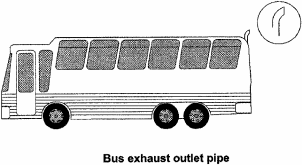
Division 3 - Noise emissions[Division 3 of Part 10 Substituted by S.R. 2008, No. 165, Applied:17 Dec 2008]
Subdivision 1 - General[Subdivision 1 of Division 3 of Part 10 Inserted by S.R. 2008, No. 165, Applied:17 Dec 2008]
136A. Measurement of stationary noise levels
[Regulation 136A Inserted by S.R. 2008, No. 165, Applied:17 Dec 2008](1) In this regulation –National Transport Commission means the National Transport Commission established by the National Transport Commission Act 2003 of the Commonwealth.(2) For this Division, the stationary noise level of a motor vehicle is to be measured in accordance with the procedure set out for that type of motor vehicle in the report entitled the National Stationary Exhaust Noise Test Procedures for In-service Motor Vehicles, published by the National Transport Commission in April 2000.
136B. Meaning of "certified to ADR 83/00"
[Regulation 136B Inserted by S.R. 2008, No. 165, Applied:17 Dec 2008] For this Division, a motor vehicle is certified to ADR 83/00 if approval has been given, under section 10A of the Motor Vehicle Standards Act 1989 of the Commonwealth, to place identification plates showing compliance with ADR 83/00 on motor vehicles of that type.
137. Silencing device for exhaust systems
[Regulation 137 Substituted by S.R. 2008, No. 165, Applied:17 Dec 2008] A motor vehicle propelled by an internal combustion engine must be fitted with an effective silencing device through which all the exhaust from the engine passes.
Subdivision 2 - Noise levels applying to pre-2004 motor vehicles[Subdivision 2 of Division 3 of Part 10 Inserted by S.R. 2008, No. 165, Applied:17 Dec 2008]
[Regulation 137A Inserted by S.R. 2008, No. 165, Applied:17 Dec 2008] This Subdivision applies to a motor vehicle other than a motor vehicle certified to ADR 83/00.
138. Stationary noise levels: car-type vehicles and motor bikes and motor trikes
[Regulation 138 Substituted by S.R. 2008, No. 165, Applied:17 Dec 2008](1) In this regulation –car-type vehicle means –(a) a car; or(b) a utility truck, panel van or other motor vehicle derived from a car design; or(c) a motor vehicle with 4 or more wheels that is built mainly to carry not more than 9 people including the driver.(2) The stationary noise level of a car-type vehicle, or motor bike or motor trike, must not exceed –(a) for a car-type vehicle built after 1982, 90dB(A); or(b) for another car-type vehicle, 96dB(A); or(c) for a motor bike or motor trike built after February 1985, 94dB(A); or(d) for another motor bike or motor trike, 100dB(A).(3) However, this regulation does not apply to a car-type vehicle built after 1982 for 2 years after the commencement of this regulation, if –(a) the stationary noise level of the vehicle does not exceed 96dB(A); and(b) the stationary noise level limit applying to the vehicle under the law of the State or Territory where the vehicle is registered, or otherwise authorised to be driven on a public street, by a vehicle registration authority is not 90dB(A) or less.
Note For vehicles that do not fall within the definition of "motor vehicle" in the Act, the maximum permissible noise levels applying to their use away from public streets are set by the Environmental Management and Pollution Control (Miscellaneous Noise) Regulations 2004 .
139. Stationary noise levels: other vehicles with spark ignition engines
[Regulation 139 Substituted by S.R. 2008, No. 165, Applied:17 Dec 2008](1) This regulation applies to a motor vehicle, except a motor vehicle to which regulation 138 applies, with a spark ignition engine.(2) The stationary noise level of the motor vehicle must not exceed the noise level applying to the vehicle under the following table:
Column 1
Column 2
Column 3
Column 4
Column 5
Item
GVM (t)
Exhaust height (mm)
When vehicle built
Noise level (dB(A))
1.
< or = 3.5
< 1500
before July 1983
92
after June 1983
89
2.
> 3.5
< 1500
before July 1983
98
after June 1983
95
3.
< or = 3.5
> or = 1500
before July 1983
88
after June 1983
85
4.
> 3.5
> or = 1500
before July 1983
94
after June 1983
91
140. Stationary noise levels: other vehicles with diesel engines
[Regulation 140 Substituted by S.R. 2008, No. 165, Applied:17 Dec 2008](1) This regulation applies to a motor vehicle, except a motor vehicle to which regulation 138 applies, with a diesel engine.(2) The stationary noise level of the motor vehicle must not exceed the noise level applying to the vehicle under the following table:
Column 1
Column 2
Column 3
Column 4
Column 5
Item
GVM (t)
Exhaust height (mm)
When vehicle built
Noise level (dB(A))
1.
< or = 3.5
< 1500
before July 1980
105
after June 1980 but before July 1983
102
after June 1983
99
2.
> 3.5 but < or = 12
< 1500
before July 1980
107
after June 1980 but before July 1983
104
after June 1983
101
3.
> 12
< 1500
before July 1980
109
after June 1980 but before July 1983
106
after June 1983
103
4.
< or = 3.5
> or = 1500
before July 1980
101
after June 1980 but before July 1983
98
after June 1983
95
5.
> 3.5 but < or = 12
> or = 1500
before July 1980
103
after June 1980 but before July 1983
100
after June 1983
97
6.
> 12
> or = 1500
before July 1980
105
after June 1980 but before July 1983
102
after June 1983
99
Subdivision 3 - Noise levels applying to motor vehicles certified to ADR 83/00[Subdivision 3 of Division 3 of Part 10 Inserted by S.R. 2008, No. 165, Applied:17 Dec 2008]
[Regulation 141 Substituted by S.R. 2008, No. 165, Applied:17 Dec 2008] The stationary noise level of a motor vehicle that is certified to ADR 83/00 must not exceed, by more than 5dB(A), the noise level that is established for the motor vehicle when it is certified.
PART 11 - LPG fuel systems
NoteThis Part sets out requirements to ensure that LPG fuel systems are safely installed in motor vehicles and that vehicles with LPG installed can be identified as LPG-powered vehicles.
(1) A motor vehicle equipped to run on LPG must comply with the requirements for the use of LPG in vehicles in –(a) the version of Australian Standard AS 1425 in force at the commencement of this regulation; or(b) if an earlier version of the standard was current when the vehicle was first equipped to run on LPG, that version.(2) A vehicle equipped to run on LPG must have fixed conspicuously to the front and rear number plates a label that is –(a) made of durable material; and(b) at least 25 millimetres wide and 25 millimetres high; and(c) reflective red conforming to Australian Standard AS 1742-1975 Manual of Uniform Traffic Control Devices, Appendix C, Class 2; and(d) marked "LPGAS" or "LPG", or with words or acronyms to similar effect, in capital letters at least 6 millimetres high.
PART 12 - Maximum road speed limiting
NoteThis Part requires certain heavy vehicles built after 1987, but before July 1991, to have a restricted top speed. However, emergency vehicles and certain 2-axle prime movers operated by farmers and used in primary production are exempt.
(1) A bus with a GVM over 14.5 tonnes that was built after 1987 must comply with third edition ADR 65.(2) A prime mover with a GVM over 15 tonnes that was built after 1987 must comply with third edition ADR 65.
Note Vehicle Standards Bulletin 2 (VSB 2) contains the requirements of third edition ADR 65. The Bulletin is available from the Department of Transport and Regional Services.
144. Exemptions from speed limiting
Regulation 143 does not apply to –(a) an ambulance, police vehicle or Australian Defence Force vehicle; or(b) a vehicle built or permanently modified for firefighting or emergency rescue purposes; or(c) a bus fitted with hand grips or similar equipment for standing passengers to hold; or(d) a 2-axle prime mover if –(i) it was built after 1987 but before July 1991; and(ii) its operator is a person who uses it for agriculture, horticulture or other primary production activities, except forestry, fishing and mining.
PART 13 - Mechanical connections between vehicles
NoteThis Part sets out various requirements to ensure that the couplings used when operating motor vehicles and trailers in combinations are strong enough to hold them together.
Division 1 - Couplings on all types of vehicles
145. General coupling requirements
(1) A fifth wheel coupling, the mating parts of a coupling, a kingpin or towbar must not be used for a load more than the manufacturer's load rating.(2) A kingpin must be used only with a fifth wheel coupling that has a corresponding jaw size.
Example:
An adaptor must not be used to fit a kingpin to a fifth wheel coupling.
(3) The mating parts of a coupling used to connect a semi-trailer to a towing vehicle must not allow the semi-trailer to roll to an extent that makes the towing vehicle unstable.
(1) [Regulation 146 Subregulation (1) amended by S.R. 2008, No. 165, Applied:17 Dec 2008] A coupling for attaching a trailer to a towing vehicle must be built and fitted so –(a) the coupling is equipped with a positive locking mechanism; and(b) the positive locking mechanism can be released regardless of the angle of the trailer to the towing vehicle.(2) If the trailer in a combination –it must be connected to the towing vehicle by at least one chain, cable or other flexible device, as well as the coupling required by subregulation (1) .(a) [Regulation 146 Subregulation (2) amended by S.R. 2008, No. 165, Applied:17 Dec 2008] is a pig trailer; or(b) is not fitted with break-away brakes in accordance with regulation 123(3) –(3) The connection referred to in subregulation (2) must be built and fitted so –(a) the trailer is kept in tow if the coupling breaks or accidentally detaches; and(b) normal angular movement of the coupling is permitted without unnecessary slack.(4) If practicable, the connection referred to in subregulation (2) must be built and fitted so the drawbar of the trailer is prevented from hitting the ground if the coupling accidentally detaches.
Division 2 - Additional coupling requirements for B-doubles
(1) A fifth wheel coupling used to connect a towing vehicle to a semi-trailer used in a B-double must not be built with a pivot that allows a semi-trailer to roll relative to the towing vehicle.(2) However, subregulation (1) does not apply to a fifth wheel coupling if –(a) the semi-trailer design requires torsional stresses to be minimised; and(b) the roll axis of the fifth wheel coupling is above the surface of the coupler plate; and(c) the degree of rotation allowed around the roll axis of the fifth wheel coupling is restricted to prevent roll instability.
148. Selection of fifth wheel couplings for B-doubles
(1) A fifth wheel coupling used in a B-double must have a D-value complying with Australian Standard AS 1773-1990 Articulated Vehicles – Fifth Wheel Assemblies.(2) A turntable used in a B-double must have a D-value complying with Australian Standard AS 1773-1990 Articulated Vehicles – Fifth Wheel Assemblies.(3) If a fifth wheel coupling used in a B-double is built for a 50 millimetre or 90 millimetre kingpin, the coupling must –(a) meet the dimension requirements in Australian Standard AS 1773-1990 Articulated Vehicles – Fifth Wheel Assemblies; and(b) not be worn away more than recommended by the standard.(4) If a fifth wheel coupling used in a B-double is built for a 75 millimetre kingpin, the coupling must –(a) be compatible with the kingpin mentioned in regulation 152(3) ; and(b) not be worn away so that it does not comply with regulation 149 .
149. D-value of a fifth wheel coupling
In testing a fifth wheel coupling built for a 75 millimetre kingpin used in a B-double to decide whether its D-value complies with regulation 148(1) , the longitudinal movement, after readjusting the jaws of the coupling using a kingpin built to the dimensions mentioned in regulation 152(3)(a) , must not be over 4 millimetres.
150. Mounting of fifth wheel couplings on B-doubles
A fifth wheel coupling must be mounted on a prime mover, or semi-trailer used in a B-double, in accordance with Australian Standard AS 1771-1987 Installation of Fifth Wheel and Turntable Assemblies.
151. Branding of fifth wheel couplings and turntables on B-doubles
(1) A fifth wheel coupling on a vehicle built after June 1991 forming part of a B-double must be clearly and permanently marked in accordance with Australian Standard AS 1773-1990 Articulated Vehicles – Fifth Wheel Assemblies with –(a) the name or trademark of its manufacturer; and(b) its D-value rating; and(c) its nominal size.(2) A turntable used in a vehicle built after the commencement of this regulation that forms part of a B-double must be marked with –(a) the name or trademark of the turntable's manufacturer; and(b) the D-value rating of the turntable in accordance with Australian Standard AS 1773-1990 Articulated Vehicles – Fifth Wheel Assemblies.
152. Selection of kingpins for B-doubles
(1) A kingpin used in a B-double must –(a) be a 50, 75 or 90 millimetre kingpin; and(b) have a D-value complying with Australian Standard AS 2175-1990 Articulated Vehicles – Kingpins.(2) A 50 or 90 millimetre kingpin used in a B-double must –(a) be built to meet the dimension requirements in Australian Standard AS 2175-1990 Articulated Vehicles – Kingpins; and(b) not be worn away more than recommended by the standard.(3) A 75 millimetre kingpin used in a B-double must –(a) not be worn away more than mentioned in subregulation (4) ; and(b) be built to meet the dimensions in the following essential diagram:(4) In testing a 75 millimetre kingpin mentioned in the essential diagram in subregulation (3) to decide whether its D-value complies with subregulation (1)(b) –(a) diameter F must not wear more than 3 millimetres; and(b) diameter G must not wear more than 2 millimetres; and(c) height H must not wear more than 2.3 millimetres.

153. Attachment of kingpins on B-doubles
A kingpin used in a trailer that forms part of a B-double must be attached in accordance with –(a) the manufacturer's specifications and instructions; or(b) the guidelines detailed in Australian Standard AS 2175-1990 Articulated Vehicles – Kingpins.
154. Branding of kingpins on B-doubles
A kingpin used in a trailer built after June 1991 that forms part of a B-double must be clearly and permanently marked on the lower circular face of the kingpin in accordance with Australian Standard AS 2175-1990 Articulated Vehicles – Kingpins with –(a) the name or trademark of its manufacturer; and(b) its D-value rating; and(c) its nominal size.
PART 14 - Bus construction and fittings
Note 1This Part sets out various requirements relating to bus construction and fittings, so that they can be operated safely and without discomfort to drivers and passengers.
Note 2Some other requirements relating specifically to buses are contained in other provisions of these standards such as regulation 36(3) and (7) (rear vision mirrors), regulation 42(4) and (5) (electrical wiring) and regulation 44(2) , (3) and (4) (windows and ventilation).
Division 1 - General construction
155. Floor, framework, panelling, &c.
(1) The floor of a bus must be of sound construction and have a non-slip surface.(2) The framework of the roof and body of a bus must be constructed of –(a) steel; or(b) wood suitably strengthened with steel at all joints; or(c) other material approved by the Registrar.(3) The panelling of the body of a bus must be –(a) metal; or(b) fibreglass; or(c) other material approved by the Registrar.(4) The panelling of the roof of a bus must be waterproofed, and constructed of –(a) metal; or(b) fibreglass; or(c) other material approved by the Registrar.(5) The interior of the body of a bus must be suitably lined.(6) All parts of a bus that are connected by nuts, bolts or studs and subject to vibration must be fastened by –(a) locknuts; or(b) castellated nuts effectively pinned with a split pin; or(c) nuts with spring or locknut washers approved by the Registrar.
156. Isolation of engine and fuel system, &c.
(1) The fuel tank or fuel tank filler pipe of a bus must not be fitted within –(a) the engine compartment of the bus; or(b) any separate compartment provided for the driver; or(c) the interior of the bus.(2) The fuel tank filler pipe of a bus –(a) must be so arranged that no overflow or leakage of fuel can accumulate in or on the bus; and(b) must not, except in the case of a small bus with a seating capacity of not more than 15 adults, including the driver, be fitted within 900 millimetres of an entrance or exit.(3) A bus must be fitted with adequate sealing or shielding so as to prevent heat from its motor, generator or exhaust pipe connections from –(a) injuriously affecting the bus or any part of the bus; or(b) causing discomfort to passengers.(4) The floor of a bus must be sealed so as to prevent fumes from the engine entering the interior of the bus.
157. Miscellaneous safety requirements
(1) A bus with a transmission incorporating any longitudinal drive shafts, couplings or intermediate shafts, must be designed, built and maintained so that the front end of such a shaft or coupling is prevented from contacting the road in the event of becoming detached from its normal position.(2) If a bus having a single rear axle is equipped to seat more than 15 persons, including the driver, but is not an articulated or all-wheel drive bus, it must be fitted with dual tyres.(3) A bus must be fitted with a fire extinguisher selected and located in accordance with Australian Standard AS 2444-1985 Portable Fire Extinguishers – Selection and Location.
Division 2 - Entry and exit
158. Ordinary entrances and exits
In relation to ordinary entrances and exits, a bus must meet the following requirements:(a) unless otherwise approved by the Registrar, there must be only one ordinary entrance on the left side of the bus;(b) there must not be an entrance or exit on the right side, other than –(i) an emergency exit required under regulation 159 ; or(ii) the driver's door;(c) the height of an entrance must not be less than the interior height of the vehicle;(d) an entrance must not be less than 550 millimetres wide.
(1) In relation to emergency exits, a bus must meet the following requirements:(a) an emergency exit accessible to passengers must be fitted –(i) at the extreme rear of the bus; or(ii) if the Registrar considers that requirement to be unreasonable for the particular bus, in the rear half of the roof of the passenger compartment;(b) an emergency exit referred to in paragraph (a) must have an area of not less than –(i) 5 200 square centimetres in the case of a small bus; or(ii) 7 000 square centimetres in the case of a large bus;(c) no dimension of an emergency exit referred to in paragraph (a) is to be less than 500 millimetres;(d) if an emergency exit referred to in paragraph (a)(ii) is provided, an additional exit having an area of not less than 3 200 square centimetres and no dimension less than 500 millimetres must be provided on the right side of the vehicle in the rear half of the passenger compartment;(e) a suitable means of immediately opening an emergency exit must be available to that exit at all times;(f) except in the case of an emergency exit known as a "pushout" type, there must be a suitable opening and closing device on both the inside and outside of an emergency exit;(g) an emergency exit must be kept clear of obstruction and be clearly indicated by the words "EMERGENCY EXIT" displayed both inside and outside the bus.(2) However, a bus is not required to be fitted with an emergency exit in accordance with subregulation (1) if it –(a) is designed and constructed to seat not more than 12 adults including the driver; and(b) is fitted with one or more doors on each side; and(c) has an overall width of not more than 2 metres.(3) For this regulation, a hinged and latched door fitted to a small bus with a seating capacity of not more than 15 adults, including the driver, may be regarded as an emergency exit if it is capable of being opened outwards from inside the bus.
A bus must not be fitted with –(a) an interior door that separates the space normally used by passengers from the access doors or emergency exits; or(b) an inward opening door other than a door commonly known as a "jack-knife" or "glide-away" door which is so constructed that no part of it extends beyond the back of the lowest step of the entrance or exit where it is located.
Each entrance to a bus must be securely fitted with steps that meet the following requirements:(a) the height of the tread of the lowest step from the ground must not be over 410 millimetres or under 250 millimetres;(b) the height of any step in relation to an adjacent step must not be over 300 millimetres;(c) the transverse depth of the tread of each step in a small bus must not be less than 180 millimetres;(d) the transverse depth of the tread of each step in a large bus must not be less than 225 millimetres;(e) the width of the tread of the lowest step must not be less than the width of the entrance;(f) the width of each step, other than the lowest step, must not be less than 450 millimetres;(g) each step must be fitted with skid-resistant tread;(h) step treads and risers must be directly illuminated, except in the case of an external access step to a single row of seats for a small bus having a seating capacity of not more than 15 adults, including the driver.
Division 3 - Interior dimensions
The distance from the floor of a bus to the centre line of its roof must not be less than –(a) 1.2 metres in the case of a small bus with an aisle length not over 2 metres; or(b) 1.35 metres in the case of any other small bus; or(c) 1.65 metres in the case of –(i) each deck of a double-deck bus; or(ii) a large bus that is not involved in frequent stops for the purpose of picking up or setting down passengers; or(d) 1.8 metres in the case of a large bus that is involved in frequent stops for the purpose of picking up or setting down passengers.
Unless otherwise approved by the Registrar –(a) an aisle on a small bus must not be less than 300 millimetres wide; and(b) an aisle on a large bus must not be less than 300 millimetres wide if the bus is used only to carry seated passengers and not less than 380 millimetres wide in the case of any other large bus.
Division 4 - Passenger accommodation
In relation to passenger seating, a bus must meet the following requirements:(a) each seat must be securely fastened to, or form part of, the body of the bus and be so constructed that reasonable comfort and adequate support is provided for passengers;(b) a floor space of not less than 200 millimetres must be provided at the front of each seat measured from the vertical plane at the front extremity of the cushion;(c) in the case of front-facing seats, the horizontal distance between the inside back of each seat and the back of the seat immediately in front must not be less than –(i) 600 millimetres in the case of a school bus; or(ii) 660 millimetres in the case of any other bus;(d) the distance between the front of the seat backs of facing seats must not be less than 1.2 metres;(e) the distance from the floor to the top of each cushion must not be more than 500 millimetres or less than –(i) 380 millimetres in the case of a school bus; or(ii) in the case of any other bus –(A) 300 millimetres if the floor level is interrupted by a wheel housing, engine housing or similar protuberance; or(B) 400 millimetres in the case of a large bus, and 380 millimetres in the case of a small bus, if the floor level is not interrupted by any protuberance;(f) the distance from the top of the cushion to the top of the back of each seat must not be less than 380 millimetres;(g) the distance from the top of the cushion to the bottom of the back of the seat must not be more than 75 millimetres;(h) the space for each passenger, measured along the front of the seat, must not be less than –(i) 275 millimetres in the case of a school bus; and(ii) 400 millimetres in the case of any other bus;(i) the distance from the front to the back of each seat cushion must not be less than 350 millimetres.
The driver's seat on a bus must be –(a) securely attached to the bus; and(b) designed and fitted in such a way that the driver can be comfortable and have control of the bus.
(1) A bus must be fitted with a suitable rail or partition in front of any seat located on the left side of the bus immediately behind a step so as to prevent persons from falling into a step well.(2) A large bus must, if the driving position is not otherwise separated from the passenger compartment, be fitted with a suitable guard rail or other structure so as to prevent passengers from –(a) coming into contact with the driver or the controls; or(b) obstructing the driver's view.
PART 15 - Other matters
A vehicle is taken to have equipment mentioned in the Vehicle Standards only if the equipment is in working order.
(1) For the Vehicle Standards, a restored vehicle is taken to have been built when it was originally built and not when it was restored.(2) In this regulation,restored vehicle means a vehicle that is being, or has been, restored to its manufacturer's specifications, so far as it is practicable to meet the specifications.
(1) For the Vehicle Standards, a retractable axle is taken to be an axle only when it is in the lowered position.(2) In this regulation,retractable axle means an axle with a means of adjustment enabling it to be raised or lowered relative to the other axles in the axle group.
170. Measurement of distance between parallel lines
For the Vehicle Standards, a distance between two parallel lines is measured at right angles between the lines.
171. Interpretation of certain second edition ADRs
The words "left" and "right" in the following second edition ADRs have opposite meaning in the application of the ADRs, in accordance with the Vehicle Standards, to a motor vehicle with a left-hand drive:(a) ADR 8 Safety Glass;(b) ADR 12 Glare Reduction in Field of View;(c) ADR 14 Rear Vision Mirrors;(d) ADR 16 Windscreen Wipers and Washers;(e) ADRs 18 and 18A Location and Visibility of Instruments;(f) ADRs 35 and 35A Commercial Vehicle Braking Systems.
Note The following table contains a list of some terms used in the third edition ADRs and the corresponding term used in the Vehicle Standards:
Third edition ADRs
Vehicle Standards
dipped-beam headlamp
low-beam (for a headlight)
front fog lamp
front fog light
rear fog lamp
rear fog light
wheelguard
mudguard
main-beam headlamp
high-beam (for a headlight)
reversing lamp
reversing light
direction indicator lamp
direction indicator light
stop lamp
brake light
rear registration plate lamp
number plate light
front position (side) lamp
parking light
rear position (side) lamp
tail light
end-outline marker lamp
front or rear clearance light
external cabin lamp
external cabin light
internal lamp
interior light
side marker lamp
side marker light
daytime running lamp
daytime running light
rear reflex reflector, non-triangular
rear reflector
front reflex reflector, non-triangular
front reflector
side reflex reflector, non-triangular
side reflector
PART 16 - Dictionary
In these regulations –50 millimetre kingpin means a kingpin meeting the dimension requirements for a 50 millimetre kingpin in Australian Standard AS 2175-1990 Articulated Vehicles – Kingpins;75 millimetre kingpin means a kingpin with the dimensions mentioned in regulation 152 ;90 millimetre kingpin means a kingpin meeting the dimension requirements for a 90 millimetre kingpin in Australian Standard AS 2175-1990 Articulated Vehicles – Kingpins;Act means Vehicle and Traffic Act 1999 ;adopted standard see regulation 24 ;ADR see regulation 14 ;air brake means an air-operated or air-assisted brake;articulated bus means a bus with at least 2 rigid sections that allow passengers access between the sections and are connected to allow rotary movement between the sections;Australian Standard means a standard approved for publication on behalf of the Council of the Standards Association of Australia;
Note Copies of Australian Standards are available from offices of the Standards Association of Australia.
axle group means a single, tandem, twinsteer, tri, or quad axle group;B-double means a combination consisting of a prime mover towing 2 semi-trailers;braking system, of a vehicle, means all the brakes of the vehicle and all the components of the mechanisms by which they are operated;British Standard means a standard approved for publication on behalf of the British Standards Institution;
Note Copies of British Standards are available from offices of the Standards Association of Australia.
British Standards Institution means the institution of that name established under royal charter in the United Kingdom;car means a motor vehicle built mainly to carry people that –(a) seats not over 9 adults including the driver; and(b) has a body commonly known as a sedan, station wagon, coupe, convertible or roadster; and(c) has 4 or more wheels;centre line, of an axle group, means –(a) if the group consists of 2 axles, one of which is fitted with twice the number of tyres as the other axle, a line located one-third of the way from the centre line of the axle with more tyres towards the centre line of the axle with fewer tyres; and(b) in any other case, a line located midway between the centre lines of the outermost axles of the group;converter dolly means a trailer with one axle group or a single axle, and a fifth wheel coupling, designed to convert a semi-trailer into a dog trailer;[Regulation 172 Amended by No. 52 of 2005, Sched. 1, Applied:01 Jul 2009] [Regulation 172 Amended by No. 16 of 2010, Sched. 1, Applied:01 Jan 2011] dangerous goods means dangerous goods within the meaning of the Dangerous Goods (Road and Rail Transport) Act 2010 ;daylight means the period in a day from sunrise to sunset;dog trailer means a trailer, including a trailer consisting of a semi-trailer and converter dolly, with –(a) one axle group or a single axle at the front that is steered by connection to the towing vehicle by a drawbar; and(b) one axle group or a single axle at the rear;drawbar means a part of a trailer, except a semi-trailer, connecting the trailer body to a coupling for towing purposes;drive includes be in control of;driver, of a vehicle, means the person driving the vehicle;emergency brake means a brake designed to be used if a service brake fails;fifth wheel coupling means a device, except the upper rotating element and the kingpin (which are parts of a semi-trailer), used with a prime mover, semi-trailer or converter dolly, to allow quick coupling and uncoupling and to provide for articulation;front fog light means a light used to improve the illumination of the road in case of fog, snowfall, heavy rain or a dust storm;glazing means material fitted to the front, sides, rear or interior of a vehicle, through which the driver can see the road, but does not include a coating added after manufacture of the material;GTM (gross trailer mass) means the mass transmitted to the ground by the axles of a trailer when the trailer is loaded to its GVM and connected to a towing vehicle;high-beam, for a headlight or front fog light fitted to a vehicle, means that the light is built or adjusted so, when the vehicle is standing on level ground, the top of the main beam of light projected is above the low-beam position;large bus means a bus with a seating capacity of more than 25 adults including the driver;left, for a vehicle, means to the left of centre of the vehicle when viewed by a person in the vehicle who is facing to the front of the vehicle;low-beam, for a headlight or front fog light fitted to a vehicle, means that the light is built or adjusted so, when the vehicle is standing on level ground, the top of the main beam of light projected is –(a) not higher than the centre of the headlight or fog light, when measured 8 metres in front of the vehicle; and(b) not over one metre higher than the level where the motor vehicle is standing, when measured 25 metres in front of the vehicle;luminous transmittance, for glazing, means the amount of light that can pass through the glazing as a percentage of the amount of light that would be transmitted if the glazing were absent;[Regulation 172 Amended by S.R. 2008, No. 165, Applied:17 Dec 2008]moped means a motor bike or motor trike with an engine cylinder capacity of not over 50 millilitres and a maximum speed of not over 50 kilometres an hour;motor trike means a motor vehicle that runs on 3 wheels symmetrically arranged in relation to its longitudinal median axis;mudguard means a fitting or device, with or without a mudflap, that is built and fitted to a vehicle in a way that will, as far as practicable, catch or deflect downwards any stone, mud, water, or other substance, thrown up by the rotation of the wheel to which the fitting or device is fitted;national standard see regulation 15 ;pig trailer means a trailer that –(a) has one axle group or a single axle near the middle of its load-carrying surface; and(b) is connected to a towing vehicle by a drawbar;pole-type trailer means a trailer that –(a) is attached to a towing vehicle by a pole, or an attachment fitted to the pole; and(b) is ordinarily used for transporting loads, such as logs, pipes, structural members, or other long objects, that can generally support themselves like beams between supports;police vehicle means a vehicle driven by a police officer in the course of his or her duty;quad axle group means a group of 4 axles in which the horizontal distance between the centre lines of the outermost axles is over 3.2 metres, but not over 4.9 metres;rear fog light means a light used on a vehicle to make it more easily visible from the rear in dense fog;repeater horn means a device that makes a sound alternating between different tones or frequencies on a regular time cycle;right, for a vehicle, means to the right of the centre of the vehicle when viewed by a person in the vehicle who is facing to the front of the vehicle;road tank vehicle has the same meaning as in the sixth edition of the Australian Code for the Transport of Dangerous Goods by Road and Rail;school bus means a bus that is being used exclusively for the carriage of schoolchildren, with or without a supervising adult;second edition ADR see regulation 17 ;service brake, for a vehicle, means the brake normally used to decelerate the vehicle;single axle means an axle not forming part of an axle group;small bus means a bus with a seating capacity of not more than 25 adults including the driver;spring brake means a brake using one or more springs to store the energy needed to operate the brake;Standards Association of Australia means the association of that name incorporated in Australia under royal charter;street rod vehicle is a vehicle that has been modified for safe road use and –(a) has a body and frame that were built before 1949; or(b) is a replica of a vehicle the body and frame of which were built before 1949;third edition ADR see regulation 18 ;transport enforcement vehicle means a vehicle driven or used by authorised officers in the course of their duty;tri axle group means a group of at least 3 axles in which the horizontal distance between the centre lines of the outermost axles is over 2 metres, but not over 3.2 metres;turntable means a bearing built to carry vertical and horizontal loads, but not to allow quick separation of its upper and lower rotating elements, and used to connect and allow articulation between –(a) a prime mover and semi-trailer; or(b) the steering axle or axle group of a dog trailer and the body of the trailer; or(c) a fifth wheel coupling and the vehicle to which it is mounted;twinsteer axle group means a group of 2 axles –(a) with single tyres; and(b) fitted to a motor vehicle and connected to the same steering mechanism; and(c) the horizontal distance between the centre lines of which is at least one metre, but not over 2 metres;vacuum brakes means vacuum-operated or vacuum-assisted brakes;[Regulation 172 Amended by S.R. 2008, No. 165, Applied:17 Dec 2008] Vehicle Standards Bulletin (VSB) means a Vehicle Standards Bulletin published by the Department of Infrastructure, Transport, Regional Development and Local Government of the Commonwealth;yellow includes amber.

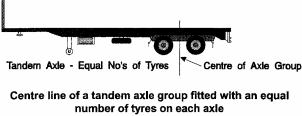
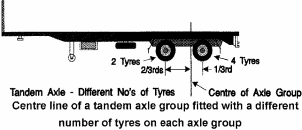
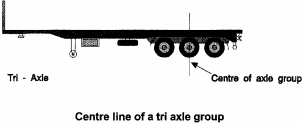
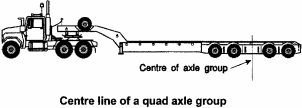
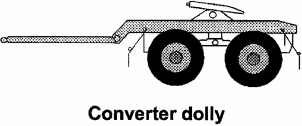
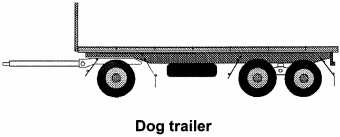
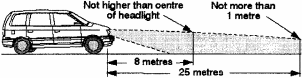
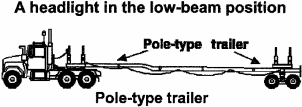

SCHEDULE 1 - Urban areas
1. Burnie Urban AreaThe Burnie urban area is that area contained within the imaginary boundary defined by an imaginary line joining the geographical locations on the public streets listed below.
Public Street
Geographical Location
1.
Bass Highway
Intersection with Besser Crescent
2.
West Mooreville Road
Intersection with East Cam Road
3.
Mooreville Road
Intersection with Three Mile Line Road
4.
Mount Road
Intersection with Old Surrey Road
5.
Stowport Road
Intersection with Bass Highway
6.
Bass Highway
Intersection with Clarke Street
2. Devonport Urban AreaThe Devonport urban area is that area contained within the imaginary boundary defined by an imaginary line joining the geographical locations on the public streets listed below.
Public Street
Geographical Location
1.
Bass Highway
Intersection with Waverley Road
2.
Forth Road
Intersection with Bass Highway
3.
Tugrah Road
Intersection with Powells Creek
4.
Sheffield Road
Intersection with Clayton Drive
5.
Mersey Main Road
Intersection with Cornicks Road
6.
River Road
Intersection with Oakwood Drive
7.
Bass Highway
Intersection with Port Sorell Main Road
8.
Brooke Street
Intersection with Pardoe Road
3. Hobart Urban AreaThe Hobart urban area is that area contained within the imaginary boundary defined by an imaginary line joining the geographical locations on the public streets listed below.
Public Street
Geographical Location
1.
Midland Highway
Intersection with Ford Road
2.
Broadmarsh Road
Intersection with Midland Highway
3.
Boyer Road
Intersection with Midland Highway
4.
Lyell Highway
Intersection with Midland Highway
5.
Berriedale Road
Intersection with Allunga Road
6.
Huon Road
Intersection with Summerleas Road
7.
Southern Outlet
Intersection with Summerleas Road
8.
Channel Highway
Intersection with Howden Road
9.
South Arm Road
Intersection with Acton Road
10.
Tasman Highway
Intersection with Belbins Road
11.
Grass Tree Hill Road
Intersection with Sugarloaf Road
12.
Baskerville Road
Intersection with East Derwent Highway
13.
Old Beach Road
Intersection with Plymouth Road
14.
Cove Hill Road
Intersection with Cove Bridge (Jordan River)
15.
Tea Tree Road
Intersection with Briggs Road
4. Launceston Urban AreaThe Launceston urban area is that area contained within the imaginary boundary defined by an imaginary line joining the geographical locations on the public streets listed below.
Public Street
Geographical Location
1.
East Tamar Highway
Intersection with George Town Road
2.
West Tamar Highway
Intersection with Cormiston Road
3.
Cormiston Road
Intersection with West Tamar Highway
4.
Ecclestone Road
Intersection with Rowsphorn Road
5.
New Ecclestone Road
Intersection with Ecclestone Road
6.
Reatta Road
Intersection with Lake Trevallyn Road
7.
Bass Highway
Intersection with Westbury Road
8.
Midland Highway
Intersection with Evandale Road
9.
Relbia Road
Intersection with Glenwood Road
10.
St Leonards Road
Intersection with Kings Lane
11.
Tasman Highway
Intersection with Abels Hill Road
12.
Lilydale Road
Intersection with Russells Plains Road
Displayed and numbered in accordance with the Rules Publication Act 1953.
Notified in the Gazette on 24 October 2001
These regulations are administered in the Department of Infrastructure, Energy and Resources.