

Mineral Resources Regulations 2006
I, the Governor in and over the State of Tasmania and its Dependencies in the Commonwealth of Australia, acting with the advice of the Executive Council, make the following regulations under the Mineral Resources Development Act 1995 .
19 June 2006W. J. E. COX
Governor
By His Excellency's Command,
BRYAN GREEN
Minister for Economic Development and Resources
PART 1 - Preliminary
These regulations may be cited as the Mineral Resources Regulations 2006 .
These regulations take effect on 28 June 2006.
In these regulations –Act means the Mineral Resources Development Act 1995 ;[Regulation 3 Amended by S.R. 2011, No. 82, Applied:17 Aug 2011][Regulation 3 Amended by S.R. 2011, No. 82, Applied:17 Aug 2011] Australian Accounting Standards means the Australian Accounting Standards, made by the Australian Accounting Standards Board, as those Standards are in force from time to time;building and dimension stone means stone used –(a) for ornamental purposes; or(b) in walls, floors or roofs of structures; or(c) as a paving stone;datum post means a post erected on the corner of land being marked out;gold dore means an alloy of gold and silver resulting from the treatment of gold-bearing minerals;GST has the same meaning as in the A New Tax System (Goods and Services Tax) Act 1999 of the Commonwealth;metal means a metallic mineral specified in Part 1 of Schedule 4 refined to an elemental state;mineral concentrate means the product of a chemical or physical process of extracting a metal or metallic mineral from a mineral ore that results in the enrichment of that metal or metallic mineral;mineral ore means the naturally occurring material from which one or more minerals of economic value can be extracted;net sales in relation to a mineral means the amount received from the sale of –(a) if a mineral concentrate has not been produced from the mineral, the mineral itself (less sale costs); or(b) if a mineral concentrate has been produced from the mineral, the mineral concentrate (less sale costs);public notice means a notice published in a newspaper circulating in the area in which the land which is the subject of the notice is situated;quarter means –(a) a period of 3 months ending on 31 March, 30 June, 30 September or 31 December in any year; or(b) any other approved period;reference rate means the 30 Day Bank Bill Swap Reference Rate published daily by the Australian Financial Markets Association;sale costs means –(a) costs incurred by a lessee or licensee in transporting a mineral or mineral concentrate outside the site of production to the point of sale; and(b) costs incurred by a lessee or licensee in refining a mineral concentrate outside the site of its production; and(c) any other costs approved by the Minister;year means any 4 consecutive quarters used for accounting purposes.
3A. Determination of amount received from sale of mineral
[Regulation 3A Inserted by S.R. 2011, No. 82, Applied:17 Aug 2011](1) In this regulation –AAS revenue from the sale of the mineral means the amount that is –(a) determined, in accordance with the Australian Accounting Standards, to be the revenue from the sale of the mineral; and(b) required in accordance with those Standards to be recorded in an income statement.(2) For the purposes of these regulations, the amount received from a sale of a mineral is –(a) the AAS revenue from the sale of the mineral; or(b) if subregulation (4) applies in relation to the sale, the amount determined, in accordance with that subregulation, to be the revenue from the sale.(3) Subregulation (4) applies to a sale of a mineral if –(a) the mineral was sold by a lessee or licensee to a person related to the lessee or licensee; and(b) the AAS revenue from the sale of the mineral was less than would have been recorded in an income statement if the market price, as at the time of the sale of the mineral, had been paid for the mineral.(4) If this subregulation applies to a sale of a mineral, the revenue from the sale is the amount that would have been the AAS revenue from the sale of the mineral if the mineral had been sold at the market price for the mineral, as at the time of the sale of the mineral.(5) In this regulation, a person is related to a lessee or licensee if –(a) the person is a natural person and the lessee or licensee is a relative of the person or is a body corporate controlled by a relative of the person; or(b) the person is a body corporate, the lessee or licensee is a body corporate and the person is related to the lessee or licensee under section 50 of the Corporations Act.(6) For the purposes of subregulations (3) and (4) , the time of sale of a mineral is the time at which possession of the mineral is transferred to the purchaser of the mineral.
For the purpose of section 5(7) of the Act, the prescribed area of land is the area of land shown on Plans 3251 to 3260 (inclusive) in the Central Plan Register.
PART 2 - Licences and Leases
(1) A person is to mark out land in respect of an application for a lease by –(a) erecting on one of the corners of the land a post that –(i) is not less than 100 millimetres across each way; and(ii) projects not less than one metre from the ground; and(b) affixing to the post a legible and durable notice stating the following:(i) the purpose of the lease;(ii) any category or type of mineral to be covered by the lease;(iii) the area of the land;(iv) the position of the notice in relation to the land;(v) the date of the marking out;(vi) the name and address of the applicant for the lease;(vii) the name and address of the person marking out the land.(2) Instead of erecting a new post for marking out, a person may use an existing tree or an existing post that –(a) is not less than 100 millimetres across each way; and(b) projects not less than one metre from the ground.(3) An applicant for a lease is to lodge with the Registrar –(a) [Regulation 5 Subregulation (3) amended by S.R. 2011, No. 82, Applied:17 Aug 2011] a notice, in an approved form, of the marking out;(b) [Regulation 5 Subregulation (3) amended by S.R. 2011, No. 82, Applied:17 Aug 2011] . . . . . . . .(4) A notice is to be lodged with the Registrar within –(a) 7 days after the marking out; or(b) 7 days after giving public notice of the application in accordance with any conditions the Director determines under section 72(4) of the Act; or(c) any further period the Registrar may allow.(5) The area and boundaries of the land are to be calculated from the datum post.
For the purpose of section 75(4) of the Act, the prescribed area of land is the area of land shown on Plan 3261 in the Central Plan Register.
PART 3 - Royalty
7. Prescribed rates of royalty
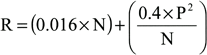
(1) For the purpose of section 102(1) of the Act, the prescribed rate of royalty payable by a lessee in respect of a mineral specified in Schedule 1 is the rate specified in that Schedule.(2) For the purpose of section 102(1A) of the Act, the prescribed rate of royalty payable by a licensee in respect of a mineral specified in Schedule 1 is the rate specified in that Schedule.(3) For the purpose of sections 102(1) and (1A) of the Act, the prescribed rate of royalty payable by a lessee or a licensee in respect of a mineral not specified in Schedule 1 is that produced by:where –R is the royalty;N is the yearly net sales of the mineral for the immediately preceding year;P is the yearly profit as defined in regulation 8 , if any, for the immediately preceding year.(4) For the purpose of section 102(1C) of the Act, the prescribed maximum rate of royalty payable for a mineral not specified in Schedule 1 is equivalent to 5% of net sales.(5) If the value of the net sales of a mineral not specified in Schedule 1 is less than $100 000 for a year, the prescribed rate of royalty is 1.6% of net sales.(6) If the value of the net sales of a mineral not specified in Schedule 1 is at least $100 000 and less than $600 000 for a year –(a) net sales royalty is to be assessed and paid on a quarterly basis; and(b) profit royalty is to be assessed and paid on an annual basis.(7) For the purpose of subregulation (6) –net sales royalty means the component of the formula in subregulation (3) represented by:profit royalty means the component of the formula in subregulation (3) represented by:


(1) For the purpose of regulation 7(3) , yearly profit is the prescribed yearly profit for the lessee's or licensee's mine from which the mineral referred to in that subregulation is obtained, adjusted –(a) to exclude –(i) interest; and(ii) hedging gains and losses; and(iii) exploration expenditure; and(iv) financing costs; and(v) [Regulation 8 Subregulation (1) amended by S.R. 2011, No. 82, Applied:17 Aug 2011] royalty; and(b) to include –(i) delineation drilling costs; and(ii) head office expenses; and(iii) mine rehabilitation interest expense.(2) In this regulation –delineation drilling costs means the lessee's or licensee's costs of drilling for specified resources in the lease area or licence area and the costs of developing access routes for such drilling;exploration expenditure means non-capitalised expenditure incurred by the lessee or licensee in prospecting or searching for minerals –(a) inside or outside the lease area or licence area; and(b) outside an area of specified resources;head office expenses means the approved costs incurred by the lessee or licensee in the administration and management of the mine referred to in subregulation (1) from that lessee's or licensee's head office, whether located in the State, in Australia or overseas, in so far as those costs –(a) relate to the mining and sale of minerals from that mine; and(b) have not already been included in the calculation of the lessee's or licensee's yearly profit for that mine; and(c) do not include interest, financing costs, hedging gains or losses or exploration expenditure;JORC Code means the code for reporting of mineral resources and ore reserves, published by the Australasian Joint Ore Reserves Committee, as updated from time to time;[Regulation 8 Subregulation (2) amended by S.R. 2011, No. 82, Applied:17 Aug 2011] mine rehabilitation interest expense means the lessee's or licensee's interest expense associated with a discounted rehabilitation provision, within the meaning of the Australian Accounting Standards, for the mine;[Regulation 8 Subregulation (2) amended by S.R. 2011, No. 82, Applied:17 Aug 2011] prescribed yearly profit means the yearly earnings before interest and taxation as shown in an income statement prepared in accordance with the Australian Accounting Standards;specified resources means –as defined in the JORC Code.(a) measured or indicated resources; or(b) ore reserves –
(1) For the purpose of section 102A(2) of the Act, a rebate on royalty payable is 20% for a metal, other than gold dore, produced in Tasmania from a mineral mined in Tasmania.(2) Subregulation (1) does not apply to the primary treatment of a mineral to produce a mineral concentrate for sale or transportation.(3) For the purpose of section 102A(2) of the Act, a rebate on royalty payable is 10% for gold dore produced in Tasmania from a mineral mined in Tasmania.(4) The Minister, after consultation with the Treasurer, may increase a rebate under subregulation (3) to 20% having regard to the following:(a) the size of a new investment and additional employment arising from the production of gold dore;(b) any benefit to the Tasmanian economy from the new investment producing gold dore.
10. Estimation of yearly profit
For the purpose of enabling royalty to be paid as required by regulation 11 , the Director may allow the holder of a mineral tenement to estimate yearly profit if –(a) the Director is satisfied that insufficient data is available to enable the holder to determine yearly profit; and(b) the holder supplies the Director within 30 days after the end of the holder's financial year with –(i) a reconciled statement of accounts relating to the operation of the tenement; and(ii) the full balance of any royalty payable based upon that statement.
For the purpose of section 102(2)(b) of the Act, royalty is payable –(a) in respect of each quarter; and(b) by the 30th day after the end of that quarter.
If the Director so determines, a lessee may pay royalty in respect of a mineral in instalments of any amount the Director determines, having regard to –(a) the net sales of that mineral in the quarter to which royalty is payable; and(b) any profit or loss in respect of that mineral for that quarter and any previous quarter or quarters of the year to which that quarter relates; and(c) the amount of any instalment of royalty paid in that year.
Interest on any royalty not paid by the due date is payable at twice the reference rate as published on the due date.
(1) The holder of a mineral tenement is to keep a record of the following:(a) the quantity of minerals obtained during mining under the mineral tenement;(b) the quantity of mineral products produced from the treatment of ores;(c) the quantity of mineral products sold;(d) the amount received from the sale of mineral products;(e) any details, calculations or information used to determine yearly profits.(2) The holder of a mineral tenement is to retain a record kept under subregulation (1) in good condition for at least 7 years.(3) The Director may require the holder of a mineral tenement to supply –(a) copies of all records kept under subregulation (1) ; and(b) any other information necessary to enable the amount of royalty payable by that person to be assessed.(4) The Director, or any other person authorised in writing by the Director, may examine –(a) the records kept under subregulation (1) ; and(b) any information requested under subregulation (3)(b) .
15. Production and sales report
(1) A lessee, irrespective of whether or not minerals have been produced or sold during a quarter, is to submit to the Director within 30 days after the end of each quarter a report containing details of the production and sales of minerals for that quarter.(2) A licensee who has sold minerals during a quarter is to submit to the Director within 30 days after the end of each quarter a report containing details of the production and sales of minerals for that quarter.(3) A report is to be in an approved form.
(1) The holder of a mineral tenement required to pay royalty who has sold minerals during a quarter is to submit a royalty return to the Director within 30 days after the end of that quarter.(2) A royalty return is to –(a) be in a form approved by the Minister; and(b) contain any details, calculations or information the Minister determines are appropriate.(3) An approval under subregulation (2)(a) and a determination under subregulation (2)(b) may be made generally or for the purpose of a particular case.(4) If a mineral not specified in Schedule 1 is sold at a price less than the market price, the Minister may determine the amount of yearly profit in respect of that mineral up to an amount not exceeding the amount of yearly profit that would have been likely if the mineral had been sold at the market price.
(1) The holder of a mineral tenement for a mineral not specified in Schedule 1 is, within 120 days after the end of the mineral tenement holder's financial year, to submit to the Director –(a) [Regulation 17 Subregulation (1) amended by S.R. 2011, No. 82, Applied:17 Aug 2011] a certificate from the mineral tenement holder's auditor certifying that the income statement used as the basis to complete the mineral tenement holder's royalty returns for that financial year has been prepared in accordance with the Australian Accounting Standards; and(b) a copy of the mineral tenement holder's annual financial statements for that financial year.(2) In subregulation (1) –financial statements means the financial statements for the mine from which a mineral referred to in the subregulation is obtained;income statement means the mineral tenement holder's income statement for the mine from which a mineral referred to in the subregulation is obtained.
PART 4 - Fees and Rent
(1) The fees specified in Schedule 2 are payable in respect of licences, leases and other matters.(2) The fees specified in Schedule 3 are payable in respect of rent for land over which licences and leases are granted.(3) The fees specified in Schedule 3 are GST inclusive.
The holder of an exploration licence or a retention licence is to pay the rent in respect of the licence on or before the anniversary of the date on which the licence was issued.
PART 5 - Miscellaneous
The minerals specified in Schedule 4 are prescribed as metallic minerals, industrial minerals, semi-precious stones and precious stones.
[Regulation 21 Inserted by S.R. 2011, No. 82, Applied:17 Aug 2011](1) In this regulation –amending regulations means the Mineral Resources Amendment Regulations 2011 ;commencement day means the day on which the amending regulations take effect;relevant licence means an exploration licence (other than a special exploration licence), granted before the commencement day, for petroleum, coal seam gas or a geothermal substance.(2) Despite the changes to Schedule 3 effected by the amending regulations, the fee payable for rent for the second period of 12 months of a relevant licence is the amount that would have been payable for that period if the amending regulations had not taken effect.
SCHEDULE 1 - Royalties[Schedule 1 Substituted by S.R. 2011, No. 82, Applied:17 Aug 2011]
Regulation 7(1) and (2)
1. | For petroleum, for each $100 of the gross value of petroleum at the well head | $12.00 | 2. | For coal seam gas, for each $100 of the gross value of coal seam gas at the well head | $12.00 | 3. | For – | (a) clay, per tonne | $1.20 | (b) kaolin, per tonne | $1.20 | (c) dolomite for metallurgical and chemical use, per tonne | $1.20 | (d) dolomite for other uses, per tonne | $0.60 | (e) limestone for chemical and metallurgical use, per tonne | $1.20 | (f) limestone for other uses, per tonne | $0.60 | (g) silica for metallurgical use, per tonne | $1.20 or 5% of sales value, whichever is the greater | (h) silica for other uses (excluding silica flour), per tonne | $0.60 | (i) sand, per tonne | $0.60 | (j) gravel, per tonne | $0.60 | (k) pebbles, per tonne | $2.40 | (l) building and dimension stone, per cubic metre | $5.00 | (m) crushed and broken stone, per tonne | $0.60 | (n) magnesite for chemical and metallurgical use, per tonne | $1.20 or 5% of sales value, whichever is the greater | (o) magnesite for other uses, per tonne | $0.60 | (p) geothermal substance | 2.5% of the value of sale at the well head | (q) iron oxide used in pigment manufacture, per tonne | $1.20 |
SCHEDULE 2 - Fees
PART 1 - Licences and leases[Part 1 of Schedule 2 Amended by S.R. 2011, No. 82, Applied:17 Aug 2011] [Part 1 of Schedule 2 Amended by S.R. 2011, No. 82, Applied:17 Aug 2011] [Part 1 of Schedule 2 Amended by S.R. 2011, No. 82, Applied:17 Aug 2011] [Part 1 of Schedule 2 Amended by S.R. 2011, No. 82, Applied:17 Aug 2011] [Part 1 of Schedule 2 Amended by S.R. 2011, No. 82, Applied:17 Aug 2011] [Part 1 of Schedule 2 Amended by S.R. 2011, No. 82, Applied:17 Aug 2011] [Part 1 of Schedule 2 Amended by S.R. 2011, No. 82, Applied:17 Aug 2011] [Part 1 of Schedule 2 Amended by S.R. 2011, No. 82, Applied:17 Aug 2011]
Item No. | Type of fee | Amount Fee units | 1. | Applications for licences and leases | (a) exploration licence (other than special exploration licence) | 600 | (b) special exploration licence | 2 400 | (e) retention licence | 600 | (f) mining lease | 400 | (g) prospecting licence | 10 | 2. | Objections | (a) exploration licence | 20 | (b) special exploration licence | 20 | (c) retention licence | 20 | (d) mining lease | 20 | 3. | Applications for extensions of term | (a) exploration licence | 300 | (b) special exploration licence | 600 | (c) retention licence | 300 | 4. | Applications for exemptions from conditions | (a) exploration licence or special exploration licence | 100 | (b) retention licence | 100 | (c) mining lease | 100 | 5. | Transfers | (a) exploration licence or special exploration licence | 100 | (b) retention licence | 100 | (c) application for retention licence | 100 | (d) mining lease (private land) | 150 | (e) mining lease (Crown land) | 300 | 6. | Renewal of mining lease | 300 | 7. | Surrender | (a) exploration licence or special exploration licence | 50 | (b) retention licence | 50 | (c) mining lease | 50 | 8. | Consolidation of exploration licences or special exploration licences | 100 | 9. | Sublease of mining lease | 100 |
PART 2 - Miscellaneous
Item No. | Type of fee | Fee units | 1. | Inspection of register kept by Mining Tribunal | 5 | 2. | Approval of instrument of legal or equitable interest in mineral tenement | 100 | 3. | Lodgment of caveat | 50 | 4. | Inspection of register kept by Registrar | 5 | 5. | Collection of royalty on behalf of private owners | 5% of royalty |
SCHEDULE 3 - Rent[Schedule 3 Substituted by S.R. 2011, No. 82, Applied:17 Aug 2011]
Regulation 18(2) and (3)
Item No. | Type of fee | Amount | Fee units | 1. | Exploration licence – | (a) each of the first 2 periods of 12 months, per square kilometre | 16.5 | (b) each subsequent period of 12 months, per square kilometre | 33 | 2. | Special exploration licence – | (a) each of the first 2 periods of 12 months, per square kilometre | 1.1 | (b) each subsequent period of 12 months, per square kilometre | 1.65 | 3. | Retention licence – | (a) coal, petroleum, coal seam gas or geothermal substance, per square kilometre for each period of 12 months | 550 | (b) minerals other than coal, petroleum, coal seam gas or geothermal substance, per square kilometre for each period of 12 months | 1 100 | 4. | Mining lease, per hectare, for each calendar year – | 13.75 with minimum 275 |
SCHEDULE 4 - Prescribed minerals
PART 1 - Metallic mineralsThe following are minerals prescribed as metallic minerals:[Part 1 of Schedule 4 Amended by S.R. 2011, No. 82, Applied:17 Aug 2011] [Part 1 of Schedule 4 Amended by S.R. 2011, No. 82, Applied:17 Aug 2011] [Part 1 of Schedule 4 Amended by S.R. 2011, No. 82, Applied:17 Aug 2011] [Part 1 of Schedule 4 Amended by S.R. 2011, No. 82, Applied:17 Aug 2011]
1. | aluminium | 2. | antimony | 3. | arsenic | 4. | beryllium | 5. | bismuth | 6. | cadmium | 7. | caesium | 8. | cobalt | 9. | copper | 10. | gallium | 11. | germanium | 12. | gold | 13. | hafnium | 14. | indium | 15. | iridium | 16. | iron (except iron oxides used in pigment manufacture) | 17. | lead | 18. | lithium | 20. | manganese | 21. | mercury | 22. | molybdenum | 23. | monazite | 24. | nickel | 25. | niobium | 26. | osmium | 27. | palladium | 28. | platinoid minerals | 29. | platinum | 30. | rare earth metals | 31. | rhodium | 32. | rubidium | 33. | ruthenium | 34. | selenium | 35. | silver | 36. | tantalum | 37. | tellurium | 38. | tin | 39. | titanium | 40. | tungsten (including scheelite and wolframite) | 41. | vanadium | 42. | zinc | 43. | zirconium | 44. | ores of any of the above minerals |
PART 2 - Industrial MineralsThe following are minerals prescribed as industrial minerals:[Part 2 of Schedule 4 Amended by S.R. 2011, No. 82, Applied:17 Aug 2011] [Part 2 of Schedule 4 Amended by S.R. 2011, No. 82, Applied:17 Aug 2011] [Part 2 of Schedule 4 Amended by S.R. 2011, No. 82, Applied:17 Aug 2011] [Part 2 of Schedule 4 Amended by S.R. 2011, No. 82, Applied:17 Aug 2011] [Part 2 of Schedule 4 Amended by S.R. 2011, No. 82, Applied:17 Aug 2011]
1. | alum | 2. | alunite | 3. | apatite | 4. | asbestos | 5. | attapulgite | 6. | barite | 7. | bentonite | 8. | beryl | 9. | borates | 10. | calcite | 11. | chromite | 12. | corundum | 13. | diamond | 14. | diatomaceous earth | 15. | dolomite | 16. | feldspar | 17. | fluorite | 18. | garnet | 19. | graphite | 20. | gypsum | 21. | halite (including solar salt) | 22. | halloysite | 23. | ilmenite | 24. | iron oxide (used in pigment manufacture) | 25. | kaolinite | 26. | leucoxene | 27. | limestone | 28. | magnesite | 30. | marble | 31. | mica | 32. | mineral pigments | 33. | monazite | 34. | montmorillonite | 35. | olivine | 36. | perlite | 37. | phosphates | 38. | pyrophyllite | 39. | quartz | 40. | rare earth minerals | 41. | rutile | 42. | silica | 43. | sulfur | 44. | syenite | 45. | talc | 46. | vermiculite | 47. | wollastonite | 48. | zeolites | 49. | zircon |
PART 3 - Semi-precious stonesThe following are minerals prescribed as semi-precious stones:
1. | agate | 2. | beryl | 3. | chalcedony | 4. | chrysoberyl | 5. | crocoite | 6. | crystal | 7. | petrified wood | 8. | quartz | 9. | stichtite | 10. | topaz | 11. | tourmaline | 12. | turquoise | 13. | zircon (as a gemstone) |
PART 4 - Precious stonesThe following are minerals prescribed as precious stones:
1. | corundum (as a gemstone including ruby and sapphire) | 2. | diamond | 3. | peridot |
Displayed and numbered in accordance with the Rules Publication Act 1953.
Notified in the Gazette on 28 June 2006
These regulations are administered in the Department of Infrastructure, Energy and Resources.