

Taxi Industry Regulations 1996
I, the Governor in and over the State of Tasmania and its Dependencies in the Commonwealth of Australia, acting with the advice of the Executive Council, make the following regulations under the Taxi Industry Act 1995 .
16 December 1996G. S. M. GREEN
Governor
By His Excellency's Command,
T. JOHN CLEARY
Minister for Transport
PART 1 - Preliminary
These regulations may be cited as the Taxi Industry Regulations 1996 .
These regulations take effect on 2 January 1997.
In these regulations –[Regulation 3 Amended by S.R. 2000, No. 69, Applied:26 Jun 2000][Regulation 3 Amended by S.R. 2000, No. 69, Applied:26 Jun 2000] Act means the Taxi and Luxury Hire Car Industries Act 1995 ;authorised officer means an officer of the Commission authorised under section 9(2) of the Traffic Act 1925 ;[Regulation 3 Amended by S.R. 2000, No. 69, Applied:26 Jun 2000] compliance plate means an identification plate approved to be placed on a vehicle, or taken to have been placed on a vehicle, under the Motor Vehicle Standards Act 1989 of the Commonwealth;[Regulation 3 Amended by S.R. 2004, No. 15, Applied:17 Mar 2004] discount fare means a fare registered with the Commission under regulation 24A ;driver means a person who is engaged or employed in driving a taxi, or who is in charge of a taxi;[Regulation 3 Amended by S.R. 2000, No. 69, Applied:26 Jun 2000] [Regulation 3 Amended by S.R. 2005, No. 130, Applied:30 Nov 2005] fare agreement means an agreement between the Commission and an accredited taxi group permitting the charging of fares other than those prescribed in Schedule 4 ;[Regulation 3 Amended by S.R. 2005, No. 130, Applied:30 Nov 2005] licence means a perpetual taxi licence, a temporary taxi licence or a WAT licence issued under the Act;licence number-plate means the plate bearing the number and or letters of the licence under the authority of which a vehicle is used as a taxi;licensed taxi means a taxi in respect of which a licence is in force;licensee means the holder of a licence;[Regulation 3 Amended by S.R. 2000, No. 69, Applied:26 Jun 2000] luxury hire car means a luxury hire car within the meaning of Part 4A of the Act;[Regulation 3 Amended by S.R. 2000, No. 69, Applied:26 Jun 2000] luxury vehicle means a luxury vehicle within the meaning of Part 4A of the Act;[Regulation 3 Amended by S.R. 2000, No. 69, Applied:26 Jun 2000] metropolitan taxi area means any of the following taxi areas:(a) Hobart taxi area;(b) Launceston taxi area;(c) Devonport taxi area;(d) Burnie taxi area;[Regulation 3 Amended by S.R. 2000, No. 69, Applied:26 Jun 2000] permit of substitution means a permit under section 22 of the Act;public street has the same meaning as in the Traffic Act 1925 ;register of taxi licences means the register required to be kept by the Commission in accordance with regulation 11 ;responsible operator in relation to a taxi means –(a) [Regulation 3 Amended by S.R. 2005, No. 130, Applied:30 Nov 2005] if an arrangement exists under regulation 15 , the person named in that arrangement as the lessee or assignee; or(b) if no such arrangement is in force, the licensee;[Regulation 3 Amended by S.R. 2005, No. 130, Applied:30 Nov 2005] sealing pliers means the pair of pliers issued by the Commission to a taximeter sealer under regulation 23A(4) ;security interest means an interest acknowledged in, created by or otherwise arising under a mortgage, lease, hire-purchase agreement or charge, against a licence;[Regulation 3 Amended by S.R. 2005, No. 130, Applied:30 Nov 2005] special agreement means a taxi hiring agreement entered into between an intending passenger and one or more of the following:(a) a driver;(b) a responsible operator;(c) an accredited taxi group;[Regulation 3 Amended by S.R. 2000, No. 69, Applied:26 Jun 2000] standard fare means the fare for the hire of a taxi as prescribed in Schedule 4 ;[Regulation 3 Amended by S.R. 2000, No. 69, Applied:26 Jun 2000] [Regulation 3 Amended by S.R. 2004, No. 15, Applied:17 Mar 2004] taxi means a vehicle that is licensed and operated as a taxi under the Act, and includes a wheelchair-accessible taxi;[Regulation 3 Amended by S.R. 2000, No. 69, Applied:26 Jun 2000] taxi area means a taxi area specified in the Taxi Industry (Taxi Areas) Regulations 1996 for the purposes of the Act;taximeter means an electronic or mechanical instrument which -(a) calculates the charge for hiring a taxi according to distance travelled or waiting time or both; and(b) indicates that charge in figures;[Regulation 3 Amended by S.R. 2005, No. 130, Applied:30 Nov 2005] taximeter sealer means a person appointed by the Commission to test, seal and calibrate taximeters under regulation 23A ;[Regulation 3 Amended by S.R. 2000, No. 69, Applied:26 Jun 2000] [Regulation 3 Amended by S.R. 2004, No. 15, Applied:17 Mar 2004] taxi zone means a taxi zone within the meaning of rule 182 of the Road Rules;[Regulation 3 Amended by S.R. 2004, No. 15, Applied:17 Mar 2004] [Regulation 3 Amended by No. 17 of 1996, Applied:16 May 2005][Regulation 3 Amended by No. 17 of 1996, Applied:16 May 2005] WAT licence means a wheelchair-accessible taxi licence issued under Part 4B of the Act;[Regulation 3 Amended by S.R. 2004, No. 15, Applied:17 Mar 2004] WAT licensee means the holder of a WAT licence.
4. Application of these regulations
These regulations apply only to a taxi and to the driver, licensee or responsible operator of a taxi operating in an area prescribed as a taxi area under the Taxi Industry (Taxi Areas) Regulations 1996 .[Regulation 5 Rescinded by S.R. 2000, No. 69, Applied:26 Jun 2000] . . . . . . . . [Regulation 6 Rescinded by S.R. 2005, No. 130, Applied:30 Nov 2005] . . . . . . . .
PART 2 - Licensing of taxis
(1) The prescribed fees for various services associated with the administration and operation of taxi licences are specified in Schedule 1 .(2) A failure by a person required by these regulations to pay any fee constitutes a debt to the Commission which is recoverable as such in a court of competent jurisdiction.
(1) An application for a new perpetual taxi licence –(a) is to be in writing; and(b) [Regulation 8 Subregulation (1) amended by S.R. 2005, No. 130, Applied:30 Nov 2005] is to be made on a form that the Commission has provided or approved for the purpose; and(c) is to specify the area to which the application applies; and(d) is to include any details required by the form; and(e) [Regulation 8 Subregulation (1) amended by S.R. 2000, No. 69, Applied:26 Jun 2000] is to be accompanied by the appropriate fee specified in Schedule 1.(2) The Commission, by notice in writing, may require an applicant for a licence to produce the vehicle to which the application relates for inspection at a time and place specified in the notice.(3) The holder of a perpetual taxi licence must pay the annual administration fee set out in Schedule 1 .
(1) The holder of a temporary taxi licence must cause a taxi operated under the authority of that licence to display a label issued by the Commission stating the expiry date of the licence.Penalty: Fine not exceeding 5 penalty units.(2) An application from an accredited taxi group for a temporary taxi licence –(a) is to be in writing; and(b) [Regulation 9 Subregulation (2) amended by S.R. 2005, No. 130, Applied:30 Nov 2005] is to be made on a form that the Commission has provided or approved for the purpose; and(c) is to include any details required by the form; and(d) [Regulation 9 Subregulation (2) amended by S.R. 2000, No. 69, Applied:26 Jun 2000] is to be accompanied by the appropriate fee specified in Schedule 1.(3) A vehicle in respect of which a temporary taxi licence is issued must be inspected and approved by the Commission as suitable to operate as a taxi before the issue of a licence.(4) A responsible operator must remove a label issued under subregulation (1) after the expiry of the temporary taxi licence.Penalty: Fine not exceeding 2 penalty units.
10. Particulars to be entered on licences
The Commission must enter on a perpetual taxi licence or a temporary taxi licence –(a) the name and address of the licensee; and(b) the licence number; and(c) the taxi area within, to or from which the vehicle specified in the licence is authorised to operate as a taxi.
(1) The Commission must maintain a register of all persons holding a licence and any person with a contingent interest in that licence.(2) The particulars to be entered on the register are to include the following:(a) the name and address of the responsible operator, if different from the licensee;(b) the licence number;(c) the details of the taxi area within, to or from which the vehicle to which the licence relates is to operate;(d) the details of any taxi group, accredited or otherwise, of which the licensee, driver or responsible operator is a member;(e) the details of the vehicle operating under the authority of the licence, including the maximum number of adult passengers the vehicle may carry;(f) any security interest held against the licence, including the name of the holder of the security;(g) in the case of a temporary taxi licence, the period of the licence and details of any conditions or restrictions applicable to that licence;(h) any permit issued to the responsible operator allowing the use of a substitute vehicle in respect of a licence;(i) in the case of an accredited taxi group responsible for the operation of the relevant taxi, a reference to the agreement made between the Commission and the group.
12. Transfer of ownership of licence
(1) [Regulation 12 Subregulation (1) substituted by S.R. 2005, No. 130, Applied:30 Nov 2005] An application to transfer a perpetual taxi licence from one licensee to another licensee –(a) is to be in writing; and(b) is to be made on a form that the Commission has provided or approved for the purpose; and(c) is to include any details required by the form.(2) [Regulation 12 Subregulation (2) amended by S.R. 2005, No. 130, Applied:30 Nov 2005] An application must be accompanied by the appropriate fee specified in Schedule 1 .(3) The Commission must keep a record of any change of ownership of a licence or any interest in a licence.
(1) An application for the transfer of a licence in respect of one vehicle to another vehicle –(a) is to be in writing; and(b) [Regulation 13 Subregulation (1) amended by S.R. 2005, No. 130, Applied:30 Nov 2005] is to be made on a form that the Commission has provided or approved for the purpose; and(c) is to include any details required by the form.(2) [Regulation 13 Subregulation (2) substituted by S.R. 2005, No. 114, Applied:12 Oct 2005] The Commission is to approve an application for the transfer of a licence from one vehicle to another if the Commission is satisfied that the other vehicle is suitable for use as a taxi.(3) [Regulation 13 Subregulation (3) amended by S.R. 2000, No. 69, Applied:26 Jun 2000] An application must be accompanied by the appropriate fee specified in Schedule 1 .(4) The Commission must keep a record of any replacement vehicles operating under a licence.
[Regulation 13A Inserted by S.R. 2000, No. 69, Applied:26 Jun 2000](1) The power of the Commission under section 22 of the Act is to be exercised on the application of the licensee or responsible operator of the vehicle (in this regulation referred to as the "unavailable vehicle") that has ceased to be available.(2) The application is to –(a) be lodged with the Commission; and(b) identify the unavailable vehicle and the other vehicle (in this regulation referred to as the "substitute vehicle") that is proposed to be used in place of the unavailable vehicle; and(c) give reasons for the proposed substitution and specify the period for which the substitution is required; and(d) be supported by such evidence or other information as the Commission may require.(3) The Commission is not to issue a permit of substitution unless the substitute vehicle has been inspected by the Commission or an authorised officer and approved for use as a taxi.(4) A permit of substitution may be issued unconditionally or subject to conditions.(5) A permit of substitution is to be in such form and contain such information as the Commission determines but it must at least –(a) identify the substitute vehicle; and(b) specify the perpetual taxi licence to which the permit relates; and(c) specify the area of operation of the substitute vehicle as a taxi; and(d) specify the period of duration of the permit; and(e) specify any conditions of the permit.(6) A permit of substitution may be issued for any period not exceeding 4 weeks.(7) The Commission may, on the application of the permit-holder and if satisfied that there are reasonable grounds for so doing, extend the duration of the permit for one further period not exceeding 4 weeks.(8) A person who holds a permit of substitution must not contravene or fail to comply with a condition of the permit.Penalty: Fine not exceeding 10 penalty units.(9) A person who holds a permit of substitution must –(a) affix the taxi licence number plate of the unavailable vehicle to the substitute vehicle specified in the permit; and(b) keep that taxi licence number plate affixed to that vehicle until the permit expires; and(c) remove that taxi licence number plate from that vehicle as soon as the permit expires.Penalty: Fine not exceeding 10 penalty units.(10) A person must not use a vehicle as a taxi, or cause or allow a vehicle to be used as a taxi, if another vehicle is being used as a taxi in place of that vehicle under a permit of substitution.Penalty: Fine not exceeding 10 penalty units.
(1) The holder of a security interest in a perpetual taxi licence may apply for the registration of a security interest against that licence.(2) An application for registration of a security interest –(a) is to be in writing; and(b) [Regulation 14 Subregulation (2) amended by S.R. 2005, No. 130, Applied:30 Nov 2005] is to be made on a form that the Commission has provided or approved for the purpose; and(c) is to supply any details required by the form.(3) On receipt of an application, the Commission is to register the name of the applicant as the holder of a security interest against the licence specified in the application.(4) The holder of a registered security interest in a perpetual taxi licence must notify the Commission in writing within 14 days after the security interest being discharged or extinguished.Penalty: Fine not exceeding 2 penalty units.
(1) [Regulation 15 Subregulation (1) substituted by S.R. 2005, No. 130, Applied:30 Nov 2005] If the owner of a perpetual taxi licence leases or assigns that licence to another person, that other person is the responsible operator.(1A) [Regulation 15 Subregulation (1A) inserted by S.R. 2005, No. 130, Applied:30 Nov 2005] If the owner of a perpetual taxi licence leases or assigns that licence to another person, the owner must notify the Commission in writing within 14 days of –(a) the name and address of the responsible operator; and(b) the details of the vehicle that it is proposed will be operated under that licence.Penalty: Fine not exceeding 5 penalty units.(2) The notification to the Commission is to be signed by both parties to the assignment or leasing arrangement.(3) [Regulation 15 Subregulation (3) amended by S.R. 2005, No. 130, Applied:30 Nov 2005] The Commission is to record the details referred to in subregulation (1A)(a) and (b) in the register of taxi licences.(4) The lessee and the assignee of a perpetual taxi licence must notify the Commission in writing within 14 days after the termination of the leasing arrangement or assignment.Penalty: Fine not exceeding 5 penalty units.
16. Taxi standards: vehicles suitable to be licensed as taxis
(1) For the purposes of these regulations, the age of a vehicle is to be determined by the month and year of its compliance plate.(2) [Regulation 16 Subregulation (2) substituted by S.R. 2000, No. 69, Applied:26 Jun 2000] [Regulation 16 Subregulation (2) substituted by S.R. 2003, No. 100, Applied:03 Sep 2003] The Commission must not allow a vehicle to operate as a taxi for the first time unless the Commission determines that it is suitable for that use and –(a) the vehicle –(i) is not more than 5 years of age if it is proposed to operate the vehicle under a licence that relates to a metropolitan taxi area; or(ii) is not more than 7 years of age if it is proposed to operate the vehicle under a licence that relates to a taxi area other than a metropolitan taxi area; or(b) the vehicle –(i) is listed in column 1 of the table in item 1(b) of Schedule 5 to the Act; and(ii) would not, if allowed to commence operating as a taxi, exceed the applicable age restriction specified in subregulation (3) .(3) [Regulation 16 Subregulation (3) substituted by S.R. 2000, No. 69, Applied:26 Jun 2000] Except as provided by subregulation (4) , the Commission must not allow a vehicle to operate as a taxi at any time if the Commission determines that the vehicle is not suitable for that use or the vehicle is –(a) more than 8 years of age if it has been operating under a licence that relates to a metropolitan taxi area; or(b) more than 10 years of age if it has been operating under a licence that relates to a taxi area other than a metropolitan taxi area.(4) [Regulation 16 Subregulation (4) inserted by S.R. 2000, No. 69, Applied:26 Jun 2000] The Commission may allow a vehicle that has previously operated as a taxi to continue operating as such notwithstanding that it exceeds the applicable maximum age specified in subregulation (3) if the Commission is satisfied that –(a) the vehicle is still suitable for that use; and(b) [Regulation 16 Subregulation (4) amended by S.R. 2005, No. 130, Applied:30 Nov 2005] by reason of an emergency or other special circumstances, it is appropriate to allow the continued operation of the vehicle as a taxi.(c) [Regulation 16 Subregulation (4) amended by S.R. 2005, No. 130, Applied:30 Nov 2005] . . . . . . . .(5) [Regulation 16 Subregulation (5) inserted by S.R. 2004, No. 15, Applied:17 Mar 2004] This regulation does not apply to a wheelchair-accessible taxi.
17. Issue of number-plates and labels
[Regulation 17 Substituted by S.R. 2005, No. 114, Applied:12 Oct 2005](1) The Commission may, in respect of a taxi operating under a perpetual taxi licence or a temporary taxi licence, issue either or both of the following to the licensee or responsible operator of the taxi:(a) a distinctive licence number-plate;(b) a distinctive label.(2) A licence number-plate or label issued in respect of a taxi under subregulation (1) may –(a) be in such form as the Commission determines; and(b) be in addition to, or in substitution for, any other plate, label or form of identification issued by the Commission in respect of that taxi.(3) A licence number-plate or label issued under subregulation (1) remains the property of the Commission.(4) The Commission may, by written notice, request that the licensee or responsible operator of a taxi return a licence number-plate issued to that licensee or responsible operator under subregulation (1) within such time as the Commission specifies in the notice.(5) The licensee or responsible operator of a taxi must comply with a request made of that licensee or responsible operator under subregulation (4) .Penalty: Fine not exceeding 10 penalty units.(6) The Commission may, on payment of the prescribed fee, issue the licensee or responsible operator of a taxi with a replacement for a licence number-plate issued under subregulation (1) .
17A. Obligation to display number-plates
[Regulation 17A Inserted by S.R. 2005, No. 114, Applied:12 Oct 2005](1) This regulation applies if the licensee or responsible operator of a taxi is issued with a licence number-plate by the Commission under regulation 17(1) .(2) The licensee or responsible operator must ensure that the licence number-plate is affixed, in the prescribed position, to the vehicle shown on the register of taxi licences as the vehicle to which the licence number-plate relates.Penalty: Fine not exceeding 5 penalty units.(3) It is a defence in proceedings for an offence under subregulation (2) if the defendant establishes that, when the offence allegedly occurred –(a) the licence number-plate was –(i) lost; or(ii) unusable because of damage sustained in an accident; and(b) he or she had notified the Commission in writing as soon as practicable after –(i) the loss was discovered; or(ii) the licence number-plate sustained the damage.(4) For the purposes of subregulation (2) , the prescribed position for the licence number-plate is immediately above or next to the taxi's front number-plate so that the licence number-plate is clearly legible from a distance of 20 metres at any point within an arc of 45 degrees from the surface of the licence number-plate above or to either side of the taxi.(5) The licensee or responsible operator of a taxi must not affix a licence number-plate issued under regulation 17(1) to any vehicle other than the vehicle shown on the register of taxi licences as the vehicle to which the licence number-plate relates.Penalty: Fine not exceeding 5 penalty units.
17B. Obligation to display labels
[Regulation 17B Inserted by S.R. 2005, No. 114, Applied:12 Oct 2005](1) This regulation applies if the licensee or responsible operator of a taxi is issued with a label by the Commission under regulation 17(1) .(2) The licensee or responsible operator must ensure that –(a) the label is affixed to the taxi in accordance with the Commission's written instructions; and(b) while the vehicle is operating as a taxi, the label remains so affixed to the taxi.Penalty: Fine not exceeding 5 penalty units.
17C. Obligation to display inspection labels
[Regulation 17C Inserted by S.R. 2005, No. 114, Applied:12 Oct 2005](1) This regulation applies if the licensee or responsible operator of a taxi is issued with an inspection label for the taxi by the Registrar.(2) The licensee or responsible operator must –(a) immediately affix the inspection label to the left hand side of the inner side of the rear window of the taxi; and(b) ensure that, while the vehicle is operating as a taxi, the inspection label remains so affixed to the taxi.Penalty: Fine not exceeding 5 penalty units.
PART 3 - Ballot for buy backs
A ballot under section 17(7) of the Act is to be conducted in the following manner:(a) an officer appointed by the Commission must, in the presence of 2 other officers and a member of the Taxi Industry Association of Tasmania Limited in Tasmania, enclose each tender subject to ballot in an envelope and deposit all the envelopes in a locked ballot-box;(b) the envelopes are to be or as nearly identical as practicable;(c) an officer appointed by the Commission must shake and rotate the ballot-box and permit any other person present, if he or she so desires, to do the same;(d) the ballot-box is to be unlocked and another officer appointed by the Commission must take out and open the envelopes from it one by one; and(e) the licence holders entitled to buy back are determined by the order in which the envelopes are withdrawn from the ballot box.
PART 4 - Accreditation of taxi groups
19. Accreditation of taxi groups
(1) An application for accreditation –(a) is to be in writing; and(b) is to be addressed to the Commission; and(c) is to give full details of the service to be provided; and(d) [Regulation 19 Subregulation (1) amended by S.R. 2005, No. 130, Applied:30 Nov 2005] is to state the members of the proposed accredited taxi group.(2) The Commission must not approve an application unless it considers that the proposed members are able to comply with the terms and conditions set down in a proposed agreement between the Commission and the group.(3) A proposed agreement is to be in the public interest and for the benefit of all persons using taxis in the area to which it relates.
20. Variation or cancellation of accreditation agreement
(1) The Commission may vary or cancel an accreditation agreement if –(a) the taxi group is no longer capable of providing an efficient and reliable taxi service in accordance with the agreement; or(b) the taxi group obtained accreditation by fraud or misrepresentation; or(c) the taxi group requests the Commission to vary or cancel the agreement and the Commission agrees to the request.(2) Before varying or cancelling a taxi group's accreditation agreement, the Commission must –(a) serve notice on the taxi group stating why the Commission considers the agreement should be varied or cancelled; and(b) allow the group a reasonable opportunity to make a submission in relation to the variation or cancellation.(3) Subregulation (2) does not apply if the variation or cancellation was requested by the relevant accredited taxi group.
PART 5 - Operation of taxis
21. Standard fares and charges
[Regulation 21 Substituted by S.R. 2000, No. 69, Applied:26 Jun 2000](1) The standard fares and extra charges for the hire of a taxi are as set out in Schedule 4 .
[Regulation 21A Inserted by S.R. 2000, No. 69, Applied:26 Jun 2000](1) In this regulation –fare includes extra charges;passenger means a person hiring a taxi;[Regulation 21A Subregulation (1) amended by S.R. 2005, No. 130, Applied:30 Nov 2005] standard fare includes extra charges allowable under regulation 21 .[Regulation 21A Subregulation (1) amended by S.R. 2005, No. 130, Applied:30 Nov 2005](2) A driver must not charge a passenger more than the standard fare for a hiring unless –(a) a higher fare is authorised by a fare agreement; or(b) a higher fare is authorised by a special agreement entered into, and approved by the Commission, before the hiring.Penalty: Fine not exceeding 10 penalty units.(3) A driver operating under a fare agreement must not charge a passenger more for a hiring than the fare authorised by that agreement.Penalty: Fine not exceeding 10 penalty units.(4) A driver must not charge a passenger for any period during which the taxi is delayed because of any of the following causes:(a) a lack of fuel for the taxi;(b) a mechanical breakdown of the taxi;(c) a traffic accident involving the taxi;(d) the lawful closure of a road or bridge, being a closure that was publicly notified in a newspaper before the hiring;(e) the directions or other actions of a police officer or authorised officer who is investigating the commission or possible commission of an offence involving the driver or taxi;(f) an event that the driver, with reasonable foresight, could have prevented or avoided.Penalty: Fine not exceeding 10 penalty units.(5) A driver may, before accepting any hiring, request the payment of a deposit not exceeding the expected cost of the hiring.
22. Duties of responsible operators and drivers
(1) A responsible operator must cause to be carried in the taxi prominent notice of the standard fares and charges or any alternative fares approved in respect of the taxi.Penalty: Fine not exceeding 10 penalty units.(2) The responsible operator of a taxi must ensure that any alternative fares approved in respect of that taxi are displayed in a manner acceptable to the Commission.Penalty: Fine not exceeding 10 penalty units.(3) [Regulation 22 Subregulation (3) inserted by S.R. 2000, No. 69, Applied:26 Jun 2000] A driver who accepts a hiring must travel by –(a) the route nominated by the passenger; or(b) if no route is nominated, the most direct route that may reasonably be used from the point at which the taxi was hired to the destination stated by the passenger.Penalty: Fine not exceeding 10 penalty units.
[Regulation 23 Amended by S.R. 2004, No. 21, Applied:07 Apr 2004] [Regulation 23 Substituted by S.R. 2005, No. 130, Applied:30 Nov 2005](1) The responsible operator of a taxi must ensure that the taxi is fitted with –(a) a taximeter that complies with the requirements of this Part; and(b) a taxi top-light that complies with the requirements of Schedule 2 ; and(c) if the taxi is required to operate on more than one tariff, external tariff indicator lights that comply with Schedule 2 .Penalty: Fine not exceeding 10 penalty units.(2) Subregulation (1)(b) does not apply if the taxi is being used –(a) for the carriage of passengers in order to attend a wedding or funeral; or(b) for the carriage of passengers under a contract or agreement that is –(i) in a form approved by the Commission; and(ii) entered into between the licensee or his or her agent and any other person; or(c) for the carriage of passengers in accordance with a term of an accreditation agreement; or(d) to provide a limited passenger service in accordance with the Passenger Transport Act 1997 .(3) If a taxi is required to operate on more than one tariff, the driver must not operate the taxi while the taximeter is operating in the wrong tariff for the time of operation.Penalty: Fine not exceeding 10 penalty units.(4) The driver of a taxi must not operate the taxi while the taximeter is operating on the third or fourth tariff if the taxi is not operating under a WAT licence.Penalty: Fine not exceeding 10 penalty units.
[Regulation 23A Inserted by S.R. 2005, No. 130, Applied:30 Nov 2005](1) A person may apply to the Commission to be appointed as a taximeter sealer.(2) An application for appointment as a taximeter sealer is to –(a) be in writing; and(b) include any information or evidence required by the Commission.(3) The Commission is to appoint a person as a taximeter sealer –(a) as necessary for the exercise or performance by the Commission of its powers and functions with respect to the testing, sealing and calibration of taximeters; and(b) on such terms and conditions as it thinks fit.(4) The Commission is to issue a taximeter sealer with a pair of sealing pliers on payment of the prescribed fee.(5) If a pair of sealing pliers is lost, destroyed or damaged, the taximeter sealer who was issued with those pliers is to pay the prescribed fee to the Commission for replacement sealing pliers.(6) Sealing pliers issued under subregulation (4) remain the property of the Commission.(7) A taximeter sealer must surrender the sealing pliers issued under subregulation (4) if requested to do so by the Commission.Penalty: Fine not exceeding 10 penalty units.(8) A taximeter sealer must not, in giving any information to the Commission for the purposes of this regulation –(a) make a statement knowing it to be false or misleading; or(b) omit any matter from a statement knowing that without that matter the statement is false or misleading.Penalty: Fine not exceeding 10 penalty units.
(1) [Regulation 24 Subregulation (1) amended by S.R. 2005, No. 130, Applied:30 Nov 2005] [Regulation 24 Subregulation (1) amended by S.R. 2000, No. 69, Applied:26 Jun 2000] A driver must not, without lawful excuse, operate a taxi from a taxi zone that is not within the taxi area to which the taxi licence number-plate affixed to the taxi relates.Penalty: [Regulation 24 Subregulation (1) amended by S.R. 2005, No. 130, Applied:30 Nov 2005] Fine not exceeding 10 penalty units.(1A) [Regulation 24 Subregulation (1A) inserted by S.R. 2005, No. 130, Applied:30 Nov 2005] A driver must not, without lawful excuse, operate a taxi so that a hiring is commenced and completed wholly outside the taxi area to which the taxi licence number-plate affixed to the taxi relates.Penalty: Fine not exceeding 20 penalty units.(2) [Regulation 24 Subregulation (2) amended by S.R. 2000, No. 69, Applied:26 Jun 2000] Subject to subregulations (3) and (4) , if a taxi is hired for the carriage of passengers, the driver –(a) as soon as the taxi is hired and not before, must start the taximeter; and(b) [Regulation 24 Subregulation (2) amended by S.R. 2000, No. 69, Applied:26 Jun 2000] immediately at the end of the hiring, must stop the taximeter or operate it to hold the reading constant.Penalty: [Regulation 24 Subregulation (2) amended by S.R. 2005, No. 130, Applied:30 Nov 2005] Fine not exceeding 10 penalty units.(3) Subregulation (2) does not apply to a taxi being used for the carriage of passengers –(a) in order to attend a wedding or funeral; or(b) [Regulation 24 Subregulation (3) amended by S.R. 2004, No. 15, Applied:17 Mar 2004] [Regulation 24 Subregulation (3) amended by S.R. 2005, No. 130, Applied:30 Nov 2005] under a contract or agreement that is –(i) in a form approved by the Commission; and(ii) entered into between the licensee or his or her agent and any other person; or(c) in accordance with a term of an accreditation agreement.(4) [Regulation 24 Subregulation (4) inserted by S.R. 2000, No. 69, Applied:26 Jun 2000] Subregulation (2) does not apply to a taxi that is being used to provide a limited passenger service in accordance with section 15A of the Passenger Transport Act 1997 .(5) [Regulation 24 Subregulation (5) inserted by S.R. 2000, No. 69, Applied:26 Jun 2000] A driver must not stand a taxi in a public street when the taxi is not being used for the carriage of passengers under the authority of a licence unless –(a) the place where the taxi is standing is a taxi zone within the taxi area for which the taxi is licensed; or(b) in any other case, a sign with the words "not for hire" is prominently displayed on the taxi and neither the driver nor any person known to the driver solicits or accepts any immediate hiring of the taxi.Penalty: Fine not exceeding 10 penalty units.(6) [Regulation 24 Subregulation (6) inserted by S.R. 2000, No. 69, Applied:26 Jun 2000] A driver must not –(a) refuse to accept a hiring while the driver's taxi is in a taxi zone; or(b) permit a person to ride in or on the driver's taxi without the consent of the hirer of the taxi; or(c) [Regulation 24 Subregulation (6) amended by S.R. 2005, No. 130, Applied:30 Nov 2005] when the driver's taxi is in a taxi zone, fail to stand the taxi in the foremost vacant space within that zone; or(d) [Regulation 24 Subregulation (6) amended by S.R. 2005, No. 130, Applied:30 Nov 2005] leave his or her taxi unattended in a taxi zone without reasonable grounds for doing so.Penalty: Fine not exceeding 10 penalty units.(7) [Regulation 24 Subregulation (7) inserted by S.R. 2000, No. 69, Applied:26 Jun 2000] It is a defence in proceedings under subregulation (6)(a) for the defendant to show that he or she had reasonable grounds for believing that the intending hirer –(a) would not be able to pay for the hiring; or(b) represented a real or potential threat to the defendant's physical safety or to the safe operation of the defendant's taxi.(8) [Regulation 24 Subregulation (8) inserted by S.R. 2000, No. 69, Applied:26 Jun 2000] The responsible operator or driver of a taxi must not solicit, in a public place, a person to hire that taxi.(9) [Regulation 24 Subregulation (9) inserted by S.R. 2000, No. 69, Applied:26 Jun 2000] The responsible operator or driver of a taxi must not cause or permit a person to solicit, in a public place, another person to hire that taxi.(10) [Regulation 24 Subregulation (10) inserted by S.R. 2000, No. 69, Applied:26 Jun 2000] Nothing in subregulation (8) or (9) is to be taken as preventing a taxi from being hired when it is standing for hire on a taxi zone, or from being hailed.
[Regulation 24A Inserted by S.R. 2004, No. 15, Applied:17 Mar 2004] [Regulation 24A Substituted by S.R. 2005, No. 130, Applied:30 Nov 2005](1) A responsible operator may apply to the Commission for the registration of a fare that is lower than the standard fare to be charged in respect of a taxi or a group of taxis.(2) The Commission may register a fare that is lower than the standard fare as a discount fare if the Commission is satisfied with the terms and conditions of the lower fare.(3) A driver or responsible operator of a taxi may only charge a discount fare if –(a) details of the terms and conditions of that discount fare are displayed in the taxi so that those details are legible from the outside of the taxi; and(b) the fare is charged in accordance with those terms and conditions.Penalty: Fine not exceeding 10 penalty units.(4) A driver or responsible operator must charge a discount fare if –(a) details of that discount fare are displayed in his or her taxi; and(b) the terms and conditions of the hiring of the taxi meet the displayed terms and conditions of the discount fare.Penalty: Fine not exceeding 10 penalty units.(5) A driver or responsible operator must not display in a taxi the details of a discount fare if the taximeter installed in the taxi is not calibrated to charge the discount fare.Penalty: Fine not exceeding 10 penalty units.(6) This regulation does not apply to a driver or responsible operator who charges a fare that is authorised by a fare agreement or special agreement.
25. Approval, testing and setting of taximeters
(1) A taximeter is to be –(a) of a type approved by the Commission; and(b) installed in a manner approved by the Commission; and(c) mounted so as to be clearly visible to passengers; and(d) [Regulation 25 Subregulation (1) amended by S.R. 2000, No. 69, Applied:26 Jun 2000] [Regulation 25 Subregulation (1) amended by S.R. 2005, No. 130, Applied:30 Nov 2005] capable of displaying the figures relating to –(i) the standard fares and charges as set out in Schedule 4 ; and(ii) if a discount fare is registered by the Commission under regulation 24A in respect of the taxi, that discount fare; and(e) capable of being switched to a position so that the figure relating to the charge for the hire of that taxi is held constant; and(f) tested and sealed in accordance with regulation 26 ; and(g) [Regulation 25 Subregulation (1) amended by S.R. 2004, No. 15, Applied:17 Mar 2004] [Regulation 25 Subregulation (1) amended by S.R. 2005, No. 130, Applied:30 Nov 2005] capable of being set in motion by the driver of a taxi immediately a hiring commences.(h) [Regulation 25 Subregulation (1) amended by S.R. 2004, No. 15, Applied:17 Mar 2004] [Regulation 25 Subregulation (1) amended by S.R. 2005, No. 130, Applied:30 Nov 2005] . . . . . . . .(2) [Regulation 25 Subregulation (2) omitted by S.R. 2005, No. 130, Applied:30 Nov 2005] . . . . . . . .(3) [Regulation 25 Subregulation (3) amended by S.R. 2005, No. 130, Applied:30 Nov 2005] [Regulation 25 Subregulation (3) inserted by S.R. 2000, No. 69, Applied:26 Jun 2000] Where in respect of the use of a taxi it is desired to calculate fares on more than one tariff, whether the fare is to be calculated using a tariff specified in Schedule 4 or a discount fare registered under regulation 24A , the taxi's taximeter is to be adjusted so that each position on the meter operates as follows:(a) the first position is to be used for the first tariff;(b) the second position is to be used for the second tariff;(c) [Regulation 25 Subregulation (3) amended by S.R. 2004, No. 15, Applied:17 Mar 2004] the third position is to be used for the third tariff for wheelchair-accessible taxis;(d) [Regulation 25 Subregulation (3) amended by S.R. 2004, No. 15, Applied:17 Mar 2004] the fourth position is to be used for the fourth tariff for wheelchair-accessible taxis;(e) [Regulation 25 Subregulation (3) amended by S.R. 2004, No. 15, Applied:17 Mar 2004] the fifth position, if any, is to be used to record extra charges;(f) [Regulation 25 Subregulation (3) amended by S.R. 2004, No. 15, Applied:17 Mar 2004] [Regulation 25 Subregulation (3) amended by S.R. 2005, No. 130, Applied:30 Nov 2005] the sixth position, if any, is to be used for any applicable discount fare.(g) [Regulation 25 Subregulation (3) amended by S.R. 2004, No. 15, Applied:17 Mar 2004] [Regulation 25 Subregulation (3) amended by S.R. 2005, No. 130, Applied:30 Nov 2005] . . . . . . . .(h) [Regulation 25 Subregulation (3) amended by S.R. 2004, No. 15, Applied:17 Mar 2004] [Regulation 25 Subregulation (3) amended by S.R. 2005, No. 130, Applied:30 Nov 2005] . . . . . . . .
(1) A taximeter installed in a taxi is to be tested under regulation 27 before it is used under these regulations.(1A) [Regulation 26 Subregulation (1A) inserted by S.R. 2005, No. 130, Applied:30 Nov 2005] If sealing, testing or calibrating a taximeter, a taximeter sealer is to provide to the responsible operator of the taxi a test certificate, or similar document, that –(a) states whether or not the taximeter is correctly calculating, measuring and displaying fares and charges in accordance with –(i) the standard fares and charges as set out in Schedule 4 ; and(ii) if a discount fare is registered by the Commission under regulation 24A in respect of the taxi, that discount fare; and(b) sets out any other information that the taximeter sealer considers relevant.(1B) [Regulation 26 Subregulation (1B) inserted by S.R. 2005, No. 130, Applied:30 Nov 2005] A taximeter sealer is to provide a copy of a test certificate, or other document, provided under subregulation (1A) to the Commission on the request of the Commission.(2) [Regulation 26 Subregulation (2) substituted by S.R. 2005, No. 130, Applied:30 Nov 2005] A responsible operator must produce the most recent test certificate, or similar document, provided under subregulation (1A) if requested to do so by an authorised officer or police officer within 7 days after receiving that request.Penalty: Fine not exceeding 2 penalty units.(3) [Regulation 26 Subregulation (3) amended by S.R. 2005, No. 130, Applied:30 Nov 2005] A taximeter that is tested and found to be correct must be sealed by that authorised officer, police officer or taximeter sealer in such a manner so as to prevent any interference with the internal parts without breaking the seal.
27. Testing and sealing of taximeters
(1) [Regulation 27 Subregulation (1) substituted by S.R. 2005, No. 130, Applied:30 Nov 2005] The responsible operator of a taxi must –(a) ensure that the taximeter is correctly calculating, measuring and displaying fares and charges in accordance with –(i) the standard fares and charges as set out in Schedule 4 ; and(ii) if a discount fare is registered by the Commission under regulation 24A in respect of the taxi, that discount fare; and(b) submit the taximeter to an authorised officer, police officer or taximeter sealer for testing at a time specified by the Commission.Penalty: Fine not exceeding 10 penalty units.(2) The Commission, an authorised officer or police officer may require a person to produce a taxi at any time and place the Commission, authorised officer or police officer directs, for the purpose of inspecting and testing the taximeter fitted to it.(3) [Regulation 27 Subregulation (3) amended by S.R. 2005, No. 130, Applied:30 Nov 2005] In testing a taximeter, the authorised officer, police officer or taximeter sealer may allow a limit of error not exceeding 1.5 per cent.(4) [Regulation 27 Subregulation (4) amended by S.R. 2000, No. 69, Applied:26 Jun 2000] The responsible operator must pay to the Commission the appropriate fee specified in Schedule 1 on every occasion on which the taximeter affixed to the taxi is tested under this Part by an authorised officer or police officer.(5) [Regulation 27 Subregulation (5) inserted by S.R. 2005, No. 130, Applied:30 Nov 2005] A person must not test, seal or calibrate a taximeter unless that person is an authorised officer, police officer or taximeter sealer.Penalty: Fine not exceeding 10 penalty units.
28. Interference with taximeters
The responsible operator or driver must not operate a taxi if the affixed taxi meter is not registering correctly, is out of order or has a broken seal.Penalty: Fine not exceeding 10 penalty units.
PART 5A - Security Camera Systems
[Regulation 28A Inserted by S.R. 2004, No. 21, Applied:07 Apr 2004] In this Part –download means to copy a video recording from a security camera system to another storage device, including a disk or tape, to to print an image from a security camera system;operating taxi means a licensed taxi and includes a vehicle operating in substitution of that taxi;police officer has the same meaning as in the Police Regulation Act 1898 ;security camera system means a camera system specified in regulation 28C ;Ulverstone taxi area is the Ulverstone taxi area specified in Schedule 1 to the Taxi Industry (Taxi Areas) Regulations 1996 ;unauthorised purpose means a purpose that is not connected with –(a) the investigation of an alleged offence by a police officer or an authorised officer; or(b) the prosecution of, or the issue of a notice in respect of, an alleged offence; or(c) the testing of a security camera system in accordance with these regulations;video recording includes –(a) electronically stored material from which a recorded image or recorded sound can be generated or reproduced; and(b) a printed image from such material.
28B. Duty and power to install security camera system
[Regulation 28B Inserted by S.R. 2004, No. 21, Applied:06 Jul 2004](1) The responsible operator of an operating taxi that is licensed to operate in a metropolitan taxi area or the Ulverstone taxi area must ensure that a security camera system is installed in the taxi.Penalty: Fine not exceeding 20 penalty units and, in the case of a continuing offence, a further fine not exceeding 2 penalty units for each day during which the offence continues.(1A) [Regulation 28B Subregulation (1A) inserted by S.R. 2005, No. 130, Applied:30 Nov 2005] The driver of a taxi that is licensed to operate in a metropolitan taxi area or the Ulverstone taxi area must not operate the taxi unless a security camera system is installed in the taxi.Penalty: Fine not exceeding 20 penalty units.(2) The responsible operator of an operating taxi that is licensed to operate in a taxi area not mentioned in subregulation (1) may fit a security camera system in the taxi.(3) A person must not install a security camera system under subregulation (2) unless the system is a camera system specified in regulation 28C .Penalty: Fine not exceeding 10 penalty units.
[Regulation 28C Inserted by S.R. 2004, No. 21, Applied:07 Apr 2004] The following camera systems are security camera systems for the purpose of these regulations:(a) the Arkive as manufactured by AMSD Pty Ltd – Bitron Video Australia;(b) the Cabcam Dv as manufactured by Martin Meters;(c) the RDC 3020 as manufactured by Raywood Communications Pty Ltd;(d) the Sigtec Verifeye Camera – Mk2 as manufactured by Sigtec Pty Ltd;(e) the Cabcam DVR 300 as manufactured by Cabcam Pty Ltd.
[Regulation 28D Inserted by S.R. 2004, No. 21, Applied:07 Apr 2004](1) A person installing a security camera system in a taxi must install that system in accordance with Schedule 5 .Penalty: Fine not exceeding 20 penalty units.(2) If a security camera system is installed in an operating taxi, the responsible operator of the taxi must also display signs that comply with item 3 of Schedule 2 .Penalty: Fine not exceeding 5 penalty units.(3) A sign displayed under item 3 of Schedule 2 –(a) must be able to be read from outside the vehicle; and(b) must not be obscured or covered.Penalty: Fine not exceeding 5 penalty units.
28E. Testing of security camera system
[Regulation 28E Inserted by S.R. 2004, No. 21, Applied:07 Apr 2004](1) After a security camera system is installed, the system is to be tested by the manufacturer to ensure that the system is fully operational.(2) If an authorised officer or a police officer requires the testing of the security camera system, the driver or responsible operator of a taxi must present the taxi at a time and place specified by the officer.Penalty: Fine not exceeding 10 penalty units.(3) When having the security camera system tested, the driver or responsible operator is to –(a) have the system tested by the manufacturer in accordance with the test regime specified by the manufacturer of the camera system installed; and(b) cause the system to be readjusted if an adjustment is required for the system to be fully operational.(4) A driver, or responsible operator, of a taxi must display in the taxi written evidence of the most recent testing of the security camera system that complies with item 4 of Schedule 2 .Penalty: Fine not exceeding 5 penalty units.(5) The written evidence of the most recent testing of a security camera system displayed under item 4 of Schedule 2 –(a) must be able to be read from inside the vehicle; and(b) must not be obscured or covered.Penalty: Fine not exceeding 5 penalty units.(6) The responsible operator of a taxi must ensure the security camera system installed in the taxi has been tested by the manufacturer in accordance with these regulations within the preceding 12-month period.Penalty: Fine not exceeding 20 penalty units.(7) Nothing in this regulation prevents the responsible operator of a taxi from voluntarily submitting a security camera system for testing.
28F. Operation of security camera system
[Regulation 28F Inserted by S.R. 2004, No. 21, Applied:07 Apr 2004](1) A driver of a vehicle with a security camera system installed must not use that vehicle as a taxi unless the security camera system indicates it is fully operational.Penalty: Fine not exceeding 20 penalty units.(2) A driver of a vehicle with a security camera system installed must not use the vehicle as a taxi if the camera lens of the security camera system is obstructed in any way.Penalty: Fine not exceeding 20 penalty units.(3) A person must not prevent or impede the operation of a security camera system by –(a) interfering with any part of the system; or(b) causing or permitting such interference.Penalty: Fine not exceeding 20 penalty units.
[Regulation 28G Inserted by S.R. 2004, No. 21, Applied:07 Apr 2004](1) A person must not download a video recording from a security camera system unless –(a) the person has received a copy of a police incident report, or a police incident number, of a matter reported to a police officer and in respect of which the video recording may be relevant; or(b) the person is acting at the direction of a police officer, an authorised officer or the Commissioner of Transport; or(c) the person is acting pursuant to an order or direction of a court or tribunal constituted by law; or(d) it is necessary to reset the security camera system; or(e) it is required as part of the installation or testing of the security camera system.Penalty: Fine not exceeding 20 penalty units.(2) If a video recording is downloaded under subregulation (1)(d) or (e) and is not required for police investigations, or legal proceedings, under regulation 28H , the person downloading the video recording must –(a) keep the video recording for 60 days after the video recording was downloaded; and(b) at the end of those 60 days, dispose of the video recording in accordance with regulation 28K .Penalty: Fine not exceeding 20 penalty units.(3) A video recording is required for police investigations, or legal proceedings, if a police officer requests a copy of that recording under regulation 28H within the 60 days referred to in subregulation (2) .
28H. Video recordings used for legal proceedings
[Regulation 28H Inserted by S.R. 2004, No. 21, Applied:07 Apr 2004](1) A person downloading a video recording under regulation 28G(1)(a) , (b) or (c) must –(a) forward a copy of that recording to police as soon as possible; and(b) keep the original recording and any copy of the recording until notified to dispose of the recording under subregulation (5) .Penalty: Fine not exceeding 20 penalty units.(2) A police officer may request a copy of a video recording downloaded under regulation 28G(1)(d) or (e) if a copy of that recording is required for police investigations or legal proceedings.(3) If a police officer requests a copy of a video recording under subregulation (2) , the person with the original video recording must –(a) comply with that request; and(b) keep the original recording and any other copy of the recording until notified to dispose of the recording under subregulation (5) .Penalty: Fine not exceeding 20 penalty units.(4) The Commissioner of Police is to –(a) store a video recording received under subregulation (1) or (2) ; or(b) dispose of that video recording, and any copy of that video recording, in accordance with regulation 28K .(5) The Commissioner of Police is to issue a notice in writing to a person keeping a video recording under subregulation (1) or (3) informing the person that the original recording, and any copy of the recording, held by the person is to be disposed of.(6) A person who has received a written notice issued under subregulation (5) must comply with the notice.Penalty: Fine not exceeding 20 penalty units.
28J. Use and storage of video recordings
[Regulation 28J Inserted by S.R. 2004, No. 21, Applied:07 Apr 2004](1) A person must not use a video recording made by, or downloaded from, a security camera system, or a copy of such a video recording, for an unauthorised purpose.Penalty: Fine not exceeding 20 penalty units.(2) A person in possession of a video recording made by, or downloaded from, a security camera system, or a copy of such a video recording, must ensure that the recording or copy is not misplaced or used for an unauthorised purpose.Penalty: Fine not exceeding 20 penalty units.
28K. Disposal of video recording
[Regulation 28K Inserted by S.R. 2004, No. 21, Applied:07 Apr 2004] A video recording or a copy of a video recording may be disposed of by –(a) deleting the original recording or copy; or(b) permanently removing any trace of the recording or copy from its storage device; or(c) destroying the recording or copy so that it is no longer possible to access the recording or copy.
PART 5B - Wheelchair-accessible taxis
[Regulation 28L Inserted by S.R. 2004, No. 60, Applied:21 Jul 2004] A WAT licence is to be in such form as the Commission determines but must contain at least the following information:(a) the name and address of the WAT licensee;(b) the licence number;(c) particulars of the vehicle to which the licence applies;(d) the date on which the licence was issued and the date on which, unless sooner forfeited or surrendered, it expires;(e) particulars of any conditions of the licence.
[Regulation 28M Inserted by S.R. 2004, No. 60, Applied:21 Jul 2004](1) The Commission must keep a register of WAT licences in which it is to record, in respect of each licence issued –(a) the name and address of the WAT licensee; and(b) the licence number; and(c) particulars of the vehicle to which the licence applies; and(d) the conditions of the licence; and(e) particulars of any transfer, suspension or cancellation of the licence; and(f) any other matters the Commission considers appropriate.(2) The register is not a public register.
28N. Distinguishing number-plates and labels
[Regulation 28N Inserted by S.R. 2004, No. 60, Applied:21 Jul 2004](1) [Regulation 28N Subregulation (1) amended by S.R. 2005, No. 114, Applied:12 Oct 2005] The Commission may issue a WAT licensee with a distinctive licence number-plate or label, or both, for the vehicle to which the licensee’s licence applies.(2) [Regulation 28N Subregulation (2) amended by S.R. 2005, No. 114, Applied:12 Oct 2005] A licence number-plate or label so issued may be in such form as the Commission determines.(3) [Regulation 28N Subregulation (3) amended by S.R. 2005, No. 114, Applied:12 Oct 2005] A licence number-plate or label so issued may be in addition to, or in substitution for, any other plate, label or form of identification issued by the Commission in respect of the vehicle.(4) [Regulation 28N Subregulation (4) amended by S.R. 2005, No. 114, Applied:12 Oct 2005] A licence number-plate so issued remains the property of the Commission.(5) [Regulation 28N Subregulation (5) amended by S.R. 2005, No. 114, Applied:12 Oct 2005] If the Commission exercises its power under subregulation (1) , it must also issue the WAT licensee with written instructions for affixing the licence number-plate or label on the vehicle for which the licence has been issued.(6) The registered operator of the vehicle must –(a) [Regulation 28N Subregulation (6) amended by S.R. 2005, No. 114, Applied:12 Oct 2005] affix the licence number-plate or label to the vehicle in accordance with the Commission’s written instructions; and(b) [Regulation 28N Subregulation (6) amended by S.R. 2005, No. 114, Applied:12 Oct 2005] keep the licence number-plate or label affixed to the vehicle in accordance with the Commission’s written instructions for so long as the person holds a WAT licence in respect of the vehicle; and(c) [Regulation 28N Subregulation (6) amended by S.R. 2005, No. 114, Applied:12 Oct 2005] cause the licence number-plate or label to be completely covered up during any period during which the person’s WAT licence in respect of the vehicle is suspended; and(d) [Regulation 28N Subregulation (6) amended by S.R. 2005, No. 114, Applied:12 Oct 2005] remove the licence number-plate or label from the vehicle within 14 days after the day on which the person’s WAT licence in respect of the vehicle expires, is surrendered or is cancelled; and(e) [Regulation 28N Subregulation (6) amended by S.R. 2005, No. 114, Applied:12 Oct 2005] return the licence number-plate to the Commission within 30 days after the day on which the person’s WAT licence expires, is surrendered or is cancelled.Penalty: Fine not exceeding 10 penalty units.(6A) [Regulation 28N Subregulation (6A) inserted by S.R. 2005, No. 114, Applied:12 Oct 2005] It is a defence in proceedings for an offence under subregulation (6)(b) if the defendant establishes that, when the offence allegedly occurred –(a) the licence number-plate was –(i) lost; or(ii) unusable because of damage sustained in an accident; and(b) he or she had notified the Commission in writing as soon as practicable after –(i) the loss was discovered; or(ii) the licence number-plate sustained the damage.(7) [Regulation 28N Subregulation (7) amended by S.R. 2005, No. 114, Applied:12 Oct 2005] The Commission may issue a WAT licensee with a replacement licence number-plate or label on payment of a prescribed fee.(8) [Regulation 28N Subregulation (8) inserted by S.R. 2005, No. 114, Applied:12 Oct 2005] The Commission may, by written notice, request a WAT licensee to return a licence number-plate issued to that licensee under subregulation (1) within such time as the Commission specifies in the notice.(9) [Regulation 28N Subregulation (9) inserted by S.R. 2005, No. 114, Applied:12 Oct 2005] The WAT licensee must comply with a request under subregulation (8) .Penalty: Fine not exceeding 10 penalty units.
28P. Application for WAT licence under section 23N of Act
[Regulation 28P Inserted by S.R. 2004, No. 60, Applied:21 Jul 2004] An application under section 23N(2) of the Act is to be –(a) lodged with the Commission; and(b) made on a form that the Commission has provided or approved for the purpose; and(c) accompanied by the appropriate fee specified in Schedule 1 ; and(d) supported by such information or evidence as the Commission requires.
28Q. Change of name or address
[Regulation 28Q Inserted by S.R. 2004, No. 60, Applied:21 Jul 2004] A WAT licensee must, within 30 days after changing his or her name or postal address, notify the Commission of his or her new name or postal address.Penalty: Fine not exceeding 10 penalty units.
28R. Suspension of WAT licence
[Regulation 28R Inserted by S.R. 2004, No. 60, Applied:21 Jul 2004](1) The circumstances in which the Commission may suspend a WAT licence are as follows:(a) where the WAT licensee has failed to comply with a condition of the licence;(b) where the vehicle to which the licence applies has ceased temporarily to be registered;(c) where the vehicle to which the licence applies has ceased to meet the specifications of a wheelchair-accessible taxi.(2) The Commission, if it considers that the circumstances permit, may –(a) give the WAT licensee notice of its intention to suspend the licence; and(b) consider any representations of the licensee.(3) On suspending a WAT licence, the Commission must immediately give the WAT licensee notice of –(a) the suspension; and(b) the reasons for the suspension; and(c) the actions that the licensee must take to have the suspension lifted.
28S. Cancellation of WAT licence
[Regulation 28S Inserted by S.R. 2004, No. 60, Applied:21 Jul 2004](1) The circumstances in which the Commission may cancel a WAT licence are as follows:(a) where it is satisfied that the WAT licensee has failed to comply with what the Commission considers to be a fundamental licence condition;(b) where it is satisfied that the vehicle to which the licence applies has ceased to be registered and is likely to remain unregistered indefinitely or for a prolonged period;(c) where it is satisfied that the vehicle to which the licence applies has ceased to meet the specifications of a wheelchair-accessible taxi;(d) [Regulation 28S Subregulation (1) amended by S.R. 2006, No. 119, Applied:15 Nov 2006] where the licence is surrendered to the Commission;(e) [Regulation 28S Subregulation (1) amended by S.R. 2006, No. 119, Applied:15 Nov 2006] where the Commission is satisfied that the WAT licensee has, without valid reason, failed to provide a service under the WAT licence for more than 28 consecutive days;(f) [Regulation 28S Subregulation (1) amended by S.R. 2006, No. 119, Applied:15 Nov 2006] where the Commission is satisfied that the WAT licensee has become bankrupt or insolvent or has applied to take the benefit of any law for the relief of bankrupt or insolvent debtors.(2) The Commission, if it considers that the circumstances permit, may –(a) give the WAT licensee notice of its intention to cancel the licence; and(b) consider any representations of the licensee.(3) On cancelling a WAT licence, the Commission must immediately give the WAT licensee notice of –(a) the cancellation; and(b) the reasons for the cancellation; and(c) the actions, if any, that the Commission requires the licensee to take as a result of the cancellation.
28T. Reporting requirements for WAT licensees
[Regulation 28T Inserted by S.R. 2004, No. 60, Applied:21 Jul 2004] A WAT licensee must –(a) provide the Commission with a report each month of the total number of wheelchair passengers transported by the licensee for that month; and(b) submit the report, in a form approved by the Commission, within 7 days after the end of the relevant month.Penalty: Fine not exceeding 10 penalty units.
28U. Procedure for issuing WAT licences
[Regulation 28U Inserted by S.R. 2004, No. 60, Applied:21 Jul 2004] [Regulation 28U Amended by S.R. 2007, No. 96, Applied:31 Oct 2007] When making a WAT licence available under section 23N(1) , (2)(a) or (3) of the Act, the Commission is to –(a) call for expressions of interest for the licence; and(b) give preference, when issuing the licence, to a person who is an operator of a public passenger vehicle fitted with a wheelchair lift and accredited under the Passenger Transport Act 1997 , on the basis of one licence for each such vehicle operated as at 1 January 2004; and(c) conduct a ballot for any remaining licences not issued under paragraph (b) among any other parties who have expressed interest.
28UA. Ballot for remaining WAT licences
[Regulation 28UA Inserted by S.R. 2006, No. 119, Applied:15 Nov 2006](1) The Commission is to conduct a ballot under regulation 28U(c) for any remaining WAT licences in the following manner:(a) a separate draw is to be held for each WAT licence on offer;(b) each party that has submitted an expression of interest in the WAT licence for which a draw is held is to have one entry in that draw;(c) a party is not eligible for inclusion in a draw for a WAT licence if the Commission is satisfied that the party is an associated entity of a party that has already submitted an expression of interest for the ballot;(d) the first entry drawn from the ballot box used for the draw is to be allocated the licence for that draw;(e) once a party has been allocated the total number of WAT licences for which it has submitted an expression of interest, that party is not to be included in any further draws.(2) In this regulation –associated entity means an associated entity within the meaning of section 50AAA of the Corporations Act.
[Regulation 28V Inserted by S.R. 2004, No. 60, Applied:21 Jul 2004](1) [Regulation 28V Subregulation (1) amended by S.R. 2005, No. 89, Applied:03 Aug 2005] A trip subsidy is payable by the Commission, in accordance with the table set out in Schedule 6 , to a WAT licensee for each trip on which the licensee carries a wheelchair passenger.(2) [Regulation 28V Subregulation (2) amended by S.R. 2005, No. 89, Applied:03 Aug 2005] The Commission is to determine the trip subsidy payable in respect of a taxi area not specified in Schedule 6 .(3) [Regulation 28V Subregulation (3) amended by S.R. 2005, No. 89, Applied:03 Aug 2005] Before paying a trip subsidy, the Commission may require the WAT licensee to provide such evidence of the trip as the Commission considers necessary.
PART VA - . . . . . . . .[Part VA Rescinded by S.R. 2004, No. 60, Applied:21 Jul 2004] [Regulation 28VA Inserted by S.R. 2004, No. 15, Applied:17 Mar 2004] [Regulation 28VA Rescinded by S.R. 2004, No. 60, Applied:21 Jul 2004] . . . . . . . . [Regulation 28VB Inserted by S.R. 2004, No. 15, Applied:17 Mar 2004] [Regulation 28VB Rescinded by S.R. 2004, No. 60, Applied:21 Jul 2004] . . . . . . . . [Regulation 28VC Inserted by S.R. 2004, No. 15, Applied:17 Mar 2004] [Regulation 28VC Rescinded by S.R. 2004, No. 60, Applied:21 Jul 2004] . . . . . . . . [Regulation 28VD Inserted by S.R. 2004, No. 15, Applied:17 Mar 2004] [Regulation 28VD Rescinded by S.R. 2004, No. 60, Applied:21 Jul 2004] . . . . . . . . [Regulation 28VE Inserted by S.R. 2004, No. 15, Applied:17 Mar 2004] [Regulation 28VE Rescinded by S.R. 2004, No. 60, Applied:21 Jul 2004] . . . . . . . . [Regulation 28VF Inserted by S.R. 2004, No. 15, Applied:17 Mar 2004] [Regulation 28VF Rescinded by S.R. 2004, No. 60, Applied:21 Jul 2004] . . . . . . . . [Regulation 28VG Inserted by S.R. 2004, No. 15, Applied:17 Mar 2004] [Regulation 28VG Rescinded by S.R. 2004, No. 60, Applied:21 Jul 2004] . . . . . . . . [Regulation 28VH Inserted by S.R. 2004, No. 15, Applied:17 Mar 2004] [Regulation 28VH Rescinded by S.R. 2004, No. 60, Applied:21 Jul 2004] . . . . . . . . [Regulation 28VI Inserted by S.R. 2004, No. 15, Applied:17 Mar 2004] [Regulation 28VI Rescinded by S.R. 2004, No. 60, Applied:21 Jul 2004] . . . . . . . . [Regulation 28VJ Inserted by S.R. 2004, No. 15, Applied:17 Mar 2004] [Regulation 28VJ Rescinded by S.R. 2004, No. 60, Applied:21 Jul 2004] . . . . . . . .
PART 6 - Miscellaneous
[Regulation 29 Amended by S.R. 2004, No. 21, Applied:07 Apr 2004] Unless an agreement has been made between the Commission and an accredited taxi group in relation to the inspection of taxis, a taxi must be presented by the responsible operator for inspection by an authorised officer, or another person specified by the Commission, at least every 6 months, and at any other time specified by the Commission.[Regulation 30 Rescinded by S.R. 2000, No. 69, Applied:26 Jun 2000] . . . . . . . .Penalty: [Regulation 29 Amended by S.R. 2005, No. 130, Applied:30 Nov 2005] Fine not exceeding 10 penalty units.
If any property left in a taxi remains unclaimed for 7 days, the driver or responsible operator of the taxi must deliver the property as soon as possible to the nearest police station.Penalty: [Regulation 31 Amended by S.R. 2000, No. 69, Applied:26 Jun 2000] Fine not exceeding 2 penalty units.
32. Advertising material in or on taxis
A responsible operator or driver of a taxi must not use or drive the taxi if it contains any advertising matter that –(a) is unsafe or distracting to other drivers; or(b) detracts from the comfort and convenience of the passengers.Penalty: [Regulation 32 Amended by S.R. 2005, No. 130, Applied:30 Nov 2005] Fine not exceeding 5 penalty units.
(1) The Commission may require by notice in writing that a responsible operator or a member of an accredited taxi group supply the Commission with any information relating to the operation of the taxi that the Commission considers necessary for the effective administration of the Act.(2) [Regulation 33 Subregulation (2) amended by S.R. 2005, No. 130, Applied:30 Nov 2005] The responsible operator or the member of an accredited taxi group must supply the returns within 14 days after receiving notice under subregulation (1) .Penalty: [Regulation 33 Subregulation (2) amended by S.R. 2005, No. 130, Applied:30 Nov 2005] Fine not exceeding 5 penalty units.(3) Any return or information required for the purposes of this regulation is to be –(a) in writing; and(b) treated as strictly confidential.
[Regulation 33A Inserted by S.R. 2000, No. 69, Applied:26 Jun 2000] In any proceedings for an offence against these regulations –(a) proof that one external tariff light was illuminated at a particular time or place is evidence that the taximeter was operating at the first tariff at that time or place; and(b) proof that both external tariff lights were illuminated at a particular time or place is evidence that the taximeter was operating at the second tariff at that time or place.
For the purposes of these regulations, a notice is duly served on the responsible operator or driver of a taxi if it is served personally or left at the last address specified in, or endorsed on, the licence, certificate of registration, or driver's licence of that responsible operator or driver.[Regulation 35 Amended by S.R. 1997, No. 194, Applied:31 Dec 1997] [Regulation 35 Amended by S.R. 1998, No. 88, Applied:30 Jun 1998] [Regulation 35 Amended by S.R. 1999, No. 21, Applied:31 Mar 1999] [Regulation 35 Rescinded by S.R. 2000, No. 69, Applied:26 Jun 2000] . . . . . . . .
SCHEDULE 1 - Fees[Schedule 1 Amended by S.R. 2000, No. 69, Applied:26 Jun 2000] [Schedule 1 Amended by S.R. 2001, No. 53, Applied:23 May 2001] [Schedule 1 Substituted by S.R. 2004, No. 15, Applied:17 Mar 2004]
Regulations 7 , 8 , 9 , 12 and 28D
[Schedule 1 Amended by S.R. 2005, No. 130, Applied:30 Nov 2005]Fee units | Fee for conversion of cab licence to perpetual taxi licence | 100 | Application for perpetual taxi licence or WAT licence | 100 | Issue of perpetual taxi licence | Assessed market value as set out in the Taxi Industry (Taxi Areas) Regulations 1996 | Issue of WAT licence | 30 | Annual administration fee for perpetual taxi licence | 100 | Application for temporary taxi licence | 100 | Notification of transfer of ownership of perpetual taxi licence or WAT licence | 10 | Application for transfer of perpetual taxi licence or WAT licence in respect of one vehicle to another vehicle | 10 | Testing of taximeter | 10 | Issue of replacement taxi licence number-plate or label | 10 | Issue or replacement of sealing pliers | 200 |
SCHEDULE 2 - Requirements for taxis
1. [Schedule 2 Amended by S.R. 2005, No. 130, Applied:30 Nov 2005] Taxi top-lights
A taxi top-light –
(a) must be affixed to the roof of the taxi; and
(b) must have at least one light enclosed capable of illuminating the top-light by day or night; and
(c) must display to the front of the taxi the word "taxi" or similar words to indicate that it is a taxi; and
(d) must be switched on when the vehicle is operating as a taxi, and switched off when the taxi is not available for hire, but need not be switched on when the vehicle is standing for hire on a public rank during daylight hours.
2. External tariff indicator lights[Schedule 2 Amended by S.R. 2004, No. 15, Applied:17 Mar 2004]
External tariff indicator lights must –
(a) be yellow or amber in colour; and
(b) be mounted one on each side of the taxi sign and, in the case of a wheelchair-accessible taxi, centrally on top of the taxi sign; and
(c) each be fitted with a globe of not less than 4 and not more than 6 watts; and
(d) not be fitted with reflectors; and
(e) be wired so that when the taximeter is operating –
(i) in the first tariff, the light on the left or near-side is illuminated; and
(ii) in the second tariff, the light on the left or nearside and the light on the right or far side are illuminated; and.
(iii) in the third tariff, the central light and the light on the left or nearside are illuminated; and
(iv) in the fourth tariff, all the lights are illuminated.
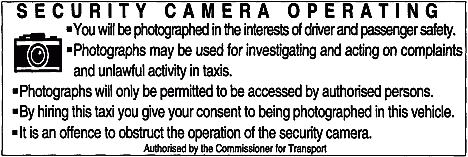
3. [Schedule 2 Amended by S.R. 2004, No. 21, Applied:07 Apr 2004] Security camera signs
A security camera sign –
(a) is to be located –
(i) immediately above each external door handle if the taxi is a sedan or station wagon; or
(ii) adjacent to each external door handle, including the external rear-door handle if the vehicle has rear access for wheelchairs, if the taxi is a van; and
(b) is to be at least 50 millimetres high and at least 150 millimetres wide and be in the following form:
4. [Schedule 2 Amended by S.R. 2004, No. 21, Applied:07 Apr 2004] Security camera test label
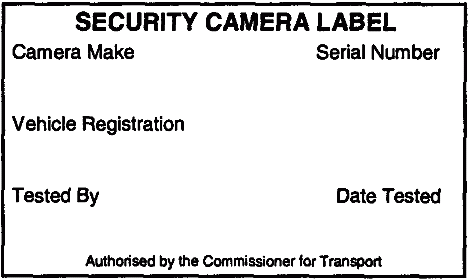
A security camera test label –
(a) is to be located on the upper left-hand side of the inside of the front windscreen; and
(b) is to be attached to the front windscreen; and
(c) is to be in the following form:
SCHEDULE 3[Schedule 3 Amended by No. 51 of 1999, s. 12, Applied:27 Oct 1999] [Schedule 3 Amended by S.R. 2000, No. 69, Applied:26 Jun 2000] [Schedule 3 Rescinded by S.R. 2005, No. 130, Applied:30 Nov 2005]
SCHEDULE 4 - Standard fares[Schedule 1 Amended by S.R. 2000, No. 69, Applied:26 Jun 2000] [Schedule 4 Substituted by S.R. 2000, No. 96, Applied:01 Jul 2000] [Schedule 4 Substituted by S.R. 2000, No. 248, Applied:27 Dec 2000] [Schedule 4 Substituted by S.R. 2002, No. 25, Applied:17 Apr 2002] [Schedule 4 Substituted by S.R. 2003, No. 69, Applied:30 Jun 2003] [Schedule 4 Amended by S.R. 2004, No. 107, Applied:01 Dec 2004] [Schedule 2 Amended by S.R. 2004, No. 15, Applied:17 Mar 2004] [Schedule 4 Amended by S.R. 2004, No. 107, Applied:01 Dec 2004] [Schedule 2 Amended by S.R. 2004, No. 15, Applied:17 Mar 2004] [Schedule 4 Substituted by S.R. 2005, No. 117, Applied:02 Nov 2005] [Schedule 4 Substituted by S.R. 2007, No. 25, Applied:09 May 2007]
Regulations 3 , 21 and 25
1. Standard fares for taxis operating under a licence that relates to the Hobart, Launceston, Burnie, Devonport or Ulverstone taxi area(1) First tariff: Between the hours of 6 a.m. and 8 p.m. on any weekday that is not a public holiday in the place where the taxi is hired, the following tariff (called the first tariff) is to be charged:(a) the amount recorded on the taximeter, that meter being calibrated to record –(i) the sum of $3.10 on the taxi being set in motion; and(ii) the sum of 10 cents for the first 30.7m travelled, or the first 5.6 seconds of time elapsed, whichever occurs first; and(iii) after the distance travelled or, alternatively, time elapsed as specified in subparagraph (ii) , the sum of 10 cents for each complete 61.4m travelled or each 11.1 seconds of time elapsed, whichever is the greater.(2) Second tariff: During the times when the first tariff does not apply, the following tariff (called the second tariff) is to be charged:(a) the amount recorded on the taximeter, that meter being calibrated to record –(i) the sum of $3.10 on the taxi being set in motion; and(ii) the sum of 10 cents for the first 25.6m travelled, or the first 5.6 seconds of time elapsed, whichever occurs first; and(iii) after the distance travelled or, alternatively, time elapsed as specified in subparagraph (ii) , the sum of 10 cents for each complete 51.2m travelled or each 11.1 seconds of time elapsed, whichever is the greater.
2. Standard fares for King Island and Flinders Island taxi areas(1) First tariff: Between the hours of 6 a.m. and 8 p.m. on any weekday that is not a public holiday in the place where the taxi is hired, the following tariff (called the first tariff) is to be charged:(a) the amount recorded on the taximeter, that meter being calibrated to record –(i) the sum of $4.60 on the taxi being set in motion; and(ii) the sum of 10 cents for the first 27.5m travelled, or the first 4.8 seconds of time elapsed, whichever occurs first; and(iii) after the distance travelled or, alternatively, time elapsed as specified in subparagraph (ii) , the sum of 10 cents for each complete 55.1m travelled or each 9.7 seconds of time elapsed, whichever is the greater.(2) Second tariff: During the times when the first tariff does not apply, the following tariff (called the second tariff) is to be charged:(a) the amount recorded on the taximeter, that meter being calibrated to record –(i) the sum of $4.60 on the taxi being set in motion; and(ii) the sum of 10 cents for the first 23.0m travelled, or the first 4.8 seconds of time elapsed, whichever occurs first; and(iii) after the distance travelled or, alternatively, time elapsed as specified in subparagraph (ii) , the sum of 10 cents for each complete 45.9m travelled or each 9.7 seconds of time elapsed, whichever is the greater.
3. Standard fares for taxis operating under a licence that relates to a taxi area other than the Hobart, Launceston, Burnie, Devonport, Ulverstone, King Island or Flinders Island taxi area(1) First tariff: Between the hours of 6 a.m. and 8 p.m. on any weekday that is not a public holiday in the place where the taxi is hired, the following tariff (called the first tariff) is to be charged:(a) the amount recorded on the taximeter, that meter being calibrated to record –(i) the sum of $3.10 on the taxi being set in motion; and(ii) the sum of 10 cents for the first 31.3m travelled, or the first 5.6 seconds of time elapsed, whichever occurs first; and(iii) after the distance travelled or, alternatively, time elapsed as specified in subparagraph (ii) , the sum of 10 cents for each complete 62.6m travelled or each 11.1 seconds of time elapsed, whichever is the greater.(2) Second tariff: During the times when the first tariff does not apply, the following tariff (called the second tariff) is to be charged:(a) the amount recorded on the taximeter, that meter being calibrated to record –(i) the sum of $3.10 on the taxi being set in motion; and(ii) the sum of 10 cents for the first 26.1m travelled, or the first 5.6 seconds of time elapsed, whichever occurs first; and(iii) after the distance travelled or, alternatively, time elapsed as specified in subparagraph (ii) , the sum of 10 cents for each complete 52.1m travelled or each 11.1 seconds of time elapsed, whichever is the greater.
4. Extra charges(1) In the case of trips originating outside the Burnie, Devonport, Hobart or Launceston taxi area as described in Schedule 1 to the Taxi Industry (Taxi Areas) Regulations 1996 between the hours of 12.30 a.m. and 5.00 a.m., a surcharge of $2.60 is to apply.(2) In the case where credit arrangements have been made with the hirer, an accounting fee not exceeding 10% of the metered fare may be charged.(3) In the case where a taxi has been soiled or befouled by a person using the taxi, the responsible operator or driver may charge that person a fee of up to $25.00, being the amount that the responsible operator or driver estimates to be the reasonable costs of cleaning the taxi.(4) The responsible operator or driver may charge the hirer an additional charge for road tolls, ferry charges and entry or exit fees, if the responsible operator or driver –(a) is able to produce a receipt demonstrating payment of that toll, charge or fee; or(b) has incurred, or will incur, a liability to pay that toll, charge or fee.
5. Standard fares for wheelchair-accessible taxis while conveying a wheelchair passenger in any taxi area(1) Third tariff: Between the hours of 6 a.m. and 8 p.m. on any weekday that is not a public holiday in the place where the wheelchair-accessible taxi is conveying a wheelchair passenger, the following tariff (called the third tariff) is to be charged:(a) the amount recorded on the taximeter, that meter being calibrated to record –(i) the sum of $4.70 on the taxi being set in motion; and(ii) the sum of 10 cents for the first 27.8m travelled, or the first 4.8 seconds of time elapsed, whichever occurs first; and(iii) after the distance travelled or, alternatively, time elapsed as specified in subparagraph (ii) , the sum of 10 cents for each complete 55.6m travelled or each 9.7 seconds of time elapsed, whichever is the greater.(2) Fourth tariff: During the times when the third tariff does not apply, the following tariff (called the fourth tariff) is to be charged:(a) the amount recorded on the taximeter, that meter being calibrated to record –(i) the sum of $4.70 on the taxi being set in motion; and(ii) the sum of 10 cents for the first 23.2m travelled, or the first 4.8 seconds of time elapsed, whichever occurs first; and(iii) after the distance travelled or, alternatively, time elapsed as specified in subparagraph (ii) , the sum of 10 cents for each complete 46.3m travelled or each 9.7 seconds of time elapsed, whichever is the greater.
6. High-occupancy vehicle tariffThe operator of a wheelchair-accessible taxi, when carrying 5 or more passengers, may, at any time of day, charge a high-occupancy vehicle tariff equivalent to the fourth tariff, set out in clause 5(2) .
SCHEDULE 5 - Installation of Security Camera System[Schedule 5 Inserted by S.R. 2004, No. 21, Applied:07 Apr 2004]
PART 1 - General
1. Interpretation(1) In this Schedule –rear-vision camera means an internal camera that is positioned above the rear-vision mirror in a taxi.(2) A word not defined in this Schedule has the same meaning as it has for the purposes of Part 5A .
PART 2 - Installation
1. A security camera system must be installed in accordance with the manufacturer's instructions.
2. A security camera system includes all cameras installed in the taxi and must include at least one rear-vision camera.
3. The rear-vision camera must provide a clear view of the taxi driver and all seated passengers.
4. The rear-vision camera must be able to capture all occupants of the vehicle in any image taken by the camera.
5. An internal camera must be readily visible to all vehicle occupants.
6. All cameras must be mounted in such a manner so as to readily prevent misalignment of the field of view, except in the case of a vehicle accident or other severe impact.
7. The first external camera, if at least one is installed, should be positioned to provide a view of any person standing at the window of the driver's door.
8. An external camera, if fitted, may be concealed or not identifiable to persons outside the taxi.
9. Internal and external cameras additional to the rear-vision camera may be fitted to the taxi but the additional cameras –(a) must be at least the same standard in all aspects as the rear-vision camera; and(b) must be fitted in accordance with this Part.
10. The installation of the security camera system must not affect the compliance of the taxi with the Vehicle and Traffic Act 1999 .
11. The cameras and all system components must be installed in a manner that does not interfere with the driver's vision or view of mirrors or otherwise normal operations of the vehicle.
12. The security camera system must not inappropriately interfere with another system on board the taxi, and must itself not be affected by any sources of interference likely to be encountered in the taxi.
13. Apart from the internal camera referred to in item 5 , all other internal components of the security camera system must be concealed.
14. The security camera system must be installed in a manner that enables the system to be easily tested to ensure that all features are operating and that images are being recorded as required under these regulations.
15. The security camera system must be installed in a manner that enables the easy download of a video recording from the camera system.
SCHEDULE 6 - Trip subsidy[Schedule 6 Inserted by S.R. 2004, No. 60, Applied:21 Jul 2004]
1. [Schedule 6 Amended by S.R. 2005, No. 89, Applied:03 Aug 2005] The trip subsidy payable for each trip on which at least one wheelchair passenger is carried by a WAT licensee is as follows:
Taxi area
Trip subsidy
Hobart
$10
Launceston
$12
Devonport
$16
Burnie
$16
SCHEDULE V[Schedule 2 Amended by S.R. 2004, No. 15, Applied:17 Mar 2004] [Schedule V Rescinded by S.R. 2004, No. 60, Applied:21 Jul 2004]
Displayed and numbered in accordance with the Rules Publication Act 1953.
Notified in the Gazette on 25 December 1996
These regulations are administered in the Department of Transport.