

Local Government (General) Regulations 2005
I, the Administrator in and over the State of Tasmania and its Dependencies in the Commonwealth of Australia, acting with the advice of the Executive Council, make the following regulations under the Local Government Act 1993 .
22 June 2005E. C. CRAWFORD
Administrator
By His Excellency's Command,
J. G. COX
Minister Assisting the Premier on Local Government
PART 1 - Preliminary
These regulations may be cited as the Local Government (General) Regulations 2005 .
These regulations take effect on 1 July 2005.
In these regulations –Act means the Local Government Act 1993 ;Consumer Price Index figure means the Consumer Price Index : All Groups Index Number for Hobart published by the Australian Statistician under the authority of the Census and Statistics Act 1905 of the Commonwealth;election dispute means a dispute in relation to the result of an election held under the Act;election dispute proceedings means proceedings relating to an election dispute;first meeting means a council meeting at which an election is to be held under section 43A or 44 of the Act;inflationary factor, in respect of each year, means the amount ascertained by dividing the Consumer Price Index figure for the June quarter of that year by the Consumer Price Index figure for the June quarter of the previous year;June quarter, in relation to a year, means April, May and June of that year;multiple-stage tender means a tender referred to in regulation 26 ;multiple-use register means a register referred to in regulation 25 ;nominating period means the period beginning at 9 a.m. on the fourth business day before the meeting of the council at which the elections under section 43A or 44 of the Act of a mayor or deputy mayor are to be held and ending at noon on the last business day before that meeting;open tender means a tender referred to in regulation 24 ;public tender means a tender referred to in regulation 23 ;Rules of Court means Rules of Court referred to in regulation 17 ;scrutineer means a person appointed as scrutineer under regulation 5(2) ;table means to present for information only.
PART 2 - Elections
Division 1 - Elections of mayor and deputy mayor by councillors
4. Nominations for mayor and deputy mayor
(1) Before the nominating period, the general manager is to issue to all councillors –(a) a notice of an election for the office of mayor or deputy mayor or both; and(b) a nomination form for that election.(2) The general manager is not to release the names or details of any councillor who has nominated until the end of the nominating period.(3) At the end of the nominating period, the general manager is to inform each councillor –(a) of the nominations received; and(b) whether a ballot is required.(4) A ballot is required if there is more than one nomination for an office.(5) If a ballot is not required, the general manager is to declare the nominee elected to the office of mayor or deputy mayor, as applicable, at the beginning of the first meeting.(6) If a nomination is not received for the office of mayor or deputy mayor, the general manager is to invite nominations for the office at the first meeting.(7) If a nomination is not received after the invitation –(a) the council is to appoint a councillor to act in the vacant office; and(b) the general manager is to advise the Director accordingly.
(1) If there are 2 or more nominations for the office of mayor or deputy mayor, a ballot is to be conducted by the general manager in accordance with this Division.(2) A candidate may appoint a person who is not a councillor as a scrutineer by written notification to the general manager of that appointment before the ballot commences.(3) The councillors present at the meeting at which the ballot is to be conducted are to appoint a councillor who is not a candidate to preside at the meeting for the period of the ballot.(4) Each councillor present at the meeting, whether a candidate or not, is to be given a ballot paper on which are printed in alphabetical order the names of all the candidates.
(1) Voting is to be carried out by secret ballot at a meeting of the council.(2) Each councillor is to vote for one candidate by striking through the names of the other candidates for whom the councillor does not intend to vote.(3) The councillor appointed to preside at the ballot may vote as a councillor.(4) If the names of more than 2 candidates appear on the ballot paper and no candidate receives a simple majority, the following procedure applies:(a) the candidate who received the smallest number of votes is to be excluded as a candidate;(b) new ballot papers, which have the names of the continuing candidates printed on them in alphabetical order, are to be prepared;(c) one of those new ballot papers is to be given to each councillor present at the meeting, whether a candidate or not;(d) voting is to take place in accordance with subregulation (2) .(5) The procedure specified in subregulation (4) is to be repeated until one candidate receives a simple majority.
(1) The counting of votes may be conducted in a room other than the council meeting room.(2) A scrutineer is entitled to be present at the count.(3) On any count with more than 2 continuing candidates, if 2 or more candidates receive an equal number of votes and that number is the smallest number for the purpose of regulation 6(4) , the candidate to be excluded is the candidate whose name is first drawn on a drawing or casting of lots under regulation 20 .(4) If there are only 2 continuing candidates in a count and each receives an equal number of votes, a new ballot is to be conducted.(5) If a ballot conducted under subregulation (4) results in an equal number of votes for each continuing candidate, the successful candidate is the candidate whose name is first drawn on a drawing or casting of lots under regulation 20 .(6) Except as provided in subregulation (5) , the successful candidate is the candidate with a simple majority.
8. Declaration of result of ballot
(1) The general manager is to declare the successful candidate elected to the office of mayor or deputy mayor, as appropriate.(2) The general manager is to ensure that the result of the ballot for each office is recorded in the minutes of the meeting.
Division 2 - Hearing and determination of election dispute
9. Parties to election dispute
(1) The Supreme Court may allow a person to appear and be heard, or to be represented, in election dispute proceedings under this Division.(2) A party may only be represented by one person.(3) The Electoral Commissioner is entitled to appear and be heard in any election dispute proceedings.(4) The Electoral Commissioner is a party in the proceedings if –(a) the Electoral Commissioner appears under subregulation (3) ; or(b) the dispute involves the conduct of an electoral officer.
(1) Election dispute proceedings in respect of the same election are to be heard in the same hearing.(2) Subject to subregulation (1) , applications are to be heard in the order in which they appear in the list.(3) Notice of the time and place for the hearing of an election dispute is to be given at least 7 days before the day of the hearing in the manner prescribed by the Rules of Court.(4) A hearing is to be in open court without a jury.(5) The Supreme Court may adjourn the hearing from time to time but the hearing, so far as is reasonably practicable, is to be continued from day to day until its conclusion.(6) A hearing in relation to the election of a councillor is to proceed despite a subsequent resignation of the councillor.(7) The Supreme Court may inquire –(a) into the identity of electors; and(b) whether or not their votes were properly admitted or rejected for the purpose of an election.(8) The Supreme Court may not inquire into the correctness of the electoral roll.(9) The Supreme Court is to be guided by the substantial merits and good conscience of the case without regard to –(a) any legal forms or technicalities; or(b) whether the evidence before the Court is in accordance with the law of evidence or not.
(1) A party in any election dispute proceedings may give evidence to prove that a person was not duly elected.(2) If it appears that there is an equality of votes between any candidates at an election and that the addition of a vote would entitle any of those candidates to be elected, the Supreme Court is to refer the matter to the Electoral Commissioner.(3) On receipt of a matter referred by the Supreme Court, the Electoral Commissioner is to –(a) decide between the candidates by lots; and(b) proceed as if the candidate who was decided by lot had received an additional vote.(4) The Supreme Court may not receive evidence to the effect that a witness was not permitted to vote at the election concerned unless the witness satisfies the Court that –(a) he or she was entitled to vote under the Act; and(b) in so far as the witness was permitted to do so, he or she complied with the requirements of the Act relating to voting by electors.
(1) A person summoned as a witness at any election dispute proceedings is not excused from answering a question relating to an offence alleged to have been committed at, or in connection with, an election –(a) on grounds that the answer to the question may incriminate or tend to incriminate that person or the spouse or partner of that person; or(b) on grounds of privilege.(2) An answer by a witness to a question put by or before the Supreme Court in any election dispute proceedings is not admissible in evidence in any other legal proceedings, except in the case of a criminal proceeding for perjury.
A person attending the Supreme Court to give evidence in any election dispute proceedings is entitled to expenses according to the scale applicable in respect of witnesses attending the trial of an action before the Supreme Court.
(1) At the conclusion of the hearing of an application in respect of an election dispute, the Supreme Court may make any one or more of the following orders:(a) an order dismissing the application, in whole or in part;(b) an order declaring that a person who was declared elected at the election was not duly elected;(c) an order declaring that a person who was not declared elected at the election is duly elected;(d) subject to regulation 15(1) , an order declaring that an election in respect of a municipal area or electoral district is void on the closing day fixed or determined under section 268A of the Act.(2) If the Supreme Court makes an order under subregulation (1)(b) that a person was not duly elected, it is to declare, in the same order, that the office of councillor for which the person was not so elected is vacant.(3) If the Supreme Court makes an order under subregulation (1)(d) declaring that an election in respect of any municipal area or electoral district is void, that election is taken to have wholly failed.(4) A certified copy of the order referred to in subregulation (3) is to be given to the Electoral Commissioner.(5) The Electoral Commissioner is to advise the Minister and the relevant council of the order referred to in subregulation (3) .
(1) The Supreme Court is not to make an order under regulation 14(1)(d) declaring that an election is void because of –(a) a delay in the taking of the votes of electors or in the issuing of a certificate of election under section 304 of the Act if the delay did not affect the result of the election; or(b) the absence of, or an error or omission by, an electoral officer which did not affect the result of the election.(2) If an elector was prevented from voting at an election because of the absence of, or an error or omission by, an electoral officer, the Supreme Court may not admit evidence of the way in which the elector intended to vote in order to determine whether or not the absence of, or error or omission by, the electoral officer affected the result of the election.
The Supreme Court may –(a) award costs against an unsuccessful party to any election dispute proceedings; and(b) recommend that costs, or a specified part of them, be paid by the council.
(1) Rules of Court may be made under the Supreme Court Civil Procedure Act 1932 for the purpose of this Division.(2) If no Rules of Court are made under subregulation (1) , the practice and procedure with respect to any election dispute proceedings are to be directed by the Supreme Court.
Division 3 - Drawing or casting of lots
18. Order of names on batch of ballot papers
For the purpose of section 288(2) of the Act, the order in which the names of the candidates are to be printed on each batch of ballot papers is to be determined in accordance with Schedule 1 .
19. Exclusion and election of candidates
(1) For the purpose of clause 5(1) of Part 2 of Schedule 7 and clause 15(2) of Part 3 of Schedule 7 to the Act –(a) the returning officer is to conduct a draw in accordance with regulation 20 ; and(b) the candidate to be excluded is the candidate whose name is first recorded.(2) For the purpose of clause 5(2) of Part 2 of Schedule 7 to the Act –(a) the returning officer is to conduct a draw in accordance with regulation 20 ; and(b) the candidate elected is the candidate whose name is first recorded.
20. Procedure for drawing or casting lots
(1) To draw or cast lots, a returning officer is to –(a) make out, in respect of each candidate to be included in the draw, a slip bearing that candidate's name; and(b) place each of the slips in a separate identical hollow opaque sphere; and(c) place the spheres in a container sufficiently large to allow those spheres to move about freely when shaken or rotated; and(d) shake or rotate the container and permit any other person present who wishes to do so to shake or rotate the container; and(e) take out of the container and open one of the spheres to obtain the enclosed slip; and(f) record the name of the candidate which appeared on that slip; and(g) repeat the process specified in paragraphs (d) , (e) and (f) until all spheres have been removed from the container.(2) For the purpose of subregulation (1)(f) and (g) , the names of the candidates are to be recorded in the order in which the spheres were taken out of the container.
Division 4 - Electoral advertising
(1) A person must not publicly display a poster or sign or a group of posters or signs containing advertising relating to the election of a candidate if –(a) the poster or sign exceeds 3 square metres; or(b) the group of posters or signs in total exceed 3 square metres.(2) A poster or sign forms part of a group of posters or signs if it is located within 10 metres of another poster or sign.(3) A candidate must not display, or permit to be displayed, posters or signs containing advertising relating to the election of that candidate exceeding a total number of 50, whether or not the posters or signs contain advertising relating to the election of another candidate.(4) A person must not publicly display a poster or sign relating to the election of a candidate without the written authority of that candidate.
(1) A person must not purchase advertising time on television or radio in relation to the election of a candidate without the written authority of that candidate.(2) A candidate must not purchase, or permit to be purchased, advertising time on television or radio in relation to the election of the candidate if the advertising time during the relevant period is likely to exceed –(a) 10 minutes on television; or(b) 50 minutes on radio.(3) A person must not purchase advertising space in relation to the election of a candidate without the written authority of that candidate.(4) A candidate must not purchase or permit to be purchased advertising space in relation to the election of the candidate if the advertising space, during the relevant period, is likely to exceed a total of –(a) 2 pages of advertising in a daily newspaper circulating in the municipal area; or(b) 5 pages in any other newspaper circulating in the State.(5) The total expenditure for the purchase of advertising time or space by or on behalf of a candidate must not –(a) in respect of a single election, exceed a total amount of $5 000; and(b) in respect of an election for a councillor and an election for a mayor or deputy mayor, exceed a total amount of $8 000.(6) A candidate is taken to have incurred the total time and space of, and expenditure involved in, advertising which promotes that candidate in respect of an election irrespective of whether or not that advertising also promotes another candidate.(7) A candidate who authorises a person to conduct electoral advertising on his or her behalf relating to an election is taken to have personally undertaken that advertising.
PART 3 - Tendering and contracting
Division 1 - Tenders for goods and services
(1) A council must publicly invite tenders for any contract it intends to enter into for the supply and provision of goods or services valued at or above $50 000, excluding GST, by one of the following:(a) an open tender under regulation 24 ;(b) a multiple-use register under regulation 25 ;(c) a multiple-stage tender under regulation 26 .(2) A council, through a public tender process, may establish a standing contract in which a single tenderer or multiple tenderers may be contracted for a specified period to provide specified goods or services during that period without the need for a further tender process.(3) A council must not split a contract into 2 or more contracts for the primary purpose of avoiding compliance with the requirement to publicly invite tenders.(4) A council may extend a contract entered into by tender –(a) as specified in the contract; or(b) if the contract does not specify extensions, by an absolute majority.(5) A council is to report the following in its annual report in relation to any contract for the supply or provision of goods or services valued at or above $50 000, excluding GST, entered into or extended under subregulation (4)(b) in the financial year:(a) a description of the contract;(b) the period of the contract;(c) the periods of any options for extending the contract;(d) the value of any tender awarded or, if a tender was not required, the value of the contract excluding GST;(e) the business name of the successful contractor;(f) the business address of the successful contractor.
(1) The general manager is to invite tenders by publishing at least once a notice in a daily newspaper circulating in the municipal area specifying –(a) the nature of the goods or services the council requires; and(b) any identification details allocated to the contract; and(c) where the tender is to be lodged; and(d) particulars identifying a person from whom more detailed information relating to the tender may be obtained; and(e) the period within which the tender is to be lodged.(2) The period within which a tender is to be lodged must be at least 14 days after the date on which the notice is published.(3) The general manager is to ensure that prospective tenderers are provided with the following in order to make a tender:(a) details of the goods or services required;(b) details of the duration of the contract, including any extensions that are specified in the contract;(c) the criteria for evaluating tenders;(d) the method of evaluating tenders against the evaluation criteria;(e) any mandatory tender specifications and contract conditions;(f) a reference to the council's code of tendering.(4) A person making a tender must –(a) do so in writing; and(b) specify the goods or services tendered for; and(c) lodge the tender within the period specified in the notice.
(1) A council may establish a multiple-use register of suppliers who meet criteria established by the council in respect of the supply of particular categories of goods or services.(2) A council is to invite applications from suppliers for inclusion on a multiple-use register by causing to be published at least once in a daily newspaper circulating in the municipal area a notice specifying –(a) the nature of the goods or services the council requires; and(b) any identification details allocated to the register; and(c) where the application is to be lodged; and(d) the person from whom more detailed information may be obtained; and(e) the period within which the application is to be lodged.(3) The general manager is to ensure that applicants are provided with the following in order to make an application:(a) details of the categories of goods or services required;(b) the criteria for evaluating applications;(c) the method of evaluating applications against the criteria;(d) a reference to the council's code for tenders and contracts.(4) A council may –(a) accept an application for inclusion on a multiple-use register; or(b) reject the application.(5) If a council rejects an application, the general manager is to advise the applicant of the reasons for that rejection.(6) If a council accepts an application, the general manager is to advise the applicant of the category for which the applicant is to be included on the multiple-use register.(7) A council is to invite tenders for a contract for the supply of goods or services from all suppliers included on a multiple-use register for a particular category of goods or services.(8) A multiple-use register is to be reviewed at least once every 2 years.(9) A council must allow a supplier to apply for inclusion on a multiple-use register at any time, unless the supplier –(a) has made an application within the previous 12 months; and(b) the application has not been accepted.
(1) A council may invite tenders for a contract for the supply of goods or services using a multiple-stage tender process.(2) A multiple-stage tender process is a process by which suppliers are evaluated through stages against criteria determined by the council.(3) At the first stage of a multiple-stage tender process, the general manager is to invite expressions of interest from prospective tenderers by causing to be published at least once in a daily newspaper circulating in the municipal area a notice specifying –(a) the nature of the goods or services the council requires; and(b) any identification details allocated to the contract; and(c) where the expression of interest is to be lodged; and(d) the person from whom more detailed information may be obtained; and(e) the period within which the expression of interest is to be lodged.(4) The general manager is to ensure that prospective tenderers are provided with the following in order to lodge an expression of interest:(a) details of the goods or services required;(b) the criteria for evaluating expressions of interest;(c) the method of evaluating expressions of interest against the criteria;(d) details of any further stages in the tender process;(e) a reference to the council's code for tenders and contracts.(5) At the final stage of a multiple-stage tender process, the general manager is to invite all suppliers who have met the criteria determined by the council to tender for the supply of goods or services.(6) If only one supplier meets the criteria determined by the council at the first stage as specified in subregulation (3) , the council may contract with that supplier after –(a) a tender by that supplier; or(b) a decision by absolute majority of the council to do so.(7) The general manager is to ensure the consistency of the criteria used at each stage of a multiple-stage tender process.
27. Non-application of public tender process
(1) Regulation 23 does not apply to the following:(a) an emergency if, in the opinion of the general manager, there is insufficient time to invite tenders for the goods or services required in that emergency;(b) a contract for goods or services supplied or provided by, or obtained through, an agency of a State or of the Commonwealth;(c) a contract for goods or services supplied or provided by another council, a single authority, a joint authority or the Local Government Association of Tasmania;(d) a contract for goods or services in respect of which a council is exempted under another Act from the requirement to invite a tender;(e) a contract for goods or services that is entered into at public auction;(f) a contract for insurance entered into through a broker;(g) a contract arising when a council is directed to acquire goods or services due to a claim made under a contract of insurance;(h) a contract for goods or services if the council resolves by absolute majority and states the reasons for the decision, that a satisfactory result would not be achieved by inviting tenders because of –(i) extenuating circumstances; or(ii) the remoteness of the locality; or(iii) the unavailability of competitive or reliable tenderers;(i) a contract of employment with a person as an employee of the council.(2) A council is to report in its annual report all instances where subregulation (1)(a) or (h) has been applied with the following details:(a) a brief description of the reason for not inviting public tenders;(b) a description of the goods or services acquired;(c) the value of the goods or services acquired;(d) the name of the supplier.
Division 2 - Code for tenders and contracts
28. Code for tenders and contracts
The code adopted under section 333B of the Act is to –(a) promote the following principles:(i) open and effective competition;(ii) value for money;(iii) enhancement of the capabilities of local business and industry;(iv) ethical behaviour and fair dealing; and(b) establish and maintain procedures to ensure that all potential suppliers are provided with the same information relating to the requirements of a tender or contract and are given equal opportunity to meet the requirements; and(c) establish and maintain procedures to ensure that fair and equal consideration is given to all tenders or quotations received; and(d) establish and maintain procedures to deal honestly with, and be equitable in the treatment of, all potential or existing suppliers; and(e) establish and maintain procedures to ensure a prompt and courteous response to all reasonable requests for advice and information from potential or existing suppliers; and(f) seek to minimise the cost to suppliers of participating in the tendering process; and(g) protect commercial-in-confidence information; and(h) for contracts valued at under $50 000 excluding GST, specify when 3 written quotations are required; and(i) establish and maintain procedures for the use of multiple-use registers for contracts valued at under $50 000, excluding GST; and(j) establish and maintain procedures for reporting by the general manager to the council in relation to the purchase of goods or services in circumstances where a public tender or quotation process is not used; and(k) establish and maintain procedures for the review of each tender process to ensure that each tender is in accordance with these regulations and the code; and(l) establish and maintain procedures for the following:(i) amending or extending a tender once it has been released;(ii) opening tenders;(iii) the consideration of tenders that do not fully conform with the tender requirements;(iv) the debriefing of unsuccessful tenderers;(v) handling complaints regarding processes related to the supply of goods or services.
PART 4 - Miscellaneous
29. Incapacity to perform duties as councillor
For the purpose of making an application to a magistrate under section 28J of the Act, a prescribed person means the Director.
A customer service charter adopted under section 339F of the Act is to address the following matters:(a) the manner in which a complaint referred to in section 339E of the Act may be made;(b) the manner in which a response to a complaint is to be made;(c) opportunities for a review of a response by the general manager;(d) the periods within which complaints are to be dealt with;(e) other actions that may be taken if a complainant is dissatisfied by the response;(f) reporting of the complaints received.
The following are prescribed services for the purpose of section 93(1)(g) of the Act:(a) the management, maintenance, monitoring and auditing of an on-site waste water management system as defined in the Building Act 2000 ;(b) a community medical service.
For the purpose of section 107(1)(e) of the Act, prescribed factors for general or service rates are –(a) the diameter of the pipe through which water is supplied by a council to a property or group of properties within the municipal area of that council; and(b) the division of land by the issue of a separate strata title to each parcel subject to the Strata Titles Act 1998 ; and(c) if separately assessed land is predominantly used for residential dwelling, the number of residential dwellings on that land.
For the purpose of section 124(3) of the Act, a council may determine that rates are not payable by instalments if the total amount of rates for a financial year is $100 or less.
34. Publication of details of register of money
(1) For the purpose of section 139A of the Act, the following are prescribed as details to be published in respect of the register of money kept under that section:(a) the name of the last known owner of the land;(b) the address of the land;(c) the amount of money recorded on the register in respect of the land.(2) For the purpose of section 139A of the Act, the prescribed amounts are any amounts of $50 or more.
For the purpose of section 157A of the Act, the prescribed matters are as follows:(a) the title of the proposed by-law;(b) the objectives of the proposed by-law;(c) the envisaged or potential impact and the primary features of the proposed by-law affecting the community or particular groups within the community;(d) an invitation for submissions from the public on the proposed by-law;(e) the manner in which submissions may be made;(f) the period within which submissions may be made;(g) the availability of the regulatory impact statement and a copy of the proposed by-law or how that information may be accessed;(h) a contact point or person for public enquiries on the content and effect of the proposed by-law.
For the purpose of section 72(1)(e) of the Act, the following are prescribed matters to be included in the annual report of a council:(a) a statement reporting on the council's plans in relation to water supplied by it for domestic consumption;(b) sufficient financial information to demonstrate that it is applying the pricing guidelines in relation to water supplied by it for domestic consumption and provision of wastewater services as specified in the Urban Water and Wastewater Pricing Guidelines for Local Government issued by the Government Prices Oversight Commission.
37. Compulsory acquisition of land
A council may acquire land under section 176 of the Act for the following purposes:(a) the establishment of, or extension to, its public offices;(b) the establishment of, or extension to, a works depot, pound, plant nursery or child care centre;(c) the establishment of, or extension to, public land;(d) the establishment or realignment of a highway or local highway, as defined by section 3 of the Local Government (Highways) Act 1982 ;(e) the establishment of, or the provision of access to –(i) a water storage, reticulation or treatment facility or system; and(ii) a stormwater reticulation system, drainage system, handling system, disposal facility system or pump station; and(iii) a sewage reticulation system, treatment system, disposal facility system or pump station; and(iv) a waste management facility, waste disposal site or waste transfer station;(f) the establishment and operation of a quarry for the extraction, processing and storage of rock, crushed rock, gravel or sand for council works.
For the purposes of section 214D(3) of the Act, the Board may make a recommendation relating to the declaration of a municipal area or part of a municipal area as a city if all of the following circumstances exist:(a) if, for 5 years immediately preceding the Board's review, the municipal area had a population of at least 20 000 persons;(b) if at least 60% of the population of the municipal area lives in an urban area;(c) if an elector poll conducted on behalf of the council has indicated that the majority of electors favour the recommendation.
39. Plan of boundaries of towns
A council is to lodge a plan with the Central Plan Register established under the Survey Co-ordination Act 1944 of the boundaries of any town or proposed town.
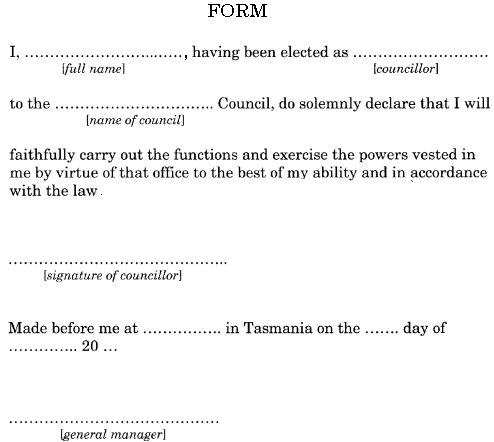
(1) For the purpose of section 321 of the Act, the declaration of office is to be in accordance with the form specified in Schedule 2 .(2) A person elected as councillor is to read aloud the declaration of office in the presence of the general manager and sign the declaration.(3) The general manager is to sign the declaration of office as witness.
The fees specified in Schedule 3 are the fees payable in respect of the matters mentioned in that Schedule.
42. Allowances for elected members
(1) The annual allowances payable to mayors, deputy mayors and councillors for the period of 12 months starting on 1 November 2004 are as specified in Schedule 4 .(2) The allowances payable in each subsequent period of 12 months starting on 1 November –(a) take effect from that date each year; and(b) are calculated by multiplying the allowances for the previous year by the inflationary factor for the current year.(3) The annual allowance is to be paid in monthly or fortnightly instalments.
A councillor is entitled to be reimbursed for reasonable expenses in accordance with the policy adopted under Schedule 5 to the Act in relation to –(a) telephone rental and telephone calls; and(b) travelling; and(c) care of any child of the councillor.
For the purpose of section 72B of the Act, the following newspapers are prescribed newspapers:(a) in respect of the municipal area of King Island, the King Island Courier;(b) in respect of the municipal area of Flinders, the Island News.
The Statutory Rules specified in Schedule 5 are rescinded.
SCHEDULE 1 - Order of names on batch of ballot papers
1. InterpretationIn this Schedule –batch means a group of ballot papers on which the names of candidates appear in the same order;column, in relation to a ballot paper, means the single vertical column in which the names of candidates are to appear on the ballot paper;favoured position means a favoured position within the meaning of Schedule 3 to the Electoral Act 2004 ;matrix column means a vertical column in a matrix;matrix row means a horizontal row in a matrix.
2. Batch of ballot papers(1) The number of ballot papers in each batch, as far as is practicable, is to be the same.(2) The number of batches is to be equal to the number of candidates.
3. Favoured position(1) In relation to each candidate, there is to be printed, in respect of each favoured position, a batch of ballot papers on which the name of that candidate appears in that favoured position.(2) If there are 6 or more candidates, the name of a candidate is not to appear immediately above the name of a particular candidate on more than one batch of ballot papers if the names of both candidates would be in favoured positions.
4. Matrices(1) There is to be a matrix corresponding to the number of candidates.(2) The purpose of each matrix is to determine the order of names on each batch of ballot papers.(3) The number of matrix columns and matrix rows are to be the same as the corresponding number of candidates.(4) Each matrix is to comprise letters, each of which represents the name of a particular candidate.(5) The names of the candidates, in the order in which they are drawn in accordance with regulation 20 , are to be represented by the letters A, B, C and so on in alphabetical order.(6) The order in which the names of candidates is to be printed on the batches of ballot papers is to be in accordance with the particular matrix for that number of candidates.
5. Matrix column(1) The first matrix column is to be in alphabetical order starting with A.(2) The names on the first batch of ballot papers are to be printed in the order represented by the first matrix column.(3) The names on the second batch of ballot papers are to be printed in the order represented by the second matrix column, and so on.
6. Matrices for 12 or fewer candidatesIf the number of candidates is 12 or less, the matrices are as set out in Schedule 2 to the Electoral Regulations 2005 .
7. Matrices for more than 12 candidates(1) If the number of candidates is more than 12 but less than 31, the Electoral Commissioner is to prepare matrices as follows:(a) the first matrix row is to contain a sequence of letters as set out in subclause (2) ;(b) the second matrix row is to contain the same sequence of letters commencing with the letter B, continuing to the end of the sequence and then continuing from the start of the sequence to the letter immediately before B;(c) the third matrix row is to contain the same sequence of letters commencing with the letter C, continuing to the end of the sequence and then continuing from the start of the sequence to the letter immediately before C;(d) the subsequent matrix rows are to contain a sequence of letters following the patterns specified in paragraphs (b) and (c) .(2) The sequence of letters in the first matrix row is as follows:(a) if there are 13 candidates, A B K C G F D L J I E M H;(b) if there are 14 candidates, A B L C G F D M J K E I H N;(c) if there are 15 candidates, A B M C G F D N L H E K J O I;(d) if there are 16 candidates, A B N C G F D O L J E M H P K I;(e) if there are 17 candidates, A B O C G F D P M J E K H Q I N L;(f) if there are 18 candidates, A B P C I H D Q G L E N M R J K O F;(g) if there are 19 candidates, A B Q C I H D R G P E N M S J K O F L;(h) if there are 20 candidates, A B R C O G D S N Q E J M T L I K F H P;(i) if there are 21 candidates, A B S C O G D T N R E L M U H J I F P Q K;(j) if there are 22 candidates, A B T C O G D U N S E P L V H J I F Q R K M;(k) if there are 23 candidates, A B U C O G D V N T E L I W H J Q F R S K P M;(l) if there are 24 candidates, A B V C O G D W N U E J I X H M K F S T R L Q P;(m) if there are 25 candidates, A B W C O G D X N V E J I Y H M K F T U S L Q R P;(n) if there are 26 candidates, A B X C O G D Y N W E J I Z H M K F U V T L P Q S R;(o) if there are 27 candidates, A B Y C O G D Z N X E J I AA H M L F V W U P Q T K R S;(p) if there are 28 candidates, A B Z C O G D AA P Y E J I AB H U L F W X V S N R K Q M T;(q) if there are 29 candidates, A B AA C O G D AB P Z E J I AC H R L F X Y W Q N S K T M U V;(r) if there are 30 candidates, A B AB C O G D AC P AA E J I AD H Q L F Y Z X R N V K W M T S U.(3) If the number of candidates is 31 or more, the Electoral Commissioner is to prepare matrices taking into account the provisions of these regulations.
8. Collation of ballot papers(1) Ballot papers are to be collated so that a ballot paper from batch 1 is followed by a ballot paper from batch 2, then a ballot paper from batch 3 and so on up to a ballot paper from the last batch, to be followed by a ballot paper from batch 1, batch 2 and so on until the collation is complete.(2) Ballot papers are to be inserted into envelopes in the order as collated for sending or delivering or providing in person to an elector under section 284 or 286 of the Act.
SCHEDULE 2 - Declaration of Office
SCHEDULE 3 - Fees
1. | Application for a council land information certificate under section 337 of the Act | 50 fee units | 2. | Issue of a certificate of liabilities under section 132 of the Act | 30 fee units | 3. | Copy of the annual report of a council | Maximum of 5 fee units |
SCHEDULE 4 - Allowances for elected members
Council | Mayor | Deputy Mayor | Councillor | Hobart City | 72 000 | 15 500 | 12 000 | Launceston City | 72 000 | 15 500 | 12 000 | Clarence City | 57 000 | 13 500 | 11 000 | Glenorchy City | 57 000 | 13 500 | 11 000 | Kingborough | 57 000 | 13 500 | 11 000 | Burnie City | 42 000 | 11 500 | 9 500 | Central Coast | 42 000 | 11 500 | 9 500 | Devonport City | 42 000 | 11 500 | 9 500 | Huon Valley | 27 000 | 9 500 | 8 000 | Meander Valley | 27 000 | 9 500 | 8 000 | Northern Midlands | 27 000 | 9 500 | 8 000 | Waratah/Wynyard | 27 000 | 9 500 | 8 000 | West Tamar | 27 000 | 9 500 | 8 000 | Break O'Day | 20 500 | 8 000 | 7 000 | Brighton | 20 500 | 8 000 | 7 000 | Circular Head | 20 500 | 8 000 | 7 000 | Derwent Valley | 20 500 | 8 000 | 7 000 | Dorset | 20 500 | 8 000 | 7 000 | George Town | 20 500 | 8 000 | 7 000 | Latrobe | 20 500 | 8 000 | 7 000 | Sorell | 20 500 | 8 000 | 7 000 | Glamorgan-Spring Bay | 17 000 | 7 000 | 6 000 | West Coast | 17 000 | 7 000 | 6 000 | Central Highlands | 14 000 | 6 500 | 5 500 | Flinders | 14 000 | 6 500 | 5 500 | Kentish | 14 000 | 6 500 | 5 500 | King Island | 14 000 | 6 500 | 5 500 | Southern Midlands | 14 000 | 6 500 | 5 500 | Tasman | 14 000 | 6 500 | 5 500 |
SCHEDULE 5 - Statutory Rules rescinded
Local Government Regulations 1994 (No. 25 of 1994) | Local Government Amendment Regulations 1994 (No. 85 of 1994) | Local Government Amendment Regulations (No. 2) 1994 (No. 100 of 1994) | Local Government Amendment Regulations (No. 3) 1994 (No. 125 of 1994) | Local Government Amendment Regulations (No. 4) 1994 (No. 181 of 1994) | Local Government Amendment Regulations 1995 (No. 178 of 1995) | Local Government Amendment Regulations 1996 (No. 122 of 1996) | Local Government (Elections) Regulations 1998 (No. 12 of 1998) | Local Government Amendment Regulations 1999 (No. 2 of 1999) | Local Government Amendment Regulations (No. 2) 1999 (No. 69 of 1999) | Local Government Amendment (Operational Plans) Regulations 1999 (No. 160 of 1999) | Local Government Amendment Regulations 2000 (No. 189 of 2000) | Local Government Amendment Regulations 2002 (No. 183 of 2002) | Local Government Amendment Regulations 2004 (No. 92 of 2004) |
Displayed and numbered in accordance with the Rules Publication Act 1953.
Notified in the Gazette on 29 June 2005
These regulations are administered in the Department of Premier and Cabinet.