
Referendum Procedures Act 1994
An Act relating to the conduct of referendums
Be it enacted by His Excellency the Governor of Tasmania, by and with the advice and consent of the Legislative Council and House of Assembly, in Parliament assembled, as follows:
PART 1 - Preliminary
This Act may be cited as the Referendum Procedures Act 1994 .
This Act commences on the day on which it receives the Royal Assent.
In this Act –announcement includes a statement or commentary;approved means approved by the Chief Electoral Officer;article includes a report, letter or commentary;Assembly means the House of Assembly of the Parliament of Tasmania;Assembly division means an electoral division, determined in accordance with the Constitution Act 1934 , for the return of members to represent the electors of that division in the Assembly;Assembly general election means the elections held or to be held contemporaneously in respect of the several Assembly divisions pursuant to writs issued by the Governor on the dissolution or expiry of the Assembly;Assistant Chief Electoral Officer means the person appointed and holding office as Assistant Chief Electoral Officer under section 5 of the Electoral Act 1985 ;authorized witness means an authorized witness referred to in section 138 ;ballot-paper means a ballot-paper for a referendum;Chief Electoral Officer means the person appointed and holding office as Chief Electoral Officer under section 4 of the Electoral Act 1985 ;corrupt practice means –(a) an offence that is a crime by virtue of this Act; or(b) aiding, abetting, counselling or procuring the commission of or attempting or conspiring to commit such an offence;declaration envelope means an envelope bearing a declaration made by an elector for the purposes of voting at a referendum under section 35 or Division 4 , 5 , 6 or 7 of Part 2 ;declared institution means an institution declared under section 15 of the Electoral Act 1985 ;elector means a person whose name appears on an electoral roll for an Assembly division;electoral officer means the Chief Electoral Officer, the Assistant Chief Electoral Officer, an electoral registrar, a polling official or any other person holding a prescribed position;electoral registrar means the returning officer of an Assembly division;electoral roll means a House of Assembly electoral roll maintained for the purposes of the Electoral Act 1985 ;enrolled means enrolled on a House of Assembly electoral roll in accordance with the Electoral Act 1985 ;illegal practice means –(a) an offence against this Act, other than a corrupt practice or an offence specified in Division 8 of Part 2 ; or(b) aiding, abetting, counselling or procuring the commission of or attempting or conspiring to commit such an offence;informal ballot-paper means a ballot-paper which is informal as referred to in section 92 ;issuing officer means an electoral officer who issues a ballot-paper to an elector in accordance with this Act;medical practitioner means a legally-qualified medical practitioner;official mark means an approved mark or approved stamp;parcel means a number of items packed together;poll means a poll for a referendum;polling-booth means any premises, vehicle or facility at a polling-place that is used for the conduct of the poll at a referendum;polling-day means a day on which a poll for a referendum is conducted;polling official includes a returning officer, an assistant returning officer, a presiding officer, an assistant presiding officer and a clerical assistant;prescribed offence means an offence –(a) under section 90 ; or(b) prescribed by the regulations for the purposes of this definition;prescribed penalty means –(a) in relation to an offence under section 90 , 0·2 penalty units; and(b) in relation to any other offence, the penalty specified in the regulations in relation to that offence;referendum means a referendum held in accordance with this Act;referendum matter means a matter that is –(a) intended or likely to affect, or capable of affecting, the result of a referendum; or(b) intended or likely to influence, or capable of influencing, an elector in, or in relation to, voting at a referendum;regulations means regulations made and in force under this Act;returning officer means a returning officer appointed under the Electoral Act 1985 in respect of an Assembly division;scrutineer includes –(a) a scrutineer appointed under section 19 (1) of this Act; and(b) a scrutineer appointed in respect of a referendum under any other Act;scrutiny means the process of –(a) admitting or rejecting declaration envelopes which purport to contain ballot-papers; and(b) counting ballot-papers;writ means a writ for the holding of a referendum.
PART 2 - Conduct of Referendums
Division 1 - Writs for holding referendums
(1) If a referendum is authorized or required by or under an Act to be held in accordance with this Act, the Governor may issue a writ for the holding of a referendum, not less than 21 days after the Act which authorizes or requires the referendum to be held receives the Royal Assent.(2) If a referendum pursuant to this Act is to be held on the same day as an Assembly general election, the date of issue of the writ for the referendum is to be the same as the date of issue of the writ for the election.
(1) A writ for the holding of a referendum is to –(a) specify each proposal to be submitted to the electors at the referendum; and(b) fix –(i) the day, being a Saturday, for the conduct of the poll; and(ii) the day for the return of the writ.(2) If a proposal to be submitted to the electors at the referendum concerns the passing of a proposed law, a copy of the text of the proposed law is to be attached to the writ.(3) The writ is to be taken to have been issued at 6 p.m. on the day on which it was issued.
(1) The day fixed for the conduct of the poll is to be a day not less than 21 days and not more than 51 days after the day on which the writ was issued.(2) The day fixed for the return of the writ is to be a day not later than 60 days after the day on which the writ was issued.
7. Writ directed to Chief Electoral Officer
A writ for the holding of a referendum is to be directed to the Chief Electoral Officer.
8. Action by Chief Electoral Officer
The Chief Electoral Officer must, immediately after receiving a writ for the holding of a referendum –(a) endorse on the writ the date on which it was received; and(b) cause a notice to be published in each daily newspaper published in Tasmania setting out –(i) the date on which the writ was received; and(ii) each of the proposals specified in the writ and the days fixed for the conduct of the poll and the return of the writ; and(c) forward a copy of the writ to the returning officer for each Assembly division.
9. Arguments in relation to proposals
(1) If a referendum is authorized or required by or under an Act to be held in accordance with this Act –(a) an argument in favour of each proposal to be submitted to the electors at the referendum is to be authorized by a majority of those members of Parliament who are in favour of the proposal and forwarded to the Chief Electoral Officer; and(b) an argument against each proposal is to be authorized by a majority of those members of Parliament who are against the proposal and forwarded to the Chief Electoral Officer.(2) An argument referred to in subsection (1) is to –(a) be in a form approved by the Chief Electoral Officer, consisting of no more than 2 000 words; and(b) be forwarded to the Chief Electoral Officer within 21 days after the day on which the Act authorizing or requiring the referendum to be held is passed.(3) The Chief Electoral Officer is to cause the arguments for and against each proposal to be submitted to the electors at a referendum to be brought to the notice of electors before the day fixed for the conduct of the poll.
(1) The Governor may, by proclamation, before or after the day fixed for the conduct of a poll –(a) fix a later day for the conduct of the poll either generally or in any Assembly division; or(b) fix a later day for the return of the writ, which day may be more than 60 days after the day on which the writ was issued; or(c) extend for a reasonable period the time for resolving a difficulty that might otherwise interfere with the due course of the referendum.(2) The day fixed for the conduct of a poll may not be changed under subsection (1) later than 7 days before that day.(3) If the Governor fixes a later day for the conduct of a poll, the Chief Electoral Officer is to immediately cause that change to be brought to the notice of –(a) electors generally, if the date is changed in all Assembly divisions; or(b) electors in the relevant Assembly division, if the date is changed in that Assembly division.(4) Where the day fixed for the conduct of a poll for a referendum is the same as the day fixed for the conduct of a poll at an Assembly general election and the time for holding the election is extended under section 76 of the Electoral Act 1985 , the day on which the election is to be held in an Assembly division is to be taken to be the day on which the poll for the referendum is conducted in that Assembly division.(5) If the Governor fixes a later day for the conduct of a poll, that later day is to be taken as having been fixed by the writ.
Division 2 - Powers and functions of electoral officers
11. Returning officer to make arrangements for polling
(1) The returning officer for an Assembly division is to make the necessary arrangements for the poll for a referendum to take place in that Assembly division.(2) The returning officer must, with any other arrangements made under subsection (1) –(a) appoint an assistant returning officer to be the officer in charge of each counting-centre within the Assembly division and a presiding officer to be the officer in charge of each subsidiary counting-centre in that Assembly division; and(b) appoint all necessary polling officials required to conduct the polling at the polling-places in the Assembly division; and(c) ensure that compartments for voters are provided at each polling-booth in the Assembly division and that each compartment is furnished with ballot-boxes and other equipment necessary for the conduct of polling at the booth; and(d) ensure that each polling-booth in the Assembly division is provided with the necessary certified copy or copies of the electoral roll for that Assembly division and any approved documents; and(e) ensure that sufficient ballot-papers for the conduct of polling are obtained from the Chief Electoral Officer and that a sufficient number of those ballot-papers is issued to each officer in charge of a polling-booth in the Assembly division.(3) If on polling-day for a referendum a person appointed as a polling official fails to attend, or is absent from, a polling-booth, the officer in charge of that polling-booth may, if satisfied that it is not practicable to contact the returning officer, appoint another person to act in place of that person.(4) A person appointed under subsection (3) is to be taken as having been duly appointed under subsection (2) if the returning officer ratifies the appointment.
If a referendum is required or authorized to be held in accordance with this Act, the Chief Electoral Officer must, before and in time for the poll, ensure that the returning officer responsible for the conduct of the poll in each Assembly division is provided with sufficient ballot-papers.
13. Use of certain premises as polling-booth prohibited
[Section 13 Amended by No. 24 of 2004, s. 56, Applied:01 Jan 2005] A part of any premises authorized under the Liquor Licensing Act 1990 as premises at which liquor may be sold must not be used as a polling-booth.
14. Polling-booths divided into sections
(1) The returning officer for an Assembly division may cause a polling-booth in that Assembly division to be divided into sections for the purposes of voting if the returning officer considers that the number of electors who are likely to vote at the polling-booth is sufficient to warrant such division.(2) If a polling-booth is divided into sections, the officer in charge of that polling-booth is to –(a) cause to be displayed at, or near, each of those sections, in succession, the first and the last of a series of letters in alphabetical order to denote the section at which each elector, whose surname begins with a letter of the alphabet in that series, is to vote; and(b) ensure that each elector votes in the correct section.(3) The officer in charge of a polling-booth is to –(a) cause each section into which that polling-booth is divided to be arranged so that each inner compartment opens only into that part of the section in which the ballot-box is kept; and(b) provide, in each compartment, pencils for the use of electors; and(c) provide a ballot-box which can be securely fastened and has a cleft opening through which ballot-papers may be placed.
15. Appointment of deputy officer in charge
(1) If on polling-day for a referendum the officer in charge of a polling-booth is to be absent from the polling-booth for any period, that officer is to appoint one of the other electoral officers on duty at the polling-booth as his or her deputy during that absence.(2) An electoral officer appointed as deputy of the officer in charge is to be taken to be the officer in charge of the polling-booth during the period of the absence.
(1) If a hospital, a convalescent home, an old peoples' home or a similar institution is designated as a polling-place, the returning officer responsible for the Assembly division in which the institution is situated is to provide as many polling-booths in that institution as the returning officer considers necessary for the conduct of polling for the referendum at that institution.(2) A polling-booth provided under subsection (1) may be used as a mobile booth to provide the following classes of electors with an opportunity to vote at a referendum during the period commencing not earlier than 7 days after the day on which the writ for the holding of the referendum is issued and ending at the close of the poll for the referendum:(a) electors who are, for the time being, resident in the institution in which the booth is located;(b) electors who are unable to attend at a polling-place to vote because of illness, infirmity or approaching maternity;(c) electors who have requested, by message to the returning officer for the Assembly division or an electoral officer appointed by that returning officer, an opportunity to vote at the mobile booth.(3) A person to whom a message referred to in subsection (2) (c) has been given for delivery to an electoral officer must deliver that message to the appropriate officer without delay unless the person is ordered by the elector's medical practitioner not to do so.Penalty: Fine not exceeding 2 penalty units.(4) An elector's medical practitioner may only order that a message referred to in subsection (2) (c) is not to be delivered if the medical practitioner considers on medical grounds that the elector should not vote at the referendum.(5) If an elector's message referred to in subsection (2) (c) has been delivered, the returning officer for the Assembly division or an electoral officer appointed by that returning officer is to direct the officer in charge of a mobile booth to provide the elector with an opportunity to vote by visiting the elector, with the mobile booth, during the period referred to in subsection (2) .(6) An officer who visits an elector under subsection (5) is to take the ballot-box provided for the mobile booth with him or her on that visit and is to be accompanied by at least one other electoral officer and any scrutineer appointed in respect of the booth who chooses to accompany the officer on the visit.(7) On any such visit to an elector, the elector's vote, so far as is reasonably practicable, is to be taken in all respects as if the vote were recorded in a fixed polling-booth.(8) A visit in accordance with subsection (5) must not be made if forbidden by a medical practitioner on medical grounds.
17. Declaration by certain electoral officers
A polling official must, before performing any functions assigned to that person by or under this Act with respect to a poll held for the purposes of a referendum, make and sign a declaration in the approved form before an approved person.
(1) The returning officer for each Assembly division must, before polling-day–(a) provide for use at each polling-booth in that Assembly division –(i) where practicable, at least one copy of the printed electoral roll in force for that Assembly division; and(ii) as many copies of the electoral roll in force for that Assembly division as are required to equip each polling-booth in that Assembly division that is not divided into sections and each section of each polling-booth in that Assembly division that is so divided; and(b) deliver to the officer in charge of each polling-booth in that Assembly division as many of the ballot-papers printed for the referendum as the returning officer considers are likely to be required by electors entitled to vote at the polling-booth.(2) A copy of an electoral roll referred to in subsection (1) must be certified by the returning officer for the Assembly division to be a true copy.(3) An officer to whom ballot-papers are delivered in accordance with subsection (1) (b) must keep a precise account of those ballot-papers.(4) The returning officer for an Assembly division is to retain for use at his or her office –(a) at least one copy of the printed electoral roll in force for that Assembly division; and(b) as many ballot-papers as the returning officer considers are likely to be required by electors who are permitted to vote at that office before polling-day.(5) The returning officer must keep a precise account of the ballot-papers so retained.(6) Before a ballot-paper is issued to an elector at a polling-booth, the electoral officer who issues the ballot-paper must initial or sign the back of the ballot-paper.(7) The officer in charge of a polling-booth is responsible for writing, or causing to be written, any additional ballot-papers that may be required for the purposes of enabling electors to vote at that polling-booth.
(1) A majority of those members of Parliament who are in favour, or who are not in favour, of a proposal to be submitted to the electors at a referendum may appoint one scrutineer to represent them at –(a) each place where ballot-papers for the referendum are issued; and(b) each place where scrutiny in respect of the referendum is conducted.(2) The appointment of a scrutineer is to be made on a form approved by the Chief Electoral Officer.(3) A scrutineer is entitled to be present in the part of a polling-booth in which ballot-papers are received from electors.(4) A scrutineer who is present in a polling-booth must not –(a) fail or refuse to comply with a lawful direction given to the scrutineer by the officer in charge of the polling-booth; or(b) interfere with, or attempt to influence, an elector who is in the polling-booth; or(c) without the authority of the officer in charge of the polling-booth, communicate with a person in the polling-booth unless that communication is necessary for the scrutineer to perform his or her function as a scrutineer; or(d) misconduct himself or herself in the polling-booth.Penalty: Fine not exceeding 5 penalty units.(5) A person may not act as a scrutineer at a polling-booth unless the person has made and signed a declaration in the approved form in the presence of the officer in charge of the polling-booth.(6) The officer in charge of a polling-booth is to forward a declaration made by a scrutineer to the returning officer for the Assembly division in which the polling-booth is situated.
Division 3 - Voting on polling-day
The voting at a referendum is to be taken on the day fixed by the writ as the day for the conduct of the poll.
The polling-places, counting-centres and polling-booths designated and declared under the Electoral Act 1985 in respect of Assembly divisions are the polling-places, counting-centres and polling-booths in respect of those Assembly divisions for the purposes of referendums held in accordance with this Act.
22. Persons who may be present at polling
(1) The following persons may be present at a polling-booth during the conduct of a poll:(a) the Chief Electoral Officer;(b) the returning officer for the Assembly division in which the polling-booth is situated;(c) the officer in charge of the polling-booth;(d) a polling official appointed to assist the officer in charge of the polling-booth in the conduct of the poll at that polling-booth;(e) a scrutineer;(f) a police officer designated by the officer in charge of the polling-booth;(g) the electors who are voting or who are about to vote;(h) any other person who has the permission of the officer in charge of the polling-booth to be present at that polling-booth.(2) A person must not –(a) enter a polling-booth on polling-day unless that person is a person specified in subsection (1) ; or(b) refuse to leave a polling-booth on polling-day immediately on being required to do so by the officer in charge of that booth or a police officer acting under the direction or authority of the officer in charge.Penalty: Fine not exceeding 5 penalty units.(3) The officer in charge of a polling-booth or a police officer referred to in subsection (2) may remove a person from the polling-booth if that person contravenes or fails to comply with that subsection.
23. Exhibition of ballot-boxes
(1) At the commencement of the poll at a polling-booth, the officer in charge of that booth must –(a) exhibit each ballot-box to be used at the polling-booth in an open and empty condition and allow any person present to inspect such a ballot-box; and(b) immediately afterwards, secure each ballot-box and cause it to be placed in full view of the persons present in the polling-booth.(2) The officer in charge of a polling-booth must ensure that each ballot-box is kept securely fastened.
The officer in charge of a polling-booth must ensure that –(a) the polling-booth is opened for polling at 8 a.m. on the day fixed by the writ as the day for the conduct of the poll and is not closed until all the electors present in that booth at 6 p.m. on the day and desiring to vote, have voted; and(b) the doors of the polling-booth are closed at 6 p.m. on that day and that no person is admitted to the booth for the purpose of voting after that time.
25. Electors entitled to vote at referendum
A person is only entitled to vote at a referendum if, had the referendum been an Assembly general election, that person would have been entitled to vote at that election.
(1) If an employee who is entitled to vote at a referendum requests his or her employer for permission to go to a polling-booth to vote, the employer must allow the employee to do so, at a reasonable time.Penalty: Fine not exceeding 5 penalty units.(2) Subsection (1) does not apply in respect of an employee who is required to work for 5 hours or less during the hours on which polling-booths are open for polling.
(1) An elector may vote at a referendum at a polling-place for the Assembly division for which the elector is enrolled.(2) Unless otherwise provided by this Act, an elector is not entitled to vote at a referendum at a place other than a polling-place referred to in subsection (1) .
A person claiming to vote at a referendum at a polling-booth must –(a) state that person's surname and given names and the address for which the person claims to be enrolled; and(b) if requested to do so by the officer in charge of the polling-booth, the assistant presiding officer or another polling official, state any other particulars necessary for the purpose of identifying the name on the electoral roll under which the person is claiming to vote.
(1) Where a person claims, at a polling-booth, to be entitled to vote at a referendum the officer in charge of the polling-booth, the assistant presiding officer or another polling official may put to that person all or any of the following questions:(a) "Have you already voted either here or elsewhere in this referendum?" or, if the referendum is being held on the same day as an Assembly general election, "Have you already voted either here or elsewhere in this referendum or election?";(b) "Are you at least 18 years old?";(c) "Are you entitled to vote at this referendum?" or, if the referendum is being held on the same day as an Assembly general election, "Are you entitled to vote at this referendum and at this election?";(d) "Are you the person whose name appears as (here state the name under which the person claims to vote) on the certified copies of the electoral rolls for the electoral division of (here state the name of the Assembly division in respect of which the person claims to vote)?".(2) If a scrutineer at a polling-booth requests the officer in charge of the polling-booth, the assistant presiding officer or another polling official to ask a person who claims to be entitled to vote a question referred to in subsection (1) , the officer or official must put that question to that person.
30. Rejection of claim to vote
(1) The claim of a person to vote at a referendum is to be rejected if the person –(a) fails to comply with section 28 ; or(b) fails to give a full answer to a question put to that person under section 29 ; or(c) does not answer a question specified in section 29 (1) (a) absolutely in the negative; or(d) does not answer a question specified in section 29 (1) (b) , (c) or (d) absolutely in the positive.(2) A person's answers to questions put under section 29 are conclusive in relation to the referendum at which that person claims to be entitled to vote and matters relating to those answers may not be further inquired into during the polling for that referendum.
(1) If the officer in charge of a polling-booth at which a person claims to vote at a referendum is satisfied that the person is sufficiently identified as an elector, that officer is not to reject the person's claim only because –(a) a given name of the elector has been omitted from an electoral roll; or(b) a given name or the address of the elector has been incorrectly entered on an electoral roll; or(c) the elector's surname has been incorrectly spelt on an electoral roll.(2) A female elector is not disqualified from voting at a referendum under a name appearing on an electoral roll merely because her surname has been changed by marriage.(3) If a female elector referred to in subsection (2) exercises her entitlement to vote at a referendum, the officer in charge of the polling-booth concerned is to note the change in the elector's surname and report it to the Chief Electoral Officer as soon as is practicable after the poll for the referendum has been conducted.
32. Issue of ballot-papers at polling-booths
(1) The officer in charge of a polling-booth, the assistant presiding officer or another polling official is to issue a ballot-paper to a person who claims to vote at a polling-booth if –(a) the person has complied with section 28 and has given answers to any questions put under section 29 in a manner which indicates that the person is entitled to vote at the referendum; and(b) the name under which the person claims to vote appears on the certified list of electors for the Assembly division in respect of which the claim is made or the person establishes that he or she is entitled to vote under section 35 ; and(c) in the case of a person who claims to vote under Division 6 or 7 , the person has complied with the provisions of the relevant Division.(2) A ballot-paper issued under subsection (1) is to be initialled or signed by the officer in charge of the polling-booth.(3) If requested to do so by a scrutineer, the officer in charge of a polling-booth, the assistant presiding officer or another polling official is to –(a) note an objection by the scrutineer to the entitlement of a person to vote at the referendum; and(b) keep a record of any such objection.
As soon as a ballot-paper is issued to a person who claims to be entitled to vote at a referendum, the officer in charge of the polling-booth or a polling officialacting under that officer's direction is to –(a) place a mark against the person's name on the appropriate certified copy of the electoral roll in use at the polling-booth indicating that the person has voted at the referendum; or(b) make a record, in writing, that the person has voted at the referendum, if the person's name is not on such a certified copy of that electoral roll.
After a ballot-paper in respect of a referendum has been issued at a polling-booth to an elector, the elector must carry out the following actions, in the order specified, without delay:(a) retire alone to an unoccupied compartment of the polling-booth and there, in private, mark the elector's vote on the ballot-paper in accordance with the directions contained on the ballot-paper;(b) fold the ballot-paper so that the marks made by the elector cannot be seen but so as to show clearly the initials or signature of the officer in charge of the polling-booth or other polling official;(c) show the ballot-paper so folded to the officer in charge of the polling-booth, the assistant presiding officer or another polling official;(d) openly, and without unfolding the ballot-paper, deposit it in the ballot-box provided at the booth;(e) leave the booth.
35. Elector's name not on electoral roll
(1) If a person attends a polling-booth on polling-day and claims to be enrolled for the Assembly division concerned and entitled to vote at the referendum, that person is, subject to section 29 of the Constitution Act 1934 and subsection (2) of this section, to be permitted to vote at the referendum even though –(a) the name of that person appears to have been omitted from or struck off the electoral roll for that Assembly division; or(b) the officer in charge of the polling-booth cannot find the person's name on the certified copy of the electoral roll in use at the polling-booth.(2) A person referred to in subsection (1) may only be permitted to vote at the referendum if the person makes a declaration in an approved form before the officer in charge of the polling-booth.(3) Where a person is permitted to vote under subsection (1) , the person must fold the ballot-paper as specified in section 34 (b) and hand it as so folded to the officer in charge of the polling-booth concerned.(4) On being handed the ballot-paper by a person in accordance with subsection (3) , the officer in charge of the polling-booth concerned must –(a) in the presence of that person and of any scrutineer present, and without unfolding the ballot-paper, place it in an envelope bearing the declaration of that person and addressed to the returning officer for the Assembly division in respect of which that person claims to vote; and(b) immediately securely fasten the envelope and deposit it in the ballot-box.(5) Where an envelope is deposited in a ballot-box as provided by subsection (4) , the electoral officer authorized under this Act to open the ballot-box must, immediately after opening the ballot-box and without opening the envelope, transmit the envelope to the returning officer to whom it is addressed.(6) On receiving an envelope transmitted in accordance with subsection (5) , the returning officer concerned must –(a) before opening the envelope, examine the declaration of the voter; and(b) if the declaration appears to the returning officer to be in order and if he or she is satisfied, after making such inquiries as considered necessary, that the name of the person who voted was or should have been included on the certified list of electors concerned or that that person is one to whom section 118 (1) (c) (i) and (ii) of the Electoral Act 1985 relates and that that person was entitled to vote at the referendum, open the envelope and deal with the ballot-paper in an approved manner; and(c) immediately direct the electoral registrar concerned to effect any necessary correction to the roll.(7) If the declaration does not appear to be in order or if the returning officer is not satisfied as referred to in subsection (6) (b) , the returning officer must reject the ballot-paper without opening the envelope.(8) On receiving a direction under subsection (6) (c) , the electoral registrar must immediately comply with the direction.
36. Elector's name marked as already having voted
(1) If a person attends a polling-booth on polling-day and claims to be entitled to vote at the referendum, that person may, subject to section 29 of the Constitution Act 1934 and subsection (2) of this section, be permitted to vote at the referendum even though a mark has been placed against that person's name on the certified copy of the electoral roll in use at that polling-booth.(2) A person referred to in subsection (1) may only be permitted to vote at the referendum if the person makes a declaration in the approved form before the officer in charge of the polling-booth.(3) The ballot-paper of a person voting at a referendum under subsection (1) must not be scrutinized or counted unless the returning officer for the Assembly division concerned is satisfied that the person is entitled to vote at the referendum.(4) The ballot-paper of a person voting at a referendum under subsection (1) is to be dealt with in an approved manner.
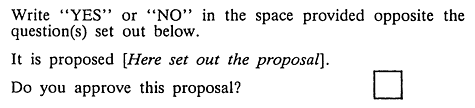
(1) The voting at a referendum is to be by ballot.(2) An elector is to record his or her vote at a referendum –(a) if the elector approves a proposal, by writing the word "Yes" in the space provided on the ballot-paper in respect of the proposal; or(b) if the elector does not approve a proposal, by writing the word "No" in the space provided on the ballot-paper in respect of the proposal.(3) An elector is to write the word "Yes" or the word "No" in respect of each proposal printed on the ballot-paper.
38. Assistance to certain electors
(1) If the officer in charge of a polling-booth is satisfied that an elector who is at the polling-booth to vote at a referendum is unable to do so without assistance because the elector has impaired sight, is physically incapacitated or is illiterate, that officer is to permit a person appointed by the elector to –(a) enter an unoccupied compartment of the booth with the elector; and(b) record a vote on the ballot-paper according to the elector's instructions; and(c) fold the elector's ballot-paper; and(d) deposit the elector's ballot-paper in the appropriate ballot-box provided at the booth.(2) If an elector referred to in subsection (1) fails to appoint a person to assist the elector, the officer in charge of the polling-booth is to –(a) mark a vote on the ballot-paper according to the elector's instructions; and(b) fold the elector's ballot-paper; and(c) deposit the elector's ballot-paper in the appropriate ballot-box provided at the booth.(3) The actions of the officer in charge of the polling-booth under subsection (2) are to be carried out in the presence of a scrutineer, or if no scrutineer is available, in the presence of another electoral officer who is on duty at the booth.(4) The instructions of an elector may be given to a person by the elector handing to that person a printed or written statement, including a "How to vote" card, which indicates, in respect of each proposal printed on the ballot-paper, whether the elector approves that proposal or does not approve it.
(1) If an elector to whom a ballot-paper has been issued at a polling-booth satisfies the officer in charge of the polling-booth that the elector has spoilt that ballot-paper by mistake or accident, and that ballot-paper has not been deposited in a ballot-box provided at the booth, the officer is to –(a) hand to the elector a new ballot-paper; and(b) cancel the spoilt ballot-paper; and(c) retain the spoilt ballot-paper for future reference.(2) The officer in charge of a polling-booth may only carry out the actions specified in subsection (1) (a) , (b) and (c) after that officer has received the spoilt ballot-paper.
(1) A person must not, without lawful authority –(a) remove a ballot-paper from a place where ballot-papers are issued; or(b) enter a compartment of a polling-booth while another person is in the compartment; or(c) remain in a place where ballot-papers are being, or may be, issued for a longer period than is necessary for the purposes of this Act; or(d) obstruct or unnecessarily delay the proceedings at a place where ballot-papers are being, or may be, issued.Penalty: Fine not exceeding 5 penalty units.(2) A person must not –(a) prevent a person from gaining access to a place where ballot-papers are being, or may be, issued; or(b) obstruct the approaches to a place where ballot-papers are being, or may be, issued.Penalty: Fine not exceeding 10 penalty units.(3) A person must not carry out any of the following actions inside or within 100 metres of a place where ballot-papers are being, or may be, issued:(a) canvass for votes;(b) solicit votes;(c) induce or attempt to induce an elector to approve or not approve a proposal submitted to the electors at a referendum.Penalty: Fine not exceeding 10 penalty units.(4) A person must not induce or attempt to induce an elector who is required to vote at a referendum to refrain from voting at the referendum.Penalty: Fine not exceeding 10 penalty units.(5) A person must not, without the permission of the officer in charge of a polling-booth, re-enter the polling-booth at which polling for a referendum is being conducted after having been removed from the booth for misconduct or failure to comply with a lawful direction given by an electoral officer or a police officer who is on duty at the booth.Penalty: Fine not exceeding 5 penalty units or imprisonment for a term not exceeding one month.(6) A person must not –(a) in a place at which ballot-papers are being, or may be, issued or at which polling for a referendum is being conducted, act in a disorderly manner or refuse or fail to comply with a lawful direction given by an electoral officer or a police officer who is on duty at that place; or(b) display or leave in any such place a card or paper which has on it directions or instructions as to how an elector should or might vote at the referendum.Penalty: Fine not exceeding 5 penalty units.
41. Conduct of electoral officers
(1) An electoral officer must not –(a) influence the vote of an elector at a referendum, or attempt to do so; or(b) influence the result of a referendum, other than by recording an elector's vote in accordance with this Act, or attempt to do so; or(c) without the prior consent of the elector, disclose information acquired by the electoral officer in the course of performing his or her functions under this Act concerning the way in which a particular elector voted at a referendum.Penalty: Fine not exceeding 40 penalty units or imprisonment for a term not exceeding 12 months.(2) An electoral officer must not, without lawful excuse –(a) fail or refuse to initial, sign, mark or stamp a ballot-paper as required by this Act; or(b) fail or refuse to correctly mark a certified copy of an electoral roll as required by this Act.Penalty: Fine not exceeding 5 penalty units.
(1) In this section ballot-paper means –(a) a ballot-paper that is or is to be used at a referendum; and(b) a paper purporting to be a ballot-paper, that is or is to be used at a referendum.(2) A person must not, without lawful authority –(a) make or stamp an official mark on a ballot-paper; or(b) make or stamp a mark on a ballot-paper, which mark so closely resembles an official mark as to be likely to cause a person to mistake it for an official mark.Penalty: Fine not exceeding 40 penalty units or imprisonment for a term not exceeding 12 months.(3) A person must not, without lawful authority –(a) make or stamp an official mark on a paper other than a ballot-paper; or(b) make or stamp a mark on a paper other than a ballot-paper, which mark so closely resembles an official mark as to be likely to cause a person to mistake it for an official mark.Penalty: Fine not exceeding 20 penalty units or imprisonment for a term not exceeding 6 months.(4) A person must not, without lawful authority, have possession of a paper bearing an official mark or a mark which so closely resembles an official mark as to be likely to cause a person to mistake it for an official mark.Penalty: Fine not exceeding 20 penalty units or imprisonment for a term not exceeding 6 months.(5) A person must not, without lawful authority, make, use or have possession of –(a) an instrument capable of making or stamping an official mark on a paper; or(b) an instrument capable of making or stamping a mark on a paper, which mark so closely resembles an official mark as to be likely to cause a person to mistake it for an official mark.Penalty: Fine not exceeding 20 penalty units or imprisonment for a term not exceeding 6 months.
43. Maintenance of order at polling-places
(1) The Chief Electoral Officer, a returning officer or a police officer may exercise any power necessary to maintain order and keep the peace at a place at which polling for a referendum is being conducted.(2) The powers referred to in subsection (1) include, but are not limited to, the following powers:(a) to arrest or cause to be arrested, without warrant, a person whom the officer believes on reasonable grounds is committing, has committed or is attempting to commit an offence under this Act;(b) to remove a person referred to in paragraph (a) or cause such a person to be removed from the place at which polling for a referendum is being conducted or the immediate vicinity of such a place;(c) to remove, or cause to be removed, from a place at which polling for a referendum is being conducted or the immediate vicinity of such a place, a person who –(i) having been given a lawful direction by or under the authority of the officer in charge of a polling-booth or a returning officer, fails to comply with that direction; or(ii) is obstructing the access or approaches to the place; or(iii) is obstructing or unnecessarily delaying the proceedings at the place; or(iv) is behaving in a disorderly manner or causing a disturbance.(3) An officer in charge of a polling-booth may exercise any power necessary to maintain order and keep the peace at that polling-booth.(4) The powers referred to in subsection (3) include, but are not limited to, the following powers:(a) to arrest or cause to be arrested, without warrant, a person whom the officer believes on reasonable grounds is committing, has committed or is attempting to commit an offence under this Act, at or in the immediate vicinity of a polling-booth;(b) to remove a person referred to in paragraph (a) or cause such a person to be removed from a polling-booth or its immediate vicinity;(c) to remove, or cause to be removed, from a polling-booth or its immediate vicinity, a person who –(i) having been given a lawful direction by or under the authority of that officer or a returning officer, fails to comply with that direction; or(ii) is obstructing the access or approaches to the polling-booth; or(iii) is obstructing or unnecessarily delaying the proceedings at the polling-booth; or(iv) is behaving in a disorderly manner or causing a disturbance.(5) A person arrested under subsection (1) or (3) must, as soon as is practicable, be taken before a justice to be dealt with for the offence in respect of which the person was arrested.
(1) If the proceedings for taking the poll at a referendum are interrupted or obstructed at a polling-booth by riot, violence or a natural disaster, the officer in charge of the polling-booth must not for that reason finally close the poll but must adjourn the taking of the poll to the following day.(2) If necessary, the officer in charge of the polling-booth may further adjourn the taking of the poll from day to day until the interruption or obstruction has ceased, at which time the officer in charge must again proceed with the taking of the poll at that polling-booth.(3) The officer in charge of a polling-booth is to adjourn polling for a referendum at that booth to a day not later than 21 days after the day fixed for the conduct of the poll if –(a) for any reason other than riot, violence or a natural disaster, polling does not commence at the polling-booth on the day fixed for the conduct of the poll; or(b) polling has commenced but cannot be proceeded with because of the lack of necessary forms, documents or materials.(4) If polling for a referendum is adjourned under subsection (3) the officer in charge of the polling-booth must immediately cause public notice to be given as to the day to which the polling is adjourned.(5) If a poll at a polling-booth is adjourned under subsection (1) or (3) –(a) the officer in charge of the polling-booth is to immediately give notice of the adjournment to the returning officer for the Assembly division in which the polling-booth is situated; and(b) that returning officer must immediately give notice of the adjournment to the Chief Electoral Officer.(6) If polling for a referendum at a polling-booth in an Assembly division is adjourned, only those electors who are enrolled for that Assembly division and who have not already voted at the referendum are entitled to vote at the poll following the adjournment.(7) An adjournment of the polling for a referendum may be for a period not exceeding 21 days.(8) If polling for a referendum is not completed within 21 days after the day fixed in the writ for the conduct of the poll, the Chief Electoral Officer must immediately endorse that fact on the writ and return the writ to the Governor.
Division 4 - Postal voting
45. Application for postal vote certificate and postal ballot-paper
(1) An elector may apply for a postal vote certificate and a postal ballot-paper in respect of a referendum if the elector –(a) will not, throughout the hours of polling for a referendum on polling-day, be within Tasmania; or(b) will not, throughout the hours of polling for the referendum on polling-day, be within 8 kilometres, by the nearest practicable route, of a polling-booth open for the purposes of the referendum; or(c) will, throughout the hours of polling for the referendum on polling-day, be travelling under conditions which will preclude the elector from voting at any such polling-booth; or(d) will be precluded from attending at a polling-booth to vote at the referendum due to the elector's serious illness, infirmity or approaching maternity; or(e) by reason of the elector's membership of a religious order or religious beliefs –(i) is precluded from attending at a polling-booth to vote at the referendum; or(ii) will be precluded from voting throughout the hours of polling for the referendum on polling-day or throughout the greater part of those hours.(2) An application for a postal vote certificate and postal ballot-paper in respect of a referendum is to be –(a) in accordance with the approved form and specify the ground on which the elector is making the application; and(b) signed by the elector in the elector's own handwriting; and(c) made to –(i) the returning officer for the Assembly division in which the elector is enrolled; or(ii) if the elector reasonably believes that the application may not reach that returning officer to enable the elector to receive the postal vote certificate and postal ballot-paper in time to permit the elector to vote at the referendum, the returning officer for another Assembly division; and(d) sent or delivered to the appropriate returning officer not earlier than 9 days before the issue of the writ for the holding of the referendum.(3) An elector who has made an application under subsection (1) is only entitled to a postal ballot-paper and postal vote certificate in respect of a referendum if –(a) in the case of an application sent to a returning officer, the application is received by or on behalf of the returning officer before 6 p.m. –(i) on the second day before polling-day, if the application is sent from within Tasmania; or(ii) on the third day before polling-day, if the application is sent from elsewhere within Australia; or(iii) on the fifth day before polling-day, if the application is sent from outside Australia; or(b) in the case of an application delivered to a returning officer, the application is delivered to the returning officer before 6 p.m. on the day preceding polling-day.(4) A person must not persuade or induce, or associate with any person in persuading or inducing, a person to make an application for a postal vote certificate and postal ballot-paper in respect of a referendum.Penalty: Fine not exceeding 20 penalty units or imprisonment for a term not exceeding 6 months.(5) An elector must not make, and a person must not induce an elector to make, a false statement in an application for a postal vote certificate and postal ballot-paper in respect of a referendum or in any declaration contained in such an application.Penalty: Fine not exceeding 20 penalty units or imprisonment for a term not exceeding 6 months.
46. Issue of certificate and ballot-paper
(1) On receipt of an application made in accordance with section 45 , a returning officer or issuing officer is to deliver or post to the elector who made the application –(a) a postal ballot-paper in the same form as a ballot-paper issued to a person attending a polling-booth on the polling-day for the referendum to which the application relates; and(b) an envelope bearing –(i) the address of the returning officer for the Assembly division in respect of which the elector has declared that he or she is entitled to vote; and(ii) a postal vote certificate that is in accordance with the approved form.(2) A returning officer or issuing officer must initial or sign the back of a postal ballot-paper issued by that officer in such a position as to be readily seen when the ballot-paper is folded to conceal the vote.
47. Returning officer to retain applications
A returning officer who receives an application for a postal vote certificate and postal ballot-paper in respect of a referendum is to –(a) retain the application, if the applicant claims to be entitled to vote in respect of the Assembly division for which that returning officer is appointed; and(b) if the applicant claims to be entitled to vote in respect of another Assembly division –(i) endorse on the application the date on which the postal vote certificate and postal ballot-paper were issued; and(ii) immediately send the application to the returning officer for that other Assembly division.
48. Inspection of applications
A returning officer must make an application for a postal vote certificate and postal ballot-paper in respect of a referendum available for public inspection until the result of the referendum can no longer be disputed.
49. Numbering of applications and certificates
The returning officer for an Assembly division is to –(a) number, in consecutive order, the applications for postal vote certificates and postal ballot-papers in respect of a referendum which are received by that returning officer; and(b) clearly identify the Assembly division in which the applicant claims to be enrolled; and(c) number each postal vote certificate issued pursuant to such an application with numbers corresponding to the numbers endorsed on the application.
50. Cancellation of postal vote certificates and postal ballot-papers
An elector to whom a postal vote certificate and postal ballot-paper in respect of a referendum has been issued is not entitled to vote for the referendum personally at a polling-booth unless that elector has delivered the postal vote certificate and postal ballot-paper to the officer in charge of the polling-booth for cancellation.
51. Elector claims personal vote and appears to have received postal vote certificate
(1) If an elector attends a polling-booth on polling-day and claims to be entitled to vote personally at the referendum, that person may, subject to subsection (2) , be entitled to vote personally at that booth even though a postal vote certificate and postal ballot-paper in respect of the referendum appear to have been sent to the elector and the elector has not returned the certificate and ballot-paper in accordance with section 50 .(2) A person referred to in subsection (1) is only entitled to vote personally at the polling-booth if the person –(a) states that he or she has not received the postal vote certificate and postal ballot-paper in respect of the referendum; and(b) makes a declaration in the approved form before the officer in charge of the polling-booth.(3) The vote of a person referred to in subsection (1) is to be taken in accordance with Division 3 .(4) The officer in charge of a polling-booth must, immediately after the close of polling –(a) inform the returning officer for the Assembly division concerned that an elector to whom subsection (1) applies has voted personally at the polling-booth in that officer's charge; and(b) forward the elector's declaration to the returning officer together with the ballot-paper issued to the elector at the polling-booth.(5) If a postal ballot-paper appears to have been received from an elector to whom this section applies –(a) that postal ballot-paper is to be rejected at the counting of votes at the conclusion of the poll; and(b) the returning officer is to record in writing the reason for that rejection.
If a returning officer or issuing officer is satisfied that a person who has applied for a postal ballot-paper in respect of a referendum is entitled to such a ballot-paper, that person's application is not rendered ineffective by reason only of an omission, an incorrect or insufficient description or a misdescription in respect of any particular required to be included in the application.
53. Directions for postal voting
(1) Subject to subsection (2) , the following directions for regulating voting at a referendum by means of postal ballot-papers are to be observed as far as it is reasonably practicable to do so:(a) the elector is to show a postal ballot-paper, in blank, and the elector's postal vote certificate to an authorized witness;(b) the elector is, in the presence of the authorized witness, to sign his or her name in the elector's own handwriting on the postal vote certificate in the place provided for the signature of the elector;(c) the authorized witness is to sign his or her name in the witness' own handwriting on the postal vote certificate in the place provided for the signature of the authorized witness and is to add the title under which that person acts as an authorized witness and the date of signing;(d) the elector is to, then and there in the presence of the authorized witness –(i) record the elector's vote in respect of the referendum on the ballot-paper in accordance with the directions contained on it, in the view of the authorized witness but so that the authorized witness is unable to see what marks the elector makes on the ballot-paper; and(ii) fold the ballot-paper so that the marks made by the elector cannot be seen; and(iii) place the ballot-paper in the envelope addressed to the returning officer and fasten the envelope;(e) after the envelope has been fastened, the elector is to immediately post or deliver it, or cause it to be posted or delivered, to the returning officer for the Assembly division concerned;(f) if the elector is unable to vote without assistance because the elector has impaired sight, is physically incapacitated or is illiterate, a person appointed by the elector is, in the presence of the authorized witness, to –(i) record a vote on the postal ballot-paper according to the elector's instructions; and(ii) fold the elector's ballot-paper so that the vote cannot be seen; and(iii) place the ballot-paper in the envelope addressed to the returning officer and fasten the envelope; and(iv) hand the envelope to the elector who is to immediately post or deliver it, or cause it to be posted or delivered, to the returning officer concerned;(g) if no person is appointed by the elector in accordance with paragraph (f) , the authorized witness, if so requested by the elector, is to take the action required by that paragraph to be taken by a person appointed by the elector, and, in taking that action is to mark the ballot-paper according to the instructions of the elector.(2) The instructions of an elector may be given to the appointed person or the authorized witness by the elector handing to that person a printed or written statement, including a "How to vote" card, indicating in respect of each proposal printed on the postal ballot-paper whether the elector approves that proposal or does not approve it.(3) An authorized witness must not –(a) look at or acquire information concerning the elector's vote at a referendum other than under subsection (1) (f) or (g) ; or(b) permit any person to acquire information concerning the elector's vote at a referendum, to assist the elector to vote or to interfere in any way with the elector recording his or her vote.(4) Action required by subsection (1) (d) and (f) is to be carried out before the close of polling for a referendum.(5) An elector who is voting at a referendum by means of a postal ballot-paper may –(a) post that ballot-paper to the returning officer for the Assembly division in respect of which the elector is entitled to vote; or(b) deliver that ballot-paper to any returning officer before the close of polling for the referendum; or(c) deliver that ballot-paper to the officer in charge of any polling-booth at which a poll is being conducted before the close of polling for the referendum.(6) A postal ballot-paper is to be rejected at the counting of votes for a poll if –(a) that ballot-paper, if posted, does not reach the returning officer for the Assembly division in respect of which the elector concerned is entitled to vote before the expiration of 10 days after the day on which the poll is conducted; or(b) that ballot-paper, if delivered, is not delivered to a returning officer or an officer in charge of a polling-booth at which a poll is being conducted before the close of polling for the referendum; or(c) subsection (4) has been contravened.(7) The returning officer is to record in writing the reason for the rejection of a postal ballot-paper.
54. Duties of authorized witnesses
(1) An authorized witness must –(a) ensure that the directions set out in section 53 are complied with by an elector voting at a referendum by post before the authorized witness and by each person present when the elector records his or her vote; and(b) refrain from disclosing any information concerning the vote recorded by an elector voting at a referendum by post before the authorized witness, unless that elector has given consent for the authorized witness to do so.(2) An authorized witness must not, in any way, influence or attempt to influence the vote of an elector voting at a referendum by post before that authorized witness.(3) An authorized witness must not persuade or induce an elector voting at a referendum by post to hand the envelope containing the elector's postal ballot-paper to the authorized witness for posting or delivery.(4) Subsection (3) does not preclude an authorized witness from posting or delivering any such envelope at the request of the elector.Penalty: Fine not exceeding 10 penalty units or imprisonment for a term not exceeding 3 months or a fine not exceeding 10 penalty units and imprisonment for a term not exceeding 3 months.
(1) A person must not record, or attempt or purport to record, a vote on a postal ballot-paper issued to an elector for a referendum unless that person is –(a) that elector; or(b) a person appointed by that elector or the authorized witness acting in accordance with section 53 (1) (f) or (g) .Penalty: Fine not exceeding 10 penalty units or imprisonment for a term not exceeding 3 months.(2) A person must not open the envelope in which a postal ballot-paper issued to an elector for a referendum has been placed in accordance with section 53 , unless that person is –(a) the returning officer for the Assembly division in respect of which the elector is or claims to be entitled to vote; or(b) an electoral officer acting under the directions of that returning officer.Penalty: Fine not exceeding 5 penalty units.(3) If a person is entrusted with an application for a postal vote certificate and postal ballot-paper in respect of a referendum, or an envelope which contains or purports to contain a postal ballot-paper for a referendum, for the purpose of posting or delivery to a returning officer or delivery to the officer in charge of a polling-booth, that person must do so without delay.Penalty: Fine not exceeding 5 penalty units.
56. Persons present at postal voting
(1) A person present when an elector is before an authorized witness for the purpose of voting at a referendum by post must –(a) comply with a reasonable direction given by the authorized witness; and(b) unless the person is a person appointed under section 53 to assist the elector or is the authorized witness, refrain from –(i) communicating with the elector in relation to the elector's vote; and(ii) assisting the elector or in any way interfering with the elector in relation to the elector's vote; and(iii) looking at the elector's vote or doing anything so that the person may acquire information concerning the elector's vote.Penalty: Fine not exceeding 5 penalty units.(2) A person appointed by an elector under section 53 (1) (f) or the authorized witness acting in accordance with section 53 (1) (g) must record the elector's vote according to the elector's instructions.Penalty: Fine not exceeding 5 penalty units.
57. Preliminary scrutiny of postal ballot-papers
(1) At the preliminary scrutiny of postal declaration envelopes and applications for postal vote certificates in respect of a referendum, a returning officer must produce, unopened, the envelopes purporting to contain postal ballot-papers received up to the close of the poll, together with the applications for postal vote certificates.(2) The returning officer must compare the signature of the elector on a postal vote certificate with the signature of the same elector on the application for the certificate and allow the scrutineers to examine both signatures.(3) If the returning officer is satisfied of the following matters, the returning officer must remove the ballot-paper from the postal declaration envelope and place the ballot-paper, without unfolding it or allowing it to be unfolded, in a ballot-box for further counting:(a) that the signature on the postal vote certificate is that of the elector who signed the application for the certificate;(b) that the signature purports to have been witnessed by an authorized witness;(c) that the elector is entitled to vote at the referendum in respect of the Assembly division for which the returning officer is appointed.(4) If the returning officer is not satisfied of the matters specified in subsection (3) , the returning officer must disallow the ballot-paper without opening the envelope.(5) After each of the postal declaration envelopes, ballot-papers and applications has been dealt with, the returning officer must –(a) prepare separate parcels containing –(i) those envelopes from which ballot-papers have been removed for further counting; and(ii) those envelopes containing disallowed ballot-papers; and(b) place those parcels, physically separated from each other, in one or more boxes; and(c) seal each box; and(d) proceed with the further counting by –(i) removing the ballot-papers from the ballot-box in which they were placed; and(ii) opening the ballot-papers so removed and allowing and counting those which are formal and disallowing and rejecting those which are informal.
58. Spoilt postal ballot-papers
(1) The returning officer or issuing officer who issued a postal ballot-paper for a referendum to an elector under this Division must provide a new ballot-paper to that elector if –(a) the returning officer or issuing officer is satisfied that –(i) the elector spoilt the issued ballot-paper by mistake or accident; and(ii) the ballot-paper has not been placed in an envelope in accordance with section 53 ; and(b) the returning officer or issuing officer has received the spoilt ballot-paper.(2) If the returning officer issues a new postal ballot-paper to an elector under subsection (1) , the returning officer is to cancel the spoilt postal ballot-paper and retain it for future reference.
Division 5 - Pre-poll voting
59. Permission to vote before polling-day
The returning officer or issuing officer for the Assembly division in respect of which an elector is entitled to vote at a referendum is to permit the elector to vote at any time during the period commencing at noon on a day not earlier than 7 days after the day on which the writ for holding the referendum was issued and ending at 6 p.m. on the day preceding polling-day if –(a) the elector requests to do so; and(b) the returning officer or issuing officer is satisfied that –(i) the elector will not, throughout the hours of polling for the referendum on polling-day, be within Tasmania; or(ii) the elector will not, throughout the hours of polling for the referendum on polling-day, be within 8 kilometres, by the nearest practicable route, of a polling-booth open for the purposes of the referendum; or(iii) the elector will, throughout the hours of polling for the referendum on polling-day, be travelling under conditions which will preclude the elector from voting at any such polling-booth; or(iv) by reason of the elector's membership of a religious order or religious beliefs, the elector is precluded from attending at a polling-booth to vote at the referendum or precluded from voting throughout the hours of polling for the referendum on polling-day or throughout the greater part of those hours.
60. Procedure for pre-poll voting
(1) A returning officer or issuing officer who receives a request under section 59 may, and, if requested to do so by a scrutineer, must, put to the elector who made the request any of the questions referred to in section 29 which are applicable.(2) An elector who requests to vote at a referendum before polling-day is to be permitted to do so if the elector –(a) answers any questions put to the elector under subsection (1) satisfactorily; and(b) makes a declaration in the approved form.(3) The declaration is to be –(a) printed or written on an envelope; and(b) completed, and signed by the elector in his or her own handwriting, which signature is to be witnessed by the returning officer or issuing officer in whose presence it was made.(4) The returning officer or issuing officer is to hand to an elector who is permitted to vote at a referendum before polling-day a ballot-paper in the same form as a ballot-paper issued to a person attending a polling-booth on polling-day for the referendum.(5) Before handing a ballot-paper to an elector in accordance with subsection (4) , a returning officer or issuing officer must initial or sign the back of the ballot-paper in such a position as to be readily seen when the ballot-paper is folded to conceal the vote.(6) The elector is to –(a) record his or her vote on the ballot-paper in respect of the referendum in accordance with the directions contained on it, in the view of the returning officer or issuing officer but so that the returning officer or issuing officer is unable to see the marks the elector makes on the ballot-paper; and(b) fold the ballot-paper so that the marks made by the elector cannot be seen; and(c) immediately return the folded ballot-paper to the returning officer or issuing officer.
61. Assistance to certain electors
(1) If the returning officer or issuing officer who permits an elector to vote at a referendum before polling-day is satisfied that the elector is unable to vote without assistance because the elector has impaired sight, is physically incapacitated or is illiterate, the returning officer or issuing officer is to permit a person appointed by the elector to –(a) record a vote on the ballot-paper according to the elector's instructions; and(b) fold the elector's ballot-paper so that the vote cannot be seen; and(c) return the elector's ballot-paper to the returning officer or issuing officer.(2) If an elector referred to in subsection (1) fails to appoint a person to assist the elector, the returning officer or issuing officer is to –(a) record a vote on the ballot-paper according to the elector's instructions; and(b) fold the elector's ballot-paper so that the vote cannot be seen.(3) The actions of the returning officer or issuing officer under subsection (2) are to be carried out in the presence of a scrutineer, or if no scrutineer is available, in the presence of a polling official.(4) The instructions of an elector may be given to a person by the elector handing to that person a printed or written statement, including a "How to vote" card, which indicates, in respect of each proposal printed on the ballot-paper, whether the elector approves that proposal or does not approve it.
62. Ballot-papers to be placed in envelopes
If a ballot-paper in respect of a referendum is returned to a returning officer or an issuing officer under section 60 (6) (c) or 61 (1) (c) , or a returning officer or an issuing officer records a vote on a ballot-paper under section 61 (2) , that officer is –(a) in the elector's presence, to place the ballot-paper in the envelope bearing the elector's declaration referred to in section 60 (3) and fasten the envelope; and(b) to retain the envelope and the ballot-paper until the close of the poll.
A person must not record, or attempt or purport to record, a vote on a ballot-paper handed to an elector so that the elector may vote under this Division unless that person is –(a) that elector; or(b) a person appointed by that elector in accordance with section 61 (1) or a returning officer or an issuing officer acting in accordance with section 61 (2) .Penalty: Fine not exceeding 20 penalty units or imprisonment for a term not exceeding 6 months.
64. Persons present at pre-poll voting
(1) A person present when an elector is attending the office of a returning officer or at a place where ballot-papers are issued for the purpose of voting under this Division must –(a) comply with a direction given by the returning officer in the performance or exercise of his or her functions or powers; and(b) unless the person is a person appointed under section 61 (1) or the returning officer or issuing officer, refrain from –(i) communicating with the elector in relation to the elector's vote; and(ii) assisting the elector or in any way interfering with the elector in relation to the elector's vote; and(iii) looking at the elector's vote or doing anything so that the person may acquire information concerning the elector's vote.Penalty: Fine not exceeding 5 penalty units.(2) A person appointed by an elector under section 61 (1) or a returning officer or issuing officer acting in accordance with section 61 (2) must record the elector's vote according to the elector's instructions.Penalty: Fine not exceeding 5 penalty units.
65. Preliminary scrutiny of pre-poll votes
(1) At the preliminary scrutiny of pre-poll declaration envelopes the returning officer must produce, unopened, the pre-poll declaration envelopes purporting to contain ballot-papers marked by electors who have voted before polling-day.(2) If the returning officer is satisfied that a ballot-paper has been issued in accordance with this Division, the returning officer must remove the ballot-paper from the pre-poll declaration envelope, and, without unfolding the ballot-paper or allowing any other person to do so, must place the ballot-paper in a securely fastened ballot-box for further counting.(3) If the returning officer is not satisfied that a ballot-paper has been issued in accordance with the provisions of this Division, the returning officer must disallow the ballot-paper without opening the envelope.(4) After each of the pre-poll declaration envelopes and ballot-papers has been dealt with, the returning officer must –(a) prepare separate parcels containing –(i) those envelopes from which ballot-papers have been removed for further counting; and(ii) those envelopes containing disallowed ballot-papers; and(b) place those parcels, physically separated from each other, in one or more boxes; and(c) seal each box; and(d) proceed with the further counting by –(i) removing the ballot-papers from the ballot-box in which they were placed; and(ii) opening the ballot-papers so removed and allowing and counting those which are formal and disallowing and rejecting those which are informal.
(1) The returning officer or issuing officer who issued a ballot-paper to an elector so that the elector may vote at a referendum before polling-day must hand a new ballot-paper to that elector if –(a) the returning officer or issuing officer is satisfied that –(i) the elector spoilt the issued ballot-paper by mistake or accident; and(ii) the ballot-paper has not been placed in an envelope in accordance with section 62 ; and(b) the returning officer or issuing officer has received the spoilt ballot-paper.(2) If the returning officer or issuing officer issues a new ballot-paper to an elector under subsection (1) , that officer is to cancel the spoilt ballot-paper and retain it for future reference.
Division 6 - Pre-poll voting at declared institutions
67. Taking poll at declared institutions
(1) The returning officer for an Assembly division in which a declared institution is situated or an electoral officer appointed, by instrument in writing, by that returning officer may take the poll for a referendum at the institution.(2) The returning officer is to appoint at least 2 polling officials, by instrument in writing, to assist in taking the poll at an institution.(3) The returning officer or other electoral officer concerned may, at any time during the period commencing at noon on a day not earlier than 7 days after the day on which the writ for holding the referendum was issued and ending at the close of polling for the referendum, enter into and remain in a declared institution for the purpose of taking the poll at the institution.(4) If the returning officer or other electoral officer concerned visits a declared institution that officer is to be accompanied by at least one other polling official.
68. Entitlement to vote at declared institutions
(1) An elector is entitled to vote at a referendum while the returning officer or other electoral officer appointed by the returning officer under section 67 is at a declared institution for the purpose of taking the poll for the referendum at the institution if that elector –(a) is, for the time being, an inpatient or inmate of the institution; and(b) has requested, by message to the returning officer for the Assembly division in which the institution is situated or the other electoral officer appointed to take the poll for the referendum, an opportunity to vote at the institution.(2) An elector referred to in subsection (1) to whom a postal vote certificate and postal ballot-paper in respect of a referendum has been issued under Division 4 is not entitled to vote for the referendum at the institution unless the elector has delivered that postal vote certificate and postal ballot-paper to the returning officer or other electoral officer who takes the poll for the referendum at the institution.
69. Duty to deliver request to vote
A person to whom a message referred to in section 68 (1) (b) has been given for delivery to a returning officer or another electoral officer appointed by the returning officer under section 67 must deliver that message to the appropriate officer before, or immediately after, the officer enters the declared institution for the purpose of taking the poll for the referendum unless the person is ordered by a medical practitioner, on medical grounds, not to do so.Penalty: Fine not exceeding 2 penalty units.
70. Procedure for voting at declared institutions
(1) The returning officer or other electoral officer appointed by the returning officer under section 67 who takes the poll for a referendum at a declared institution is to visit each elector entitled to vote for the referendum at that institution to afford each of those electors an opportunity to vote.(2) The returning officer or other electoral officer appointed by a returning officer under section 67 who visits an elector in accordance with subsection (1) is to be accompanied by at least one other polling official who is to remain present for the duration of that visit.(3) A visit referred to in subsection (1) must not be made to an elector if the returning officer or other electoral officer is informed by a medical practitioner or a staff member of the institution that the visit has been forbidden by a medical practitioner on medical grounds.(4) The returning officer or other electoral officer may, and, if requested to do so by a scrutineer, must, put to an elector entitled to vote at a declared institution any of the questions referred to in section 29 which are applicable.(5) An elector who requests to vote at a referendum at a declared institution and is entitled to do so is to be permitted to vote at the referendum at that declared institution if the elector –(a) answers any questions put to the elector under subsection (4) to the satisfaction of the returning officer or other electoral officer concerned; and(b) makes a declaration in the approved form.(6) The declaration is to be –(a) printed or written on an envelope; and(b) completed, and signed by the elector in his or her own handwriting, which signature is to be witnessed by the returning officer or other electoral officer in whose presence it was made.(7) The returning officer or other electoral officer is to hand to an elector who is permitted to vote at a referendum at a declared institution a ballot-paper in the same form as a ballot-paper issued to a person attending a polling-booth on polling-day for the referendum.(8) Before handing a ballot-paper to an elector in accordance with subsection (7) , the returning officer or other electoral officer must initial or sign the back of the ballot-paper in such a position as to be readily seen when the ballot-paper is folded to conceal the vote.(9) The elector is to –(a) record his or her vote on the ballot-paper in respect of the referendum in accordance with the directions contained on it, in the view of the returning officer or other electoral officer but so that that officer is unable to see the marks the elector makes on the ballot-paper; and(b) fold the ballot-paper so that the marks made by the elector cannot be seen; and(c) immediately return the folded ballot-paper to the returning officer or other electoral officer.
71. Assistance to certain electors
(1) If the returning officer or other electoral officer appointed by the returning officer under section 67 is satisfied that an elector who is permitted to vote at a referendum at a declared institution is unable to vote without assistance because the elector has impaired sight, is physically incapacitated or is illiterate, the returning officer or other electoral officer is to permit a person appointed by the elector to –(a) record a vote on the ballot-paper according to the elector's instructions; and(b) fold the elector's ballot-paper so that the vote cannot be seen; and(c) return the elector's ballot-paper to the returning officer or other electoral officer.(2) If an elector referred to in subsection (1) fails to appoint a person to assist the elector, the returning officer or other electoral officer is to –(a) record a vote on the elector's ballot-paper according to the elector's instructions; and(b) fold the elector's ballot-paper so that the vote cannot be seen.(3) The actions of the returning officer or other electoral officer under subsection (2) are to be carried out in the presence of a scrutineer, or if no scrutineer is available, in the presence of another polling official.(4) The instructions of an elector may be given to a person by the elector handing to that person a printed or written statement, including a "How to vote" card, which indicates, in respect of each proposal printed on the ballot-paper, whether the elector approves that proposal or does not approve it.
72. Ballot-papers to be placed in envelopes
If a ballot-paper in respect of a referendum is returned to a returning officer or another electoral officer under section 70 (8) (c) or 71 (1) (c) or that officer records a vote on a ballot-paper under section 71 (2) , the returning officer or other electoral officer concerned is –(a) in the elector's presence, to place the ballot-paper in the envelope bearing the elector's declaration referred to in section 70 (5) and securely fasten the envelope; and(b) in the case of –(i) the returning officer, to retain the envelope and the ballot-paper until the close of the poll; or(ii) another electoral officer, as soon as practicable, to forward the ballot-paper to the returning officer who appointed that electoral officer to take the poll at that declared institution.
(1) A person must not hinder or obstruct an electoral officer or scrutineer in performing a function or exercising a power in relation to voting at a referendum at a declared institution.Penalty: Fine not exceeding 5 penalty units.(2) A person must not record, or attempt or purport to record, a vote on a ballot-paper handed to an elector so that the elector may vote under this Division at a referendum unless that person is –(a) that elector; or(b) a person appointed by that elector in accordance with section 71 (1) or a returning officer or other electoral officer acting in accordance with section 71 (2) .Penalty: Fine not exceeding 20 penalty units or imprisonment for a term not exceeding 6 months.
74. Persons present at voting at declared institution
(1) A person present when an elector is visited by a returning officer or another electoral officer appointed by the returning officer under section 67 for the purpose of voting under this Division must –(a) comply with a direction given by the returning officer or other electoral officer in the performance or exercise of his or her functions or powers; and(b) unless the person is a person appointed under section 71 (1) or the returning officer or other electoral officer refrain from –(i) communicating with the elector in relation to the elector's vote; and(ii) assisting the elector or in any way interfering with the elector in relation to the elector's vote; and(iii) looking at the elector's vote or doing anything so that the person may acquire information concerning the elector's vote.Penalty: Fine not exceeding 5 penalty units.(2) A person appointed by an elector under section 71 (1) or the returning officer or other electoral officer acting in accordance with section 71 (2) must record the elector's vote according to the elector's instructions.Penalty: Fine not exceeding 5 penalty units.
75. Preliminary scrutiny of votes under this Division
(1) At the preliminary scrutiny of pre-poll declaration envelopes under this Division the returning officer must produce, unopened, the pre-poll declaration envelopes purporting to contain ballot-papers marked by electors who have voted under this Division.(2) If the returning officer is satisfied that an elector referred to in subsection (1) is enrolled for the Assembly division for which the returning officer is appointed, the returning officer must remove the elector's ballot-paper from the pre-poll declaration envelope and, without unfolding the ballot-paper or allowing any other person to do so, place it in a securely fastened ballot-box for further counting.(3) If the returning officer is not satisfied that an elector is entitled to vote in respect of the Assembly division for which the returning officer is appointed, the returning officer must disallow the ballot-paper without opening the envelope.(4) After each of the pre-poll declaration envelopes and ballot-papers has been dealt with, the returning officer must –(a) prepare separate parcels containing –(i) those envelopes from which ballot-papers have been removed for further counting; and(ii) those envelopes containing disallowed ballot-papers; and(b) place those parcels, physically separated from each other, in one or more boxes; and(c) seal each box; and(d) proceed with the further counting by –(i) removing the ballot-papers from the ballot-box in which they were placed; and(ii) opening the ballot-papers so removed and allowing and counting those which are formal and disallowing and rejecting those which are informal.
(1) The returning officer or other electoral officer appointed by the returning officer under section 67 who issued a ballot-paper to an elector so that the elector may vote under this Division at a referendum must hand a new ballot-paper to that elector if –(a) the returning officer or other electoral officer is satisfied that –(i) the elector spoilt the issued ballot-paper by mistake or accident; and(ii) the ballot-paper has not been placed in an envelope in accordance with section 72 ; and(b) the returning officer or other electoral officer has received the spoilt ballot-paper.(2) If the returning officer or other electoral officer issues a new ballot-paper to an elector under subsection (1) , that officer is to cancel the spoilt ballot-paper and retain it for future reference.
(1) A power or function exercised or performed by a returning officer or another electoral officer under any of the following provisions may be performed or exercised by a polling official appointed to assist that officer:(a) section 68 ;(b) section 69 ;(c) section 70 ;(d) section 71 (1) ;(e) section 72 ;(f) section 73 ;(g) section 74 ;(h) section 76 .(2) A power exercised or a function performed by a polling official as specified in subsection (1) is to be treated as if it were exercised or performed by a returning officer or other electoral officer appointed by the returning officer under section 67 .
Division 7 - Absent electors
78. Electors permitted to vote outside division
(1) An elector who, on polling-day for a referendum, is absent from the Assembly division at which he or she is entitled to vote, may attend a polling-booth in another Assembly division for the purpose of voting at that referendum.(2) Before voting under subsection (1) , an elector must state his or her name and, unless the elector's address is not shown on the relevant electoral roll under section 34 of the Electoral Act 1985 , his or her address in the Assembly division at which the elector claims to be entitled to vote.(3) The officer in charge of the polling-booth may, and if requested to do so by a scrutineer must, put to an elector seeking to vote at a referendum outside the Assembly division for which he or she is enrolled any of the questions referred to in section 29 which are applicable.(4) An elector is to be permitted to vote as an absent elector if the elector –(a) answers any questions put to the elector under subsection (3) to the satisfaction of the officer in charge of the polling-booth; and(b) makes a declaration in the approved form.(5) The declaration is to be –(a) printed or written on an envelope addressed to the returning officer for the Assembly division for which the elector is enrolled; and(b) completed, and signed by the elector in his or her own handwriting, which signature is to be witnessed by the officer in charge of the polling-booth in whose presence it was made.(6) The officer in charge of the polling-booth or another polling official is to hand to an elector permitted to vote at that polling-booth as an absent elector, a ballot-paper in respect of the referendum.(7) Before handing a ballot-paper to an elector in accordance with subsection (6) , the officer in charge of the polling-booth or the other polling official must initial or sign the back of the ballot-paper in such a position as to be readily seen when the elector has folded the ballot-paper.(8) If the officer in charge of a polling-booth is unable to provide an elector who is voting at that polling-booth as an absent elector with a printed or partly printed ballot-paper for the referendum, that officer is to supply to the elector a paper which must be initialled or signed by the officer in charge on the back and on which is written the form of words contained in the printed ballot-paper.(9) A paper referred to in subsection (8) is to be taken to be a ballot-paper in respect of a referendum for the purposes of this Act.(10) The elector is to –(a) record his or her vote on the ballot-paper in respect of the referendum in accordance with the directions contained on it, in the view of the officer in charge of the polling-booth concerned but so that that officer is unable to see the marks the elector makes on the ballot-paper; and(b) fold the ballot-paper so that the marks made by the elector cannot be seen; and(c) immediately return the folded ballot-paper to the officer in charge of the polling-booth or another electoral officer.
79. Assistance to certain absent electors
(1) If the officer in charge of a polling-booth or a polling official is satisfied that an elector who is permitted to vote at that polling-booth for a referendum as an absent elector is unable to vote without assistance because the elector has impaired sight, is physically incapacitated or is illiterate, the officer or polling official is to permit a person appointed by the elector to –(a) record a vote on the ballot-paper according to the elector's instructions; and(b) fold the elector's ballot-paper so that the vote cannot be seen; and(c) return the elector's ballot-paper to the officer in charge of the polling-booth.(2) If an elector referred to in subsection (1) fails to appoint a person to assist the elector, the officer in charge of the polling-booth or the polling official is to –(a) record a vote on the ballot-paper according to the elector's instructions; and(b) fold the elector's ballot-paper so that the vote cannot be seen.(3) The actions of the officer in charge of the polling-booth or the polling official under subsection (2) are to be carried out in the presence of a scrutineer, or if no scrutineer is available, in the presence of another polling official.(4) The instructions of an elector may be given to a person by the elector handing to that person a printed or written statement, including a "How to vote" card which indicates, in respect of each proposal printed on the ballot-paper, whether the elector approves that proposal or does not approve it.
80. Ballot-papers to be placed in envelopes
If a ballot-paper in respect of a referendum is returned to the officer in charge of a polling-booth or another polling official under section 78 (10) (c) or section 79 (1) (c) or if the officer in charge of the polling-booth or polling official records a vote on a ballot-paper under section 79 (2) , the officer or polling official concerned is, in the presence of the elector, to place the ballot-paper in the envelope bearing the elector's declaration referred to in section 78 (4) and securely fasten the envelope.
A person must not record, or attempt or purport to record, a vote on a ballot-paper handed to an elector so that the elector may vote at a referendum as an absent elector unless that person is –(a) that elector; or(b) a person appointed by that elector in accordance with section 79 (1) or an officer in charge of a polling-booth or a polling official acting in accordance with section 79 .Penalty: Fine not exceeding 20 penalty units or imprisonment for a term not exceeding 6 months.
82. Preliminary scrutiny of absent votes
(1) At the preliminary scrutiny of absent voter declaration envelopes the returning officer must produce, unopened, the absent voter declaration envelopes purporting to contain ballot-papers marked by electors who have voted as absent electors.(2) If the returning officer is satisfied that an elector referred to in subsection (1) is enrolled for the Assembly division for which the returning officer is appointed, the returning officer must remove the elector's ballot-paper from the absent voter declaration envelope and, without unfolding the ballot-paper or allowing any other person to do so, place it in a securely fastened ballot-box for further counting.(3) If the returning officer is not satisfied that the elector is enrolled for the Assembly division for which the returning officer is appointed, the returning officer must disallow the ballot-paper without opening the envelope.(4) After each of the absent voter declaration envelopes and ballot-papers has been dealt with, the returning officer must –(a) prepare separate parcels containing –(i) those envelopes from which ballot-papers have been removed for further counting; and(ii) those envelopes containing disallowed ballot-papers; and(b) place those parcels, physically separated from each other, in one or more boxes; and(c) seal each box; and(d) proceed with the further counting by –(i) removing the ballot-papers from the ballot-box in which they were placed; and(ii) opening the ballot-papers so removed and allowing and counting those which are formal and disallowing and rejecting those which are informal.
(1) The officer in charge of a polling-booth or other electoral officer who issued a ballot-paper to an elector under this Division must hand a new ballot-paper to that elector if –(a) the officer is satisfied that –(i) the elector spoilt the issued ballot-paper by mistake or accident; and(ii) the ballot-paper has not been placed in an envelope in accordance with section 80 ; and(b) the officer has received the spoilt ballot-paper.(2) If the officer in charge of a polling-booth or another electoral officer issues a new ballot-paper to an elector under subsection (1) , that officer is to cancel the spoilt ballot-paper and retain it for future reference.
Division 8 - Compulsory voting
In this Division –permitted period means a period commencing on the date on which a notice is sent to an elector under section 86 and ending on the date specified in that notice as the final date on which the form required under that section may be lodged;record of apparent non-voters means a record of the apparent non-voters prepared in accordance with section 85 (a) .
85. Records of apparent non-voters
At the close of polling for a referendum –(a) a record of apparent non-voters is to be prepared, in an approved form, for each Assembly division; and(b) the returning officer for each Assembly division is to certify the record of apparent non-voters by statutory declaration.
(1) Subject to subsection (4) , the returning officer for an Assembly division must send a notice to each elector who, by reference to the record of apparent non-voters for that Assembly division, appears to have failed to vote at a referendum, which notice advises the elector that he or she –(a) appears to have failed to vote at the referendum; and(b) is required to –(i) state the true reason for that failure on the form provided; and(ii) lodge that completed form, signed by the elector and witnessed as prescribed, with the returning officer on or before a specified date.(2) A notice referred to in subsection (1) is to be in an approved form and contain the following information:(a) the full name of the elector as it appears on the electoral roll or the elector's surname and initials;(b) the elector's address as shown on the electoral roll;(c) the name of the Assembly division for which the elector is enrolled;(d) the elector's number on the electoral roll;(e) the date, being a date at least 21 days after the date on which the notice is posted, before or on which the elector is to lodge the form.(3) A notice referred to in subsection (1) is to be sent to the elector, by post –(a) within 3 months after the close of polling for the referendum; and(b) to the elector's address specified in the electoral roll or, if the elector's address is not so specified, to the address specified in the request made by the elector under section 34 of the Electoral Act 1985 .(4) Subsection (1) does not apply if –(a) the name of an elector appears on more than one electoral roll or more than once on an electoral roll and the returning officer is satisfied that the elector has voted in respect of one such enrolment; or(b) the returning officer is satisfied that the elector –(i) is dead; or(ii) was absent from Tasmania on polling-day; or(iii) was ineligible to vote at the election; or(iv) has a valid and sufficient reason for failing to vote at the referendum.
(1) If an elector to whom a notice is sent under section 86 is unable to complete, sign and lodge the form referred to in that section because the elector is absent from his or her residence or is physically incapacitated, another elector who has personal knowledge of the facts may, subject to the regulations, complete, sign and lodge the form, duly witnessed as prescribed, within the permitted period.(2) A form completed, signed and lodged by another elector under subsection (1) is to be treated as if it were completed, signed and lodged by the elector to whom the notice was sent under section 86 .
(1) If a returning officer receives a properly completed and signed form, witnessed as prescribed, within the permitted period, the returning officer is to –(a) make a note to that effect on the record of apparent non-voters opposite the name of the elector; and(b) endorse in writing beside that note his or her opinion as to whether the reason given by the elector in the form is a valid and sufficient reason for the elector to have failed to vote in the referendum.(2) If the returning officer does not receive a form referred to in subsection (1) within the permitted period, the returning officer is to make a note to that effect on the record of apparent non-voters opposite the name of the elector.
89. Record of apparent non-voters as evidence
A record of apparent non-voters which is notated and endorsed in accordance with section 88 , or a copy of such a record certified by the returning officer is evidence in any proceedings –(a) of the contents of that record of apparent non-voters; and(b) of the fact that the electors whose names on the record of apparent non-voters are indicated by a distinguishing mark did not vote at the referendum; and(c) that those electors were each sent a notice under section 86 ; and(d) that those electors did or did not comply with the requirements set out in that notice.
(1) An elector must not fail to vote at a referendum.Penalty: Fine not exceeding 0·5 penalty units.(2) Subsection (1) does not apply to an elector who has a valid and sufficient reason for failing to vote at the referendum, which reason may include an honest belief on the part of the elector that abstention from voting is part of the elector's religious duty.(3) An elector who receives a notice under section 86 must not fail to comply with the requirements set out in that notice.Penalty: Fine not exceeding 0·5 penalty units.(4) A person must not state a false reason on a form referred to in section 86 (1) (b) for the failure of that person or another person to vote at a referendum.Penalty: Fine not exceeding 0·5 penalty units.(5) Proceedings for an offence specified in this section may only be instituted by –(a) the Chief Electoral Officer; or(b) an electoral officer authorized to do so, either generally or in a particular case, by the Chief Electoral Officer.
Division 9 - Proceedings after close of poll for referendum
(1) As soon as practicable after the close of polling for a referendum, the officer in charge of a polling-booth is, in the presence of another electoral officer and any scrutineer who wishes to be present, to open the ballot-box and conduct a count of the ballot-papers.(2) For the purposes of subsection (1) , the ballot-papers are to be counted to determine in respect of each proposal submitted to the electors at the referendum –(a) the number of ballot-papers marked by electors approving the proposal; and(b) the number of ballot-papers marked by electors not approving the proposal; and(c) the number of informal ballot-papers.
(1) A ballot-paper is informal in respect of a proposal submitted to the electors at a referendum if –(a) the ballot-paper –(i) is not initialled or stamped in accordance with this Act; and(ii) is not marked with an official mark; or(b) the ballot-paper has on it any mark or writing which, in the opinion of the electoral officer responsible for admitting or rejecting the ballot-paper, would enable the elector to whom it was issued to be identified; or(c) the word "Yes" or the word "No" is not written in the space provided on the ballot-paper in respect of the proposal and the electoral officer responsible for admitting or rejecting the ballot-paper is not satisfied that the elector's intention in respect of the proposal is clearly indicated on the ballot-paper.(2) A ballot-paper which is informal in respect of a proposal submitted to the electors at a referendum may not be admitted at a scrutiny in relation to that proposal but may be admitted in relation to another proposal if the ballot-paper is not informal in respect of that other proposal.
93. Objections to admission of ballot-papers
(1) A scrutineer present at the counting of ballot-papers in respect of a referendum at a polling-booth may object to the admission of a ballot-paper in respect of a proposal on the ground that it is an informal ballot-paper.(2) If an objection is made under subsection (1) , the electoral officer who is counting the ballot-papers is to decide whether or not the ballot-paper may be admitted in respect of that proposal and is to mark the ballot-paper, or parts of it, "admitted" or "rejected" accordingly.
94. Duties of officers in charge of polling-booths
(1) Immediately after the counting of ballot-papers at a polling-booth is concluded, the officer in charge of the polling-booth is to –(a) prepare separate parcels containing –(i) the ballot-papers which were used for voting during the referendum; and(ii) the ballot-papers which were not used; and(iii) the certified copies of electoral rolls supplied to and signed by that officer and any books, electoral rolls and papers kept or used by that officer during the polling; and(b) place those parcels, physically separated from each other, in one or more boxes; and(c) seal each box and endorse on it –(i) a description of the parcels contained in the box; and(ii) the name of the Assembly division and the polling-booth; and(iii) the date of polling; and(d) sign each endorsement.(2) As soon as the boxes referred to in subsection (1) are ready, the officer in charge of the polling-booth is to forward them to the returning officer for the Assembly division in which the polling-booth is situated, together with –(a) a list, signed by the officer in charge of the polling-booth and another electoral officer, which sets out, in respect of each proposal submitted to the electors at the referendum –(i) the number of ballot-papers marked by electors approving the proposal; and(ii) the number of ballot-papers marked by electors not approving the proposal; and(iii) the number of informal ballot-papers; and(b) an account, in an approved form, of the ballot-papers which were used for voting during the referendum and those which were not so used.
95. Duties of returning officers
(1) As soon as practicable after the close of polling for a referendum, a returning officer is to open each of the boxes sent to that officer in accordance with section 94 and conduct a count of the ballot-papers used for voting during the referendum in the Assembly division for which that officer is responsible.(2) The returning officer is to count in respect of each proposal printed on the ballot-papers for the referendum –(a) the number of ballot-papers marked by electors approving the proposal; and(b) the number of ballot-papers marked by electors not approving the proposal; and(c) the number of informal ballot-papers.(3) A returning officer conducting a count of ballot-papers in respect of a referendum may reverse any previous decision as to whether or not a ballot-paper may be admitted in relation to a proposal.(4) A returning officer may obtain such assistance as that officer considers necessary for the conduct of a count of ballot-papers under this section.(5) As soon as practicable after a count of ballot-papers has been completed under subsection (1) , the returning officer is to –(a) prepare and sign a certificate setting out the result of the count; and(b) transmit that certificate to the Chief Electoral Officer.
96. Recounting of ballot-papers
(1) A returning officer must conduct a recount of all or some of the ballot-papers counted by that officer, if directed to do so, before the endorsement of the writ by the Chief Electoral Officer under section 98 .(2) The Chief Electoral Officer may direct that ballot-papers be recounted if –(a) the Governor has required the ballot-papers to be counted again; or(b) the Chief Electoral Officer considers it appropriate to do so.(3) A returning officer conducting a recount of ballot-papers in respect of a referendum may reverse any previous decision as to whether a ballot-paper may be admitted in relation to a proposal.(4) If a certificate referred to in section 95 (5) –(a) has not been transmitted to the Chief Electoral Officer before a recount is directed, the returning officer is to include the result of the recount in that certificate; or(b) has been transmitted to the Chief Electoral Officer before a recount is directed –(i) the returning officer is to prepare and sign a certificate setting out the result of the recount and transmit that certificate to the Chief Electoral Officer; and(ii) the Chief Electoral Officer, on receipt of the certificate in respect of the recount, is to cancel the earlier certificate.(5) A certificate in respect of a recount of ballot-papers for a referendum is to be treated as if it were a certificate referred to in section 95 (5) .
The Chief Electoral Officer is to add together the totals shown on the returning officers' certificates to determine in respect of each proposal submitted to the electors at a referendum –(a) the aggregate number of ballot-papers marked by electors approving the proposal; and(b) the aggregate number of ballot-papers marked by electors not approving the proposal; and(c) the aggregate number of informal ballot-papers.
98. Declaration of result and return of writ
(1) As soon as possible after determining the aggregate numbers under section 97 , and not later than the day fixed for the return of the writ, the Chief Electoral Officer is to –(a) endorse a statement on the writ showing the aggregate numbers so determined; and(b) sign the statement; and(c) return the endorsed writ to the Governor.(2) On the same day as the day on which the endorsed writ is returned to the Governor the Chief Electoral Officer is to make a public declaration of the aggregate numbers determined in respect of each proposal submitted to the electors at the referendum and is to state in that declaration whether –(a) more ballot-papers were marked by electors approving the proposal than not approving it; or(b) more ballot-papers were marked by electors not approving the proposal than approving it.(3) The Chief Electoral Officer is to cause a copy of the statement endorsed on the writ for the referendum to be published in the Gazette and in each daily newspaper circulating in this State or a district within this State.(4) The copy of the statement published under subsection (3) is conclusive evidence of the result of the referendum.
99. Ballot-papers transmitted to Chief Electoral Officer
(1) As soon as practicable after polling-day for a referendum, a returning officer for an Assembly division is to –(a) prepare separate parcels containing –(i) the envelopes received by that officer in connection with the referendum and from which the ballot-papers have been removed; and(ii) the envelopes received by that officer in connection with the referendum which purport to contain ballot-papers which were disallowed and which have not been opened; and(iii) the ballot-papers forwarded to that officer in accordance with section 94 ; and(iv) any other ballot-papers printed or written for the referendum which were not used; and(b) place those parcels, physically separated from each other, in one or more boxes; and(c) seal each box and endorse on it –(i) a description of its contents; and(ii) the name of the Assembly division concerned; and(iii) the date of polling; and(d) sign each endorsement.(2) A returning officer is to permit a scrutineer to place his or her signature on a box referred to in subsection (1) if the scrutineer wishes to do so.(3) Subject to subsection (4) , as soon as the boxes referred to in subsection (1) are ready the returning officer is to forward them to the Chief Electoral Officer.(4) For the purpose of investigating whether plural voting or personation has been committed during a referendum, a returning officer may retain a box or parcel referred to in section 94 or subsection (1) of this section and may, in the presence of any scrutineer who wishes to be present, open any such box or parcel.(5) If a box or parcel is opened under subsection (4) , the returning officer is to reseal the box, or repack the parcel and seal it in a box, as soon as the investigation is concluded, and –(a) carry out the actions required in relation to a box by this section; and(b) report the result of the investigation to the Chief Electoral Officer.(6) The Chief Electoral Officer is to keep each ballot-paper used for voting at a referendum in his or her custody and in a secure place until –(a) the expiration of the period during which any question relating to the referendum may be referred to the Supreme Court; or(b) if a question relating to the referendum is so referred to the Supreme Court, the date on which the question is determined or the referral is withdrawn.(7) After the expiration of the period referred to in subsection (6) (a) , or the determination or withdrawal referred to in subsection (6) (b) , the Chief Electoral Officer may cause the ballot-papers to be destroyed in an approved manner, by an approved person.
100. Ballot-papers to be evidence
(1) If any used ballot-paper or other document purporting to have been taken from a box forwarded to the Chief Electoral Officer under section 99 (3) has written on it a certificate purporting to be signed by the Chief Electoral Officer certifying the particulars required by section 99 (1) (c) to be endorsed on the box and that it was taken from the box, that ballot-paper or other document is evidence that –(a) it was so taken; and(b) in the case of a ballot-paper, it was –(i) deposited in a ballot-box; or(ii) transmitted in accordance with this Act; and(c) in the case of another document, it was used at the referendum to which the endorsement and writing relate.(2) A used ballot-paper certified in accordance with subsection (1) is evidence of a vote recorded at the referendum concerned.
101. Opening boxes and parcels
(1) The Chief Electoral Officer may open a box or parcel referred to in section 99 .(2) The Governor, a court or the Chief Electoral Officer may direct or order a person to open a box or parcel referred to in section 99 .(3) A person must not open a box or parcel referred to in section 99 unless the person is –(a) authorized to do so; or(b) directed or ordered to do so.Penalty: Fine not exceeding 40 penalty units or imprisonment for a term not exceeding 12 months.
Division 10 - Miscellaneous
102. Matters which do not affect referendum result
(1) A referendum may not be disputed merely because of a defect in the title, or a want of title, of a person by whom the referendum or any polling for the referendum has been conducted as long as the person has been appointed to, or has been acting in, the office conferring the right to conduct the referendum or polling.(2) A referendum may not be declared void merely because –(a) there was no returning officer for a particular Assembly division at the time of the issue of the writ for the referendum; or(b) of a delay in returning the writ.
103. Accidental and unavoidable impediments
(1) If any impediment, misfeasance or omission arises or occurs in connection with a referendum which the Governor is satisfied is accidental or unavoidable, the Governor may –(a) take any action necessary to remove the impediment or rectify the misfeasance or omission; or(b) declare, by proclamation, that all or any part of the proceedings taken at, or for the purposes of, the referendum are valid, notwithstanding the impediment, misfeasance or omission.(2) A proclamation referred to in subsection (1) (b) is not effective unless it states specifically the nature of the impediment, misfeasance or omission.
PART 3 - Corrupt Practices
104. False or misleading statements
(1) A person must not, in any claim or application under this Act –(a) make a statement knowing it to be false or misleading; or(b) omit any matter from a statement knowing that without that matter the statement is misleading.(2) A person who contravenes or fails to comply with subsection (1) is guilty of a crime, punishable on indictment under the Criminal Code .(3) Notwithstanding section 389 of the Criminal Code , a person who is convicted of a crime under subsection (1) is liable to a penalty of a fine not exceeding 40 penalty units or imprisonment for a term not exceeding 12 months.
105. Offences relating to voting
(1) A person must not, at or in connection with a referendum –(a) destroy a ballot-paper that is used or to be used in connection with the referendum; or(b) forge a ballot-paper or alter a ballot-paper knowing it to be forged; or(c) forge a declaration required by this Act or utter such a declaration knowing it to be forged; or(d) without authority, remove a ballot-paper from a polling-booth or any other place where ballot-papers are issued; or(e) fraudulently deposit a ballot-paper, or a paper purporting to be a ballot-paper, in a ballot-box used at the referendum; or(f) without authority, supply a ballot-paper to a person to enable a person to vote at the referendum; or(g) without authority, take, open, destroy or interfere with a ballot-box or ballot-paper used or to be used at the referendum; or(h) give an answer to a question referred to in section 29 which the person knows is false or misleading; or(i) make a declaration required by this Act knowing it to be false or misleading; or(j) personate an elector for the purpose of voting at the referendum; or(k) vote more than once at the referendum; or(l) having voted at the referendum, apply for another ballot-paper in respect of the referendum; or(m) apply to vote at the referendum in the name of a fictitious person or any other person, whether living or dead; or(n) deposit more than one ballot-paper in a ballot-box that is being used for the purposes of the referendum.(2) A person who contravenes or fails to comply with subsection (1) is guilty of a crime, punishable on indictment under the Criminal Code .(3) Notwithstanding section 389 of the Criminal Code , a person who is convicted of a crime under subsection (1) is liable to a penalty of a fine not exceeding 40 penalty units or imprisonment for a term not exceeding 12 months.
(1) A person must not, directly or indirectly, personally or by any other person on his or her behalf –(a) give, lend, agree to give or lend, offer, promise, procure or promise or endeavour to procure any money, property or other benefit to or for an elector or a person on behalf of an elector to –(i) influence the elector in his or her vote in connection with a referendum; or(ii) induce the elector to refrain from voting at a referendum; or(iii) induce the elector to vote in favour of or against any proposal to be submitted to the electors at a referendum; or(b) knowingly do an act referred to in paragraph (a) on account of the elector having voted or refrained from voting at a referendum or having voted in favour of or against any proposal submitted to the electors at the referendum; or(c) receive, request, obtain or agree or attempt to receive or obtain any money, property or other benefit on the understanding that –(i) the person's vote in connection with a referendum is to be influenced by that valuable consideration or is to be given in any particular way; or(ii) the person will refrain from voting at the referendum; or(iii) the person will vote in favour of or against any proposal to be submitted to the electors at the referendum.(2) A person who contravenes or fails to comply with subsection (1) is guilty of a crime, punishable on indictment under the Criminal Code .(3) Notwithstanding section 389 of the Criminal Code , a person who is convicted of a crime under subsection (1) is liable to a penalty of a fine not exceeding 100 penalty units or imprisonment for a term not exceeding 2 years or a fine not exceeding 100 penalty units and imprisonment for a term not exceeding 2 years.
(1) A person must not, directly or indirectly, personally or by or with any other person, corruptly give, provide, cause to be given or provided, be an accessory to giving or providing or pay or actively allow another person to pay on his or her behalf, wholly or in part, any expenses incurred for food, drink, entertainment or hospitality to or for an elector –(a) with a view to –(i) influencing that elector's vote in connection with a referendum; or(ii) inducing the elector to refrain from voting at a referendum; or(iii) inducing the elector to vote in favour of or against any proposal to be submitted to the electors at a referendum; or(b) on account of the elector having voted or refrained from voting at a referendum or having voted in favour of or against any proposal submitted to the electors at a referendum.(2) A person who contravenes or fails to comply with subsection (1) is guilty of a crime, punishable on indictment under the Criminal Code .(3) Notwithstanding section 389 of the Criminal Code , a person who is convicted of a crime under subsection (1) is liable to a penalty of a fine not exceeding 20 penalty units or imprisonment for a term not exceeding 6 months or a fine not exceeding 20 penalty units and imprisonment for a term not exceeding 6 months.
(1) A person must not, in order to induce or compel an elector to vote or refrain from voting at a referendum or to vote in favour of or against a proposal submitted to the electors at a referendum or on account of that elector having voted or refrained from voting at a referendum or having voted in favour of or against a proposal submitted to the electors at a referendum –(a) directly or indirectly, personally or by any other person on his or her behalf, use or threaten to use force, violence or restraint on or towards any person; or(b) personally or by or through any other person, inflict or threaten to inflict injury, damage, harm or loss on any person; or(c) in any other manner, intimidate any person.(2) A person must not, by abduction, duress, fraud or deception –(a) impeach, prevent or otherwise interfere with the free exercise of the right to vote by an elector at a referendum; or(b) compel, induce or prevail on an elector to vote or refrain from voting at a referendum or to vote in favour of or against a proposal submitted to the electors at a referendum.(3) A person who contravenes or fails to comply with subsection (1) or (2) is guilty of a crime, punishable on indictment under the Criminal Code .(4) Notwithstanding section 389 of the Criminal Code , a person who is convicted of a crime under subsection (1) or (2) is liable to a penalty of a fine not exceeding 250 penalty units or imprisonment for a term not exceeding 5 years or a fine not exceeding 250 penalty units and imprisonment for a term not exceeding 5 years.
109. Printing false information
(1) A person must not, in respect of a referendum, print, publish or distribute a "How to vote" card, advertisement, notice, handbill, pamphlet, poster or card if it –(a) contains a representation of a ballot-paper for the referendum or a representation apparently intended to represent such a ballot-paper with directions which are intended or likely to mislead or improperly interfere with an elector in voting at the referendum; or(b) contains an untrue or incorrect statement which is intended or likely to mislead or improperly interfere with an elector in voting at the referendum.(2) Subsection (1) does not prevent the printing, publishing or distributing of material which is not otherwise unlawful and which contains instructions as to how to vote in favour of or against a proposal to be submitted to the electors at a referendum if those instructions are not intended or likely to mislead or improperly interfere with an elector in voting at the referendum.(3) A person who contravenes or fails to comply with subsection (1) is guilty of a crime, punishable on indictment under the Criminal Code .(4) Notwithstanding section 389 of the Criminal Code , a person who is convicted of a crime under subsection (1) is liable to a penalty of a fine not exceeding 40 penalty units or imprisonment for a term not exceeding 12 months or a fine not exceeding 40 penalty units and imprisonment for a term not exceeding 12 months.
110. Printing, publishing and distributing of referendum matter
A person must not print, publish or distribute a "How to vote" card, advertisement, notice, handbill, pamphlet, poster or card which contains any referendum matter unless the following information is printed in legible characters on it –(a) the name and address of the person on whose instructions it was printed; and(b) the name of the printer and the address at which it was printed.Penalty: Fine not exceeding 40 penalty units or imprisonment for a term not exceeding 12 months or a fine not exceeding 40 penalty units and imprisonment for a term not exceeding 12 months.
(1) A person who is the author or co-author of an article commenting on a referendum matter must ensure that, if the article is printed and published in a newspaper, circular, pamphlet or handbill after the issue of the writ for the holding of the referendum and before the writ is returned, the article is signed by, and states the true name and address of, each author –(a) at the end of the article; or(b) if only part of the article appears in an issue of the publication, at the end of that part.Penalty: Fine not exceeding 40 penalty units or imprisonment for a term not exceeding 12 months or a fine not exceeding 40 penalty units and imprisonment for a term not exceeding 12 months.(2) The editor and proprietor of a periodical publication must not permit an unsigned article commenting on a referendum matter to be published in that publication after the issue of the writ for the holding of the referendum and before the writ is returned.Penalty: Fine not exceeding 40 penalty units or imprisonment for a term not exceeding 12 months or a fine not exceeding 40 penalty units and imprisonment for a term not exceeding 12 months.(3) An article referred to in this section, which is printed and published in a newspaper or other periodical publication, is not required to be signed by the author of the article if the author is a person employed by the proprietor of the newspaper or other publication and informs the editor or proprietor of the newspaper or other publication that he or she objects on conscientious grounds to signing the article.(4) In a case to which subsection (3) relates, the requirements for an article to be signed under this section are sufficiently complied with if the editor signs the article.(5) This section does not apply to the publication in a newspaper or other periodical publication of –(a) a leading article; or(b) an article which consists solely of a report of a meeting and does not contain any comment on any referendum matter, other than comment made by a speaker at the meeting.
(1) A person must not, after the issue of the writ for the holding of the referendum and before the writ is returned –(a) provide an announcement commenting on a referendum matter or an advertisement containing any referendum matter to a broadcasting station or television station to be broadcast or televised unless the true name and address of each author of the announcement or advertisement is included in it; or(b) permit or cause an announcement commenting on a referendum matter or an advertisement containing any referendum matter to be broadcast or televised unless the true name and address of each author of the announcement or advertisement is included in it.Penalty: Fine not exceeding 40 penalty units or imprisonment for a term not exceeding 12 months or a fine not exceeding 40 penalty units and imprisonment for a term not exceeding 12 months.(2) This section does not apply to the inclusion in a summary of news of a report of a meeting which does not contain any comment on a referendum matter, other than comment made by a speaker at that meeting.
113. Certain crimes triable summarily
(1) If a person is brought before justices on a complaint for a crime under any of the following sections, the justices may, instead of asking the person to plead under section 56A of the Justices Act 1959 , ask the person, in the prescribed form of words or words to similar effect, whether he or she is willing to be tried by the justices instead of by a jury:(a) section 104 ;(b) section 105 ;(c) section 107 ;(d) section 109 ;(e) any prescribed section.(2) If a person referred to in subsection (1) does not object to being tried by the justices, the section creating the offence is to be taken as having created a simple offence and the complaint is to be dealt with accordingly.(3) If a person referred to in subsection (1) is under the age of 16 years, the person's answer to the justices' question is to be given by his or her parent or guardian.(4) The complainant may, in a case to which subsection (1) applies, request the justices that they not ask the defendant the question referred to in that subsection if the defendant –(a) is under committal to the Supreme Court for trial or sentence; or(b) has been charged with an offence for which he or she may be so committed, the examination into which is pending or not concluded.(5) If a complainant makes a request of the justices under subsection (4) , the complainant is to satisfy the justices in respect of the matters specified in paragraph (a) or (b) of that subsection.
114. Prosecutions involving corrupt or illegal practices
(1) If the Director of Public Prosecutions believes on reasonable grounds that a person may have engaged in a corrupt practice at a referendum, the Director of Public Prosecutions must, unless the person has received a certificate of indemnity from the Supreme Court with respect to that practice, consider the matter with a view to determining –(a) whether or not there is sufficient evidence against that person in respect of the corrupt practice to support a prosecution; and(b) if there is such evidence, whether a prosecution should be instituted.(2) If the Chief Electoral Officer believes on reasonable grounds that a person may have committed an illegal practice, that officer must, unless the person has received a certificate of indemnity from the Supreme Court with respect to that practice, consider the matter with a view to determining –(a) whether or not there is sufficient evidence against that person in respect of the illegal practice to support a prosecution; and(b) if there is such evidence, whether a prosecution should be instituted.
PART 4 - Disputed Referendums
In this Part –appeal means an appeal referred to in section 127 ;referendum application means an application made under section 116 ;Registrar means the Registrar of the Supreme Court;rules means Rules of Court referred to in section 128 .
116. Disputing validity of referendum or return
(1) The validity of a referendum or of any return or statement showing the voting at a referendum may be disputed by a referendum application made to the Supreme Court.(2) A referendum application may be made –(a) by the Chief Electoral Officer either before or after the return of the writ for the holding of the referendum, but not later than 90 days after the day on which the writ is returned; or(b) by an elector after the return of the writ for the holding of the referendum, but not later than 90 days after the day on which the writ is returned.(3) A person who makes a referendum application to the Supreme Court must transmit a statement to the Registrar setting out the facts relied upon in respect of the application.(4) An elector who makes a referendum application to the Supreme Court is to pay a deposit of the prescribed amount to the Court as security for costs.
(1) The Supreme Court has jurisdiction to hear and determine a referendum application.(2) For the purpose of exercising its jurisdiction under subsection (1) , the Supreme Court is constituted by a judge sitting alone.
(1) The Chief Electoral Officer is entitled to enter an appearance and be heard in any proceedings relating to a referendum application.(2) If the Chief Electoral Officer enters an appearance under subsection (1) or the referendum application concerns the conduct of an electoral officer, the Chief Electoral Officer is to be taken to be a respondent in the proceedings.(3) The Supreme Court may allow a person to appear and be heard, or to be represented, in proceedings relating to a referendum application.
119. Referendum applications heard together
(1) Referendum applications in respect of the same referendum are to be heard together.(2) The Registrar is to make out a list of referendum applications, placing them in the order in which they were made.(3) The Registrar is to keep a copy of the list of referendum applications at his or her office and is to make it available for inspection in accordance with the rules.(4) Subject to subsection (1) , referendum applications are to be heard in the order in which they stand in the Registrar's list.
(1) A referendum application is to be heard in open court, without a jury.(2) Notice of the time and place for the hearing of a referendum application is to be given, at least 7 days before the day of the hearing, in the manner prescribed by the rules.(3) The Supreme Court may, in its discretion, adjourn the hearing of a referendum application from time to time, but the hearing, so far as is reasonably practicable, is to be continued from day to day until its conclusion.(4) A charge of a corrupt practice or an illegal practice may be enquired into, and evidence in relation to the charge may be received, on the hearing of a referendum application.
(1) The procedure applicable in an action before the Supreme Court relating to the summoning, swearing, examining and cross-examining of witnesses applies, as far as is practicable, to and in relation to the summoning, swearing, examining and cross-examining of witnesses in proceedings under this Part.(2) A witness who truthfully answers all questions which that witness is required to answer by the Supreme Court under this Part is entitled to receive a certificate of indemnity from the Court stating that the witness has so answered.(3) An answer by a witness to a question put by or before the Supreme Court in proceedings under this Part is not admissible in evidence in any other legal proceeding, except in the case of a criminal proceeding for perjury in respect of the witness' evidence.(4) The decision of the Supreme Court giving or refusing to give a certificate of indemnity to a witness is final and conclusive.(5) Nothing in this section relieves a person receiving a certificate of indemnity from any incapacity under this Act or from any proceedings, other than criminal proceedings, to enforce that incapacity.(6) The reasonable expenses incurred by a person in attending the Supreme Court to give evidence in proceedings under this Part, according to the scale applicable in respect of witnesses attending the trial of an action before the Supreme Court, are to be allowed to the person by a certificate of the Supreme Court or the Registrar.(7) The Supreme Court may inquire into the identity of electors and whether or not their votes were properly admitted or rejected for the purposes of a referendum, but the Court may not inquire into the correctness of the electoral rolls.(8) In hearing a referendum application, the Supreme Court is to be guided by the substantial merits and good conscience of the case without regard to legal forms or technicalities or whether the evidence before the Court is in accordance with the law of evidence or not.(9) At the hearing of a referendum application, the Supreme Court may not receive evidence to the effect that a witness was not permitted to vote at the referendum concerned unless the witness satisfies the Court that –(a) he or she claimed to vote at the referendum pursuant to the provisions of this Act under which he or she was entitled or might be permitted to vote; and(b) in so far as the witness was permitted to do so, he or she complied with the requirements of this Act relating to voting by electors at referendums.(10) A party to a hearing in respect of a referendum application may not be represented by more than one counsel or one solicitor.
122. Determination as special case
(1) If, on a referendum application coming before the Supreme Court, it appears to the Supreme Court that an issue raised by the application can be conveniently stated as a special case, the Supreme Court may direct it to be stated accordingly and the special case is to be heard before the Full Court.(2) If it appears to the Supreme Court on the hearing of a referendum application that a question of law requires further consideration by the Full Court, the Supreme Court may refer the question to the Full Court by stating a case for determination of that Court.(3) At the conclusion of the hearing of a special case under subsection (1) or the reference of a question under subsection (2) , the Full Court is to determine the case or question and remit its determination to the Supreme Court for reconsideration, together with any direction that the Full Court considers appropriate in the circumstances of the case.
123. Finding of corrupt or illegal practice
The Supreme Court may make a finding in respect of a referendum application that a person has engaged in a corrupt practice or an illegal practice in respect of the referendum.
124. Determination of referendum applications
(1) At the conclusion of the hearing of a referendum application, the Supreme Court is to –(a) make a determination –(i) dismissing the application, in whole or in part; or(ii) declaring a referendum which is purported to have been held to be void in respect of all or any of the proposals submitted to the electors in it; and(b) immediately certify the determination in writing to the Governor.(2) If the Supreme Court determines that a referendum is void in respect of a proposal submitted to the electors in it, the referendum is to be treated as having failed in respect of that proposal.
(1) At the hearing of a referendum application, the Supreme Court may award costs against an unsuccessful party to the proceedings and may recommend that costs, or a specified part of them, be paid by the Crown.(2) If costs are awarded against the person who made the referendum application, the deposit paid by that person is to be applied towards payment of the amount of costs awarded.(3) Costs awarded in proceedings under this Part are recoverable and enforceable in the same way and to the same extent as costs awarded in an action before the Supreme Court.
126. Determination taking effect
A determination of the Supreme Court made under this Part does not take effect until –(a) the time limited for making an appeal against the determination expires, if no appeal is made within that time; or(b) if an appeal is made, the day on which the appeal is determined or withdrawn.
(1) An appeal against a determination of the Supreme Court made under this Part may be made to the Full Court of the Supreme Court, with special leave of the Supreme Court.(2) At the hearing of an appeal referred to in subsection (1) , the Full Court may –(a) confirm the determination; or(b) quash the determination.(3) If the Full Court quashes a determination made under this Part, the Full Court may exercise any power that the Supreme Court could have exercised in relation to the referendum application in respect of which the determination was made.
(1) Rules of Court may be made under the Supreme Court Civil Procedure Act 1932 for the purposes of this Part.(2) In the absence of Rules of Court referred to in subsection (1) , the practice and procedure with respect to proceedings under this Part is to be directed by the Supreme Court or Full Court of the Supreme Court, as appropriate.
(1) A referendum or a return or statement showing the voting at a referendum is not to be declared void on account of –(a) a delay in the taking of the votes of electors or in making a statement or return, which delay did not affect the result of the referendum; or(b) the absence of, or an error or omission by, an officer which did not affect the result of the referendum.(2) If an elector was, on account of the absence of, or an error or omission by, an officer, prevented from voting at a referendum, the Supreme Court may not, for the purpose of determining whether the absence of, or error or omission by, the officer did or did not affect the result of the referendum, admit evidence of the way in which the elector intended to vote.
PART 5 - Miscellaneous Matters
Division 1 - Other offences
(1) A paper relating to a proposal to be submitted to the electors at a referendum which is required to be signed by a person is to be signed by that person with his or her personal signature.(2) A person who is unable to sign his or her name in writing may make his or her mark as a personal signature on a paper referred to in subsection (1) , and that mark is to be treated as the person's signature if the mark –(a) is identifiable; and(b) is made in the presence of a witness who signs the paper in that capacity.(3) Subsection (2) does not apply to an application for a postal vote certificate and postal ballot-paper or to a postal vote certificate.(4) A person must not –(a) sign the name of any other person on a paper referred to in subsection (1) ; or(b) make a statement in or on such a paper which the person knows is false or misleading.Penalty: Fine not exceeding 10 penalty units or imprisonment for a term not exceeding 3 months or a fine not exceeding 10 penalty units and imprisonment for a term not exceeding 3 months.(5) Nothing in this section affects the liability of a person to be proceeded against for forgery, but, if a person is proceeded against for that crime, the person is not liable to be punished more than once in respect of the same act.
131. Witnessing electoral papers
A person must not –(a) sign his or her name as a witness on a blank paper relating to a proposal to be submitted to the electors at a referendum; or(b) sign his or her name as a witness on such a paper which has been wholly or partly completed unless the paper has been signed by the person who is required to sign it; or(c) sign his or her name as a witness on such a paper unless that person has seen the signature the person is purporting to witness, being signed; or(d) write on such a paper as his or her own name –(i) the name of another person; or(ii) a name which is not his or her own name.Penalty: Fine not exceeding 10 penalty units or imprisonment for a term not exceeding 3 months or a fine not exceeding 10 penalty units and imprisonment for a term not exceeding 3 months.
(1) A person must not, on a day fixed for the conduct of the poll for a referendum or on a day to which polling for a referendum has been adjourned –(a) distribute or display a "How to vote" card, advertisement, notice, handbill, pamphlet, poster or card containing any referendum matter; or(b) publish or cause to be published in a newspaper any referendum matter or comment in respect of a proposal to be submitted to the electors at the referendum; or(c) broadcast or televise an announcement commenting on a referendum matter or an advertisement containing any referendum matter.Penalty: Fine not exceeding 40 penalty units or imprisonment for a term not exceeding 12 months or a fine not exceeding 40 penalty units and imprisonment for a term not exceeding 12 months.(2) Subsection (1) does not apply to –(a) the Chief Electoral Officer in the performance of his or her functions under this Act; or(b) the inclusion in a summary of news of a report which relates only to the proceedings for the conduct of the poll.
A person must not make, or be involved in, a wager or bet on the result of a referendum.Penalty: Fine not exceeding 2 penalty units.
134. Offences by electoral officers
(1) An electoral officer or police officer must not refuse or deliberately neglect to perform a function which that officer is required to perform by or under this Act.Penalty: Fine not exceeding 20 penalty units or imprisonment for a term not exceeding 6 months.(2) An electoral officer must not fail to carry out a lawful direction given by a superior electoral officer.Penalty: Fine not exceeding 10 penalty units or imprisonment for a term not exceeding 3 months.
Division 2 - Other matters
(1) The Governor may determine the following matters:(a) the wording of each proposal to be submitted to the electors at the referendum;(b) if more than one proposal is to be submitted to the electors at a referendum, the order in which the proposals are to be printed on the ballot-papers for the referendum.(2) The wording of a proposal referred to in subsection (1) must not contain any argument in relation to the proposal.
The ballot-papers for a referendum are to be in accordance with Form 1 in Schedule 1 .
137. Chief Electoral Officer may obtain advice
The Chief Electoral Officer may obtain information or advice concerning any matter arising under this Act from any person.
(1) In this section Council division means an electoral division, determined in accordance with the Constitution Act 1934 , for the return of a member to represent the electors of that division in the Legislative Council of the Parliament of Tasmania.(2) An elector whose name appears on an electoral roll for an Assembly division or a Council division, or on a Commonwealth electoral roll for any other State or a Territory of the Commonwealth, is an authorized witness for the purposes of this Act in relation to a person who, in Australia, makes an application to vote at a referendum.(3) The following persons are authorized witnesses for the purposes of this Act in relation to a person who, elsewhere than in Australia, makes an application to vote at a referendum:(a) an elector referred to in subsection (2) ;(b) an officer of the naval, military or air force of the Commonwealth or of a member State of the Commonwealth of Nations;(c) a person employed in the Public Service of the Commonwealth or of a Territory of the Commonwealth or of a member State of the Commonwealth of Nations;(d) a justice of the peace for any member State of the Commonwealth of Nations.(4) A person is not eligible to be an authorized witness at or in connection with a referendum if the person is a candidate at an Assembly general election that is to be held on the same day as that referendum.
(1) The electoral roll is closed for the purposes of a referendum, other than for the purpose of complying with a direction of the Chief Electoral Officer under subsection (3) , for the period from 6 p.m. on the day on which a writ for the holding of a referendum is issued, until the close of polling at that referendum.(2) A claim for enrolment or transfer of enrolment made under the Electoral Act 1985 which is received by an electoral registrar during the period referred to in subsection (1) is not to be dealt with by that electoral registrar during that period.(3) The Chief Electoral Officer may direct that a name be struck off the electoral roll during the period referred to in subsection (1) .
(1) An elector is not required to disclose the address for which he or she is enrolled in order to be identified as an elector if the address of the elector does not appear on the electoral roll pursuant to section 34 of the Electoral Act 1985 .(2) [Section 140 Subsection (2) amended by No. 68 of 1994, s. 3 and Sched. 1 ]An elector referred to in subsection (1) is required to provide other information which may be requested by an electoral officer in order to identify the person as an elector.(3) If a notice, ballot-paper, certificate or other document is required to be sent to an elector whose address does not appear on the electoral roll pursuant to section 34 of the Electoral Act 1985 , the document is to be sent to the elector at the address most recently advised by the elector for the purposes of the Electoral Act 1985 .
141. Collection of statistical information
(1) In this section referendum documents includes –(a) ballot-papers; and(b) certified copies of the electoral roll; and(c) declarations; and(d) postal vote certificates; and(e) declaration envelopes.(2) Referendum documents used in respect of a referendum may be dealt with as necessary for the purpose of collecting statistical information relating to the referendum if –(a) the time for making a referendum application has expired without such an application having been made in relation to the referendum; or(b) the Supreme Court has determined any referendum application made in relation to the referendum.(3) The Chief Electoral Officer is responsible for the safe custody of referendum documents used in respect of a referendum until the documents are destroyed.
(1) If the Chief Electoral Officer believes on reasonable grounds that a person has committed a prescribed offence, the Chief Electoral Officer may serve on that person a notice in accordance with the approved form which –(a) alleges that the person has committed the prescribed offence and gives the particulars of the offence; and(b) sets out the prescribed penalty for that offence; and(c) notifies the person that –(i) no further action will be taken against the person in relation to the prescribed offence if the person pays the prescribed penalty within the period specified in the notice; and(ii) proceedings may be instituted against the person in relation to the prescribed offence if the person fails to pay the prescribed penalty within the period specified in the notice; and(iii) in a case where the person is obliged by or under this Act to do an act or thing even though the person has paid the prescribed penalty within the period specified in the notice, the person remains obliged to do the specified act or thing.(2) Subsection (1) does not empower the Chief Electoral Officer to serve on a person –(a) more than one notice under that subsection in relation to an alleged commission by that person of a particular prescribed offence; or(b) a notice in relation to a prescribed offence unless proceedings could be instituted against that person for that offence in accordance with the Justices Act 1959 .(3) A notice under subsection (1) may be served on a person either personally or by post.
143. Payment of prescribed penalties
(1) Where a notice under section 142 is served on a person in relation to a prescribed offence constituted by a failure to do a particular act or thing and the person remains obliged to do the act or thing –(a) if, within the period specified in the notice, the person pays the prescribed penalty to the authority specified in the notice and does the act or thing, proceedings may not be instituted against the person in respect of the prescribed offence; or(b) if, at the expiration of the period specified in the notice, the person has paid the prescribed penalty to the authority specified in the notice but has not done the act or thing, proceedings may not be instituted against the person in respect of the prescribed offence, but the obligation to do that act or thing continues; or(c) if, at the expiration of the period specified in the notice, the person has not paid the prescribed penalty to the authority specified in the notice but has done the act or thing, proceedings may be instituted against the person in respect of the prescribed offence; or(d) if, at the expiration of the period specified in the notice, the person has not paid the prescribed penalty to the authority specified in the notice and has not done the act or thing, the obligation to do that act or thing continues and proceedings may be instituted against the person in respect of the prescribed offence.(2) Where a notice under section 142 is served on a person in relation to a prescribed offence constituted by a failure to do a particular act or thing and the person does not remain obliged to do the act or thing –(a) if, within the period specified in the notice, the person pays the prescribed penalty to the authority specified in the notice, no proceedings may be instituted against the person in respect of the prescribed offence; or(b) if, at the expiration of the period specified in the notice, the person has not paid the prescribed penalty to the authority specified in the notice, proceedings may be instituted against the person in respect of the prescribed offence.(3) The payment of an amount by a person pursuant to a notice served on the person under section 142 in relation to a prescribed offence is not to be taken for any purpose to be an admission by that person of any liability in connection with the alleged commission of the prescribed offence.(4) Except as provided by subsections (1) (a) and (b) and (2) (a) , this section does not affect the operation of any provision of this Act, the regulations, the rules or any other Act in relation to the institution of proceedings in respect of prescribed offences.
The following documents are admissible in evidence in any legal proceedings and are evidence of the matters specified in them:(a) a document purporting to be a certificate by the Chief Electoral Officer or a returning officer stating that a referendum or polling at a referendum specified in the certificate was held on the day specified in the certificate;(b) a document purporting to be a certificate by the Chief Electoral Officer stating that –(i) a person specified in the certificate who is entitled to have his or her name entered on an electoral roll, whether by way of enrolment or transfer of enrolment, has failed to have his or her name so entered; or(ii) a person specified in the certificate is an elector and that that person failed to vote at a referendum held on the day specified in the certificate.
145. Service of notices or other documents
A notice or other document is effectively served on an elector under this Act if it is –(a) given to the elector; or(b) left at, or sent by post to, the elector's postal or residential address or place or address of business or employment last known to the server of the notice or other document; or(c) sent by way of facsimile to the person's facsimile number.
146. Costs and expenses of referendum
The costs and expenses incurred in, or in connection with, the conduct of a referendum in accordance with this Act are a charge on the Consolidated Fund and are payable out of the Consolidated Fund without further appropriation than this section.
(1) The Governor may make regulations for the purposes of this Act.(2) Without limiting the generality of subsection (1) , the Governor may make regulations in relation to the fees payable to electoral officers and other persons employed for the purposes of a referendum.(3) Regulations made under this section may be made so as to apply differently according to matters, limitations or restrictions, whether as to time, circumstance or otherwise, specified in the regulations.
Until provision is made in relation to this Act by order under section 4 of the Administrative Arrangements Act 1990 –(a) the administration of this Act is assigned to the Minister for Justice; and(b) the Department responsible to the Minister for Justice in relation to the administration of this Act is the Department of Justice.
SCHEDULE 1 - Forms
Form 1 - Referendum Ballot-Paper