

Vehicle and Traffic (Offence Detection Devices) Regulations 2002
I, the Governor in and over the State of Tasmania and its Dependencies in the Commonwealth of Australia, acting with the advice of the Executive Council, make the following regulations under the Vehicle and Traffic Act 1999 .
7 October 2002G. S. M. GREEN
Governor
By His Excellency's Command,
J. G. COX
Minister for Infrastructure
PART 1 - Preliminary
These regulations may be cited as the Vehicle and Traffic (Offence Detection Devices) Regulations 2002 .
These regulations take effect on the day on which the Traffic Offence Detection Devices (New Arrangements) Act 2002 commences.
(1) In these regulations, unless the contrary intention appears –Act means Vehicle and Traffic Act 1999 ;amphometer means a device that –[Regulation 3 Subregulation (1) amended by S.R. 2004, No. 67, Applied:04 Aug 2004](a) measures the speed of a moving vehicle by means of 2 detector tubes attached to the device that are placed parallel to each other, a certain distance apart, across the surface of the road; and(b) displays the measured speed numerically on a dial, or other instrument, on that device;device means –(a) a device, other than a speedometer, for measuring the speed of a moving vehicle; or(b) a device for detecting a red light offence;intersection means an intersection within the meaning of the Road Rules;laser speed analyser means a device that –(a) measures the speed of a moving vehicle by means of a laser; and(b) displays the measured speed numerically on a dial on that device;marked lane means a marked lane within the meaning of the Road Rules;operate includes install;radar speed analyser means a device that –(a) measures the speed of a moving vehicle by means of radar; and(b) displays the measured speed numerically on a dial on that device;red traffic arrow means a red traffic arrow within the meaning of the Road Rules;red traffic light means a red traffic light within the meaning of the Road Rules;tester means –(a) the person in charge of a testing authority; or(b) a person who –(i) is employed by a testing authority; and(ii) is a member of the Institution of Engineers, Australia; and(iii) has had at least 5 years' experience in the field of electronics;testing authority means –(a) the School of Engineering of the University of Tasmania; or(b) the equivalent department or school of a university in a Territory or another State; or(c) the Commonwealth Scientific and Industrial Research Organisation;TST means Tasmanian Summer Time as defined by the Daylight Saving Act 1968 .(1A) [Regulation 3 Subregulation (1A) inserted by S.R. 2004, No. 67, Applied:04 Aug 2004] Expressions that are defined in section 56E of the Act and used in these regulations have, unless the contrary intention appears, the same meaning in these regulations as they have in that section.(2) In these regulations, a reference to a form by number is a reference to the form so numbered in Schedule 1 .
PART 2 - Offence detection devices: Use and operation
Division 1 - Photographic detection devices
4. Use and operation of photographic detection devices
[Regulation 5 Rescinded by S.R. 2004, No. 67, Applied:04 Aug 2004] . . . . . . . .(1) Photographic detection devices may be used in accordance with this regulation to detect –(a) red light offences; or(b) speeding offences; or(c) offences involving the driving or use, at a particular time, of a vehicle on a public street or other road.(2) [Regulation 4 Subregulation (2) substituted by S.R. 2004, No. 67, Applied:04 Aug 2004] If a photographic detection device is used to detect red light offences, it must be so operated that, when an instrument forming part of the device registers a vehicle in a marked lane entering an intersection contrary to a red traffic light or red traffic arrow –(a) the device takes a set of photographs, or records data from which a set of photographs is capable of being derived; and(b) each photograph in the set of photographs so taken or derived shows the following information:(i) the serial number of the device;(ii) the date and time when the photograph was taken or the data was recorded;(iii) the operator's code for the person who installed the device or was operating it when the photograph was taken or the data was recorded;(iv) the location code for the place where the photograph was taken or the data was recorded;(v) the code for the marked lane in which the vehicle was travelling when the photograph was taken or the data was recorded.(3) [Regulation 4 Subregulation (3) substituted by S.R. 2004, No. 67, Applied:04 Aug 2004] If a photographic detection device is used to detect speeding offences, it must be so operated that, when an instrument forming part of the device registers a vehicle travelling at a speed equal to or greater than a speed set on the device, it –(a) takes a photograph of the vehicle or records data from which a photograph of the vehicle is capable of being derived; and(b) the photograph so taken or derived shows the following information:(i) the serial number of the device;(ii) the date and time when the photograph was taken or the data was recorded;(iii) the operator's code for the person who installed the device or was operating it when the photograph was taken or the data was recorded;(iv) the location code for the place where the photograph was taken or the data was recorded;(v) the speed-limit applying to the length of road on which the vehicle was travelling when the photograph was taken or the data was recorded;(vi) the speed of the vehicle, as measured by the device, when the photograph was taken or the data was recorded;(vii) if the device is also capable of detecting red light offences, the code for the marked lane in which the vehicle was travelling when the photograph was taken or the data was recorded.(4) A photograph taken by a photographic detection device that measures the speed of vehicles by means of radar beam emissions is not admissible as evidence in proceedings for a speeding offence if –(a) the photograph shows –(i) more than one whole vehicle; or(ii) the numberplates of more than one vehicle; and(b) the vehicles shown appear from the photograph to have been travelling in the same direction.(5) For the purposes of this regulation, a vehicle with a trailer is taken to be a single vehicle.
(1) [Regulation 6 Subregulation (1) amended by S.R. 2004, No. 67, Applied:04 Aug 2004] If a red light offence or speeding offence is detected by means of a photographic detection device, each of the following persons may inspect the photograph taken, or derived from data recorded, by the device in evidence of the offence:(a) the person charged with the offence;(b) the person who was the registered operator of the photographed vehicle at the time of the offence;(c) a person who satisfies a senior police officer, by means of a statutory declaration, that he or she was driving the photographed vehicle at the time of the offence.(2) [Regulation 6 Subregulation (2) amended by S.R. 2004, No. 67, Applied:04 Aug 2004] A person mentioned in subregulation (1) may purchase a copy of the photograph on payment of a fee of 10 fee units.(3) For the purposes of this regulation –(a) [Regulation 6 Subregulation (3) amended by S.R. 2004, No. 67, Applied:04 Aug 2004] a photograph may be inspected or purchased at Police Headquarters in Hobart, Launceston or Burnie between 9 a.m. and 4:30 p.m. on any day that is not a Saturday, a Sunday, a bank holiday or a public holiday in the relevant part of the State; and(b) [Regulation 6 Subregulation (3) amended by S.R. 2004, No. 67, Applied:04 Aug 2004] an application made by post to purchase a copy of a photograph is to be addressed to the Officer-in-Charge, Traffic Liaison Services, Tasmania Police, Hobart.
Division 2 - Other detection devices
7. Use and operation of amphometers
(1) Amphometers may be used in accordance with this regulation to detect speeding offences.(2) If an amphometer is used to detect speeding offences, the person operating the amphometer must –(a) place the 2 detector tubes attached to the amphometer across the public street or other road, or the part of the public street or other road, on which the amphometer is being operated; and(b) ensure that those detector tubes are placed approximately parallel to each other at a distance of 25 metres, plus or minus 75 millimetres or less, as measured by a measuring tape.(3) A measuring tape must not be used for the purposes of subregulation (2) unless it has been certified as accurate to within one part in 1 000 parts by the Surveyor-General or a person authorised by the Surveyor-General.(4) In any proceedings –(a) the production of a certificate purporting to be signed by the Surveyor-General or a person authorised by the Surveyor-General and certifying that a measuring tape referred to in the certificate is accurate to the degree specified in subregulation (3) is evidence of the matter so certified; and(b) the production of a certificate purporting to be signed by the Surveyor-General and certifying that a person named in the certificate is, or was at a particular time or during a particular period specified in the certificate, a person authorised by the Surveyor-General for the purposes of this regulation is evidence of the matter so certified.(5) The provisions of section 28 of the Acts Interpretation Act 1931 do not apply to the measurement of distance for the purposes of these regulations.
8. Use of radar and laser speed analysers
Radar speed analysers or laser speed analysers may be used to detect speeding offences.
PART 3 - Offence detection devices: Testing
9. Testing requirement: photographic detection devices
(1) A person who installs a photographic detection device at any location must, as soon as practicable after completing the installation, test the device to ensure that it is operating correctly.(2) A person who operates a photographic detection device at any location must, as soon as practicable after the device becomes operational and whenever a new film or disk is inserted in the device at that location, test the device to ensure that it is operating correctly.(3) A photographic detection device is taken to be operating correctly for the purposes of this regulation if it is capable of being operated in accordance with –(a) regulation 4(2) for red light offences; or(b) regulation 4(3) for speeding offences; or(c) [Regulation 9 Subregulation (3) amended by S.R. 2004, No. 67, Applied:04 Aug 2004] regulation 4(2) or (3) if a photograph taken, or derived from data recorded, by the device is to be used as evidence of the driving or use of a vehicle on a public street or other road at a particular time.(4) [Regulation 9 Subregulation (4) omitted by S.R. 2004, No. 67, Applied:04 Aug 2004] . . . . . . . .
10. Testing requirement: devices used for detection of speeding offences
(1) A device must not be used for the purpose of detecting a speeding offence unless –(a) it has been tested for accuracy by a tester within the 12 months immediately preceding the date of operation; and(b) [Regulation 10 Subregulation (1) amended by S.R. 2004, No. 26, Applied:05 May 2004] if it has been repaired, altered or adjusted since it was last used for that purpose, it has been retested by a tester; and(c) [Regulation 10 Subregulation (1) amended by S.R. 2004, No. 26, Applied:05 May 2004] it is sealed in such a manner as to prevent interference with its speed-computing circuitry without breaking the seal.(2) [Regulation 10 Subregulation (2) substituted by S.R. 2004, No. 26, Applied:05 May 2004] For subregulation (1)(b) , a device is not to be taken as having been repaired, altered or adjusted unless the repair, alteration or adjustment required the seal of the device to be broken.
In any proceedings for an offence –(a) it is not necessary to prove the testing of a device other than the testing last preceding the date on which the offence is alleged to have been committed; and(b) evidence that a device operated for the purposes of these regulations bears a number corresponding to the number of a device referred to in a certificate in accordance with Form 1, 2, 3 or 4 is evidence and, in the absence of evidence to the contrary, proof that the first-mentioned device is identical with the one referred to in the certificate.
(1) In any proceedings, a certificate in accordance with Form 1, 2, 3 or 4 purporting to be signed by a tester is evidence and, in the absence of evidence to the contrary, proof of the matters set out in the certificate.(2) [Regulation 12 Subregulation (2) omitted by S.R. 2004, No. 67, Applied:04 Aug 2004] . . . . . . . .(3) [Regulation 12 Subregulation (3) amended by S.R. 2004, No. 67, Applied:04 Aug 2004] A tester is taken to be a person having the prescribed qualifications under section 56E(2)(d) of the Act.
SCHEDULE 1 - Forms
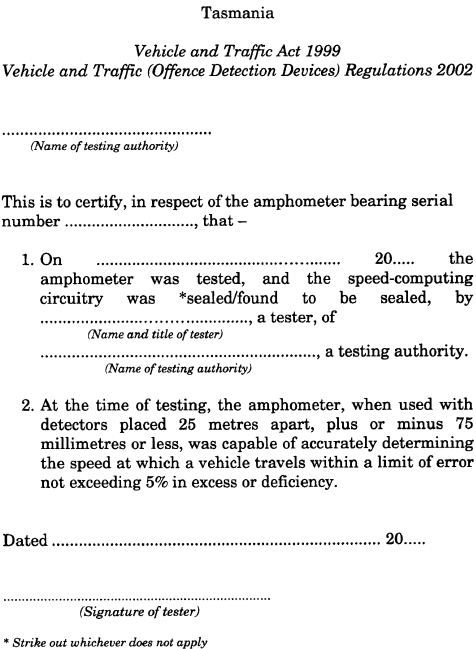
Form 1 - TEST CERTIFICATE: AMPHOMETER[Schedule 1 Amended by S.R. 2004, No. 26, Applied:05 May 2004]
Regulations 11 and 12
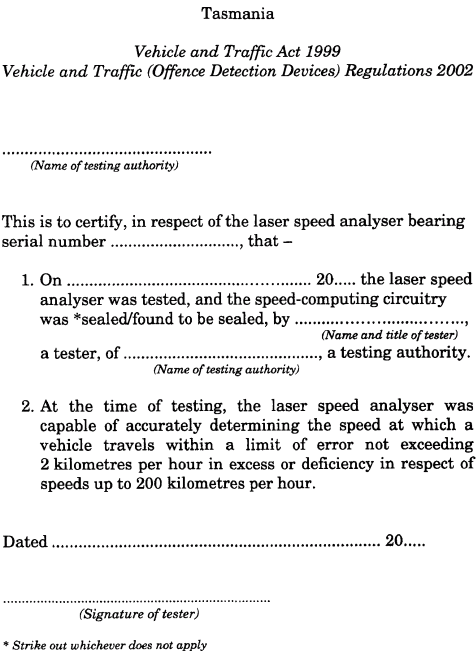
Form 2 - TEST CERTIFICATE: LASER SPEED ANALYSER[Schedule 1 Amended by S.R. 2004, No. 26, Applied:05 May 2004]
Regulations 11 and 12
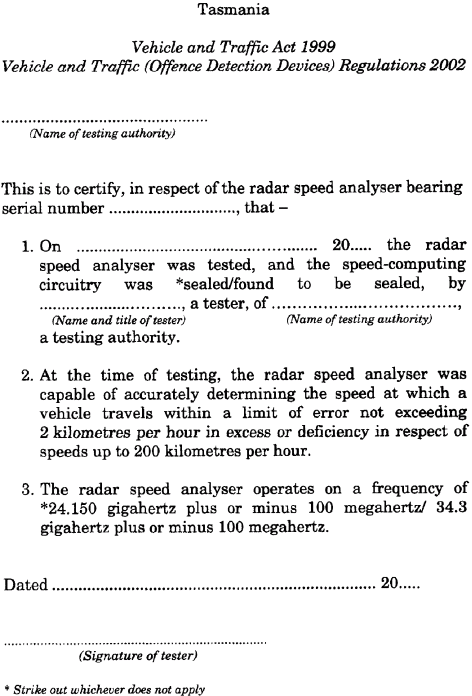
Form 3 - TEST CERTIFICATE: RADAR SPEED ANALYSER[Schedule 1 Amended by S.R. 2004, No. 26, Applied:05 May 2004]
Regulations 11 and 12
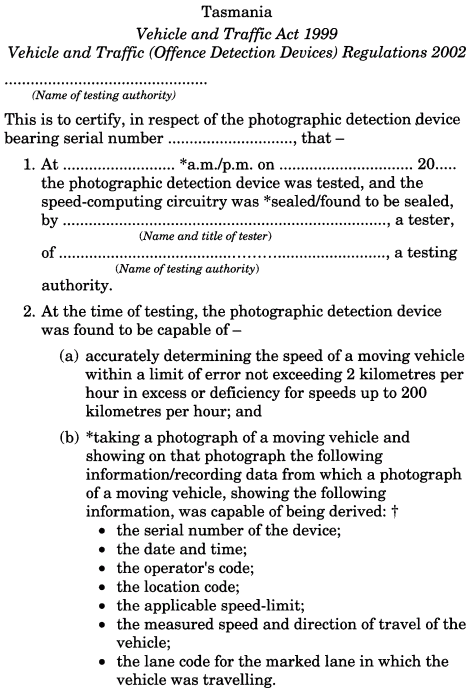
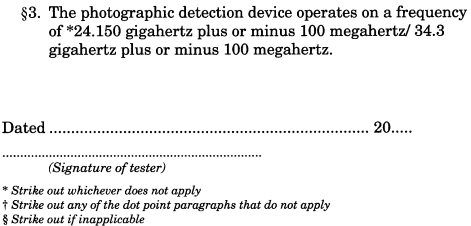
Form 4 - TEST CERTIFICATE: PHOTOGRAPHIC DETECTION DEVICE (SPEEDING OFFENCES)[Schedule 1 Amended by S.R. 2004, No. 26, Applied:05 May 2004] [Schedule 1 Amended by S.R. 2004, No. 67, Applied:04 Aug 2004]
Regulations 11 and 12
Displayed and numbered in accordance with the Rules Publication Act 1953.
Notified in the Gazette on 16 October 2002
These regulations are administered in the Department of Infrastructure, Energy and Resources.