

Legal Profession (Board of Legal Education) Rules 1994
In pursuance and exercise of the powers conferred on it by the Legal Profession Act 1993 , the Board of Legal Education makes the following rules under and for the purposes of that Act.
PART 1 - Preliminary
These rules may be cited as the Legal Profession (Board of Legal Education) Rules 1994 .
These rules take effect on 31 December 1994.
In these rules –Act means the Legal Profession Act 1993 ;chairperson means the chairperson of the Board;Northern Region means the municipal areas of Break O'Day, Dorset, Flinders, George Town, Launceston, Meander Valley, Northern Midlands and West Tamar;North-Western Region means the municipal areas of Burnie, Central Coast, Circular Head, Devonport, Kentish, King Island, Latrobe, Waratah-Wynyard and West Coast;specified subject means a subject specified under rule 5 .
The Board is to apply fees –(a) firstly, in the payment of examiner's fees and the incidental expenses of conducting examinations in the specified subjects; and(b) secondly, in the discharge of expenses incurred by the Board in the exercise of its functions; and(c) thirdly, to assist the Council with the costs incurred in the performance of its functions.
PART 2 - Subjects and examinations
(1) The following subjects are the subjects which a candidate must pass for admission under Part 5 of the Act:(a) Contract;(b) Torts;(c) Criminal Law;(d) Property Law;(e) Principles of Public Law;(f) Equity and Trusts;(g) Law of Groups;(h) Litigation;(i) [Rule 5 Subrule (1) amended by S.R. 1999, No. 93, Applied:15 Sep 1999] . . . . . . . .(j) one subject chosen from each of the groups of subjects specified in Schedule 1 .(2) A person may apply to the Board –(a) to accept other subjects than the specified subjects; or(b) to vary the order in which specified subjects are undertaken.(3) The Board may –(a) accept other subjects; or(b) permit the variation.
(1) The first examination is to be in the following subjects:(a) Contract;(b) Torts.(2) The second examination is to be in the following subjects:(a) Criminal Law;(b) Property Law.(3) The third examination is to be in the following subjects:(a) Principles of Public Law;(b) Equity and Trusts;(c) Law of Groups.(4) The fourth examination is to be in the following subjects:(a) Litigation;(b) one subject chosen from the subjects listed in Group A of Schedule 1 ;(c) one subject chosen from the subjects listed in Group B of Schedule 1 ;(d) one subject chosen from the subjects listed in Group C of Schedule 1 .(5) The fifth examination is to be in the following subjects:(a) [Rule 6 Subrule (5) amended by S.R. 1999, No. 93, Applied:15 Sep 1999] . . . . . . . .(b) one subject chosen from Group D of Schedule 1 ;(c) one subject chosen from Group E of Schedule 1 ;(d) one subject chosen from any of the subjects listed in Schedule 1 .
7. Examinations of articled clerks
(1) An articled clerk is to give notice in writing to the Board of the intention to sit for any examination in one of the specified subjects before the examination.(2) An articled clerk is not entitled to sit an examination after the first examination referred to in rule 6(1) unless he or she has passed the previous examination and received notice in writing of the Board's approval to sit the next examination.(3) An articled clerk is not entitled to sit for an examination without leave of the Board if –(a) a period of 8 years has elapsed since he or she first sat for any examination of the Board or any other examining authority, either in this State or elsewhere, and that examination is recognized as providing a qualification for admission in any State or Territory; or(b) he or she has failed twice to pass any specified subject.
8. Examination to be in writing
The examination of a candidate is to be by written questions answered in writing.
PART 3 - Certificates and forms
Division 1 - Certificates
(1) A candidate may apply to the Board for a certificate that he or she has passed an examination in a specified subject.(2) If the Board is satisfied that a person has passed an examination, the Board is to issue a certificate to that person.
10. Certificate under section 23 of the Act
[Rule 10 Substituted by S.R. 2000, No. 33, Applied:17 May 2000](1) A person may apply to the Board for a certificate that he or she has the qualifications specified in section 23 of the Act.(2) If the Board is satisfied that a person has the qualifications specified in section 23 of the Act, the Board is to issue a certificate in accordance with Form 1 of Schedule 2 .
11. Articled clerks with law degrees
(1) An articled clerk may apply to the Board for a certificate that he or she has the qualifications specified in section 24 of the Act.(2) If the Board is satisfied that an articled clerk has the qualifications specified in section 24 of the Act, the Board is to issue a certificate in accordance with Form 2 of Schedule 2 .
12. Articled clerks without law degrees
(1) An articled clerk may apply to the Board for a certificate that he or she has the qualifications specified in section 25 of the Act.(2) If the Board is satisfied that an articled clerk has the qualifications specified in section 25 of the Act, the Board is to issue a certificate in accordance with Form 3 of Schedule 2 .
[Rule 14 Rescinded by S.R. 2000, No. 33, Applied:17 May 2000] . . . . . . . .(1) A person may apply to the Board for a certificate that that person –(a) [Rule 13 Subrule (1) amended by S.R. 2003, No. 111, Applied:24 Sep 2003] has qualifications and professional experience substantially equivalent to the requirements referred to in section 23 , 24 or 25 of the Act; or(b) has demonstrated competence as a solicitor or as a barrister and solicitor in another jurisdiction.(2) The Board is to issue a certificate in accordance with Form 4 of Schedule 2 if the Board is satisfied that a person –(a) [Rule 13 Subrule (2) amended by S.R. 2003, No. 111, Applied:24 Sep 2003] has qualifications and professional experience substantially equivalent to the requirements referred to in section 23 , 24 or 25 of the Act; or(b) has demonstrated competence as a solicitor or as a barrister and solicitor in another jurisdiction.
The Board is to issue a certificate in accordance with Form 6 of Schedule 2 to a person entering articles of clerkship.
Division 2 - Forms
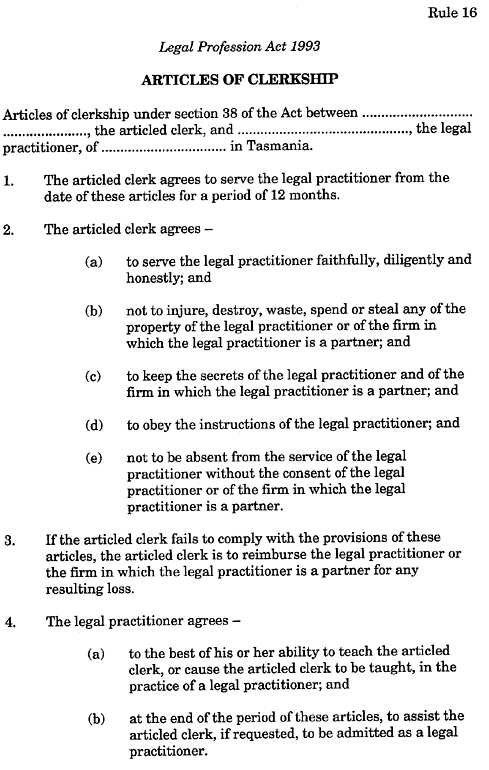
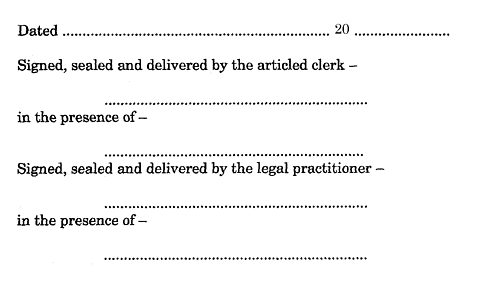
[Rule 16 Amended by S.R. 2000, No. 33, Applied:17 May 2000] Articles of clerkship are to be in accordance with Form 7 of Schedule 2 .
17. Publication and form of notice
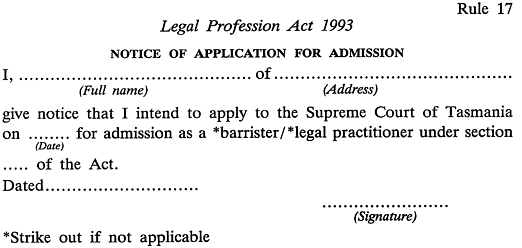
(1) For the purposes of section 30(1) of the Act, a person who intends to apply for admission as a barrister or legal practitioner is to cause a notice of that intention to be published at least one month and not more than 3 months before the application is made.(2) A person who intends to apply for admission in Hobart is to cause a notice to be published –(a) once in a newspaper published in Hobart; and(b) once in a newspaper published in the Northern Region or the North-Western Region.(3) A person who intends to apply for admission in the Northern Region is to cause a notice to be published –(a) once in a newspaper published in Hobart; and(b) once in a newspaper published in the Northern Region.(4) A person who intends to apply for admission in the North-Western Region is to cause a notice to be published –(a) once in a newspaper published in Hobart; and(b) once in a newspaper published in the North-Western Region.(5) A notice is to be –(a) in accordance with Form 8 of Schedule 2 ; and(b) served on –(i) the Registrar; and(ii) the Executive Director.
PART 3A - Overseas Applicants
17A. Applicants admitted in other jurisdictions
[Rule 17A Inserted by S.R. 2003, No. 111, Applied:24 Sep 2003](1) If a person is admitted as a barrister or solicitor, or barrister and solicitor, in an overseas jurisdiction (other than New Zealand), he or she may apply to the Board for a direction as to what further academic or practical requirements, if any, must be met in order to satisfy the Board under section 27(1)(b)(ii) or 28(1)(b)(ii) of the Act that he or she has qualifications and professional experience substantially equivalent to the requirements referred to in section 23 , 24 or 25 of the Act.(2) The application must be accompanied by an affidavit or statutory declaration –(a) stating the nature and details of the applicant's academic qualifications, practical qualifications and professional experience; and(b) providing original or authenticated documentary evidence that the applicant has the academic and practical qualifications relied upon; and(c) providing original or authenticated documentary evidence of the applicant's admission in the overseas jurisdiction; and(d) stating that the applicant is currently admitted and entitled to practice in the overseas jurisdiction, has not at any stage been struck off the roll of practitioners or otherwise suspended from practice and is not presently subject to a disciplinary inquiry or proceedings; and(e) describing the nature, range, duration and character of the applicant's practice in the overseas jurisdiction; and(f) stating whether the applicant has applied for a like direction, or admission, in any other Australian jurisdiction and the result of any such application.(3) On receipt of the application, the Board, having regard to such considerations as it thinks fit, may –(a) give the direction; or(b) advise the applicant that he or she is not required to meet any further academic or practical requirements; or(c) refuse to give the direction.(4) If subrule (3)(a) applies, the applicant may make an application under rule 13(1)(a) once he or she has met the further requirements specified in the direction.(5) If subrule (3)(b) applies, the Board may deal with the application as if it were an application under rule 13(1)(a) .(6) If subrule (3)(c) applies, the Board is to notify the applicant of the refusal and the reasons for the refusal.
17B. Applicants with qualifications gained outside Australia but not admitted
[Rule 17B Inserted by S.R. 2003, No. 111, Applied:24 Sep 2003](1) If a person –he or she may apply to the Board for a direction as to what further academic or practical requirements, if any, must be met in order to satisfy the Board under section 27(1)(b)(ii) of the Act that he or she has qualifications and professional experience substantially equivalent to the requirements referred to in section 23 , 24 or 25 of the Act.(a) is qualified by qualifications gained outside Australia to be admitted as a solicitor or a barrister and solicitor in an overseas jurisdiction (including New Zealand); but(b) has not been so admitted –(2) The application must be accompanied by an affidavit or statutory declaration –(a) stating the nature and details of the applicant's academic qualifications, practical qualifications and professional experience; and(b) providing original or authenticated documentary evidence that the applicant has the academic and practical qualifications relied upon; and(c) stating whether the applicant has applied for a like direction, or admission, in any other Australian jurisdiction and the result of any such application.(3) On receipt of the application, the Board, having regard to such considerations as it thinks fit, may –(a) give the direction; or(b) advise the applicant that he or she is not required to meet any further academic or practical requirements; or(c) refuse to give the direction.(4) If subrule (3)(a) applies, the applicant may make an application under rule 13(1)(a) once he or she has met the further requirements specified in the direction.(5) If subrule (3)(b) applies, the Board may deal with the application as if it were an application under rule 13(1)(a) .(6) If subrule (3)(c) applies, the Board is to notify the applicant of the refusal and the reasons for the refusal.
17C. Fee payable on application
[Rule 17C Inserted by S.R. 2003, No. 111, Applied:24 Sep 2003] The fee payable on an application to the Board under rule 17A or 17B is $200.
17D. Sufficient proficiency in English
[Rule 17D Inserted by S.R. 2003, No. 111, Applied:24 Sep 2003] If the first language of an overseas applicant is not English, the applicant must satisfy the Board that he or she has sufficient proficiency in written and spoken English to practise in Australia.
PART 4 - Rescission and savings
The following rules are rescinded:
Legal Practitioners (Board of Legal Education) Rules 1978 (S.R. 1978, No. 250)
Legal Practitioners (Board of Legal Education) Amendment Rules 1980 (S.R. 1980, No. 16)
Legal Practitioners (Board of Legal Education) Amendment Rules 1981 (S.R. 1981, No. 201)
Legal Practitioners (Board of Legal Education) Amendment Rules 1983 (S.R. 1983, No. 113)
Legal Practitioners (Board of Legal Education) Amendment Rules 1984 (S.R. 1984, No. 2)
Legal Practitioners (Board of Legal Education) Amendment Rules 1986 (S.R. 1986, No. 171)
Legal Practitioners (Board of Legal Education) Amendment Rules 1990 (S.R. 1990, No. 46)
Legal Practitioners (Board of Legal Education) Amendment Rules 1992 (S.R. 1992, No. 161)
Legal Practitioners Rules 1979 (S.R. 1979, No. 19)
Legal Practitioners Amendment Rules 1993 (S.R. 1993, No. 298)
A person who has passed any of the subjects specified by the Legal Practitioners (Board of Legal Education) Rules 1978 may complete the examinations in these subjects in accordance with those rules.
SCHEDULE 1 - Elective subjects
Group A | Jurisprudence 1 | Jurisprudence 2 | Jurisprudence 3 | Jurisprudence 4 | Criminology | Sociology of Law | Comparative Law | Legal History |
Group B | International Law | Marine Resources | Antarctic and Southern Ocean Law | Human Rights | Advanced International Law | Maritime Law |
Group C | Planning Law | Advanced Administrative Law | Conciliation and Arbitration Law | Environmental Law | Employment Law | Trade Union Law | Advanced Criminal Law | Welfare Law | Anti-Discrimination Law | Media Law | Advanced Constitutional Law |
Group D | Commercial Law | Tax 1 | International Trade | Intellectual Property | Internal Company Structure | Trade Practices Law | Law and Finance | Personal and Corporate Solvency | Consumer Protection | Tax 2 | Regulation of Securities | Banking Law |
Group E | Family 1 – The Family and the Child | Family 2 – Financial Aspects of Family Law | Succession | Conflicts | Information Law | Law and Medicine | Landlord and Tenant | Sentencing | Compensation Law | Restitution | Clinical Legal Education |
SCHEDULE 2 - Forms
Form 1[Schedule 2 Amended by S.R. 2000, No. 33, Applied:17 May 2000]
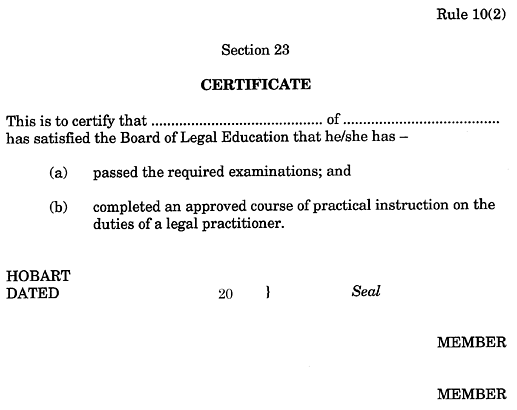
Form 2

Form 3
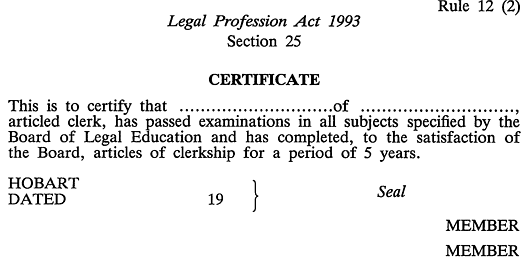
Form 4
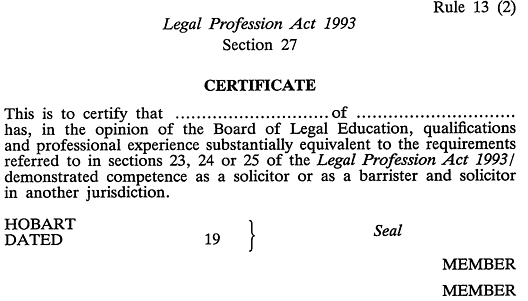
Form 6
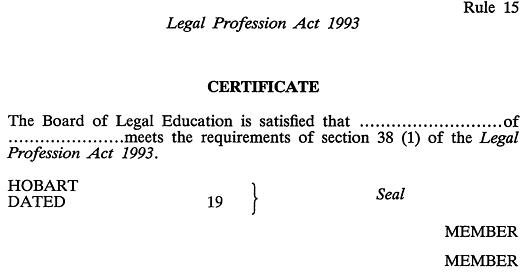
Form 7[Schedule 2 Amended by S.R. 2000, No. 33, Applied:17 May 2000]
Form 8
The foregoing rules were made by the Board of Legal Education at a meeting of the Board held on 1 December 1994.
The common seal of the Board of Legal Education was affixed on 13 December 1994 in the presence of –
ALAN BLOW,
Member
IAN ELLIOTT,
Member
Displayed and numbered in accordance with the Rules Publication Act 1953.
Notified in the Gazette on 28 December 1994
These rules are administered in the Department of Justice.