

Electoral Act 1985
An Act to provide for the holding of elections to elect persons as members of the Tasmanian Parliament, to regulate the conduct of those elections, to provide for the enrolment of electors for the purposes of those elections, to repeal the Electoral Act 1907 and other enactments, and to provide for related matters
Be it enacted by His Excellency the Governor of Tasmania, by and with the advice and consent of the Legislative Council and House of Assembly, in Parliament assembled, as follows:
PART I - Preliminary
This Act may be cited as the Electoral Act 1985 .
(1) This Act shall be reserved for the signification of the Sovereign's pleasure thereon.(2) This section and section 1 shall commence on the day on which a proclamation of the Governor signifying the Sovereign's assent to this Act is notified in the Gazette.(3) Except as provided in subsection (2) , this Act shall commence on such day after the day referred to in that subsection as may be fixed by proclamation.
[Section 3 Subsection (1) amended by No. 16 of 1992, s. 4 ][Section 3 Subsection (1) amended by No. 80 of 1994, s. 4 ](1) [Section 3 Subsection (1) amended by No. 29 of 1984, s. 3 and Sched. 1 ][Section 3 Subsection (1) amended by No. 27 of 1996, s. 4 ]In this Act, unless the contrary intention appears –address, in relation to the address of a person, means the address of his place of residence;approved form means a form approved by the Chief Electoral Officer under section 19 (3) ;Assembly means the House of Assembly of the Parliament of Tasmania;Assembly division means an electoral division, determined in accordance with the Constitution Act 1934 , for the return of members to represent the electors of that division in the Assembly;Assembly election means an election to return members in respect of an Assembly division;Assembly general election means the elections held or to be held contemporaneously in respect of the several Assembly divisions pursuant to writs issued by the Governor on the dissolution or expiry of the Assembly;authorized witness means a person who is an authorized witness for the purposes of this Act by virtue of section 18 ;by-election means an election held or to be held for the return of a member of the Council pursuant to a writ to fill a vacancy in the Council other than a vacancy arising because of the expiry of the term for which a member of the Council was elected;candidate means a person who is nominated as a candidate for election to a seat in the Assembly or Council, and, where a person, before the next ensuing election for that seat publicly declares his intention to seek election to that seat, includes that person, but, except as provided in Part IX , does not include a person who is a candidate to fill a vacancy in the Assembly in accordance with that Part;Chief Electoral Officer means the person appointed and holding office as Chief Electoral Officer pursuant to section 4 , and includes a person for the time being authorized to exercise and perform the powers and functions of the Chief Electoral Officer;commencement day means the day fixed in accordance with section 2 (3) ;corrupt practice means an offence that is a crime by virtue of this Act, and includes aiding, abetting, counselling, and procuring the commission of, and attempting and conspiring to commit, such a crime;Council means the Legislative Council of the Parliament of Tasmania;Council division means an electoral division, determined in accordance with the Constitution Act 1934 , for the return of a member to represent the electors of that division in the Council;Council election means –(a) a periodic Council election to return a member in respect of a Council division; or(b) a by-election;counting-centre means a polling-place designated by proclamation under section 14 (1) (a) that is declared by proclamation under section 14 (1) (b) to be a counting-centre for the purposes of section 184 ;declared institution means an institution for the time being declared under section 15 to be a declared institution for the purposes of this Act;election means an Assembly election or a Council election;election agent, in relation to a candidate at a Council election, means a person who is or was appointed or authorized in writing by the candidate to act as the agent of the candidate for the purpose of, or in connection with, the candidate's campaign for election;elector means a person whose name appears on an electoral roll as an elector;electoral division or division means an Assembly division or a Council division;electoral officer means the Chief Electoral Officer, the Deputy Chief Electoral Officer, a returning officer, an electoral registrar, an assistant returning officer, a presiding officer, an assistant presiding officer, a poll-clerk and a clerical assistant and includes –(a) an Antarctic returning officer and an assistant Antarctic returning officer appointed under Part VA ; and(b) any other person holding a position prescribed by the regulations for the purposes of this definition;electoral registrar means –(a) in respect of an Assembly division, the returning officer of that division; or(b)(c) in respect of a Council division, a person appointed and holding office pursuant to section 8 as the electoral registrar of that division;electoral roll or roll means an electoral roll maintained for the purposes of this Act, and, in relation to an electoral division, means the roll of electors shown on the State roll as being enrolled for that division;endorsed candidate means a candidate for election to the Assembly whose nomination is endorsed by a registered party;endorsement representative, in relation to a registered party, means a person whose name is for the time being entered in the party register maintained in respect of that party in accordance with section 57 (2) ;enrolled means enrolled on an electoral roll in accordance with this Act;first preference, in relation to a vote recorded for a candidate at an election, means the recording on a ballot-paper cast at the election of the number "1" in the square opposite the candidate's name on the ballot-paper;functions includes duties and responsibilities;illegal practice means an offence under this Act that is not a corrupt practice or an offence under section 31 or Division 11 of Part V , and includes aiding, abetting,counselling, and procuring the commission of, and attempting and conspiring to commit, such an offence;medical practitioner means a legally-qualified medical practitioner;nomination day means the day on or before which candidates for election must be nominated as required by a provision of this Act;officer in charge of a polling-booth means –within a division in which that polling-booth is situated;(a) an assistant returning officer appointed under section 104 (2) to be the officer in charge of a counting-centre; or(b) a presiding officer appointed under section 104 (2) to be the officer in charge of a subsidiary counting-centre –other or abbreviated name, in relation to a registered party, means the name other than the name of the party registered under Part IV as the name to be printed on ballot-papers at the head of a group of names of endorsed candidates of the party;party means a group of not fewer than 100 persons, whether incorporated or not, that exists for political purposes, and includes any branch in Tasmania of such a group that is established outside Tasmania for those purposes;periodic Council elections means the periodical elections of members of the Council held or required to be held in a year in accordance with section 19 of the Constitution Act 1934 ;polling-booth means any premises, vehicle, or other facility at a polling-place that is used for the conduct of the poll at an election;registered party means a party that is for the time being registered under section 57 ;the regulations means regulations made and in force under this Act;returning officer means the returning officer appointed in respect of an electoral division, and includes a person who is for the time being lawfully authorized to act in the place of the returning officer;State roll means the State roll prepared and kept under section 19 ;subsidiary polling-place means a polling-place designated by proclamation under section 14 (1) (a) that is declared by proclamation under section 14 (1) (b) to be subsidiary to a counting-centre for the purposes of section 184 ;supplementary electoral roll or supplementary roll means a roll prepared and printed pursuant to section 25 (2) .(1A) [Section 3 Subsection (1A) inserted by No. 80 of 1994, s. 4 ]A reference in this Act to a roll for a Council division or an Assembly division is a reference to the electors shown on the State roll as being enrolled for that division.(2) A reference in this Act to a poll in relation to an electoral division is a reference to a poll for the return of members of the Assembly, or, as the case may be, a member of the Council, to represent that division.(3) [Section 3 Subsection (3) amended by No. 9 of 1992, s. 4 ]In this Act –(a) a reference to the failure of an election in respect of a Council division is a reference to such an election –(i) in respect of which no candidates have been nominated or returned for the division; or(ii) which has failed by virtue of the operation of section 102 (3) ; and(b) a reference to the failure of an election in respect of an Assembly division is a reference to such an election in respect of which no person has been nominated as a candidate or a person would, but for the failure of the election, have been returned as a member of the Assembly for the division; and(c) [Section 3 Subsection (3) amended by No. 31 of 1998, s. 17, Applied:28 Jul 1998] a reference to the partial failure of an election in respect of an Assembly division is a reference to such an election in respect of which one or more but fewer than 5 candidates would, but for the partial failure of the election, have been returned as a member or members of the Assembly for the division.(4) In this Act, the expression at an election or during an election means the whole of the period beginning with the day of nomination and ending with the day on which the returning officer for the electoral division in respect of which the election is held declares the result of the election.
PART II - Administration
Division 1 - Electoral officers
(1) [Section 4 Subsection (1) substituted by No. 5 of 1990, s. 3 and Sched. 1 ][Section 4 Subsection (1) substituted by No. 86 of 2000, Sched. 1, Applied:01 May 2001] The Governor may appoint a State Service officer or State Service employee to be Chief Electoral Officer and that officer or employee may hold that office in conjunction with State Service employment.(2) [Section 4 Subsection (2) substituted by No. 27 of 1996, s. 5 and Sched. 1 ]The Chief Electoral Officer has the following functions:(a) the administration of this Act;(b) to promote public awareness of electoral and parliamentary matters by means of educational and information programs and by other means;(c) to publish material on matters relating to his or her functions;(d) the investigation and prosecution of illegal practices under this Act;(e) such other functions as are imposed or conferred by or under this Act.(3) [Section 4 Subsection (3) omitted by No. 27 of 1996, s. 5 and Sched. 1 ]. . . . . . . .(4) [Section 4 Subsection (4) amended by No. 86 of 2000, Sched. 1, Applied:01 May 2001] [Section 4 Subsection (4) amended by No. 29 of 1984, s. 3 and Sched. 1 ]A person appointed to hold office as Chief Electoral Officer may, subject to the instrument of appointment under section 31(4) of the State Service Act 2000 , hold any other appointment that is not incompatible with the performance by him of his functions as Chief Electoral Officer.
5. Deputy Chief Electoral Officer
[Section 5 Substituted by No. 27 of 1996, s. 6 ](1) [Section 5 Subsection (1) amended by No. 86 of 2000, Sched. 1, Applied:01 May 2001] The Governor may appoint a State Service officer or State Service employee to be Deputy Chief Electoral Officer and that officer or employee is to hold that office in conjunction with State Service employment.(2) If the Chief Electoral Officer is unable to perform the duties of his or her office, the Deputy Chief Electoral Officer has all the functions, powers and duties of the Chief Electoral Officer.
5A. Delegation by Chief Electoral Officer
[Section 5A Substituted by No. 27 of 1996, s. 6 ](1) The Chief Electoral Officer may, by instrument in writing, delegate any of his or her functions or powers under this Act (other than this power of delegation) to the Deputy Chief Electoral Officer.(2) The Chief Electoral Officer may, by instrument in writing, delegate any of his or her functions or powers under Part VA to an electoral officer.
(1) The Minister, on the recommendation of the Chief Electoral Officer, shall appoint a returning officer in respect of each Assembly division and each Council division.(2) Subject to and in accordance with any directions given by the Chief Electoral Officer, the returning officer of an Assembly division or a Council division is responsible for conducting every election of a member of the Assembly, or, as the case may be, of the Council, to represent that division in the Assembly or the Council.(3) Except as provided by subsection (4) , a returning officer is not entitled to vote at an election for the electoral division in respect of which he is the returning officer.(4) Subject to the provisions of this Act, where the returning officer for an electoral division is enrolled as an elector of another electoral division, he may vote at an election in respect of that other division.(5) [Section 6 Subsection (5) amended by No. 86 of 2000, Sched. 1, Applied:01 May 2001] [Section 6 Subsection (5) amended by No. 29 of 1984, s. 3 and Sched. 1 ]A person holding office as a returning officer is not subject to the State Service Act 2000 .(6) [Section 6 Subsection (6) amended by No. 86 of 2000, Sched. 1, Applied:01 May 2001] [Section 6 Subsection (6) substituted by No. 29 of 1984, s. 3 and Sched. 1 ]A State Service officer or State Service employee may hold an office referred to in subsection (5) in conjunction with State Service employment.
7. Assistant returning officers, &c.
(1) The returning officer for each electoral division may appoint such assistant returning officers, presiding officers, assistant presiding officers, poll-clerks, and clerical assistants as he considers necessary to conduct an election in respect of that division.(2) An assistant returning officer –(a) shall be the officer in charge of such counting-centre as is designated by the returning officer who appointed him; and(b) is responsible for the counting of votes recorded at that counting-centre and any place that is a subsidiary polling-place in respect of that counting-centre.(3) An assistant returning officer has and shall perform all the functions, and has and may exercise all the powers, of the returning officer who appointed him subject to such limitations and restrictions as are –(a) expressed in his appointment as assistant returning officer;(b) prescribed by the regulations; or(c) contained in any direction given to him by the returning officer.(4) [Section 7 Subsection (4) amended by No. 86 of 2000, Sched. 1, Applied:01 May 2001] [Section 7 Subsection (4) amended by No. 29 of 1984, s. 3 and Sched. 1 ]A person holding office under this section is not subject to the State Service Act 2000 .(5) [Section 7 Subsection (5) amended by No. 86 of 2000, Sched. 1, Applied:01 May 2001] [Section 7 Subsection (5) substituted by No. 29 of 1984, s. 3 and Sched. 1 ]A State Service officer or State Service employee may hold an office referred to in subsection (4) in conjunction with State Service employment.
(1) There shall in respect of each electoral division be an electoral registrar.(2) The returning officer of an Assembly division shall be the electoral registrar of that division.(3) [Section 8 Subsection (3) substituted by No. 80 of 1994, s. 5 ]The Chief Electoral Officer may appoint a person to be an electoral registrar of a Council division.(3A) [Section 8 Subsection (3A) amended by No. 86 of 2000, Sched. 1, Applied:01 May 2001] [Section 8 Subsection (3A) inserted by No. 80 of 1994, s. 5 ]A person holding office as an electoral registrar for a Council division is not, as such, subject to the State Service Act 2000 .(3B) [Section 8 Subsection (3B) amended by No. 86 of 2000, Sched. 1, Applied:01 May 2001] [Section 8 Subsection (3B) inserted by No. 80 of 1994, s. 5 ]A State Service officer or State Service employee may hold office as an electoral registrar in conjunction with State Service employment.(4) [Section 8 Subsection (4) amended by No. 16 of 1992, s. 5 ]The electoral registrar of an Assembly division is responsible for preparing and maintaining the electoral rolls for that division and has and shall perform such other functions, and has and may exercise such powers, as may be imposed or conferred on an electoral registrar by or under this Act.(5) The electoral registrar appointed in respect of a Council division is responsible for preparing and maintaining the electoral rolls for that division and has and shall perform such other functions, and has and may exercise such powers, as may be imposed or conferred on an electoral registrar by or under this Act.(6) Where an electoral registrar appointed in respect of a Council division is not the returning officer for that division, the electoral registrar is directly responsible to that returning officer with respect to the proper performance of his functions and the exercise of his powers.
9. Power of Chief Electoral Officer to appoint deputy in certain cases
(1) If at any time it appears to the Chief Electoral Officer that a person holding office as returning officer or as electoral registrar is, through illness, absence on leave, or for any other reason, not able to perform and exercise the functions and powers of that office, the Chief Electoral Officer may appoint some suitable person to act in a temporary capacity in place of the first-mentioned person.(2) A person appointed under subsection (1) , while acting as returning officer or electoral registrar, has and shall perform all the functions, and has and may exercise all the powers, of the office to which he is appointed in a temporary capacity.
10. Conditions of employment of electoral officers
(1) An electoral officer is entitled to be paid such allowances as may be prescribed by, or determined in accordance with, the regulations.(2) An electoral officer is entitled to be paid such remuneration as may be prescribed by, or determined in accordance with, the regulations.(3) The terms and conditions of employment of an electoral officer (other than those referred to in subsections (1) and (2) ) shall be such as may be prescribed by, or determined in accordance with, the regulations.(4) [Section 10 Subsection (4) amended by No. 86 of 2000, Sched. 1, Applied:01 May 2001] [Section 10 Subsection (4) amended by No. 29 of 1984, s. 3 and Sched. 1 ]Except in so far as the regulations expressly provide, subsections (2) and (3) do not apply to the Chief Electoral Officer or to the Assistant Chief Electoral Officer or to or in respect of any other electoral officer who is appointed or employed subject to and in accordance with the State Service Act 2000 .
11. Returning officer, &c., to keep forms
It is a responsibility of a returning officer and of an electoral registrar to keep copies of forms required for use by members of the public for the purposes of this Act.
12. Electoral officer to cease to hold office if he becomes a candidate
(1) If at any time a person who holds office as an electoral officer is nominated as a candidate, he thereupon, by operation of this section, ceases to hold that office, unless he is a person to whom section 2 (1) of the Constitution (State Employees) Act 1944 applies.(2) A person who has been nominated as a candidate is not eligible for appointment as an electoral officer unless the election for which he was nominated has been held and he was not returned as a member at that election.
Division 2 - Electoral divisions and polling-places[Section 13 Repealed by No. 16 of 1992, s. 6 ]. . . . . . . .
14. Polling-places and counting-centres
(1) [Section 14 Subsection (1) amended by No. 16 of 1992, s. 7 ]The Governor may, by proclamation –(a) designate in respect of –(i) each Assembly division such polling-places as appear necessary for the conduct of an election in relation to that division; and(ii) each Council division such polling-places as appear necessary for the conduct of an election in relation to that division; and(b) declare polling-places designated under paragraph (a) to be counting-centres, or to be subsidiary to counting-centres, for the purposes of section 184 .(2) [Section 14 Subsection (2) amended by No. 16 of 1992, s. 7 ]The Governor may, by proclamation –(a) declare polling-places designated as provided in subsection (1) (a) to be polling-places for a specified Assembly division;(b) designate in respect of a Council division polling-places which are located outside the boundaries of the division; or(c) subject to subsection (3) , revoke a proclamation containing a designation or declaration under subsection (1) or under paragraph (a) or (b) of this subsection either with or without the substitution of a further designation or declaration.(3) [Section 14 Subsection (3) amended by No. 16 of 1992, s. 7 ]A revocation of a proclamation containing the designation of a place as a polling-place for the purposes of conducting an election in relation to a particular Assembly division or Council division shall, if it purports to have effect between the issue of the writ for the election and the time fixed for its return, have no effect until that time.
The Governor may, by proclamation, declare an institution, being a hospital, convalescent home, nursing home, or other institution of a class prescribed by the regulations which has not been designated as a polling-place, to be a declared institution for the purposes of this Act.
16. Transfer of electors from one electoral roll to another
(1) [Section 16 Subsection (1) substituted by No. 80 of 1994, s. 6 ]Where a relevant occurrence takes place and as a result of that occurrence the division or divisions indicated for an elector are no longer appropriate, the Chief Electoral Officer must cause that division or those divisions to be changed, as the particular circumstances require.(2) [Section 16 Subsection (2) amended by No. 16 of 1992, s. 8 ]In subsection (1) , relevant occurrence means –(a) . . . . . . . .(b) the alteration of the boundaries of an electoral division;(c) the establishment of a new electoral division; or(d) the abolition of an electoral division.
Division 3 - [Part II, Div. 3 Heading amended by No. 46 of 1991, s. 4 and Sched. 2 ]Functions of Director of Public Prosecutions
17. Functions of Director of Public Prosecutions
[Section 17 Subsection (3) amended by No. 46 of 1991, s. 4 and Sched. 2 ][Section 17 Subsection (3) amended by No. 68 of 1994, s. 3 and Sched. 1 ](1) [Section 17 Subsection (1) amended by No. 46 of 1991, s. 4 and Sched. 2 ]Where the Director of Public Prosecutions becomes aware of information that a corrupt practice has occurred in relation to an election, he shall, if he considers it desirable to do so, make such inquiries and institute such prosecutions as the circumstances of the matter appear to him to require.(2) [Section 17 Subsection (2) amended by No. 46 of 1991, s. 4 and Sched. 2 ]Where an election application under Part VIII is made by a person other than the Director of Public Prosecutions or his representative, the Director of Public Prosecutions or his representative shall enter an appearance at, and participate in, the hearing of the application by the Supreme Court.(3) [Section 17 Subsection (3) amended by No. 86 of 2000, Sched. 1, Applied:01 May 2001] [Section 17 Subsection (3) amended by No. 29 of 1984, s. 3 and Sched. 1 ]The Director of Public Prosecutions may nominate a barrister or legal practitioner within the meaning of the Legal Profession Act 1993 and of not less than 7 years' standing to be his representative for the purposes of this Act, and that representative, if not a State Service officer or State Service employee, is to be entitled to receive such remuneration as the Attorney-General, after consultation with the Treasurer, may determine in respect of him.(4) [Section 17 Subsection (4) amended by No. 46 of 1991, s. 4 and Sched. 2 ]Subject to subsection (5) , the costs incurred in meeting the expenses of the Director of Public Prosecutions or his representative in attending and participating in the hearing of an election application under Part VIII shall in the first instance be paid by the Treasurer out of funds provided by Parliament.(5) [Section 17 Subsection (5) amended by No. 46 of 1991, s. 4 and Sched. 2 ]If the Supreme Court, on the hearing of an election application under Part VIII , thinks it just to do so, it may cause all or part of the costs referred to in subsection (4) to be repaid to the Treasurer by the parties to the application (other than the Director of Public Prosecutions or his representative (if any) or the Chief Electoral Officer).
Division 4 - Authorized witnesses
(1) [Section 18 Subsection (1) amended by No. 16 of 1992, s. 9 ]An elector whose name appears on an electoral roll for an Assembly division or a Council division or on a Commonwealth electoral roll for any other State or a Territory of the Commonwealth is an authorized witness for the purposes of this Act in relation to a person who, in Australia, makes an application to vote at an election.(2) The following persons are authorized witnesses for the purposes of this Act in relation to a person who, elsewhere than in Australia, makes an application to vote at an election:(a) an elector referred to in subsection (1) ;(b) an officer of the naval, military, or air force of the Commonwealth or of some other part of the Sovereign's dominions;(c) a person employed in the Public Service of the Commonwealth or of a Territory of the Commonwealth or of some other part of the Sovereign's dominions;(d) a justice of the peace for any part of the Sovereign's dominions.(3) A person is not eligible to be an authorized witness at or in connection with an election if he is a candidate at the election or any other election that is to be held contemporaneously with that election.
PART III - Registration of Electors
Division 1 - Electoral rolls
19. State roll and division rolls
[Section 19 Substituted by No. 80 of 1994, s. 7 ](1) For the purposes of this Act, there is to be prepared and kept –(a) a State roll showing the Council and Assembly electors and indicating the electoral divisions in which each elector is enrolled; and(b) a roll for each Council division which is to be the roll of electors shown on the State roll as being enrolled for that division; and(c) a roll for each Assembly division which is to be the roll of electors shown on the State roll as being enrolled for that division.(2) The State roll may be kept by electronic means or any similar means.(3) The forms to be used for the purposes of the State roll are to be as approved by the Chief Electoral Officer.(4) The Chief Electoral Officer must, as soon as practicable after approving a form, publish the form and notice of the approval in the Gazette.(5) For the purposes of this Act, any addition, alteration, deletion or other action to be taken for the purpose of an Assembly roll or Council roll is to be effected by an appropriate change to the State roll.
(1) [Section 20 Subsection (1) amended by No. 16 of 1992, s. 11 ]Subject to section 34 , in preparing a roll of electors for a division, there shall be specified –(a) the surname and the given name or names of each elector;(b) the address of his place of residence; and(c) such other particulars (if any) relating to him as may be prescribed by the regulations.(2) [Section 20 Subsection (2) omitted by No. 80 of 1994, s. 8 ]. . . . . . . .
21. Arrangements with Commonwealth
(1) [Section 21 Subsection (1) amended by No. 80 of 1994, s. 9 ]The Governor may enter into an arrangement with the Governor-General of the Commonwealth for the preparation, alteration, and revision of the State roll, in a manner consistent with the provisions of this Act, jointly by the State and the Commonwealth, to the intent that the rolls may be used as electoral rolls for Commonwealth elections as well as State elections.(2) [Section 21 Subsection (2) amended by No. 80 of 1994, s. 9 ]Subject to section 34 , when any such arrangement has been made, there may be entered on the State roll, for the purposes of Commonwealth elections –(a) the names and addresses of persons who are not entitled to be enrolled as electors of the State, provided that it is clearly indicated that the names and addresses of those persons are not entered on those rolls as State electors;(b) a clear indication against the names of persons enrolled as State electors, to show that those persons are or are not also enrolled as Commonwealth electors; and(c) any other particulars.(3) [Section 21 Subsection (3) amended by No. 80 of 1994, s. 9 ]For the purposes of this Act, the names and addresses, marks, and other particulars entered on the State roll in accordance with subsection (2) shall not be deemed to be part of the roll.
22. Persons entitled to be enrolled
(1) [Section 22 Subsection (1) amended by No. 16 of 1992, s. 12 ]A person who, by virtue of section 29 of the Constitution Act 1934 , would be entitled to be enrolled as an elector for the Assembly is entitled to have his name entered on the electoral roll for the Assembly division in which he resides if he has resided in that division during the immediately preceding period of one month.(2) A person who, by virtue of section 28 of the Constitution Act 1934 , would be entitled to be enrolled as an elector for the Council is entitled to have his name entered on the electoral roll for the Council division in which he resides if he has resided in that division during the immediately preceding period of one month.(3) [Section 22 Subsection (3) amended by No. 16 of 1992, s. 12 ]A person is not entitled to have his name entered on more than one electoral roll for an Assembly division at any one time.(4) [Section 22 Subsection (4) amended by No. 16 of 1992, s. 12 ]Except as provided in subsections (7) and (8) , the electoral roll for an Assembly division on which a person is entitled to have his name entered is the electoral roll for the Assembly division in which he resides.(5) A person is not entitled to have his name entered on more than one electoral roll for a Council division at any one time.(6) Except as provided in subsections (7) and (8) , the electoral roll for a Council division on which a person is entitled to have his name entered is the electoral roll for the Council division in which he resides.(7) [Section 22 Subsection (7) amended by No. 16 of 1992, s. 12 ]A member of the Assembly or a member of the Council is, if he so wishes, entitled to have his name entered and kept on the electoral roll for the Assembly division or, as the case may be, the Council division for which he is a member instead of on the electoral roll for the Assembly division or Council division in which he resides.(8) [Section 22 Subsection (8) amended by No. 16 of 1992, s. 12 ]Where in accordance with subsection (7) the name of a member of the Assembly or of the Council is entered and kept on an electoral roll for an Assembly division or a Council division, the spouse of the member is, if that spouse so wishes, entitled to have his or her name entered and kept on that electoral roll.(9) [Section 22 Subsection (9) amended by No. 16 of 1992, s. 12 ]Where a person already has his name entered on an electoral roll for an Assembly division or a Council division, any subsequent entry of that person's name on that electoral roll is invalid and of no effect.
22A. Provisional enrolment of persons over 17 years
[Section 22A Inserted by No. 27 of 1996, s. 7 ](1) Where a person –the Chief Electoral Officer must provisionally enrol that person on the State roll.(a) is aged 17 years; and(b) would, if aged 18 years, be entitled to be enrolled by virtue of section 28 or 29 of the Constitution Act 1934 as an elector for the Assembly or the Council; and(c) has made a request for provisional enrolment in a form approved by the Chief Electoral Officer –(2) A provisional enrolment has no effect for the purposes of this Act until the person enrolled attains the age of 18 years at which time he or she is taken to be enrolled.
(1) [Section 23 Subsection (1) amended by No. 16 of 1992, s. 13 ]Whenever the Governor, by proclamation, directs new electoral rolls to be prepared for all Assembly divisions and Council divisions or such of them as may be specified in the proclamation, the Chief Electoral Officer shall take all appropriate steps to have those rolls prepared in accordance with the direction.(2) A proclamation made for the purposes of subsection (1) may specify the manner in which the electoral rolls to which the proclamation relates are to be prepared.
24. Entry and omission of names of electors
[Section 24 Amended by No. 16 of 1992, s. 14 ][Section 24 Amended by No. 80 of 1994, s. 10 ]In preparing a new roll for an Assembly division or a Council division –(a) there shall be entered on the roll the names of all persons –being persons who appear to be qualified for enrolment as electors for the division; and(i) whose names appear on the roll then in force for the division; or(ii) who have lodged with the electoral registrar for the division a claim in accordance with an approved form for enrolment as an elector for the division –(b) there shall be omitted from the roll the names of all persons –(i) [Section 24 Amended by No. 58 of 1999, Sched. 1, Applied:01 Nov 2000] who, from information provided by the Registrar of Births, Deaths and Marriages, appear to be dead; or(ii) who appear not to be qualified for enrolment as electors for the division.
25. Printing of electoral rolls
(1) [Section 25 Subsection (1) amended by No. 16 of 1992, s. 15 ]The Chief Electoral Officer may cause the electoral roll for an Assembly division or a Council division to be printed whenever he thinks fit.(2) [Section 25 Subsection (2) amended by No. 16 of 1992, s. 15 ]The Chief Electoral Officer –(a) shall cause a supplementary electoral roll to be prepared and printed for an Assembly division or a Council division immediately before an election in respect of that Assembly division or that Council division, as the case may be; and(b) may, if he thinks fit, cause a supplementary electoral roll to be so prepared and printed at any other time.(3) As soon as practicable after receiving electoral rolls printed pursuant to subsection (1) or supplementary electoral rolls printed pursuant to subsection (2) , the Chief Electoral Officer shall supply copies of those rolls to the electoral registrar concerned.
26. Alterations which may be made to new electoral roll by electoral registrar
(1) [Section 26 Subsection (1) amended by No. 16 of 1992, s. 16 ]The electoral registrar for an Assembly division or a Council division shall, on receiving a new electoral roll for that Assembly division or for that Council division, as the case may be –that roll, pursuant to claims or notifications received by him after the date of the proclamation directing the preparation of new rolls where those additions, alterations, or corrections have not already been made in, or those names have not been struck off, the new electoral roll.(a) make additions, alterations, and corrections in; and(b) strike names off –(2) Where objections have been lodged or notices of objection have been issued and action in respect of those objections or notices of objection has not been completed before the proclamation directing the preparation of new electoral rolls, the objections or notices of objection shall have effect in relation to the new electoral rolls as if those rolls had been in existence at the time of the lodging of the objections or the issuing of the notices of objection.
27. Right of public to inspect electoral rolls
(1) The Chief Electoral Officer shall ensure that copies of the latest print of the electoral roll for each Assembly division and each Council division and of each supplementary roll –(a) are kept available for inspection by members of the public without fee –(i) at his office during its ordinary hours of business; and(ii) at such other places (if any) as are prescribed by the regulations; and(b) are, on payment of the prescribed fee, obtainable from the Government Printing Office and at such other places as he determines.(2) [Section 27 Subsection (2) amended by No. 16 of 1992, s. 17 ]Without limiting the operation of subsection (1) , the electoral registrar for an Assembly division or a Council division shall –(a) keep available –for inspection by members of the public without fee copies of the electoral roll and each supplementary roll for the Assembly division or, as the case may be, the Council division; and(i) at his office in the division during its ordinary hours of business; and(ii) at such other places in the division, and during such periods, as are prescribed by the regulations –(b) keep such copies available at those places for purchase by members of the public on payment of the prescribed fee.
28. Persons to provide information
(1) Every State employee, every employee of a local authority, and every elector and person qualified to be an elector shall, on being requested to do so by an electoral officer, provide all such information as may be required in connection with the preparation, maintenance, or revision of the electoral rolls.(2) [Section 28 Subsection (2) amended by No. 68 of 1994, s. 3 and Sched. 1 ]In subsection (1) , a reference to a State employee is a reference to an employee within the meaning of the Long Service Leave (State Employees) Act 1994 .(3) A police officer shall assist an electoral registrar by making such inquiries and collecting such information as the electoral registrar may specify.
[Section 28A Inserted by No. 27 of 1996, s. 8 ](1) On request by the endorsement representative of a registered party, the Chief Electoral Officer must provide the representative with a copy of the State roll and periodic variations to that roll and may also provide from time to time revised copies of that roll.(2) On request by a member of the Assembly or of the Council, the Chief Electoral Officer must provide him or her with a copy of the electoral roll for the division which he or she represents and periodic variations to that roll and may also provide from time to time revised copies of that roll.(3) For the purposes of subsections (1) and (2) –(a) a request may be made only once during each term of the Assembly; and(b) a copy of the roll must be provided in printed or electronic form or both, as may be requested; and(c) a copy of a roll is to specify only the names, residential addresses and postal addresses of electors but will not include the address of any elector whose address, under section 34 , does not appear on the roll.(4) On request by a person who has nominated as a candidate for an Assembly election or a Council election, the Chief Electoral Officer must provide him or her with a copy in printed form of the electoral roll for the division for which he or she has nominated.(5) The Chief Electoral Officer may provide to any other person, body or organisation, as he or she may approve, a copy of the State roll or of any part of that roll in printed or electronic form.(6) For the purposes of subsection (5) –(a) an approval by the Chief Electoral Officer is to be in writing and is to specify the purpose for which information contained in the roll may be used; and(b) a copy of the roll is to include the names, residential addresses, postal addresses and such other particulars relating to the electors as the Chief Electoral Officer considers relevant to the purpose for which the roll may be used.
28B. Approved use of electoral rolls
[Section 28B Inserted by No. 27 of 1996, s. 8 ](1) A person who, without reasonable excuse, uses information obtained from an electoral roll provided in electronic form under section 28A , except for a permitted purpose, is guilty of an offence and is liable on summary conviction to a fine not exceeding 100 penalty units or to imprisonment for a period not exceeding 6 months, or both.(2) For the purposes of subsection (1) , a permitted purpose is –(a) in the case of a person referred to in section 28A (1) or (2) –(i) any purpose connected with an election or referendum; or(ii) monitoring the accuracy of information on the roll; or(iii) the performance by a member of the Assembly or the Council of his or her functions as a member; or(b) in the case of a person referred to in subsection (5) of section 28A , the purpose specified by the Chief Electoral Officer is the approval granted under that subsection.
28C. Prohibited use of electoral rolls
[Section 28C Inserted by No. 27 of 1996, s. 8 ]Except in accordance with section 28B , a person must not, without reasonable excuse –information that the person knows, or has reasonable grounds for believing, has been obtained from, or by means of, an electoral roll provided in electronic form under this Division.(a) use for a commercial purpose; or(b) disclose to another person –Penalty: Fine not exceeding 100 penalty units or imprisonment for a period not exceeding 6 months, or both.
Division 2 - Enrolment
29. Additions to electoral rolls
(1) Whenever a claim is made by a person for enrolment or transfer of enrolment, the electoral registrar concerned may add or, as the case may be, transfer that person's name to the appropriate electoral roll.(2) [Section 29 Subsection (2) amended by No. 80 of 1994, s. 10 ]A claim for enrolment or transfer of enrolment shall –(a) be in accordance with an approved form; and(b) be signed by the claimant with his personal signature which shall be attested by a person of a class prescribed by the regulations for the purposes of this subsection who shall sign his name as a witness in his own handwriting.(3) An electoral registrar is under no obligation to accept any claim that does not comply with subsection (2) .
30. Claims for transfer of enrolment
(1) [Section 30 Subsection (1) amended by No. 16 of 1992, s. 18 ]Where –that person is, if he is for the time being residing in that other division, entitled to have his name transferred to the electoral roll for that other division.(a) the name of an elector is on the electoral roll for an Assembly division; and(b) that elector has resided in another Assembly division for the immediately preceding period of one month –(2) Where –that person is, if he is for the time being residing in that other division, entitled to have his name transferred to the electoral roll for that other division.(a) the name of an elector is on the electoral roll for a Council division; and(b) that elector has resided in another Council division for the immediately preceding period of one month –(3) [Section 30 Subsection (3) amended by No. 16 of 1992, s. 18 ]The validity of a transfer of enrolment under subsection (1) or (2) shall not be questioned on the ground that the person concerned has not in fact resided in an Assembly division or a Council division for a period of one month.
31. Compulsory enrolment and transfer
[Section 31 Subsection (1) amended by No. 80 of 1994, s. 10 ](1) [Section 31 Subsection (1) amended by No. 16 of 1992, s. 19 ]Where a person becomes entitled to have his name entered on the electoral roll for an Assembly division or a Council division, whether by way of enrolment or transfer of enrolment, that person shall, within 21 days after becoming so entitled, fill in and sign a claim in accordance with an approved form and send or deliver the claim to the electoral registrar for the Assembly division or Council division in which he resides.(2) [Section 31 Subsection (2) amended by No. 16 of 1992, s. 19 ]Where a person enrolled as an elector changes his place of residence within the Assembly division or the Council division in respect of which he is enrolled, that person shall, within 21 days after the change occurs, give to the electoral registrar for that Assembly division or, as the case may be, that Council division notice of the change in accordance with an approved form.(3) [Section 31 Subsection (3) amended by No. 16 of 1992, s. 19 ]A person who –fails to comply with subsection (1) or (2) is guilty of an offence and is liable on summary conviction to a penalty not exceeding $50.(a) having become entitled to have his name entered on an electoral roll; or(b) being enrolled as an elector, having changed his place of residence within the Assembly division or Council division in respect of which he is enrolled –(4) Section 26 of the Justices Act 1959 does not apply in respect of a complaint for an offence under subsection (3) .
32. Procedure for enrolment and transfer of enrolment
[Section 32 Subsection (1) amended by No. 80 of 1994, s. 10 ](1) [Section 32 Subsection (1) amended by No. 16 of 1992, s. 20 ]The electoral registrar for an Assembly division or a Council division shall, on receiving a claim for enrolment or transfer of enrolment under this Division –(a) record on the claim the date on which it was so received; and(b) if the claim appears to him to be in order and he is satisfied that the claimant is entitled to be enrolled, immediately –(i) enter on the electoral roll for that Assembly division or for that Council division, as the case requires, the name of the claimant and the prescribed particulars relating to him;(ii) notify the claimant in writing that he is enrolled as an elector; and(iii) in the case of a transfer of enrolment, give notice of the transfer to the electoral registrar who keeps the Assembly division roll, or, as the case may be, the Council roll, from which the elector's name was transferred.(2) [Section 32 Subsection (2) amended by No. 16 of 1992, s. 20 ]The electoral registrar who keeps the Assembly division roll or the Council roll from which an elector's name has been transferred shall, on receiving a notice of the transfer given in accordance with subsection (1) (b) (iii) , strike the elector's name off that Assembly division roll or Council roll.(3) This section is subject to section 38 .
33. Reference of claims to returning officer or Chief Electoral Officer in certain cases
[Section 33 Subsection (1) amended by No. 80 of 1994, s. 10 ](1) [Section 33 Subsection (1) amended by No. 16 of 1992, s. 21 ]Where the electoral registrar for an Assembly division or a Council division is not satisfied that a person who has made a claim under this Division is entitled to be enrolled as an elector of that division, he shall immediately –(a) refer the person's claim, with such observations as he considers appropriate, to the appropriate officer for his decision; and(b) give to the person a notice in writing to the effect that the claim has been so referred.(2) Immediately after the appropriate officer concerned has made such inquiries as he considers necessary to enable him to decide the claim, he shall return the claim to the electoral registrar from whom he received it, together with –(a) his decision in writing in respect of the claim; and(b) if he decides to reject the claim, the reason for the rejection.(3) [Section 33 Subsection (3) amended by No. 16 of 1992, s. 21 ]If the appropriate officer decides that the person who made the claim is entitled to be enrolled as an elector of the Assembly division or Council division concerned, the electoral registrar concerned shall, immediately on being notified of the appropriate officer's decision to that effect –(a) enrol the claimant as an elector of that division; and(b) send to him a notice in writing to the effect that he has been so enrolled.(4) [Section 33 Subsection (4) amended by No. 16 of 1992, s. 21 ]If the appropriate officer decides that the person who made the claim is not entitled to be enrolled as an elector of the Assembly division or Council division concerned, the electoral registrar concerned shall, immediately on being notified of the appropriate officer's decision to that effect, send to that person a notice in writing to the effect that his claim has been rejected –(a) specifying the reason for the rejection; and(b) [Section 33 Subsection (4) amended by No. 73 of 2001, Sched. 1, Applied:01 Jul 2002] informing that person that he is entitled to apply to the Magistrates Court (Administrative Appeals Division) for a review of the decision.(5) [Section 33 Subsection (5) amended by No. 16 of 1992, s. 21 ]Where the electoral registrar for an Assembly division or a Council division is also the returning officer for the Assembly division concerned or that Council division –(a) subsections (1) and (2) do not apply;(b) the electoral registrar shall immediately decide the claim; and(c) subsections (3) and (4) apply as if –(i) the references to the appropriate officer were references to the electoral registrar; and(ii) the words "on being notified of the appropriate officer's decision to that effect" were omitted from those subsections.(6) [Section 33 Subsection (6) amended by No. 16 of 1992, s. 21 ]In this section, appropriate officer means –(a) in the case of an Assembly division roll, the returning officer for the relevant Assembly division; or(b) in the case of a Council roll, the Chief Electoral Officer.(7) This section is subject to section 38 .
34. Request for address not to be shown on electoral roll
[Section 34 Subsection (1) amended by No. 80 of 1994, s. 10 ](1) [Section 34 Subsection (1) amended by No. 16 of 1992, s. 22 ]Where a person considers that having his address shown on the electoral roll for the Assembly division or Council division for which he is claiming enrolment would place the personal safety of himself or of members of his family at risk, he may lodge with the claim for enrolment or transfer of enrolment a request, in accordance with an approved form, that his address not be entered on that electoral roll.(2) [Section 34 Subsection (2) amended by No. 16 of 1992, s. 22 ]Where –he may lodge with the electoral registrar for that Assembly division or for that Council division a request, in accordance with an approved form, that his address be struck off the particulars relating to him that are entered on that roll.(a) the address of a person is included in the particulars relating to the person that are entered on the electoral roll for an Assembly division or a Council division; and(b) the person considers that having his address so shown places the personal safety of himself or of members of his family at risk –(3) A request under subsection (1) or (2) shall give particulars of the relevant risk and shall be verified by statutory declaration by the person making the request or some other person.(4) [Section 34 Subsection (4) amended by No. 16 of 1992, s. 22 ]If an electoral registrar with whom a request under subsection (1) or (2) is lodged as provided by the appropriate subsection is satisfied that having the address of the person making the request shown on the electoral roll for the Assembly division concerned or for the Council division concerned, as the case may be, would place or places the personal safety of the person or members of the person's family at risk, the electoral registrar shall grant the request and –and shall send to that person a notice in writing to the effect that the request has been granted.(a) in a case where the request is lodged under subsection (1) – shall not include the address of the person in the particulars relating to the person that are entered on that electoral roll; or(b) in a case where the request is lodged under subsection (2) – shall strike off the address of the person from the particulars relating to the person that are entered on that electoral roll –(5) [Section 34 Subsection (5) amended by No. 80 of 1994, s. 10 ]If an electoral registrar with whom a request under subsection (1) or (2) is lodged as provided by the appropriate subsection is not satisfied as mentioned in subsection (4) , the electoral registrar shall refuse the request and shall send to the person making the request a notice in writing to the effect that the request has been refused, specifying the reason for the refusal, and informing him of his right to make an application under section 46 (4) .(6) Notwithstanding anything contained in section 38 , where an address is struck off an electoral roll in pursuance of subsection (4) , the address so struck off shall be obliterated.(7) [Section 34 Subsection (7) amended by No. 16 of 1992, s. 22 ]An electoral registrar for an Assembly division or for a Council division shall, when directed to do so by the Chief Electoral Officer, conduct a review of the electoral roll for that Assembly division or, as the case may be, for that Council division, in relation to electors whose addresses are not shown on the electoral roll by virtue of this section and, upon completion of the review, shall make such alterations to the roll as he thinks necessary to ensure that the only electors whose addresses are not shown on the roll by virtue of this section are electors the personal safety of whom or of whose family, the electoral registrar is satisfied, would be at risk if their addresses were shown on the roll.
35. Power of electoral registrar to alter electoral rolls
(1) [Section 35 Subsection (1) amended by No. 16 of 1992, s. 23 ]In addition to other powers of alteration conferred on him by this Act, an electoral registrar may alter an electoral roll kept by him by –(a) correcting any mistake or omission in the particulars of the enrolment of an elector;(b) making such alterations on the roll as appear to him necessary in the manner in which any premises or place are or is identified, described, or referred to;(c) altering, on the written application of an elector, the original name or address of the elector on the electoral roll for the same Assembly division or Council division;(d) striking off the name of a deceased elector;(e) striking off the superfluous entry where the name of the same elector appears more than once on the electoral roll for the same Assembly division or Council division; or(f) reinstating a name struck off by mistake.(2) An electoral roll may be altered by the appropriate officer by adding the name and other relevant particulars of a person who he is satisfied is entitled to be enrolled on that roll.(3) [Section 35 Subsection (3) amended by No. 16 of 1992, s. 23 ]An alteration to an electoral roll in respect of an Assembly division or a Council division shall not, without the authority of the appropriate officer, be made at any time after 6 p.m. on the date of the issue of the writ for an election to be held in respect of that Assembly division or that Council division and before the close of the polling at that election.(4) If directed to do so by the appropriate officer, an electoral registrar shall alter a roll kept by him –(a) subject to subsection (5) , by reinstating a name that has been struck off the roll as a result of an objection under Division 3 ;(b) by reinstating any other name that has been struck off the roll by mistake; or(c) by striking off the roll the name of a person who appears to the appropriate officer to be no longer qualified for enrolment on the roll.(5) The appropriate officer shall not give a direction for the reinstatement of a name under subsection (4) (a) unless he is satisfied that –(a) the objection was based on a mistake of fact; and(b) the person objected to still retains, and has continuously retained at all relevant times, his right to be enrolled on the roll in respect of which the objection is made.(6) Where the name of a person is struck off a roll under subsection (4) (c) , the electoral registrar concerned shall send to that person by post a notice of that fact.(7) An electoral registrar who receives a claim for enrolment or transfer of enrolment, and who without reasonable excuse fails to do everything necessary on his part to be done to secure the enrolment or the transfer of enrolment of the claimant in accordance with the claim is guilty of an offence and is liable on summary conviction to a penalty not exceeding $500.(8) [Section 35 Subsection (8) amended by No. 16 of 1992, s. 23 ]In this section, appropriate officer means –(a) in the case of an Assembly division roll, the returning officer for the relevant Assembly division; or(b) in the case of a Council roll, the Chief Electoral Officer.
36. Power of Chief Electoral Officer to alter electoral rolls
(1) Where the Chief Electoral Officer is satisfied that –the Chief Electoral Officer may strike the name of that person off the roll or direct the electoral registrar concerned to strike that name off the roll, in which case that registrar shall comply with any such direction.(a) a person is no longer qualified for enrolment on a particular electoral roll; or(b) a person who received enrolment pursuant to a claim in which he made a material false statement should not have been enrolled –(2) The power under subsection (1) may be exercised in relation to a person referred to in paragraph (b) of that subsection at any time after 6 p.m. on the date of the issue of a writ for an election and before the close of the polling at that election.(3) Where the name of a person is struck off an electoral roll under subsection (1) , the Chief Electoral Officer shall send to that person by post a notice of that fact.
37. Transfer of elector's name to proper division roll
(1) [Section 37 Subsection (1) amended by No. 16 of 1992, s. 24 ]Where the name of an elector is on the electoral roll in respect of an Assembly division or a Council division on which he is not entitled to have his name entered and he is entitled to have his name entered on the electoral roll in respect of another Assembly division or another Council division, the Chief Electoral Officer may –(a) strike the name of the elector off the first-mentioned roll and enter it on the second-mentioned roll; or(b) direct the electoral registrars concerned to take the action referred to in paragraph (a) .(2) Where a direction is given under subsection (1) (b) to any electoral registrars, those registrars shall comply with the direction.(3) [Section 37 Subsection (3) omitted by No. 16 of 1992, s. 24 ]. . . . . . . .(4) Where, in accordance with this section, the name of an elector is entered on an electoral roll, the electoral officer responsible for making the entry shall immediately notify the elector that his name is entered on that roll and has been struck off the electoral roll on which it was previously entered.
38. Method of altering electoral roll
In making an alteration to an electoral roll in accordance with this Division, an electoral officer shall –(a) ensure that the entry that is to be altered is not obliterated;(b) specify the reason for the alteration and the date on which the alteration is made; and(c) authenticate the alteration with his initials.
39. Claims for enrolment or transfer of enrolment received immediately before election not to be dealt with until after election
Whenever a writ for an election has been issued in respect of an electoral division –and except for the purpose of complying with a direction referred to in paragraph (b) , the electoral roll shall be closed for that period.(a) a claim for enrolment or transfer of enrolment which is received by the electoral registrar for that division after 6 p.m. on the date of the issue of the writ shall not be dealt with by him until after the close of the polling at that election; and(b) except as directed by the Chief Electoral Officer, no name shall be struck off the electoral roll in respect of that division pursuant to a notice of transfer of enrolment which is received by the electoral registrar for that division during the period referred to in paragraph (a) –
40. Lists of deaths and marriages to be forwarded to electoral registrar
(1) [Section 40 Subsection (1) amended by No. 58 of 1999, Sched. 1, Applied:01 Nov 2000] The Registrar of Births, Deaths and Marriages shall, as soon as practicable after the beginning of each month or at such other times as may be arranged with the Chief Electoral Officer, send to the electoral registrar for each electoral division, either directly or through the Chief Electoral Officer, as may be arranged–(a) [Section 40 Subsection (1) amended by No. 58 of 1999, Sched. 1, Applied:01 Nov 2000] a list setting out the names, addresses, and dates of death of all persons who have attained the age of 18 years and whose deaths have been registered in the register maintained under Part 7 of the Births, Deaths and Marriages Registration Act 1999 during the immediately preceding month in respect of the electoral division concerned; and(b) [Section 40 Subsection (1) amended by No. 58 of 1999, Sched. 1, Applied:01 Nov 2000] a list of the marriages of all women who have attained the age of 18 years that are registered in that register during the immediately preceding month in respect of the electoral division concerned.(2) A list referred to in subsection (1) (b) shall specify –(a) the former name and address of each woman mentioned in the list; and(b) the name and address of the man to whom she is married.(3) [Section 40 Subsection (3) amended by No. 46 of 1991, s. 4 and Sched. 2 ]The Director of Corrective Services shall, in respect of a person who has attained the age of 18 years and who is in prison by reason of his being sentenced to a term of imprisonment of 12 months or more, as soon as practicable after the end of each month in which any such person is sentenced, send to the Chief Electoral Officer a list specifying –(a) the surname and given name or names, the age, and the last known address of every person so sentenced during that month;(b) the date of the sentence;(c) the nature of the offence;(d) the period of imprisonment to which he is sentenced; and(e) the electoral roll (if any) on which that person's name is enrolled.(4) The Chief Electoral Officer shall, immediately after receiving a list referred to in subsection (1) or (3) , send a copy of any particulars included in the list to the electoral registrar for each electoral division to which the particulars relate.(5) An electoral registrar shall, on receipt of information sent to him in accordance with this section, take appropriate action under this Division to effect such alterations to the electoral rolls kept by him as appear to him to be necessary.
Division 3 - Objections
41. Right to object to entry of name on electoral roll
(1) [Section 41 Subsection (1) amended by No. 16 of 1992, s. 25 ]Subject to this section, a person may lodge with –(a) the returning officer for an Assembly division an objection to the inclusion of the name of a specified person on the electoral roll in respect of that division; or(b) the Chief Electoral Officer an objection to the inclusion of the name of a specified person on the electoral roll in respect of a Council division.(2) A person is not entitled to lodge an objection under this section unless he is an electoral officer (not being the electoral officer concerned), a police officer, or an elector for the same electoral division as the person to whom the objection relates.(3) [Section 41 Subsection (3) amended by No. 80 of 1994, s. 10 ]An objection under subsection (1) shall –(a) be in accordance with an approved form and signed by the objector;(b) specify the grounds on which the objection is based; and(c) except where lodged by an electoral officer or a police officer, be accompanied by a deposit of an amount prescribed by the regulations for the purposes of this subsection.(4) If, after due consideration, the returning officer or the Chief Electoral Officer decides that an objection lodged with him is frivolous, the amount deposited shall be forfeited to the Crown and shall thereupon be paid into the Treasury to the credit of the Consolidated Revenue.
42. Duty of electoral officer to object
(1) Where an electoral officer believes on reasonable grounds that the name of a person enrolled on an electoral roll should not be on that roll or should be struck off that roll, that officer shall lodge an objection under section 41 .(2) In subsection (1) , the reference to an electoral officer does not include a reference to the electoral officer with whom the objection may be lodged under section 41 .
(1) Whenever an objection is lodged under section 41 , the electoral officer concerned shall immediately give notice of the objection to the person in relation to whom the objection has been lodged.(2) [Section 43 Subsection (2) amended by No. 80 of 1994, s. 10 ]A notice under subsection (1) to a person shall –(a) be in accordance with an approved form; and(b) be served by posting it –(i) if the address of that person is known to the electoral officer – to that address; or(ii) if that address is not known to the electoral officer – to such address (if any) as is shown in relation to that person on the electoral roll on which that person's name last appeared.(3) Where the electoral officer concerned is satisfied that the ground of objection stated in an objection lodged by another electoral officer or a police officer is not a valid ground of objection, the electoral officer concerned may dismiss the objection, in which case no notice of the objection need be given to the person objected to.(4) [Section 43 Subsection (4) amended by No. 16 of 1992, s. 26 ]An objection made on the ground that a person does not live in the Assembly division or the Council division in respect of which he is enrolled shall be deemed not to be valid unless it alleges that that person –(a) does not reside in that Assembly division or Council division and has not lived in that division for at least the immediately preceding period of one month; or(b) does not reside in that Assembly division or Council division and has obtained enrolment for some other Assembly division or Council division.
(1) A person in relation to whom an objection has been lodged under section 41 is entitled, not later than 21 days after being given notice of the objection under section 43 (1) , to answer the objection.(2) An answer given under subsection (1) may be oral or in writing, but, if it is given orally, the electoral officer to whom it is given shall cause the answer to be reduced to writing immediately.
45. Determination of objections
(1) [Section 45 Subsection (1) amended by No. 80 of 1994, s. 10 ]An electoral officer with whom an objection has been lodged under section 41 shall immediately –determine the objection and shall send a notice of the determination in an approved form to that person and to the person who lodged the objection.(a) on receipt of the answer of the person in relation to whom the objection has been lodged; or(b) if no answer is received from that person within a period of 21 days after notice of the objection has been given to him under section 43 (1) , after the end of that period –(2) Subject to subsection (3) , if it appears to the electoral officer concerned that the person in relation to whom an objection has been lodged under section 41 is not entitled to have his name enrolled on the electoral roll in respect of which the objection was made, the electoral officer shall –(a) if he is not the electoral registrar responsible for keeping that roll, give a direction in writing to the electoral registrar so responsible requiring him to strike the name of that person off that roll; or(b) if he is the electoral registrar so responsible, immediately strike the name of that person off that roll.(3) The name of a person shall not be struck off an electoral roll under subsection (2) at any time after 6 p.m. on the date of the issue of the writ for an election to be held in respect of the electoral division in relation to which the roll is kept and before the close of the polling at that election.(4) If an objection lodged by a person other than an electoral officer or a police officer is held to be frivolous by the electoral officer with whom it is lodged, the person in relation to whom the objection is lodged is entitled to be paid such reasonable allowance, not exceeding the amount prescribed for the purposes of section 41 (3) (c) , as the electoral officer thinks fit to award.(5) In default of payment, an allowance awarded under subsection (4) may be recovered by the person objected to from the objector as a debt due from the objector.(6) Where an electoral registrar receives a direction made under subsection (2) (a) , he shall, subject to subsection (3) , immediately comply with the direction.
Division 4 - Applications for review[Division 4 of Part III Heading amended by No. 73 of 2001, Sched. 1, Applied:01 Jul 2002]
46. Applications to courts of petty sessions
(1) [Section 46 Subsection (1) amended by No. 73 of 2001, Sched. 1, Applied:01 Jul 2002] A person–may apply to the Magistrates Court (Administrative Appeals Division) for a review of the decision to reject the claim or strike his or her name off the electoral roll.(a) who has sent or delivered to an electoral registrar a claim under Division 2 for enrolment or transfer of enrolment, and who has not been enrolled pursuant to that claim; or(b) whose name has been struck off an electoral roll by direction of an electoral officer pursuant to an objection lodged under section 41 –(2) [Section 46 Subsection (2) amended by No. 73 of 2001, Sched. 1, Applied:01 Jul 2002] Where an objection has been determined by an electoral officer adversely to the person objecting, that person, if not an electoral officer or a police officer, may apply to the Magistrates Court (Administrative Appeals Division) for a review of the determination.(3) [Section 46 Subsection (3) amended by No. 73 of 2001, Sched. 1, Applied:01 Jul 2002] Where an application under subsection (1) or (2) has reference to the decision of an electoral officer on an objection, the applicant shall serve the objector or the person objected to, as the case may be, with notice of the application, and the person so served may appear or may in writing authorize any person to appear on his behalf to oppose the application.(4) [Section 46 Subsection (4) amended by No. 73 of 2001, Sched. 1, Applied:01 Jul 2002] A person who has lodged with an electoral registrar a request under section 34 (1) that his address not be entered on an electoral roll for which the registrar is responsible or a request under section 34 (2) that his address be struck off the particulars relating to him that are entered on such a roll and who receives a notice under section 34 (5) that the registrar has refused the request may apply to the Magistrates Court (Administrative Appeals Division) for a review of the refusal.
47. Orders of Magistrates Court (Administrative Appeals Division) to be sent to electoral registrar, &c.
[Section 47 Substituted by No. 73 of 2001, Sched. 1, Applied:01 Jul 2002] The registrar of the Magistrates Court (Administrative Appeals Division) that determines an application made under section 46 is to send by post to the electoral registrar concerned a certified copy of the order of the Court, and that electoral registrar is to make such amendments to the electoral roll as are necessary to give effect to the order.
Division 5 - Miscellaneous matters
48. Electoral rolls for purposes of elections
(1) [Section 48 Subsection (1) amended by No. 16 of 1992, s. 27 ]As soon as practicable after the issue of the writ for an election at which the electors enrolled for an electoral division are required to vote, every electoral registrar shall –(a) prepare and certify a printed copy of the electoral roll last printed for the division;(b) alter the copy referred to in paragraph (a) so that, except as provided by paragraph (c) , that copy will correspond to the electoral roll as in force immediately before 6 p.m. on the date of the issue of the writ;(c) prepare and certify a printed copy of a supplementary roll containing the names of all persons whose names, pursuant to claims for enrolment or transfer of enrolment in respect of that division received at any time before 6 p.m. on the date of the issue of the writ, have been added to the electoral roll which was last printed in respect of that division; and(d) where the electoral registrar is not also the returning officer for that electoral division, transmit to that returning officer the copies of the rolls certified under paragraphs (a) and (c) .(2) An electoral registrar shall ensure that every copy of a supplementary roll required to be prepared by him under subsection (1) –(a) is in accordance with the prescribed form; and(b) has the names of electors arranged in alphabetical order of their surnames, with a number prefixed to each name beginning at the first name with the number next in arithmetical sequence after the last number on the electoral roll which was last printed and continuing in similar sequence to the last name on the supplementary roll.(3) [Section 48 Subsection (3) amended by No. 16 of 1992, s. 27 ]For the purposes only of an election in respect of a particular Assembly division or Council division, the copy of the electoral roll which was last printed and which has been, if necessary, altered as provided by subsection (1) (b) , together with the copy of the supplementary roll prepared and certified under subsection (1) (c) , shall be the electoral roll for the Assembly division or, as the case may be, for the Council division.(4) Where the Chief Electoral Officer is satisfied that an electoral registrar refuses or has failed to perform a function imposed on him by subsection (1) or (2) , the Chief Electoral Officer or a person authorized by him may perform that function, and, for the purpose of enabling him to perform that function, the Chief Electoral Officer or authorized person has and may perform and exercise all the functions and powers of an electoral registrar under this Act.
49. Witness to claim must personally satisfy himself of truth of statements
(1) A person who witnesses a claim for enrolment or transfer of enrolment shall, before affixing his signature to the claim, satisfy himself, by inquiry from the claimant or otherwise, that the statements contained in the claim are true.(2) [Section 49 Subsection (2) amended by No. 67 of 1994, s. 3 and Sched. 1 ]If a person to whom subsection (1) applies fails to comply with that subsection, he is guilty of an offence and is liable on summary conviction to a fine not exceeding 5 penalty units.
[Section 50 Amended by No. 67 of 1994, s. 3 and Sched. 1 ]A person who, having accepted custody of a claim for enrolment or transfer of enrolment for transmission on behalf of any other person to an electoral registrar, fails to transmit the claim immediately to that electoral registrar is guilty of an offence and is liable on summary conviction to a fine not exceeding 5 penalty units.
(1) Where an accidental or unavoidable impediment, misfeasance, or omission has occurred in the preparation, transmission, or printing of an electoral roll under this Part, the Governor may, by proclamation –(a) take all such measures as may be necessary for removing the impediment or rectifying the misfeasance or omission; or(b) declare any such roll valid, notwithstanding the impediment, misfeasance, or omission.(2) A proclamation under subsection (1) shall state specifically the nature of the impediment, misfeasance, or omission and shall be immediately published in the Gazette.
52. Offences relating to enrolment, &c.
(1) [Section 52 Subsection (1) amended by No. 67 of 1994, s. 3 and Sched. 1 ]A person shall not –(a) make a statement which, to his knowledge, is false or misleading in a material respect in any information supplied to an electoral registrar, or person acting in that capacity, in relation to the preparation or alteration of an electoral roll;(b) enter, or cause to be entered, on an electoral roll –(i) a name which, to his knowledge, is a fictitious name;(ii) a name that is not the name by which the person seeking to be enrolled is usually known; or(iii) the name of a person who, to his knowledge, is dead;(c) sign the name of a person, or a fictitious name, on a form of claim, application, or objection under this Part, either as a claimant, applicant, objector, or witness; or(d) sign his name as witness to a signature on a form of claim, application, or objection under this Part unless –(i) he has seen the signature written or the signer has, in his presence, acknowledged that he wrote the signature; and(ii) he has, by asking the signer or otherwise, satisfied himself as to the identity of the signer and as to the truth of the statements contained in the document that is to be witnessed.Penalty: Fine not exceeding 5 penalty units.(2) In proceedings for an offence under subsection (1) for signing the name of another person, it is not a defence to prove that the other person requested the defendant to sign, or consented to the defendant signing, that name.
PART IV - Registration of Political Parties
53. Interpretation for the purpose of Part IV
In this Part, unless the contrary intention appears –party register means the register maintained by the Chief Electoral Officer pursuant to section 57 (2) ;registered member, in relation to a registered party, means a person whose name is entered in the party register in relation to that party in accordance with section 57 (2) (c) or a person whose name has been substituted for that name as proved by section 58 ;registration objection board means a board constituted in accordance with section 65 .
54. Registration of political parties
Subject to and in accordance with this Part, the Chief Electoral Officer shall, on application being made for that purpose, register a party for the purposes of this Act.
55. Mode of application for registration of party
(1) An application for registration under this Part –(a) shall be in writing in accordance with Form 1 in Schedule 1 ;(b) shall be signed by 100 persons each of whom –(i) has attained the age of 18 years;(ii) is ordinarily resident in Tasmania; and(iii) is a member of the party in relation to which the application is made; and(c) shall be lodged with the Chief Electoral Officer –and there shall be specified in the application –(d) the name of the party;(e) the other or abbreviated name (if any) which the applicants desire to be printed on ballot-papers as the name of the party for the purposes of this Part; and(f) the name and address of a member of the party (whether one of the applicants or not) who, if registration is granted, shall be the endorsement representative.(2) Each of the signatories to an application under subsection (1) shall make a statutory declaration in which he shall declare that he is a member of the party in relation to which the application is made and the Chief Electoral Officer shall refuse to accept the application unless such a declaration of each signatory is lodged with him.
56. Public notice of application for registration of a party
(1) Before proceeding to register a party in pursuance of an application under this Part, the Chief Electoral Officer shall, as soon as practicable after the application and the statutory declarations referred to in section 55 have been lodged with him, give notice of the application in accordance with Form 2 in Schedule 1 and in accordance with this section.(2) A notice given in accordance with this section shall be published twice in each daily newspaper published in Tasmania and in the Gazette, and shall specify –(a) the particulars referred to in section 55 (1) (d) and (e) ; and(b) the names and addresses of the persons by whom the application was made.(3) The publication of a notice in the Gazette and in each daily newspaper as required by subsection (2) shall, in the Gazette and each newspaper, be separated in time by a period of not less than 6 days nor more than 14 days.
(1) If, after the expiration of one month after the last publication of the notice referred to in section 56 , no objection is lodged with the Chief Electoral Officer, or the Chief Electoral Officer does not make an objection in accordance with this Part, or if, on an objection being so lodged or made, a registration objection board directs him to do so, the Chief Electoral Officer shall register the party that is the subject of the application.(2) On registering a party, the Chief Electoral Officer shall cause to be entered in the party register that he shall maintain for the purpose –(a) the name of the party;(b) the other or abbreviated name (if any) by which the party shall be designated on ballot-papers as the name of the party for the purposes of this Act;(c) the names and addresses of the applicants for registration of the party; and(d) the name and address of the endorsement representative of the party.
[Section 57A Inserted by No. 78 of 1995, s. 9 ](1) For the purpose of determining the accuracy of the party register, the Chief Electoral Officer may require the endorsement representative of each registered party to provide to the Chief Electoral Officer, in a form approved by the Chief Electoral Officer, a statement –(a) as to whether or not the registered members named in the requirement are current members of the registered party; and(b) notifying the Chief Electoral Officer of a change of address of the endorsement representative or any of the registered members named in the requirement who are current members of the registered party.(2) A requirement under subsection (1) is to be provided in writing to the endorsement representative.(3) The Chief Electoral Officer must not make a requirement under subsection (1) more than once in each year.(4) The endorsement representative must comply with a requirement made under this section –(a) in a form approved and provided by the Chief Electoral Officer; and(b) within 30 days after receiving the requirement.(5) If the endorsement representative notifies the Chief Electoral Officer of a change of address of himself or herself or a registered member, the Chief Electoral Officer must correct the party register.(6) If the endorsement representative fails to comply with a requirement made under subsection (1) within the period specified in subsection (4) (b) , the Chief Electoral Officer may take action under section 63 as if he or she believed that all the registered members specified in the requirement had ceased to be members of the registered party.
58. Change of registered member
(1) A person who –may apply to the Chief Electoral Officer to have the name and address of a registered member of the party deleted from the party register and his own name and address substituted in place of that name and address.(a) has attained the age of 18 years;(b) is ordinarily resident in Tasmania; and(c) is a member of a registered party –(2) Subject to subsection (3) , an application under this section shall be in accordance with Form 3 in Schedule 1 and shall contain a statement of the concurrence of the registered member whose name is to be deleted and shall be signed by the applicant, that registered member, and at least 3 of the other registered members of the party as witnesses.(3) Notwithstanding subsection (2) , an application under this section need not contain a statement of the concurrence of, or be signed by, the registered member whose name is to be deleted if at least 3 of the other registered members each make a statutory declaration that he is a registered member of the party and that the member whose name is to be deleted has ceased to be a member of the party or that, for any reason stated in the declaration, it is not reasonably practicable to obtain the concurrence and signature of that member, and those declarations are lodged with the Chief Electoral Officer with the application.(4) On receiving an application that complies with this section, the Chief Electoral Officer shall cause the party register to be altered accordingly, and thereafter the applicant shall, to the exclusion of the person whose name has been deleted, be a registered member of the party in relation to which the application was made.(5) After altering the party register in accordance with this section, the Chief Electoral Officer shall cause notice of the alteration to be given to the applicant and, whenever practicable, to the person whose name has been deleted from the party register.
59. Change of endorsement representative
(1) Any 3 registered members of a party may apply in accordance with Form 4 in Schedule 1 to the Chief Electoral Officer to have the name and address of the endorsement representative of the party deleted from the party register and the name and address of another person substituted for the name and address of that endorsement representative.(2) Subject to subsection (3) , on receiving an application under subsection (1) , the Chief Electoral Officer shall cause the party register to be altered accordingly, and thereafter the person named in the application as the substitute endorsement representative shall, to the exclusion of the person whose name has been deleted, be the endorsement representative of the party in relation to which the application was made.(3) The Chief Electoral Officer shall not in any case act in accordance with an application under subsection (1) unless –(a) the applicants referred to in that subsection lodge with their application statutory declarations made by each of them that the person who was registered as the endorsement representative has ceased to be the endorsement representative of the party; and(b) the person whose name is sought to be substituted has been appointed as endorsement representative in place of the person who was so registered.
60. Application for change of party name
(1) Any 3 registered members of a party may apply in accordance with Form 5 in Schedule 1 to the Chief Electoral Officer to have the name of the party, or the other or abbreviated name of the party, entered in the party register, or any of them, changed to a name specified in the application.(2) Before proceeding to alter a party register in pursuance of an application under subsection (1) , the Chief Electoral Officer shall, as soon as practicable after the application has been lodged with him, give notice of it in accordance with Form 6 in Schedule 1 and in accordance with this section.(3) A notice given in accordance with this section shall be published twice in each daily newspaper published in Tasmania and in the Gazette and shall specify –(a) the name of the registered party in relation to which the application is made; and(b) the name to be deleted and the name to be substituted for that name.(4) The publication of a notice in the Gazette and in each daily newspaper as required by subsection (3) shall, in the Gazette and each newspaper, be separated in time by a period of not less than 6 days nor more than 14 days.(5) The Chief Electoral Officer shall not in any case act in accordance with an application under subsection (1) unless the applicants referred to in that subsection lodge with their application statutory declarations made by each of them that the change of name is in consequence of the proper action of the executive or other controlling body of the party.
61. Change of party name in register
Subject to section 60 (5) , if, after the expiration of one month after the last publication of the notice referred to in section 60 (2) , no objection is lodged with the Chief Electoral Officer, or the Chief Electoral Officer does not make an objection, in accordance with this Part or if, on an objection being so lodged or made, a registration objection board directs him to do so, the Chief Electoral Officer shall cause the party register to be altered in accordance with the application.
62. Cancellation of registration of a party; application of party
(1) Subject to subsection (3) , the Chief Electoral Officer shall, on the application of 3 of the registered members of a registered party, delete all particulars in relation to that party from the party register.(2) An application under subsection (1) shall be in accordance with Form 7 in Schedule 1 and shall be lodged with the Chief Electoral Officer.(3) The Chief Electoral Officer shall not in any case act in accordance with an application under subsection (1) unless the applicants referred to in that subsection lodge with their application statutory declarations made by each of them that the registered party the subject of the application has ceased to exist or that the application is in consequence of the proper action of the executive or other controlling body of the party.
63. Cancellation of registration of a party; ineligibility for registration
(1) If the Chief Electoral Officer believes for any reason that any of the registered members of a registered party has ceased to be a member of the party or has ceased to be eligible for the purposes of this Act to be a registered member of that party, and that, by reason of that fact, the number of registered members of that party has fallen below 100, he shall give notice of that fact in accordance with Form 8 in Schedule 1 to the endorsement representative of that party.(2) Within one month after the giving of a notice under subsection (1) , the endorsement representative to whom it is given, or a registered member of the registered party of which that representative is the endorsement representative, may lodge with the Chief Electoral Officer a statutory declaration that the party that is the subject of the notice still exists and is comprised of at least 100 members and that the person, the subject of the notice, is still a member of the party and, for reasons stated in the declaration, is eligible as provided by this Act to be such a member.(3) If, within one month after the giving to an endorsement representative of a notice under subsection (1) , the Chief Electoral Officer does not receive –the Chief Electoral Officer shall delete all particulars in relation to that party from the party register.(a) the statutory declaration referred to in subsection (2) in relation to the person who is the subject of the notice; or(b) an application under section 58 to have the name of that person deleted from the party register and the name of an eligible person substituted for the name of that person –
64. Objection to registration of a party or to a change of name of a registered party
(1) A person whose name appears in the party register as a member of a registered party may, within one month after the second publication of the notice required by section 56 or of the notice required by section 60 , lodge with the Chief Electoral Officer a notice of objection in accordance with Form 9 in Schedule 1 against the granting of the application which is the subject of the notice.(2) An objection under subsection (1) may be on the ground –and on no other ground.(a) that any of the persons making the application is not eligible, within the terms of section 55 (1) (b) , to be a registered member of a registered party; or(b) that the name of the party in respect of which the application is made, or the other or abbreviated name (if any) by which, if the party is registered, it will be designated on ballot-papers as the name of the party for the purposes of this Act, is identical with or so nearly resembles the full, or other or abbreviated, name of the registered party on behalf of which the objection is made as to be reasonably likely to be misleading or confusing to persons voting as to the party affiliations (if any) of the candidates for election or any of them –(3) The Chief Electoral Officer may, within one month after the second publication of a notice required by section 56 or of a notice required by section 60 , object to the granting of the application which is the subject of the notice by lodging a notice of objection with the Registrar of the Supreme Court.(4) An objection under subsection (3) may be on the ground –and on no other ground.(a) that the name of the party in respect of which the relevant application is made is indecent, obscene, or frivolous; or(b) specified in subsection (2) (b) –(5) Where a notice of objection under subsection (1) is lodged with the Chief Electoral Officer, he shall, after satisfying himself that the person lodging it is a registered member of the registered party on behalf of which the objection is brought, immediately transmit it to the Registrar of the Supreme Court, together with his certificate that the objector is a registered member of that party.
65. Registration objection board
(1) The Registrar of the Supreme Court shall, as soon as practicable after the receipt by him of a notice of objection and, in the case of an objection under section 64 (1) , the certificate of the Chief Electoral Officer referred to in section 64 (5) , communicate the objection to the Chief Justice who, with 2 other judges of the Supreme Court, shall constitute a registration objection board which shall, as soon as practicable, hear and determine the objection.(2) Where an objection under section 64 is brought, the applicants for registration or for a change of name, as the case may be, shall be joined as a party at the hearing and determination of the objection.(3) On the hearing and determination of an objection under section 64 , the procedure shall be as the registration objection board determines.(4) A determination of any 2 members of a registration objection board constitutes a determination of that board.(5) [Section 65 Subsection (5) amended by No. 54 of 2000, Sched. 4, Applied:01 Dec 2001] A determination of a registration objection board under this section isfinal and is not subject to appeal or review, and shall not be challenged, quashed, or called in question before any court or in any legal proceedings, or restrained, removed, or otherwise affected by an order of review under the Judicial Review Act 2000 , or otherwise.(6) If, on the hearing of an objection as provided by this section, a registration objection board determines to disallow the objection, it shall make an order directed to the Chief Electoral Officer requiring him to add to or change the particulars recorded in the party register in accordance with the application, and the Chief Electoral Officer shall comply with the order.(7) On the determination under this section of an objection, a registration objection board shall make such orders as to payment of costs as appear to be just and such costs shall be recoverable in the same manner as costs required to be paid by an order made in the Supreme Court.
66. Operation of certain provisions of Part suspended on issue of writ for election
When the Governor issues a writ for an election, then, notwithstanding any of the foregoing provisions of this Part –until the declaration of the poll consequent on the issue of the writ.(a) no application to register a party, or to change the name or the other or abbreviated name of a registered party, shall be lodged with, or received by, the Chief Electoral Officer;(b) the Chief Electoral Officer shall suspend action on any application to register a party, or to change the name or the other or abbreviated name of a registered party, then in his hands; and(c) if a notice of objection under section 64 has been lodged with the Chief Electoral Officer or with the Registrar of the Supreme Court by the Chief Electoral Officer –(i) no proceedings in respect of the objection before a registration objection board shall be commenced; or(ii) if any such proceedings have been commenced, they shall be stayed –
67. Right of member of public to inspect party register
(1) A person may attend the office of the Chief Electoral Officer during the ordinary hours of business of that office and request him to produce the party register for inspection, without fee, by that person.(2) The Chief Electoral Officer shall comply with a request made to him under subsection (1) .(3) A person to whom the party register is produced pursuant to a request made under subsection (1) , as well as inspecting that register, is entitled to make copies of the register or of any entry in it, without fee.
A notice or other document the service or giving of which is authorized or required under this Part may be served or given either personally or by post.
PART V - Conduct of Elections
Division 1 - Writs for holding Assembly elections
69. Issue of writs for holding Assembly general election in specified circumstances
[Section 69 Amended by No. 28 of 1991, s. 4 ]Whenever –writs for the holding of an Assembly general election in accordance with this Division shall be issued by the Governor not less than 5 days and within 10 days after that publication or the expiry of those terms.(a) a proclamation dissolving the Assembly is published in the Gazette; or(b) the terms for which members of the Assembly have been elected expire by effluxion of time –
70. Contents of writ for Assembly election
(1) A writ for the holding of an Assembly election shall be in accordance with the prescribed form but in any event shall fix –(a) the day on or before which candidates for election must be nominated;(b) in the event of the election being contested, the day on which polling for the election is to be held; and(c) the day on or before which the writ is to be returned to the Governor.(2) For the purposes of this Act, a writ to which subsection (1) applies shall be deemed to have been issued at 6 p.m. on the date on which the writ was issued.
71. Writ to be directed to returning officer for each Assembly division
A writ for the holding of an Assembly election shall be directed to the returning officer for the Assembly division concerned.
72. Nomination day for Assembly elections
The day on or before which persons may be nominated as candidates for an Assembly election shall be a day which is not less than 7 days, nor more than 21 days, after the date on which the writ for the election was issued, but the Governor may, by proclamation, fix a nomination day later than 21 days after that date if, in his opinion, there are special reasons for so doing.
73. Polling-day at Assembly election
(1) The polling-day for an Assembly election shall be fixed so that the election takes place on a day which is not less than 14 days, nor more than 30 days, after nomination day.(2) In the case of an Assembly general election the same day shall be fixed for polling in each Assembly division.
74. Day for return of writ for Assembly election
The day fixed for the return of a writ for an Assembly election shall be a day which is not later than 60 days after the date of the issue of that writ or on such later day as the Governor, by proclamation, may direct.
75. Duties of returning officer in receipt of writ
(1) The returning officer for an Assembly division shall, on receiving a writ for an election in respect of that division –(a) endorse on the writ the date of its receipt;(b) fix a place at which he will receive nomination papers in respect of persons who are nominated as candidates for the election; and(c) immediately give public notice of –(i) the purport of the writ;(ii) the nomination day for the election;(iii) the day of polling, in the event of the election being contested; and(iv) the address of the place fixed by him pursuant to paragraph (b) .(2) For the purpose of subsection (1) (c) , a reference to public notice is a reference to a notice in a newspaper published in the Assembly division to which the relevant writ relates or, if there is no newspaper so published, in a newspaper which ordinarily circulates in that division or, failing that, the exhibiting of printed or written placards in such places within that division as the returning officer believes most likely to attract the notice of members of the public.(3) The returning officer for an Assembly division shall attend at the place fixed by him for receiving nomination papers at all times during which that place is open for business in the interval between the receipt by him of a writ for the holding of an election in respect of that division and noon on nomination day.
(1) Subject to subsection (2) , the Governor may, within 20 days before or after the polling-day fixed for an Assembly election, provide for all or any of the following matters:(a) the extension of the time for holding the election;(b) the extension of the time for the return of the writ for the election;(c) the extension of the time for resolving a difficulty that might otherwise interfere with the due course of the election.(2) A polling-day fixed for an Assembly election shall not be postponed pursuant to subsection (1) (a) at a time later than 7 days before that polling-day.(3) Where the Governor provides under subsection (1) (a) for the extension of the time for holding an Assembly election, the returning officer for the relevant Assembly division shall immediately give public notice of the extension.(4) For the purpose of subsection (3) , the reference to public notice is a reference to a notice as provided for in section 75 (2) .
Division 2 - Writs for holding Council elections
77. Issue of writs for Council elections
(1) Writs for the holding of periodic Council elections in accordance with this Division shall be issued by the Governor not earlier than 51 days nor later than 14 days before the day fixed by or in accordance with section 19 (4) of the Constitution Act 1934 for the holding of those elections.(2) Except as provided by subsection (3) , whenever the seat of a member of the Council becomes vacant otherwise than by reason of the expiry of his term of office, a writ for the holding of a by-election to fill the vacancy shall be issued by the Governor within 40 days after the vacancy occurs.(3) In the event of the seat of a member of the Council becoming vacant at any time during the period beginning with the day that is 4 months immediately preceding the day fixed by or in accordance with section 19 (4) of the Constitution Act 1934 for the holding of periodic Council elections and ending with the day on which writs for the holding of those elections are issued, a writ for the holding of a by-election is not, unless the Governor otherwise determines, required to be issued until the day on which the writs for those periodic Council elections are issued.(4) Where in any year a writ for the holding of a by-election to fill a vacancy occurring in the seat of a member of the Council is not issued until the date on which the writs for the periodic Council elections for that year are issued, the by-election shall be held on the same day as that fixed for the holding of those periodic Councilelections.(5) The Governor may, by proclamation, extend, in respect of a by-election, the period of 40 days referred to in subsection (2) .
78. Contents of writ for Council election
(1) A writ for the holding of a Council election shall be in accordance with the prescribed form but in any event shall –(a) fix the day on or before which candidates for election must be nominated;(b) in the case of –(i) periodic Council elections, specify the day fixed by or in accordance with section 19 (4) of the Constitution Act 1934 for polling to take place in the event of those elections or any of them being contested; or(ii) a Council by-election, fix the day on which polling for the election is to be held in the event of the election being contested; and(c) fix the day on or before which the writ is to be returned to the Governor.(2) For the purposes of this Act, a writ to which subsection (1) applies shall be deemed to have been issued at 6 p.m. on the date on which the writ was issued.
79. Writ to be directed to returning officer for each Council division
A writ for the holding of a Council election shall be directed to the returning officer for the Council division concerned.
80. Nomination day for Council elections
The day on or before which persons may be nominated as candidates at a Council election shall be a day which is not less than 7 days, nor more than 21 days, after the date on which the writ for the election was issued, but the Governor may, by proclamation, fix a nomination day later than 21 days after that date if, in his opinion, there are special reasons for so doing.
81. Polling-day at Council by-election
The polling-day for a Council by-election shall be fixed so that the election takes place on a day which is not less than 14 days, nor more than 30 days, after nomination day.
82. Day for return of writ for Council election
The day fixed for the return of a writ for a Council election shall be a day which is not later than 60 days after the date of the issue of that writ or such later day as the Governor, by proclamation, may direct.
83. Duties of returning officer in receipt of writ
(1) The returning officer for a Council division shall, on receiving a writ for an election in respect of that division –(a) endorse on the writ the date of its receipt;(b) fix a place at which he will receive nomination papers in respect of persons who are nominated as candidates for the election; and(c) immediately give public notice of –(i) the purport of the writ;(ii) the nomination day for the election;(iii) the day of polling, in the event of the election being contested; and(iv) the address of the place fixed by him pursuant to paragraph (b) .(2) For the purpose of subsection (1) (c) , a reference to public notice is a reference to a notice in a newspaper published in the Council division to which the relevant writ relates or, if there is no such newspaper so published, in a newspaper which ordinarily circulates in that division or, failing that, the exhibiting of printed or written placards in such places within that division as the returning officer believes most likely to attract the notice of members of the public.(3) The returning officer for a Council division shall attend at the place fixed by him for receiving nomination papers at all times during which that place is open for business in the interval between the receipt by him of a writ for the holding of an election in respect of that division and noon on nomination day.
(1) Subject to subsection (2) , the Governor may, within 20 days before or after the polling-day fixed for a Council election, provide for all or any of the following matters:(a) the extension of the time for holding the election;(b) the extension of the time for the return of the writ for the election;(c) the extension of the time for resolving a difficulty that might otherwise interfere with the due course of the election.(2) A polling-day fixed for a Council election shall not be postponed pursuant to subsection (1) (a) at a time later than 7 days before that polling-day.(3) Where the Governor provides under subsection (1) (a) for the extension of the time for holding a Council election, the returning officer for the relevant Council division shall immediately give public notice of the extension.(4) For the purpose of subsection (3) , the reference to public notice is a reference to a notice as provided for in section 83 (2) .
Division 3 - Nominations for election to the Assembly
85. Certain persons disqualified from being nominated as candidates for election to Assembly
(1) The nomination of a person as a candidate for election to represent an Assembly division in the Assembly is void –(a) if the person is the holder of a seat in the Council;(b) if that election is to be held on the same day as an election for another Assembly division, the person has already been nominated as a candidate for that other Assembly division, and his nomination in relation to that other Assembly division has not been withdrawn;(c) if, at the time when he is nominated as a candidate for that election, the person has already been nominated as a candidate for election to represent a Council division in the Council for which the election has not yet been held; or(d) if the person is a member of the Parliament of the Commonwealth.(2) Where an election in respect of an Assembly division is to be held on the same day as the election in respect of another Assembly division and the nomination of a person as a candidate at that first-mentioned election is received at the same time as the nomination of that person as a candidate at that last-mentioned election –(a) except as provided in paragraph (b) , both those nominations are void; and(b) where one of those nominations is withdrawn, the other nomination is valid.
86. Nomination of candidates for election to Assembly
(1) A person is not capable of being electedas a member of the Assembly unless he is duly nominated in accordance with this Division or Part IX .(2) A nomination of a candidate for an Assembly election shall be made by delivering to the returning officer for the Assembly division concerned a nomination paper in accordance with Form 10 in Schedule 1 at some time after the issue of the writ for the election and before noon on nomination day.(3) A nomination paper shall be signed by not less than 2 electors who are entitled to vote at the election to which the nomination paper relates.(4) The acceptance of a nomination by the returning officer concerned is conclusive evidence that the electors who made the nomination or 2 of those electors are eligible to do so.(5) An elector shall not nominate more than one candidate for an Assembly election.
87. Certain nominations as candidates for Assembly elections invalid
(1AA) [Section 87 Subsection (1AA) inserted by No. 27 of 1996, s. 9 ]In this section –business day means a day when the place fixed for receiving nominations for the relevant division is open for business;party name means the name, or an abbreviation or acronym of the name, of a registered party or of a group of persons registered as a political party under the law of the Commonwealth or any other State.(1) A nomination in respect of a person as a candidate for an Assembly election is invalid unless –(a) that person consents to be so nominated;(b) that person makes –(i) a declaration that he is qualified to be elected as a member of the Assembly by virtue of the qualifications specified in the declaration; and(ii) a declaration that he is not disqualified under the Constitution Act 1934 from being elected as a member of the Assembly for the reasons specified in the declaration;(c) the nomination paper is received after the issue of the writ for the election and before noon on nomination day; and(d) that person or some other person on his behalf has, at the time of delivery of the nomination paper, deposited with the returning officer concerned the sum of $200 in cash or in the form of a banker's cheque.(2) Subject to this section, the declarations referred to in subsection (1) (b) shall –(a) be endorsed on the nomination paper; and(b) be made and signed by the candidate in the presence of an elector, who shall attest the candidate's signature.(3) A nomination to which subsection (1) applies is not invalid by reason of a formal defect or error in it if the returning officer receiving the nomination is satisfied that the provisions of this Act have been substantially complied with in relation to it.(4) A returning officer who receives a nomination to which subsection (1) applies may accept any declarations referred to in subsection (1) (b) that are not endorsed on the nomination paper concerned but that accompany the nomination paper or are otherwise received by him from the candidate that the returning officer considers to be satisfactory and the decision of that returning officer to accept any such declarations is final.(5) If a person nominated as a candidate for an Assembly election is outside Tasmania at the time of his nomination, the declarations that he is required to make by subsection (1) (b) may –who shall attest the first-mentioned person's signature.(a) in the case of a person who is in Australia, be made and signed by that person in the presence of another person who is an authorized witness for the purposes of this Act by virtue of section 18 (1) ; or(b) in the case of a person who is elsewhere than in Australia, be made and signed by that person in the presence of another person who is an authorized witness for the purposes of this Act by virtue of section 18 (2) –(6) [Section 87 Subsection (6) inserted by No. 27 of 1996, s. 9 ]The Chief Electoral Officer may determine that a nomination in respect of a person as a candidate for an Assembly election is invalid on the ground that the person has changed his or her name to a name which –(a) is a party name; or(b) so nearly resembles a party name that it is likely to be confused with, or mistaken for, a party name; or(c) includes the word "independent" or a word of similar import; or(d) is the name of a public body; or(e) so nearly resembles the name of a public body that it is likely to be confused with, or mistaken for, the name of the public body; or(f) is obscene or offensive.(7) [Section 87 Subsection (7) inserted by No. 27 of 1996, s. 9 ]The Chief Electoral Officer may also determine that a nomination in respect of a person as a candidate for an Assembly election is invalid if the person has changed his or her name to a name which the Chief Electoral Officer considers could cause confusion.(8) [Section 87 Subsection (8) inserted by No. 27 of 1996, s. 9 ]If the Chief Electoral Officer determines that a nomination is invalid on a ground mentioned in subsection (6) or (7) , he or she must –(a) advise the person nominated in writing of the decision; and(b) state reasons for the decision; and(c) inform the person of any right to appeal to the Supreme Court under section 87A ;(d) if the nomination was received before 5 p.m. on the fourth business day before nomination day, make the decision available to the person at the place fixed for receiving nominations for the relevant division before 5 p.m. on the third business day before nomination day.
87A. Right of appeal to the Supreme Court
[Section 87A Inserted by No. 27 of 1996, s. 10 ](1) In this section, business day has the same meaning as in section 87 .(2) A person –may, not later than 5 p.m. on the second business day before nomination day, appeal to the Supreme Court against the determination.(a) whose nomination was received before 5 p.m. on the fourth business day before nomination day; and(b) who is aggrieved by a determination of the Chief Electoral Officer under section 87 (6) or (7) that the nomination is invalid –(3) An appeal is to be heard and determined by a Judge or Master of the Supreme Court as soon as practicable.(4) On an appeal, an order for costs may not be made against the appellant unless the Judge or Master is satisfied that the appeal is frivolous or vexatious.(5) No action or proceeding may be brought in respect of a determination of the Chief Electoral Officer under section 87 (6) or (7) except as provided by this section.
88. Form of consent for nomination for Assembly election
(1) The consent of a person nominated as a candidate for an Assembly election is sufficient if he signs the form of consent at the foot of the nomination paper, but the returning officer receiving the nomination may accept any other form of written consent accompanying the nomination paper or otherwise received by him from the candidate that the returning officer considers to be satisfactory and the decision of that returning officer to accept any such other form is final.(2) If a person so nominated is outside Tasmania at the time of his nomination, his consent to nomination may be signified to the returning officer –provided that the returning officer receives the letter or message before noon on nomination day.(a) by letter sent to the returning officer by post or affixed to the nomination paper; or(b) by a message sent to the returning officer by telegram, telex, or other electronic means –
89. Grouping of Assembly candidates
(1) A claim in accordance with the prescribed form may be lodged with the returning officer for an Assembly division by or on behalf of 2 or more candidates nominated for election in respect of the division to have the names of those candidates included in a group on the ballot-papers to be used in that election.(2) Two or more candidates who have made a claim under subsection (1) may, in accordance with the prescribed form and before noon on nomination day, withdraw that claim.(3) A claim under subsection (1) is of no effect if –(a) the name of a candidate included in the claim is already included in any other claim under that subsection; or(b) the nomination of a candidate whose name is included in the claim is withdrawn under section 93 .(4) A claim lodged under subsection (1) shall not be rejected because of a formal defect or error in the claim so long as the returning officer with whom the claim is lodged is satisfied that the requirements of this Division and any regulations made for the purposes of this Division have been substantially complied with.(5) Where a claim in accordance with this section is lodged with a returning officer, the returning officer shall –(a) subject to section 91 , include in a group the names of the candidates on whose behalf the claim is made; and(b) notify each of those candidates of the fact that the returning officer has included the candidate's name in the group and of the name or names of the other candidate or candidates included in the group.
90. Names of registered parties on ballot-papers
(1) Subject to subsections (2) and (3) , on the application of the endorsement representative of a registered party made to the returning officer for an Assembly division, a group of names of candidates by whom or on whose behalf a claim has been lodged under section 89 , being names specified in the application, shall be placed under a heading that is the name of the registered party in respect of which the applicant is the endorsement representative or the other or abbreviated name that is entered in the party register for the purpose.(2) An application under subsection (1) shall be in accordance with Form 11 in Schedule 1 and shall be made not later than noon on nomination day.(3) On being satisfied that an applicant under subsection (1) is the endorsement representative of the registered party in relation to which the application is made, the returning officer concerned shall comply with the application and shall then notify that endorsement representative that he has done so.
91. Claim by candidates to appear on ballot-papers under name of registered party
(1) Where a claim lodged under section 89 relates to a group that is to appear on ballot-papers under a heading specifying the name of a registered party, the claim shall be rejected unless it is accompanied by the certificate in accordance with the prescribed form of the endorsement representative of that registered party to the effect that the candidates by whom or on whose behalf the claim is made have been endorsed by that registered party.(2) On receiving a claim under section 89 which is accompanied by a certificate in accordance with subsection (1) , the returning officer concerned shall satisfy himself that the person giving the certificate is the endorsement representative of the registered party to which the claim relates.
92. Disposal of deposit lodged for Assembly election
(1) The sum deposited with a returning officer in accordance with section 87 (1) (d) shall be retained by that officer pending the holding of the election to which the deposit relates.(2) Where a candidate for an Assembly election –the returning officer responsible for the conduct of the election shall refund the sum deposited byor on behalf of the candidate in accordance with section 87 (1) (d) either to the candidate or to some person authorized by the candidate in writing to receive it on his behalf.(a) has been returned as a member of the Assembly;(b) has not been so returned but has obtained a number of votes which, at the time of his exclusion from the poll held for the purpose of the election, is not less than one-fifth of a quota as defined in clause 1 (1) of Schedule 3 ; or(c) has withdrawn his name from nomination as a candidate as provided by section 93 –(3) If a candidate for an Assembly election dies before the day fixed for holding the election, the returning officer responsible for the conduct of the election shall refund to the candidate's legal personal representatives the sum deposited by or on behalf of the candidate in accordance with section 87 (1) (d) .(4) Whenever a poll is held at an Assembly election, the sum deposited with the returning officer by or on behalf of a candidate in accordance with section 87 (1) (d) shall be forfeited to the Crown and paid by the returning officer into the Treasury to the credit of the Consolidated Revenue if the candidate fails to obtain a number of votes which, at the time of his exclusion from the poll, is equal to not less than one-fifth of a quota as defined in clause 1 (1) of Schedule 3 .
93. Withdrawal of nomination of candidate for Assembly election
(1) Subject to subsection (2) , a candidate for an Assembly election may withdraw his name from nomination by delivering to the returning officer responsible for the conduct of the election, before noon on nomination day, a notice in writing to that effect signed by him.(2) Where 2 or more candidates are included in a group, any of those candidates may withdraw his name from nomination with the consent of the remaining candidate or candidates but not otherwise.
94. Proceedings after close of nominations for Assembly division
(1) [Section 94 Subsection (1) amended by No. 31 of 1998, s. 18, Applied:28 Jul 1998] [Section 94 Subsection (1) amended by No. 27 of 1996, s. 11 ]If, in relation to an Assembly election, there are not at noon on nomination day more than 5 candidates for election, the returning officer for the Assembly division concerned–(a) shall, as soon as practicable after that time and at the place fixed for the receipt of nomination papers, publicly declare those candidates to be duly elected as members of the Assembly for that division; and(b) shall publish the declaration in at least one newspaper circulating in the division and return the writ to the Governor endorsed according to that declaration.(2) [Section 94 Subsection (2) amended by No. 31 of 1998, s. 18, Applied:28 Jul 1998] [Section 94 Subsection (2) amended by No. 27 of 1996, s. 11 ]If, in relation to an Assembly election, a candidate dies after noon on nomination day and before the day fixed for polling in respect of the election and there are not more than 5 candidates remaining, the returning officer for the Assembly division concerned–(a) shall, as soon as practicable and publicly, declare the remaining candidates to be duly elected as members of the Assembly for that division; and(b) shall publish the declaration in at least one newspaper circulating in the division and return the writ to the Governor endorsed according to that declaration.(3) [Section 94 Subsection (3) amended by No. 31 of 1998, s. 18, Applied:28 Jul 1998] [Section 94 Subsection (3) amended by No. 27 of 1996, s. 11 ]Subject to subsection (4) , if, in relation to an Assembly election, there is at noon on nomination day more than 5 candidates for election, a poll shall take place on the day fixed by the writ for that election, and the returning officer for the Assembly division concerned–(a) shall, as soon as practicable after noon on nomination day and at the place fixed by him for the receipt of nomination papers, publicly announce–(i) that a poll will so take place;(ii) the names of the persons who are candidates at the election; and(iii) where any of those persons are included in a group– the group in which they are included; and(b) shall also immediately publish in a newspaper circulating in that division a similar announcement which shall include a statement specifying the date of the poll and a list of the polling-places, and a description of the polling-booths, in that division.(4) If, in relation to an Assembly election, a candidate nominated for election dies after noon on nomination day and before the day fixed for polling and polling takes place in accordance with subsection (3) , any votes recorded by electors for that candidate, unless exhausted, shall, at the counting of votes, be treated as if they had been recorded for the candidate next in order of the elector's preference.(5) [Section 94 Subsection (5) amended by No. 9 of 1992, s. 5 ]If, in relation to an Assembly election, a candidate nominated for election dies on or after the polling-day for the election, any votes cast by electors for that candidate shall, at the counting of votes, be dealt with as if the candidate had not died and if, at the completion of the counting of votes, sufficient votes have been cast for that candidate to return him as a member for the Assembly division concerned, a vacancy shall be deemed to have occurred in his seat as if he had died on the day after the declaration of the poll, and that vacancy shall be filled as provided by Part IX .
95. Fresh writ to be issued where Assembly election fails or partially fails
If an Assembly election fails or partially fails, a supplementary writ for the holding of a fresh election in respect of the Assembly division concerned shall be issued by the Governor within 10 days after the day which was fixed for the holding of that election or, where the failure or partial failure of the election does not become apparent until after the day so fixed, within 10 days after the day on which that failure or partial failure becomes apparent.
Division 4 - Nominations for the Council
96. Certain persons disqualified from being nominated as candidates for election to Council
(1) The nomination of a person as a candidate for election to represent a Council division in the Council is void –(a) [Section 96 Subsection (1) amended by No. 8 of 1997, s. 21, Applied:01 May 1997] if the person is the holder of a seat in the Assembly or of another Council division;(b) if that election is to be held on the same day as an election for another Council division, the person has already been nominated as a candidate for that other Council division, and his nomination in relation to that other Council division has not been withdrawn;(c) if, at the time when he is nominated as a candidate for that election, the person has already been nominated as a candidate for election to represent an Assembly division in the Assembly for which the election has not yet been held; or(d) if the person is a member of the Parliament of the Commonwealth.(1A) [Section 96 Subsection (1A) inserted by No. 31 of 1998, s. 19, Applied:28 Jul 1998] Notwithstanding subsection (1)(a) , the nomination of a person as a candidate for election to represent a Council division is not void for the reason that the person is a member of the Legislative Council where his or her term of office as such a member is to cease at the election by the operation of a determination under section 29A(1) of the Legislative Council Electoral Boundaries Act 1995 .(2) Where an election in respect of a Council division is to be held on the same day as the election in respect of another Council division and the nomination of a person as a candidate at that first-mentioned election is received at the same time as the nomination of that person as a candidate at that last-mentioned election –(a) except as provided in paragraph (b) , both those nominations are void; and(b) where one of those nominations is withdrawn, the other nomination is valid.
97. Nomination of candidates for election to Council
(1) A person is not capable of being elected as a member of the Council unless he is duly nominated in accordance with this Division.(2) A nomination of a candidate for a Council election shall be made by delivering to the returning officer for the Council division concerned a nomination paper in accordance with Form 12 in Schedule 1 at some time after the issue of the writ for the election and before noon on nomination day.(3) A nomination paper shall be signed by not less than 2 electors who are entitled to vote at the election to which the nomination paper relates.(4) The acceptance of a nomination by the returning officer concerned is conclusive evidence that the electors who made the nomination or 2 of those electors are eligible to do so.(5) An elector shall not nominate more than one candidate for a Council election.
98. Certain nominations as candidates for Council elections invalid
(1AA) [Section 98 Subsection (1AA) inserted by No. 27 of 1996, s. 12 ]In this section –business day means a day when the place fixed for receiving nominations for the relevant division is open for business;party name means the name, or an abbreviation or acronym of the name, of a registered party or of a group of persons registered as a political party under the law of the Commonwealth or any other State.(1) A nomination in respect of a person as a candidate for a Council election is invalid unless –(a) that person consents to be so nominated;(b) that person makes –(i) a declaration that he is qualified to be elected as a member of the Council by virtue of the qualifications specified in the declaration; and(ii) a declaration that he is not disqualified under the Constitution Act 1934 from being elected as a member of the Council for the reasons specified in the declaration;(c) the nomination paper is received after the issue of the writ for the election and before noon on nomination day; and(d) that person or some other person on his behalf has, at the time of delivery of the nomination paper, deposited with the returning officer concerned the sum of $200 in cash or in the form of a banker's cheque.(2) Subject to this section, the declarations referred to in subsection (1) (b) shall –(a) be endorsed on the nomination paper; and(b) be made and signed by the candidate in the presence of an elector, who shall attest the candidate's signature.(3) A nomination to which subsection (1) applies is not invalid by reason of a formal defect or error in it if the returning officer receiving the nomination is satisfied that the provisions of this Act have been substantially complied with in relation to it.(4) A returning officer who receives a nomination to which subsection (1) applies may accept any declarations referred to in subsection (1) (b) that are not endorsed on the nomination paper concerned but that accompany the nomination paper or are otherwise received by him from the candidate that the returning officer considers to be satisfactory and the decision of that returning officer to accept any such declarations is final.(5) If a person nominated as a candidate for a Council election is outside Tasmania at the time of his nomination, the declarations that he is required to make by subsection (1) (b) may –who shall attest the first-mentioned person's signature.(a) in the case of a person who is in Australia, be made and signed by that person in the presence of another person who is an authorized witness for the purposes of this Act by virtue of section 18 (1) ; or(b) in the case of a person who is elsewhere than in Australia, be made and signed by that person in the presence of another person who is an authorized witness for the purposes of this Act by virtue of section 18 (2) –(6) [Section 98 Subsection (6) inserted by No. 27 of 1996, s. 12 ]The Chief Electoral Officer may determine that a nomination in respect of a person as a candidate for a Council election is invalid on the ground that the person has changed his or her name to a name which –(a) is a party name; or(b) so nearly resembles a party name that it is likely to be confused with, or mistaken for, the party name; or(c) includes the word "independent" or a word of similar import; or(d) is the name of a public body; or(e) so nearly resembles the name of a public body that it is likely to be confused with, or mistaken for, the name of the public body; or(f) is obscene or offensive.(7) [Section 98 Subsection (7) inserted by No. 27 of 1996, s. 12 ]The Chief Electoral Officer may also determine that a nomination in respect of a person as a candidate for a Council election is invalid if the person has changed his or her name to a name which the Chief Electoral Officer considers could cause confusion.(8) [Section 98 Subsection (8) inserted by No. 27 of 1996, s. 12 ]If the Chief Electoral Officer determines that a nomination is invalid on a ground mentioned in subsection (6) or (7) , he or she must –(a) advise the person nominated in writing of the decision; and(b) state reasons for the decision; and(c) inform the person of any right to appeal to the Supreme Court under section 98A ; and(d) if the nomination was received before 5 p.m. on the fourth business day before nomination day, make the decision available to the person at the place fixed for receiving nominations for the relevant division before 5 p.m. on the third business day before nomination day.
98A. Right of appeal to the Supreme Court
[Section 98A Inserted by No. 27 of 1996, s. 13 ](1) In this section, business day has the same meaning as in section 98 .(2) A person –may, not later than 5 p.m. on the second business day before nomination day, appeal to the Supreme Court against the determination.(a) whose nomination was received before 5 p.m. on the fourth business day before nomination day; and(b) who is aggrieved by a determination of the Chief Electoral Officer under section 98 (6) or (7) that the nomination is invalid –(3) An appeal is to be heard and determined by a Judge or Master of the Supreme Court as soon as practicable.(4) On an appeal, an order for costs may not be made against the appellant unless the Judge or Master is satisfied that the appeal is frivolous or vexatious.(5) No action or proceeding may be brought in respect of a determination of the Chief Electoral Officer under section 98 (6) or (7) except as provided by this section.
99. Form of consent for nomination for Council election
(1) The consent of a person nominated as a candidate for a Council election is sufficient if he signs the form of consent at the foot of the nomination paper, but the returning officer receiving the nomination may accept any other form of written consent accompanying the nomination paper or otherwise received by him from the candidate that the returning officer considers to be satisfactory and the decision of that returning officer to accept any such other form is final.(2) If a person so nominated is outside Tasmania at the time of his nomination, his consent to nomination may be signified to the returning officer –provided that the returning officer receives the letter or message before noon on nomination day.(a) by letter sent to the returning officer by post or affixed to the nomination paper; or(b) by a message sent to the returning officer by telegram, telex, or other electronic means –
100. Disposal of deposit lodged for Council election
(1) The sum deposited with a returning officer in accordance with section 98 (1) (d) shall be retained by that officer pending the holding of the election to which the deposit relates.(2) Where a candidate for a Council election –the returning officer responsible for the conduct of the election shall refund the sum deposited by or on behalf of the candidate in accordance with section 98 (1) (d) either to the candidate or to some person authorized by the candidate in writing to receive it on his behalf.(a) has been returned as a member of the Council;(b) has not been so returned but has obtained a number of votes which, at the time of his exclusion from the poll held for the purpose of the election, is not less than one-fifth of the number of votes necessary to constitute an absolute majority of votes as defined in clause 1 (1) of Schedule 4 ; or(c) has withdrawn his name from nomination as a candidate as provided by section 101 –(3) If a candidate for a Council election dies before the day fixed for holding the election, the returning officer responsible for the conduct of the election shall refund the sum deposited by or on behalf of –(a) the candidate in accordance with paragraph (d) of section 98 (1) to the candidate's legal personal representatives; and(b) each of the surviving candidates in accordance with that paragraph either to that candidate or to some person authorized by the candidate in writing to receive it on his behalf.(4) Whenever a poll is held at a Council election, the sum deposited with the returning officer by or on behalf of a candidate in accordance with section 98 (1) (d) shall be forfeited to the Crown and paid by the returning officer into the Treasury to the credit of the Consolidated Revenue if the candidate fails to obtain a number of votes which, at the time of his exclusion from the poll, is equal to not less than one-fifth of the number of votes necessary to constitute an absolute majority of votes as defined in clause 1 (1) of Schedule 4 .
101. Withdrawal of nomination of candidate for Council election
A candidate for a Council election may withdraw his name from nomination by delivering to the returning officer responsible for the conduct of the election, before noon on nomination day, a notice in writing to that effect signed by him.
102. Proceedings after close of nominations for Council election
(1) If, in relation to a Council election, there is at noon on nomination day only one candidate for election, the returning officer for the Council division concerned –(a) shall, on the day appointed for the taking of the poll and at the place fixed for the receipt of nomination papers, publicly declare that candidate to be duly elected as a member of the Council for that division; and(b) shall publish the declaration in at least one newspaper circulating in that division and return the writ to the Governor endorsed according to the declaration.(2) [Section 102 Subsection (2) amended by No. 27 of 1996, s. 14 ]If, in relation to a Council election, there is at noon on nomination day more than one candidate for election, a poll shall take place on the day fixed by the writ for that election, and the returning officer for the Council division concerned –(a) shall, as soon as practicable after noon on nomination day and at the place fixed by him for the receipt of nomination papers, publicly announce –(i) that a poll will so take place; and(ii) the names of the persons who are candidates at the election; and(b) shall also, as soon as practicable, publish in a newspaper circulating in that division a similar announcement which shall include a statement specifying the date of the poll and a list of the polling-places, and a description of the polling-booths, in that division.(2A) [Section 102 Subsection (2A) inserted by No. 9 of 1992, s. 6 ]If, in relation to an election in respect of a Council division, a candidate nominated for election dies before noon on nomination day, the nomination day is, except for the purposes of sections 80 and 81 , taken to be the day immediately following the first-mentioned nomination day.(3) [Section 102 Subsection (3) inserted by No. 9 of 1992, s. 6 ]If, in relation to an election in respect of a Council division, a candidate nominated for election dies after noon on nomination day and before the day fixed for polling for the election, the election fails.(4) [Section 102 Subsection (4) inserted by No. 9 of 1992, s. 6 ]If, in relation to an election in respect of a Council division, a candidate nominated for election dies on or after the day fixed for polling for the election, any votes cast by electors for that candidate are, at the counting of votes, to be dealt with as if the candidate had not died.(5) [Section 102 Subsection (5) inserted by No. 9 of 1992, s. 6 ]If, at the completion of the counting of votes, sufficient votes have been cast for a candidate referred to in subsection (4) to be returned as a member of the Council division concerned, a vacancy is deemed to have occurred in the member's seat as if the member had died on the day after the declaration of the poll.(6) [Section 102 Subsection (6) inserted by No. 9 of 1992, s. 6 ]A vacancy deemed to have occurred under subsection (5) is to be filled as provided by section 77 .
103. Fresh writ to be issued where Council election fails
If a Council election fails, a supplementary writ for the holding of a fresh election in respect of the Council division concerned shall be issued by the Governor within 10 days after the day which was fixed for the holding of that election or, where the failure of the election does not become apparent until after the day so fixed, within 10 days after the day on which that failure becomes apparent.
Division 5 - Functions of Chief Electoral Officer, returning officers, and presiding officers before polling-day
104. Returning officer to make necessary arrangements for polling to take place
(1) Whenever a poll is required to take place in accordance with section 94 (3) or 102 (2) , the returning officer for the electoral division concerned shall, subject to the provisions of this Part, make all necessary arrangements for the poll to take place.(2) Without limiting the generality of subsection (1) , the returning officer for the electoral division concerned shall –(a) appoint an assistant returning officer to be the officer in charge of each counting-centre within the division and a presiding officer to be the officer in charge of each subsidiary counting-centre in that division;(b) appoint all necessary assistant presiding officers, poll-clerks, clerical assistants, and doorkeepers required to conduct the polling at the polling-places in the division;(c) ensure that compartments for voters are provided at each polling-booth in his division and that each such compartment is furnished with all ballot-boxes and other equipment necessary for the conduct of the polling at the booth;(d) ensure that each polling-booth in his division is provided with the necessary certified copy or copies of the electoral roll for that division, and with such other documents (if any) as may be prescribed by the regulations; and(e) ensure that sufficient ballot-papers for the conduct of the polling are obtained from the Chief Electoral Officer and that a sufficient number of those ballot-papers is issued to each officer in charge of a polling-booth in the division.(3) If on polling-day a person appointed as an assistant presiding officer, poll-clerk, clerical assistant, or doorkeeper fails to attend, or is absent from, a polling-booth, the officer in charge of that polling-booth may, if in his opinion it is not practicable for him to contact the returning officer, appoint some other person to act in place of that person, and such a person shall be deemed to have been duly appointed by the returning officer under subsection (2) if the appointment under this subsection by the officer in charge of the polling-booth is subsequently ratified by the returning officer.
Whenever a poll is required to take place in accordance with section 94 (3) or 102 (2) , the Chief Electoral Officer shall, before and in time for the poll, ensure that the returning officer responsible for the conduct of the poll is provided with sufficient ballot-papers to enable him to carry out that responsibility.
106. Ballot-papers for use at Assembly elections
(1) The Chief Electoral Officer is responsible for ensuring that the ballot-papers for use at an Assembly election –(a) are in accordance with Form 13 in Schedule 1 ; and(b) are printed and collated as provided by this section and by and under Schedule 2 .(2) In causing ballot-papers to be printed for an Assembly election, the Chief Electoral Officer is responsible for ensuring that –(a) where there is no group among the candidates for election – the names of all candidates are printed in a single vertical column;(b) where there is only one group among the candidates for election – the names of the candidates included in the group are printed in a vertical column before the names of the candidates (if any) which are not included in that group;(c) where there are 2 or more groups among the candidates for election – the names of candidates included in the groups shall be printed in vertical columns across the ballot-papers in the order determined in accordance with subsection (5) before the names of candidates (if any) which are not included in such a group;(d) the order, within a group, in which the names of candidates in that group are to be printed in each batch of ballot-papers is the order as determined in accordance with Schedule 2 ;(e) the names of candidates (if any) which are not included in a group shall be printed, after the vertical column or columns referred to in paragraph (b) or (c) , in a vertical column as if those names were included in a group but without any identification of the kind referred to in subsection (3) (a) (i) ; and(f) the order, within a vertical column referred to in paragraph (e) , in which the names of the ungrouped candidates are to be printed, is the order determined in accordance with Schedule 2 .(3) In causing ballot-papers to be printed for an Assembly election –(a) the Chief Electoral Officer is responsible for ensuring that –(i) each group is identified by the word "group" followed by a successive letter of the English alphabet, starting with the letter "A", and in the event of there being more than 26 groups and all the letters of the English alphabet having been exhausted, by such other identifying symbol as is determined by the Chief Electoral Officer;(ii) the surname of each candidate for election is in conspicuous type;(iii) each candidate is identified, as is determined by the Chief Electoral Officer, by his given name or names, by the initial letter or letters of his given name or names, or by a combination of his given name or one or more of his given names and the initial letter or letters of his other given name or names (if any);(iv) the given name or names or the initial letter or letters of the given name or names of each candidate are in less conspicuous type than the type in which his surname is printed; and(v) a square is printed opposite the name of each candidate;(b) a given name, or the initial of a given name, of a candidate may be printed on a line after the line on which his surname is printed; and(c) where a similarity in the names of 2 or more candidates is likely to cause confusion – the Chief Electoral Officer may arrange the names with such description or addition as will enable them to be distinguished from each other.(4) Where, before polling-day for an Assembly election –the Chief Electoral Officer shall take such action with respect to the printing of the ballot-papers (including, if he thinks fit, causing the ballot-papers to be reprinted, causing notations or marks to be made on them, or causing further ballots of the kind referred to in subsection (5) to be held) as in his opinion is necessary as a consequence of the circumstances referred to in paragraph (a) or (b) .(a) a candidate has died; or(b) a candidate is declared by a court to be incapable of being elected at that election –(5) [Section 106 Subsection (5) substituted by No. 27 of 1996, s. 15 ]If, after noon on nomination day for an Assembly election, there are 2 or more groups of candidates for that election, the returning officer concerned must as soon as practicable determine the order in which those groups are to be entered on the ballot-papers in a random sequence by a method determined by the Chief Electoral Officer.(6) [Section 106 Subsection (6) omitted by No. 27 of 1996, s. 15 ]. . . . . . . .
107. Ballot-papers for use at Council elections
(1) The Chief Electoral Officer is responsible for ensuring that the ballot-papers for use at a Council election –(a) are in accordance with Form 14 in Schedule 1 ; and(b) are printed and collated in accordance with this section and by and under Schedule 2 .(2) In causing ballot-papers to be printed for a Council election –(a) the Chief Electoral Officer is responsible for ensuring that –(i) the names of the candidates for election are printed in a single vertical column;(ii) the order in which the names of candidates for election are to be printed in each batch of ballot-papers is the order as determined in accordance with Schedule 2 ;(iii) the surname of each candidate for election is in conspicuous type;(iv) each candidate is identified, as is determined by the Chief Electoral Officer, by his given name or names, by the initial letter or letters of his given name or names, or by a combination of his given name or one or more of his given names and the initial letter or letters of his other given name or names (if any);(v) the given name or names or the initial letter or letters of the given name or names of each candidate are in less conspicuous type than the type in which his surname is printed; and(vi) a square is printed opposite the name of each candidate;(b) a given name, or the initial of a given name, of a candidate may be printed on a line after the line on which his surname is printed; and(c) where a similarity in the names of 2 or more candidates is likely to cause confusion – the Chief Electoral Officer may arrange the names with such description or addition as will enable them to be distinguished from each other.
108. Polling-booths to be divided into sections where necessary
(1) Whenever a poll is required to take place in respect of an electoral division, the returning officer for that division shall cause polling-booths in that division to be divided into sections for the purposes of voting if he considers that the number of electors who will vote at those polling-booths is sufficient to warrant such a division.(2) If, pursuant to subsection (1) , a polling-booth is divided into sections, the officer in charge of that polling-booth shall –(a) cause to be affixed at, or in the vicinity of, each of those sections, in succession, the first and the last of a series of letters of the alphabet in their alphabetical order as will denote the section at which each elector, the initial letter of whose surname begins with a letter of the alphabet in that series, is to vote; and(b) ensure that no elector is permitted to vote in any section except that which is so denoted.(3) No part of any premises which are licensed under the Licensing Act 1976 for the sale of intoxicating liquor may be used as a polling-booth.(4) [Section 108 Subsection (4) amended by No. 23 of 1989, s. 5 ]The officer in charge of a polling-booth shall –(a) cause every section into which that polling-booth is divided pursuant to subsection (1) to be so arranged as to have one or more inner compartments opening only into that part of the section in which the ballot-box is kept;(b) provide in every such compartment pencils for the use of electors; and(c) provide for that section a ballot-box which can be securely fastened and has a cleft opening through which ballot-papers may be placed.(5) Where an election in respect of an electoral division is being held on a particular day, it is not necessary for polling-booths at polling-places in any other electoral division to be opened if no election is being held in respect of that other division on that day.
109. Power of officer in charge of polling-booth to appoint deputy in certain cases
If on polling day the officer in charge of a polling-booth finds it necessary to be absent from the polling-booth for any period, he shall appoint one of the other electoral officers on duty at the polling-booth to be his deputy during his absence, and, where any such electoral officer is so appointed, he shall, during the absence of the officer in charge, be deemed to be the officer in charge of the polling-booth for the purposes of this Act.
110. Mobile booths in certain institutions
(1) Where any hospital, convalescent home, old peoples' home, or similar institution is designated as a polling-place, the returning officer in whose electoral division the institution is situated shall provide such number of polling-booths in that institution as he determines to be necessary for the conduct of polling at that institution.(2) Where only one polling-booth is provided under subsection (1) , that booth shall, in addition to being used as a stationary booth, be used as a mobile booth, and, where more than one polling-booth is so provided, one or more of those booths designated by the returning officer shall be used as a mobile booth or mobile booths.(3) [Section 110 Subsection (3) amended by No. 27 of 1996, s. 16 ]A mobile booth shall be used so as to provide an elector with an opportunity to vote at an election at any time during the period commencing as soon as practicable after noon on nomination day and ending at the close of the poll for the election, where that elector –(a) is for the time being residing in the hospital, home, or similar institution in which the booth is located;(b) because of illness or infirmity, or, in the case of a woman, because of approaching maternity, is unable to attend at the polling-place to vote; and(c) has, by message to the returning officer for the relevant division or an electoral officer appointed by him, requested him to provide the elector with an opportunity to vote at the mobile booth.(4) A person to whom a message referred to in subsection (3) (c) has been given for delivery to the returning officer for the relevant division or an electoral officer appointed by him shall, unless otherwise ordered by a medical practitioner if he considers that, on medical grounds, the elector concerned should not vote at the election, deliver the message immediately to that officer.(5) [Section 110 Subsection (5) amended by No. 67 of 1994, s. 3 and Sched. 1 ]A person to whom subsection (4) applies who fails to comply with that subsection is guilty of an offence and is liable on summary conviction to a fine not exceeding 2 penalty units.(6) Where an elector's message has, in accordance with subsection (4) , been delivered to the returning officer for the relevant division or an electoral officer appointed by him, he shall direct the officer in charge of a mobile booth to provide the elector with an opportunity to vote by visiting the elector, with the mobile booth, during the period referred to in subsection (3) .(7) Where an officer referred to in subsection (6) makes a visit in accordance with a direction under that subsection, he shall, subject to subsection (9) , take with him the ballot-box provided for the mobile booth and shall be accompanied by such of the scrutineers appointed in respect of the booth as choose to accompany him.(8) On any such visit to an elector, the elector's vote, so far as is reasonably practicable, shall be taken in all respects as if the vote were recorded in a fixed polling-booth.(9) A visit in accordance with subsection (7) shall not be made if forbidden by a medical practitioner on medical grounds.
111. Returning officer, &c., to make declaration
Any returning officer, assistant returning officer, presiding officer, assistant presiding officer, poll-clerk, or clerical assistant shall, before entering on any of the functions assigned to him by or under this Act with respect to a poll held for the purposes of an election, make and sign before a prescribed person a declaration in the prescribed form.
112. Returning officer to provide officers in charge of polling-booths with copies of electoral rolls
(1) Whenever a poll is to be taken for the purposes of an Assembly election or a Council election, the returning officer for the Assembly division or Council division concerned shall, before polling-day –(a) provide for use at each polling-booth in that division –(i) where practicable, at least one copy of the printed electoral rolls in force for that division; and(ii) such number of copies of all electoral rolls in force for that division as is sufficient to equip each polling-booth in that division that is not divided into sections pursuant to section 108 (1) or each division of each such polling-booth that is so divided, being copies certified under the hand of the returning officer to be true copies; and(b) deliver to the officer in charge of each polling-booth in that division such number of the ballot-papers printed for the election as will be sufficient for the use of electors entitled to vote at the polling-booth.(2) An officer to whom ballot-papers are delivered in accordance with subsection (1) (b) shall keep a precise account of all such ballot-papers.(3) The returning officer for an electoral division shall retain for use at his office –and shall keep a precise account of those ballot-papers.(a) at least one copy of the printed electoral rolls for that division; and(b) such number of ballot-papers as he considers will be required for the use of electors who are permitted to vote at his office before polling-day –(4) Before a ballot-paper is issued to an elector at a polling-booth, the officer in charge of that polling-booth shall ensure that the back of the ballot-paper has been initialled or signed by him.(5) The officer in charge of a polling-booth is responsible for writing, or causing to be written, any additional ballot-papers that may be required for the purposes of enabling electors to vote at that polling-booth.
113. Appointment of scrutineers
(1) A candidate may, by writing signed by him, appoint one or more scrutineers to represent him at each polling-booth where votes are to be recorded at the election for which he is a candidate.(2) Except as expressly provided in this Act, a scrutineer so appointed is entitled to be present in that part of a polling-booth in which ballot-papers are received from electors.(3) If a scrutineer so appointed leaves a polling-booth during polling at that polling-booth, another scrutineer so appointed may act in his place, but only one scrutineer is entitled to be present in that polling-booth in respect of any one candidate at any one time.(4) [Section 113 Subsection (4) amended by No. 67 of 1994, s. 3 and Sched. 1 ]A scrutineer who is for the time being in a polling-booth pursuant to subsection (2) or (3) shall not –(a) fail or refuse to comply with a lawful direction given to him by the officer in charge of the polling-booth;(b) interfere with, or attempt to influence, an elector who is in the polling-booth;(c) communicate with a person in the polling-booth, except in so far as it is necessary to do so in the performance of his functions as a scrutineer; or(d) misconduct himself in the polling-booth.Penalty: Fine not exceeding 5 penalty units.(5) A scrutineer, before acting as such at a polling-booth, shall make and sign before the officer in charge of the polling-booth a declaration in accordance with the prescribed form, and the officer shall cause every such declaration to be transmitted to the Chief Electoral Officer.
Division 6 - General provisions for regulating voting on polling-day
114. Persons permitted to be present at polling
(1) The officer in charge of a polling-booth shall ensure that no candidate for the election concerned takes part in any way in the conduct of polling at the polling-booth.(2) At any time during the taking of a poll at a polling-booth, there may be present at the polling-booth –(a) the Chief Electoral Officer;(b) the returning officer for the electoral division in which the polling-booth is situated;(c) the officer in charge of the polling-booth;(d) the assistant presiding officers, poll-clerks, clerical assistants, and doorkeepers appointed to assist the officer in charge of the polling-booth in the conduct of the poll at that polling-booth;(e) the scrutineers appointed by candidates in accordance with section 113 ;(f) a police officer designated by the officer in charge of the polling-booth;(g) the electors who are voting or who are about to vote; and(h) any other person who has the permission of the officer in charge of the polling-booth to be present at that polling-booth.(3) [Section 114 Subsection (3) amended by No. 67 of 1994, s. 3 and Sched. 1 ]A person who, without lawful authority, enters a polling-booth on polling-day or, being in a polling-booth on polling-day, refuses to leave the booth immediately on being required to do so by the officer in charge of that booth, or by a police officer acting under the direction or authority of the officer so in charge, is guilty of an offence and is liable on summary conviction to a fine not exceeding 5 penalty units.(4) The officer in charge or a police officer referred to in subsection (3) may remove from a polling-booth a person who contravenes that subsection.
115. Officer in charge of polling-booth to exhibit ballot-box before taking poll
[Section 115 Amended by No. 23 of 1989, s. 6 ]At the commencement of the poll at a polling-booth, the officer in charge of that booth –(a) shall exhibit for the inspection of such persons who are present the ballot-box or ballot-boxes open and empty, that is or are to be used at the polling-booth;(b) shall, immediately afterwards, securely fasten the ballot-box or ballot-boxes, fasten its cover or their covers, and cause it or them to be –(i) placed in full view of the persons present in the polling-booth; and(ii) kept securely fastened; and(c) shall keep any key or keys to the ballot-box or ballot-boxes.
(1) Subject to subsection (2) , a poll shall commence at 8 a.m. on the day appointed for the poll to take place, and shall, unless lawfully adjourned, close at 6 p.m. on that day.(2) Subject to sections 132 (c) and 136 (1) (b) (iii) , if an elector is in a polling-booth at 6 p.m. on polling-day and desires to vote, his vote shall be taken and the poll shall not close until he has voted.
117. Permission to be granted to employees to go to polling-booth
(1) Whenever a poll is taken, an employer shall, at the request of an elector employed by him who is entitled to vote at the poll, allow that elector to go, at a reasonable time, to a polling-booth and record his vote at the poll.(2) [Section 117 Subsection (2) amended by No. 67 of 1994, s. 3 and Sched. 1 ]If a person, being an employer, refuses a request made to him in accordance with subsection (1) , he is guilty of an offence and is liable on summary conviction to a fine not exceeding 5 penalty units.(3) Subsection (1) does not apply where the elector concerned is not required to work for more than 5 hours during the hours of polling on the day on which the poll is taken.
118. Elections at which electors are to vote
(1) A person shall be admitted to vote at an election in respect of an electoral division only if –(a) he is an elector whose name appears on the electoral roll for that division;(b) he is entitled to have his name placed on that roll and is permitted to vote at that election as provided by section 127 (1) (a) ; or(c) he is a person who –(i) on the date of the issue of the writ for the election has not attained the age of 18 years but who will attain that age on or before the polling-day fixed for the election;(ii) would be entitled by virtue of section 28 or 29 of the Constitution Act 1934 , whichever is applicable, and section 22 of this Act, to be enrolled as an elector in respect of that division on attaining that age; and(iii) is permitted to vote at that election as provided by section 127 (1) (b) .(2) For the purposes of subsection (1) (a) , the electoral rolls in force at the time of the election concerned are conclusive evidence of the right of each person whose name appears on those rolls to vote as an elector unless he fails to comply with section 120 or with a request under that section or shows by his answers to the questions prescribed by section 121 that he is not entitled to vote at that election.(3) [Section 118 Subsection (3) amended by No. 16 of 1992, s. 28 ]A person who, pursuant to subsection (1) (b) or (c) , is admitted to vote at an election in respect of an electoral division shall, for the purposes of this Act (except Division 11 of this Part), be deemed, in the case of –(a) an election in respect of an Assembly division, to be an elector who is enrolled for that Assembly division; or(b) an election in respect of a Council division, to be an elector who is enrolled for that Council division.
119. Place at which elector is permitted to vote
[Section 119 Amended by No. 16 of 1992, s. 29 ](1) An elector may vote –(a) in the case of an Assembly election – at a polling-place that is declared to be a polling-place for the Assembly division for which he is enrolled; or(b) in the case of a Council election – at a polling-place that is declared to be a polling-place for the Council division for which he is enrolled.(2) Except as provided by Division 7 , 8 , 9 , or 10 , an elector is not entitled to vote at a place other than a polling-place at which he is permitted to vote under subsection (1) .
120. Person claiming to vote to give name, &c.
A person claiming to vote at a polling-booth shall –(a) state his surname and his given name or names; and(b) if requested to do so by the officer in charge of the polling-booth or assistant presiding officer or a poll-clerk, state any other particulars necessary for the purpose of identifying the name on the electoral roll under which the vote is claimed.
121. Questions permitted, &c., to be put to person who claims to vote
(1) Where a person claims, at a polling-booth, to be entitled to vote at an election in respect of an electoral division, the officer in charge of the polling-booth, the assistant presiding officer, or a poll-clerk may put to that person all or any of the following questions:(a) "Have you already voted either here or elsewhere in this election" (and, where elections in respect of other electoral divisions are being held on the same day as the first-mentioned election) "or at an election in respect of any other division that is being held at the same time as this election?";(b) "Are you of the full age of 18 years?";(c) "Are you qualified to vote at this election?";(d) "Are you the person whose name appears as (here state the name under which the person claims to vote) on the certified copies of the electoral rolls for the electoral division of (here state the name of the Assembly or Council division in respect of which the person claims to vote)?".(2) Without limiting subsection (1) , if a scrutineer at a polling-booth requests the officer in charge of the polling-booth, the assistant presiding officer, or a poll-clerk to ask a person who claims to be entitled to vote a question referred to in that subsection, the officer or clerk shall put that question to that person.
122. Rejection of claim to vote in certain cases
(1) If a person who claims to be entitled to vote at an election –his claim shall be rejected.(a) fails to comply with section 120 or with a request made under that section;(b) fails to answer fully a question put to him under section 121 ;(c) where applicable, does not answer a question referred to in section 121 (1) (a) absolutely in the negative when put to him; or(d) does not answer a question referred to in section 121 (1) (b) , (c) , and (d) absolutely in the affirmative when put to him –(2) A person's answers to questions put to him under section 121 shall be conclusive in relation to the election at which he claims to be entitled to vote and matters relating to those answers shall not be further inquired into during the polling for that election.
123. Errors not to forfeit vote
(1) The fact that –does not warrant the rejection at a polling for an election of a claim of entitlement to vote if the person who makes the claim is, in the opinion of the officer in charge of the polling-booth concerned, sufficiently identified.(a) any given name or names of an elector is or are omitted from an electoral roll;(b) any incorrect given name or names or address of an elector is or are entered on an electoral roll; or(c) the surname of an elector appearing on an electoral roll is incorrectly spelt –(2) A female elector is not disqualified from voting at an election under a name appearing on an electoral roll merely because her surname has been changed by marriage but, where such an elector exercises her entitlement to vote, the officer in charge of the polling-booth concerned shall note the change and report it to the Chief Electoral Officer as soon as practicable after the election has been held.
124. Duty of officer in charge of polling-booth, &c., to hand ballot-paper to elector
(1) Where –the officer in charge of the polling-booth, or, if the claim is made to the assistant presiding officer or a poll-clerk, the assistant presiding officer or poll-clerk, shall issue to that person a ballot-paper the back of which is initialled or signed by the officer in charge of the polling-booth.(a) at a polling-booth a person who claims to vote –(i) complies with section 120 and with a request made of him under that section; and(ii) answers all questions (if any) put to him under section 121 in a manner that indicates that he is entitled to vote;(b) the name under which he claims to vote appears on the certified list of electors for the electoral division in respect of which his claim is made or, if that name does not so appear, he establishes that he is permitted to vote under section 127 ; and(c) in a case where he claims to vote under Division 9 or 10 , he complies with the provisions of the Division that are applicable in the circumstances of the case –(2) The officer in charge of a polling-booth, the assistant presiding officer, or a poll-clerk, at the request of a scrutineer, shall note an objection by the scrutineer to the right of a person to vote at an election and shall keep a record of any such objection.
125. Certified copy of electoral roll to be marked when ballot-paper issued to elector
As soon as a ballot-paper is issued to a person attending a polling-booth who claims to be entitled to vote at an election, the officer in charge of the polling-booth, or a poll-clerk acting under his direction, shall place a mark against the person's name on the appropriate certified copy of the electoral roll in use at the polling-booth indicating that that person has voted at the election or, if that person's name is not on such a certified copy of that electoral roll, shall make a record, in writing, that that person has so voted.
126. Vote to be marked inprivate
After a ballot-paper has been issued at a polling-booth to an elector, the elector shall, without delay –(a) retire alone to an unoccupied compartment of the polling-booth and there, in private, mark his vote on the ballot-paper in accordance with the directions contained on it;(b) fold the ballot-paper so that the marks made by him cannot be seen but so as to show clearly the initials or signature of the officer in charge of the polling-booth;(c) show the ballot-paper so folded to the officer in charge of the polling-booth, assistant presiding officer, or a poll-clerk acting under the direction of that officer;(d) then openly, and without unfolding the ballot-paper, deposit it in the ballot-box provided at the booth; and(e) thereafter leave the booth.
127. Case where person's name does not appear on certified copy of electoral roll
(1) [Section 127 Subsection (1) amended by No. 16 of 1992, s. 30 ]Where a person attending a polling-booth on polling-day claims to be entitled to vote at an Assembly election or a Council election –that person shall, subject to section 28 or 29 of the Constitution Act 1934 , whichever is applicable, and to the provisions of this Act, be permitted to vote at the election if he makes a declaration in accordance with subsection (2) before that officer.(a) being a person who claims that he is enrolled for the Assembly division concerned or, as the case may be, for the Council division concerned and –(i) the name of that person appears to have been erroneously omitted from or struck off the electoral roll of electors for that Assembly division or, as the case may be, for that Council division; or(ii) the officer in charge of the polling-booth cannot find the name of that person on the certified copy of the electoral roll in use at the polling-booth; or(b) being a person to whom section 118 (1) (c) (i) and (ii) relates –(2) [Section 127 Subsection (2) amended by No. 16 of 1992, s. 30 ]A declaration under subsection (1) shall be in the prescribed form and shall state that –(a) in the case of a person whose name appears to have been omitted from an electoral roll –(i) he sent or delivered to the electoral registrar for the Assembly division or Council division concerned a duly completed claim for enrolment or transfer of enrolment, as the case may be, in respect of that division before the beginning of the period for which the roll was closed for the election in accordance with section 39 ;(ii) that claim was, to the best of his knowledge, received by the electoral registrar concerned before the beginning of that period; and(iii) he did not, after sending or delivering that claim and before the beginning of that period, become qualified to be enrolled for another Assembly division or, as the case may be, another Council division;(b) in the case of a person whose name appears to have been struck off an electoral roll –(i) to the best of his knowledge his name was not struck off that roll on account of an objection lodged under this Act, of a transfer or duplication of enrolment, or of his being not qualified to vote; and(ii) from the time of his enrolment for the Assembly division or Council division concerned to the beginning of the period for which the electoral roll concerned was closed for the election in accordance with section 39 , he had continuously retained his right to enrolment for that division;(c) in the case of a person whose name is or should be on the electoral roll for the Assembly division or Council division for which he claims to be entitled to vote but cannot be found by the officer in charge of the polling-booth concerned – he claims that his name appears or should appear on the roll; or(d) in the case of a person to whom section 118 (1) (c) (i) and (ii) relates –(i) he attained the age of 18 years on or before the relevant polling-day; and(ii) he would be entitled by virtue of section 28 or 29 of the Constitution Act 1934 , whichever is applicable, and section 22 of this Act, to be enrolled as an elector in respect of the appropriate Assembly division or Council division on attaining that age.(3) Where a person is permitted to vote under subsection (1) , he shall fold his ballot-paper as prescribed by this Act and hand it as so folded to the officer in charge of the polling-booth concerned.(4) On being handed the ballot-paper by a person in accordance with subsection (3) , the officer in charge of the polling-booth concerned –(a) shall, in the presence of that person and of any scrutineers who are present and without unfolding the ballot-paper, place it in an envelope bearing the declaration of that person and addressed to the returning officer for the electoral division in respect of which that person claims to vote; and(b) shall immediately securely fasten the envelope and deposit it in the ballot-box.(5) Where an envelope is deposited in a ballot-box as provided by subsection (4) , the electoral officer authorized under this Act to open the ballot-box shall, without opening the envelope, immediately transmit it to the returning officer to whom it is addressed.(6) On receiving an envelope transmitted to him in accordance with subsection (5) , the returning officer concerned –but if the declaration does not appear to be in order or if he is not satisfied as referred to in paragraph (b) (i) , that returning officer shall reject the ballot-paper without opening the envelope.(a) shall, before opening the envelope, examine the declaration of the voter; and(b) shall –(i) if the declaration appears to him to be in order and if he is satisfied, after making such inquiries as he considers necessary, that the name of the person who voted was or should have been included on the certified list of electors concerned or, as the case may be, that that person is one to whom section 118 (1) (c) (i) and (ii) relates and that that person was entitled to vote at the election, open the envelope and deal with the ballot-paper as prescribed by the regulations; and(ii) immediately direct the electoral registrar concerned to effect any necessary correction to the roll for which he is responsible –(7) On receiving a direction under subsection (6) (b) (ii) , the electoral registrar concerned shall immediately comply with the direction.
128. Elector claiming to be entitled to vote where name on certified copy of electoral roll marked as having already voted
(1) Whenever a person, against whose name on the certified copy of the electoral roll in use at a polling-booth a mark has been placed in accordance with section 125 , claims to be entitled to vote at that polling-booth, he may, subject to section 28 or 29 of the Constitution Act 1934 , whichever is applicable, sections 120 and 121 of this Act, and the regulations in so far as they relate to this section but notwithstanding any other provision of this Act, be permitted to vote if he makes a declaration in the prescribed form before the officer in charge of that polling-booth.(2) The ballot-paper of a person voting at an election pursuant to subsection (1) shall be dealt with as prescribed by the regulations, but no such ballot-paper shall be scrutinized or counted unless the returning officer for the electoral division concerned is satisfied that the person is entitled to vote at the election.
129. Manner in which vote to be recorded
(1) An elector shall not strike out the name of a candidate from the ballot-paper when or, for the purposes of, recording his vote at an election.(2) In the case of an Assembly election, an elector –(a) [Section 129 Subsection (2) amended by No. 31 of 1998, s. 20, Applied:28 Jul 1998] must record his or her vote for at least 5 candidates by placing the numbers "1", "2", "3", "4" and "5" in the squares on the ballot-paper opposite the names of 5 candidates in the order of his or her preference for them; and(b) [Section 129 Subsection (2) amended by No. 31 of 1998, s. 20, Applied:28 Jul 1998] may, if he wishes, vote for additional candidates by placing consecutive numbers beginning with the number "6" in the squares on the ballot-paper opposite the names of those additional candidates in the order of his preference for them.(3) In the case of a Council election –(a) where there are only 2 candidates, an elector shall record his vote by placing the number "1" in the square on the ballot-paper opposite the name of the candidate for whom he desires to give his first preference vote and the number "2" in the square on the ballot-paper opposite the name of the candidate for whom he desires to give his second preference vote; or(b) where there are more than 2 candidates for election, an elector –(i) shall record his vote as provided in paragraph (a) and shall also record a contingent vote for at least one of the remaining candidates by placing in the square on the ballot-paper opposite the name of that candidate the number "3" so as to indicate the order of his preference for him; and(ii) may, if he so wishes, vote for additional candidates (if any) by placing consecutive numbers beginning with the number "4" in the squares on the ballot-paper opposite the names of those additional candidates in the order of his preference for them.
130. Assistance to certain electors
(1) If an elector who attends a polling-booth for the purpose of voting at an election satisfies the officer in charge of the polling-booth that –that he is unable to vote without assistance, the officer in charge of the polling-booth shall permit a person appointed by the elector to enter an unoccupied compartment of the booth with the elector and mark a vote on the ballot-paper according to the instructions of the elector and then fold the ballot-paper and deposit it in the appropriate ballot-box provided at the booth.(a) his sight is so impaired;(b) he is so physically incapacitated; or(c) he is so illiterate –(2) If any such elector fails to appoint a person as provided by subsection (1) , the officer in charge of the polling-booth concerned –mark a vote on the ballot-paper according to the instructions of the elector, and then fold the ballot-paper and deposit it in the appropriate ballot-box provided at the booth.(a) in the presence of such scrutineers as are present; or(b) if there are no scrutineers present, in the presence of another electoral officer who is on duty at the booth –(3) For the purposes of subsection (2) , the instructions of an elector may be given by handing to the officer in charge of the polling-booth concerned a "how to vote" card, or a printed or written statement indicating the candidates for whom the elector desires to vote and the order of his preferences for them.
If an elector to whom a ballot-paper has been handed at a polling-booth satisfies the officer in charge of the polling-booth that he has spoilt his ballot-paper by mistake or accident, and that ballot-paper has not been deposited in a ballot-box provided at the booth, the officer, on receipt of the spoilt ballot-paper, shall –(a) hand to the elector a new ballot-paper; and(b) cancel the spoilt ballot-paper and preserve it for future reference.
132. Ballot-papers not to be removed from polling-booth, &c.
[Section 132 Amended by No. 67 of 1994, s. 3 and Sched. 1 ]A person shall not, without lawful authority –(a) remove a ballot-paper from a polling-booth, or, where the office of a returning officer is open to enable electors to vote before polling-day, remove a ballot-paper from that office;(b) except as provided by section 130 , enter a compartment of a polling-booth while a person is in the compartment;(c) remain in the compartment of a polling-booth, or, where he is voting at the office of a returning officer before polling-day, remain at that office, for a longer period than is necessary for the purpose of marking his ballot-paper; or(d) obstruct or unnecessarily delay the proceedings at a polling-booth, or, where the office of a returning officer is open to enable electors to vote before polling-day, the proceedings at that office.Penalty: Fine not exceeding 5 penalty units.
133. Offences relating to the conduct of polling
(1) [Section 133 Subsection (1) amended by No. 67 of 1994, s. 3 and Sched. 1 ]A person shall not, on polling-day for an election, or on a day to which polling is adjourned, or on a day on which the office of a returning officer is open to enable electors to vote before polling-day, prevent the access, or obstruct the approaches, to a polling-booth or the office of the returning officer, as the case may be.Penalty: Fine not exceeding 10 penalty units.(2) [Section 133 Subsection (2) amended by No. 67 of 1994, s. 3 and Sched. 1 ]A person shall not, within 100 metres of, or within, a polling-booth at which polling for an election is being conducted or, where the office of a returning officer is open to enable electors to vote before polling-day, within 100 metres of, or within, that office –(a) canvass for votes;(b) solicit the vote of an elector; or(c) induce or attempt to induce an elector not to vote for a particular candidate or particular candidates.Penalty: Fine not exceeding 2 penalty units.(3) [Section 133 Subsection (3) amended by No. 67 of 1994, s. 3 and Sched. 1 ]A person shall not induce or attempt to induce an elector who, by virtue of this Act, is required to vote at an election not to vote at that election.Penalty: Fine not exceeding 10 penalty units.(4) [Section 133 Subsection (4) amended by No. 67 of 1994, s. 3 and Sched. 1 ]A person shall not, without the permission of the officer in charge of the polling-booth, re-enter a polling-booth at which polling for an election is being conducted after having been removed from the booth for misconduct or failure to comply with a lawful direction given by an electoral officer or a police officer who is on duty at the booth.Penalty: Fine not exceeding 5 penalty units or imprisonment for a term not exceeding 3 months.(5) [Section 133 Subsection (5) amended by No. 67 of 1994, s. 3 and Sched. 1 ]A person shall not –(a) in a polling-booth at which polling for an election is being conducted, act in a disorderly manner or refuse or fail to comply with a lawful direction given by an electoral officer or a police officer who is on duty at the booth; or(b) display or leave in any such booth a card or paper which has on it directions or instructions as to how an elector should or might vote at the election.Penalty: Fine not exceeding 2 penalty units.
134. Conduct of electoral officers and police officers at election
(1) [Section 134 Subsection (1) amended by No. 67 of 1994, s. 3 and Sched. 1 ]An electoral officer shall not –(a) influence the vote of an elector at an election or, except by recording his vote, influence the result of an election; or(b) without the prior consent of the elector, disclose any information acquired by him in the course of performing his functions under this Act concerning the way in which a particular elector voted at an election.Penalty: Fine not exceeding 20 penalty units or imprisonment for a term not exceeding 12 months.(2) [Section 134 Subsection (2) amended by No. 67 of 1994, s. 3 and Sched. 1 ]Where an electoral officer is required by or under this Act to –that electoral officer shall not, without lawful excuse, fail to comply with that requirement.(a) initial, sign, mark, or stamp a ballot-paper; or(b) mark correctly a certified copy of an electoral roll –Penalty: Fine not exceeding 5 penalty units.(3) The disclosure at any time by an electoral officer of the nominations from time to time received from candidates for an election, or of any particulars contained in a nomination-paper, does not constitute an offence under subsection (1) .(4) The provisions of this section, so far as relevant and with any necessary modifications, apply to a police officer in the same way as they apply to an electoral officer.
135. Illegal use of official mark
(1) [Section 135 Subsection (1) amended by No. 67 of 1994, s. 3 and Sched. 1 ]A person shall not, without lawful authority, make or stamp an official mark on a ballot-paper or on a paper purporting to be a ballot-paper that is or is to be used at an election.Penalty: Fine not exceeding 20 penalty units or imprisonment for a term not exceeding 12 months.(2) [Section 135 Subsection (2) amended by No. 67 of 1994, s. 3 and Sched. 1 ]A person shall not, without lawful authority –(a) make or stamp an official mark on a paper other than one referred to in subsection (1) ;(b) have in his possession a paper which bears an official mark; or(c) make, use, or have in his possession an instrument capable of making or stamping an official mark on a paper.Penalty: Fine not exceeding 10 penalty units or imprisonment for a term not exceeding 6 months.(3) For the purposes of subsections (1) and (2) , a reference to an official mark is a reference to –(a) a mark or stamp prescribed by the regulations for the purpose of distinguishing a paper used for the purposes of this Act; or(b) a mark or stamp which so closely resembles a mark or stamp so prescribed as to be likely to cause a person to be deceived.
136. Powers of returning officer, &c.
(1) Every returning officer and every police officer has and may exercise such powers as may be necessary to maintain order and keep the peace at a place at which polling for an election is being conducted and, for that purpose and without limiting any other powers conferred on him by law –(a) may –(i) without warrant, arrest or cause to be arrested a person who he believes on reasonable grounds is committing or has committed or is attempting to commit an offence under this Act at or in the immediate vicinity of a polling-booth or, where the office of the returning officer is open to enable electors to vote before polling-day, at or in the immediate vicinity of that office; or(ii) instead of arresting or causing the arrest of that person, remove him or cause him to be removed from the polling-booth and its immediate vicinity or, as the case may be, that office and its immediate vicinity; and(b) may remove or cause to be removed from a polling-booth and its immediate vicinity and, where the office of the returning officer is open to enable electors to vote before polling-day, from that office and its immediate vicinity, a person –(i) who, having been given a lawful direction by or under the authority of the officer in charge of the polling-booth or returning officer, fails to comply with that direction;(ii) who is obstructing the access or approaches to the polling-booth or, as the case may be, to that office;(iii) who is obstructing or unnecessarily delaying the proceedings at the polling-booth or, as the case may be, at that office; or(iv) who is behaving in a disorderly manner or is causing a disturbance.(2) An officer in charge of a polling-booth has and may exercise such powers as may be necessary to maintain order and keep the peace at that polling-booth and, for that purpose and without limiting any other powers conferred on him by law –(a) may –(i) without warrant, arrest or cause to be arrested a person who he believes on reasonable grounds is committing or has committed or is attempting to commit an offence under this Act at or in the immediate vicinity of that polling-booth; or(ii) instead of arresting or causing the arrest of that person, remove him or cause him to be removed from that polling-booth and its immediate vicinity; and(b) may remove or cause to be removed from that polling-booth and its immediate vicinity, a person –(i) who, having been given a lawful direction by or under the authority of that officer or a returning officer, fails to comply with that direction;(ii) who is obstructing the access or approaches to that polling-booth;(iii) who is obstructing or unnecessarily delaying the proceedings at that polling-booth; or(iv) who is behaving in a disorderly manner or is causing a disturbance.(3) A person arrested under subsection (1) or (2) shall, as soon as practicable thereafter, be taken before a justice to be dealt with according to law for the offence for which he was arrested.
137. When polling may be adjourned
(1) When the proceedings for taking the poll at an election are interrupted or obstructed at a polling-booth by riot, open violence, or a natural disaster, the officer in charge of that polling-booth shall not for that reason finally close the poll, but shall adjourn the taking of the poll to the following day; and, if necessary, that officer shall further adjourn the poll from day to day until the interruption or obstruction has ceased, at which time he shall again proceed with the taking of the poll at that polling-booth.(2) If, for any reason other than riot, open violence, or a natural disaster, polling has not commenced at a polling-both on the day fixed for the poll to take place or, where the polling has commenced but, because of the lack of necessary forms, documents, or materials, cannot be proceeded with, the officer in charge of that polling-booth shall adjourn the polling to a day not later than 21 clear days after the day so fixed, and that officer shall immediately cause public notice to be given as to the day to which the polling has been adjourned.(3) Where a poll at a polling-booth has been adjourned in accordance with subsection (1) or (2) , the officer concerned shall immediately give notice of the adjournment to the returning officer for the electoral division in which the polling-booth is situated, and in every such case the returning officer shall not notify the total number of votes cast, or finally declare the result of the election, until the adjourned poll has been finally closed and the ballot-papers transmitted to the returning officer.(4) Whenever a poll has been adjourned at a polling-booth in an electoral division, the returning officer for that division shall immediately give notice of the adjournment to the Chief Electoral Officer.(5) [Section 137 Subsection (5) amended by No. 16 of 1992, s. 31 ]Where polling for an election at one or more polling-booths in any Assembly division or Assembly divisions, or polling for an election at one or more polling-booths in a Council division, has been adjourned, only those electors who are enrolled for that Assembly division or those Assembly divisions or, as the case may be, that Council division, and who have not already voted at that election, are entitled to vote at the adjourned poll.(6) An adjournment of the proceedings at an election shall be for a period not exceeding 21 days, and, if the polling at a polling-booth has not been completed within that period, the returning officer for the electoral division in which the polling-booth is situated shall immediately endorse that fact on the writ and return it to the Governor.
Division 7 - Voting by post
138. Application for a postal vote certificate and postal ballot-paper
(1) An elector who –may make an application for a postal vote certificate and a postal ballot-paper to the returning officer for the electoral division in respect of which the elector is entitled to vote or, if the elector has reason to believe that the application may not reach that returning officer so as to enable him to receive from that returning officer the postal vote certificate and the postal ballot-paper in time to permit him to vote at the election, to the returning officer for another electoral division.(a) will not, throughout the hours of polling for an election on polling-day, be within Tasmania;(b) will not, throughout the hours of polling for the election on polling-day, be within 8 kilometres by the nearest practicable route of a polling-booth open for the purposes of the election or, in the case of an elector for a Council election, who will not, throughout the hours of polling on polling-day, be within 8 kilometres by the nearest practicable route of a polling-booth open for the division for which he is enrolled;(c) will, throughout the hours of polling for the election on polling-day, be travelling under conditions which will preclude him from voting at any such polling-booth;(d) is seriously ill or infirm, and, by reason of such illness or infirmity, will be precluded from attending at any such polling-booth to vote at the election, or, in the case of a woman, will, by approaching maternity, be precluded from attending at any such polling-booth to vote at the election; or(e) by reason of his membership of a religious order or his religious beliefs –(i) is precluded from attending at a polling-booth to vote at the election; or(ii) will be precluded from voting throughout the hours of polling for the election on polling-day or throughout the greater part of those hours –(2) An application under subsection (1) shall –(a) be in accordance with the prescribed form and specify the ground on which the elector is making the application;(b) be signed by the elector in his own handwriting; and(c) be sent or delivered not earlier than the ninth day preceding the issue of the writ for the election to which it relates.(3) An elector who has made an application under subsection (1) is, notwithstanding that the application complies with subsection (2) , entitled to a postal ballot-paper and postal vote certificate only if –(a) in the case of an application sent to a returning officer, the application is received by him before 6 p.m. –(i) on the second day preceding polling-day, if the application is sent from within Tasmania;(ii) on the third day preceding polling-day, if the application is sent from elsewhere within Australia; or(iii) on the fifth day preceding polling-day, if the application is sent from outside Australia; or(b) in the case of an application delivered to a returning officer, the application is delivered to him before 6 p.m. on the day preceding polling-day.(4) [Section 138 Subsection (4) amended by No. 67 of 1994, s. 3 and Sched. 1 ]A person shall not persuade or induce or associate himself with any person in persuading or inducing any person to make an application for a postal vote certificate and postal ballot-paper.Penalty: Fine not exceeding 10 penalty units or imprisonment for a term not exceeding 3 months.(5) [Section 138 Subsection (5) amended by No. 67 of 1994, s. 3 and Sched. 1 ]An elector shall not make, and a person shall not induce an elector to make, a false statement in an application for a postal vote certificate and postal ballot-paper, or in any declaration contained in such an application.Penalty: Fine not exceeding 10 penalty units or imprisonment for a term not exceeding 3 months.
139. Issue of certificate and ballot-paper
(1) Where a returning officer receives an application made in accordance with section 138 , he shall deliver or post to the elector who made the application –(a) a ballot-paper that, in the case of an Assembly election, is in accordance with Form 13 in Schedule 1 or, in the case of a Council election, is in accordance with Form 14 in that Schedule; and(b) an envelope bearing –(i) the address of the returning officer for the electoral division in respect of which the elector has declared that he is entitled to vote; and(ii) a postal vote certificate that is in accordance with the prescribed form.(2) Before delivering or posting a ballot-paper under subsection (1) , the returning officer shall, if the particulars of the candidates are not already printed on it, enter on the ballot-paper –(a) the name of the electoral division in respect of which the elector has declared that he is entitled to vote; and(b) the names of the candidates for that division in the order determined as prescribed by section 106 or 107 , whichever is applicable, and by and under Schedule 2 .
140. Inspection of applications
(1) An application for a postal vote certificate and postal ballot-paper received by a returning officer shall, if it relates to an applicant claiming to be entitled to vote in respect of the electoral division for which he is returning officer, be kept by him, or if it relates to an applicant claiming to be entitled to vote in respect of another electoral division, after being endorsed by him with the date of the issue of the postal vote certificate and postal ballot-paper, immediately be sent by him to the returning officer for that other division.(2) An application for a postal vote certificate and postal ballot-paper shall be open to public inspection at all convenient times during office hours, until the election can be no longer questioned.
141. Numbering of applications and certificates
(1) The returning officer for an electoral division shall –(a) number, in consecutive order, the applications for postal vote certificates and postal ballot-papers received by him;(b) prefix each number given to an application referred to in paragraph (a) with other numbers identifying the electoral division in which the applicant to which it relates claims to be enrolled; and(c) number each postal vote certificate issued pursuant to such an application with numbers corresponding to the numbers endorsed on the application pursuant to paragraphs (a) and (b) .(2) A returning officer shall initial or sign the back of a postal ballot-paper issued by him in such a position as to be readily seen when the ballot-paper is folded so as to conceal the vote.
142. Returning officer to notify issue of postal vote certificates and postal ballot-papers
(1) The returning officer for the electoral division in respect of which applicants for postal vote certificates and postal ballot-papers claim to be entitled to vote shall, if there is time conveniently to do so, note on the certified copies of the electoral roll concerned the names of all electors to whom postal vote certificates and postal ballot-papers have been issued by him.(2) If there is not time for a returning officer conveniently to note on the certified copies of the electoral roll concerned the issue of a postal vote certificate and postal ballot-paper, the returning officer shall immediately advise the officers in charge of the polling-booths within the electoral division in respect of which the elector is entitled to vote of the issue of the postal vote certificate and postal ballot-paper.(3) An elector to whom a postal vote certificate has been issued is not entitled to vote at a polling-booth unless he first delivers to the officer in charge of the booth his postal vote certificate and postal ballot-paper for cancellation.
143. Provision to apply where elector who appears to have received postal vote certificate, &c., claims to vote personally at polling-booth
(1) If an elector to whom a postal vote certificate and postal ballot-paper appear to have been sent attends a polling-booth at which polling for an election is being conducted and, at that booth –the officer in charge of that booth may take from the elector a declaration in the prescribed form, and thereupon the elector shall become entitled to vote personally at that booth and his vote shall be recorded as prescribed by Division 6 .(a) states that he has not received that certificate and that ballot-paper; and(b) claims to be entitled to vote at that polling-booth personally –(2) The officer in charge of a polling-booth –(a) shall immediately inform the returning officer for the electoral division concerned that an elector to whom subsection (1) applies has voted personally at the polling-booth in his charge; and(b) shall immediately forward the declaration taken in accordance with that subsection to that returning officer with the ballot-papers –and, if a postal ballot-paper appears to have been received from the elector –(c) that ballot-paper shall be rejected at the counting of the votes at the conclusion of the poll; and(d) that returning officer shall record in writing the reason for the rejection of that ballot-paper.
144. Effect of immaterial error
An application for a postal ballot-paper is not rendered ineffective for the reason only that in the application there is an omission or incorrect or insufficient description or misdescription in respect of any particulars required by or under this Act to be included in the application if the returning officer concerned is satisfied that the applicant is entitled to a postal ballot-paper.
145. Directions for postal voting
(1) Subject to subsection (2) , the following directions for regulating voting by means of postal ballot-papers are to be observed as far as it is reasonably practicable to do so:(a) the elector shall show his postal ballot-paper, in blank, and his postal vote certificate to an authorized witness;(b) the elector shall then and there, in the presence of the authorized witness, sign his name in his own handwriting on the postal vote certificate in the place provided for the signature of the voter;(c) the authorized witness shall then andthere sign his name in his own handwriting on the postal vote certificate in the place provided for the signature of the authorized witness, and shall add the title under which he acts as an authorized witness and the date of signing;(d) the elector shall then and there in the presence of the authorized witness –(i) mark his vote on the ballot-paper in accordance with the directions contained on it in the view of the authorized witness, but so that the authorized witness is unable to see what marks the elector makes on the ballot-paper;(ii) fold the ballot-paper so that the marks made by him cannot be seen; and(iii) place the ballot-paper in the envelope addressed to the returning officer and fasten the envelope;(e) after the envelope has been fastened, the elector shall immediately post or deliver it, or cause it to be posted or delivered, to the returning officer for the electoral division concerned;(f) subject to paragraph (g) , if the elector's sight is so impaired, he is so physically handicapped, or he is so illiterate that he cannot vote without assistance, a person appointed by the elector shall, according to the instructions of the elector, mark the elector's vote on the ballot-paper in the presence of the authorized witness, and shall then and there –(i) fold the ballot-paper so that the vote cannot be seen;(ii) place it in the envelope addressed to the returning officer and fasten the envelope; and(iii) hand it to the elector who shall immediately post or deliver it, or cause it to be posted or delivered, to the returning officer;(g) if no person is appointed by the elector in accordance with paragraph (f) , the authorized witness, if so requested by the elector, shall take the action required by that paragraph to be taken by a person appointed by the elector, and, in taking that action, shall mark the ballot-paper according to the instructions of the elector;(h) the authorized witness shall not, unless the elector's sight is so impaired, he is so physically handicapped, or he is so illiterate that he cannot vote without assistance and no person is appointed by the elector to mark his vote for him, look at, or make himself acquainted with, the vote given by the elector, and, except as provided in paragraph (f) , shall not permit any person, other than the elector, to become acquainted with the elector's vote or to assist the elector to vote or to interfere in any way with the elector in relation to the recording of his vote.(2) [Section 145 Subsection (2) substituted by No. 23 of 1989, s. 7 ]Where an elector is voting by means of a postal ballot-paper –before the close of polling for an election.(a) the elector shall comply with the direction specified in subsection (1) (d) (iii) ; or(b) the person acting on behalf of the elector under subsection (1) (f) or (g) shall comply with subsection (1) (f) (iii) –(2A) [Section 145 Subsection (2A) inserted by No. 23 of 1989, s. 7 ]An elector who is voting by means of a postal ballot-paper may –(a) post that ballot-paper to the returning officer for the electoral division in respect of which the elector is entitled to vote;(b) deliver that ballot-paper to any returning officer before the close of polling for an election; or(c) deliver that ballot-paper to the officer in charge of any polling-booth at which a poll is being conducted before the close of polling for an election.(2B) [Section 145 Subsection (2B) inserted by No. 23 of 1989, s. 7 ]A postal ballot-paper shall be rejected at the counting of votes for a poll where –and the returning officer shall record in writing the reason for the rejection of that ballot-paper.(a) that ballot-paper, if posted, does not reach the returning officer for the electoral division in respect of which the elector concerned is entitled to vote before the expiration of 10 days after the day on which the poll is held;(b) that ballot-paper, if delivered, is not delivered to a returning officer or an officer in charge of a polling-booth at which a poll is being conducted before the close of polling for an election; or(c) subsection (2) has been contravened –(3) The instructions of a person under subsection (1) (f) or (g) may be given by handing to that person a "how to vote card", or a printed or written statement indicating the candidates for whom the elector desires to vote and the order of his preferences for them.
146. Duty of authorized witness
(1) An authorized witness shall –(a) comply with section 145 in so far as it applies to him;(b) see that the directions in that section are complied with by an elector voting by post before him, and by every person present when the elector votes; and(c) except with the prior consent of the elector concerned, refrain from disclosing any knowledge of the vote of an elector voting by post before him.(2) An authorized witness shall not, in any way, influence or attempt to influence the vote of an elector voting by post before him.(3) An authorized witness who has discharged the functions prescribed by section 145 in relation to an elector shall not persuade or induce the elector to hand to him for posting or delivery the envelope containing the postal ballot-paper, but nothing in this section precludes an authorized witness from posting or delivering any such envelope at the request of the elector.(4) [Section 146 Subsection (4) amended by No. 67 of 1994, s. 3 and Sched. 1 ]An authorized witness who –is guilty of an offence and is liable on summary conviction to a fine not exceeding 10 penalty units or imprisonment for a term not exceeding 3 months, or both.(a) fails to comply with a provision of subsection (1) ; or(b) contravenes subsection (2) or (3) –
147. Offences relating to postal vote certificates and postal ballot-papers
(1) [Section 147 Subsection (1) amended by No. 67 of 1994, s. 3 and Sched. 1 ]Where a postal ballot-paper is issued to an elector, a person other than –shall not mark, or attempt or purport to mark, a vote on the ballot-paper.(a) the elector; or(b) a person appointed by the elector or an authorized witness acting in accordance with section 145 (1) (f) –Penalty: Fine not exceeding 10 penalty units or imprisonment for a term not exceeding 6 months.(2) [Section 147 Subsection (2) amended by No. 67 of 1994, s. 3 and Sched. 1 ]Where a postal ballot-paper has been issued to an elector, a person other than –shall not open the envelope in which the postal ballot-paper has been placed in accordance with section 145 (1) .(a) the returning officer for the electoral division in respect of which the elector is entitled to vote or claims to be entitled to vote; or(b) an electoral officer acting under the directions of that returning officer –Penalty: Fine not exceeding 5 penalty units.(3) [Section 147 Subsection (3) amended by No. 67 of 1994, s. 3 and Sched. 1 ]A person to whom an application for a postal vote certificate and postal ballot-paper or an envelope containing or purporting to contain a postal ballot-paper is entrusted by an elector for the purpose of posting or delivery to a returning officer or delivery to an officer in charge of a polling-booth and who fails to post or deliver immediately the application or envelope is guilty of an offence and is liable on summary conviction to a fine not exceeding 5 penalty units.
148. Duty of persons present when an elector votes by post
(1) A person who is present when an elector is before an authorized witness for the purpose of voting by post shall –(a) obey all directions of the authorized witness; and(b) except as provided in section 145 (1) (f) in the case of a person whose sight is impaired, who is physically handicapped, or who is illiterate –(i) refrain from making any communication to the elector in relation to his vote;(ii) refrain from assisting the elector or in any manner interfering with him in relation to his vote; and(iii) refrain from looking at the elector's vote or from doing anything whereby he may become acquainted with the elector's vote.(2) [Section 148 Subsection (2) amended by No. 67 of 1994, s. 3 and Sched. 1 ]A person who, without reasonable excuse, fails to comply with subsection (1) is guilty of an offence and is liable on summary conviction to a fine not exceeding 5 penalty units.(3) [Section 148 Subsection (3) amended by No. 67 of 1994, s. 3 and Sched. 1 ]A person present when an elector is before an authorized witness for the purpose of voting by post who, being appointed by the elector pursuant to section 145 (1) (f) , fails, without reasonable excuse, to mark the elector's vote on his postal ballot-paper according to the elector's instructions is guilty of an offence and is liable on summary conviction to a fine not exceeding 5 penalty units.
149. Preliminary counting of postal ballot-papers
(1) At the preliminary counting of votes in respect of a poll, the returning officer concerned shall produce unopened all envelopes containing postal ballot-papers received up to the close of the poll and shall also produce all applications for postal vote certificates.(2) [Section 149 Subsection (2) amended by No. 23 of 1989, s. 8 ]The returning officer concerned shall then compare the signature of the elector on a postal vote certificate with the signature of the same elector on the application for the certificate and allow the scrutineers to examine both signatures, and, if after making that comparison, the returning officer is satisfied that the signature on the certificate is that of the elector who signed the application for the certificate and if he is also satisfied that –he shall remove the ballot-paper from the envelope and, without unfolding the ballot-paper or allowing any other person to do so, place the ballot-paper in a securely fastened ballot-box for further counting, together with any other ballot-papers accepted for further counting under this subsection, but, if he is not so satisfied, he shall disallow the ballot-paper without opening the envelope.(a) the signature purports to have been witnessed by an authorized witness; and(b) the elector is entitled to vote in respect of the electoral division for which the returning officer is appointed –(3) After dealing with all envelopes, ballot-papers, and applications to which subsection (2) applies in the manner prescribed by that subsection, the returning officer concerned –(a) shall seal up in separate parcels –(i) those envelopes from which ballot-papers have been removed for further counting; and(ii) those envelopes containing disallowed ballot-papers; and(b) shall then proceed with the further counting –(i) by removing the ballot-papers from the ballot-box in which they were placed in accordance with subsection (2) ; and(ii) by opening the ballot-papers so removed and allowing and counting those which are formal and disallowing and rejecting those which, by virtue of section 187 , are informal.
150. Postal ballot-papers not to be informal because of certain omissions or mistakes
A postal ballot-paper does not become informal merely because –(a) the surname of a candidate only has been written on the ballot-paper if no other candidate has the same surname; or(b) of a mistake in spelling if the elector has made his intention clear.
151. Spoilt postal ballot-papers
If an elector to whom a postal ballot-paper has been issued satisfies the returning officer who issued the ballot-paper that he has spoilt his postal ballot-paper by mistake or accident, and that ballot-paper has not been placed in an envelope in accordance with section 145 (1) , the returning officer, on receipt of the spoilt ballot-paper, shall –(a) hand to the elector a new ballot-paper; and(b) cancel the spoilt ballot-paper and preserve it for future reference.
Division 8 - Pre-poll voting at office of returning officer
152. Permission to vote before polling-day
[Section 152 Amended by No. 27 of 1996, s. 17 ]The returning officer for the division in respect of which an elector is entitled to vote may, at the request of the elector, if the officer is satisfied that the elector –permit the elector to vote at any time during the period commencing as soon as practicable after noon on nomination day and ending at 6 p.m. on the day preceding polling-day.(a) will not, throughout the hours of polling for an election on polling-day, be within Tasmania;(b) will not, throughout the hours of polling for the election on polling-day, be within 8 kilometres by the nearest practicable route of a polling-booth open for the purposes of the election or, in the case of an elector for a Council election, who will not, throughout the hours of polling on polling-day, be within 8 kilometres by the nearest practicable route of a polling-booth open for the division for which he is enrolled;(c) will, throughout the hours of polling for the election on polling-day, be travelling under conditions which will preclude him from voting at any such polling-booth; or(d) by reason of his membership of a religious order or his religious beliefs –(i) is precluded from attending at a polling-booth to vote at the election; or(ii) will be precluded from voting throughout the hours of polling for the election on polling-day or throughout the greater part of those hours –
153. Procedure for voting before polling-day
(1) Where a returning officer receives a request under section 152 , he may, and, if requested to do so by a scrutineer, shall, put to the elector who made the application any of the questions referred to in section 121 which are applicable to the case, and, if the elector answers the questions satisfactorily or if no questions are put to the elector, the elector shall, after making a declaration in accordance with the prescribed form, be permitted to vote.(2) The form of the declaration referred to in subsection (1) shall be printed or written on an envelope and shall, after being completed, be signed by the elector in his own handwriting in the presence of the returning officer who shall then witness the elector's signature.(3) Subject to subsection (4) , the returning officer shall, after the elector has made the declaration required by subsection (1) , hand to the elector a ballot-paper that, in the case of an Assembly election, is in accordance with Form 13 in Schedule 1 or, in the case of a Council election, is in accordance with Form 14 in that Schedule, and, on receiving such a ballot-paper, the elector shall –(a) mark his vote on the ballot-paper in accordance with the directions contained on it in the view of the returning officer, but so that the returning officer is unable to see what marks the elector makes on the ballot-paper;(b) fold the ballot-paper so that the marks made by him cannot be seen; and(c) immediately return the ballot-paper so folded to the returning officer.(4) Before handing a ballot-paper to an elector in accordance with subsection (3) , a returning officer shall –(a) if the particulars of the candidates are not already printed or written on it, enter on the ballot-paper –(i) the name of the electoral division in respect of which the elector has declared that he is entitled to vote; and(ii) the names of the candidates for the election for that division in the order determined as prescribed by section 106 or 107 , whichever is applicable, and by and under Schedule 2 ; and(b) initial or sign the back of the ballot-paper in such a position as to be readily seen when the elector has folded the ballot-paper in accordance with subsection (3) (b) .(5) When a ballot-paper is returned to a returning officer in accordance with subsection (3) (c) or section 155 (1) or when he marks a vote on a ballot-paper in accordance with section 155 (2) , the returning officer shall –(a) in the presence of the elector, place it in the envelope bearing the elector's declaration and securely fasten the envelope; and(b) retain the envelope and ballot-paper until the close of the poll.(6) When an elector has voted under this section, the returning officer concerned shall enter on a certified copy of the electoral roll concerned the fact that the elector has voted and the date of the vote.(7) [Section 153 Subsection (7) amended by No. 67 of 1994, s. 3 and Sched. 1 ]An authorized witness shall not, in any way, influence or attempt to influence the vote of an elector voting under this section.Penalty: Fine not exceeding 10 penalty units or imprisonment for a term not exceeding 3 months, or both.
154. Returning officer to notify relevant officers in charge of polling-booths that elector has voted before polling-day
When an elector has voted in accordance with section 153 , the returning officer concerned shall, if certified copies of the electoral roll have been provided to the officers in charge of the polling-booths within the electoral division in respect of which the elector is entitled to vote, immediately notify those officers that the elector has voted and, on being so notified, each such officer shall enter a note of that fact on the certified copies of the electoral roll provided to him, but if certified copies of the electoral roll have not been so provided, the returning officer shall enter such a note on the certified copies of the electoral roll in his possession.
155. Assistance to certain electors
(1) If an elector permitted to vote under section 153 satisfies the returning officer concerned that –that he is unable to vote without assistance, the returning officer shall permit a person appointed by the elector to assist the elector, and the person so appointed shall, in the same manner as would be required if he were the elector, after the elector has made the declaration required by section 153 (1) , mark a vote on the ballot-paper according to the instructions of the elector and then fold and return the ballot-paper to the returning officer.(a) his sight is so impaired;(b) he is so physically incapacitated; or(c) he is so illiterate –(2) If any such elector fails to appoint a person as provided by subsection (1) , the returning officer concerned –shall, in the same manner as would be required if he were the elector, after the elector has made the declaration required by section 153 (1) , mark a vote on the ballot-paper according to the instructions of the elector and then fold the ballot-paper.(a) in the presence of such scrutineers as are present; or(b) if there are no scrutineers present, in the presence of his poll-clerk –(3) The instructions of a person under subsection (1) or (2) may be given by handing to that person a "how to vote card", or a printed or written statement indicating the candidates for whom the elector desires to vote and the order of his preferences for them.
156. Appointment of scrutineers
(1) A candidate may, by writing signed by him, appoint one or more scrutineers in order to observe voting by electors under section 153 .(2) Subject to subsection (3) , a scrutineer so appointed is, between noon on the day of nomination and 6 p.m. on the second day preceding polling-day, during the ordinary business hours of the office of the returning officer concerned, entitled to be present in that part of the office of the returning officer in which voting under section 153 takes place.(3) If a scrutineer so appointed leaves the office of the returning officer concerned during the period that he is entitled to be present at that office, another scrutineer so appointed may act in his place, but only one scrutineer is entitled to be present at that office in respect of any one candidate at any one time.(4) [Section 156 Subsection (4) amended by No. 67 of 1994, s. 3 and Sched. 1 ]A scrutineer appointed under subsection (1) shall not –(a) fail or refuse to comply with a lawful direction given to him by the returning officer concerned;(b) interfere with, or attempt to influence, an elector who is voting under section 153 ;(c) communicate with any such elector, except in so far as it is necessary to do so in the performance of his functions as a scrutineer; or(d) misconduct himself at the office of that returning officer when present at that office pursuant to subsection (2) or (3) .Penalty: Fine not exceeding 5 penalty units.(5) A scrutineer, before acting as such, at the office of the returning officer concerned when open to enable electors to vote before polling-day, shall make and sign before the returning officer a declaration in accordance with the prescribed form, and the returning officer shall cause every such declaration to be transmitted to the Chief Electoral Officer.
157. Penalty for unlawfully marking ballot-paper
[Section 157 Amended by No. 67 of 1994, s. 3 and Sched. 1 ]A person shall not mark, or attempt or purport to mark, a vote on a ballot-paper handed to an elector under section 153 (3) or 160 unless he –(a) is that elector; or(b) is a person appointed by that elector under section 155 (1) or is a returning officer acting in accordance with section 155 (2) .Penalty: Fine not exceeding 10 penalty units or imprisonment for a term not exceeding 6 months.
158. Duty of persons present when elector votes under section 153
(1) A person who is present when an elector is attending the office of a returning officer for the purpose of voting under section 153 shall –(a) obey all directions of the returning officer; and(b) except as provided in section 155 (1) –(i) refrain from making any communication to the elector in relation to his vote;(ii) refrain from assisting the elector or in any manner interfering with him in relation to his vote; and(iii) refrain from looking at the elector's vote or from doing anything whereby he may become acquainted with the elector's vote.(2) [Section 158 Subsection (2) amended by No. 67 of 1994, s. 3 and Sched. 1 ]A person who, without reasonable excuse, fails to comply with subsection (1) is guilty of an offence and is liable on summary conviction to a fine not exceeding 5 penalty units.(3) [Section 158 Subsection (3) amended by No. 67 of 1994, s. 3 and Sched. 1 ]A person present when an elector is attending the office of a returning officer for the purpose of voting under section 153 who, being appointed by the elector pursuant to section 155 (1) , fails, without reasonable excuse, to mark the elector's vote on his ballot-paper according to the elector's instructions is guilty of an offence and is liable on summary conviction to a fine not exceeding 5 penalty units.
159. Preliminary counting of ballot-papers of electors under section 153
(1) At the preliminary counting of votes in respect of a poll, the returning officer concerned shall produce unopened all envelopes containing ballot-papers marked by electors who have voted under section 153 .(2) The returning officer concerned shall then remove the ballot-paper from each envelope referred to in subsection (1) , being a ballot-paper which he is satisfied has been issued in accordance with the provisions of this Division, and, without unfolding the ballot-paper or allowing any other person to do so, place the ballot-paper in a locked and sealed ballot-box for further counting, together with any other ballot-papers accepted for further counting under this subsection, but, if he is not so satisfied, he shall disallow the ballot-paper without opening the envelope.(3) After dealing with all envelopes and ballot-papers in the manner prescribed by subsection (2) , the returning officer concerned –(a) shall seal up in separate parcels –(i) those envelopes from which ballot-papers have been removed for further counting; and(ii) those envelopes containing disallowed ballot-papers; and(b) shall then proceed with the further counting –(i) by removing the ballot-papers from the ballot-box in which they were placed in accordance with subsection (2) ; and(ii) by opening the ballot-papers so removed and allowing and counting those which are formal and disallowing and rejecting those which, by virtue of section 187 , are informal.
If an elector voting under section 153 to whom a ballot-paper has been handed under subsection (3) of that section satisfies the returning officer who issued the ballot-paper that he has spoilt his ballot-paper by mistake or accident, and that ballot-paper has not been placed in an envelope in accordance with subsection (5) of that section, the returning officer, on receipt of the spoilt ballot-paper, shall –(a) hand to the elector a new ballot-paper; and(b) cancel the spoilt ballot-paper and preserve it for future reference.
Division 9 - Pre-poll voting at declared institutions
161. Taking of poll at declared institution
(1) The returning officer for an electoral division in which a declared institution is situated may preside and take the poll at the institution or, by writing under his hand, may appoint another electoral officer to act for him and take the poll at the institution, and in either case, the returning officer shall, by similar writing, appoint one or more poll-clerks to assist in taking the poll at the institution.(2) [Section 161 Subsection (2) amended by No. 27 of 1996, s. 18 ]The returning officer or other electoral officer concerned may, at any time during the period commencing as soon as practicable after noon on nomination day and ending at the close of polling for the election, enter into and remain in a declared institution for the purpose of taking the poll at the institution.(3) [Section 161 Subsection (3) amended by No. 67 of 1994, s. 3 and Sched. 1 ]A person shall not hinder or obstruct any electoral officer or scrutineer in the performance or exercise of his functions or powers in relation to voting under this Division.Penalty: Fine not exceeding 5 penalty units.(4) In a visit made by a returning officer or another electoral officer to a declared institution, the returning officer or other electoral officer, as the case may be, shall be accompanied by a poll-clerk.
162. Entitlement to vote at declared institution
(1) An elector who –is entitled to vote under this Division while the returning officer or other electoral officer is at the institution for the purpose of taking the poll.(a) is, for the time being, an in patient or inmate of a declared institution; and(b) has, by message to the returning officer for the electoral division in which the institution is situated or the other electoral officer appointed to take the poll at the institution, requested an opportunity to record his vote at the institution –(2) An elector to whom a postal vote certificate and postal ballot-paper have been issued is not entitled to vote under this Division unless he first delivers, for cancellation, to the returning officer or other electoral officer who takes the poll at the institution of which the elector is an in patient or inmate, his postal vote certificate and postal ballot-paper.
163. Duty to deliver request to vote
(1) A person to whom a message referred to in section 162 (1) (b) is given for delivery to a returning officer or another electoral officer shall, unless otherwise ordered, on medical grounds, by a medical practitioner, deliver the message to the returning officer or other electoral officer before, or immediately after, the returning officer or other electoral officer enters, for the purpose of taking the poll, the declared institution of which the person making the request contained in the message is an in patient or inmate.(2) [Section 163 Subsection (2) amended by No. 67 of 1994, s. 3 and Sched. 1 ]A person to whom subsection (1) applies who fails to comply with that subsection is guilty of an offence and is liable on summary conviction to a fine not exceeding 2 penalty units.
164. Procedure for voting at declared institutions
(1) A returning officer or another electoral officer shall afford an elector entitled to vote under this Division the opportunity to record his vote by visiting the elector at the declared institution of which the elector is, for the time being, an in patient or inmate.(2) A visit to an elector shall not be made under this section if the returning officer or other electoral officer concerned is informed, by a medical practitioner or member of the staff of the declared institution of which the elector is, for the time being, an in patient or inmate, that the visit is forbidden, on medical grounds, by a medical practitioner.(3) The returning officer or other electoral officer concerned may, and, if requested to do so by a scrutineer, shall, put to an elector visited by him under this Division any of the questions referred to in section 121 which are applicable to the case, and, if the elector answers the questions satisfactorily or if no questions are put to the elector, the elector shall, after making a declaration in the prescribed form, be permitted to vote.(4) The form of the declaration referred to in subsection (3) shall be printed or written on an envelope and shall, after being completed, be signed by the elector in his own handwriting in the presence of the returning officer or other electoral officer concerned who shall then witness the elector's signature.(5) Subject to subsection (6) , the returning officer or other electoral officer concerned shall, after the elector has made the declaration required by subsection (3) , hand to the elector a ballot-paper that, in the case of an Assembly election, is in accordance with Form 13 in Schedule 1 or, in the case of a Council election, is in accordance with Form 14 in that Schedule, and, on receiving such a ballot-paper, the elector shall –(a) mark his vote on the ballot-paper in accordance with the directions contained on it in the view of the returning officer or other electoral officer, but so that the returning officer or other electoral officer is unable to see what marks the elector makes on the ballot-paper;(b) fold the ballot-paper so that the marks made by him cannot be seen; and(c) immediately return the ballot-paper so folded to the returning officer or other electoral officer.(6) Before handing a ballot-paper to an elector in accordance with subsection (5) , the returning officer or other electoral officer concerned shall –(a) if the particulars of the candidates are not already printed or written on it, enter on the ballot-paper –(i) the name of the electoral division in respect of which the elector has declared that he is entitled to vote; and(ii) the names of the candidates for the election for that division in alphabetical order; and(b) initial or sign the back of the ballot-paper in his own handwriting in such a position as to be readily seen when the elector has folded the ballot-paper in accordance with subsection (5) (b) .(7) When a ballot-paper is returned to him in accordance with subsection (5) (c) or section 165 (1) or when he marks a vote on a ballot-paper in accordance with section 165 (2) , a returning officer or other electoral officer shall –(a) in the presence of the elector, place it in the envelope bearing the elector's declaration and securely fasten the envelope; and(b) in the case of –(i) the returning officer – retain the envelope and ballot-paper until the close of the poll; or(ii) another electoral officer – as soon as practicable forward the ballot-paper to the returning officer who shall deal with it in the manner provided in subsection (9) .(8) When an elector has voted under this section, the returning officer or other electoral officer concerned shall enter on a certified copy of the electoral roll concerned the fact that the elector has voted and the date of the vote.(9) As soon as practicable after the receipt by a returning officer of a ballot-paper under subsection (5) or (7) , the returning officer shall –(a) if the ballot-paper contains the vote of an elector entitled to vote in respect of the electoral division for which he is the returning officer and –(i) if certified copies of the roll have been provided to the officers in charge of polling-booths in the electoral division in respect of which the elector is entitled to vote, immediately notify those officers that the elector has voted; or(ii) if certified copies of the roll have not been so provided, enter on the certified copies of the electoral roll in his possession a note of the fact that the elector has voted; or(b) if the ballot-paper contains the vote of an elector entitled to vote in respect of an electoral division not referred to in paragraph (a) – deal with the ballot-paper in the same manner as that in which he is required by section 177 to deal with an absent elector's ballot-paper.(10) An officer in charge of a polling-booth, on being notified under subsection (9) (a) (i) , that an elector has voted, shall enter a note of that fact on the certified copies of the electoral roll provided to him.
165. Assistance to certain electors
(1) If an elector permitted to vote under section 164 satisfies the returning officer or other electoral officer concerned that –that he is unable to vote without assistance, the returning officer or other electoral officer shall permit a person appointed by the elector to assist the elector, and the person so appointed shall, in the same manner as would be required if he were the elector, after the elector has made the declaration required by section 164 (3) , mark a vote on the ballot-paper according to the instructions of the elector and then fold and return the ballot-paper to the returning officer or other electoral officer, as the case may be.(a) his sight is so impaired;(b) he is so physically incapacitated; or(c) he is so illiterate –(2) If any such elector fails to appoint a person asprovided by subsection (1) , the returning officer or other electoral officer concerned –shall, in the same manner as would be required if he were the elector, after the elector has made the declaration required by section 164 (3) , mark a vote on the ballot-paper according to the instructions of the elector and then fold the ballot-paper.(a) in the presence of such scrutineers as are present; or(b) if there are no scrutineers present, in the presence of his poll-clerk –(3) The instructions of a person under subsection (1) or (2) may be given by handing to that person a "how to vote card", or a printed or written statement indicating the candidates for whom the elector desires to vote and the order of his preferences for them.
166. Appointment of scrutineers
(1) A candidate may, by writing signed by him, appoint one or more scrutineers in order to observe voting by electors under this Division.(2) Subject to subsection (3) , a scrutineer so appointed is entitled to accompany a returning officer or another electoral officer while the latter is performing his functions at a declared institution.(3) If a scrutineer so appointed leaves the company of the returning officer or other electoral officer concerned while the officer is performing his functions at a declared institution, another scrutineer so appointed may act in his place, but only one scrutineer is entitled, at any one time in respect of any one candidate, to accompany the returning officer or other electoral officer while the officer is performing his functions at a declared institution.(4) [Section 166 Subsection (4) amended by No. 67 of 1994, s. 3 and Sched. 1 ]A scrutineer appointed under subsection (1) shall not –(a) fail or refuse to comply with a lawful direction given to him by a returning officer or another electoral officer on a visit, under this Division, to an elector;(b) interfere with, or attempt to influence, an elector who is voting under this Division;(c) communicate with any such elector, except in so far as it is necessary to do so in the performance of his functions as a scrutineer; or(d) misconduct himself when accompanying a returning officer or another electoral officer on a visit, under this Division, to an elector.Penalty: Fine not exceeding 5 penalty units.(5) A scrutineer, before acting as such in relation to the voting by electors under this Division at a declared institution, shall make and sign before the returning officer or other electoral officer concerned who takes the poll at the institution a declaration in accordance with the prescribed form.(6) Where a declaration is made and signed in accordance with subsection (5) before an electoral officer other than a returning officer, he shall transmit the declaration to the returning officer concerned.(7) Where a declaration is made and signed in accordance with subsection (5) before a returning officer or transmitted to the returning officer pursuant to subsection (6) , the returning officer shall transmit the declaration to the Chief Electoral Officer.
167. Penalty for unlawfully marking ballot-paper, &c.
[Section 167 Amended by No. 67 of 1994, s. 3 and Sched. 1 ]A person shall not mark, or attempt or purport to mark, a vote on a ballot-paper handed to an elector under section 164 (5) or 170 unless he –(a) is that elector; or(b) is a person appointed by that elector under section 165 (1) or is a returning officer or another electoral officer acting in accordance with section 165 (2) .Penalty: Fine not exceeding 10 penalty units or imprisonment for a term not exceeding 6 months.
168. Duty of persons present when elector votes under this Division
(1) A person who is present when an elector is visited by a returning officer or another electoral officer for the purpose of voting under this Division shall –(a) obey all directions of the returning officer or other electoral officer; and(b) except as provided in section 165 (1) –(i) refrain from making any communication to the elector in relation to his vote;(ii) refrain from assisting the elector or in any manner interfering with him in relation to his vote; and(iii) refrain from looking at the elector's vote or from doing anything whereby he may become acquainted with the elector's vote.(2) [Section 168 Subsection (2) amended by No. 67 of 1994, s. 3 and Sched. 1 ]A person who, without reasonable excuse, fails to comply with subsection (1) is guilty of an offence and is liable on summary conviction to a fine not exceeding 5 penalty units.(3) [Section 168 Subsection (3) amended by No. 67 of 1994, s. 3 and Sched. 1 ]A person present when an elector is visited by a returning officer or another electoral officer for the purpose of voting under this Division who, being appointed by the elector pursuant to section 165 (1) , fails, without reasonable excuse, to mark the elector's vote on his ballot-paper according to the elector's instructions is guilty of an offence and is liable on summary conviction to a fine not exceeding 5 penalty units.
169. Preliminary counting of ballot-papers of certain electors under this Division
(1) At the preliminary counting of votes in respect of a poll, the returning officer concerned shall produce unopened all envelopes containing ballot-papers marked by electors who have voted under this Division.(2) [Section 169 Subsection (2) amended by No. 23 of 1989, s. 9 ]If the returning officer concerned is satisfied that an elector referred to in subsection (1) is entitled to vote in respect of the electoral division for which the returning officer is appointed, he shall remove his ballot-paper from the envelope referred to in that subsection and, without unfolding the ballot-paper or allowing any other person to do so, place it in a securely fastened ballot-box for further counting, together with any other ballot-papers accepted for further counting under this subsection, but, if he is not so satisfied, he shall disallow the ballot-paper without opening the envelope.(3) After dealing with all envelopes and ballot-papers in the manner prescribed by subsection (2) , the returning officer concerned –(a) shall seal up in separate parcels –(i) those envelopes from which ballot-papers have been removed for further counting; and(ii) those envelopes containing disallowed ballot-papers; and(b) shall then proceed with the further counting –(i) by removing the ballot-papers from the ballot-box in which they were placed in accordance with subsection (2) ; and(ii) by opening the ballot-papers so removed and allowing and counting those which are formal and disallowing and rejecting those which, by virtue of section 187 , are informal.
If an elector voting under this Division to whom a ballot-paper has been handed under subsection (5) of section 164 satisfies the returning officer or other electoral officer who takes the poll at the institution of which the elector is an in patient or inmate that he has spoilt his ballot-paper by mistake or accident, and that ballot-paper has not been placed in an envelope in accordance with subsection (7) of that section, the returning officer or other electoral officer, on receipt of the spoilt ballot-paper, shall –(a) hand to the elector a new ballot-paper; and(b) cancel the spoilt ballot-paper and preserve it for future reference.
171. Reference to returning officer, &c., deemed to include poll-clerk in certain cases
A reference in sections 162 , 163 , 164 ( subsections (8) and (9) excepted), 165 (1) , 166 , 167 , 168 , and 170 to a returning officer or another electoral officer shall be deemed to include a reference to a poll-clerk appointed to assist the returning officer or other electoral officer in the performance of his functions.
Division 10 - Absent electors
172. Elector to be permitted to vote outside Assembly division in certain cases
(1) Subject to the provisions of this section, an elector who, on polling-day for an election in respect of an Assembly division at which he is entitled to vote, is absent from that division may attend a polling-booth in any other Assembly division for the purpose of voting at that election.(2) Before voting under subsection (1) , an elector shall state his name and, except where his address is not shown on the relevant electoral roll by virtue of section 34 , state his address in the Assembly division in respect of which he claims to be entitled to vote and the officer in charge of the polling-booth concerned may, and, if requested to do so by a scrutineer, shall, put to the elector any of the questions referred to in section 121 which are applicable to the case, and, if the elector answers the questions satisfactorily or if no questions are put to the elector, the elector shall, after making a declaration in the prescribed form, be permitted to vote as an absent elector.(3) The form of the declaration referred to in subsection (2) shall be printed or written on an envelope addressed to the returning officer for the Assembly division in respect of which the elector is entitled to vote and, after being completed, shall be signed by the elector in his own handwriting in the presence of the officer in charge of the polling-booth concerned who shall then witness the elector's signature.(4) Subject to subsection (5) , the officer in charge of the polling-booth concerned shall, after the elector has made the declaration required by subsection (2) , hand to the elector a ballot-paper in accordance with Form 13 in Schedule 1 , and, on receiving such a ballot-paper, the elector shall –(a) mark his vote on the ballot-paper in accordance with the directions contained on it in the view of the officer, but so that the officer is unable to see what marks the elector makes on the ballot-paper;(b) fold the ballot-paper so that the marks made by him cannot be seen; and(c) immediately return the ballot-paper so folded to the officer or another electoral officer.(5) Before handing a ballot-paper to an elector in accordance with subsection (4) , the officer in charge of the polling-booth concerned shall –(a) if the particulars of the candidates are not already printed or written on it, enter on the ballot-paper –(i) the name of the Assembly division in respect of which the elector has declared that he is entitled to vote; and(ii) the names of the candidates for the election for that division in alphabetical order; and(b) initial or sign the back of the ballot-paper in his own handwriting in such a position as to be readily seen when the elector has folded the ballot-paper in accordance with subsection (4) (b) .(6) If the officer in charge of the polling-booth concerned is unable to provide the elector with a printed or partly printed ballot-paper in accordance with Form 13 in Schedule 1 , he shall, after the declaration has been made as required by subsection (2) , supply to the elector a paper which is initialled or signed by the officer on the back and on which is written the words "House of Assembly Election" and –and thereupon the paper shall be deemed to be a ballot-paper in the appropriateform.(a) the name of the Assembly division concerned;(b) such other particulars in relation to candidates and the groups (if any) among those candidates as are contained in a printed ballot-paper in accordance with that form, except that the names of grouped or ungrouped candidates written on that paper shall be in alphabetical order; and(c) the directions as to the method of voting specified in that form –(7) On receiving a ballot-paper supplied to him pursuant to subsection (6) , the elector shall –(a) mark his vote on the ballot-paper in accordance with the directions contained on it in the view of the officer in charge of the polling-booth, but so that the officer is unable to see what marks the elector makes on the ballot-paper;(b) fold the ballot-paper so that the marks made by him cannot be seen; and(c) immediately return the paper so folded to the officer in charge of the polling-booth or another electoral officer.(8) When a ballot-paper is returned to an officer in charge of a polling-booth or another electoral officer in accordance with subsection (4) (c) or (7) (c) or when an officer in charge of a polling-booth marks a vote on a ballot-paper in accordance with section 173 (2) , the officer shall, in the presence of the elector, place it in the envelope bearing the elector's declaration and securely fasten the envelope.
173. Assistance to absent electors
(1) If an elector permitted to vote under section 172 satisfies the officer in charge of a polling-booth that –that he is unable to vote without assistance, the officer shall permit a person appointed by the elector to assist the elector, and the person so appointed shall, in the same manner as would be required if he were the elector, after the elector has made the declaration required by section 172 (2) , mark a vote on the ballot-paper according to the instructions of the elector and then fold and return the ballot-paper to the officer in charge of the polling-booth.(a) his sight is so impaired;(b) he is so physically incapacitated; or(c) he is so illiterate –(2) If any such elector fails to appoint a person as provided by subsection (1) , the officer in charge of the polling-booth concerned –shall, in the same manner as would be required if he were the elector, after the elector has made the declaration required by section 172 (2) , mark a vote on the ballot-paper according to the instructions of the elector and then fold the ballot-paper.(a) in the presence of such scrutineers as are present; or(b) if there are no scrutineers present, in the presence of a poll-clerk –(3) The instructions of a person under subsection (1) or (2) may be given by handing to that person a "how to vote card", or a printed or written statement indicating the candidates for whom the elector desires to vote and the order of his preference for them.
174. Penalty for unlawfully marking ballot-paper, &c.
[Section 174 Amended by No. 67 of 1994, s. 3 and Sched. 1 ]A person shall not mark, or attempt or purport to mark, a vote on a ballot-paper handed to an elector under section 172 (4) or 175 or supplied to him under section 172 (6) unless he –(a) is that elector; or(b) is a person appointed by that elector under section 173 (1) or is the officer in charge of the polling-booth concerned acting in accordance with section 173 (2) .Penalty: Fine not exceeding 10 penalty units or imprisonment for a term not exceeding 6 months.
175. Spoilt ballot-papers: absent electors
If an elector who attends a polling-booth as referred to in section 172 (1) satisfies the officer in charge of the polling-booth that he has, by mistake or accident, spoilt the ballot-paper handed to him under section 172 (4) or supplied to him under section 172 (6) , and that ballot-paper has not been placed in an envelope in accordance with section 172 (8) , the officer, on receipt of the spoilt ballot-paper, shall –(a) hand the elector a new ballot-paper; and(b) cancel the spoilt ballot-paper and preserve it for future reference.
176. Functions of officer in charge of polling-booth with respect to absent voting
(1) As soon as an elector has returned a ballot-paper to the officer in charge of the polling-booth concerned or to another electoral officer in accordance with section 172 (4) (c) or (7) (c) , the officer shall cause the envelope containing the elector's vote to be forwarded to the returning officer for the division in respect of which the elector claims to be entitled to vote.(2) Immediately after the close of polling for an Assembly election, the officer in charge of a polling-booth shall, by telephone or some other expeditious means, give to each returning officer to whom he has forwarded envelopes containing ballot-papers of absent electors particulars of the number of envelopes forwarded by him pursuant to subsection (1) .(3) The officer in charge of a polling-booth shall make a record containing –(a) the name of every elector who has, at the polling-booth, voted as an absent voter at an election; and(b) the name of the Assembly division in respect of which the elector has declared that he is entitled to vote, as indicated in his declaration under section 172 (2) .(4) At the close of the poll for an election, the officer in charge of a polling-booth shall, where he has made a record pursuant to subsection (3) , certify the record and forward it to the returning officer for the division in respect of which the elector claims to be entitled to vote.
177. Functions of returning officer with respect to absent voting
(1) At the preliminary counting of votes in respect of a poll, the returning officer concerned shall produce unopened all envelopes containing ballot-papers marked by electors who have voted under section 172 .(2) [Section 177 Subsection (2) amended by No. 23 of 1989, s. 10 ]If the returning officer concerned is satisfied that an elector referred to in subsection (1) is enrolled for the electoral division for which the returning officer is appointed, he shall remove the elector's ballot-paper from the envelope referred to in that subsection and, without unfolding the ballot-paper or allowing any other person to do so, place it in a securely fastened ballot-box for further counting, together with any other ballot-papers accepted for further counting under this subsection, but, if he is not so satisfied, he shall disallow the ballot-paper without opening the envelope.(3) After dealing with all envelopes and ballot-papers in the manner prescribed by subsection (2) , the returning officer concerned –(a) shall seal up in separate parcels –(i) those envelopes from which ballot-papers have been removed for further counting; and(ii) those envelopes containing disallowed ballot-papers; and(b) shall then proceed with the further counting –(i) by removing the ballot-papers from the ballot-box in which they were placed in accordance with subsection (2) ; and(ii) by opening the ballot-papers so removed and allowing and counting those which are formal and disallowing and rejecting those which, by virtue of section 187 , are informal.
Division 11 - Compulsory voting
178. Interpretation: Division 11 of Part V
In this Division –marked roll means the copy of an electoral roll marked by a returning officer in accordance with section 179 (a) ;permitted period, in relation to a notice sent in accordance with section 180 , means the period commencing with the date on which the notice is sent and ending with the date inserted in the notice in accordance with subsection (2) (b) of that section.
179. Returning officer to mark and certify electoral rolls
At the close of polling for an election, the returning officer for the electoral division concerned shall –(a) from every certified copy of an electoral roll used at the election, indicate by a distinguishing mark on another copy of that roll the names of the electors enrolled for that division who appear to have failed to record their votes at the election; and(b) certify the marked roll by statutory declaration under his hand.
180. Notice to be sent to electors who have failed to vote at election
(1) Within 3 months after the close of polling for an election, the returning officer for the electoral division concerned shall, subject to subsection (4) , send by post to each elector who, by reference to a marked roll, appears to have failed to record his vote at the election, a notice in accordance with the prescribed form notifying him that he appears to have failed to record his vote at the election and requiring him to state the true reason for his failure to record his vote.(2) [Section 180 Subsection (2) amended by No. 16 of 1992, s. 32 ]Before sending a notice to an elector in accordance with subsection (1) , the returning officer for the electoral division concerned shall cause to be inserted in the notice –(a) the full name of the elector as it appears on the electoral roll concerned, or, if the returning officer thinks fit, the surname of the elector together with the initial or initials of his given name or names, and such address (if any) as shown for him on the electoral roll, the name of the electoral division for which he is enrolled, and the elector's number on the electoral roll; and(b) a date (being a date not less than 21 days after the date of posting of the notice) before or on which the form at the foot of the notice duly completed and signed by the elector, and witnessed as prescribed, is to be lodged with the returning officer.(3) A notice referred to in subsection (1) shall be sent to the elector concerned at his address as specified in the marked roll in which his name appears, if it is so specified, or, if his address is not so specified, to his address as specified in the request made by him under section 34 (1) or (2) .(4) Subsection (1) does not apply where –(a) the name of an elector appears on more than one electoral roll and the returning officer for the electoral division concerned is satisfied that the elector has voted in respect of one such enrolment; or(b) the returning officer for the electoral division concerned is satisfied that the elector –(i) is dead;(ii) was absent from Tasmania on polling-day;(iii) was ineligible to vote at the election; or(iv) had a valid and sufficient reason for his failure to vote at the election.
(1) An elector to whom a notice has been sent pursuant to section 180 shall –(a) complete the form at the foot of the notice by stating in it the true reason why he failed to record his vote;(b) sign the form; and(c) post or deliver the form so as to reach the returning officer for the electoral division concerned not later than the date inserted in the notice.(2) If an elector is unable, by reason of absence from his residence or physical incapacity, to complete, sign, and post or deliver the form within the permitted period –(a) any other elector who has personal knowledge of the facts may, subject to the regulations, complete, sign, and post or deliver within that period the form duly witnessed as prescribed; and(b) the completion, signing, and delivery or posting of the form may be treated as compliance by the first-mentioned elector with the provisions of this section.(3) On receipt within the permitted period of any such form properly completed and signed and witnessed as prescribed, the returning officer for the electoral division concerned shall –(a) make on the marked roll, opposite the name of the elector to whom the form relates, a note to that effect; and(b) indicate in writing on the marked roll opposite the name of the elector his opinion whether or not the reason contained in the form is a valid and sufficient reason for the failure of the elector to record his vote at the election.(4) If, in the case of an elector to whom a notice has been sent pursuant to section 180 , the form is not received within the permitted period by the returning officer who sent the notice, the returning officer shall make on the marked roll opposite the name of the elector a note to that effect.
182. Marked roll or copy thereof or extract therefrom to be evidence
A marked roll which indicates –or a copy of any such marked roll certified by that returning officer under his hand, shall, in all proceedings, be evidence of the contents of that marked roll and of the fact that the electors whose names appear on the marked roll did not vote at the election, and that the notice under section 180 was received by those electors, and that those electors did or did not, as the case may be, comply with the requisitions contained in the notice within the permitted period.(a) the names of electors who appear to have failed to vote at an election;(b) the names of electors from whom or on whose behalf the returning officer for the electoral division concerned received within the permitted period forms properly completed and signed;(c) the names of the electors from whom or on whose behalf that returning officer did not, within that period, receive forms properly completed and signed; and(d) the opinions of that returning officer –
183. Offence not to record vote at election, &c.
(1) [Section 183 Subsection (1) amended by No. 67 of 1994, s. 3 and Sched. 1 ]An elector who –is guilty of an offence and is liable on summary conviction to a fine not exceeding 0·5 penalty unit.(a) fails to record his vote at an election without a valid and sufficient reason for the failure;(b) on receipt of a notice sent to him pursuant to section 180 , fails to complete and sign and post or deliver to the returning officer for the electoral division concerned so as to reach him within the permitted period the form at the foot of the notice; or(c) states in the form a false reason for not having recorded his vote or, in the case of an elector who completes or purports to complete a form on behalf of any other elector pursuant to section 181 (2) , states in that form a false reason as to why the other elector did not vote –(2) In subsection (1) (a) , a reference to a valid and sufficient reason includes a reference to an honest belief on the part of the elector concerned that abstention from voting is part of his religious duty.(3) Proceedings for an offence under subsection (1) may not be instituted except by the Chief Electoral Officer or another electoral officer authorized in writing, either generally or in a specific case, by the Chief Electoral officer.
Division 12 - Proceedings after close of polling for an election
(1) As soon as practicable after the close of polling for an election, the officer in charge of each polling-booth in the electoral division concerned shall –(a) count the number of unused and spoilt ballot-papers;(b) pack and securely fasten and seal in 2 separate parcels –(i) the ballot-papers referred to in paragraph (a) ; and(ii) the certified copy or copies of the electoral roll or rolls marked in accordance with section 125 and each record made by him under that section;(c) endorse on each of the parcels referred to in paragraph (b) –and sign the endorsement with his name;(i) a description of its contents;(ii) the name of the Assembly division or Council division to which the election relates;(iii) the name and address of the polling-booth; and(iv) the date on which the polling took place –(d) prepare a return specifying –(i) the number of ballot-papers originally delivered to him for the election;(ii) the number of those ballot-papers which were delivered to and used by electors;(iii) the number of spoilt ballot-papers returned to that officer; and(iv) the number of ballot-papers not used by electors at the polling; and(e) where the polling-booth is located in a subsidiary polling-place, immediately have conveyed to the officer in charge of a polling-booth located in a counting-centre –(i) the ballot-box or ballot-boxes used for polling at the first-mentioned polling-booth;(ii) the parcels referred to in paragraph (b) ; and(iii) the return referred to in paragraph (d) .(2) For the purpose of having a ballot-box used in a polling-booth located in a subsidiary polling-place conveyed to a polling-booth located in a counting-centre, the officer in charge of the first-mentioned polling-booth shall nominate one or more poll-clerks or clerical assistants who were on duty at that first-mentioned polling-booth to accompany the ballot-box to the polling-booth located in the counting-centre and, on being so nominated, such a poll-clerk or clerical assistant shall accompany the ballot-box, and ensure that it remains sealed, while it is being so conveyed.(3) A scrutineer appointed in respect of a polling-booth located in a subsidiary polling-place is, if he so wishes, entitled to accompany ballot-boxes while they are being conveyed in accordance with subsection (1) (e) .(4) As soon as practicable after the close of polling for an election, the officer in charge of each polling-booth located in a counting-centre, in the presence of such of the scrutineers who choose to be present and the poll-clerks and clerical assistants (if any) who are on duty at that polling-booth, but no other persons –(a) shall open the ballot-boxes which were in use at that polling-booth and at any polling-booths located in subsidiary polling-places and remove the ballot-papers from those boxes;(b) shall –(i) count the number of first preferences recorded for each candidate and place the ballot-papers on which those preferences are recorded in a separate parcel;(ii) reject all informal ballot-papers; and(iii) count the number of, and place in another parcel, all of the ballot-papers which have been rejected as being informal; and(c) shall then –(i) by telephone or some other expeditious means, give to the returning officer for the electoral division concerned particulars of –(A) the number of first preferences counted for each candidate at the polling-booths referred to in paragraph (a) ; and(B) the number of ballot-papers rejected at those polling-booths as being informal;(ii) make out and sign an abstract containing the information given in accordance with subparagraph (i) ;(iii) place in a separate parcel the return referred to in paragraph (d) of subsection (1) that is prepared by him and every return referred to in that paragraph that is conveyed to him pursuant to subsection (1) (e) (iii) ;(iv) fasten and seal the parcels referred to in paragraph (b) (i) and (iii) and the parcel referred to in subparagraph (iii) of this paragraph;(v) endorse the parcels so referred to with –and sign the endorsement with his name; and(A) a description of the contents of the parcels;(B) the name of the electoral division;(C) the names of those polling-booths; and(D) the date on which the polling took place –(vi) transmit to the returning officer for that division as expeditiously as possible –(A) the parcels packed at the first-mentioned polling-booth pursuant to subsection (1) (b) ;(B) the parcels conveyed to that polling-booth pursuant to subsection (1) (e) ; and(C) the parcels fastened and sealed pursuant to subparagraph (iv) .(5) The return referred to in subsection (1) (d) shall be verified by the signatures of the officer in charge of the polling-booth concerned and of the poll-clerks and clerical assistants (if any) who were on duty at that polling-booth and by any scrutineer present who consents to sign the return.
185. Appointment of scrutineers at counting centre
(1) A candidate may, by writing signed by him, appoint one or more scrutineers to act on his behalf at each polling-booth at which the counting of votes is being or is to be carried on.(2) Subject to subsection (3) , a scrutineer appointed under subsection (1) is entitled to be present in a polling-booth at which the counting of votes is being carried on.(3) If a scrutineer so appointed leaves a polling-booth at which the counting of votes is being carried on, another scrutineer so appointed may act in his place, but only one scrutineer is entitled to be present in that polling-booth in respect of any one candidate at any one time.(4) [Section 185 Subsection (4) amended by No. 67 of 1994, s. 3 and Sched. 1 ]Except in so far as it is necessary to perform his functions as a scrutineer, a scrutineer so appointed shall not interfere with the counting of votes at a polling-booth.Penalty: Fine not exceeding 5 penalty units.(5) [Section 185 Subsection (5) amended by No. 67 of 1994, s. 3 and Sched. 1 ]A scrutineer who is for the time being in a polling-booth pursuant to subsection (2) or (3) shall not –(a) fail or refuse to comply with a lawful direction given to him by the officer in charge of the polling-booth; or(b) misconduct himself in the polling-booth.Penalty: Fine not exceeding 5 penalty units.
186. Objections to the admission of ballot-papers
(1) Where the counting of votes is being carried on at a polling-booth, a scrutineer entitled to be present at the polling-booth may object to the admission of a ballot-paper on the ground that the ballot-paper is informal.(2) If any such scrutineer objects to the admission of a ballot-paper on the ground that it is informal, the electoral officer who is carrying out the counting shall decide whether or not the ballot-paper should be admitted or rejected and shall mark the ballot-paper "admitted" or "rejected" accordingly.(3) An electoral officer may reject a ballot-paper on the ground that it is informal even though no objection under subsection (1) has been made.
(1) For the purposes of this Act, a ballot-paper shall be treated as being informal if –(a) it is not duly authenticated by the initials or signature of –or by the impression on it of such official mark or stamp as may be prescribed for the purpose by the regulations;(i) in the case of voting under Division 6 or 10 , the officer in charge of the polling-booth concerned or another electoral officer authorized by him for that purpose;(ii) in the case of voting under Division 7 or 8 , the returning officer concerned; or(iii) in the case of voting under Division 9 , the returning officer concerned or another electoral officer concerned, being one appointed to act for the returning officer –(b) there is no vote recorded on the ballot-paper or the elector has failed to record his vote in the manner directed by the ballot-paper; or(c) it has on it a mark or writing not authorized by this Act which, in the opinion of the electoral officer responsible for admitting or rejecting the ballot-paper, will enable a person to identify the elector who recorded his vote on the ballot-paper.(2) In the case of a ballot-paper used for the purpose of voting at an Assembly election, the ballot-paper shall be treated as being informal if –(a) [Section 187 Subsection (2) amended by No. 31 of 1998, s. 21, Applied:28 Jul 1998] it has the same number (being any of the numbers 1 to 5 inclusive) entered opposite the names of more than one candidate; or(b) [Section 187 Subsection (2) amended by No. 31 of 1998, s. 21, Applied:28 Jul 1998] the elector has not recorded his vote for at least 5 candidates in accordance with section 129 (2) (a) .(3) In the case of a ballot-paper used for the purpose of voting at a Council election where there are 3 or more candidates for election, the ballot-paper shall, subject to subsection (4) , be treated as being informal if the elector has not indicated his preference for at least 3 of the candidates.(4) Where, in respect of a Council election –then, if the space opposite the name of the remaining candidate is left empty, the number "3" shall be deemed to have been placed opposite the name of that remaining candidate.(a) there are no more than 3 candidates;(b) the number "1" is placed opposite the name of one of the candidates; and(c) the number "2" is placed opposite the name of another of the candidates –(5) Notwithstanding anything to the contrary in this Act, a ballot-paper shall not, by reason of any marking on it, be treated as informal or rejected at the counting of the votes, if, in the opinion of the electoral officer responsible for admitting or rejecting the ballot-paper, the elector's intention is clearly indicated on the ballot-paper.(6) Without limiting the generality of subsection (5) , a ballot-paper shall not be treated as being informal merely because –(a) the elector has written Roman numbers; or(b) in the case of a ballot-paper used for the purposes of voting at an Assembly election –(i) the same number (not being any of the numbers beginning with the number "1" and ending with the number equivalent to the number of persons required to be elected at the election) is written on the ballot-paper opposite the names of more than one of the candidates, in which case the order of the elector's preference shall be determined as if the names of all candidates opposite to whose names the number so repeated or any higher number has been placed had not been on the ballot-paper; or(ii) the elector in completing the ballot-paper omits a number in the numerical sequence of the order of his preference (not being any of the numbers beginning with the number "1" and ending with the number equivalent to the number of persons required to be elected at the election), in which case the order of the elector's preference shall be determined as if the names of all candidates opposite to whose names any number higher than any number so omitted has been placed had not been on the ballot-paper.
188. Duty of returning officer on receipt of ballot-papers transmitted by officers in charge of polling-booths
(1) As soon as practicable after receiving the parcels transmitted to him in accordance with section 184 (4) (c) (vi) , a returning officer shall, in the presence of such of the scrutineers who choose to be present and with the assistance of such electoral officers as he considers necessary –(a) open the sealed parcels which contain ballot-papers;(b) reject as informal any of those ballot-papers that have been admitted and that he considers should have been rejected as being informal;(c) admit any of those ballot-papers that have been rejected as being informal and that he considers should not have been so rejected;(d) in accordance with Schedule 3 or 4 , as the case requires, count the votes recorded on those ballot-papers and on those ballot-papers that, as provided by sections 127 and 128 and Divisions 7 , 8 , 9 , and 10 , have been accepted for further counting; and(e) make out and sign an abstract of the result of the polling for the election.(1A) [Section 188 Subsection (1A) inserted by No. 27 of 1996, s. 19 ]The counting of votes under subsection (1) may be carried out by electronic means.(2) If the returning officer concerned is satisfied, after inquiry, that any ballot-papers have been lost, destroyed, or mislaid, and that those ballot-papers, if counted, could not affect the result of the polling for the election concerned, he may complete the counting of votes without counting those ballot-papers.
(1) As soon as practicable after ascertaining the result of polling for an election in accordance with section 188 , the returning officer for an electoral division shall make a public declaration of the result of the election.(2) [Section 189 Subsection (2) amended by No. 31 of 1998, s. 22, Applied:28 Jul 1998] In the case of an election in respect of an Assembly division, the returning officer for the division shall endorse on the writ for the election the names of the candidates elected and forward the writ to the Chief Electoral Officer who must return it to the Governor within the period specified in it.(3) In the case of an election in respect of a Council division, the returning officer for the division shall endorse on the writ for the election the name of the candidate elected and return the writ to the Governor within the period specified in it.(4) At any time before declaring, pursuant to subsection (1) , the result of an election, the returning officer may, at the request of any of the candidates or of his own motion, or shall if directed to do so by the Chief Electoral Officer, recount the ballot-papers contained in any parcel.(5) A request made by a candidate for the purposes of subsection (4) shall specify the reasons for the request.
190. Returning officer's parcels to be transmitted to Chief Electoral Officer
(1) As soon as practicable after polling-day for an election in respect of an Assembly division or a Council division, the returning officer for that division shall –(a) pack, fasten, and seal, in separate parcels, each of which contains only –(i) envelopes received by him in connection with the election and from which ballot-papers have been removed; and(ii) unopened envelopes so received by him and containing disallowed ballot-papers;(b) pack, fasten, and seal, in a separate parcel, all of the ballot-papers contained in separate parcels which were transmitted to him pursuant to section 184 (4) (c) (vi) ; and(c) pack, fasten, and seal in a separate parcel all other ballot-papers which have been printed or written for the election and which have not been used at the election –and shall –(d) permit any of the scrutineers who wishes to do so to sign the parcels packed, fastened, and sealed by the returning officer under this subsection;(e) endorse on each parcel so packed, fastened, and sealed the following particulars:and sign the endorsement with his name; and(i) a description of its contents;(ii) the name of the electoral division;(iii) the date on which the polling took place –(f) transmit to the Chief Electoral Officer the parcels so packed, fastened, and sealed.(2) Notwithstanding subsection (1) , the returning officer concerned –(a) may, for the purpose of investigating whether or not plural voting or personation has been engaged in at an election, retain in his possession for such time as he considers reasonable, and, after notice to the candidates and intimating that a scrutineer for each candidate is entitled to be present, break open the seals of parcels packed, fastened, and sealed by him or transmitted to him pursuant to section 184 (4) (c) (vi) ;(b) shall, after such an investigation, repack, refasten, and reseal the parcels and transmit them as provided by subsection (1) (f) ; and(c) shall report to the Chief Electoral Officer the result of that investigation.(3) The Chief Electoral Officer shall cause all parcels transmitted to him under subsection (1) (f) that contain ballot-papers dealt with in accordance with Schedule 3 or 4 to be preserved in such manner, and to be kept in such custody, as may be prescribed by the regulations –(a) in the case of an Assembly general election – until the period during which the result of the next following Assembly general election may be disputed under this Act has expired; or(b) in the case of any other election – until the period during which the validity of the election may be disputed under this Act has expired or, where any application or applications in respect of the election has or have been lodged pursuant to section 214 , the Supreme Court has determined the application or applications.(4) After the expiration of the period referred to in subsection (3) (a) or the expiration of the period, or the determination of the application or applications, referred to in subsection (3) (b) , the Chief Electoral Officer may cause the parcels transmitted to him pursuant to subsection (1) (f) to be destroyed.
191. Ballot-papers, &c., to be evidence
(1) Where any used ballot-paper or other document purporting to have been taken from a parcel transmitted to the Chief Electoral Officer pursuant to section 190 (1) (f) has written on it a certificate purporting to be signed by the Chief Electoral Officer certifying the particulars required by section 190 (1) (e) to be endorsed on the parcel and that it was taken from the parcel, that ballot-paper or other document is admissible in evidence in proceedings before any court that it was so taken and that, in the case of a ballot-paper, it was deposited in a ballot-box or transmitted in accordance with this Act and, if another document, that it was used at the election to which the endorsement and writing relate.(2) A used ballot-paper certified in accordance with subsection (1) is evidence of a vote recorded at the election concerned.
192. Penalty for breaking seal of or opening parcel containing used ballot-papers, &c.
(1) A person whointentionally –(a) breaks the seal of; or(b) opens –a parcel referred to in section 190 is guilty of a crime and, subject to subsection (3) , is liable to be punished on indictment under the Criminal Code unless the breaking or opening was done –(c) for the purposes of this Act; or(d) by or in accordance with the direction or order of a competent court, the Minister pursuant to subsection (2) , or any other person authorized for that purpose.(2) The Minister may, if he considers it necessary to do so, direct the Chief Electoral Officer to break the seal of, and open, a parcel referred to in section 190 .(3) [Section 192 Subsection (3) amended by No. 67 of 1994, s. 3 and Sched. 1 ]Notwithstanding section 389 of the Criminal Code , a person who is convicted of a crime under subsection (1) is liable to a fine not exceeding 50 penalty units or to imprisonment for a term not exceeding 12 months.
Division 13 - Miscellaneous provisions relating to the conduct of elections
193. Election not to be questioned for want of titles of officers
An election in respect of an electoral division is not liable –(a) to be disputed merely because of a defect in the title, or a want of title, of a person by whom the election, or any polling for the election, has been conducted, if the person has been actually appointed to, or has been acting in, the office conferring the right to conduct the election or polling; or(b) to be declared void merely because there was no returning officer for the division at the time of the issue of the writ for the election, or because of a delay in returning the writ.
194. Election not to be disputed on account of certain impediments, &c.
(1) Where any impediment, misfeasance, or omission has occurred or arisen in connection with an election which, in the opinion of the Governor, was accidental or unavoidable, the Governor –(a) may take all such measures as may be necessary for removing the impediment, or rectifying the misfeasance or omission; or(b) may, by proclamation, declare all or any of the proceedings taken at or for the purposes of the election to be valid, notwithstanding the impediment, misfeasance, or omission.(2) A proclamation made for the purposes of subsection (1) (b) is not effective unless it states specifically the nature of the impediment, misfeasance, or omission.
PART VA - Polling in Antarctica[Part VA Inserted by No. 27 of 1996, s. 20 ]
[Section 194A Inserted by No. 27 of 1996, s. 20 ](1) In this Part, unless the contrary intention appears –Antarctica means the Australian Antarctic Territory and includes –(a) the Territory of Heard Island and McDonald Islands; and(b) Macquarie Island;Antarctic elector means an elector who –(a) is, in the course of his or her employment, in Antarctica on the polling day for an election; and(b) has made a request under section 194D that the elector be treated, while he or she is in Antarctica, as an Antarctic elector;research personnel means personnel who are to be, or have been, engaged in the work of a research station in Antarctica operated, whether continuously or otherwise, by the Commonwealth;station means –(a) a research station in Antarctica that is operated by the Commonwealth and has been declared by the Chief Electoral Officer, by written instrument, to be a permanent research station; or(b) in relation to a particular election, a ship that has been declared by the Chief Electoral Officer, by written instrument, to be a station for the purposes of this Part in relation to that election;transmit includes transmit by telephone, facsimile or other means approved by the Chief Electoral Officer.(2) The Chief Electoral Officer must not make a declaration under paragraph (b) of the definition of station in subsection (1) in relation to a ship unless the Chief Electoral Officer is satisfied that, on polling day in the election, the ship is likely to be at sea transporting research personnel to or from Antarctica.
194B. Antarctic returning officers and assistant Antarctic returning officers
[Section 194B Inserted by No. 27 of 1996, s. 20 ](1) There is to be an Antarctic returning officer, and an assistant Antarctic returning officer, for each station.(2) Antarctic returning officers and assistant Antarctic returning officers are to be appointed by the Chief Electoral Officer by instrument in writing.(3) The person in charge of a station must not be appointed to be the Antarctic returning officer, or assistant Antarctic returning officer, for that station.(4) The person in charge of a station may, by instrument in writing, appoint a person (including the assistant Antarctic returning officer) to act as the Antarctic returning officer for the station during any period, or during all periods, when the Antarctic returning officer for the station is absent from duty at the station, is absent from Antarctica, or is for any other reason unable to perform the functions of the office.(5) The person in charge of a station may, by instrument in writing, appoint a person to act as the assistant Antarctic returning officer for the station during any period, or during all periods, when the assistant Antarctic returning officer for the station is acting as Antarctic returning officer for the station, is absent from duty at the station, is absent from Antarctica, or is for any other reason unable to perform the functions of the office.(6) A person acting as Antarctic returning officer or assistant Antarctic returning officer for a station has and may exercise all the powers, and must perform all the functions, of the Antarctic returning officer, or the assistant Antarctic returning officer, for the station, as the case requires.
194C. Application of Act to polling in Antarctica
[Section 194C Inserted by No. 27 of 1996, s. 20 ](1) Subject to this Part, this Act applies, so far as practicable, to the taking of a poll in Antarctica.(2) Sections 121 , 125 , 127 and 128 do not apply to the taking of a poll in Antarctica.(3) In the application of this Act to the taking of a poll in Antarctica –(a) references to an officer in charge in relation to a polling place are taken to be references to the Antarctic returning officer in relation to a station; and(b) references to an assistant presiding officer or poll-clerk in relation to a polling place are taken to be references to the assistant Antarctic returning officer in relation to a station; and(c) references to a polling booth, a compartment of a polling booth or the office of a returning officer are taken to be references to the part of a station at which the polling is taking place.(4) Section 126 applies to the taking of a poll at a station as if the reference in that section to an unoccupied compartment of the booth were a reference to an unoccupied part of the station.
[Section 194D Inserted by No. 27 of 1996, s. 20 ](1) An elector who is, or expects to be, in the course of employment in Antarctica may, by notice given to the returning officer for the division for which the elector is enrolled, request that he or she be treated, while in Antarctica, as an Antarctic elector in relation to any election the polling day of which occurs while the elector is in Antarctica.(2) A notice under subsection (1) must be given to a returning officer by delivering or transmitting it to the returning officer.(3) A notice under subsection (1) is not effective, in relation to an election, unless it is received by a returning officer before noon on nomination day for the election.(4) On the receipt of a request made by an elector under subsection (1) , the returning officer must annotate the roll for the division for which the elector is enrolled so as to indicate that the elector is an Antarctic elector.(5) Notwithstanding section 37 , while a person is entitled to be treated as an Antarctic elector by virtue of an annotation under subsection (4) to the roll for a division, the person is entitled to –(a) have his or her name retained on the roll for the division; and(b) vote as an elector of the division.(6) A returning officer must delete an annotation made under subsection (4) in relation to an elector immediately after he or she becomes aware that the elector has ceased to be in Antarctica.
194E. Arrangements for polling in Antarctica
[Section 194E Inserted by No. 27 of 1996, s. 20 ](1) If a poll is required for an election and there is an Antarctic elector in relation to the election, the Chief Electoral Officer must as soon as practicable after the close of nominations cause to be transmitted to the Antarctic returning officer at whose station the elector is based –(a) directions for the preparation by the Antarctic returning officer of ballot-papers for use in relation to the election to be held in the State; and(b) the name of the elector and the particulars relating to the elector that are entered on the roll for the State.(2) Where information is transmitted by the Chief Electoral Officer to an Antarctic returning officer under this section, both the Chief Electoral Officer or the returning officer, as the case may be, and the Antarctic returning officer must, immediately after the transmission, cause a statement in writing of the information transmitted to be prepared.
194F. Candidates not to take part in polling
[Section 194F Inserted by No. 27 of 1996, s. 20 ]A candidate must not take part in any way in the conduct of the polling in Antarctica.
[Section 194G Inserted by No. 27 of 1996, s. 20 ](1) The polling at a station in Antarctica is to be conducted as follows:(a) before any vote is taken, the Antarctic returning officer for the station must exhibit the ballot-box empty, and must then securely fasten its cover;(b) the poll must be open during such hours on such days as the Antarctic returning officer, subject to subsection (2) , directs;(c) the Antarctic returning officer or the assistant Antarctic returning officer must, at all times at which the poll is open, be present in that part of the station at which the polling is taking place.(2) The polling at a station in relation to an election must not continue beyond 6 o'clock in the afternoon by standard time in Tasmania on the day of polling in the election.
194H. Entitlement of Antarctic electors to vote
[Section 194H Inserted by No. 27 of 1996, s. 20 ]An Antarctic elector whose name has been transmitted to the Antarctic returning officer for a station under section 194E is entitled to vote at the station during the period when the poll is open at that station.
194J. Questions to be put to voter at Antarctic station
[Section 194J Inserted by No. 27 of 1996, s. 20 ](1) The Antarctic returning officer for a station must put to each person claiming to vote at the station such questions as the officer thinks necessary to enable the person's identity and place of living to be established.(2) If a person claiming to vote refuses to answer fully a question put to him or her under this section, the person's claim to vote at the station must be rejected.
194K. Right of Antarctic elector to receive ballot-paper
[Section 194K Inserted by No. 27 of 1996, s. 20 ]The Antarctic returning officer or the assistant Antarctic returning officer for a station must, at the polling, give to each person claiming to vote at the station a ballot-paper for the division for which the person is enrolled, duly initialled by the Antarctic returning officer, if the person is entitled to vote under section 194H and the person's claim to vote is not rejected.
194L. List of Antarctic electors to be marked
[Section 194L Inserted by No. 27 of 1996, s. 20 ]Immediately on giving a ballot-paper to the person claiming to vote, the Antarctic returning officer or the assistant Antarctic returning officer must record on the statement prepared by the officer under section 194E (2) the fact that the ballot-paper has been given to that person.
194M. Proceedings by Antarctic returning officer on close of poll
[Section 194M Inserted by No. 27 of 1996, s. 20 ]At the close of the poll, the Antarctic returning officer must, in the presence of the assistant Antarctic returning officer –(a) open the ballot-box; and(b) transmit to the Chief Electoral Officer –(i) particulars of each elector who has voted in the poll taken at the relevant station; and(ii) unless subparagraph (iii) applies, particulars of the marking of each ballot-paper; and(iii) if the Antarctic returning officer is unable clearly to read or understand the particulars referred to in subparagraph (ii) , a statement to that effect together with such information relating to those particulars as the Antarctic returning officer thinks sufficient to explain that inability; and(c) cause a statement in writing of the information transmitted to be prepared.
194N. Result of polling in Antarctica
[Section 194N Inserted by No. 27 of 1996, s. 20 ](1) On receipt of the particulars referred to in section 194M (b) (ii) , the Chief Electoral Officer must forthwith –(a) initial the back of a postal ballot-paper appropriate for the division for which the vote was cast; and(b) cause those particulars to be transcribed to the postal ballot-paper; and(c) seal the postal ballot-paper in an envelope; and(d) sign the envelope; and(e) cause to be sent to the returning officer for the division to which the ballot-paper relates the envelope containing the postal ballot-paper.(2) The Chief Electoral Officer must not mark a postal ballot-paper under this section in a manner that is likely to enable the ballot-paper to be identified as representing the vote of an Antarctic elector.(3) A reference in Part V to scrutiny –(a) includes a reference to scrutiny of any act or thing done under subsection (1) (a) to (d) (inclusive); and(b) does not include a reference to scrutiny of –(i) any act or thing done in Antarctica; or(ii) the transmission of any information to or from Antarctica.(4) For the purposes of Schedules 3 and 4 , a ballot-paper marked in accordance with subsection (1) (b) is taken to have been used for voting under Division 7 of Part V .
194P. Preservation of ballot-papers, &c.
[Section 194P Inserted by No. 27 of 1996, s. 20 ](1) As soon as practicable after the close of the poll for an election, the Antarctic returning officer for each station must transmit to the Chief Electoral Officer a copy of the statements prepared by the officer under section 194E (2) and the ballot-papers used for voting at the station.(2) The documents to which this section applies that are used at or in connection with an election must be preserved in accordance with directions of the Chief Electoral Officer for the purposes of this subsection until –whichever last occurs.(a) the election can no longer be questioned; or(b) the expiration of the period of 6 months commencing on the date of the declaration of the poll –(3) Subsection (2) applies to the following documents:(a) the statements referred to in sections 194E (2) , 194M (c) and 194N (3) (a) ;(b) the postal ballot-papers referred to in section 194N (1) (b) ;(c) the ballot-papers prepared by an Antarctic returning officer and used for voting in Antarctica.
PART VI - Electoral Expenditure in Respect of Council Elections
Division 1 - Candidate's expenditure
195. Interpretation: Division 1 of Part VI
(1) [Section 195 Subsection (1) amended by No. 46 of 1991, s. 4 and Sched. 2 ]For the purposes of this Part, a reference to relevant electoral expenditure in relation to a candidate at a Council election held or to be held under this Act is a reference to expenditure incurred by or with the authority of the candidate –(a) within the relevant period; or(b) before the relevant period in respect of goods, or goods and services, which are or are to be supplied or provided to, or made use of by or with the authority of, the candidate during the relevant period –being expenditure that relates to the campaign for promoting or procuring the election of the candidate, other than expenditure so incurred which relates to –(c) the personal and reasonable living and travelling expenses of the candidate and of an election agent engaged by him;(d) the purchase of electoral rolls;(e) the renting or hiring of premises for the purposes of that campaign;(f) the appointment of scrutineers; and(g) conveying electors on the day of the election to and from polling-booths within the electoral division for which the candidate is seeking to be elected.(2) For the purpose of subsection (1) , the relevant period is –(a) in the case of the periodical election of members to the Council, the period beginning on 1st January in the year in which the election is to be held and ending on the day for holding the election; or(b) in the case of any other Council election, the period beginning on the day on which the judgment of a court or other event occasioning the election occurs and ending on the day for holding the election.(3) In this Division, the permitted maximum amount has the meaning assigned to that expression by section 197 (1) .
196. Expenditure on behalf of candidate prohibited in certain cases
(1) Subject to subsection (2) , a person, other than a candidate or the election agent of a candidate, shall not incur any expenditure with a view to promoting or procuring the election of the candidate to a seat in the Council.(2) Subsection (1) does not preclude the payment or giving of any money, security, or equivalent of money directly to the candidate or to the election agent of the candidate with a view to promoting or procuring the election of the candidate as referred to in that subsection.
197. Restrictions on candidate's expenditure
(1) A candidate for election to a seat in the Council shall not, in respect of his campaign for that election, incur relevant electoral expenditure exceeding in the aggregate the following amount (in this Division referred to as "the permitted maximum amount"):(a) if the election is held in the year 1985 – $5 000;(b) if the election is held in a later year – $5 000, together with an additional amount of $250 for each year after the year 1985.(2) A court which convicts a candidate of an offence against subsection (1) shall, at the time of conviction, make a finding of the amount by which the relevant electoral expenditure incurred by the candidate exceeded the maximum permitted by that subsection.(3) For the purposes of subsection (1) , expenditure incurred by the election agent of a candidate shall be deemed to have been incurred by the candidate.(4) Where a candidate is seeking election to a seat in the Council, the candidate shall not authorize a person other than the election agent of the candidate to incur on his behalf expenditure with a view to promoting or procuring the candidate's election to that seat.
198. Return of candidate's expenditure to be filed
Within 60 days after the day on which the result of a Council election is declared, or within such extended period, not exceeding 30 days, as the Chief Electoral Officer may allow, every candidate at the election shall sign and declare before a justice and file with the Chief Electoral Officer a true return of his relevant electoral expenditure in accordance with Form 15 in Schedule 1 –(a) showing particulars of –(i) all such expenditure that has been paid by the candidate or paid on behalf of the candidate by an election agent of the candidate; and(ii) all disputed claims and all unpaid claims against the candidate in respect of any such expenditure; and(b) accompanied by a receipted bill for each item of expenditure referred to in paragraph (a) that exceeds $10.
Division 2 - Party expenditure
199. Restrictions on incurring party electoral expenditure
A person shall not incur any expenditure for or on behalf of a party with a view to promoting or procuring the election of candidates to seats in the Council, whether those candidates are endorsed candidates of the party or not.
Division 3 - Provisions relating to candidate's expenditure
200. Duty of Chief Electoral Officer to check returns
On the filing of a return under section 198 , the Chief Electoral Officer shall satisfy himself as to the authenticity and accuracy of the return and that all particulars that ought to have been included in the return have been included.
201. Return, &c., to be open for public inspection
(1) The Chief Electoral Officer shall keep at his office or at such other place as may be prescribed all returns filed with him in accordance with section 198 for a period of 12 months after they have been filed, and during that period the returns shall be made available for inspection without fee by a member of the public.(2) At the expiration of the period referred to in subsection (1) , the Chief Electoral Officer may cause the returns to be disposed of in such manner as he thinks fit.
202. Power of Chief Electoral Officer to require information, &c., with respect to expenditure at Council elections
(1) Where the Chief Electoral Officer has reason to believe that a person is in possession of information, or has in his possession or under his control records, relating to expenditure incurred at or in connection with a Council election, he may, by written notice, require that person –(a) to provide the Chief Electoral Officer with that information; or(b) to produce for inspection those records, or such of them as may be specified by the Chief Electoral Officer in that notice, at such time and place as may be so specified.(2) Where a requirement relating to expenditure incurred at or in connection with a Council election is made in accordance with subsection (1) , the Chief Electoral Officer may also require the person to whom the requirement was made to answer any question that the Chief Electoral Officer may wish to put to him with respect to that expenditure.(3) Where arequirement is made under subsection (1) (b) to produce records for inspection, the Chief Electoral Officer may also require any person who was a party to the compilation of those records to make a statement providing an explanation of them.(4) Where records are produced in accordance with a requirement made under subsection (1) (b) , the Chief Electoral Officer may make and retain copies of those records, or of any parts of those records.(5) A person shall not, without reasonable excuse, fail to comply with a requirement made to him in accordance with subsection (1) , (2) , or (3) .(6) Without limiting by implication the circumstances that constitute a reasonable excuse for the purposes of subsection (5) –(a) it is a reasonable excuse for a person to fail to provide information that the information was not in his possession and that it was not reasonably practicable for him to obtain that information;(b) it is a reasonable excuse for a person to fail to produce records that the records were neither in his possession nor under his control and that it was not reasonably practicable for him to produce those records; and(c) it is a reasonable excuse to fail to make a statement providing an explanation of any records that the person was not in possession of the information necessary to provide the explanation and that it was not reasonably practicable for him to obtain that information.(7) Where information provided, or an answer given, or a statement made, in response to a requirement made in accordance with subsection (1) , (2) , or (3) tends to incriminate the person giving the information or answer, or making the statement, neither the terms of the requirement nor the information, answer, or statement may be used (whether or not that person objected to giving the information or answer or to making the statement) in any proceedings against that person except proceedings under section 203 (7) in relation to that information, answer, or statement.(8) A person is not obliged to provide any information, produce records, answer a question, or make a statement under this section unless he has first been informed by the Chief Electoral Officer that he is required and is obliged, by virtue of this section, to provide the information, answer the question, produce the records, or make the statement, as the case may be.(9) Without limiting subsection (8) , a person is not obliged to comply with a requirement made under this section by an officer other than the Chief Electoral Officer unless that officer, if required to do so, first produces the authorization referred to in subsection (10) (a) .(10) In this section –(a) a reference to the Chief Electoral Officer includes a reference to an officer other than the Chief Electoral Officer who is authorized in writing by the Chief Electoral Officer, either generally or in a specific instance, to exercise the powers conferred on the Chief Electoral Officer under this section; and(b) a reference to records includes books (including bankers' books), accounts, minutes, registers, deeds, writings, or documents and any other sources of information compiled, recorded, or stored in written form, on microfilm, or by electronic process, or in any other manner or by any other means.
Division 4 - Offences relating to electoral expenses
203. Offences relating to electoral expenses
(1) [Section 203 Subsection (1) amended by No. 67 of 1994, s. 3 and Sched. 1 ]A person who contravenes section 196 or 199 is guilty of an offence and is liable on summary conviction to a fine not exceeding 10 penalty units or to imprisonment for a term not exceeding 6 months.(2) [Section 203 Subsection (2) amended by No. 67 of 1994, s. 3 and Sched. 1 ]A candidate at a Council election who contravenes section 197 by incurring any amount up to and including $1 000 in excess of the permitted maximum amount is guilty of an offence and is liable on summary conviction to a fine not exceeding 0·05 penalty unit for each $1 of that first-mentioned amount.(3) [Section 203 Subsection (3) amended by No. 67 of 1994, s. 3 and Sched. 1 ]A candidate at a Council election who contravenes section 197 by incurring any amount more than $1 000 in excess of the permitted maximum amount is guilty of an offence and is liable on summary conviction to a fine not exceeding 150 penalty units.(4) [Section 203 Subsection (4) amended by No. 67 of 1994, s. 3 and Sched. 1 ]A candidate who, without reasonable excuse, fails to comply with section 198 within the period prescribed by that section, or, where the Chief Electoral Officer has allowed that period to be extended, within that extended period, is guilty of an offence and is liable on summary conviction to a fine not exceeding 200 penalty units.(5) If a court finds that a candidate who is successful at a Council election is guilty of –(a) an offence under subsection (3) and, in respect of that offence, the court makes a finding that the candidate incurred relevant electoral expenditure that exceeded the permitted maximum amount by more than $1 000, the court shall, if it is satisfied with the correctness of that finding, declare that candidate's election void, unless the court is satisfied that there are special circumstances that make it undesirable or inappropriate for it to make such a declaration; or(b) an offence under subsection (4) , the court shall declare that candidate's election void, unless the court is satisfied that there are special circumstances of the kind referred to in paragraph (a) .(6) [Section 203 Subsection (6) amended by No. 67 of 1994, s. 3 and Sched. 1 ]A candidate who, in purported compliance with section 198 , files a return, invoice, or receipt which is, to his knowledge, false or misleading in a material particular is guilty of an offence and is liable on summary conviction to a fine not exceeding 10 penalty units or to imprisonment for a term not exceeding 6 months.(7) [Section 203 Subsection (7) amended by No. 67 of 1994, s. 3 and Sched. 1 ]A person who –is guilty of an offence and is liable on summary conviction to a fine not exceeding 5 penalty units or to imprisonment for a term not exceeding 3 months.(a) contravenes section 202 (5) ; or(b) in purported compliance with a requirement made under section 202 (1) , (2) , or (3) , provides information, produces records, gives an answer, or makes a statement which is or are, to his knowledge, false or misleading in a material particular –(8) In any proceedings for an offence under this section, a copy of a record or part of a record made under section 202 (4) is admissible in evidence in those proceedings and, in the absence of evidence to the contrary, the contents of the copy shall be presumed to be the same as those on the original record or part.
PART VII - Corrupt Practices, &c.
204. Crimes relating to false claims and applications
(1) A person who, in any claim or application under this Act, makes a statement or declaration which is, to his knowledge, false or misleading in a material particular is guilty of a crime and, subject to subsection (2) and section 211 , is liable to be punished on indictment under the Criminal Code .(2) [Section 204 Subsection (2) amended by No. 67 of 1994, s. 3 and Sched. 1 ]Notwithstanding section 389 of the Criminal Code , a person who is convicted of a crime under subsection (1) is liable to a fine not exceeding 50 penalty units or to imprisonment for a term not exceeding 12 months.
205. Crimes relating to voting at election, &c.
(1) If, at or in connection with an election, a person –he is guilty of a crime and, subject to subsection (2) and section 211 , is liable to be punished on indictment under the Criminal Code .(a) fraudulently destroys or defaces a nomination paper or ballot-paper that is used or to be used in connection with the election;(b) forges a ballot-paper or alters a ballot-paper knowing it to be forged;(c) in respect of a matter for which a declaration is required by a provision of this Act, forges such a declaration or utters such a declaration knowing it to be forged;(d) fraudulently removes a ballot-paper from a polling-booth;(e) fraudulently deposits a ballot-paper, or any other paper purporting to be a ballot-paper, in a ballot-box that is used at the election;(f) without lawful authority, supplies a ballot-paper to a person for the purpose of enabling that or some other person to vote at the election;(g) without lawful authority, takes, opens, destroys, or interferes with a ballot-box or ballot-paper that is used or to be used at the election;(h) having had a question put to him in accordance with section 121 , gives an answer which, to his knowledge, is false or misleading;(i) makes in respect of a matter for which a declaration is required by a provision of this Act a declaration which, to his knowledge, is false or misleading in a material respect;(j) personates an elector for the purpose of voting at the election;(k) votes twice at the election or, having voted at the election, applies again at the election for a ballot-paper in his own name;(l) applies to vote under this Act in the name of a fictitious person or in the name of any other person, whether living or dead;(m) votes at the election after having voted at an election in respect of another Assembly or Council division held contemporaneously with the first-mentioned election; or(n) deposits more than one ballot-paper in a ballot-box that is being used for the purposes of an election –(2) [Section 205 Subsection (2) amended by No. 67 of 1994, s. 3 and Sched. 1 ]Notwithstanding section 389 of the Criminal Code , a person who is convicted of a crime under subsection (1) is liable to a fine not exceeding 50 penalty units or to imprisonment for a term not exceeding 12 months.
(1) A person who –is guilty of the crime of electoral bribery and, subject to subsection (2) , is liable to be punished on indictment under the Criminal Code .(a) directly or indirectly, by himself or by any other person on his behalf –(i) gives or lends, agrees to give or lend, offers, promises, or procures, or promises or endeavours to procure, any money or valuable consideration to or for an elector, or a person on behalf of an elector, in order to induce the elector to vote, or refrain from voting, at an election or to induce him to indicate the order of his preference for any particular candidate or candidates after recording his first choice on a ballot-paper at an election; or(ii) knowingly does an act referred to in subparagraph (i) on account of such an elector having voted, or refrained from voting, at an election or, having at an election, indicated the order of his preference as mentioned in that subparagraph;(b) directly or indirectly, by himself or by any other person on his behalf –(i) gives or procures, or agrees to give or procure, offers or promises, or promises to procure or endeavour to procure, an office or employment to or for an elector or other person;(ii) retains or dismisses an elector or other person in or from an office or employment in order to induce the elector to vote or refrain from voting at an election or to induce him, at an election, to indicate the order of his preference as mentioned in paragraph (a) (i) ; or(iii) knowingly does an act referred to in subparagraph (i) on account of an elector having voted or refrained from voting at an election or having, at an election, indicated the order of his preference as mentioned in paragraph (a) (i) ;(c) directly or indirectly, by himself or by any other person on his behalf, makes any gift, loan, agreement, offer, promise, or procurement of the kind referred to in paragraph (a) (i) to or for a person in order to induce the person to procure or endeavour to procure –(i) the return of a person as a member of the Assembly or the Council;(ii) the vote of an elector at an election;(iii) the candidature of a person at an election;(iv) the withdrawal of such a candidature; or(v) the opposition to a candidate at an election;(d) on account of or in consequence of any gift, loan, agreement, offer, promise, or procurement of the kind referred to in paragraph (a) (i) , procures or engages, promises, or endeavours to procure the return of a person as a member of the Assembly or the Council or the vote of any elector at an election;(e) advances or pays, or causes to be advanced or paid, money to or for the use of a person with the intention of having the money or any part of it expended in bribery at an election;(f) knowingly pays money, or causes money to be paid, to a person in discharge or repayment of money wholly or partially expended in bribery at an election;(g) before, during, or after an election, directly or indirectly, by himself or by any other person on his behalf, receives money or any valuable consideration on account of a person –at the election; or(i) having voted or refrained from voting; or(ii) having induced any other person to vote or refrain from voting –(h) before or during an election, directly or indirectly, by himself or by any other person on his behalf, receives, agrees, or contracts for money or any valuable consideration, office, employment for himself or any other person for –at an election –(i) voting or agreeing to vote;(ii) refraining or agreeing to refrain from voting; or(iii) inducing any other person to vote or to refrain from voting –(2) [Section 206 Subsection (2) amended by No. 67 of 1994, s. 3 and Sched. 1 ]Notwithstanding section 389 of the Criminal Code , a person convicted of a crime under subsection (1) is liable to a fine not exceeding 100 penalty units or to imprisonment for a term not exceeding 2 years, or both.(3) The declaration by a candidate or by a person on behalf of a candidate of a policy or proposed policy or of a public action or proposed public action does not of itself constitute, or is to be regarded as being an ingredient of, the crime of electoral bribery.
(1) A candidate at an election who corruptly, by himself or by or with any other person, at any time before or during the election, directly or indirectly –food, drink, entertainment, or hospitality to or for any person, in order to ensure or promote his election, or for the purpose of corruptly influencing that person or any other person to record or refrain from recording his vote at the election, or on account of that person having voted or refrained from voting at the election, is guilty of the crime of treating at an election, and, subject to subsection (4) and section 211 , is liable to be punished on indictment under the Criminal Code .(a) gives or provides;(b) causes to be given or provided;(c) is an accessory to the giving or providing; or(d) pays or actively allows a person to pay on his behalf, wholly or in part, any expenses incurred for –(2) Subject to subsection (3) , a person who, being a candidate at an election, directly or indirectly, offers, promises, or gives to or for a club or an association or any other body, whether of the same kind as a club or an association or not, a gift, donation, or prize is guilty of the crime of treating at an election and, subject to subsection (4) and section 211 , is liable to be punished on indictment under the Criminal Code .(3) In proceedings for a crime under subsection (2) in relation to a gift, donation, or prize offered, promised, or given to or for any purpose to a club or an association or any other body, whether of the same kind as a club or an association or not, it is a defence for the defendant to show that gifts, donations, or prizes similar in nature and in amount or value are regularly given by him to the club, association, or other body for a similar purpose.(4) [Section 207 Subsection (4) amended by No. 67 of 1994, s. 3 and Sched. 1 ]Notwithstanding section 389 of the Criminal Code , a person convicted of a crime under subsection (1) or (2) is liable to a fine not exceeding 25 penalty units or to imprisonment for a term not exceeding 6 months, or both.
(1) A person who –in order to induce or compel that other person to vote or refrain from voting at an election, or on account of that person having voted or refrained from voting at an election, is guilty of the crime of electoral intimidation and, subject to subsection (3) , is liable to be punished on indictment under the Criminal Code .(a) directly or indirectly, by himself or by any other person on his behalf –any force, violence, or restraint on or towards any other person;(i) makes use of; or(ii) threatens to make use of –(b) inflicts or threatens the infliction by himself, or by or through any other person, of any injury, damage, harm, or loss on or to any other person; or(c) in any other manner, intimidates any other person –(2) A person who, by abduction, duress, or any fraud or deception –is guilty of the crime of electoral intimidation and, subject to subsection (3) , is liable to be punished on indictment under the Criminal Code .(a) impedes, prevents, or otherwise interferes with the free exercise of the right to vote by an elector at an election; or(b) compels, induces, or prevails on an elector either to record or refrain from recording his vote at an election –(3) [Section 208 Subsection (3) amended by No. 67 of 1994, s. 3 and Sched. 1 ]Notwithstanding section 389 of the Criminal Code , a person convicted of a crime under subsection (1) or (2) is liable to a fine not exceeding 100 penalty units or to imprisonment for a term not exceeding 5 years, or both.
209. Printing, &c., false information
(1) A person who –is guilty of the crime of disseminating false electoral information and, subject to subsection (3) and section 211 , is liable to be punished on indictment under the Criminal Code .(a) prints, publishes, or distributes any "how to vote" card, electoral advertisement, notice, handbill, pamphlet, or card containing a representation of a ballot-paper or a representation apparently intended to represent a ballot-paper, and having on it any directions intended or likely to mislead or improperly interfere with an elector in or in relation to the recording of his vote; or(b) prints, publishes, or distributes any "how to vote" card, electoral advertisement, notice, handbill, pamphlet, or card containing an untrue or incorrect statement intended or likely to mislead or improperly interfere with an elector in or in relation to the recording of his vote –(2) Subsection (1) does not prevent the printing, publishing, or distributing of any "how to vote" card, not otherwise illegal, which contains instructions on how to vote for any particular candidate or candidates, so long as those instructions are not intended or likely to mislead an elector in or in relation to the recording of his vote.(3) [Section 209 Subsection (3) amended by No. 67 of 1994, s. 3 and Sched. 1 ]Notwithstanding section 389 of the Criminal Code , a person convicted of a crime under subsection (1) is liable to a fine not exceeding 25 penalty units or to imprisonment for a term not exceeding 6 months, or both.
210. Corrupt withdrawal of election application
(1) If –he is guilty of the crime of corrupt withdrawal of an election application and, subject to subsection (2) , is liable to be punished on indictment under the Criminal Code .(a) a person –(i) makes an agreement or arrangement; or(ii) enters into an undertaking, in relation to the withdrawal under section 221 of an election application under section 214 ; and(b) the agreement, arrangement, or undertaking is for the withdrawal of the election application in consideration of –(i) a payment;(ii) the seat that is in dispute being vacated; or(iii) the withdrawal of any other such election application –(2) [Section 210 Subsection (2) amended by No. 67 of 1994, s. 3 and Sched. 1 ]Notwithstanding section 389 of the Criminal Code , a person convicted of a crime under subsection (1) is liable to a fine not exceeding 50 penalty units or to imprisonment for a term not exceeding 12 months, or both.
211. Certain crimes under this Act triable summarily
(1) Where a person is brought before justices on a complaint for a crime under –the justices, instead of asking him to plead under section 56A of the Justices Act 1959 , may, in the prescribed form of words, or words to similar effect, ask the person whether he is willing to be tried by the justices instead of by a jury.(a) section 204 ;(b) section 205 ;(c) section 207 ;(d) section 209 ; or(e) any other section of this Act prescribed by the regulations for the purposes of this section –(2) Subject to subsection (3) , if a person to whom subsection (1) applies, or if he is under the age of 16 years, his parent or guardian, does not object to his being tried by the justices, the section creating the offence shall be deemed to have created a simple offence and the complaint shall be dealt with accordingly.(3) If, in a case to which subsection (1) applies, the complainant, before the defendant is asked whether he objects to being tried by the justices, shows to the justices that the defendant –and requests that the procedure provided by this section should not apply, the justices may proceed as if this section had not been enacted.(a) is under committal to the Supreme Court for trial or sentence; or(b) has been charged with an offence for which he may be so committed, the examination into which is pending or not concluded –
212. Prosecutions for offences involving corrupt or illegal practices
(1) [Section 212 Subsection (1) amended by No. 46 of 1991, s. 4 and Sched. 2 ]Whenever the Director of Public Prosecutions has reason to believe that a person may have engaged in a corrupt practice at an election, whether as a result of a finding under section 222 by the Supreme Court or otherwise, he shall, unless that person has received a certificate of indemnity under section 219 (4) (a) with respect to that corrupt practice, consider the matter with a view to determining whether or not there is sufficient evidence to support a prosecution against that person in respect of the corrupt practice and, if there is such evidence, whether such a prosecution should be instituted.(2) Whenever the Chief Electoral Officer has reason to believe that a person may have committed an illegal practice, whether as a result of a finding under section 222 by the Supreme Court or otherwise, he shall, unless that person has received an indemnity under section 219 (4) (a) with respect to that offence, consider the matter with a view to determining whether or not there is sufficient evidence to support a prosecution against that person in respect of the offence and, if there is such evidence, whether such a prosecution should be instituted.
PART VIII - Disputed Elections and Returns
213. Application and interpretation of Part VIII
(1) Except as provided in section 240 , nothing in this Part applies to an election under section 231 or 233 .(2) In this Part, unless the contrary intention appears –election application means an application under section 214 ;the Full Court means the Full Court of the Supreme Court;the rules means the Rules of Court made as provided by section 229 .
214. Method of disputing election on return
(1) The validity of an election or the return of a person as a member of the Assembly or the Council may be disputed by an application made to the Supreme Court and not otherwise.(2) An application under subsection (1) may be made by one or more of the following persons:(a) the Director of Public Prosecutions or his representative;(b) a person who voted as an elector at the election concerned or who had a right to vote at that election;(c) a person who was a candidate at that election.(3) The person whose election or return or, as the case may be, the person whose conduct is questioned, shall be the respondent to an application under subsection (1) .(4) An application under subsection (1) shall –(a) be in the form prescribed by the rules;(b) state the matters prescribed by the rules;(c) be signed by the applicant or by each of the applicants if more than one; and(d) be attested by 2 witnesses whose occupations and addresses are specified in the application.(5) An application under subsection (1) shall be lodged with the Registrar of the Supreme Court within 90 days after the return of the writ for the election concerned and shall be served in the manner prescribed by the rules or, if there are no rules relating to the service of such an application, as nearly as is practicable in the same manner as a writ of summons may be served in an action before the Supreme Court.(6) Except in the case of an application by the Crown Advocate or his representative, an application under subsection (1) shall be accompanied by a deposit of such amount as is prescribed by the rules for the purposes of this section as security for costs.(7) The Supreme Court shall not determine an application that does not comply with this section.
215. Jurisdiction of Supreme Court to hear and determine election application
(1) The Supreme Court has jurisdiction to hear and determine an election application.(2) The Supreme Court shall be constituted by a judge sitting alone for the purpose of exercising the jurisdiction conferred by subsection (1) .
216. Crown Advocate and Chief Electoral Officer to be entitled to be parties to an election application
(1) Where, pursuant to section 17 (2) , the Crown Advocate or his representative enters an appearance at the hearing of an election application, he shall be deemed to be a party respondent to the application.(2) The Chief Electoral Officer is entitled by leave of the Supreme Court to enter an appearance and be heard in any proceedings relating to an election application.(3) Where the Chief Electoral Officer enters an appearance under subsection (2) or where an election application complains of the conduct of an electoral officer, the Chief Electoral Officer shall be deemed to be a party respondent to the application.(4) Where the Crown Advocate or his representative is a party respondent to an election application and it appears to him that the application is frivolous or vexatious, he may, subject to and in accordance with the rules, make an application to the Supreme Court for the dismissal of the application and, on the hearing of the application for the dismissal, the Court may, if it is of the opinion that the election application is frivolous or vexatious, make an order dismissing the election application.
217. All applications relating to the same election to be heard together
(1) All election applications in respect of an election in relation to an Assembly or Council division or the return of a candidate or candidates for the same division shall be heard together.(2) The Registrar of the Supreme Court shall, as soon as practicable after the time for making election applications has expired, make out a list of all election applications, placing them in the order in which they were lodged, and shall keep at his office a copy of the list which he shall keep open to inspection in the manner prescribed by the rules.(3) Subject to subsection (1) , all election applications shall, so far as is practicable, be heard in the order in which they stand in the list.
218. Hearing of election application
(1) An election application shall be heard in open court, without a jury, and a notice of the time and place of the hearing shall be given in the manner prescribed by the rules, not less than 7 days before the day of the hearing.(2) The Supreme Court may, in its discretion, adjourn the hearing of an electionapplication from time to time, but the hearing shall, so far as is reasonably practicable, be continued from day to day until its conclusion.(3) In a case where the respondent has been returned as a member of the Assembly or the Council, the hearing of an election application shall proceed notwithstanding the resignation from the Assembly or the Council of the respondent and notwithstanding the prorogation of Parliament.(4) On the hearing of an election application, a charge of a corrupt or illegal practice may be inquired into, and evidence in relation to the charge may be received.(5) On the hearing of an election application complaining of an invalid election and claiming a seat in the Assembly or the Council for some person, the respondent may give evidence to prove that that person was not duly elected, in the same manner as if he had made an election application in relation to the election of that person.(6) If, in relation to an election application, it appears that there is an equality of votes between any candidates at the election and that the addition of a vote would entitle any of those candidates to be declared elected, the Supreme Court shall decide between them by lot and proceed as if the candidate on whom the lot then falls had received an additional vote.
219. Procedure and evidence in relation to hearing of election application
(1) Subject to this Part, the procedure applicable in an action before the Supreme Court relating to the summoning, swearing, examining, and cross-examining of witnesses shall, as far as is practicable, apply to and in relation to the summoning, swearing, examining, and cross-examining of witnesses in proceedings under this Part.(2) [Section 219 Subsection (2) amended by No. 68 of 1994, s. 3 and Sched. 1 ]The Director of Public Prosecutions shall comply with a direction given to him by the Supreme Court with respect to the summoning and examination of a witness to give evidence at the hearing of an election application.(3) [Section 219 Subsection (3) amended by No. 68 of 1994, s. 3 and Sched. 1 ]Where it appears to the Director of Public Prosecutions that a person is able to give material evidence as to the subject of the hearing of an election application, he shall, if he considers it desirable to do so, summon that person to attend the hearing for examination as a witness.(4) A person summoned as a witness at the hearing of an election application is not excused from answering a question relating to an offence alleged to have been committed at or in connection with an election on the ground that the answer to the question may incriminate or tend to incriminate that person or the husband or wife of that person or on the ground of privilege, but –(a) a witness who truthfully answers all questions which he is required by the Supreme Court to answer in proceedings under this Part is entitled to receive a certificate of indemnity from the Court stating that the witness has so answered; and(b) an answer by a person to a question put by or before the Supreme Court in any such proceedings shall not, except in the case of a criminal proceeding for perjury in respect of the evidence, be admissible in evidence in any other legal proceeding.(5) The decision of the Supreme Court giving or refusing to give a certificate of indemnity to a witness under subsection (4) (a) is final and conclusive.(6) Nothing in this section relieves a person receiving a certificate of indemnity from any incapacity under this Act or from any proceedings, other than criminal proceedings, to enforce that incapacity.(7) The reasonable expenses incurred by a person in attending the Supreme Court to give evidence in proceedings under this Part, according to the scale applicable in respect of witnesses attending the trial of an action before the Supreme Court, shall be allowed to him by a certificate of the Supreme Court or the Registrar of the Supreme Court.(8) On the hearing of an election application, the Supreme Court shall inquire into whether or not the application is signed, as required by section 214 (4) (c) , and, so far as the electoral rolls are concerned, may inquire into the identity of persons and whether or not their votes were improperly admitted or rejected, assuming the electoral rolls to be correct, but the Court shall not inquire into the correctness of the electoral rolls.(9) In hearing an election application, the Supreme Court shall be guided by the substantial merits and good conscience of the case without regard to legal forms or technicalities or whether the evidence before the Court is in accordance with the law of evidence or not.(10) At the hearing of an election application, the Supreme Court shall not receive evidence to the effect that a witness was not permitted to vote at the election concerned unless the witness satisfies the Court –(a) that he claimed to vote at the election pursuant to the provision of this Act under which he was entitled or might be permitted to vote; and(b) that, in so far as he was permitted to do so, he complied with the requirements of this Act relating to voting by electors.(11) In no case shall more than one counsel or one solicitor appear on behalf of a party to an election application.
220. Special case for determination by Full Court
(1) If, on an election application coming before the Supreme Court, it appears to the Supreme Court that an issue raised by the election application can be conveniently stated as a special case, the Supreme Court may direct it to be stated accordingly and the special case shall be heard before the Full Court.(2) If it appears to the Supreme Court on the hearing of an election application that a question of law requires further consideration by the Full Court, the Supreme Court may refer the question to the Full Court by stating a case for determination of that Court.(3) At the conclusion of the hearing of a special case under subsection (1) or the reference of a question under subsection (2) , the Full Court shall determine the case or question and remit its determination to the Supreme Court for reconsideration, together with any directions that the Full Court considers it appropriate to give in the circumstances of the case.
221. Withdrawal and abatement of election application
(1) An applicant may withdraw an election application only with the leave of the Supreme Court made on a special application in accordance with subsection (2) .(2) A special application referred to in subsection (1) shall be made as prescribed by the rules, but shall not be made until the prescribed notice of intention to make it has been –(a) given in the electoral division to which the relevant election application relates; and(b) served on each of the other parties to the hearing of the election application.(3) Where there is more than one applicant in relation to an election application, a special application referred to in subsection (1) shall not be made otherwise than with the consent of all the applicants.(4) A respondent to an election application may oppose a special application under subsection (1) with respect to the withdrawal of the election application.(5) If an election application is withdrawn, the applicant is liable to pay the costs of the respondent.(6) Before the Supreme Court gives leave for the withdrawal of an election application, the Court shall inquire into the reasons for the withdrawal and, in the course of such an inquiry, shall determine whether the withdrawal –(a) was the result of an agreement, arrangement, or understanding; or(b) was in consideration of –(i) the seat in the Assembly or the Council that is in issue being vacated at any time in the future;(ii) the withdrawal of any other election application; or(iii) any other matter.(7) After making a determination under subsection (6) , the Supreme Court shall publish its reasons for the determination to the Chief Electoral Officer as if it were giving reasons for a judgment.(8) If, before the hearing of an election application, a respondent other than the Crown Advocate or the Chief Electoral Officer –notice of that fact shall be given in the electoral division to which the application relates and, within the prescribed period after the notice is given, a person who might have been an applicant in respect of the election may apply to the Supreme Court to be admitted as a respondent to oppose the application, and shall be admitted accordingly.(a) gives the prescribed notice that he does not intend to oppose the application or dies; or(b) where the application questions any election or return – resigns, or otherwise ceases to hold the seat in the Assembly or the Council that is in issue –(9) A respondent who has, as provided by subsection (8) , given the prescribed notice that he does not intend to oppose an election application shall not be allowed to appear or act as a party against theapplication in any proceedings in respect of it.(10) Where a respondent to an election application has given notice in accordance with subsection (8) , the Registrar of the Supreme Court shall report that fact to the Governor and also to the Crown Advocate and the Chief Electoral Officer.(11) An election application shall be abated by the death of a sole applicant or the survivor of several applicants.(12) The abatement of an election application shall not affect the liability of the applicant or any other person to the payment of costs previously incurred.
222. Determination of election application
(1) At the conclusion of the hearing of an election application, the Supreme Court –(a) shall, subject to this section, make a determination –or make a determination dismissing the application in whole or in part; and(i) declaring that any person who was returned as elected at an election was not duly elected on the date on which the election was held;(ii) declaring as duly elected any candidate for election who was not returned at the election; or(iii) declaring an election in respect of an electoral division to have been void on the date on which it was purported to have been held –(b) shall immediately certify in writing the determination to the Governor and –(i) in the case of an Assembly election – to the Speaker of the Assembly; or(ii) in the case of a Council election – to the President of the Council.(2) If, at the hearing of an election application, the Supreme Court finds that a candidate who was returned at the election engaged in a corrupt practice at or in relation to the election, his return as an elected member of the Assembly or the Council shall, by virtue of the finding, be void on the date on which the election was held.(3) If, at the hearing of an election application, the Supreme Court finds that a candidate who was returned at the election engaged in an illegal practice at or in relation to the election, the Court may make a determination declaring his return as an elected member of the Assembly or the Council to be void, but only if it is of the opinion that –(a) the result of the election was likely to be affected by the illegal practice having been engaged in by the candidate at or in relation to the election; and(b) it is just that the candidate should be declared not to have been duly elected at the election.(4) If, at the hearing of an election application, the Supreme Court finds that any corrupt or illegal practice was engaged in at or in relation to the election, on behalf of a successful candidate, the Court may make a determination declaring the election to have been void on the date on which the election was purported to have been held, but only if it is of the opinion that –(a) the result of the election was likely to be affected by the corrupt or illegal practice having been engaged in at or in relation to the election; and(b) it is just that the election should be declared void.(5) Where, on the hearing of an election application, the return of a candidate becomes void by virtue of subsection (2) or by virtue of a determination under subsection (3) and the Supreme Court does not make a determination under subsection (4) in relation to the same election application or in relation to election applications heard with that election application, the Court may make a determination declaring as having been duly elected at the election a candidate at the election who was not returned as elected but who, in the opinion of the Court, should have been so returned.(6) Where, on the hearing of an election application, the Supreme Court makes a finding to the effect that any corrupt or illegal practice has been engaged in at or in relation to an election, the Registrar of the Supreme Court shall immediately report that finding to the Minister.
223. Result of finding by Supreme Court that person has engaged in corrupt or illegal practice at election
Whenever the Supreme Court makes a finding under section 222 that a person has engaged in any corrupt or illegal practice at an election, the Crown Advocate, in the case of a corrupt practice, or the Chief Electoral Officer, in the case of an illegal practice, shall consider the finding with a view to determining whether or not there is sufficient evidence to support a prosecution against any person in respect of any corrupt or illegal practice and, in the case of a person who has not received a certificate of indemnity, whether or not such a prosecution should be instituted.
224. Votes to be struck off for corrupt or illegal practice
(1) Where, on the hearing of an election application seeking a declaration that a candidate who was not elected at an election was duly elected, a candidate is proved to have been guilty, either by himself or by another person on his behalf, of the crime of electoral bribery, treating at an election, or electoral intimidation, in respect of a person who voted at the election, there shall, on a counting of votes for the election, be struck off from the number of votes appearing to have been given to the candidate one vote for every person who voted at the election and is proved to have been bribed, treated, or intimidated, as the case may be.(2) If a person who engages in any corrupt or illegal practice at an election votes at that election, his vote shall, on a finding by a court that he has engaged in that practice at the election, be void.(3) If a person who is subject under an enactment relating to corrupt or illegal practices to an incapacity to vote at an election votes at that election, his vote shall be void.
225. Effect of declaration, &c., of Supreme Court on an election application
(1) If, at the conclusion of the hearing of an election application, the Supreme Court makes a determination declaring a person who was returned at the election not to have been duly elected, that person shall, subject to section 228 , be deemed to have ceased to be a member of the Assembly or the Council, as the case may be, on the date on which the election was held, or, if at the conclusion of such a hearing, the Supreme Court makes a determination declaring a candidate who was not returned at the election to have been duly elected, that candidate may take his seat in the Assembly or Council accordingly.(2) If, at the conclusion of the hearing of an election application, the Supreme Court makes a determination declaring an election in respect of any Assembly or Council division to be void, the election shall be regarded as having wholly failed in that division.
226. Costs of election application
(1) At the hearing of an election application, the Supreme Court may award costs against an unsuccessful party to the proceedings and may in its discretion make a recommendation that the costs or any specified part of them be paid by the Crown.(2) Where costs are awarded to a party to an election application against the applicant, the deposit paid by the applicant under section 214 (6) shall be applied towards payment of the amount of costs awarded, but otherwise the deposit shall be repaid to the applicant.(3) All costs awarded in proceedings under this Part are recoverable and enforceable in thesame way and to the same extent as costs awarded in an action before the Supreme Court are recoverable and enforceable.
227. Limitation on taking effect of determinations and orders under this Part
A determination or order of the Supreme Court under this Part shall not take effect until –(a) the time limited for making an appeal against the determination or order has expired; or(b) where an appeal is made within the period prescribed by the rules – the appeal is finally determined by the Full Court or, if the appeal is withdrawn before being finally determined by the Full Court, the day on which the appeal is withdrawn.
(1) Subject to and in accordance with the rules, an appeal against a determination or order of the Supreme Court under this Part may be made to the Full Court, but only with the special leave of the Supreme Court.(2) At the hearing of an appeal under subsection (1) , the Full Court may confirm the determination or order appealed against or may quash that determination or order, in which case the Court has and may exercise all the powers that the Supreme Court has and may exercise under this Part in relation to an election application.
229. Power to make Rules of Court for the purposes of Parts VIII and X
[Section 229 Amended by No. 98 of 1985, s. 4 ](1) Rules of Court, not inconsistent with this Act, may be made under the Supreme Court Civil Procedure Act 1932 for carrying this Part and Part X into effect, and, in particular –(a) for regulating the practice and procedure of the Supreme Court and the Full Court with respect to proceedings under this Part and Part X; and(b) for prescribing the forms to be used for or in connection with any such proceedings.(2) Subsection (1) does not limit the rule-making powers of the Supreme Court Civil Procedure Act 1932 .
230. Application of Supreme Court Civil Procedure Act 1932 to proceedings under this Part
Notwithstanding the Supreme Court Civil Procedure Act 1932 , the provisions of that Act and of rules under that Act apply to and in respect of proceedings before the Supreme Court under this Part only to the extent that they are not inconsistent with the provisions of this Act.
PART IX - Filling Vacancies in the Assembly
231. Procedure to be followed where vacancy occurs in Assembly
(1) Wherever a vacancy occurs in the seat of a member of the Assembly otherwise than because of –the Speaker of the Assembly shall, by notice signed by him, inform the Governor that the seat has become vacant.(a) the resignation of the member;(b) the dissolution of the Assembly or the expiry of the term for which members of the Assembly were elected at an Assembly general election; or(c) the failure or partial failure of an election in respect of an Assembly division –(2) Where the Governor receives –the Governor shall inform the Chief Electoral Officer who shall, if satisfied that it is practicable to fill the vacancy as provided by this section, publish in at least 2 newspapers circulating generally in the Assembly division concerned a notice in accordance with the prescribed form to the effect that the seat of that member has become vacant.(a) a notice under subsection (1) informing him that a seat in the Assembly has become vacant; or(b) the resignation of a member of the Assembly pursuant to section 15 of the Constitution Act 1934 –(3) Where a seat representing an Assembly division becomes vacant and the vacancy is notified in accordance with subsection (2) , a person who –may, subject to this section, nominate himself as a candidate for the vacant seat.(a) was a candidate at the election to fill all the seats for that division last held before the vacancy occurred;(b) did not withdraw from, and was not elected at, that election; and(c) is still qualified under the Constitution Act 1934 to be elected as a member of the Assembly –(4) For the purposes of subsection (3) (c) , a person is qualified under the Constitution Act 1934 to be elected as a member of the Assembly, notwithstanding that –(a) he was not, at the time of the occurrence of the vacancy, living in Tasmania; or(b) he has not, for a period prescribed by section 14 (1) of that Act , been living in Tasmania between the date of the election referred to in subsection (3) and the date of the occurrence of the vacancy.(5) A person may make a nomination under subsection (3) –to the Chief Electoral Officer, but the Chief Electoral Officer shall not receive any such consent after noon on the tenth day after the day on which he published notice of the vacancy in accordance with subsection (2) .(a) by delivering or posting his written consent to act, if elected; or(b) by signifying his consent to act in the event of his election by ordinary message sent by telegram, telex, or other electronic means –(6) Where a nomination under subsection (3) is made otherwise than by telegram, telex, or other electronic means, it is not valid unless made in the prescribed form by the nominating candidate and unless his signature is witnessed by an elector.(7) Where such a nomination is made by a message by telegram, telex, or other electronic means, it is not valid unless it is verified in the prescribed manner.(8) Where the Chief Electoral Officer receives a nomination or nominations made under subsection (3) , the vacant seat concerned shall be filled as provided in Schedule 5 .(9) A reference in this section to the election last held to fill all the seats for an Assembly division includes a reference to such an election held before the commencement day.
232. Arrangements for re-counting of votes
(1) Subject to section 231 and Schedule 5 , the Chief Electoral Officer shall make such arrangements for the re-counting of votes and the reallocation of preferences under that Schedule as may be prescribed by the regulations.(2) A person who has nominated for a vacant seat as provided in section 231 may appoint one scrutineer to represent him at the re-counting of votes and reallocation of preferences under Schedule 5 .
233. Filling of vacancy in seat of member of Assembly where vacancy cannot be filled as provided by section 231
(1) Whenever –the Parliamentary Leader of the registered party to which the vacating member belonged may, by notice in writing to the Chief Electoral Officer, request that an election be held to fill the vacancy, and the Chief Electoral Officer shall, as soonas practicable after receiving such a request, report the request to the Governor.(a) a vacancy occurs in the seat of a member of the Assembly otherwise than because of –(i) the dissolution of the Assembly or the expiry of the term for which members of the Assembly were elected at an Assembly general election; or(ii) the failure or partial failure of an election in respect of an Assembly division; and(b) it is impracticable to fill the vacancy under the provisions of section 231 and Schedule 5 because there are no available candidates who belong to the same registered party as the vacating member –(2) As soon as practicable after a report under subsection (1) is received by the Governor, there shall be issued by the Governor a writ, directed to the returning officer of the division in respect of which the relevant vacancy has occurred, for the election of a person to fill that vacancy.
PART X - Qualifications for and Vacancies in Assembly and Council
234. Reference to Supreme Court of questions as to qualification, vacancy, or eligibility
(1) A question relating to –may be referred by resolution of the Assembly to the Supreme Court, and the Supreme Court shall thereupon have jurisdiction to hear and determine the question.(a) the qualification of a member of the Assembly;(b) a vacancy in the Assembly; or(c) the eligibility of a person to be elected to the Assembly under Part IX –(2) A question relating to –may be referred by resolution of the Council to the Supreme Court, and the Supreme Court shall thereupon have jurisdiction to hear and determine the question.(a) the qualification of a member of the Council; or(b) a vacancy in the Council –(3) Nothing in this section or in sections 235 to 239 (both sections inclusive) applies to a matter referred to in section 240 .
235. Speaker or President to state case
Whenever a question is referred to the Supreme Court under section 234 , the Speaker of the Assembly or, as the case may be, the President of the Council, shall transmit to the Supreme Court a statement of the question on which the determination of the Court is desired, together with any proceedings, papers, reports, or documents relating to the question that are in the possession of the Assembly or Council, as the case requires.
The Supreme Court may allow a person who, in the opinion of the Court, is interested in the determination of a question referred to it under section 234 to be heard on the hearing of the reference, or may direct notice of the reference to be served on a person, and a person so allowed to be heard or so directed to be served shall be deemed to be a party to the reference.
237. Powers of Supreme Court on hearing of reference under section 234
On the hearing of a reference under section 234 , the Supreme Court shall sit in open court and shall, at the conclusion of the hearing –or, where appropriate, dismiss the reference, either wholly or in part.(a) determine that, on a date specified by the Court, a person who is not qualified to be a member of the Assembly, or, as the case may be, of the Council, is disqualified from continuing to be a member of the Assembly or the Council;(b) determine that, on a date so specified, the seat of a member of the Assembly, or, as the case may be, of the Council, has become vacant;(c) determine that, on a date so specified, a person is not eligible to be elected to the Assembly under Part IX ; or(d) determine that, on a date so specified, a person who is not capable of sitting or voting as a member of the Assembly, or, as the case may be, of the Council, is no longer capable of sitting as a member of the Assembly or the Council –
238. Determination, &c., to be sent to House affected
At the conclusion of the hearing of a reference under section 234 , the Registrar of the Supreme Court shall immediately forward to the Speaker of the Assembly or, as the case may be, the President of the Council, a copy of the determination or order of the Supreme Court under this Part.
239. Application of certain sections of this Act to reference under section 234
The provisions of sections 215 , 219 (1) , (4) , (5) , (6) , (7) , (9) , and (11) , 220 , 226 (1) and (3) , 227 , 228 , and 230 apply, in so far as they are capable of applying and with any necessary modifications, to a reference under section 234 in the same way as they apply to an election application under section 214 .
240. Application of certain sections to questions arising in relation to an election under section 231 or 233
(1) This section applies only to and in respect of an election referred to in section 231 or 233 .(2) The validity of an election under section 231 or 233 may be questioned by an application made to the Supreme Court under this section, and not otherwise.(3) An application under subsection (2) may be made by one or more of the following persons:(a) a person who voted as an elector at the immediately preceding election in respect of the Assembly division concerned or who had a right to vote at that election;(b) a person whose name is currently on the electoral rolls for that Assembly division;(c) a person who was a candidate at the election referred to in paragraph (a) .(4) The person whose election is questioned shall be the respondent to an application under subsection (2) .(5) An application under subsection (2) shall –(a) be in accordance with the prescribed form;(b) state the matters prescribed by the rules;(c) be signed by the applicant or by each of the applicants, if more than one; and(d) be attested by 2 witnesses whose occupations and addresses are specified in the application.(6) An application under subsection (2) shall be lodged with the Registrar of the Supreme Court within 90 days after the election under section 231 is notified to the Governor in accordance with Schedule 5 or after the election under section 233 is notified to theGovernor, as the case may be, and shall be served in the manner prescribed by the rules or, if there are no rules relating to the service of such an application, as nearly as is practicable in the same manner as a writ of summons may be served in an action before the Supreme Court.(7) An application under subsection (2) shall be accompanied by a deposit of such amount as may be prescribed by the rules for the purposes of this section as security for costs.(8) The Supreme Court shall not hear an application that does not comply with this section.(9) Subject to subsections (10) and (11) , the provisions of sections 215 , 216 , 217 , 218 , 219 , 220 , 221 , 222 (1) , 225 , 226 , 227 , 228 , and 230 apply, in so far as they are capable of applying and with any necessary modifications, to an application under subsection (2) , in the same way as they apply to an election application under section 214 .(10) Section 216 applies to an application under subsection (2) as if the following subsection were substituted for subsection (1) of that section:(1) The Crown Advocate or his representative is entitled by leave of the Supreme Court to enter an appearance and be heard in any proceedings relating to an election application and, if the Crown Advocate or his representative enters such an appearance, he shall be deemed to be a party respondent to the application.(11) The provisions of section 222 (1) (a) (ii) and (iii) and section 225 do not apply to an application under subsection (2) that relates to an election under section 233 .(12) If the Supreme Court makes a determination declaring a person returned at an election under section 233 not to have been duly elected, that person shall cease to be a member of the Assembly on the date on which the election was held.
PART XI - Miscellaneous Provisions
Division 1AA - Non-Parliamentary elections[Part XI, Div. 1AA Inserted by No. 27 of 1996, s. 21 ]
240A. Power of Chief Electoral Officer to conduct non-Parliamentary elections
[Section 240A Inserted by No. 27 of 1996, s. 21 ]The Chief Electoral Officer may conduct ballots or elections for any person, organisation or body and may charge reasonable fees for his or her services.
Division 1 - Miscellaneous offences
(1) An electoral paper which, by this Act, is required to be signed by a person shall be signed by that person with his personal signature.(2) Where a person who is unable to sign his name in writing makes his mark as his signature to an electoral paper, the mark shall, for the purposes of this Act, be deemed to be his personal signature if it is identifiable as such and is made in the presence of a witness who signs the electoral paper as such.(3) Subsection (2) does not apply to an application under section 138 (1) for a postal vote certificate and a postal ballot-paper or to a postal vote certificate referred to in section 145 (1) (c) .(4) Subject to subsection (3) , nothing in this section authorizes a person to sign an electoral paper otherwise than by a mark or in his own handwriting in a case where this Act requires him to sign the electoral paper in his own handwriting.(5) [Section 241 Subsection (5) amended by No. 67 of 1994, s. 3 and Sched. 1 ]A person shall not sign the name of any other person on an electoral paper or make in an electoral paper a statement which, to his knowledge, is false or misleading.Penalty: Fine not exceeding 10 penalty units or imprisonment for a term not exceeding 3 months, or both.(6) Nothing in this section affects the liability of a person to be proceeded against for forgery, but, if he is proceeded against for that crime, he is not liable to be punished more than once in respect of the same act.
242. Witnessing electoral papers
[Section 242 Amended by No. 67 of 1994, s. 3 and Sched. 1 ]A person who –is guilty of an offence and is liable on summary conviction to a fine not exceeding 10 penalty units or to imprisonment for a term not exceeding 3 months, or both.(a) signs his name as a witness on a blank electoral paper;(b) signs his name as a witness on an electoral paper which has been wholly or partly completed unless it has been signed by the person intended to sign it;(c) signs his name as a witness on an electoral paper unless he has seen the person, whose signature he purports to witness, sign it; and(d) writes on an electoral paper as his own name –(i) the name of another person; or(ii) any name not being his own name –
243. Printing, publishing, and distribution of electoral matter unlawful in certain cases
(1) [Section 243 Subsection (1) amended by No. 67 of 1994, s. 3 and Sched. 1 ]A person who prints, publishes, or distributes any matter to which this section applies containing any electoral matter, without –being printed in legible characters on the paper, is guilty of an offence and is liable on summary conviction to a fine not exceeding 10 penalty units or to imprisonment for a term not exceeding 3 months, or both.(a) the name and address of the person on whose instructions the matter was printed; and(b) the name of the printer and the address at which it was printed –(2) In subsection (1) , the expression electoral matter means any matter which is intended or likely to affect, or is capable of affecting, the result of an election or which is intended or likely to influence, or is capable of influencing, an elector in, or in relation to, the casting of his vote at an election, and, in particular, includes –(a) the name of a candidate at an election;(b) the name of the party (if any) of any such candidate;(c) the name or address of the committee rooms of any such candidate or party;(d) the photograph of any such candidate; and(e) any drawing or printed matter which purports to depict any such candidate or to be a likeness or representation of any such candidate.(3) [Section 243 Subsection (3) amended by No. 67 of 1994, s. 3 and Sched. 1 ]A person who publishes in a newspaper a report of a speech of a candidate at an election for the publication of which any sum of money or other consideration has been paid or promised by, or charged to, a person, is guilty of an offence and is liable on summary conviction to a fine not exceeding 5 penalty units, unless the word "Advertisement" is legibly printed at the head of the report or, if the report is printed in columns, at the head of each column.(4) [Section 243 Subsection (4) amended by No. 67 of 1994, s. 3 and Sched. 1 ]If a person prints, publishes, or distributes a matter to which this section applies which contains the name of a candidate without the written consent of the candidate, that person is guilty of an offence and is liable on summary conviction to a fine not exceeding 50 penalty units or to imprisonment for a term not exceeding 12 months, or both.(4A) [Section 243 Subsection (4A) inserted by No. 27 of 1996, s. 22 ] Subsection (4) does not apply to any matter printed, published or distributed by the Chief Electoral Officer in the course of promoting public awareness of elections and parliamentary matters.(5) In this section, the expression matter to which this section applies means any advertisement, "how to vote" card, handbill, pamphlet, poster, or notice.
244. Articles relating to forthcoming election to be signed
(1) After the issue of the writ for an election and before the return of the writ to the Governor, an article commenting on any electoral matter printed and published in a publication to which this section applies shall be signed by the author or authors and shall state the true name and address of the author or, as the case may be, the true names and addresses of the authors –(a) at the end of the article; or(b) where part only of the article appears in an issue of the publication – at the end of that part.(2) [Section 244 Subsection (2) amended by No. 67 of 1994, s. 3 and Sched. 1 ]A person who, being an author of an article referred to in subsection (1) , fails to comply with that subsection is, subject to this section, guilty of an offence and is liable on summary conviction to a fine not exceeding 5 penalty units.(3) [Section 244 Subsection (3) amended by No. 67 of 1994, s. 3 and Sched. 1 ]If an unsigned article commenting on an electoral matter is included in a newspaper or other periodical publication published after the issue of the writ for an election and before the return of the writ to the Governor, the editor and proprietor of the newspaper or other publication are, subject to this section, each guilty of an offence and are each liable on summary conviction to a fine not exceeding 5 penalty units.(4) This section does not require an article referred to in this section, which is printed and published in a newspaper or other periodical publication, to be signed by the author of the article, if the author is a person employed by the proprietor of the newspaper or other publication and informs the editor or proprietor of the newspaper or other publication that he objects on conscientious grounds to signing the article.(5) If, in any case to which subsection (4) relates, the article is signed by the editor or proprietor of the newspaper or other periodical publication, the provisions of this section with respect to the signing of articles shall be deemed to have been complied with.(6) This section does not apply to the publication in a newspaper or other periodical publication of –(a) a leading article; or(b) an article which consists solely of a report of a meeting and does not contain any comment on any electoral matter, other than comment made by a speaker at the meeting.(7) In this section –article includes a report, a letter, and a commentary;electoral matter, in relation to an election, means –(a) a matter relating to a candidate at the election;(b) a matter relating to a political party involved directly or indirectly in the election; or(c) a political issue that is before, or submitted to, the electors at the election;publication to which this section applies means a newspaper, circular, pamphlet, or "dodger".
245. Offences relating to broadcasting, &c., of electoral matter
(1) [Section 245 Subsection (1) amended by No. 67 of 1994, s. 3 and Sched. 1 ]After the issue of the writ for an election and before the return of the writ to the Governor, a person shall not –from any broadcasting station or television station any announcement commenting on any electoral matter unless that announcement includes the true name and address of the author, or, as the case may be, the true names and addresses of the authors, of the announcement.(a) broadcast or televise; or(b) permit to be broadcast or televised –Penalty: Fine not exceeding 5 penalty units.(2) Where an announcement is broadcast or televised in contravention of subsection (1) , the person who provided the announcement to the broadcasting station or television station concerned for broadcasting or televising is guilty of an offence and is liable on summary conviction to a penalty not exceeding $500, unless he proves that the true name an address of the author, or, as the case may be, the true names and addresses of the authors, were included in the announcement.(3) This section does not apply to the inclusion in a summary of news of a report of a meeting which contains no comment, other than comment made by a speaker at the meeting, on an electoral matter.(4) For the purposes of this section, an announcement shall be deemed to have been televised if it is transmitted from a television station in such a manner as to be capable of reception by a television receiver in the form of images or sound or in the form of images and associated sound.(5) In this section –announcement includes a statement and a commentary;broadcasting station has the meaning assigned to that expression in the Broadcasting and Television Act 1942 of the Commonwealth;electoral matter has the same meaning assigned to that expression in section 244 (7) ;television receiver and television station have the respective meanings assigned to those expressions in the Broadcasting and Television Act 1942 of the Commonwealth.
246. Offences relating to acts on polling-day
(1) [Section 246 Subsection (1) amended by No. 67 of 1994, s. 3 and Sched. 1 ]A person shall not, on the polling-day fixed for an election, or on a day to which the polling for an election has been adjourned –(a) distribute any matter to which this section applies containing any electoral matter; or(b) publish or cause to be published in a newspaper an advertisement for or on behalf of, or relating in any way to, a candidate or political party, or a matter or comment relating to a question arising from, or an issue of, the election campaign.Penalty: Fine not exceeding 5 penalty units or imprisonment for a term not exceeding 3 months, or both.(2) In this section –electoral matter has the meaning assigned to that expression in section 244 (7) ;matter to which this section applies means any advertisement, "how to vote" card, handbill, pamphlet, poster, or notice.
247. Person not to incur electoral expense without authority
[Section 247 Amended by No. 67 of 1994, s. 3 and Sched. 1 ]A person who incurs or authorizes an electoral expense on behalf of a candidate without the candidate's written authority is guilty of an offence and is liable on summary conviction to a fine not exceeding 10 penalty units.
248. Wagers, &c., on result of elections prohibited
(1) [Section 248 Subsection (1) amended by No. 67 of 1994, s. 3 and Sched. 1 ]A person who makes or is concerned in any wager or bet on the result of an election is guilty of an offence and is liable on summary conviction to a fine not exceeding 5 penalty units.(2) In subsection (1) , election, as well as having the meaning assigned to that expression by section 3 (1) , includes an Assembly general election and an election under section 231 or 233 .
249. Offences by electoral officers
(1) [Section 249 Subsection (1) amended by No. 67 of 1994, s. 3 and Sched. 1 ]An electoral officer shall not refuse or deliberately neglect to perform a function which he is required to perform by or under this Act.Penalty: Fine not exceeding 20 penalty units or imprisonment for a term not exceeding 12 months.(2) [Section 249 Subsection (2) amended by No. 67 of 1994, s. 3 and Sched. 1 ]Where an electoral officer is required by or under this Act to –that electoral officer shall not, without lawful excuse, fail to comply with that requirement.(a) properly attest a declaration that is required by or for the purposes of a provision of this Act;(b) secure the enrolment of a person from whom he has received a claim for enrolment or transfer of enrolment;(c) perform an official function; or(d) carry out the lawful direction of another electoral officer who is superior to him –Penalty: Fine not exceeding 5 penalty units.(3) The provisions of this section, so far as they are relevant and with any necessary modifications, apply to a police officer in the same way as they apply to an electoral officer.
Division 2 - Enforcement
250. Disqualification from being elected, &c.
(1) Any candidate or other person who is convicted of a corrupt practice or who is found by the Supreme Court under Part VIII of having engaged in a corrupt practice shall, for a period of 4 years from and including the date of the conviction or finding, be incapable –(a) of being elected to, and sitting as a member of, either the Assembly or the Council; and(b) of being enrolled as an elector or of voting at any election under this Act.(2) Where the return of a person who was a candidate at an election is void by virtue of the operation of section 222 (2) and the Supreme Court makes a determination under section 222 (4) declaring the election to have been void, that person is not qualified to be a candidate at an election that is subsequently held in consequence of the first-mentioned election having been declared void.
(1) Where the Chief Electoral Officer believes on reasonable grounds that a person has committed a prescribed offence, the Chief Electoral Officer may, subject to subsection (2) , serve on that person a notice in accordance with the prescribed form –(a) alleging that that person has committed the prescribed offence and giving particulars in relation to the prescribed offence;(b) setting out the prescribed penalty in respect of the prescribed offence; and(c) stating –(i) in the case of a prescribed offence constituted by a failure to do a particular act or thing, in relation to which the obligation to do that act or thing continues if it has not been done –(A) that the obligation to do the act or thing continues, notwithstanding the service of the notice or the payment of the prescribed penalty;(B) that if, within the period specified in the notice (being a period that is not less than 21 days), the person pays the prescribed penalty to the authority specified in the notice and does the act or thing, no further action will be taken against the person in relation to the prescribed offence; and(C) that if, at the expiration of the period specified in the notice, the person has not paid the prescribed penalty to the authority specified in the notice or has not done the act or thing, proceedings may be instituted against that person for the prescribed offence; or(ii) in the case of a prescribed offence constituted by a failure to do a particular act or thing in relation to which the obligation to do that act or thing does not continue if it has not been done –(A) that if, within the period specified in the notice (being a period that is not less than 21 days), the person pays the prescribed penalty to the authority specified in the notice, no further action will be taken against the person in relation to the prescribed offence; and(B) that if, at the expiration of the period specified in the notice, the person has not paid the prescribed penalty to the authority specified in the notice, proceedings may be instituted against the person for the prescribed offence.(2) Subsection (1) does not empower the Chief Electoral Officer –(a) to serve on a person more than one notice under that subsection in relation to an alleged commission by that person of a particular prescribed offence; or(b) to serve on a person a notice in relation to a prescribed offence unless proceedings could be instituted against that person for that offence in accordance with the Justices Act 1959 .(3) A notice under subsection (1) may be served on a person either personally or by post.(4) Where a notice under subsection (1) is served on a person in relation to a prescribed offence constituted by a failure to do a particular act or thing referred to in subsection (1) (c) (i) –(a) if, within the period specified in the notice, the person pays the prescribed penalty to the authority specified in the notice, and does the act or thing – no proceedings may be instituted against the person in respect of the prescribed offence;(b) if, at the expiration of the period specified in the notice, the person has paid the prescribed penalty to the authority specified in the notice but has not done the act or thing – no proceedings may be instituted against the person in respect of the prescribed offence, but the obligation to do that act or thing continues, and this section applies in relation to the continued failure to do that act or thing as if, on the day on which the person so paid the prescribed penalty, he had been convicted of an offence constituted by a failure to do that act or thing;(c) if, at the expiration of the period specified in the notice, the person has not paid the prescribed penalty to the authority specified in the notice but has done the act or thing – proceedings may be instituted against the person in respect of the prescribed offence; or(d) if, at the expiration of the period specified in the notice, the person has not paid the prescribed penalty to the authority specified in the notice and has not done the act or thing – the obligation to do that act or thing continues, and proceedings may be instituted against the person in respect of the prescribed offence.(5) Where a notice under subsection (1) is served on a person in relation to a prescribed offence constituted by a failure to do a particular act or thing referred to in subsection (1) (c) (ii) –(a) if, within the period specified in the notice, the person pays the prescribed penalty to the authority specified in the notice – no proceedings may be instituted against the person in respect of the prescribed offence; or(b) if, at the expiration of the period specified in the notice, the person has not paid the prescribed penalty tothe authority specified in the notice – proceedings may be instituted against the person in respect of the prescribed offence.(6) The payment of an amount by a person pursuant to a notice served on the person under this section in relation to a prescribed offence shall not be taken for any purpose to be an admission by that person of any liability in connection with the alleged commission of the prescribed offence.(7) Except as provided by subsections (4) (a) and (b) and (5) (a) , this section does not affect the operation of any provision of this Act, of the regulations, of the rules, or of any other Act in relation to the institution of proceedings in respect of offences that are prescribed offences for the purposes of this section.(8) [Section 251 Subsection (8) amended by No. 67 of 1994, s. 3 and Sched. 1 ]In this section –prescribed offence means –(a) an offence under section 31 ;(b) an offence under section 183 ; or(c) an offence specified by the regulations for the purposes of this definition; andprescribed penalty means –(a) in relation to an offence under section 31 – a fine not exceeding 0·1 penalty unit; and(b) in relation to an offence under section 183 – a fine not exceeding 0·05 penalty unit; and(c) in relation to an offence specified by the regulations for the purposes of paragraph (c) of the definition of prescribed offence – the amount specified by the regulations in relation to that offence.
(1) [Section 252 Subsection (1) amended by No. 67 of 1994, s. 3 and Sched. 1 ]Where –(a) by or under a section, or a subsection of a section, of this Act an act or thing is required or directed to be done within a particular period or before a particular time;(b) failure to do that act or thing within the period, or before the time, referred to in paragraph (a) constitutes an offence; and(c) that act or thing is not done within the period, or before the time, referred to in paragraph (a) –the following provisions of this subsection have effect:(d) the obligation to do that act or thing continues, notwithstanding that that period has expired or that time has passed, until that act or thing is done;(e) where a person is convicted of an offence that is constituted by failure to do that act or thing within that period or before that time, as the case may be, that person is guilty of a separate and further offence in respect of each day after the day of the conviction during which the failure to do that act or thing continues;(f) the fine applicable to each such separate and further offence is an amount not exceeding 0·5 penalty unit.(2) [Section 252 Subsection (2) amended by No. 67 of 1994, s. 3 and Sched. 1 ]Where –that person is guilty of a separate and further offence in respect of each day after the day of the conviction during which the failure to do that act or thing continues and the fine applicable to each such separate and further offence is an amount not exceeding 0·5 penalty unit.(a) by or under a section, or a subsection of a section, of this Act an act or thing is required or directed to be done but no period within which or time by which that act or thing is to be done is specified;(b) failure to do that act or thing constitutes an offence; and(c) a person is convicted of an offence in respect of a failure to do that act or thing –(3) Charges against the same person for any number of offences under subsection (1) (e) or subsection (2) may be joined in the same complaint if those offences relate to a failure to do the same act or thing.(4) If a person is convicted of more than one offence under subsection (1) (e) or more than one offence under subsection (2) , the court may impose one penalty in respect of all the offences of which the person is so convicted under that subsection, but that penalty shall not exceed the sum of the maximum penalties that could be imposed if the penalty were imposed in respect of each offence separately.
(1) Where a person has engaged, is engaging, or is proposing to engage, in any conduct that constituted, constitutes, or would constitute, a contravention of this Act, the Supreme Court may, on the application of –grant an injunction restraining the first-mentioned person from engaging in the conduct and, if in the opinion of the Court it is desirable to do so, requiring that person to do any act or thing.(a) the Crown Advocate; or(b) any person whose interests have been, are, or would be, affected by the conduct –(2) Where a person has refused or failed, is refusing or failing, or is proposing to refuse or fail, to do an act or thing that he is required by this Act to do, the Supreme Court may, on the application of –grant an injunction requiring the first-mentioned person to do that act or thing.(a) the Crown Advocate; or(b) a person whose interests have been, are, or would be, affected by the refusal or failure to do that act or thing –(3) Where an application is made to the Supreme Court for an injunction under subsection (1) , the Court may, if in the opinion of the Court it is desirable to do so, before considering the application, grant an interim injunction restraining a person from engaging in conduct of the kind referred to in subsection (1) pending the determination of the application.(4) The Court may rescind or vary an injunction granted under subsection (1) , (2) , or (3) .(5) Where an application is made to the Supreme Court for the grant of an injunction restraining a person from engaging in conduct of a particular kind, the power of the Court to grant the injunction may be exercised –(a) if the Court is satisfied that the person has engaged in conduct of that kind – whether or not it appears to the Court that the person intends to engage again, or to continue to engage, in conduct of that kind; or(b) if it appears to the Court that, in the event that an injunction is not granted, it is likely the person will engage in conduct of that kind – whether or not the person has previously engaged in conduct of that kind and whether or not there is an imminent danger of substantial damage to any person if the first-mentioned person engages in conduct of that kind.(6) Where an application is made to the Supreme Court for a grant of an injunction requiring a person to do a particular act or thing, the power of the Court to grant the injunction may be exercised –(a) if the Court is satisfied that the person has refused or failed to do that act or thing – whether or not it appears to the Court that the person intends to refuse or fail again, or to continue to refuse or fail, to do that act or thing; or(b) if it appears to the Court that, in the event that an injunction is not granted, it is likely the person will refuse or fail to do that act or thing – whether or not the person has previously refused or failed to do that act or thing and whether or not there is an imminent danger of substantial damage to any person if the first-mentioned person refuses or fails to do that act or thing.(7) Where the Crown Advocate makes an application to the Supreme Court for the grant of an injunction under this section, the Court shall not require him or any other person, as a condition of granting an interim injunction, to give an undertaking as to damages.(8) Where the Supreme Court has power under this section to grant an injunction restraining a person from engaging in particular conduct, or requiring a person to do a particular act or thing, the Court may, either in addition to or in substitution for the grant of the injunction, order that person to pay damages to any other person.
Division 3 - Supplementary
254. Evidentiary provision with respect to candidature at election
A document purporting to be a certificate by the Chief Electoral Officer or by a returning officer and stating that an election specified in the certificate was held on the day specified in the certificate and that a person specified in the certificate was a candidate at the election is admissible in evidence in any legal proceedings and is evidence of the matters specified in the certificate.
255. Evidentiary provisions with respect to failure to enrol and failure to vote
A document purporting to be a certificate by the Chief Electoral Officer and stating –is admissible in evidence in any legal proceedings and is evidence of the matters specified in the certificate.(a) that a person specified in the certificate who is entitled to have his name entered on an electoral roll, whether by way of enrolment or transfer of enrolment, has failed to have his name so entered; or(b) that a person specified in the certificate is an elector and that he has failed to record his vote at an election that was held on the day specified in the certificate –
(1) A person who is returned as a member of a House of Parliament is not qualified to sit in that House as a member unless he has made and subscribed before the Governor, or a person deputed by the Governor to perform his functions under this subsection, a declaration in accordance with the prescribed form.(2) If a person who is returned as a member of a House of Parliament fails to make and subscribe the declaration referred to in subsection (1) within a period of 3 sitting days of that House after he is so returned, his seat as a member of that House shall, unless before the expiration of that period that House passes a resolution to the contrary, become vacant at the end of that period.
257. Immaterial errors not to vitiate election
An election is not liable to be declared void merely on account of –(a) any irregularity or delay in the declaration of nominations, polling for theelection, or the return of the writ for the election; or(b) the absence of, or an omission or error by, an electoral officer which is not proved to have affected the result of the election.
258. Costs and expenses of election
[Section 258 Amended by No. 68 of 1994, s. 3 and Sched. 1 ]The costs and expenses incurred in or in connection with the conduct of an election are a charge on the Consolidated Fund and are payable out of the Consolidated Fund without further appropriation than this section.
259. Disposal of money received by electoral officer
[Section 259 Amended by No. 68 of 1994, s. 3 and Sched. 1 ]All money received by an electoral officer under the provisions of this Act shall be paid to the Treasurer and shall be deemed to have been received on account of the Consolidated Fund.
(1) The Governor may make regulations for the purposes of this Act.(2) Without limiting the generality of subsection (1) , regulations under that subsection may be made for or with respect to –(a) the service of electoral papers on electors and other persons;(b) making provision to enable electors who are members of the Commonwealth Armed Forces to vote at an election where those electors are absent from Tasmania because of their service in those Armed Forces;(c) the days, times, and places at which electoral registrars or their deputies are required to keep open their offices for the benefit of members of the public;(d) prescribing fees for the sale of electoral rolls to members of the public; and(e) the disposal by returning officers of the contents of parcels transmitted to them pursuant to section 184 (4) (c) (vi) that do not consist of ballot-papers and other documents contained in parcels transmitted to the Chief Electoral Officer pursuant to section 190 (1) (f) .(3) A provision of a regulation under subsection (1) may –or may do a combination of those things.(a) apply generally or be limited in its application by reference to specified exceptions or specified factors;(b) apply differently according to different factors of a specified kind; or(c) authorize any matter or thing to be from time to time determined, applied, or regulated by any specified person or body –(4) [Section 260 Subsection (4) amended by No. 67 of 1994, s. 3 and Sched. 1 ]Regulations under subsection (1) may provide that it is an offence, punishable on summary conviction, for a person to contravene or fail to comply with any of the regulations and may provide in respect of any such offence for the imposition of a fine not exceeding 5 penalty units and, in the case of a continuing offence, a further fine not exceeding 0·1 penalty unit for each day during which the offence continues.
261. Repeals, savings, and transitional provisions
(1) The enactments specified in Schedule 6 are repealed.(2) The savings and transitional provisions set out in Schedule 7 have effect.(3) On the commencement of the Electoral Amendment Act 1994 –(a) the State roll is taken to be constituted by the several rolls kept for the Assembly divisions under section 19 as in force immediately before that commencement; and(b) a person who immediately before that commencement was enrolled for a Council division retains his or her eligibility to vote at the next periodic Council election for that division so long as he or she is at the time of that election eligible to be enrolled for that division.
SCHEDULE 1 - Forms[Schedule 1 Form 10Clause 2 amended by No. 29 of 1984, s. 3 and Sched. 1 ]
Form 1
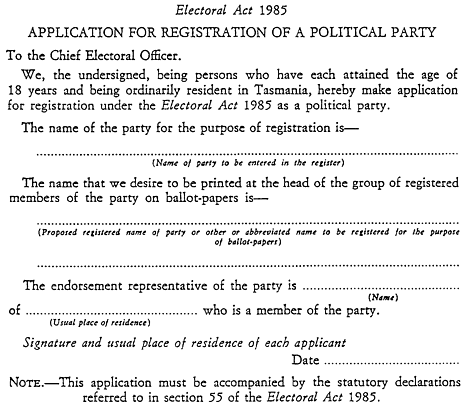
Form 2
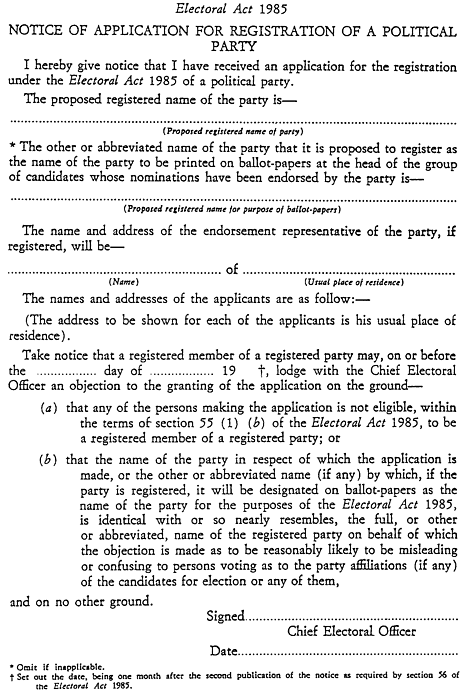
Form 3
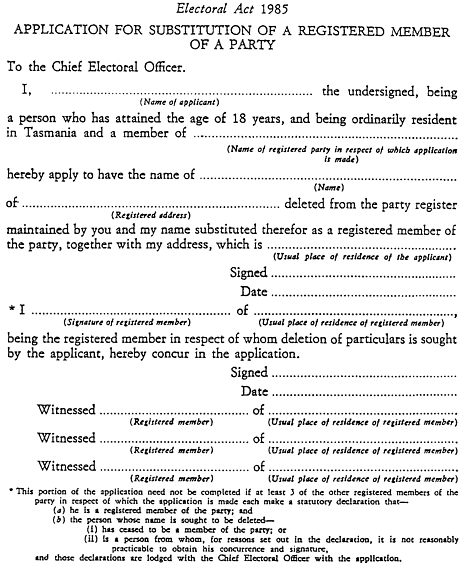
Form 4
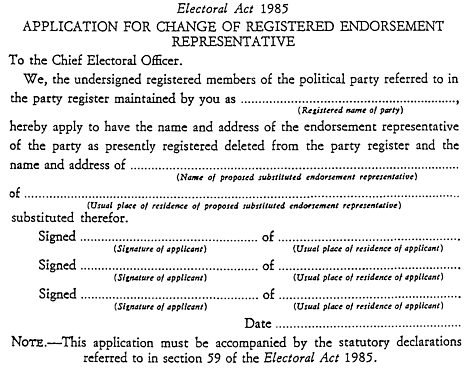
Form 5
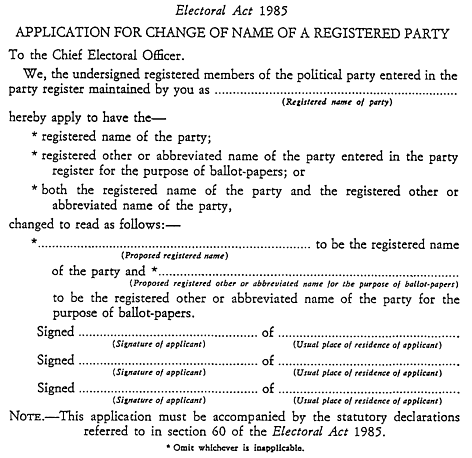
Form 6
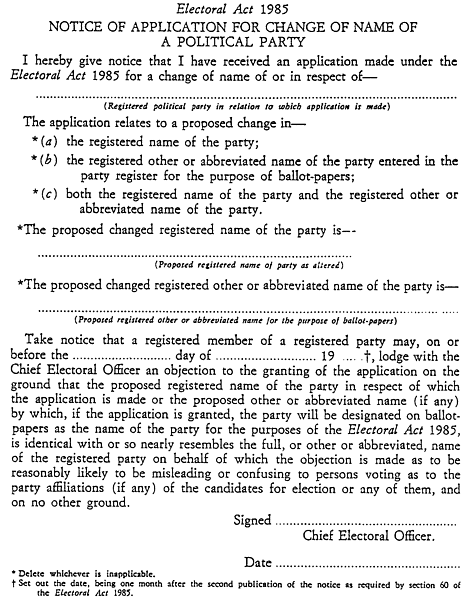
Form 7
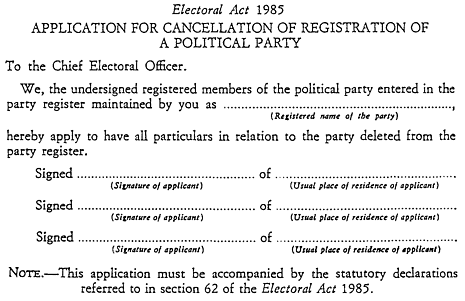
Form 8
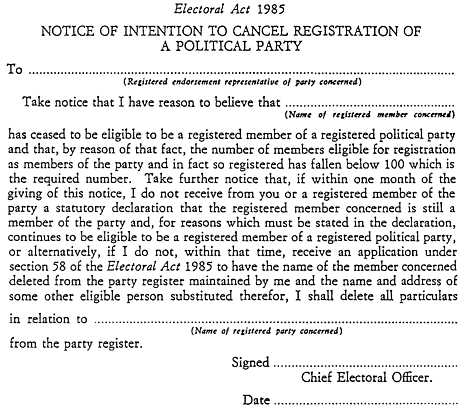
Form 9
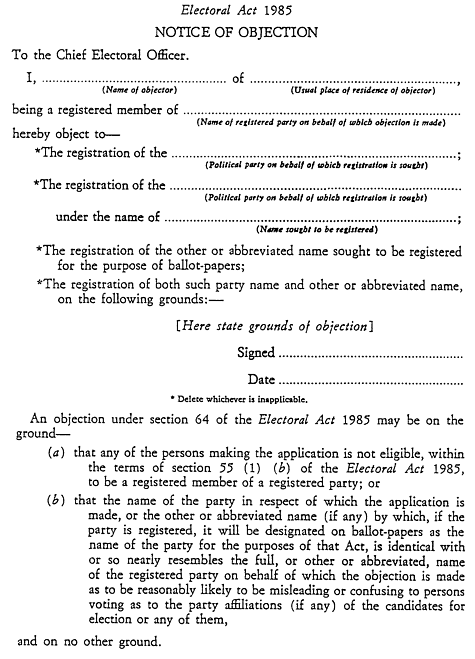
Form 10
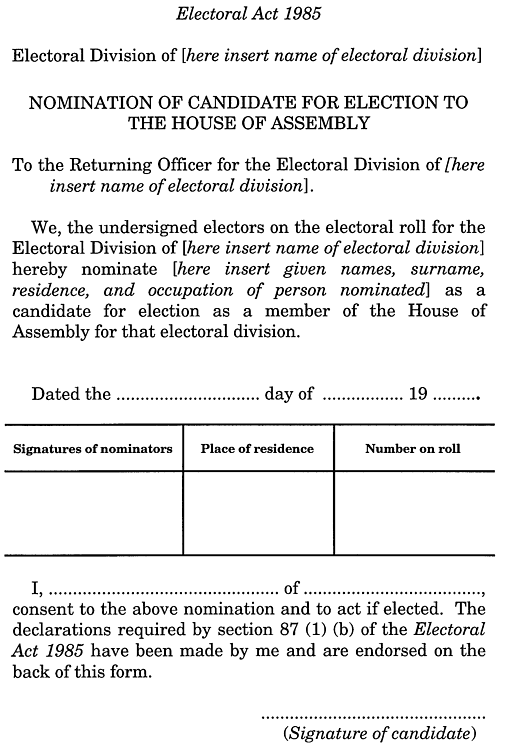
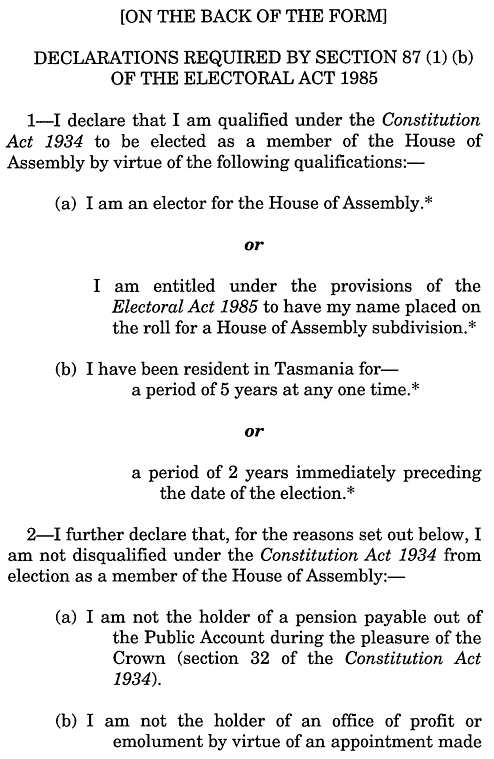
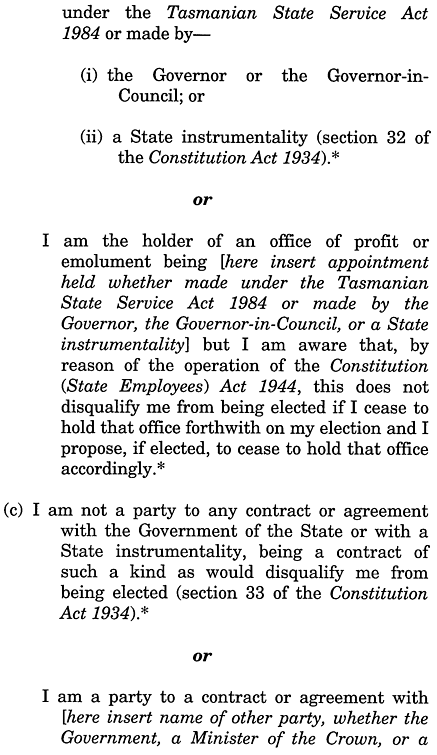
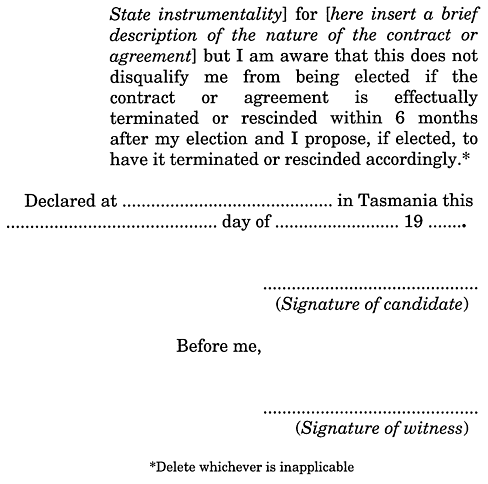
Form 11
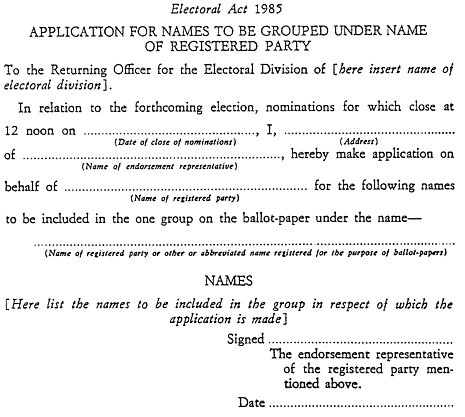
Form 12
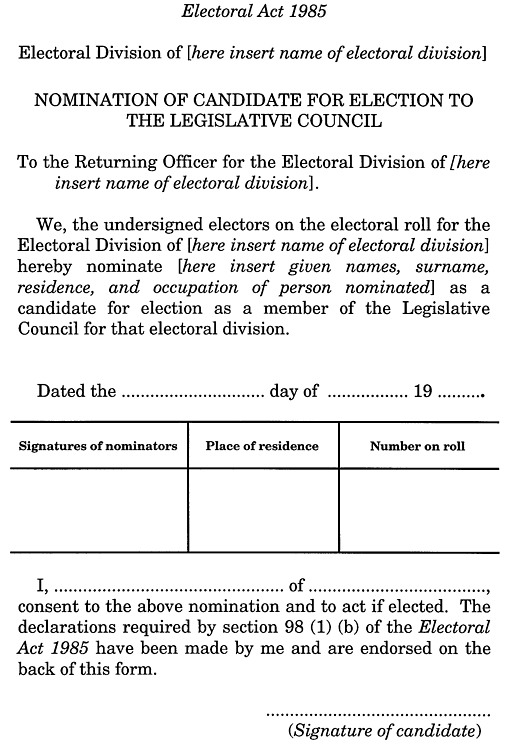
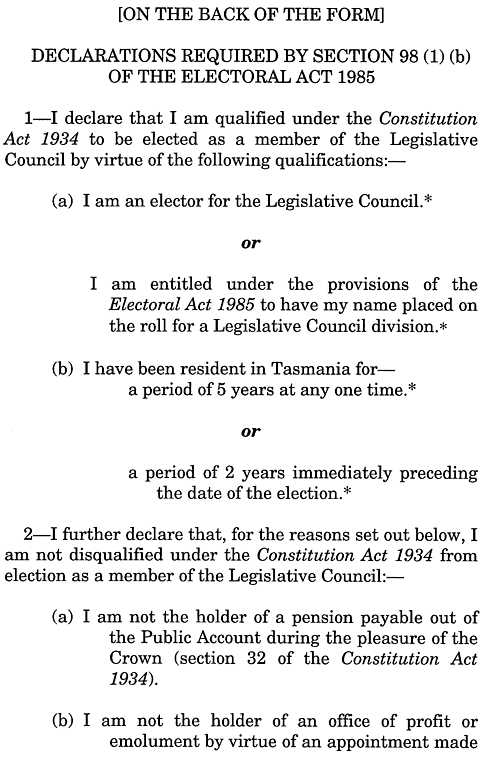
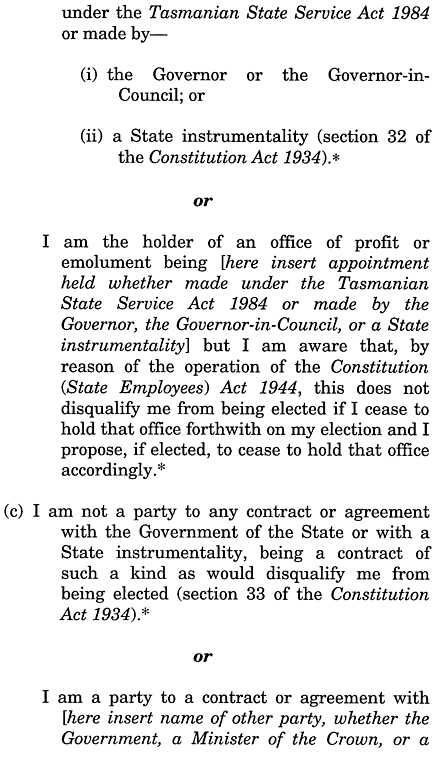
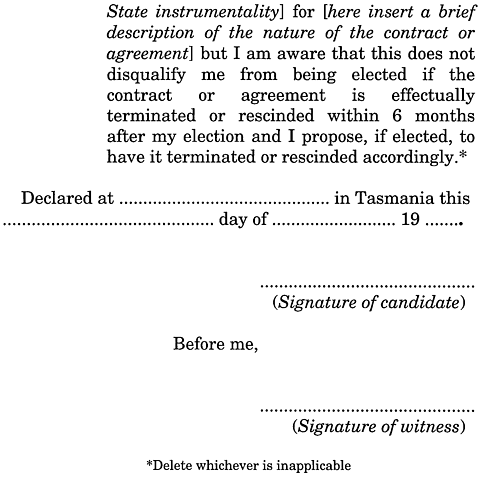
Form 13[Schedule 1 Amended by No. 31 of 1998, s. 23, Applied:28 Jul 1998]
Sections 106 (1) (a) , 139 (1) (a) , 153 (3) , 164 (5) , and 172 (4) and (6)
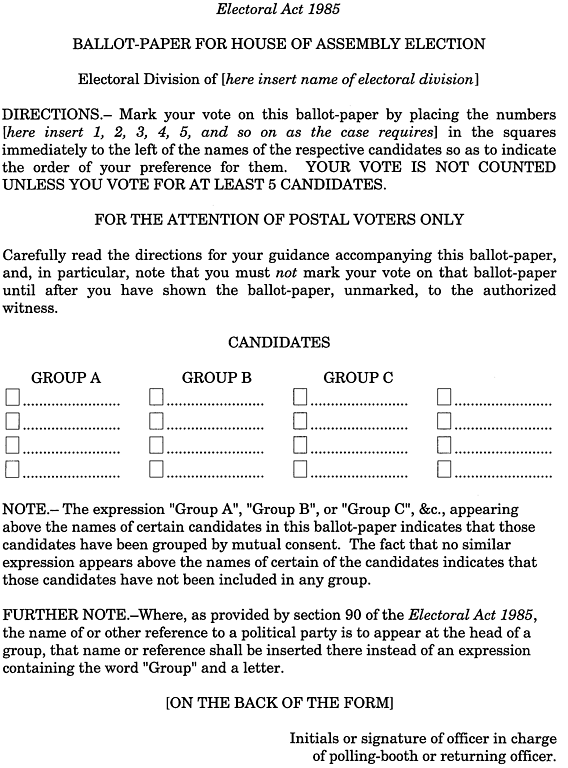
Form 14
Sections 107 (1) (a) , 139 (1) (a) , 153 (3) , and 164 (5)
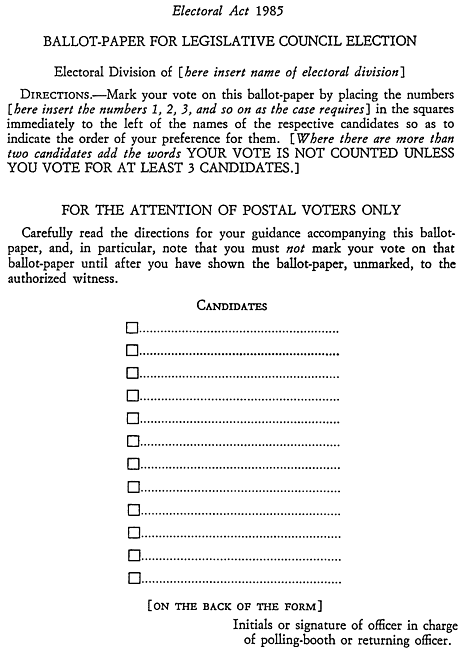
Form 15
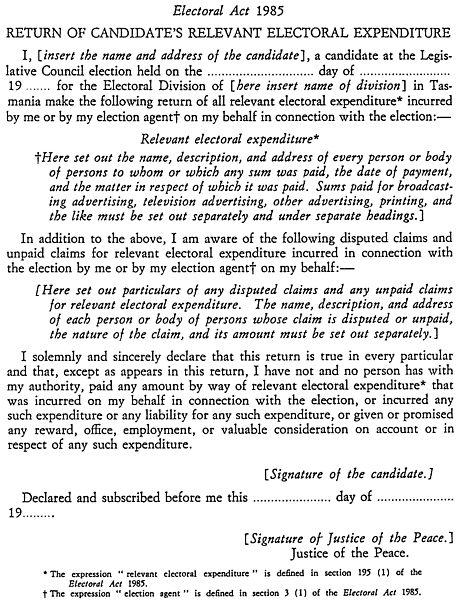
SCHEDULE 2 - Printing and Collation of Ballot-Papers[Schedule 2 Amended by No. 27 of 1996, s. 23 ]
Sections 106 (1) (b) and 107 (1) (b)
1. In this Schedule, unless the contrary intention appears –column, in relation to –(a) a ballot-paper for an Assembly election in respect of which there is no group of candidates or a ballot-paper for a Council election, means the single vertical column in which the names of the candidates are to appear on the ballot-paper;(b) a ballot-paper for an Assembly election in respect of which there is one group or more than one group of candidates and candidates whose names are not included in such a group, means –(i) any of the vertical columns in which the names of candidates included in such a group are to appear on the ballot-paper; or(ii) the vertical column in which the names of the candidates whose names are not included in such a group are to appear on the ballot-paper; or(c) a ballot-paper for an Assembly election in respect of which there is one group or more than one group of candidates and no other candidates, means any of the vertical columns in which the names of candidates included in such a group are to appear on the ballot-paper;favoured position, in relation to a column of a ballot-paper, means (reading from the top of the column) –(a) where the names of 2 candidates are to appear in the column – the first position in the column;(b) where the names of 3 candidates are to appear in the column – the first and third positions in the column;(c) where the names of 4 candidates are to appear in the column – the first and fourth positions in the column;(d) where the names of 5 candidates are to appear in the column – the first, third, and fifth positions in the column;(e) where the names of 6 candidates are to appear in the column – the first, second, fifth, and sixth positions in the column;(f) where the names of 7 candidates are to appear in the column – the first, second, sixth, and seventh positions in the column;(g) where the names of 8 candidates are to appear in the column – the first, second, seventh, and eighth positions in the column;(h) where the names of 9 candidates are to appear in the column – the first, second, eighth, and ninth positions in the column; and(i) where the names of 10 or more candidates are to appear in the column – the first, second, third, and last 3 positions in the column.
2. In relation to each candidate whose name is required to be included in the column or, as the case may be, one of the columns of a ballot-paper in accordance with section 106 or 107 –(a) there shall be printed, in respect of each of the favoured positions for that column, a batch of ballot-papers on which the name of that candidate appears in such a favoured position; and(b) the number of ballot-papers in each batch on which the name of that candidate appears in that column in a particular favoured position shall, as far as is practicable, be equal to the number of ballot-papers in each of the other batches of ballot-papers on which the name of every other candidate whose name is to be included in that column appears in that favoured position.
3. For the printing of the first batch of ballot-papers, the names of the candidates in the column or, as the case may be, in each of the columns shall be listed in a random sequence by a method determined by the Chief Electoral Officer.
4. Subject to the provisions of this Schedule, the printing order for subsequent batches shall be as prescribed by the regulations.
5. Where 6 or more names are to be included in a column, the name of a candidate shall not appear immediately above the name of a particular other candidate on more than one batch of ballot-papers where the names of both candidates would be in favoured positions in that column.
6. Before ballot-papers for an election in respect of an electoral division are distributed to returning officers, the Chief Electoral Officer shall, as far as is practicable, ensure that each issue of ballot-papers is collated in such a way that the ballot-paper immediately following another ballot-paper in the issue is in a form different from that of the other ballot-paper.
7. The officer in charge of each polling-booth at which voting for an election is taking place or, as the case may be, the returning officer or another electoral officer under Division 7 , 8 , or 9 of Part V , shall issue ballot-papers so that, as nearly as practicable, each elector who enters the polling-booth, or who applies for a ballot-paper after the first elector, is given a ballot-paper, in a form that is different from the form of the ballot-paper that was issued to the elector who immediately preceded him.
SCHEDULE 3 - Method of Counting Votes Recorded at an Assembly Election
1.(1) In this Schedule, unless the contrary intention appears –quota means the number of votes sufficient to elect a candidate at an election;second preference recorded for a candidate means the recording on a ballot-paper of the number "2" in the square opposite the name of a person whose name appears on the ballot-paper as a candidate;surplus means the number of votes which a candidate has obtained at any stage of the counting of votes in excess of the quota;transfer value means that portion of a vote which is unused by –(a) an elected candidate who has obtained a surplus; or(b) a candidate excluded on account of his being lowest on the poll and which is therefore transferred to the candidate next in the order of the elector's preference.(2) For the purposes of the definition of "transfer value" in subclause (1) , the transfer value of a vote is either one or a fraction of one.
2. The number of first preferences recorded for each candidate shall be counted.
3. The aggregate number of first preferences so recorded shall be divided by one more than the number of candidates required to be elected, and the quotient increased by one, disregarding any remainder, shall be the quota, and (except as provided in clause 11 ), no candidate shall be elected until he obtains a number of votes equal to or greater than the quota.
4. A candidate who has, after the first preferences have been counted, a number of such preferences equal to or greater than the quota shall be declared elected.
5. Where the number of first preferences obtained by a candidate is equal to the quota, the whole of the ballot-papers on which a first preference is recorded for that candidate shall be set aside as finally dealt with.
6. Where the number of first preferences obtained by a candidate is in excess of the quota, the proportion of those preferences in excess of the quota shall be transferred to the other candidates not yet declared elected, next in the order of the electors' respective preferences, in the following manner:(a) all the ballot-papers on which a first preference is recorded for the elected candidate shall be re-examined, and the number of second preferences, or, in the case provided for in clause 13 , third or next consecutive preferences, recorded for each unelected candidate shall be counted;(b) the surplus of the elected candidate shall be divided by the total number of votes obtained by him on the counting of the first preferences, and the resulting fraction shall be the transfer value;(c) the number of second or other preferences, ascertained in paragraph (a) to be recorded for each unelected candidate, shall be multiplied by the transfer value;(d) the resulting number, disregarding any fractional remainder, shall be transferred to each unelected candidate, and added to the number of votes obtained by him on the counting of the first preferences.
7.(1) Where, on the counting of the first preferences or on a transfer, more than one candidate has a surplus, the largest surplus shall be first dealt with, and if at that stage more than one candidate has a surplus, the then largest surplus shall be dealt with, and so on, but if one candidate has obtained a surplus at a count or transfer previous to that at which another candidate obtains a surplus, the surplus of the former shall be first dealt with.(2) Where 2 or more surpluses are equal, the surplus of the candidate who was the highest on the poll at the count or transfer at which they last had an unequal number of votes shall be first dealt with, and, if they have had an equal number of votes at all preceding counts or transfers, the returning officer shall decide which candidate's surplus shall be first dealt with.
8.(1) Where the number of votes obtained by a candidate is increased to a number which is equal to, or exceeds, the quota by a transfer under this Schedule, the candidate shall thereupon be declared elected.(2) In a case to which subclause (1) applies, notwithstanding the fact that the candidate may have reached the quota, the transfer shall be completed, and all the votes to which he is entitled from the transfer shall be transferred to him, but no votes of any other candidate shall be transferred to him.(3) Where the number of votes obtained by a candidate is increased to a number which is equal to the quota by a transfer under this Schedule, the whole of the ballot-papers on which such votes are recorded shall be set aside as finally dealt with.(4) Where the number of votes obtained by a candidate is increased to a number which exceeds the quota by a transfer under this Schedule, his surplus shall be transferred to the candidates next in the order of the voters' respective preferences, in the following manner:(a) the ballot-papers on which are recorded the votes obtained by the elected candidate in the last transfer shall be re-examined, and the number of third, or, in the case provided for in clause 13 , next consecutive preferences recorded for each unelected candidate counted;(b) the surplus of the elected candidate shall be divided by the total number of ballot-papers mentioned in paragraph (a) , and the resulting fraction shall be the transfer value;(c) the number of third or other preferences, ascertained in accordance with paragraph (a) as having been recorded for each unelected candidate, shall be multiplied by the last-mentioned transfer value;(d) the resulting number, disregarding any fractional remainder, shall be credited to each unelected candidate, and added to the number of votes previously obtained by him.
9.(1) Where, after the first preferences have been counted and all surpluses, if any, have been transferred as provided by this Schedule, no candidate, or less than the number of candidates required to be elected, has or have obtained the quota, the candidate who, at that time, has the least number of first preference votes transferred to him as provided by this Schedule, shall be excluded, and all the votes obtained by him shall be transferred to the candidates next in the order of the electors' respective preferences, in the same manner as provided by clause 6 .(2) The votes obtained by an excluded candidate as first preferences shall first be transferred, and, for the purposes of this Schedule, the transfer value of each of those votes shall be "1".(3) The other votes of an excluded candidate shall then be dealt with in the order of the transfers in which, and at the transfer value at which, he obtained them.(4) Each of the transfers which takes place under subclause (2) or (3) shall be deemed for all purposes to be a separate transfer.
10.(1) Where the number of votes obtained by a candidate is increased to a number which is equal to, or exceeds, the quota by a transfer under this Schedule, he shall thereupon be declared elected.(2) In a case to which subclause (1) applies, notwithstanding the fact that the candidate may have reached the quota, the transfer shall be completed, and all the votes to which the candidate is entitled from the transfer shall be transferred to him, but no other votes shall be transferred to him.(3) Where the number of votes obtained by a candidate is increased to a number of votes which is equal to, but does not exceed, the quota, by a transfer under this Schedule, the whole of the ballot-papers on which those votes are recorded shall be set aside as finally dealt with.(4) Where the number of votes obtained by a candidate is increased to a number which exceeds the quota by a transfer under this Schedule, his surplus shall be transferred to the candidates next in the order of the electors' respective preferences in the same manner as provided by clause 8 (4) , but that surplus shall not be dealt with until all the votes of the excluded candidate have been transferred.(5) Where a surplus exists, it shall be dealt with before any other candidate is excluded.
11. The process of excluding the candidate who has polled the next lowest number of votes at the election and transferring to other candidates his votes shall be repeated until all the candidates, except the number required to be elected, have been excluded, and the unexcluded candidates who have not already been so declared shall then be declared elected.
12. Where at any time it becomes necessary to exclude a candidate, and 2 or more candidates having the same number of votes, have at that time, the least number of first preference votes transferred to them as provided by this Schedule, then whichever of those candidates was recorded as having the lowest number of votes at the last count or transfer at which they had an unequal number of votes shall be first excluded, and if those candidates have had an equal number of votes at all preceding counts ortransfers, the returning officer shall decide which of those candidates shall be first excluded.
13. In determining which candidate is next in the order of an elector's preference, any candidates who have been declared elected or who have been excluded shall not be considered, and the order of the elector's preference shall be determined as if the names of those candidates had not been on the ballot-paper.
14. Where on a transfer it is found that on a ballot-paper there is no candidate opposite whose name a number is placed, other than a candidate whose name has already been either declared elected or excluded, the ballot-paper shall be set aside as exhausted.
SCHEDULE 4 - Method of Counting Votes Recorded at a Council Election
1.(1) In this Schedule, a reference to an absolute majority of votes, in relation to a candidate at an election, is a reference to a number of votes greater than one-half of the total number of ballot-papers on which electors have recorded their votes for the candidate at the election, other than exhausted and informal ballot-papers.(2) For the purposes of subclause (1) , the casting vote of the returning officer shall be taken into account in determining whether or not a candidate has an absolute majority of votes.
2. The number of first preferences recorded for each candidate shall be counted, and all informal ballot-papers shall be rejected.
3. The candidate obtaining an absolute majority of votes shall be elected.
4. If no candidate has an absolute majority of votes, the candidate who has the fewest votes shall be excluded, and each ballot-paper counted to him shall, unless exhausted, be counted to the unexcluded candidate next in the order of the elector's preference.
5. If no candidate then has an absolute majority of votes, the process of excluding the candidate who has the fewest votes and counting each of his ballot-papers, unless exhausted, to the unexcluded candidate next in the order of the elector's preferences, shall be repeated until one candidate has an absolute majority of votes.
6. Every ballot-paper, not rejected as informal, shall be counted in every count until it becomes exhausted, when it shall be rejected in all further counts.
7. When a candidate is excluded, any ballot-paper counted to him shall be deemed to be exhausted if there is not indicated on it a consecutive preference for one unexcluded candidate.
8. If on any count 2 or more candidates have an equal number of votes and one of them has to be excluded, the returning officer shall decide which is to be excluded, and if in the final count 2 candidates have an equal number of votes, the returning officer shall decide by his casting vote which of them shall be elected.
SCHEDULE 5 - Method of Filling Vacancy Arising in the House of Assembly[Schedule 5 Amended by No. 88 of 1993, s. 4 ]
1. InterpretationIn this Schedule –(a) a reference to a consenting candidate, in relation to a vacant seat in the Assembly, is a reference to a person who nominates himself for the vacant seat as provided in section 231 ;(b) a reference to the relevant election, in relation to a vacant seat, is a reference to the election last held to fill all of the seats for the Assembly division which the vacating member formerly represented in the Assembly;(c) a reference to the vacating member is a reference to the member whose seat in the Assembly has become vacant; and(d) a reference to the vacant seat is a reference to the seat of the vacating member.
2. Case where there is only one consenting candidateIf there is only one consenting candidate, the Chief Electoral Officer shall immediately –(a) declare the candidate to be duly elected as a member of the Assembly to fill the vacant seat; and(b) by writing under his hand notify to the Governor the election of the candidate.
3. Case where there are 2 or more consenting candidatesIf there are 2 or more consenting candidates, the Chief Electoral Officer shall, within 7 days after the date fixed for the receipt of nominations, proceed to ascertain in the manner provided by clause 4 , by an examination of all the completed ballot-papers counted at the relevant election for the member whose seat has become vacant and the ballot-papers directed to be counted for the vacating member as so provided, which of the consenting candidates is to be elected to fill the vacant seat.
4. Provisions to apply to determine which of 2 or more consenting candidates is to be elected(1) In this clause, a reference to the completed ballot-papers counted for the vacating member is –(a) where, after the first preferences were counted at the relevant election, the number of first preferences recorded for that member was equal to or exceeded the quota required for election to the Assembly – a reference to all the ballot-papers on which those first preferences were recorded; and(b) in any other case – a reference to all the completed ballot-papers counted for that member at the time of his election, including ballot-papers relating to votes that were transferred to him.(2) Where –so many of those votes as would have been transferred to that member of the votes of that member, if the votes of the excluded candidate had been transferred to the candidates next in the order of the electors' respective preferences, shall, for the purposes of this clause, be deemed to have been so transferred to, and to be obtained by, that member and the completed ballot-papers representing those votes shall be counted for that member.(a) the member whose seat has become vacant was, by virtue of clause 11 of Schedule 3 , declared elected at the relevant election after the candidate who was lowest on the poll at that election has been excluded from the counting; and(b) the votes obtained by the excluded candidate were not required to be transferred to the candidates next in the order of the electors' preferences –(3) The ballot-papers counted, or by subclause (2) , directed to be counted, for the vacating member shall be examined, and all the votes obtained, or deemed to have been obtained, by him shall be transferred to and counted for the consenting candidates first or next in the order of the electors' respective preferences.(4) The votes obtained as first preferences by the vacating member at the relevant election shall be transferred to the next preferred candidate at that election, with the transfer value of each of those votes determined in accordance with subclause (4A) , and the other votes (if any) of the vacating member shall then be dealt with in the order of the transfers in which they were obtained and at the transfer value determined in accordance with subclause (4B) .(4A) If the votes obtained as first preferences by the vacating member –(a) were sufficient to elect the member, the transfer value of those votes is the fraction determined by dividing the number of votes sufficient to elect the member by the total number of votes obtained by the member; or(b) were insufficient to elect the member, the transfer value of those votes is one.(4B) If the votes obtained by the vacating member at an individual count, other than the votes obtained as first preferences –(a) did not provide a sufficient number of votes to elect that member, the transfer value of the votes obtained on such a count is that at which they were obtained by the member; or(b) provided a sufficient number of votes to elect the member, the transfer value of the votes received at that count is that which would have provided the number of votes which the member required to be elected immediately prior to that count.(5) Each of the transfers which takes place under subclause (4) shall be deemed for the purposes of this Schedule to be a separate transfer.(6) For the purpose of determining which consenting candidate is first or next in the order of the electors' preferences –(a) the name of, and first choices recorded at the relevant election for, an excluded candidate who is a consenting candidate at the election to fill the vacant seat shall, for the purposes of that last-mentioned election, not be omitted from any completed ballot-papers transferred to the vacating member, but shall be counted for that consenting candidate; and(b) any candidates who were declared elected at the relevant election or who are not consenting candidates shall be disregarded and the order of the electors' preferences shall be determined as if the names of those candidates had not been included on the ballot-papers.(7) Where, in relation to a completed ballot-paper, it is found that there is no candidate opposite whose name a number has been placed other than a candidate –the ballot-paper shall be set aside as exhausted.(a) who has already been declared elected;(b) who is not a consenting candidate; or(c) whose name must, by virtue of section 187 (6) (b) , be omitted from the ballot-paper when determining the order of the electors' preferences –(8) After the number of votes in favour of each consenting candidate has been ascertained in accordance with the preceding provisions of this clause, the method of counting votes set out in Schedule 4 where one member only has to be returned for a division shall, with any necessary modifications, be applied and followed, and the Chief Electoral Officer shall declare the consenting candidate who obtains an absolute majority of the votes within the meaning of that Schedule to be duly elected to fill the vacant seat.(9) Where at any time it becomes necessary to exclude a consentingcandidate, and 2 or more consenting candidates have the same number of votes and are lowest on the poll, then whichever of those candidates was lowest on the poll at the last count or transfer at which they had an unequal number of votes shall be first excluded, and if those candidates have had an equal number of votes at all preceding counts or transfers, the returning officer shall decide which consenting candidate shall be first excluded.(10) As soon as practicable after declaring a consenting candidate to be elected as provided in subclause (8) , the Chief Electoral Officer shall by writing under his hand notify the election of that candidate to the Governor.
5. Where the seat of a member of the Assembly becomes vacant and the vacating member was himself elected under the provisions of this Schedule or of section 132A of the Electoral Act 1907 (as in force immediately before the commencement day) –(a) the Chief Electoral Officer shall, for the purpose of filling the vacancy, examine the ballot-papers that, at the relevant election, were counted for the member in whose place the vacating member was elected (including voting-papers representing votes transferred to the last-mentioned member); and(b) the foregoing provisions of this Schedule shall accordingly be construed subject to paragraph (a) .
6. A reference in this Schedule to the relevant election includes, where appropriate, a reference to an election held before the commencement day.
SCHEDULE 6 - Repeals
Year and number of Act | Short title of Act | 7 Edw. VII No. 6 | Electoral Act 1907 | No. 66 of 1974 | Electoral Act 1974 | No. 112 of 1976 | Electoral Act 1976 | No. 39 of 1979 | Electoral Amendment Act 1979 | No. 78 of 1979 | Electoral Amendment Act (No. 2) 1979 | No. 31 of 1981 | Electoral Amendment Act 1981 | No. 34 of 1983 | Electoral Amendment Act 1983 |
SCHEDULE 7 - Savings and Transitional Provisions
1. In this Schedule, repealed Act means the Electoral Act 1907 .
2. A person who, immediately before the commencement day, is holding office under the repealed Act as an officer shall, on and after that day, become an electoral officer under and subject to this Act, with the same title or designation as he had under the repealed Act .
3. All proclamations under section 14 (1) of the repealed Act that are in force immediately before the commencement day shall continue in force as if they had been made under section 13 (1) of this Act.
4. All notices under section 15 of the repealed Act that are in force immediately before the commencement day shall continue in force as if they were proclamations made under section 14 of this Act.
5.(1) The Registrar-General shall, as soon as practicable after the commencement day, forward to the electoral registrar for each electoral division, either directly or through the Chief Electoral Officer as may be arranged –(a) a list setting out the name, address, and date of death of each person who, having attained the age of 18 years but not having attained the age of 21 years, died before the commencement day and whose death was registered in the register of births and deaths in respect of the electoral division concerned; and(b) a list of the marriage of each woman who, having attained the age of 18 years but not having attained the age of 21 years, married before the commencement day and whose marriage was registered in the register of marriages in respect of the electoral division concerned.(2) A list referred to in subclause (1) (b) shall specify –(a) the former name and address of each woman mentioned in the list; and(b) the name and address of the man to whom she is married.(3) The Chief Electoral Officer shall, immediately after receiving a list referred to in subclause (1) , send a copy of any particulars included in the list to the electoral registrar for each electoral division to which the particulars relate.(4) An electoral registrar shall, on receipt of information sent to him in accordance with this clause, take appropriate action under Division 2 of Part III to effect such alterations to the electoral rolls kept by him as appear to him to be necessary.
6. All electoral rolls prepared and kept under the repealed Act in respect of Assembly subdivisions and Council divisions and in force immediately before the commencement day shall continue in force as if they had been prepared under and in accordance with Part III of this Act.
7. Any party which, immediately before the commencement day, was registered under Part VIIIA of the repealed Act and had, immediately before that commencement, not fewer than 100 members shall, on and after that day, be deemed to be registered under and subject to Part IV of this Act.
8.(1) The Governor may make regulations containing other provisions of a savings or transitional nature consequent on the enactment of this Act.(2) A provision made under subclause (1) may take effect as from the commencement day or a later day.(3) To the extent to which a provision referred to in subclause (1) takes effect from a date that is earlier than the date of its publication in the Gazette, the provision does not operate so as –(a) to affect, in a manner prejudicial to any person (other than the State or an authority of the State), the rights of that person existing before the date of its publication in the Gazette; or(b) to impose liabilities on any person (other than the State or an authority of the State) in respect of anything done or omitted to be done before the date of its publication in the Gazette.(4) A provision made under subclause (1) shall, if the regulations under this clause so provide, have effect notwithstanding the foregoing clauses of this Schedule.(5) A reference in any provision of this Act (this clause excepted) to regulations does not include a reference to regulations made under this clause.