

Fire Service (Miscellaneous) Regulations 1996
I, the Governor in and over the State of Tasmania and its Dependencies in the Commonwealth of Australia, acting with the advice of the Executive Council and on the recommendation of the State Fire Commission, make the following regulations under the Fire Service Act 1979 .
25 November 1996G. S. M. Green
Governor
By His Excellency's Command,
John Beswick
Minister for Police and Public Safety
PART 1 - Preliminary
These regulations may be cited as the Fire Service (Miscellaneous) Regulations 1996 .
These regulations take effect on the day on which their making is notified in the Gazette.
(1) In these regulations –the Act means the Fire Service Act 1979 ;permit means a permit under section 66 of the Act.(2) In these regulations, a reference to a form by number is a reference to the form so numbered in Schedule 1 .
PART 2 - Administrative
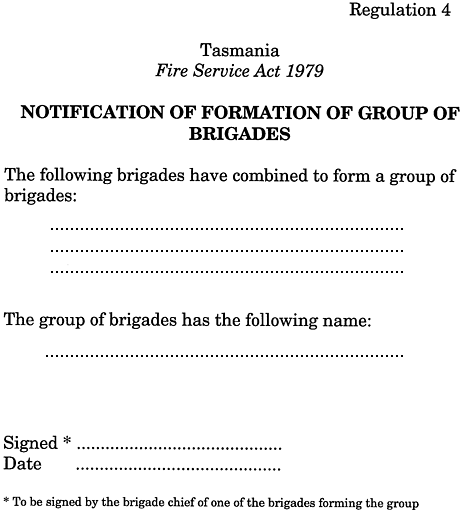
4. Notification of formation of group of brigades
A notification under section 33(2) of the Act of the formation of a group of brigades is to be in accordance with Form 1 .
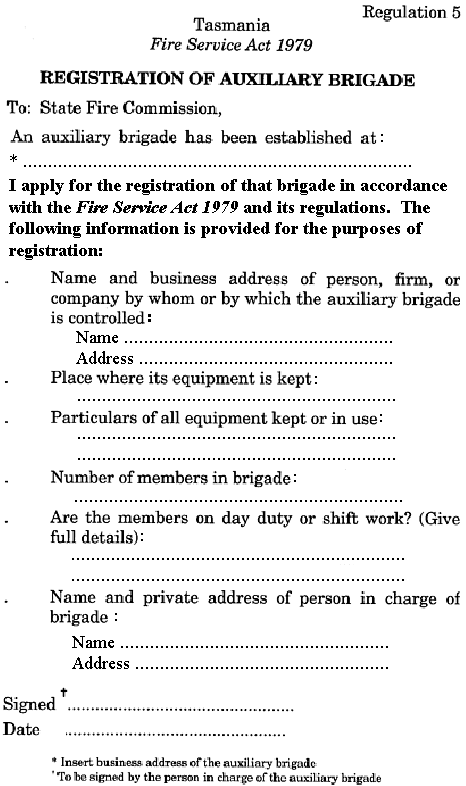
5. Registration of auxiliary brigades
(1) [Regulation 5 Subregulation (1) amended by No. 37 of 2001, s. 9, Applied:01 Jul 2001] Registration of an industry fire brigade is to be effected by lodging with the Commission a notice in accordance with Form 2 .(2) [Regulation 5 Subregulation (2) amended by No. 37 of 2001, s. 9, Applied:01 Jul 2001] The person in charge of a registered industry brigade must, within 7 days of any change occurring in the information contained in the notice referred to in subregulation (1) , give the Commission notice and particulars of the change.Penalty: Fine not exceeding 5 penalty units.
6. Equipment of auxiliary brigades
(1) [Regulation 6 Subregulation (1) amended by No. 37 of 2001, s. 9, Applied:01 Jul 2001] A stand-pipe, coupling and hose used by an industry brigade is to be of the same type or pattern as those used by the brigade for the operational district in which the industry brigade is established or, if the industry brigade is not established in an operational district, of such type or pattern as may be approved by the Commission.(2) [Regulation 6 Subregulation (2) amended by No. 37 of 2001, s. 9, Applied:01 Jul 2001] The person in charge of an industry brigade must, within 7 days after any equipment is received or disposed of by that brigade, give the Commission notice and particulars of the receipt or disposal.Penalty: Fine not exceeding 5 penalty units.
(1) The Commission may grant a person a special gratuity in recognition of voluntary or special service rendered by the person to a brigade or group of brigades.(2) A special gratuity is not to exceed $100 unless the Commission, because of exceptional circumstances in any particular case, approves of the payment of a special gratuity of a greater sum.
8. Reimbursement of volunteer expenses
(1) A volunteer who incurs out-of-pocket expenses in the course of fire-fighting duties is entitled, on the recommendation of the Chief Officer, to be reimbursed by the Commission.(2) The amount reimbursed is, in each case, at the discretion of the Commission.
9. Prescribed superannuation scheme under section 24(6)
For the purposes of section 24(6) of the Act, the State Fire Commission Superannuation Scheme Pty. Ltd. is a prescribed superannuation scheme.
PART 3 - Fire safety
10. Land and premises to which section 48 applies
The classes of land and premises specified in Schedule 2 are prescribed as the classes of land and premises to which section 48 of the Act applies.
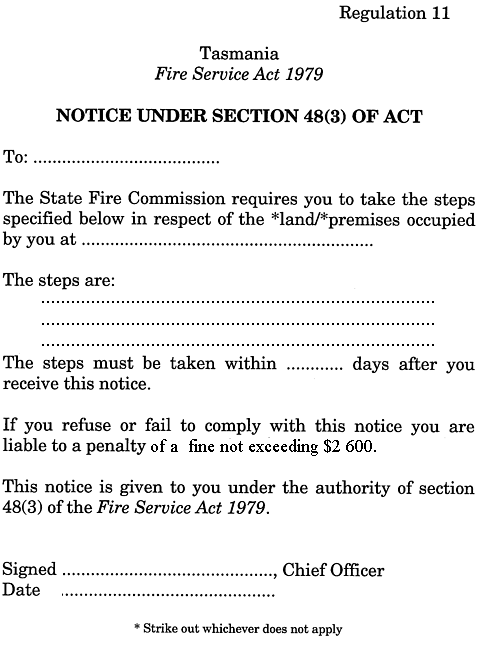
11. Prescribed notice under section 48(3)
A notice under section 48(3) of the Act is to be in accordance with Form 3 .
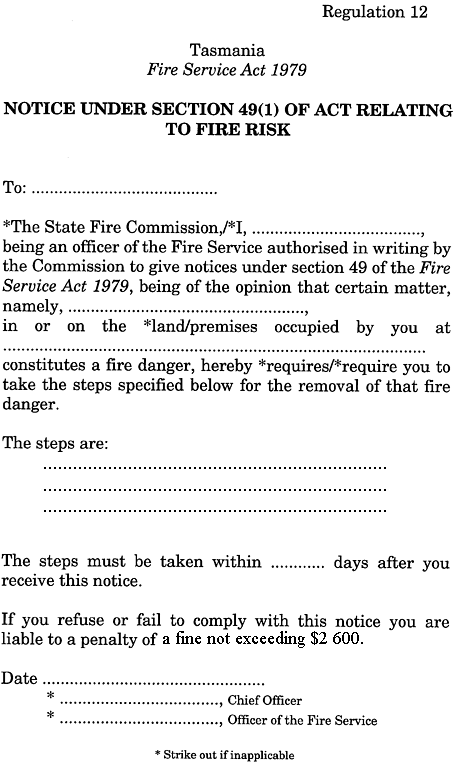
12. Prescribed notice under section 49(1)
A notice under section 49(1) of the Act is to be in accordance with Form 4 .
13. Certain premises to be equipped with fire-fighting tools
(1) The occupier of premises that are used as a wood fuel mill, sawmill or forest products landing must –(a) if the premises are situated within a reticulated water area – cause those premises to be equipped with fire hydrants and hoses sufficient to cover the whole area of operation of the mill or landing; or(b) if the premises are situated within a non-reticulated water area – cause those premises to be equipped with the following fire-fighting equipment:(i) a knapsack pump, with a capacity of not less than 9 litres, which is in good order and condition and filled with water;(ii) a slash hook or pulaski;(iii) a fire rake or grubbing hoe;(iv) a clean receptacle containing not less than 180 litres of water and provided with a means of transferring the water; or(c) if the premises are used as a forest products landing for a forest products harvesting operation requiring specialised equipment to bring forest products to that landing - cause the premises to be equipped with the following fire-fighting equipment:(i) a mobile tank containing not less than 300 litres of water;(ii) a self-priming centrifugal pump producing a pressure of not less than 400 kPa at shut-off with hoses and fittings to the specification of the Commission;(iii) 2 rake hoes.Penalty: Fine not exceeding 26 penalty units.(2) The occupier of any premises referred to in subregulation (1) must –(a) cause every chain-saw used on or in connection with those premises to be provided with a knapsack pump or charged airwater extinguisher which –(i) has a capacity of not less than 9 litres; and(ii) is in good operating condition; and(iii) is filled with water; and(iv) is kept within 100 metres of the place where the chain-saw is being used or carried on associated logging machinery; and(b) cause a fire break to be made around those premises which is –(i) sufficient to isolate the premises from the surrounding vegetation; and(ii) cleared to bare earth.Penalty: Fine not exceeding 26 penalty units.
14. Operation of solid fuelled engines in the open
(1) A person must not operate a solid fuelled engine outside an enclosed building on a day that is declared under section 70 of the Act to be a day of total fire ban.Penalty: Fine not exceeding 26 penalty units.(2) A person may operate a solid fuelled engine outside an enclosed building on a day other than a day that is declared under section 70 of the Act to be a day of total fire ban subject to the following conditions:(a) that the dumping of coals or ash is confined to an area defined by a member of the Fire Service who is authorised for that purpose;(b) that the ash box of the engine is constructed so that burning material cannot escape except when the coals and ash are cleared out in the area referred to in paragraph (a) ;(c) that an approved spark arrestor is fitted to the smoke stack;(d) that any other requirements which may be specified by a member of the Fire Service are met.
15. Inspection of engines and appliances
An engine or appliance of a kind referred to in section 132(2)(a) of the Act may be inspected by –(a) the Chief Officer; or(b) a fire officer; or(c) if the engine or appliance is situated within a locality declared to be a fire protected area under section 53 of the Act – a forest officer.
16. Inspection of fire hydrants and fire plugs
A brigade chief of a brigade–(a) may cause the fire hydrants and fire-plugs within the brigade's operational district to be inspected as often as the brigade chief considers necessary; and(b) must take immediate action to correct any faults found in, or repair any damage done to, those fire hydrants and fire-plugs.
17. Fires for burning, &c., wood waste, &c. from use of sawmills and factories
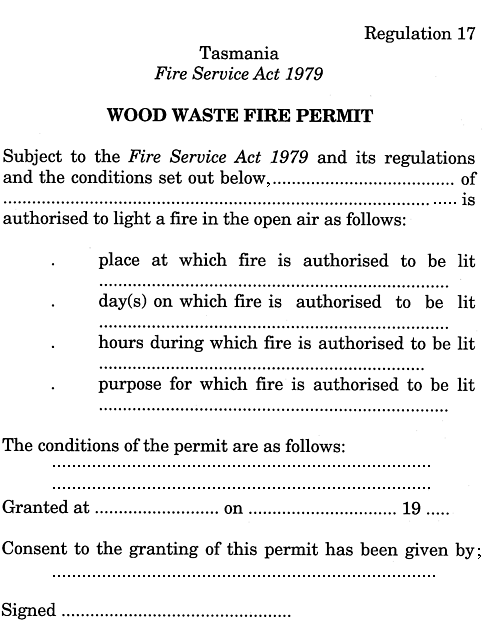
(1) A person must not, during a fire permit period, light, maintain or use in the open air a fire for the purpose of burning or destroying wood waste or other flammable material resulting from the operation of premises used as a sawmill or factory otherwise than under the authority of a permit in accordance with Form 5 granted for that purpose by a fire permit officer.Penalty: Fine not exceeding 26 penalty units.(2) A permit under subregulation (1) to light, maintain or use in the open air a fire referred to in that subregulation is –(a) in an operational district – to be granted with the consent of, and subject to such conditions as may be determined by, the brigade chief of the brigade operating within that operational district; or(b) in any other area – to be granted with the consent of, and subject to such conditions as may be determined by, the Chief Officer.(3) Without limiting subregulation (2) , a brigade chief or the Chief Officer may determine that a permit under subregulation (1) is to include a condition that –(a) if the burning or destruction of any wood waste or other flammable material is done in a pit – the surface of the burning materials is to be at least 1.5 metres below the level of the top of the pit; or(b) if that burning or destruction is done on the surface of the ground – the site of the fire is to be enclosed by a fence constructed of solid non-flammable material and at least 2 metres high.(4) A permit under subregulation (1) may be revoked or amended at the direction of the Chief Officer or the brigade chief of the brigade operating in the operational district in respect of which the permit was granted.(5) A person to whom a fire permit officer refuses to grant a permit under subregulation (1) may appeal to the Commission.(6) The Commission, as soon as practicable after receiving an appeal under subregulation (5) , is to –(a) investigate the appeal; and(b) determine the appeal on such conditions as it considers desirable; and(c) furnish the appellant with written notice of its determination with respect to the appeal.
18. Notices to be given by holders of permits under section 66
(1) In this regulation,public authority means a public authority which is responsible for the construction or maintenance of any transmission line, road or railway.(2) The holder of a permit must, before lighting a fire in the open air that he or she is authorised by the permit to light during a fire permit period, give notice orally or in writing of the intention to light such a fire –(a) if the fire to be lit is on land outside an operational district – to the owner or occupier of any land –(i) adjoining or adjacent to, whether separated by a road or a watercourse or not, the land on which the fire is to be lit; and(ii) the boundaries of which are less than 1.5 kilometres from the place where the fire is to be lit; and(b) if the fire to be lit is on land within an operational district – to the owner or occupier of any land adjoining, whether separated by a road or watercourse or not, the land on which the fire is to be lit.Penalty: Fine not exceeding 26 penalty units.(3) Where a notice of intention to light a fire under subregulation (2) is given orally, it is to be given within 14 days of the day on which the fire is to be lit.(4) Where a notice of intention to light a fire under subregulation (2) is given in writing, it is –(a) in the case of a notice delivered into the hands of the owner or occupier to whom the notice is to be given pursuant to that subregulation – to be delivered not less than 4 hours and not more than 14 days before the day on which the fire is to be lit; or(b) in the case of a notice delivered to a person other than such an owner or occupier – to be delivered not less than 24 hours and not more than 14 days before the day on which the fire is to be lit.(5) The onus of proving that a notice under this regulation was given and delivered within the periods specified in subregulation (3) or (4) lies on the holder of the permit.(6) A permit may exempt a holder of the permit from giving notice under subregulation (2) of intention to light a fire if the fire permit officer is satisfied –(a) that the owner or occupier to whom notice is to be given pursuant to that subregulation cannot be given notice by reason of the absence of that owner or occupier; and(b) on information received from the brigade chief of the brigade which is based closest to the land on which the fire is to be lit – that all reasonable precautions to prevent the spread of fire have been taken and that the fire is not likely to escape on to the land of that owner or occupier.(7) Where a fire permit officer exempts a holder of a permit from giving notice of intention to light a fire, the fire permit officer is to endorse the permit accordingly.(8) Where the holder of a permit is a public authority, it is taken to comply with subregulation (2) if it –(a) gives at least 7 days' public notice of its intention to light the fire which it is authorised by the permit to light during a fire permit period; and(b) gives to the council of the municipal area in which it intends to light such a fire at least 7 days' notice, in writing, of its intention to light the fire.(9) For the purposes of subregulation (8)(a) , public notice of intention to light a fire –(a) is to be given by advertisement in the Saturday edition of a daily newspaper published or circulating in the relevant region; and(b) is to set out clearly the places at which the fire is to be lit, the nature of the vegetation to be cleared by the fire and the period during which the fire is to be lit.
19. Dealing with appeals against refusal to grant permit
The Commission, as soon as practicable after an appeal is made under section 66(9) of the Act, is to –(a) investigate that appeal; and(b) determine that appeal on such conditions as it considers desirable; and(c) furnish the appellant with written notice of its determination with respect to his appeal.
20. Fires to which section 69 applies
[Regulation 20 Amended by S.R. 1997, No. 147, Applied:12 Nov 1997] A fire that is lit, maintained or used for the purpose of burning domestic garden refuse, where the burning is done in heaps not exceeding one cubic metre in volume or in an incinerator, is prescribed as a class of fire for the purposes of section 69 of the Act.
PART 4 - Miscellaneous
A person must not use a badge issued by the Fire Service for a purpose that is not authorised by the Commission or Chief Officer.Penalty: Fine not exceeding 26 penalty units.
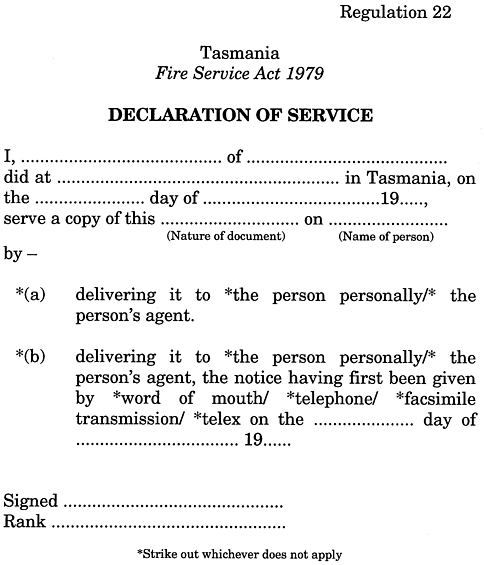
(1) In this regulation,notice means a notice or other document or writing required or authorised by the Act to be served on, or given to, a person.(2) For the purposes of section 116(1)(d) of the Act, a notice may be served on, or given to, a person by –(a) word of mouth; or(b) telephone; or(c) facsimile transmission; or(d) telex.(3) A person who serves or gives a notice in a manner prescribed by subregulation (2) must, as soon as practicable after serving or giving that notice, serve on or give to the relevant person or, where applicable, the person's agent, the appropriate notice in accordance with section 116(1)(a) or (b) of the Act.Penalty: Fine not exceeding 5 penalty units.(4) A person who serves or gives a notice in the manner prescribed by section 116(1)(a) of the Act must –(a) retain a copy of the notice; and(b) endorse on, or attach to, that copy a declaration of service in accordance with Form 6 ; and(c) complete that declaration of service.Penalty: Fine not exceeding 5 penalty units.(5) A person who serves or gives a notice in the manner prescribed by subregulation (2) must –(a) retain a copy of the notice given pursuant to subregulation (3) (other than a notice sent by certified mail service); and(b) comply with the requirements of subregulation (4)(b) and (c) .Penalty: Fine not exceeding 5 penalty units.
The regulations specified in Schedule 3 are rescinded.
SCHEDULE 1 - Forms
Form 1
Form 2
Form 3
Form 4
Form 5
Form 6
SCHEDULE 2 - Classes of land and premises to which section 48 applies
1. InterpretationIn this Schedule,used means used wholly or partly.
2. Land and premisesAny building in which persons are employed or engaged, directly or indirectly –(a) in any handicraft; or(b) in the manufacture, preparation or packaging of goods, articles or foodstuffs for sale; or(c) in connection with a trade.
3. Any place of assembly as defined in section 54 of the Public Health Act 1962 .
4. Any building used –(a) as a shop, restaurant, beauty salon or rest-room; or(b) for the purposes of any other business, commercial or professional undertaking or calling.
5. Any building used for back-packer accommodation or as a guest-house, boarding-house or hostel.
6. Any building used for the purposes of a club, association or community organisation.
7. Any building used as a school residence or for the accommodation of pupils or teachers at any school.
8. Any building used –(a) as a hospital, sanatorium or rest home; or(b) as the staff quarters of a hospital, sanatorium or rest home.
9. Any building in which dangerous or flammable goods or substances are manufactured, processed, or stored.
10. [Schedule 2 Amended by No. 2 of 1998, Sched. 3, Applied:01 Jul 2000] . . . . . . . .
11. Any building used as an orphanage, home for children or day nursery.
12. Any building that is divided into flats or apartments.
13. Any land, building or premises on or in which motor vehicles are usually or occasionally parked.
14. [Schedule 2 Amended by No. 49 of 1999, Sched. 2, Applied:01 Feb 2000] Any detention centre within the meaning of the Youth Justice Act 1997 .
SCHEDULE 3 - Regulations rescinded
Fire Service Regulations 1981 (Statutory Rules 1981, No. 84) | Fire Service Amendment Regulations (No. 2) 1981 (Statutory Rules 1981, No. 275) | Fire Service Amendment Regulations 1982 (Statutory Rules 1982, No. 196) | Fire Service Amendment Regulations 1983 (Statutory Rules 1983, No. 4) | Fire Service Amendment Regulations (No. 2) 1983 (Statutory Rules 1983, No. 210) | Fire Service Amendment Regulations 1984 (Statutory Rules 1984, No. 92) | Fire Service Amendment Regulations (No. 2) 1984 (Statutory Rules 1984, No. 175) | Fire Service Amendment Regulations 1985 (Statutory Rules 1985, No. 19) | Fire Service Amendment Regulations (No. 2) 1985 (Statutory Rules 1985, No. 220) | Fire Service Amendment Regulations 1986 (Statutory Rules 1986, No. 239) | Fire Service Amendment Regulations (No. 2) 1986 (Statutory Rules 1986, No. 244) | Fire Service Amendment Regulations 1988 (Statutory Rules 1988, No. 13) | Fire Service Amendment (Insurance Levy) Regulations 1990 (Statutory Rules 1990, No. 186) | Fire Service Amendment Regulations 1991 (Statutory Rules 1991, No. 28) | Fire Service Amendment Regulations (No. 2) 1991 (Statutory Rules 1991, No. 163) | Fire Service Amendment Regulations 1992 (Statutory Rules 1992, No. 69) | Fire Service Amendment Regulations 1993 (Statutory Rules 1993, No. 51) | Fire Service Amendment Regulations (No. 2) 1993 (Statutory Rules 1993, No. 104) | Fire Service Amendment Regulations (No. 3) 1993 (Statutory Rules 1993, No. 257) | Fire Service Amendment Regulations 1995 (Statutory Rules 1995, No. 45) |
Displayed and numbered in accordance with the Rules Publication Act 1953.
Notified in the Gazette on 4 December 1996
These regulations are administered by the Tasmania Fire Service.