

Trade Measurement (Weighbridges) Regulations 2000
I, the Governor in and over the State of Tasmania and its Dependencies in the Commonwealth of Australia, acting with the advice of the Executive Council, make the following regulations under the Trade Measurement Act 1999 .
28 August 2000g. s. m. green
Governor
By His Excellency's Command,
p. patmore
Minister for Justice and Industrial Relations
PART 1 - Preliminary
These regulations may be cited as the Trade Measurement (Weighbridges) Regulations 2000 .
These regulations take effect on the day on which their making is notified in the Gazette.
In these regulations, unless the contrary intention appears –Act means the Trade Measurement Act 1999 ;approved means approved by the administering authority;certificate of suitability, in relation to a weighbridge, means a certificate issued by the administering authority for the purposes of section 50(1)(a) of the Act to the effect that the weighbridge is suitable for use as a public weighbridge;end-and-end measurement means the determination of a measurement relating to a vehicle (whether loaded or not) by adding together separate measurements of the mass supported singly or in combination by the different axles of the vehicle, those separate measurements having been determined by separate operations of a weighbridge;licence means a public weighbridge licence;operator means the person who personally determines a measurement by use of a weighbridge;public weighing means the use of a weighbridge by or on behalf of the public or for which a charge is made.
These regulations have effect in addition to, and do not derogate from, any other regulations under the Act relating to measuring instruments generally.
PART 2 - Requirements for weighbridges used for trade
This Part applies to weighbridges used for trade (including public weighbridges).
A weighbridge must be so situated that –(a) there is sufficient room for a vehicle using the weighbridge to move on and off without turning on the platforms; and(b) its headwork is protected from wind and rain by an office or other adequate means; and(c) water or debris from the surrounding area does not accumulate on the platforms or in the pit.
A weighbridge must –(a) provide the operator with a clear view of the platforms; and(b) have the indicator that is used by the operator located not more than 6 metres from the edge of the platforms or in some other approved position; and(c) in the case of a road weighbridge, have an indicator in such a position that the mass displayed on it may easily be read by the driver of a vehicle using the weighbridge.
A weighbridge must have approaches that –(a) are in the same plane as the platforms for a minimum distance of –(i) 3 metres if the length of the platforms is less than 18 metres; or(ii) 1 metre if the length of the platforms is 18 metres or more; and(b) have a hard, true and durable surface of concrete or other approved material; and(c) are arranged so that drainage from the surface does not flow into the pit.
(1) The platforms of a weighbridge must be of concrete or steel, or both, or be of other approved materials.(2) Unless exempted under subregulation (3) , a weighbridge must be provided with guard rails or other suitable means to prevent vehicles from moving onto or off the platform otherwise than from end to end.(3) The administering authority may exempt a weighbridge from compliance with subregulation (2) .
If a weighbridge has a pit –(a) the entrance to the pit must be covered and be at least 1 metre deep and 900mm wide; and(b) the neck of the pit must be at least 900mm wide; and(c) there must be a clearance of at least 150mm on each side of a lever in the neck of the pit; and(d) there must be free access to every part of the underwork and –(i) if free access is available from above to every part of the underwork, there must be a clearance of at least 150mm below all parts of the underwork; or(ii) in any other case, there must be a clearance of at least 400mm below the lowest lever; and(e) the pit must be free-draining or be provided with automatic mechanical drainage and be kept free from any accumulation of water, mud and debris.
If a weighbridge does not have a pit –(a) there must be a clearance of at least 150mm under the lowest live part of the platforms; and(b) the floor between load cell supports must be of concrete at least 75mm thick and must be effectively drained and kept free from any accumulation of water, mud and debris; and(c) there must be in the same plane as, or lower than, the floor a clear space of at least 1 metre from the external edges of the frame; and(d) the load cell footings must be individually and mutually stable.
12. Weighbridge with electronic devices
If a weighbridge is equipped with electronic devices –(a) they must be protected from electrical interference and the rays of the sun; and(b) the data plate of the load cells must have such access as is necessary to enable it to be read with ease.
13. Multi-platform weighbridge
In a multi-platform weighbridge –(a) any dead space between platforms must not exceed 2 metres; and(b) the platforms must not interfere with each other so as to affect their operation; and(c) a visual summing indicator must be provided.
If a weighbridge is portable –(a) there must be a clearance of at least 150mm under the lowest live part of the platforms; and(b) it must have a base that is stable when the weighbridge is in use; and(c) the headwork and exposed levers must have adequate protection; and(d) the ground under the platform must be treated to prevent the growth of foliage and must be kept free from any accumulation of water, mud and debris.
PART 3 - Certificate of suitability (Public weighbridges)
15. Issue of certificate of suitability
(1) A licensee may apply for a certificate of suitability for a weighbridge by lodging at the office of the administering authority the fee prescribed under the Administration Act and an approved form of application.(2) On receipt of an application for a certificate of suitability, the administering authority is to arrange for an inspector to examine the weighbridge.(3) The administering authority is to issue a certificate of suitability for the weighbridge if an inspector examines it and finds that –(a) it is suitable for use as a public weighbridge because of its type, capacity and strength and the size of its platforms; and(b) it is so positioned that a vehicle using it may enter and leave the platforms without reversing; and(c) it otherwise complies with the requirements of these regulations.
16. Duration of certificate of suitability
(1) Except during any period of suspension, or unless it is sooner surrendered or cancelled, a certificate of suitability remains in force –(a) until the end of the period of 12 months that next succeeds its date of issue; or(b) as provided by subregulation (2) .(2) If application is made for a new certificate of suitability before, but not more than one month before, the date that is 12 months after the date of issue of its predecessor but is not finally dealt with before that later date, the previous certificate continues in force until the new certificate is issued or the application is refused.(3) The date of issue of a new certificate of suitability is to be considered to be the date that is 12 months after the date of issue of its predecessor (even if it is issued before or after that later date) and the new certificate is to be dated accordingly.(4) If a weighbridge is re-located, its certificate of suitability ceases to have effect.
17. Duplicate certificate of suitability
(1) If the administering authority is satisfied that a certificate of suitability has been lost, destroyed or made useless by damage, the administering authority may, on payment of the fee prescribed under the Administration Act for a duplicate certificate, issue a duplicate of the certificate.(2) A duplicate certificate issued under subregulation (1) has the same effect as the original certificate.
18. Suspension or cancellation of certificate of suitability
(1) The administering authority may, by notice in writing served on the licensee personally or by post, suspend the certificate of suitability for a weighbridge if the administering authority, after examination of the weighbridge by an inspector, is of the opinion that any application for a new certificate for the weighbridge made at the time of the examination would have been refused.(2) The administering authority may terminate a suspension after a further examination of the weighbridge by an inspector and payment of the fee prescribed under the Administration Act for the further examination.(3) Termination of a suspension may be effected unconditionally or after compliance with specified conditions, whether or not including conditions as to time for compliance.(4) If conditions imposed under subregulation (3) , or added or amended under paragraph (a) , are not complied with, the administering authority may, by notice in writing served on the licensee personally or by post –(a) amend or add to the conditions; or(b) cancel the certificate of suitability.(5) The administering authority may, instead of suspending a certificate of suitability, impose conditions subject to which the certificate will continue in force, including a condition requiring a further examination of the weighbridge and payment of the fee prescribed under the Administration Act for the further examination.
19. Return of cancelled certificate
If a certificate of suitability issued to a licensee is cancelled, the licensee (whether or not still holding a licence) must deliver the certificate to the licensing authority not later than 7 days after its cancellation.Penalty: Fine not exceeding 2 penalty units.
20. Register of certified weighbridges
The administering authority is to maintain a register of weighbridges for which a certificate of suitability is current and is to enter in the register –(a) the location of the weighbridge and particulars of its certification; and(b) a number allotted by the administering authority as the registered number for the weighbridge; and(c) such other particulars as the administering authority considers appropriate.
PART 4 - Public weighbridges - licensees and operators
It is a condition of a licence that the licensee –(a) must do everything that the Act and these regulations require to be done by the licensee; and(b) must not do anything that the Act and these regulations require the licensee to refrain from doing.
22. Sign and certificate to be exhibited
A licensee must exhibit in view of the public at each weighbridge made available under the authority of the licence –(a) words and figures not less than 100mm high and of proportionate breadth, and in clear contrast with their background, that read "Registered Public Weighbridge No." showing the registered number; and(b) properly protected, the certificate of suitability for the weighbridge.
23. Tare books and measurement tickets
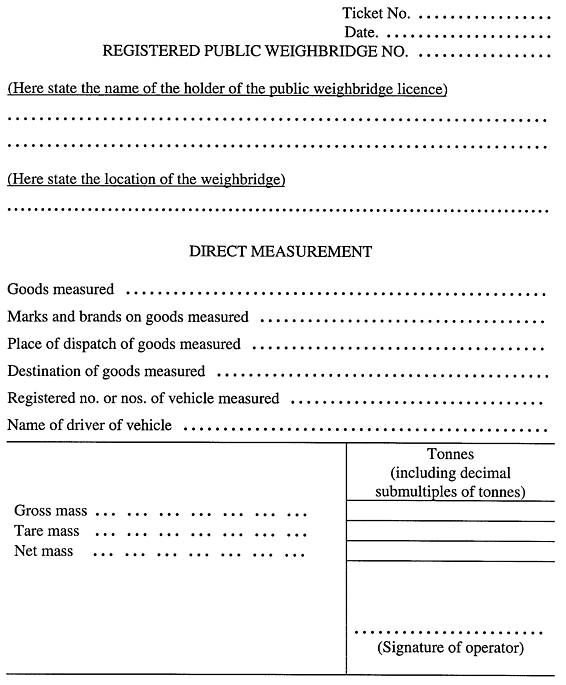
(1) A licensee must provide at each weighbridge made available under the authority of the licence –(a) tare mass books in accordance with Forms 1 and 2 in Schedule 2; and(b) measurement tickets in accordance with Forms 1-4 in Schedule 3.(2) The measurement tickets provided by a licensee –(a) must be printed and bound in books, or provided in approved pads, containing original tickets and provision for at least one copy of each original; and(b) must be numbered consecutively with each copy ticket bearing the same number as its original; and(c) must have the word "original" printed on each original ticket and the word "duplicate" on each copy ticket.(3) The licensee must ensure that a copy of the relevant measurement ticket is issued to a customer of the licensee and the licensee must retain for at least 12 months the original of the measurement ticket (whether or not a copy of it has been issued) and all unissued copy tickets.(4) A licensee must, immediately after a pad of measurement tickets has been completely used, permanently make up in book form (by stapling or other suitable means) all originals and copies retained under subregulation (3) from the used pad.(5) A licensee must, on being required by an inspector to do so, produce original and copy tickets retained under subregulation (3) .
24. General duties of licensee
A licensee who makes a weighbridge available as a public weighbridge must ensure that –(a) the weighbridge is kept truly balanced, that the platforms are kept clean and that the space between the frame and the platforms is kept free from obstructions; and(b) measurement of a vehicle or livestock brought to the weighbridge is not refused during normal trading hours in the area unless the capacity of the weighbridge is insufficient or advance payment of the charge is required but not made; and(c) due care is exercised in determining a measurement by use of the weighbridge; and(d) entries are made in the tare mass book, and measurement tickets are completed and copies issued, with due care and in accordance with these regulations; and(e) on demand made at the weighbridge at any reasonable time by an inspector or other interested person, there is produced the original of any measurement ticket relating to a measurement made by use of the weighbridge during the preceding 12 months; and(f) the administering authority is informed, and the weighbridge is withdrawn from use, if the licensee knows, or has reason to believe, that a measurement made by use of the weighbridge would be incorrect.
An operator of a public weighbridge must not –(a) fail to comply with a requirement of Schedule 1 when the weighbridge is in use for public weighing; or(b) alter the original of a measurement ticket after a copy of it has been issued; or(c) issue a measurement ticket that is not a correct copy of the original; or(d) remove from a book, or issue, the original of a measurement ticket; or(e) remove, or permit to be removed, from a book an unused or cancelled measurement ticket; or(f) use the weighbridge for public weighing when he or she knows, or has reason to believe, that the weighbridge is incorrect.Penalty: Fine not exceeding 20 penalty units.
26. Notification by licensee of change of particulars
A licensee must notify the licensing authority in writing of –(a) any change in the address for the service of notices on the licensee; and(b) the full name and residential address of each person who commences or ceases to be employed by the licensee to operate any weighbridge made available under the authority of the licence, and must do so not later than 14 days after the event.
27. Vehicle registration weighing – exemption from licensing, &c.
(1) If a public weighbridge is used only to measure the tare mass of a vehicle for registration purposes, that use is not to be considered to be use as a public weighbridge for the purposes of section 43 of the Act so long as –(a) the operator of the weighbridge issues a written statement of the mass measured; and(b) that statement is marked with the words "FOR REGISTRATION PURPOSES ONLY" in prominent capital letters at least 5mm high.(2) Regulation 25 does not apply to the operator of a weighbridge to which subregulation (1) applies.
For the purposes of section 47 of the Act, the prescribed particulars to be kept in a register by the licensing authority in respect of each licence are as follows:(a) the number of the licence and the date of its issue;(b) the name of the licensee and the address at which notices may be served personally on the licensee;(c) particulars of any conditions to which the licence is subject imposed under section 48 of the Act;(d) such other particulars as the licensing authority thinks desirable.
PART 5 - End-and-end weighing
29. Prohibited for public weighbridges
If a public weighbridge is used for public weighing to determine an end-and-end measurement, the licensee and operator of the public weighbridge are each guilty of an offence.Penalty: Fine not exceeding 20 penalty units.
30. Restrictions in other cases
(1) A person must not use for trade a weighbridge in order to determine an end-and-end measurement unless subregulation (2) is complied with.Penalty: Fine not exceeding 20 penalty units.(2) This subregulation is complied with if –(a) use of the weighbridge is not use for public weighing; and(b) the wheelbase of the vehicle concerned is –(i) longer than the length of the platform of the weighbridge or, if the weighbridge has 2 or more platforms, the total of the lengths of the platforms; and(ii) shorter than the sum of the length, or total length, found under subparagraph (i) and the length of the shorter, or, if their lengths are the same, of either, of the approaches to the platform or platforms; and(c) the approaches have a smooth and level surface which is paved with concrete or other approved material and is in the same horizontal plane as the top of the platform or platforms; and(d) the perimeter of the approaches is clearly indicated by painted marks or by other approved means; and(e) at all times during the measuring –(i) the wheels on one or more of the axles are located on the platform or platforms and the wheels on the other axles are located within the indicated perimeter of the approaches; and(ii) the brakes, gears and any other means capable of restricting the free movement of the vehicle are disengaged.
PART 6 - Miscellaneous
31. Fraudulent activities of licensee or operator
A licensee or operator of a weighbridge must not –(a) knowingly permit, assist in, or connive at, a fraud in connection with the measurement of anything by using the weighbridge or the issue of a measurement ticket; or(b) make, or connive at the making of, a representation known by the licensee or operator to be false with respect to the measurement of anything by means of the weighbridge; or(c) knowing of any fraudulent proceeding in connection with the measurement of anything by means of the weighbridge, fail to impart that knowledge to an inspector as soon as practicable.Penalty: Fine not exceeding 20 penalty units.
SCHEDULE 1 - Duties of operator of public weighbridge
1. Due care to be exercisedAn operator is to exercise due care in the performance of his or her functions under the Act and these regulations.
2. Entry in tare mass bookAn operator who measures the tare mass of a vehicle without issuing a measurement ticket is to immediately enter in the tare mass book consecutively in the order in which each tare mass is measured the particulars required by the form of the book.
3. Measurement tickets - completion and issue(1) An operator –(a) is to complete and issue a measurement ticket only in the form appropriate for the measurement made and in accordance with the particulars required by the form and these regulations; and(b) is to, except in the case of a tare mass entered in the tare mass book, complete a measurement ticket in its numerical order in the book or pad immediately after finding a measurement by use of the weighbridge; and(c) is to issue a measurement ticket immediately after its completion unless it is required to be retained after cancellation or for issue under clause 5(2)(a) of this Schedule; and(d) is not to complete or issue a measurement ticket except for the purpose of complying with paragraph (b) or (c) or clause 5(2)(a) of this Schedule; and(e) on completing a measurement ticket for 2 linked but separately registered vehicles, is to enter the registration figures and letters for both vehicles; and(f) is to include in each measurement shown on a measurement ticket for a vehicle the measurement of the load supported by all axles.(2) An operator who makes an error in completing a measurement ticket is to forthwith cancel, and retain in the book or pad, the measurement ticket and the duplicate or duplicates forming part of the book or pad.(3) An operator is to, by the use of carbon paper or other effective means, make each duplicate that forms part of a book or pad of measurement tickets an exact copy of the original of the ticket completed by the operator.(4) An operator is not to issue a measurement ticket that includes any matter additional to that required by these regulations unless the additional matter –(a) appears in a margin, at the foot, or on the reverse side, of the ticket; and(b) is not inconsistent with, and does not qualify, the meaning or accuracy of the information on the ticket.
4. Issue of measurement ticket – tare mass onlyAn operator who issues a measurement ticket recording only the tare mass of a vehicle is to alter the measurement ticket –(a) by striking out the words "gross mass" and "net mass" on the ticket and writing in their place the words "tare mass only"; and(b) by stamping across the face of the ticket the words "TARE MASS ONLY" in prominent capital letters not less than 5mm high.
5. Issue of measurement ticket – loaded vehicle(1) An operator who measures the mass of a loaded vehicle of which the tare mass has been determined is to immediately complete, and issue a copy of, an appropriate measurement ticket.(2) An operator who measures the mass of a loaded vehicle of which the tare mass has not been determined is to –(a) immediately record the gross mass on the next consecutive measurement ticket and issue a ticket only after the tare mass of the vehicle has been determined; or(b) issue a measurement ticket on which the gross mass has been recorded after –(i) striking out the words "tare mass" and "net mass" on the ticket and writing in their place the words "gross mass only"; and(ii) stamping across the face of the ticket the words "GROSS MASS ONLY" in prominent capital letters not less than 5mm high.(3) An operator is not to enter tare mass on the measurement ticket for a loaded vehicle unless the operator copies the tare mass from –(a) an entry made in the tare mass book; or(b) a tare mass measurement ticket issued under clause 4 , not more than 24 hours earlier, by the same operator or another operator using the same weighbridge or another weighbridge on the same premises.
6. Axle load measurement(1) If the measurement to be made is not an end-and-end measurement but is only for the purpose of issuing a measurement ticket showing each load supported by separate axles, or groups of axles, of a vehicle, the operator of the weighbridge is to ensure that subclause (2) is complied with.(2) This subclause is complied with if –(a) the approaches to the weighbridge have a smooth and level surface which is paved with concrete or other approved material and is in the same horizontal plane as the top of the platform or platforms; and(b) the perimeter of the approaches is clearly indicated by painted marks or by other approved means; and(c) at all times during the measuring –(i) the wheels on one or more of the axles are located on the platform or platforms and the wheels on the other axles are located within the indicated perimeter of the approaches; and(ii) the brakes, gears and other means capable of restricting the free movement of the vehicle are disengaged.
7. Copies of measurement tickets(1) If required to do so by –the operator of the weighbridge is to, on payment of the licensee's fee, supply a copy of the measurement ticket.(a) a buyer or seller of goods of which the measurement has been found by use of a weighbridge; or(b) any other person who has an interest in the goods –(2) An operator is not to supply a copy of a ticket under subclause (1) unless the copy complies with subclause (3) or (4).(3) A copy of a measurement ticket complies with this subclause if it is supplied from a book or pad of measurement tickets after being amended –(a) by striking out its number and writing nearby the words "Copy of ticket No. " (quoting the number of the ticket of which it is a copy); and(b) by stamping across the face of the ticket the words "COPY ONLY" in prominent capital letters not less than 5mm high.(4) A copy of a measurement ticket complies with this subclause if it is issued from a book or pad printed in a form approved for the purpose of making those copies that includes on its face the words "COPY ONLY" in prominent capital letters not less than 5mm high.(5) Except for any requirement as to time, and except for an inconsistency with this clause, these regulations apply in relation to a copy measurement ticket in the same way as they apply to the ticket of which it is a copy.
8. Inspector may require measurement to be madeAn operator, if required to do so by an inspector exercising the functions of an inspector, is to make without charge a measurement relating to a loaded or unloaded vehicle.
SCHEDULE 2 - Forms of tare mass book
Form 1
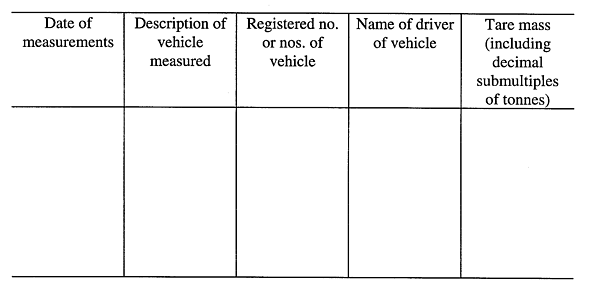
Form 2
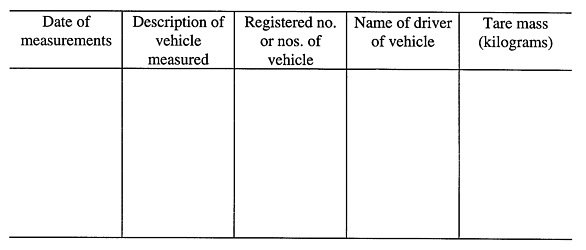
SCHEDULE 3 - Forms of measurement tickets
Form 1
Form 2
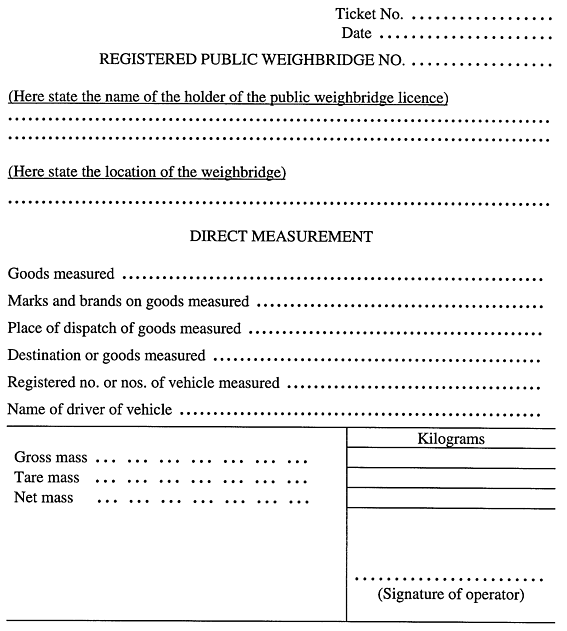
Form 3
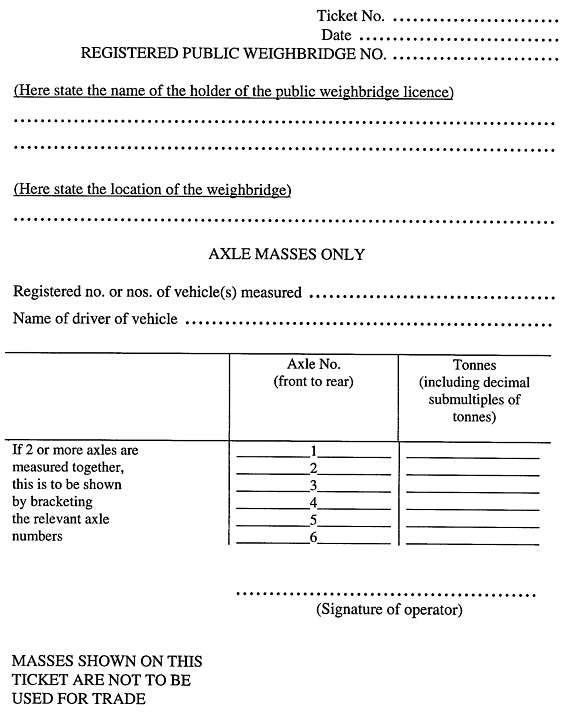
Form 4
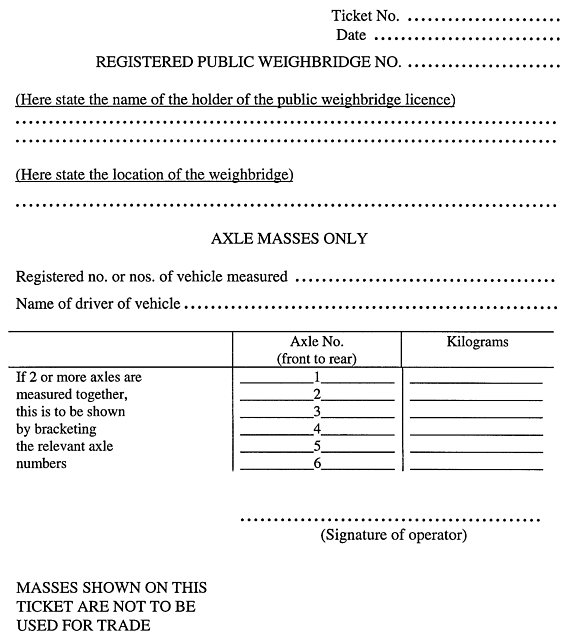
Displayed and numbered in accordance with the Rules Publication Act 1953.
Notified in the Gazette on 6 September 2000
These regulations are administered in the Department of Justice and Industrial Relations.