

Gaming Control Act 1993
An Act to establish a system for the licensing, supervision and control of casinos and to regulate their use and operation, to establish a system for the supervision and control of gaming machines and keno and to regulate their use and operation and to provide for other matters
Be it enacted by His Excellency the Governor of Tasmania, by and with the advice and consent of the Legislative Council and House of Assembly, in Parliament assembled, as follows:
PART 1 - Preliminary
This Act may be cited as the Gaming Control Act 1993 .
This Act commences on the day on which it receives the Royal Assent.
(1) [Section 3 Subsection (1) amended by No. 46 of 1996, s. 4 ]In this Act, unless the contrary intention appears –[Section 3 Subsection (1) amended by No. 102 of 1999, s. 4, Applied:22 Dec 1999] amend means –(a) insert matter; and(b) omit matter; and(c) omit matter and substitute other matter;[Section 3 Subsection (1) amended by No. 102 of 1999, s. 4, Applied:22 Dec 1999] approved game means a game approved under section 76ZZF ;approved gaming equipment means gaming equipment of a type approved by the Commission under section 80 or 81 ;[Section 3 Subsection (1) amended by No. 102 of 1999, s. 4, Applied:22 Dec 1999] approved location means premises specified in a gaming endorsement in which the licensed provider may undertake a gaming activity authorised by the endorsement;[Section 3 Subsection (1) amended by No. 102 of 1999, s. 4, Applied:22 Dec 1999] approved rules means rules of an approved game that have been approved under section 76ZZF ;[Section 3 Subsection (1) amended by No. 102 of 1999, s. 4, Applied:22 Dec 1999] approved sports event means a sports event declared under subsection (8) to be an approved sports event;approved venue means premises on which a venue operator is licensed to conduct gaming;[Section 3 Subsection (1) amended by No. 102 of 1999, s. 4, Applied:22 Dec 1999] authorised deposit-taking institution means a body corporate that is an authorised deposit-taking institution for the purposes of the Banking Act 1959 of the Commonwealth;authorized person means –(a) a Commissioner; or(b) an inspector; or(c) a person appointed by the Commission in writing to be an authorized person for the purposes of this Act;casino means premises, or part of premises, defined as a casino for the time being under section 15 ;casino employee means a special employee having functions in or in relation to a casino;casino licence means a licence granted and in force under section 13 or 28 ;casino operator means a person who is a holder of a casino licence;chips means any tokens, other than gaming tokens, used instead of money for the purpose of gaming;Commission means the Tasmanian Gaming Commission established under section 123 ;Commissioner means a member of the Commission;[Section 3 Subsection (1) amended by No. 102 of 1999, s. 4, Applied:22 Dec 1999] competitor includes participant;computer cabinet means the sealed section in a gaming machine which contains the game programme storage medium and the Random Access Memory;[Section 3 Subsection (1) amended by No. 102 of 1999, s. 4, Applied:22 Dec 1999] computer server means a computer that is capable of one or more of the following:(a) communicating with another computer;(b) generating a simulated game;(c) providing to that other computer –(i) access to a database; or(ii) transaction-based services; or(iii) software applications;[Section 3 Subsection (1) amended by No. 102 of 1999, s. 4, Applied:22 Dec 1999] control system means a system of internal controls, and administrative and accounting procedures, for the conduct of a gaming business by a licensed provider;decision, in relation to the Commission, includes determination;Deed means the Deed made between The Federal Hotels Limited, Australian National Hotels Limited, Tasmanian Country Club-Casino Proprietary Limited and the Crown in right of the State of Tasmania, a copy of which is set out in Schedule 1 ;[Section 3 Subsection (1) amended by No. 102 of 1999, s. 4, Applied:22 Dec 1999] device includes any electrical, electronic or mechanical machine;electronic monitoring system means any dial-up or on-line real time electronic, computer or communications system or device that is so designed that it may be used, or adapted, to send or receive data from gaming equipment in relation to the security, accounting or operation of gaming equipment;employ includes engage under a contract for services;exclusion order means an order under section 105 prohibiting a person from entering, or remaining in, a casino;existing licence means a licence to operate a casino granted and in force under a repealed Act;[Section 3 Subsection (1) amended by No. 102 of 1999, s. 4, Applied:22 Dec 1999] fee unit has the same meaning as in the Fee Units Act 1997 ;[Section 3 Subsection (1) amended by No. 102 of 1999, s. 4, Applied:22 Dec 1999] fixed odds wagering endorsement means an endorsement contained in a Tasmanian gaming licence that authorises the activities specified in section 76T ;[Section 3 Subsection (1) amended by No. 102 of 1999, s. 4, Applied:22 Dec 1999] fixed odds wagering event means a real horse race, real harness race and real greyhound race;[Section 3 Subsection (1) amended by No. 102 of 1999, s. 4, Applied:22 Dec 1999] game means a game of chance or a game that is partly a game of chance and partly a game requiring skill but does not include any major lottery, pools or prescribed game;gaming means the playing of a game for money or other reward, whether by means of a gaming machine or otherwise;[Section 3 Subsection (1) amended by No. 102 of 1999, s. 4, Applied:22 Dec 1999] gaming Act means –(a) the Racing and Gaming Act 1952 ; and(b) the TT-Line Gaming Act 1993 ; and(c) the Casino Company Control Act 1973 ; and(d) an Act of the Commonwealth or another State or a Territory that is similar in effect to this Act or the Racing and Gaming Act 1952 ; and(e) subordinate legislation under any Act referred to in paragraph (a) , (b) , (c) or (d) ;[Section 3 Subsection (1) amended by No. 102 of 1999, s. 4, Applied:22 Dec 1999] gaming activity means the wagering in a contingency relating to any sports event, fixed odds wagering event, simulated game, major lottery, pools or prescribed event if that event, game, major lottery, pools or prescribed event is not a prohibited gaming activity;gaming area means a casino or any area in licensed premises to which a licensed premises gaming licence relates approved by the Commission for the conduct of gaming;[Section 3 Subsection (1) amended by No. 102 of 1999, s. 4, Applied:22 Dec 1999] gaming business means the business of a licensed provider conducted under the authority of a Tasmanian gaming licence in respect of a gaming endorsement;[Section 3 Subsection (1) amended by No. 102 of 1999, s. 4, Applied:22 Dec 1999] gaming endorsement means –[Section 3 Subsection (1) amended by No. 102 of 1999, s. 4, Applied:22 Dec 1999](a) a sports betting endorsement; and(b) a fixed odds wagering endorsement; and(c) a simulated gaming endorsement; and(d) a major lottery endorsement; and(e) a prescribed endorsement;[Section 3 Subsection (1) amended by No. 102 of 1999, s. 4, Applied:22 Dec 1999] gaming equipment means –(a) linked jackpot equipment and an electronic monitoring system; and(b) an electronic, electrical or mechanical device specifically designed, customised or installed for use in connection with gaming or a gaming activity; and(c) computer software specifically designed, customised or installed for use in connection with gaming or a gaming activity; and(d) any other device used, or capable of being used, for or in connection with gaming or a gaming activity; and(e) a part of, or a replacement part for, gaming equipment;gaming machine means any device, whether wholly or partly mechanically or electronically operated, that is so designed that –(a) it may be used for the purpose of playing a game; and(b) as a result of making a wager on the device by the insertion of a gaming token, winnings may become payable;gaming machine game means a game designed to be played on a gaming machine and identifiable from all other games by differences in rules or programming;gaming machine type means a type of gaming machine, including the computer cabinet and computer hardware and software, on which a range of games may be played without any alteration to the gaming machine other than the substitution of a new game programme or an alteration to the information or artwork displayed on the gaming machine;gaming operation means any activity authorized by a gaming operator's licence;gaming operator means the holder of a gaming operator's licence;gaming operator's licence means a licence granted and in force under section 13 or 28 ;gaming token means Australian currency or any token, credit or any other thing that enables a wager to be made on a gaming machine;[Section 3 Subsection (1) amended by No. 102 of 1999, s. 4, Applied:22 Dec 1999] greyhound race means a race between greyhound dogs in pursuit of a moving object;[Section 3 Subsection (1) amended by No. 102 of 1999, s. 4, Applied:22 Dec 1999] gross profit, in relation to keno, simulated games, gaming machine games and games approved under section 103 , means the gross profit calculated in accordance with section 136 ;[Section 3 Subsection (1) amended by No. 102 of 1999, s. 4, Applied:22 Dec 1999] harness race means a race between horses with a pacing or trotting gait;[Section 3 Subsection (1) amended by No. 102 of 1999, s. 4, Applied:22 Dec 1999] horse race means a race between horses with a galloping gait;inspector means a person appointed under section 128 to be an inspector for the purposes of this Act;jackpot means a winning entitlement to the whole or a part of a special prize pool;[Section 3 Subsection (1) amended by No. 11 of 1998, s. 4, Applied:22 May 1998] keno means a game in which a person wagers –(a) that certain numbers selected by that person will be among a group of numbers randomly selected from a total pool of 80 numbers; or(b) on the outcome of the numbers randomly selected from a total pool of 80 numbers;law enforcement agency means –(a) the police force of this or any other State or of a Territory; or(b) the Australian Federal Police; or(c) the National Crime Authority; or(d) any other authority or person responsible for the enforcement of the laws of the Commonwealth or of this or any other State or of a Territory;licensed operator means a casino operator or a gaming operator;licensed premises means premises in respect of which a licence under the Liquor and Accommodation Act 1990 is in force authorizing the sale of liquor for consumption on the premises –(a) to members of the public, other than in conjunction with the provision of meals; or(b) to members of the club specified in the licence, a person introduced to the club by a member in accordance with the rules of the club or a person who is a member of the club by reason of a reciprocal arrangement with another club;licensed premises gaming licence means a licence granted and in force under section 42 ;licensed premises gaming operator means the person who is the holder of a licensed premises gaming licence;[Section 3 Subsection (1) amended by No. 102 of 1999, s. 4, Applied:22 Dec 1999] licensed provider means a person who holds a Tasmanian gaming licence;licensed technician means a person who is the holder of a licence in force under Division 4 of Part 4 ;linked jackpot arrangement means an arrangement whereby 2 or more gaming machines or other prescribed machines are linked to a device that –(a) records from time to time an amount which may be payable, or part of which may be payable, as a jackpot; and(b) for the purpose of recording the amount referred to in paragraph (a) , receives data from each machine to which the device is linked; and(c) is not capable of affecting the outcome of a game on a machine to which the device is linked;linked jackpot equipment means any jackpot meter, payout display, linking equipment, computer equipment, programming or other device (other than a gaming machine) forming, or capable of forming, part of a linked jackpot arrangement;liquor has the same meaning as in the Liquor and Accommodation Act 1990 ;[Section 3 Subsection (1) amended by No. 102 of 1999, s. 4, Applied:22 Dec 1999] lottery has the meaning given by section 4A ;[Section 3 Subsection (1) amended by No. 102 of 1999, s. 4, Applied:22 Dec 1999] major lottery has the meaning given by section 4B ;[Section 3 Subsection (1) amended by No. 102 of 1999, s. 4, Applied:22 Dec 1999] major lottery endorsement means an endorsement contained in a Tasmanian gaming licence that authorises the activities specified in section 76V ;money clearance means the removal of money, chips or gaming tokens from a drop box;non-licensed premises means premises in respect of which a licence may be granted under the Liquor and Accommodation Act 1990 authorising the sale of liquor for consumption on the premises –(a) to members of the public, other than in conjunction with the provision of meals; or(b) to members of the club specified in the licence, a person introduced to the club by a member in accordance with the rules of the club or a person who is a member of the club by reason of a reciprocal arrangement with another club;operations, in relation to a casino, means –(a) the conduct of gaming in the casino; or(b) other matters affecting or arising out of, activities in the casino;[Section 3 Subsection (1) amended by No. 102 of 1999, s. 4, Applied:22 Dec 1999] player means a person who wagers on any approved sports event, fixed odds wagering event, simulated game, major lottery or pools, otherwise than as a licensed provider or the employee of a licensed provider;[Section 3 Subsection (1) amended by No. 102 of 1999, s. 4, Applied:22 Dec 1999] pools means football pools and other similar pools prescribed in the regulations;prescribed duties –(a) in relation to a special employee, means duties associated with the conduct of gaming specified by the Commission in accordance with subsection (6) ; and(b) in relation to a technician, means duties associated with the installation and operation of gaming equipment specified by the Commission in accordance with subsection (6) ;[Section 3 Subsection (1) amended by No. 102 of 1999, s. 4, Applied:22 Dec 1999] prescribed endorsement means an endorsement of a kind prescribed in the regulations that is contained in a Tasmanian gaming licence that authorises the activities specified in section 76W ;[Section 3 Subsection (1) amended by No. 102 of 1999, s. 4, Applied:22 Dec 1999] prescribed event means an event, or an event of a class, prescribed in the regulations in respect of a prescribed endorsement;prohibited device means a device –(a) used or intended to be used for interfering with the normal operation of gaming equipment; or(b) used or intended to be used for the purpose of enabling a person to count or otherwise record cards dealt in the course of gaming in a casino;[Section 3 Subsection (1) amended by No. 102 of 1999, s. 4, Applied:22 Dec 1999] prohibited gaming activity means any game, major lottery or pools declared by the Minister under subsection (7) to be a prohibited gaming activity;public interest or interest of the public means public interest or interest of the public having regard to the creation and maintenance of public confidence and trust in the credibility, integrity and stability of the conduct of gaming;[Section 3 Subsection (1) amended by No. 102 of 1999, s. 4, Applied:22 Dec 1999] real means not simulated;record includes any book, account, document, paper or other source of information compiled, recorded or stored in written form, or on microfilm, or by electronic process, or by any other means;[Section 3 Subsection (1) amended by No. 102 of 1999, s. 4, Applied:22 Dec 1999] registered company auditor means a person registered as an auditor, or taken to be so registered, under Part 9.2 of the Corporations Law;[Section 3 Subsection (1) amended by No. 102 of 1999, s. 4, Applied:22 Dec 1999] registered player, in relation to a licensed provider, means a person registered as a player with that provider under section 76ZU ;[Section 3 Subsection (1) amended by No. 102 of 1999, s. 4, Applied:22 Dec 1999] regulations means regulations made and in force under this Act;repealed Act means any Act referred to in Schedule 4 ;[Section 3 Subsection (1) amended by No. 11 of 1998, s. 4, Applied:22 May 1998][Section 3 Subsection (1) amended by No. 11 of 1998, s. 4, Applied:22 May 1998] restricted gaming area means a physically discrete area within an approved venue which minors must not enter and which is devoted primarily to the conduct of gaming;Roll means the Roll of Recognized Manufacturers and Suppliers of Gaming Equipment maintained under section 70 ;[Section 3 Subsection (1) amended by No. 102 of 1999, s. 4, Applied:22 Dec 1999] self-exclusion notice means a notice given under section 76ZL(1) ;sell includes offer for sale;[Section 3 Subsection (1) amended by No. 102 of 1999, s. 4, Applied:22 Dec 1999] simulated game means a computer-generated simulated game, other than keno or a lottery, where –(a) a prize consisting of money or something else of value is offered or can be won under the rules of the game; and(b) a player –(i) enters the game or takes any step in the game by means of a telecommunications device; and(ii) pays a monetary payment or other valuable consideration to participate in the game; and(c) the winner of a prize is decided wholly or partly by chance;[Section 3 Subsection (1) amended by No. 102 of 1999, s. 4, Applied:22 Dec 1999] simulated gaming endorsement means an endorsement contained in a Tasmanian gaming licence that authorises the activities specified in section 76U ;special employee means a person holding a licence in force under Division 3 of Part 4 ;special prize pool means a prize pool established for the payment of jackpots;[Section 3 Subsection (1) amended by No. 102 of 1999, s. 4, Applied:22 Dec 1999] sports betting endorsement means an endorsement contained in a Tasmanian gaming licence that authorises the activities specified in section 76S ;[Section 3 Subsection (1) amended by No. 102 of 1999, s. 4, Applied:22 Dec 1999] sports event means any of the following activities:(a) a real race between –(i) human, or teams or groups of human, competitors; or(ii) mechanical, or teams or groups of mechanical, competitors; or(iii) animal, or teams or groups of animal, competitors, other than a horse race, harness race or greyhound race; or(iv) a mixture of human, mechanical or animal, or teams or groups of human, mechanical, animal or mixed human, mechanical and animal, competitors;(b) a real sport, game, fight, exercise or pastime, whether involving individual competitors or teams or groups of competitors;(c) a prescribed activity;[Section 3 Subsection (1) amended by No. 102 of 1999, s. 4, Applied:22 Dec 1999] Tasmanian gaming licence means a licence granted and in force under Part 4A ;[Section 3 Subsection (1) amended by No. 102 of 1999, s. 4, Applied:22 Dec 1999] telecommunications device means –(a) a computer adapted for communicating by way of the Internet or another communications network; and(b) a television receiver adapted to allow the viewer to transmit information by way of a cable television network or another communications network; and(c) a telephone; and(d) any other electrical or electronic device for communicating at a distance;[Section 3 Subsection (1) amended by No. 102 of 1999, s. 4, Applied:22 Dec 1999] turnover means the total amount paid to a licensed provider in respect of gaming activities or a particular gaming activity by persons wagering with the provider less any money paid or refundable to any of those persons by reason of the cancellation of wagers in respect of any, or the particular, gaming activity, or otherwise;[Section 3 Subsection (1) amended by No. 11 of 1998, s. 24, Applied:22 May 1998] unrestricted area means the area within an approved venue other than the restricted gaming area;unrestricted gaming equipment means approved gaming equipment in respect of which a permit under section 82 is in force;[Section 3 Subsection (1) amended by No. 102 of 1999, s. 4, Applied:22 Dec 1999] venue operator means a person who is the holder of a licensed premises gaming licence or a casino licence;[Section 3 Subsection (1) amended by No. 102 of 1999, s. 4, Applied:22 Dec 1999] working day means a day that is not a Saturday, a Sunday or a bank holiday under the Bank Holidays Act 1919 ;[Section 3 Subsection (1) amended by No. 102 of 1999, s. 4, Applied:22 Dec 1999] written notice includes a notice given in the form of electronic data from which a written document can be produced or reproduced.(2) A reference in this Act to conduct of gaming is a reference to –(a) the management, use, supervision and operation of gaming; and(b) the sale, redemption or use of chips or gaming tokens; and(c) the installation, alteration, adjustment, maintenance or repair of gaming equipment; and(d) the use or distribution of proceeds from gaming; and(e) accounting, banking, money counting, storage and other acts in connection with or related or incidental to gaming; and(f) the acceptance of wagers for games of keno.(3) For the purposes of this Act, a person other than –(a) a special employee; or(b) a licensed technician –in the performance of his or her duties, is taken to play a gaming machine if the person, directly or indirectly –(c) inserts a gaming token into the gaming machine; or(d) causes gaming machine credits to be registered by the gaming machine; or(e) makes a wager on the gaming machine; or(f) makes, or participates in making, the decisions involved in playing the gaming machine.(4) In this Act –(a) a reference to a function includes a reference to a power, authority or duty; and(b) a reference to the exercise of a function includes, in relation to a duty, a reference to the performance of the duty.(5) For the purposes of this Act, corporations are related to each other if they are, under the Corporations Law , related to each other.(6) The Commission may, by notice in the Gazette, specify prescribed duties in relation to a special employee and a technician.(7) [Section 3 Subsection (7) substituted by No. 102 of 1999, s. 4, Applied:22 Dec 1999] The Minister, by notice published in the Gazette, may declare to be a prohibited gaming activity any game, major lottery or pools that the Minister is satisfied is contrary to the public interest.(8) [Section 3 Subsection (8) inserted by No. 102 of 1999, s. 4, Applied:22 Dec 1999] At the request of a licensed provider or on its own discretion, the Commission by notice published in the Gazette may declare –(a) a sports event to be an approved sports event; and(b) a sports event of a class specified in the notice to be an approved sports event.(9) [Section 3 Subsection (9) inserted by No. 102 of 1999, s. 4, Applied:22 Dec 1999] A notice referred to in subsection (6) , (7) or (8) is not a statutory rule for the purposes of the Rules Publication Act 1953 .
(1) A person is an associate of an applicant for a casino licence or of the holder of such a licence if the person –(a) holds or will hold any relevant financial interest, or is or will be entitled to exercise any relevant power (whether in right of the person or on behalf of any other person) in the casino business of the applicant or licence holder, and by virtue of that interest or power, is able or will be able to exercise a significant influence over or with respect to the management or operation of that casino business; or(b) holds or will hold any relevant position, whether in right of the person or on behalf of any other person, in the casino business of the applicant or licence holder.(2) [Section 4 Subsection (2) amended by No. 102 of 1999, s. 5, Applied:22 Dec 1999] A person is an associate of an applicant for a licence (other than a casino licence or a Tasmanian gaming licence) or listing on the Roll or of the holder of such a licence or a person so listed if the person–(a) holds or will hold any relevant financial interest, or is or will be entitled to exercise any relevant power (whether in right of the person or on behalf of any other person) in the gaming operation business of the applicant, licence holder or person listed, and by virtue of that interest or power, is able or will be able to exercise a significant influence over or with respect to the management or operation of that gaming operation business; or(b) holds or will hold any relevant position, whether in right of the person or on behalf of any other person, in the gaming operation business of the applicant, licence holder or person listed; or(c) is a relative of the applicant, licence holder or person listed.(2A) [Section 4 Subsection (2A) inserted by No. 102 of 1999, s. 5, Applied:22 Dec 1999] A person is an associate of an applicant for a Tasmanian gaming licence or a licensed provider if the person –(a) holds or will hold any relevant financial interest, or is or will be entitled to exercise any relevant power (whether in right of the person or on behalf of any other person) in the gaming business to be conducted by the applicant or the licensed provider and, by virtue of that interest or power, is able or will be able to exercise a significant influence over or with respect to the management or operation of that business; or(b) holds or will hold any relevant position, whether in right of the person or on behalf of any other person, in the gaming business to be conducted by the applicant or the licensed provider; or(c) is a relative of the applicant or licensed provider.(3) In this section –relative means spouse (including de facto spouse), parent, child or sibling (whether of the full or half blood);relevant financial interest, in relation to a business, means –(a) any share in the capital of the business; or(b) any entitlement to receive any income derived from the business;relevant position, in relation to a business, means the position of director, manager or other executive position or secretary, however that position is designated;relevant power means any power, whether exercisable by voting or otherwise and whether exercisable alone or in association with others –(a) to participate in a directorial, managerial or executive decision; or(b) to elect or appoint any person to any relevant position.
[Section 4A Inserted by No. 102 of 1999, s. 6, Applied:22 Dec 1999](1) In this Act,lottery means a scheme or device for the distribution of a prize by way of sale, gift or otherwise if –(a) the prize consists of a right to any real or personal benefit or real or personal thing; and(b) the distribution involves an element of chance for which a payment or other consideration is made or given.(2) Despite subsection (1) , a scheme or device for the distribution of a prize by way of sale, gift or otherwise is not a lottery if the scheme or device –(a) is for the promotion of a business; and(b) is a scheme or device in which the payment or other consideration is, in the opinion of the Commission, equivalent to the prevailing market price for the right to a benefit or thing the purchase of which is the consideration for the opportunity to participate in the distribution.
4B. Meaning of "major lottery"
[Section 4B Inserted by No. 102 of 1999, s. 6, Applied:22 Dec 1999](1) In this Act, a lottery is a major lottery if –(a) the Commission, by written notice provided to a licensed provider or other person conducting the lottery, has determined it to be a major lottery; or(b) it is a lottery of a class of lottery that the Commission, by notice published in the Gazette, has determined to be major lotteries and the Commission has not exempted the lottery from being classified as a major lottery.(2) The Commission may exempt a lottery from being classified as a major lottery by written notice provided to a licensed provider or other person conducting the lottery.(3) A notice provided or published under this section is not a statutory rule for the purposes of the Rules Publication Act 1953 .
[Section 4C Inserted by No. 102 of 1999, s. 6, Applied:22 Dec 1999](1) In this section –issued includes given in person, sent by post and communicated by any telecommunications device;game includes a major lottery, pools and game that is prescribed for the purposes of the definition of "game" in section 3(1) .(2) A ticket in a game is sold in Tasmania if it is issued to a person, or an acknowledgment of the sale of a ticket is issued to the person, at or from premises situated in Tasmania.
This Act binds the Crown in right of Tasmania and, so far as the legislative power of Parliament permits, in all its other capacities.
PART 2 - Deed
6. Approval, execution and effect of Deed
(1) The Deed is ratified and approved.(2) The provisions of the Deed have the force of law as if those provisions were enacted by this Act.
7. Provisions of this Act to prevail over Deed
If there is an inconsistency between a provision of this Act and a provision or term of the Deed, the provision of this Act prevails.
PART 3 - Licensing of Casinos and Gaming Operations
8. Gaming in licensed casinos declared lawful
(1) Despite the provision of any other Act or any law, the conduct and playing of a game and the use of gaming equipment is lawful when the game is conducted, and the gaming equipment is provided, in a casino by or on behalf of the casino operator in accordance with this Act.(2) The Racing and Gaming Act 1952 does not apply to the conduct and playing of a game and the use of gaming equipment when the game is conducted, and the gaming equipment is provided, in a casino by or on behalf of the casino operator in accordance with this Act.(3) This section does not operate to enable a proceeding to be brought to recover –unless the money was won from or wagered with a casino operator.(a) money won in the course of gaming in a casino; or(b) money or a cheque or other instrument given in payment of money so won; or(c) a loan of money to be wagered in the course of gaming in a casino –(4) The conduct of operations in a casino in accordance with this Act and the conditions of the relevant casino licence is not a public or private nuisance.(5) Section 9 of the Police Offences Act 1935 does not apply to implements or articles used or intended to be used in gaming conducted in a casino by or on behalf of the casino operator in accordance with this Act.
9. Gaming in certain licensed premises declared lawful
(1) Despite the provisions of any other Act or law, the conduct of gaming is lawful when the gaming is conducted, and the gaming equipment is provided, at licensed premises in respect of which a licensed premises gaming licence is in force in accordance with this Act.(2) The Racing and Gaming Act 1952 does not apply to the conduct and playing of a game and the use of gaming equipment when the game is conducted, and the gaming equipment is provided, at licensed premises in respect of which a licensed premises gaming licence is in force by or on behalf of a gaming operator in accordance with this Act.(3) The conduct of gaming in licensed premises in respect of which a licensed premises gaming licence is in force in accordance with this Act and the conditions of the relevant licence is not a public or private nuisance.(4) Section 9 of the Police Offences Act 1935 does not apply to implements or articles used or intended to be used in gaming conducted at licensed premises in respect of which a licensed premises gaming licence is in force in accordance with this Act.
10. Conduct of keno by licensed gaming operators declared lawful
(1) Despite the provisions of any other Act or law, the conduct of the game of keno is lawful when the game is conducted by a gaming operator and the tickets for the game are obtained at licensed premises in respect of which a licensed premises gaming licence is in force in accordance with this Act.(2) The Racing and Gaming Act 1952 does not apply to the conduct of the game of keno and the use of gaming equipment when the game is conducted, and the gaming equipment is used, by a gaming operator in accordance with this Act.(3) The conduct of the game of keno by a gaming operator in accordance with this Act and the conditions of the licence to conduct the game is not a public or private nuisance.
11. Authority conferred by casino licence
[Section 11 Amended by No. 102 of 1999, s. 7, Applied:22 Dec 1999] [Section 11 Substituted by No. 112 of 2001, s. 6, Applied:22 Dec 1999](1) A casino licence authorizes the holder of the licence, subject to this Act and any conditions to which the licence is subject, to do such of the following things as are specified in the licence:(a) to purchase or obtain from manufacturers and suppliers listed on the Roll approved gaming equipment;(b) to purchase or obtain from manufacturers and suppliers unrestricted gaming equipment;(c) to conduct at a casino gaming, other than a gaming activity;(d) to sell or dispose of gaming equipment with the approval of the Commission;(e) to service, repair or maintain gaming equipment through the services of licensed technicians;(f) to do all things necessarily incidental to carrying on the activities authorized by this section.(2) For the purposes of subsection (1)(c) , wagering in a contingency relating to the SDS Racing Game is not a gaming activity but is gaming.(3) In subsection (2) ,SDS Racing Game means the game approved under that name by the Commission under section 103 whether called "SDS Racing Game", "Racetrax", "Trackside" or any other name.
12. Authority conferred by gaming operator's licence
A gaming operator's licence authorizes the holder of the licence, subject to this Act and any conditions to which the licence is subject, to do such of the following things as are specified in the licence:(a) to purchase or obtain from manufacturers and suppliers listed on the Roll approved gaming equipment;(b) to purchase or obtain from manufacturers and suppliers unrestricted gaming equipment;(c) to supply approved gaming equipment to licensed premises gaming operators;(d) to conduct games of keno;(e) to conduct gaming machine games at licensed premises in respect of which a licensed premises gaming licence is in force;(f) to sell or dispose of gaming equipment with the approval of the Commission;(g) to service, repair or maintain gaming equipment through the services of licensed technicians;(h) to do all things necessarily incidental to carrying on the activities authorized by this section.
13. Granting of casino licence and gaming operator's licence
(1) The Commission must, in accordance with the terms of the Deed, grant a casino licence, in respect of the premises or part of premises for which the existing licence was granted, and a gaming operator's licence to the holder of an existing licence or to a corporation that is related to the holder of that licence.(2) The Commission may grant a casino licence in respect of any other premises or part of premises to the holder of an existing licence or to a corporation that is related to the holder of that licence.(3) A licence granted under subsection (1) or (2) may be granted subject to such conditions as the Commission thinks fit.(4) [Section 13 Subsection (4) amended by No. 102 of 1999, s. 8, Applied:22 Dec 1999] [Section 13 Subsection (4) amended by No. 102 of 1999, s. 8, Applied:22 Dec 1999] Where the Deed provides for the issue of a licence to operate a casino and to conduct a gaming operation, other than a gaming business, on an exclusive basis, the Commission must not issue a further licence to operate a casino and to conduct such a gaming operation except in accordance with this section.(5) If a casino licence or a gaming operator's licence is cancelled or surrendered, the Commission may call for applications for the licence in accordance with section 22 .(6) Without limiting the matters to which conditions may relate, the conditions of a licence to operate a casino or to conduct a gaming operation may relate to any matter for which provision is made by this Act or the Deed.(7) A licence to operate a casino may be granted in respect of one casino only, but more than one licence may be held by a casino operator concurrently.(8) Where the Commission grants a casino licence under subsection (1) , an existing licence to operate the casino in respect of which the casino licence is granted is revoked.(9) Where the gaming operator's licence does not authorize the licensee to conduct games of keno, the Commission may, in accordance with section 22 , call for applications for a gaming operator's licence to conduct games of keno.
(1) The conditions of a casino licence or a gaming operator's licence may be amended in accordance with this section.(2) An amendment may be proposed –(a) by the licensed operator by requesting the Commission in writing to make the amendment; or(b) by the Commission by giving notice in writing of the proposed amendment to the licensed operator.(3) The Commission must give the licensed operator at least 28 days to make submissions to the Commission concerning any proposed amendment and must consider the submissions made.(4) The Commission must then decide whether to make the proposed amendment, either with or without changes from that originally proposed, and must notify the licensed operator of its decision.(5) An amendment proposed by the Commission must be in the public interest or for the proper conduct of gaming.(6) Any amendment that the Commission decides upon takes effect when notice of the decision is given to the licensed operator or on any later date specified in the notice.
15. Commission to define casino premises
(1) The boundaries of a casino are to be defined by being specified in the casino licence.(2) The Commission may from time to time redefine the boundaries of a casino as the Commission thinks fit and may do so of its own motion or on the application of the casino operator.(3) An application for the redefining of the boundaries of a casino must be accompanied by the prescribed fee.(4) The defining or redefining of the boundaries of a casino takes effect when the Commission gives written notice of it to the casino operator or on any later date specified in the notice.(5) It is to be a condition of a casino licence that no person other than the casino operator or a related corporation may own the premises or any other part of the premises that contains the casino except with the prior written approval of the Commission.
A casino licence and a gaming operator's licence remain in force for the period specified in the licence unless sooner cancelled or surrendered under this Act.
(1) A licensed operator must not mortgage, charge or otherwise encumber or assign a casino licence or gaming operator's licence except with the prior approval of the Commission.(2) Where the proposed assignee and the licensed operator are corporations which are related to each other, the consent referred to in subsection (1) is not to be withheld unreasonably.
(1) The Minister and the Commission may enter into an agreement with a licensed operator and a financial institution, registered under the Banking Act 1959 of the Commonwealth, in relation to the provision of financial accommodation to the licensed operator by the financial institution.(2) The agreement may specify the actions to be taken by the Commission –(a) if the licensed operator is placed under external administration under the Corporations Law ; and(b) if the Commission is empowered under section 20 to cancel or suspend a casino licence or a gaming operator's licence held by the licensed operator.
19. Licensing under the Liquor and Accommodation Act 1990
While a casino licence is in force, no person other than the casino operator or an employee of the casino operator may hold a licence under the Liquor and Accommodation Act 1990 in respect of the premises or any part of the premises that contains the casino.
20. Cancellation, &c., of casino licence or gaming operator's licence
(1) In this section –disciplinary action means the cancellation or suspension of a casino licence or gaming operator's licence, the issuing of a letter of censure, the variation of the conditions of a casino licence or gaming operator's licence or the imposition of a fine not exceeding 10 000 penalty units;grounds for disciplinary action means –(a) in relation to a casino licence, any of the following grounds:(i) that the casino operator, a person in charge of the casino, an agent of the casino operator or a casino employee has contravened a provision of this Act or a condition of the licence and in the Commission's view the contravention is so serious as to warrant disciplinary action;(ii) that the casino operator has refused or failed to comply with a written direction made by the Commission under section 93 ;(iii) that the casino operator has failed to provide information that the operator is required by this Act to provide or has provided information knowing it to be false or misleading;(iv) that the casino premises are, for specified reasons, no longer suitable for the conduct of casino operations;(v) that the casino operator is, for specified reasons, considered to be no longer a suitable person to hold the licence;(vi) that, for specified reasons, it is considered to be no longer in the public interest that the licence should remain in force; and(b) in relation to a gaming operator's licence, any of the following grounds:(i) that the gaming operator, a person in charge of the gaming operation, an agent of the gaming operator or an employee of the gaming operator has contravened a provision of this Act or a condition of the licence and in the Commission's view the contravention is so serious as to warrant disciplinary action;(ii) that the gaming operator has refused or failed to comply with a written direction made by the Commission under section 93 ;(iii) that the gaming operator has failed to provide information that the operator is required by this Act to provide or has provided information knowing it to be false or misleading;(iv) that the gaming operator is, for specified reasons, considered to be no longer a suitable person to hold the licence;(v) that, for specified reasons, it is considered to be no longer in the public interest that the licence should remain in force.(2) The Commission may serve on a licensed operator a notice in writing affording the operator an opportunity to show cause within 28 days why disciplinary action should not be taken on the grounds for disciplinary action specified in the notice.(3) The licensed operator, within the period allowed by the notice, may arrange with the Commission for the making of submissions to the Commission as to why disciplinary action should not be taken and the Commission must consider any submissions so made.(4) The Commission may then take disciplinary action against the licensed operator as the Commission sees fit and does so by giving written notice to the operator –(a) of the cancellation or suspension of the casino licence or gaming operator's licence, the variation of the terms of the licence or the imposition of the fine; or(b) in the form of a letter of censure.(5) The cancellation, suspension or variation of a licence under this section takes effect when notice is given to the licensed operator or on a later date specified in the notice.(6) A letter of censure may censure the licensed operator in respect of any matter connected with the operation of the casino or the conduct of the gaming operation and may include a direction to the operator to rectify within a specified time any matter giving rise to the letter of censure.(7) If any direction given under subsection (6) is not complied with in the specified time, the Commission may, by giving written notice to the licensed operator, cancel, suspend or vary the terms of the licence or impose a fine not exceeding 10 000 penalty units without affording the licensed operator a further opportunity to be heard.(8) The Commission may suspend for a period not exceeding 30 days a casino licence or a gaming operator's licence if the licence holder has been or is being placed under external administration under the Corporations Law .(9) If after the expiration of the period referred to in subsection (8) , the licence holder remains under external administration under the Corporations Law , the Commission may suspend for a further period the casino licence or gaming operator's licence or cancel such a licence.(10) The Commission may not exercise its powers to cancel or suspend a casino licence or a gaming operator's licence in a manner that is contrary to an agreement under section 18 .(11) A casino licence and a gaming operator's licence is of no effect for the purposes of section 8 and a gaming operator's licence is of no effect for the purposes of section 9 and 10 while it is suspended but the suspension does not affect its operation for any other purpose.(12) A fine imposed under this section may be recovered as a debt due to the Crown.
(1) A licensed operator may surrender a casino licence or a gaming operator's licence by giving notice in writing to the Commission.(2) The surrender takes effect only if the Commission consents to the surrender.
22. Action to be taken if licence cancelled, &c.
(1) If a casino licence or a gaming operator's licence is cancelled or surrendered, the Commission may, if it is satisfied that it is in the public interest to do so, call for applications for the licence.(2) An application must be in a form approved by the Commission and must be accompanied by the prescribed fee.(3) The application must contain or be accompanied by such additional information as the Commission may request.(4) If a requirement made by this section is not complied with, the Commission may refuse to consider the application.(5) If an application is refused under subsection (4) or withdrawn by the applicant, the Commission, at its discretion, may refund the whole or part of the application fee.
23. Matters to be considered in determining application
(1) The Commission must not grant an application for a casino licence or a gaming operator's licence unless satisfied that the applicant, and each associate of the applicant, is a suitable person to be concerned in or associated with the management and operation of a casino or a gaming operation.(2) In particular, the Commission must consider whether –(a) each such person is of good repute, having regard to character, honesty and integrity; and(b) each such person is of sound and stable financial background; and(c) in the case of an applicant that is not a natural person, the applicant has, or has arranged, a satisfactory ownership, trust or corporate structure; and(d) the applicant has or is able to obtain financial resources that are adequate to ensure the financial viability of the casino or gaming operation and the services of persons who have sufficient experience in the management and operation of a casino or gaming operation; and(e) the applicant has sufficient business ability to maintain a successful casino or gaming operation; and(f) any of those persons has any business association with any person, body or association who or which, in the opinion of the Commission, is not of good repute having regard to character, honesty and integrity or has undesirable or unsatisfactory financial resources; and(g) each director, partner, trustee, executive officer and secretary and any other officer or person determined by the Commission to be associated or connected with the ownership, administration or management of the operations or business of the applicant is a suitable person to act in that capacity.
24. Investigation of application
(1) On receiving an application for a casino licence or a gaming operator's licence, the Commission must cause to be carried out all such investigations and inquiries as it considers necessary to enable it to consider the application properly.(2) The Commission –(a) may require any person it is investigating in relation to the person's suitability to be concerned in or associated with the management or operation of a casino or of a gaming operation to consent to have his or her photograph, finger prints and palm prints taken; and(b) must refer a copy of the application and of any such photograph, finger prints and palm prints and any supporting documentation to the Commissioner of Police.(3) The Commission of Police must inquire into and report to the Commission on such matters concerning the application as the Commission requests.(4) The Commission may refuse to consider an application for a casino licence or a gaming operator's licence if any person from whom it requires a photograph, finger prints or palm prints under this section refuses to allow his or her photograph, finger prints or palm prints to be taken.
25. Commission may require further information, &c.
(1) The Commission may, by notice in writing, require a person who is an applicant for a casino licence or a gaming operator's licence or a person whose association with the applicant is, in the opinion of the Commission, relevant to the application to do any one or more of the following:(a) to provide, in accordance with directions in the notice, any information, verified by statutory declaration, that is relevant to the investigation of the application and is specified in the notice;(b) to produce, in accordance with directions in the notice, any records relevant to the investigation of the application that are specified in the notice and to permit examination of the records, the taking of extracts from them and the making of copies of them;(c) to authorize a person described in the notice to comply with a specified requirement of a kind referred to in paragraph (a) or (b) ;(d) to furnish to the Commission any authorities and consents that the Commission directs for the purpose of enabling the Commission to obtain information, including financial and other confidential information, concerning the person and his or her associates or relations from other persons.(2) If a requirement made under this section is not complied with, the Commission may refuse to consider the application concerned.
26. Cost of investigations to be paid by applicant
(1) The reasonable costs incurred by the Commission in investigating and inquiring into an application for a casino licence or a gaming operator's licence are payable to the Commission by the applicant, unless the Commission determines otherwise in a particular case.(2) The Commission may require part or full payment in advance of the amount it estimates will be payable by the applicant and may refuse to deal with the application until the required payment is made.(3) Investigation and inquiry costs may include travelling expenses within or outside the State.(4) It is a condition of any licence granted to the applicant that any amount payable under this section by the applicant is paid.
(1) If a change occurs to the information provided in or in connection with an application for a casino licence or a gaming operator's licence (including any documents lodged with the application) before the application is granted or refused, the applicant must as soon as possible give the Commission written particulars of the change verified by statutory declaration.Penalty: Fine not exceeding 50 penalty units.(2) When particulars of the change are given, those particulars must then be considered to have formed part of the original application for the purposes of the application of subsection (1) to any further change in the information provided.
28. Determination of application
(1) The Commission is to determine an application for a casino licence or a gaming operator's licence by either granting or refusing the application and is to notify the applicant in writing of its decision.(2) A casino licence and a gaming operator's licence may be granted subject to such conditions as the Commission thinks fit.(3) Without limiting the matters to which conditions may relate, the conditions of a casino licence or a gaming operator's licence may relate to any matter for which provision is made by this Act but must not be inconsistent with a provision of this Act.(4) The Commission is not required to give reasons for its decision on an application but may give reasons if it thinks fit.(5) If an application is granted, a licence to operate a casino or to conduct a gaming operation is granted for the term, and subject to the conditions, specified in the licence.
29. Licence cannot be granted without Minister's approval
(1) Except as provided in section 13 (1) , the Commission must not grant a casino licence or a gaming operator's licence to any person unless the Minister has approved the granting of such a licence to that person and has advised the Commission of any terms and conditions to be included in the licence.(2) Before approving the granting of a casino licence under subsection (1) , the Minister must cause notification of intent to approve the granting of the casino licence, together with any terms and conditions to be included in the licence, to be laid before each House of Parliament.(3) Either House of Parliament may pass a resolution directing the Minister not to approve the granting of the casino licence, of which notice has been given, within 15 sitting days of the notification being laid before the House.(4) Where a resolution under subsection (3) has been passed by a House, the Minister must not approve the granting of the casino licence.
30. Change in situation of licensed operator
(1) In this section –major change in the situation existing in relation to a licensed operator means –(a) any change in that situation which results in a person becoming an associate of the licensed operator; or(b) any other change in that situation which is of a class or description prescribed as a major change for the purposes of this section;minor change in the situation existing in relation to a licensed operator means any change in that situation that is prescribed as a minor change for the purposes of this section.(2) A licensed operator must –(a) ensure that a major change in the situation existing in relation to the operator which is within the operator's power to prevent occurring does not occur except with the prior approval in writing of the Commission; and(b) notify the Commission in writing of the likelihood of any major change in the situation existing in relation to the operator to which paragraph (a) does not apply as soon as practicable after the operator becomes aware of the likelihood of the change; and(c) notify the Commission in writing of any major change in the situation existing in relation to the operator to which paragraphs (a) and (b) do not apply within 3 days after becoming aware that the change has occurred; and(d) notify the Commission in writing of any minor change in the situation existing in relation to the operator within 14 days after becoming aware that the change has occurred.Penalty: Fine not exceeding 50 penalty units.(3) If a major change for which the approval of the Commission is sought under this section involves a person becoming an associate of the licensed operator, the Commission must not grant its approval unless satisfied that the person is a suitable person to be associated with the management of a casino or of a gaming operation.(4) Sections 24 and 25 apply to and in respect of an application for approval under this section in the same way as they apply to and in respect of an application for a casino licence or a gaming operator's licence.
PART 4 - Licensing of Licensed Premises Operators, Employees and Technicians and Listing of Manufacturers
Division 1 - General
31. Authority conferred by licensed premises gaming licence
[Section 31 Substituted by No. 102 of 1999, s. 9, Applied:22 Dec 1999](1) A licensed premises gaming licence authorises the holder of the licence, subject to this Act and any conditions to which the licence is subject, to do such of the following things as are specified in the licence:(a) to obtain gaming equipment of a type approved by the Commission under section 80 or 81 ;(b) to possess gaming machines and other gaming equipment at the licensed premises to which the licence relates;(c) to accept wagers and make payments for games of keno;(d) to do all things necessarily incidental to carrying on the activities authorised by this section.(2) In subsection (1)(b) ,gaming equipment does not include any device designed, customised or installed specifically for use in relation to the operation of, or wagering on, simulated games.
32. Authority conferred by a special employee's licence
[Section 32 Amended by No. 102 of 1999, Sched. 2, Applied:22 Dec 1999] A special employee's licence authorizes the holder of the licence, subject to this Act and any conditions to which the licence is subject, to be employed or work for a venue operator, gaming operator or licensed provider and to carry out prescribed duties.
33. Authority conferred by a technician's licence
A technician's licence authorizes the holder of the licence, subject to this Act and any conditions to which the licence is subject, to service, repair or maintain gaming equipment and to carry out prescribed duties.
34. Authority conferred by listing on the Roll
A person whose name is listed on the Roll is authorized, subject to this Act –(a) to manufacture, sell or supply gaming machines and gaming machine games of a type approved by the Commission under section 80 ; and(b) to manufacture, sell or supply other gaming equipment of a type approved by the Commission under section 81 ; and(c) [Section 34 Amended by No. 102 of 1999, s. 10, Applied:22 Dec 1999] to enter into arrangements with licensed operators and licensed providers to service, repair or maintain gaming equipment through the services of licensed technicians.
35. Offence to breach licence conditions
The holder of a licensed premises gaming licence must comply with all conditions, if any, to which the person's licence is subject.Penalty: Fine not exceeding 2 500 penalty units.
Division 2 - Licensed premises gaming licence
36. Application for licensed premises gaming licence
(1) A person may apply to the Commission to be granted a licensed premises gaming licence for licensed premises.(2) An application for a licence must be made in a form approved by the Commission and must be accompanied by the prescribed fee.(3) On receipt of an application, the Commission must forward information that it considers appropriate concerning the application to the gaming operator from whom the applicant proposes to obtain gaming equipment.(4) The gaming operator must, within 28 days of the receipt of the application, advise the Commission of the suitability of the premises in respect of which it is proposed to grant a licensed premises gaming licence and any other matter relating to the application that the gaming operator considers necessary.(5) The gaming operator does not incur any liability in respect of advice provided in good faith to the Commission under subsection (4) .(6) Within 14 days of making an application to the Commission, the applicant must cause to be published in a newspaper circulating in the area in which the licensed premises are situated a notice containing the information required by the Commission and a statement that any person may object to the grant of a licence by giving notice in writing to the Commission within 14 days of the date of publication and stating the grounds for the objection.(7) If a requirement imposed on the applicant under this section is not complied with, the Commission may refuse to consider the application.(8) [Section 36 Subsection (8) substituted by No. 11 of 1998, s. 5, Applied:22 May 1998] The Commission, at its discretion, may refund the whole or part of an application fee –(a) if an application is refused under subsection (7) or withdrawn by the applicant; or(b) for any other reason the Commission considers appropriate.
(1) A person may object to the grant of a licensed premises gaming licence on any of the following grounds:(a) that the applicant or an associate of the applicant is not of good repute having regard to character, honesty and integrity;(b) that the applicant or an associate of the applicant has a business association with a person, body or association who or which is not of good repute having regard to character, honesty and integrity;(c) that a director, partner, trustee, executive officer or the secretary or any other officer or person associated or connected with the ownership, administration or management of the conduct of gaming of the business of the applicant is not a suitable person to act in that capacity.(2) The Commission must consider every objection made under subsection (1) .
38. Matters to be considered in determining application
(1) The Commission must not grant an application for a licensed premises gaming licence unless satisfied that –(a) the applicant and each associate of the applicant is a suitable person to be concerned in or associated with the management and operation of an approved venue; and(b) the applicant's premises are suitable for the management and operation of gaming machines or for the conduct of keno, or both.(2) In particular, the Commission must consider whether –(a) the applicant and each associate of the applicant is of good repute, having regard to character, honesty and integrity; and(b) each person is of sound and stable financial background; and(c) in the case of an applicant that is not a natural person, the applicant has, or has arranged, a satisfactory ownership, trust or corporate structure; and(d) any of those persons has any business association with any person, body or association who or which, in the opinion of the Commission, is not of good repute having regard to character, honesty and integrity or has undesirable or unsatisfactory financial resources; and(e) each director, partner, trustee, executive officer and secretary and any other officer or person determined by the Commission to be associated or connected with the ownership, administration or management of the operations or business of the applicant is a suitable person to act in that capacity; and(f) the size, layout and facilities of the applicant's premises are suitable; and(g) the proposed security arrangements are adequate.
39. Investigation of application
(1) On receiving an application for a licensed premises gaming licence, the Commission must cause to be carried out all investigations and inquiries that it considers necessary to enable it to consider the application properly.(2) The Commission must refer a copy of the application and any supporting documentation to the Commissioner of Police.(3) The Commissioner of Police must inquire into and report to the Commission on any matters concerning the application that the Commission requests.
40. Commission may require further information, &c.
(1) The Commission may, by notice in writing, require a person who is an applicant for a licensed premises gaming licence or a person whose association with the applicant is, in the opinion of the Commission, relevant to the application to do any one or more of the following:(a) to provide, in accordance with directions in the notice, any information that is relevant to the investigation of the application and is specified in the notice;(b) to produce, in accordance with directions in the notice, any records relevant to the investigation of the application that are specified in the notice and to permit examination of the records, the taking of extracts from them and the making of copies of them;(c) to consent to having his or her photograph, finger prints and palm prints taken by the Commission;(d) to authorize a person described in the notice to comply with a specified requirement of the kind referred to in paragraph (a) or (b) ;(e) to furnish to the Commission any authorities and consents that the Commission directs for the purpose of enabling the Commission to obtain information (including financial and other confidential information) concerning the person and his or her associates from other persons.(2) If a requirement made under this section is not complied with, the Commission may refuse to consider the application concerned.(3) The Commission must refer a copy of any photograph, finger prints, palm prints and any supporting documentation to the Commissioner of Police.(4) The Commissioner of Police must inquire into and report to the Commission on any matters concerning the application that the Commission requests.
(1) If a change occurs in the information provided in or in connection with an application for a licensed premises gaming licence (including in any documents lodged with the application), before the application is granted or refused, the applicant must forthwith give the Commission written particulars of the change.Penalty: Fine not exceeding 50 penalty units.(2) When particulars of the change are given, those particulars must then be considered to have formed part of the original application for the purposes of the application of subsection (1) to any further change in the information provided.
42. Determination of application
(1) The Commission must determine an application for a licensed premises gaming licence by either granting or refusing the application and must notify the applicant in writing of its decision.(2) Where an application is granted, the Commission may grant a licensed premises gaming licence to take effect immediately or on and from a date to be determined by the Commission.(3) A licensed premises gaming licence may be granted subject to any conditions that the Commission thinks fit and must specify whether acceptance of wagers for games of keno is permitted, the number of gaming machines permitted (if any) and the gaming area approved for the licensed premises.(4) It is to be a condition of any licensed premises gaming licence granted to take effect before 1 January 1997 that the person to whom the licence is granted must not possess, before that date, gaming machines for any purpose other than the installation of those machines.(5) Without limiting the matters to which conditions may relate, the conditions of a licensed premises gaming licence may relate to any matter for which provision is made by this Act but must not be inconsistent with a provision of this Act.(6) The Commission must give reasons for its decision to refuse an application.(7) If an application is granted, the licensed premises gaming licence is granted for a term not exceeding 5 years, subject to the conditions, and for the licensed premises, specified in the licence.
43. Transfer of licensed premises gaming licence
A licensed premises gaming licence is not transferable to any other person or licensed premises.
43A. Surrender of licensed premises gaming licence
[Section 43A Inserted by No. 11 of 1998, s. 6, Applied:22 May 1998](1) The holder of a licensed premises gaming licence may surrender the licence by giving written notice to the Commission.(2) The surrender takes effect only if the Commission consents to the surrender.
43B. Renewal of licensed premises gaming licence
[Section 43B Inserted by No. 11 of 1998, s. 6, Applied:22 May 1998](1) The holder of a licensed premises gaming licence may, not earlier than such period before the expiration of the current licence as is determined by the Commission, apply to the Commission for the renewal of the licence.(2) If an application is made under subsection (1) –(a) the current licence continues in force until the licence is renewed or its renewal is refused; and(b) if renewed, the renewal takes effect from the day on which the current licence was due to expire.(3) An application for renewal must be made in a form approved by the Commission and must be accompanied by the prescribed fee.(4) Sections 38 , 39 , 40 , 41 and 42 apply to an application for the renewal of a licensed premises gaming licence in the same manner as they apply to an application for the granting of a licensed premises gaming licence.
(1) The conditions of a licensed premises gaming licence may be amended in accordance with this section.(2) An amendment may be proposed –(a) by the licensee by requesting the Commission in writing to make the amendment and giving reasons for the request; or(b) by the Commission by giving notice in writing of the proposed amendment and giving reasons to the licensee and the gaming operator who places gaming equipment in those licensed premises.(3) Where it is proposed to amend a condition of a licensed premises gaming licence to authorize the possession and operation of gaming machines at the licensed premises, the Commission must not make the proposed amendment unless it is satisfied as to the matters specified under section 38 .(4) The Commission must give the licensee and the gaming operator at least 28 days to make submissions to the Commission concerning any proposed amendment (whether proposed by the Commission or the licensee) and must consider the submissions made.(5) The Commission must then decide whether to make the proposed amendment, either with or without changes from that originally proposed, and must notify the licensee and gaming operator of its decision.(6) An amendment proposed by the Commission must be in the public interest or for the proper conduct of gaming.(7) Any amendment that the Commission decides upon takes effect when notice of the decision is given to the licensee or on any later date that may be specified in the notice.
45. Notification of certain applications concerning liquor licence
(1) The holder of a licensed premises gaming licence must give notice in writing to the Commission if any of the following occurs:(a) an application is made under Part 2 of the Liquor and Accommodation Act 1990 to vary, transfer or surrender a licence or permit under that Act in respect of the licensed premises to which the licensed premises gaming licence relates;(b) the Commissioner for Licensing or the Liquor Licensing Board advises the operator of an intention to cancel or suspend a licence or permit issued under Part 2 of the Liquor and Accommodation Act 1990 .(2) [Section 45 Subsection (2) amended by No. 46 of 1996, s. 5 ]If a licence under the Liquor and Accommodation Act 1990 in respect of licensed premises to which a licensed premises gaming licence relates –(a) is cancelled or surrendered, the licensed premises gaming licence is immediately cancelled; or(ab) is transferred, the licensed premises gaming licence is cancelled unless the Commission determines otherwise; or(b) is suspended for a period of time, the licensed premises gaming licence is immediately suspended for the same period.
46. Modification of gaming areas
(1) The holder of a licensed premises gaming licence must not modify a gaming area in licensed premises in respect of which the licence is in force without the prior written approval of the Commission.Penalty: Fine not exceeding 100 penalty units.(2) The Commission may grant, with or without conditions, or refuse to grant an application for approval of modification of a gaming area having regard to –(a) the size, layout and facilities of the licensed premises; and(b) any other matter that the Commission considers relevant.
(1) [Section 47 Subsection (1) amended by No. 46 of 1996, s. 6 ]In this section –disciplinary action means the cancellation or suspension of a licensed premises gaming licence, the variation of the terms of such a licence, the imposition of a fine not exceeding 50 penalty units or the issuing of a letter of censure;grounds for disciplinary action in relation to a licensed premises gaming licence means any of the following grounds:(a) that the licence was improperly obtained in that, at the time the licence was granted, there were grounds for refusing it;(b) that the licensee has failed to provide information that the licensee is required by this Act to provide or has provided information knowing it to be false or misleading;(c) that there have been repeated breaches in the licensed premises in respect of which a licensed premises gaming licence is in force of rules made by the Commission under section 91 ;(d) that the licensed premises in respect of which a licensed premises gaming licence is in force is, for specified reasons, no longer suitable for the conduct of gaming;(e) that the licensee has contravened this Act and in the Commission's view the contravention is so serious as to warrant disciplinary action;(f) that the licensee is, having regard to the matters set out in section 38 (2) , considered to be no longer a suitable person to hold the licence.(2) The Commission may serve on a licensee a notice in writing affording the licensee an opportunity to show cause within 28 days why disciplinary action should not be taken on grounds for disciplinary action specified in the notice.(3) The licensee, within the period allowed by the notice, may arrange with the Commission for the making of submissions to the Commission as to why disciplinary action should not be taken and the Commission must consider any submissions so made.(4) The Commission may then take disciplinary action against the licensee as the Commission sees fit and does so by giving written notice to the licensee –(a) [Section 47 Subsection (4) amended by No. 11 of 1998, s. 7, Applied:22 May 1998] of the cancellation or suspension of the licensed premises gaming licence, the variation of the terms of the licence or the imposition of a fine; or(b) in the form of a letter of censure.(5) The cancellation, suspension or variation of a licensed premises gaming licence under this section takes effect when the notice is given or on a later date specified in the notice.(6) A letter of censure may censure the licensee in respect of any matter connected with the operation of the licensed premises in respect of which a licensed premises gaming licence is in force and may include a direction to the licensee to rectify within a specified time any matter giving rise to the letter of censure.(7) [Section 47 Subsection (7) amended by No. 11 of 1998, s. 7, Applied:22 May 1998] If any direction given under subsection (6) is not complied with in the specified time, the Commission may, by giving written notice to the licensee, cancel, suspend or vary the terms of the licensed premises gaming licence or impose a fine not exceeding 50 penalty units without affording the licensee a further opportunity to be heard.(8) A licensed premises gaming licence is of no effect for the purposes of section 9 while it is suspended but the suspension does not affect its operation for any other purposes.(9) The Commission may cancel or suspend a licensed premises gaming licence if the licence holder has been or is being placed under external administration under the Corporations Law .(10) [Section 47 Subsection (10) inserted by No. 11 of 1998, s. 7, Applied:22 May 1998] A fine imposed under this section may be recovered as a debt due to the Crown.
47A. Suspension of licensed premises gaming licence in certain circumstances
[Section 47A Inserted by No. 11 of 1998, s. 8, Applied:22 May 1998](1) The Commission may suspend a licensed premises gaming licence by notice in writing given to the licensee if it is satisfied that the licensee or an associate of the licensee has been convicted of an offence against this Act or, whether in Tasmania or not, with an offence involving fraud or dishonesty.(2) A licensed premises gaming licence is of no effect for the purposes of section 9 while it is suspended but the suspension does not affect its operation for any other purposes.(3) The Commission may, at any time, terminate or reduce a period of suspension.
(1) The Commission may grant a provisional licensed premises gaming licence to a person for licensed premises in respect of which a licensed premises gaming licence was in force immediately preceding the grant of the provisional licensed premises gaming licence.(2) Subject to subsection (3) , a provisional licensed premises gaming licence expires at the end of the period of 90 days after it is granted.(3) The Commission may extend the period referred to in subsection (2) .(4) A provisional licensed premises gaming licence may only be granted under subsection (1) to enable an application for a licensed premises gaming licence to be made.(5) This Act applies to a provisional licensed premises gaming licence in the same way as it applies to a licensed premises gaming licence (to the extent that is consistent with this section).
Division 3 - Special employee's licence
In this Division –[Section 49 Amended by No. 102 of 1999, s. 11, Applied:22 Dec 1999] function of a special employee means a duty prescribed for the purposes of the definition of "special employee" in this section;licence means a licence in force under this Division;licensee means the holder of a licence;special employee means a natural person who –(a) is employed or working, whether for remuneration or reward or not, in an approved venue and who carries out prescribed duties; or(b) [Section 49 Amended by No. 102 of 1999, s. 11, Applied:22 Dec 1999] is employed by or working for a gaming operator and who carries out prescribed duties; or(c) [Section 49 Amended by No. 102 of 1999, s. 11, Applied:22 Dec 1999] is employed or working, whether or not for remuneration or reward, for a licensed provider and who carries out prescribed duties.
50. Special employees to be licensed
(1) A person must not exercise any of the functions of a special employee except in accordance with the authority conferred on the person by a licence.Penalty: Fine not exceeding 50 penalty units or a term of imprisonment not exceeding 3 months or both.(2) [Section 50 Subsection (2) amended by No. 102 of 1999, Sched. 2, Applied:22 Dec 1999] A venue operator, gaming operator or licensed provider must not–unless the person is authorized by a licence to exercise the function concerned.(a) employ or use the services of a person to perform any function of a special employee; or(b) allocate or permit or suffer to be allocated to a person the exercise of any function of a special employee–Penalty: Fine not exceeding 50 penalty units.(3) [Section 50 Subsection (3) amended by No. 102 of 1999, Sched. 2, Applied:22 Dec 1999] [Section 50 Subsection (3) amended by No. 11 of 1998, s. 9, Applied:22 May 1998] [Section 50 Subsection (3) substituted by No. 46 of 1996, s. 7 ]A licensee must not carry out any prescribed duties not authorised under a licence unless the Commission has received a certificate as to the competence of the licensee to perform those duties from a venue operator, gaming operator or licensed provider who has employed, is employing or is proposing to employ, the licensee.(4) [Section 50 Subsection (4) amended by No. 102 of 1999, Sched. 2, Applied:22 Dec 1999] [Section 50 Subsection (4) omitted by No. 46 of 1996, s. 7 ][Section 50 Subsection (4) inserted by No. 11 of 1998, s. 9, Applied:22 May 1998] The Commission may, on such occasions as it may require after the receipt of a certificate of competence under subsection (3) in respect of a licensee, request the venue operator, gaming operator or licensed provider employing the licensee to provide another certificate as to the competence of the licensee.
(1) An application for a licence must be in a form approved by the Commission and must be accompanied by –(a) the prescribed fee; and(b) the documents, if any, that may be specified by the Commission and required in the form of application; and(c) [Section 51 Subsection (1) amended by No. 102 of 1999, Sched. 2, Applied:22 Dec 1999] a certificate by the venue operator, gaming operator or licensed provider who employs or is proposing to employ the applicant as to the competence of the applicant to exercise the functions specified in the certificate.(2) The applicant is required to consent to having his or her photograph, finger prints and palm prints taken by the Commission.(3) The Commission must refer a copy of the application and of any photograph, finger prints and palm prints and any supporting documentation to the Commissioner of Police.(4) The Commissioner of Police must inquire into and report to the Commission on any matters concerning the application that the Commission requests.(5) An application for a licence may not be made by a person who is under the age of 18 years or who is a person within a class of persons prescribed as being ineligible to apply for a licence.(6) If a requirement under this section is not complied with the Commission may refuse to consider the application concerned.(7) [Section 51 Subsection (7) substituted by No. 11 of 1998, s. 10, Applied:22 May 1998] The Commission, at its discretion, may refund the whole or part of an application fee –(a) if an application is refused under subsection (6) or withdrawn by the applicant; or(b) for any other reason the Commission considers appropriate.
(1) If a change occurs in the information provided in or in connection with an application for a licence (including in any documents lodged with the application) before the application is granted or refused, the applicant must, as soon as practicable after the change occurs, give the Commission written particulars of the change.(2) When particulars of the change are given, those particulars are then to be considered to have formed part of the original application for the purposes of the operation of subsection (1) in relation to any further change in the information provided.
53. Commission may require further information, &c.
(1) The Commission may, by notice in writing, require a person who is an applicant for a licence or who, in the opinion of the Commission, has some association or connection with the applicant that is relevant to the application to do any one or more of the following:(a) to provide, in accordance with directions in the notice, any information that is relevant to the investigation of the application and is specified in the notice;(b) to produce, in accordance with directions in the notice, any records relevant to investigation of the application that are specified in the notice and to permit examination of the records, the taking of extracts from them and the making of copies of them;(c) to authorize a person described in the notice to comply with a specified requirement of the kind referred to in paragraph (a) or (b) ;(d) to furnish to the Commission any authorities and consents that the Commission directs for the purpose of enabling the Commission to obtain information (including financial and other confidential information) concerning the person and his or her associates from other persons.(2) If a requirement made under this section is not complied with, the Commission may refuse to consider the application.
54. Application to be investigated
The Commission must investigate each application.
55. Determination of application
(1) The Commission must consider an application for a licence and must take into account the investigation under section 54 and any submission made by the applicant within the time allowed and must make an assessment of –(a) the integrity, responsibility, personal background and financial stability of the applicant; and(b) the general reputation of the applicant having regard to character, honesty and integrity.(2) The Commission must determine the application by either issuing a licence to the applicant or refusing the application and must inform the applicant in writing of its determination.(3) The Commission must give reasons for its decision to refuse an application.(4) [Section 55 Subsection (4) amended by No. 46 of 1996, s. 8 ]A licence issued under this section must specify the licensee's name and the authority given by the licence.
(1) A licence is subject to any condition imposed by the Commission and notified to the licensee on the issue of the licence or during its currency.(2) A condition of a licence may be varied or revoked by the Commission whether or not on application made to the Commission by the licensee.(3) It is a condition of every licence that the licensee must not participate in gaming while on duty other than as required in the course of his or her employment.(4) Subject to subsection (5) , it is a condition of every licence that the licensee must not solicit or accept any gratuity, consideration or other benefit from a patron in a gaming area.(5) An authorized person may approve a licensee accepting a benefit from a patron if the benefit is, in the opinion of the authorized person, of nominal value.
[Section 56A Inserted by No. 11 of 1998, s. 11, Applied:22 May 1998](1) A special employee may apply to the Commission for a replacement of his or her licence.(2) An application for a replacement licence must be made in a form approved by the Commission and must be accompanied by the prescribed fee.(3) A replacement licence is to be in a form approved by the Commission.
(1) A special employee must at all times while on duty wear identification of a kind approved by the Commission in such manner as to be visible to other persons.(2) [Section 57 Subsection (2) amended by No. 102 of 1999, s. 12, Applied:22 Dec 1999] [Section 57 Subsection (2) amended by No. 102 of 1999, s. 12, Applied:22 Dec 1999] Upon a written request from a venue operator or licensed provider, the Commission may exempt a special employee or class of special employee from the requirements of subsection (1) on such terms and conditions as the Commission may determine.
(1) The Commission may, pending a decision on an application for a licence, grant the applicant a provisional licence.(2) Subject to subsection (3) , a provisional licence expires at the end of the period of 90 days after it is granted.(3) The Commission may extend the period referred to in subsection (2) .(4) A provisional licence is subject to any conditions or restrictions of which the provisional licensee is notified by the Commission when issuing the licence.(5) A provisional licence may be cancelled by the Commission at any time and, unless sooner surrendered or cancelled, ceases to have effect on the approval or refusal of the provisional licensee's application for a licence.(6) This Act applies to a provisional licence in the same way as it applies to a licence (to the extent that is consistent with this section).
A licence remains in force until whichever of the following happens first:(a) the licence is cancelled;(b) the licensee, by notice in writing, surrenders the licence to the Commission;(c) the fifth anniversary of the grant of the licence.
(1) A licensee may, not earlier than one month before the expiration of his or her current licence, apply to the Commission for the renewal of that licence, in which case –(a) the current licence continues in force until the licence is renewed or its renewal is refused; and(b) if renewed, the renewal takes effect from the day on which the current licence was due to expire.(2) An application for renewal must be made in a form approved by the Commission and must be accompanied by the prescribed fee.(3) Sections 52 , 53 , 54 and 55 apply to an application for the renewal of a licence in the same manner as they apply to an application for the issue of a licence.
61. Cancellation, &c., of licence
(1) In this section –disciplinary action in relation to a licensee means any of the following:(a) the service of a written notice on the licensee censuring him or her for any action specified in the notice;(b) variation of the licence;(c) suspension of the licence for a specified period;(d) cancellation of the licence;grounds for disciplinary action in relation to a licence means any of the following grounds:(a) that the licence was improperly obtained in that, when it was granted, there were grounds for refusing it;(b) that the licensee has been convicted of an offence against this Act or, whether or not in Tasmania, of an offence involving fraud or dishonesty punishable on conviction by imprisonment for 3 months or more (whether or not in addition to a fine);(c) that the licensee has contravened a condition of the licence;(d) that the licensee has failed to provide information that he or she is required by this Act to provide or has provided information knowing it to be false or misleading;(e) that the licensee has become bankrupt, applied to take the benefit of any law relating to bankrupt or insolvent debtors, has compounded with his or her creditors or made an assignment of his or her remuneration for their benefit;(f) that for any reason, the licensee is not a suitable person to be the holder of the licence.(2) The Commission may inquire into whether there are grounds for disciplinary action against a licensee.(3) If the Commission considers that disciplinary action should be taken against the licensee, the Commission must advise the licensee of that fact and give the licensee at least 28 days to make submissions to the Commission on the matter.(4) The Commission must consider any submissions made by the licensee within the time allowed and is to decide whether to take disciplinary action against the licensee.(5) If the Commission decides that there are grounds for disciplinary action against a licensee, the Commission may take the action and does so by giving notice in writing of the action to the licensee.(6) The disciplinary action takes effect when the notice is given or on a later date specified in the notice.
62. Suspension of licence in certain circumstances
The Commission may suspend a licence by notice in writing given to the licensee if the Commission is satisfied that the licensee has been charged with an offence against this Act or with an offence involving fraud or dishonesty.
63. Effect, &c., of suspension of licence
(1) During any period of suspension of a licence, the licensee is deemed not to be the holder of a licence.(2) The Commission may, at any time, terminate or reduce a period of suspension of a licence.
64. Termination of employment on suspension or cancellation of licence
[Section 64 Amended by No. 102 of 1999, Sched. 2, Applied:22 Dec 1999] [Section 64 Amended by No. 102 of 1999, s. 13, Applied:22 Dec 1999] If a venue operator, gaming operator or licensed provider receives written notice from the Commission that the licence of a special employee has been suspended or cancelled, or has otherwise ceased to be in force, the operator or provider must, within 24 hours after receiving the notice, terminate the employment that constitutes the exercise of the functions of a special employee or cause it to be terminated.Penalty: Fine not exceeding 100 penalty units.
65. Provision of information relating to licensee
(1) [Section 65 Subsection (1) omitted by No. 11 of 1998, s. 12, Applied:22 May 1998] . . . . . . . .(2) [Section 65 Subsection (2) amended by No. 102 of 1999, s. 14, Applied:22 Dec 1999] A licensed operator or licensed provider must–(a) within 7 days after a licensee commences his or her duties, notify the Commission, in a form approved by the Commission, of the commencement of the exercise of those duties; and(b) not later than 7 days after a licensee ceases his or her duties, notify the Commission, in a form approved by the Commission, of the cessation of the exercise of those duties.Penalty: Fine not exceeding 50 penalty units.(3) The Commission, by notice in writing, may require a licensee –(a) to provide, in accordance with directions in the notice, any information relevant to the holding of the licence that is specified in the notice; or(b) to produce, in accordance with directions in the notice, any records relevant to the holding of the licence that are specified in the notice and to permit examination of the records and the making of copies of the records.(4) It is a condition of a licence that the licensee must comply with the requirements of a notice under this section.
Division 4 - Technician's licence
In this Division –licence means a licence in force under this Division;licensee means the holder of a licence;[Section 66 Amended by No. 11 of 1998, s. 13, Applied:22 May 1998] technician means a person who installs, services, maintains or repairs gaming equipment and carries out prescribed duties.
67. Only licensed technicians to repair, &c., gaming equipment
[Section 67 Amended by No. 102 of 1999, Sched. 2, Applied:22 Dec 1999] A venue operator, gaming operator or licensed provider must not–unless the person is authorized by a licence to exercise the function concerned.(a) employ or use the services of a person to perform any function of a technician in relation to gaming equipment; or(b) allocate or permit to be allocated to a person the exercise of any function of a technician in relation to gaming equipment–Penalty: Fine not exceeding 250 penalty units.
The provisions of Division 3 (except section 51 (1) (c) ) apply, with any necessary modification, to applications for the issue or renewal of technician's licences and licensees.
(1) [Section 69 Subsection (1) amended by No. 11 of 1998, s. 14, Applied:22 May 1998] A person must not install, service, maintain or repair gaming equipment unless the person holds a current technician's licence under this Act.Penalty: Fine not exceeding 250 penalty units or imprisonment for 12 months.(2) [Section 69 Subsection (2) amended by No. 11 of 1998, s. 14, Applied:22 May 1998] A person must not employ, or cause to be employed, another person to install, service, maintain or repair gaming equipment unless the second-mentioned person holds a current technician's licence under this Act.Penalty: Fine not exceeding 250 penalty units.
Division 5 - Manufacturers and suppliers of gaming equipment
70. Roll of Recognized Manufacturers and Suppliers of Gaming Equipment
The Commission must maintain a Roll of Recognized Manufacturers and Suppliers of Gaming Equipment.
71. Application to be listed on Roll
(1) A person who manufactures or supplies, or intends to manufacture or supply, gaming equipment to gaming operators or casino operators may apply to the Commission to be listed on the Roll.(2) An application must be made in a form approved by the Commission and must be accompanied by the prescribed fee.(3) The application must contain or be accompanied by any additional information that the Commission may request.(4) The applicant is required to consent to having his or her photograph, finger prints and palm prints taken by the Commission.(5) The Commission must refer a copy of the application and of any photograph, finger prints and palm prints and supporting documentation to the Commissioner of Police.(6) The Commissioner of Police must inquire into and report to the Commission on any matters concerning the application that the Commission requests.(7) Within 14 days of the application an applicant must cause to be published in a newspaper circulating generally in Tasmania a notice containing the prescribed information and stating that any person may object to the grant of the application by giving notice in writing to the Commission within 14 days of the date of publication and stating the grounds for the objection.(8) If a requirement made by this section is not complied with the Commission may refuse to consider the application.(9) If an application is refused under subsection (8) or withdrawn by the applicant, the Commission, at its discretion, may refund the whole or part of the application fee.
72. Cost of investigations to be paid by applicant
(1) The reasonable costs incurred by the Commission in investigating and inquiring into an application to be listed on the Roll are payable to the Commission by the applicant, unless the Commission determines otherwise in a particular case.(2) The Commission may require part or full payment in advance of the amount it estimates will be payable by the applicant and may refuse to deal with the application until the required payment is made.(3) Investigation and inquiry costs may include travelling expenses within or outside the State.(4) It is a condition of any applicant being listed on the Roll that any amount payable under this section by the applicant is paid.
(1) A person may object to the granting of an application for listing on the Roll by giving notice in writing to the Commission within 14 days of the date of publication of the notice required by section 71 (7) and stating the grounds for the objection.(2) The Commission must consider every objection so made.
74. Determination of application
(1) The Commission must determine an application for listing on the Roll by either granting or refusing the application and must notify the applicant in writing of the decision.(2) Without limiting the matters which the Commission may consider in determining whether to grant an application, the Commission must consider whether –(a) the applicant and each associate of the applicant is of good repute, having regard to character, honesty and integrity; and(b) any of those persons has any business association with any person, body or association who or which, in the opinion of the Commission, is not of good repute having regard to character, honesty and integrity or has undesirable or unsatisfactory financial resources; and(c) each director, partner, trustee, executive officer and secretary and any other officer or person determined by the Commission to be associated or connected with the ownership, administration or management of the operations or business of the applicant is a suitable person to act in that capacity.(3) The Commission is not required to give reasons for its decision on any application under section 71 but may do so if it thinks fit.
75. Removal from Roll on disciplinary grounds
[Section 75 Substituted by No. 11 of 1998, s. 15, Applied:22 May 1998](1) In this section –disciplinary action means –(a) the issuing of a letter of censure; or(b) the imposition of a fine not exceeding 50 penalty units; or(c) the suspension of the listing of the name of a person on the Roll for a specified period; or(d) the removal of the listing of the name of a person from the Roll;grounds for disciplinary action, in relation to the listing of the name of a person on the Roll, means any of the following grounds:(a) that the listing was improperly obtained in that, at the time the application for listing was granted, there were grounds for refusing it;(b) that a change in the situation of the person listed on the Roll has taken place and the person has failed to notify the Commission in accordance with section 161 ;(c) that the person listed on the Roll, or any associate of that person, has been convicted of an offence against this Act or, whether or not in Tasmania, of an offence involving fraud or dishonesty punishable on conviction by imprisonment for 3 months or more (whether or not in addition to a fine);(d) that the person listed on the Roll has provided information that he or she is required by this Act to provide knowing it to be false or misleading;(e) that any gaming equipment manufactured or supplied by the person listed on the Roll is, in the opinion of the Commission, unreliable or otherwise unsatisfactory;(f) that for any reason, the person listed on the Roll is not a suitable person to be listed on the Roll or an associate of that person is not suitable to be an associate of a person listed on the Roll;(g) that the person listed on the Roll or an associate, employee, agent or other person engaged by the person listed on the Roll has contravened a provision of this Act and in the Commission's view the contravention is so serious as to warrant disciplinary action.(2) The Commission may serve on a person listed on the Roll a notice in writing affording the person an opportunity to show cause within 28 days why disciplinary action should not be taken on grounds for disciplinary action specified in the notice.(3) The person listed on the Roll, within the period specified in the notice, may arrange with the Commission for the making of submissions to the Commission as to why disciplinary action should not be taken and the Commission must consider any submissions so made.(4) The Commission may then take disciplinary action against the person listed on the Roll as the Commission sees fit and does so by giving written notice to the person –(a) of the removal of the listing of the name of the person from the Roll; or(b) of the suspension of the listing of the name of the person on the Roll for the period specified in the notice; or(c) of the imposition of a fine; or(d) in the form of a letter of censure.(5) The removal of the listing of the name of a person from the Roll or the suspension of the listing of the name of a person on the Roll takes effect when the notice is given or on a later date specified in the notice.(6) A letter of censure may censure the person listed on the Roll in respect of any matter connected with the listing of the name of that person on the Roll and may include a direction to the person to rectify within a specified time any matter giving rise to the letter of censure.(7) If any direction given under subsection (6) is not complied with in the specified time, the Commission may, by giving written notice to the person listed on the Roll, remove the listing of the name of the person from the Roll, suspend the listing of the name of the person on the Roll for the period specified in the notice or impose a fine not exceeding 50 penalty units without affording the person a further opportunity to be heard.(8) The Commission may, at any time, terminate or reduce a period of suspension of the listing of the name of a person on the Roll.(9) The Commission may remove the listing of the name of a person from the Roll or suspend the listing of the name of a person on the Roll if the person has been or is being placed under external administration under the Corporations Law.(10) A fine imposed under this section may be recovered as a debt due to the Crown.
75A. Removal from Roll in certain cases
[Section 75A Inserted by No. 11 of 1998, s. 15, Applied:22 May 1998] The Commission may remove the name of a person from the Roll if –(a) in the case of a natural person, the person has died; and(b) in any other case, the person is no longer in existence.
76. Payments, &c., to venue operator unlawful
(1) [Section 76 Subsection (1) amended by No. 102 of 1999, s. 15, Applied:22 Dec 1999] A manufacturer or supplier of gaming equipment (other than a gaming operator), or an employee or associate of such a manufacturer or supplier, must not make, either directly or indirectly, payment to or confer a benefit on a venue operator, gaming operator or licensed provider.(2) [Section 76 Subsection (2) amended by No. 102 of 1999, s. 15, Applied:22 Dec 1999] A venue operator, gaming operator or licensed provider must not receive any benefit whatsoever from a manufacturer or supplier of gaming equipment (other than a gaming operator) or an employee or associate of such a manufacturer or supplier.Penalty: Fine not exceeding 1 000 penalty units or imprisonment for a term of 4 years or both.
PART 4A - Gaming and wagering under Tasmanian gaming licence
Division 1 - Lawful and unlawful activities[Division 1 Inserted by No. 102 of 1999, s. 16, Applied:22 Dec 1999]
Despite any other law, the following activities are lawful:(a) the conduct of a gaming activity in accordance with, and subject to, a Tasmanian gaming licence;(b) the advertisement and promotion, subject to this Act and a Tasmanian gaming licence, of a gaming activity;(c) participation, subject to this Act, in a gaming activity;(d) the doing of anything else required or authorised to be done under this Act.
76B. Offence to conduct gaming business without endorsed Tasmanian gaming licence
(1) In this section,game includes a major lottery, pools and a game that is a prescribed game for the purposes of the definition of "game" in section 3(1) .(2) A person must not, except under the authority of an appropriately endorsed Tasmanian gaming licence carry on in or from Tasmania a business of conducting a gaming activity.(3) For the purposes of subsection (2) , if money is placed or deposited at premises for the purpose of using the money on behalf of a person as a wager in a gaming activity, that activity is taken to be conducted at those premises.(4) Subsection (2) does not apply to –(a) a gaming activity carried on –(i) by a person registered as a bookmaker under section 59 of the Racing and Gaming Act 1952; and(ii) as authorised by or under that Act; and(b) a simulated game in which all wagers are returned to players, whether as prizes or otherwise; and(c) a gaming activity carried on –(i) by the Totalizator Agency Board; and(ii) as authorised by or under the Racing and Gaming Act 1952.(5) A person who supplies to the public a listed carriage service (within the meaning of the Telecommunications Act 1997 of the Commonwealth) that enables end-users to access the Internet is not guilty of an offence under subsection (2) by reason only of hosting or carrying information that is kept on a data storage device and accessed, or available for access, using that service if the person was not aware of that information.
Division 2 - Application for, and determination of, Tasmanian gaming licence[Division 2 Inserted by No. 102 of 1999, s. 16, Applied:22 Dec 1999]
76C. Application for Tasmanian gaming licence
(1) A person may apply to the Commission for a Tasmanian gaming licence.(2) An application must –(a) be in a form approved by the Commission; and(b) specify the type of each gaming endorsement with which the applicant wishes the licence, if granted, to be endorsed; and(c) contain or be accompanied by the information and documents required by the Commission; and(d) be accompanied by the application fee of 30 000 fee units.
76D. Consideration of application
(1) The Commission may refuse to process an application for a Tasmanian gaming licence if –(a) the applicant has not complied with a requirement made under section 76G ; or(b) the application does not comply with or conform to any requirement specified in section 76C(2) .(2) Except as otherwise prescribed under subsection (1) , the Commission must process an application for a Tasmanian gaming licence.
76E. Refund of application fee
The Commission, at its discretion, may refund a part not exceeding 80% of an application fee paid under section 76C(2) –(a) if the Commission refuses to process the application under section 76D(1) ; or(b) if the application is withdrawn by the applicant; or(c) for any other reason the Commission considers appropriate.
76F. Excess costs of application
(1) If the reasonable costs incurred by the Commission in investigating and processing an application for a Tasmanian gaming licence exceed the amount of the application fee paid under section 76C(2) , the Commission may require the applicant to pay the whole or part of the excess amount.(2) A requirement under subsection (1) must be made in writing provided to the applicant.
76G. Investigation of application
(1) In processing an application for a Tasmanian gaming licence, the Commission must carry out all investigations that it considers necessary and appropriate.(2) In an investigation, the Commission may take all steps, and make all inquiries, that are reasonable and appropriate.(3) In an investigation, the Commission may investigate the applicant, an associate of the applicant and any other person the Commission considers relevant to the suitability of the applicant to hold a Tasmanian gaming licence.(4) In an investigation, the Commission may require any one or more of the following persons to allow the taking of his or her photograph, palm prints and fingerprints:(a) the applicant;(b) a director, chief executive officer or other person concerned in the management of the applicant;(c) an associate of the applicant;(d) a director, chief executive officer or other person concerned in the management of an associate of the applicant;(e) any other person the Commission considers relevant to the investigation of the application.(5) In an investigation, the Commission may refer a copy of the application, any supporting documentation and any photographs, palm prints and fingerprints taken under subsection (4) to the Commissioner of Police and request an inquiry into any matter concerning the application that is specified in the request.(6) The Commissioner of Police must inquire into, and report to the Commission on, any matters concerning the application that the Commission requests under subsection (5) .(7) In an investigation, the Commission, by written notice, may require an applicant for a Tasmanian gaming licence and any associate of the applicant to do any one or more of the following:(a) to provide, in accordance with specified directions, any specified information that the Commission considers relevant to the investigation of the application;(b) to produce, in accordance with specified directions, any specified records that the Commission considers relevant to the investigation of the application and to permit examination of the records, the taking of extracts from them and the making of copies of them;(c) to authorise a person described in the notice to comply with a specified requirement of the kind referred to in paragraph (a) or (b) ;(d) to provide to the Commission any authorities and consents that the Commission directs for the purpose of enabling the Commission to obtain information (including financial and other confidential information) concerning the person and the person's associates from other persons.(8) In subsection (7) ,specified means specified in the notice referred to in that subsection.(9) If a requirement made under this section is not complied with, the Commission may refuse to continue with the investigation and may refuse to process the application for the Tasmanian gaming licence.
(1) If a change occurs in the information provided in or in connection with an application for a Tasmanian gaming licence (including in any documents lodged with the application) before the application is determined, the applicant must give the Commission written particulars of the change as soon as is reasonably practicable.Penalty: Fine not exceeding 60 penalty units.(2) When particulars of the change are given, those particulars then form part of the original application.
76I. Determination of application
(1) After completing its investigation in respect of an application for a Tasmanian gaming licence, the Commission must –(a) determine the application for a Tasmanian gaming licence by either granting or refusing to grant the Tasmanian gaming licence; and(b) if the Commission determines to grant the licence, determine which gaming endorsements are to be endorsed on the licence.(2) The Commission must not grant a Tasmanian gaming licence or determine that a gaming endorsement is to be endorsed on a Tasmanian gaming licence if it is not satisfied that –(a) the applicant is a suitable person to hold a Tasmanian gaming licence or a Tasmanian gaming licence endorsed with that gaming endorsement; and(b) the applicant, if a natural person, is over the age of 18 years.(3) The Commission must not grant a Tasmanian gaming licence or determine that a gaming endorsement is to be endorsed on a Tasmanian gaming licence if the applicant has not paid the application fee required by section 76C and any costs the applicant has been required to pay under section 76F .(4) On determining an application, the Commission must give written notice to the applicant of its determinations.
76J. Suitability of person to hold a Tasmanian gaming licence
In deciding whether a person is suitable to hold a Tasmanian gaming licence or to have a gaming business under a particular gaming endorsement, the Commission may have regard to the following matters:(a) the applicant's character, honesty, integrity and business reputation;(b) the applicant's current financial position and financial background;(c) if the applicant is not a natural person, whether the applicant has, or has arranged, a satisfactory ownership, trust or corporate structure;(d) that the applicant has, or has access to, the technical ability and resources to conduct gaming activities generally and, in particular, gaming activities of a kind to be conducted under that endorsement;(e) that each associate of the applicant is a suitable person to be associated with a gaming activity or gaming business generally and, in particular, a gaming activity or gaming business of a kind to be carried on under that gaming endorsement;(f) anything else prescribed by the regulations;(g) anything else the Commission considers relevant.
76K. Suitability of associates
In deciding whether an associate of an applicant for a Tasmanian gaming licence is a suitable person to be associated with a gaming activity or a gaming business, the Commission may have regard to the following matters:(a) the associate's character, honesty, integrity and business reputation;(b) the associate's current financial position and financial background;(c) if the associate has a business association with another person –(i) the other person's character, honesty, integrity and business reputation; and(ii) the other person's current financial position and financial background;(d) anything else prescribed by the regulations;(e) anything else the Commission considers relevant.
76L. Issue of Tasmanian gaming licence
On the grant of an application for a Tasmanian gaming licence, the Commission must issue to the applicant a Tasmanian gaming licence endorsed with those gaming endorsements that the Commission has determined under section 76I(1) are to be endorsed on the licence.
76M. Form of Tasmanian gaming licence
(1) A Tasmanian gaming licence must be endorsed with at least one gaming endorsement.(2) A gaming endorsement endorsed on a Tasmanian gaming licence forms part of the Tasmanian gaming licence.(3) A gaming endorsement is endorsed on a Tasmanian gaming licence if it –(a) appears within the content of the licence; or(b) is stamped or noted on the licence; or(c) is attached to the licence.
76N. Form of gaming endorsement
(1) Each gaming endorsement endorsed on a Tasmanian gaming licence must specify the premises in which the licensed provider may undertake the activities authorised by the endorsement.(2) Premises in respect of which a licensed premises gaming licence is in force may not be specified in a simulated gaming endorsement for the purposes of subsection (1) .
Division 3 - Application for, and determination of, new gaming endorsement[Division 3 Inserted by No. 102 of 1999, s. 16, Applied:22 Dec 1999]
76O. Application for new gaming endorsement
(1) A licensed provider may apply to the Commission for a gaming endorsement of a type not already endorsed on the provider's Tasmanian gaming licence.(2) An application must –(a) be in a form approved by the Commission; and(b) specify the type of gaming endorsement being applied for; and(c) contain or be accompanied by the information and documents required by the Commission.
76P. Investigation, processing and determination of application for new gaming endorsement
Sections 76D , 76G , 76H , 76J and 76K apply, with necessary modification and adaptation, in respect of the investigation, processing and determination of an application for a new gaming endorsement made under section 76O .
76Q. Costs of processing application for new gaming endorsement
(1) The Commission may require an applicant for a new gaming endorsement to pay the whole or any part of the reasonable costs of the Commission in investigating and processing the application.(2) A requirement under subsection (1) must be made in writing provided to the applicant.
76R. Endorsing Tasmanian gaming licence with new gaming endorsement
(1) On the grant of an application for a new gaming endorsement, the Commission –(a) must require the licensed provider to provide the Tasmanian gaming licence to the Commission; and(b) must, as soon as practicable after receiving the licence, either –(i) endorse the licence with that gaming endorsement and return it to the licensed provider; or(ii) issue to the licensed provider a replacement Tasmanian gaming licence endorsed with that gaming endorsement and all gaming endorsements that were contained in the Tasmanian gaming licence provided to the Commission as required under paragraph (a) .(2) A new gaming endorsement takes effect on the day it is granted or on a later day determined by the Commission and specified in it.(3) If a new gaming endorsement specifies that it is to take effect on a day other than the day it is granted, the date on which it takes effect may be specified by reference to –(a) a date; or(b) the occurrence of an event; or(c) the fulfilment of a condition; or(d) any other matter the Commission considers appropriate.
Division 4 - Tasmanian gaming licence[Division 4 Inserted by No. 102 of 1999, s. 16, Applied:22 Dec 1999]
76S. Authority of Tasmanian gaming licence with sports betting endorsement
A Tasmanian gaming licence endorsed with a sports betting endorsement authorises the licensed provider, subject to this Act and any conditions to which the Tasmanian gaming licence is subject, to do such of the following activities as are specified in the endorsement:(a) to accept wagers in respect of approved sports events by way of a telecommunications device situated in an approved location;(b) to accept wagers in respect of approved sports events with persons who are physically present at the event or an approved location;(c) to do all things necessarily incidental to carrying on the activities specified in the endorsement.
76T. Authority of Tasmanian gaming licence with fixed odds wagering endorsement
A Tasmanian gaming licence endorsed with a fixed odds wagering endorsement authorises the licensed provider, subject to this Act and any conditions to which the Tasmanian gaming licence is subject –(a) to accept fixed odds wagers in respect of horse races, harness races and greyhound races by way of a telecommunications device situated in an approved location; and(b) to accept fixed odds wagers in respect of horse races, harness races and greyhound races from persons who are physically present at an approved location; and(c) to do all things necessarily incidental to carrying on the activities referred to in paragraphs (a) and (b) .
76U. Authority of Tasmanian gaming licence with simulated gaming endorsement
A Tasmanian gaming licence endorsed with a simulated gaming endorsement authorises the licensed provider, subject to this Act and any conditions to which the Tasmanian gaming licence is subject –(a) to conduct simulated games by way of a telecommunications device situated at an approved location; and(b) to accept by way of a telecommunications device wagers in respect of simulated games conducted by the licensed provider; and(c) to do all things necessarily incidental to carrying on the activities referred to in paragraphs (a) and (b) .
76V. Authority of major lottery endorsement
A Tasmanian gaming licence endorsed with a major lottery endorsement authorises the licensed provider, subject to this Act and any conditions to which the Tasmanian gaming licence is subject, to do such of the following activities as are specified in the endorsement:(a) to conduct major lotteries from an approved location;(b) on personal application at an approved location, to sell tickets in major lotteries conducted by the licensed provider;(c) by post or a telecommunications device, to sell tickets in major lotteries conducted by the licensed provider;(d) to conduct pools;(e) to accept wagers in pools conducted by the licensed provider;(f) to do all things necessarily incidental to carrying on the activities referred to in paragraphs (a) , (b) , (c) and (d) .
76W. Authority of Tasmanian gaming licence with prescribed endorsement
A Tasmanian gaming licence endorsed with a prescribed endorsement authorises the licensed provider, subject to this Act and any conditions to which the Tasmanian gaming licence is subject –(a) to accept wagers in respect of prescribed events that are specified in the endorsement; and(b) to carry on the activities prescribed in the regulations in respect of that endorsement that are specified in the endorsement; and(c) to do all things necessarily incidental to carrying on those activities.
76X. Tasmanian gaming licence subject to conditions
(1) A Tasmanian gaming licence is subject to any conditions determined by the Commission and specified in, or attached to, it.(2) Without limiting the matters to which conditions may relate, the conditions of a Tasmanian gaming licence may relate to any matter for which provision is made by this Act but must not be inconsistent with a provision of this Act.(3) Without limiting the matters to which conditions may relate, the conditions of a Tasmanian gaming licence may relate to any one or more of the following matters:(a) approval of premises and facilities;(b) the security of gaming equipment;(c) approval of an electronic monitoring system;(d) the keeping of records and financial statements;(e) the holding of funds on behalf of players;(f) the provision of reports;(g) prizes.(4) The conditions specified in, or attached to, a Tasmanian gaming licence may adopt wholly or in part, with or without modification and specifically or by reference, any published code, standard or other document, whether the code, standard or other document is published before or after the commencement of this section.(5) A reference in subsection (4) to a code, standard or other document is a reference to that code, standard or other document as amended from time to time.(6) The conditions specified in, or attached to, a Tasmanian gaming licence form part of the Tasmanian gaming licence.
76Y. When Tasmanian gaming licence and gaming endorsement take effect
(1) A Tasmanian gaming licence takes effect on the day it is granted or on a later day determined by the Commission and specified in it.(2) A gaming endorsement endorsed on a newly granted Tasmanian gaming licence takes effect on the day the Tasmanian gaming licence takes effect or on a later day determined by the Commission and specified in the gaming endorsement.(3) If a Tasmanian gaming licence or gaming endorsement specifies that it is to take effect on a day other than the day the licence is granted, the date on which the licence or endorsement takes effect may be specified by reference to –(a) a date; or(b) the occurrence of an event; or(c) the fulfilment of a condition; or(d) any other matter the Commission considers appropriate.
76Z. Period of Tasmanian gaming licence
A Tasmanian gaming licence has effect for the period, not exceeding 5 years, specified in it.
76ZA. Tasmanian gaming licence not transferable
A Tasmanian gaming licence is not transferable to any other person.
76ZB. Amendment of Tasmanian gaming licence conditions
(1) A licensed provider may request the Commission, by written notice, to amend the conditions to which the Tasmanian gaming licence is subject.(2) On the request of a licensed provider or on the Commission's own discretion, the Commission by written notice provided to the licensed provider may amend the conditions to which the Tasmanian gaming licence is subject.(3) If the Commission amends the conditions to which a Tasmanian gaming licence is subject it may do so by amending the existing Tasmanian gaming licence or by issuing a replacement Tasmanian gaming licence.(4) On receipt of a request made under subsection (1) , the Commission may undertake the investigations it considers appropriate.(5) Section 76G applies in respect of an investigation under this section.(6) The Commission, by notice in writing provided to the licensed provider, may require the licensed provider to pay the whole or any part of the reasonable costs of the Commission in investigating and processing a request made under subsection (1) .
76ZC. Renewal of Tasmanian gaming licence
(1) A licensed provider may, within the period of 90 days before the expiration of the current Tasmanian gaming licence or such longer period as is determined by the Commission, apply to the Commission for the renewal of the licence.(2) An application for renewal must –(a) be in a form approved by the Commission; and(b) contain any information and be accompanied by any documents the Commission requires.(3) On receipt of an application for renewal, the Commission may undertake the investigations it considers appropriate.(4) Sections 76D , 76G , 76H , 76I , 76J , 76K and 76L apply, with necessary modification and adaptation, in respect of the investigation, processing and determination of an application for the renewal of a Tasmanian gaming licence and the issue of the renewed Tasmanian gaming licence.(5) The Commission may require an applicant to pay the whole or any part of the reasonable costs of the Commission in investigating and processing the application.(6) A requirement under subsection (5) must be made in writing provided to the applicant.(7) If an application for renewal of a Tasmanian gaming licence is made under this section, the current Tasmanian gaming licence continues in force until it is renewed or its renewal is refused.(8) The renewal of a Tasmanian gaming licence takes effect from the day on which the current licence was due to expire.(9) If the Commission refuses to renew a Tasmanian gaming licence, the Tasmanian gaming licence ceases to have effect on the day specified in the refusal.
76ZD. Investigation of licensed provider
(1) At any time, the Commission may investigate a licensed provider.(2) In an investigation, the Commission may take all steps and make all inquiries that are reasonable and appropriate.(3) In an investigation, the Commission may require any one or more of the following persons to allow the taking of his or her photograph, palm prints and fingerprints:(a) the licensed provider;(b) a director, chief executive officer or other person concerned in the management of the licensed provider;(c) any other person the Commission considers relevant.(4) The Commission may refer any photograph, palm prints and fingerprints taken under subsection (3) and any other matter the Commission considers relevant to the Commissioner of Police.(5) The Commissioner of Police must inquire into and report to the Commission on any matters referred under subsection (4) .(6) In an investigation, the Commission by notice in writing may require the licensed provider, or any person whose association with the licensed provider is in the opinion of the Commission relevant to whether the licensed provider continues to be a suitable person to hold a Tasmanian gaming licence or a gaming endorsement, to do any one or more of the following:(a) to provide, in accordance with specified directions, any specified information that the Commission considers relevant to the investigation of the application;(b) to produce, in accordance with specified directions, any specified records that the Commission considers relevant to the investigation of the application and to permit examination of the records, the taking of extracts from them and the making of copies of them;(c) to authorise a person described in the notice to comply with a specified requirement of the kind referred to in paragraph (a) or (b) ;(d) to provide to the Commission any authorities and consents that the Commission directs for the purpose of enabling the Commission to obtain information (including financial and other confidential information) concerning the person and the person's associates from other persons.(7) In subsection (6) ,specified means specified in the notice referred to in that subsection.(8) A person must not fail to comply with a requirement made under subsection (3) or (6) without reasonable excuse.Penalty: Fine not exceeding 240 penalty units.(9) A person does not commit an offence against subsection (8) if the failure to comply with a requirement is a failure to provide any information or document and that information or document is not relevant to the investigation.(10) The Commission may take a failure to comply with a requirement made under subsection (3) or (6) to be sufficient evidence that the licensed provider is no longer a suitable person to hold a Tasmanian gaming licence.(11) An investigation under this section may be combined with an investigation under section 76ZE .
76ZE. Investigation into associate or other person
(1) The Commission may investigate an associate of a licensed provider.(2) Section 76ZD(3) , (4) , (5) , (6) , (7) , (8) and (9) applies to an investigation under this section as if the person being investigated were the licensed provider.(3) The Commission may take a failure to comply with a requirement made under section 76ZD(3) or (6) as applied by this section to be sufficient evidence that the person being investigated is not, or is no longer, a suitable person to be an associate of a licensed provider or to have a business association with an associate of a licensed provider.(4) If the Commission determines on investigation that a person is not, or is no longer, a suitable person to be an associate of a licensed provider or to have a business association with an associate of a licensed provider, the Commission by written notice may require the licensed provider, within the period specified in the notice, to –(a) terminate the association with the associate; or(b) require the associate –(i) to break off its business association with the person investigated; and(ii) if the associate does not break off that business association within 21 days after the licensed provider makes the requirement, to terminate the provider's association with the associate within a further period of 21 days.
Division 5 - Disciplinary action[Division 5 Inserted by No. 102 of 1999, s. 16, Applied:22 Dec 1999]
76ZF. Grounds for disciplinary action
(1) Each of the following is a ground for disciplinary action in relation to a Tasmanian gaming licence:(a) the licensed provider is no longer suitable to hold a Tasmanian gaming licence or a gaming endorsement;(b) an associate of the licensed provider is no longer suitable to be an associate of a licensed provider;(c) the licensed provider has contravened a provision of this Act or a gaming Act;(d) the licensed provider has been found guilty of an offence involving fraud or dishonesty, whether or not in Tasmania, the maximum penalty for which exceeds imprisonment for 3 months;(e) the licensed provider has failed to discharge financial obligations to a player or to the State;(f) the licensed provider is bankrupt, has compounded with creditors, has made an assignment of remuneration for the benefit of creditors or otherwise taken, or applied to take, the benefit of any law for the relief of bankrupt or insolvent debtors;(g) the licensed provider is affected by control action under the Corporations Law;(h) the Tasmanian gaming licence was obtained by a materially false or misleading representation or in some other improper way.(2) For the purposes of forming the belief that the ground mentioned in subsection (1)(a) exists, the Commission may have regard to the same matters to which it may have regard in deciding whether an applicant for a Tasmanian gaming licence is suitable to hold such a licence.(3) For the purposes of forming the belief that the ground mentioned in subsection (1)(b) exists, the Commission may have regard to the same matters to which it may have regard in deciding whether an associate of an applicant for a Tasmanian gaming licence is suitable to be associated with a gaming activity or a gaming business.(4) For the purposes of subsection (1)(g) , a licensed provider is affected by control action under the Corporations Law if the licensed provider –(a) has executed a deed of company arrangement under the Corporations Law; or(b) is the subject of a winding-up (whether voluntarily or under a court order) under the Corporations Law; or(c) is the subject of an appointment of an administrator, liquidator, receiver or receiver and manager under the Corporations Law.
(1) In this section,disciplinary action means any one or more of the following:(a) the cancellation of a Tasmanian gaming licence;(b) the suspension of a Tasmanian gaming licence;(c) the cancellation of a gaming endorsement;(d) the suspension of a gaming endorsement;(e) the amendment of the conditions to which a Tasmanian gaming licence is subject, including the imposition of conditions where there were previously no conditions;(f) the imposition of a fine not exceeding 10 000 penalty units;(g) the issuing of a letter of censure.(2) The Commission may notify a licensed provider by written notice –(a) that it is considering taking disciplinary action on the grounds specified in the notice; and(b) that the provider, within 28 days of receipt of the notice, may make written submissions to the Commission as to why disciplinary action should not be taken.(3) After considering any submissions made as specified in subsection (2) , the Commission may take such disciplinary action as it considers appropriate or take no further action.(4) Despite subsections (2) and (3) , the Commission may issue a letter of censure to a licensed provider without first allowing the provider an opportunity to make submissions as to why the letter of censure should not be issued.(5) A letter of censure may include a direction to the licensed provider to take the action specified in the letter for the purposes of rectifying any matter giving rise to the letter of censure and may direct that the action be taken within a period specified in the letter.(6) If a licensed provider fails to comply with a direction given in a letter of censure within the time specified in the letter of censure, the Commission may –(a) if the letter of censure was issued after giving the provider the opportunity to make submissions as to why disciplinary action should not be taken, take further disciplinary action without giving the provider a further opportunity to make submissions; or(b) if the letter of censure was issued without first giving the provider the opportunity to make submissions as to why disciplinary action should not be taken, take disciplinary action in accordance with subsections (2) and (3) .(7) The Commission must notify a licensed provider by written notice of its determination under subsection (3) .(8) The cancellation or suspension of a Tasmanian gaming licence or a gaming endorsement, or the amendment of the conditions to which a Tasmanian gaming licence is subject, takes effect on the day the licensed provider receives the notice given under subsection (7) or on a later day specified in that notice.(9) A Tasmanian gaming licence or a gaming endorsement is of no effect if it has been cancelled or while it is suspended.(10) The Commission may at any time terminate or reduce a period of suspension.(11) A fine imposed under this section may be recovered as a debt due to the Crown.
Division 6 - End of Tasmanian gaming licence[Division 6 Inserted by No. 102 of 1999, s. 16, Applied:22 Dec 1999]
76ZH. When Tasmanian gaming licence ends
A Tasmanian gaming licence ceases to have effect –(a) at the end of the period for which it has effect under section 76Z ; or(b) when it is surrendered with the agreement of the Commission; or(c) if it is cancelled, on the day specified in the notice of cancellation provided to the holder of the prescribed licence under section 76ZG(7) ; or(d) 90 days after the day on which the licensed provider dies, becomes bankrupt, takes or applies to take the benefit of any law for the relief of bankrupt or insolvent debtors, compounds with creditors, makes an assignment of remuneration for the benefit of creditors, is affected by control action under the Corporations Law (within the meaning of section 76ZF ) or becomes mentally incapable of conducting a gaming business in the opinion of the Commission unless the licence is continued under section 76ZJ ; or(e) if the licence is continued under section 76ZJ , at the end of the 6 month or shorter period referred to in section 76ZJ(7) .
76ZI. Surrender of Tasmanian gaming licence or gaming endorsement
(1) A licensed provider may surrender the Tasmanian gaming licence, by giving written notice to the Commission, if the Commission agrees to the surrender.(2) If a Tasmanian gaming licence is surrendered, the person who held the licence must return it to the Commission.(3) A licensed provider may surrender a gaming endorsement without surrendering the Tasmanian gaming licence by giving written notice to the Commission, if the Commission agrees to the surrender.(4) If a gaming endorsement is surrendered –(a) the licensed provider must give the Tasmanian gaming licence to the Commission; and(b) the Commission must amend the licence by –(i) deleting that endorsement; or(ii) issuing a replacement licence that is not endorsed with that endorsement.
76ZJ. Continuation of Tasmanian gaming licence after death, &c.
(1) Any of the following persons may apply to the Commission to have their name entered as substitute licensed provider on a Tasmanian gaming licence:(a) a person who is, or intends to become, the legal personal representative of a deceased licensed provider;(b) the guardian or administrator appointed under the Guardianship and Administration Act 1995 in respect of a licensed provider who is a represented person, within the meaning of that Act;(c) the official receiver, trustee or assignee of a licensed provider who becomes bankrupt or takes or applies to take the benefit of any law for the relief of bankrupt or insolvent debtors, compounds with creditors or makes an assignment of remuneration for the benefit of creditors;(d) a receiver and manager, an administrator, an official liquidator or a provisional liquidator who is appointed in respect of a licensed provider that is a body corporate.(2) An application must –(a) be in a form approved by the Commission; and(b) contain the information required by the Commission; and(c) be accompanied by the documents required by the Commission; and(d) be accompanied by any prescribed fee.(3) The Commission, at its discretion, may refund the whole or part of an application fee.(4) Sections 76D , 76G and 76H apply in respect of an application under this section.(5) If –the Commission must enter the applicant's name as substitute licensed provider on the Tasmanian gaming licence accordingly.(a) the Commission is satisfied that –(i) the applicant is suitable to carry on the business of the licensed provider; and(ii) the applicant's associates are suitable to be associated with a licensed provider; and(b) the prescribed fee, if any, is paid –(6) If a licensed provider –and no person applies under subsection (1) to have their name entered as substitute licensed provider on the Tasmanian gaming licence, the Commission may so enter on the licence the name of a person referred to in subsection (1) or any other person nominated by such a person that the Commission considers appropriate if the person whose name is to be so entered agrees to it in writing provided to the Commission.(a) dies; or(b) is affected by control action under the Corporations Law; or(c) is bankrupt, has taken or applied to take the benefit of any law for the relief of bankrupt or insolvent debtors, has compounded with creditors or made an assignment of remuneration for the benefit of creditors; or(d) becomes a represented person, within the meaning of the Guardianship and Administration Act 1995 ; or(e) is no longer suitable to hold the Tasmanian gaming licence –(7) A person whose name is entered on a Tasmanian gaming licence as substitute licensed provider under subsection (5) or (6) is taken to be the licensed provider for the period of 6 months, or a shorter period specified by the Commission, after the name is so entered.(8) If the Commission enters a person's name as substitute licensed provider on a Tasmanian gaming licence, the person whose name was on the Tasmanian gaming licence as licensed provider is no longer the licensed provider in respect of that Tasmanian gaming licence.(9) If the Commission enters a person's name as substitute licensed provider on a Tasmanian gaming licence under subsection (5) or (6) , it may at the same time amend the licence and give directions in respect of the conduct of gaming business under the licence.
Division 7 - Player protection[Division 7 Inserted by No. 102 of 1999, s. 16, Applied:22 Dec 1999]
76ZK. Self-limit on wagers by player
(1) By written notice provided to a licensed provider, a registered player may set a limit on the amount the player may have debited to the funds held by the licensed provider on behalf of the player for the purposes of covering wagers with the provider.(2) A limit set under subsection (1) may be set by a reference to –(a) a single wager; or(b) a period of time; or(c) any other thing the registered player and licensed provider consider appropriate.(3) A licensed provider must not accept a wager from a player if accepting the wager contravenes, or could result in a contravention of, a limit set by the person under this section.Penalty: Fine not exceeding 240 penalty units.(4) A registered player who has set a limit under this section may amend or revoke the limit by written notice provided to the licensed provider.(5) A notice setting a limit under subsection (1) or amending the limit by making it more strict takes effect when the licensed provider receives it.(6) A notice revoking a limit set under subsection (1) or amending the limit by making it less strict takes effect 7 days after it is received by the licensed provider unless it is earlier withdrawn by written notice provided to the provider.
76ZL. Self-exclusion from wagering by player
(1) A player may give written notice to a licensed provider or the Commission to the effect that the person is not to be permitted to wager with any licensed provider by means of a telecommunications device.(2) On receipt of a self-exclusion notice under subsection (1) , a licensed provider must provide the Commission with the notice or a copy of it as soon as reasonably practicable.Penalty: Fine not exceeding 100 penalty units.(3) On receipt of a self-exclusion notice or a copy of a self-exclusion notice under subsection (1) or (2) , the Commission must provide a copy of the notice to every licensed provider.(4) A self-exclusion notice takes effect in respect of a licensed provider when it, or a copy of it, is received by the provider.(5) A licensed provider who has been given a self-exclusion notice by a person, or who has been provided with a copy of a self-exclusion notice, must not accept a wager from the person by means of a telecommunications device while the self-exclusion notice has effect.Penalty: Fine not exceeding 240 penalty units.(6) A person may revoke a self-exclusion notice in respect of a particular licensed provider by written notice given to the provider.(7) On receipt of a notice of revocation, the licensed provider must give written notice of the revocation to the Commission.(8) The revocation of a self-exclusion notice takes effect in respect of a licensed provider 7 days after the notice of revocation is received by the provider unless notice of the revocation is earlier withdrawn by written notice provided to the provider.
76ZM. Licensed provider not to act as credit provider
A licensed provider must not provide credit to a person who wagers with the provider under the authority of a Tasmanian gaming licence.
76ZN. Complaints about licensed providers
(1) A person may make a complaint to the Commission or the relevant licensed provider about the conduct of a gaming activity, the licensed provider or a special employee.(2) A complaint must –(a) be made by written notice; and(b) state the complainant's name and address; and(c) give details of the complaint and the matters giving rise to the complaint.(3) As soon as practicable after receiving a complaint, the Commission must –(a) inquire into the complaint; or(b) if the Commission considers it appropriate, refer the complaint to the relevant licensed provider.(4) The Commission must give written notice to the complainant, in writing, of –(a) the result of the Commission's inquiry; or(b) the Commission's decision to refer the complaint to the licensed provider.(5) In conducting an inquiry, the Commission has the powers specified in sections 76ZD and 76ZE .(6) As soon as reasonably practicable after receiving a complaint under subsection (1) or the referral of a complaint under subsection (3)(b) , a licensed provider must investigate the complaint.Penalty: Fine not exceeding 60 penalty units.(7) Within 21 days after a complaint is received by, or referred to, the licensed provider, the provider must give written notice of the result of the inquiry to –(a) the complainant; and(b) if the complaint was referred to the licensed provider by the Commission, the Commission.Penalty: Fine not exceeding 60 penalty units.(8) If a complainant is aggrieved by the result of an inquiry conducted by a licensed provider, the complainant may by written notice request the Commission to investigate the complaint.(9) Subsections (4) and (5) apply in respect of an inquiry by the Commission on receipt of a request under subsection (8) .(10) A decision of the Commission under subsection (4) is binding on both the licensed provider and the complainant.
Division 8 - Duties in respect of player's funds[Division 8 Inserted by No. 102 of 1999, s. 16, Applied:22 Dec 1999]
76ZO. Remitting funds of active player
At the request of a registered player or the personal representatives of a registered player, a licensed provider must remit any funds of the player held by the provider on behalf of the player no later than the first working day after the request is received.Penalty: Fine not exceeding 60 penalty units.
76ZP. Remitting funds of inactive player
If no wager has been recorded on behalf of a registered player for a period of 2 years, the licensed provider –(a) must remit any funds held on behalf of the player; or(b) if the person cannot be found, must deal with the funds as unclaimed moneys under the Unclaimed Moneys Act 1918 .
76ZQ. Limits on use of player's funds
A licensed provider must not have recourse to funds held on behalf of a registered player except for one or more of the following purposes:(a) to debit from those funds the amount of a wager made by the player in, or the amount the person has indicated he or she wants to wager in the course of, a gaming activity conducted by the provider;(b) to remit some or all of those funds to the player at his or her request;(c) as otherwise authorised by or under this Act.
Division 9 - Duties and powers in respect of prizes[Division 9 Inserted by No. 102 of 1999, s. 16, Applied:22 Dec 1999]
(1) If a claim for a prize in respect of a gaming activity is made to a licensed provider within 2 years after the day on which the prize becomes payable or claimable, the licensed provider must –(a) as soon as reasonably practicable try to resolve the claim; and(b) if the licensed provider is not able to resolve the claim, as soon as reasonably practicable inform the claimant by written notice given to the claimant –(i) of the licensed provider's decision on the claim; and(ii) that the person may, within 10 days after receiving the notice, ask the Commission to review the decision.(2) If the claim is not resolved to the satisfaction of the claimant, the claimant may request the Commission to review the licensed provider's decision on the claim or, if the claimant has not received a notice under subsection (1)(b) , to resolve the claim.(3) A request to the Commission under subsection (2) –(a) must be in a form approved by the Commission; and(b) if the claimant received notice under subsection (1)(b) , must be made within 10 days after receiving the notice.(4) If a request is made to the Commission, the Commission may carry out investigations the Commission considers necessary to resolve matters in dispute.(5) The decision of the Commission on reviewing a licensed provider's decision is binding on both the licensed provider and the claimant.
76ZS. Unclaimed non-monetary prize
(1) This section applies to a non-monetary prize in a gaming activity conducted by a licensed provider that is not collected within 3 months after notification by registered post to the winner of the place at which it may be collected.(2) A licensed provider –(a) may dispose of a prize to which this section applies by public auction or tender or in some other way approved by the Commission in writing provided to the licensed provider; and(b) may pay for the disposal from the proceeds of sale; and(c) must –(i) pay the remainder of the proceeds to the winner of the prize; or(ii) if the licensed provider is unaware of the identity or whereabouts of the winner of the prize, deal with the remainder of the proceeds as unclaimed moneys under the Unclaimed Moneys Act 1918 .
(1) If a licensed provider has reason to believe that the result of a gaming activity has been affected by an illegal activity or malfunction of equipment, the licensed provider may withhold a prize in the gaming activity.(2) If a licensed provider withholds a prize under this section, the licensed provider –(a) must inform the Commission of the circumstances of the incident as soon as is reasonably practicable; and(b) must not conduct a further gaming activity if a recurrence of the illegality or malfunction is likely.Penalty: Fine not exceeding 500 penalty units.(3) On being informed under subsection (2) of the withholding of a prize, the Commission must investigate the matter and –(a) may take all steps, and make all inquiries, that are reasonable and appropriate; and(b) has the powers specified in sections 76ZD and 76ZE .(4) After investigating the incident, the Commission may, by written notice provided to the licensed provider –(a) direct the licensed provider to pay the prize; or(b) confirm the licensed provider's decision to withhold the prize, but direct the licensed provider to refund amounts wagered.(5) The licensed provider must comply with a direction under subsection (4) .Penalty: Fine not exceeding 500 penalty units.
Division 10 - General duties of licensed providers[Division 10 Inserted by No. 102 of 1999, s. 16, Applied:22 Dec 1999]
76ZU. Keeping register of players
(1) A licensed provider must keep an accurate and up-to-date register of players entitled to wager in a gaming activity by means of a telecommunications device.Penalty: Fine not exceeding 100 penalty units.(2) On the application of a person, a licensed provider may, in the provider's discretion, register the person as a player by entering the name of the person in the register of players.(3) A licensed provider must not register a person as a player if the person is less than 18 years of age.(4) It is a defence to a charge for an offence against subsection (3) for the licensed provider to show that the provider or other person responsible for registering the person as a player believed on reasonable grounds that the person was 18 years of age or older.(5) A licensed provider must remove the name of a person from the register of players –(a) if the person dies; or(b) if the person requests it; or(c) if the provider considers it appropriate and the Commission agrees; or(d) for any other prescribed reason.(6) A person is a registered player with a licensed provider if the person's name is in the register of players kept by that provider.
76ZV. Restrictions on who may wager
A licensed provider, in conducting a gaming activity, must not accept a wager from a person by means of a telecommunications device except where –(a) the person is registered as a player with the provider; and(b) the funds necessary to cover the amount of the wager are held by the provider on behalf of the person; and(c) the person's identity has been authenticated in accordance with the conditions to which the provider's Tasmanian gaming licence is subject.
76ZW. Prohibition on licensed provider wagering
A licensed provider must not wager with himself, herself or itself in a gaming activity in respect of the provider's gaming business.Penalty: Fine not exceeding 600 penalty units.
76ZX. Restrictions on conduct of gaming activity
(1) In this section,game includes a major lottery, pools and a game that is a prescribed game for the purposes of the definition of "game" in section 3(1) .(2) A licensed provider must not conduct or offer to conduct a gaming activity in respect of a game except where –(a) the game is an approved game conducted in accordance with the approved rules at or from an approved location; and(b) gaming equipment used in conducting the game and gaming activity is approved by the Commission under section 76ZZG .Penalty: Fine not exceeding 1 000 penalty units.(3) A licensed provider must not conduct or offer to conduct a gaming activity except where the control system of the provider is approved by the Commission under section 76ZZI .
76ZY. Restriction on accepting new associate
(1) A licensed provider must –(a) notify the Commission in writing that a person is likely to become an associate as soon as practicable after the licensed provider becomes aware of the likelihood; and(b) ensure that a person does not become an associate except with the prior written approval of the Commission.Penalty: Fine not exceeding 10 000 penalty units.(2) Before giving an approval for the purposes of subsection (1)(b) , the Commission may –(a) investigate the proposed associate under section 76ZE ; and(b) by written notice provided to the licensed provider, require the provider to pay the whole or a part of the reasonable costs of the Commission in conducting the investigation.(3) The Commission may refuse to give an approval for the purposes of subsection (1)(b) if the licensed provider does not pay costs as required under subsection (2)(b) .
76ZZ. Compliance with Tasmanian gaming licence conditions
A licensed provider must not contravene any condition to which the Tasmanian gaming licence is subject.Penalty: Fine not exceeding 1 000 penalty units.
Division 11 - Miscellaneous[Division 11 Inserted by No. 102 of 1999, s. 16, Applied:22 Dec 1999]
76ZZA. Prohibition on advertising and promotion of simulated gaming
(1) A person who –must not advertise or in any other way directly or indirectly promote to the public the use of those computers for the purposes of wagering on simulated games.(a) provides computers for the use of the public, whether or not for fee or other reward; or(b) allows in premises owned or controlled by the person computers for such use –Penalty: Fine not exceeding 1 000 penalty units.(2) A licensed provider must not enter into a contract or other arrangement with a person who provides computers for the use of the public, whether or not for fee or other reward, if a purpose of that contract or arrangement is the direct or indirect promotion of wagering on simulated games.Penalty: Fine not exceeding 1 000 penalty units.(3) Without limiting what may constitute direct or indirect promotion of wagering on simulated games for the purposes of subsections (1) and (2) , a computer that is left showing, or on opening up access to the Internet automatically shows, anything related to wagering on simulated games is a promotion of wagering on simulated games.(4) A person does not advertise or directly or indirectly promote wagering on simulated games or the use of computers for that purpose if an advertisement occurs or appears in the use of the Internet and that occurrence or appearance was outside the control of that person.
76ZZB. Prohibition on altering Tasmanian gaming licence
A person must not alter or deface a current Tasmanian gaming licence without the authorisation of the Commission.Penalty: Fine not exceeding 1 000 penalty units.
76ZZC. Prohibition on special employee wagering
A special employee of a licensed provider must not wager in a gaming activity provided by the employee's employer under the authority of a Tasmanian gaming licence otherwise than by accepting wagers in the course of his or her duties as an employee of the provider.Penalty: Fine not exceeding 240 penalty units.
76ZZD. Commission may restrict participation in gaming activities by gaming official
(1) The Commission may, by written notice given to a person employed in the administration of this Part, direct the person –(a) not to wager in a gaming activity; or(b) not to wager in a gaming activity except in circumstances, or for the purposes, specified in the notice.(2) A person must not contravene a direction given under subsection (1) .Penalty: Fine not exceeding 60 penalty units.
76ZZE. Directions to licensed provider
(1) The Commission may, by written notice given to a licensed provider, give directions about the conduct of the provider's gaming business and gaming activities.(2) A licensed provider must comply with directions given under subsection (1) .Penalty: Fine not exceeding 1 000 penalty units.
76ZZF. Approval of games and rules
(1) In this section,game includes a major lottery, pools and a game that is prescribed for the purposes of the definition of "game" in section 3(1) .(2) The Commission may approve –(a) the games that may be conducted under the authority of a Tasmanian gaming licence; and(b) the rules of each such game.(3) The Commission may only approve rules of a game which the Commission is satisfied are fair to players, reasonable and not contrary to the public interest.(4) The Commission must keep –(a) an up-to-date list of all approved games; and(b) an up-to-date record of the rules approved in respect of each approved game.(5) On the issue of a Tasmanian gaming licence, the Commission must provide the licensed provider with written notice of the approved games the provider may conduct under the licence and a copy of the approved rules of each such game.(6) On the request of any person, the Commission must at any reasonable time –(a) let the person peruse the list of approved games and their approved rules; and(b) provide the person with a copy of the whole or part of that list and the approved rules.(7) The Commission may at any time –(a) revoke its approval of a game; or(b) amend the approved rules of an approved game; or(c) revoke the approved rules of an approved game and substitute new approved rules.(8) If the Commission approves a game and its rules, revokes its approval of a game or amends or substitutes the approved rules of an approved game, it must give to each licensed provider who has, had or will have authority under a Tasmanian gaming licence to conduct that game written notice of the approval, revocation, amendment or substitution.
76ZZG. Approval of gaming equipment
(1) In this section,gaming equipment means gaming equipment that is used, likely to be used or proposed to be used by a licensed provider.(2) The Commission may accept for evaluation particular gaming equipment or gaming equipment of a class.(3) The Commission may require a person who submits for evaluation gaming equipment under subsection (2) to provide any additional information or material that the Commission considers necessary for the evaluation and to pay the costs incurred by the Commission in undertaking the evaluation.(4) If particular gaming equipment or gaming equipment of a class accepted for evaluation under subsection (2) is considered by the Commission to be suitable for use in a gaming business, the Commission must approve the particular gaming equipment or gaming equipment of that class subject to such conditions (if any) as it determines.(5) The Commission must not approve any particular gaming equipment or gaming equipment of a class which it considers is not or may not be suitable for use in a gaming business.(6) The Commission may accept for approval a certificate that –(a) is from a person the Commission approves for the purpose of analysing and validating gaming equipment; and(b) certifies that the gaming equipment specified in the certificate is gaming equipment of a class that has been approved by the Commission or is suitable for use in a gaming business.(7) If the Commission approves a certificate accepted under subsection (6) , the gaming equipment specified in the certificate is taken to have been approved under subsection (4) .(8) If gaming equipment differs in any material particular from the gaming equipment approved by the Commission, the gaming equipment ceases to be approved under this section.
76ZZH. Withdrawal of approval of gaming equipment
(1) The Commission may withdraw the approval of particular gaming equipment or gaming equipment of a class approved under section 76ZZG if the Commission considers it necessary or appropriate in the public interest or for the proper conduct of a gaming business.(2) If approval is withdrawn under subsection (1) , the Commission must give written notice of the withdrawal to –(a) any person who submitted to the Commission the gaming equipment or a certificate relating to the gaming equipment under section 76ZZG ; and(b) all licensed providers using any gaming equipment of the class of gaming equipment to which the withdrawal relates.(3) A notice under subsection (2) must specify the time within which the gaming equipment must be removed from use.(4) If approval is withdrawn under subsection (1) , the Commission must allow a licensed provider a reasonable time within which to remove the gaming equipment from use unless there is an immediate threat to the public interest.(5) A licensed provider must not use, or permit to be used, gaming equipment if –(a) the Commission has withdrawn approval of that gaming equipment, or the class of gaming equipment of which that gaming equipment is a member; and(b) notice of the withdrawal of approval has been given under subsection (2) ; and(c) either no time has been allowed by the notice for the removal from use of the gaming equipment or any such time allowed by the notice has expired.Penalty: Fine not exceeding 1 000 penalty units.
76ZZI. Approval of control system
(1) The Commission may, by written notice –(a) approve the control system of a licensed provider; and(b) revoke its approval of the control system of a licensed provider.(2) The Commission –(a) must not approve the control system of a licensed provider unless satisfied that it is suitable for use in respect of the gaming businesses conducted, or to be conducted, by the licensed provider; and(b) must revoke its approval of the control system of a licensed provider if satisfied that it is no longer suitable for use in respect of the gaming businesses conducted by the licensed provider.
PART 5 - Control of Gaming
Division 1 - Gaming control relating to approved venues
77. Approval of certain contracts by Commission
(1) In this section –contract includes any kind of agreement or arrangement;relevant contract means –(a) a contract between a licensed premises gaming operator and a gaming operator; and(b) a contract between a licensed operator and a manufacturer or supplier listed on the Roll.(1A) [Section 77 Subsection (1A) inserted by No. 46 of 1996, s. 9 ]The Commission may determine that a specified relevant contract or class of relevant contract requires its approval.(2) [Section 77 Subsection (2) amended by No. 46 of 1996, s. 9 ]A relevant contract must –(a) be in accordance with a form approved by the Commission; or(b) if the Commission has determined that the contract requires its approval, be approved by the Commission.(3) [Section 77 Subsection (3) amended by No. 46 of 1996, s. 9 ]It the Commission determines that a relevant contract or class of relevant contract requires its approval, it must not give that approval if, in its opinion, the contract –(a) is harsh and unconscionable; or(b) is not in the public interest; or(c) jeopardises the integrity and conduct of gaming; or(d) is in breach of this Act.
78. Rectification order as alternative to disciplinary action
(1) As an alternative to taking disciplinary action against a licensed operator under section 20 or a licensed premises gaming operator under section 47 , the Commission may direct the operator in writing to take specified action within a specified time to rectify the matter which constitutes the grounds for the disciplinary action concerned.(2) If an operator referred to in subsection (1) fails to take the specified action within the specified time, the Commission may proceed to take the relevant disciplinary action by giving written notice of the action to the operator, and the action takes effect when the notice is given or on a later date specified in the notice.
(1) The Commission may approve the rules under which a game of keno is to be conducted by a gaming operator.(2) Where the Commission approves the rules under which keno is to be conducted, it must supply a copy of those rules to the gaming operator and to the licensed premises gaming operator who is authorized to accept wagers for the games of keno.(3) A gaming operator and a licensed premises gaming operator must not permit a game of keno to be conducted or played unless the game is conducted or played in accordance with the rules of the game approved by the Commission.Penalty: Fine not exceeding 100 penalty units.(4) At the request of the gaming operator or on its own volition, the Commission may repeal, revoke, rescind, amend, alter or vary a rule approved under subsection (1) .(5) The Commission must not take action of its own volition under subsection (4) unless the action is in the public interest or for the proper conduct of gaming.(6) The Commission must notify, in writing, the gaming operator of any repeal, revocation, rescission, amendment, alteration or variation of the rules under which the game of keno is to be conducted.(7) As soon as practicable after receipt of notification under subsection (6) , the gaming operator is to notify each licensed premises gaming operator participating in the game of keno conducted by that gaming operator.(8) A repeal, revocation, rescission, amendment, alteration or variation takes effect on the date that the Commission gives notice under subsection (6) .
80. Approval of gaming machine types and games
(1) The Commission may accept for evaluation gaming machine types and gaming machine games.(2) The Commission may require a person who submits a gaming machine type or gaming machine game under subsection (1) to provide any additional information or material that the Commission considers necessary for the evaluation and to pay the costs incurred by the Commission in undertaking the evaluation.(2A) [Section 80 Subsection (2A) inserted by No. 46 of 1996, s. 10 ]The Commission may require rules under which a gaming machine game is to be played.(2B) [Section 80 Subsection (2B) inserted by No. 46 of 1996, s. 10 ]If the Commission requires rules under which a gaming machine game is to be played, the Commission may –(a) approve the rules; or(b) refuse to approve the rules.(2C) [Section 80 Subsection (2C) inserted by No. 46 of 1996, s. 10 ]A gaming machine game that requires rules is only to be played in accordance with those rules as approved by the Commission.(3) If a gaming machine type or gaming machine game accepted for evaluation under subsection (1) is considered by the Commission to be suitable for use in gaming, the Commission must approve the machine type or game subject to such conditions (if any) as it determines.(4) The Commission must reject all gaming machine types or gaming machine games accepted for evaluation under subsection (1) which it considers are not suitable for gaming.(5) If a gaming machine type or a gaming machine game differs in any material particular from the machine type or game approved by the Commission, the gaming machine type or gaming machine game ceases to be approved under this section.(6) [Section 80 Subsection (6) inserted by No. 46 of 1996, s. 10 ]The Commission may repeal or vary any rules approved under subsection (2B) .
81. Approval of other gaming equipment
(1) [Section 81 Subsection (1) substituted by No. 102 of 1999, s. 17, Applied:22 Dec 1999] In this section,gaming equipment does not include –(a) gaming machine types; and(b) gaming machine games; and(c) gaming equipment used, or proposed to be used, by a licensed provider.(2) The Commission may accept for evaluation particular gaming equipment or gaming equipment of a specified class or description.(3) The Commission may require a person who submits gaming equipment under subsection (2) to provide any additional information or material that the Commission considers necessary for the evaluation and to pay the costs incurred by the Commission in undertaking the evaluation.(4) If particular gaming equipment or gaming equipment of a specified class or description accepted for evaluation under subsection (2) is considered by the Commission to be suitable for use in gaming, the Commission must approve the particular gaming equipment or class or description of gaming equipment subject to such conditions (if any) as it determines.(5) The Commission must reject all gaming equipment accepted for evaluation under subsection (2) which it considers is not suitable for gaming.(6) If gaming equipment differs in any material particular from the gaming equipment approved by the Commission, the gaming equipment ceases to be approved under this section.
82. Purchase of gaming equipment from person not listed on the Roll
(1) A licensed operator may apply in writing to the Commission for a permit to purchase or obtain gaming equipment of a type approved by the Commission under section 81 from a person who is not listed on the Roll.(2) The Commission may grant a permit under subsection (1) if it considers the equipment type –(a) is an item which is incidental to the conduct of gaming; or(b) is a component of gaming equipment that is unable to influence the outcome of a wager; or(c) is generally used for purposes other than the conduct of gaming; or(d) meets any other prescribed condition.(3) A permit granted by the Commission under this section remains in force until it is revoked.
(1) The Commission may withdraw the approval of an approved gaming machine type or gaming machine game or other gaming equipment if the Commission considers it necessary or appropriate in the public interest or for the proper conduct of gaming.(2) If approval is withdrawn under subsection (1) , the Commission must give written notice of the withdrawal to –and must specify in the notice the time within which the gaming machine type or gaming machine game or gaming equipment type must be removed from use.(a) the person who submitted the gaming machine type or gaming machine game under section 80 or gaming equipment under section 81 ; and(b) venue operators and gaming operators using any gaming machine of that gaming machine type or including that game or any other gaming equipment of that gaming equipment type –(3) If approval is withdrawn under subsection (1) , the Commission must allow a venue operator or gaming operator a reasonable time within which to remove the gaming machine type or gaming machine game or gaming equipment type from use unless there is an immediate threat to the public interest.(4) Subject to subsection (3) , a venue operator or gaming operator must not permit a gaming machine to be played if –(a) the machine is of a type in respect of which the Commission has withdrawn approval under subsection (1) ; and(b) notice has been given under subsection (2) .Penalty: Fine not exceeding 1 000 penalty units.(5) Subject to subsection (3) , a venue operator or a gaming operator must not permit gaming equipment to be used if –(a) it is of a type in respect of which the Commission has withdrawn approval under subsection (1) ; and(b) notice has been given under subsection (2) .Penalty: Fine not exceeding 1 000 penalty units.(6) Subject to subsection (3) , a venue operator or a gaming operator must not permit a gaming machine game to be played if –(a) the Commission has withdrawn approval of that game under subsection (1) ; and(b) notice has been given under subsection (2) .Penalty: Fine not exceeding 1 000 penalty units.
84. Approval of jackpots and linked jackpot arrangements
(1) The Commission may –(a) approve a jackpot or a linked jackpot arrangement; and(b) approve the rules under which a jackpot or linked jackpot arrangement is to operate.(2) The Commission must not approve a jackpot or linked jackpot arrangement unless it has approved the rules under which it is to operate.(3) Where the Commission approves a jackpot or linked jackpot arrangement, it must notify the licensed operator of its approval and supply a copy of the rules relating to the jackpot or linked jackpot arrangement to the licensed operator and the venue operator of each approved venue where the jackpot or linked jackpot arrangement will operate.(4) A licensed operator must not permit a jackpot or linked jackpot arrangement to operate in an approved venue unless –(a) the licensed operator has received notification of the approval of the jackpot or linked jackpot arrangement; and(b) the jackpot or linked jackpot arrangement is operated in accordance with the rules approved by the Commission.Penalty: Fine not exceeding 100 penalty units.(5) A licensed operator must accumulate contributions to a special prize pool established under a jackpot or linked jackpot arrangement in a manner that is prescribed.(6) At the request of the licensed operator or on its own volition, the Commission may repeal, revoke, rescind, amend, alter or vary a rule approved under subsection (1) .(7) The Commission must not take action of its own volition under subsection (6) unless the action is in the public interest or for the proper conduct of gaming.(8) The Commission must notify in writing the licensed operator of any repeal, revocation, rescission, amendment, alteration or variation of the rules approved under subsection (1) .(9) As soon as practicable after a gaming operator receives notification under subsection (8) , the gaming operator is to notify each licensed premises gaming operator participating in the jackpot or linked jackpot arrangement.(10) A repeal, revocation, rescission, amendment, alteration or variation takes effect on the date that the Commission gives notice under subsection (8) .
85. Identification of machines
(1) The Commission must issue an identification number for each gaming machine.(2) The Commission may, at any time after the issue of an identification number for a gaming machine, cause the issue of a new identification number for that gaming machine.(3) [Section 85 Subsection (3) amended by No. 11 of 1998, s. 16, Applied:22 May 1998] A gaming operator must not possess a gaming machine unless there is securely affixed on one external surface of the cabinet of the gaming machine a label showing–(a) the identification number issued under subsection (1) or (2) ; and(b) any other particulars that the Commission considers appropriate.Penalty: Fine not exceeding 50 penalty units.
86. Gaming prohibited on unprotected devices
(1) A gaming operator or a venue operator must not without lawful excuse be in possession of, or permit gaming on, a gaming machine unless the computer cabinet of the gaming machine is securely sealed with a seal in accordance with procedures approved by the Commission.Penalty: Fine not exceeding 400 penalty units or imprisonment for a term not exceeding 2 years or both.(2) At any time when a seal on a computer cabinet has been broken, the venue operator must not permit gaming on the gaming machine until the gaming machine has been resealed in accordance with procedures approved by the Commission.Penalty: Fine not exceeding 400 penalty units or imprisonment for a term not exceeding 2 years or both.
87. Unlawful interference with gaming equipment
(1) A person must not –(a) be in possession of any device made or adapted, or intended by the person to be used, for interfering with the normal operation of gaming equipment; or(b) do any act or thing calculated, or likely, to interfere with the normal operation of gaming equipment; or(c) insert, or cause to be inserted, in a gaming machine any thing other than a gaming token of the denomination or type displayed on the gaming machine as a gaming token to be used in order to operate or gain credit on the gaming machine.Penalty: Fine not exceeding 1 000 penalty units or imprisonment for a term not exceeding 4 years or both.(2) If a police officer believes on reasonable grounds that a person has committed an offence under subsection (1) , the police officer may search the person for any device or thing that the police officer suspects was used in the commission of the offence.(3) Subsection (1) does not prohibit the possession in an approved venue of any thing referred to in subsection (1) (a) by a venue operator, an agent of the venue operator, a special employee, an inspector or a police officer if the thing has been seized by any of those persons from another person for use as evidence in proceedings for an offence under that subsection.(4) On the conviction of a person for an offence under subsection (1) , any device used or intended to be used for interfering with the normal operation of gaming equipment is forfeited to the Crown.
88. Protection of sensitive areas of gaming equipment
(1) Except as provided in subsection (2) , a person must not –(a) break a seal securing a computer cabinet or gain access to any thing within the computer cabinet; or(b) affix a seal to a computer cabinet; or(c) break any seal protecting the integrity of the game programme of a gaming machine; or(d) remove, replace or in any way affect or interfere with the operation of a computer cabinet or any thing within the computer cabinet; or(e) remove or interfere with any security device of gaming equipment; or(f) interfere with the normal operation of the reel assemblies of a gaming machine; or(g) remove or interfere with the housing protecting the mechanical meters of a gaming machine; or(h) interfere with the normal operation of the mechanical meters of a gaming machine; or(i) disconnect or interfere with a connection between a mechanical meter and a computer cabinet; or(j) interfere with information stored or transmitted electronically by any gaming machine, linked jackpot arrangement or electronic monitoring system; or(k) remove, alter or otherwise interfere with the electronic monitoring system or application software; or(l) remove or interfere with any mark or seal affixed to gaming equipment to preserve the integrity of operation of the gaming equipment; or(m) remove, alter or otherwise interfere with the manufacturer's identification plate or the manufacturer's serial number of a gaming machine; or(n) remove, alter or otherwise interfere with an identification label affixed to a gaming machine under section 85 ; or(o) affix any thing capable of being represented as being a label referred to in section 85 to a gaming machine or a device capable of being represented as being a gaming machine.Penalty: Fine not exceeding 400 penalty units or imprisonment for a term not exceeding 2 years or both.(2) The Commission, by notice in writing, may authorize an inspector, a technician or any other person to exercise all or any of the powers specified in subsection (1) .
A person must not, in relation to a gaming machine in an approved venue, remove gaming tokens from the cabinet or drop box of the gaming machine unless the person is –(a) the gaming operator of the approved venue; or(b) the venue operator of the approved venue; or(c) a special employee at the approved venue in the performance of his or her duties; or(d) a licensed technician in the performance of his or her duties.Penalty: Fine not exceeding 50 penalty units.
90. Installation and storage of gaming equipment
(1) A gaming operator who provides gaming equipment to a licensed premises gaming operator –(a) must install the equipment, or cause it to be installed, in a gaming area approved for that purpose by the Commission; and(b) must cause any gaming equipment not so installed to be stored in a room approved by the Commission and secured in the manner approved by the Commission; and(c) must request the Commission to inspect the installation, test the games and give approval to commence gaming.(2) A casino operator who obtains gaming equipment –(a) must install the equipment, or cause it to be installed, in a gaming area approved for that purpose by the Commission; and(b) must cause any gaming equipment not so installed to be stored in a room approved by the Commission and secured in the manner approved by the Commission; and(c) must request the Commission to inspect the installation, test the games and give approval to commence gaming.(3) On a request from a gaming operator or a casino operator under this section, the Commission must inspect the gaming equipment installed and test the games on the gaming equipment and may give approval to commence gaming.(4) A gaming operator or a casino operator must not allow any person to use gaming equipment for the conduct of gaming that is not installed as required by this section.Penalty: Fine not exceeding 1 000 penalty units.
(1) The Commission may make rules for the conduct of gaming in licensed premises in respect of which a licensed premises gaming licence is in force with respect to –(a) [Section 91 Subsection (1) amended by No. 11 of 1998, s. 17, Applied:22 May 1998] entry to restricted gaming areas; and(b) [Section 91 Subsection (1) amended by No. 11 of 1998, s. 18, Applied:22 May 1998] dress requirements in restricted gaming areas; and(c) [Section 91 Subsection (1) amended by No. 11 of 1998, s. 18, Applied:22 May 1998] sobriety in restricted gaming areas; and(d) security in the licensed premises; and(e) services provided by licensed premises gaming operators; and(f) procedures for the resolution of disputes concerning payment of winnings; and(g) exclusion of persons from gaming on licensed premises; and(h) any other matter relevant to the conduct of gaming.(2) The Commission may make different rules for different classes of licensed premises.(3) The Commission may repeal, revoke, rescind, amend, alter or vary a rule made under subsection (1) .(4) The Commission must notify in writing each licensed premises gaming operator of rules made under this section and any repeal, revocation, rescission, amendment, alteration or variation of those rules.(5) A repeal, revocation, rescission, amendment, alteration or variation takes effect on the date that the Commission gives notice under subsection (4) .
92. Rules to be displayed and enforced
(1) A licensed premises gaming operator must display in a prominent place at the licensed premises in respect of which a licensed premises gaming licence relates a copy of rules made by the Commission under section 91 as in force from time to time.Penalty: Fine not exceeding 25 penalty units.(2) A licensed premises gaming operator must enforce or cause to be enforced rules made under section 91 .Penalty: Fine not exceeding 25 penalty units.
93. Commission may give directions
(1) The Commission may give to a gaming operator or a venue operator a written direction that relates to the conduct of gaming, the keeping or inspection of financial records or the administration of the approved venue.(2) It is a condition of a gaming operator's or a venue operator's licence that the gaming operator or venue operator comply with a direction given under subsection (1) as soon as it takes effect.(3) The direction takes effect when the direction is given to the operator or on a later date specified in the direction.(4) A direction under this section must not be inconsistent with this Act or the conditions of the operator's licence.(5) The power conferred by this section includes a power to give a direction to a casino operator to adopt, vary, cease or refrain from any practice in respect of the conduct of gaming.
(1) Any person who holds a licence under this Act must not make a loan or extend credit in any form to any person to enable that person or any other person to play a game or a gaming machine in an approved venue.Penalty: Fine not exceeding 100 penalty units.(2) The Commission must notify in writing each venue operator of the time within which the venue operator must bank a cheque accepted by that operator in the course of the conduct of gaming.(3) A venue operator must, within the time notified to it under subsection (2) , bank a cheque accepted by that operator in the course of the conduct of gaming.Penalty: Fine not exceeding 100 penalty units.(4) A venue operator must not agree to the redemption of a cheque accepted by that operator in the course of the conduct of gaming for the purpose of avoiding compliance with subsection (3) .Penalty: Fine not exceeding 100 penalty units.
A venue operator must cause all transactions in respect of the sale or redemption of gaming tokens in the approved venue to be carried out in a manner that ensures the integrity of the transactions.Penalty: Fine not exceeding 100 penalty units.
96. Electronic monitoring system to be in place
(1) It is a condition of a gaming operator's licence that gaming machine games are not to be conducted by that operator unless there is in place an electronic monitoring system approved by the Commission for detecting significant events and recording, monitoring and controlling significant game play transactions associated with gaming machines installed by the operator.(2) It is a condition of a gaming operator's licence that games of keno are not to be conducted by that operator unless there is in place an electronic monitoring system approved by the Commission for detecting significant events and recording, monitoring and controlling significant game play transactions associated with such games.(3) For the purposes of subsections (1) and (2) , "significant game play transactions" are as determined by the Commission and notified in writing to the gaming operator.
97. Malfunction of gaming machines
(1) A venue operator, gaming operator or special employee must refuse to pay, or to allow payment to be made to, a person in respect of a wager made or gaming machine credits accumulated on a gaming machine if the venue operator, gaming operator or special employee reasonably suspects that the gaming machine failed to function in the manner in which it was designed and programmed to function.(2) A special employee who refuses to pay or to allow payment to be made to a person in the circumstances referred to in subsection (1) must inform the venue operator and the gaming operator, if applicable, as soon as practicable after the refusal.(3) In the event of a dispute over a refusal to pay in the circumstances referred to in subsection (1) , the venue operator and gaming operator, if applicable, must resolve the dispute in accordance with procedures approved by the Commission.
98. Defective gaming machines not allowed
(1) A venue operator and a gaming operator must not allow a gaming machine that –to be played, other than for testing purposes, until it is functioning in the manner in which it was designed and programmed to function.(a) is installed in the approved venue of the venue operator; and(b) does not function in the manner in which it was designed and programmed to function –Penalty: Fine not exceeding 100 penalty units.(1A) [Section 98 Subsection (1A) inserted by No. 11 of 1998, s. 18, Applied:22 May 1998] A person listed on the Roll who supplies approved gaming equipment to a venue operator or a gaming operator which does not function in the manner in which it was designed and programmed to function or to a standard approved by the Commission is guilty of an offence.Penalty: Fine not exceeding 100 penalty units.(2) It is a defence to a prosecution for an offence against subsection (1) for the defendant to prove that he or she –(a) had taken all reasonable precautions to ensure that the gaming machine was functioning in the manner in which it was designed and programmed to function; and(b) at the time of the alleged offence, did not know, and ought not to have known, that the gaming machine was not functioning in the manner in which it was designed and programmed to function.
99. Removal of certain persons
(1) A venue operator may remove from, or refuse entry to, the operator's approved venue any person who –(a) breaches rules made by the Commission under section 91 ; or(b) damages or physically abuses a gaming machine; or(c) behaves in a manner likely to cause offence to other persons; or(d) is suspected on reasonable grounds of being in the approved venue for the purpose of committing an offence or aiding another person to commit an offence against this Act.(2) A venue operator may use no more force than is reasonably necessary to remove a person under subsection (1) .
100. Detention of suspected persons
(1) An inspector who suspects on reasonable grounds that a person who is in an approved venue or on the premises of which the approved venue forms part is contravening or attempting to contravene a provision of this or any other Act or has contravened any such provision may detain the suspected person in a suitable place in or near the approved venue until the arrival at the place of detention of a police officer.(2) A person who is –and who suspects on reasonable grounds that a person in the approved venue is contravening or attempting to contravene section 252A or 264 of the Criminal Code or a prescribed provision of this Act or has contravened any such section or provision may detain the suspected person in a suitable place in or near the approved venue until the arrival at the place of detention of a police officer.(a) the venue operator; or(b) a gaming operator; or(c) a special employee who is a member of a class of employee authorized by the Commission in writing to detain a person under this section –(3) A person may not be detained under this section unless –(a) no more force is used than is reasonably necessary; and(b) the person detained is informed of the reasons for the detention; and(c) the person effecting the detention immediately notifies a police officer of the detention and the reasons for the detention.
101. Injunctions to prevent contraventions, &c.
(1) [Section 101 Subsection (1) amended by No. 102 of 1999, s. 18, Applied:22 Dec 1999] If the Supreme Court is satisfied on the application of the Commission that a venue operator, gaming operator or licensed provider has engaged or is proposing to engage in conduct that constitutes or would constitute–the Court may grant an injunction on such terms as the Court determines to be appropriate.(a) a contravention of a provision of this Act; or(b) attempting to contravene such a provision; or(c) aiding, abetting, counselling or procuring a person to contravene such a provision; or(d) inducing, or attempting to induce, whether by threats, promises or otherwise, a person to contravene such a provision; or(e) being in any way, directly or indirectly, knowingly concerned in, or party to, the contravention by a person of such a provision; or(f) conspiring with others to contravene such a provision–(2) If in the opinion of the Supreme Court it is desirable to do so, the Court may grant an interim injunction pending determination of the application.(3) The Supreme Court may rescind or vary an injunction granted under this section.(4) The power of the Supreme Court to grant an injunction restraining a person from engaging in conduct may be exercised –(a) whether or not it appears to the Court that the person intends to engage again, or to continue to engage, in conduct of that kind; and(b) whether or not the person has previously engaged in conduct of that kind; and(c) whether or not there is an imminent danger of substantial damage to any person if the first-mentioned person engages in conduct of that kind.(5) The power of the Supreme Court to grant an injunction requiring a person to do an act or thing may be exercised –(a) whether or not it appears to the Court that the person intends to fail again, or to continue to fail, to do that act or thing; and(b) whether or not the person has previously failed to do that act or thing; and(c) whether or not there is an imminent danger of substantial damage to any person if the first-mentioned person fails to do that act or thing.(6) When the Commission makes an application to the Supreme Court for the grant of an injunction under this section, the Court is not to require the Commission or any other person, as a condition of granting an interim injunction, to give any undertakings as to damages.
Division 2 - Gaming control relating to casinos
102. Casino layout to be as approved by Commission
(1) It is a condition of a casino licence that gaming is not to be conducted in the casino unless the facilities provided in relation to the conduct and monitoring of operations in the casino are in accordance with plans, diagrams and specifications that are for the time being approved by the Commission under this section.(2) The Commission may approve plans, diagrams and specifications indicating the following:(a) the situation within the casino of gaming tables and gaming equipment, counting rooms, cages and other facilities provided for operations in the casino;(b) the manner in which a closed circuit television system operates within the casino, including details of the positions and field of coverage of the cameras and viewing screens and the height of the cameras above the gaming;(c) the communication facilities provided for persons monitoring operations in the casino, whether by means of the closed circuit television system or otherwise.(3) At the request of the casino operator or on its own volition, the Commission may amend an approval under this section.(4) The Commission must not on its own volition amend an approval under this section unless the amendment is in the public interest or for the proper conduct of gaming.(5) An inspector may on the request of a casino operator approve a temporary change within the casino of the situation of gaming tables and other gaming equipment.
103. Approval of games played in casino
(1) [Section 103 Subsection (1) amended by No. 46 of 1996, s. 11 ]The Commission may, on application being made to it, approve games (other than games played on a gaming machine) that may be played in a casino.(1A) [Section 103 Subsection (1A) inserted by No. 46 of 1996, s. 11 ]The Commission may require an applicant to pay any costs incurred by the Commission in evaluating the application.(2) The Commission may approve the rules under which a game referred to in subsection (1) is to be played.(3) The Commission must not approve a game unless it has approved the rules under which it is to be played.(4) Where the Commission approves the rules under which a game is to be played, it must supply a copy of those rules to the casino operator.(5) A casino operator must not permit a game (other than a game played on a gaming machine) to be conducted or played in a casino unless –(a) there is a notice in force under this section approving the game; and(b) the game is conducted or played in accordance with the rules of the game approved by the Commission.Penalty: Fine not exceeding 100 penalty units.(6) At the request of the casino operator or on its own volition, the Commission may repeal, revoke, rescind, amend, alter or vary a rule approved under subsection (2) .(7) The Commission must not take action under subsection (6) unless the action is in the public interest or for the purposes of the conduct of gaming.(8) The Commission must notify in writing the casino operator of any repeal, revocation, rescission, amendment, alteration or variation of the rules approved under subsection (2) .(9) A person may request the Commission or a casino operator for a copy of the rules approved by the Commission under subsection (2) and the Commission and casino operator are to comply with that request.(10) A repeal, revocation, rescission, amendment, alteration or variation takes effect on the date the Commission gives notice under subsection (8) .
(1) The Commission may approve arrangements made by a casino operator for the promotion and conduct of junkets involving casinos.(2) The arrangements may –(a) impose restrictions on who may organize or promote a junket; and(b) require the promoter of a junket, or the casino operator concerned, to give the Commission advance notice of the junket and to furnish to the Commission detailed information concerning the conduct of and the arrangements for the conduct of any junket; and(c) require any contract or other agreement that relates to the conduct of a junket to be in a form and contain provisions approved by the Commission; and(d) require the promoter of a junket, or the casino operator concerned, to give specified information concerning the conduct of the junket to participants in the junket; and(e) require the promoter of a junket, or the casino operator concerned, to furnish to the Commission a list of the names and addresses of the participants in the junket.(3) In this section –junket includes any arrangement organized by a promoter where a group of persons receive inducements of money or money's worth to participate in gaming at a casino;promoter means a person responsible for the organization or promotion of a junket whose remuneration in whole or in part is based on the total amount wagered by the participants in the junket or on some other basis associated with amounts wagered.
(1) A casino operator or a person authorized by a casino operator may, by order given to a person orally or in writing, prohibit the person from entering or remaining in the casino.(2) If a person is given an oral order and the person requires the order to be given in writing, the oral order is suspended while the order is put in writing (but only if the person remains available in the casino to be given the written order).(3) A casino operator may give a written order under this section to a person, on the application of the person, prohibiting the person from entering or remaining in the casino.(4) An application under subsection (3) is to be signed by the applicant and the signature of the applicant is to be witnessed in a manner determined by the Commission.(5) As soon as practicable after a casino operator gives an order under this section, the operator must –(a) in the case of a written order, give a copy of the order to an inspector; and(b) in the case of an oral order, give written details of the order to an inspector.Penalty: Fine not exceeding 50 penalty units.(6) This section does not authorize the exclusion from a casino of an authorized person or a police officer when that authorized person or police officer is acting in the course of his or her duty.
(1) A person receiving an order in writing under section 105 prohibiting the person from entering or remaining in a casino may, within 28 days after receiving the order, appeal against the order to the Commission.(2) The appeal must be made in writing and specify the grounds on which it is made.(3) The Commission may cause such inquiries to be made by the Commission in relation to the order as the Commission thinks fit and the results of the inquiries to be reported to it.(4) Upon consideration of the grounds of appeal specified by the appellant and any matters reported upon to the Commission in relation to the direction, the Commission may –(a) reject the appeal; or(b) allow the appeal.(5) The decision of the Commission –(a) is to be communicated in writing to the appellant and the casino operator; and(b) is final and conclusive and may not be appealed against, reviewed, quashed or in any way called in question in any court on any account.(6) The allowance of the appeal by the Commission revokes the order without prejudice to the right of the casino operator or person in charge of the operation of the casino at a particular time, acting in good faith, to give a further order to that person for a reason considered by him or her to be a sufficient reason.(7) An appeal against an order does not prejudice the effectiveness of the order pending the Commission's decision.
107. Commissioner of Police may order person to be excluded
(1) The Commissioner of Police may direct a casino operator in writing to exclude a person from the casino by giving the person or causing the person to be given an order under section 105 , and the casino operator must comply with the direction.Penalty: Fine not exceeding 50 penalty units.(2) The Commissioner of Police may give such a direction in anticipation of the person entering the casino.(3) Where practicable, the Commissioner of Police must make available to the casino operator a photograph of the person who is the subject of the direction and must give the person notice of the direction.
108. Duration of exclusion orders
(1) An exclusion order remains in force in respect of a person unless and until it is revoked by the casino operator or a person authorized by the casino operator.(2) An exclusion order given at the direction of the Commissioner of Police cannot be revoked except with the written approval of the Commissioner of Police.(3) Where an exclusion order is revoked by a casino operator or by a person authorized by a casino operator, the casino operator or person so authorized must give notice of the revocation to the Commission as soon as practicable after it occurs.Penalty: Fine not exceeding 20 penalty units.
(1) A casino operator must maintain a list of the names of persons who are the subject of exclusion orders for the casino.Penalty: Fine not exceeding 50 penalty units.(2) Where practicable, the casino operator is to attach to the list referred to in subsection (1) photographs of the persons who are the subject of exclusion orders.(3) The casino operator must –(a) on the first day of each month provide an inspector with a copy of the list of the names of persons who, immediately before that day, were the subject of exclusion orders; and(b) notify an inspector of the making or revocation of an exclusion order as soon as practicable after the making or the revocation of the exclusion order.Penalty: Fine not exceeding 50 penalty units.(4) A person must not provide any part of a list maintained under subsection (1) or provided under subsection (3) to any person except –(a) the casino operator; or(b) a casino employee; or(c) an authorized person.Penalty: Fine not exceeding 10 penalty units.
110. Excluded persons not to enter casino
A person the subject of an exclusion order relating to a casino must not enter or remain in the casino.Penalty: Fine not exceeding 20 penalty units.
111. Removal of excluded persons from casino
(1) This section applies to the following persons in a casino:(a) the person for the time being in charge of the casino;(b) a casino employee of a class approved in writing by the Commission.(2) A casino employee who knows that a person, the subject of an exclusion order, is in the casino must notify a person to whom this section applies as soon as practicable.Penalty: Fine not exceeding 20 penalty units.(3) The person notified under subsection (2) must remove the person from the casino or cause the person to be removed from the casino.(4) It is lawful for a person to whom this section applies, using no more force than is reasonably necessary –(a) to prevent a person, the subject of an exclusion order, from entering the casino; and(b) to remove such a person from the casino or cause such a person to be removed from the casino.
112. Possession of certain things prohibited
(1) A person must not, in a casino, use any prohibited device.Penalty: Fine not exceeding 50 penalty units.(2) A person must not, in a casino or on premises of which a casino forms part, use or have in his or her possession –(a) chips that he or she knows are bogus or counterfeit chips; or(b) gaming tokens that he or she knows are bogus or counterfeit gaming tokens; or(c) cards, dice or coins that he or she knows have been marked, loaded or tampered with; or(d) for the purpose of cheating or stealing, any equipment, device or thing that permits or facilitates cheating or stealing.Penalty: Fine not exceeding 100 penalty units.(3) If a police officer believes on reasonable grounds that a person has committed an offence under subsection (1) or (2) , the police officer may search the person for the device that the police officer suspects was used in the commission of the offence.(4) Subsection (2) does not prohibit the possession in a casino of anything referred to in subsection (2) (a) , (b) or (c) by a person in charge of the casino, an agent of the casino operator, a casino employee, an inspector or a police officer, if the thing has been seized by any of those persons from another person for use as evidence in proceedings for an offence.(5) On the conviction of a person of an offence under subsection (1) or (2) , any device used in the commission of that offence is forfeited to the Crown.
PART 6 - Minors
In this Part –acceptable proof of age for a person means documentary evidence that might reasonably be accepted as applying to the person and as proving that the person is at least 18 years of age;minor means a person who is under the age of 18 years.
This Part applies to an approved venue only during the hours of operation of the approved venue.
115. Minors not to enter restricted gaming areas
[Section 115 Amended by No. 11 of 1998, Sched. 1, Applied:22 May 1998] A minor must not for any purpose enter or remain in a restricted gaming area.Penalty: Fine not exceeding 10 penalty units.
116. Minors not to participate in gaming
(1) A minor must not play a gaming machine in any area of an approved venue.Penalty: Fine not exceeding 20 penalty units.(2) A minor must not place a wager on a game of keno in any area of an approved venue.Penalty: Fine not exceeding 20 penalty units.(3) A minor who plays a gaming machine in contravention of this section is not entitled to any winnings he or she may have made on the machine and those winnings are forfeited to the Crown.(4) A minor who places a wager on a game of keno is not entitled to any winnings he or she may have made on that wager and those winnings are forfeited to the Crown.
117. Minors in approved venue – offences by venue operator
(1) [Section 117 Subsection (1) amended by No. 11 of 1998, Sched. 1, Applied:22 May 1998] If a minor enters a restricted gaming area of an approved venue, the venue operator is guilty of an offence.Penalty: Fine not exceeding 20 penalty units.(2) [Section 117 Subsection (2) amended by No. 11 of 1998, Sched. 1, Applied:22 May 1998] If a minor is in a restricted gaming area of an approved venue, the venue operator must remove the minor or cause the minor to be removed from the restricted gaming area, using no more force than is reasonably necessary.Penalty: Fine not exceeding 20 penalty units.(3) A venue operator must not allow a person to play a gaming machine or place a wager on a game of keno in any area of an approved venue if the venue operator knows or reasonably suspects that the person is a minor.Penalty: Fine not exceeding 20 penalty units.(4) It is a defence to a prosecution for an offence under this section if it is proved that –(a) the minor was above the age of 14 years; and(b) [Section 117 Subsection (4) amended by No. 11 of 1998, Sched. 1, Applied:22 May 1998] before the minor entered the restricted gaming area or approved venue (as the case may be) or while the minor was in the restricted gaming area or approved venue (as the case may be) there was produced to the venue operator or to his or her agent or employee acceptable proof of age for the minor.
118. Entry of minors to be prevented
(1) [Section 118 Subsection (1) amended by No. 11 of 1998, Sched. 1, Applied:22 May 1998] If a venue operator or a special employee is aware that a person who may reasonably be suspected of being a minor is attempting to enter a restricted gaming area, the venue operator or special employee must refuse the person entry to the restricted gaming area.Penalty: Fine not exceeding 10 penalty units.(2) The venue operator or special employee is not required to refuse the person entry if there is produced to the venue operator or employee acceptable proof of age for the person.
119. Proof of age may be required
(1) The person for the time being in charge of an approved venue, a special employee, an inspector or a police officer may, if he or she has reasonable cause to suspect that a person in an approved venue is a minor –(a) require the person in the approved venue to state his or her correct age, name and address; and(b) if it is suspected on reasonable grounds that the age, name or address given in response to the requirement is false, require the person to produce evidence of its correctness.(2) A person must not fail to comply with a requirement under subsection (1) (a) and must not, without reasonable cause, fail to comply with a requirement under subsection (1) (b) .Penalty: Fine not exceeding 10 penalty units.(3) It is not an offence to fail to comply with a requirement under subsection (1) if the person who made the requirement did not inform the person of whom the requirement was made, at the time it was made, that it is an offence to fail to comply with the requirement.(4) If a person contravenes subsection (2) , a police officer may arrest the person without warrant and bring the person before a magistrate to be dealt with according to law.
120. Minors using false evidence of age
[Section 120 Amended by No. 11 of 1998, Sched. 1, Applied:22 May 1998] A minor who uses any evidence purporting to be evidence of his or her age in order to obtain entry to or remain in a restricted gaming area is guilty of an offence if the evidence is false in a material particular in relation to the minor.Penalty: Fine not exceeding 10 penalty units.
121. Venue operators must erect warning notices
(1) [Section 121 Subsection (1) amended by No. 11 of 1998, Sched. 1, Applied:22 May 1998] A venue operator must cause a notice, in a form approved by the Commission, to be erected at a prominent position at each entrance to each restricted gaming area at an approved venue and to be displayed prominently on each gaming machine.(2) The notice must state such of the following information as the Commission may determine:(a) [Section 121 Subsection (2) amended by No. 11 of 1998, Sched. 1, Applied:22 May 1998] the minimum age at which a person may enter and remain in the restricted gaming area and operate a gaming machine;(b) that a person suspected of being under the minimum age may be required to provide evidence of age;(c) that a person under the minimum age is not entitled to any winnings from the operation of a gaming machine or from placing a wager on a game of keno;(d) [Section 121 Subsection (2) amended by No. 11 of 1998, Sched. 1, Applied:22 May 1998] the maximum penalties for entering or remaining in the restricted gaming area, for operating a gaming machine or for placing a wager on a game of keno.(3) A venue operator who fails to comply with subsection (1) is guilty of an offence.Penalty: Fine not exceeding 40 penalty units.
122. Apprentices permitted entry to restricted gaming areas
[Section 122 Amended by No. 11 of 1998, Sched. 1, Applied:22 May 1998] It is a defence to a prosecution under this Part if it is proved that the minor concerned was an apprentice or trainee (within the meaning of the Industrial and Commercial Training Act 1985 ) and that the minor's entry into or presence in the restricted gaming area on the occasion in question was for the purpose only of his or her receiving training or instruction as an apprentice or trainee.
PART 7 - Tasmanian Gaming Commission
123. Tasmanian Gaming Commission
(1) The Tasmanian Gaming Commission is established.(2) The Commission –(a) is a body corporate with perpetual succession; and(b) has a seal; and(c) may sue and be sued in its corporate name.(3) The seal of the Commission is to be kept and used as authorized by the Commission.(4) All courts and persons acting judicially must take judicial notice of the imprint of the seal of the Commission on a document and presume that it was duly sealed by the Commission.
(1) The Commission consists of 3 persons appointed by the Governor on the recommendation of the Minister.(2) The Minister must not recommend a person for appointment as a member of the Commission unless the Minister is satisfied that the person has appropriate knowledge, experience and expertise to act as a member.(3) A person is not eligible to be appointed as a member of the Commission if that person has been employed by or significantly associated with a licensed premises gaming operator, casino operator or gaming operator at any time within the preceding 2 years.(4) One of the members of the Commission is to be appointed by the Governor to be the chairperson of the Commission.(5) Schedule 2 has effect.(6) Schedule 3 has effect.(7) Until the members of the Commission are appointed under subsection (1) , but for a period not exceeding one year after the commencement of this Act, the Commission is to be a corporation sole constituted by the Secretary of the Department.
The functions of the Commission are as follows:(a) to regulate and control gaming to ensure that it is conducted honestly and free from criminal influence and exploitation;(b) to investigate and make recommendations to the Minister on matters relating to gaming policy;(c) to research and investigate matters relating to the control of gaming including the probity and financial security of persons involved in the management of gaming operations;(d) to liaise with authorities or persons responsible for the regulation and control of the conduct of gaming;(e) to review and determine complaints relating to the conduct of gaming;(f) to perform such other functions as are imposed on it by this Act or any other Act or as are prescribed.
The Commission has power to do all things necessary or convenient to be done in connection with the performance of its functions under this Act or any other Act.
127. Power of Minister to give directions to Commission
(1) The Minister may give to the Commission any direction that the Minister considers to be necessary or desirable with respect to the performance or exercise by the Commission of its functions or powers under this Act or any other Act.(2) The Commission is not bound by a direction given under subsection (1) unless the direction is in writing and signed by the Minister.(3) The power conferred on the Minister by subsection (1) must not be exercised so as –(a) to require the Commission to do anything that it is not empowered to do by this Act or any other Act; or(b) to prevent the Commission from performing any function that it is expressly required by this Act or any other Act to perform, whether conditionally or unconditionally; or(c) to interfere with the formation by the Commission of any opinion or belief in relation to any matter that is to be determined as a prerequisite to the performance or exercise by the Commission of any of its functions or powers under this Act or any other Act.(4) Subsection (1) does not authorize the Minister to give a direction to the Commission preventing it from –any licence, approval or other authority that it may grant or issue under this Act.(a) granting or refusing to grant; or(b) exercising its power under this Act or any other Act to cancel, revoke or suspend –(5) The Minister may, at any time, by notice in writing given to the Commission, revoke a direction given to it under subsection (1) .
PART 8 - Inspectors
(1) Subject to and in accordance with the Tasmanian State Service Act 1984 , there may be appointed or employed inspectors for the purposes of this Act.(2) The Secretary of the Department may –to be inspectors for the purposes of this Act and those persons hold office in conjunction with their positions or offices under that Act.(a) appoint persons employed in the Department; and(b) with the approval of the Head of another Agency, within the meaning of the Tasmanian State Service Act 1984 , appoint persons employed in that Agency –(3) A person may not be appointed as an inspector under subsection (1) or (2) unless the Commission is satisfied after due inquiry that the person is of good reputation, having regard to character, honesty and integrity.(4) The Commission may require a person the Commission is inquiring into in relation to the person's suitability to be appointed an inspector to consent to having his or her photograph, finger prints and palm prints taken.(5) The Commission must refer a copy of any photograph, finger prints and palm prints and any supporting documentation to the Commissioner of Police.(6) The Commissioner of Police must inquire into and report to the Commission on any matters concerning the person's suitability to be appointed as an inspector that the Commission requests.(7) Unless the Commission otherwise approves, a person is not eligible to be appointed an inspector if, at any time during the preceding 2 years, the person has been employed by or significantly associated with a licensed operator.
129. Identification of inspectors
(1) An inspector is not authorized to exercise the functions of an inspector unless he or she is in possession of an identification card issued by the Commission.(2) If a person proposing to exercise the functions of an inspector fails to produce on demand his or her identification card, the person is not authorized to exercise those functions in relation to the person making the demand.
(1) [Section 130 Subsection (1) amended by No. 102 of 1999, Sched. 1, Applied:22 Dec 1999] An inspector or a police officer may at any time enter and remain on the premises of a venue operator, gaming operator, licensed provider or person listed on the Roll for the purposes of doing any one or more of the following:(a) [Section 130 Subsection (1) amended by No. 102 of 1999, s. 19, Applied:22 Dec 1999] observing the conduct of gaming or a gaming activity on such premises;(b) ascertaining whether the operation of any such premises is being properly conducted, supervised and managed;(c) ascertaining whether the provisions of this Act or any other Act are being complied with;(d) in any other respect, exercising his or her functions under this Act.(2) [Section 130 Subsection (2) substituted by No. 46 of 1996, s. 12 ]An inspector or a police officer may at any time enter and remain on any licensed premises or non-licensed premises to ascertain whether any unlawful gaming is being carried out on those premises.(3) [Section 130 Subsection (3) inserted by No. 46 of 1996, s. 12 ]An inspector or a police officer must not remain on any premises if he or she does not produce an identity card when requested to do so by a person apparently in charge of the premises.
(1) [Section 131 Subsection (1) amended by No. 46 of 1996, s. 13 ]The functions of inspectors under this Act are as follows:(a) [Section 131 Subsection (1) amended by No. 102 of 1999, s. 20, Applied:22 Dec 1999] [Section 131 Subsection (1) amended by No. 102 of 1999, s. 20, Applied:22 Dec 1999] to supervise operations at approved venues and on the premises of gaming operators, licensed providers and persons listed on the Roll, and to inspect the gaming equipment used and records kept in such premises, for the purpose of ascertaining whether or not the operator, provider or person listed is complying with the provisions of this Act, the conditions of the licence, and any directions or rules issued by the Commission under this Act;(b) to supervise the handling and counting of money in a casino;(c) to receive and investigate complaints, in accordance with section 132 , from patrons relating to the conduct of gaming at approved venues;(d) to assist in any other manner, where necessary, in the detection of offences committed against this Act or the Racing and Gaming Act 1952 ;(e) to report to the Commission as required;(f) such other functions as are conferred on inspectors under this Act or any other Act.(2) [Section 131 Subsection (2) amended by No. 102 of 1999, s. 20, Applied:22 Dec 1999] Inspectors must not participate in gaming or wager with a licensed provider while on duty other than as required in the course of their employment.Penalty: Fine not exceeding 20 penalty units.
132. Investigation of complaints
(1) [Section 132 Subsection (1) amended by No. 46 of 1996, s. 14 ]On receiving a complaint from a patron relating to the conduct of gaming at an approved venue or non-licensed premises, an inspector must as soon as possible investigate the complaint.(2) [Section 132 Subsection (2) amended by No. 46 of 1996, s. 14 ]Unless the Commission otherwise directs, the inspector must inform the venue operator or person apparently in charge of the non-licensed premises and, if applicable, the relevant gaming operator of the substance of the complaint and give each of the operators a reasonable opportunity to make a response to it.(3) If, as a result of the investigation, the inspector is satisfied that there has been a contravention of –the inspector must report the matter to the Commission in writing.(a) a condition of a licence granted under this Act; or(b) the rules of a game approved under this Act; or(c) any direction given by the Commission under this Act; or(d) any of the internal controls or administrative and accounting procedures for a casino under section 137 ; or(e) any other provision of this Act or any other Act –(4) The Commission must inform the complainant of the results of the investigation of the complaint and of any action taken as a consequence of it.
(1) [Section 133 Subsection (1) amended by No. 46 of 1996, s. 15 ]An inspector may do any one or more of the following:(a) require any person in possession of, or having control of, any gaming equipment or records to produce the equipment or records for inspection and to answer questions or provide information relating to the equipment or records;(b) inspect any gaming equipment or records and take copies of, extracts from, or notes relating to, any records;(c) if the inspector considers it necessary to do so for the purpose of obtaining evidence of the commission of an offence, seize any gaming equipment, records or prohibited device;(d) by notice in writing require –to attend before the inspector at a specified time or place and answer questions, or provide information, with respect to any business or activity authorized by a licence under this Act.(i) the venue operator or the gaming operator; or(ii) the manufacturer or supplier listed on the Roll; or(iii) a special employee; or(iv) [Section 133 Subsection (1) amended by No. 102 of 1999, s. 21, Applied:22 Dec 1999] an employee of a person referred to in subparagraph (ii) ; or(v) [Section 133 Subsection (1) amended by No. 102 of 1999, s. 21, Applied:22 Dec 1999] a licensed provider –(e) examine and test any gaming equipment in such premises and order the person in charge of the premises to withdraw unsatisfactory gaming equipment from use on the premises;(ea) require any person to provide assistance to the inspector that is reasonably necessary to perform his or her functions;(f) call to his or her aid a police officer if he or she is obstructed, or believes on reasonable grounds that he or she will be obstructed, in the exercise of his or her functions;(g) any other thing authorized under this Act or any other Act to be done by an inspector.(2) If an inspector seizes gaming equipment, records or a prohibited device under this section, they may be retained by the Commission until the completion of any proceedings in which they may be evidence but only if, in the case of records, the person from whom the records were seized is provided, within a reasonable time after the seizure, with a copy of the records certified by the Commission as a true copy.(3) Subsection (2) ceases to have effect in relation to things seized if, on the application of a person aggrieved by the seizure, the court in which proceedings referred to in that subsection are instituted so orders.(4) A copy of records provided under subsection (2) is, as evidence, of equal validity to the records of which it is certified to be a copy.(5) A person is not required by this section to answer a question that might incriminate the person.(6) A police officer has, while assisting an inspector, the functions of an inspector.(7) [Section 133 Subsection (7) substituted by No. 46 of 1996, s. 15 ]In this section, records means records relating to –(a) any business or activity authorised by a licence under this Act; and(b) any unlawful gaming under this Act or the Racing and Gaming Act 1952 ; and(c) any controlled activities within the meaning of the Racing and Gaming Act 1952 .
(1) [Section 134 Subsection (1) amended by No. 46 of 1996, s. 16 ]An inspector, with the consent of the Commission, or a police officer may apply to a magistrate for the issue of a search warrant if the inspector or police officer believes on reasonable grounds that there are on any premises gaming equipment, records or a prohibited device and that –(a) in relation to those articles an offence under this Act or the Racing and Gaming Act 1952 has been, is being, or is likely to be, committed; or(b) those articles may be evidence of an offence under this Act or the Racing and Gaming Act 1952 .(2) A magistrate to whom such an application is made, if satisfied by evidence on oath or by affidavit that there are reasonable grounds for doing so, may issue a search warrant in a form approved by the magistrate authorizing an inspector or police officer named in the warrant and any assistants to enter the premises, or part of premises, specified in the warrant for the purpose of searching for and seizing the gaming equipment, records or prohibited device referred to in subsection (1) .(3) A search warrant issued under this section ceases to have effect at the expiration of one month after its issue.(4) In this section, records has the same meaning as in section 133 .
135. Offences relating to inspectors
(1) [Section 135 Subsection (1) amended by No. 46 of 1996, s. 17 ]A person must not –(a) assault, obstruct, hinder, threaten, abuse, insult or intimidate an inspector or a police officer when the inspector or police officer is exercising or attempting to exercise his or her functions under this Act; or(b) fail to produce for inspection any gaming equipment, records or prohibited device in the possession or under the control of the person when required so to do by an inspector or police officer in the exercise of his or her functions under this Act; or(c) fail without reasonable excuse to attend before an inspector or police officer and answer questions or supply information when required so to do by the inspector or police officer in the exercise of his or her functions under this Act; or(d) except with the permission of an inspector or police officer, take any gaming equipment, records or prohibited device seized, impounded or retained under the authority of this Act; or(e) when directed by an inspector or police officer, in the exercise of his or her functions under this Act, to cease to have available for use any gaming equipment considered by the inspector or police officer to be unsatisfactory for use, fail to comply with the direction; or(ea) fail without reasonable excuse to comply with a requirement of an inspector to provide assistance that is reasonably necessary for the inspector to perform his or her functions; or(f) prevent, directly or indirectly, a person from attending before an inspector or police officer, producing to an inspector or member any gaming equipment, records or prohibited device or answering any question of, or supplying any information to an inspector or police officer when that person is required to do so under this Act.Penalty: Fine not exceeding 50 penalty units.(2) [Section 135 Subsection (2) amended by No. 102 of 1999, s. 22, Applied:22 Dec 1999] If an inspector or a police officer requires a person at an approved venue or at the premises of a gaming operator, a licensed provider or a manufacturer or supplier listed on the Roll to state his or her full name and residential address the person must not–(a) fail to comply with the requirement; or(b) in purported compliance with the requirement, state a name or address that is false.Penalty: Fine not exceeding 20 penalty units.(3) An inspector or a police officer is not authorized to require a person at an approved venue, or on premises, referred to in subsection (2) to state his or her full name or residential address unless the inspector or police officer –(a) suspects on reasonable grounds that the person has committed an offence; and(b) has informed the person, at the time of stating the requirement, that it is an offence to fail to comply with the requirement.(4) In this section, records has the same meaning as in section 133 .
PART 9 - Financial Provisions
Division 1 - Accounts and levies
136. Calculation of gross profits
(1) The gross profit derived for any period from the conduct of gaming is to be calculated in accordance with this section.(2) The gross profit derived from keno or gaming machine games during any period is to be calculated by deducting from the total amount wagered in that period the sum of all winnings paid, other than jackpots, and amounts determined as prescribed for payment to a jackpot special prize pool.(3) Subject to subsection (6) , the gross profit derived from games other than keno approved under section 103 during any period is to be calculated by deducting from the total amount wagered during that period the sum of all winnings paid, and adjusting the amount obtained for any change in the value of unredeemed chips.(4) For the purposes of subsection (3) –(a) if the value of the unredeemed chips at the end of a period is greater than it was at the beginning of the period, an amount equal to the increase in value is to be added to the amount obtained under subsection (3) ; or(b) if the value of the unredeemed chips at the end of a period is less than it was at the beginning of the period, an amount equal to the reduction in value is to be deducted from the amount obtained under subsection (3) .(5) In subsection (4) –(a) the value of a chip is the amount required to be given for its issue; and(b) any sum received for the issue of a chip is an amount wagered; and(c) a chip is unredeemed so long as it is not used in gaming or redeemed for cash.(6) The gross profit derived from a game approved under section 103 , where the casino operator receives a commission or payment calculated in accordance with the total amount wagered on such a game, is the commission or payment received by the casino operator.(7) A reference to winnings in this section does not include the value of any prizes paid out as part of a promotion.
137. Controls and procedures to be implemented in casinos
(1) A casino operator must not conduct operations in the casino unless the Commission has approved in writing a system of internal controls and administrative and accounting procedures for the casino.(2) Any approval referred to in subsection (1) may be amended as the Commission thinks fit.(3) An approval or amendment of an approval under this section takes effect when notice of it is given in writing to the casino operator concerned or on a later date specified in the notice.(4) The casino operator must ensure that the system approved for the time being under this section for the casino is implemented.Penalty: Fine not exceeding 50 penalty units.
138. Content of approved system
(1) A system of internal controls and administrative and accounting procedures approved for the purposes of section 137 must include (but is not limited to) details of the following:(a) accounting procedures, including the standardization of forms, and the definition of terms, to be used in operations in a casino;(b) procedures, forms and, where appropriate, formulas for or with respect to –(i) gross profit, house percentages and their calculation; and(ii) the value of money exchanged for chips or gaming tokens; and(iii) complementary services; and(iv) training procedures;(c) job descriptions and the system of organizing personnel and chain of command authority such as to establish diversity of responsibility among employees engaged in operations in a casino and identification of primary and secondary supervisory positions for areas of responsibility, which areas must not be so extensive as to be impractical for an individual to supervise effectively;(d) procedures for the conduct and playing of games;(e) procedures for the receipt, storage and disbursement of gaming tokens, chips and cash, the cashing of cheques, the redemption of chips and gaming tokens and the recording of all transactions pertaining to gaming operations;(f) procedures for the collection and security of money at the gaming tables and other places in a casino where games are conducted;(g) procedures and forms relating to transfers of money within a casino;(h) procedures for the transfer of money from the gaming tables and other places in a casino where games are conducted to other areas of a casino for counting;(i) procedures and forms for the transfer of money, gaming tokens or chips from and to a gaming area;(j) procedures and security for the counting and recording of revenue;(k) procedures governing the utilization of an electronic monitoring system for detecting significant events associated with gaming;(l) procedures for the security, storage and recording of chips and gaming tokens utilized in the gaming operations in a casino;(m) procedures and standards for the maintenance, security and storage of gaming equipment;(n) procedures for the payment and recording of winnings;(o) procedures for the issue of chips and gaming tokens;(p) procedures for the cashing of cheques and recording of transactions by cheque;(q) procedures for the establishment and use of deposit accounts;(r) procedures for the use and management of security and surveillance facilities, including closed circuit television systems;(s) procedures governing the utilization of security personnel within a casino;(t) procedures for the control of keys used or for use in operations in a casino.(2) For the purposes of an approval or amendment of an approval, controls and procedures may be described narratively or represented diagrammatically, or by a combination of both methods.(3) For the purposes of subsection (1) (k) , significant events means events determined by the Commission and notified to the casino operator.
(1) [Section 139 Subsection (1) amended by No. 102 of 1999, s. 23, Applied:22 Dec 1999] [Section 139 Subsection (1) amended by No. 11 of 1998, s. 19, Applied:22 May 1998] [Section 139 Subsection (1) amended by No. 62 of 1996, s. 3 and Sched. 1 ]A casino operator, gaming operator and licensed provider must–(a) [Section 139 Subsection (1) amended by No. 102 of 1999, s. 23, Applied:22 Dec 1999] [Section 139 Subsection (1) amended by No. 74 of 1999, Sched. 2, Applied:01 Jan 2000] [Section 139 Subsection (1) amended by No. 74 of 1999, Sched. 2, Applied:01 Jan 2000] keep and maintain separate accounts, as approved by the Commission, at an authorised deposit-taking institution in the State for use solely for all financial transactions arising from the conduct of gaming or a gaming business; and(b) [Section 139 Subsection (1) amended by No. 74 of 1999, Sched. 2, Applied:01 Jan 2000] [Section 139 Subsection (1) amended by No. 74 of 1999, Sched. 2, Applied:01 Jan 2000] provide the Commission, as required, and in a form approved by the Commission, with a written authority addressed to the authorised deposit-taking institution referred to in paragraph (a) authorizing the institution to comply with any requirements of an inspector exercising the powers conferred by this section.Penalty: Fine not exceeding 100 penalty units.(1A) [Section 139 Subsection (1A) amended by No. 74 of 1999, Sched. 2, Applied:01 Jan 2000] [Section 139 Subsection (1A) inserted by No. 11 of 1998, s. 20, Applied:22 May 1998] A licensed premises gaming operator must provide the Commission, as required, and in a form approved by the Commission, with a written authority addressed to an authorised deposit-taking institution authorising the institution to comply with any requirements of an inspector exercising the powers conferred by this section in relation to the financial transactions arising from the conduct of gaming by the licensed premises gaming operator.Penalty: Fine not exceeding 100 penalty units.(2) [Section 139 Subsection (2) amended by No. 74 of 1999, Sched. 2, Applied:01 Jan 2000] [Section 139 Subsection (2) amended by No. 11 of 1998, s. 20, Applied:22 May 1998] [Section 139 Subsection (2) amended by No. 11 of 1998, s. 20, Applied:22 May 1998] [Section 139 Subsection (2) amended by No. 62 of 1996, s. 3 and Sched. 1 ]The Commission may, by notice in writing, require the manager or other principal officer of an authorised deposit-taking institution referred to in subsection (1) or (1A) to provide an inspector with a statement of an account referred to in those subsections and such other particulars relating to the account as may be specified in the notice.(3) A person to whom a notice is given under subsection (2) , must comply with the notice.Penalty: Fine not exceeding 50 penalty units.
(1) [Section 140 Subsection (1) amended by No. 102 of 1999, s. 24, Applied:22 Dec 1999] [Section 140 Subsection (1) amended by No. 102 of 1999, s. 24, Applied:22 Dec 1999] [Section 140 Subsection (1) amended by No. 102 of 1999, s. 24, Applied:22 Dec 1999] A venue operator, gaming operator and licensed provider must keep such accounting records as correctly record and explain transactions arising from the conduct of gaming or a gaming business and the financial position of the operator or provider.(2) The accounting records must be kept in such manner as will enable true and fair financial statements and accounts to be prepared from time to time and the financial statements and accounts to be conveniently and properly audited.(3) [Section 140 Subsection (3) amended by No. 102 of 1999, s. 24, Applied:22 Dec 1999] A venue operator, gaming operator and licensed provider must, as soon as practicable after the end of each financial year, prepare financial statements and accounts, including–(a) trading accounts, where applicable, for the financial year; and(b) profit and loss accounts for the financial year; and(c) a balance sheet as at the end of the financial year that gives a true and fair view of the financial operations of the operator.Penalty: Fine not exceeding 50 penalty units.
141. Records to be kept on the premises
(1) [Section 141 Subsection (1) amended by No. 102 of 1999, s. 25, Applied:22 Dec 1999] [Section 141 Subsection (1) amended by No. 102 of 1999, s. 25, Applied:22 Dec 1999] A venue operator, gaming operator and licensed provider must ensure that all records relating to the conduct of gaming or a gaming business by the operator or provider are–(a) [Section 141 Subsection (1) amended by No. 102 of 1999, s. 25, Applied:22 Dec 1999] [Section 141 Subsection (1) amended by No. 102 of 1999, s. 25, Applied:22 Dec 1999] kept at the approved venue of the venue operator or at the approved location of the provider or at the principal place of business of the operator or provider; and(b) retained for not less than 7 years after the completion of the transactions to which they relate.Penalty: Fine not exceeding 50 penalty units.(2) [Section 141 Subsection (2) amended by No. 102 of 1999, s. 25, Applied:22 Dec 1999] The Commission may by instrument in writing grant an exemption to a venue operator, gaming operator or licensed provider from all or specified requirements of this section in respect of all or specified, or specified classes of, documents and may grant such an exemption subject to conditions.
(1) [Section 142 Subsection (1) amended by No. 102 of 1999, s. 26, Applied:22 Dec 1999] Each casino operator, gaming operator and licensed provider must, as soon as practicable after the end of each financial year, cause the books, accounts and financial statements of the operator to be audited by an auditor registered under Part 9.2 of the Corporations Law .(2) The licensed operator must cause a copy of the financial accounts and the audits statements relating to them as required under the Corporations Law to be lodged with the Commission within 4 months after the end of the financial year to which the report relates.Penalty: Fine not exceeding 100 penalty units.(3) If requested by the Commission, a licensed operator must cause financial statements, other than those referred to in subsection (2) , to be lodged with the Commission within the period specified in that subsection in respect of a casino operation or a gaming operation.Penalty: Fine not exceeding 100 penalty units.(4) The Commission may require the financial statements referred to in subsection (3) to be audited by an auditor referred to in subsection (1) .
(1) [Section 143 Subsection (1) amended by No. 102 of 1999, s. 27, Applied:22 Dec 1999] If required by the Commission, a casino operator, gaming operator or licensed provider must submit reports to the Commission.(2) [Section 143 Subsection (2) amended by No. 102 of 1999, Sched. 2, Applied:22 Dec 1999] The reports are to be submitted at the times, and are to contain the information, that is specified by notice in writing given to the casino operator, gaming operator or licensed provider by the Commission from time to time.Penalty: Fine not exceeding 50 penalty units.
(1) A casino operator and a gaming operator must ensure that the pay-out schedule on gaming machines at each approved venue is set so as to return to players the players' proportion of the total amounts wagered.(2) The players' proportion of the total amounts wagered includes the sum of jackpot special prizes determined under the rules approved by the Commission under section 84 and is not less than 85%.
145. Other returns by gaming operators
(1) A gaming operator must ensure that the venue operator is paid in respect of such periods as the Commission determines –(a) in respect of keno wagers, accepted by the venue operator – the percentage of the total amount wagered on keno at the approved venue during that period as agreed by the gaming operator and the venue operator under a relevant contract approved by the Commission under section 77 ; and(b) in respect of gaming machines – the venue operator's percentage of the gross profit derived during that period from gaming machines operated by the gaming operator at the approved venue.(2) The venue operator's percentage is –(a) in the case of a venue operator who holds a licence referred to in section 10 of the Liquor and Accommodation Act 1990 – 32%; and(b) in any other case – 30%.
Division 2 - Licence fees, taxation and other amounts payable
(1) The holder of a casino licence must pay a licence fee to the Treasurer on the first day of each month during the currency of the licence.(2) Subject to subsection (3) , the licence fee payable under subsection (1) is –(a) during the period between the nominated day and the changeover day – $10 800 per month; and(b) during the period between the changeover day and 30 June 1994 – $27 500 per month; and(c) during the period between 1 July 1994 to 31 December 1994 – $44 100 per month; and(d) during the period between 1 January 1995 to 30 June 1996 – $60 800 per month; and(e) during the financial year commencing on 1 July 1996 – $60 800 per month multiplied by the relevant factor; and(f) during any subsequent financial year – the licence fee for the previous year multiplied by the relevant factor.(3) A licence fee calculated in accordance with subsection (2) (e) or (f) is to be rounded to the nearest one hundred dollars with fifty dollars being rounded to the next one hundred dollars.(4) In this section –changeover day means –whichever is the earlier;(a) the first day of the month in which the number of gaming machines operated by the holder of the casino licence exceed the number of gaming machines operated by that licence holder under an existing licence; or(b) the first day of the month in which the Commission gives approval under section 90 (3) to commence gaming using gaming machine games other than the games deemed to be approved under section 80 pursuant to section 178 (2) ; or(c) 1 March 1994 –Consumer Price Index means –(a) the All Groups Consumer Price Index for Hobart published by the Australian Bureau of Statistics; and(b) if the Consumer Price Index is suspended or discontinued, such index published by the Australian Bureau of Statistics as determined by the Commission which reflects movements of the cost of living in Hobart;March quarter means the months of January, February and March;nominated day means the first day of the month following the day on which this Act commences;relevant factor, in relation to a financial year, means a factor calculated by dividing the Consumer Price Index for the March quarter preceding that financial year by the Consumer Price Index for the March quarter in the calendar year immediately preceding that financial year.
147. Gaming operator licence fee
(1) The holder of a gaming operator's licence must pay the licence fee prescribed, if any, to the Treasurer on the first day of each month during the currency of the licence.(2) A licence fee is not payable by a gaming operator where the gaming operator constitutes a group, within the meaning of Part IIIA of the Pay-roll Tax Act 1971 , with a casino operator.
148. Licensed premises gaming licence fee
(1) The holder of a licensed premises gaming licence must pay a licence fee to the Treasurer on the first day that the licence takes effect and on the end of each period of 12 months after that day.(2) The licence fee payable under subsection (1) is the sum of $1 000 and an amount of $100 for each machine permitted under the licence in excess of 10.(3) [Section 148 Subsection (3) inserted by No. 11 of 1998, s. 20, Applied:22 May 1998] If the holder of a licensed premises gaming licence ceases to hold that licence during the currency of the licence, the Commission may refund to that person an amount calculated in accordance with the following formula:where –A is the amount to be refunded;LF is the licence fee paid in respect of the 12-month period referred to in subsection (1) ;M is the number of months remaining after the person ceased to hold the licence in respect of the 12-month period for which the licence fee was paid.
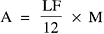
148A. Annual Tasmanian gaming licence fee
[Section 148A Inserted by No. 102 of 1999, s. 28, Applied:22 Dec 1999](1) A licensed provider must pay a Tasmanian gaming licence fee to the Treasurer in the following manner:(a) if the licence takes effect on a day other than 1 July in any financial year, that proportion of the whole licence fee specified in subsection (2) that relates to the proportion of the financial year during which the licence has effect is to be paid within 3 days after receiving notice of the grant of the Tasmanian gaming licence;(b) the whole licence fee specified in subsection (2) in respect of a complete financial year during which the licence is to have effect under the term of the licence is to be paid on the first day of that financial year;(c) if the term of the licence will end on a day other than 30 June in any financial year, that proportion of the whole licence fee specified in subsection (2) that relates to the proportion of that financial year during which the licence has effect is to be paid on the first day of that financial year.(2) The amount of a Tasmanian gaming licence fee payable each year the licence is in force is, subject to subsection (1) –(a) if the Tasmanian gaming licence is endorsed with a sports betting endorsement – 200 000 fee units; or(b) if the Tasmanian gaming licence is endorsed with a fixed odds wagering endorsement – 200 000 fee units; or(c) if the Tasmanian gaming licence is endorsed with a simulated gaming endorsement – 300 000 fee units; or(d) if the Tasmanian gaming licence is endorsed with a major lottery endorsement – 300 000 fee units; or(e) if the Tasmanian gaming licence is endorsed with a prescribed endorsement – the licence fee prescribed in the regulations in respect of that prescribed endorsement; or(f) if the Tasmanian gaming licence is endorsed with more than one of the endorsements referred to in paragraphs (a) , (b) , (c) , (d) and (e) – the total of the amounts specified in respect of each endorsement endorsed on the Tasmanian gaming licence.(3) The amount of a Tasmanian gaming licence fee is automatically increased so as to comply with subsection (2) if a new gaming endorsement is endorsed on an existing Tasmanian gaming licence and subsection (1)(a) applies to the amount by which the fee is increased by the grant of the endorsement and to payment of that amount.
(1) A licensed operator must pay to the Treasurer, on or before the 7th day of each month, an amount equal to unclaimed winnings arising from the conduct of gaming during the preceding month.(2) The amount of unclaimed winnings for a month in respect of the game of keno is to be calculated in accordance with the following formula:where –A is the amount of unclaimed winnings for the month;B is the total amount of winnings payable in respect of winning tickets purchased during the month that were unpresented at the end of the month;C is the total amount of winnings paid out during the month in respect of winning tickets that were unpresented at the beginning of the month.(3) [Section 149 Subsection (3) inserted by No. 102 of 1999, s. 29, Applied:22 Dec 1999] A licensed provider, other than a prescribed licensed provider or a licensed provider of a prescribed class, must pay to the Treasurer, on or before the 7th day of each month, an amount equal to prizes not paid out in respect of the conduct of gaming activities during the preceding month.(4) [Section 149 Subsection (4) inserted by No. 102 of 1999, s. 29, Applied:22 Dec 1999] A licensed provider prescribed, or a licensed provider of a class prescribed, for the purposes of subsection (3) must pay a prescribed amount in relation to prizes not paid out in respect of the conduct of gaming activities as and when prescribed.

(1) A licensed operator must pay to the Treasurer a tax on the gross profits derived from gaming each month.(2) The tax in respect of gross profits derived from games approved under section 103 and from keno is a sum equivalent to 15% of the gross profit derived from those games and from keno.(3) The tax in respect of gross profits derived from gaming machine games is a sum equivalent to the total of –(a) in respect of the period commencing on the commencement day and ending on the day preceding the changeover day – 20% of the gross profits; and(b) in respect of the period commencing on the changeover day and ending on 30 June 1994 – a sum equivalent to the total of –(i) 25% of that part of the gross profits derived during the period that do not exceed the relevant factor multiplied by $30 million; and(ii) 30% of that part of the gross profits derived during that period that exceed the relevant factor multiplied by $30 million but do not exceed the relevant factor multiplied by $35 million; and(iii) 35% of that part of the gross profits derived during that period that exceed the relevant factor multiplied by $35 million; and(c) in respect of any financial year commencing on or after 1 July 1994 a sum equivalent to the total of –(i) 25% of that part of the gross profits derived during a financial year that do not exceed $30 million; and(ii) 30% of that part of the gross profits derived during a financial year that exceed $30 million but do not exceed $35 million; and(iii) 35% of that part of the gross profits derived during a financial year that exceed $35 million.(4) If 2 or more licensed operators constitute a group, within the meaning of Part IIIA of the Pay-roll Tax Act 1971 , the tax payable under subsection (3) is to be calculated as if the licensed operators which constitute the group were a single licensed operator.(5) A sum payable by way of tax under subsection (1) must be paid to the Treasurer on or before the 7th day of the month immediately following the month to which that tax relates.(6) For the purpose of this section, the relevant factor is the number of days commencing on the changeover day and ending on 30 June 1994 divided by 365.(7) In this section –changeover day means –whichever is the earlier;(a) the day on which the number of gaming machines operated by the holder of the casino licence exceed the number of gaming machines operated by that licence holder under an existing licence; or(b) the day on which the Commission gives approval under section 90 (3) to commence gaming using gaming machine games other than the games deemed to be approved under section 80 pursuant to section 178 (2) ; or(c) 1 March 1994 –commencement day means the day on which this Act commences.
150A. Taxation in respect of Tasmanian gaming licence
[Section 150A Inserted by No. 102 of 1999, s. 30, Applied:22 Dec 1999](1) In this section –cumulative gross profits means gross profits derived by a licensed provider during a prescribed period;gaming revenue, in relation to a month, means the total amount wagered with a licensed provider on simulated games during that month less –(a) the total of all prizes paid out to the winning players or under section 149 during that month in respect of simulated games (other than prizes paid from a jackpot special prize pool); and(b) the total of amounts determined under the rules of the simulated games for payment in respect of that total amount wagered into a jackpot special prize pool;jackpot means winnings payable from money that accumulates as contributions are made to a jackpot special prize pool;monthly gross profits means gross profits derived by a licensed provider during the month in relation to which tax is payable under this section;prescribed period, in relation to a month for which tax is payable under this section, means the period –(a) commencing on the first day of the financial year in which that month occurs; and(b) ending at the end of that month.(2) For the purposes of the definition of "gaming revenue", if the amount of all prizes paid by the licensed provider exceeds the total of gaming revenue received in any month, the amount of the excess may be counted as prizes payable in the next or a subsequent month.(3) A licensed provider must pay to the Treasurer in relation to each month during which the Tasmanian gaming licence is in force a tax relating to the gaming business conducted in respect of each gaming endorsement endorsed on the licence.(4) The tax payable in relation to a month and the gaming business conducted in respect of a sports betting endorsement is –(a) 0.5% of the licensed provider's turnover in respect of that month in relation to wagers from persons in Australia and New Zealand in relation to sports events; and(b) 0.25% of the licensed provider's turnover in respect of that month in relation to wagers from persons not in Australia or New Zealand in relation to sports events.(5) The tax payable in relation to a month and the gaming business conducted in respect of a fixed odds wagering endorsement is 1% of the licensed provider's turnover in respect of that month in respect of wagers in relation to real horse races, harness races and greyhound races conducted in Tasmania and elsewhere.(6) [Section 150A Subsection (6) amended by No. 16 of 2000, s. 4, Applied:19 Apr 2000] The tax payable in relation to a month and the gaming business conducted in respect of a simulated gaming endorsement in relation to wagers from persons in Australia is –(a) if the cumulative gross profits of the licensed provider are or do not exceed $30 000 000, 25% of the monthly gross profits; or(b) if the cumulative gross profits of the licensed provider exceed $30 000 000 but are or do not exceed $35 000 000, the total of –(i) 25% of that part of the monthly gross profits derived during that part of that month occurring before the cumulative gross profits so exceeded $30 000 000; and(ii) 30% of that part of the monthly gross profits derived during that part of that month occurring when and after the cumulative gross profits so exceeded $30 000 000; or(c) if the cumulative gross profits of the licensed provider exceed $35 000 000, the total of –(i) 25% of that part of the monthly gross profits derived during that part of that month occurring before the cumulative gross profits so exceeded $30 000 000; and(ii) 30% of that part of the monthly gross profits derived during that part of that month occurring when and after the cumulative gross profits so exceeded $30 000 000 but before those cumulative gross profits so exceeded $35 000 000; and(iii) 35% of that part of the monthly gross profits derived during that part of that month occurring when and after the cumulative gross profits so exceeded $35 000 000.(6A) [Section 150A Subsection (6A) inserted by No. 16 of 2000, s. 4, Applied:19 Apr 2000] The tax payable in relation to a month and the gaming business conducted in respect of a simulated gaming endorsement in relation to wagers from persons elsewhere than in Australia is 4% of the monthly gross profits.(7) The tax payable in relation to a month and the gaming business conducted in respect of a major lottery endorsement is 35.55% of the licensed provider's turnover.(8) A licensed provider must pay the tax payable in relation to a month not later than 7 days after the end of that month.
[Section 150B Inserted by No. 102 of 1999, s. 30, Applied:22 Dec 1999](1) The Treasurer may enter into an agreement with the appropriate representative of the Government of a State, a Territory, a country or part of a country in relation to the sharing of tax and other revenue –(a) obtained under this Act in relation to a Tasmanian gaming licence; or(b) obtained by that Government in relation to a gaming activity of a licensed provider conducted in that place or this State.(2) An agreement made under subsection (1) may provide for incidental and supplementary matters.(3) If an agreement made under subsection (1) is inconsistent with a provision of this Act, the agreement prevails to the extent of the inconsistency.(4) [Section 150B Subsection (4) inserted by No. 16 of 2000, s. 5, Applied:19 Apr 2000] If the Treasurer enters into an agreement with the Government of a State, Territory, country or part of a country under subsection (1) in relation to a tax payable by a licensed provider under section 150A(6A) in respect of a month, the licensed provider must pay to the Treasurer in respect of that month an amount equal to the amount that the Treasurer must pay to that Government under that agreement.(5) [Section 150B Subsection (5) inserted by No. 16 of 2000, s. 5, Applied:19 Apr 2000] The amount payable under subsection (4) –(a) is in addition to the amount payable as tax under section 150A(6A) ; and(b) is to be paid at the same time as that tax.(6) [Section 150B Subsection (6) inserted by No. 16 of 2000, s. 5, Applied:19 Apr 2000] Subsection (1) does not apply in respect of revenue obtained under subsection (4) .
(1) A gaming operator must pay to the Treasurer a levy each month being a sum equivalent to the community support percentage of the gross profit derived from gaming machine games.(2) The community support percentage is –(a) in the case of the gross profit derived from an approved venue in respect of which a licence is in force under section 10 of the Liquor and Accommodation Act 1990 – 2%; and(b) in any other case – 4%.(3) A sum payable under subsection (1) must be paid to the Treasurer on or before the 7th day of each month immediately following the month to which it relates.(4) The Treasurer must distribute the levy as follows:(a) 25% for the benefit of sport and recreation clubs;(b) 25% for the benefit of charitable organizations;(c) 50% for the provision of –(i) research into gambling; and(ii) services for the prevention of compulsive gambling; and(iii) treatment or rehabilitation of compulsive gamblers; and(iv) community education concerning gambling; and(v) other health services.
152. Special financial arrangements
Where the Deed provides –(a) for the payment of guaranteed minimum amounts of tax by the person who is issued with a licence under section 13 any additional amounts payable in accordance with the Deed are deemed to be a tax payable under section 150 ; and(b) for a rebate of the licence fee payable under section 146 , any amounts payable by the Minister in accordance with the Deed are deemed to be amounts owing to the person referred to in paragraph (a) and may be offset against any other amount due by that person under this Act.
All amounts due under this Part may be recovered by the Treasurer in a court of competent jurisdiction as a debt due to the Crown.
Division 3 - Gaming and wagering guarantee
153A. Gaming and wagering guarantee
[Section 153A of Part 9 Inserted by No. 102 of 1999, s. 31, Applied:22 Dec 1999](1) In this section –gaming and wagering guarantee means a guarantee from an authorised deposit-taking institution relating to the business carried on, or to be carried on, under a Tasmanian gaming licence endorsed with a guaranteeable endorsement;guaranteeable endorsement means –(a) a sports betting endorsement; or(b) a fixed odds wagering endorsement; or(c) a prescribed endorsement if the regulations provide that it is also a guaranteeable endorsement; or(d) two or more of the gaming endorsements referred to in paragraphs (a) , (b) and (c) .(2) A person must provide a gaming and wagering guarantee from an authorised deposit-taking institution if –(a) the person has been granted a Tasmanian gaming licence endorsed with a guaranteeable endorsement; or(b) the person is a licensed provider whose Tasmanian gaming licence has newly been endorsed with a guaranteeable endorsement; or(c) the Commission under subsection (3)(b) requires a licensed provider to provide a new gaming and wagering guarantee.(3) By written notice to a licensed provider whose Tasmanian gaming licence is endorsed with a guaranteeable endorsement, the Commission may require the licensed provider to do one or more of the following:(a) provide to the Commission financial statements showing the turnover of the provider in respect of that endorsement for the period of 12 months specified in the notice;(b) provide the Commission with a new gaming and wagering guarantee.(4) A copy of a gaming and wagering guarantee is to be provided to the Commission within 21 days after, as the case requires –(a) the person receives notice of the grant of the Tasmanian gaming licence; or(b) the licensed provider receives notice of the grant of the new guaranteeable endorsement; or(c) the licensed provider receives the requirement made under subsection (3) .(5) A gaming and wagering guarantee provided in accordance with subsection (2)(a) or (b) must be for an amount of not less than $1 000 000.(6) A gaming and wagering guarantee provided in accordance with the requirement of the Commission made under subsection (3) must be for not less than the amount specified in the requirement, that specified amount being an amount that is not less than $1 000 000 or 1% of the licensed provider's turnover relating to all gaming businesses conducted in respect of the guaranteeable endorsement during the 12 months immediately preceding the month in which the Commission made that requirement.(7) The Commission, under subsection (3) , may not require a licensed provider to provide a new gaming and wagering guarantee unless –(a) at least 6 months have passed since the Tasmanian gaming licence or endorsement to which the requirement relates was granted; or(b) at least 6 months have passed since the last such requirement was made; or(c) the licensed provider has acquired a new associate; or(d) the Commission considers that there has been a substantial increase in the turnover of the licensed provider.(8) If the Commission under subsection (3) requires a licensed provider to provide a new gaming and wagering guarantee and the licensed provider has not at that time conducted a gaming business in respect of the guaranteeable endorsement for a period of 12 months, the Commission may, for the purposes of determining the amount of the guarantee under subsection (6) , estimate the provider's turnover for a period of 12 months by having regard to the provider's turnover for the period during which the provider has conducted that gaming business.
Division 4 - Miscellaneous
153B. Application of Taxation Administration Act 1997
[Section 153B of Part 9 Inserted by No. 102 of 1999, s. 31, Applied:22 Dec 1999] The provisions of the Taxation Administration Act 1997 apply in relation to this Part and, for that purpose, this Part is taken to be a taxation law within the meaning of that Act.
[Section 153C of Part 9 Inserted by No. 102 of 1999, s. 31, Applied:22 Dec 1999] This Act is not, and never has been, an Income Tax Rating Act for the purposes of Part IV of the Constitution Act 1934 .
PART 10 - Miscellaneous
154. Manufacture, &c., of gaming equipment
(1) A venue operator and a gaming operator must not manufacture, sell, supply, obtain or be in possession of gaming equipment except in accordance with this Act.Penalty: Fine not exceeding 1 000 penalty units or imprisonment for a term not exceeding 4 years or both.(2) Despite subsection (1) , a venue operator and a gaming operator may manufacture, sell, supply, obtain or be in possession of gaming equipment if –(a) the equipment is for use outside Tasmania; and(b) the person has the written authority of the Commission.(3) The authority of the Commission may be subject to any terms, conditions or limitations that the Commission thinks fit.
155. Possession of gaming equipment
(1) [Section 155 Subsection (1) amended by No. 46 of 1996, s. 18 ]The Commission may authorize in writing any person or class of persons to be in possession of gaming equipment for the purpose of testing, training, promotion, research or development.(2) [Section 155 Subsection (2) inserted by No. 46 of 1996, s. 18 ]The Commission may authorise a casino operator to provide gaming equipment for gratuitous gaming or static displays subject to any condition relating to the use and operation of the equipment the Commission determines.
156. Seizure and forfeiture of equipment
(1) A police officer or an inspector may seize without warrant any equipment which the police officer or inspector reasonably suspects is gaming equipment that is not authorized under this Act to be in an approved venue.(2) A police officer or inspector may apply to a court not less than 28 days after seizure of equipment for an order that the equipment seized be forfeited to the Crown.(3) On an application under subsection (2) , the court must order that the equipment be forfeited to the Crown if the court is satisfied that the equipment is gaming equipment that is not authorized under this Act to be in the approved venue regardless of whether a charge has been filed in relation to the equipment or whether a person has been convicted of an offence in relation to the equipment.(4) The owner of equipment seized under subsection (1) may apply, within 28 days of the seizure, to a court for the return of the equipment.(5) On an application under subsection (4) , the court must order that the equipment be returned to its owner if the court is satisfied that the equipment is gaming equipment authorized under this Act to be in the approved venue.(6) If the owner of equipment seized under subsection (1) does not apply for the return of the equipment within 28 days of the seizure, the equipment is forfeited to the Crown.(7) Any equipment forfeited under this section is to be sold or otherwise disposed of in accordance with the directions of the court.(8) The proceeds (if any) of the sale or disposal is to be applied as if they were penalties.
[Section 156A Inserted by No. 102 of 1999, s. 32, Applied:22 Dec 1999](1) In this section,instant money lottery means a lottery in which the distribution of prizes in the lottery is determined by the requirement to match symbols or amounts on a ticket in the lottery.(2) If there appears on a ticket in an instant money lottery the expression "match 3", "match three", "match any 3" or "match any three", or an expression having similar effect, the expression has, and always has had, the same meaning as the expression "find 3 of the same".(3) This section applies to a claim in respect of an instant money lottery whether made before or after the commencement of this section and whether or not proceedings have been brought in respect of the claim.
(1) Subject to subsection (3) , a person must not directly or indirectly, except in the performance of duties or exercise of powers under this Act, make a record of, or divulge to any person, any information with respect to the affairs of another person acquired by the first-mentioned person in the performance of those duties or exercise of those powers.Penalty: Fine not exceeding 50 penalty units.(2) Subject to subsection (5) , a person is not, except for the purposes of this Act, required –in the performance of duties or exercise of powers under this Act.(a) to produce in a court a document that has come into his or her possession or under his or her control; or(b) to divulge to a court any information that has come to his or her notice –(3) A person may –(a) divulge specified information to such persons as the Minister directs if the Minister certifies that it is necessary in the public interest that the information should be so divulged; or(b) divulge information to a law enforcement agency or gaming regulation agency; or(c) divulge information to a person who is expressly or impliedly authorized by the person to whom the information relates to obtain it.(4) An authority or person to whom information is divulged under subsection (3) , and a person or employee under the control of that authority or person, is subject, in respect of that information, to the same rights, privileges, obligations and liabilities under this section as if that authority, person or employee were a person performing duties under this Act and had acquired the information in the performance of those duties.(5) If –(a) the Minister certifies that it is necessary in the public interest that specified information should be divulged to a court; or(b) a person to whom information relates has expressly authorized it to be divulged to a court –a person may be required –(c) to produce in the court any document containing the information; or(d) to divulge the information to the court.(6) This provision has effect notwithstanding anything contained in the Freedom of Information Act 1991 .(7) In this section –court includes any tribunal, authority or person having power to require the production of documents or the answering of questions;gaming regulation agency means any authority or person responsible for the regulation and control of the conduct of gaming in any other State or a Territory;produce includes permit access to.
[Section 158 Amended by No. 46 of 1996, s. 19 ]The Commission may delegate any of its functions or powers under this Act or any other Act (other than this power of delegation).
159. Conflict of interest and duty
(1) [Section 159 Subsection (1) amended by No. 102 of 1999, s. 33, Applied:22 Dec 1999] An authorized person must not be a venue operator, a gaming operator, a licensed provider, a manufacturer or supplier listed on the Roll or an employee in any capacity of such an operator, manufacturer or supplier.(2) [Section 159 Subsection (2) amended by No. 102 of 1999, Sched. 1, Applied:22 Dec 1999] An authorized person who knowingly has directly or indirectly, any business or financial association with or any business or financial interest in any matter in conjunction with a venue operator, gaming operator, licensed provider or manufacturer or supplier listed on the Roll must as soon as possible–(a) notify the Commission of the association or interest; and(b) if directed to do so by the Commission, within a time specified by the Commission terminate the association or relinquish the interest.(3) [Section 159 Subsection (3) amended by No. 102 of 1999, Sched. 1, Applied:22 Dec 1999] An authorized person who ceases to be employed under the Tasmanian State Service Act 1984 after the commencement of this Act must not at any time during the next 2 years, be employed by or significantly associated with, a casino operator, gaming operator, licensed provider or manufacturer or supplier listed on the Roll unless the Commission otherwise approves.(4) [Section 159 Subsection (4) amended by No. 102 of 1999, Sched. 1, Applied:22 Dec 1999] A person who ceases to be a Commissioner must not at any time during the next 2 years after ceasing to be a Commissioner be employed by, or significantly associated with, a licensed premises gaming operator, casino operator, gaming operator, licensed provider or manufacturer or supplier listed on the Roll unless the Commission otherwise approves.(5) Subsection (3) does not apply to a person who immediately before the commencement of this Act held office as the Commissioner for Gaming or as an inspector under the Gaming Act 1983 .(6) [Section 159 Subsection (6) amended by No. 102 of 1999, Sched. 1, Applied:22 Dec 1999] A casino operator, gaming operator, licensed provider or manufacturer or supplier listed on the Roll must not employ, or be significantly associated with, a person prohibited by subsection (3) or (4) from being so employed or associated.Penalty: Fine not exceeding 50 penalty units.
160. Protection from liability of authorized persons
(1) An authorized person does not incur any personal liability in respect of any act done or omitted to be done by the authorized person in good faith in the performance or exercise, or purported performance or exercise, of any function or power of the authorized person or in the administration or execution, or proposed administration or execution, of this Act.(2) Subsection (1) does not preclude the Crown from incurring liability that the authorized person would, but for subsection (1) , incur.
161. Change in situation of licensee or person listed on the Roll
[Section 161 Substituted by No. 11 of 1998, s. 21, Applied:22 May 1998](1) Whenever a change of a kind specified by the Commission in writing given to the holder of any licence under this Act or a manufacturer or supplier listed on the Roll takes place in the situation existing in relation to that person, the person must, in a form approved by the Commission and on payment of the prescribed fee, notify the Commission of the change within 14 days after it takes place.Penalty: Fine not exceeding 20 penalty units.(2) Where notification of a change relates to a change in an associate of a licensee or a person whose name is listed on the Roll, the Commission must investigate and consider each notification of change –(a) if the change relates to a licensed operator, in accordance with sections 23 , 24 and 25 ; or(b) if the change relates to a licensed premises gaming operator, in accordance with sections 38 , 39 and 40 ; or(c) if the change relates to a person whose name is listed on the Roll, in accordance with section 71 .
162. Destruction of finger prints, &c.
(1) [Section 162 Subsection (1) amended by No. 11 of 1998, s. 22, Applied:22 May 1998] Any finger prints or palm prints obtained by the Commission under this Act and any copies of them may be destroyed by the Commission as soon as the Commission has no further use for them.(2) The Commission is deemed to have no further use for finger prints or palm prints when –(a) they were obtained in connection with an application for a licensed premises gaming licence and the application is refused; or(b) they were obtained in connection with the grant of a casino licence or a gaming operator's licence and the licence is not granted; or(ba) [Section 162 Subsection (2) amended by No. 102 of 1999, s. 34, Applied:22 Dec 1999] they were obtained in connection with an application for a Tasmanian gaming licence and the licence is not granted; or(c) they were obtained in connection with an application by a manufacturer or supplier to be listed on the Roll and the application is refused; or(d) the licence in connection with which they were obtained is cancelled or surrendered; or(e) they were obtained in connection with the appointment of a person as an inspector or as an authorized person and the person is not so appointed.(2A) [Section 162 Subsection (2A) inserted by No. 11 of 1998, s. 23, Applied:22 May 1998] The Commission may destroy any finger prints or palm prints obtained by the Commission under this Act and any copies of them in any circumstances it considers appropriate.(3) A person who in connection with an application for a licence or to be listed on the Roll or appointment as an inspector has possession of finger prints or palm prints obtained by the Commission under this Act, or copies of them, must deliver them to the Commission, in accordance with the directions of the Commission, so as to enable the Commission to comply with subsection (1) .Penalty: Fine not exceeding 20 penalty units.(4) The holder of a special employee's licence may, when his or her licence is surrendered, request that his or her finger prints or palm prints be retained by the Commission for a period not exceeding 3 years.
163. Records not kept in writing
(1) This section applies to a record that –(a) is not in writing; or(b) is not written in the English language; or(c) is not decipherable on sight.(2) A requirement under this Act to produce a record is to be considered to be a requirement to produce (in addition to the record if it is in writing or instead of the record if it is not in writing) a statement written in the English language and decipherable on sight containing the whole of the information in the record.
164. False or misleading information
(1) A person must not –give information that is false or misleading in a material particular.(a) in, or in relation to, an application for a licence; or(b) in purported compliance with the requirements of a notice under this Act; or(c) in answer to a question asked by an inspector in the exercise of his or her functions as an inspector; or(d) [Section 164 Subsection (1) amended by No. 102 of 1999, s. 35, Applied:22 Dec 1999] in purporting to provide information that the person has been authorized to provide; or(e) [Section 164 Subsection (1) amended by No. 102 of 1999, s. 35, Applied:22 Dec 1999] in, or in relation to, a return provided in respect of the finances of the holder of a licence under this Act –Penalty: Fine not exceeding 50 penalty units.(2) It is a defence to a prosecution of a person for an offence under subsection (1) if it is proved that, at the time the information was given, the person believed, on reasonable grounds –(a) in the case of false information that the information was true; or(b) in the case of misleading information that the information was not misleading.
165. Inducements, cheating, &c.
(1) A person must not dishonestly –to deliver, give or credit to the first-mentioned person or another person any money, chips, gaming tokens, benefit, advantage, valuable consideration or security.(a) by a scheme or practice; or(b) by the use of gaming equipment; or(c) by the use of an instrument or article of a type used in connection with gaming, or appearing to be of a type used in connection with gaming or of any other thing –in relation to gaming or the conduct of gaming, induce –(d) a person licensed under this Act; or(e) a person listed on the Roll; or(f) an associate of a person so licensed or listed; or(g) a person acting on behalf of a person so licensed or listed –(2) A person licensed under this Act or a person listed on the Roll or an associate of a person so licensed or listed must not dishonestly –in relation to gaming or the conduct of gaming, induce a person to deliver, give or credit to the person so licensed or listed or another person, any money, chips, gaming tokens, benefit, advantage, valuable consideration or security.(a) by a scheme or practice; or(b) by the use of gaming equipment; or(c) by the use of an instrument or article of a type used in connection with gaming or appearing to be of a type used in connection with gaming or of any other thing –(3) A person must not dishonestly cause gaming equipment to deliver, give or credit to the person or another person any chips, gaming tokens, benefit, advantage, valuable consideration or security.Penalty: Fine not exceeding 1 000 penalty units or imprisonment for a term not exceeding 4 years or both.
166. Bribery of authorized persons
(1) An authorized person must not corruptly ask for, receive or obtain, or agree to receive or obtain, any money, property or benefit of any kind for the authorized person or any other person –(a) so that the authorized person will forego or neglect his or her functions or duties under this Act or in order to influence the authorized person in the performance of his or her functions or duties under this Act; or(b) on account of any thing already done or omitted to be done or to be afterwards done or omitted to be done by the authorized person in the performance of his or her functions or duties under this Act; or(c) for the authorized person to use or take advantage of his or her position improperly to gain any benefit or advantage for or facilitate the commission of an offence by another person.Penalty: Fine not exceeding 1 000 penalty units or imprisonment for a term not exceeding 4 years or both.(2) A person must not corruptly give to, confer on or procure for, or promise or offer to give to, confer on or procure for, an authorized person or any other person any money, property or benefit of any kind –(a) so that the authorized person will forego or neglect his or her functions or duties under this Act or in order to influence the authorized person in the performance of his or her functions or duties under this Act; or(b) on account of any thing already done or omitted to be done or to be afterwards done or omitted to be done by the authorized person in the performance of his or her functions or duties under this Act; or(c) for the authorized person to use or take advantage of his or her position improperly to gain any benefit or advantage for or facilitate the commission of an offence by the first-mentioned person or any other person.Penalty: Fine not exceeding 1 000 penalty units or imprisonment for a term not exceeding 4 years or both.
167. Gambling by authorized persons prohibited
(1) An authorized person must not gamble in an approved venue except to the extent that it may be necessary to do so in the exercise of his or her functions in the course of the administration of this Act.(2) If an authorized person ceases to be an authorized person, he or she must not gamble in an approved venue during the next 3 months.Penalty: Fine not exceeding 20 penalty units.
168. Service of documents on Commission
(1) A document may be served on the Commission by sending it by post to the principal office of the Commission or leaving it at that office with a person authorized in writing by the Commission to accept service of documents on behalf of the Commission.(2) Nothing in this section affects the operation of any provision of a law or of the rules of a court authorizing a document to be served on the Commission in any other manner.
(1) In proceedings under this Act, an assertion –is evidence of the fact or facts asserted.(a) that, at a specified time or during a specified period a specified person was the Minister administering this or any other Act; or(b) that, at a specified time or during a specified period, a specified person held, or is acting in a specified office; or(c) that a signature purporting to be the signature of a Minister, a police officer or an authorized person is the signature it purports to be; or(d) that, at a specified time or during a specified period, a specified person was, or was not, the holder of a specified licence under this Act; or(e) that, at a specified time, a person attained a specified age or that, at a specified time or during a specified period, a specified person was under or over a specified age –(2) In proceedings under this Act –(a) a document purporting to be a copy of a direction, notice, order, requirement or decision given or made under this Act is evidence of a direction, notice, order, requirement or decision of which it purports to be a copy; and(b) a document purporting to be a copy of a licence under this Act is evidence of a licence of which it purports to be a copy; and(c) evidence that a person accepted service of a document is evidence of the authority of the person to accept service of the document.
(1) If a corporation contravenes any provision of this Act, each person who is a director of the corporation or who is concerned in the management of the corporation is to be taken to have contravened the same provision if the person knowingly authorized or permitted the contravention.(2) A person may be proceeded against and convicted under a provision in accordance with subsection (1) whether or not the corporation has been proceeded against or convicted under that provision.(3) Nothing in this section affects any liability imposed on a corporation for an offence committed by the corporation against this Act.
(1) A proceeding for an offence against this Act may only be brought by –(a) a police officer; or(b) the Commission; or(c) a person authorized to do so, either generally or in a particular case, by the Commission.(2) In a proceeding for an offence against this Act it must be presumed, in the absence of evidence to the contrary, that the person bringing the proceeding was authorized to bring it.
172. Information gathering for law enforcement purposes
(1) [Section 172 Subsection (1) amended by No. 102 of 1999, Sched. 1, Applied:22 Dec 1999] For the purpose of obtaining information that may be of assistance to a law enforcement agency, the Commission may direct a venue operator, gaming operator, licensed provider or manufacturer or supplier listed on the Roll in writing to provide the Commission with information obtained by the operator, manufacturer or supplier concerning their operations.(2) A direction under subsection (1) may relate to particular information or to information generally and may relate to particular or general information concerning a specified person.(3) The direction must specify –(a) [Section 172 Subsection (3) amended by No. 102 of 1999, s. 36, Applied:22 Dec 1999] the kind of information that the venue operator, gaming operator, licensed provider, manufacturer or supplier is required to provide; and(b) the manner in which the information is to be provided.(4) [Section 172 Subsection (4) amended by No. 102 of 1999, s. 36, Applied:22 Dec 1999] It is a condition of a casino licence, licensed premises gaming licence, Tasmanian gaming licence or gaming operator's licence that the holder of the licence must comply with a direction under subsection (1) .(5) The Commission may make information obtained by the Commission under this section available to any law enforcement agency.
(1) A person aggrieved by a decision of the Commission –may appeal to the Supreme Court from the decision.(a) [Section 173 Subsection (1) amended by No. 102 of 1999, s. 37, Applied:22 Dec 1999] to cancel or suspend, or to refuse to cancel or suspend, a licence or gaming endorsement under this Act; or(b) to amend, or to refuse to amend, the conditions of a licence under this Act; or(c) [Section 173 Subsection (1) amended by No. 11 of 1998, s. 23, Applied:22 May 1998] to list or refuse to list the name of a person on the Roll, to remove the listing of the name of a person from the Roll or to suspend the listing of the name of a person on the Roll –(2) The Supreme Court must hear and determine the appeal and make such order as it thinks appropriate by reason of its decision, including, without limiting its power to make such orders –(a) an order affirming or setting aside the decision of the Commission; or(b) an order remitting the matter to the Commission to decide again in accordance with the directions of the Supreme Court.
(1) The Governor may make regulations for the purposes of this Act.(2) Regulations under this section may be made for or with respect to any of the following:(a) the activities of persons licensed under this Act;(b) the activities of manufacturers and suppliers listed on the Roll;(c) the periods within which, and the manner in which, appeals may be made to the Supreme Court under section 173 ;(d) classes of approved venue and the restrictions and entitlements applying to each class;(e) [Section 174 Subsection (2) amended by No. 102 of 1999, s. 38, Applied:22 Dec 1999] facilities and amenities in approved venues, approved locations or classes of approved venues or approved locations;(f) security arrangements to be taken by persons licensed under this Act or by manufacturers and suppliers listed on the Roll;(g) technical standards to which the electronic monitoring systems of gaming operators must conform;(h) production, registration, security and confidentiality of chips and gaming tokens;(i) access to gaming machines and other gaming equipment;(j) [Section 174 Subsection (2) amended by No. 102 of 1999, s. 38, Applied:22 Dec 1999] administration and accounting procedures of gaming operators, venue operators and licensed providers;(k) [Section 174 Subsection (2) amended by No. 102 of 1999, s. 38, Applied:22 Dec 1999] [Section 174 Subsection (2) amended by No. 102 of 1999, s. 38, Applied:22 Dec 1999] the collection and security of money in approved venues and approved locations and between approved venues or approved locations and financial institutions;(l) procedures for the counting of revenue in approved venues;(m) procedures and standards for the maintenance, security and storage of gaming equipment;(n) the acquisition of gaming equipment including tendering and the calling of expressions of interest;(o) conditions under which linked jackpot arrangements are permitted;(p) conditions for the accumulation or contribution of money to special prize pools;(q) fees for the purposes of this Act;(r) [Section 174 Subsection (2) amended by No. 102 of 1999, s. 38, Applied:22 Dec 1999] any matter incidental or supplemental to the prescribing of a prescribed endorsement;(s) [Section 174 Subsection (2) amended by No. 102 of 1999, s. 38, Applied:22 Dec 1999] any matter relevant to the conduct of gaming, a gaming activity or a gaming business.(3) Regulations under this section –(a) may impose a fine not exceeding 20 penalty units for a contravention of or failure to comply with the regulations; and(b) may be of general or of specially limited application; and(c) may differ according to differences in time, place or circumstance; and(d) may apply, adopt or incorporate any matter contained in any document, code, standard, rule, specification or method formulated, issued, prescribed or published by any person whether –(i) wholly or partially or as amended by the regulations; or(ii) as formulated, issued, prescribed or published at the time the regulations are made or any time before then; or(iii) as formulated, issued, prescribed or published from time to time; and(e) may leave any matter or thing to be from time to time determined, applied, dispensed with or regulated by the Commission or an authorized person.(4) A power conferred by subsection (1) to make regulations providing for the imposition of fees may be exercised by providing for all or any of the following matters:(a) specific fees;(b) maximum fees;(c) minimum fees;(d) fees that vary according to class of premises or venue;(e) the manner of payment of fees;(f) the time or times at which fees are to be paid.(5) Regulations under this section may contain provisions of a savings or transitional nature consequent on the enactment of this Act.(6) A provision referred to in subsection (5) may, if the regulations so provide, take effect from the commencement of this Act or a later date.
The Acts specified in Schedule 4 are repealed.The amendments effected by this section have been incorporated into the authorised version of the Casino Company Control Act 1973 .[Section 177 Amended by No. 68 of 1994, s. 3 and Sched. 1 ]The amendment effected by this section has been incorporated into the authorised version of the Racing and Gaming Act 1952 .
178. Transitional and savings provisions
(1) In this section –commencement day means the day on which this Act commences;former body means the Tasmanian Gaming Commission constituted under the Gaming Act 1983 .(2) A game that was specified in the casino licence under the Wrest Point Casino Licence and Development Act 1968 immediately before the commencement of this Act and a game in respect of which a declaration under section 10 of the Northern Casino Act 1978 was in force immediately before that commencement are deemed to be approved by the Commission under section 80 or 103 of this Act and the rules in respect of those games are deemed to be approved by the Commission under section 103 .(3) Any machine, instrument or device prescribed as being an authorized machine in regulations in force under the Wrest Point Casino Licence and Development Act 1968 or the Northern Casino Act 1978 immediately before the commencement of this Act is deemed to be a gaming machine type approved by the Commission under section 80 or is deemed to be other gaming equipment approved by the Commission under section 81 .(4) A direction in force under section 9A of the Wrest Point Casino Licence and Development Act 1968 or section 12 of the Northern Casino Act 1978 immediately before the commencement of this Act in so far as it is not inconsistent with the provisions of this Act is deemed to be a direction given to a casino operator under section 93 .(5) Any approval given by the former body in relation to internal controls and administrative and accounting procedures in accordance with a direction referred to in subsection (4) is deemed to be an approval given by the Commission under section 137 .(6) The Commission must issue a special employee's licence to a person who, immediately before the commencement of this Act, was authorized under the Gaming Act 1983 to undertake duties approved by the former body in a casino.(7) Until the Commission issues a special employee's licence to a person under subsection (6) , the person is deemed to be the holder of a provisional special employee's licence.(8) The Commission must issue a technician's licence to a person who, immediately before the commencement of this Act, was authorized under the Gaming Act 1983 to be employed in a casino as a technician.(9) Until the Commission issues a technician's licence to a person under subsection (8) , the person is deemed to be the holder of a provisional technician's licence.(10) It is to be a condition of a licence issued under subsection (6) or (8) that the licensee consent to having his or her finger prints and palm prints taken by the Commission before 1 January 1997.(11) A person who immediately before the commencement of this Act held office as an inspector under the Gaming Act 1983 is taken to be an inspector on the same terms and conditions as those applying to the inspector appointed under the Gaming Act 1983 .(12) On the commencement day, the property and rights of the former body vest in the Commission and the liabilities and obligations of the former body become the liabilities and obligations of the Commission.(13) On and after the commencement day, any contract or agreement entered into by the former body and in force immediately before that day is taken to be a contract or agreement entered into by the Commission.(14) On and after the commencement day, legal proceedings instituted by or against the former body before, and pending on, the commencement day may be continued by or against the Commission.(15) Any legal or other proceedings which may, before the commencement day, have been instituted or continued by or against the former body may, on and after that day, be instituted or continued by or against the Commission.(16) On and after the commencement day, a judgment or order of a court obtained in legal proceedings by or against the former body may be enforced by or against the Commission.(17) On and after the commencement day –(a) a reference to the former body in any law or in any contract, award or other instrument in force immediately before that day and to which the former body was a party is taken to be a reference to the Commission; and(b) a document addressed to and purporting to be served on the former body is taken to be served on the Commission.(18) All acts, matters and things done or omitted to be done by, or done or suffered in relation to, the former body before the commencement day have, on and after that day, the same force and effect as if they had been done or omitted to be done by, or done or suffered in relation to, the Commission.
178A. Further transitional and savings provisions
[Section 178A Inserted by No. 102 of 1999, s. 39, Applied:22 Dec 1999] Schedule 5 has effect.
Until provision is made in relation to this Act by order under section 4 of the Administrative Arrangements Act 1990 –(a) the administration of this Act is assigned to the Treasurer; and(b) the Department responsible to the Treasurer in relation to the administration of this Act is the Department of Treasury and Finance.
SCHEDULE 1 - Deed
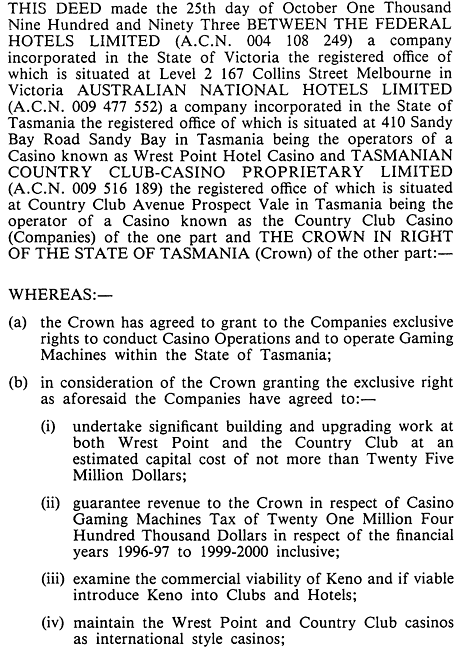
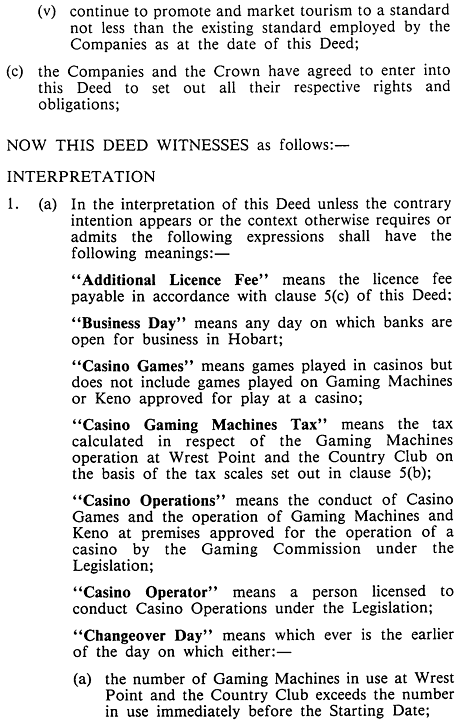
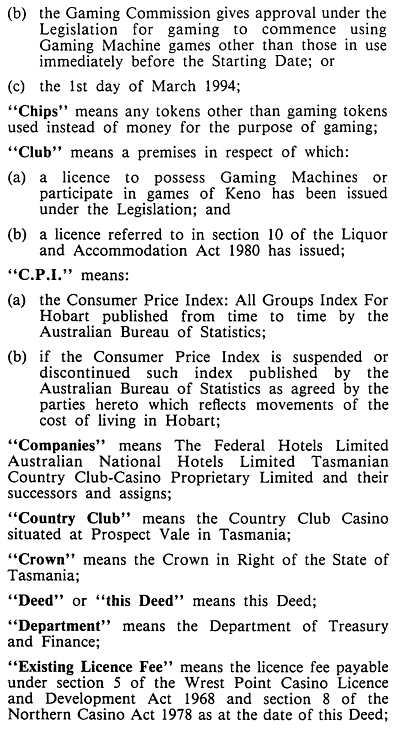
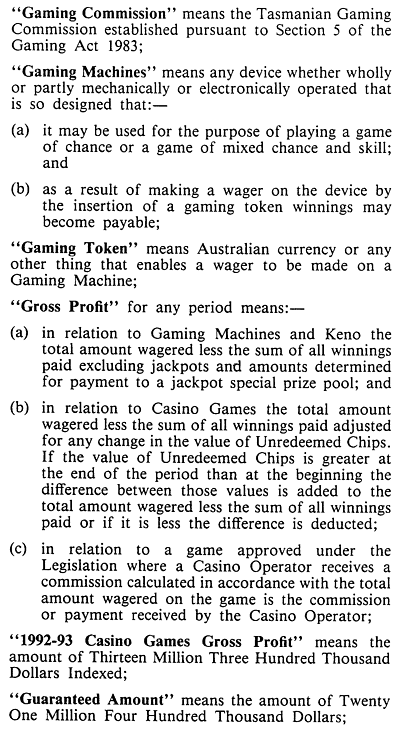
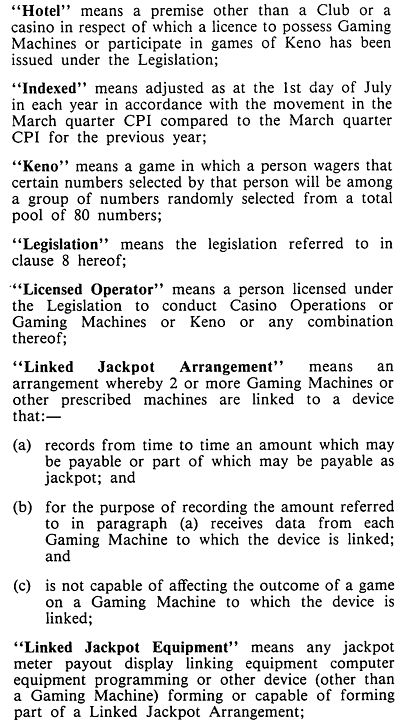


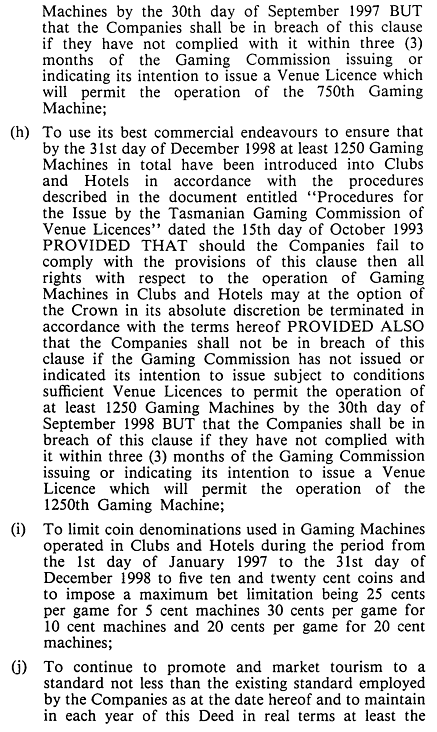
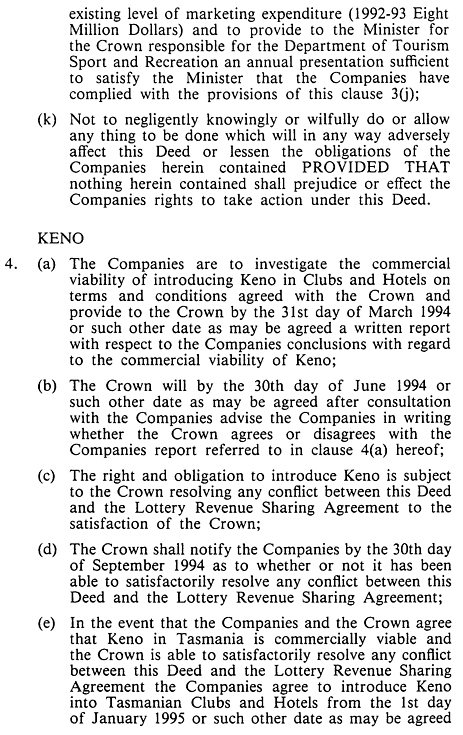
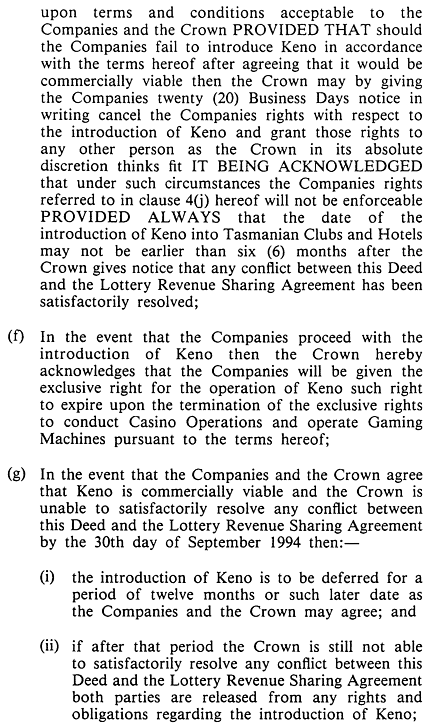
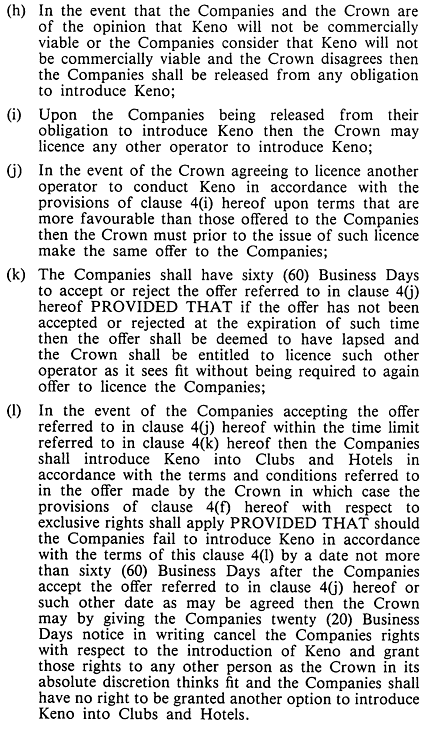

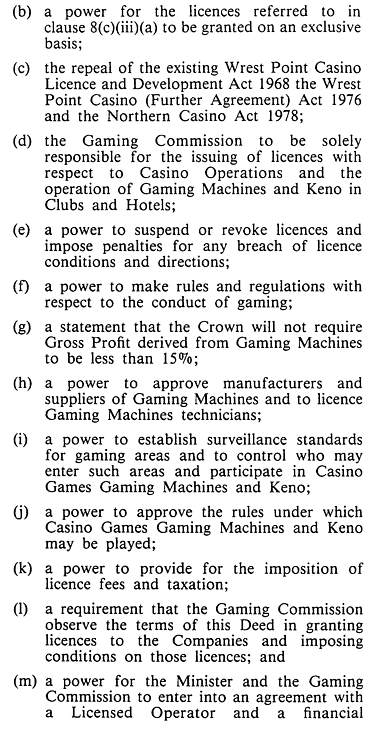

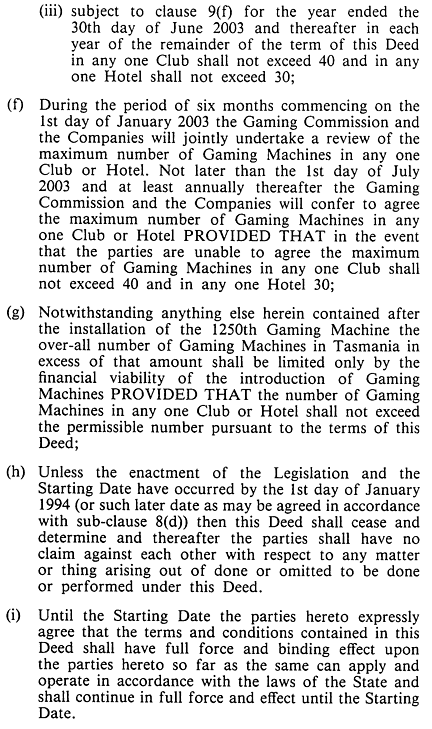
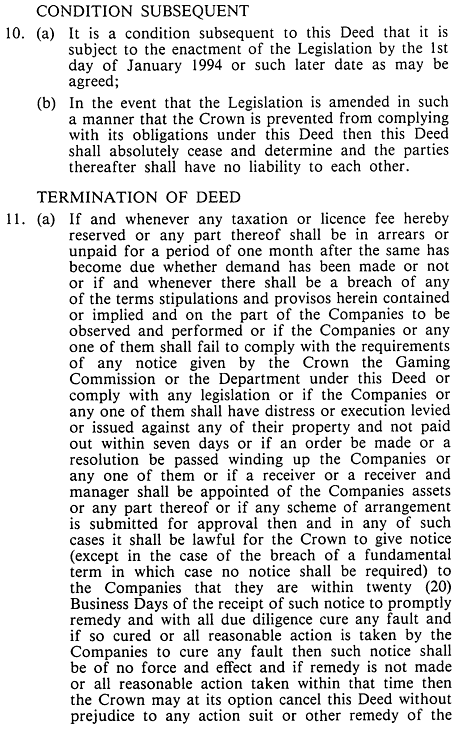

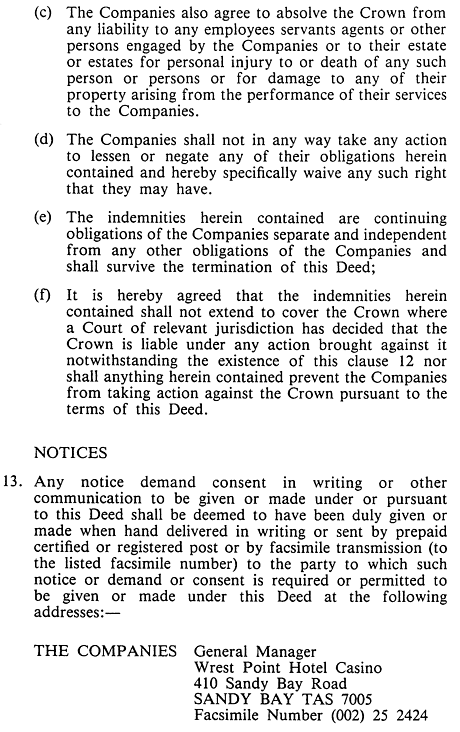

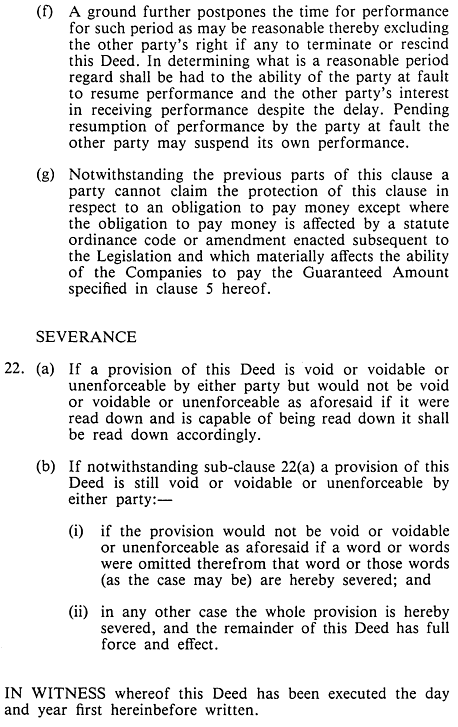
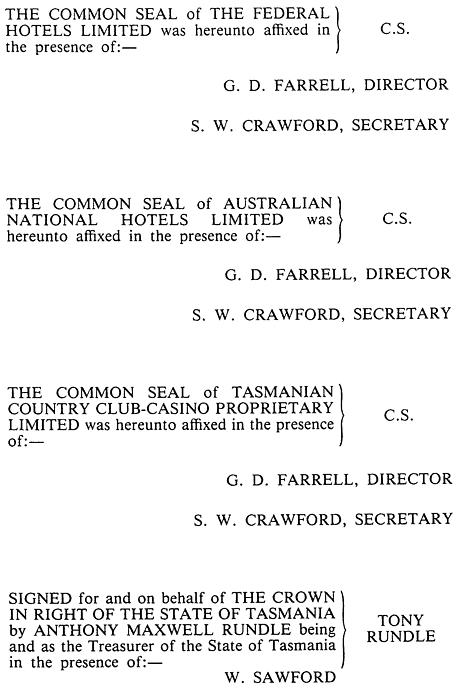
SCHEDULE 2 - Provisions with Respect to Membership of Commission
1. Terms of office(1) A member of the Commission is to be appointed for such term, not exceeding 4 years, as is specified in the relevant instrument of appointment and, if otherwise qualified, is eligible for reappointment from time to time for a term not exceeding 4 years.(2) A person is not eligible to be appointed as a member of the Commission if the person has attained the age of 65 years.
2. Provisions requiring devotion of whole of time to other dutiesWhere, by or under any Act, provision is made requiring the holder of an office to devote the whole of his or her time to the duties of office under that Act, that provision does not operate to disqualify that person from holding that office and also the office of a member of the Commission.
3. Conditions of appointment(1) Subject to subclause (2) , a member of the Commission is entitled to be paid such remuneration and allowances as the Governor may from time to time determine.(2) A member of the Commission holds office on such conditions in relation to matters not provided for by this Act as are specified in the instrument of appointment.
4. Deputies of members(1) The Minister may appoint a deputy of a member of the Commission.(2) If a member of the Commission is unable for any reason to perform the duties of a member, the member's deputy may perform those duties and, when doing so, is treated as a member.(3) A deputy member of the Commission holds office for such term, not exceeding 4 years, and on such conditions as are specified in the deputy member's instrument of appointment.
5. ResignationA member of the Commission may resign by signed notice given to the Governor.
6. Removal of member of CommissionThe Governor may remove a member of the Commission from office if –(a) the member fails to disclose a pecuniary interest as required under clause 6 of Schedule 3 ; or(b) the member is convicted in Tasmania, or elsewhere, of an offence involving fraud or dishonesty which is punishable on conviction by imprisonment for a term of 3 months or more or of an offence which is punishable by imprisonment for a term of 12 months or more; or(c) the Governor considers that the member is physically or mentally incapable of continuing as a member; or(d) the Governor considers that the member is unable to perform adequately or competently the functions of the office as a member; or(e) the member becomes bankrupt, applies to take the benefit of any law for the relief of bankrupt or insolvent debtors, compounds with the member's creditors or makes an assignment of the member's remuneration or estate for their benefit; or(f) the member is absent from 3 consecutive ordinary meetings of the Commission without leave of absence; or(g) the member attains the age of 65 years.
7. Filling of vacancy(1) A member of the Commission vacates office if the member –(a) dies; or(b) resigns; or(c) is removed from office under clause 6 .(2) The Minister may appoint a person to a vacant office of a member for the residue of the predecessor's term of office.
8. Validity of proceedings, &c.(1) An act or proceeding of the Commission or of any person acting under a power of delegation of the Commission is not invalidated or prejudiced by reason only of the fact that, at the time when the act or proceeding was done, taken or commenced, there was a vacancy in the membership of the Commission.(2) All acts and proceedings of the Commission or of any person acting under a power of delegation of the Commission are, notwithstanding the subsequent discovery of any defect in the appointment of any member of the Commission or that any person was disqualified from acting as, or incapable of being, a member of the Commission, as valid as if the member had been duly appointed and was qualified to act as, or capable of being, a member, and as if the Commission had been fully constituted.
9. PresumptionsIn any proceedings by or against the Commission, unless evidence is given to the contrary, proof is not required of –(a) the constitution of the Commission; or(b) any resolution of the Commission; or(c) the appointment of any member of the Commission; or(d) the presence of a quorum at any meeting of the Commission.
SCHEDULE 3 - Provisions with Respect to Meetings of Commission
1. Convening of meetingsMeetings of the Commission may be convened by the chairperson of the Commission or by any 2 members of the Commission.
2. Presiding at meetings(1) The chairperson of the Commission is to preside at all meetings of the Commission at which the chairperson is present.(2) If the chairperson of the Commission is not present at a meeting of the Commission, a member of the Commission elected by the members present is to preside at that meeting.
3. Quorum and voting at meetings(1) Two members of the Commission form a quorum at any duly convened meeting of the Commission.(2) Any duly convened meeting of the Commission at which a quorum is present is competent to transact any business of the Commission.(3) Questions arising at a meeting of the Commission are to be determined by a majority of votes of the members of the Commission present and voting and, in the event of an equality of votes, the person presiding at the meeting has a second or casting vote.
4. Conduct of meetings(1) Subject to this Act, the Commission may regulate the calling of, and the conduct of business at, its meetings as it considers appropriate.(2) The Commission may permit members to participate in a particular meeting or all meetings by telephone or any other means of communication.(3) A member who participates in a meeting under a permission granted under subclause (2) is taken to be present at the meeting.(4) Without limiting subclause (1) , the Commission may allow a person to attend a meeting for the purpose of advising or informing it on any matter.
5. MinutesThe Commission is to keep minutes of its proceedings.
6. Disclosure of interests(1) If –the member must, as soon as practicable after the relevant facts come to the member's knowledge, disclose the nature of the interest to a meeting of the Commission.(a) a member of the Commission has a direct or indirect pecuniary interest in a matter being considered, or about to be considered, by the Commission; and(b) the interest could conflict with the proper performance of the member's duties in relation to consideration of the matter –(2) A disclosure under subclause (1) is to be recorded in the minutes of the meeting and, unless the Commission otherwise determines, the member is not to –(a) be present during any deliberation of the Commission in relation to the matter; or(b) take part in any decision of the Commission in relation to the matter.(3) For the purpose of making a determination under subclause (2) in relation to a member who has made a disclosure under subclause (1) , a member who has a direct or indirect pecuniary interest in the matter to which the disclosure relates is not to –(a) be present during any deliberations of the Commission for the purpose of making the determination; or(b) take part in the making by the Commission of the determination.
SCHEDULE 4 - Acts repealed
Sections 3 and 175
Short title of Act | Number and year of Act | Gaming Act 1983 | No. 81 of 1983 | Northern Casino Act 1978 | No. 81 of 1978 | Wrest Point Casino Licence and Development Act 1968 | No. 78 of 1968 | Wrest Point Casino (Further Agreement) Act 1976 | No. 69 of 1976 | Wrest Point Casino Licence and Development Amendment Act 1982 | No. 28 of 1982 |
SCHEDULE 5 - Further transitional and savings provisions[Schedule 5 Inserted by No. 102 of 1999, s. 40, Applied:22 Dec 1999]
1. InterpretationIn this Schedule –agreement means an agreement under section 85A of the Racing and Gaming Act;permit means a permit under section 85A of the Racing and Gaming Act;pool betting licence has the same meaning as in the Racing and Gaming Act;prescribed day means the day on which the Gaming Control Amendment Act 1999 commences;promoter has the same meaning as in section 85A of the Racing and Gaming Act;Racing and Gaming Act means the Racing and Gaming Act 1952 as in force immediately before the commencement of the Gaming Control Amendment Act 1999 ;relevant Deed means the Deed, as amended from time to time, made on 27 July 1998 between the Crown in right of the State of Tasmania and Australian National Hotels Pty Ltd;Supervising Agency has the same meaning as in section 74A of the Racing and Gaming Act;telephone sports betting licence has the same meaning as in the Racing and Gaming Act.
2. Continued operation of relevant DeedWhile the relevant Deed is in force, nothing in Part 4A of this Act or section 11(c) –(a) affects the operation of the relevant Deed; or(b) prevents Australian National Hotels Pty Ltd from conducting Casino Internet Operations from the Wrest Point Hotel Casino under, and as acknowledged by, the relevant Deed without also being the holder of a Tasmanian gaming licence endorsed with a simulated gaming endorsement.
3. Telephone sports betting licences(1) A telephone sports betting licence that is in force immediately before 18 November 1999 and is still in force immediately before the prescribed day is taken on and after that day to be a Tasmanian gaming licence that –(a) is endorsed with a sports betting endorsement; and(b) contains the same terms as the telephone sports betting licence; and(c) is subject to the conditions to which the telephone sports betting licence was subject; and(d) has effect, subject to this Act, until 14 May 2000.(2) Clause 5 does not apply in respect of a Tasmanian gaming licence that a person is taken to hold under subclause (1) .(3) If a person who is taken to hold a Tasmanian gaming licence under subclause (1) intends to continue the business conducted under that Tasmanian gaming licence after 14 May 2000, the person must apply for a new Tasmanian gaming licence under section 76C .(4) On making an application referred to in subclause (3) , the applicant is not required to pay the application fee specified in section 76C(2)(d) but the Commission may require the applicant to pay the whole or part of the reasonable costs incurred by the Commission in investigating, processing and determining the application.(5) Clause 6 and sections 148A and 153A do not apply in respect of a Tasmanian gaming licence endorsed with a sports betting endorsement granted in relation to an application referred to in subclause (3) , whether being the Tasmanian gaming licence so granted or that Tasmanian gaming licence after renewal, but the holder of that Tasmanian gaming licence must –(a) pay to the Commission the prescribed licence fee; and(b) provide to the Commission a gaming and wagering guarantee, within the meaning of section 153A , of the prescribed amount as, and in the manner, prescribed.(6) Any business conducted under a telephone sports betting licence before the prescribed day is taken to have been conducted under a Tasmanian gaming licence endorsed with a sports betting endorsement.(7) If, before the prescribed day, circumstances existed that could or would have resulted in the Supervising Agency taking action under section 74I or 74J of the Racing and Gaming Act as in force immediately before that day, the Commission may take action in respect of those circumstances under section 76ZG .(8) Any commission that, under section 74L of the Racing and Gaming Act –(a) is payable immediately before the prescribed day continues to be payable on and after that day; or(b) has accrued in respect of any period ending immediately before the prescribed day but is not at that time due to be paid is to be paid on or after that day as directed by the Commission.(9) An amount payable by a person under this clause is a debt due to the Crown.(10) The regulations may provide for matters of a transitional or savings nature arising out of the application of this clause.(11) Regulations of a kind referred to in subclause (10) may take effect on the prescribed day or a later day specified in the regulations.
4. Major lotteries(1) If, immediately before the prescribed day, an agreement is in force, the permit issued in respect of that agreement continues in force until 31 January 2002 or the agreement is sooner determined in accordance with the agreement and the Racing and Gaming Act, as in force immediately before the prescribed day, continues to apply in respect of that permit and the agreement.(2) While the permit referred to in subclause (1) remains in force, the Commission must not endorse any other Tasmanian gaming licence with a major lottery endorsement so as to authorise the licensed provider to sell, on personal application at an approved location, tickets in major lotteries conducted by the licensed provider unless the holder of the permit consents in writing.
5. Tasmanian gaming licence with sports betting endorsementDespite section 76S(b) , a Tasmanian gaming licence endorsed with a sports betting endorsement does not authorise the licensed provider, during the period commencing on the prescribed day and ending on 31 December 2003, to accept wagers in respect of an approved sports event from persons physically present at the approved sports event or an approved location.
6. Tasmanian gaming licence with fixed odds wagering endorsementDespite section 76T , a Tasmanian gaming licence endorsed with a fixed odds wagering endorsement does not authorise the licensed provider, during the period commencing on the prescribed day and ending on 31 December 2003, to accept from any person physically present at an approved location fixed odds wagers in respect of any horse race, harness race or greyhound race.