

Police Regulation Act 1898
An Act to make better provision for the appointment and regulation of the Police Force
[Preamble Repealed by 25 Geo. V No. 78 ]
Be it enacted by His Excellency the Governor of Tasmania, by and with the advice and consent of the Legislative Council and House of Assembly, in Parliament assembled, as follows:
PART I - [Part I Heading inserted by No. 92 of 1971, s. 2 ]Preliminary
[Section 1 Amended by 25 Geo. V No. 78 ]This Act may be cited as the Police Regulation Act 1898 .
[Section 2 Amended by 25 Geo. V No. 78 ]This Act shall come into operation on 1st January 1899.[Section 3 Repealed by 25 Geo. V No. 78 ]. . . . . . . . [Section 4 Repealed by 25 Geo. V No. 78 ]. . . . . . . .
[Section 5 Amended by 25 Geo. V No. 78 ][Section 5 Amended by No. 16 of 1954, s. 2 ][Section 5 Amended by No. 92 of 1971, s. 3 ][Section 5 Amended by No. 29 of 1984, s. 3 and Sched. 1 ][Section 5 Amended by No. 39 of 1994, s. 4 ][Section 5 Amended by No. 91 of 1995, s. 4 ]In this Act, unless the contrary intention appears –Association means the Police Association of Tasmania;Board means the Police Promotions Appeal Board established under Part IVA ;cadet means any person employed under section 28A ;chairperson means the chairperson of the Board;Commissioner means the Commissioner of Police;departmental employee means a person appointed or employed pursuant to section 28C ;disciplinary offence means a breach of any regulation made under section 29 (d) ;district means any part of the State or any part of the Tasmanian Police Force proclaimed to be a district under section 6 ;police officer means any person employed in the police force;technical officer means a person appointed or employed as a technical officer pursuant to section 28C ;the police force means all officers of police, sergeants of police, constables, and junior constables appointed under the authority of this Act.
[Section 6 Inserted by No. 39 of 1995, s. 5 ]The Governor, by proclamation, may –(a) declare any part of Tasmania or any part of the Tasmanian Police Force to be a district for the purposes of this Act; and(b) name that district; and(c) declare a headquarters station for that district.
PART IA - [Part IA Heading amended by No. 92 of 1971, s. 4 ]Appointments
Division 1 - [Part IA, Div. 1 Heading inserted by No. 92 of 1971, s. 4 ]Police officers[Section 7 Repealed by No. 39 of 1994, s. 6 ]. . . . . . . .
[Section 8 Amended by 25 Geo. V No. 78 ]The Governor may appoint a Commissioner of Police, who shall, under the direction of the Minister, and subject to the provisions of this Act, have the control and superintendence of the police force.
[Section 9 Substituted by No. 44 of 1949, s. 2 ](1) The Governor may appoint a person to be Deputy-Commissioner, and the person so appointed shall assist the Commissioner in the control and superintendence of the police force and shall act as Commissioner during any illness, suspension, or absence of the Commissioner, and during any vacancy in the office of Commissioner, and while so acting shall have the powers and perform the duties of the Commissioner.(2) Applications shall be called for every such appointment.
[Section 9A Substituted by No. 33 of 1977, s. 2 ](1) [Section 9A Subsection (1) amended by No. 100 of 1987, s. 4 ]The Governor may appoint 3 persons to be Assistant Commissioners and the persons so appointed shall assist the Commissioner in the control and superintendence of the police force and any of the Assistant Commissioners may be appointed to act as Deputy-Commissioner during any illness, suspension, or absence of the Deputy-Commissioner, and while so acting, shall have the powers and perform the duties of the Deputy-Commissioner.(2) Applications shall be called for every appointment other than an appointment to act as Deputy-Commissioner referred to in subsection (1) .
9B. Retirement of Commissioner, &c.
[Section 9B Substituted by No. 33 of 1977, s. 2 ]The Commissioner, Deputy-Commissioner, and Assistant Commissioners respectively shall each retire from office on attaining the age of 65 years.
9C. Appointment not subject to appeal
[Section 9C Inserted by No. 33 of 1977, s. 2 ]An appointment made by the Governor pursuant to section 8 , 9 , or 9A is not subject to appeal under this Act.
[Section 10 Substituted by No. 16 of 1954, s. 4 ][Section 10 Amended by No. 100 of 1987, s. 5 ](1) [Section 10 Subsection (1) amended by No. 92 of 1971, s. 5 ]The Governor may appoint such superintendents, inspectors, and other officers of police as he may think necessary.(2) Subject to the regulations, an officer of police appointed under this section –(a) shall be subject to the control of the Commissioner; and(b) shall be charged with the government and superintendence of such portion of the police force as the Commissioner directs, and may, if the Commissioner so determines, be assigned to a district.
[Section 11 Amended by 25 Geo. V No. 78 ]The Governor may at any time suspend, reduce, discharge, or dismiss any Commissioner, or any superintendent, inspector, or other officer of police appointed by him under this Act.[Section 11A Repealed by No. 5 of 1990, s. 3 and Sched. 1 ]. . . . . . . .
12. Appointment, dismissal, &c., of sergeants and constables
[Section 12 Substituted by No. 16 of 1954, s. 5 ](1) [Section 12 Subsection (1) amended by No. 39 of 1994, s. 7 ]The Commissioner may –(a) appoint such sergeants of police, constables, and junior constables, of different grades, as the Commissioner may think fit;(b) if the Commissioner so determines, assign a sergeant of police, constable, or junior constable to a district; and(c) suspend, reduce, or dismiss any sergeant of police, constable, or junior constable.(2) The Governor may disallow any appointment made under the authority of this section.
13. Salaries, &c., of police officers
[Section 13 Inserted by No. 21 of 1963, s. 12 and Sched. 1 ]The salaries, wages, allowances, and other emoluments to be paid to the several ranks in the police force and to special constables shall be such as the Commissioner may, with the approval of the Governor, determine.
14. Regulation of number of persons, &c., that may be employed in an Agency
[Section 14 Inserted by No. 29 of 1984, s. 3 and Sched. 1 ](1) The Governor, on the recommendation of the Minister, may, from time to time, by order, notwithstanding any other law of Tasmania, determine on such terms and conditions as may be specified in the order, the employment level for, or the number of persons that may be employed in, the police force, being such level or number as he determines to be appropriate for the efficient, effective, and economical performance of the functions and activities of the police force.(2) Before making a recommendation under subsection (1) , the Minister shall consult –(a) the Minister administering the Tasmanian State Service Act 1984 ; and(b) the Treasurer.(3) The Governor may, on the recommendation of the Minister, from time to time by order vary or revoke a determination made under subsection (1) .(4) Before making a recommendation to vary or revoke a determination under subsection (3) , the Minister shall consult –(a) the Minister administering the Tasmanian State Service Act 1984 ; and(b) the Treasurer.(5) Where an order is made under subsection (1) or (3) , the Minister shall forward a copy of the order to –(a) the Minister administering the Tasmanian State Service Act 1984 ;(b) the Treasurer; and(c) the Commissioner.(6) Where an order made under subsection (1) or (3) is forwarded to the Commissioner pursuant to subsection (5) , he shall ensure that no appointment is made in contravention of the determination specified in that order.
15. Authority of police officers
[Section 15 Amended by 25 Geo. V No. 78 ]Every police officer appointed under the authority of this Act shall have such powers and privileges and be liable to all such duties as any constable duly appointed now has or hereafter may have either by the common law or by virtue of any Act.
16. Oath to be taken by police officers
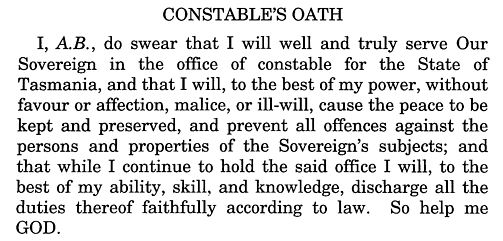
[Section 16 Amended by 25 Geo. V No. 78 ](1) Any person appointed to be a police officer shall not be capable of acting in any way as such officer until he shall have taken and subscribed the oath set forth in Form 1 in Schedule 2 .(2) The said oath shall be administered by a justice, and shall in all cases be subscribed by the person taking the same; and the oaths so taken and subscribed by all persons appointed to any office under this Act shall be forwarded by the justice before whom the same were taken to the Commissioner.
17. Oath taken under Act hereby repealed deemed to have been taken under this Act
Every officer of police and every constable who is in office on the date preceding the date when this Act comes into operation, and who shall have taken the oath required by any Act hereby repealed to be taken by officers of police and constables appointed thereunder, shall be deemed to have taken and subscribed under the provisions of this Act the oath set forth in Form 1 in Schedule 2 .
18. Oath equivalent to agreement
[Section 18 Amended by 25 Geo. V No. 78 ]Every person who has taken and subscribed such oath shall, from the day on which such oath shall have been taken and subscribed, be taken to have thereby entered into a written agreement with, and shall be thereby bound to serve, the Crown as a police officer in whatsoever capacity he may be at any time thereafter required to serve, and at the current rate of pay of any rank to which he may be appointed or reduced, until legally discharged; and such agreement shall not be set aside, cancelled or annulled for want of reciprocity, but every agreement shall be determined by the discharge, dismissal, or other removal from office of any such person, or by the acceptance of the resignation of such person by the Governor or the Commissioner, as the case may be.
19. One month's notice of resignation to be given by police officers
[Section 19 Amended by 25 Geo. V No. 78 ]No police officer shall be at liberty to resign his office or withdraw himself from the duties thereof, notwithstanding the period of his engagement shall have expired, unless expressly authorized in writing so to do by the Commissioner, or unless he shall give to the Commissioner one month's notice in writing of his intention so to resign or withdraw.
20. Repute to be evidence of appointment
If any question shall arise as to the right of the Commissioner or any police officer to hold or exercise the duties of his office, common reputation shall be deemed prima facie evidence of such right, and it shall not be necessary to have or produce any written appointment or other document or matter whatsoever in proof of such right.
21. All powers vested in police officers to cease upon discharge
When any police officer shall be discharged or dismissed from or shall otherwise cease to hold and exercise his office, all powers and authorities vested in him as a police officer shall immediately cease.
[Section 22 Substituted by No. 16 of 1954, s. 7 ](1) If it appears to the Commissioner, or to any officer of police of or above the rank of inspector, that –the Commissioner or the officer of police, as the case may be, may, by precept in writing under his hand, appoint so many as he thinks fit of the persons residing within that district who are not legally exempt from serving the office of special constable to act as special constables in and for that district for such time and in such manner as he thinks necessary.(a) any tumult, riot, serious crime, or breach of the peace has taken place, or may reasonably be likely to take place within any district; or(b) the ordinary police force is not sufficient for the preservation of the public peace within, and for the protection of the inhabitants of, and the security of property within, any district –(2) In addition to appointing persons to act as special constables pursuant to subsection (1) the Commissioner or officer of police, as the case may be, may also appoint such other persons as may be willing to serve to act as special constables in and for the relevant district, notwithstanding that they may be legally exempt from serving or may not be residing within the district.(3) [Section 22 Subsection (3) substituted by No. 78 of 1983, s. 4 ]Notwithstanding subsections (1) and (2) , the Commissioner may, with the approval of the Minister, appoint to act as a special constable for the whole of the State and for the time and purposes authorized by the Commissioner –(a) a member of the police force of the Commonwealth or of a police force of a State or Territory;(b) a person appointed or employed under an Act or other law of the Commonwealth or of Tasmania for the purpose of administering or enforcing any such Act or other law, while that person is actually engaged in performing his functions under any such Act or other law; or(c) a person who, in the opinion of the Commissioner with regard to the functions of that person, ought to be so appointed.
23. Oath taken by special constables
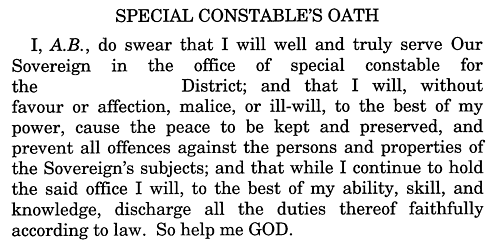
[Section 23 Amended by 25 Geo. V No. 78 ][Section 23 Amended by No. 16 of 1954, s. 8 ]Every person appointed a special constable under this Act shall, before acting as such, take an oath before a justice according to Form 1 in Schedule 2 , in the case of a special constable appointed under section 22 (3) , or Form 2 in that Schedule in any other case.
24. Penalty on special constable refusing to take the oath of office
[Section 24 Amended by 25 Geo. V No. 78 ][Section 24 Amended by No. 55 of 1965, s. 5 ][Section 24 Amended by No. 67 of 1994, s. 3 and Sched. 1 ]If any person residing within any such district is appointed a special constable, who is not legally exempt from serving the office of constable, and neglects or refuses without sufficient cause or excuse to appear at the time and place for which he is summoned by the Commissioner or superintendent for the purpose of taking the said oath, or refuses to take the said oath when thereunto lawfully required by the Commissioner or superintendent, he shall be liable to a fine not exceeding 0·1 penalty unit.
25. Penalty on special constable refusing to serve or guilty of disobedience of orders
[Section 25 Amended by 25 Geo. V No. 78 ][Section 25 Amended by No. 55 of 1965, s. 5 ][Section 25 Amended by No. 67 of 1994, s. 3 and Sched. 1 ]If any person being appointed and sworn a special constable as aforesaid, and being called upon to serve, neglects or refuses to act as such special constable, or to obey such lawful orders and directions as may be given to him for the performance of the duties of his office, he shall be liable to a fine not exceeding 0·1 penalty unit, unless he shows to the satisfaction of the justices adjudicating that he was prevented by sickness or such other unavoidable accident as in their judgment is a sufficient excuse.
26. Powers of special constables
[Section 26 Amended by 25 Geo. V No. 78 ][Section 26 Amended by No. 16 of 1954, s. 9 ]Every special constable appointed under this Act shall, within the district, if any, in and for which he is appointed or, in the case of a special constable appointed under section 22 (3) , shall, throughout the State have and exercise all such powers, authorities, and privileges, and be liable to all such duties and responsibilities, as any other constable duly appointed now has or hereafter may have in this State.
27. Special constables to be paid for their services
[Section 27 Amended by No. 16 of 1954, s. 10 ]Every special constable appointed as aforesaid by the Commissioner or an officer of police shall receive for his services such salary, wages, and allowances as the Minister directs.
28. Exemption from serving as special constable
[Section 28 Amended by 25 Geo. V No. 78 ]The like persons shall be deemed to be legally exempted from serving the office of special constable as are legally exempted from serving upon a jury in Tasmania.
Division 2 - Cadets, technical officers, and departmental employees[Part IA, Div. 2 Inserted by No. 92 of 1971, s. 6 ]
28A. Appointment and dismissal of cadets
[Section 28A Inserted by No. 92 of 1971, s. 6 ][Section 28A Amended by No. 39 of 1994, s. 8 ]The Commissioner may –(a) appoint such cadets as he thinks fit; and(b) suspend or dismiss any cadet.
[Section 28B Inserted by No. 92 of 1971, s. 6 ]Where a junior constable is appointed as a cadet, having been in continuous employment as a junior constable immediately prior to such appointment as a cadet –(a) his appointment as a junior constable is by force of this section revoked; and(b) his appointment as a cadet is deemed to have been effected on the day he was appointed a junior constable.
[Section 28C Substituted by No. 29 of 1984, s. 3 and Sched. 1 ](1) Subject to and in accordance with the Tasmanian State Service Act 1984 , technical officers and persons, other than police officers, may be appointed or employed for the purposes of this Act.(2) Persons appointed pursuant to subsection (1) shall not be permitted to perform any duty under this Act (except the rendering of aid or assistance under section 37 ) other than a duty associated with or ancillary to the duty he is appointed to carry out.
28D. Notice of intention to resign or withdraw
[Section 28D Inserted by No. 92 of 1971, s. 6 ][Section 28D Amended by No. 29 of 1984, s. 3 and Sched. 1 ]Except with the written consent of the Commissioner, no cadet shall resign from his office or withdraw from the duties thereof unless he gives to the Commissioner one month's notice in writing of his intention to do so.
PART II - Duties and discipline
[Section 29 Substituted by No. 92 of 1971, s. 7 ][Section 29 Amended by No. 29 of 1984, s. 3 and Sched. 1 ][Section 29 Amended by No. 67 of 1994, s. 3 and Sched. 1 ]The Governor may make regulations for the government of the police force with respect to all matters necessary for carrying into effect the several objects of this Act and, in particular and without limiting the generality of this section, may make regulations for or in relation to –(a) making the members of the police force efficient for the discharge of their respective duties;(b) prescribing their duties in enforcing obedience to law;(c) . . . . . . . .(d) prescribing disciplinary offences being offences of, or of the nature of –in the office of a member of the police force or of a cadet; and(i) insubordination;(ii) misconduct;(iii) neglect of duty; or(iv) violation of duty –(e) prescribing fines, not exceeding 0·4 penalty unit, for the breach of any regulation made under this section.
29A. Commissioner to review reports of disciplinary offences: Notice to be given
[Section 29A Inserted by No. 50 of 1973, s. 3 ](1) [Section 29A Subsection (1) amended by No. 29 of 1984, s. 3 and Sched. 1 ]The Commissioner shall review every report and any other document bearing on the matter of a report from which it appears a police officer or cadet has committed or is committing a disciplinary offence.(2) [Section 29A Subsection (2) amended by No. 29 of 1984, s. 3 and Sched. 1 ]Where the Commissioner, acting under subsection (1) , believes on reasonable grounds that a police officer or cadet has committed or is committing a disciplinary offence, he shall cause a notice to be served on that person specifying the offence that he believes has been or is being committed and informing that person that he may –and that, if he admits under this section the commission of a disciplinary offence, or (in the case of a denial under this section) if the Commissioner after due inquiry is satisfied that the person has committed a disciplinary offence, the Commissioner may impose on him, in respect thereof, a penalty under Part III .(a) admit in writing the commission of the offence so specified or of any other disciplinary offence;(b) deny in writing the commission of the offence so specified; or(c) elect to have that offence determined on complaint before a magistrate –
29B. Police officer, &c., may admit offence or elect trial by magistrate
[Section 29B Inserted by No. 50 of 1973, s. 3 ][Section 29B Amended by No. 29 of 1984, s. 3 and Sched. 1 ]Within 14 days of the service on him of a notice under section 29A , a police officer or cadet shall submit a written submission in accordance with paragraph (a) of subsection (2) of that section, or a written denial in accordance with paragraph (b) of that subsection, or make an election in accordance with paragraph (c) of that subsection.
29C. Police officer, &c., admitting disciplinary offence entitled to be heard
[Section 29C Inserted by No. 50 of 1973, s. 3 ][Section 29C Amended by No. 29 of 1984, s. 3 and Sched. 1 ]Where a police officer or cadet makes an admission under section 29A (2) (a) , he may for the purpose of making an explanation or in relation to any penalty that may be imposed by the Commissioner –(a) tender a written submission; or(b) request to be paraded before the Commissioner.
29D. When disciplinary offence to be determined on complaint before a magistrate
[Section 29D Inserted by No. 50 of 1973, s. 3 ][Section 29D Amended by No. 29 of 1984, s. 3 and Sched. 1 ]Where a police officer or cadet on whom a notice under section 29A is served –the offence shall be determined on complaint before a magistrate in accordance with the Justices Act 1959 .(a) elects, within the period specified in section 29B , to have the offence specified in the notice determined on complaint before a magistrate; or(b) has, at the expiration of the period specified in section 29B , failed or refused to make an admission or a denial or such an election as provided by that section –
PART III - Penalties
30. Penalty for resigning without notice
[Section 30 Amended by 25 Geo. V No. 78 ][Section 30 Amended by No. 55 of 1965, s. 5 ][Section 30 Amended by No. 92 of 1971, s. 8 ][Section 30 Amended by No. 29 of 1984, s. 3 and Sched. 1 ][Section 30 Amended by No. 67 of 1994, s. 3 and Sched. 1 ]If any police office or cadet shall resign his office or withdraw himself from the duties thereof without the previous permission or notice required by this Act, he shall be liable to a fine not exceeding 0·2 penalty unit.
[Section 31 Amended by 25 Geo. V No. 78 ][Section 31 Amended by No. 55 of 1965, s. 5 ][Section 31 Subsection (1) amended by No. 67 of 1994, s. 3 and Sched. 1 ][Section 31 Amended by No. 29 of 1984, s. 3 and Sched. 1 ][Section 31 Amended by No. 67 of 1994, s. 3 and Sched. 1 ][Section 31 Amended by No. 46 of 1991, s. 4 and Sched. 2 ](1) [Section 31 Subsection (1) amended by No. 50 of 1973, s. 4 ]Any police officer who is guilty of any insubordination, misconduct, neglect, or violation of duty in his office as such police officer, shall be liable to a fine not exceeding 0·4 penalty unit.(2) [Section 31 Subsection (2) substituted by No. 50 of 1973, s. 4 ]In any case in which a police officer or cadet who, having been served with a notice under section 29A , admits in writing, within the period prescribed in section 29B , the commission of a disciplinary offence or, within that period, denies the commission of such an offence but the Commissioner, after due inquiry, is satisfied that that person has committed a disciplinary offence, the Commissioner may impose a fine not exceeding the fine prescribed in relation to that offence.(3) [Section 31 Subsection (3) inserted by No. 50 of 1973, s. 4 ]A penalty imposed by the Commissioner under subsection (2) may, if not paid within the time, if any, allowed by the Commissioner in that behalf, be withheld from any salary due or to become due to the police officer or cadet, as the case may be.
31A. Offence by a police officer under another Act punishable under this Act; offence punishable under this Act so punishable even though officer acting under another Act
[Section 31A Inserted by No. 87 of 1976, s. 2 ](1) An offence committed by a police officer when performing a duty or discharging the functions of an office or place imposed or conferred upon him by or under any Act other than this Act shall be deemed to be an offence for the purposes of this Part, notwithstanding that the officer has not been charged in any court with, or convicted by any court of, that offence and the officer is liable, in respect of that offence, to punishment under this Part accordingly.(2) When a police officer is performing a duty imposed on him by or under any Act other than this Act or is appointed to an office or place by or under any Act other than this Act, the offences prescribed for the purposes of this Act shall apply in respect of the discharge of his function by the officer acting under that other Act in all respects as if he were acting in his office as a police officer under this Act.
32. Penalty for taking bribe, &c.
[Section 32 Amended by 25 Geo. V No. 78 ][Section 32 Amended by No. 55 of 1965, s. 5 ][Section 32 Amended by No. 92 of 1971, s. 9 ][Section 32 Amended by No. 29 of 1984, s. 3 and Sched. 1 ][Section 32 Amended by No. 67 of 1994, s. 3 and Sched. 1 ]Any police officer or cadet who shall take any bribe, pecuniary or otherwise, either directly or indirectly, to forego his duty, or who shall in any manner aid or connive at the escape or attempt to escape of any prisoner in lawful custody, or who shall desert his post, or assault his superior in rank in the police force, or shall neglect or refuse to obey or execute any process directed to be by him executed, shall on the complaint of any police officer be liable to a fine not exceeding 0·5 penalty unit or to imprisonment for a term not exceeding 6 months.
33. Penalty for not delivering accoutrements
[Section 33 Amended by 25 Geo. V No. 78 ]If any person who, having been a police officer has been discharged or dismissed from, or who has otherwise ceased to hold and execute his office, shall not forthwith deliver over everything whatsoever which may have been supplied to him for the execution of his office, or which may be in his custody by virtue thereof, to such person as may be appointed by any order, special or general, issued by the Commissioner, he shall, on the complaint of any officer, be liable to be imprisoned for 3 months; and any justice shall issue his warrant to search for and seize to the use of the Crown all and every the arms, ammunition, accoutrements, horses, saddles, bridles, clothing, and other appointments and things whatsoever which shall not be so delivered over wherever the same shall be found.
34. Penalty for personating police officer
[Section 34 Amended by 25 Geo. V No. 78 ][Section 34 Amended by No. 55 of 1965, s. 5 ][Section 34 Amended by No. 67 of 1994, s. 3 and Sched. 1 ]If any person, not being a police officer, shall have in his possession any arms or ammunition, or any article of clothing, accoutrements, or appointments supplied to any police officer, and shall not be able satisfactorily to account for his possession thereof, or shall put on or assume the dress, name, designation, or description of a police officer, with the intention that it should be believed, or the knowledge that it is likely that it will be believed that he is a police officer, he shall, in addition to any other punishment for which he may be liable for such offence, on the complaint of any police officer be liable to a fine not exceeding 1 penalty unit.
34A. Penalty for use of chequered cap band
[Section 34A Inserted by No. 53 of 1981, s. 3 ][Section 34A Amended by No. 67 of 1994, s. 3 and Sched. 1 ]Without affecting the generality of section 34 , a person, not being a police officer, who wears, or directs or requires another person to wear, any head dress incorporating a chequered cap band the same as or similar to that required by the Commissioner to be worn by a police officer is guilty of an offence and is liable on summary conviction to a fine not exceeding 1 penalty unit.
35. Penalty for bribing police officer
[Section 35 Amended by 25 Geo. V No. 78 ][Section 35 Amended by No. 55 of 1965, s. 5 ][Section 35 Amended by No. 67 of 1994, s. 3 and Sched. 1 ]If any person gives, or offers or promises to give, any bribe, recompense, or reward to, or makes any collusive agreement with, any police officer to induce him in any way to neglect his duty, or to conceal or connive at any act whereby any law or any regulation may be infringed or evaded, he shall, whether such recompense or bribe, reward, or offer, promise, or agreement is accepted or performed or not, be liable to a fine not exceeding 1 penalty unit or to imprisonment for a term not exceeding 6 months.
36. Penalties on persons assaulting police officer
[Section 36 Amended by 25 Geo. V No. 78 ]Every person who assaults or resists, or who aids or incites any person to assault or resist, any police officer in the execution of his duty, or any person at the time lawfully acting in aid of such officer, shall in addition to any other penalty be liable to pay the amount of any damage caused by such assault or resistance to the clothes, apparel, or accoutrements of such officer or any person lawfully aiding such officer as aforesaid, and in default of payment of the amount of any such damage, to be imprisoned for 2 months.
37. Penalty for not assisting police officer
[Section 37 Amended by 25 Geo. V No. 78 ][Section 37 Amended by No. 55 of 1965, s. 5 ][Section 37 Amended by No. 67 of 1994, s. 3 and Sched. 1 ]Any police officer when in the lawful execution of his duty, may call upon any male bystander, not being under the age of 18 years, to aid or assist him to secure or convey any prisoner in his charge to a watch-house or other place when reasonable necessity exists for calling for such assistance; and any such person refusing to aid or assist such police officer when so called upon shall be liable to a fine not exceeding 0·1 penalty unit.
38. Prosecution of offenders under other Acts
[Section 38 Amended by 25 Geo. V No. 78 ]Nothing contained in this Act shall be construed to prevent any person from being prosecuted under any other Act for any offence made punishable by this Act, or from being liable under any other Act to any other or higher penalty or punishment than is provided for such offence by this Act.
PART IV - Superannuation Fund[Part IV Repealed by No. 5 of 1988, s. 25 ][Section 39 Repealed by No. 5 of 1988, s. 25 ]. . . . . . . . [Section 40 Repealed by No. 5 of 1988, s. 25 ]. . . . . . . . [Section 41 Repealed by No. 5 of 1988, s. 25 ]. . . . . . . . [Section 42 Repealed by No. 5 of 1988, s. 25 ]. . . . . . . . [Section 43 Repealed by No. 5 of 1988, s. 25 ]. . . . . . . . [Section 44 Repealed by No. 5 of 1988, s. 25 ]. . . . . . . . [Section 45 Repealed by No. 5 of 1988, s. 25 ]. . . . . . . . [Section 46 Repealed by No. 5 of 1988, s. 25 ]. . . . . . . . [Section 47 Repealed by No. 5 of 1988, s. 25 ]. . . . . . . . [Section 48 Repealed by No. 5 of 1988, s. 25 ]. . . . . . . . [Section 49 Repealed by No. 5 of 1988, s. 25 ]. . . . . . . .
PART IVA - Police Promotions Appeal Board[Part IVA Substituted by No. 91 of 1995, s. 5 ]
49A. Police Promotions Appeal Board
[Section 49A Substituted by No. 91 of 1995, s. 5 ](1) The Police Promotions Appeal Board is established.(2) The Board consists of 3 members appointed by the Minister of whom –(a) one is the chairperson; and(b) one is a police officer selected from a list of 3 police officers nominated by the Association; and(c) one is a person with the appropriate skills and experience.(3) The Minister may appoint a suitable person without a nomination if a nomination is not made under subsection (2) (b) within 30 days after the Minister requires.(4) Schedule 3 has effect in respect of membership of the Board.(5) Schedule 4 has effect in respect of meetings of the Board.
49B. Member not to hear appeal
[Section 49B Substituted by No. 91 of 1995, s. 5 ](1) A member of the Board must not hear an appeal if the Minister is of the opinion that for the member to do so may prejudice the hearing on the basis of a conflict of interest, bias or similar basis.(2) A member prevented from hearing an appeal is taken to be temporarily absent.
[Section 49C Substituted by No. 91 of 1995, s. 5 ](1) The Minister may appoint a suitable person to be the deputy of a member of the Board in that member's temporary absence.(2) A deputy member may act as a member of the Board and while so acting has the same powers and functions as the member for whom he or she is the deputy.(3) In any proceedings, proof is not required of –(a) the circumstances in which a person is appointed as a deputy member; or(b) the appointment of a deputy member.
49D. General functions and powers of Board
[Section 49D Substituted by No. 91 of 1995, s. 5 ](1) The Board is to hear and determine appeals under this Part.(2) The Board has power to do all things necessary or convenient to perform its functions.
49E. Secretarial and administrative support
[Section 49E Substituted by No. 91 of 1995, s. 5 ]The Secretary of the responsible Department in relation to the Justices Act 1959 is to provide to the Board secretarial and administrative assistance in relation to the hearing and determination of an appeal under this Part.
49F. Notice of intention to appoint
[Section 49F Substituted by No. 91 of 1995, s. 5 ](1) If the Governor or Commissioner intends to appoint a police officer to a position of a prescribed rank, a notice of that intention is to be published in the Police Gazette.(2) A notice of intention is to be published by –(a) the Minister, if an intended appointment is to a rank referred to in section 10 ; or(b) the Commissioner, in any other case.
[Section 49G Substituted by No. 91 of 1995, s. 5 ](1) A police officer who applies for a position of a prescribed rank may appeal to the Board against the intended appointment of another police officer to that position if the appointment would be a promotion for that other officer.(2) A notice of appeal is to be –(a) in writing; and(b) lodged with the Board within 14 days of the publication of a notice under section 49F (1) .(3) The Board may require any document or record in support of the appeal to be lodged.(4) Any document or record must be lodged with the Board within 7 days of lodging the notice of appeal.(5) An appeal lapses if any document or record is not lodged within 7 days of lodging the notice of appeal.(6) The Board is to notify the Minister or Commissioner if an appeal is not lodged or lapses.
[Section 49H Substituted by No. 91 of 1995, s. 5 ](1) An appeal in relation to an appointment to a position of a prescribed rank may be made on either or both of the following grounds:(a) that the appellant believes he or she is more entitled to appointment to the position than the person intended to be appointed on the basis of superior merit and good conduct;(b) that there has been an irregularity in the selection process.(2) For the purposes of an appeal, merit is the capacity of a person to perform the work associated with a particular position having regard to –(a) the knowledge, skills, qualifications and experience of the person; and(b) the person's potential for future development in that rank and position.
[Section 49I Substituted by No. 91 of 1995, s. 5 ](1) On receiving a notice of appeal, the Board is to examine the notice and any associated documents or records to determine whether or not a case for the appeal may exist.(2) The Board may dismiss the appeal if satisfied that a case for the appeal does not exist.
[Section 49J Substituted by No. 91 of 1995, s. 5 ](1) The Board is to hear and determine an appeal in accordance with this Part.(2) The hearing of an appeal by the Board is to be conducted with as little formality and technicality, and with as much expedition, as this Part and a proper consideration of the matter permit.(3) The rules of evidence do not apply to a hearing by the Board and the Board may be informed on any matter in any way it considers appropriate.(4) The Board must observe the rules of natural justice.(5) Subject to this Part, the Board may regulate its own proceedings.
[Section 49K Inserted by No. 91 of 1995, s. 5 ]On the hearing of an appeal under this Part, the Commissioner is to make available to the Board any one or all of the following persons:(a) the chairperson of the selection panel or, subject to the approval of the Board, a member of the selection panel;(b) the person it is intended to appoint to the position;(c) the appellant;(d) any witnesses summoned by the Board.
49L. Board may summon witnesses
[Section 49L Inserted by No. 91 of 1995, s. 5 ](1) A party to an appeal may request the Board to summon a person to attend the proceedings as a witness.(2) The Board may summon a person to be a witness or to produce any document or record relevant to the proceedings by serving on the person a notice in writing requiring that person to attend the proceedings to –(a) give evidence; or(b) produce the documents or records.(3) The notice is to specify the following:(a) the name of the person on whom it is served;(b) the time and place at which the person is required to attend;(c) any document or record the Board requires to be produced at the proceedings;(d) any other matter the Board determines.(4) A person summoned by the Board to attend the proceedings must not –(a) fail to attend the proceedings; or(b) refuse to be sworn; or(c) refuse to answer any question put by the Board; or(d) fail to produce any document or record specified in the notice.Penalty: Fine not exceeding 5 penalty units.
49M. Remuneration of witnesses
[Section 49M Inserted by No. 91 of 1995, s. 5 ](1) A witness who is not a member of the police force and is summoned to attend proceedings before the Board on the hearing of an appeal is entitled to be paid an allowance for travelling expenses and maintenance during any absence from his or her usual place of residence in accordance with the scale of allowances to witnesses specified in –(a) Appendix M to Part I of the Rules of the Supreme Court 1965 ; or(b) Part II of the appendix to the Rules of Court made under the Criminal Code Act 1924 .(2) The appellant and any other member of the police force summoned to attend proceedings before the Board on the hearing of an appeal are entitled to be paid travelling expenses and maintenance during any absence from his or her usual place of work at the rates prescribed in the Police Award.
[Section 49N Inserted by No. 91 of 1995, s. 5 ](1) In determining an appeal under this Part, the Board may –(a) dismiss the appeal; or(b) in respect of an appeal under section 49H (1) (a) , uphold the appeal and direct that the appellant be appointed to the position and, if applicable, the prescribed rank; or(c) in respect of an appeal under section 49H (1) (b) , uphold the appeal and direct that the Commissioner take any action, other than appointment of the appellant, the Board considers necessary.(2) The decision of the Board is final.(3) The Board is to notify its decision in writing to –(a) every party to the appeal; and(b) the Minister or the Commissioner.
49O. Date of appointment after appeal
[Section 49O Inserted by No. 91 of 1995, s. 5 ]If the Board upholds an appeal under section 49N , the appointment of the appellant to the position and, if applicable, the prescribed rank takes effect on the date of the notification of the Board's decision.
[Section 49P Inserted by No. 91 of 1995, s. 5 ]. . . . . . . . [Section 49R Repealed by No. 91 of 1995, s. 5 ]. . . . . . . . [Section 49RA Repealed by No. 91 of 1995, s. 5 ]. . . . . . . . [Section 49S Repealed by No. 91 of 1995, s. 5 ]. . . . . . . .(1) The Governor or the Commissioner may make the intended appointment if –(a) all appeals under this Part in respect of the intended appointment are dismissed; or(b) an appeal is not made within the period specified in section 49G (2) (b) .(2) An appointment takes effect on the fifteenth day after the date of publication of a notice under section 49F (2) .
PART IVB - Police Disciplinary Board[Part IVB Inserted by No. 7 of 1955, s. 2 ]
[Section 50 Substituted by No. 7 of 1955, s. 2 ][Section 50 Amended by No. 5 of 1990, s. 3 and Sched. 1 ]In this Part, unless the contrary intention appears –Association means the Police Association;Board means the Police Disciplinary Board constituted under this Part;secretary means secretary of the Board.
50A. The Police Disciplinary Board
[Section 50A Inserted by No. 7 of 1955, s. 2 ](1) For the purposes of this Act, there shall be a Board, to be known as the Police Disciplinary Board, constituted as provided by this section.(2) [Section 50A Subsection (2) amended by No. 23 of 1963, s. 2 ]Subject to subsection (10) , the Board shall consist of 3 persons appointed by the Governor, of whom –(a) one shall be a magistrate who shall be the chairman of the Board;(b) one shall be a person, not being a police officer, nominated by the Minister; and(c) one shall be a person selected by the Minister from a list of 3 persons submitted to the Minister by the governing body of the Association.(3) [Section 50A Subsection (3) amended by No. 29 of 1984, s. 3 and Sched. 1 ]If the Association fails, within 30 days after being requested by the Minister so to do, to nominate a person for appointment as a member of the Board, the Governor may, without a nomination, appoint a police officer to represent the Association, as the case may be, as a member of the Board.(4) Each of the members of the Board shall, subject to this Part, hold office for a term of 3 years from the date of his appointment.(5) [Section 50A Subsection (5) amended by No. 29 of 1984, s. 3 and Sched. 1 ]A member of the Board may be paid such fees, and such out-of-pocket expenses and travelling allowances, as the Governor may determine, but no remuneration shall be paid pursuant to this subsection to a member of the Board who is an employee, within the meaning of the Tasmanian State Service Act 1984 , except with the approval of the Head of the Agency in which the employee is employed.(6) The chairman and one other member constitute a quorum of the Board, and the Board may function, notwithstanding a vacancy in its membership, so long as a quorum remains.(7) The chairman of the Board may exercise a deliberative vote only.(8) If, at a meeting of the Board at which only 2 members are present, the votes of those members on any question are equal, the determination of that question shall be postponed until a subsequent meeting at which all the members are present.(9) At any meeting of the Board, the decision of a majority of the members present thereat shall be deemed to be the decision of the Board.(10) [Section 50A Subsection (10) substituted by No. 23 of 1963, s. 2 ]There shall be a substitute member of the Board who shall be appointed by the Governor on the nomination of the Association.(11) [Section 50A Subsection (11) amended by No. 23 of 1963, s. 2 ]For the purposes only of the hearing and determination of an appeal by a police officer who is a member of the Board, the substitute member of the Board shall sit and act as a member thereof in lieu of the member by whom the appeal is made.(12) All acts and proceedings of the Board while a substitute member is sitting or acting as a member thereof shall be deemed to be fully valid and effectual for all purposes.(13) Subject to this Part and to the regulations, the Board may regulate its own procedure.
[Section 50B Inserted by No. 7 of 1955, s. 2 ](1) [Section 50B Subsection (1) amended by No. 23 of 1963, s. 3 and s. 6 ]The office of a member of the Board becomes vacant –(a) at the expiration of the term for which he is appointed; or(b) if he –(i) dies;(ii) resigns his office by writing under his hand addressed to the Governor;(iii) being the chairman, ceases to hold office as a magistrate;(iv) . . . . . . . .(v) being the member appointed under section 50A (2) (c) , ceases to be a police officer or, if he is not a police officer at the time of his appointment, if he ceases to be the secretary of the Association; or(vi) is removed from office by the Governor in accordance with subsection (2) .(2) The Governor may remove a member of the Board from office –(a) for misbehaviour, negligence, or incompetence;(b) if, in the opinion of the Governor, the member becomes incapable of performing his duties as a member; or(c) if the member –(i) becomes bankrupt, or applies to take or takes advantage of any law relating to bankrupt or insolvent debtors;(ii) is convicted of a crime, within the meaning of the Criminal Code , and the Governor considers that, by reason of the nature of the crime, it is not proper that he should continue to hold office as a member of the Board; or(iii) is absent, without leave of the Minister, from 3 or more consecutive meetings of the Board.
[Section 50C Inserted by No. 7 of 1955, s. 2 ](1) [Section 50C Subsection (1) substituted by No. 5 of 1990, s. 3 and Sched. 1 ]The Secretary of the Department may appoint a person employed in the Department to be secretary of the Board and that person shall hold that office in conjunction with a position or an office under the Tasmanian State Service Act 1984 .(2) [Section 50C Subsection (2) amended by No. 5 of 1990, s. 3 and Sched. 1 ]The secretary shall convene meetings or sittings of the Board, shall keep a record of all proceedings and decisions of the Board, and shall perform such other duties as the Board may require or as may be prescribed.
[Section 50D Inserted by No. 7 of 1955, s. 2 ][Section 50D Subsection (6) amended by No. 71 of 1995, s. 3 and Sched. 1 ](1) A police officer (in this section referred to as "the appellant") who is aggrieved by any decision, determination, order, or recommendation made by the Commissioner –may appeal therefrom to the Board, which shall hear and determine the appeal.(a) with respect to –(i) any reduction in the position, rank, or pay of that police officer;(ii) the dismissal of that police officer from the police force; or(iii) the imposition by the Commissioner on that police officer of any fine or the forfeiture by that police officer of all or any of his pay;(b) requiring that police officer to resign from the police force –(2) [Section 50D Subsection (2) amended by No. 5 of 1990, s. 3 and Sched. 1 ]An appeal under this section shall be instituted –(a) by written notice of appeal setting forth the grounds of the appeal and delivered or forwarded by post to the secretary; and(b) within 30 days after the appellant has been notified of the decision, determination, order, or recommendation in respect of which the appeal is made.(3) The appellant shall within the time mentioned in subsection (2) (b) , deliver or forward by post to the Commissioner a copy of his notice of appeal.(4) [Section 50D Subsection (4) amended by No. 5 of 1990, s. 3 and Sched. 1 ]Upon receipt of a notice of appeal under this section, the secretary shall, after conferring with the chairman of the Board, fix a date, time, and place for the hearing of the appeal, and shall forthwith notify the appellant and the Commissioner of the time and place so fixed.(5) [Section 50D Subsection (5) amended by No. 5 of 1990, s. 3 and Sched. 1 ]The date fixed for the hearing of an appeal under this section shall be not less than 7 days after the notice of appeal is received by the secretary.(6) [Section 50D Subsection (6) amended by No. 5 of 1990, s. 3 and Sched. 1 ]Upon the hearing of an appeal under this section –(a) the appellant, and the Commissioner or a police officer or a person employed in the Department nominated by the Commissioner, may appear before the Board and tender evidence and examine witnesses appearing before the Board;(b) the appellant, and the Commissioner or other officer referred to in paragraph (a) , may be represented by a legal practitioner or by an agent who may examine witnesses and address the Board; and(c) the Board has and may exercise the same powers as are conferred by Part 3 of the Commissions of Inquiry Act 1995 on Commissions established under section 4 of that Act in respect of inquiries under that Act.(6A) [Section 50D Subsection (6A) inserted by No. 23 of 1963, s. 4 ]On determining an appeal under this section, the Board may uphold the appeal in whole or in part, or may dismiss the appeal, and may make such orders as it may consider necessary or desirable for the purpose of giving effect to its decision.(6B) [Section 50D Subsection (6B) inserted by No. 23 of 1963, s. 4 ]Without prejudice to the generality of subsection (6A) , on the determination of an appeal under this section, the Board may make any one or more of the following orders, namely:(a) an order that the position, rank, or rate of pay to which the appellant was reduced by the Commissioner shall be a higher or lower position, rank, or rate of pay than that to which the appellant was so reduced;(b) an order that the amount of any fine imposed on the appellant by the Commissioner be increased or reduced;(c) an order that the amount of the pay that the Commissioner directed should be forfeited by the appellant be increased or decreased.(7) Subject to subsection (8) , the decision of the Board upon the determination of an appeal under this section is final, and the Commissioner shall give effect thereto accordingly.(7A) [Section 50D Subsection (7A) inserted by No. 50 of 1973, s. 5 ]No person, other than the members of the Board and the persons mentioned in subsection (6) , together with any persons performing any clerical or administrative duty at the hearing of the appeal, shall be admitted to the room or place in which the Board hears an appeal under this section.(8) [Section 50D Subsection (8) amended by No. 50 of 1973, s. 5 ]An appeal lies to a judge of the Supreme Court, sitting in chambers, on points of law only, from decisions of the Board, and that judge has jurisdiction to hear and determine any such appeal.(9) The Commissioner shall give effect to any decision or order of the Supreme Court made upon the hearing of an appeal to the Court from a decision of the Board.(10) [Section 50D Subsection (10) amended by No. 29 of 1984, s. 3 and Sched. 1 ]The right of appeal conferred on police officers by this section extends to any superintendent or inspector or other officer of police (other than the Commissioner, the Deputy-Commissioner, or the Assistant Commissioners) appointed by the Governor who is aggrieved by any decision, determination, or order of the Governor with respect to any reduction in the position, rank, or pay of that superintendent, inspector, or other officer or his discharge or dismissal from the police force, and the foregoing provisions of this section shall be construed accordingly.(11) [Section 50D Subsection (11) amended by No. 23 of 1963, s. 4 and s. 6 ]In the application of the provisions of this section to an appeal made by any superintendent, inspector, or other officer of police appointed by the Governor, a reference to the Commissioner –(a) in subsections (7) and (9) , shall be construed as a reference to the Governor; and(b) in subsections (3) and (4) , shall be construed as a reference to the Minister.(12) Subject to this section, the procedure on the making, hearing, and determination of appeals under this section shall be as prescribed or, in the absence of regulations in that behalf, as the Board may determine.(13) [Section 50D Subsection (13) substituted by No. 46 of 1991, s. 5 and Sched. 3 ]For the purposes of this section,police officer includes a cadet.
PART V - Miscellaneous
51. Certain lands to revert to the Crown
[Section 51 Amended by 25 Geo. V No. 78 ]Upon the date on which this Act comes into operation, all lands and buildings, or any part of any lands or buildings, vested in any municipality and heretofore used exclusively for police purposes, or as a residence for any officer of police or for any constable, in any municipality, and which were before the day on which such municipality was proclaimed vested in the Crown, and upon which the council of such municipality have not expended any money in the construction of any buildings erected thereon, shall revert to the Crown, and shall thereafter be available for the purposes of this Act, or may be disposed of as the Governor may think fit.
52. Protection from liability for police officers
[Section 52 Inserted by No. 84 of 1986, s. 4 ](1) A police officer shall not incur any civil liability for an act or omission done or made in good faith in the exercise or discharge, or purported exercise or discharge, of any powers, functions, duties, or responsibilities conferred or imposed upon him by any provision of this or any other Act (whenever enacted) or by law.(2) A liability that would, but for subsection (1) , lie against a police officer shall lie against the Crown.
53. Protection from liability of persons assisting police officers
[Section 53 Inserted by No. 85 of 1994, s. 4 ][Section 54 Repealed by 25 Geo. V No. 78 ]. . . . . . . . [Section 55 Repealed by 25 Geo. V No. 78 ]. . . . . . . . [Section 56 Repealed by 25 Geo. V No. 78 ]. . . . . . . . [Section 57 Repealed by 25 Geo. V No. 78 ]. . . . . . . . [Section 58 Repealed by 25 Geo. V No. 78 ]. . . . . . . . [Section 59 Repealed by 25 Geo. V No. 78 ]. . . . . . . . [Section 60 Repealed by 5 Edw. VII No. 30, s. 2 ]. . . . . . . .(1) A person who at the request and under the direction of a police officer assists the police officer in a search and rescue operation does not incur any civil liability for any act or omission done or made in good faith in the search and rescue operation.(2) A liability that would, but for subsection (1) , lie against a person assisting a police officer in a search and rescue operation lies against the Crown.
61. Power of court to order security for costs in actions brought against police officers
[Section 61 Amended by 25 Geo. V No. 78 ]In any action brought against any police officer for anything done by him as such officer, the court in which such action is brought, or a judge, may order that the plaintiff in such action shall give security for costs, or that all proceedings therein shall be stayed.[Section 62 Repealed by 25 Geo. V No. 78 ]. . . . . . . . [Section 63 Repealed by 25 Geo. V No. 78 ]. . . . . . . . [Section 64 Repealed by 25 Geo. V No. 78 ]. . . . . . . .
SCHEDULE 1 - Repeal of Acts[Schedule 1 Amended by 25 Geo. V No. 78 ]
Date and number of Act. | Title of Act. | Extent of repeal. | 29 Vict. No. 9 | Police Regulation Act 1865 | The whole Act | 45 Vict. No. 21 | Police Regulation Amendment Act 1881 | The whole Act | 54 Vict. No. 12 | Police Regulation Amendment Act 1890 | The whole Act |
SCHEDULE 2 - Forms[Schedule 2 Amended by 25 Geo. V No. 78 ][Schedule 2 Amended by No. 46 of 1991, s. 5 and Sched. 3 ][Schedule 2 Form 2 amended by No. 16 of 1954, s. 20 ][Schedule 2 Form 2 amended by No. 46 of 1991, s. 5 and Sched. 3 ]
Form 1
Form 2
SCHEDULE 3 - Membership of Board[Schedule 3 Inserted by No. 91 of 1995, s. 6 ]
1. InterpretationIn this Schedule, member means a member of the Board.
2. Term of officeA member is to be appointed for such period, not exceeding 3 years, as is specified in the member's instrument of appointment.
3. Holding other officeThe holder of an office who is required under any Act to devote the whole of his or her time to the duties of that office is not disqualified from –(a) holding that office and also the office of a member; or(b) accepting any remuneration payable to a member.
4. Remuneration of membersA member is entitled to be paid such remuneration, allowances and expenses as the Minister determines.
5. Vacation of office(1) A member vacates office if the member –(a) dies; or(b) resigns; or(c) is removed from office under subclause (2) or (3) .(2) The Minister may remove a member from office if the member –(a) is absent from 3 consecutive meetings of the Board without the permission of the Board; or(b) becomes bankrupt, applies to take the benefit of any law for the relief of bankrupt or insolvent debtors, compounds with creditors or makes an assignment of remuneration or estate for their benefit; or(c) is convicted, in Tasmania or elsewhere, of a crime or an offence punishable by imprisonment for 12 months or longer; or(d) is convicted of an offence against this Act or the Tasmanian State Service Act 1984 .(3) The Minister may remove a member from office if satisfied that the member is unable to perform adequately or competently the duties of office.
6. Filling of vacancies(1) If the office of the member referred to in section 49A (1) (b) becomes vacant, the Minister may appoint a person selected from nominations received under that paragraph to the vacant office for the remainder of that member's term of office.(2) If the office of a member referred to in section 49A (1) (a) or (c) becomes vacant, the Minister may appoint a suitable person to the vacant office for the remainder of that member's term of office.
SCHEDULE 4 - Meetings of Board
1. InterpretationIn this Schedule –meeting means a meeting of the Board;member means a member of the Board.
2. Convening of meetingsThe chairperson may convene a meeting at any time.
3. Procedure at meetings(1) The quorum at any duly convened meeting is 3 members.(2) Any duly convened meeting at which a quorum is present is competent to transact any business of the Board.(3) Questions arising at a meeting are to be determined by a majority of votes of the members present and voting.(4) A telephone or video conference between members is a meeting at which the members participating in the conference are present.
4. ChairpersonThe chairperson, or, in his or her absence, the deputy chairperson, of the Board is to preside at all meetings.
5. MinutesThe Board is to cause full and accurate minutes to be kept of its proceedings at meetings.
6. General procedureSubject to this Schedule, the procedure for the calling of, and for the conduct of business at, meetings is as determined by the Board.
7. Validity of proceedings(1) An act or proceeding of the Board or of a person acting under the direction of the Board is not invalid by reason only that at the time when the act or proceeding was done, taken or commenced there was a vacancy in the membership of the Board.(2) An act or proceeding of the Board or of a person acting under the direction of the Board is valid even if –(a) the appointment of a member of the Board was defective; or(b) a person appointed as a member of the Board was disqualified from acting as, or incapable of being, such a member.
8. PresumptionsIn any proceedings by or against the Board, unless evidence is given to the contrary, proof is not required of –(a) the constitution of the Board; or(b) any resolution of the Board; or(c) the appointment of any member; or(d) the presence of a quorum at any meeting of the Board.