
Environment Protection (Sea Dumping) Act 1987
An Act to provide for the protection of the environment by regulating the dumping into the sea, and the incineration at sea, of wastes and other matter and the dumping into the sea of certain other objects, and for related purposes
Be it enacted by His Excellency the Governor of Tasmania, by and with the advice and consent of the Legislative Council and House of Assembly, in Parliament assembled, as follows:
PART I - Preliminary
This Act may be cited as the Environment Protection (Sea Dumping) Act 1987 .
(1) This section and section 1 shall commence on the day on which this Act receives the Royal Assent.(2) Except as provided in subsection (1) , this Act shall commence on such day as may be fixed by proclamation.(3) The Governor may, in a proclamation under subsection (2) , suspend the operation of any specified provision of this Act until a subsequent day fixed in the proclamation, or until a day to be fixed by subsequent proclamation.
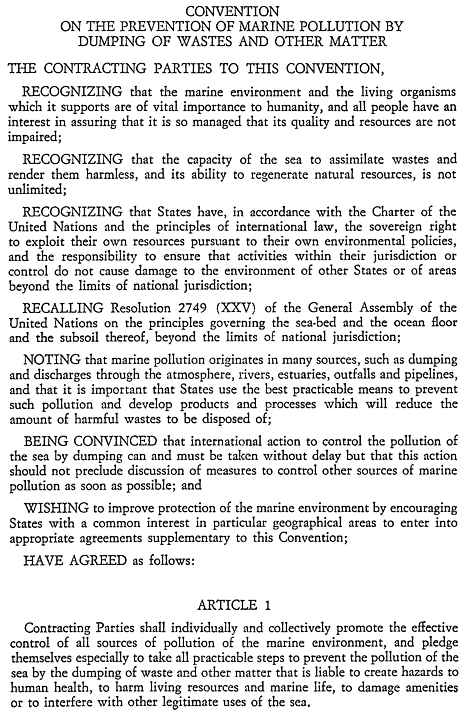
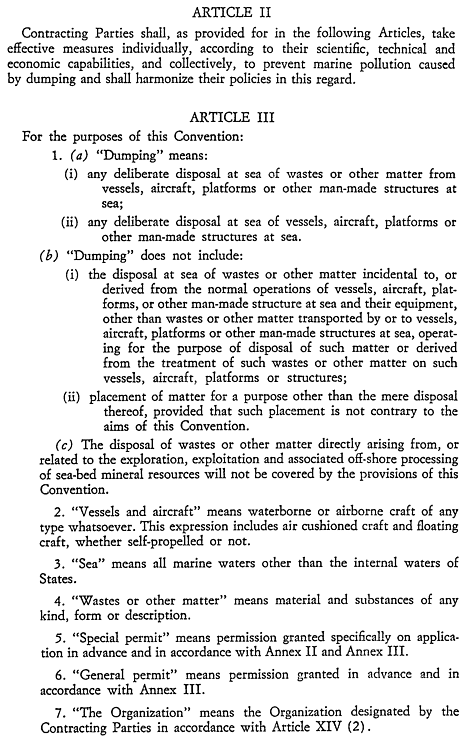
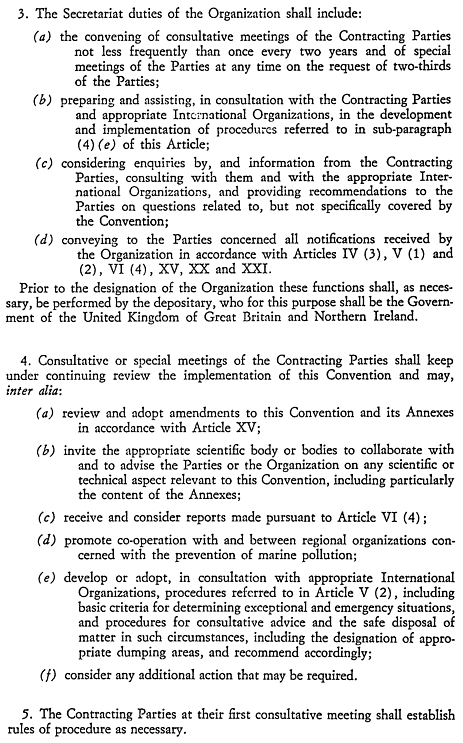
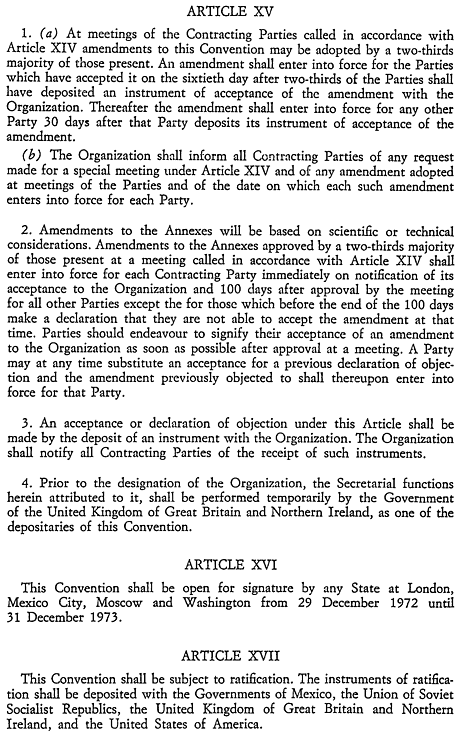
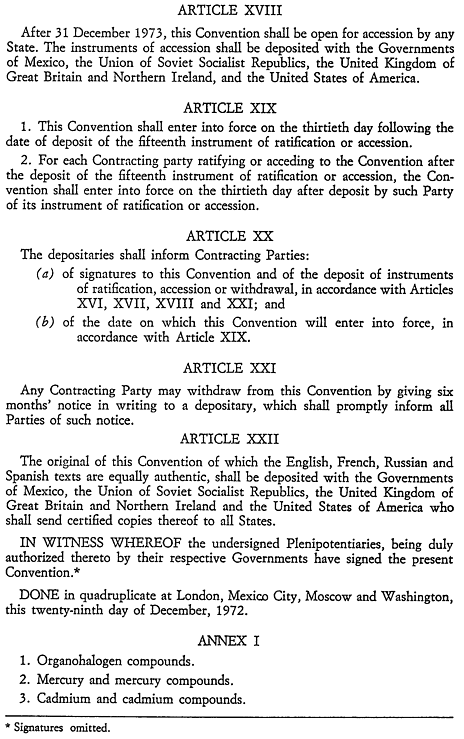
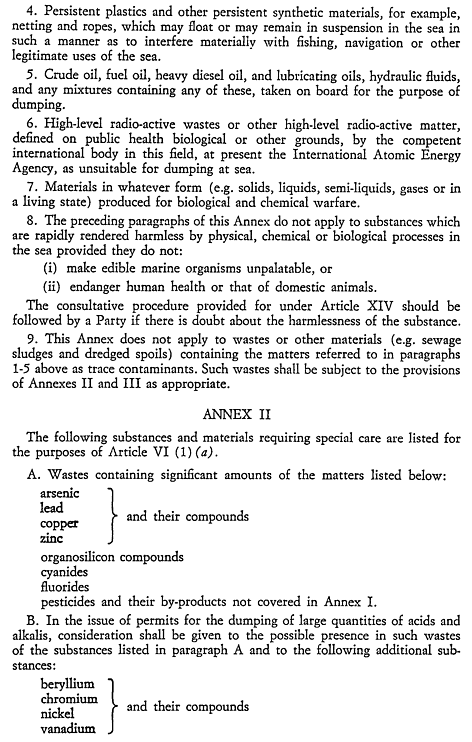
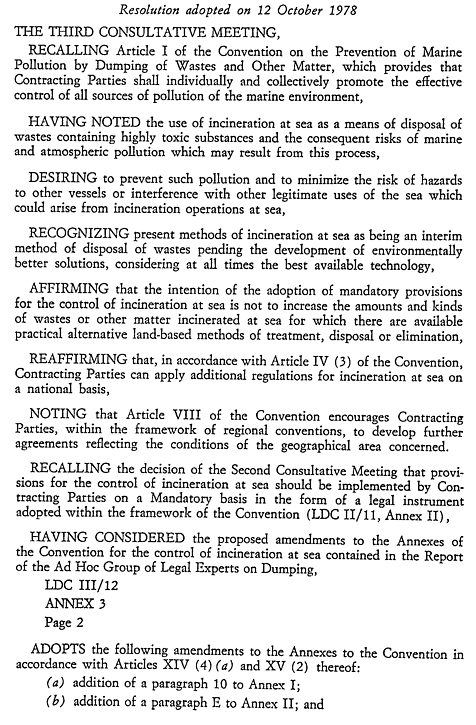
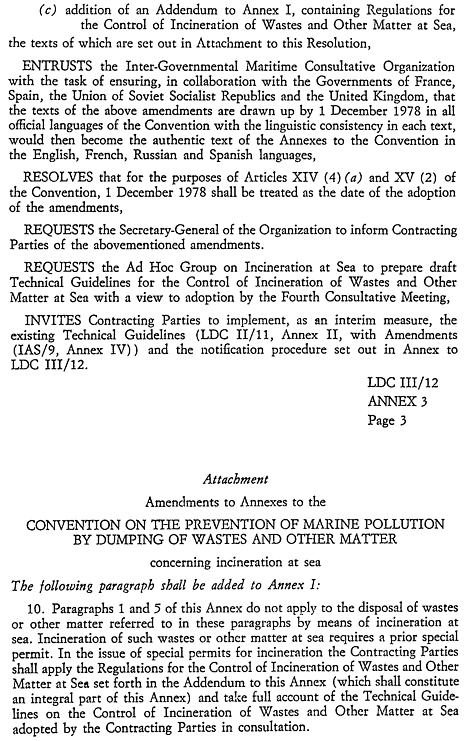
(1) [Section 3 Subsection (1) amended by No. 37 of 1996, s. 3 and Sched. 1 ]In this Act, unless the contrary intention appears –coastal waters means, in relation to the State, that part of the sea that is from time to time included in the coastal waters of the State by virtue of the Coastal Waters (State Powers) Act 1980 of the Commonwealth;the Convention means the Convention entitled "Convention on the Prevention of Marine Pollution by Dumping of Wastes and other Matter" being the Convention a copy of the English text of which is set out in the first Schedule as amended by –(a) the amendments set out in the Attachment to the Resolution a copy of the English text of which is set out in the second Schedule ;(b) the amendments set out in the Attachment to the Resolution a copy of the English text of which is set out in the third Schedule ; and(c) any other amendment to the Convention –(i) which is accepted by Australia; and(ii) which, as a copy of that amendment in the English text, is set out in the regulations;Crown means the Crown in the right of the State;holder of a permit means the person to whom a permit has been granted under Part III ;inspector means –(a) an authorized officer as defined by the Environmental Management and Pollution Control Act 1994 other than a police officer or a council officer, within the meaning of that Act; or(b) a police officer of or above the rank of sergeant;interpreter means –(a) a person appointed under section 21 (9) ; or(b) a person appointed as an interpreter under any other Act of Tasmania or of the Commonwealth;owner, in relation to a vessel, aircraft, or platform, includes –(a) every person who is a co-owner of the vessel, aircraft, or platform or of any part of, or any share in, the vessel, aircraft, or platform; and(b) every person who has the use or control (whether alone or jointly with another person or other persons) of the vessel, aircraft, or platform;permit means a permit granted under Part III ;person in charge means –(a) in relation to a vessel, the master or other person in charge of the vessel;(b) in relation to an aircraft, the person in charge of the aircraft; or(c) in relation to a platform, the person in charge of the operations conducted on or from the platform;platform includes any man-made structure at sea that is fixed to the sea bed beneath coastal waters;police officer has the meaning assigned to that expression by the Police Regulation Act 1898 ;[Section 3 Subsection (1) amended by No. 16 of 1997, Sched. 1, Applied:30 Jul 1997][Section 3 Subsection (1) amended by No. 16 of 1997, Sched. 1, Applied:30 Jul 1997] port waters means the waters within the jurisdiction of the Marine and Safety Authority as specified in the Marine and Safety Authority Act 1997 ;premises means a building or structure, or any part of a building or structure, or an area of land.(2) Except so far as the contrary intention appears, an expression that is used both in this Act and in the Convention (whether or not a particular meaning is assigned to it by the Convention) has, in this Act, the same meaning as in the Convention.
This Act does not apply in relation to the disposal –(a) of wastes or other matter directly arising from, or related to, the exploration, exploitation, and associated off-shore processing, of sea bed mineral resources; or(b) within port waters which are not part of the territorial sea of the Commonwealth of spoil dredged from within the boundaries of the port concerned.
(1) This Act binds the Crown but nothing in this Act renders the State liable to be prosecuted for an offence.(2) Subsection (1) does not affect any liability of a person in charge of a vessel, aircraft, or platform of which the State is the owner to be prosecuted for an offence.
PART II - Regulation of Dumping and Incineration at Sea
Division 1 - Dumping at sea
6. Dumping of wastes or other matter
Where, otherwise than in accordance with a permit, any wastes or other matter are dumped into coastal waters from any vessel, aircraft, or platform, the owner and the person in charge of the vessel, aircraft, or platform and the owner of the wastes or other matter are each guilty of an offence and are liable on conviction to the penalty specified in section 9 .
Where, otherwise than in accordance with a permit, a vessel, aircraft, or platform is dumped into coastal waters, the owner of the vessel, aircraft, or platform that is so dumped is guilty of an offence and, in addition, where the dumping takes place from a vessel, aircraft, or platform, the owner and the person in charge of the vessel, aircraft, or platform are each guilty of an offence and are liable on conviction to the penalty specified in section 9 .
8. Loading of wastes or other matter for dumping
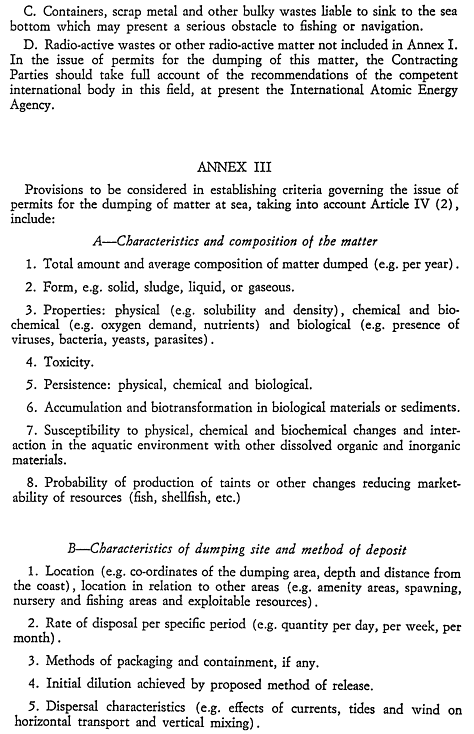
(1) Where, otherwise than in accordance with a permit, any prescribed matter is loaded on any vessel or aircraft in the State or in coastal waters, or on any platform, for the purpose of being dumped into the sea or being incinerated at sea, the owner and the person in charge of the vessel, aircraft, or platform and the owner of the prescribed matter are each guilty of an offence and are liable on conviction to the penalty specified in section 9 .(2) In subsection (1) , prescribed matter means –(a) any wastes or other matter; or(b) any vessel, aircraft, or platform.
9. Offences under this Division
[Section 9 Amended by No. 67 of 1994, s. 3 and Sched. 1 ]The penalty upon conviction of an offence under this Division is a fine not exceeding –(a) where the offence relates to wastes or other matter to which Annex I to the Convention applies, 500 penalty units if the offender is a natural person or 1 000 penalty units if the offender is a body corporate;(b) where the offence relates to wastes or other matter to which Annex II to the Convention applies, 250 penalty units if the offender is a natural person or 500 penalty units if the offender is a body corporate; or(c) in any other case, 100 penalty units if the offender is a natural person or 200 penalty units if the offender is a body corporate.
10. Defences to charge of an offence
It is a defence to a charge of an offence under section 6 or 7 if the person charged proves that –(a) the dumping the subject of the charge was necessary to secure the safety of human life, or of a vessel, aircraft, or platform, at sea in a case of force majeure caused by stress of weather; or(b) the dumping the subject of the charge was the only reasonable way of averting a threat to human life, or to the safety of a vessel, aircraft, or platform, at sea and there was every probability that the damage caused by such dumping would be less than would otherwise occur –and, in either case, that –(c) the dumping was so conducted as to minimize the likelihood of damage to human or marine life; and(d) a report of the dumping, setting out the prescribed information, was furnished to the Minister as soon as practicable after the occurrence of the dumping.
Division 2 - Incineration at sea
(1) This section applies to incineration at sea carried out on, or carried out from –(a) a vessel in coastal waters; or(b) a platform.(2) The incineration at sea of wastes or other matter listed in paragraphs 2, 3, 4, 6, and 7 of Annex I to the Convention, being incineration to which this section applies, is prohibited.(3) The incineration at sea, otherwise than in accordance with a permit, of wastes or other matter listed in paragraphs 1 and 5 of Annex I to the Convention, being incineration to which this section applies, is prohibited.(4) The incineration at sea, otherwise than in accordance with a permit, of wastes or other matter listed in Annex II, being incineration to which this section applies, is prohibited.(5) The incineration at sea, otherwise than in accordance with a permit, of any wastes or other matter (other than wastes or other matter referred to in subsection (2) , (3) , or (4) ), being incineration to which this section applies, is prohibited.(6) [Section 11 Subsection (6) amended by No. 67 of 1994, s. 3 and Sched. 1 ]The owner and the person in charge of a vessel or platform on which incineration at sea in contravention of this section is carried out and the owner of the wastes or other matter so incinerated are each guilty of an offence against this section and are liable on conviction, to a fine not exceeding –(a) where the incineration was in contravention of subsection (2) , 500 penalty units if the offender is a natural person or 1 000 penalty units if the offender is a body corporate;(b) where the incineration was in contravention of subsection (3) , 400 penalty units if the offender is a natural person or 800 penalty units if the offender is a body corporate;(c) where the incineration was in contravention of subsection (4) , 250 penalty units if the offender is a natural person or 500 penalty units if the offender is a body corporate; or(d) where the incineration was in contravention of subsection (5) , 100 penalty units if the offender is a natural person or 200 penalty units if the offender is a body corporate.
Division 3 - Reparation on account of dumping
12. Restoration of environment
Where –the Minister may cause to be taken such steps as he thinks proper to repair or remedy any condition, or to mitigate any damage, arising from that dumping.(a) wastes or other matter are, or a vessel, aircraft, or platform is, dumped into coastal waters; and(b) the Minister considers that that dumping is likely to –(i) cause an obstruction, or constitute a danger, to vessels; or(ii) result in harm to humans, bird life, or marine life –
13. Liability for expenses incurred by the State resulting from dumping
(1) Where –a person so convicted is liable to pay to the Crown an amount equal to the total amount of those expenses and liabilities of the Crown and that amount may be recovered, as a debt due to the Crown by the person, by action in a court of competent jurisdiction.(a) a person has been convicted of an offence under section 6 or 7 ; and(b) by reason of the exercise by the Minister of his powers under section 12 , the Crown has incurred expenses or other liabilities in repairing or remedying any condition, or mitigating any damage, arising from the dumping that constituted the offence –(2) Where 2 or more persons have been convicted of offences referred to in subsection (1) in respect of the same act of dumping, the Crown is not, by virtue of that subsection, entitled to recover from those persons amounts that, in the aggregate, exceed the total amount of the expenses and liabilities incurred by the Crown, by reason of the exercise by the Minister of his powers under section 12 , as a result of that dumping.(3) Subject to subsection (4) , where the owner of a vessel, aircraft, or platform –that amount is a charge upon the vessel, aircraft, or platform, as the case may be, and the vessel, aircraft, or platform may be detained by an inspector until the amount is paid or security for the payment of the amount is provided to the satisfaction of the Minister.(a) has been convicted of an offence under section 6 or 7 with respect to dumping from the vessel, aircraft, or platform; and(b) is liable by virtue of subsection (1) to pay an amount to the Crown in respect of that offence –(4) Subsection (3) does not entitle a person to detain a vessel, aircraft, or platform unless the vessel or aircraft is in the State or in coastal waters.(5) [Section 13 Subsection (5) amended by No. 67 of 1994, s. 3 and Sched. 1 ]Where –(a) a vessel or platform that has been detained under subsection (3) goes to sea before it is released from detention; or(b) an aircraft that has been detained under subsection (3) leaves the State before it is released from detention –the person in charge and owner of the vessel, aircraft, or platform, as the case may be, shall each be guilty of an offence and shall be liable on conviction –(c) in the case of the master, to a fine not exceeding 50 penalty units or imprisonment for a term not exceeding 2 years, or both;(d) in the case of the owner, if the owner is not a body corporate, to a fine not exceeding 50 penalty units or imprisonment for a term not exceeding 2 years, or both; or(e) in the case of the owner, if the owner is a body corporate, to a fine not exceeding 100 penalty units.
PART III - Permits
(1) A person may make an application to the Minister for the grant of a permit required for the purposes of this Act.(2) Subject to section 15 , a person may not make an application under subsection (1) –(a) in relation to the dumping or loading for dumping of any wastes or other matter to which Annex I to the Convention applies; or(b) in relation to the incineration at sea of wastes or other matter listed in paragraphs 2, 3, 4, 6, and 7 of Annex I to the Convention.(3) An application for a permit must be made in accordance with the appropriate form approved by the Minister from time to time.(4) Where an application is made for the grant of a permit and the Minister requires further information for the purpose of enabling him to deal with the application, he may, by notice in writing served on the applicant not later than 60 days after the application is made, require the applicant to furnish to the Minister, as specified in the notice, a statement in writing setting out that further information and, if a notice is so served, the application shall be deemed, for the purposes of section 15 , not to have been duly made until the statement is furnished.(5) Where, in his preliminary consideration of an application for a permit for dumping, the Minister forms the view that, in order to enable him to decide whether a permit should be granted or not, or to formulate conditions that should be imposed in respect of a permit if a permit is granted, it will be necessary for research and analysis to be undertaken to determine the effect that the proposed dumping may have on the marine environment, the Minister, before giving further consideration to the application, may require the applicant to enter into an agreement with the Crown that includes one or more of the following provisions:(a) that the applicant will, at his own expense but subject to the direction and supervision of the Minister, undertake such research and analysis as is specified in the agreement, being research and analysis relating to the effect that the proposed dumping might have on the marine environment;(b) that the applicant will reimburse the Crown the amount, as ascertained by the Minister, of any expense incurred by the Crown in undertaking research and analysis of a kind referred to in paragraph (a) ;(c) that the applicant will reimburse the Crown the amount, as ascertained by the Minister, of any expense incurred by the Crown in supervising any research and analysis undertaken by the applicant in accordance with the agreement;(d) that, if the applicant fails, or neglects, to carry out any research or analysis as required by the agreement –(i) the Crown may undertake the necessary research and analysis; and(ii) in that event, the applicant will reimburse the Crown the amount, as ascertained by the Minister, of the expense incurred by the Crown in connection with such undertaking;(e) that the applicant is to give a security to the Crown for the payment of any amount that he may become liable to pay to the Crown under the agreement;(f) that the applicant will report to the Minister the results of any research and analysis undertaken by him in accordance with the agreement.(6) Where an applicant is required under subsection (5) to enter into an agreement with the Crown providing for the undertaking of research and analysis as specified in the agreement, his application shall be deemed, for the purposes of section 15 , not to have been duly made until the research and analysis has been completed to the satisfaction of the Minister.
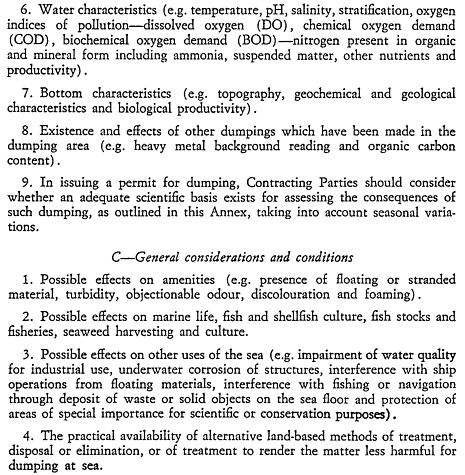
[Section 15 Subsection (9) amended by No. 30 of 1995, s. 3 and Sched. 1 ][Section 15 Subsection (9) amended by No. 18 of 1995, s. 3 and Sched. 1 ](1) [Section 15 Subsection (1) amended by No. 37 of 1996, s. 3 and Sched. 1 ]Subject to this section and sections 50 , 51 and 53 of the Environmental Management and Pollution Control Act 1994 , the Minister may, in his discretion, grant, or refuse to grant, a permit to a person who has made an application in accordance with section 14 .(2) The Minister shall give a decision under subsection (1) on an application for a permit within 90 days after the application is made.(3) Subject to subsection (4) , a permit for dumping or loading for dumping shall not be granted in respect of any wastes or other matter to which Annex I to the Convention applies.(4) The Minister may grant a permit for dumping or loading for dumping wastes or other matter to which Annex I to the Convention applies if, in the opinion of the Minister, there is an emergency posing an unacceptable risk relating to human health and admitting no other feasible solution.(5) In considering the granting of a permit for dumping or loading, the Minister shall have regard to –(a) the factors set forth in Annex III to the Convention;(b) in a case to which section B of Annex II to the Convention applies, the matters set out in that section; and(c) in a case to which Section D of Annex II to the Convention applies, any recommendations referred to in that section.(6) A permit for incineration at sea of wastes or other matter listed in paragraphs 1 and 5 of Annex I to the Convention shall not be granted except in accordance with the Regulations for the Control of Incineration of Wastes and Other Matter at Sea set forth in the Addendum to that Annex and, in considering the granting of such a permit, the Minister shall take full account of the Technical Guidelines on the Control of Incineration of Wastes and Other Matter at Sea adopted by the Contracting Parties to the Convention in consultation.(7) A permit for incineration at sea of wastes or other matter listed in Annex II to the Convention shall not be granted except in accordance with the Regulations for the Control of Incineration of Wastes and Other Matter at Sea set forth in the Addendum to Annex I, to the extent that those regulations are applicable, and, in considering the granting of such a permit, the Minister shall take full account of the Technical Guidelines on the Control of Incineration of Wastes and Other Matter at Sea adopted by the Contracting Parties to the Convention in consultation, to the extent that those guidelines are applicable.(8) Before granting a permit for dumping, the Minister may require the applicant to enter into an agreement with the Crown that includes one or more of the following provisions:(a) that the applicant will, at his own expense but subject to the direction and supervision of the Minister, undertake such research and monitoring as is specified in the agreement, being research and monitoring relating to the consequences of the release into the marine environment through the proposed dumping operation of any contaminants;(b) that the applicant will investigate, as specified in the agreement and subject to the direction and supervision of the Minister, the possibility of avoiding or reducing the need for further dumping by him;(c) that the applicant will reimburse the Crown the amount, as ascertained by the Minister, of any expense incurred by the Crown in undertaking research, monitoring, or investigation of a kind referred to in paragraphs (a) and (b) ;(d) that the applicant will reimburse the Crown the amount, as ascertained by the Minister, of any expense incurred by the Crown in supervising any research, monitoring, or investigation undertaken by the applicant in accordance with the agreement;(e) that, if the applicant fails, or neglects, to carry out any research, monitoring, or investigation as required by the agreement –(i) the Crown may undertake the necessary research, monitoring, or investigation, as the case may be; and(ii) in that event, the applicant will reimburse the Crown the amount, as ascertained by the Minister, of the expense incurred by the Crown in connection with such undertaking;(f) that the applicant is to give a security to the Crown for the payment of any amount that he may become liable to pay to the Crown under the agreement;(g) that the applicant will report to the Minister the results of any research, monitoring, or investigation undertaken by him in accordance with the agreement.(9) [Section 15 Subsection (9) amended by No. 5 of 1990, s. 3 and Sched. 1 ]Before granting a permit, the Minister shall –(a) [Section 15 Subsection (9) amended by No. 16 of 1997, Sched. 1, Applied:30 Jul 1997] in the case of a permit for dumping into port waters, consult the Marine and Safety Authority established under the Marine and Safety Authority Act 1997 ;(b) in the case of a permit for dumping into coastal waters that lie outside the limits of a port, consult the Minister responsible for the administration of the Living Marine Resources Management Act 1995 and the Minister administering the Public Health Act 1962 ;(c) if he considers it necessary to do so when considering the suitability of alternative methods of disposal of any wastes or other matter or of any vessel, aircraft, or platform, consult one or more councils.(10) A permit shall be expressed, in accordance with the Convention, to be either a general permit or a special permit.(11) A permit remains in force for the period specified in the permit.
16. Suspension and revocation of permits
(1) The Minister may, at any time, by notice in writing served on the holder of a permit, vary, suspend, or revoke the permit where he is satisfied that –(a) a provision of this Act relating to the permit or a condition imposed in respect of the permit has been contravened; or(b) it is necessary or expedient to do so in order properly to regulate the activities with which this Act is concerned.(2) A suspension of a permit may be of indefinite duration or for a period specified in the notice.(3) Where proceedings for an offence in relation to a permit are commenced during a period of suspension of the permit, the suspension may be continued until the proceedings (including any appeal) are completed.(4) During the period of suspension of a permit, the permit has no force or effect, but the period of currency of the permit continues to run.(5) The suspension of a permit does not prevent its revocation.(6) The revocation or suspension of a permit takes effect when notice of the revocation or suspension, as the case may be, is served on the holder of the permit or on such later date (if any) as is specified in the notice.
17. Conditions in respect of permits
(1) The Minister may, when granting a permit or at any time while a permit is in force, impose conditions in respect of the permit and may, at any time, revoke, suspend, vary, or cancel a suspension of, a condition so imposed.(2) A condition imposed in respect of a permit, or a revocation, suspension, or variation, or a cancellation of a suspension, of such a condition, takes effect when notice of the condition or of the revocation, suspension, variation, or the cancellation of the suspension, is served on the holder of the permit or on such later date (if any) as is specified in the notice.(3) The Minister may, when granting a permit for dumping from a vessel any thing other than the waste or other matter referred to in section 18 , impose in respect of that permit the condition that an escorting officer appointed by the Minister under section 18 be present on board the vessel in order to –(a) observe the loading, handling, and storing on board the vessel of –to be dumped;(i) the wastes or other matter; or(ii) the vessel, aircraft, or platform –(b) verify that –to be dumped from the vessel are or is, as the case may be, the wastes or other matter, or the vessel, aircraft, or platform, in respect of the dumping of which that permit was granted;(i) the wastes or other matter; or(ii) the vessel, aircraft, or platform –(c) observe the dumping into the sea in accordance with that permit of –to be dumped; and(i) the wastes or other matter; or(ii) the vessel, aircraft, or platform –(d) give to the master of the vessel such directions as that escorting officer thinks necessary –(i) in relation to any matter arising out of the presence on board the vessel of the wastes or other matter, or of the vessel, aircraft, or platform, to be dumped;(ii) to ensure that the loading, handling, or storing on board the vessel of the wastes or other matter, or of the vessel, aircraft, or platform, to be dumped, or the dumping into the sea of those wastes or that other matter or of that vessel, aircraft, or platform, is in accordance with that permit or with any condition imposed in respect of that permit (including a direction to cease loading or handling, or to cease dumping into the sea, the whole or any part of those wastes or that other matter or of that vessel, aircraft, or platform).(4) By force of this subsection, there is imposed in respect of a permit referred to in subsection (3) a condition that the holder of that permit will ensure that the escorting officer referred to in that subsection –(a) is received on board any vessel used, or to be used, for the carriage of the wastes or other matter, or of the vessel, aircraft, or platform, to be dumped during all times when his presence on board is necessary for the purpose of carrying out his functions;(b) be supplied with any necessary food and accommodation, being food and accommodation of an acceptable standard, when he is on board the vessel used or to be used for the purpose referred to in paragraph (a) ; and(c) is, when dumping has ceased, returned in accordance with arrangements agreed between the holder of that permit and the Minister to the port of embarkation or such other place as is agreed between the holder of that permit and the Minister.(5) When a vessel has on board an escorting officer referred to in subsection (3) for the purpose referred to in that subsection, the person in charge of the vessel shall –(a) permit that escorting officer to have access to every part of the vessel to which it is necessary that he have access for the purpose of carrying out his functions;(b) when requested by that escorting officer to do so, give to that escorting officer any information in the possession of the person in charge of the vessel concerning the wastes or other matter, or the vessel, aircraft, or platform, dumped or to be dumped, as the case requires; and(c) not take, or cause or permit to be taken, any action in relation to the wastes or other matter, or the vessel, aircraft, or platform, dumped or to be dumped, as the case requires, that is in contravention of any direction given to him by that escorting officer in the carrying out of his functions.(6) A person in charge of a vessel who fails to comply with, or contravenes the provisions of subsection (5) is guilty of an offence and is liable on conviction to a fine not exceeding 100 penalty units.(7) It is a defence to a charge of an offence under subsection (5) (c) if the person in charge ofthe vessel concerned proves that the action the subject of the charge was necessary to ensure the safety of that vessel or of any person on board.
18. Radioactive wastes or other matter
(1) Where the Minister proposes to grant a permit for the dumping or loading of wastes or other matter that are radioactive, the Minister shall state in the permit that the permit is a permit for dumping or loading, as the case may be, radioactive wastes or other matter.(2) The Minister may appoint such persons to be escorting officers (if any) as he thinks necessary to be present on board any vessel on which wastes or other matter are to be carried for the purpose of –(a) observing the loading, and stowing, on board the vessel of the wastes or other matter;(b) monitoring the levels of radiation caused by the wastes or other matter;(c) observing the dumping into the sea of the wastes or other matter in accordance with the permit; and(d) giving to the master of the vessel –(i) such directions as the escorting officer thinks necessary in relation to any matter arising out of the presence on board the vessel of the wastes or other matter; or(ii) such directions as the escorting officer thinks necessary to ensure that the handling or stowing of the wastes or other matter on board the vessel, or the dumping into the sea of such wastes or other matter, is in accordance with the permit or with any condition imposed in respect of the permit (including a direction to cease loading, or to cease dumping into the sea, the wastes or other matter or any part of the wastes or other matter).(2) It shall be a condition of every permit for dumping or loading radioactive wastes or other matter that the holder of the permit will ensure that –(a) any escorting officers appointed by the Minister in relation to the permit –(i) are received on board any vessel used, or to be used, for the carriage of the wastes or other matter concerned during all times when their presence on board is necessary for the purpose of carrying out their functions; and(ii) are supplied with any necessary food and accommodation, being food and accommodation of an acceptable standard, when they are on board the vessel; and(b) in the case of a permit for dumping, any escorting officers on board when dumping has ceased are, in accordance with arrangements agreed between the holder of the permit and the Minister, returned to the port of embarkation or such other place as is agreed between the holder of the permit and the Minister.(3) When a vessel that has on board an escorting officer for the purpose of carrying out his functions in relation to radioactive wastes or other matter on board, or to be loaded on board, the vessel, the person in charge of the vessel –(a) shall permit the escorting officer to have access to every part of the vessel to which it is necessary that he have access for the purpose of carrying out his functions;(b) when requested by the escorting officer so to do, shall give to the escorting officer any information in the possession of the person in charge concerning the radioactive wastes or other matter; and(c) shall not take any action, or cause or permit any action to be taken, in relation to the radioactive wastes or other matter that is in contravention of any direction given to him by the escorting officer in the carrying out of his functions.(4) [Section 18 Subsection (4) amended by No. 67 of 1994, s. 3 and Sched. 1 ]A person in charge of a vessel who fails to comply with, or contravenes, the provisions of subsection (3) is guilty of an offence and is liable on conviction to a fine not exceeding 100 penalty units.(5) It is a defence to a charge of an offence under subsection (3) (c) if the person in charge of the vessel proves that the action the subject of the charge was necessary to ensure the safety of the vessel or of any person on board.(6) For the purposes of this section, wastes or other matter shall not be regarded as being radioactive if they are not subject to any control under the Radiation Control Act 1977 and the Radioactive Substances Regulations 1963 .
19. Applications to Minister to vary operation of permits
(1) The holder of a permit may make application to the Minister for the revocation or variation of a condition imposed in respect of the permit.(2) The holder of a permit that is suspended may make application to the Minister for the cancellation of that suspension.(3) The Minister shall, within 60 days after the receipt of an application under subsection (1) or (2) –(a) if he is satisfied that the application should be granted –as the case may be;(i) revoke the condition;(ii) vary the condition in accordance with the application;(iii) cancel the suspension of the permit –(b) if he is not so satisfied – refuse to grant the application.
20. Matters to be published in Gazette
The Minister shall cause to be published in the Gazette particulars of –(a) applications for permits;(b) permits granted and any conditions imposed in respect of those permits;(c) refusals to grant permits;(d) any revocation, suspension, or cancellation of the suspension, of a permit; and(e) any revocation, suspension or variation, or any cancellation of a suspension, of a condition imposed in respect of a permit.
PART IV - Inspectors
21. Boarding of vessels, &c., by inspector
(1) This section applies to –(a) any vessel or any aircraft that is in the State; or(b) any vessel, or any aircraft capable of landing on water, that is in coastal waters, or any platform.(2) An inspector may, with such assistance as he thinks necessary, board any vessel, aircraft, or platform to which this section applies for the purpose of exercising the functions of an inspector in accordance with section 23 if he believes on reasonable grounds that there is in, or on, that vessel, aircraft, or platform –and, in the case of a vessel or aircraft, may, for that purpose, stop and detain that vessel or aircraft.(a) any matter or thing that is to be dumped into the sea or incinerated at sea; or(b) any matter or thing that may afford evidence as to the commission of an offence against this Act –(3) An inspector may require any person on board a vessel, aircraft, or platform to which this section applies whom he finds committing, or whom he suspects on reasonable grounds of having committed, an offence against this Act to state his full name and usual place of residence.(4) Where an inspector believes on reasonable grounds that a vessel to which this section applies and that is in coastal waters has been used or otherwise involved in the commission of an offence against this Act, he may bring, or require the person in charge of the vessel to bring, the vessel to the nearest port in Tasmania to which it is safe and practicable to bring the vessel.(5) An inspector may, for purposes of this Act, require the person in charge of a vessel, aircraft, or platform to which this section applies to give information concerning the vessel, aircraft, or platform and her crew and any other person on board the vessel, aircraft, or platform.(6) [Section 21 Subsection (6) amended by No. 37 of 1996, s. 3 and Sched. 1 ]Where an inspector (other than a police officer who is in uniform) boards a vessel, aircraft, or platform to which this section applies, he shall –and, if he fails to do so, he is not authorized to remain, or to require any person assisting him to remain, on board that vessel, aircraft, or platform or to detain that vessel or aircraft.(a) in the case of a police officer, produce, for inspection by the person in charge of that vessel, aircraft, or platform, written evidence of the fact that he is a police officer; or(b) in any other case, produce written evidence that the inspector is an authorized office under section 20 of the Environmental Management and Pollution Control Act 1994 –(7) [Section 21 Subsection (7) amended by No. 37 of 1996, s. 3 and Sched. 1 ]Where an inspector (other than a police officer who is in uniform) makes a requirement of a person under this section, the inspector shall –and, if he fails to do so, that person is not obliged to comply with the requirement.(a) in the case of a police officer, produce, for inspection by that person, written evidence of the fact that he is a police officer; or(b) in any other case, produce written evidence that the inspector is an authorized office under section 20 of the Environmental Management and Pollution Control Act 1994 –(8) Where an inspector boards a vessel, aircraft, or platform to which this section applies, he may take with him an interpreter.(9) The Minister may appoint a person who, in his opinion, is qualified by reason of his knowledge of a language as an interpreter of that language for the purposes of this section.(10) [Section 21 Subsection (10) amended by No. 67 of 1994, s. 3 and Sched. 1 ]A person who, without reasonable excuse, fails to comply with a requirement made of him by an inspector or by an interpreter on behalf of an inspector under this section is guilty of an offence and is liable on conviction to a fine not exceeding 20 penalty units.
(1) An inspector may, with the consent of the occupier of any premises, enter the premises for the purpose of exercising the functions of an inspector in accordance with section 23 .(2) Where an inspector has reason to believe that there is on premises –the inspector may apply to a justice for a warrant authorizing the inspector to enter the premises for the purpose of exercising the functions of an inspector in accordance with section 23 .(a) any matter or thing that is to be dumped into the sea or incinerated at sea; or(b) any matter or thing that may afford evidence as to the commission of an offence against this Act –(3) If, on an application under subsection (2) , a justice is satisfied, by information on oath –the justice may grant a warrant authorizing the inspector, with such assistance as he thinks necessary, to enter the premises, during such hours of the day or night as the warrant specifies or, if the warrant so specifies, at any time, if necessary by force, for the purpose of exercising the functions of an inspector in accordance with section 23 .(a) that there is reasonable ground for believing that there is on the premises to which the application relates –(i) any matter or thing that is to be dumped into the sea or incinerated at sea; or(ii) any matter or thing that may afford evidence as to the commission of an offence against this Act; and(b) that the issue of the warrant is reasonably required for the purposes of this Act –(4) Where an inspector has entered any premises in pursuance of this section, he may exercise the functions of an inspector in accordance with section 23 .
(1) The functions of an inspector who boards a vessel, aircraft, or platform under section 21 or enters premises under section 22 are as follows:(a) to search for, and take possession of, any matter or thing that may afford evidence as to the commission of an offence against this Act;(b) to search for, inspect, take extracts from, and make copies of any document that relates to the loading, dumping, or incineration at sea of any matter or thing;(c) to inspect, and take samples of, any wastes or other matter;(d) to observe –(i) the loading on a vessel or aircraft, in accordance with a permit, of any matter or thing that is to be dumped into the sea or incinerated at sea; or(ii) the dumping into the sea, or the incineration at sea, in accordance with a permit, of any matter or thing.(2) For the purposes of carrying out his functions under subsection (1) , an inspector may, on any vessel, aircraft, platform, or premises –(a) break open any hold, compartment, container, or other receptacle; or(b) take such photographs as he considers necessary.
24. Powers and functions of inspectors in addition to those conferred by Environmental Management and Pollution Control Act 1994
[Section 24 Amended by No. 37 of 1996, s. 3 and Sched. 1 ]The powers and functions conferred on an inspector by sections 22 and 23 are in addition to, and do not derogate from, or replace, the powers and functions conferred by section 92 (1) of the Environmental Management and Pollution Control Act 1994 on an authorized officer as defined by that Act.
25. Powers of arrest of inspectors
(1) An inspector who is a police officer may arrest without warrant any person –(a) who hinders or assaults an inspector or a person accompanying or assisting an inspector; or(b) where he has reason to believe that the person has committed an offence against this Act and –(i) failed to state truthfully his name or usual place of residence when required to do so;(ii) would fail to attend court in answer to a summons issued in respect of the offence; or(iii) would continue or repeat the offence if not arrested.(2) Where an inspector who is a police officer arrests a person under subsection (1) , the inspector shall –(a) produce for inspection by that person, written evidence of the fact that he is a police officer; and(b) bring that person or cause him to be brought before a justice or other proper authority to be dealt with in accordance with the law.(3) Nothing in this section prevents the arrest of a person in accordance with any other law.
26. Immunity from personal liability
(1) No personal liability shall attach to an inspector, or any person lawfully assisting an inspector, for any act or omission by him in good faith and in the exercise or discharge, or purported exercise or discharge, of the powers, duties, or functions of an inspector under this Act.(2) A liability that would, but for subsection (1) , lie against an inspector or other person shall lie against the Crown.
PART V - Miscellaneous
27. Appeal from refusal to grant a permit
(1) Subject to subsection (2) , a person who is aggrieved by –may appeal to a magistrate.(a) a refusal of the Minister to grant a permit under this Act; or(b) a decision of the Minister to vary, suspend, or revoke a permit under this Act –(2) An appeal under subsection (1) must be instituted within 30 days of the date of the decision appealed against, but a magistrate may, if he is satisfied that it is just and reasonable in the circumstances to do so, dispense with the requirement that the appeal should be instituted within that time.(3) A magistrate may, on the hearing of an appeal, exercise any one or more of the following powers:(a) affirm, vary, or quash the decision of the Minister and make any incidental or other order that may be just in the circumstances;(b) remit the matter to the Minister for his reconsideration; or(c) make any order as to costs.
(1) The Supreme Court may –(a) upon application by the Attorney-General or by an interested person, grant an injunction restraining a person from engaging in conduct that constitutes, or would constitute, an offence under Division 1 or 2 of Part II ; and(b) make any order incidental or supplementary to an order made or an application under paragraph (a) , including an order as to costs.(2) The reference in subsection (1) (a) to an interested person shall be read as including a reference to a person whose use or enjoyment of any part of the sea, or of the air space above, or of the sea bed or subsoil beneath, any part of the sea, is, or is likely to be, adversely affected by the conduct concerned.(3) The reference in subsection (1) (a) to engaging in conduct shall be read as including a reference to –(a) doing, refusing to do, or refraining from doing, any act or thing; or(b) causing or permitting another person to do, refuse to do, or refrain from doing, any act or thing.
(1) The Minister may, either generally or as otherwise provided by the instrument of delegation, by writing signed by him, delegate to a person all or any of his powers under this Act, other than his power of delegation.(2) Where a power delegated under this section by the Minister is exercised by the delegate, the power shall, for the purposes of this Act, be deemed to have been exercised by the Minister.(3) A delegate under this section is, in the exercise of his delegated powers, subject to the directions of the Minister.(4) A delegation under this section does not prevent the exercise of a power by the Minister.
(1) [Section 30 Subsection (1) amended by No. 67 of 1994, s. 3 and Sched. 1 ]A person who, in, or in connection with, an application for a permit –(a) makes a statement that, to his knowledge, is false or misleading in a material particular; or(b) furnishes to the Minister, or any other person acting in the administration of this Act, a document that, to the knowledge of the first-mentioned person, contains information that is false or misleading in a material particular –is guilty of an offence and is liable on conviction –(c) if the person is a natural person, to a fine not exceeding 50 penalty units or imprisonment for a term not exceeding 2 years, or both; or(d) if the person is a body corporate, to a fine not exceeding 200 penalty units.(2) [Section 30 Subsection (2) amended by No. 67 of 1994, s. 3 and Sched. 1 ]A person who –(a) makes to an inspector a statement that, to the knowledge of the person, is false or misleading in a material particular; or(b) furnishes to an inspector a document that, to the knowledge of the person, contains information that is false or misleading in a material particular –is guilty of an offence and is liable on conviction –(c) if the person is a natural person, to a fine not exceeding 10 penalty units; or(d) if the person is a body corporate, to a fine not exceeding 20 penalty units.
31. Compliance with conditions of permit
[Section 31 Amended by No. 67 of 1994, s. 3 and Sched. 1 ]The holder of a permit who contravenes, or fails to comply with, a condition imposed in respect of the permit is guilty of an offence and is liable on conviction –(a) if the person is a natural person, to a fine not exceeding 50 penalty units; or(b) if the person is a body corporate, to a fine not exceeding 100 penalty units.
(1) An offence against section 6 , 7 , 8 , 11 , 13 (5) , or 30 (1) is an indictable offence.(2) Notwithstanding that an offence referred to in subsection (1) is an indictable offence, a court of summary jurisdiction may hear and determine proceedings in respect of such an offence if the court is satisfied that it is proper to do so and the defendant and the prosecutor consent.(3) [Section 32 Subsection (3) amended by No. 67 of 1994, s. 3 and Sched. 1 ]Where, in accordance with subsection (2) , a court of summary jurisdiction convicts a person of an offence against section 6 , 7 , 8 , 11 , or 13 (5) , the penalty that the court may impose is a fine not exceeding –(a) if the person is a natural person, 20 penalty units; or(b) if the person is a body corporate, 50 penalty units.(4) [Section 32 Subsection (4) amended by No. 67 of 1994, s. 3 and Sched. 1 ]Where, in accordance with subsection (2) , a court of summary jurisdiction convicts a person of an offence against section 30 (1) , the penalty that the court may impose is –(a) if the person is a natural person, a fine not exceeding 20 penalty units or imprisonment for a term not exceeding 12 months, or both; or(b) if the person is a body corporate, a fine not exceeding 50 penalty units.
(1) In proceedings for an offence against this Act –(a) an allegation in a complaint that a person is, or was on a specified day, the owner or person in charge of a specified vessel, aircraft, or platform (as the case may be) shall, in the absence of proof to the contrary, be deemed to be proof of the matter alleged;(b) any record kept in pursuance of this Act is admissible as prima facie evidence of the facts stated in the record;(c) a copy of an entry in such a record, being a copy certified by the person by whom the record is required to be kept to be a true copy of the entry, is admissible as prima facie evidence of the facts stated in the entry; and(d) a document purporting to be a record kept in pursuance of this Act, or purporting to be such a certified copy as is referred to in paragraph (c) , shall, unless the contrary is established, be deemed to be such a record or certified copy, as the case may be.(2) In proceedings for an offence against this Act, evidence of a distance or position as determined by the use of an electronic, optical, mechanical, or other device by an inspector or any other competent person shall, in the absence of proof to the contrary, be accepted as proof of the distance or position.(3) In proceedings for an offence against this Act, a statement made in evidence by an inspector that a place or area described or indicated by him was within coastal waters shall, in the absence of proof to the contrary, be accepted as proof of the matter so stated.(4) In proceedings for an offence against this Act, any conditions of a permit under this Act may be proved by the production of an apparently genuine document purporting to be a copy of the conditions certified by the Minister.
(1) [Section 34 Subsection (1) amended by No. 37 of 1993, s. 3 and Sched. 1 ]The Minister may appoint a person who has appropriate qualifications to be an analyst for the purposes of this Act.(2) [Section 34 Subsection (2) amended by No. 37 of 1993, s. 3 and Sched. 1 ]A person appointed as an analyst under section 100 (1) of the Environmental Management and Pollution Control Act 1994 is deemed to be a person appointed as an analyst for the purposes of this Act.(3) Subject to subsection (4) , a certificate of an analyst appointed under subsection (1) or deemed to be appointed under subsection (2) stating that he has analyzed or examined a substance and stating the result of his analysis or examination is admissible in any proceedings under this Act as prima facie evidence of the matters in the certificate and of the correctness of the result of the analysis or examination.(4) For the purposes of this section, a document purporting to be a certificate referred to in subsection (3) shall, unless the contrary is established, be deemed to be such a certificate and to have been duly given.(5) A certificate shall not be admitted in evidence in pursuance of subsection (3) in proceedings for an offence unless the person charged with the offence has been given a copy of the certificate together with reasonable notice of the intention to produce the certificate as evidence in the proceedings.
(1) The regulations may prescribe the fees to be paid in respect of an application for a permit or of any other application under this Act.(2) A fee prescribed in respect of an application under this Act shall be paid when the application is made or at such other time (if any) as is prescribed and, if the fee is not so paid, the application shall be deemed not to be duly made.(3) The Minister may, if he considers it necessary or desirable to do so, waive the payment of any fee payable in respect of an application and, if he does so, subsection (2) does not apply in relation to that application.
(1) Where under this Act a document or notice is required to be served on a person, the document or notice may be served –(a) in the case of a person who is neither a body corporate nor a firm –(i) by delivering it to him personally;(ii) by leaving it at that person's place of residence last known to the person required to serve the document or notice with someone who apparently resides there, or at that person's place of business or employment last known to the person required to serve the document or notice with someone who is apparently employed there, being in either case a person who has or apparently has attained the age of 16 years; or(iii) by sending it by post to that person's place of residence, business, or employment last known to the person required to serve the document or notice;(b) in the case of a body corporate –(i) by delivering it personally to the person who is, within the meaning of the Companies (Tasmania) Code , the principal executive officer of the body corporate;(ii) by leaving it at the registered office of the body corporate or at the place or principal place of business of the body corporate in Tasmania with a person apparently employed there, being a person who has or apparently has attained the age of 16 years; or(iii) by sending it by post to the registered office of the body corporate or to the place or principal place of business of the body corporate; or(c) in the case of a firm –(i) by delivering it to a member of the firm personally;(ii) by leaving it at the place or principal place of business of the firm in Tasmania last known to the person required to serve the document or notice with a person apparently employed there, being a person who has or apparently has attained the age of 16 years; or(iii) by sending it by post to the place or principal place of business of the firm in Tasmania last known to the person required to serve the document or notice.(2) A reference in subsection (1) to the registered office of a body corporate includes a reference to a registered office that is outside Tasmania.(3) The provisions of this section are in addition to the provisions of section 528 of the Companies (Tasmania) Code .
(1) The Governor may make regulations for the purposes of this Act.(2) The regulations may be made subject to such conditions, or be made to apply differently according to such factors, as may be specified in the regulations or according to such limitations or restrictions, whether as to time or circumstance or otherwise, as may be so specified.(3) [Section 37 Subsection (3) amended by No. 67 of 1994, s. 3 and Sched. 1 ]The regulations may provide that it is an offence, punishable on conviction, for a person to contravene or fail to comply with any of the regulations and may provide in respect of any such offence for the imposition of a fine not exceeding 20 penalty units and where the offence is a continuing one, further fines not exceeding 2 penalty units for each day during which the offence continues.(4) Regulations prescribing matters for the purposes of this Act may prescribe those matters by reference to regulations for the time being in force under the Environment Protection (Sea Dumping) Act 1981 of the Commonwealth.
SCHEDULE 1
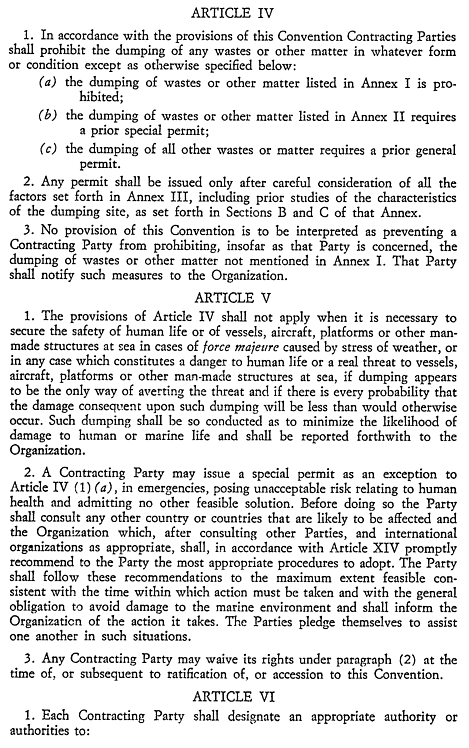
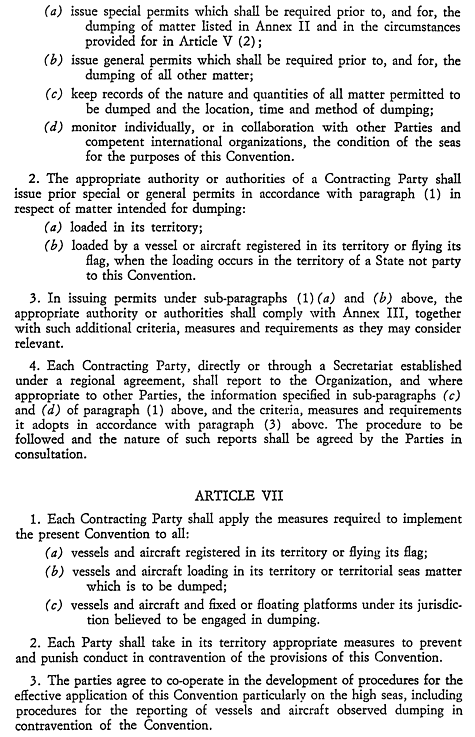
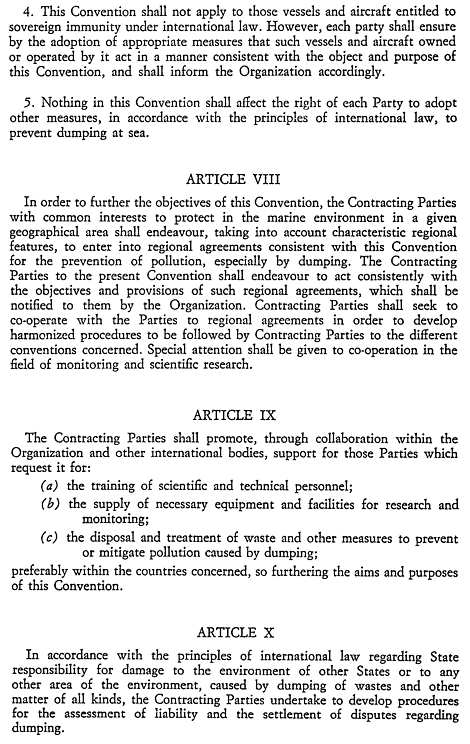
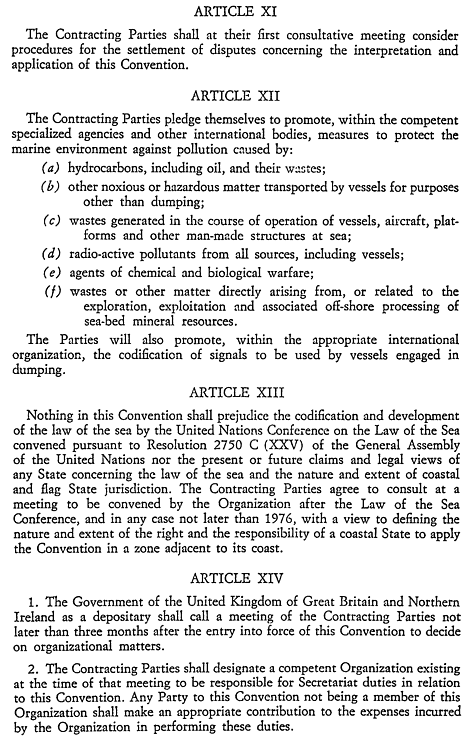
SCHEDULE 2
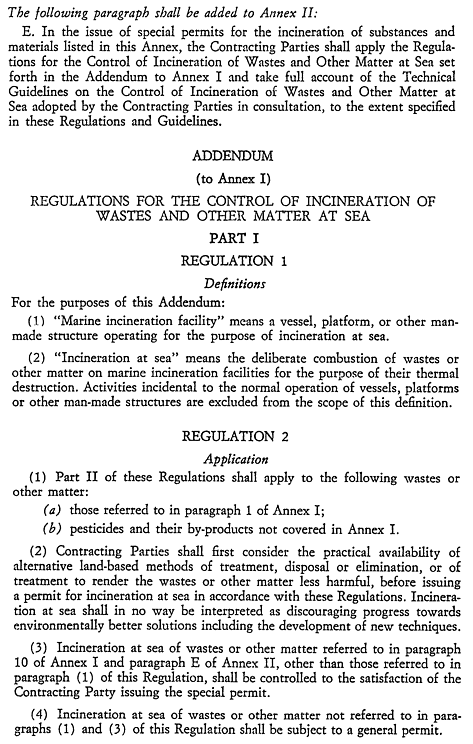
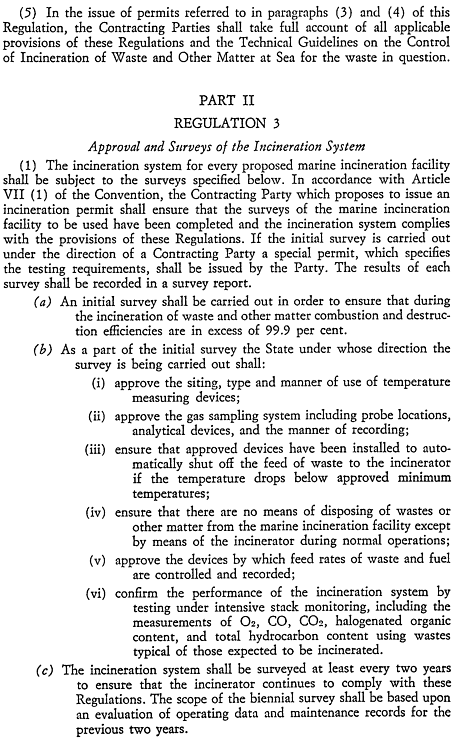
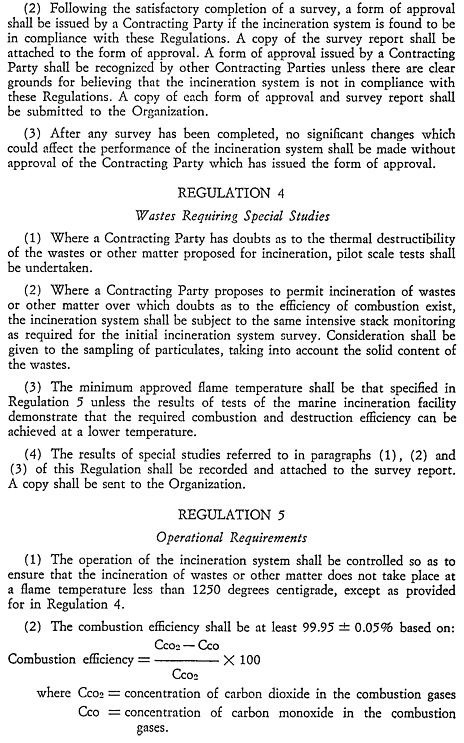
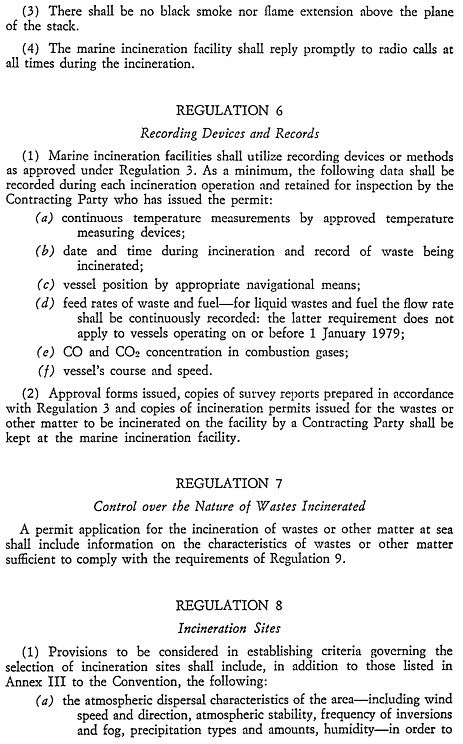
SCHEDULE 3