
Local Courts Act 1896
An Act to consolidate and amend the law relating to the recovery of debts and demands not exceeding $5 000
Be it enacted by His Excellency the Governor of Tasmania, by and with the advice and consent of the Legislative Council and House of Assembly, in Parliament assembled, as follows:
[Section 1, Substituted by No. 36 of 1958, s. 4 and Sched. 3 ]This Act may be cited as the Local Courts Act 1896 .[Section 2 Renumbered by No. 36 of 1958, s. 4 and Sched. 3 ]
[Section 3 Substituted by 25 Geo. V No. 51, s. 2 and 3 ]The Acts set forth in Schedule I are hereby repealed.[Section 4 Repealed by 25 Geo. V No. 51, s. 2 ][Section 5 Repealed by 25 Geo. V No. 51, s. 2 ][Section 6 Repealed by 25 Geo. V No. 51, s. 2 ]
[Section 7 Amended by 25 Geo. V No. 51, s. 3 ][Section 7 Amended by 25 Geo. V No. 78 ][Section 7 Amended by No. 48 of 1956, s. 2 ][Section 7 Amended by No. 13 of 1985, s. 4 ][Section 7 Amended by No. 103 of 1985, s. 4 ][Section 7 Amended by No. 45 of 1987, s. 21 and Sched. 1 ][Section 7 Amended by No. 93 of 1987, s. 4 ][Section 7 Amended by No. 68 of 1994, s. 3 and Sched. 1 ]In this Act, unless the contrary intention appears –[Section 8 Repealed by No. 45 of 1987, s. 21 and Sched. 1 ]authorized server has the meaning assigned to that expression in section 29 (5) ;bailiff means the bailiff or any bailiff of a court, and includes an assistant bailiff;Chief Commissioner means the person holding office as the Chief Commissioner of the Courts of Requests by virtue of section 14 (2) of the Magistrates Court Act 1987 ;commissioner means a commissioner appointed to hold any court under this Act;court means any court held under this Act;funds in court, in relation to a court, means the funds that, pursuant to section 147A , vest in the registrar of the court;practitioner means any barrister, attorney, solicitor, or proctor of the Supreme Court;Principal Registrar means the person holding office as Principal Registrar of the Court of Requests by virtue of section 20A ;process means every plaint, writ, summons, notice of defence, warrant of execution, fieri facias, notice, order, precept, or any other document required to be filed, issued, given, or served under the provisions of this Act;Rules of Court means Rules of Court made under section 148 ;rules of practice means the rules and forms in Schedules V and VI respectively, and also any other rules and forms hereafter to be made under the authority of this Act;small claim has the meaning assigned to that expression by the Magistrates Court (Small Claims Division) Act 1989 ;small claims division, in relation to a court, means the division of that court established by the Magistrates Court (Small Claims Division) Act 1989 ;Special Commissioner means a magistrate sitting in the small claims division of the Magistrates Court.
[Section 9 Amended by 25 Geo. V No. 78 ]Every court held before a commissioner shall be called a court of requests.
10. Power of Governor to appoint commissioners
[Section 10 Amended by 25 Geo. V No. 78 ]The Governor is hereby empowered to appoint as many fit persons as are needed to be commissioners of such courts; and the same person may be appointed commissioner of two or more such courts.
11. Power of Governor to appoint substitute commissioner
[Section 11 Amended by 25 Geo. V No. 78 ]It shall be lawful for the Governor, as occasion may in his opinion require, to appoint a fit person as a substitute to do and execute the duty of any commissioner for such time as the Governor may deem necessary; and such substitute shall, during the continuance of his appointment, and notwithstanding the death of the commissioner for whom he was appointed substitute, have all the powers and jurisdiction of the commissioner for whom he is appointed substitute.
[Section 11A Inserted by No. 45 of 1987, s. 21 and Sched. 1 ]The Chief Commissioner is responsible for the administrative co-ordination, and the allocation of work, between the commissioners.
[Section 12 Substituted by No. 45 of 1987, s. 21 and Sched. 1 ](1) The Chief Commissioner may, by instrument in writing, delegate to a commissioner the performance or exercise of such of the functions and powers of the Chief Commissioner (other than this power of delegation) under this Act or any other Act as are specified in the instrument, and may, by instrument in writing, revoke wholly or in part any such delegation.(2) A function or power, the performance or exercise of which has been delegated under this section, may, while the delegation remains unrevoked, be performed or exercised from time to time in accordance with the terms of the delegation.(3) A delegation under this section may be made subject to such conditions or limitations as to the performance or exercise of any of the functions or powers delegated, or as to time or circumstances, as are specified in the instrument.(4) Notwithstanding any delegation under this section, the Chief Commissioner may continue to perform or exercise all or any of the functions or powers delegated.(5) Any act or thing done by or to a delegate while acting in the exercise of a delegation under this section shall have the same force and effect as if the act or thing had been done by or to the Chief Commissioner and shall be deemed to have been done by or to the Chief Commissioner.
[Section 12A Inserted by No. 6 of 1962, s. 2 ](1) The Governor may by notice in the Gazette require that the office of the registrar of any court shall be kept at the place at which some other court is holden and so long as that requirement is in force the registrar shall keep an office at that place.(2) The Governor may by notice in the Gazette rescind any requirement made under this section.(3) The keeping of any office by a registrar of a court in accordance with a requirement under this section shall for the purposes of the provisions of this Act (other than this section) be deemed to be the keeping of an office at the place where that court is holden.
13. Alteration of maximum amount of jurisdiction of court
[Section 13 Amended by 25 Geo. V No. 51, s. 3 ][Section 13 Amended by 25 Geo. V No. 78 ][Section 13 Amended by No. 48 of 1956, s. 3 ][Section 13 Amended by No. 55 of 1965, s. 5 ][Section 13 Amended by No. 79 of 1983, s. 5 ](1) [Section 13 Subsection (1) substituted by No. 35 of 1965, s. 4 ]The amount to which the jurisdiction of a court is limited is –and references in this Act to the amount to which the jurisdiction of a court is limited shall, in relation to any action or other proceeding in that court, be construed as references to the amount specified in this section as the amount to which the jurisdiction of the court is limited in respect of that action or other proceeding.(a) in the case of a court that is held before a commissioner who is a practitioner, $5 000 –(b) . . . . . . . .(2) [Section 13 Subsection (2) omitted by No. 79 of 1983, s. 5 ]. . . . . . . .(3) [Section 13 Subsection (3) omitted by No. 79 of 1983, s. 5 ]. . . . . . . .(4) [Section 13 Subsection (4) omitted by No. 48 of 1956, s. 3 ]. . . . . . . .
Every court shall be a court of record.
[Section 15 Substituted by No. 35 of 1965, s. 5 ]The Governor may discontinue the holding of any court of requests or any court of general sessions.
16. Proceedings pending in discontinued courts
[Section 16 Amended by 25 Geo. V No. 78 ]Upon the discontinuance by the Governor of any court of requests or any court of general sessions, any case or proceeding depending or judgment recovered in such court may be continued or enforced in and by the court having competent jurisdiction which is nearest to the place where the court so discontinued was held.[Section 17 Repealed by No. 13 of 1989, s. 19 ]
18. Power of Commissioner to sit in chambers
[Section 18 Repealed by 25 Geo. V No. 51, s. 2 and 3 ][Section 19 Repealed by 25 Geo. V No. 51, s. 2 ](1) A commissioner in chambers shall have and may exercise in respect of any action or proceeding under this Act within the jurisdiction of the court of which he is commissioner any of the powers which, if such action or proceeding were pending in the Supreme Court, a judge of the Supreme Court might exercise in respect thereof in chambers.(2) Any order, direction, declaration, or act made, given, or done by a commissioner in the exercise of the powers conferred by this section may be reversed, discharged, or altered by a judge of the Supreme Court sitting in chambers.
20. Adjournment of court or hearing
[Section 20 Amended by 9 Geo. V No. 39, s. 3 ][Section 20 Amended by 25 Geo. V No. 51, s. 4 ]The court may adjourn any court or the hearing or further hearing of any action or proceeding in such manner and on such terms as the court may think fit. If for any reason the court does not attend at the time and place appointed for such hearing or further hearing, the registrar may declare the same adjourned; and thereupon such hearing or further hearing shall stand adjourned until such date and on such terms as the court shall thereafter appoint.
20A. Principal Registrar of Courts of Requests
[Section 20A Inserted by No. 45 of 1987, s. 21 and Sched. 1 ][Section 20A Subsection (1) amended by No. 68 of 1994, s. 3 and Sched. 1 ](1) [Section 20A Subsection (1) amended by No. 13 of 1989, s. 19 ]The Administrator of the Magistrates Court appointed under the Magistrates Court Act 1987 is, by virtue of that office and without further commission or authority, the Principal Registrar of the Courts of Requests for the purposes of this Act.(2) In the performance of their functions and the exercise of their powers under this Act, all registrars and deputy registrars, bailiffs, special bailiffs and assistant bailiffs, and persons appointed under sections 21 (5) and 22 (4) by commissioners to act as registrars or bailiffs, shall, except when carrying out duties pursuant to a direction given by a commissioner, be subject to the directions of the Principal Registrar.
21. Registrars and deputy registrars
[Section 21 Substituted by No. 29 of 1984, s. 3 and Sched. 1 ](1) [Section 21 Subsection (1) substituted by No. 5 of 1990, s. 3 and Sched. 1 ]The Minister administering the Tasmanian State Service Act 1984 may appoint a person employed under that Act to be a registrar of each court for the purposes of this Act and that person shall hold that office in conjunction with a position or an office under that Act.(2) [Section 21 Subsection (2) omitted by No. 45 of 1987, s. 21 and Sched. 1 ]. . . . . . . .(3) [Section 21 Subsection (3) substituted by No. 5 of 1990, s. 3 and Sched. 1 ]The Minister administering the Tasmanian State Service Act 1984 may appoint a person employed under that Act to be a deputy registrar for any court and that person shall hold that office in conjunction with a position or an office under that Act.(4) [Section 21 Subsection (4) omitted by No. 45 of 1987, s. 21 and Sched. 1 ]. . . . . . . .(5) Where there is no registrar or deputy registrar of a court or, for any reason, the registrar or deputy registrar is unable to act, the commissioner of the court may authorize a suitable person to perform the duties and exercise the powers of registrar of the court.(6) A deputy registrar of a court or a person authorized under this section to perform the duties of registrar of a court may exercise any of the functions conferred by this Act or otherwise on the registrar of that court, and any act or other thing done by or before the deputy registrar or the person so authorized has the same force and effect as if it were done by or before the registrar.
[Section 22 Substituted by No. 29 of 1984, s. 3 and Sched. 1 ][Section 23 Repealed by No. 29 of 1983, s. 3 ][Section 24 Repealed by No. 35 of 1965, s. 10 ](1) Subject to and in accordance with the Tasmanian State Service Act 1984 , bailiffs may be appointed for any court, for the purposes of this Act.(2) [Section 22 Subsection (2) amended by No. 5 of 1990, s. 3 and Sched. 1 ]The Secretary of the Department may, with the approval of the Head of another Agency, within the meaning of the Tasmanian State Service Act 1984 appoint persons employed in that Agency to be bailiffs for the purposes of this Act, and such employees may hold office as bailiffs in conjunction with their positions in the State Service.(3) [Section 22 Subsection (3) amended by No. 5 of 1990, s. 3 and Sched. 1 ]The Secretary of the Department may, with the approval of the Commissioner of Police, appoint police officers to be bailiffs for the purposes of this Act.(4) Where there is no bailiff for any court, or where, for any reason, there is no bailiff or not a sufficient number of bailiffs capable of acting for that court, the commissioner of that court may authorize a suitable person or persons to perform the duties and exercise the powers of bailiff or bailiffs of the court.(5) Any person may, on the application of a party to any proceeding, be authorized by the registrar to perform the duties of bailiff of the court in which such proceeding is pending for all or any of the purposes of this Act, provided that the party so applying shall give an indemnity to the satisfaction of the registrar against the acts and defaults of such bailiff.
25. Power of registrars to act as bailiffs
[Section 25 Amended by 25 Geo. V No. 78 ][Section 25 Amended by No. 29 of 1984, s. 3 and Sched. 1 ][Section 25 Amended by No. 5 of 1990, s. 3 and Sched. 1 ]The registrar of any court may be appointed by the Secretary of the Department to perform the duties of a bailiff of such court, and shall have all the powers and authorities vested in the bailiff of a court, and shall be responsible for the acts and defaults of himself and his officers in like manner as a bailiff of a court is now by law responsible for the acts and defaults of himself and his officers.
26. Power of bailiffs to appoint assistants
[Section 26 Amended by 25 Geo. V No. 78 ]Every bailiff may, subject to the restrictions hereinafter contained, by writing under his hand, appoint a sufficient number of fit persons, not exceeding such number as may be allowed by the commissioner, to be assistants to the said bailiff, and may at his pleasure dismiss all or any of them, and appoint others in their stead; and every assistant so appointed may also be suspended or dismissed by the commissioner.
[Section 27 Subsection (1) amended by No. 35 of 1965, s. 11 ][Section 28 Repealed by No. 45 of 1987, s. 21 and Sched. 1 ](1) [Section 27 Subsection (1) amended by 25 Geo. V No. 78 ]The registrar shall file, sign, and issue all process, and register all orders and judgments of the court; and keep an account of all proceedings of the court; and shall receive and keep an account of all court fees and fines payable or paid into court, and of all moneys paid into or out of court.(2) [Section 27 Subsection (2) inserted by No. 35 of 1965, s. 11 ]Any book, record, account, or other document required by this Act to be kept by an officer of a court shall be admitted as evidence of the entries therein, and a document purporting to contain a copy of such an entry purporting to be signed and certified as a true copy by the registrar of the court shall be admitted as evidence of that entry.(3) [Section 27 Subsection (3) inserted by No. 35 of 1965, s. 11 ]Where under this section, a book, record, account, or document is admissible as evidence of any such entry as is referred to in subsection (2) , that book, record, account, or document is sufficient evidence, without further proof, of the proceeding to which it relates and of the regularity of that proceeding.
[Section 29 Amended by 25 Geo. V No. 78 ][Section 29 Amended by No. 36 of 1958, s. 4 and Sched. 3 ][Section 29 Amended by No. 103 of 1985, s. 5 ][Section 29 Amended by No. 93 of 1987, s. 5 ](1) The bailiff shall attend every sitting of the court, for such time as may be required by the court, except when his absence is allowed for reasonable cause by the court, and every bailiff shall, by himself or by his assistants appointed as aforesaid, serve and execute all process issued out of the court, and generally perform all duties and exercise all functions to be performed and exercised by any bailiff appointed under this Act; and every such bailiff and his assistants shall in the execution of their duties conform to all general rules regulating the proceedings of the court, and, subject thereunto, to the order and direction of the court; and every such bailiff shall be responsible for all the acts and defaults of himself and of his assistants, in like manner as the Sheriff is responsible for the acts and defaults of himself and his officers.(2) Where there shall be more than one bailiff of any court, such one of such bailiffs as the court shall appoint shall attend every sitting of the court.(3) [Section 29 Subsection (3) inserted by No. 35 of 1965, s. 12 ]Nothing in this section prohibits the service of process in any proceedings by a party to those proceedings or by a person who is the holder of a subsisting process server's licence under the Commercial and Inquiry Agents Act 1974 or who is specified in section 42 (1) of that Act as a person to whom that Act does not apply where that process is authorized or required to be so served under the rules of practice or under any other provision of this Act.(4) [Section 29 Subsection (4) inserted by No. 35 of 1965, s. 12 ]References in subsection (3) to a party to any proceedings shall be construed as including references to a practitioner acting on behalf of that party in those proceedings, or any person acting on the directions of that party or that practitioner.(5) [Section 29 Subsection (5) inserted by No. 103 of 1985, s. 5 ]Where a person other than a bailiff serves any process in any proceedings (being a process that is authorized or required to be served by him under the rules of practice), that person (in this Act referred to as an "authorized server") is entitled to recover a service fee in accordance with a scale prescribed by the regulations.
29A. Service of notices and orders under the Magistrates Court (Small Claims Division) Act 1989
[Section 29A Inserted by No. 13 of 1985, s. 5 ](1) [Section 29A Subsection (1) amended by No. 68 of 1994, s. 3 and Sched. 1 ]The bailiff of a court shall, by himself or by one of his assistants appointed under section 26 , serve, as provided by the Magistrates Court (Small Claims Division) Act 1989 , any notice given, or any order made, under that Act that relates to a small claim referred to the Special Commissioner in his jurisdiction in relation to the small claims division of that court.(2) A bailiff of a court or one of his assistants appointed under section 26 shall, when serving any notice or order referred to in subsection (1) , comply with any directions with respect to the service of the notice or order that are given to him by the registrar or deputy registrar of that court.
30. Bailiffs answerable for escapes and for neglect
In case any bailiff employed to levy any execution shall by neglect, or connivance, or omission, lose the opportunity of levying any such execution, then, upon complaint of the party aggrieved, by reason of such neglect, connivance, or omission, and the fact alleged being proved to the satisfaction of the court out of which the process issues, such court shall order such bailiff to pay such damages as it appears that the plaintiff has sustained thereby, not exceeding in any case the sum of money for which the said execution issued, together with such costs as the court may think fit, and the bailiff shall be liable therefor, and upon demand made thereof, and his refusal or neglect so to pay and satisfy the same, payment thereof shall be enforced by such means as are herein provided for enforcing a judgment recovered in the said court.
31. Remedies against, and penalties on, registrars, bailiffs, and other officers
[Section 31 Amended by No. 55 of 1965, s. 5 ][Section 31 Amended by No. 43 of 1991, s. 5 and Sched. 1 ]If any registrar, bailiff, or other officer of the court, acting under colour or pretence of the process of the court, is charged with extortion or misconduct, or with not duly paying or accounting for any money received or levied by him under the authority of this Act, it shall be lawful for the court to inquire into such matter in a summary way, and for that purpose to summon and enforce the attendance of all necessary parties in like manner as the attendance of witnesses in any action or proceeding may be enforced, and to make such order thereupon for the repayment of any money extorted, or for the due payment of any money so received or levied as aforesaid, and for the payment of such damages and costs as the court thinks just; and also, if the court thinks fit, to impose such fine upon the registrar, bailiff, or officer, not exceeding 5 penalty units for each offence, as the court deems adequate; and in default of payment of any money so ordered to be paid, payment of the same may be enforced by such means as are herein provided for enforcing a judgment recovered in the said court.
32. Actions cognizable under this Act
[Section 32 Substituted by 25 Geo. V No. 51, s. 2 and 3 ][Section 32A Repealed by 25 Geo. V No. 51, s. 2 ](1) The following shall be the actions cognizable by courts: All personal actions where the debt or damage claimed is not more than the amount to which the jurisdiction of the court in which the action is brought is limited, excepting actions in which the title to any corporeal or incorporeal hereditaments, or to any toll, fair, market, or franchise, is in question, or in which the validity of any devise or bequest or limitation under any will or settlement may be disputed, or for the infringement of letters patent or copyright, or for any arrest or false imprisonment or malicious prosecution, or for any libel or slander, or for seduction or breach of promise of marriage.(2) No action of ejectment, other than actions brought in accordance with the provisions hereinafter contained for recovering possession of corporeal hereditaments, and no action of replevin, shall be cognizable by any court.(3) [Section 32 Subsection (3) amended by 25 Geo. V No. 78 ]None of the exceptions to the jurisdiction of courts made by this section shall apply to the jurisdiction of any court held before a commissioner who is a practitioner.(4) The jurisdiction of the courts shall extend to the recovery of any demand, not exceeding the sum to which the jurisdiction of the court is limited, which is the whole or part of the unliquidated balance of a partnership account, or the amount or part of the amount of a distributive share under an intestacy, or of any legacy under a will.(5) In any case in which a person has an equitable claim or demand against another person in respect of which the only relief sought is the recovery of a sum of money and the amount claimed does not exceed the sum to which the jurisdiction of the court is limited, the person seeking to enforce the claim or demand may sue for and recover it in the court.(6) Subsection (5) shall not be construed to confer on courts an equitable jurisdiction within the meaning of sections 182 and 183 of the Supreme Court Civil Procedure Act 1932 .
33. Courts have jurisdiction throughout State, but action to be brought in nearest court
[Section 33 Amended by 25 Geo. V No. 78 ][Section 33 Amended by No. 36 of 1958, s. 4 and Sched. 3 ](1) In order to avoid technical difficulties arising from local jurisdiction, every court shall have jurisdiction throughout the State, but the plaintiff in any action brought under this Act shall file his plaint in the court having jurisdiction to the amount claimed nearest to the place where the defendant or one of the defendants dwelt or carried on business at any time within 6 months next before the day on which such plaint shall be filed as aforesaid, or in the court having jurisdiction to the amount claimed nearest to the place where the cause of action, either wholly or in any part arose.(2) Notwithstanding the provisions of subsection (1) , in every action in which the plaintiff sues for the value of any work or labour performed or services rendered, the plaintiff shall be at liberty to file his plaint either in the court having jurisdiction to the amount claimed nearest to the place where the work or labour was performed or the services rendered, or in the court having jurisdiction to the amount claimed nearest to the place where the agreement for the performance of such work or labour or services as aforesaid was made.
33A. Place and time of trial or hearing of any action, &c., may be changed
[Section 33A Inserted by 9 Geo. V No. 39, s. 2 ][Section 33A Amended by 25 Geo. V No. 78 ](1) Notwithstanding anything contained in this Act, the place and time of trial or hearing of any action or proceeding in –may at any time after the filing of the plaint be changed by order of the commissioner of such court, either on his own motion or at the instance of any party, of which order notice shall be given to the parties or their respective attorneys in such manner as the commissioner shall decide.(a) the court of requests held at Currie (King Island);(b) any court of requests held at or to be appointed for Flinders Island; or(c) any other court of requests to which the provisions of this section shall be extended by proclamation –(2) The Governor may by proclamation extend and apply the provisions of this section to any court of requests other than those hereinbefore specified.
33B. Deputy-registrar and duties
[Section 33B Inserted by 9 Geo. V No. 39, s. 2 ]Where any order is made under section 33A , changing the place of trial or hearing of any action or proceeding, the registrar of the court wherein the plaint is filed, shall transmit to the registrar of the court at or nearest to the substituted place of trial or hearing all process in the action or proceeding, and the latter registrar shall, for the purposes of the trial or hearing, be and act as the deputy of the former registrar, and on the conclusion of the trial or hearing shall return to him the said process, together with any further process in the action or proceeding, with a memorandum of the result of the trial or hearing, together with all fees collected by him in connection therewith, and shall thereupon cease to be such deputy.
[Section 33C Inserted by 9 Geo. V No. 39, s. 2 ](1) If, before the filing of a plaint, all parties thereto agree by a memorandum signed by them or by their respective attorneys or agents that such plaint shall be filed in some specified court of requests not being a court in which that plaint should be filed in compliance with section 33 , then the plaint, together with the said memorandum, may be filed in the court of requests so specified, and thereupon such last-mentioned court shall have the same jurisdiction in respect of the action and of all proceedings incidental thereto or consequent thereon and for the recovery of the like amount as any court in which the plaint should have been filed in compliance with section 33 aforesaid.(2) If, after the filing of a plaint in any action commenced in any court of requests or court of general sessions, all parties thereto agree by a memorandum signed by them or by their respective attorneys or agents that the action shall be transferred to some other court, being a court of requests, and hereinafter called "the substituted court", then the commissioner or chairman of the court in which the action was commenced (hereinafter called "the original court") may, at his discretion, order that the action be transferred to the substituted court upon such terms, if any, as the parties shall by such memorandum specify.(3) In any action where no defence has been filed within the time appointed, but the plaintiff is not entitled to judgment under section 46 , then an order similar to that mentioned in subsection (2) may be made upon the filing of a memorandum requesting such order and signed only by the plaintiff or his attorney or agent.(3A) [Section 33C Subsection (3A) inserted by No. 35 of 1965, s. 13 ]An order may be made by a commissioner or chairman under subsection (2) or subsection (3) whether the court is sitting or not.(4) Whenever any order is made under the provisions of subsections (2) or (3) , all process in the transferred action shall be forthwith transmitted by the registrar of the original court to the registrar of the substituted court, and the action shall thereafter be continued and proceed in the substituted court in the same way in all respects as if it had been commenced therein, and the substituted court shall have the same jurisdiction in respect of the action and of all proceedings incidental thereto or consequent thereon and for the recovery of the like amount as the original court. And the action shall be heard either at such sittings of the substituted court as shall be specified in the memorandum aforesaid, or at such other time as the commissioner of the substituted court shall appoint.
[Section 34 Amended by 25 Geo. V No. 78 ][Section 34 Amended by No. 36 of 1958, s. 4 and Sched. 3 ](1) If on the trial of any action brought under this Act it shall appear to the court that at the time of the commencement of the action another court of competent jurisdiction was nearer by not less than 5 miles to the place where the defendant, or if there are several defendants then to all the places where the several defendants respectively, at any time within 6 months next before the day on which the plaint in such action was filed, dwelt or carried on business, and also to the place where the cause of action wholly arose, the plaintiff shall be non-suited unless the defendant or defendants forego his or their right to such non-suit.(2) Nothing in subsection (1) shall interfere with the right hereinbefore conferred on the plaintiff in any action for work or labour performed or for services rendered to file his plaint in the court having jurisdiction to the amount claimed nearest to the place where the work or labour was performed or the services rendered, or in the court having jurisdiction to the amount claimed nearest to the place where the agreement for such work or labour or service was made.
35. Court to have jurisdiction where claim reduced by set-off
Where in any action brought in any court the debt or demand consists of a balance not exceeding the amount to which the jurisdiction of the court is limited after deduction as a set-off of an admitted debt or demand claimed or recoverable by the defendant from the plaintiff, the court shall have jurisdiction to try such action.
35A. Set-off and counter-claim
[Section 35A Inserted by 25 Geo. V No. 51, s. 3 ]A defendant in a action may set-off or set-up by way of counter-claim against the claims of the plaintiff any right or claim, whether such set-off or counter-claim sound in damages or not, and such set-off or counter-claim shall have the same effect as a cross-action, so as to enable the court to pronounce a final judgment in the same action both on the original and the cross-claim; but the commissioner on the application of the plaintiff before trial, if in the opinion of the commissioner such set-off or counter-claim cannot be conveniently disposed of in the pending action, or ought not to be allowed, may refuse permission to the defendant to avail himself thereof.
35B. Power of court to allow costs where action commenced over which court has no jurisdiction
[Section 35B Inserted by 25 Geo. V No. 51, s. 3 ]When any action is commenced over which the court has no jurisdiction, or in respect of which the plaint should, pursuant to section 33 , have been filed in some other court, the court, unless, in the case of an action commenced by a plaint which should have been filed in some other court, the parties consent to the court proceeding to hear the action, shall order it to be struck out, and shall have power to award costs in the same manner as if the court had jurisdiction therein or if the plaint had been filed in the appropriate court and the plaintiff had not appeared, or had appeared and failed to prove his demand; and whenever any such action is withdrawn the defendant may have judgment entered up for the amount of his costs to be taxed by the registrar upon the scale provided for a claim of the like amount.
36. Demands not to be divided for purpose of two or more actions
It shall not be lawful for the plaintiff to divide any cause of action for the purpose of bringing two or more actions under this Act, but any plaintiff having cause of action for a sum in excess of that to which the jurisdiction of the court is limited, in respect of which a plaint might be filed under this Act if there were no such excess, may abandon the excess, and thereupon the plaintiff shall, on proving his case, recover to an amount not exceeding such sum; and the judgment of the court upon such plaint shall be in full discharge of all demands in respect of such cause of action, and entry of the judgment shall be made accordingly.
37. No second action in another court for same cause
If any party sues another in any court for any debt or other cause of action, for which he has already sued him and obtained judgment against him in any other court, proof of such former action having been brought and judgment obtained may be given, and the party so suing shall not be entitled to recover in such second action, and shall be adjudged to pay 3 times the costs of such second action to the opposite party.
38. Power of minors to sue for wages
[Section 38 Amended by No. 21 of 1973, s. 5 and Sched. 1 ]It shall be lawful for any person under the age of 18 years to bring an action in any court for any sum of money, not greater than the sum to which the jurisdiction of the court is limited, which may be due to him for wages or piecework, or for work as a servant, in the same manner as if he were of full age.
39. Power of executors, &c., to sue and be sued
[Section 39 Amended by 25 Geo. V No. 51, s. 4 ]It shall be lawful for any executor or administrator to sue and be sued in any court in like manner as if he were a party in his own right, and judgment and execution shall be such as in the like case would be given or issued in the Supreme Court.
40. One of several persons liable may be sued
[Section 40 Amended by 25 Geo. V No. 78 ][Section 40 Amended by No. 36 of 1958, s. 3 and Sched. 1 ](1) Where any plaintiff has any demand recoverable under this Act against two or more persons jointly answerable, it shall be sufficient if any of such persons is served with process, and judgment may be obtained and execution issued against the person so served, notwithstanding that others jointly liable may not have been served or sued; and every such person against whom judgment has been obtained under this Act, and who has satisfied such judgment, shall be entitled to demand and recover in a court contribution from any other person jointly liable with him in all cases where contribution may be enforced under any existing law.(2) A person who is not served with process, and alleged by the plaint or summons to be jointly answerable with any other person who has been served with process, may at any time before the return day of the summons enter a defence to the summons, and appear at the hearing and dispute his liability in the same manner as if he had been served with process.(3) Where a person has not been served with process, wherein he is alleged by the plaint or summons to be jointly answerable with any other person who has been served with process, it shall be lawful for the person at whose suit such process has been issued to file by leave of the court or the commissioner a plaint, and to issue summonses thereon, against the person who has not been served as aforesaid for such amount of the debt as shall not have been recovered under the first issued summons; and no judgment obtained under the first issued summons shall be a bar to the proceedings under the aforesaid subsequent plaint and summons.
[Section 41 Amended by No. 6 of 1962, s. 4 ][Section 41 Amended by No. 35 of 1965, s. 14 ]Any person desirous of bringing an action under this Act shall present to the registrar to be filed a plaint in writing, stating the names and the usual or last-known places of abode of the parties, and the substance of the action intended to be brought, and full and explicit particulars of the claim for which the action is brought; and thereupon a summons, bearing a copy of the plaint, shall, on being presented to the registrar for signature, be issued under his hand according to such form, and be served on the defendant so many days before the day on which the court is held at which the cause is to be tried, and in such manner as may be directed by the rules of practice; and no misnomer or inaccurate description of any person or place in any such plaint or summons shall vitiate the same, so that the person or place be therein described as commonly known.
Where a plaint has been filed in any action in which two or more persons are defendants, it shall be lawful for the registrar on presentation thereof to him to issue as many concurrent summonses to appear to such plaint as there are defendants, which said summonses shall be served in the prescribed manner.
43. Provision for service of process, &c., by bailiff of another court
[Section 43 Substituted by No. 13 of 1985, s. 6 ](1) Where process is required to be served or executed under this Act at a place nearer to another court than to the court from which the process was issued –(a) the process may be served by the bailiff of that other court;(b) such a service or execution is as valid as if it had been made by the bailiff of the court from which the process was issued; and(c) the bailiff of that other court shall serve that process on its being transmitted to him by the registrar or bailiff of the court from which it was issued.(2) [Section 43 Subsection (2) amended by No. 68 of 1994, s. 3 and Sched. 1 ]Where any notice or order under the Magistrates Court (Small Claims Division) Act 1989 referred to in section 29A (1) is required to be served under this Act by a bailiff at a place nearer to another court than to the court for which he has been appointed bailiff (in this subsection referred to as "the original court") –(a) the notice or order may be served by the bailiff of that other court;(b) such a service is as valid as if it had been made by the bailiff of the original court; and(c) the bailiff of that other court shall serve that notice or order on its being transmitted to him by the registrar or deputy registrar of the original court or the bailiff of the original court.(3) In this section, a reference to a bailiff of a court includes a reference to an assistant of the bailiff appointed under section 26 .
44. Proof of service of process
[Section 44 Amended by No. 35 of 1965, s. 15 ]Service of any process of a court may be proved by affidavit, purporting to be sworn before any person hereinafter authorized to take affidavits, and the fee, if any, for taking such affidavit shall be costs in the cause.
44A. Proof of service of notices and orders under the Magistrates Court (Small Claims Division) Act 1989
[Section 44A Inserted by No. 13 of 1985, s. 7 ](1) [Section 44A Subsection (1) amended by No. 68 of 1994, s. 3 and Sched. 1 ]The bailiff of a court or an assistant of that bailiff appointed under section 26 shall give to the registrar or deputy registrar of the court written notice of the service by him of any notice or order under the Magistrates Court (Small Claims Division) Act 1989 referred to in section 29A (1) .(2) A document purporting to be a notice under subsection (1) and stating that a notice or an order specified in that notice was, on a day specified in that notice, served on a person specified in that notice is evidence in proceedings before the Special Commissioner of the matters stated in that notice.
45. Notice of defence to be given in all cases to registrar
(1) [Section 45 Subsection (1) amended by No. 6 of 1962, s. 5 ]Notice of defence to any action brought in any court shall be given to the registrar within the appropriate time, and the registrar shall, within the time limited by the rules of practice, after receiving such notice, forward the same to the plaintiff or his attorney by the post, or cause the same to be delivered at his usual place of abode or business; but it shall not be necessary for the defendant to prove on the trial that such notice was forwarded or delivered to the plaintiff or his attorney by the registrar.(2) [Section 45 Subsection (2) amended by No. 6 of 1962, s. 5 ]In this section appropriate time means such time after service of the summons as may be prescribed in the rules of practice, or such longer time as may be allowed by the court or agreed on between the parties.
45A. Reply to set-off or counter-claim
[Section 45A Inserted by 25 Geo. V No. 51, s. 3 ][Section 45A Subsection (1) amended by No. 6 of 1962, s. 6 ](1) [Section 45A Subsection (1) amended by No. 48 of 1956, s. 4 ]Where the defendant by his defence sets off, or sets up by way of counter-claim, any right or claim, the plaintiff, within the appropriate time, shall file with the registrar in writing a reply to such set-off or counter-claim.(2) The provisions of section 45 and of the rules relating to notices of defence shall apply to any such reply.(3) [Section 45A Subsection (3) omitted by No. 6 of 1962, s. 6 ]. . . . . . . .(4) [Section 45A Subsection (4) amended by No. 6 of 1962, s. 6 ]If the plaintiff fails to file a reply within the appropriate time the defendant shall be entitled to judgment for his set-off or counter-claim as hereinafter provided.(5) Such judgment shall be entered on the order of the court if the action is heard or of the court or commissioner if otherwise.(6) [Section 45A Subsection (6) inserted by No. 6 of 1962, s. 6 ]In this section appropriate time means the period of 10 days, or such longer period as may be allowed by the court or agreed on by the parties, following the delivery to the defendant or his attorney of the notice of defence.
46. Entry of judgment where no defence is filed
[Section 46 Substituted by No. 35 of 1965, s. 16 ](1) Where, in any action in a court for a debt or liquidated demand, no notice of defence is given within the time within which it is required to be given the plaintiff may have judgment entered by the registrar against the defendant for an amount not exceeding the amount of his claim and costs.(2) Where, in any action in a court for pecuniary damages, no notice of defence is given within the time within which it is required to be given the plaintiff may have interlocutory judgment entered by the registrar against the defendant, and the amount of the damages may be assessed by the court and judgment given accordingly.(3) Nothing in this section entitles a plaintiff to have a final or an interlocutory judgment entered after the expiration of 6 years from the date of the summons.(4) Where a final judgment or an interlocutory judgment has been entered under this section, the court may, at any time, on the application of the defendant, set aside that judgment and give leave to defend on such terms as it considers just, or, where the judgment so entered is a final judgment, make an order for the stay of execution upon payment of the amount of the judgment debt, either in one sum or by instalments, and within such time, as it thinks fit.
[Section 46A Inserted by No. 6 of 1962, s. 7 ](1) Where in any action a defendant claims as against any person not already a party to the action (in this section referred to as the third party) –the court may give leave to the defendant to issue and serve a third party notice.(a) that he is entitled to contribution or indemnity;(b) that he is entitled to any relief or remedy relating to or connected with the original subject-matter of the action, and substantially the same as some relief or remedy claimed by the plaintiff; or(c) that any question or issue relating to or connected with that subject-matter is substantially the same as some question or issue arising between the plaintiff and the defendant, and should properly be determined not only as between the plaintiff and defendant, but as between the plaintiff and the defendant and the third party, or between any or either of them –(2) Such leave as is referred to in subsection (1) shall be given, if the court directs a summons to the plaintiff to be issued, only on the hearing of that summons, but otherwise may be given on an ex parte application supported by affidavit.(3) A third party notice shall state the nature and grounds of the claim or the nature of the question or issue sought to be determined, and the nature and extent of any relief or remedy claimed.(4) On a third party notice being presented to the registrar it shall be filed and signed by him, and thereupon it shall be deemed to be a summons issued under his hand to the third party.(5) Where a third party notice has been filed under this section this Act has effect, subject to this section and to the rules of practice and the Rules of Court, as if the notice that has been filed were a plaint in an action brought by the defendant against the third party and as if the copy of that notice deemed by virtue of subsection (4) to be a summons were a summons issued on the filing of that plaint.(6) The third party shall, as from the service upon him of the third party notice, be a party to the action to which the notice relates with the same rights in respect of his defence against any claim made against him, and otherwise, as if an action had been brought against him under this Act by the defendant.
47. Actions not to abate on death of parties
[Section 47 Amended by 25 Geo. V No. 51, s. 4 ][Section 47 Amended by No. 36 of 1958, s. 4 and Sched. 3 ](1) Where a sole plaintiff or defendant, or one or more of several plaintiffs or defendants, or all the plaintiffs or defendants, shall die before judgment, the action shall not abate if the cause of action survive to or against the representatives of the deceased person or persons, or to or against the surviving party or parties respectively, or to or against all or any of them, as the case may be.(2) Where a sole plaintiff or defendant, or one or more of several plaintiffs or defendants, or all the plaintiffs or defendants, shall die after judgment, proceedings may be taken thereon, by leave of the commissioner, by or against the representatives of the deceased person or persons, or by or against the surviving party or parties respectively, or by or against all or any of them, as the case may require.
[Section 48 Substituted by No. 93 of 1987, s. 6 ](1) A party to an action brought under this Act may, in accordance with the rules of practice, pay a sum of money into court, being –whether with or without costs and whether with or without a denial of liability.(a) in the case of a payment by the defendant, a sum of money in satisfaction of the claim of the plaintiff or the counter-claim of any other party or, where several causes of action are joined in one action, in satisfaction of one or more of the causes of action; or(b) in the case of a payment by a party other than the defendant, a sum of money in satisfaction of the claim or counter-claim of another party –(2) After a party has paid into court any sum pursuant to subsection (1) in respect of a claim or counterclaim, he may, without leave, deliver to the party in whose favour that sum has been paid into court a notice increasing the amount of that sum.(3) Unless the contrary is stated in the notice of payment into court prescribed by the rules of practice, payment into court of a sum of money under subsection (1) shall be taken to be an admission by the person paying in the sum of the claim or counter-claim in respect of which the payment is made.(4) Where a defence sets up tender before the action, the defendant shall pay into court the sum of money alleged to have been tendered by him.(5) A party may, as provided in the rules of practice, accept the whole or part of a sum of money paid into court by another party under this section in satisfaction of the claim or counter-claim, or in satisfaction of the cause or causes of action, to which the sum relates.(6) Where a party accepts, as provided by the rules of practice, a sum of money paid into court under this section, that sum shall, subject to subsection (7) , be paid to that party, together with the interest (if any) earned on that sum since the payment of that sum into court.(7) Where a sum of money is paid into court under this section in respect of a claim or counter-claim made by or on behalf of a person under disability, the acceptance of the payment into court by or on behalf of that person is not valid without the prior approval of the court or a commissioner.(8) Where a party accepts, as provided by the rules of practice, a sum of money paid into court under this section in respect of a claim or counter-claim –(a) that claim or counter-claim abates; and(b) that party may, after 7 days after the payment out of that sum, without any further order of the court, tax his costs on the claim or counter-claim incurred up to and including the time of the payment of that sum into court, if costs are payable within the terms of the payment into court.(9) A party in an action for defamation who takes money out of court may apply by summons to the court or a commissioner for leave to make in open court a statement in terms approved by the court or a commissioner.
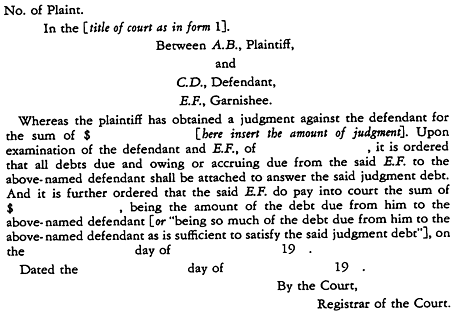
48A. Provisions relating to money paid into court under an order
[Section 48A Inserted by No. 93 of 1987, s. 7 ](1) Where a person pays money into court under an order of the court or a commissioner, he shall forthwith give notice of that payment to such parties and in such manner as is specified in the order.(2) Money paid into court under an order of the court or a commissioner shall not be paid out of court, except in pursuance of an order of the court or a commissioner.
49. Confession of debt in whole or part, and judgment thereon
Any person against whom a plaint has been filed may, if he thinks fit, whether summoned upon such plaint or not, in the presence of the registrar of the court in which such plaint has been filed, or in the presence of an attorney of the Supreme Court, or of a justice, sign a statement confessing the amount of the debt or demand or part of the amount of the debt or demand for which such plaint has been entered; and such registrar shall receive such statement, and, upon proof by affidavit of the signature of the party if such statement were not signed in the presence of the registrar, forthwith give notice thereof to the plaintiff or his attorney, and, upon the application of the plaintiff, enter up judgment for the amount admitted in such statement; and such judgment shall have the same effect and shall be enforceable in the same manner as if the court had heard the action and given judgment thereupon.
50. Agreement as to amount of debt, &c., and conditions of payment
If the person against whom a plaint has been filed can agree with the plaintiff upon the amount of the debt or demand in respect of which such plaint has been filed, and upon the terms and conditions upon which the same shall be paid or satisfied, it shall be lawful for such persons respectively, in the presence of the registrar of the court in which such plaint has been entered, or in the presence of an attorney of the Supreme Court or of a justice, to sign a statement of the amount of the debt or demand so agreed upon between such persons respectively, and of the terms and conditions upon which the same shall be paid or satisfied, and such registrar shall receive such statement, and shall thereupon, upon proof by affidavit of the signature of the party if such statement were not made in the presence of the registrar, upon the application of the plaintiff, enter up judgment for the plaintiff for the amount of the debt or demand so agreed upon, and on the terms and conditions mentioned in such statement; and such judgment shall have the same effect, and shall be enforced and enforceable in the same manner, as if the court had heard the action and given judgment thereupon.
50A. Consent judgments and orders
[Section 50A Inserted by No. 35 of 1967, s. 17 ](1) On an application in writing made by the parties to an action for the giving of any judgment or the making of any order that may be made in that action the court may give that judgment or make that order unless it considers that any party, or a practitioner acting on his behalf, should appear before the court before any judgment is given or order made in relation to the matter to which the application relates.(2) An application made by a practitioner on behalf of a party that states that it is so made shall be treated, for the purposes of this section, as an application made by that party.(3) The powers conferred on a court by this section may be exercised by the commissioner or chairman thereof whether the court is sitting or not.
[Section 51 Amended by 25 Geo. V No. 51, s. 4 ][Section 51 Amended by No. 36 of 1958, s. 4 and Sched. 3 ][Section 52 Repealed by 1 Geo. V No. 20, s. 2 ][Section 53 Repealed by 7 Geo. VI No. 37, s. 2 ](1) Any party may, without filing any affidavit, apply to the court for an order directing any other party to the action or matter to make discovery on oath of the documents which are or have been in his possession or power relating to any matter in question therein.(2) On the hearing of such application, the court may either refuse or adjourn the same, if satisfied that such discovery is not necessary, or not necessary at that stage of the action or matter, or may make such order either generally, or limited to certain classes of documents, as may in its discretion be thought fit.
54. Oral examination in case of omission to answer interrogations, &c.
[Section 54 Amended by 7 Geo. VI No. 37, s. 3 ]In case of omission without just cause to answer sufficiently interrogatories, it shall be lawful for the commissioner at his discretion to direct an oral examination upon oath of the interrogated party as to such points as he may direct before any commissioner, and the commissioner may order the attendance of such party before the person appointed to take such examination for the purpose of being orally examined as aforesaid, or the production of any writing or other documents to be mentioned in the order commanding the attendance of such party as aforesaid, and may impose therein such terms as to such examination, and the costs of the application, and of the proceedings thereon and otherwise, as to the commissioner shall seem just.
55. On failure to comply with order to answer or for discovery, &c., party liable for contempt
[Section 55 Amended by No. 36 of 1958, s. 4 and Sched. 3 ]If any party fails to comply with any order to answer interrogatories, or for discovery or inspection of documents, or for oral examination, he shall be liable as for a contempt of the court in which the order is made and shall also, if a plaintiff, be liable to have his action dismissed, and the defendant may apply for an order to that effect, and an order may be made accordingly.
Any party to any action or proceeding under this Act may obtain, at the office of the registrar of the court, summonses to witnesses under the hand of such registrar, to be served, if so required, by one of the bailiffs of the court, with or without a clause requiring the production of books, deeds, papers, and writings in the possession or control of the witnesses, and in any such summons any number of names may be inserted.[Section 57 Repealed by 1 Geo. V No. 20, s. 2 ][Section 58 Repealed by 1 Geo. V No. 20, s. 2 ]
59. Penalty on witnesses neglecting to appear, &c.
[Section 59 Amended by 25 Geo. V No. 51, s. 3 and 4 ][Section 59 Amended by 25 Geo. V No. 78 ][Section 59 Amended by No. 55 of 1965, s. 5 ][Section 59 Amended by No. 43 of 1991, s. 5 and Sched. 1 ](1) Every person on whom any summons to appear as a witness has been served, in such manner as directed by the rules of practice, and to whom at the same time payment or a tender of payment of his travelling expenses has been made in accordance with the prescribed scale, and who refuses or neglects, without sufficient cause, to appear or to produce any books, papers, or writings required by such summons to be produced, and also every person present in court who is required to give evidence, and who refuses to be sworn or to make an affirmation, or give evidence, shall be liable to such fine, not exceeding 5 penalty units, as the court may impose on him; and the whole or any part of such fine, in the discretion of the court, after deducting the costs, shall be applicable towards indemnifying the party injured by such refusal or neglect.(2) [Section 59 Subsection (2) inserted by 25 Geo. V No. 51, s. 3 ]Where witnesses' expenses are allowed in any action the same shall be payable according to the scale prescribed under the Supreme Court Civil Procedure Act 1932 .
60. Power of court to commit defaulting witnesses
Every court may commit to prison, as for contempt of court, for one month, any person who shall be fined under section 59 and shall make default in payment of the fine imposed on him thereunder.[Section 61 Repealed by 14 Geo. V No. 69, s. 3 ][Section 62 Repealed by 25 Geo. V No. 51, s. 2 ]
63. In general sessions, decision of majority of justices to be judgment
In any action or proceeding under this Act in a court of general sessions, all questions shall be decided by the majority of the justices present; and the decision of the majority shall be the judgment of the court; and in case the justices present should be equally divided in opinion, the chairman shall have a deliberative and a casting vote.
64. Commissioner to determine questions of fact and law
[Section 64 Substituted by 25 Geo. V No. 51, s. 2 and 3 ]In all actions brought in a court of requests the commissioner shall alone determine all questions as well of fact as of law, and his decision shall be the judgment of the court, unless a jury be required as hereinafter provided.
65. Action may be tried by jury if either party desires
[Section 65 Substituted by 25 Geo. V No. 51, s. 2 and 3 ]In any action brought as aforesaid the plaintiff or defendant may require a jury to try the action, and when the plaintiff requires a jury to try the action he shall insert in the plaint and summons the words "For Trial by Jury", and no further notice shall be necessary; and when the defendant requires a jury to try the action he shall insert in the notice of defence the words "For Trial by Jury", and no further notice shall be necessary.
66. Power of commissioner to order action to be tried by jury
[Section 66 Substituted by 25 Geo. V No. 51, s. 2 and 3 ]In any action brought as aforesaid the commissioner may, at any time before the return day of the summons, by order in writing, direct that the action shall be tried by jury, although no demand of a jury has been made by either of the parties thereto, and the action shall be tried by a jury accordingly.[Section 67 Repealed by 25 Geo. V No. 51, s. 2 ]
68. Parties appearing at hearing
[Section 68 Amended by 25 Geo. V No. 78 ]If notice of defence is filed to any action brought in any court, and the plaintiff and defendant shall both appear either in person or by their respective attorneys on the day mentioned in the summons issued in such action, the court shall thereupon proceed to try the cause and to give judgment.
69. Proceedings on failure of plaintiff to appear or prove his case
[Section 69 Amended by No. 36 of 1958, s. 4 and Sched. 3 ](1) [Section 69 Subsection (1) amended by No. 35 of 1965, s. 19 ]In any case in which the plaintiff is not entitled to judgment as hereinbefore provided, if upon the day of the return of the summons, or at any continuation or adjournment of the court or action in which the said summons has been issued, the plaintiff does not appear, either by himself or his attorney, the action shall be struck out; and if he does appear, either by himself or his attorney, but does not make proof of his demand to the satisfaction of the court, it shall be lawful for the court to give judgment for the defendant; and in either case, where the defendant appears, either by himself or his attorney, and does not admit the demand, to award to the defendant such sum when the defendant appears in person as the court in its discretion thinks fit, and when he appears by attorney such sum as may be allowed on taxation by the registrar, and every such sum shall be recoverable from the plaintiff by such means as any debt or damage ordered to be paid by the same court can be recovered.(2) If the plaintiff does not appear when called upon, either by himself or his attorney, and the defendant, or some one duly authorized on his behalf, appears and admits the cause of action to the full amount claimed, and pays the fees payable in the first instance by the plaintiff, the court, if it thinks fit, may proceed to give judgment as if the plaintiff had appeared.
70. Proceedings on failure of defendant to appear
[Section 70 Amended by 25 Geo. V No. 51, s. 4 ]If on the day so named in the summons, or at any continuation or adjournment of the court or action in which the summons was issued, the defendant does not appear, or sufficiently excuse his absence, or neglects to answer when called in court, the court, upon due proof of service of the summons, may proceed to the hearing or trial of the action on the part of the plaintiff only, and the judgment thereupon shall be as valid as if both parties had attended: Provided always, that the court in any such case may set aside any judgment so given in the absence of the defendant, and the execution thereupon, and may grant a new trial of the action, upon such terms, if any, as to payment of costs, giving security for debt or costs, or such other terms as the court may think fit, on sufficient cause shown for that purpose.
71. Right of plaintiff to continue
The plaintiff may discontinue his proceedings at any time by giving notice in writing of his intention to the registrar and to the defendant or his attorney, and thereupon the defendant may have judgment entered up for the amount of his costs, to be taxed by the register.
72. Powers of court in cases of set-off
(1) [Section 72 Subsection (1) substituted by No. 35 of 1965, s. 20 ]In an action in which the defendant by his defence sets off, or sets up by way of counter-claim, any right or claim, that set-off or counter-claim may be proceeded with, notwithstanding that the action is stayed, discontinued, or dismissed.(1A) [Section 72 Subsection (1A) inserted by No. 35 of 1965, s. 20 ]In any such action as is referred to in subsection (1) , separate judgments shall be given on the claim and on the set-off or counter-claim.(2) Where such set-off or counter-claim exceeds the amount to which the court has jurisdiction, the defendant may in his particulars of set-off or counter-claim abandon such excess and the case shall then proceed; but the defendant instead of abandoning such excess may, with his notice of defence, give notice of his intention to apply to a judge of the Supreme Court to stay the proceedings; and such defendant shall, within 3 days of the filing of his defence, take out a summons calling upon the plaintiff to show cause why such proceedings should not be stayed; and upon the hearing of such summons the judge shall inquire into the bona fides of the defendant's claim of set-off or counter-claim, and may make an order restraining the plaintiff from proceeding in such action, and may order the defendant to bring his action in respect of such set-off or counter-claim against the plaintiff in a court of competent jurisdiction within such time and upon such terms as to the judge may seem fit, or may make such other order in the matter as he deems fit.(3) Where any money for costs or otherwise is made payable by such judge's order under this section, such order shall have the effect of a judgment entered up in the Supreme Court, and all proceedings may be taken thereunder accordingly.
73. Time may be granted to either party
[Section 73 Amended by 25 Geo. V No. 51, s. 4 ]The court or the commissioner may in any action or proceeding make orders for granting time to the plaintiff or defendant to proceed in the prosecution or defence thereof, and although the original time has expired.
74. Law and equity to be administered concurrently
[Section 74 Substituted by 25 Geo. V No. 51, s. 2 and 3 ][Section 74 Amended by 25 Geo. V No. 78 ]In every action commenced under this Act, law and equity shall be administered by the court according to the following rules:(a) The court and every commissioner shall recognize and take notice of all equitable estates, titles, and rights, and all equitable duties and liabilities appearing incidentally in the course of any action, in the same manner in which the Supreme Court, prior to the commencement of the Legal Procedure Act 1903 , would have recognized and taken notice of the same in any suit or proceedings in equity instituted therein prior to the commencement of that Act; and if any defendant claims to be entitled to any equitable estate or right, or to relief upon any equitable ground, against any deed, instrument, or contract, or against any right, title, or claim asserted by the plaintiff in the action, or alleges any ground of equitable defence to any claim of the plaintiff in the action, the court and every commissioner shall give to every equitable estate, right, or ground of relief so claimed, and to every equitable defence so alleged, such and the same effect, by way of defence against the claim of the plaintiff, as the Supreme Court ought to have given if the same or the like matters had been relief on by way of defence in any suit or proceeding in equity which might have been instituted for the same or the like purpose prior to the commencement of the Legal Procedure Act 1903 ;(b) Subject to the provisions of this section for giving effect to equitable rights and other matters of equity, and to the other provisions of this Act, the court and every commissioner shall recognize and give effect to all legal claims and demands, and all estates, titles, rights, duties, obligations, and liabilities existing by the common law or by any custom or created by any statute, in the same manner as the same would have been recognized if this section had not been enacted;(c) Generally in all matters not particularly mentioned in this section in which there is any conflict or variance between the rules of equity and the rules of the common law with reference to the same matter, the rules of equity shall prevail.
The proof of title in any one or more of the plaintiffs in ejectment shall be sufficient to entitle such plaintiff or plaintiffs to a verdict.
76. Amendments of defects or errors
[Section 76 Amended by 25 Geo. V No. 51, s. 4 ][Section 76 Amended by 25 Geo. V No. 78 ]The court or the commissioner may at all times amend all defects and errors in any proceeding whether there is anything in writing to amend by or not, and whether the defect or error be that of the party applying to amend or not; and all such amendments may be made with or without costs, and upon such terms as to the court or commissioner may seem fit; and all such amendments as may be necessary for the purpose of determining in the existing proceedings the real question in controversy between the parties shall be so made, if duly applied for.
77. Before whom affidavits may be sworn
Any affidavit to be used in a court may be sworn before the registrar of any court without the payment of any fee, or before a commissioner of the Supreme Court, or before a justice.[Section 78 Repealed by 25 Geo. V No. 51, s. 2 ][Section 79 Repealed by 25 Geo. V No. 51, s. 2 ]
[Section 80 Substituted by No. 50 of 1966, s. 21 ][Section 81 Repealed by No. 50 of 1966, s. 21 ](1) Where a jury is required for the trial of any issue in a court the registrar of the court shall make application to the Sheriff to summon a sufficient number of jurors to attend the court for which the jury is required.(2) For the purposes of the Jury Act 1899 an application made under subsection (1) has the like effect as a precept referred to in section 26 of that Act , except that, for the purposes of this section –(a) references in that Act to the Supreme Court shall be construed as references to the court in respect of which the application was made; and(b) references in that Act to the Clerk of the Court shall be construed as references to the registrar.(3) [Section 80 Subsection (3) omitted by No. 68 of 1994, s. 3 and Sched. 1 ]. . . . . . . .(4) Section 7B of the Jury Act 1899 applies in relation to a person summoned to appear as a juror for the purposes of this Act as if the reference in that section to the Sheriff included a reference to the court in respect of which that person was summoned to serve as a juror.(5) Section 51 of the Jury Act 1899 applies to persons summoned to serve as jurors under this Act as if for references in that section to the Supreme Court there were substituted references to a court within the meaning of this Act; but any fine imposed under that section, as applied by this section, shall be recoverable as a fine imposed under this Act.(6) The registrar of the court shall cause the persons empanelled to try any cause before that court to be sworn in accordance with section 33 of the Jury Act 1899 .
[Section 82 Amended by 25 Geo. V No. 78 ]Whenever there are any jury trials 3 jurymen shall be impanelled and sworn in each action to give their verdict; and either of the parties to such action shall be entitled to his lawful challenge for cause against all or any of the said jurors in like manner as he would be entitled in the Supreme Court, and to a peremptory challenge against two jurors; and the verdict of such 3 jurymen, if they agree, shall be the judgment of the court; and if after being one hour in deliberation they cannot agree, then the verdict of two of them shall be the judgment of the court; and if after deliberation for 3 hours two cannot agree, the jury shall be discharged, and the action may be tried again at such time as the court may think fit to order.
[Section 83 Amended by 25 Geo. V No. 51, s. 4 ]Every order and judgment of any court, except as herein provided, shall be final and conclusive between the parties, but the court shall have power to non-suit the plaintiff in every case in which the plaintiff shall, in the opinion of the court, fail to establish his claim; and the court shall also in every case whatever have the power to order a new trial to be had upon such terms as to the court may appear reasonable upon application being made in the prescribed manner.
[Section 83A Substituted by 25 Geo. V No. 51, s. 2 and 3 ][Section 83A Amended by No. 55 of 1965, s. 3 and Sched. 1 ]Every judgment shall carry interest at the rate of 5 per cent per annum, or, where the debt upon which the judgment is entered up carried interest, after the rate at which it carried interest, from the time of entering up judgment until the same shall be satisfied, and such interest may be levied under warrant of execution on such judgment.
83B. Power of court or jury to allow interest on debts
[Section 83B Substituted by 25 Geo. V No. 51, s. 2 and 3 ]Upon all debts or sums certain, the court or, in the case where the action is tried with a jury, the jury, on the trial of any action may, if the court or jury thinks fit, allow interest to the creditor at a rate not exceeding the current rate of interest from the time when such debts or sums were payable, if payable at a certain time, or, if payable otherwise, then from the time when the demand of payment shall have been made in writing, so as such demand shall give notice to the debtor that interest will be claimed from the date of such demand until the time of payment.
84. Examination of judgment debtor as to his property and debts due to him
[Section 84 Amended by 25 Geo. V No. 51, s. 4 ]It shall be lawful for any creditor who has obtained a judgment in any court to apply to the commissioner for an order asking that the judgment debtor shall be orally examined before the court or such other person as the commissioner shall appoint, as to any and what debts are owing to him, and what property he had or has had at or since the date of the judgment; and the commissioner may make such order for the examination of such judgment debtor, and for the production of any books or documents; and the examination shall be conducted in the same manner as in the case of an oral examination of an opposite party under this Act.
84A. Penalty on judgment debtor neglecting order to appear
[Section 84A Inserted by 25 Geo. V No. 51, s. 3 ][Section 84A Amended by 25 Geo. V No. 78 ][Section 84A Amended by No. 43 of 1991, s. 5 and Sched. 1 ]If any judgment debtor, who has been ordered to attend before the court, or any person appointed as provided by section 84 , shall refuse or neglect, without sufficient cause –he shall be liable to such fine, not exceeding 5 penalty units, as the court may impose on him; and in default of payment thereof the court may commit the judgment debtor to any gaol for one month.(a) to appear at the time and place stated in such order;(b) to produce any books or documents which he has been thereby ordered to produce;(c) to be sworn; or(d) to give any evidence –
85. Power of registrar to order attachment of debts
[Section 85 Substituted by 2 Edw. VII No. 19, s. 7 ][Section 85 Amended by 25 Geo. V No. 78 ][Section 85 Amended by 6 Geo. V No. 40, s. 2 ](1) Upon the ex parte application of any creditor who has obtained a judgment in any court, and upon affidavit made and sworn as provided in subsection (2) , stating –the registrar may order that all debts owing or accruing from such third person (hereinafter called "the garnishee") to the judgment debtor shall be attached to answer the judgment debt, and by the same or any subsequent order it may be ordered that the garnishee shall appear before the court to show cause why he should not pay the judgment creditor the debt due from him to the judgment debtor, or so much thereof as may be sufficient to satisfy the judgment debt: Provided always that the registrar may in his discretion refuse to interfere where from the smallness of the amount to be recovered, or of the debt sought to be attached or otherwise, the remedy sought will in his opinion be worthless or vexatious.(a) that judgment has been recovered and that it is still unsatisfied;(b) to what amount; and(c) that any other person is –and is within the jurisdiction of the court –(i) indebted to the judgment debtor; or(ii) the employer of, or otherwise responsible for the payment to, the judgment debtor of any salary (if the application is made under section 85A ) –(2) [Section 85 Subsection (2) substituted by No. 6 of 1962, s. 9 ]An affidavit under subsection (1) shall be made and sworn by –and, if it is made and sworn by an attorney of the judgment creditor, is sufficient if, instead of stating the matters required by subsection (1) to be stated therein, it states that the deponent to the best of his knowledge, information, and belief swears to those matters.(a) the judgment creditor in person; or(b) if the judgment creditor is a body corporate, the manager, secretary, or public officer thereof; or(c) the attorney of the judgment creditor –(3) An order under this section or section 85A shall be filed in triplicate and served in duplicate on the garnishee; and the garnishee shall forthwith deliver, or send by post, to the judgment debtor, a copy of such order.
85A. Attachment of salary, wages, &c.
[Section 85A Inserted by 6 Geo. VI No. 40, s. 2 ](1) [Section 85A Subsection (1) amended by No. 68 of 1994, s. 3 and Sched. 1 ]Where any such application as aforesaid is made in respect of salary as herein defined the Registrar may make an order that the garnishee, when, and so often as, any payment of salary is, or becomes, payable by him to the judgment debtor, shall deduct therefrom such sum as the Registrar shall think just and reasonable, and shall specify in such order.(2) An order under this section shall be in lieu of the order prescribed by section 85 (1) and shall –(a) have effect, unless sooner discharged or varied, until the amount of the judgment debt and the costs of the garnishee proceedings have been paid or satisfied; and(b) require the garnishee to appear before the court on a specified date to show cause why the order should not be made absolute.(3) An order may be made under this section although –(a) no salary is due and payable to the judgment debtor at the date of the application or of the order; or(b) the amount due or accruing due to the judgment debtor is uncertain or dependent upon some contingency.(4) The court at any time upon –may vary or discharge any order made under this section, and, upon any such application, may increase or diminish the deductions to be made under such order.(a) application by the judgment creditor or judgment debtor;(b) such notice, if any, being given to the persons to be thereby affected as the court may direct; and(c) sufficient cause being shown to the satisfaction of the court –(5) Where the garnishee does not enter a defence as provided by section 87 the fees and charges to be paid to practitioners in respect of proceedings under this section shall be in accordance with the scale set forth in Part II of Schedule III .(6) [Section 85A Subsection (6) omitted by No. 35 of 1965, s. 22 ]. . . . . . . .(7) For the purposes of this section and of any proceedings thereunder salary includes wages or any sum of money payable periodically.
[Section 86 Substituted by 2 Edw. VII No. 19, s. 2 ](1) Service of an order that debts due or accruing to the judgment debtor shall be attached, or notice thereof to the garnishee in such manner as the registrar shall direct, shall bind such debts in the garnishee's hands.(2) [Section 86 Subsection (2) inserted by 6 Geo. VI No. 40, s. 2 ]Every garnishee upon whom an order under section 85A has been served shall deduct from the salary of the judgment debtor the periodical sums specified in such order so long as the order remains in force; and shall pay into court forthwith all sums so deducted as and when the deductions are made respectively.
87. Garnishee to enter defence or pay into court
(1) [Section 87 Subsection (1) amended by 62 Vict. No. 43, s. 4 ]The garnishee may, if he disputes the debt due or claimed to be due from him to the judgment debtor, or if the debt sought to be attached belongs to some other person who has a lien or charge, give to the registrar a notice of defence not less than 5 days before the date upon which he is ordered to show cause, stating whether he disputes the debt as aforesaid; or whether it belongs to some other person as aforesaid; or the garnishee may, if he admits the debt due or claimed to be due as aforesaid not less than 5 days before the date above-mentioned, pay into court the amount admitted to be due from him to the judgment debtor, or an amount equal to the judgment debt; and if the amount so paid in is less than the judgment debt, he shall file a notice of defence at the same time, stating that the amount paid into court is the whole of the debt due by him to the judgment debtor.(2) [Section 87 Subsection (2) inserted by 6 Geo. VI No. 40, s. 2 ]Where the proceedings are taken under section 85A the garnishee by such notice of defence as aforesaid may dispute his liability to pay salary to the judgment debtor; or may aver that such salary belongs to some other person who has a lien or charge upon it.
88. Notice of defence to be forwarded to judgment creditor
The notices of defence mentioned in section 87 shall be forwarded by the registrar to the judgment creditor or his attorney in the same manner and within the same time as an ordinary notice of defence to an action under this Act.
89. If garnishee does not enter defence or pay in, execution may issue
[Section 89 Subsection (1) amended by 25 Geo. V No. 78 ](1) [Section 89 Subsection (1) amended by 62 Vict. No. 43, s. 4 ]If the garnishee does not in accordance with the provisions of section 87 pay into court the amount due from him to the judgment debtor, or an amount equal to the judgment debt, and does not give a notice of defence to the purport mentioned in the last-mentioned section, or if he does not appear upon order (provided that he has not in the meantime received notice from the judgment creditor that he need not appear), then the commissioner may order execution to issue, and it may be sued forth accordingly without any further process to levy the amount due from such garnishee in or towards satisfaction of the judgment debt.(2) [Section 89 Subsection (2) inserted by 6 Geo. VI No. 40, s. 2 ]Where the proceedings are taken under section 85A execution may be ordered as provided by subsection (1) in respect of any sum ordered to be paid by the garnishee in the deduction or payment into court of which he has made default.
90. Proceedings where third person has lien on debt
[Section 90 Amended by 25 Geo. V No. 51, s. 4 ]Whenever it is suggested by the garnishee that the debt sought to be attached belongs to some third person who has a lien or charge upon it, the court may adjourn the proceedings against the garnishee, and may order such third person to appear and state the nature of his claim upon such debt; and after hearing the allegation of such third person under such order, and of any other person whom by the same or any subsequent order the court may think fit to order to appear, or in case of such third person not appearing upon summons, the court may order execution to levy the amount due from the garnishee, or may order the proceedings against the garnishee to be continued at a date to be named in such order.
91. Power of court to bar claim of third person
[Section 91 Amended by 25 Geo. V No. 51, s. 4 ][Section 91 Amended by 25 Geo. V No. 78 ]The court may bar the claim of such third person, or make such other order as it may think fit, upon such terms in all cases with respect to the lien or charge of such third person, and as to costs, as it shall think just and reasonable.
92. When garnishee enters defence, court to determine liability
[Section 92 Amended by 25 Geo. V No. 51, s. 4 ]When any garnishee enters a notice of defence as aforesaid and appears to show cause under the said order, the court shall determine as to the liability of the garnishee; and as to the party by whom the costs of the notice of defence and subsequent proceedings shall be paid, and shall make an order or orders in accordance with such determination, including an order to pay by instalments under the provisions of section 97 , if the court shall think fit so to do.
93. Garnishee discharged by payment
Payment made by or execution levied upon the garnishee under any such proceedings as aforesaid shall be a valid discharge to him as against the judgment debtor to the amount paid or levied, although such proceedings may be set aside or the judgment reversed.
94. Lodgment with registrar of statement of debts owing to defendant
[Section 94 Amended by 25 Geo. V No. 51, s. 4 ][Section 94 Amended by 25 Geo. V No. 78 ]Where a plaintiff is desirous that the defendant, if the defendant shall have judgment given against him, shall be orally examined forthwith after the judgment shall have been given as to what debts are due and owing to him, the plaintiff shall, before the cause is called on, lodge with the registrar a statement in writing of the name, address, and description of the person or persons within the State whom he considers are debtors to the defendant.
95. Garnishee may be examined immediately after judgment if present
(1) Where such a statement has been lodged by a plaintiff, the defendant, if he shall have had judgment given against him, may be examined before the court at the request of the plaintiff as to any debts due and owing or accruing from any person mentioned in the statement to the defendant, and if such person be then present he may be required forthwith to show cause why he should not be ordered to pay into court for the benefit of the judgment creditor such debts or so much thereof as will satisfy the judgment debt, and the court may make an order for the payment of such debts or so much thereof as will satisfy the judgment debt; and such order may be enforced in like manner as any order or judgment made or given in any action or proceeding in the court, and where the garnishee pays the money as ordered he shall not be liable for any costs; and an entry of the payment shall be made in the debt attachment book mentioned in section 96 .(2) [Section 95 Subsection (2) inserted by 6 Geo. VI No. 40, s. 2 ]Where the moneys sought to be attached comprise salary as defined by section 85A the order under subsection (1) shall be in accordance with the provisions of that section.
96. Debt attachment book to be kept by registrar
A debt attachment book shall be kept by the registrar of every court, and in such book entry shall be made of the attachment and proceedings thereon with the names, dates, and statements of the amount recovered and otherwise, and copies of any entries made therein may be taken by any person upon application to the registrar.
96A. Attachment of moneys owed by the Crown
[Section 96A Inserted by No. 85 of 1959, s. 2 ](1) Subject to the rules of practice, the court and the registrar have the same jurisdiction to make an order for the attachment of a debt owing by, or accruing from, the Crown (including any person having the rights and immunities of the Crown in respect of a debt) to any person as the court or registrar has to make an order for the attachment of a debt owing by, or accruing from, one subject to another.(2) This section does not affect the operation of the Tasmanian Government Officers' Salaries Attachment Act 1927 .
97. Order to pay by instalments where judgment does not exceed $40, &c.
[Section 97 Amended by 25 Geo. V No. 51, s. 4 ][Section 97 Amended by 25 Geo. V No. 78 ][Section 97 Amended by No. 55 of 1965, s. 5 ]Where judgment has been obtained in a court for a sum not exceeding $40, exclusive of costs, the court may order such sum and the costs to be paid at such times, and by such instalments, if any, as it thinks fit, and all such moneys shall be paid into court; but in all other cases the court shall order the full amount for which judgment has been obtained to be paid either forthwith or within 14 days from the date of the judgment, unless the plaintiff, or his counsel, attorney, or agent, will consent that the same shall be paid by instalments, in which case the court shall order the same to be paid at such times and by such instalments, if any, as shall be consented to, and all such moneys, whether payable in one sum or by instalments, shall be paid into court.[Section 98 Repealed by 25 Geo. V No. 51, s. 2 ]
If there are cross judgments between the parties, execution shall be taken out by that party only who has obtained judgment for the larger sum, and for so much only as remains after deducting the smaller sum, and satisfaction for the remainder shall be entered, as well as satisfaction on the judgment for the smaller sum, and if both sums are equal satisfaction shall be entered upon both judgments.
100. Execution against personal property and lands
[Section 100 Amended by 25 Geo. V No. 51, s. 4 ][Section 100 Amended by 25 Geo. V No. 78 ]Whenever judgment has been obtained or the court has made an order for the payment of money, the amount shall be recoverable, in case of default or failure of payment thereof forthwith, or at the time or times and in the manner thereby directed, by execution against the personal property, and, in case there is not sufficient personal property, but not otherwise, against the lands, of the party against whom such judgment has been obtained or order made; and the registrar of the court, at the request of the party obtaining such judgment or prosecuting such order, shall issue under his hand a writ of fieri facias as a warrant of execution to the bailiff of the court, who by such warrant shall then be empowered to levy, or cause to be levied, by seizure and sale of the personal property, and in case there is not sufficient personal property then of the lands, of such party such sum of money as is ordered or judgment has been given for, wheresoever such personal property or lands may be found in the State, and also the costs and expenses of and incident to the execution; and all police officers shall aid in the execution of every such warrant.
101. Execution not to issue until after default in payment of some instalment
[Section 101 Amended by 25 Geo. V No. 51, s. 4 ]If the court has made any order for the payment of any sum of money by instalments, execution upon such order shall not issue until after default in payment of some instalment according to such order, and execution or successive executions may then issue for the whole of the said sum of money and costs then remaining unpaid, or for such portion thereof as the court may order, at the time of making the original order, or as the court may order at any subsequent time.
102. What may be taken in execution
[Section 102 Amended by 25 Geo. V No. 78 ](1) [Section 102 Subsection (1) amended by No. 35 of 1965, s. 24 ]Subject to section 103A , every bailiff or officer executing any process of execution issuing out of the court against the personal property and lands of any person may by virtue thereof seize and take, or levy on, and sell or dispose of any of the goods and chattels of such person, and also any money or bank notes, and any cheques, bills of exchange, promissory notes, bonds, specialties, or securities for money, and any interest legal or equitable in any personal estate whatsoever belonging to any such person in whose hands soever any of such things may be, and also any scrip or shares in any company belonging to the person against whom such warrant shall have issued; and in case the personal property is not sufficient to satisfy the execution, may also seize and take in execution and sell any real property of such person or any interest therein, whether legal or equitable.(2) In every case of sale of property taken in execution it shall be sufficient for the bailiff to put up for sale and to sell and dispose of all the right, title, and interest of the party against whom the execution issued in and to such property, and the bailiff, at the request of the purchaser of any right, title, and interest sold either before or after the passing of this Act and upon full payment of the purchase money, shall execute an assignment of the said right, title, and interest, reciting the issue of the warrant and the time and place of sale, and that the same was in pursuance of such warrant, and such assignment shall have the effect of immediately and absolutely vesting in the purchaser all such right, title, and interest, from the time when the property was taken in execution as fully and effectually to all intents and purposes as the same then were vested in such party, and such purchaser shall have and exercise thereafter in his own name and to his own use the same means of enforcing such right, title, and interest, and of recovering and possessing the property to which the same shall relate, together with every title, deed, conveyance, document, or power, matter, right, or thing incident thereto, as such party himself at the time of such taking in execution might have had and exercised in case no such warrant of execution had issued.(3) And in the case of shares or scrip in any company, the bailiff or officer shall immediately, or as soon after such sale as may be, by a sale note, transfer every such share to the purchaser thereof, and such sale note shall be a good, valid, and legal transfer of the right, title, and interest of the party against whom such execution has issued in such scrip or shares to all intents and purposes as if such transfer had been made by the holder of any such share to such purchaser, any law or regulation to the contrary notwithstanding, and the manager or other proper officer of the company shall, on application, register and give effect to such sale note, and do all things requisite and necessary for completing the title of the purchaser to the right, title, and interest purchased by him.(4) [Section 102 Subsection (4) omitted by 25 Geo. V No. 78 ]. . . . . . . .
103. Power of purchaser of securities seized in execution to sue in name of defendant
[Section 103 Amended by 25 Geo. V No. 51, s. 4 ]The purchaser of any cheques, bills of exchange, promissory notes, bonds, specialties, or other securities for money which have been so seized or taken as aforesaid may sue in the name of the defendant, or in the name of any person in whose name the defendant might have sued, for the recovery of the sums secured or made payable thereby, when the time of payment thereof has arrived, and may, by leave of the court or the commissioner, endorse any such cheques, bills of exchange, or promissory notes payable to or to the order of the payee, and such endorsement shall be a good discharge to any banker or other person paying the same.
103A. Restriction on goods that may be taken in execution
[Section 103A Inserted by No. 35 of 1965, s. 25 ](1) [Section 103A Subsection (1) amended by No. 55 of 1965, s. 5 ]There shall not be seized or taken under section 102 (1) any tools or implements used by the debtor in his trade, unless there is left in his ownership tools or implements of his trade the value of which is not less than $300, nor shall there be so seized or taken any wearing apparel or beds or bedding of the debtor or his family.(2) Where any household goods of a debtor are seized under section 102 (1) nothing in that section authorizes, without the consent in writing of the debtor, the removal of the goods from the premises on which they are seized, or their sale or disposal, until –but except as is otherwise expressly provided in this subsection, nothing in this section prejudices or affects the exercise of any rights arising from the seizure.(a) where an application is made under this section in respect of the seizure, leave is given by the court for the execution against the goods to proceed; or(b) where no such application is made, the expiration of 14 days from the day on which the goods were seized –(3) Within a period of 14 days from the day on which any household goods are seized under section 102 (1) the debtor may apply to a court for an order in respect of the goods.(4) If, on an application under subsection (3) , the court considers the effect of the taking in execution of any goods to which the application relates would be to deprive the debtor or any member of his family of the use of goods reasonably necessary for the essential requirements of living or for the maintenance of health, it shall order that those goods be restored, and, if it does not so order, shall, by order, give leave for the execution to proceed in respect of those goods.(5) Where a court, under this section orders that any goods be restored, the seizure of the goods shall cease to be of effect and, without prejudice to anything done before the order was made, any rights arising from the seizure shall determine.(6) References in this section to the household goods of a debtor shall be construed as references to any goods or chattels ordinarily kept at the premises at which he or his family reside and used for the purposes of the occupation or enjoyment of those premises as a dwelling.(7) References in this section to the goods of a debtor shall be construed as including references to any goods in which he has any interest, and references in this section to the seizure of those goods, or their sale or disposal, shall be construed as including references, respectively, to the seizure of that interest, or its sale or disposal.(8) In this section, in relation to the execution of any process, debtor means the party against whom the judgment or order in respect of which the process was issued was obtained or made.
104. Execution at a distance from the court
In all cases where a warrant of execution has issued against the personal property or lands of any party, and such personal property or lands are or are believed to be nearer to another court than to the court out of which the process has issued, it shall be lawful for the bailiff of the latter court to send such warrant of execution to the bailiff of such other court, and thereupon such last-mentioned bailiff is hereby authorized and required to act in all respects as if the warrant of execution had been directed to him by the court of which he is the bailiff, and shall, within such time as may be specified in the rules of practice, return to the registrar of the court from which the same issued what he has done in the execution of such process, and in case a levy has been made shall, within such time as may be specified in the rules of practice, pay over all moneys received in pursuance of the warrant to the registrar of the court from which the same issued.
105. Power to suspend execution
[Section 105 Amended by 25 Geo. V No. 51, s. 4 ]If at any time it appears to the satisfaction of the court, or, when the court is not sitting, of the commissioner, by the oath of any person or otherwise, that any defendant is unable, from sickness or other sufficient cause, to pay and discharge the debt or damages recovered against him, or any instalment thereof ordered to be paid as aforesaid, it shall be lawful for such court or commissioner, in its or his discretion, to suspend or stay any judgment, order, or execution given, made, or issued in such action, for such time and on such terms as the court or commissioner thinks fit, and so from time to time until it appears by the like proof as aforesaid that such temporary cause of disability has ceased.
106. Sales of property taken in execution
[Section 106 Amended by 25 Geo. V No. 78 ][Section 106 Amended by No. 36 of 1958, s. 4 and Sched. 3 ]Every sale of any property other than real property taken in execution shall be made not less than 7 days, and of real property not less than 21 days, after the levy by the bailiff, by public auction, without being licensed as an auctioneer, after having been duly advertised in such manner and for such time as may be directed by the rules of practice, but goods of a perishable nature may be sold immediately on seizure; and any personal property taken in execution may, with the consent in writing of the execution debtor, be sold by the bailiff by private contract at any time after seizure.
107. Power of landlord to claim rent in arrear if goods seized
[Section 107 Amended by 25 Geo. V No. 78 ][Section 107 Amended by No. 36 of 1958, s. 4 and Sched. 3 ](1) The landlord of any tenement in which any goods taken in execution under the order of a court shall be so taken may claim the rent thereof at any time within 7 days after the date of such taking, or before the removal of the goods, by filing in court a statutory declaration or affidavit by himself or his attorney, which shall state the amount of rent claimed to be in arrear, and the time for and in respect of which such rent is due; and if such claim be made, the bailiff or officer making the levy shall, in addition thereto, distrain for the rent so claimed and the costs of such distress, and shall not within 7 days next after such distress sell any part of the goods taken unless they be of a perishable nature, and the bailiff shall afterwards sell such of the goods under the execution and distress as shall satisfy first the costs of and incident to the sale, next the claim of such landlord not exceeding the rent of 4 weeks where the tenement is let by the week, the rent of two terms of payment where the tenement is let for any other term less than a year, and the rent of one year in any other case, and lastly the amount for which the warrant issued; and if any replevin be made of the goods so taken, the bailiff shall notwithstanding sell such portion thereof as will satisfy the costs of and incident to the sale under the execution and the amount for which the warrant issued; and in either event the overplus of the sale, if any, and the residue of the goods shall be returned to the defendant, and the poundage of the bailiff for keeping possession, appraisement, and sale under such distress shall be the same as would have been payable if the distress had been an execution of a court, and no other fees shall be demanded or taken in respect thereof.(2) Notwithstanding the provisions of subsection (1) , it shall be lawful for the bailiff to withdraw if the amount of rent claimed shall exceed the total value of the goods found on the premises.
[Section 108 Amended by 25 Geo. V No. 51, s. 4 ](1) All process issued out of any court shall be served and executed by a bailiff of such court, or of any other court, in the same manner in all respects as process of a similar nature issuing out of the Supreme Court may be or might have been served or executed by the Sheriff; and every such bailiff shall, as to the execution of process issuing from another court, be and he is accordingly hereby constituted the bailiff of such other court, and shall be subject to the order and direction of such court and the commissioner thereof; and every bailiff shall, for the purpose of enabling him to perform the duties of his office, have the same powers and authorities, and shall, in the exercise of the duties of his office, be subject to the same liabilities, as the Sheriff.(2) [Section 108 Subsection (2) amended by No. 55 of 1965, s. 5 ]When any writ of fieri facias or warrant of execution for a sum not exceeding $100 for debt and costs is issued out of the Supreme Court in any action or other proceeding brought or taken in the said Court, and the lands or chattels of the person against whom such writ or warrant is issued are nearer to the place at which a court is held under this Act than to either Hobart or Launceston, the Sheriff may forward his warrant to the bailiff of such last-mentioned court, and such warrant shall thereupon be executed in the same manner as a warrant of execution is now executed by the Sheriff's bailiff, and all moneys received in pursuance of such warrant shall be paid to the Sheriff, and the Sheriff shall not be answerable for the neglect or wrongful act of any such bailiff.
109. Execution superseded by payment
[Section 109 Amended by 25 Geo. V No. 78 ]In or upon every warrant of execution the registrar of the court shall cause to be inserted or endorsed the sum of money and costs adjudged, with the costs of such warrant and the execution thereof; and if the party against whom such execution is issued before an actual sale thereunder pays or tenders or causes to be paid or tendered to the registrar of the court out of which such warrant of execution has issued, or to the bailiff holding the warrant of execution, such sum of money and costs as aforesaid, or such part thereof as the person entitled thereto agrees to accept in full satisfaction of his debt or damages and costs, together with the costs for the execution, such execution shall be superseded, and possession of the property levied upon shall immediately be given up.
110. Reimbursement of expenses of execution to bailiff
[Section 110 Amended by No. 36 of 1958, s. 4 and Sched. 3 ](1) Where a bailiff has necessarily incurred expenses in the execution of a warrant of execution or warrant of commitment, and is unable from insufficiency of personal property or lands of the party against whom the execution issued, or other cause, without his own default, to obtain reimbursement of such expenses, by means of such execution, within one month after the issue of the warrant, such expenses or the amount thereof unpaid shall be paid to the bailiff by the party at whose suit the execution issued; and on non-payment of the same by such last-mentioned party on demand, the court shall, in a summary way, ascertain the amount of such expenses, and enforce payment thereof by such last-mentioned party to the bailiff by the same means as are herein provided for enforcing a judgment of the court; and such amount shall be recoverable by such last-mentioned party against the opposite party as costs in the cause.(2) For the purposes of this section, the registrar may require the plaintiff to deposit with him a sum sufficient to cover the expenses of the execution of a warrant of execution or warrant of commitment before proceedings are taken to put the same in force.
111. Claimant of goods taken in execution must deposit their value or pay costs of keeping possession
[Section 111 Amended by 25 Geo. V No. 51, s. 4 ]Where any claim shall be made to or in respect of any personal property taken in execution under the process of any court, the claimant may deposit with the bailiff either the amount of the value of the property claimed, such value to be fixed by appraisement in case of dispute, to be by such bailiff paid into court to abide the decision of the court upon such claim, or the sum which the bailiff shall be allowed to charge as costs for keeping possession of such property until such decision can be obtained, or may give to the bailiff in the prescribed manner security for the value of the property claimed; and in default of the claimant so doing the bailiff shall sell such property as if no such claim had been made, and shall pay into court the proceeds of such sale to abide the decision of the court.
112. Power of bailiff to interplead
[Section 112 Amended by 25 Geo. V No. 51, s. 4 ](1) If any claim shall be made to or in respect of any personal property taken in execution under the process of any court, or in respect of the proceeds or value thereof, by any person, it shall be lawful for the Registrar upon the application of the officer charged with the execution of such process, as well before as after any action brought against him, to issue a summons calling before the court as well the party issuing such process as the party making such claim, and the court shall adjudicate upon such claim and make such order between the parties in respect thereof and of the costs of the proceedings as it shall think fit, and shall also adjudicate between such parties, or either of them, and the bailiff or aforesaid officer with respect to any damage or claim of or to damages arising or capable of arising out of the execution of such process, and make such order in respect thereof and of the costs of the proceedings as to it shall seem fit; and such orders shall be enforced in like manner as any order in any action brought in such court, and shall be final and conclusive as between the parties, and as between them or either of them and the bailiff or aforesaid officer unless the decision of the court shall be in either case appealed from; and upon the issue of the summons any action which shall have been brought in any court in respect of such claim, or of any damage arising out of the execution of such process, shall be stayed.(2) Provided always that any court before whom any person making such claim as aforesaid shall appear in answer to any summons calling upon him to support his claim may, in its discretion, order such person to make himself defendant in the same or other action, or to proceed to trial on one or more feigned issue or issues either in the Supreme Court in its superior jurisdiction, or in any court, and also to direct which of the parties shall be plaintiff and defendant respectively on such trial.(3) No claim as aforesaid to or in respect of any personal property taken in execution under the process of any court shall be valid, unless notice thereof be given to the bailiff or officer taking such property in execution within 10 days of such taking: Provided always that the court or the commissioner may, on the application of the claimant, allow further time for making such claim, on such terms as shall seem just.(4) The proceeds of the sale of any personal property taken in execution shall be held by the registrar until the expiration of the said period of 10 days pending any such claim as aforesaid.
113. Claims to property seized in execution may be made by telegram
All claims mentioned in section 112 to or in respect of any personal property taken in execution may be made by telegram, and the delivery of the telegram to the bailiff shall be held equivalent to the delivery of the signed copy thereof lodged in the telegraph office.
114. Sale of goods held under bill of sale
[Section 114 Amended by 25 Geo. V No. 51, s. 4 ]Where goods or chattels have been seized in execution by a bailiff or other officer under process of any court, and some third person claims to be entitled to such goods or chattels under a bill of sale or otherwise by way of security for a debt, the commissioner of such court may order a sale of the whole or part thereof, upon such terms as to payment of the whole or part of the secured debt or otherwise as such commissioner thinks fit, and may direct the application of the proceeds of such sale in such manner and upon such terms as to such commissioner seems just.
114A. Power of court to decide interpleader summons where married woman claims
[Section 114A Amended by 25 Geo. V No. 51, s. 3 ]Every court shall have full power and jurisdiction to decide an interpleader summons in any case in which a married woman claims any personal property taken in execution at the suit of a judgment creditor of her husband by a bailiff of any court.
115. Removal of actions into Supreme Court
[Section 115 Amended by 25 Geo. V No. 51, s. 4 ][Section 115 Amended by 25 Geo. V No. 78 ]Any action or proceeding commenced in any court may be summarily removed into the Supreme Court by order of the Supreme Court or a judge thereof, if it appears to such court or judge that the case is one which for any reason it is fit or desirable should be tried in the Supreme Court; and such order shall have the force and effect of a writ of certiorari, and may be made upon such terms as to payment of costs, giving security for the amount claimed or costs, or such other terms as such court or judge thinks fit.
116. Meaning of the word "tenant"
[Section 116 Amended by 25 Geo. V No. 51, s. 4 ]In so much of this Act as relates to the recovery of possession of corporeal hereditaments, except where the same is inconsistent with the context, the word tenant shall include any person who claims through or under any tenant, and also any person who came into possession of any corporeal hereditament by the licence or with the consent of the tenant thereof, and also any person who being upon any such hereditament with the consent of the tenant thereof continues thereon after the tenant vacates possession thereof or dies.
117. Possession of small tenements may be recovered where term expired or determined by notice
[Section 117 Subsection (1) amended by No. 36 of 1958, s. 4 and Sched. 3 ](1) [Section 117 Subsection (1) amended by 25 Geo. V No. 78 ]When the term and interest of the tenant of any corporeal hereditament, where neither the annual value of the premises nor the rent payable for a year in respect thereof shall exceed the amount to which the jurisdiction of the court is limited, and upon which no fine or premium shall have been paid, shall have expired, or shall have been determined either by the landlord or the tenant by a legal notice to quit, and such tenant neglects or refuses to deliver up possession accordingly, the landlord may enter a plaint, at his option, against such tenant in the court nearest to which the premises lie for the recovery of the same; and thereupon a summons shall issue to such tenant; and if the defendant shall not within 10 days of the service of the summons upon him file a notice of his intention to defend, and, at the time named in the summons, show good cause to the contrary, then, on proof of his still neglecting or refusing to deliver up possession of the premises, and of the yearly value and rent of the premises, and of the holding, and of the expiration or other determination of the tenancy, with the time and manner thereof, and of the title of the plaintiff if such title has accrued since the letting of the premises, and of the service of the summons if the defendant shall not appear thereto, the court may order that possession of the premises mentioned in the plaint be given by the defendant to the plaintiff, either forthwith or on or before such day as the court thinks fit to name; and if such order be not obeyed, the registrar shall, where the defendant has appeared, whether such order can be proved to have been served or not, and where the defendant has not appeared, then on proof by affidavit or otherwise of the service of the order, at the instance of the plaintiff, issue a warrant authorizing and requiring the bailiff of the court to give possession of such premises to the bailiff.(2) In any such plaint against a tenant, the plaintiff may add a claim for rent or mesne profits or both, down to the day appointed for the hearing or to any preceding day named in the plaint, so as the same shall not exceed such amount as aforesaid, and any misdescription in the nature of such claim may be amended at the trial.
118. Possession may be recovered for non-payment of rent
Where the rent payable for a year in respect of any corporeal hereditament does not exceed the amount to which the jurisdiction of the court is limited, and such rent shall for one half-year be in arrear, and the landlord shall have right by law to re-enter for the non-payment thereof, he may, without any formal demand or re-entry, enter a plaint in the court nearest to which the premises lie for the recovery of the premises; and thereupon a summons shall issue to the tenant, the service whereof shall stand in lieu of a demand and re-entry; and if the tenant shall, within 10 days from the service of such summons, pay into court all the rent in arrear, and the costs, the said action shall cease, but if he shall not make such payment, or shall not within 10 days from the service of the summons upon him, file a notice of his intention to defend, and at the time named in the summons show good cause why the premises should not be recovered, then, on proof of the yearly rent of the premises, and the fact that one-half year's rent was in arrear before the plaint was entered, and that no sufficient distress was then to be found on the premises to countervail such arrear, and of the landlord's power to re-enter, and of the rent being still in arrear, and of the title of the plaintiff if such title has accrued since the letting of the premises, and of the service of the summons if the defendant shall not appear thereto, the court may order that possession of the premises mentioned in the plaint be given by the defendant to the plaintiff on or before such day, not being less than 4 weeks from the day of hearing, as the court shall think fit to name, unless within that period all the rent in arrear and the costs be paid into court; and if such order be not obeyed, and such rent and costs be not so paid, the registrar shall, where the defendant has appeared, whether such order can be proved to have been served or not, and where the defendant has not appeared then on proof by affidavit or otherwise of the service of the order at the instance of the plaintiff, issue a warrant authorizing and requiring the bailiff of the court to give possession of such premises to the plaintiff; and the plaintiff shall from the time of the execution of such warrant hold the premises discharged of the tenancy, and the defendant and all persons claiming by, through, or under him shall, so long as the order of the court remains unreversed, be barred from all relief in equity or otherwise.
119. Sub-tenant served with summons must give notice to his immediate landlord
Where any summons for the recovery of a tenement as is hereinbefore specified shall be served on or come to the knowledge of any sub-tenant of the plaintiff's immediate tenant, such sub-tenant being an occupier of the whole or a part of the premises sought to be recovered, he shall forthwith give notice thereof to his immediate landlord under penalty of forfeiting 3 years' rack-rent of the premises held by such sub-tenant to such landlord, to be recovered by such landlord by action in the court from which the summons has issued; and such landlord, on the receipt of such notice, if not originally a defendant, may be added or substituted as a defendant to defend possession of the premises in question.
120. How process served in plaints to recover possession of premises
[Section 120 Amended by 25 Geo. V No. 78 ]Any process relating to the recovery of a tenement may be served like summonses to appear to plaints; and if the defendant cannot be found, and his place of dwelling shall either not be known or admission thereto cannot be obtained for serving any such process, a copy thereof shall be posted on some conspicuous part of the premises sought to be recovered, and such posting shall be deemed good service on the defendant.
121. Warrants to bailiffs sufficient to justify entry, &c.
Any warrant to a bailiff to give possession of a tenement shall justify the bailiff named therein in entering upon the premises named therein, with such assistants as he shall deem necessary, and in giving possession accordingly; but no entry under any such warrant shall be made except between the hours of 8 in the morning and 5 in the afternoon.
122. Warrants in force for three months from day for delivery of possession
Every such warrant shall, on whatever day it may be issued, bear date on the day next after the last day named by the court in its order for the delivery of possession of the premises in question, and shall continue in force for 3 months from such date and no longer, but no order for delivery of possession need be served in any case in which the defendant has appeared.
[Section 123 Substituted by 25 Geo. V No. 51, s. 2 and 3 ][Section 123 Amended by No. 35 of 1965, s. 26 ][Section 123 Amended by No. 55 of 1965, s. 5 ][Section 123 Amended by No. 79 of 1983, s. 6 ][Section 123 Amended by No. 35 of 1965, s. 26 ][Section 124 Repealed by 25 Geo. V No. 51, s. 2 ][Section 125 Repealed by 25 Geo. V No. 51, s. 2 ][Section 126 Repealed by 25 Geo. V No. 51, s. 2 ](1) [Section 123 Subsection (1) amended by 7 Geo. VI No. 37, s. 3 ]If either party to an action brought in any court is dissatisfied with the determination or direction of the court, such party may appeal from the same to a judge of the Supreme Court at chambers; and the judge hearing such appeal may either order a new trial, on such terms as may seem fit, or may order judgment to be entered for either party, and may make such order in the premises and with respect to the costs of the appeal as may seem proper.(2) [Section 123 Subsection (2) amended by 7 Geo. VI No. 37, s. 3 ]If any claimant to any goods or property taken in execution under the process of any court, or to the proceeds or value thereof, or the party at whose instance the warrant of execution has issued under which such goods or property have been taken, is dissatisfied with the determination, decision, or direction, of the court given in respect of any such goods or property, or in respect of the value or proceeds thereof, upon the hearing of any interpleader proceedings, such claimant or party may appeal from such determination, decision, or direction in the same manner as any party to an action brought under this Act may appeal from the determination or direction of the court in such action.(3) [Section 123 Subsection (3) inserted by 7 Geo. VI No. 37, s. 3 ]Where the amount claimed in action, or the value of the goods or property taken in execution, does not exceed the sum of $1000, an appeal under this section shall be allowed only on the ground that –(a) the determination or direction of the court was erroneous in point of law; or(b) evidence was wrongly admitted or rejected.(3A) [Section 123 Subsection (3A) omitted by No. 79 of 1983, s. 6 ]. . . . . . . .(4) [Section 123 Subsection (4) inserted by 7 Geo. VI No. 37, s. 3 ]Upon any such appeal the decision of the judge hearing the same shall be final and conclusive unless the Full Court or a judge on application by either party grants leave for an appeal to the Full Court.
127. Rule or order in lieu of mandamus to commissioner or officer of court
[Section 127 Amended by 25 Geo. V No. 51, s. 4 ]No writ of mandamus shall henceforth issue to a commissioner or an officer of any court for refusing to do any act relating to the duties of his office, but any party requiring such act to be done may apply to the Supreme Court or a judge thereof, upon an affidavit of the facts, for a rule or summons calling upon such commissioner or officer of the court, and also the party to be affected by such act, to show cause why such act should not be done; and if after the service and on the return of such rule or summons good cause is not shown, the Supreme Court or a judge thereof may by rule or order direct the act to be done, and the commissioner or officer of the said court upon being served with such rule or order shall obey the same on pain of attachment; and in any event the Supreme Court or a judge thereof may make such order with respect to costs as to such Court or judge seems fit.
[Section 128 Amended by 25 Geo. V No. 51, s. 4 ][Section 128 Amended by No. 48 of 1956, s. 5 ][Section 128 Amended by No. 103 of 1985, s. 6 ]There shall be payable on every proceeding in the courts fees in accordance with a scale prescribed by the regulations, and a table of such fees shall be put up in some conspicuous place in the registrar's office; and the fees on every proceeding shall be paid in the first instance by the plaintiff or party on whose behalf such proceeding is to be taken, on or before taking such proceeding, and in default payment thereof shall be enforced by order of the court by such means as any debt or damage ordered to be paid by the court can be recovered.
129. Fees to be paid in stamps
[Section 129 Amended by 25 Geo. V No. 78 ]At such courts as the Governor may appoint, all fees payable to the court by virtue of this Act shall be paid by duty stamps affixed to or impressed on the document in respect of which any such fee is payable; and no document liable to be stamped shall be filed or delivered until the stamp thereon shall have been defaced, except documents on which the stamp has been impressed, and it shall be the duty of the registrar or officer receiving such document to see that such defacement has been duly made.
130. No fees other than the prescribed fees to be taken by officers
[Section 130 Amended by 1 Geo. V No. 50, s. 3 ][Section 130 Amended by 25 Geo. V No. 51, s. 4 ][Section 130 Amended by No. 55 of 1965, s. 5 ][Section 130 Amended by No. 43 of 1991, s. 5 and Sched. 1 ]No officer of any court shall demand or receive from any suitor for the performance of any duty under this Act any fee or reward whatsoever other than such fees as are directed or authorized to be paid by this Act; and every officer who demands or receives from any suitor any fee or reward for the performance of any duty under this Act other than the fees directed or authorized to be paid by this Act shall, for every such offence, be liable to a fine not exceeding 10 penalty units to be recovered by order of the court or a commissioner, or in a summary way before justices.
131. Registrar's accounts to be audited
[Section 131 Amended by 25 Geo. V No. 51, s. 4 ]The Auditor-General shall, annually or oftener, as he may think fit, audit and settle the accounts of the registrar and other officers of any court.[Section 132 Repealed by No. 35 of 1965, s. 27 ]
133. Costs to abide event of action
[Section 133 Amended by 25 Geo. V No. 51, s. 4 ][Section 133 Amended by 25 Geo. V No. 78 ]All the costs of any action or proceeding in the court shall be paid by or apportioned between the parties in such manner as the court or commissioner directs, and in default of any special direction shall abide the event of the action or proceeding; and execution may issue for the recovery of any such costs in like manner as for any debt adjudged in the court.
[Section 134 Substituted by No. 47 of 1983, s. 4 ](1) The costs as between party and party to be paid to a practitioner –shall be as prescribed by the Rules of Court.(a) for appearing and acting in a court and for business transacted by that practitioner in connection with an action brought under this Act; and(b) for a proper attendance in a court by an apprentice of the practitioner or by an articled clerk to the practitioner with a limited right of audience and for business transacted by that apprentice or articled clerk in connection with such an action –(2) [Section 134 Subsection (2) amended by No. 68 of 1994, s. 3 and Sched. 1 ]In subsection (1) –apprentice means a person serving an apprenticeship under the Legal Profession Act 1993 ;articled clerk means a clerk serving under articles pursuant to that Act.
135. Costs to be taxed by registrar subject to review
[Section 135 Amended by 62 Vict. No. 43, s. 6 ][Section 135 Amended by 6 Geo. VI No. 40, s. 2 ][Section 135 Amended by No. 48 of 1956, s. 7 ][Section 135 Amended by No. 6 of 1962, s. 10 ][Section 135 Amended by No. 47 of 1983, s. 5 ]Except as provided by section 135A , 135B , and 136 , all costs between party and party, and between attorney and client, shall be taxed, after such due notice to the opposite party as may be prescribed by the rules of practice, by the registrar of the court, but his taxation may be reviewed by the commissioner of a court of requests upon the application of either party, and in no case upon the taxation of the costs between attorney and client shall any charges not mentioned in the Rules of Court be allowed unless the registrar is satisfied, by writing under the hand of the client, that he has agreed to pay such further charges, and no attorney shall have a right to recover from his client any costs or charges not so allowed on taxation.
135A. No taxation where costs agreed
[Section 135A Inserted by No. 6 of 1962, s. 11 ]Nothing in section 135 requires the taxation of any costs agreed between the parties if, in respect of any matters in respect of which fees and charges are prescribed by the Rules of Court, the costs so agreed do not exceed the fees and charges so prescribed.
135B. Taxation of costs not required where damages assessed pursuant to section 46 (2) and judgment given
[Section 135B Substituted by No. 46 of 1987, s. 4 ]Nothing in section 135 requires the taxation of any costs between party and party where damages have been assessed by a court pursuant to section 46 (2) and judgment given accordingly and, notwithstanding any provision in the Rules of Court to the contrary, those costs shall not be subject to variation by a court or a commissioner.
136. No taxation in certain cases
[Section 136 Substituted by 6 Geo. VI No. 40, s. 2 ]The provisions of section 135 shall not apply to any proceedings –where no defence has been entered, and it shall not be necessary for the costs incurred in respect of such proceedings to be taxed as provided in that section.(a) for recovery of a liquidated demand; or(b) under section 85A –
[Section 137 Amended by 25 Geo. V No. 51, s. 4 ]A commissioner shall have the same power to order security for costs as a judge of the Supreme Court now has.
[Section 138 Substituted by 25 Geo. V No. 51, s. 2 and 3 ](1) The general rules of practice contained in Schedule V shall regulate the proceedings in the courts as to all matters to which they extend, and the judges of the Supreme Court may alter or annul any such rules of practice, and make further or additional rules for carrying this Act into effect.(1A) [Section 138 Subsection (1A) inserted by No. 35 of 1965, s. 28 ]Any rules of practice made under this section may make provision with respect to the functions of officers of a court and the carrying out of those functions, and with respect to the making and the keeping of records and accounts in relation to any proceedings instituted in a court or any matters arising therefrom.(2) In any case not expressly provided for in this Act or the rules of practice, the general principles of practice in the Supreme Court shall be adopted and applied to actions and proceedings under this Act.
[Section 139 Amended by 25 Geo. V No. 51, s. 4 ][Section 139 Amended by No. 36 of 1958, s. 4 and Sched. 3 ][Section 139 Amended by No. 68 of 1994, s. 3 and Sched. 1 ](1) It shall be lawful for any party to any action or proceeding for a practitioner, or, by leave of the court, any other person on behalf of the party, to appear and to address the court; but no person not being a practitioner shall be entitled to have or recover any sum of money for appearing or acting on behalf of any other person in the said court.(2) No person, not being a practitioner, or the registrar of any court, or the plaintiff or defendant in any action or proceeding brought under this Act, or a clerk in the bona fide separate and exclusive employment of such plaintiff or defendant, shall be entitled to prepare or to present to any registrar any process or document to be filed, served, or executed under this Act, or to transact any other business in any court, save as in this section before provided; and any person who offends against this section, or attempts to do so, shall, on complaint to such court, be liable as for a contempt of court within the meaning of this Act.(3) [Section 139 Subsection (3) inserted by No. 46 of 1968, s. 16 and Sched. 2 ]This section has effect subject to the Legal Profession Act 1993 .
[Section 140 Amended by 25 Geo. V No. 51, s. 4 ][Section 140 Amended by No. 55 of 1965, s. 5 ][Section 140 Amended by No. 43 of 1991, s. 5 and Sched. 1 ]If any person wilfully insults any commissioner, or any justice, or any juror, or any registrar, bailiff, or officer of a court for the time being sitting or attending in court, or in the performance of his duty, or in going to or returning from the court, or wilfully interrupts the proceedings of the court, or otherwise misbehaves in court, he shall be liable for contempt of court, and it shall be lawful for any bailiff or officer of the court, with or without the assistance of any other person, by the order of the court, to take such offender into custody, and detain him until the rising of the court; and the court or commissioner is hereby empowered, if it or he thinks fit, by a warrant under the hand of the registrar, reciting generally the grounds of committal without showing the particulars thereof or the jurisdiction, to commit any such offender to any gaol for 7 days, or to impose upon any such offender a fine not exceeding one penalty unit for every such offence, and in default of payment thereof to commit the offender to any gaol for 7 days unless the said fine be sooner paid.[Section 141 Repealed by No. 35 of 1965, s. 29 ]
142. Fine or penalty to be enforced and accounted for
[Section 142 Amended by 25 Geo. V No. 51, s. 4 ]Payment of any fine or penalty imposed by any court or commissioner under the authority of this Act may be enforced by the order of the court or commissioner in like manner as payment of any debt adjudged in the said court, or be recovered in a summary way before any two justices, and shall be accounted for as herein provided.
143. Appropriation of fees, fines and penalties
[Section 143 Substituted by No. 45 of 1987, s. 21 and Sched. 1 ][Section 143 Amended by No. 68 of 1994, s. 3 and Sched. 1 ]All fees received under this Act by any officer of the court, and all fines and penalties imposed by this Act, shall be paid into the Consolidated Fund.
144. Order and appointments to be gazetted
[Section 144 Amended by 25 Geo. V No. 51, s. 4 ]All orders and appointments made by the Governor for the purposes of this Act, shall be published in the Gazette, and the production of a copy thereof purporting to contain any such order or appointment shall be conclusive evidence of such order or appointment.
145. Where commissioner or officer interested in cause of action
[Section 145 Amended by 25 Geo. V No. 51, s. 4 ][Section 145 Amended by 25 Geo. V No. 78 ]Where a commissioner or any officer of any court is a party to any action, except in respect of any claim to goods and chattels taken in execution of the process of the court or the proceeds or value thereof, such action may, at the election of the party suing, be brought in the court of competent jurisdiction which is nearest to the place of holding the court of which such party is the commissioner or officer.
146. No action without notice against bailiff, &c., acting under order of court
No action shall be brought against any bailiff, or against any person acting by the order and in aid of any bailiff, for anything done in obedience to any warrant under the hand of the registrar, until the party bringing such action, or his attorney or agent, has made a demand, in writing, for the perusal and a copy of such warrant, and left such demand at the office of the bailiff, and the same has been refused or neglected by the space of 6 days after such demand and in case after such demand and compliance therewith, by showing the said warrant to and permitting a copy to be taken thereof by the party demanding the same, any action is brought against such bailiff or other person acting in his aid for any such cause as aforesaid without making the registrar who signed the said warrant defendant, on producing or proving such warrant at the trial of such action the jury shall give their verdict for the defendant, notwithstanding any defect of jurisdiction or other irregularity in the said warrant; and if such action is brought jointly against such registrar, and also against such bailiff, or person acting in his aid as aforesaid, then on proof of such warrant the jury shall find for such bailiff and for such person so acting as aforesaid, notwithstanding such defect or irregularity as aforesaid; and if the verdict is given against the said registrar, in such case the plaintiff shall recover his costs against him, to be taxed in such manner by the proper officer as to include such costs as such plaintiff is liable to pay to the defendant for whom such verdict is found as aforesaid.
147. Officer or party not to be trespasser by reason of irregularity
[Section 147 Amended by No. 55 of 1965, s. 3 and Sched. 1 ]No officer of a court in executing any warrant of a court, and no person at whose instance any such warrant shall be executed, shall be deemed a trespasser by reason of any irregularity or informality in any proceeding on the validity of which such warrant depends, or in the form of such warrant, or in the mode of executing it, but the party aggrieved may bring an action for any special damage which he may have sustained by reason of such irregularity or informality against the party guilty thereof, and in such action he shall recover no costs unless the damages awarded shall exceed $4.
[Section 147AA Inserted by No. 68 of 1994, s. 5 ](1) Where a person is declared to be a vexatious litigant under an order in force under section 194G of the Supreme Court Civil Procedure Act 1932 , that person may not, without the leave of the Chief Magistrate or the Deputy Chief Magistrate, institute any proceedings in a court.(2) If proceedings are pending in a court when an order is made as mentioned in subsection (1) , those proceedings are taken to be stayed unless leave is given as mentioned in that subsection.(3) Where proceedings pending in a court are taken to be stayed and the person declared to be a vexatious litigant has not applied for, or has not been granted, leave to proceed in those proceedings, any other party to those proceedings may apply to a court for an order for the costs incurred by that party in those proceedings.
147A. Suitors' funds in a court to vest in registrar
[Section 147A Inserted by No. 93 of 1987, s. 8 ]All funds transferred to, paid into, or deposited in, a court to the credit of an action or account vest in the registrar on behalf of the court and shall be dealt with by him in accordance with this Act and the rules of practice and any order made by a court or commissioner.
147B. Liability of Consolidated Fund for default of registrars
[Section 147B Inserted by No. 93 of 1987, s. 8 ](1) If the Minister certifies in writing to the Treasurer that a registrar –the Treasurer shall pay to such persons as are specified by the Minister in his certificate such amounts as are specified in that certificate as being required for the purpose of paying the money so required to be paid, or of making good the default, as the case may be.(a) has failed to pay any money that is part of the funds in court and that is, by law or by an order made by the court or a commissioner, required to be paid by the registrar; or(b) has been guilty of a default in relation to any such money –(2) Any amount payable pursuant to a certificate under subsection (1) is a charge on the Consolidated Fund and is payable out of that Fund without further appropriation than this subsection.
147C. Banking and investment of suitors' funds
[Section 147C Inserted by No. 93 of 1987, s. 8 ](1) As soon as practicable after any money has been transferred to, paid into, or deposited in, a court, the registrar shall, subject to any provision in the rules of practice, invest that money by deposit at interest in the Treasury.(2) The interest or other income arising from a deposit under subsection (1) shall be dealt with as prescribed by the rules of practice.
147D. Validation of acts pursuant to rules of practice
[Section 147D Inserted by No. 93 of 1987, s. 8 ]All acts done by a registrar pursuant to the rules of practice that relate to the funds in court are as valid and effectual as if they had been done pursuant to an order made by a court or commissioner.
[Section 147E Inserted by No. 93 of 1987, s. 8 ]Where a registrar is authorized by this Act to make a payment of money to a person (being a payment to which that person is entitled and for which he has made a request) by transmitting to him by a post crossed cheque or other instrument intended to enable him to obtain payment of the sum expressed in the cheque or other instrument, the posting of a letter containing a cheque or other instrument and addressed to the person entitled to it at the address given by him in his request shall, in relation to the liability of the registrar and of the Consolidated Fund respectively, be equivalent to the delivery of the cheque or other instrument to the person himself.
[Section 148 Substituted by No. 48 of 1956, s. 8 ]The judges, or a majority of them, may make Rules of Court under and for the purposes of this Act.
[Section 149 Inserted by No. 103 of 1985, s. 7 ]The Governor may make regulations –(a) prescribing a scale or scales of service fees or the purposes of section 29 (5) ;(b) prescribing a scale or scales of fees for the purposes of section 128 ;(c) prescribing the fees that are payable in respect of the inspection of processes filed in a court, including, without prejudice to the generality of the foregoing, prescribing a maximum fee payable in respect of any such inspections that are made in respect of particular proceedings during any one day or during any other period specified in the regulations; and(d) prescribing matters for or with respect to any of the fees referred to in paragraph (a) , (b) , or (c) .
SCHEDULE I - Acts to be Repealed
Date and number of Act. | Title of Act. | Extent of repeal. | 51 Vict. No. 23 | Small Debts Act 1887 | The whole Act | 52 Vict. No. 10 | An Act to confer further powers upon commissioners of courts of requests | The whole Act |
SCHEDULE II
SCHEDULE III
SCHEDULE IV
SCHEDULE V - Rules of Practice
1. In these rules, unless the contrary intention appears –common fund means a common fund referred to in rule 40C ;half-year means a half-year ending on a day specified in rule 40D (1) ;money in court means any sum of money paid into a court or placed to the credit of an action or account in a court, and includes interest on money lodged in a court and vested under any Act or these rules.
1A. The registrar shall keep an office at each place where the court of which he is registrar is holden, and such office shall be kept open every day from 10 o'clock in the morning until 4 o'clock in the afternoon, except on Christmas Day, Good Friday, or any day gazetted as a public holiday, and except on Saturday.
2. The registrar of every court shall keep a day book, wherein he shall correctly enter an account of the business of each day as the same arises, and a record book, having an index to the names of plaintiffs, and another to the names of defendants, in which he shall enter all proceedings in the several actions, and all amendments thereof, which books he shall always have in court upon the trial; and also a ledger, having like indexes, which shall be posted up weekly from the day book; in which ledger an account shall be opened in every action, and be continued and kept distinct from every other account, showing the names of the plaintiff and defendant and of their attorneys or agents, what moneys were received, paid or transmitted, and when, and by and to whom, and for what purpose in that particular action; and also an execution and commitment book, having like indexes, in which shall be entered the names of the plaintiff, defendant, attorney, and bailiff, when process issued and returnable, amount of levy and return.
2A. For the purposes of subsection (3) of section 29 of the Act, the following process in any proceedings may be served by a party to those proceedings or by another person referred to in that subsection:(a) a summons to appear to a plaint;(b) a summons to a witness;(c) a summons for directions;(d) a notice of defence;(e) all other interlocutory process.
3. Unless a person who, in any proceedings, files process mentioned in rule 2A otherwise notifies the registrar in writing, the registrar shall, forthwith after that process is filed, issue it to the bailiff to be served by him.
4. Where process is required to be served by the bailiff at a place nearer to another court than to the court from whence the same has issued, the registrar shall transmit the same and a copy thereof to the bailiff of such other court, with a letter according to the form in Schedule VI .
5. Whenever the bailiff returns any process to the registrar not served, the registrar shall forthwith give notice to the plaintiff of such non-service.
6. Whenever money is paid into or deposited in court, whether before or after judgment, an acknowledgment in writing of such payment or deposit shall be given on the summons or on the order.
7. No officer of the court, and no partner or clerk of any such officer shall on account of suitors sign the ledger or any other book, or receive money, or otherwise act as agent for that purpose; and no registrar shall receive any process to be issued or filed under the provisions of this Act unless it be presented to him by the plaintiff or defendant, or a clerk in his bona fide separate and exclusive employment, or a duly certificated practitioner on his behalf, or by the clerk of such practitioner.
8. No officer of the court shall become surety in any case where, by the practice of the court, security is required.
9. The bailiff shall keep a service book, in which he shall enter every process received by him for service, specifying distinctly the time as well of the receipt as of the service thereof, and when and how the samewas served; and also an execution book, in which he shall enter every warrant which he has been required to execute, and shall state therein what he shall have done under each warrant and the times at which property seized was sold, and what sum was produced thereby, and the net balance of the sale, and when and to whom the same was paid or transmitted; and if the warrant be not executed within 14 days from the day of its delivery to him, why it was not executed; and shall also in all cases make and deliver to the registrar a return in the form in Schedule VI of what he shall have done under such warrant; and shall at all reasonable times give to a suitor every information that he may reasonably require as to the execution or non-execution of any warrant which has been issued at his instance.
10. The bailiff shall attend for the purpose of receiving process, or for the performance of other duties, at the office of the registrar once at least every day; and shall compare and examine the copy of each process delivered to him by the registrar, so as to enable him to prove its correctness.
11.(1) Every summons issued to any bailiff or authorized server for service shall be returned by him to the registrar by whom the same was issued forthwith after service thereof, with an affidavit in the form in Schedule VI thereon stating the time and manner of such service; and in case of non-service he shall likewise return the summons forthwith after failure to effect service, with a memorandum thereon stating the cause of such non-service.(2) Where a bailiff or an authorized server serves a summons by certified mail, the affidavit which he is required to make pursuant to subrule (1) –(a) shall specify the serial number of the certified mail posting receipt of the Australian Post Office connected with the posting of the summons; and(b) shall have attached thereto the receipt referred to in paragraph (a) and the return receipt of the Australian Post Office relating to the receipt of the summons.(3) In this rule, summons includes an order under section 85 or section 85A of the Act.
12. Every bailiff levying or receiving any money by virtue of any process issuing out of the court of which he is bailiff shall, within 24 hours from the receipt thereof, pay over the same to the registrar of such court.
13. Whenever a warrant required to be executed at a place nearer to another court than to the court out of which it has issued has not been executed within 14 days from the day of its delivery, the bailiff of such other court shall, on the day after the termination of such 14 days, make a return in the form in Schedule VI to the registrar of the court from which it has issued of what he shall have done under such warrant, and why it has not been executed; and when the same warrant has not been executed during the time that it is in force, such bailiff shall return the same to the registrar of the court from which it has issued within 24 hours from the expiration of such time, and shall endorse on such warrant the reason why the same could not be executed, and he shall sign such endorsement, but the bailiff shall return such warrant to the last-named court at any time, although unexecuted, if he shall be directed to do so by the registrar of such court, and shall give such information as such registrar may require in the matter of the warrant.
14. Every plaint shall be in the form in Schedule VI , and shall be entered in the record book before the summons is issued.
15. Every plaint or notice of defence shall contain only a statement in a summary form of the material facts on which the party relies for his claim or defence, as the case may be, but not the evidence by which they are to be proved, and shall when necessary be divided into paragraphs and numbered consecutively, and such statement shall be as brief as the nature of the case will admit. Dates, sums, and numbers shall be expressed in figures.
16. When the plaintiff is unacquainted with the defendant's Christian name, the defendant may be described by his surname, or by his surname and the initial of his Christian name, or by such name as he is generally known by, and the defendant may be so described in the summons; and in the event of the plaintiff or defendant not appearing, the proceedings under sections 69 and 70 may be taken as if the true Christian name and surname had been stated in the plaint and summons, and all subsequent proceedings thereon may be taken in conformity with such description, but without prejudice to any amendment made at any future time by direction of the court.
17. No plaint shall be filed by an infant until his next friend has undertaken, in the form set forth in Schedule VI , to be responsible for costs, and on entering into such undertaking the next friend shall be liable in the same manner and to the same extent as if he were a plaintiff in an ordinary suit; and the cause shall proceed in the name of the infant by such next friend, and the undertaking shall be filed by the registrar; but no order of the court shall be necessary for the appointment of such next friend. If the plaintiff fail in, or discontinue, his suit, and do not pay the amount of costs awarded by the court to be paid by him to the defendant, proceedings may be taken for the recovery of such amount from the next friend as for the recovery of any debt ordered to be paid by the court.
18. On filing the plaint, the plaintiff shall in all cases, where the sum sought to be recovered shall exceed $4, deliver at the office of the registrar as many copies of a statement of the particulars of his demand or cause of action as there are defendants, and 2 additional copies to be filed, which copies may be embodied in or annexed to the process, and where the demand exceeds the amount over which the court has jurisdiction, but the plaintiff desires to abandon the excess or to admit a set-off, and sue for the residue, the abandonment or the admission of the set-off shall be entered on the particulars before service; and so with regard to the defendant's particulars of set-off; and in all cases the particulars shall be deemed part of the process.
19. If the plaintiff's particulars of demand or cause of action cannot be comprised in 3 folios of 72 words each, he shall file such a statement of the nature of his claim, and the amount of the sum or balance which he claims to be due, as may be comprised within that number of folios; and so with regard to the defendant's particulars of set-off.
20. In case of failure by the plaintiff or defendant, as the case may be, to file such particulars or statement, or where such particulars or statement shall be insufficient, any party may apply on summons at any time for delivery of particulars or further particulars as the case may be, and on the hearing of such summons the court or commissioner may make such order and on such terms as it or he may deem just.
21. A defendant shall be allowed the same period of time for entering his defence after the delivery of particulars under a commissioner's order as he had at the return of the summons, unless otherwise provided for in such order.
22. In actions for penalties to secure the performance of covenants, within the meaning of the Statute 8 and 9 Will. 3, c. 11, the plaintiff shall deliver particulars of the breaches on which he relies, in the same manner as required by rule 18 , which, when delivered, shall be deemed part of the process; and if the court shall be of opinion that the plaintiff is entitled to recover, judgment shall be entered for the penalty, where the penalty does not exceed the amount to which the court has jurisdiction; and where the penalty does exceed such amount, then for the amount to which the court has jurisdiction, and an entry shall be made in the record book of the damages awarded to the plaintiff, and execution may issue for the amount of such damages; and in case of subsequent breaches, the plaintiff may enter a plaint and sue out a summons in the nature of a scire facias on such judgment, and shall deliver particulars of such subsequent breaches in the manner before mentioned,which shall be deemed part of such process.
23.(1) The summons to appear to a plaint shall be in the form set forth in Schedule VI , and shall be dated of the day on which the plaint was entered, and the date thereof shall be the commencement of the action.(2) The words –respectively occurring in form 3 shall be printed in bold-faced sans-serif letters of not less than 8 points face measurement.(a) "If you pay the debt and costs, as set out hereunder, within 10 days after the service of this summons";(b) "If you admit part only of the claim, unless judgment has been entered against you, you may, by paying into the Registrar's Office the amount so admitted, whether with or without costs,"(c) "If you intend to defend this action, notice of defence, in writing, stating the ground or grounds thereof, must be filed with the Registrar within 10 days after the service of this summons";(d) "On a defence being filed"; and(e) "And take notice that if you do not file a defence within 10 days after the service of this summons" –
24. Such summons may be returnable either at the next court after the entry of the plaint, or at any subsequent court, to be held within 12 months from the date of the summons.
25. Where a summons has not been served, successive summonses may be issued without entering a new plaint, unless the non-service has been caused by the fact of the defendant's having removed from the address given before the entry of the plaint, or unless the plaintiff shall have given a wrong or insufficient address, but if the bailiff shall ascertain that the defendant has removed to some other place nearer to the court by 8 kilometres than any other court, he shall serve the summons at such other place, endorsing on the copy thereof the new address; and the successive summonses shall bear the same date and number as the summons first issued, which date and number shall be written in red ink in the record book, and such summonses shall be a continuance of the first summons.
26. A summons to appear to a plaint shall be served at least 21 days before the return date thereof.
27.(1) Except as otherwise provided in these rules, a summons to a plaint or an order under section 85 or section 85A of the Act may be served on a person, other than a corporation or an unincorporated body –(a) by delivering the summons or order to the person to whom it is directed;(b) by leaving the summons or order for him at his last known or most usual place of abode or business with a person apparently an inmate thereof or employed thereat and apparently not less than 16 years of age; or(c) by certified mail to his last known or most usual place of abode or business.(2) Notwithstanding subrule (1) (b) , no place of business shall be deemed to be the place of business of a defendant unless he is the proprietor or one of the proprietors thereof.(3) A summons to appear to a plaint or an order under section 85 or section 85A of the Act may be served on –(a) a corporation –(i) by delivering the summons or order to the registered office, or a place of business, of the corporation;(ii) by delivering the summons or order to a director, secretary, or other responsible officer of the corporation; or(iii) by pre-paid post or certified mail to the registered office, or a place of business, of the corporation; or(b) an unincorporated body –(i) by delivering the summons or order to the president, chairman, secretary, treasurer, or other responsible officer thereof; or(ii) by certified mail to the headquarters or office of that body.
28. Where a defendant is living or serving on board of any ship or vessel, it shall be sufficient service to deliver the copy summons to an officer on board who is, at the time of such service, apparently in charge of such ship or vessel.
29. Where a defendant is residing or quartered in any barracks, and serving His Majesty as a soldier, it shall be sufficient service to deliver the copy summons at the barracks to the adjutant of the corps, or to any officer or sergeant of the company or troop to which such soldier belongs.
30. Where the defendant is a prisoner in a gaol, it shall be sufficient service to deliver the copy summons at the gaol to the governor or any person appearing to be the head officer in charge thereof.
31. Where a defendant is working in any mine or other works underground, it shall be sufficient service to deliver the copy summons to the mining manager at the mine or works.
32. Where a defendant is employed and dwells in any lunatic or other public asylum, or in any common gaol or house of correction, it shall be sufficient service to deliver the copy summons to the gatekeeper or lodge-keeper of the asylum, gaol, or house of correction.
33. . . . . . . . .
34. Where a defendant keeps his house or place of dwelling or place of business closed, in order to prevent a bailiff or an authorized server from serving the summons, it shall be sufficient service to affix the copy summons to the door of such house or place of dwelling or place of business. Where a defendant shall be or shall be supposed to be out of Tasmania, the commissioner, or, in his absence, the registrar, may, upon an affidavit of the fact, direct the service to be effected within such time and in such manner as the commissioner or registrar may think fit.
35. Where a bailiff or an authorized server is prevented by the violence or threats of the defendant, or of any other person in concert with him, from personally serving such summons, it shall be sufficient service to leave the copy summons as near to the defendant as practicable.
36. The above rules as to the mode, but not those as to the time, of service of summonses to appear to a plaint shall apply to the service of all summonses whatsoever and to the service of an order under section 85 or section 85A of the Act, except where otherwise directed by law or by these rules.
36A.(1) Where a summons is served by certified mail, service of the summons may be proved by production of –and those documents are prima facie evidence that a certified mail article with that serial number, containing the document proved by affidavit of service to be enclosed therein, was received by way of service, by or on behalf of the addressee of the article.(a) an apparently duly completed certified mail posting receipt of the Australian Post Office bearing the serial number referred to in the relevant affidavit of service as that connected with the summons; and(b) an apparently duly completed return receipt of the Australian Post Office purporting to show that a certified mail article with that serial number was received –(2) In this rule, summons includes an order under section 85 or section 85A of the Act.
37. No process shall be served on Sunday, Christmas Day, or Good Friday; but such days shall be counted in the computation of the time required by these rules in respect of such service.
38. In all cases where a party sues or defends in person, he shall, upon presenting process to be filed, write or cause to be written thereon an address within 2 kilometres of the courthouse or registrar's office where the action is depending, at which process, not requiring personal service, shall be left; and if such address shall not be written on the said process, or if such address shall be more than 2 kilometres from the courthouse or registrar's office, then the opposite party shall be at liberty to proceed by sticking up or leaving all process in the registrar's office without the necessity of any further service.
39.(1) A payment into court under section 48 shall be –(a) made at any time before the hearing of the action to which the payment relates; and(b) accompanied by the costs, according to the appropriate scale, on the amount of the payment where that amount is paid into court with costs.(2) Where a party makes a payment into court under section 48 (1) , he shall, within 24 hours after the time of the payment, deliver to the party in whose favour the payment is made a notice of payment into court.(3) A notice of payment into court for the purposes of subrule (2) shall be in accordance with Form 8 in Schedule VI .(4) A party who has delivered a notice of payment into court under subrule (2) may, by leave of the court or the appropriate commissioner, amend or withdraw the notice.(5) Where, pursuant to subrule (4) , a party amends or withdraws a notice of payment into court, that party shall, as the case requires, deliver a copy of the amended notice to the other party or advise him, in writing, of the withdrawal.(6) For the purposes of section 48 (5) , the acceptance by a party of a sum paid into court under section 48 by another party shall be made by serving on that other party a notice of acceptance in accordance with Form 9 in Schedule VI –whichever is the earlier.(a) within 14 days of the receipt by the first-mentioned party of –(i) a notice under subrule (2) , in the case of a payment into court under section 48 (1) ; or(ii) a notice under section 48 (2) , in the case of the increase of a payment into court under section 48 (1) ; or(b) before the hearing of the relevant action –
40.(1) Where the whole of a sum of money paid into court is not accepted as provided by rule 39 (6) , the money remaining in court shall not be paid out –(a) unless a memorandum consenting to the payment out of court has been signed by every party to the action and has been lodged with the registrar; or(b) except in pursuance of an order of the court or a commissioner.(2) An order under subrule (1) (b) may be made at any time before, at, or after trial.
40A. Where, in an action, after money is paid into court under section 48 in respect of a claim or counterclaim –the interest (if any) earned on that money since its payment into court belongs to the party by whom that money was paid into court, but may be used to satisfy the judgment.(a) the party on whom notice of payment into court is served pursuant to rule 39 (2) does not, as provided by rule 39 (6) , accept that money, or, being a person under disability, that party's acceptance of that money is not approved by the court or a commissioner under section 48 (7) ; and(b) judgment is given for that party in the action –
40B. Except in an action to which a defence of tender before action is pleaded or in which a plea under the Defamation Act 1957 has been filed –(a) no statement of the fact that money has been paid into court under section 48 shall be inserted in the pleadings; and(b) no communication of that fact shall, at the hearing of an action, be made to the commissioner or jury until all questions of liability and of the amount of debt or damages have been decided.
40C. The money in court shall form a common fund that shall be invested as provided in section 147C (1) .
40D.(1) Subject to subrule (3) , the registrar of a court shall, at the close of every half-year ending on 30th June or 31st December, credit interest at the prescribed rate per annum to each of the accounts kept in the court to which money forming part of its common fund was standing at the close of that half-year.(2) For the purposes of subrule (1) , prescribed rate per annum, in relation to a half-year referred to in that subrule, means the rate of interest per annum fixed by the Registrar of the Supreme Court, pursuant to rule 6 of Order 25 of Part I of the Rules of the Supreme Court 1965, in relation to the same half-year.(3) Notwithstanding subrule (1) , interest shall not in any case be computed on fractions of $2.(4) Subject to subrule (5) , interest on money forming part of a common fund shall accrue by calendar months and shall not be computed for any less period than one month, unless the court in respect of which that common fund is formed, a commissioner, or the registrar of that court otherwise directs.(5) For the purposes of subrule (4) , interest –(a) shall be computed on and from a day to be fixed by the registrar in the month next succeeding that in which the money is paid into the common fund; and(b) shall cease on the corresponding day of the last month preceding the day of the withdrawal of the money from the common fund.(6) Where payment of interest into a common fund is by cheque, the proceeds of such a cheque shall not be deemed to form part of the common fund, until the cheque has been credited in the books of the bank into which it has been paid by the registrar of the appropriate court for the purposes of its collection.(7) Subject to subrule (8) , where money that has been invested as part of a common fund is paid out of court before the close of a half-year, interest that is deemed to have accrued and has not been credited to the account to which the money is standing shall be computed at the rate last previously fixed under subrule (1) .(8) There shall, if the registrar of the appropriate court considers it necessary, be deducted from the amount of the interest payable on money pursuant to subrule (7) a sum at such rate not exceeding 0·5 per cent per annum as the registrar determines.
40E.(1) Interest earned by a common fund and not credited to accounts to which money forming part of the common fund was standing during any half-year shall be carried to a reserve fund (in this rule referred to as "the reserve fund").(2) The reserve fund shall be treated as part of the appropriate common fund and may, with the approval of the court in respect of which that common fund is formed or a commissioner, be used by the registrar of that court –(a) in making good the deficiencies (if any) in the funds in court;(b) in making good the amount (if any) by which the amount of interest to be credited to the accounts forming part of the common fund during any half-year exceeds the amount of interest earned for that half-year; or(c) to defray any sundry expenses incurred in administering the funds in court.(3) Interest in the reserve fund that is not used for the purposes of subrule (2) –(a) shall be invested as part of the appropriate common fund; and(b) shall not be treated as unclaimed money.
41. Where a defendant intends to rely on the defence of infancy, he shall in his notice of defence set forth, so far as he is able, the place and date of his birth.
42. Where a defendant intends to rely on the defence of a discharge under any law relating to bankruptcy, he shall in his notice of defence set forth the date of his discharge, and the court by which such discharge was granted.
43. Notice of defence, and as many copies thereof as there are opposite parties, shall in all cases be given to the registrar in writing, signed by the defendant or his attorney or agent, within 10 days after service of the summons; and the registrar shall, within 24 hours from the time of receiving the same, transmit by post, or cause to be delivered, one copy of such notice to each of the opposite parties, or their respective attorneys. Such notice of defence shall be in the form in Schedule VI .
44. Where the action is brought upon a bill of exchange against the acceptor, or upon a promissory note against the maker, or upon a cheque against the drawer, there shall be attached to the notice of defence an affidavit by the defendant that he is advised and believes that he has a good and valid defence to the action, stating the nature of such defence, and that the same is not entered for the purpose of gaining time or delay; and in every such case, unless such affidavit is attached to the notice of defence, the notice of defence shall not be received or entered.
45. . . . . . . . .
46. Every allegation of fact in any plaint, if not denied specifically or by necessary implication, or stated to be not admitted in the notice of defence, shall be taken to be admitted, except as against an infant, lunatic, or person of unsound mind not so found by inquisition.
47. A summons to a witness shall be served personally and at a reasonable time before the actual hearing. Such summons shall be in the form in Schedule VI .
48. Where either party proposes to give a judgment of the Supreme Court or any other document, whether printed or written, in evidence, he may, by a demand in writing made a reasonable time before the hearing, require the other party to admit (saving all just exceptions to the admissibility of such document in evidence) the document to be read in evidence without proof; and if such demand be not made no costs of proving such document shall be allowed, unless the court shall otherwise order. If such demand be not complied with, and the court thinks it reasonable that the admission should have been made, the party refusing or neglecting to admit shall bear the expense of proving such document, whatever may be the event of the cause.
49. The parties to any cause, at any time before the cause is called on, may by consent and without payment of any hearing fee, postpone the hearing to any subsequent court.
50. Where a cause is adjourned, no order of adjournment shall be served on either party, unless by direction of the court.
51. Where an infant defendant appears at the hearing, and names a person willing to act as guardian, and who then assents so to act, such person shall be appointed guardian accordingly; but if the defendant do not name a guardian, the court may appoint any person in court willing to become guardian; or in default of such person the court shall appoint the registrar to be guardian, and the cause shall proceed thereupon as if another person had been appointed guardian; and the name of the guardian appointed shall be entered in the form in Schedule VI and no responsibility shall attach to the person so appointed guardian at the instance of the court.
52. Where a plaintiff avails himself of the provisions of section 40 , and proceeds against only one or more of several persons jointly answerable, the defendant or defendants sued may avail himself or themselves of any set-off or other defence to which he or they would be entitled if all the persons answerable were made defendants.
53. Where a person other than the defendant appears before the court or the commissioner, and admits that he is the person whom the plaintiff intended to charge, his name may be substituted for that of the defendant, if the plaintiff consents, and thereupon the action or proceeding shall continue as if such person had been originally named in the process, and the costs of the person originally named as defendant shall be in the discretion of the court or commissioner.
54. Where a party sues or is sued in a representative character, but to the court or the commissioner it appears that he ought to have sued or been sued in his own right, the court or the commissioner may, at the instance of either party, and on such terms as it or he shall think fit, amend the proceedings accordingly, which shall thereupon continue as if the proper description of the party had been given in the summons.
55. Where a party sues or is sued in his own right, but to the court or the commissioner it appears that he ought to have sued or been sued in a representative character, the court or the commissioner may, at the instance of either party, and on such terms as it or he shall think fit, amend the proceedings accordingly, which shall thereupon continue as if the proper description of the party had been given in the summons.
56. Where the name or description of a plaintiff in the summons is insufficient or incorrect, it may be amended at the instanceof either party by order of the court or the commissioner, on such terms as it or he shall think fit, and thereupon the proceedings shall continue as if the name or description had been originally such as it appears after the amendment has been made.
57. Where the name or description of a defendant in the summons is insufficient or incorrect, and the defendant appears and objects to the description, it may be amended at the instance of either party by order of the court or the commissioner, on such terms as it or he shall think fit, and thereupon the proceedings shall continue, as if the name or description had been originally such as it appears after the amendment has been made; but if no objection is taken to the name or description the proceedings may continue, and in the judgment and all subsequent proceedings founded thereon, the defendant may be named and described in the same manner.
58. In actions by or against a husband, if the wife be improperly joined or omitted as a party, the summons may be amended at the instance of either party by order of the court or the commissioner, on such terms as it or he shall think fit, and thereupon the proceedings shall continue as if the proper persons had been made parties to the action.
59. Where it appears that any person has been improperly joined as plaintiff, the name of such person may, at the instance of either party, be struck out, by order of the court or the commissioner, on such terms as it or he shall think fit, and thereupon the proceedings shall continue as if the proper persons had alone been made plaintiffs.
60. Where it appears that the name of any person has been omitted as plaintiff, the name of such person may, at the instance of either party, be added, by order of the court or the commissioner, on such terms as it or he shall think fit, and thereupon the proceedings shall continue as if the proper persons had been originally made parties; and if such person shall, either personally or by writing, signed by him or his agent, consent to become a plaintiff in manner aforesaid, the court shall pronounce judgment as if such person had originally been made a plaintiff; but if such person shall not consent to become a plaintiff in manner aforesaid, judgment of non-suit shall be entered.
61. Where it appears that any person has been improperly joined as defendant, the name of such person improperly joined may, at the instance of either party, be struck out by order of the court or the commissioner, on such terms as it or he shall think fit, and thereupon the proceedings shall continue as if the proper persons had alone been made defendants, and the costs of the persons improperly joined as defendants shall be in the discretion of the court or the commissioner.
62. Where two or more persons are made defendants, and some of them have not been served, the names of the defendants who have not been served may, at the instance of either party, be struck out, by order of the court or the commissioner, on such terms as it or he shall think fit; and thereupon the proceedings shall continue as if the persons whose names have not been struck out had alone been made defendants.
63. The expenses of witnesses, whether they have been examined or not, may, in the discretion of the registrar, be allowed, though they have not been summoned.
64. Money paid into court on a judgment shall be appropriated first in satisfaction of the costs, and afterwards in satisfaction of the original demand.
65. Costs of warrants of execution, whether executed or unexecuted or unproductive, shall be allowed against the defendant, unless the court or the commissioner shall otherwise direct.
66. Costs of warrants of commitment, whether executed or unexecuted, shall be allowed against the defendant, unless the court or the commissioner shall otherwise direct.
67. Where the officer shall receive the amount of the execution upon delivery of notice thereof, or within half an hour thereafter, a possession fee of 25 cents shall be charged; but if the officer shall necessarily remain in possession more than half an hour, and the execution shall be paid out on the day of levy, the possession fee for that day shall be charged.
68. Orders for payment of money or costs, or both, and orders of adjournment, when directed to be served, shall in all cases be prepared by the registrar, and delivered to the bailiff, who shall deliver the same or send them by post or otherwise to the parties on whom they are respectively directed to be served or their attorneys: Provided always that it shall not be necessary for the party in whose favor any order has been made to prove, previously to his taking proceedings thereon, that it was delivered or posted or reached the opposite party.
69. When an order is made for the payment of any sum of money by instalments, such instalments shall be payable at such periods as the court or the commissioner shall order; and if no period be mentioned, the first shall become due on the twenty-eighth day from the day of making the order, and every successive instalment shall become due at a like period of 28 days from the day of the previous instalment becoming due; and such instalment shall be paid into court in accordance with section 97 .
70. When an order is made for payment by instalments or otherwise, the registrar shall give notice to the plaintiff or his attorney by post, in the form set forth in Schedule VI , of every payment made: Provided that such notice shall not be given where the instalment does not exceed one dollar.
71. No warrant of execution shall, without leave of the court or the commissioner, issue on a judgment more than 6 years old, unless some payment has been made into court under such judgment within 12 months previously; but no notice to the defendant, previously to applying for such leave, shall be necessary, and such leave shall be expressed on the warrant.
72. Warrants of execution shall bear date on the day on which they are issued, and shall continue in force for 12 months from such date, and no longer, and every such warrant shall be filed in duplicate.
73. Where a defendant has made default in payment of the whole amount awarded by the judgment or of an instalment thereof, a warrant of execution, without leave of the court, may issue; and such execution shall be for the whole amount of the judgment and costs then remaining unsatisfied, unless in the case of instalments the court shall otherwise direct at the time of giving judgment.
74. The registrar shall, on issuing a warrant of execution, endorse on such warrant the amount to be levied, distinguishing the amount adjudged to be paid, and the amount of the fee for issuing the warrant; and shall deliver to the bailiff the original warrant and a copy thereof; and the bailiff, upon levying, shall deliver such copy to the party against whom the execution has issued, or leave the same at the place where the execution is levied.
75. No bailiff or other officer of the court shall, either for himself or as agent for any other person, directly or indirectly, purchase any property at any sale under any process of the court.
76. 3 days at least before the day appointed for the sale of any personal property under any process, a list of such personal property shall be affixed to or near to the front door of the courthouse of the district where the execution has been levied, and kept so affixed until the day of sale; and where the sum to be levied amounts to $20 or upwards, notice of the intended sale, specifying the time and place thereof and the description of property to be sold shall, in addition, be advertised once in a newspaper 3 days at least before the day of sale.
77. 14 days at least before the day appointed for the sale of any land under any process, notice of such intended sale, specifying the time and place thereof, describing the property to be sold, as to situation, name, boundaries or abuttals, quantity, and nature, shall be advertised once in the Gazette and once in a newspaper.
78. In the case of the sale of property seized under any warrant of execution in or upon any dependency of this State, where communication with the mainland is uncertain, it shall not be necessary for notice of the intended sale to be advertised as directed by the two preceding rules; but in lieu of such notice by advertisement notice of such intended sale may be affixed to some building upon or nearest to the place where such property shall be seized.
79. . . . . . . . .
80. Execution on a judgment shall not issue by or against any person not a party to the suit without leave of a commissioner.
81. An application for a new trial, or to set aside proceedings, shall be made to the court on the day of hearing, or to a commissioner within 14 days from the delivery of the verdict or judgment; and proceedings shall be stayed until the determination of such application.
82. . . . . . . . .
83. . . . . . . . .
84. . . . . . . . .
85. . . . . . . . .
86. . . . . . . . .
87. . . . . . . . .
88. Where any claim is made to or in respect of any personal property taken in execution under the process of any court, or in respect of the proceeds or value thereof, by any landlord for rent, or by any person not being the party against whom such process has issued, and summonses have been issued on the application of the bailiff, such summonses shall be served 5 days before the return day thereof in such mode as hereinbefore directed for a summons to appear to a plaint, and the case shall proceed as if the claimant were the plaintiff, and the execution creditor the defendant; and the claimant shall, 3 days before the day on which the summonses are returnable, deliver to the bailiff, or leave at the office of the registrar, particulars of any personal property alleged to be the property of the claimant, or the proceeds or value thereof, and the grounds of his claim, or in case of a claim for rent of the amount thereof, and for what period, and in respect of what premises the same is claimed to be due, and the name, address, and description of the claimant shall be fully set forth in such particulars; and any money paid into court under the execution shall be retained by the registrar until the claim shall have been adjudicated upon; and such particulars shall be filed and copies delivered and transmitted in the same manner as hereinbefore provided for notices of defence under this Act: Provided that by consent an interpleader claim may be tried, although this rule has not been complied with: Provided also that any party may apply to a commissioner for an extension of time.
89. Interpleader summonses shall be issued from the court from which the execution issued.
90. Where the claim to any personal property taken in execution, or the proceeds or value thereof, shall be decided against the claimant, the costs of the bailiff shall be retained by him out of the amount levied, if the court shall so order, but without prejudice to the right of the execution creditor against the claimant for the sum so retained.
91. In all cases where a party is required to give security the same shall, unless otherwise agreed on, be by bond or other instrument under seal, and such party shall serve, by post or otherwise, on the opposite party, or his attorney, and the registrar at his office, notice of the proposed sureties, if any, in the form set forth in Schedule VI ; and the registrar shall forthwith give notice to both parties of the day and hour on which he proposes that the bond or instrument shall be executed; and shall state, in the notice to the obligee, that should he have any valid objection to make to the sureties, or either of them, it must then be made, and the registrar shall determine the sufficiency of such sureties.
92. The sureties shall make an affidavit of their sufficiency before the registrar, or some other of the persons mentioned in section 77 in the form in Schedule VI , unless the opposite party shall dispense with such affidavit.
93. The bond shall be executed in the presence of the registrar, or some other of the persons mentioned in section 77 .
94. Where a party makes a deposit of money in lieu of giving a bond, he shall forthwith give notice to the opposite party, or his attorney, by post or otherwise, of such deposit having been made.
95. In all cases where the security is by bond or other instrument under seal, the bond or instrument, as the case may be, shall be deposited with the registrar until the cause be finally disposed of.
96. In actions by executors or administrators, if the plaintiff fail, the costs shall, unless the court shall otherwise order, be awarded in favour of the defendant, and shall be levied of the proper personal property of the plaintiff.
97. Where an executor or administrator, plaintiff or defendant, shall not appear on the day of hearing, the provisions of sections 69 and 70 shall apply respectively, subject to the rules applicable to executors or administrators suing or sued.
98. A party suing an executor or administrator may charge in the plaint and summons, that the defendant has had assets, and has wasted them.
99. In all cases where the defendant is so charged, if the court shall be of opinion that the defendant has wasted the assets, the judgment shall be, that the debt or damage and costs shall be levied of the personal property which was of the deceased, and which came to the hands of the defendant as executor or administrator if the defendant has so much thereof in his hands to be administered, and if he has not, then of the proper personal property of the defendant; and the non-payment of the amount of the demand immediately on the court finding such demand to be correct, and that the defendant is chargeable in respect of assets, shall be conclusive evidence of wasting to the amount with which he is so chargeable.
100. Where a defendant sued as an executor or administrator does not appear, or where the defendant appearing denies his representative character, or alleges a release to himself of the demand, whether he insists on any other ground of defence or not, if the judgment of the court be in favour of the plaintiff, the judgment shall be that the amount found to be due and costs shall be levied of the personal property which was of the deceased, and which came to the hands of the defendant as executor or administrator if the defendant has so much thereof in his hands to be administered, and if he has not, then of the proper personal property of the defendant.
101. Where a defendant sued as an executor or administrator admits his representative character, and only denies the demand, if the plaintiff prove it, the judgment shall be that the demand and costs shall be levied of the personal property which was of the deceased, and which came to the hands of the defendant as executor or administrator if the defendant has so much thereof in his hands to be administered, and if he has not, then as to the costs, of the proper personal property of the defendant.
102. Where such defendant admits his representative character, but denies the demand, and alleges a total or partial administration of assets, and the plaintiff proves his demand, and the defendant proves the administration alleged, the judgment shall be to levy the costs of proving the demand of the personal property which was of the deceased, and which came to the hands of the defendant as executor or administrator if the defendant has so much thereof in his hands to be administered, and if he has not, then of the proper personal property of the defendant; and as to the whole or residue of the demand, judgment that it be levied of the personal property of the deceased which thereafter shall come to the hands of the defendant as executor or administrator to be administered; and the plaintiff shall pay the defendant's costs of proving the administration of assets.
103. Where such defendant admits his representative character, but denies the demand, and alleges a total or partial administration of assets, and the plaintiff proves his demand, but the defendant does not prove the administration alleged, the judgment shall be to levy the amount of the demand, if such amount of assets is shown to have come to the hands of the defendant, or such amount as is shown to have come to them, and costs, of the personal property which was of the deceased, and which came to the hands of the defendant as executor or administrator, if the defendant has so much thereof in his hands to be administered, and if he has not, then as to the costs, of the proper personal property of the defendant, and as to the residue of the demand, if any,judgment that it be levied of the personal property of the deceased which thereafter shall come to the hands of the defendant as executor or administrator to be administered.
104. Where such defendant admits his representative character and the plaintiff's demand, but alleges a total or partial administration of the assets, and proves he administration alleged, the judgment shall be that it be levied of the personal property of the deceased which thereafter shall come to the hands of the defendant as executor or administrator to be administered; and the plaintiff shall pay the defendant's costs of proving the administration of assets.
105. Where such defendant admits his representative character and the plaintiff's demand, but alleges a total or partial administration of the assets, but does not prove the administration alleged, and has not established any other ground of defence, the judgment shall be to levy the amount of the demand, if so much of the assets is shown to have come to the hands of the defendant, or such amount as is shown to have come to them, and costs, of the personal property which was of the deceased, and which came to the hands of the defendant as executor or administrator if the defendant has so much thereof in his hands to be administered, and if he has not, then as to the costs, of the proper personal property of the defendant, and as to the residue of the demand, if any, judgment that it be levied of the personal property of the deceased which thereafter shall come to the hands of the defendant as executor or administrator to be administered.
106. Where judgment has been given against an executor or administrator, that the amount be levied of the personal property of the deceased which thereafter shall come to the hands of the defendant as executor or administrator to be administered, the plaintiff or his personal representative may issue a summons in the form set forth in Schedule VI , and if it shall appear that assets have come to the hands of the executor or administrator since the judgment, the court may order that the debt, damages, and costs be levied of the personal property which was of the deceased, and which came to the hands of the defendant as executor or administrator if the defendant has so much thereof in his hands to be administered, and if he has not, then as to the costs, of the proper personal property of the defendant: Provided that it shall be competent for the party applying to charge in the summons that the executor or administrator has wasted the assets of the testator or intestate, in the same manner as in rule 98 , and the provision of rule 98 shall apply to such inquiry; and the court may, if it appear that the party charged has wasted the assets, direct a levy to be made as to the debt and costs of the personal property which was of the deceased, and which came to the hands of the defendant as executor or administrator if the defendant has so much thereof in his hands to be administered, and if he has not, then of the proper personal property of the defendant.
107. Where a defendant admits his representative character, and the plaintiff's demand, and that he is chargeable with any sum in respect of assets, he shall pay such sum into court, subject to the rules relating to payment into court in other cases.
108. In actions against executors or administrators for which provision is not hereinbefore specially made, if the defendant fail as to any of his defences, the judgment shall be for the plaintiff as to his costs of disproving such defence, and such costs shall be levied of the personal property which was of the deceased, and which came to the hands of the defendant as executor or administrator if the defendant has so much thereof in his hands to be administered, and if he has not, then of the proper personal property of the defendant.
109. Where by these rules any party is required to give notice according to a form mentioned in Schedule VI , it shall be sufficient if the notice given complies substantially with such form.
110. In cases not otherwise expressly provided for, all notices required by this Act or the Rules of Practice to be given by any party or the registrar to any other party shall be deemed to be duly given if such notice or a copy or duplicate thereof be served on the attorney of the party to receive the same, if such party have appeared by attorney, or by serving or leaving the same at the address for service given by the party, if he have appeared in person.
111. In all cases where any notice or thing is required by these rules to be given or done within a period of 24 hours, or within a period of 48 hours, no part of Sunday, Christmas Day, or Good Friday shall be included in the computation of such period.
112. In all cases in which any particular number of days is prescribed by this Act, the same shall be reckoned exclusively of the first day and inclusively of the last day.
113. Where the time or doing any act or taking any proceeding expires on a Sunday or other day on which the registrar's office is closed, such act or proceeding shall, so far as regards the time of doing or taking the same, be held to be duly done or taken if done or taken on the day on which the said office shall next be open.
114. Successive summonses may be issued for the purpose of preventing the operation of any statute whereby the time for the commencement of any action is or may be limited, and the first and each subsequent summons shall be in force for 12 months from the time of issuing the same, including the day of such issuing, and such subsequent summons shall be issued before the expiration of the previous summons, and entered in the record book of the court: Provided that on filing the plaint in the first instance, the usual fee shall be paid; but for such subsequent summonses no further fee shall be paid, nor shall it be necessary that any attempt be made to serve the first summons or any successive summons, unless the plaintiff require the same; and each successive summons shall be a continuance of the action on and from the day on which the first summons was issued.
115. The judgment in detinue, if for the plaintiff, shall be for the value of the goods detained, together with a sum to be stated in the judgment by way of damages for the detention and costs; but it may be made part of the order that on payment of damages for the detention and costs, and return of the goods, on or before a day to be named, satisfaction shall be entered.
116. All confessions under section 49 shall be delivered to the registrar within 10 days of the service of the summons: Provided that, at any time before the cause is called on, the defendant may confess and admit the claim according to the form set forth in Schedule VI , subject, however, to an order by the court to pay such costs as the plaintiff has incurred in consequence of the defendant not having delivered such confession as hereinbefore required.
117. In all cases of consent under section 50 the defendant may confess the amount of the plaintiff's costs, besides the court fees, and the judgment shall be entered by the registrar forthwith, and the amount of the plaintiff's costs shall be stated separately.
118. In proceedings for which forms are not provided in Schedule VI the registrars shall frame the forms required.
119.(1) Except as provided in subrule (2) of this rule, the rules for pre-trial conferences contained in Order 32A of the Rules of the Supreme Court 1965 do not apply to actions and proceedings under this Act.(2) Notwithstanding subrule (1) of this rule, the provisions of Order 32A of the Rules of the Supreme Court 1965 apply to any proceeding for compensation under the Workers Compensation Act 1927 which is commenced by plaint as if that proceeding were an action for the purposes of that Order.
SCHEDULE VI - Forms
Form 1 - Undertaking by next friend of infant to be responsible for defendant's costs
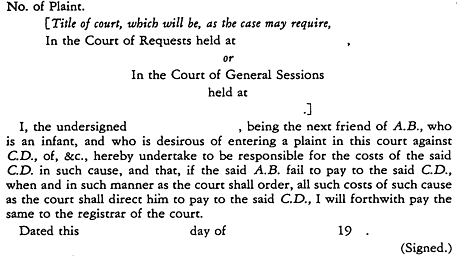
Form 2 - Form of plaint
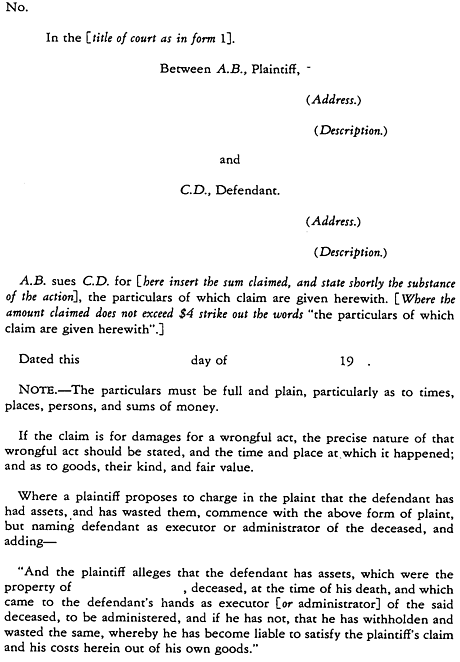
Form 3 - Summons to appear to a Plaint
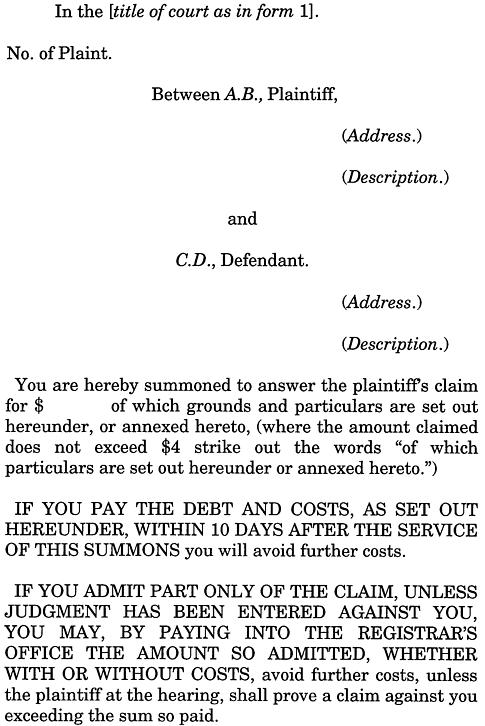
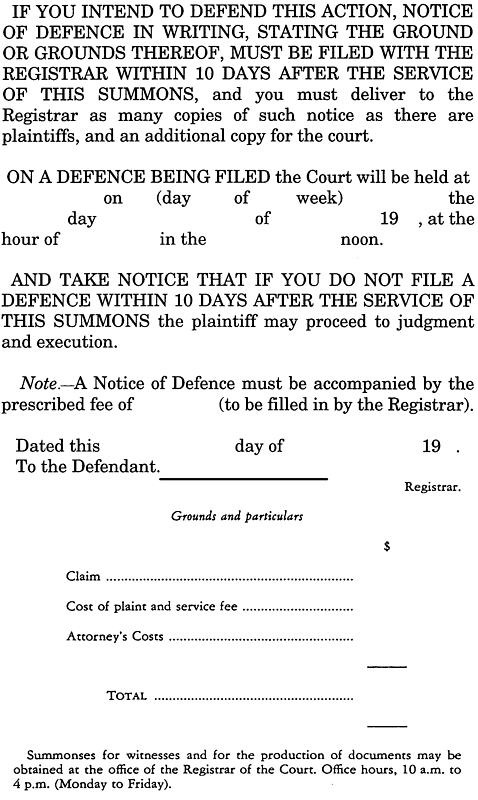
Form 4 - A letter to be sent with summons to Bailiff of another court
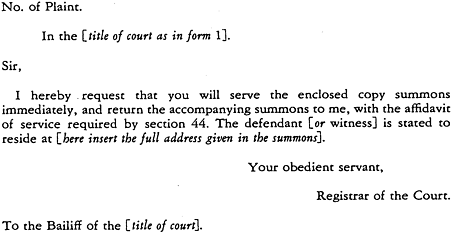
Form 5 - Affidavit of service of summons or order
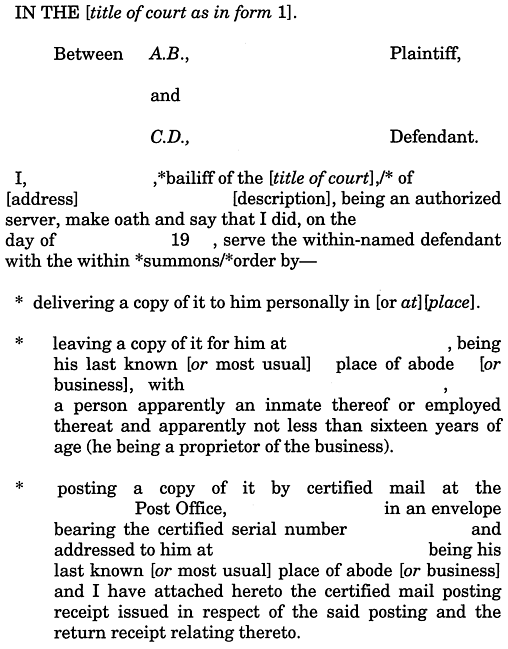
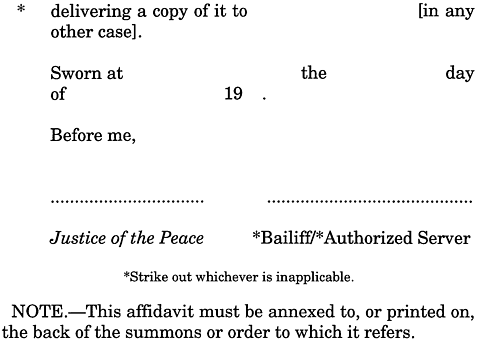
Form 6 - Notice of sureties
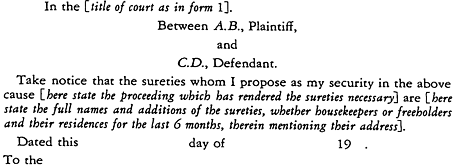
Form 7 - Affidavit of Justification
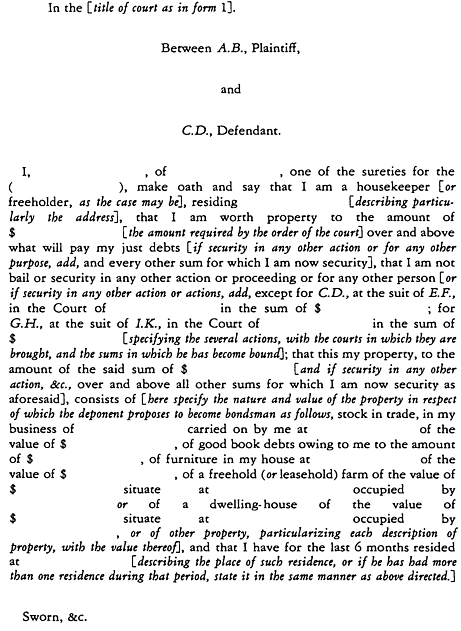
Form 8 - Notice of payment into court
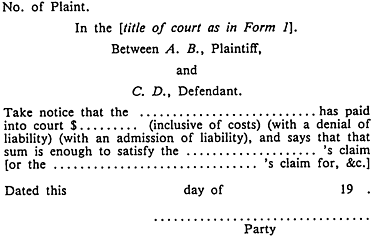
Form 9 - Notice of acceptance of sum paid into court
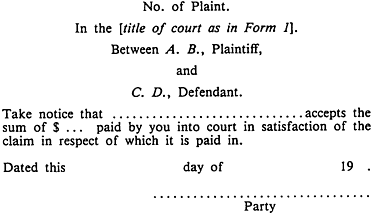
Form 10 - Notice of defence
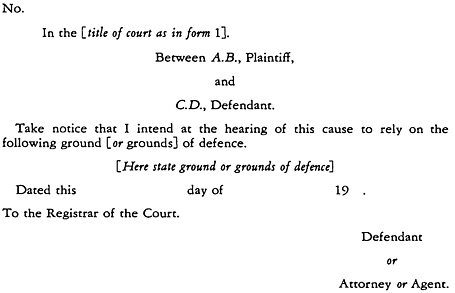
Form 11 - Summons to witness
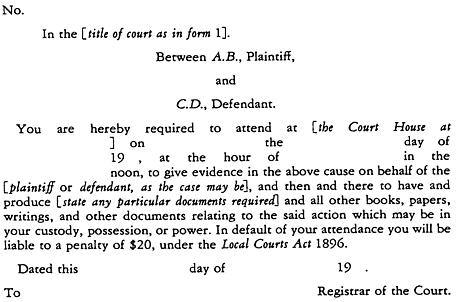
Form 12 - Order fining a witness
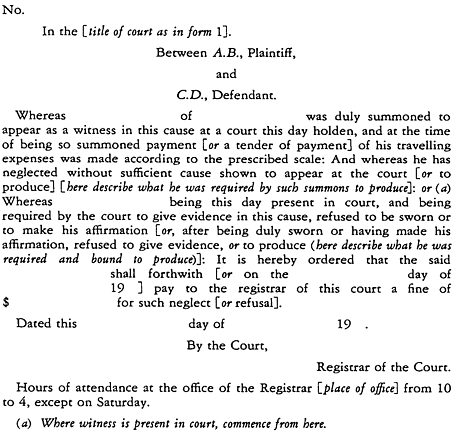
Form 13 - Warrant of execution against the personal property and lands of a witness for a fine
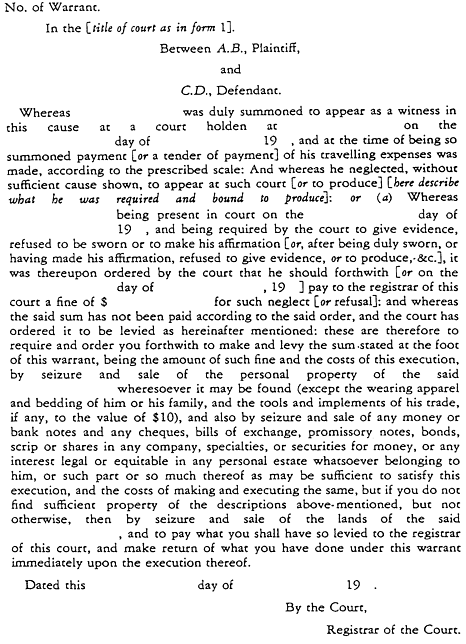
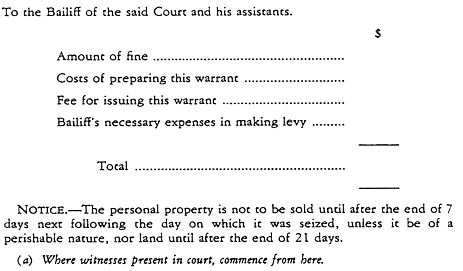
Form 14

Form 15 - Summons to Jurors
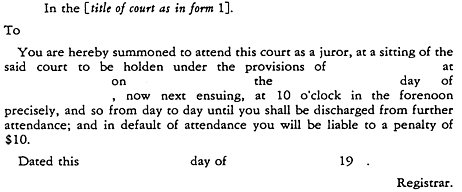
Form 16 - Order fining a Juror for non-attendance
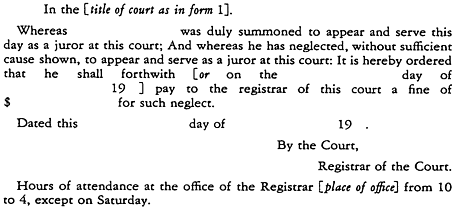
Form 17 - Warrant of execution against the goods and lands of a juror for a fine
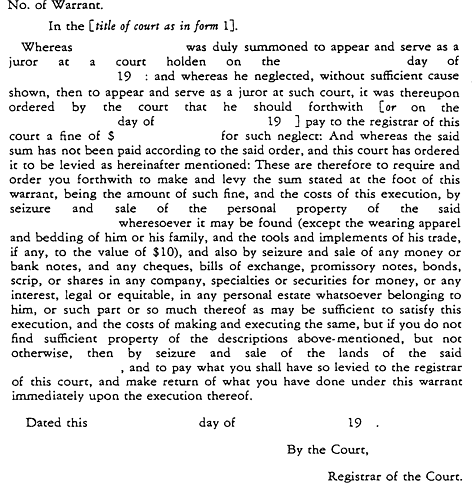
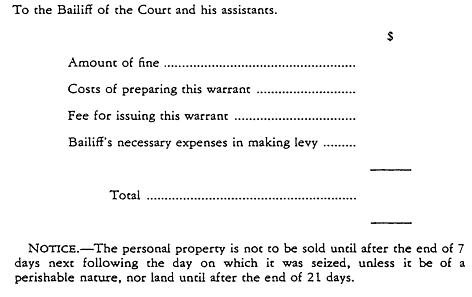
Form 18 - Order appointing guardian named by infant defendant
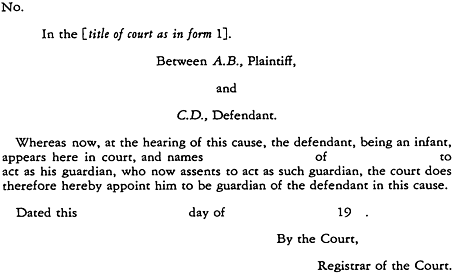
Form 19 - Order appointing guardian of infant defendant where defendant does not name a guardian
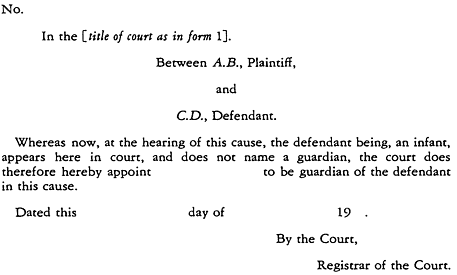
Form 20 - Order for costs to defendant where plaintiff does not appear
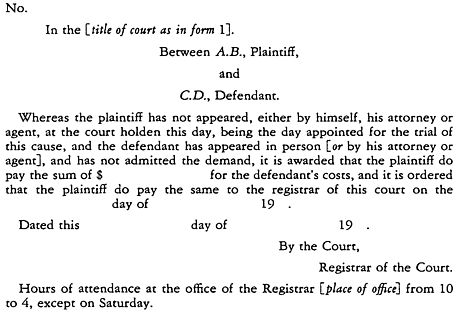
Form 21 - Judgment for defendant or of non-suit
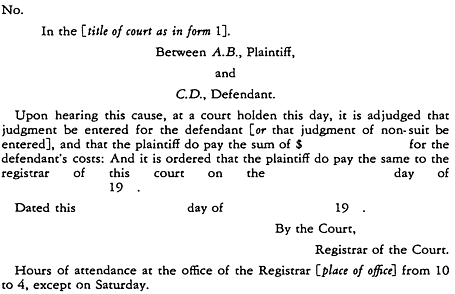
Form 22 - Judgment for plaintiff
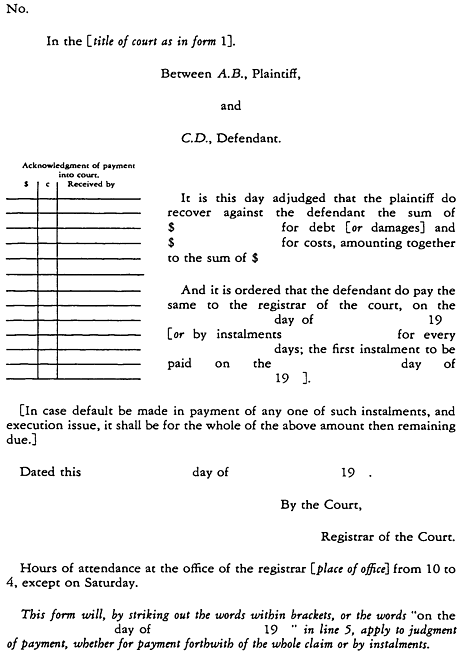
Form 23 - Order to suspend order of judgment
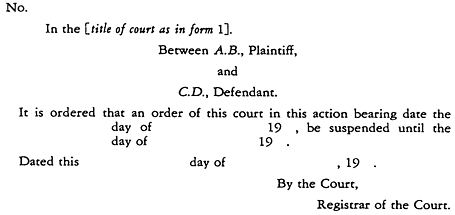
Form 24 - Notice to plaintiff of payment of instalment
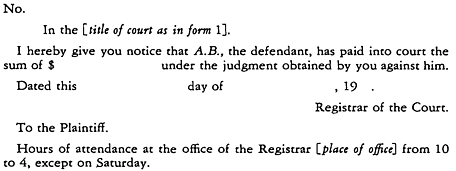
Form 25 - Warrant of execution against the personal property and lands of defendant
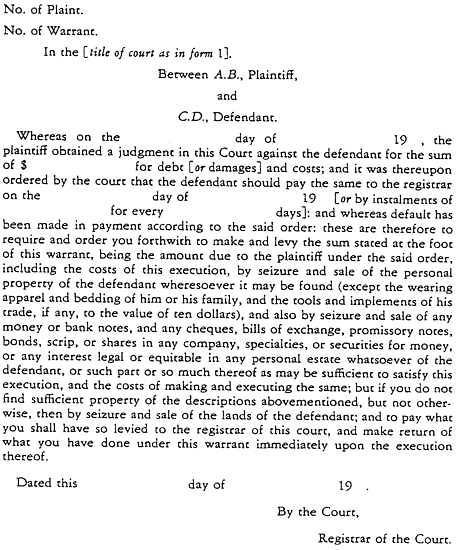
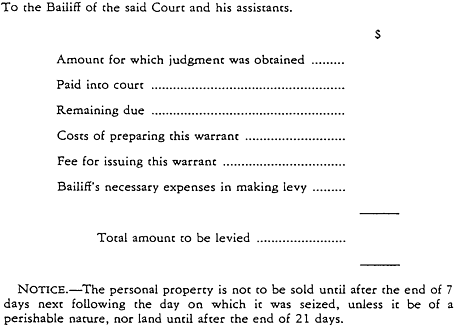
Form 26 - Warrant of execution against the personal property and lands of plaintiff
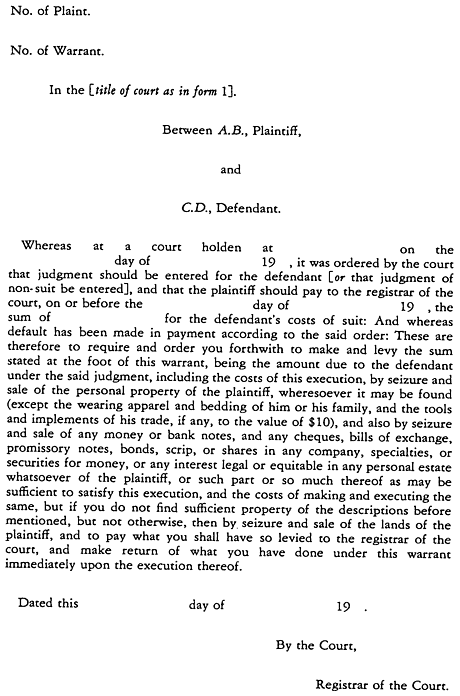
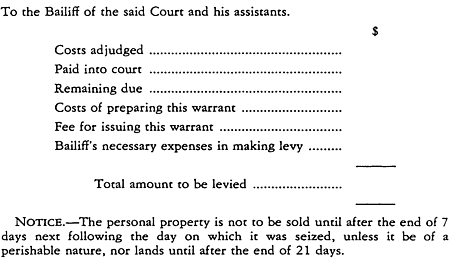
Form 27 - Execution return
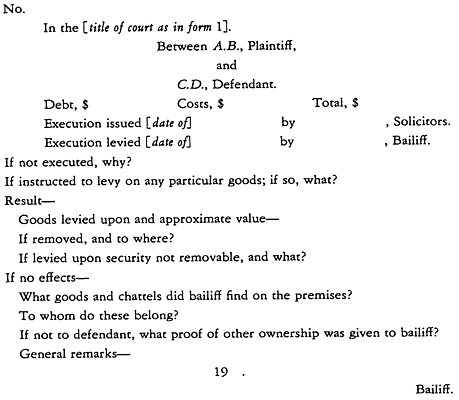
Form 28 - Order of court for a new trial
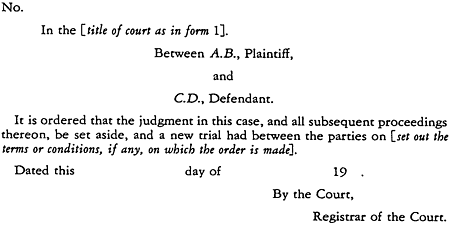
Form 29 - Order to rescind a former order
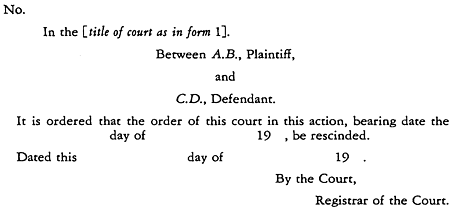
Form 30
Form 31
Form 32
Form 33
Form 34
Form 35
Form 36 - Interpleader summons to execution Creditor
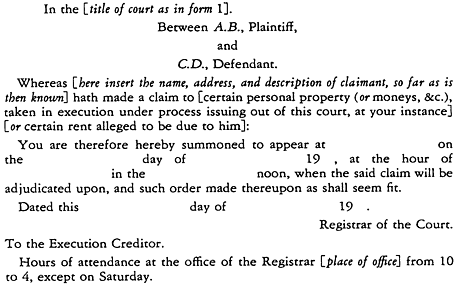
Form 37 - Interpleader summons to a Claimant
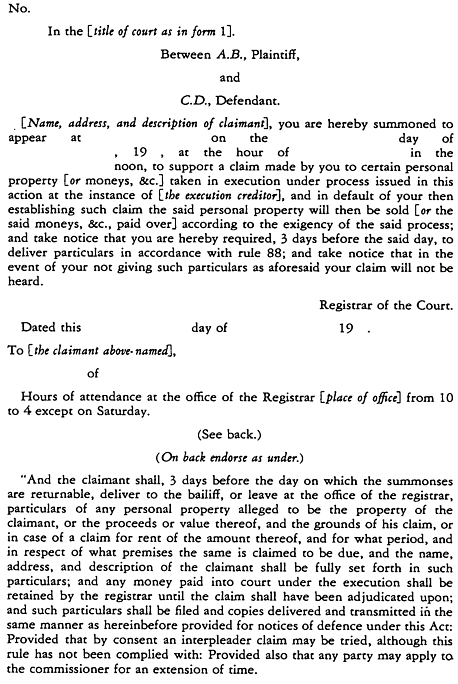
Form 38 - Interpleader summons to a claimant setting up a claim for rent
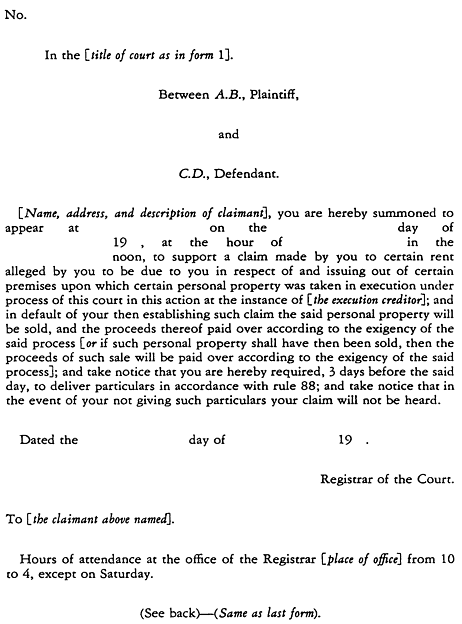
Form 39 - Order of an interpleader summons where the claim is not established
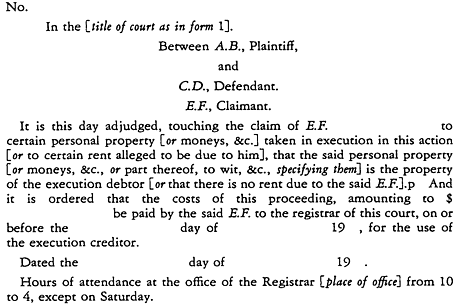
Form 40 - Order on an interpleader summons where the claim is not established
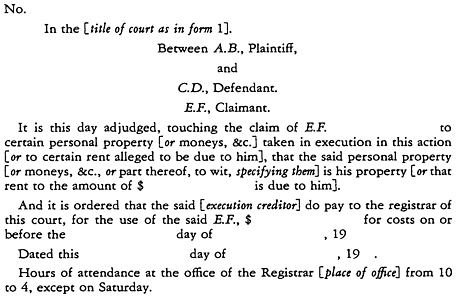
Form 41 - Warrant of execution against the personal property and lands of claimant
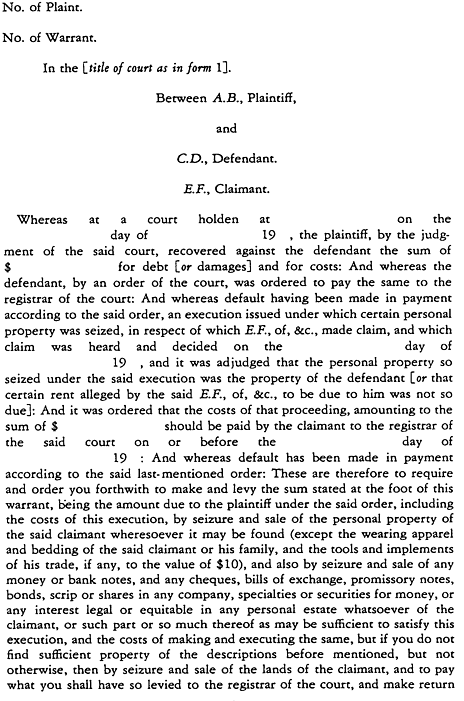

Form 42
Form 43
Form 44 - Admission of claim or part of claim
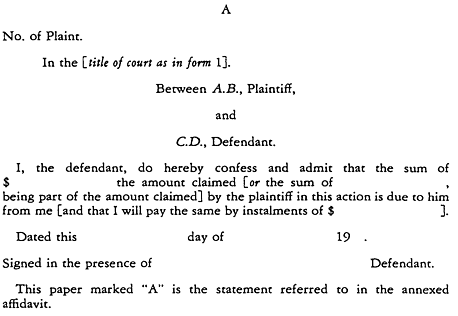
Form 45 - Affidavit of signature to admission
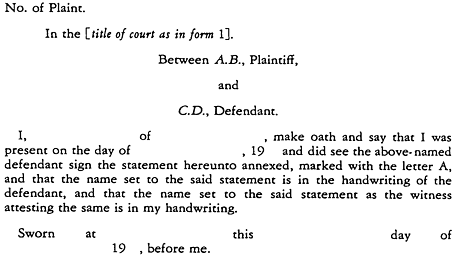
Form 46 - Notice to plaintiff of admission of claim
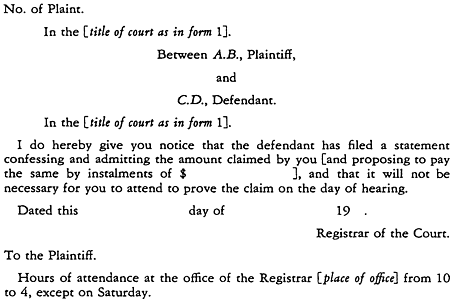
Form 47 - Notice to plaintiff of admission of part of claim
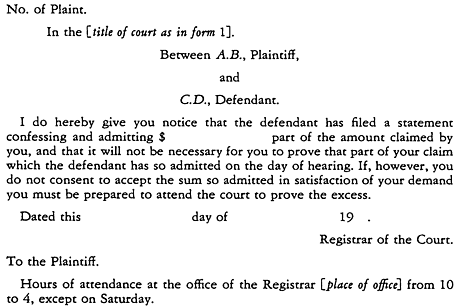
Form 48 - Consent to judgment
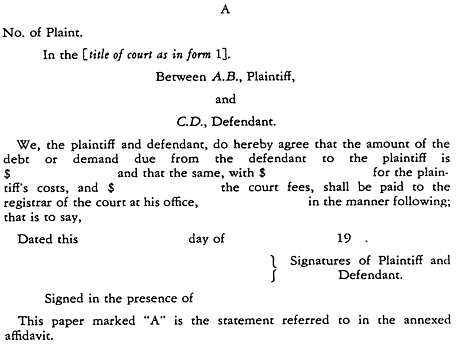
Form 49 - Affidavit of signature
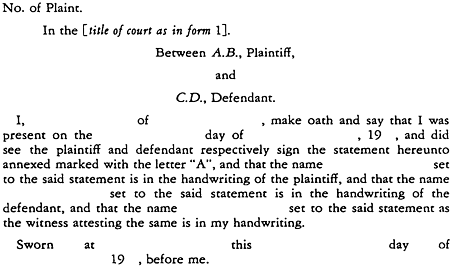
Form 50 - Judgment against an executor who has wasted assets
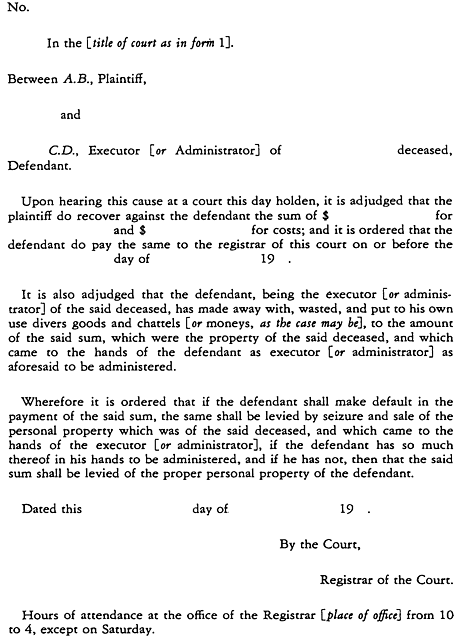
Form 51 - Judgment against an executor who has denied his representative character
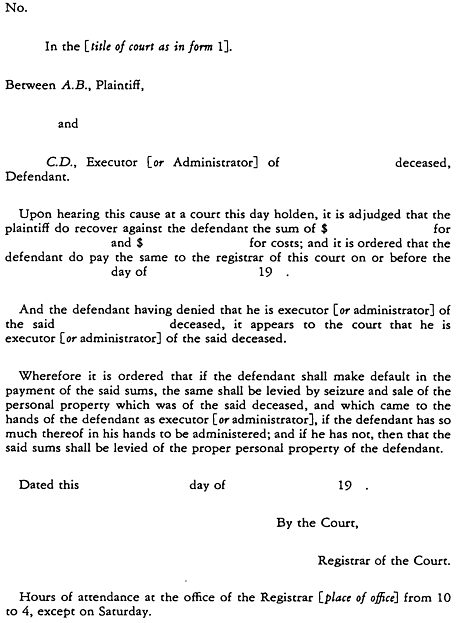
Form 52 - Judgment against an executor or administrator who has pleaded a release of the claim to himself
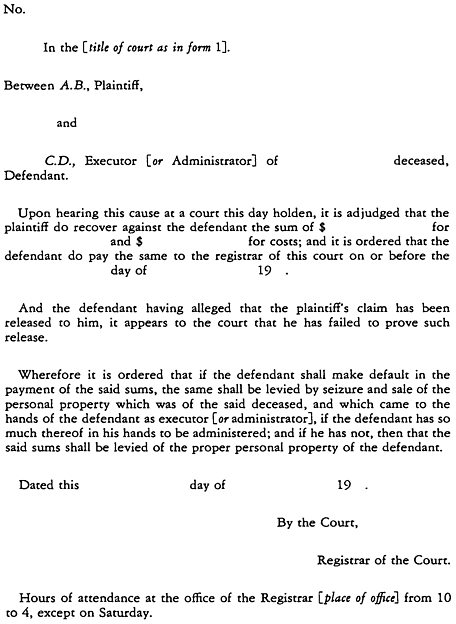
Form 53 - Judgment against executor or administrator who admits his representative character and denies the demand
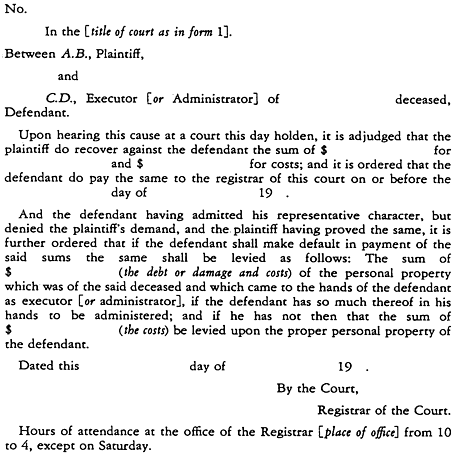
Form 54 - Judgment against executor or administrator where he admits his representative character, but denies the demand, and alleges total or partial administration of assets, and the plaintiff proves his demand, and the defendant proves administration
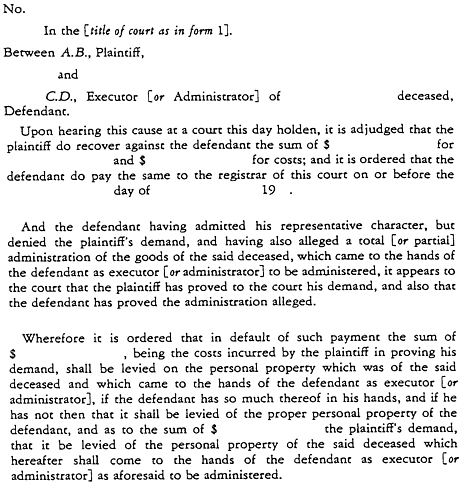
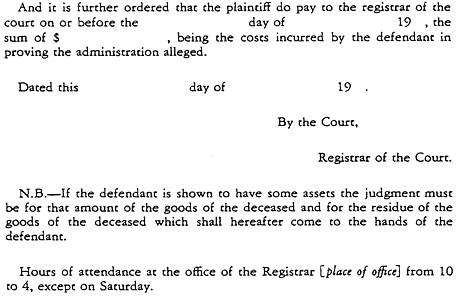
Form 55 - Judgment against executor or administrator where the defendant admits his representative character, but denies the demand, and alleges total or partial administration of assets, and the plaintiff proves his demand, and the defendant does not prove the administration.
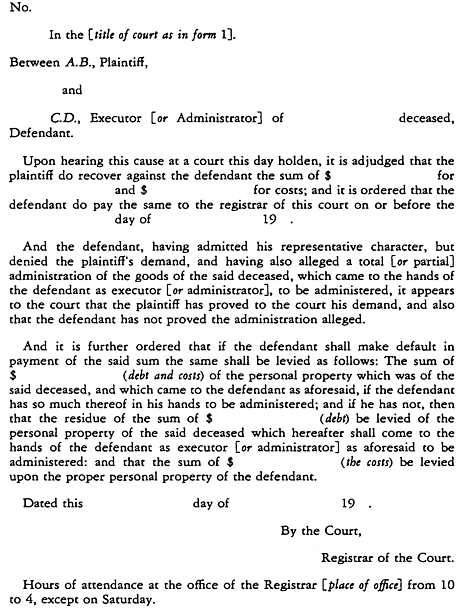
Form 56 - Judgment against an executor or administrator who admits his representative character and the plaintiff's demand, but alleges a total or partial administration of assets, and proves the administration.
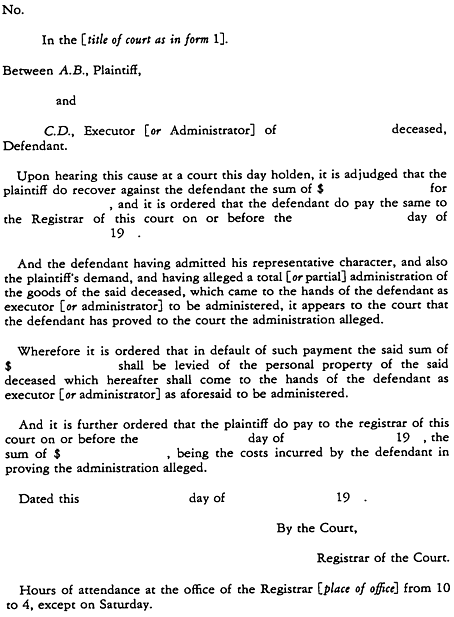
Form 57 - Judgment against an executor or administrator who admits his representative character and the plaintiff's demand, but alleges a total or partial administration of assets, and does not prove the administration.
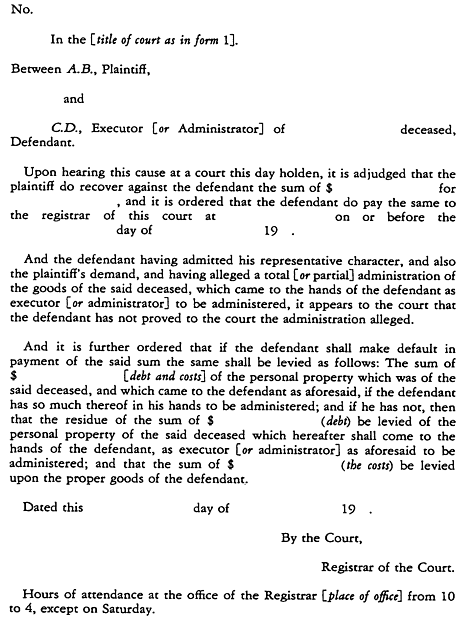
Form 58 - Summons to an executor of plaintiff's intention to apply to the court where assets have come to defendant's hands since judgment.
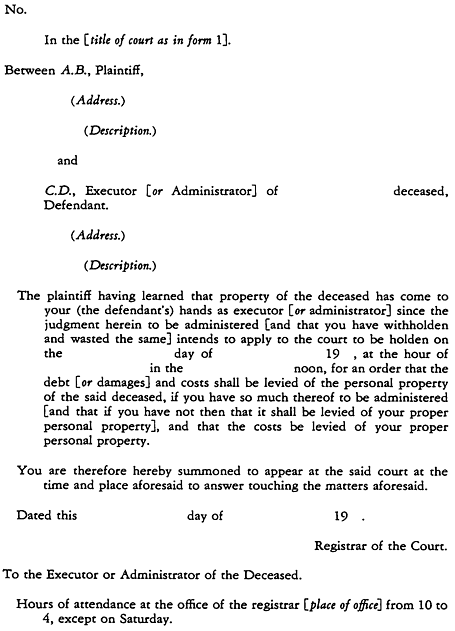
Form 59 - Warrant of execution against the goods of a testator or intestate
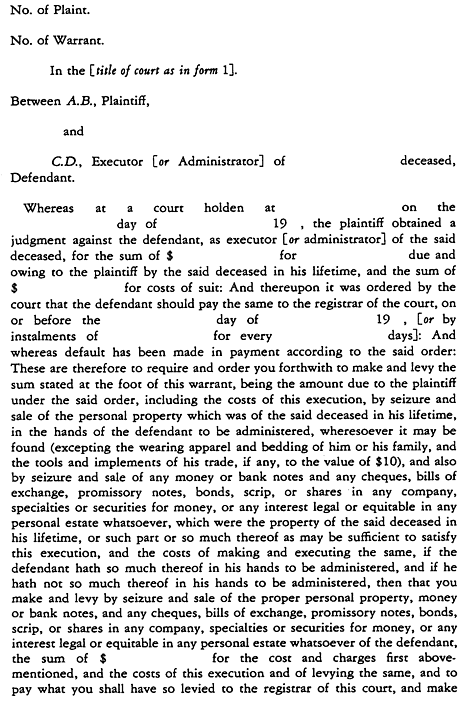
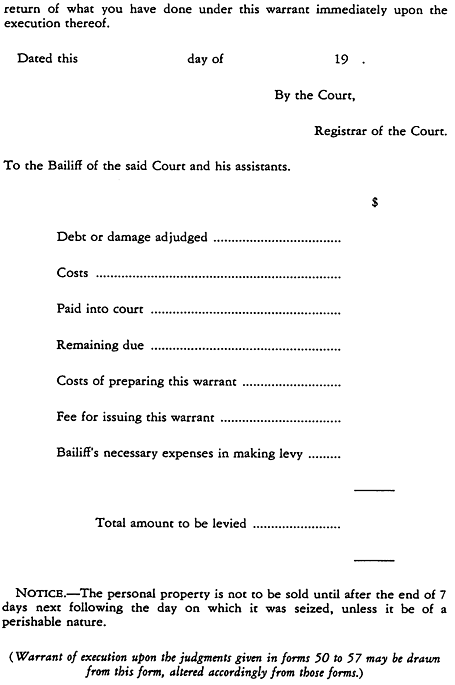
Form 60 - Judgment against an executor or administrator who has wasted assets come to his hands since the judgment
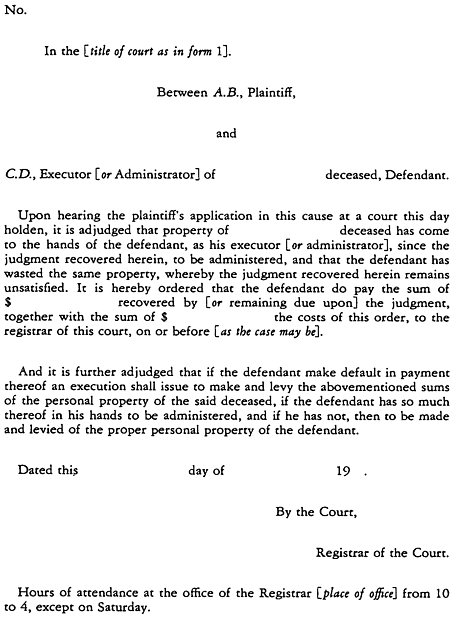
[Commences:
Form 61 - Plaint where tenant or other person hold over
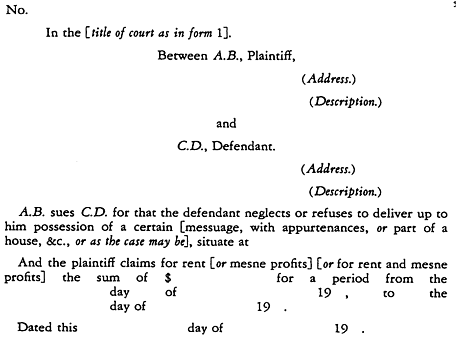
Form 62 - Plaint for recovery of possession for non-payment of rent
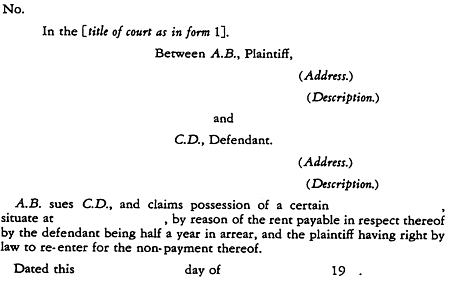
Form 63 - Summons to a tenant or other person holding over
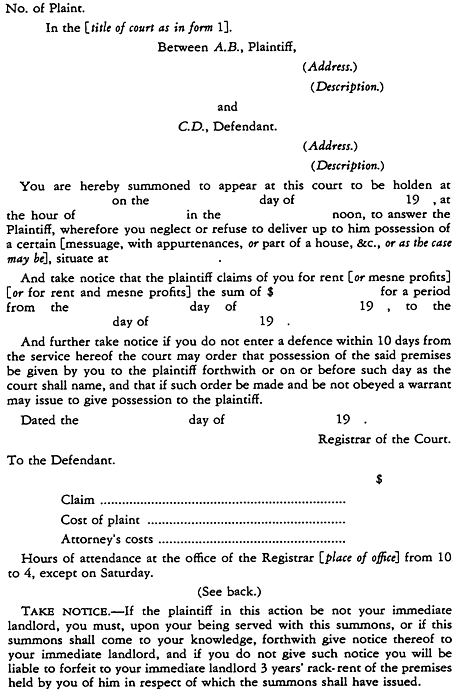
Form 64 - Summons for recovery of possession on non-payment of rent
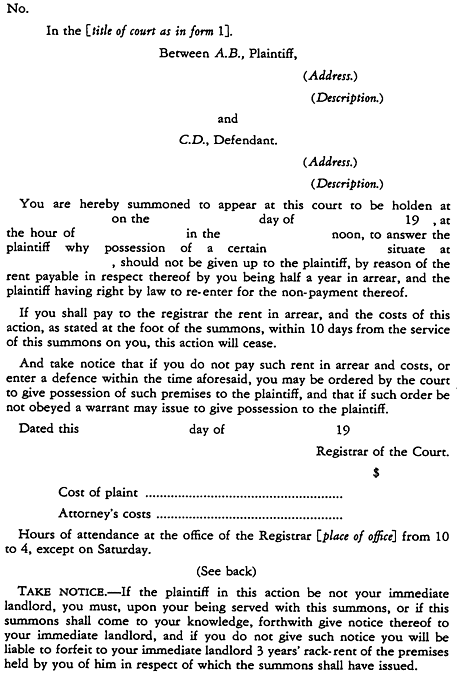
Form 65 - Order for recovery of tenement
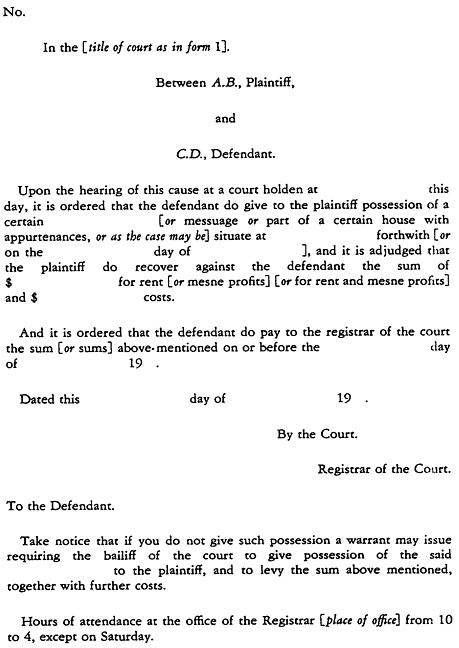
Form 66 - Warrant for giving possession of tenement
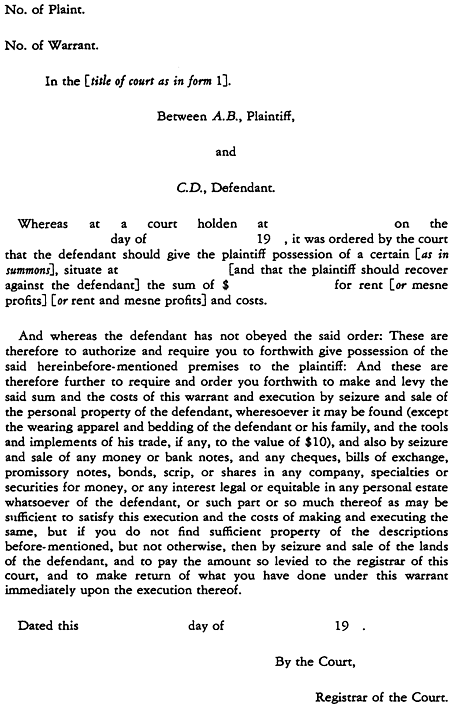
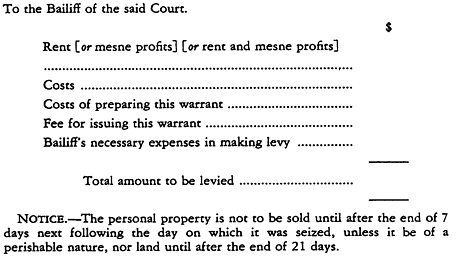
Form 67 - Judgment in detinue
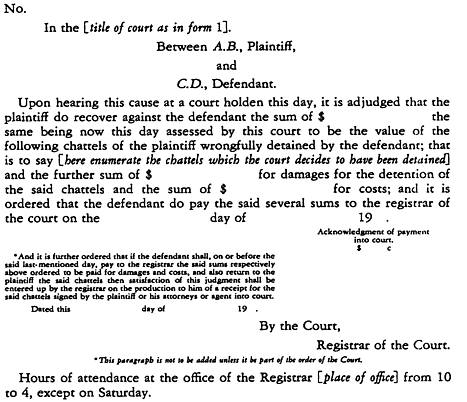
Form 68 - Warrant of execution in detinue against personal property and lands of defendant
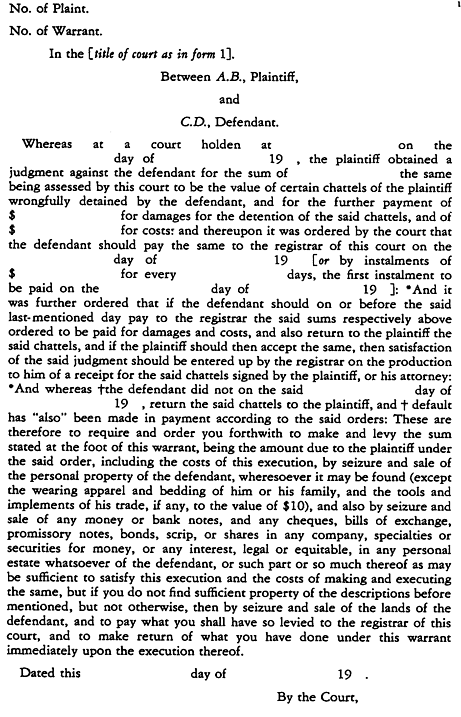
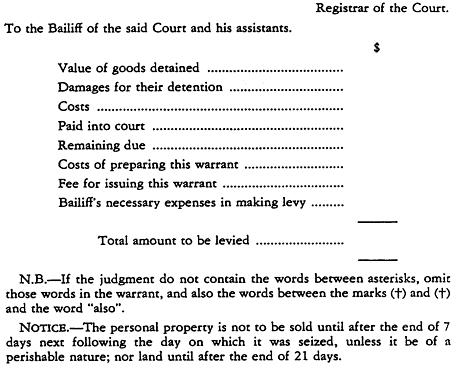
Form 69 - Warrant of commitment for contempt
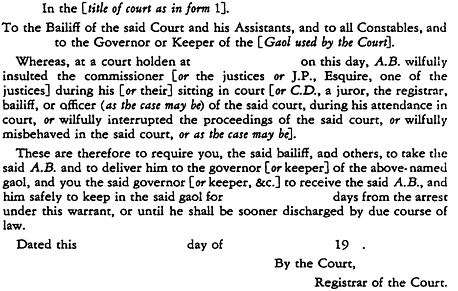
Form 70 - Summons to judgment debtor to show cause why he should not be examined as to debts due to him
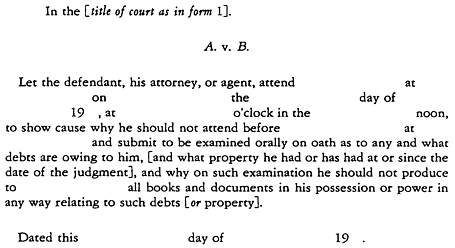
Form 71 - Order thereon
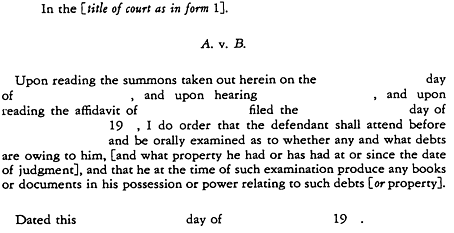
Form 72 - Affidavit on summons for examination of defendant, or to ground application for attachment of a debt
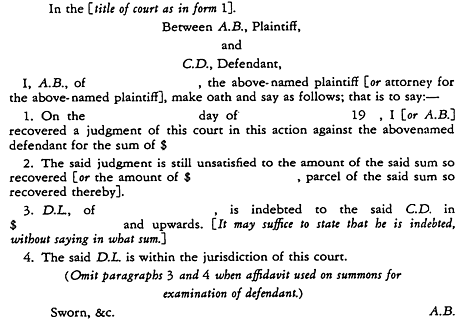
Form 73 - Order ex parte for the attachment of debts and summons for garnishee to pay same
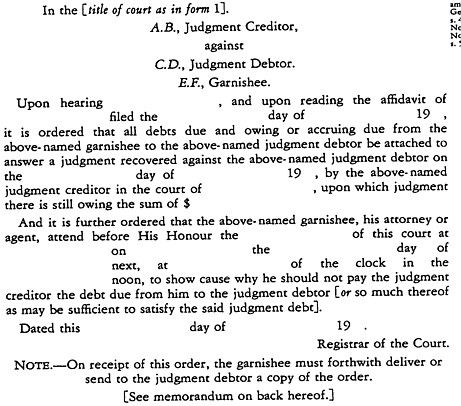
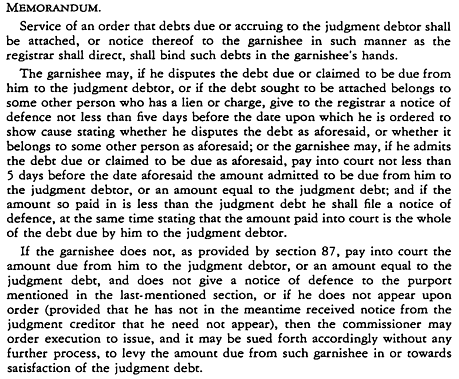
Form 73A - Order ex parte for attachment of salary
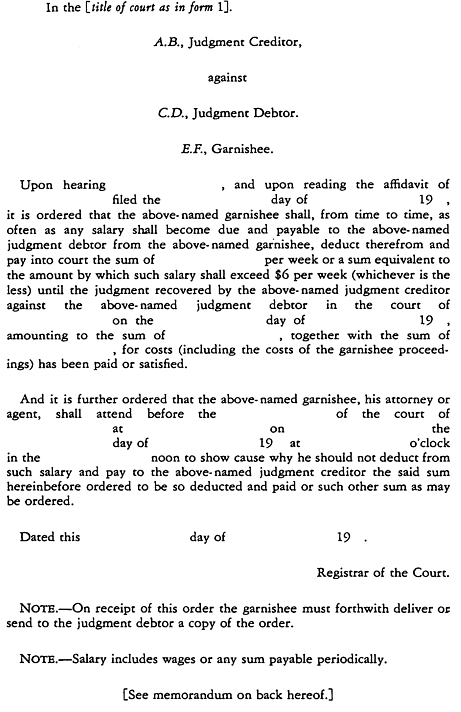

Form 74 - Order for payment by garnishee of a debt due from him, or in default for execution to issue against him
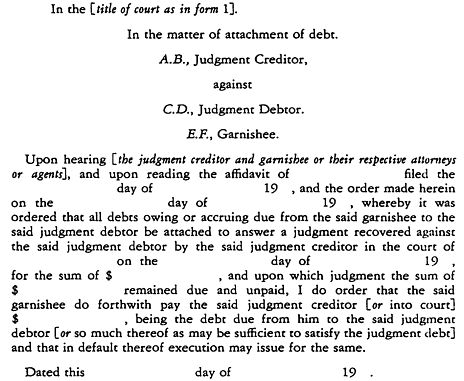
Form 74A - Order absolute for attachment of salary
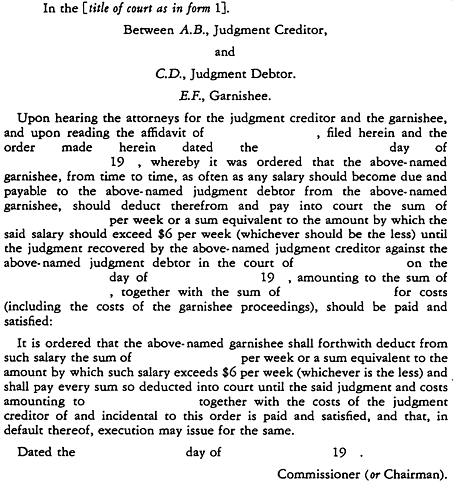
Form 75 - Warrant of execution against a garnishee
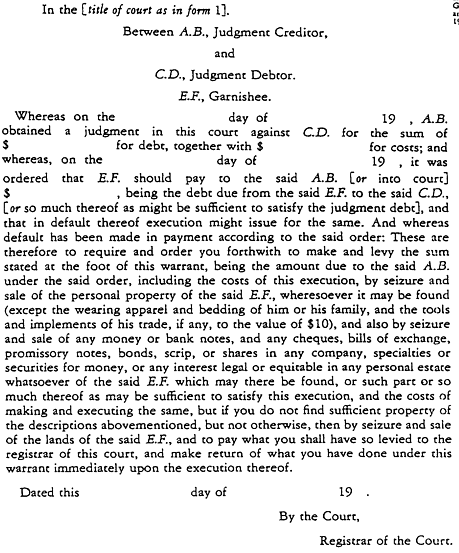
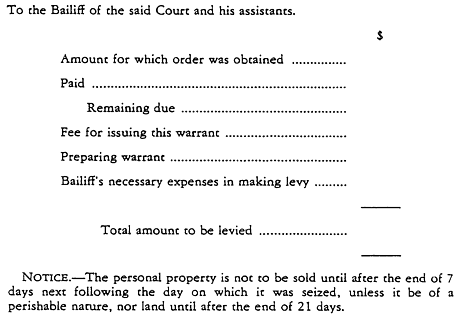
Form 76 - Order for third person claiming lien or charge of debt sought to be attached to appear and state nature of his claim
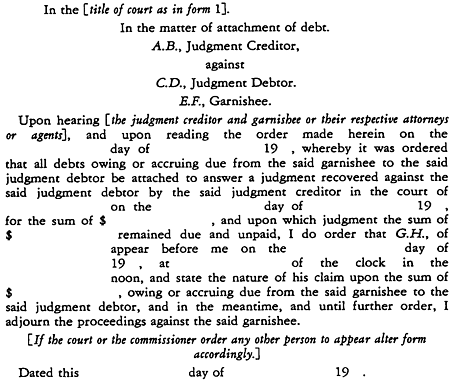
Form 77 - Order on hearing such third person or other person, or in case such third person does not appear
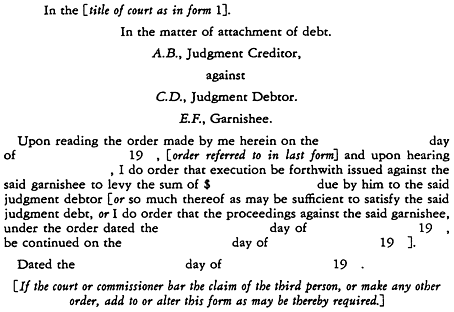
Form 78 - Notice of desire to examine defendant as to certain debts due to him
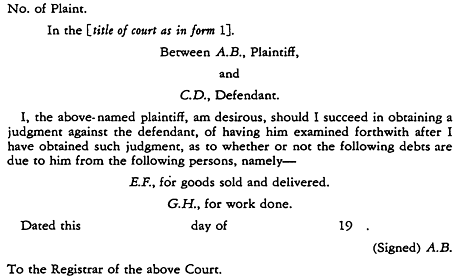
Form 79 - Order when garnishee present