

Legal Profession (Disciplinary Tribunal) Rules 1995
The Disciplinary Tribunal makes the following Rules under section 69(5) of the Legal Profession Act 1993 .
These rules may be cited as the Legal Profession (Disciplinary Tribunal) Rules 1995 .
These rules take effect on the day on which their making is notified in the Gazette.
In these rules –Act means the Legal Profession Act 1993 ;application means an application to hear and determine a complaint under section 72 of the Act;approved document exchange means an approved document exchange as defined in the Supreme Court Rules;notice of hearing means a notice served under section 72(5) of the Act;practitioner means a practitioner as defined in section 56 of the Act;Secretary means the Secretary to the Tribunal appointed under section 70 of the Act.
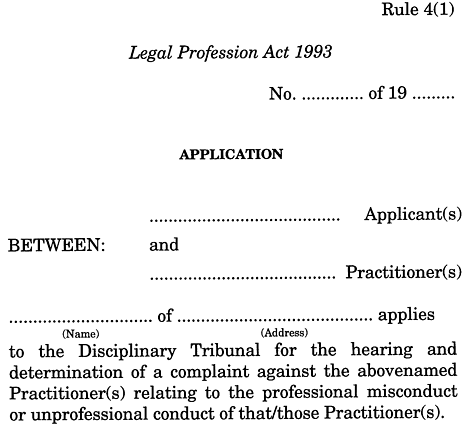
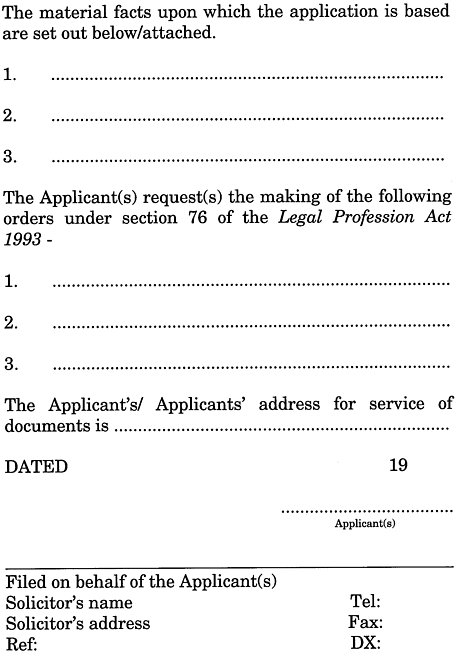
An application is to be in accordance with Form 1 in Schedule 1 .
(1) The Secretary is to arrange for an application to be delivered personally to the practitioner to whom the complaint relates.(2) The Secretary is to arrange the service of any document issued by or at the direction of the Tribunal.(3) Any document, other than an application, required to be served on a person may be served by –(a) leaving it –(i) at the place last known to the server of the document as the place at which the person to be served carries on practice or is employed; and(ii) with a person who appears to be employed, or carry on practice, there and appears to be at least 16 years old; or(b) sending it by pre-paid post to the person's residence or the place referred to in paragraph (a) ; or(c) if the person has lodged a notice of address for service –(i) leaving it at that address in accordance with paragraph (a)(ii) ; or(ii) sending it by pre-paid post to that address; or(d) delivering it, addressed to the person, into the person's facility for the reception of documents at an approved document exchange.(4) Instead of serving a document the Tribunal may direct certain steps to be taken to bring the document to the notice of any person to be served with that document, if it is impracticable to serve the person.(5) The Tribunal may direct the manner in which service of any document is to be proved.
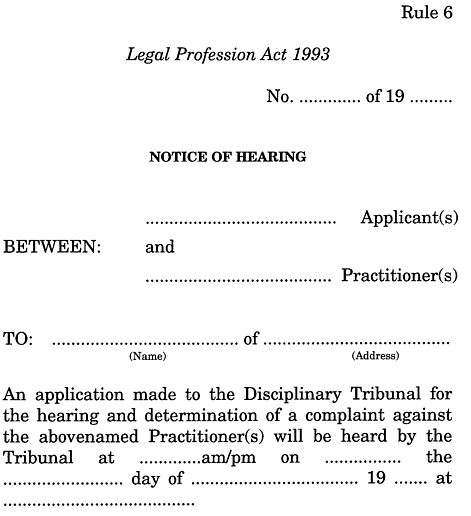
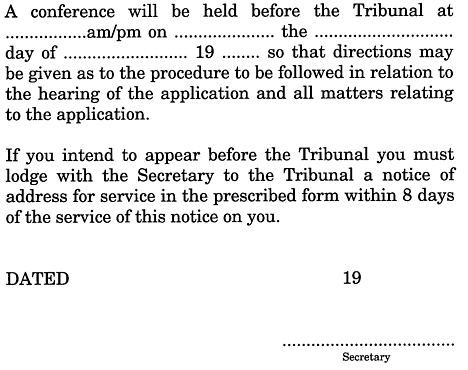
A notice of hearing is to be in accordance with Form 2 in Schedule 1 .
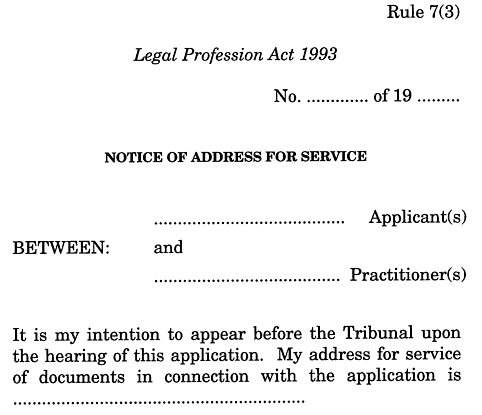
7. Notice of address for service
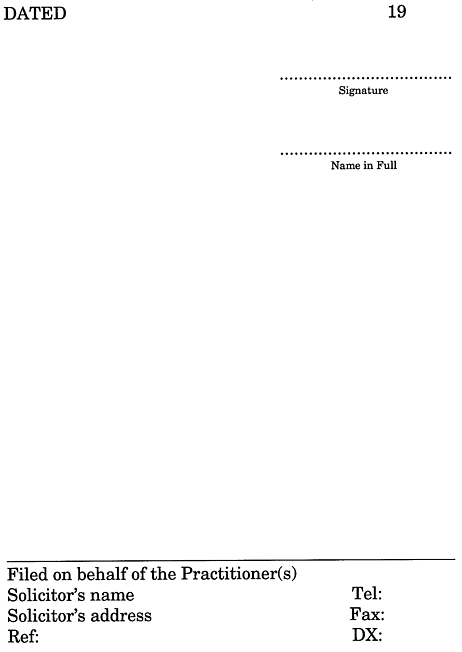
(1) A person who is served with a notice of hearing and intends to appear before the Tribunal at the hearing of the application is to lodge with the Secretary a notice of address for service.(2) The person is to lodge the notice of address for service within 8 days of being served with the notice of hearing.(3) The notice of address for service is to be in accordance with Form 3 in Schedule 1 .
(1) At any stage of proceedings the Tribunal, either of its own motion or at the request of a party to the proceedings, may give any directions or make any orders as to the procedure to be followed in relation to an application as the Tribunal considers appropriate.(2) A party may make a request under subrule (1) by –(a) sending a letter to the Secretary setting out the directions or orders sought and the grounds for those directions or orders; and(b) sending a copy of the letter to all other parties to the proceedings.(3) The Tribunal, either of its own motion or at the request of a party to the proceedings, may hold a conference for the purpose of giving directions or making orders under subrule (1) .(4) The Tribunal may include notice of a conference in a notice of hearing.
At any stage of proceedings the Tribunal may order that an application or any document relating to an application be amended on any terms and conditions the Tribunal considers appropriate.
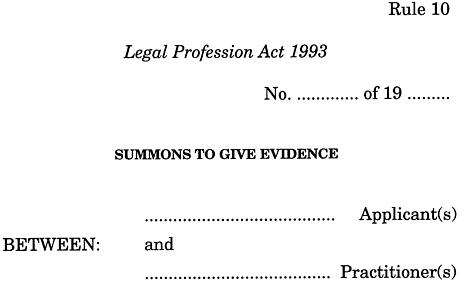
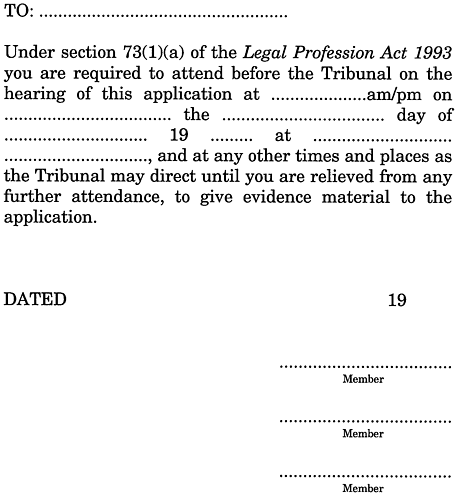
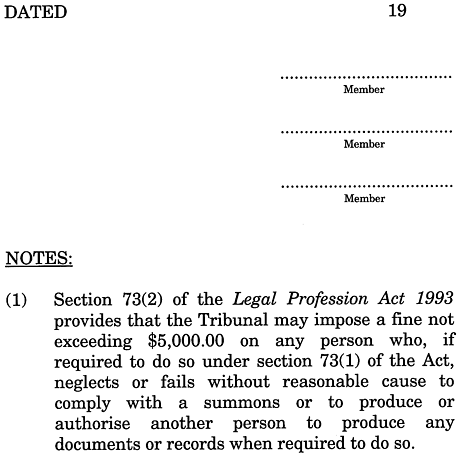
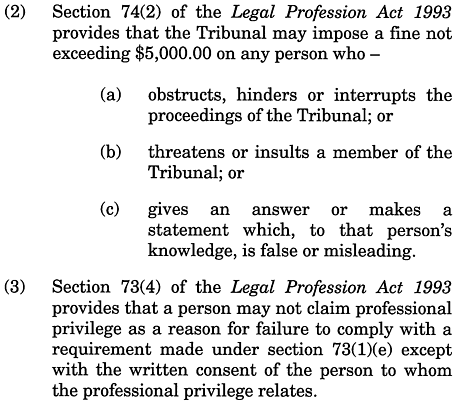
For the purposes of section 73(1)(a) of the Act, a summons is to be in accordance with Form 4 in Schedule 1 .
11. Form of requirement to produce documents
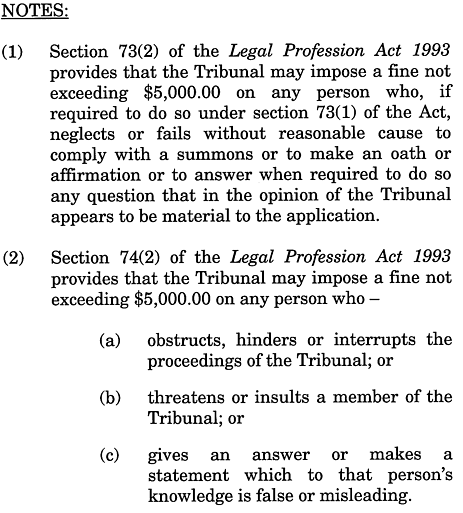
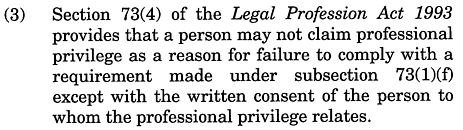
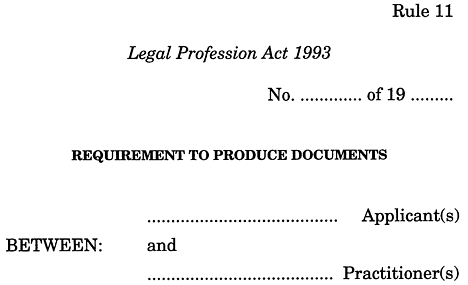
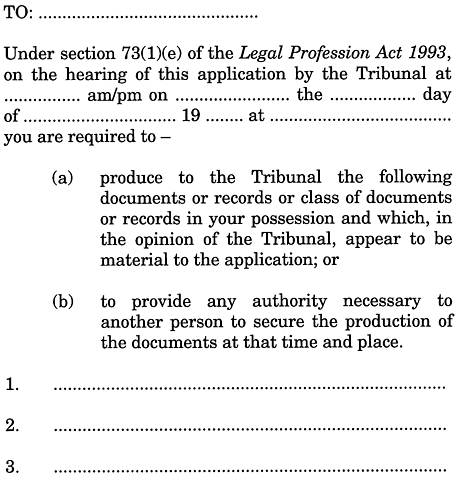
A requirement under section 73(1)(e) of the Act is to be –(a) in accordance with Form 5 in Schedule 1 ; and(b) served on the person required to produce, or authorise another person to produce, any document.
(1) The Tribunal, at the hearing of an application, may –(a) direct that evidence be taken by affidavit; and(b) give directions specifying a timetable for the filing and serving of any affidavit and any notice to cross-examine the deponent of the affidavit.(2) The Tribunal may serve, in accordance with these rules, all parties to the proceedings with notice of any directions given under subrule (1) .(3) A party wishing to cross-examine a deponent of an affidavit may serve on the party who filed the affidavit a notice requiring the deponent to attend the hearing for cross examination.(4) If the Tribunal does not specify a time for service of a notice requiring the deponent to attend the hearing, the notice must be served a reasonable time before the deponent is required to attend.(5) An affidavit must not be used in evidence unless –(a) the deponent attends in accordance with any notice under subrule (3) ; or(b) the Tribunal makes an order exempting the deponent from cross-examination.
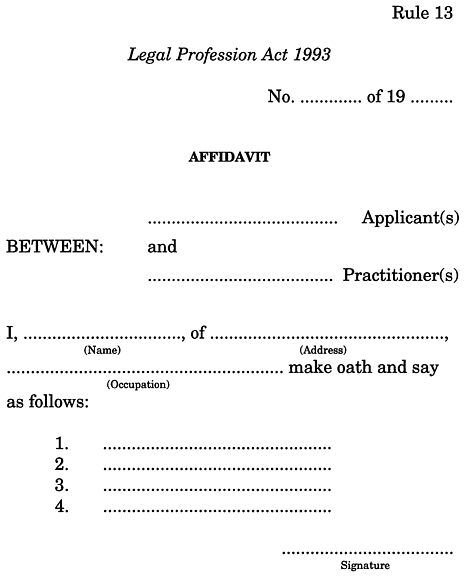
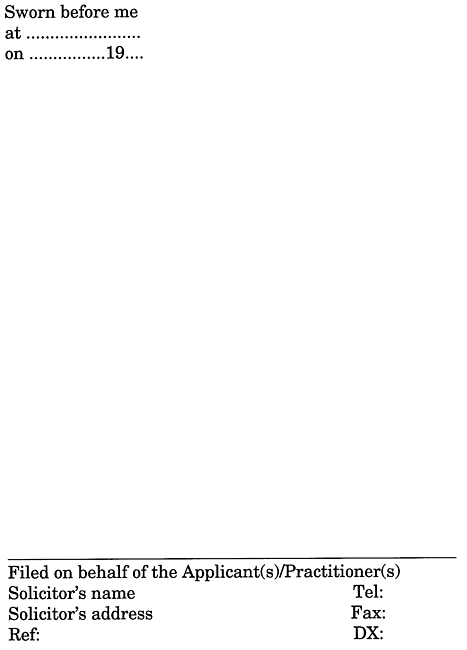
An affidavit is to be –(a) in accordance with Form 6 in Schedule 1 ; and(b) sworn before any of the following:(i) a judge of the Supreme Court;(ii) the Master, Registrar or Deputy Registrar of the Supreme Court;(iii) a district registrar of the Supreme Court;(iv) a commissioner of the Supreme Court to administer oaths;(v) a magistrate;(vi) a justice.
14. Written submission at hearing
A party to an application giving a written submission under section 74(1)(c) of the Act is to serve the submission on all other parties to the application and the Secretary not less than 2 days before the date fixed for hearing the application.
(1) The applicant or the practitioner to whom the hearing relates may file a notice of agreement with the Tribunal if the parties to the application agree to a settlement.(2) A notice of agreement is to set out the terms of the agreement and the reasons for the applicant not wishing to proceed to a hearing.(3) On the filing of a notice of agreement, the Tribunal is to determine whether or not to proceed, or proceed further, with a hearing of the application.
(1) An application is to be heard in private unless the Tribunal orders otherwise.(2) The Tribunal may give any determination, order or reason for any determination or order in private or public as the Tribunal thinks fit.
(1) Subject to subrule (2) , the Tribunal is bound by the rules of evidence.(2) The Tribunal may inform itself in any manner it thinks fit of any matter relevant to determining the accepted standards of practice and behaviour within the legal profession.
(1) The Secretary is to cause a tape recording of every hearing before the Tribunal to be made.(2) The Secretary is to make available to a party to an application before the Tribunal a transcript of the tape recording of the hearing on –(a) the request of the party;(b) payment of the cost of production of the transcript.
(1) Within 7 days of the Tribunal making an order under section 76 of the Act, the Secretary is to serve each party to the application with a copy of the order and the reasons for it.(2) The Tribunal may extend the period for service in any circumstances it thinks fit.
20. Request for Tribunal to act
(1) A party to an application may request the Tribunal to exercise its powers under section 73(1)(a) , (e) , (g) or (h) of the Act.(2) The Tribunal may require a party making a request under subrule (1) to undertake to pay the reasonable costs incurred by any person in complying with –(a) a summons issued under section 73(1)(a) of the Act as a result of the request; or(b) any requirement of the Tribunal made under section 73(1)(e) , (g) or (h) of the Act as a result of the request.(3) A party at whose request a summons under section 73(1)(a) of the Act is issued or a requirement under section 73(1)(e) of the Act is made is to serve the person who is the subject of the summons or requirement with a copy of the summons or notice of the requirement.
(1) A party served with a notice of hearing is to deliver a list of all the documents on which the party intends to rely at the hearing to –(a) the Secretary; and(b) every other party to the hearing.(2) A party to a hearing must deliver the list at least 14 days before the date fixed for the hearing.(3) Any party to a hearing may inspect any of the documents in the list delivered to that party.(4) A party delivering a list is to provide, at a reasonable cost, a copy of any document in the list if requested to do so.
(1) At any time not later than 7 days before the day fixed for the hearing of an application, a party to the hearing may require, by notice in writing, another party to admit the authenticity of any document without the need for formal proof of the document at the hearing.(2) Within 3 days of receiving a notice under subrule (1) , a party who does not admit the authenticity of a document is to give notice to the party possessing the document that proof of its authenticity will be required at the hearing.(3) A party is taken to have admitted the authenticity of a document if the party fails to give notice in accordance with subrule (2) in respect of the document, unless the Tribunal orders otherwise.(4) If a party does not admit the authenticity of a document and its authenticity is subsequently proved at the hearing, the cost of that proof is to be paid by that party unless the Tribunal determines that the grounds for not admitting the authenticity of the document were reasonable.
23. Tribunal may dispense with requirements
If it appears to the Tribunal to be just to do so, the Tribunal may –(a) dispense with a requirement of these rules relating to any form, notice, affidavit, document, service, procedure or time; and(b) vary or rescind any order or direction it has given in relation to any of those matters.
SCHEDULE 1 - Forms
Form 1
Form 2
Form 3
Form 4
Form 5
Form 6
These Rules were made by the Disciplinary Tribunal at a meeting of the Tribunal on 28 August 1995.
P. E. EVANS
Chairperson
K. A. M. PITT
Member
V. R. SMITH
Member
Displayed and numbered in accordance with the Rules Publication Act 1953.
Notified in the Gazette on 6 September 1995
These rules are administered in the Department of Justice.