

Local Government Regulations 1994
I, the Governor in and over the State of Tasmania and its Dependencies in the Commonwealth of Australia, acting with the advice of the Executive Council, make the following regulations under the Local Government Act 1993 .
14 February 1994P. H. BENNETT
Governor
By His Excellency's Command,
T. JOHN CLEARY
Minister for Local Government
PART 1 - Preliminary
These regulations may be cited as the Local Government Regulations 1994 .
These regulations take effect on the day on which their making is notified in the Gazette.
In these regulations –Act means the Local Government Act 1993 ;application means an application made under section 304 of the Local Government Act 1993 ;election dispute means a dispute in relation to the result of an election held under the Act;nominating period means the period beginning on the day on which the certificate of election is issued and ending on the day before the first meeting of the council after the election of councillors;proceedings means proceedings relating to the hearing of an election dispute;Registrar means the Registrar of the Supreme Court;Rules of Court means Rules of Court referred to in regulation 16 .
PART 2 - Elections and polls
Division 1 - Election of mayor and deputy mayor by councillors
4. Nominations for mayor and deputy mayor
(1) The general manager is to issue to all councillors –(a) a notice of the elections of mayor and deputy mayor; and(b) nomination forms for those elections.(2) The general manager is not to release the names or details of any councillor who has nominated until the end of the nominating period.(3) At the end of the nominating period the general manager is to inform each councillor –(a) of the nominations received; and(b) whether a ballot is required.(4) If a ballot is not required, the nominee is to be declared elected to the position nominated by the nominee by the general manager at the first meeting of the council following the election of councillors.(5) If a nomination is not received for any position, another notice of election is to be made by the general manager.(6) A council is not to hold any meeting after the election of councillors until at least one nomination for mayor and at least one nomination for deputy mayor has been received.
(1) If there are 2 or more candidates for the office of mayor or deputy mayor, a ballot is to be conducted in accordance with this regulation.(2) Voting is to be carried out at the meeting of the council by secret ballot.(3) Each councillor present at the meeting, whether a candidate or not, is to be given a ballot-paper on which are printed in alphabetical order the names of all the candidates.(4) Each councillor is to vote for one preferred candidate by striking through the names of the other candidates for whom he or she does not intend to vote.(5) The name of the candidate who, at the first count, has the smallest number of votes is to be excluded and a new ballot-paper prepared which has the names of the continuing candidates printed on it in alphabetical order.(6) This procedure is to be repeated until a single candidate remains.(7) The surviving candidate is the successful candidate.(8) If 2 or more candidates have an equal number of votes, the name of the candidate to be withdrawn is to be decided by the drawing or casting of lots conducted in accordance with regulation 21 .(9) The councillors present at the first meeting of a council after an election has been held under Part 15 of the Act are to appoint a councillor, who is not a candidate, to preside at the ballot.(10) The councillor appointed to preside may vote as a councillor.
(1) A candidate may appoint a scrutineer who may be present at the counting of the votes.(2) A candidate is to advise the general manager in writing before the commencement of the meeting of any such appointment.
Division 2 - Election disputes
(1) The Supreme Court may allow a person to appear and be heard, or to be represented, in proceedings relating to an election dispute.(2) A party may only be represented by one person.(3) The Chief Electoral Officer is entitled to enter an appearance and be heard in any proceedings relating to an election dispute.(4) The Chief Electoral Officer is a party in the proceedings if –(a) the Chief Electoral Officer enters an appearance under subregulation (3) ; or(b) the dispute involves the conduct of an electoral officer.
8. Applications in respect of election dispute
(1) The Registrar is to make out a list of applications in relation to an election dispute, placing them in the order in which they were made.(2) Proceedings in respect of the same election are to be heard in the same hearing.(3) The Registrar is to –(a) keep a copy of the list of applications; and(b) make it available for inspection in accordance with the Rules of Court.(4) Subject to subregulation (2) , applications are to be heard in the order in which they appear in the list.
(1) Notice of the time and place for the hearing of an election dispute is to be given at least 7 days before the day of the hearing in the manner prescribed by the Rules of Court.(2) A hearing is to be in open court without a jury.(3) The Supreme Court may adjourn the hearing of an election dispute from time to time, but the hearing, so far as is reasonably practicable, is to be continued from day to day until its conclusion.(4) A hearing in relation to the election of a councillor is to proceed despite the subsequent resignation of the councillor.(5) The Supreme Court may –(a) inquire into the identity of electors; and(b) inquire whether or not their votes were properly admitted or rejected for the purposes of an election.(6) The Supreme Court may not inquire into the correctness of the electoral roll.(7) The Supreme Court is to be guided by the substantial merits and good conscience of the case without regard to –(a) any legal forms or technicalities; or(b) whether the evidence before the Court is in accordance with the law of evidence or not.
(1) A party in proceedings may give evidence to prove that a person was not duly elected.(2) If it appears that there is an equality of votes between any candidates at an election and that the addition of a vote would entitle any of those candidates to be elected, the Supreme Court is to –(a) decide between the candidates by lots; and(b) proceed as if the candidate on whom the lot then falls had received an additional vote.(3) The Supreme Court may not receive evidence to the effect that a witness was not permitted to vote at the election concerned unless the witness satisfies the Court that –(a) he or she was entitled to vote under the Act; and(b) in so far as the witness was permitted to do so, he or she complied with the requirements of the Act relating to voting by electors.
(1) A person summoned as a witness at any hearing of an election dispute proceedings is not excused from answering a question relating to an offence alleged to have been committed at, or in connection with, an election –(a) on the ground that the answer to the question may incriminate or tend to incriminate that person or the spouse of that person; or(b) on the ground of privilege.(2) An answer by a witness to a question put by or before the Supreme Court in any proceedings is not admissible in evidence in any other legal proceeding, except in the case of a criminal proceeding for perjury.
A person attending the Supreme Court to give evidence in any proceedings is entitled to reasonable expenses according to the scale applicable in respect of witnesses attending the trial of an action before the Supreme Court.
(1) At the conclusion of the hearing of an application in respect of an election dispute, the Supreme Court may make any one or more of the following orders:(a) dismissing the application, in whole or in part;(b) declaring that any person who was returned as elected at an election was not duly elected on the date on which the election was held;(c) declaring as duly elected any candidate for election who was not returned at the election;(d) declaring an election in respect of a municipal area or electoral district, to be void on the date on which it was purported to have been held.(2) If the Supreme Court makes an order under subregulation (1)(b) that a person was not duly elected, it is to declare, in the same order, that the office of councillor for which the person was not so elected is vacant.(3) If the Supreme Court makes an order under subregulation (1)(d) declaring that an election in respect of any municipal area or electoral district is void, the election must be regarded as having wholly failed in that municipal area or electoral district.(4) A certified copy of the order is to be given to the Chief Electoral Officer.(5) The Chief Electoral Officer is to advise the Minister and the relevant council of the order.
(1) The Supreme Court is not to declare an election void under regulation 13(1)(d) because of –(a) a delay in the taking of the votes of electors or in the making of a certificate of election if the delay did not affect the result of the election; or(b) the absence of, or an error or omission by, an electoral officer which did not affect the result of the election.(2) If an elector was prevented from voting at an election because of the absence of, or an error or omission by, an electoral officer, the Supreme Court may not admit evidence of the way in which the elector intended to vote in order to determine whether or not the absence of, or error or omission by, the electoral officer affected the result of the election.
(1) The Supreme Court may –(a) award costs against an unsuccessful party to the proceedings; and(b) recommend that costs, or a specified part of them, be paid by the council.(2) Costs awarded in proceedings are recoverable and enforceable in the same way and to the same extent as costs awarded in an action before the Supreme Court.
(1) Rules of Court may be made under the Supreme Court Civil Procedure Act 1932 for the purposes of this Part.(2) If no Rules of Court are made under subregulation (1) , the practice and procedure with respect to proceedings under this Part are to be directed by the Supreme Court.
Division 3 - Drawing or casting of lots
(1) For the purpose of section 274 of the Act, the order of names of all the candidates elected under that section is to be determined in accordance with regulation 21 .(2) The term of office of each candidate elected under section 274 of the Act is determined according to the position of the candidate or candidates on the list prepared under regulation 21 with the longer term or terms being given to the candidate or candidates at the top of the list.
18. Order of names on ballot paper
For the purpose of section 288 of the Act, the order in which the names of candidates are to be printed on the ballot paper is to be determined in accordance with regulation 21 .
19. Order of candidates elected at by-election
For the purpose of section 309 of the Act, the order in which candidates are to be elected to fill vacancies at a by-election is to be determined in accordance with regulation 21 .
For the purpose of clauses 5 and 15 of Schedule 7 to the Act, the order in which a candidate is to be excluded is to be determined in accordance with regulation 21 .
21. Procedure for drawing or casting lots
To draw or cast lots, a returning officer, immediately after the end of the nomination period, or if appropriate after the election, is to –(a) prepare a list of the names of candidates or councillors in any order he or she considers appropriate; and(b) read out that list; and(c) place a number of balls of equal size and weight equal to the number of candidates or councillors, each marked with a different number, in a container large enough to allow all the balls in it to move about freely when shaken or rotated; and(d) shake or rotate the container and permit any other person present who wishes to do so to shake or rotate the container; and(e) require a person who is not a candidate, councillor or scrutineer and who has been blindfolded since before the shaking or rotating of the container in accordance with paragraph (d) to take the balls out of the container one by one and, as each ball is taken out, to pass it to another person who is to call out the number on the ball; and(f) as each number is called out write the number opposite to a name in the list prepared in accordance with paragraph (a) so that the number called out first is opposite to the first name in the list and the subsequent order of the numbers in the list is the order in which they are called out; and(g) place all the balls back in the container; and(h) shake or rotate the container and permit any other person present who wishes to do so to shake or rotate the container; and(i) require the person who has been blindfolded since before the shaking or rotating of the container in accordance with paragraph (h) to take the balls out of the container one by one and, as each ball is taken out, to pass it to another person who is to call out the number on the ball; and(j) prepare a list of the numbers called out in accordance with paragraph (i) set out in the order in which they were called out; and(k) write on the list prepared in accordance with paragraph (j) opposite to each number the name set out opposite to that number in the list prepared in accordance with paragraph (f) .
Division 4 - Miscellaneous
(1) The Chief Electoral Officer is to appoint a returning officer to conduct a poll of electors for the establishment of a local committee in a locality.(2) The returning officer is to prepare a separate roll of electors in the locality.(3) The provisions of Part 15 of the Act apply, as far as practicable, to the conduct of a poll as if it were an election for councillors.
(1) For the purposes of section 278 of the Act, a person must not display a poster for an election which exceeds 3 square metres.Penalty: Fine not exceeding 5 penalty units.(2) A person must not display posters exceeding a total number of 50.Penalty: Fine not exceeding 10 penalty units.(3) A person must not purchase advertising time on television or radio in relation to an election which, during the relevant period, exceeds –(a) 10 minutes on television; and(b) 50 minutes on radio.Penalty: Fine not exceeding 20 penalty units.(4) A person must not purchase advertising space in relation to an election which, during the relevant period, exceeds a total of –(a) 2 pages of advertising in a daily newspaper circulating in the municipal area; or(b) 5 pages in any other Tasmanian newspaper.(5) The total expenditure for the purchase of advertising time or space on behalf of a candidate must not –(a) in respect of a single election, exceed a total amount of $5 000; and(b) in respect of an election for a councillor and an election for a mayor or deputy mayor, exceed a total amount of $8 000.
24. Counting of votes in envelopes
For the purpose of section 290 of the Act, the returning officer is to –(a) produce all parcels of envelopes and records received in accordance with section 290(5)(c) of the Act and open the parcels; and(b) check the envelopes against the records to ensure that all envelopes listed are to hand; and(c) establish whether the names on the record are on the electoral roll held by the returning officer; and(d) count those envelopes for which the electors are found to be correctly enrolled; and(e) deal with those envelopes for which the electors have made a declaration claiming to be entitled to vote in accordance with regulation 25 .
25. Declarations claiming entitlement to vote
(1) In relation to envelopes referred to in regulation 24(e) , the returning officer is to –(a) establish which elector's declarations include claims to vote under the House of Assembly electoral roll and which elector's declarations include claims to vote under the roll maintained by the general manager; and(b) refer claims to vote under the House of Assembly roll to the appropriate House of Assembly Electoral Registrar for acceptance or rejection; and(c) refer claims to vote under the roll maintained by the general manager to the general manager for acceptance or rejection.(2) The returning officer is to count those envelopes which have been accepted under subregulation (1)(b) or (c) .
PART 3 - Forms, allowances and fees
Division 1 - Forms
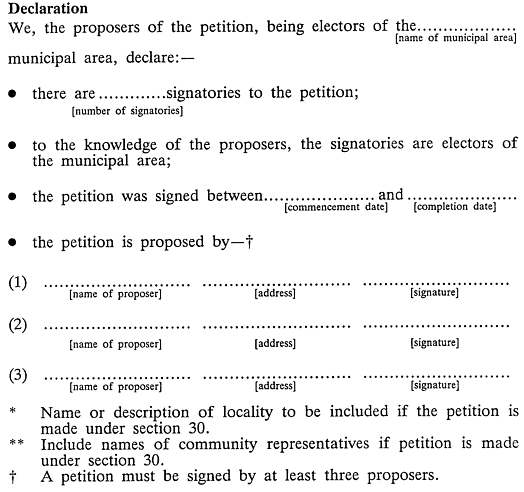
For the purposes of sections 8(2) , 30(1) , 58(1) and 103(1) of the Act, a petition is to be in accordance with Form 1 of Schedule 1 .
27. Certificate of council's power
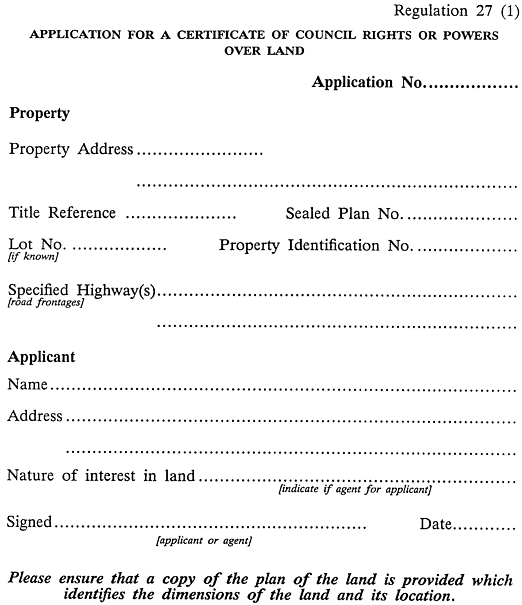
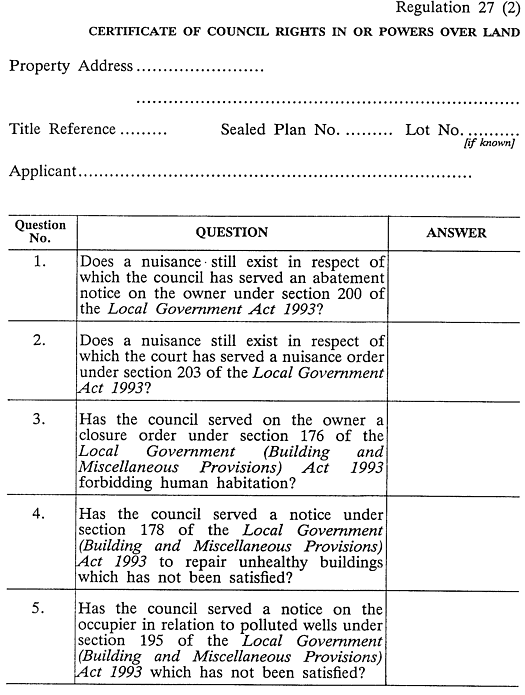
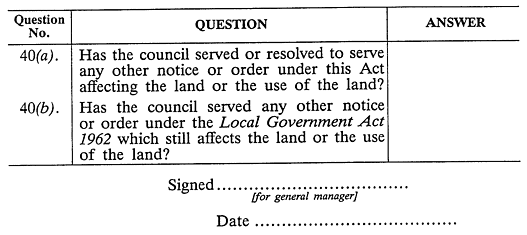
(1) An application under section 337 of the Act for a certificate stating the council's rights in, or powers over, specific land is to be in accordance with Form 2 in Schedule 1 .(2) A certificate of council's rights in, or powers over, specified land is to be in accordance with Form 3 of Schedule 1 .
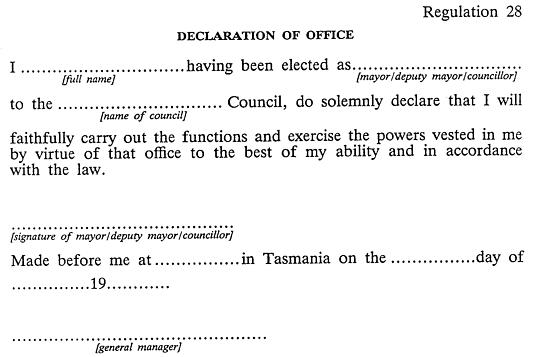
(1) For the purposes of section 321 of the Act, the declaration of office is to be in accordance with Form 4 in Schedule 1 .(2) A councillor is to read aloud the declaration in the presence of the general manager and sign the declaration.(3) The general manager is to sign the declaration as witness.
Division 2 - Allowances and fees
29. Allowances for elected members
(1) The maximum allowances payable to a mayor, deputy mayor or councillor are as follows:
No. of electors in municipal area
Councillor
Mayor
Deputy Mayor
$
$
$
less than 10 000
4 000
10 000
4 000
10 000 – 20 000
6 000
20 000
6 000
more than 20 000
8 000
42 000
10 000
(2) An allowance payable to a mayor or deputy mayor is additional to the allowance payable to a councillor.
The fees specified in Schedule 2 are the fees payable in respect of the matters mentioned in that Schedule.
PART 4 - Miscellaneous[Part 4 Inserted by S.R. 1994, No. 85, Applied:23 Jun 1994]
[Regulation 31 Substituted by S.R. 1994, No. 85, Applied:23 Jun 1994] For the purposes of section 93 of the Act, the following are prescribed services:(a) combined sewage and stormwater removal;(b) [Regulation 31 Amended by S.R. 1994, No. 125, Applied:31 Aug 1994] any fire protection service;(c) [Regulation 31 Amended by S.R. 1994, No. 125, Applied:31 Aug 1994] stormwater removal.
32. Fees and charges for prescribed matters
[Regulation 32 Inserted by S.R. 1994, No. 100, Applied:30 Jun 1994] The following are matters in respect of which a council may impose fees and charges:(a) water supply;(b) sewage removal;(c) nightsoil removal;(d) garbage removal;(e) combined sewage and stormwater removal;(f) any fire protection service.
SCHEDULE 1 - Forms
Form 1 - Petitions

Form 2
Form 3
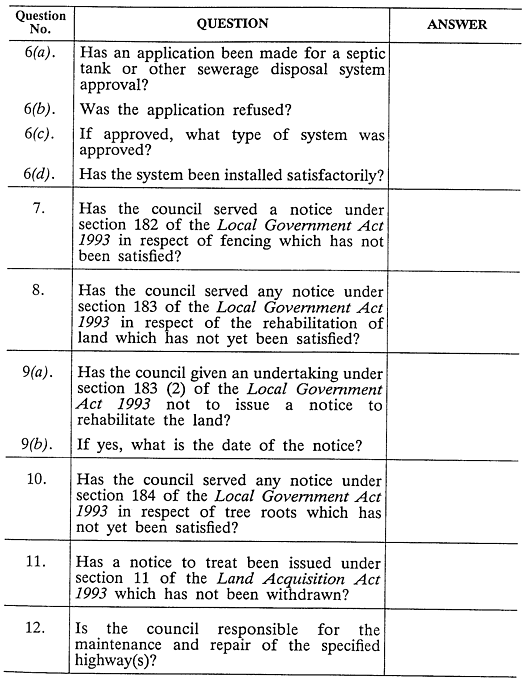
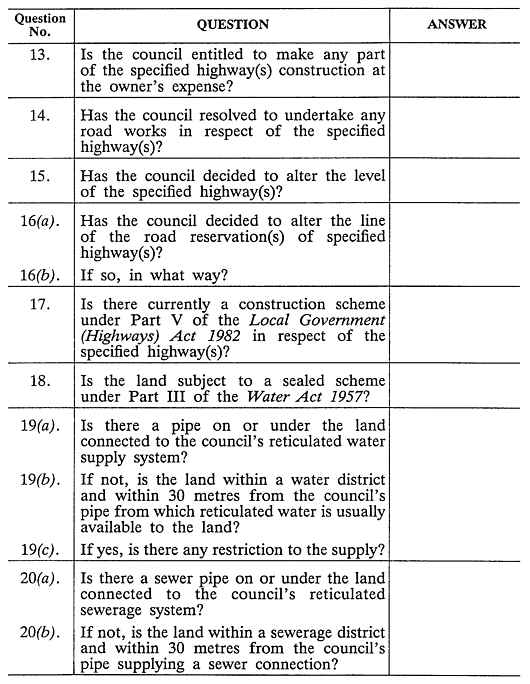
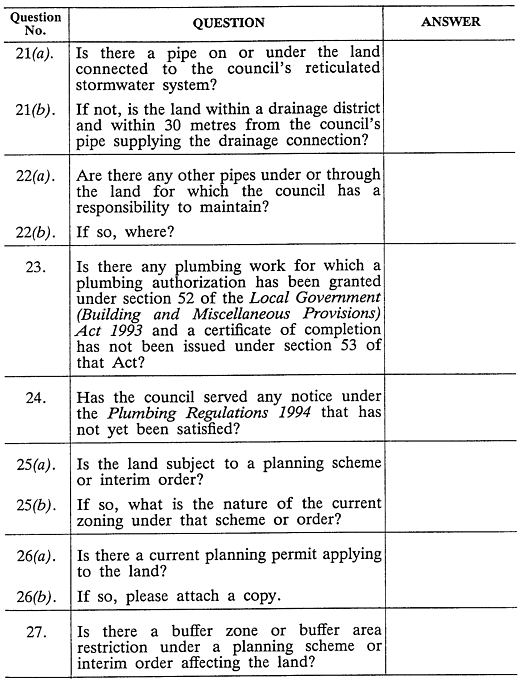
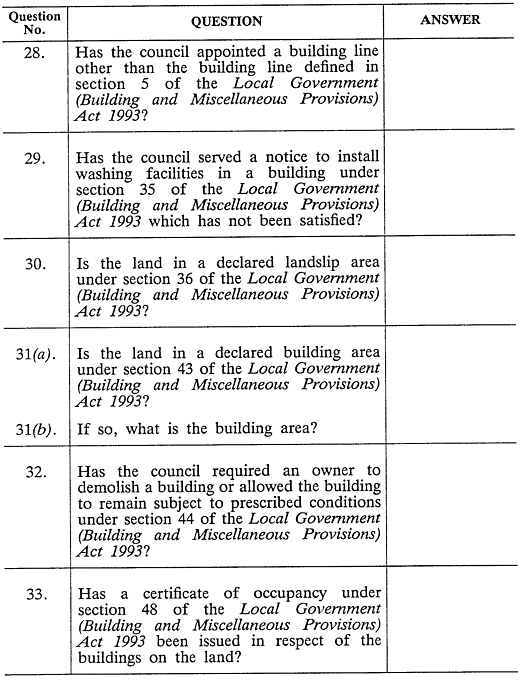
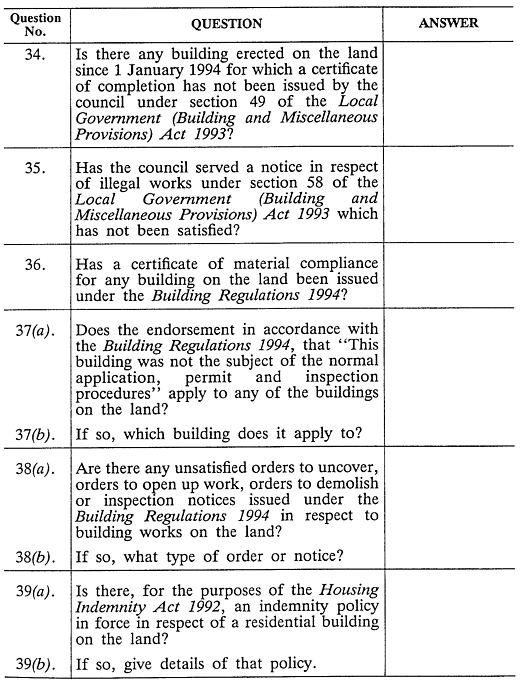
Form 4
SCHEDULE 2 - Fees
1. | Application for certificate of council's rights in and powers over land under section 337 of the Act | $50 | 2. | Application for a certificate of liabilities under section 132 of the Act | $15 | 3. | Copy of extract from the agenda of a meeting of a council | $2 plus 50¢ each page | 4. | Inspection of the minutes of a meeting of a council | $2 | 5. | Copy of extract from the agenda of a meeting of a council | $2 plus 20¢ each page | 6. | Copy of the annual report of a council | $2 |
SCHEDULE 3[Schedule 3 Rescinded by S.R. 1994, No. 85, Applied:23 Jun 1994] . . . . . . . .
Displayed and numbered in accordance with the Rules Publication Act 1953.
Notified in the Gazette on 23 February 1994
These regulations are administered in the Department of Environment and Land Management.