

Local Government Act 1993
An Act to provide for local government and establish councils to plan for, develop and manage municipal areas in the interests of their communities
Be it enacted by His Excellency the Governor of Tasmania, by and with the advice and consent of the Legislative Council and House of Assembly, in Parliament assembled, as follows:
PART 1 - Preliminary
This Act may be cited as the Local Government Act 1993 .
This Act commences on a day or days to be proclaimed.
[Section 3 Amended by No. 59 of 1996, s. 3 ]In this Act, unless the contrary intention appears –[Section 3 Amended by No. 47 of 2017, s. 4, Applied:22 Nov 2017][Section 3 Amended by No. 47 of 2017, s. 4, Applied:22 Nov 2017] absolute majority means –[Section 3 Amended by No. 8 of 2005, s. 4, Applied:01 Jul 2005] [Section 3 Amended by No. 18 of 2021, s. 243, Applied:05 Nov 2021](a) if no councillors are suspended, more than half of the number of councillors to be elected to a council; or(b) if one or more councillors are suspended, more than half of the number of councillors to be elected to a council after subtracting the number of councillors who are suspended;[Section 3 Amended by No. 18 of 2021, s. 243, Applied:05 Nov 2021] Appeal Tribunal means the Tasmanian Civil and Administrative Tribunal;[Section 3 Amended by No. 52 of 2013, s. 9, Applied:19 Nov 2013] approved means approved by the Tasmanian Electoral Commission;[Section 3 Amended by No. 41 of 1998, s. 4, Applied:18 Dec 1998] [Section 3 Amended by No. 34 of 1999, s. 4, Applied:30 Jun 1999] [Section 3 Amended by No. 8 of 2005, s. 4, Applied:01 Jul 2005] assets, for the purpose of Parts 3 and 12A and section 226A , includes –(a) any real or personal property; and(b) any estates or interests in any real or personal property; and(c) any rights, obligations or liabilities;[Section 3 Amended by No. 47 of 2017, s. 4, Applied:22 Nov 2017] audit panel means the audit panel established under section 85 ;[Section 3 Amended by No. 8 of 2005, s. 4, Applied:01 Jul 2005] authorised person means a person authorised under section 20A ;[Section 3 Amended by No. 52 of 2013, s. 9, Applied:19 Nov 2013] ballot material means –(a) a ballot paper; and(b) instructions for the completion of the ballot paper and the manner in which the ballot paper is to be returned; and(c) the envelope or envelopes to be used for the return of the ballot paper; and(d) statements of candidates;[Section 3 Amended by No. 8 of 2005, s. 4, Applied:01 Jul 2005] Board means the Local Government Board established under section 210 ;Board of Inquiry means a Board of Inquiry established under section 215 ;by-election means a by-election held under Division 9 of Part 15 ;by-laws means by-laws made by a council under Part 11 ;[Section 3 Amended by No. 8 of 2005, s. 4, Applied:01 Jul 2005] candidate means a person whose nomination for an election under Part 15 has been accepted under section 272 ;certificate of election means a certificate issued under section 304 ;[Section 3 Amended by No. 8 of 2005, s. 4, Applied:01 Jul 2005] chief executive officer means, in relation to a single authority or joint authority, the person responsible for the administration and operation of that authority;close associate means a person referred to in section 51 ;[Section 3 Amended by No. 52 of 2013, s. 9, Applied:19 Nov 2013] closing day means the day referred to in section 268A ;[Section 3 Amended by No. 29 of 2015, s. 4, Applied:13 Apr 2016] code of conduct means the model code of conduct as adopted by a council under section 28T , as amended or substituted from time to time under that section;[Section 3 Amended by No. 29 of 2015, s. 4, Applied:13 Apr 2016] code of conduct complaint means a complaint made under section 28V and, where appropriate, includes a part of such a complaint;[Section 3 Amended by No. 8 of 2005, s. 4, Applied:01 Jul 2005] [Section 3 Amended by No. 29 of 2015, s. 4, Applied:13 Apr 2016] Code of Conduct Panel means the Code of Conduct Panel established under section 28K ;community means the community of a municipal area;[Section 3 Amended by No. 34 of 1999, s. 4, Applied:30 Jun 1999] competitive neutrality principles means the national competition policy competitive neutrality principles referred to in clause 3 of the Competition Principles Agreement made between the Commonwealth, the States and the Territories;[Section 3 Amended by No. 34 of 1999, s. 4, Applied:30 Jun 1999] controlling authority means an authority established under section 29 ;council means a council established under section 18 ;council committee means a council committee established under section 23 ;councillor means a person elected to a council and includes the Lord Mayor, Deputy Lord Mayor, mayor, deputy mayor and alderman;[Section 3 Amended by No. 52 of 2013, s. 9, Applied:19 Nov 2013] declaration of a poll means a declaration under section 303 ;[Section 3 Amended by No. 8 of 2005, s. 4, Applied:01 Jul 2005]deputy mayor includes the Deputy Lord Mayor;Director means the Director of Local Government appointed under section 334 ;[Section 3 Amended by No. 72 of 2007, Sched. 1, Applied:28 Apr 2008] Director, MPES means the Director, Monetary Penalties Enforcement Service appointed under section 8 of the Monetary Penalties Enforcement Act 2005 ;[Section 3 Amended by No. 52 of 2013, s. 9, Applied:19 Nov 2013] election agent means a person authorised by the candidate to act as his or her agent in connection with the candidate's campaign for election;elector means a person entitled to vote in an election or by-election under Part 15 ;elector poll means a poll conducted under Part 6 ;[Section 3 Amended by No. 8 of 2005, s. 4, Applied:01 Jul 2005] [Section 3 Amended by No. 52 of 2013, s. 9, Applied:19 Nov 2013] electoral advertising means any advertising, by any of the following means, that is directly or indirectly in respect of a campaign for election by a candidate or intending candidate:(a) any notice, sign or poster;(b) any pamphlet or handbill;(c) any "how-to-vote" card;(d) any print medium;(e) any broadcast by radio or television;(f) [Section 3 Amended by No. 47 of 2017, s. 44, Applied:01 Aug 2018] on the internet;[Section 3 Amended by No. 52 of 2013, s. 9, Applied:19 Nov 2013] electoral area means the municipal area or electoral district in which an election is to be held;[Section 3 Amended by No. 8 of 2005, s. 4, Applied:01 Jul 2005] Electoral Commissioner means the person holding that office under the Electoral Act 2004 ;electoral district means an electoral district referred to in section 17 ;[Section 3 Amended by No. 52 of 2013, s. 9, Applied:19 Nov 2013] electoral material means –(a) ballot papers; and(b) declarations under section 284 ;[Section 3 Amended by No. 52 of 2013, s. 9, Applied:19 Nov 2013] electoral officer means a person appointed as such under section 265 ;[Section 3 Amended by No. 52 of 2013, s. 9, Applied:19 Nov 2013] electoral officer in charge means an electoral officer appointed under section 265(2) to be in charge of an issuing place;[Section 3 Amended by No. 52 of 2013, s. 9, Applied:19 Nov 2013] electoral roll means a roll kept under section 258 ;[Section 3 Amended by No. 29 of 2015, s. 4, Applied:13 Apr 2016] Executive Officer means the Executive Officer appointed under section 28M ;financial year means a period of 12 months starting on 1 July in one year and ending on 30 June in the next year;[Section 3 Amended by No. 52 of 2013, s. 9, Applied:19 Nov 2013] general manager means the person appointed as such under section 61 and, in Part 15 , includes a person nominated under section 253A ;[Section 3 Amended by No. 21 of 2000, s. 20, Applied:01 Jul 2000] GST law has the same meaning as in the A New Tax System (Goods and Services Tax) Act 1999 of the Commonwealth;[Section 3 Amended by No. 8 of 2005, s. 4, Applied:01 Jul 2005] intending candidate means a person who has publicly declared the intention to nominate for an election under Part 15 ;[Section 3 Amended by No. 52 of 2013, s. 9, Applied:19 Nov 2013] issuing place means a place appointed under section 263 ;[Section 3 Amended by No. 34 of 1999, s. 4, Applied:30 Jun 1999] joint authority means an authority established under section 30 ;[Section 3 Amended by No. 66 of 2007, Sched. 1, Applied:31 Dec 2008] legal practitioner means an Australian legal practitioner;[Section 3 Amended by No. 52 of 2013, s. 9, Applied:19 Nov 2013] list of electors means the list prepared under section 261 ;[Section 3 Amended by No. 34 of 1999, s. 4, Applied:30 Jun 1999]mayor includes the Lord Mayor;[Section 3 Amended by No. 34 of 1999, s. 4, Applied:30 Jun 1999] member means –(a) a member of a special committee or a controlling authority; and(b) a person representing a single authority council or a joint authority council on a single authority or a joint authority; and(c) a member of the board of management of a single authority or a joint authority;[Section 3 Amended by No. 29 of 2015, s. 4, Applied:13 Apr 2016] model code of conduct means a model code of conduct made by the Minister under section 28R , as amended or substituted under that section from time to time;[Section 3 Amended by No. 52 of 2013, s. 9, Applied:19 Nov 2013] municipal area means an area referred to in section 16 and, in Part 15 , includes a proposed municipal area;[Section 3 Amended by No. 52 of 2013, s. 9, Applied:19 Nov 2013] [Section 3 Amended by No. 47 of 2017, s. 4, Applied:22 Nov 2017] nomination period means the period beginning at 9 a.m. on the 8th Monday immediately before the closing day and ending at noon on the 6th Monday immediately before the closing day;[Section 3 Amended by No. 52 of 2013, s. 9, Applied:19 Nov 2013] notice of election means the notice of election under section 269 ;[Section 3 Amended by No. 8 of 2005, s. 4, Applied:01 Jul 2005] ordinary election means an election under Part 15 that is not a by-election;[Section 3 Amended by No. 34 of 1999, s. 4, Applied:30 Jun 1999] participating council means a council that, together with one or more councils, establishes a joint authority;[Section 3 Amended by No. 8 of 2005, s. 4, Applied:01 Jul 2005] partner means a partner within the meaning of the Relationships Act 2003 ;[Section 3 Amended by No. 47 of 2017, s. 4, Applied:22 Nov 2017] performance improvement direction means a direction issued to a council or councillor under section 214M ;[Section 3 Amended by No. 52 of 2013, s. 9, Applied:19 Nov 2013] polling period means a period of at least 10 days, excluding any Saturday, Sunday or statutory holiday as defined in the Statutory Holidays Act 2000 , ending on closing day;[Section 3 Amended by No. 41 of 1998, s. 4, Applied:18 Dec 1998] [Section 3 Amended by No. 8 of 2005, s. 4, Applied:01 Jul 2005] proposed municipal area means a municipal area that is to come into existence as a result of an order under section 214E ;[Section 3 Amended by No. 8 of 2005, s. 4, Applied:01 Jul 2005][Section 3 Amended by No. 8 of 2005, s. 4, Applied:01 Jul 2005] public land means public land as specified in section 177A(1) ;[Section 3 Amended by No. 8 of 2005, s. 4, Applied:01 Jul 2005] public office means –(a) in the case of a municipal area, the place at which a council carries on its administrative activities; or(b) in the case of a proposed municipal area, the place at which a council or councils of that proposed municipal area carry out their administrative activities;rateable land means land in respect of which rates are payable;rates notice means a notice referred to in section 122 ;[Section 3 Amended by No. 7 of 2011, s. 4, Applied:06 Jun 2011] regulations means the regulations made under this Act;[Section 3 Amended by No. 8 of 2005, s. 4, Applied:01 Jul 2005] relevant period means the period starting on the 30th day before the date of notice of election and ending at the end of the polling period;[Section 3 Amended by No. 52 of 2013, s. 9, Applied:19 Nov 2013] returning officer means a person appointed as such under section 264 ;[Section 3 Amended by No. 8 of 2005, s. 4, Applied:01 Jul 2005] review means a review carried out by the Board under Part 12A ;[Section 3 Amended by No. 52 of 2013, s. 9, Applied:19 Nov 2013] roll closure day means the day on which the electoral roll for an electoral area is closed under section 260 ;[Section 3 Amended by No. 52 of 2013, s. 9, Applied:19 Nov 2013] scrutineer means a person appointed as such under section 292 ;simple majority means the majority of councillors of a council present and able to vote at a meeting of the council or council committee;[Section 3 Amended by No. 34 of 1999, s. 4, Applied:30 Jun 1999] single authority means an authority established under section 30 ;[Section 3 Amended by No. 34 of 1999, s. 4, Applied:30 Jun 1999] single authority council means a council that establishes a single authority;special committee means a special committee established under section 24 ;[Section 3 Amended by No. 29 of 2015, s. 4, Applied:13 Apr 2016][Section 3 Amended by No. 19 of 2013, s. 4, Applied:20 Jun 2013] Tasmanian Electoral Commission means the Tasmanian Electoral Commission established by section 6 of the Electoral Act 2004 ;[Section 3 Amended by No. 8 of 2005, s. 4, Applied:01 Jul 2005] vehicle means a vehicle within the meaning of the Traffic Act 1925 and a bicycle;[Section 3 Amended by No. 8 of 2005, s. 4, Applied:01 Jul 2005] [Section 3 Amended by No. 52 of 2008, Sched. 1, Applied:01 Jul 2009] [Section 3 Amended by No. 8 of 2005, s. 4, Applied:01 Jul 2005] [Section 3 Amended by No. 52 of 2008, Sched. 1, Applied:01 Jul 2009] [Section 3 Amended by No. 8 of 2005, s. 4, Applied:01 Jul 2005] [Section 3 Amended by No. 52 of 2008, Sched. 1, Applied:01 Jul 2009] [Section 3 Amended by No. 8 of 2005, s. 4, Applied:01 Jul 2005] [Section 3 Amended by No. 52 of 2008, Sched. 1, Applied:01 Jul 2009] [Section 3 Amended by No. 8 of 2005, s. 4, Applied:01 Jul 2005] [Section 3 Amended by No. 52 of 2008, Sched. 1, Applied:01 Jul 2009]
PART 2 - . . . . . . . .[Part 2 Repealed by No. 8 of 2005, s. 5, Applied:01 Jul 2005]
Division 1 - . . . . . . . .[Division 1 of Part 2 Repealed by No. 8 of 2005, s. 5, Applied:01 Jul 2005] [Section 4 Subsection (2) amended by No. 88 of 1995, s. 4 ][Section 4 Subsection (2) amended by S.R. 2002, No. 136, Applied:04 Dec 2002] [Section 4 Subsection (5) omitted by No. 38 of 2000, s. 4, Applied:14 Jul 2000] [Section 4 Repealed by No. 8 of 2005, s. 5, Applied:01 Jul 2005] . . . . . . . . [Section 5 Repealed by No. 8 of 2005, s. 5, Applied:01 Jul 2005] . . . . . . . . [Section 6 Substituted by No. 86 of 2000, Sched. 1, Applied:01 May 2001] [Section 6 Repealed by No. 8 of 2005, s. 5, Applied:01 Jul 2005] . . . . . . . . [Section 7 Repealed by No. 8 of 2005, s. 5, Applied:01 Jul 2005] . . . . . . . .
Division 2 - . . . . . . . .[Division 2 of Part 2 Heading amended by No. 38 of 2000, s. 5, Applied:14 Jul 2000] [Division 2 of Part 2 Repealed by No. 8 of 2005, s. 5, Applied:01 Jul 2005] [Section 8 Subsection (1) amended by No. 38 of 2000, s. 6, Applied:14 Jul 2000] [Section 8 Repealed by No. 8 of 2005, s. 5, Applied:01 Jul 2005] . . . . . . . . [Section 9 Subsection (1) amended by No. 38 of 2000, s. 7, Applied:14 Jul 2000] [Section 9 Subsection (1) amended by No. 41 of 1998, s. 5, Applied:18 Dec 1998] [Section 9 Subsection (1) amended by No. 38 of 2000, s. 7, Applied:14 Jul 2000] [Section 9 Repealed by No. 8 of 2005, s. 5, Applied:01 Jul 2005] . . . . . . . . [Section 10 Subsection (2A) inserted by No. 38 of 2000, s. 8, Applied:14 Jul 2000] [Section 10 Subsection (3) substituted by No. 71 of 1995, s. 3 and Sched. 1 ][Section 10 Repealed by No. 8 of 2005, s. 5, Applied:01 Jul 2005] . . . . . . . . [Section 11 Subsection (6) inserted by No. 38 of 2000, s. 9, Applied:14 Jul 2000] [Section 11 Repealed by No. 8 of 2005, s. 5, Applied:01 Jul 2005] . . . . . . . . [Section 12 Subsection (1) amended by No. 88 of 1995, s. 5 ][Section 12 Subsection (1) amended by No. 41 of 1998, s. 6, Applied:18 Dec 1998] [Section 12 Subsection (1) amended by No. 34 of 1999, s. 5, Applied:30 Jun 1999] [Section 12 Subsection (1) amended by No. 38 of 2000, s. 10, Applied:14 Jul 2000] [Section 12 Subsection (2) substituted by No. 41 of 1998, s. 6, Applied:18 Dec 1998] [Section 12 Subsection (4) amended by No. 34 of 1999, s. 5, Applied:30 Jun 1999] [Section 12 Subsection (4) amended by No. 88 of 1995, s. 5 ][Section 12 Subsection (5) inserted by No. 41 of 1998, s. 6, Applied:18 Dec 1998] [Section 12 Repealed by No. 8 of 2005, s. 5, Applied:01 Jul 2005] . . . . . . . . [Section 13 Substituted by No. 41 of 1998, s. 7, Applied:18 Dec 1998] [Section 13 Repealed by No. 8 of 2005, s. 5, Applied:01 Jul 2005] . . . . . . . . [Section 14 Subsection (1) amended by No. 41 of 1998, s. 8, Applied:18 Dec 1998] [Section 14 Repealed by No. 8 of 2005, s. 5, Applied:01 Jul 2005] . . . . . . . . [Section 15 Subsection (1) amended by No. 41 of 1998, s. 9, Applied:18 Dec 1998] [Section 15 Repealed by No. 8 of 2005, s. 5, Applied:01 Jul 2005] . . . . . . . .
Division 3 - . . . . . . . .[Division 3 of Part 2 Repealed by No. 8 of 2005, s. 5, Applied:01 Jul 2005] [Section 15A of Part 2 Inserted by No. 38 of 2000, s. 11, Applied:14 Jul 2000] [Section 15A Repealed by No. 8 of 2005, s. 5, Applied:01 Jul 2005] . . . . . . . . [Section 15B of Part 2 Inserted by No. 38 of 2000, s. 11, Applied:14 Jul 2000] [Section 15B Repealed by No. 8 of 2005, s. 5, Applied:01 Jul 2005] . . . . . . . . [Section 15C of Part 2 Inserted by No. 38 of 2000, s. 11, Applied:14 Jul 2000] [Section 15C Repealed by No. 8 of 2005, s. 5, Applied:01 Jul 2005] . . . . . . . .
PART 3 - Local Government
Division 1 - Municipal areas and electoral districts
(1) The State is divided into municipal areas.(2) [Section 16 Subsection (2) substituted by No. 41 of 1998, s. 10, Applied:18 Dec 1998] A municipal area is an area specified in Column 1 of Schedule 3 .(3) A municipal area includes –(a) any accretion from the sea adjoining it; and(b) [Section 16 Subsection (3) amended by No. 19 of 2017, s. 4, Applied:23 Jun 2017] any part of the sea-shore to the low-water mark adjoining it; and(c) [Section 16 Subsection (3) amended by No. 19 of 2017, s. 4, Applied:23 Jun 2017] any bridge, jetty, wharf, boat-house, or other structure, that –and any area of land, adjoining the bridge, jetty, wharf, boat-house, or other structure, over which has been granted a right to occupation of the seabed, which right is necessary to enable the use of the bridge, jetty, wharf, boat-house, or other structure.(i) adjoins the municipal area; or(ii) is situated partly within a municipal area and partly on or over an area of the seabed that is adjacent to the municipal area –(4) [Section 16 Subsection (4) amended by No. 8 of 2005, s. 6, Applied:01 Jul 2005] [Section 16 Subsection (4) substituted by No. 41 of 1998, s. 10, Applied:18 Dec 1998] [Section 16 Subsection (4) substituted by No. 47 of 2017, s. 5, Applied:22 Nov 2017] The Minister, on receiving a report on a review made under section 214D that recommends an adjustment of the boundary of a municipal area or the boundary of an electoral district within a municipal area, regardless of whether the adjustment is minor or significant in nature, may recommend to the Governor that an order be made so adjusting that boundary.(4A) [Section 16 Subsection (4A) inserted by No. 47 of 2017, s. 5, Applied:22 Nov 2017] The Minister –may recommend to the Governor that an order be made so adjusting that boundary.(a) on receiving –a recommendation that an adjustment, that is minor in nature, be made to the boundary of a municipal area, or the boundary of an electoral district within a municipal area; and(i) from the Board, made otherwise than in a report on a review made under section 214D ; or(ii) from the Director –(b) if satisfied that all owners of land who would be affected by the adjustment have been consulted by the relevant councils and have consented, in writing, to the adjustment –(5) [Section 16 Subsection (5) substituted by No. 41 of 1998, s. 10, Applied:18 Dec 1998] [Section 16 Subsection (5) substituted by No. 47 of 2017, s. 5, Applied:22 Nov 2017] The Governor, by order and on the recommendation of the Minister under subsection (4) or (4A) , may do one or both of the following:(a) adjust a boundary of a municipal area;(b) if the municipal area is divided into electoral districts, adjust any boundary of any electoral district as may be necessary.(5AA) [Section 16 Subsection (5AA) inserted by No. 34 of 2018, s. 4, Applied:10 Dec 2018] The Governor, by order, may amend or substitute any item in column 1 of Schedule 3 or substitute that Schedule so as to give effect to an order made under subsection (5) .(5A) [Section 16 Subsection (5A) inserted by No. 41 of 1998, s. 10, Applied:18 Dec 1998] A council affected by an adjustment under subsection (5) is to pay the costs associated with that adjustment.(5B) [Section 16 Subsection (5B) inserted by No. 41 of 1998, s. 10, Applied:18 Dec 1998] Each municipal area is defined by reference to the relevant plan or plans specified in Column 1 of Schedule 3.(6) [Section 16 Subsection (6) amended by No. 8 of 2005, s. 6, Applied:01 Jul 2005] [Section 16 Subsection (6) amended by No. 41 of 1998, s. 10, Applied:18 Dec 1998] The Governor, on the recommendation of the Minister, may amend or substitute any item in column 1 of Schedule 3 or substitute that Schedule in an order made under section 214E relating to municipal areas to give effect to that order.
[Section 16A Inserted by No. 34 of 1999, s. 6, Applied:30 Jun 1999](1) A city is an area specified in column 1 of Schedule 3B .(2) The name of each city is specified in column 2 of Schedule 3B .(3) A city is defined by reference to the relevant plan specified in column 3 of Schedule 3B .(4) [Section 16A Subsection (4) amended by No. 8 of 2005, s. 7, Applied:01 Jul 2005] The Governor, on the recommendation of the Minister, may amend or substitute any item in column 1, 2 or 3 of Schedule 3B or substitute that Schedule in an order made under section 214E relating to cities to give effect to that order.
(1) A municipal area may be divided into 2 or more electoral districts.(2) The name of each electoral district of a municipal area is specified in column 4 of Schedule 3 .(3) [Section 17 Subsection (3) amended by No. 8 of 2005, s. 8, Applied:01 Jul 2005] The Governor, on the recommendation of the Minister, may amend, substitute or delete any item in column 4 or 5 of Schedule 3 in an order made under section 214E relating to electoral districts to give effect to that order.
Division 2 - Councils
(1) There is established in each municipal area a council.(2) The name of each council in a municipal area is specified in column 2 of Schedule 3 next to the name of that municipal area.(3) [Section 18 Subsection (3) substituted by No. 8 of 2005, s. 9, Applied:01 Jul 2005] A meeting of a council is to be conducted in accordance with prescribed procedures.(4) [Section 18 Subsection (4) amended by No. 8 of 2005, s. 9, Applied:01 Jul 2005] [Section 18 Subsection (4) amended by No. 34 of 1999, s. 7, Applied:30 Jun 1999] The Governor, on the recommendation of the Minister, may amend or substitute column 2 of Schedule 3 or substitute that Schedule in an order made under section 214E relating to councils to give effect to that order.
(1) A council is a body corporate with perpetual succession and a common seal.(2) The corporate name of a council –(a) [Section 19 Subsection (2) amended by No. 34 of 1999, s. 8, Applied:30 Jun 1999] in a municipal area in which there is a city, is to contain the name of the city or the name of the municipal area; or(b) in a municipal area which is not a city, is to contain the name of the municipal area.(3) The common seal is to be kept and used as authorized by the council.(4) [Section 19 Subsection (4) omitted by No. 8 of 2005, s. 10, Applied:01 Jul 2005] . . . . . . . .(5) The execution of a document sealed by a council is to be attested by such persons as the council determines.(6) [Section 19 Subsection (6) amended by No. 8 of 2005, s. 10, Applied:01 Jul 2005] All courts and persons acting judicially must take judicial notice of the common seal on a document and presume that it was duly sealed by a council.
[Section 20 Subsection (1) amended by No. 38 of 2000, s. 12, Applied:14 Jul 2000] [Section 20 Subsection (3) substituted by No. 34 of 1999, s. 9, Applied:30 Jun 1999] [Section 20 Substituted by No. 8 of 2005, s. 11, Applied:01 Jul 2005](1) In addition to any functions of a council in this or any other Act, a council has the following functions:(a) to provide for the health, safety and welfare of the community;(b) to represent and promote the interests of the community;(c) to provide for the peace, order and good government of the municipal area.(2) In performing its functions, a council is to consult, involve and be accountable to the community.(3) A council may do anything necessary or convenient to perform its functions either within or outside its municipal area.(4) A council may transfer to a single authority or a joint authority –(a) any of its assets and liabilities on any condition it determines; or(b) any of its employees.(5) A council may –(a) acquire, hold, dispose of and otherwise deal with property; and(b) sue and be sued in its corporate name.
[Section 20A Inserted by No. 34 of 1999, s. 10, Applied:30 Jun 1999] [Section 20A Substituted by No. 8 of 2005, s. 11, Applied:01 Jul 2005](1) In order that a council may perform its functions or exercise its powers under this or any other Act, the general manager may authorise a person to enter land for a specific purpose or in general.(2) An authorised person need not be an employee of a council.(3) The general manager must give notice to the owner or occupier of the land before entry is made under subsection (1) unless –(a) an emergency exists; or(b) the entry is in relation to an application by the owner or occupier for a licence, permit or other approval given by the council; or(c) notice would defeat the purpose of the entry.(4) A person entering land under this section is to produce the identity card issued to that person under section 20B .(5) The general manager may revoke an authority under this section.
[Section 20B Inserted by No. 8 of 2005, s. 11, Applied:01 Jul 2005](1) The general manager is to ensure that a person authorised to enter land pursuant to section 20A is issued with an identity card.(2) An identity card is to –(a) specify the name of the person; and(b) contain a recent photograph of the person; and(c) specify the date of issue; and(d) specify the council or agent of the council that employs the person.(3) A person whose authority is revoked under section 20A(5) must return his or her identity card to the general manager within 3 days of the revocation.Penalty: Fine not exceeding 10 penalty units.
(1) In carrying out any of its functions, a council may –(a) [Section 21 Subsection (1) amended by No. 34 of 1999, s. 11, Applied:30 Jun 1999] form or participate in the formation and operation of a corporation, trust, partnership or other body; and(b) subscribe for, or otherwise acquire and dispose of, shares in or debentures or other securities of a corporation; and(c) become a member of a company limited by guarantee; and(d) subscribe for, or otherwise acquire and dispose of, units in a trust; and(e) acquire and dispose of an interest in a partnership or other body; and(f) enter into partnership or into any arrangement for sharing of profits, union of interest, cooperation, joint venture, reciprocal concession or otherwise, with any person carrying on, or engaged in, or about to carry on or engage in, any business or transaction capable of being conducted so as to directly or indirectly benefit the community; and(g) undertake a project or activity not directly authorized by this or another Act for the purpose of raising revenue.(1A) [Section 21 Subsection (1A) inserted by No. 8 of 2005, s. 12, Applied:01 Jul 2005] A motion by a council to exercise any of its powers under subsection (1) must be accompanied by a statement of the objectives of the exercise of that power.(2) A council must obtain the approval of the Minister before exercising any of its powers under subsection (1) if the exercise of that power would –(a) involve an expenditure of at least $250 000 or 5% or more of its general rates revenue for the previous financial year, whichever is the greater; or(b) extend the council's expenditure required to service its total borrowings to an amount in excess of 30% of its revenue other than grants made to the council for the previous financial year.(3) Before giving an approval, the Minister may require a council to –(a) invite submissions from the public or conduct an elector poll in relation to the proposed exercise of any power; and(b) consider any submissions and the result of an elector poll; and(c) provide any further information the Minister requires.(4) [Section 21 Subsection (4) inserted by No. 34 of 1999, s. 11, Applied:30 Jun 1999] A council may exercise any power under subsection (1) outside the boundaries of its municipal area if that exercise is consistent with the competitive neutrality principles.(5) [Section 21 Subsection (5) inserted by No. 8 of 2005, s. 12, Applied:01 Jul 2005] The general manager is to report to the council –(a) at least once every 3 months in respect of the performance of any activities carried out pursuant to subsection (1) and any strategic issues related to those activities; and(b) any adverse developments that significantly affect or are likely to significantly affect the financial viability, the operating viability or any other aspect of any of those activities.
(1) [Section 22 Subsection (1) amended by No. 8 of 2005, s. 13, Applied:01 Jul 2005] [Section 22 Subsection (1) amended by No. 34 of 1999, s. 12, Applied:30 Jun 1999] Subject to subsection (2) , a council, in writing, may delegate with or without conditions to the general manager, controlling authority, a council committee or a special committee, any of its functions or powers under this or any other Act, other than–(a) this power of delegation, unless authorized by the council; and(b) [Section 22 Subsection (1) amended by No. 34 of 1999, s. 12, Applied:30 Jun 1999] the powers referred to in subsection (3) .(2) A council, in writing, may delegate any of the following powers only to the general manager or a council committee and only on condition that the council has determined appropriate policies and procedures to be followed in relation to those powers:(a) [Section 22 Subsection (2) amended by No. 34 of 1999, s. 12, Applied:30 Jun 1999] the collection of rates and charges under Part 9 ;(ab) [Section 22 Subsection (2) amended by No. 8 of 2005, s. 13, Applied:01 Jul 2005] the postponement of rates and charges;(b) the remission or rebate of rates and charges;(ba) [Section 22 Subsection (2) amended by No. 38 of 2000, s. 13, Applied:14 Jul 2000] the writing off of any debts owed to the council;(c) the making of grants or the provision of benefits.(3) A council must not delegate any of its powers relating to the following:(a) the borrowing of money or other financial accommodation;(b) [Section 22 Subsection (3) amended by No. 34 of 1999, s. 12, Applied:30 Jun 1999] the determination of the categories of expenses payable to councillors and any member of any committee;(c) [Section 22 Subsection (3) amended by No. 8 of 2005, s. 13, Applied:01 Jul 2005] the establishment of council committees, special committees, controlling authorities, single authorities or joint authorities;(d) the revision of the budget or financial estimates of the council;(e) [Section 22 Subsection (3) amended by No. 8 of 2005, s. 13, Applied:01 Jul 2005] the revision of the strategic plan and the annual plan of the council;(f) [Section 22 Subsection (3) amended by No. 8 of 2005, s. 13, Applied:01 Jul 2005] the appointment of the general manager;(fa) [Section 22 Subsection (3) amended by No. 8 of 2005, s. 13, Applied:01 Jul 2005] the sale, donation, exchange or other disposal of land or public land;(fb) [Section 22 Subsection (3) amended by No. 8 of 2005, s. 13, Applied:01 Jul 2005] the decision to exercise any power under section 21(1) ;(g) the making of by-laws;(h) [Section 22 Subsection (3) amended by No. 34 of 1999, s. 12, Applied:30 Jun 1999] the making of rates and charges under Part 9 ;(i) any other prescribed power.(4) The general manager is to –(a) keep a register of any delegation; and(b) make the register available for inspection at a public office.
(1) A council may establish, on such terms as it thinks fit, council committees to assist it in carrying out its functions under this or any other Act.(2) [Section 23 Subsection (2) amended by No. 8 of 2005, s. 14, Applied:01 Jul 2005] A council committee consists of councillors appointed by the council and any councillor who fills a vacancy for a meeting at the request of the council committee.(3) [Section 23 Subsection (3) substituted by No. 8 of 2005, s. 14, Applied:01 Jul 2005] A meeting of a council committee is to be conducted in accordance with prescribed procedures.
(1) A council may establish, on such terms and for such purposes as it thinks fit, special committees.(2) A special committee consists of such persons appointed by the council as the council thinks appropriate.(3) The council is to determine the procedures relating to meetings of a special committee.
Division 3 - Councillors
(1) A council consists of persons elected in accordance with Part 4 .(2) A person elected to a city council is a councillor but may be known as an alderman.(3) The number of councillors for each council is specified in column 3 of Schedule 3 next to the name of that council.(4) [Section 25 Subsection (4) amended by No. 8 of 2005, s. 15, Applied:01 Jul 2005] The Governor, on the recommendation of the Minister, may amend or substitute column 3 of Schedule 3 in an order made under section 214E relating to councils to give effect to that order.(5) Schedule 5 has effect with respect to the office of councillor.
(1) The chairperson of a council is to be known as –(a) [Section 26 Subsection (1) amended by No. 34 of 1999, s. 13, Applied:30 Jun 1999] in the case of the Hobart City Council or its successor, the Lord Mayor; and(b) in the case of any other council, the mayor.(2) The deputy chairperson of the council is to be known as –(a) [Section 26 Subsection (2) amended by No. 34 of 1999, s. 13, Applied:30 Jun 1999] in the case of the Hobart City Council or its successor, the Deputy Lord Mayor; and(b) in the case of any other council, the deputy mayor.
27. Functions of mayors and deputy mayors
(1) [Section 27 Subsection (1) amended by No. 8 of 2005, s. 16, Applied:01 Jul 2005] The functions of a mayor are–(a) [Section 27 Subsection (1) amended by No. 47 of 2017, s. 6, Applied:22 Nov 2017] to act as a leader of the community of the municipal area; and(b) [Section 27 Subsection (1) amended by No. 8 of 2005, s. 16, Applied:01 Jul 2005] [Section 27 Subsection (1) amended by No. 47 of 2017, s. 6, Applied:22 Nov 2017] to carry out the civic and ceremonial functions of the mayoral office; and(c) [Section 27 Subsection (1) amended by No. 47 of 2017, s. 6, Applied:22 Nov 2017] to promote good governance by, and within, the council; and(d) [Section 27 Subsection (1) amended by No. 47 of 2017, s. 6, Applied:22 Nov 2017] to act as chairperson of the council and to chair meetings of the council in a manner that supports decision-making processes; and(e) [Section 27 Subsection (1) amended by No. 47 of 2017, s. 6, Applied:22 Nov 2017] to act as the spokesperson of the council; and(f) [Section 27 Subsection (1) amended by No. 47 of 2017, s. 6, Applied:22 Nov 2017] to represent the council on regional organisations and at intergovernmental forums at regional, state and federal levels; and(g) [Section 27 Subsection (1) amended by No. 47 of 2017, s. 6, Applied:22 Nov 2017] to lead and participate in the appointment, and the monitoring of the performance, of the general manager; and(h) [Section 27 Subsection (1) amended by No. 47 of 2017, s. 6, Applied:22 Nov 2017] to liaise with the general manager on –(i) the activities of the council and the performance and exercise of its functions and powers; and(ii) the activities of the general manager and the performance and exercise of his or her functions and powers in supporting the council; and(i) [Section 27 Subsection (1) amended by No. 47 of 2017, s. 6, Applied:22 Nov 2017] any function imposed by an order under section 27A ; and(j) [Section 27 Subsection (1) amended by No. 47 of 2017, s. 6, Applied:22 Nov 2017] any other function imposed by this or any other Act.(aa) [Section 27 Subsection (1) amended by No. 38 of 2000, s. 14, Applied:14 Jul 2000] [Section 27 Subsection (1) amended by No. 47 of 2017, s. 6, Applied:22 Nov 2017] . . . . . . . .(ba) [Section 27 Subsection (1) amended by No. 8 of 2005, s. 16, Applied:01 Jul 2005] [Section 27 Subsection (1) amended by No. 47 of 2017, s. 6, Applied:22 Nov 2017] . . . . . . . .(1A) [Section 27 Subsection (1A) inserted by No. 8 of 2005, s. 16, Applied:01 Jul 2005] The mayor or deputy mayor is to represent accurately the policies and decisions of the council in performing the functions of mayor or deputy mayor.(2) [Section 27 Subsection (2) amended by No. 38 of 2000, s. 14, Applied:14 Jul 2000] The deputy mayor is to act in the position of mayor and exercise the powers and perform the functions of mayor if–(a) [Section 27 Subsection (2) amended by No. 47 of 2017, s. 6, Applied:22 Nov 2017] the mayor is absent from duty as Mayor or from the State, otherwise unavailable for duty as mayor or unable to perform the functions of mayor; and(b) the mayor or the council, by notice in writing, appoints the deputy mayor to act in the position.(2A) [Section 27 Subsection (2A) inserted by No. 38 of 2000, s. 14, Applied:14 Jul 2000] [Section 27 Subsection (2A) substituted by No. 8 of 2005, s. 16, Applied:01 Jul 2005] The mayor, by notice in writing, may delegate for a specified period –(a) [Section 27 Subsection (2A) amended by No. 47 of 2017, s. 6, Applied:22 Nov 2017] either or both of the functions referred to in subsection (1)(e) and (f) to the deputy mayor, a councillor or the general manager; and(b) [Section 27 Subsection (2A) amended by No. 47 of 2017, s. 6, Applied:22 Nov 2017] any other power or function of the mayor, other than the function referred to in subsection (1)(d) , to the deputy mayor.(3) An appointment under subsection (2) remains in force –(a) for the period specified in the notice; or(b) until sooner revoked.
27A. Order relating to Mayor's functions
[Section 27A Inserted by No. 47 of 2017, s. 7, Applied:22 Nov 2017](1) The Minister, by order, may do any one or more of the following:(a) clarify the functions of mayor;(b) impose on mayors such functions as the Minister considers appropriate.(2) The Minister may amend, revoke, or revoke and substitute an order.(3) Before making, amending or revoking and substituting an order, the Minister must consult with the councils as to the matters the Minister is considering including in the order, the amended order or the substitute order.(4) An order under this section may be combined with an order under one or more of the following sections:(a) section 28AA ;(b) section 62A ;(c) section 62B .(5) Section 47(3) , (3A) , (4) , (5) , (6) and (7) of the Acts Interpretation Act 1931 applies to an order under this section as if the order were regulations within the meaning of that Act.(6) An order under this section is subordinate legislation for the purposes of the Subordinate Legislation Act 1992 .
[Section 28 Substituted by No. 8 of 2005, s. 17, Applied:01 Jul 2005](1) A councillor, in the capacity of an individual councillor, has the following functions:(a) to represent the community;(b) to act in the best interests of the community;(c) to facilitate communication by the council with the community;(d) to participate in the activities of the council;(e) to undertake duties and responsibilities as authorised by the council.(2) The councillors of a council collectively have the following functions:(a) to develop and monitor the implementation of strategic plans and budgets;(b) to determine and monitor the application of policies, plans and programs for –(i) the efficient and effective provision of services and facilities; and(ii) the efficient and effective management of assets; and(iii) the fair and equitable treatment of employees of the council;(c) to facilitate and encourage the planning and development of the municipal area in the best interests of the community;(d) to appoint and monitor the performance of the general manager;(e) to determine and review the council's resource allocation and expenditure activities;(f) to monitor the manner in which services are provided by the council.(3) In performing any function under this Act or any other Act, a councillor must not –(a) direct or attempt to direct an employee of the council in relation to the discharge of the employee's duties; or(b) perform any function of the mayor without the approval of the mayor.(4) A councillor is to represent accurately the policies and decisions of the council in performing the functions of councillor.
28AA. Order relating to functions of councillors
[Section 28AA Inserted by No. 47 of 2017, s. 8, Applied:22 Nov 2017](1) The Minister, by order, may clarify the functions of councillors.(2) The Minister may amend, revoke, or revoke and substitute an order.(3) Before making, amending or revoking and substituting an order, the Minister must consult with the councils as to the matters the Minister is considering including in the order, the amended order or the substitute order.(4) An order under this section may be combined with an order under one or more of the following sections:(a) section 27A ;(b) section 62A ;(c) section 62B .(5) Section 47(3) , (3A) , (4) , (5) , (6) and (7) of the Acts Interpretation Act 1931 applies to an order under this section as if the order were regulations within the meaning of that Act.(6) An order under this section is subordinate legislation for the purposes of the Subordinate Legislation Act 1992 .
28A. Information and documents relating to functions
[Section 28A Inserted by No. 8 of 2005, s. 17, Applied:01 Jul 2005](1) A councillor, in writing, may request the general manager to make available any information or document or a copy of any information or document in the possession of the council that may be required for the purpose of performing any of the councillor's functions.(2) A councillor who makes a request under subsection (1) is to –(a) state in writing the relevance of the information or document to any of the councillor's functions; and(b) declare that he or she would not have, or would be unlikely to have, any pecuniary interest in the matter to which the information or document relates if the matter were to be an item on the agenda of a meeting of the council or a council committee.(3) The general manager may refuse the request of a councillor if –(a) the general manager believes that the request would unreasonably extend the resources of the council; or(b) the councillor has declared an interest under section 48 ; or(c) the councillor has failed or refused to make a declaration under subsection (2)(b) ; or(d) the general manager considers that the information or document requested is not required for the purpose of performing any of the councillor's functions.(4) If the general manager refuses the request the general manager is to advise the councillor in writing, stating the reasons for the refusal.(5) The general manager is to make any information or document made available to a councillor under this section available to any other councillor on request.
28B. Requirement to make information and documents available
[Section 28B Inserted by No. 8 of 2005, s. 17, Applied:01 Jul 2005](1) A councillor may seek a decision of the council to require the general manager to make information or a document available if the general manager has refused a request under section 28A .(2) Subsection (1) does not apply to any information or document that, if made available, may disclose information relating to the personal affairs of any person.(3) The general manager is to comply with a requirement made as a result of a decision by the council.
28C. Confidentiality undertaking
[Section 28C Inserted by No. 8 of 2005, s. 17, Applied:01 Jul 2005](1) If the general manager considers that the information or document is confidential, the general manager may require the councillor to whom the information or document is to be made available to give an undertaking to keep it confidential.(2) If a councillor refuses or fails to give the undertaking, the general manager may refuse to make the information or document available to the councillor.
28D. Documents relating to agendas
[Section 28D Inserted by No. 8 of 2005, s. 17, Applied:01 Jul 2005][Section 28E Inserted by No. 8 of 2005, s. 17, Applied:01 Jul 2005] [Section 28E Repealed by No. 29 of 2015, s. 6, Applied:13 Apr 2016] . . . . . . . . [Section 28F Inserted by No. 8 of 2005, s. 17, Applied:01 Jul 2005] [Section 28F Repealed by No. 29 of 2015, s. 6, Applied:13 Apr 2016] . . . . . . . . [Section 28G Inserted by No. 8 of 2005, s. 17, Applied:01 Jul 2005] [Section 28G Repealed by No. 29 of 2015, s. 6, Applied:13 Apr 2016] . . . . . . . . [Section 28H Inserted by No. 8 of 2005, s. 17, Applied:01 Jul 2005] [Section 28H Subsection (2) amended by No. 66 of 2007, Sched. 1, Applied:31 Dec 2008] [Section 28H Repealed by No. 29 of 2015, s. 6, Applied:13 Apr 2016] . . . . . . . . [Section 28I Inserted by No. 8 of 2005, s. 17, Applied:01 Jul 2005] [Section 28I Repealed by No. 29 of 2015, s. 6, Applied:13 Apr 2016] . . . . . . . .(1) [Section 28D Subsection (1) amended by No. 34 of 2018, s. 5, Applied:10 Dec 2018] [Section 28D Subsection (1) amended by No. 29 of 2015, s. 5, Applied:13 Apr 2016] A councillor, on request, is entitled to be provided with a copy of any document, or information, in the possession of the council that relates directly to an item on the agenda of the next meeting of the council or a council committee.(2) A request –(a) is to be in writing; and(b) [Section 28D Subsection (2) amended by No. 29 of 2015, s. 5, Applied:13 Apr 2016] is to specify the document, or information, by name or title or subject matter.(3) [Section 28D Subsection (3) amended by No. 29 of 2015, s. 5, Applied:13 Apr 2016] The general manager is to make any document, or information, that is provided to a councillor under this section available to any other councillor on request.(4) [Section 28D Subsection (4) amended by No. 29 of 2015, s. 5, Applied:13 Apr 2016] If the general manager considers that a document, or information, is confidential, the general manager may require the councillor to whom the document, or information, is to be provided to give an undertaking to keep it confidential.(4A) [Section 28D Subsection (4A) inserted by No. 29 of 2015, s. 5, Applied:13 Apr 2016] If the general manager considers that –the general manager may provide the document, or information, after redacting or otherwise removing that private and confidential information.(a) a document, or information, requested by a councillor contains private and confidential information relating to a person; and(b) that private and confidential information is not relevant to an item on the agenda of a meeting of the council or a council committee –(5) [Section 28D Subsection (5) amended by No. 29 of 2015, s. 5, Applied:13 Apr 2016] The general manager may refuse to provide the councillor with a document, or information, if the councillor –(a) [Section 28D Subsection (5) amended by No. 29 of 2015, s. 5, Applied:13 Apr 2016] has declared an interest under section 48 in relation to a matter covered by the document or information; or(b) refuses or fails to give the undertaking under subsection (4) .(6) [Section 28D Subsection (6) inserted by No. 29 of 2015, s. 5, Applied:13 Apr 2016] The general manager may refuse to provide the councillor with a document, any information or a part of a document or information, if the general manager considers that the document, information or part is not relevant to an item on the agenda of a meeting of the council or a council committee.(7) [Section 28D Subsection (7) inserted by No. 29 of 2015, s. 5, Applied:13 Apr 2016] If the general manager under subsection (4A) has provided a document, or information, to a councillor after redacting or otherwise removing any private or confidential information the council may direct the general manager to provide the document, or information, to the councillor without redacting or otherwise removing any information from it.(8) [Section 28D Subsection (8) inserted by No. 29 of 2015, s. 5, Applied:13 Apr 2016] If the general manager under subsection (6) has refused to provide a document, any information or a part of a document or information to a councillor, the council may direct the general manager –(a) to provide the document, information or part to the councillor without redacting or otherwise removing any information from it, information or part under subsection (4A) ; or(b) to determine under subsection (4A) whether any information in the document, information or part should be redacted or otherwise removed, and then to provide the document, information or part to the councillor, whether with or without any information being so redacted or removed.(9) [Section 28D Subsection (9) inserted by No. 29 of 2015, s. 5, Applied:13 Apr 2016] The general manager is to comply with a direction of the council given under subsection (8) .
[Section 28J Inserted by No. 8 of 2005, s. 17, Applied:01 Jul 2005](1) A prescribed person may apply to a magistrate for an order that a councillor is unable to perform or exercise adequately or competently the functions or powers of a councillor due to the physical or mental incapacity of the councillor.(2) The magistrate may –(a) grant the order; or(b) refuse to grant the order.(3) If the magistrate grants the order –(a) the councillor is removed from office with effect from the date of the order; and(b) the office of the councillor is vacant as at that date.
Division 3A - Code of conduct, complaints and complaint resolution
Subdivision 1 - Code of Conduct Panel and Executive Officer[Subdivision 1 of Part 3 Inserted by No. 29 of 2015, s. 7, Applied:13 Apr 2016]
(1) The Code of Conduct Panel is established.(2) The Minister is to appoint as members of the Code of Conduct Panel as many of the following persons as the Minister considers appropriate:(a) Australian lawyers;(b) persons who have experience in local government but who are not councillors or employees of any council and have not been such councillors or employees within the immediately preceding 2 years.(3) Before appointing persons to be members of the Code of Conduct Panel, the Minister may give notice, in any manner he or she considers appropriate, that persons interested in being members may provide written expressions of interest to the Minister.(4) Schedule 2A applies in relation to the members of the Code of Conduct Panel.(5) The instrument of appointment of a member of the Code of Conduct Panel may include conditions of appointment that are not inconsistent with Schedule 2A .
28L. Constitution of Code of Conduct Panel
(1) In the investigation and determination of a code of conduct complaint against a councillor, the Code of Conduct Panel is to be constituted by 3 members selected by the Executive Officer of whom –(a) one is to be an Australian lawyer; and(b) 2 are to be persons who have experience in local government.(2) The chairperson of the Code of Conduct Panel is a person referred to in subsection (1)(b) who is appointed as chairperson by the Executive Officer.
(1) The Secretary of the Department, on behalf of the Crown, is to appoint a person as Executive Officer in relation to the Code of Conduct Panel.(2) If the Secretary of the Department appoints a State Service officer or a State Service employee as Executive Officer, the following provisions apply:(a) that officer or employee may hold a position or office under the State Service Act 2000 in conjunction with the office of Executive Officer;(b) the State Service Act 2000 does not apply in relation to the office of Executive Officer;(c) that officer or employee is not entitled to receive any remuneration as Executive Officer.(3) The Executive Officer is appointed for the term, and on the conditions, specified in his or her instrument of appointment.
28N. Functions of Executive Officer
The Executive Officer has the following functions:(a) administrative functions in relation to the Code of Conduct Panel;(b) the functions specified in his or her instrument of appointment;(c) other functions prescribed by this Act;(d) other functions determined by the Minister.
28O. Payment of remuneration and allowances to members of Code of Conduct Panel and Executive Officer
(1) In this section –State-employed Executive Officer means an Executive Officer who is also a State Service officer or State Service employee.(2) A member of the Code of Conduct Panel is entitled to receive the remuneration and allowances determined by the Minister from time to time.(3) The remuneration and allowances payable under subsection (2) to a member of the Code of Conduct Panel in relation to a code of conduct complaint and its investigation and determination are payable by the relevant council.(4) An Executive Officer –(a) who is not a State-employed Executive Officer is entitled to receive the remuneration and allowances determined by the Minister from time to time; or(b) who is a State-employed Executive Officer is entitled to receive only the allowances determined by the Minister from time to time.(5) The remuneration and allowances payable under subsection (4) to an Executive Officer in relation to a code of conduct complaint and its investigation and determination are payable by the relevant council.(6) In the case of a State-employed Executive Officer, the remuneration that would be payable to an Executive Officer in relation to a code of conduct complaint were he or she not a State-employed Executive Officer is payable –(a) to the government department in or for which the State-employed Executive Officer is employed in his or her capacity as a State Service officer or State Service employee; and(b) by the relevant council.
28P. Requesting provision of information
(1) Each of the following persons may request, in writing, the Code of Conduct Panel or Executive Officer to provide information and documents relating to the performance of its or his or her functions as specified in the request:(a) the Minister;(b) the Secretary of the Department;(c) the Director;(d) the Board.(2) The Code of Conduct Panel or Executive Officer is to comply with a request made under subsection (1) .
28Q. Providing information to Code of Conduct Panel
If a person is required to, or may, provide a document to the Code of Conduct Panel or the chairperson of the Code of Conduct Panel, the person may provide it to either the Panel or the Executive Officer.
Subdivision 2 - Code of conduct[Subdivision 2 of Part 3 Inserted by No. 29 of 2015, s. 7, Applied:13 Apr 2016]
(1) The Minister, by order, is to make a model code of conduct relating to the conduct of councillors.(2) The Minister, by order, may amend or revoke and substitute the model code of conduct.(3) The Minister is to make a copy of the model code of conduct available to each council as soon as practicable after the model code of conduct is made, amended or revoked and substituted.
28S. Contents of model code of conduct
(1) The model code of conduct as made, amended or substituted under section 28R must be consistent with this Act and is to provide for the following matters:(a) what constitutes a conflict of interest for a councillor and the procedure to be followed if a councillor has a conflict of interest;(b) the proper and improper use by a councillor of his or her office with the council;(c) the proper and improper use by a councillor of council resources;(d) the proper and improper use by a councillor of information obtained in his or her office with the council;(e) the right of a councillor to receive gifts and benefits and the procedure to be followed by a councillor when receiving gifts and benefits in the situations specified in the model code of conduct;(f) the appropriate or inappropriate behaviour of a councillor in his or her relationships with the community, other councillors and council employees;(g) the proper and improper manner in which a councillor represents himself or herself as a councillor, and represents the council, to the community;(h) any prescribed matter.(2) The model code of conduct may provide for any other matter relating to the conduct of councillors that the Minister considers appropriate and is consistent with this Act.
(1) Within 3 months after the day on which an order under section 28R(1) takes effect, each council must adopt the model code of conduct, either with or without any variations permitted under subsection (3) , as its code of conduct relating to the conduct of its councillors.(2) Within 3 months after the Minister makes available to councils an amendment to the model code of conduct or a substitute model code of conduct, a council must adopt the amendment, or revoke its code of conduct and adopt the substitute model code of conduct as its code of conduct, either with or without variations permitted under subsection (3) .(3) In adopting the model code of conduct, an amendment to the model code of conduct or a substitute model code of conduct, a council may vary the model code of conduct, amendment or substitute model code of conduct in any manner that is allowed by the model code of conduct, amendment or substitute model code of conduct, is approved by the Minister or is prescribed.(4) A variation of the model code of conduct, an amendment to the model code of conduct or a substitute model code of conduct is to be set out in a schedule to the model code of conduct, the model code of conduct as amended or the substitute model code of conduct.(5) Within 14 days after adopting the model code of conduct, an amendment to the model code of conduct or a substitute model code of conduct, a council is to provide a copy of it to the Director.(6) The general manager is to make a copy of the council's code of conduct available –(a) for public inspection, free of charge, at the public office of the council during ordinary office hours and on its website; and(b) for purchase at a reasonable charge.(7) A council is to review its code of conduct within 3 months after each ordinary election.
28U. Compliance with code of conduct
In performing the functions and exercising the powers of his or her office with a council, a councillor is to comply with the provisions of the council's code of conduct.
Subdivision 3 - Complaints against councillors[Subdivision 3 of Part 3 Inserted by No. 29 of 2015, s. 7, Applied:13 Apr 2016]
28V. Making code of conduct complaint against councillor
(1) A person may make a complaint against one councillor in relation to the contravention by the councillor of the relevant council's code of conduct.(2) A person may make a complaint against more than one councillor in relation to the contravention by the councillors of the relevant council's code of conduct if all the councillors complained against behaved on a particular occasion in such a manner as to commit the same alleged contravention of the code of conduct.(3) A complaint is to –(a) be in writing; and(b) state the name and address of the complainant; and(c) state the name of each councillor against whom the complaint is made; and(d) state the provision of the relevant code of conduct that the councillor has allegedly contravened; and(e) contain details of the behaviour of each councillor that constitutes the alleged contravention; and(f) be lodged with the general manager of the relevant council within 6 months after the councillor or councillors against whom the complaint is made allegedly committed the contravention of the code of conduct; and(fa) [Section 28V Subsection (3) amended by No. 34 of 2018, s. 6, Applied:10 Dec 2018] be accompanied by a statutory declaration, signed by the complainant or by each complainant, verifying the accuracy of the information contained in the complaint; and(fb) [Section 28V Subsection (3) amended by No. 34 of 2018, s. 6, Applied:10 Dec 2018] contain details of all efforts made by the complainant to resolve the issue that is the subject of the complaint; and(g) be accompanied by any prescribed fee.(4) If the subject matter of a complaint by its nature consists of a series of separate incidents that, taken together, form the subject matter, the period referred to in subsection (3)(f) runs from the most recent of the incidents mentioned in the complaint.(5) A complaint may not be made by more than 2 complainants jointly.
28W. Withdrawal of or from code of conduct complaint
(1) All complainants in a code of conduct complaint, jointly, may withdraw the complaint, at any time before the complaint has been determined by the Code of Conduct Panel, by notice in writing provided to the general manager or the Code of Conduct Panel.(2) If a code of conduct complaint is made by 2 complainants, one of those complainants may withdraw from the complaint, at any time before the complaint has been determined by the Code of Conduct Panel, by notice in writing provided to the general manager or the Code of Conduct Panel.(3) If a notice withdrawing a code of conduct complaint, or withdrawing from a code of conduct complaint, is provided to the general manager after the complaint has been referred to the Code of Conduct Panel, the general manager is to notify the Executive Officer, in writing, of the withdrawal.(4) On becoming aware of a notice withdrawing a code of conduct complaint or a notice withdrawing from a code of conduct complaint, the Code of Conduct Panel is to notify the following persons, in writing, of the withdrawal:(a) the general manager, unless the notice was originally provided to him or her under subsection (3) ;(b) if the councillor against whom the complaint is made has been notified of the complaint, the councillor.
28X. Amendment of code of conduct complaint
(1) A complainant, in writing provided to the general manager or the Code of Conduct Panel, may amend a code of conduct complaint at any time before the Code of Conduct Panel commences an investigation into the complaint.(2) [Section 28X Subsection (2) amended by No. 34 of 2018, s. 7, Applied:10 Dec 2018] If the Code of Conduct Panel has commenced its investigation into a code of conduct complaint, a complainant may not amend the complaint.(3) If a notice amending a code of conduct complaint is provided to the general manager after the complaint has been referred to the Code of Conduct Panel, the general manager is to notify the Executive Officer, in writing, of the amendment.(4) On becoming aware of an amendment to a code of conduct complaint, the Code of Conduct Panel is to notify the following persons, in writing, of the amendment:(a) the general manager, unless the complainant provided the amendment to the general manager;(b) if the councillor against whom the complaint is made has been notified of the complaint, the councillor.
28Y. Initial assessment of complaint by general manager
(1) On receiving a code of conduct complaint, a general manager is to assess the complaint to determine whether it meets the requirements of section 28V .(2) Subsection (1) does not apply if the general manager is the complainant.(3) If the general manager determines that the code of conduct complaint does not meet the requirements of section 28V , he or she is to return the complaint to the complainant and notify the complainant, in writing –(a) that the complaint does not meet the requirements of section 28V for the reasons set out in the notice; and(b) that the complainant may lodge an amended or substituted complaint without payment of a further fee under section 28V(3)(g) –(i) within the period specified in section 28V for lodging a code of conduct complaint; or(ii) if the complaint is returned to the complainant after the end of that period or less than 14 days before the end of that period, within 14 days after receiving the returned complaint.
28Z. Referral of code of conduct complaint by general manager
(1) On receiving a code of conduct complaint and after determining, if required to do so, that the complaint meets the requirements of section 28V , the general manager –(a) if the complaint is against less than half of all the councillors of the council, is to refer the complaint to the Code of Conduct Panel by providing it to the Executive Officer; and(b) if the complaint is against one half or more of all the councillors of the council, is to refer the complaint to the Director.(2) If a code of conduct complaint is referred to the Director, the Director is to determine whether he or she accepts or refuses to accept the referral and is to notify the general manager of that determination within 28 days after receiving the referral.(3) If the Director fails to notify the general manager as required by subsection (2) , the Director is taken to have accepted the referral of the code of conduct complaint.(4) If the Director accepts the referral of the code of conduct complaint –(a) the complaint is taken to be a complaint made to the Director under section 339E and ceases to be a code of conduct complaint; and(b) the Director is to proceed under that section in relation to the complaint.(5) If the Director refuses to accept the referral of the code of conduct complaint, the general manager, as soon as practicable, is to refer the complaint to the Code of Conduct Panel by providing it to the Executive Officer.(6) If a code of conduct complaint is referred to the Code of Conduct Panel, the Executive Officer is to –(a) keep the original complaint or a copy of it; and(b) in accordance with section 28L , constitute the Code of Conduct Panel to investigate the complaint and appoint the chairperson of the Panel; and(c) provide a copy of the complaint to the chairperson.
28ZA. Initial assessment of code of conduct complaint by chairperson of Code of Conduct Panel
(1) On receiving a code of conduct complaint, the chairperson of the Code of Conduct Panel is to do an initial assessment of the complaint to determine whether to do one or more of the following:(a) dismiss the whole complaint;(b) dismiss part of the complaint;(c) refer the whole complaint to another person or authority;(d) refer part of the complaint to another person or authority;(e) determine that the whole complaint is to be investigated and determined by the Code of Conduct Panel;(f) determine that part of the complaint is to be investigated and determined by the Code of Conduct Panel.(2) The initial assessment is to be completed within such period as will enable the chairperson of the Code of Conduct Panel to comply with subsection (3) .(3) Within 28 days after receiving the code of conduct complaint, the chairperson of the Code of Conduct Panel –(a) is to notify the complainant and the general manager, in writing, of the result of the initial assessment and the reasons for it; and(b) if the chairperson has determined that the whole or part of the complaint is to be investigated and determined by the Code of Conduct Panel, is to –(i) notify the councillor against whom the complaint is made, in writing, of the result of the initial assessment and the reasons for it; and(ii) provide a copy of the complaint to that councillor; and(iii) provide a copy of the complaint to the other members of the Code of Conduct Panel.
28ZB. Dismissal of code of conduct complaint on initial assessment
(1) The chairperson of the Code of Conduct Panel, on an initial assessment, may dismiss the code of conduct complaint, or part of it, if he or she considers that –(a) [Section 28ZB Subsection (1) amended by No. 34 of 2018, s. 8, Applied:10 Dec 2018] the complaint or part is frivolous, vexatious or trivial; or(ab) [Section 28ZB Subsection (1) amended by No. 34 of 2018, s. 8, Applied:10 Dec 2018] the complainant has not made a reasonable effort to resolve the issue that is the subject of the complaint; or(b) the complaint or part does not substantially relate to a contravention of the code of conduct of the relevant council; or(c) the complainant has made the complaint or part in contravention of –(i) a determination of the chairperson made under subsection (2) ; or(ii) a determination of the Code of Conduct Panel made under section 28ZI(3) .(2) [Section 28ZB Subsection (2) amended by No. 34 of 2018, s. 8, Applied:10 Dec 2018] If the chairperson of the Code of Conduct Panel dismisses the code of conduct complaint or part of it on the basis that it is frivolous, vexatious or trivial, the chairperson, in the notice provided under section 28ZA(3) , may direct the complainant not to make a further complaint in relation to the same matter unless the complainant provides substantive new information in the further complaint.
28ZC. Referral of code of conduct complaint on initial assessment
(1) The chairperson of the Code of Conduct Panel, on an initial assessment, may refer the code of conduct complaint, or part of it, to any person or other authority that the chairperson considers appropriate if the chairperson reasonably considers that –(a) the complaint discloses that an offence may have been committed; or(b) the complaint would be more appropriately dealt with by that other person or authority.(2) The person or other authority to which the code of conduct complaint is referred –(a) may accept the referral or refuse to accept the referral; and(b) is to notify the chairperson of the Code of Conduct Panel of that acceptance or refusal within 28 days after receiving the referral.(3) If the person or other authority to whom the code of conduct complaint is referred fails to notify the chairperson of the Code of Conduct Panel as required by subsection (2) , the person or authority is taken to have accepted the referral of the code of conduct complaint.(4) If the person or other authority to whom the code of conduct complaint is referred accepts the referral, the code of conduct complaint ceases to be a code of conduct complaint.(5) If the person or other authority to which the code of conduct complaint is referred refuses to accept the referral, the chairperson of the Code of Conduct Panel is to do a further initial assessment under section 28ZA within 21 days after being notified of that refusal.(6) On doing a further initial assessment under section 28ZA as required by subsection (5) –(a) the chairperson is to comply with section 28ZA as if doing a first initial assessment; and(b) if the chairperson determined on the original initial assessment to investigate a part of the code of conduct complaint and had notified the councillor against whom the complaint was made of that determination, the chairperson is to notify the councillor of the result of the further initial assessment in addition to any other notice the chairperson is required to provide under section 28ZA .
28ZD. Time for investigating and determining code of conduct complaint
(1) The Code of Conduct Panel is to make every endeavour to investigate and determine a code of conduct complaint –(a) if the chairperson of the Panel has determined under section 28ZA to investigate and determine the whole complaint, within 90 days after that determination; or(b) if the chairperson of the Panel has determined under section 28ZA to investigate and determine part of the complaint but to refer to a person or other authority another part of the complaint, within 120 days after that determination.(2) If the Code of Conduct Panel is unable to investigate and determine a code of conduct complaint, or part of a code of conduct complaint, within the period specified in subsection (1) , the Panel is to include the reasons for that in its written determination made in accordance with section 28ZJ .
28ZE. Conduct of investigations generally
(1) In the investigation of a code of conduct complaint, the Code of Conduct Panel –(a) is to conduct the investigation with as little formality, and as expeditiously, as is reasonably practicable in the particular circumstances; and(b) is not bound by the rules of evidence and may inform itself on any matter in any manner it considers appropriate; and(c) must observe the rules of natural justice; and(d) may regulate its own procedure.(2) In the investigation of a code of conduct complaint, the Code of Conduct Panel may –(a) determine what evidence is required to enable it to determine the complaint; and(b) subject to subsection (3) , determine the manner in which it will accept evidence from the complainant, the councillor against whom the complaint is made and any witnesses.(3) In an investigation of a code of conduct complaint, the Code of Conduct Panel may accept evidence given orally on oath or affirmation or by written submissions and documents provided in, or annexed to, a statutory declaration.(4) At any time during an investigation of a code of conduct complaint, the Code of Conduct Panel, in writing, may request the complainant, the councillor against whom the complaint is made, a witness or the relevant council to provide information and documents, or further information and documents (including information, and documents containing information, of a kind referred to in section 338A ), that the Panel considers may be relevant to the determination of the complaint.(5) A person who has been requested under subsection (4) to provide information and documents, or further information and documents, is to do so within –(a) the period specified in the request; or(b) such longer period as the Code of Conduct Panel, before the expiration of the period specified in the request, may allow.(5A) [Section 28ZE Subsection (5A) inserted by No. 34 of 2018, s. 9, Applied:10 Dec 2018] A person who has been requested under subsection (4) to provide any information or document is to provide a statutory declaration verifying the accuracy of that information or document.(6) If a council or a councillor in response to a request under subsection (4) provides to the Code of Conduct Panel information, or a document containing information, of a kind referred to in section 338A , a member of the Code of Conduct Panel must not disclose that information or document to any person except as otherwise allowed by sections 28ZJ and 28ZK .
28ZF. Investigation of multiple code of conduct complaints against same councillor or multiple councillors
(1) If there are a number of code of conduct complaints against the same councillor or different councillors of the same council and the complaints relate to the same contravention of the council's code of conduct, the Code of Conduct Panel may determine to conduct a joint investigation into all the complaints.(2) The Code of Conduct Panel may only make a determination to conduct a joint investigation after considering the wishes of all complainants and councillors against whom the complaints are made.(3) If the Code of Conduct Panel determines under subsection (1) to conduct a joint investigation and the total number of councillors involved in the investigation is half or more of all the councillors of the relevant council, the Panel is to refer the complaints to the Director.(4) If the Code of Conduct Panel refers the code of conduct complaints to the Director, the Director is to determine whether he or she accepts or refuses to accept the referral and is to notify the Panel of that determination within 28 days after receiving the referral.(5) If the Director fails to notify the Code of Conduct Panel as required by subsection (4) , the Director is taken to have accepted the referral of the code of conduct complaints.(6) If the Director accepts the referral of the code of conduct complaints –(a) the complaints are taken to be complaints made to the Director under section 339E and cease to be code of conduct complaints; and(b) the Director is to proceed under that section in relation to the complaints.
28ZG. When hearing is to be held
(1) Except as provided by subsection (2) , the Code of Conduct Panel is to conduct the investigation of a code of conduct complaint by means of a hearing.(2) The Code of Conduct Panel may determine that a code of conduct complaint may be investigated without a hearing if it reasonably considers that –(a) neither the complainant nor the councillor against whom the complaint is made will be disadvantaged if a hearing is not held and it is appropriate in the circumstances not to hold a hearing; or(b) a hearing is unnecessary in the circumstances because the investigation can be adequately conducted by means of written submissions or examination of documentary evidence, or both.(3) If the Code of Conduct Panel determines not to hold a hearing, the members of the Panel may participate in a meeting of the Panel by telephone, television conference, written communication or any other means of communication approved by the Panel.(4) At any time after the Code of Conduct Panel has determined not to hold a hearing, the Panel may determine to hold a hearing in relation to the code of conduct complaint as a whole or to part of the code of conduct complaint.
(1) Subject to this Act, the Code of Conduct Panel may regulate the procedure of its hearings.(2) A hearing –(a) is to take the form of an inquiry by the Code of Conduct Panel into the matters raised in the code of conduct complaint that are in dispute; and(b) is not to be adversarial.(3) At a hearing, witnesses may be called by the complainant, the councillor against whom the complaint is made and the Code of Conduct Panel.(4) Evidence at a hearing is to be taken by the Code of Conduct Panel –(a) on oath or affirmation; and(b) subject to a requirement of the Code of Conduct Panel under subsection (5) , may be given orally or in writing.(5) The Code of Conduct Panel may require a person, by written notice, to attend a hearing and give evidence in person or provide documents, or both.(6) If the Code of Conduct Panel consents, a complainant or councillor against whom the code of conduct complaint is made may be represented at a hearing by an advocate who is not an Australian lawyer.(7) A hearing is closed to the public.
28ZI. Determination of code of conduct complaint
(1) After completing its investigation of a code of conduct complaint, the Code of Conduct Panel is to determine the complaint by –(a) upholding the complaint; or(b) dismissing the complaint; or(c) upholding part of the complaint and dismissing the remainder of the complaint.(2) If the code of conduct complaint or part of it is upheld, the Code of Conduct Panel may impose one or more of the following sanctions on the councillor against whom the complaint is made:(a) a caution;(b) a reprimand;(c) a requirement to apologise to the complainant or other person affected by the contravention of the code of conduct;(d) a requirement to attend counselling or a training course;(e) a suspension from performing and exercising the functions and powers of his or her office as a councillor for a period not exceeding 3 months.(3) If the code of conduct complaint or part of it is dismissed, the Code of Conduct Panel may determine that the complainant may not make a further complaint in relation to the same matter for a period not exceeding 12 months unless the complainant provides substantive new information in the further complaint.
(1) The determination of a code of conduct complaint by the Code of Conduct Panel under section 28ZI is to be in writing and is to contain –(a) a summary of the complaint; and(b) the determination of the Code of Conduct Panel; and(c) the Code of Conduct Panel's reasons for the determination; and(d) if the code of conduct complaint or part of it is upheld and the Code of Conduct Panel has imposed a sanction on a councillor, that sanction and a reasonable period within which the councillor is to comply with the sanction; and(e) if the code of conduct complaint or part of it is dismissed and the Code of Conduct Panel determines under section 28ZI(3) that the complainant may not make a further complaint in relation to the same matter, a direction to the complainant to that effect; and(f) a statement that a person aggrieved by the determination of the Code of Conduct Panel is entitled, under section 28ZP , to apply to the Magistrates Court (Administrative Appeals Division) for a review of that determination on the ground that the Panel has failed to comply with the rules of natural justice.(2) The determination of a code of conduct complaint must not contain any information of a kind referred to in section 338A but, if the Code of Conduct Panel considers that any such information is relevant to the report and should be included, it is to include that information in an addendum to the report.
28ZK. Notification of determination of code of conduct complaint
(1) In this section –addendum means an addendum to a determination report referred to in section 28ZJ(2) ;determination report means the written determination of a code of conduct complaint by the Code of Conduct Panel as required by section 28ZJ without any addendum.(2) Within 28 days after determining a code of conduct complaint, the Code of Conduct Panel is to provide a copy of its determination report to –(a) each complainant; and(b) each councillor against whom the complaint is made; and(c) the general manager of the relevant council; and(d) the Director.(3) If the Code of Conduct Panel has produced an addendum, it is to provide a copy of it to –(a) if the complainant is a councillor, that complainant; and(b) each councillor against whom the complaint is made; and(c) the general manager of the relevant council; and(d) the Director.(4) [Section 28ZK Subsection (4) amended by No. 34 of 2018, s. 10, Applied:10 Dec 2018] If the general manager receives a determination report but no addendum, the general manager is to ensure that a copy of the determination report is included within an item on the agenda for the first meeting of the relevant council at which it is practicable to do so and which is open to the public.(5) If the general manager receives a determination report and also an addendum, the general manager is to ensure –(a) [Section 28ZK Subsection (5) amended by No. 34 of 2018, s. 10, Applied:10 Dec 2018] that a copy of the determination report without the addendum is included within an item on the agenda for the first meeting of the relevant council at which it is practicable to do so and which is open to the public; and(b) [Section 28ZK Subsection (5) amended by No. 34 of 2018, s. 10, Applied:10 Dec 2018] that a copy of the determination report with the addendum is included within an item on the agenda for the first meeting of the relevant council at which it is practicable to do so and which is closed to the public.(6) [Section 28ZK Subsection (6) inserted by No. 34 of 2018, s. 10, Applied:10 Dec 2018] If a determination is the subject of a review, subsections (4) and (5) do not apply until the review is complete.(7) [Section 28ZK Subsection (7) inserted by No. 34 of 2018, s. 10, Applied:10 Dec 2018] Any person who receives a determination report must keep the determination report confidential until the report is included within an item on the agenda for a meeting of the relevant council.Penalty: Fine not exceeding 50 penalty units.(8) [Section 28ZK Subsection (8) inserted by No. 34 of 2018, s. 10, Applied:10 Dec 2018] Any person who receives an addendum must keep the addendum confidential.Penalty: Fine not exceeding 50 penalty units.(9) [Section 28ZK Subsection (9) inserted by No. 34 of 2018, s. 10, Applied:10 Dec 2018] Subsection (8) does not apply in respect of –(a) the circulation of the addendum to councillors as part of the documents that are provided to the councillors in relation to a meeting referred to in subsection (5) ; or(b) discussing the addendum with another person to whom the addendum is provided as part of the documents provided in accordance with this section.
28ZL. Effect of third suspension
(1) In this section –prescribed period, in relation to a councillor, means –(a) the councillor's current term of office; or(b) if the councillor is serving the second of 2 consecutive terms of office as a councillor (whether both those terms are with the same council or with different councils), the period consisting of both those terms of office;third suspension means the third, or a subsequent, suspension of a councillor imposed by the Code of Conduct Panel under section 28ZI(2)(e) in relation to code of conduct complaints (whether in relation to a contravention of the same provision or different provisions of a code of conduct, or of the same or a different code of conduct) during the prescribed period.(2) If the Code of Conduct Panel imposes a third suspension on a councillor, the Panel is to notify the Minister of –(a) that suspension; and(b) the details of each suspension of the councillor during the prescribed period, including details of the provisions of the code of conduct contravened and a summary of the behaviour constituting each of those contraventions.(3) On receipt of a notice provided under subsection (2) , the Minister may remove the councillor from office.
28ZM. Councillor to comply with sanction imposed for contravention of code of conduct
(1) In this section –determination report means the written determination of a code of conduct complaint by the Code of Conduct Panel as required by section 28ZJ .(2) If, when determining a code of conduct complaint, the Code of Conduct Panel imposes a sanction on a councillor that requires the councillor to apologise to a person or to attend counselling or a training course, the councillor must comply with that sanction within the period specified in the determination report.Penalty: Fine not exceeding 50 penalty units.(3) Within 7 days after a councillor has fully complied with a sanction referred to in subsection (2) , the councillor is to notify the general manager that he or she has done so.(4) If a councillor fails to comply with a sanction referred to in subsection (2) within the period specified in the determination report, the relevant general manager is to notify the Director, in writing, of that fact.(5) On receipt of a notice provided under subsection (4) , the Director is to deal with the notice as if it were a complaint under section 339E .
28ZN. Costs of parties relating to code of conduct complaint
The complainant in a code of conduct complaint and the councillor against whom the complaint is made are to bear their own costs relating to the investigation and determination of the complaint.
28ZNA. Costs of training to be borne by council
[Section 28ZNA Inserted by No. 34 of 2018, s. 11, Applied:10 Dec 2018](1) In this section –determination report means the written determination of a code of conduct complaint by the Code of Conduct Panel as required by section 28ZJ .(2) If, as a result of a determination report, a councillor is required to undergo training, the costs associated with that training are to be borne by the relevant council.
28ZO. Refund of fee accompanying lodgement of code of conduct complaint
A council must refund to each complainant who has lodged a code of conduct complaint, in equal shares, any fee paid with the lodgement in accordance with section 28V(3)(g) in any of the following circumstances:(a) the complaint is referred to the Director by the general manager under section 28Z(1)(b) and is accepted by the Director;(b) the whole complaint is referred to a person or other authority by the chairperson of the Code of Conduct Panel on initial assessment under section 28ZA(1)(c) and is accepted by that person or authority;(c) the whole complaint is withdrawn at any time before it is referred by the general manager to the Code of Conduct Panel under section 28Z(1) ;(d) the complaint or part of the complaint is upheld on determination by the Code of Conduct Panel;(e) all councillors against whom the complaint is made resign or lose the office of councillor before the complaint is dealt with as specified in paragraph (a) , (b) , (c) or (d) , as the case requires.
Subdivision 4 - Reviews of Code of Conduct Panel decisions[Subdivision 4 of Part 3 Inserted by No. 29 of 2015, s. 7, Applied:13 Apr 2016]
28ZP. Review of Code of Conduct Panel decision
If a person is aggrieved by the determination of a code of conduct complaint by the Code of Conduct Panel on the ground that the Panel failed to comply with the rules of natural justice –(a) the person may apply to the Magistrates Court (Administrative Appeals Division) for a review of that determination on that ground; and(b) that determination is a reviewable decision for the purposes of the Magistrates Court (Administrative Appeals Division) Act 2001 .
Division 4 - Authorities[Division 4 of Part 3 Substituted by No. 34 of 1999, s. 14, Applied:30 Jun 1999]
[Section 29 Substituted by No. 34 of 1999, s. 14, Applied:30 Jun 1999](1) A council may establish a controlling authority with the following functions:(a) to carry out any scheme, work or undertaking on behalf of the council;(b) to manage or administer any property or facilities on behalf of the council;(c) to provide facilities or services on behalf of the council;(d) to carry out any other functions on behalf of the council.(2) A council may make provision for –(a) the membership of a controlling authority; and(b) the term of office and remuneration of members of a controlling authority; and(c) the proceedings of a controlling authority; and(d) the powers of a controlling authority; and(e) the rules for the conduct of the business of a controlling authority.(3) A council may remove a person from membership of a controlling authority by resolution of the council.(4) A liability incurred by a controlling authority may be enforced against a controlling authority or the council by which it was established.(5) A council may abolish a controlling authority.(6) If a controlling authority is abolished, its rights and liabilities vest in the council which abolished it.(7) The establishment of a controlling authority under this section does not affect the powers of the council to act in any matter.
30. Single and joint authorities
[Section 30 Substituted by No. 34 of 1999, s. 14, Applied:30 Jun 1999](1) A council, by a resolution of an absolute majority, may resolve to establish –(a) a single authority; or(b) a joint authority with one or more other councils.(2) A single authority or joint authority may be established –(a) to carry out any scheme, work or undertaking; and(b) to provide facilities or services; and(c) to perform any function or exercise any power of a council under this or any other Act.(3) [Section 30 Subsection (3) omitted by No. 8 of 2005, s. 18, Applied:01 Jul 2005] . . . . . . . .
31. Notice of proposed authority
[Section 31 Substituted by No. 34 of 1999, s. 14, Applied:30 Jun 1999](1) [Section 31 Subsection (1) amended by No. 8 of 2005, s. 19, Applied:01 Jul 2005] A council that decides to establish a single authority or one of the councils that decides to establish a joint authority is to –(a) publish a notice at least once in a daily newspaper circulating in the relevant municipal area; and(b) display a notice in a conspicuous place in its public office from the date on which the notice is first published until the date specified in the notice.(2) A notice is to specify the following:(a) the purpose of the proposed authority;(b) the membership of the proposed authority;(c) that a copy of the proposed rules of the authority is open for inspection at the public office;(d) that a copy of the proposed rules may be purchased at a specified price at the public office;(e) [Section 31 Subsection (2) amended by No. 8 of 2005, s. 19, Applied:01 Jul 2005] that written submissions in respect of the authority may be lodged with the general manager of one of the participating councils;(f) the date until which –(i) a copy of the proposed rules may be inspected or purchased; and(ii) submissions may be made.(3) A date specified under subsection (2)(f) is to be at least 21 days after a notice is first published.(4) The general manager, as soon as practicable after the notice is first published, must make available –(a) a copy of the proposed rules –(i) to the Director; and(ii) for inspection by the public; and(b) copies of the proposed rules for purchase at a price not exceeding the approximate cost of printing the rules.(5) [Section 31 Subsection (5) omitted by No. 8 of 2005, s. 19, Applied:01 Jul 2005] . . . . . . . .
32. Approval and certification of rules
[Section 32 Substituted by No. 34 of 1999, s. 14, Applied:30 Jun 1999](1) After considering any submissions lodged under section 31 and making any alterations to the proposed rules of a proposed single authority or joint authority, a council may approve the proposed rules.(2) [Section 32 Subsection (2) amended by No. 52 of 2013, s. 10, Applied:19 Nov 2013] [Section 32 Subsection (2) amended by No. 66 of 2007, Sched. 1, Applied:31 Dec 2008] [Section 32 Subsection (2) amended by No. 8 of 2005, s. 20, Applied:01 Jul 2005] The general manager of one of the participating councils is to cause a copy of the rules approved under subsection (1) to be certified by a legal practitioner as being in accordance with the law.(3) [Section 32 Subsection (3) inserted by No. 8 of 2005, s. 20, Applied:01 Jul 2005] A council must not approve any proposed rules unless the rules have been certified by –(a) [Section 32 Subsection (3) amended by No. 66 of 2007, Sched. 1, Applied:31 Dec 2008] a legal practitioner to be in accordance with the law; and(b) the general manager of one of the participating councils to have been made in accordance with this Act.(4) [Section 32 Subsection (4) inserted by No. 8 of 2005, s. 20, Applied:01 Jul 2005] The general manager of one of the participating councils is to provide the Director with a copy of –(a) [Section 32 Subsection (4) amended by No. 52 of 2013, s. 10, Applied:19 Nov 2013] the rules approved under subsection (1) ; and(b) any subsequent amendment to those rules.
[Section 32A Inserted by No. 8 of 2005, s. 21, Applied:01 Jul 2005] The provisions of sections 31 and 32 apply to any amendment of rules of a single authority or joint authority.
33. Notice of establishment of authority
[Section 33 Substituted by No. 34 of 1999, s. 14, Applied:30 Jun 1999](1) After approving the proposed rules under section 32 , a council, by notice in the Gazette, may –(a) establish a single authority or joint authority; and(b) determine the name by which the authority is to be known.(2) The notice is to state –(a) that the authority is established on a specified date; and(b) the name of the authority; and(c) the membership of the authority, if it is a joint authority; and(d) the purpose for which the authority is established.
[Section 34 Substituted by No. 34 of 1999, s. 14, Applied:30 Jun 1999](1) A single authority or joint authority is a body corporate with perpetual succession and a common seal.(2) The common seal is to be kept and used as authorised by the rules of the single authority or joint authority.(3) The execution of a document sealed by a single authority or joint authority is to be attested in accordance with the rules of the authority.(4) [Section 34 Subsection (4) amended by No. 8 of 2005, s. 22, Applied:01 Jul 2005] All courts and persons acting judicially must take judicial notice of the common seal on a document and presume that it was duly sealed.
35. Functions and powers of authority
[Section 35 Substituted by No. 34 of 1999, s. 14, Applied:30 Jun 1999] A single authority or joint authority may –(a) acquire, hold, dispose of or otherwise deal with property; and(b) sue and be sued in its corporate name; and(c) perform any function or exercise any power specified in this Act or any other Act or in its rules.
[Section 35A Inserted by No. 8 of 2005, s. 23, Applied:01 Jul 2005] A single authority or joint authority must notify as soon as practicable the single authority council or participating councils of any development which, in its opinion, may –(a) significantly affect the financial viability or operating ability of the authority; or(b) otherwise significantly affect the authority in an adverse manner.
36. Operating outside municipal areas
[Section 36 Substituted by No. 34 of 1999, s. 14, Applied:30 Jun 1999](1) A single authority or joint authority may perform its functions and exercise its powers outside the boundaries of the municipal area or areas of the relevant single authority council or participating councils if –(a) the rules of the authority permit; and(b) that exercise is in accordance with the competitive neutrality principles.(2) Subsection (1) does not apply to regulatory powers and powers of entry under this or any other Act.
36A. Annual reports of authorities
[Section 36A Inserted by No. 8 of 2005, s. 24, Applied:01 Jul 2005](1) A single authority or joint authority must submit an annual report to the single authority council or participating councils.(2) The annual report of a single authority or joint authority is to include –(a) a statement of its activities during the preceding financial year; and(b) a statement of its performance in relation to the goals and objectives set for the preceding financial year; and(c) the financial statements for the preceding financial year; and(d) a copy of the audit opinion for the preceding financial year; and(e) any other information it considers appropriate or necessary to inform the single authority council or participating councils of its performance and progress during the financial year.
36B. Quarterly reports of authorities
[Section 36B Inserted by No. 8 of 2005, s. 24, Applied:01 Jul 2005](1) A single authority or joint authority must submit to the single authority council or participating councils a report as soon as practicable after the end of March, June, September and December in each year.(2) The quarterly report of the single authority or joint authority is to include –(a) a statement of its general performance; and(b) a statement of its financial performance.
[Section 37 Substituted by No. 34 of 1999, s. 14, Applied:30 Jun 1999](1) A single authority may be wound up –(a) by the council by absolute majority; or(b) by the Minister as a result of an inquiry under Part 13 .(2) A joint authority may be wound up –(a) by the Minister as a result of an inquiry under Part 13 ; or(b) on the decision of the majority of participating councils; or(c) if there are only 2 participating councils, by both councils.(3) The winding-up of a single authority or joint authority is to be notified in the Gazette by the council or one of the participating councils.
[Section 38 Subsection (1) omitted by No. 59 of 1996, s. 4 ][Section 38 Substituted by No. 34 of 1999, s. 14, Applied:30 Jun 1999](1) The rules of a single authority or joint authority are to provide for the following:(a) the membership of the authority;(b) the proceedings of the authority;(c) financial contributions to the authority by the relevant single authority council or participating councils;(d) the specific functions and specific powers of the authority;(da) [Section 38 Subsection (1) amended by No. 8 of 2005, s. 25, Applied:01 Jul 2005] the setting of goals and objectives of the authority;(e) the rules of conduct of the business of the authority;(f) the manner in which assets of the authority are to be distributed in the event of it being wound up;(g) the manner in which any dividend is to be paid;(h) the withdrawal of a participating council from membership of the joint authority;(i) the proportions in which the participating councils are to be responsible for the liabilities of a joint authority in the event of its insolvency;(j) [Section 38 Subsection (1) amended by No. 50 of 2008, Sched. 1, Applied:01 Mar 2009] . . . . . . . .(k) the keeping and use of the common seal;(l) the attestation of execution of documents;(m) any other prescribed matter.(2) In the case of a single authority or joint authority to which Part 3A applies, the rules are to –(a) be consistent with the requirements of the corporatisation model for government business enterprises referred to in the Competition Principles Agreement made between the Commonwealth, the States and the Territories; and(b) provide for the following:(i) dividends payable by the authority in respect of the results of the financial transactions of the authority during each financial year;(ii) the method by which payments received from the Treasurer and comptroller under Part 3A are to be distributed between participating councils;(iii) the method by which a comptroller is to be appointed for the purposes of Part 3A and the requirements for that appointment;(iv) the matters referred to in subsection (3)(a) and (b) .(3) The rules may provide for the following:(a) a board of management to perform specified functions and exercise specified powers of the single authority or joint authority;(b) the appointment by that board of a chief executive officer to be responsible for the administration and operation of the authority;(c) the appointment by the chief executive officer of persons to assist the board in performing its functions and exercising its powers;(d) the delegation of functions and powers of the board to the chief executive officer;(e) the delegation of functions and powers of the chief executive officer to a person appointed under paragraph (c) ;(f) the transfer of employees and the rights and entitlements of employees transferred –(i) from a council to a single authority or a joint authority; or(ii) from a single authority or joint authority to a council;(g) the transfer of assets and liabilities –(i) from a single authority or joint authority to a council; or(ii) from a council to a single authority or joint authority;(h) the fixing and imposition of fees and charges relating to any goods or services provided by the authority;(i) the making of by-laws in accordance with Part 11 .(3A) [Section 38 Subsection (3A) inserted by No. 8 of 2005, s. 25, Applied:01 Jul 2005] If a board of management is provided for under subsection (3)(a) , the rules of a single authority or joint authority are to provide for consultation between the membership of the authority and the board of management in respect of the strategic direction to be taken by the authority.(4) Subject to this section, the rules are not to provide for functions and powers that –(a) exceed the functions and powers of a council; or(b) empower the making of any rate or charge referred to in Part 9 ; or(c) empower the imposition of any fee or charge referred to in section 205 .(5) The rules may be amended –(a) by the absolute majority of a single authority council; or(b) by the majority of the participating councils; or(c) if there are only 2 participating councils, by both the councils.(6) Any amendments to the rules are to be dealt with as if they were proposed rules.(7) [Section 38 Subsection (7) inserted by No. 38 of 2000, s. 15, Applied:14 Jul 2000] Subsection (6) does not apply if the amendment –(a) is of a technical or administrative nature; or(b) does not significantly alter the purpose or objectives of the single authority or joint authority; or(c) does not significantly alter the interaction between the authority and the public.
Division 5 - . . . . . . . .[Division 5 of Part 3 Repealed by No. 34 of 1999, s. 14, Applied:30 Jun 1999] [Section 39 Subsection (1A) inserted by No. 59 of 1996, s. 5 ][Section 39 Repealed by No. 34 of 1999, s. 14, Applied:30 Jun 1999] . . . . . . . .
PART 3A - Payments by Single and Joint Authorities[Part 3A Heading amended by No. 34 of 1999, s. 15, Applied:30 Jun 1999] [Part 3A Inserted by No. 59 of 1996, s. 6 ]
[Section 39A Inserted by No. 59 of 1996, s. 6 ]In this Part, unless the contrary intention appears –[Section 39A Amended by No. 34 of 1999, s. 16, Applied:30 Jun 1999][Section 39A Amended by No. 34 of 1999, s. 16, Applied:30 Jun 1999] applicable authority means a single authority or joint authority declared as such in an order made under section 39B ;[Section 39A Amended by No. 34 of 1999, s. 16, Applied:30 Jun 1999] comptroller means a person administering guarantee fees on behalf of a single authority council or participating councils.
[Section 39B Inserted by No. 59 of 1996, s. 6 ][Section 39B Substituted by No. 34 of 1999, s. 17, Applied:30 Jun 1999](1) This Part applies to –(a) an applicable authority; and(b) the single authority council or participating councils of an applicable authority.(2) The Governor, by order published in the Gazette, may declare a single authority or joint authority to be an applicable authority for the purpose of this Part.
[Section 39C Inserted by No. 59 of 1996, s. 6 ](1) [Section 39C Subsection (1) amended by No. 34 of 1999, s. 18, Applied:30 Jun 1999] The Treasurer and a comptroller must pay to the relevant single authority council or participating councils the proceeds of all payments received under this Part at such times as are agreed with the single authority council or participating councils.(2) [Section 39C Subsection (2) amended by No. 34 of 1999, s. 18, Applied:30 Jun 1999] In the case of an applicable authority, the amount to be paid to the single authority council or participating councils is the amount of all payments made to the Treasurer or comptroller by the authority after adjustments are made for any refunds or variations to which the authority is entitled.(3) [Section 39C Subsection (3) amended by No. 8 of 2005, s. 26, Applied:01 Jul 2005] The Treasurer and a comptroller may deduct from any amount payable under this section, or invoice a single authority council or participating councils, an amount representing the fair and reasonable cost which he or she has incurred in the administration of this Part.(4) [Section 39C Subsection (4) amended by No. 84 of 1999, s. 15, Applied:01 Jul 2000] [Section 39C Subsection (4) amended by No. 34 of 1999, s. 18, Applied:30 Jun 1999] The Treasurer and a comptroller must, before 31 August in each year, provide each single authority council and participating council with a summary showing the calculation and payment of income tax equivalents and guarantee fees for which the Treasurer or comptroller was responsible under this Part during the previous financial year.
39D. Application of certain provisions of the Government Business Enterprises Act 1995
[Section 39D Inserted by No. 59 of 1996, s. 6 ](1) [Section 39D Subsection (1) amended by No. 84 of 1999, s. 15, Applied:01 Jul 2000] [Section 39D Subsection (1) amended by No. 34 of 1999, s. 19, Applied:30 Jun 1999] Parts 1 and 10 , except section 68 , Division 1 of Part 11 , except section 81 , and sections 114 and 118 of the Government Business Enterprises Act 1995 apply in relation to the calculation, determination and payment of income tax equivalents and guarantee fees by an applicable authority as if–(a) the authority were a Government Business Enterprise specified in Schedules 2 and 3 of that Act ; and(b) a reference to the Crown in section 70 (2) of that Act were read as a reference to a public body carrying out some or all of the functions that are ordinarily carried out by a council; and(c) a reference to the Treasurer in Division 1 of Part 11 of that Act were read as a reference to a comptroller within the meaning of this Part; and(d) [Section 39D Subsection (1) amended by No. 4 of 2017, Sched. 1, Applied:01 Jul 2019] a reference to the Public Account in Part 10 of that Act were read as a reference to an account in the Public Account; and(e) [Section 39D Subsection (1) amended by No. 4 of 2017, Sched. 1, Applied:01 Jul 2019] a reference to the Public Account in Division 1 of Part 11 of that Act were read as a reference to the comptroller.(2) For the purposes of the application of the Parts, Division and sections specified in subsection (1) , the terms specified in section 3 of the Government Business Enterprises Act 1995 apply except as provided in subsection (1) or in regulations made under subsection (3) .(3) Regulations may be made modifying the provisions of the Parts, Division and sections specified in subsection (1) .
39E. Appointment of comptroller
[Section 39E Inserted by No. 59 of 1996, s. 6 ](1) [Section 39E Subsection (1) amended by No. 34 of 1999, s. 20, Applied:30 Jun 1999] A single authority council or the participating councils must, for the purposes of this Part, appoint a comptroller who is to be responsible for all matters in respect of the calculation, determination and payment of guarantee fees and any other relevant matters.(2) [Section 39E Subsection (2) amended by No. 34 of 1999, s. 20, Applied:30 Jun 1999] A comptroller is to be appointed in accordance with rules made under section 39 .
PART 4 - Elections
Division 1 - Mayors and deputy mayors
[Section 40 Amended by No. 38 of 2000, s. 16, Applied:14 Jul 2000] [Section 40 Substituted by No. 41 of 1998, s. 11, Applied:18 Dec 1998] The mayor and deputy mayor of a council are to be elected by the electors of the municipal area.
41. Eligibility for nomination as mayor or deputy mayor
[Section 42 Subsection (1) amended by No. 88 of 1995, s. 7 ][Section 42 Repealed by No. 38 of 2000, s. 18, Applied:14 Jul 2000] . . . . . . . .(1) [Section 41 Subsection (1) amended by No. 38 of 2000, s. 17, Applied:14 Jul 2000] [Section 41 Subsection (1) substituted by No. 10 of 2014, s. 4, Applied:11 Sep 2014] A person is eligible to nominate as a candidate for the office of mayor or deputy mayor if the person is eligible to nominate as a candidate for the office of councillor under Part 15 .(2) [Section 41 Subsection (2) omitted by No. 38 of 2000, s. 17, Applied:14 Jul 2000] . . . . . . . .(3) [Section 41 Subsection (3) amended by No. 38 of 2000, s. 17, Applied:14 Jul 2000] A person may not be a candidate for both the offices of mayor and deputy mayor concurrently.(4) A person may not accept the office of mayor or deputy mayor unless the person is a councillor.(5) [Section 41 Subsection (5) amended by No. 38 of 2000, s. 17, Applied:14 Jul 2000] [Section 41 Subsection (5) amended by No. 88 of 1995, s. 6 ]The provisions of Division 4 of Part 15 relating to notices of nominations apply to a person who is eligible to nominate as a candidate for the office of mayor or deputy mayor.
(1) [Section 43 Subsection (1) substituted by No. 88 of 1995, s. 8 ][Section 43 Subsection (1) substituted by No. 38 of 2000, s. 19, Applied:14 Jul 2000] The election of a mayor and deputy mayor of a council within a municipal area that is divided into electoral districts is to be conducted without taking into account those electoral districts.(2) [Section 43 Subsection (2) amended by No. 8 of 2005, s. 27, Applied:01 Jul 2005] The election of mayor and the election of deputy mayor are each separate elections from the election of councillors but must be held concurrently with the election of councillors.(3) [Section 43 Subsection (3) amended by No. 8 of 2005, s. 27, Applied:01 Jul 2005] The elections of mayor and deputy mayor are to be held in accordance with Part 15 .
43A. Election by councillors in certain cases
[Section 43A Inserted by No. 38 of 2000, s. 20, Applied:14 Jul 2000] If there is no nomination for the office of mayor or deputy mayor of a council, the councillors of the council are to elect one of their number to the office in the prescribed manner.
(1) [Section 44 Subsection (1) amended by No. 19 of 2013, s. 5, Applied:20 Jun 2013] [Section 44 Subsection (1) amended by No. 8 of 2005, s. 28, Applied:01 Jul 2005] [Section 44 Subsection (1) amended by No. 38 of 2000, s. 21, Applied:14 Jul 2000] [Section 44 Subsection (1) substituted by No. 34 of 1999, s. 21, Applied:30 Jun 1999] The mayor and deputy mayor are to be elected for a period of 4 years and hold office from the date of issue of the certificate of election in respect of an ordinary election for that office until the date of issue of the next certificate of election in respect of an ordinary election for that office.(2) [Section 44 Subsection (2) substituted by No. 38 of 2000, s. 21, Applied:14 Jul 2000] If the office of mayor becomes vacant for any reason, the deputy mayor is to act in that office –(a) until the certificate of election for the by-election for that vacancy is issued; or(b) if the vacancy is within 6 months before the notice of the election is to be given, until the certificate of election for that election is issued.(3) [Section 44 Subsection (3) omitted by No. 38 of 2000, s. 21, Applied:14 Jul 2000] . . . . . . . .(4) [Section 44 Subsection (4) amended by No. 38 of 2000, s. 21, Applied:14 Jul 2000] If the office of deputy mayor becomes vacant for any reason, the councillors are to elect one of their number to the office of deputy mayor in the prescribed manner for the balance of the term.(5) [Section 44 Subsection (5) inserted by No. 38 of 2000, s. 21, Applied:14 Jul 2000] If the deputy mayor is acting as mayor or is temporarily absent for any period, the councillors may appoint one of their number to act as deputy mayor during that period.
Division 2 - Councillors
(1) A councillor is to be elected –(a) if a municipal area is not divided into electoral districts, by the electors in that municipal area; or(b) if a municipal area is divided into electoral districts, by the electors of the electoral district in respect of which the councillor is to be elected.(2) The election of councillors is to be held in accordance with Part 15 .(3) The number of persons to be elected as councillors by each electoral district is specified in column 5 of Schedule 3 next to the name of that electoral district.(4) [Section 45 Subsection (4) amended by No. 8 of 2005, s. 29, Applied:01 Jul 2005] [Section 45 Subsection (4) inserted by No. 34 of 1999, s. 22, Applied:30 Jun 1999] The Governor, on the recommendation of the Minister, may amend or substitute column 5 of Schedule 3 or substitute that Schedule in an order made under section 214E relating to councils to give effect to that order.
46. Term of office of councillors
(1) [Section 46 Subsection (1) amended by No. 8 of 2005, s. 30, Applied:01 Jul 2005] [Section 46 Subsection (1) substituted by No. 34 of 1999, s. 23, Applied:30 Jun 1999] A councillor is to be elected for a period of 4 years and holds office from the date of issue of the certificate of election in respect of an ordinary election for that office until the date of issue of the next certificate of election in respect of an ordinary election for that office.(2) [Section 46 Subsection (2) omitted by No. 19 of 2013, s. 6, Applied:20 Jun 2013] . . . . . . . .(2A) [Section 46 Subsection (2A) inserted by No. 88 of 1995, s. 9 ][Section 46 Subsection (2A) omitted by No. 19 of 2013, s. 6, Applied:20 Jun 2013] . . . . . . . .(2B) [Section 46 Subsection (2B) inserted by No. 88 of 1995, s. 9 ][Section 46 Subsection (2B) omitted by No. 19 of 2013, s. 6, Applied:20 Jun 2013] . . . . . . . .(2C) [Section 46 Subsection (2C) amended by No. 34 of 1999, s. 23, Applied:30 Jun 1999] [Section 46 Subsection (2C) inserted by No. 88 of 1995, s. 9 ]The Governor, on the recommendation of the Minister, may make an order determining or altering the term of office of a councillor of a council elected–(a) at an election following the dismissal of all the councillors of that council; or(b) at a deferred poll.(3) [Section 46 Subsection (3) omitted by No. 34 of 1999, s. 23, Applied:30 Jun 1999] . . . . . . . .
46A. Term of office relating to elections in 2011
[Section 46A Inserted by No. 8 of 2005, s. 31, Applied:01 Jul 2005] [Section 46A Substituted by No. 19 of 2013, s. 7, Applied:20 Jun 2013] The term of office of a councillor elected in the election held in October 2011 in respect of a municipal area is the period concluding on the day on which the certificate of election is issued in respect of the ordinary election due to be held in October 2013 in respect of the municipal area.
(1) A councillor may resign from office at any time.(2) A resignation is to be made in writing and forwarded to the general manager.(3) [Section 47 Subsection (3) amended by No. 29 of 2007, s. 4, Applied:13 Sep 2007] [Section 47 Subsection (3) substituted by No. 8 of 2005, s. 32, Applied:01 Jul 2005] Except as provided in subsection (6) , on the date of receipt by the general manager of the resignation of a councillor –(a) the resignation takes effect; and(b) the office of councillor becomes vacant.(3A) [Section 47 Subsection (3A) inserted by No. 8 of 2005, s. 32, Applied:01 Jul 2005] On receipt of a resignation, the general manager is to advise the council and the Electoral Commissioner of the resignation.(4) A councillor who has resigned as mayor or deputy mayor may continue in office as councillor.(5) A councillor who holds the office of a mayor or deputy mayor and resigns as councillor ceases to hold such office.(6) [Section 47 Subsection (6) inserted by No. 29 of 2007, s. 4, Applied:13 Sep 2007] [Section 47 Subsection (6) omitted by No. 52 of 2013, s. 11, Applied:19 Nov 2013] . . . . . . . .
PART 5 - Pecuniary Interests[Part 5 Heading amended by No. 34 of 2018, s. 12, Applied:10 Dec 2018] [Section 47A Inserted by No. 34 of 1999, s. 24, Applied:30 Jun 1999] [Section 47A Repealed by No. 8 of 2005, s. 33, Applied:01 Jul 2005] . . . . . . . .
48. Declaration of pecuniary interest by councillor
(1) [Section 48 Subsection (1) amended by No. 34 of 1999, s. 25, Applied:30 Jun 1999] A councillor must not participate at any meeting of a council, council committee, special committee, controlling authority, single authority or joint authority in any discussion, nor vote on any matter, in respect of which the councillor–(a) has an interest; or(b) is aware or ought to be aware that a close associate has an interest.Penalty: Fine not exceeding 20 penalty units.(2) [Section 48 Subsection (2) amended by No. 52 of 2013, s. 12, Applied:19 Nov 2013] A councillor must declare any interest that the councillor has in a matter before any discussion on that matter commences.Penalty: Fine not exceeding 50 penalty units.(3) [Section 48 Subsection (3) amended by No. 52 of 2013, s. 12, Applied:19 Nov 2013] On declaring that he or she has an interest, the councillor is to leave the room in which the meeting is being held.Penalty: Fine not exceeding 20 penalty units.(4) [Section 48 Subsection (4) amended by No. 52 of 2013, s. 12, Applied:19 Nov 2013] [Section 48 Subsection (4) amended by No. 8 of 2005, s. 34, Applied:01 Jul 2005] The councillor, by notice in writing, is to advise the general manager of the details of any interest that the councillor has declared under this section within 7 days of so declaring.Penalty: Fine not exceeding 20 penalty units.(5) The general manager is to –(a) ensure that the declaration of interest is recorded in the minutes of the meeting at which it is made; and(b) record the details of any interest declared in the register of interests kept under section 54 .(6) In addition to any penalty imposed under this section, a court may make an order –(a) barring the councillor from nominating as a candidate at any election for a period not exceeding 7 years; and(b) dismissing the councillor from office.
48A. Declaration of pecuniary interest by member
[Section 48A Inserted by No. 8 of 2005, s. 35, Applied:01 Jul 2005](1) At any meeting of a special committee or controlling authority, or the board of a single authority or joint authority, a member must not participate in any discussion, or vote on any matter, in respect of which the member –(a) has an interest; or(b) is aware or ought to be aware that a close associate has an interest.Penalty: Fine not exceeding 20 penalty units.(2) [Section 48A Subsection (2) amended by No. 52 of 2013, s. 13, Applied:19 Nov 2013] A member must declare any interest that he or she has in a matter before any discussion on that matter commences.Penalty: Fine not exceeding 50 penalty units.(3) [Section 48A Subsection (3) amended by No. 52 of 2013, s. 13, Applied:19 Nov 2013] On declaring an interest that he or she has, the member is to leave the room in which the meeting is being held.Penalty: Fine not exceeding 20 penalty units.(4) [Section 48A Subsection (4) amended by No. 52 of 2013, s. 13, Applied:19 Nov 2013] A member of a special committee or controlling authority, by notice in writing, is to advise the general manager of the details of any interest that he or she has declared under this section within 7 days of that declaration.Penalty: Fine not exceeding 20 penalty units.(5) [Section 48A Subsection (5) amended by No. 52 of 2013, s. 13, Applied:19 Nov 2013] A member of a board of a single authority or joint authority, by notice in writing, is to advise the chief executive officer of that authority of the details of any interest declared by the member under this section within 7 days of that declaration.Penalty: Fine not exceeding 20 penalty units.(6) The general manager or chief executive officer is to –(a) ensure that the declaration of interest is recorded in the minutes of the meeting at which it is made; and(b) record the details of any declared interest in the register of interests kept under section 53B or 54A .
[Section 50 Repealed by No. 34 of 1999, s. 27, Applied:30 Jun 1999] . . . . . . . .(1) [Section 49 Subsection (1) amended by No. 8 of 2005, s. 36, Applied:01 Jul 2005] [Section 49 Subsection (1) amended by No. 34 of 1999, s. 26, Applied:30 Jun 1999] A councillor or member has an interest in a matter if the councillor or member or a close associate would, if the matter were decided in a particular manner, receive, have an expectation of receiving or be likely to receive a pecuniary benefit or pecuniary detriment.(2) [Section 49 Subsection (2) omitted by No. 34 of 1999, s. 26, Applied:30 Jun 1999] . . . . . . . .
[Section 51 Amended by No. 8 of 2005, s. 37, Applied:01 Jul 2005] For the purposes of this Part, a person is a close associate of a councillor or member if that person is–(a) [Section 51 Amended by No. 8 of 2005, s. 37, Applied:01 Jul 2005] a body corporate of which the councillor or member is a director or a member of the governing body; or(b) [Section 51 Amended by No. 8 of 2005, s. 37, Applied:01 Jul 2005] a proprietary company in which the councillor or member is a shareholder; or(c) [Section 51 Amended by No. 8 of 2005, s. 37, Applied:01 Jul 2005] a public company in which the councillor or member is directly or indirectly a substantial shareholder; or(d) [Section 51 Amended by No. 8 of 2005, s. 37, Applied:01 Jul 2005] a beneficiary under a trust or an object of a discretionary trust of which the councillor or member is a trustee; or(e) [Section 51 Amended by No. 8 of 2005, s. 37, Applied:01 Jul 2005] a business partner of the councillor or member; or(f) [Section 51 Amended by No. 8 of 2005, s. 37, Applied:01 Jul 2005] the employer or an employee of the councillor or member; or(g) [Section 51 Amended by No. 34 of 1999, s. 28, Applied:30 Jun 1999] [Section 51 Amended by No. 8 of 2005, s. 37, Applied:01 Jul 2005] a person from whom the councillor or member has received, or might reasonably be expected to receive, a fee, commission or other reward for providing professional or other services in relation to a matter being dealt with or to be dealt with by the council, council committee, special committee, controlling authority, single authority or joint authority; or(h) [Section 51 Amended by No. 8 of 2005, s. 37, Applied:01 Jul 2005] the spouse or partner of the councillor, member, councillor's son or daughter or member's son or daughter; or(i) [Section 51 Amended by No. 8 of 2005, s. 37, Applied:01 Jul 2005] the son, daughter, brother, sister, mother or father of the councillor or member or of their spouse or partner.
[Section 52 Substituted by No. 34 of 1999, s. 29, Applied:30 Jun 1999](1) [Section 52 Subsection (1) amended by No. 8 of 2005, s. 38, Applied:01 Jul 2005] This Part does not apply to a councillor, member or close associate who has any pecuniary interest in any matter if –(a) [Section 52 Subsection (1) amended by No. 8 of 2005, s. 38, Applied:01 Jul 2005] the benefit or detriment is one received in common with all or a substantial proportion of the electors of the municipal area; or(b) [Section 52 Subsection (1) amended by No. 8 of 2005, s. 38, Applied:01 Jul 2005] the matter relates to an insurance policy or an indemnity policy being considered or taken out by the council, single authority or joint authority to insure or indemnify councillors or members or their spouses or partners unless the matter relates to, or is a claim made by, the councillor or member; or(c) [Section 52 Subsection (1) amended by No. 8 of 2005, s. 38, Applied:01 Jul 2005] in relation to the consideration of an application or request for approval, authorisation, licence, permit, exemption or other right under this or any other Act, the extent of the interest of the councillor, member or close associate is no greater than that of any other member of the public; or(ca) [Section 52 Subsection (1) amended by No. 8 of 2005, s. 38, Applied:01 Jul 2005] the matter relates to the making of a rate or charge under Part 9 ; or(d) [Section 52 Subsection (1) amended by No. 8 of 2005, s. 38, Applied:01 Jul 2005] [Section 52 Subsection (1) amended by No. 34 of 2018, s. 13, Applied:10 Dec 2018] the matter relates to any allowances or expenses payable to all councillors or members; or(e) the interest is a beneficial interest in shares of a company or other body where the total nominal value of those shares does not exceed whichever is the lesser of the following amounts:(i) an amount of $10 000;(ii) an amount which is 1% of the total nominal value of the issued share capital of the company or body.(1A) [Section 52 Subsection (1A) inserted by No. 8 of 2005, s. 38, Applied:01 Jul 2005] For the purpose of subsection (1) –substantial proportion of the electors means at least 5% or 1 000 electors, whichever is the lesser.(2) [Section 52 Subsection (2) amended by No. 8 of 2005, s. 38, Applied:01 Jul 2005] This Part does not apply to a councillor, member or close associate who has any pecuniary interest in any matter only because –(a) the matter involves –(i) [Section 52 Subsection (2) amended by No. 8 of 2005, s. 38, Applied:01 Jul 2005] expenditure from money belonging to, or held by, a council, council committee, special committee, controlling authority, single authority or joint authority and the councillor or member contributes to the money as a ratepayer; or(ii) [Section 52 Subsection (2) amended by No. 8 of 2005, s. 38, Applied:01 Jul 2005] the fixing of fees by a council, single authority or joint authority; or(iii) the terms and conditions on which the right to participate in the supply of goods and services is offered to members of the public; or(b) [Section 52 Subsection (2) amended by No. 8 of 2005, s. 38, Applied:01 Jul 2005] the councillor or member or close associate is a person to whom goods or services are supplied in the same manner and subject to the same terms and conditions as apply to members of the public; or(c) [Section 52 Subsection (2) amended by No. 8 of 2005, s. 38, Applied:01 Jul 2005] the councillor or member or close associate provides services of a professional nature to another person who is the subject of, or is involved in, the matter; or(d) [Section 52 Subsection (2) amended by No. 8 of 2005, s. 38, Applied:01 Jul 2005] the councillor or member or close associate is a member of a body, club, union or other non-profit organisation if –(i) a personal benefit or detriment to the councillor, member or close associate, or the spouse or partner of the councillor, member or close associate, is not involved; and(ii) the councillor, member or close associate is not an office-bearer of that body, club, union or organisation; or(da) [Section 52 Subsection (2) amended by No. 8 of 2005, s. 38, Applied:01 Jul 2005] the councillor, member or close associate is appointed or nominated as a member of a body by the council; or(e) [Section 52 Subsection (2) amended by No. 8 of 2005, s. 38, Applied:01 Jul 2005] the matter relates to planning and development issues that apply throughout the municipal area and do not result in any particular benefit or detriment to the councillor or member or close associate that is no greater than any member of the public; or(f) [Section 52 Subsection (2) amended by No. 8 of 2005, s. 38, Applied:01 Jul 2005] the councillor or member or close associate is an employee in the service of the Crown or of a body established under any Act for a public purpose; or(g) [Section 52 Subsection (2) amended by No. 8 of 2005, s. 38, Applied:01 Jul 2005] the councillor or member or close associate is a candidate for election as councillor, mayor or deputy mayor; or(h) [Section 52 Subsection (2) amended by No. 8 of 2005, s. 38, Applied:01 Jul 2005] the councillor, member or close associate is a member of a body established by a council.(3) [Section 52 Subsection (3) inserted by No. 8 of 2005, s. 38, Applied:01 Jul 2005] A council, at a meeting open to the public, may decide to exempt a councillor or member from this Part for a period not exceeding 12 months if the councillor or member has a potential pecuniary interest in a matter only because of being appointed or nominated as a councillor or member due to expertise arising from direct involvement in an activity that gives rise to that potential pecuniary interest.
53. Notification of pecuniary interest
(1) [Section 53 Subsection (1) amended by No. 47 of 2017, s. 9, Applied:22 Nov 2017] [Section 53 Subsection (1) substituted by No. 8 of 2005, s. 39, Applied:01 Jul 2005] Any person who considers that a councillor, member or member of an audit panel has an interest in a matter to be, or being, dealt with by a council, council committee, special committee, controlling authority or audit panel may notify the general manager in writing of that interest.(2) [Section 53 Subsection (2) amended by No. 8 of 2005, s. 39, Applied:01 Jul 2005] [Section 53 Subsection (2) substituted by No. 47 of 2017, s. 9, Applied:22 Nov 2017] On receipt of a notification, the general manager is to advise the following persons of the notification:(a) the councillor, member or member of an audit panel who is the subject of the notification;(b) all other councillors, members or members of the audit panel.
53A. Notification of pecuniary interest of member
[Section 53A Inserted by No. 8 of 2005, s. 40, Applied:01 Jul 2005](1) Any person who considers that a member of a board of a single authority or joint authority has an interest in a matter to be, or being, dealt with by a single authority or joint authority may notify the chief executive officer of that authority in writing of that interest.(2) On receipt of a notification, the chief executive officer is to advise –(a) the chairperson; and(b) the member who is the subject of the notification.
53B. Register of pecuniary interests of board members
[Section 53B Inserted by No. 8 of 2005, s. 40, Applied:01 Jul 2005](1) The chief executive officer of a single authority or joint authority is to keep a register of interests of members of the board of that authority advised under section 48A(5) .(2) [Section 53B Subsection (2) amended by No. 54 of 2009, Sched. 1, Applied:01 Jul 2010] A register kept under this section is exempt from the provisions of the Right to Information Act 2009 .
54. Register of pecuniary interests of councillors
(1) [Section 54 Subsection (1) amended by No. 52 of 2013, s. 14, Applied:19 Nov 2013] [Section 54 Subsection (1) amended by No. 8 of 2005, s. 41, Applied:01 Jul 2005] The general manager is to keep a register of interests, of councillors, of which the general manager has been advised under section 48(4) .(2) [Section 54 Subsection (2) substituted by No. 8 of 2005, s. 41, Applied:01 Jul 2005] A person, by notice in writing to the general manager, may apply to inspect the register of interests.(3) [Section 54 Subsection (3) substituted by No. 8 of 2005, s. 41, Applied:01 Jul 2005] On receipt of an application, the general manager is to allow the applicant to inspect the register of interests.(4) [Section 54 Subsection (4) omitted by No. 8 of 2005, s. 41, Applied:01 Jul 2005] . . . . . . . .(5) [Section 54 Subsection (5) omitted by No. 8 of 2005, s. 41, Applied:01 Jul 2005] . . . . . . . .
54A. Register of pecuniary interests of members
[Section 54A Inserted by No. 8 of 2005, s. 42, Applied:01 Jul 2005](1) The general manager is to keep a register of interests of members of a special committee or controlling authority.(2) A councillor of a council that has established a special committee or controlling authority may inspect a register of interests kept under this section.(3) [Section 54A Subsection (3) amended by No. 54 of 2009, Sched. 1, Applied:01 Jul 2010] A register kept under this section is exempt from the provisions of the Right to Information Act 2009 .
55. Pecuniary interests of employees and general manager
(1) [Section 55 Subsection (1) amended by No. 8 of 2005, s. 43, Applied:01 Jul 2005] [Section 55 Subsection (1) amended by No. 34 of 1999, s. 30, Applied:30 Jun 1999] An employee of a council must notify the general manager, or in the case of the general manager the mayor, in writing of having an interest as referred to in section 49 in any matter in respect of which he or she–(a) provides advice to the council or council committee; or(b) makes a decision or determination; or(c) makes a recommendation to the council or council committee.Penalty: Fine not exceeding 50 penalty units.(1A) [Section 55 Subsection (1A) inserted by No. 8 of 2005, s. 43, Applied:01 Jul 2005] Section 51 applies as if a reference to a councillor were a reference to an employee or a general manager.(2) [Section 55 Subsection (2) substituted by No. 34 of 2018, s. 14, Applied:10 Dec 2018] The general manager must –(a) advise the council of the existence of any interest notified under subsection (1) ; and(b) keep a register of any such interest.Penalty: Fine not exceeding 10 penalty units.(3) [Section 55 Subsection (3) amended by No. 54 of 2009, Sched. 1, Applied:01 Jul 2010] Any register kept under subsection (2) (b) is exempt from the provisions of the Right to Information Act 2009 .
55A. Pecuniary interests of employees of authorities
[Section 55A Inserted by No. 8 of 2005, s. 44, Applied:01 Jul 2005](1) An employee of a single authority or joint authority must notify the chief executive officer in writing, or the chief executive officer of a single authority or joint authority must notify the board of management of that authority in writing, of having an interest as referred to in section 49 in any matter in respect of which he or she –(a) provides advice to that authority; or(b) makes a decision or determination; or(c) makes a recommendation to that authority.Penalty: Fine not exceeding 50 penalty units.(2) Section 51 applies as if a reference to a councillor were a reference to an employee or a chief executive officer of a single authority or joint authority.(3) The chief executive officer of a single authority or joint authority is to –(a) advise the board of management of that authority of the existence of any interest notified under subsection (1) ; and(b) keep a register of any such interest.(4) [Section 55A Subsection (4) amended by No. 54 of 2009, Sched. 1, Applied:01 Jul 2010] Any register kept under subsection (3)(b) is exempt from the provisions of the Right to Information Act 2009 .
55B. When member of audit panel has pecuniary interest
[Section 55B Inserted by No. 47 of 2017, s. 10, Applied:22 Nov 2017](1) A member of an audit panel has an interest in the making of a recommendation or in a review by the audit panel if –(a) were the audit panel to make a particular possible recommendation and that recommendation were to be adopted by the council, the member or a close associate of the member would receive, have an expectation of receiving or be likely to receive or have an expectation of receiving a pecuniary benefit or pecuniary detriment; or(b) were the audit panel to conclude the review in a particular possible manner, the member or a close associate of the member would receive, have an expectation of receiving or be likely to receive or have an expectation of receiving a pecuniary benefit or pecuniary detriment.(2) For the purposes of subsection (1) , the member of the audit panel has an interest in the making of a recommendation or a review from when the first of the following occurs:(a) the member becomes aware that he or she has an interest;(b) the member should reasonably have become aware that he or she has an interest.(3) Sections 51 and 52 apply as if a reference to a member were a reference to a member of the audit panel.
55C. Declaration of pecuniary interest by member of audit panel
[Section 55C Inserted by No. 47 of 2017, s. 10, Applied:22 Nov 2017](1) At any meeting of an audit panel, a member who has an interest in the making of a recommendation or a review must not, once he or she becomes aware of that interest - participate in any discussion, or vote, in relation to the recommendation or review; or be present during any such discussion or vote.Penalty: Fine not exceeding 20 penalty units.(2) A member of an audit panel must declare any interest that he or she has in the making of a recommendation or a review before any discussion, or further discussion, relating to the recommendation or review takes place.Penalty: Fine not exceeding 50 penalty units.(3) The chairperson of the audit panel is to ensure that a declaration of an interest in the making of a recommendation or a review is recorded in –(a) the minutes of the meeting of the audit panel; and(b) any relevant written report that the audit panel provides to the relevant council.Penalty: Fine not exceeding 20 penalty units.(4) A member of an audit panel is to notify the general manager, in writing, of the details of any interest that he or she has declared under this section within 7 days of that declaration.Penalty: Fine not exceeding 20 penalty units.
55D. Register of pecuniary interests of members of audit panel
[Section 55D Inserted by No. 47 of 2017, s. 10, Applied:22 Nov 2017](1) The general manager is to keep a register of the interests of members of audit panels.(2) The general manager is to enter into the register the details of an interest of a member of audit panel when notified as specified in section 55C(4) .(3) A councillor may inspect that part of the register that relates to the members of the audit panel established by his or her council.(4) The register is exempt from the provisions of the Right to Information Act 2009 .
55E. Validity of audit panel proceedings, &c.
[Section 55E Inserted by No. 47 of 2017, s. 10, Applied:22 Nov 2017] Any proceeding, review or recommendation of the audit panel is not invalid by reason only that, at the time the proceeding, review or recommendation was held, conducted or made, a member of the audit panel –(a) had not declared an interest as required by section 55C ; or(b) had voted on a matter in respect of which the member had not declared such an interest.
[Section 56 Amended by No. 34 of 1999, s. 31, Applied:30 Jun 1999] [Section 56 Amended by No. 8 of 2005, s. 45, Applied:01 Jul 2005] Any proceedings or decisions of a council, council committee, special committee, controlling authority, single authority or joint authority are not invalid by reason only that at the time the proceedings were held or the decisions were made, a councillor or member–(a) [Section 56 Amended by No. 8 of 2005, s. 45, Applied:01 Jul 2005] had not declared an interest as required by section 48 or 48A ; or(b) [Section 56 Amended by No. 8 of 2005, s. 45, Applied:01 Jul 2005] had voted on a matter in respect of which the councillor or member had not declared such an interest.
PART 5A - Gifts and Donations
56A. Councillor to notify of gifts and donations
[Section 56A Inserted by No. 47 of 2017, s. 45, Applied:01 Aug 2018](1) A councillor who receives –must notify the general manager of that gift or donation.(a) a gift or donation prescribed by the regulations for the purposes of this section; or(b) a gift or donation of a class prescribed by the regulations, for the purposes of this section –Penalty: Fine not exceeding 10 penalty units.(2) A notice is to –(a) be in writing; and(b) contain the details prescribed by the regulations; and(c) be provided to the general manager within the period prescribed by the regulations.
56B. Gifts and donations register
[Section 56B Inserted by No. 47 of 2017, s. 45, Applied:01 Aug 2018](1) The general manager is to keep a register of the gifts and donations referred to in section 56A(1) that have been received by councillors.(2) The register is to include the following information:(a) the name of the councillor;(b) a description of the gift or donation;(c) any other information required by the regulations to be included.(3) [Section 56B Subsection (3) inserted by No. 34 of 2018, s. 15, Applied:10 Dec 2018] The register is to be –(a) available for public inspection at the relevant council's office; and(b) available on the relevant council's website; and(c) updated at least monthly.
PART 6 - Petitions, polls and public meetings[Part 6 Substituted by No. 8 of 2005, s. 46, Applied:01 Jul 2005]
Division 1 - Petitions[Division 1 of Part 6 Inserted by No. 8 of 2005, s. 46, Applied:01 Jul 2005]
[Section 57 Substituted by No. 8 of 2005, s. 46, Applied:01 Jul 2005](1) A person may lodge a petition with a council by presenting it to a councillor or the general manager.(2) A person lodging a petition is to ensure that the petition contains –(a) [Section 57 Subsection (2) amended by No. 47 of 2017, s. 11, Applied:22 Nov 2017] a clear and concise statement identifying the subject matter and the action requested; and(b) [Section 57 Subsection (2) amended by No. 47 of 2017, s. 11, Applied:22 Nov 2017] in the case of a paper petition, a heading on each page indicating the subject matter; and(c) [Section 57 Subsection (2) amended by No. 47 of 2017, s. 11, Applied:22 Nov 2017] in the case of a paper petition, a brief statement on each page of the subject matter and the action requested; and(d) a statement specifying the number of signatories; and(e) [Section 57 Subsection (2) amended by No. 47 of 2017, s. 11, Applied:22 Nov 2017] at the end of the petition –(i) in the case of a paper petition, the full name, address and signature of the person lodging the petition; and(ii) in the case of an electronic petition, the full name and address of the person lodging the petition and a statement by that person certifying that the statement of the subject matter and the action requested, as set out at the beginning of the petition, has not been changed.(3) [Section 57 Subsection (3) inserted by No. 47 of 2017, s. 11, Applied:22 Nov 2017] In this section –electronic petition means a petition where the petition is created and circulated electronically and the signatories have added their details by electronic means;paper petition means a petition where the petition is created on paper which is then circulated and to which the signatories have added their details directly onto the paper;petition means a paper petition or electronic petition;signatory means –(a) in the case of a paper petition, a person who has added his or her details to the paper petition and signed the petition; and(b) in the case of an electronic petition, a person who has added his or her details to the electronic petition.
[Section 58 Subsection (1) amended by No. 34 of 1999, s. 32, Applied:30 Jun 1999] [Section 58 Substituted by No. 8 of 2005, s. 46, Applied:01 Jul 2005](1) A councillor who has been presented with a petition is to –(a) [Section 58 Subsection (1) amended by No. 47 of 2017, s. 12, Applied:22 Nov 2017] . . . . . . . .(b) forward it to the general manager within 7 days after receiving it.(2) A general manager who has been presented with a petition or receives a petition under subsection (1)(b) is to table the petition at the next ordinary meeting of the council.(3) A petition is not to be tabled if –(a) it does not comply with section 57 ; or(b) it is defamatory; or(c) any action it proposes is unlawful.(4) The general manager is to advise the lodger of a petition that is not tabled the reason for not tabling it within 21 days after lodgment.
59. Petitions seeking public meetings
[Section 59 Subsection (1) amended by No. 88 of 1995, s. 10 ][Section 59 Subsection (5) inserted by No. 34 of 1999, s. 33, Applied:30 Jun 1999] [Section 59 Substituted by No. 8 of 2005, s. 46, Applied:01 Jul 2005](1) A petition under section 57 may request that a council hold a public meeting regarding the subject matter of the petition.(2) A council must hold a public meeting if the petition complies with section 57 and it is signed by whichever is the lesser of the following:(a) 5% of the electors in the municipal area;(b) 1 000 of those electors.(3) A petition that requests a public meeting is not to be made in respect of any matter relating to rates and charges in Part 9 if those rates or charges have been made for the current financial year.
[Section 60 Subsection (2) substituted by No. 34 of 1999, s. 34, Applied:30 Jun 1999] [Section 60 Subsection (2B) amended by No. 53 of 2004, Sched. 1, Applied:16 Feb 2005] [Section 60 Subsection (2B) inserted by No. 34 of 1999, s. 34, Applied:30 Jun 1999] [Section 60 Substituted by No. 8 of 2005, s. 46, Applied:01 Jul 2005](1) The general manager, by notice in writing to the person who lodged the petition, is to –(a) advise whether the petition complies with section 59 , if it seeks a public meeting; and(b) give reasonable notice of when the council is to consider the petition.(2) Within 42 days after the tabling of the petition –(a) the general manager is to advise the council at a council meeting whether the petition complies with section 59 , if applicable; and(b) the council, at that meeting, is to determine any action to be taken in respect of the petition.(3) If the petition complies with section 59 , or the council otherwise resolves to hold a public meeting regarding the subject matter of the petition, the council, within 30 days after the meeting referred to in subsection (2) , is to hold a public meeting to discuss the subject matter of the petition.(4) The council is to record in the minutes of the meeting referred to in subsection (2) –(a) the subject matter of the petition; and(b) the number of signatories to the petition.
60A. Public meetings and submissions
[Section 60A Inserted by No. 88 of 1995, s. 11 ][Section 60A Substituted by No. 8 of 2005, s. 46, Applied:01 Jul 2005](1) Before holding a public meeting under section 59 or section 60(3) , a council, in a notice publicly displayed, must –(a) state the date on which, and the time and place at which, the public meeting is to be held; and(b) state the details of the subject matter; and(c) invite written submissions in relation to the subject matter to be lodged with the general manager.(2) A copy of the notice under subsection (1) is to be –(a) published on at least 2 occasions in a daily newspaper circulating in the municipal area; and(b) sent to the person who lodged the petition.(3) A submission must be lodged within 21 days after the first publication of the notice.(4) Any submission received is to be summarised by the general manager in a document, copies of which are to be made available to those attending the public meeting.(5) The minutes of the next ordinary meeting of the council following the public meeting are to record –(a) a summary of any submission received under this section; and(b) any decision made at a public meeting held under this section.
Division 2 - Elector polls[Division 2 of Part 6 Inserted by No. 8 of 2005, s. 46, Applied:01 Jul 2005]
60B. Council-initiated elector polls
[Section 60B Inserted by No. 8 of 2005, s. 46, Applied:01 Jul 2005](1) A council, on its own motion, may hold an elector poll on any issue the council determines.(2) An elector poll under subsection (1) may be conducted in any manner the council determines.
60C. Petition requesting elector poll
[Section 60C Inserted by No. 8 of 2005, s. 46, Applied:01 Jul 2005](1) A council must hold an elector poll if –(a) a petition requesting the elector poll is received within 30 days after a public meeting is held under section 59 in relation to the same subject matter as that contained in the petition requesting that public meeting; and(b) the petition is signed by at least 5% of the electors in the municipal area or 1 000 of those electors, whichever is the lesser; and(c) the petition complies with section 57(2) .(2) If –the elector poll may be held in conjunction with that next ordinary election.(a) the person who lodged the petition agrees to an elector poll being held in conjunction with the next ordinary election; or(b) a petition requesting an elector poll is received within 60 days before the notice of election for the next ordinary election –
[Section 60D Inserted by No. 8 of 2005, s. 46, Applied:01 Jul 2005](1) An elector poll under section 60C is to be –(a) held within 60 days after the receipt of the petition, except as provided under section 60C(2) ; and(b) held for the whole municipal area; and(c) conducted as determined by the Electoral Commissioner or any other person authorised by the council.(2) An elector poll held in conjunction with an election is to be conducted as determined by the Electoral Commissioner.(3) A matter which is the subject of an elector poll is to be decided by a simple majority of the formal votes cast.(4) The general manager is to ensure that the result of an elector poll is published in a newspaper circulating in the municipal area.(5) A further elector poll on the same issue is not to be held until after the next ordinary election.
[Section 60E Inserted by No. 8 of 2005, s. 46, Applied:01 Jul 2005](1) A council is to discuss the result of an elector poll at its next ordinary meeting.(2) The result of an elector poll is not binding on a council.
Division 3 - General public meetings[Division 3 of Part 6 Inserted by No. 8 of 2005, s. 46, Applied:01 Jul 2005]
[Section 60F Inserted by No. 8 of 2005, s. 46, Applied:01 Jul 2005] A council, on its own motion, may hold a public meeting to discuss any issue the council determines.
PART 7 - Administration
Division 1 - General manager and employees
[Section 60G Inserted by No. 30 of 2023, s. 4, Applied:20 Nov 2023] In this Division –merit assessment, in relation to the appointment of a person, is a written assessment of the knowledge, skills, qualifications and experience of the person that are relevant to the required duties of the appointment, taking into consideration –(a) the relative suitability of candidates for the required duties of the appointment; and(b) the relationship between candidates’ work-related qualities and the work-related qualities genuinely required for the duties of the appointment; and(c) the relative capacity of candidates to achieve outcomes related to the duties of the appointment.
61. Appointment of general manager
[Section 61 Substituted by No. 8 of 2005, s. 47, Applied:01 Jul 2005](1) A council is to appoint a person as general manager of the council for a term not exceeding 5 years on terms and conditions it considers appropriate.(1A) [Section 61 Subsection (1A) inserted by No. 47 of 2017, s. 13, Applied:22 Nov 2017] [Section 61 Subsection (1A) substituted by No. 30 of 2023, s. 5, Applied:20 Nov 2023] A decision to appoint a person as general manager of the council under subsection (1) must be made –(a) in accordance with any relevant order made under section 61A ; and(b) primarily on the basis of a merit assessment of the person.(2) An appointment under subsection (1) is not to be extended or renewed so as to exceed 5 years in total unless the council has reviewed its terms and conditions.(3) [Section 61 Subsection (3) substituted by No. 34 of 2018, s. 16, Applied:10 Dec 2018] [Section 61 Subsection (3) substituted by No. 30 of 2023, s. 5, Applied:20 Nov 2023] Subject to subsection (4A) , if a vacancy occurs in the position of general manager, the council is to invite applications for the vacancy by placing, in a daily newspaper circulating in the municipal area, a public notice inviting such applications.(4) [Section 61 Subsection (4) amended by No. 30 of 2023, s. 5, Applied:20 Nov 2023] Not later than 6 months before the expiry of the general manager's appointment, a council may resolve to reappoint the general manager without inviting applications for the position in accordance with subsection (3) .(4A) [Section 61 Subsection (4A) inserted by No. 30 of 2023, s. 5, Applied:20 Nov 2023] Subsection (3) does not apply if a council resolves to appoint as general manager of the council a person who is, and will continue to be, appointed as the general manager of another council in another municipal area.(5) A reappointment under subsection (4) is to be treated as if it were an appointment under subsection (1) .(6) [Section 61 Subsection (6) omitted by No. 47 of 2017, s. 13, Applied:22 Nov 2017] . . . . . . . .
61A. Order relating to appointment and performance of general managers
[Section 61A Inserted by No. 47 of 2017, s. 14, Applied:22 Nov 2017](1) The Minister, by order, may do any one or more of the following:(a) specify the principles governing the selection of a general manager;(b) specify the matters, and classes of matters, that are to be taken into account when a council is selecting, or reappointing, a general manager;(c) specify the procedures to be followed by a council in relation to appointing, or reappointing, a general manager;(d) provide, or provide for the development of, the processes and procedures to be followed by a council in monitoring the performance of a general manager.(2) The Minister may amend, revoke, or revoke and substitute an order.(3) Before making, amending or revoking and substituting an order, the Minister must consult with the councils as to the matters the Minister is considering including in the order, the amended order or the substitute order.(4) Section 47(3) , (3A) , (4) , (5) , (6) and (7) of the Acts Interpretation Act 1931 applies to an order under this section as if the order were regulations within the meaning of that Act.(5) An order under this section is subordinate legislation for the purposes of the Subordinate Legislation Act 1992 .
[Section 61B Inserted by No. 47 of 2017, s. 14, Applied:22 Nov 2017](1) For the purposes of this section, a general manager is absent if –(a) he or she is absent from duty for any reason; or(b) he or she is otherwise unavailable or unable to perform the functions of the office of general manager; or(c) the position of general manager is vacant.(2) The mayor may appoint a person to act in the office of general manager if –(a) the general manager is absent and no person holds an appointment under subsection (4) ; or(b) the general manager is absent and the person appointed under subsection (4) is absent from duty or otherwise unavailable or unable to act in the office of general manager.(3) An appointment under subsection (2) ends when the first of the following occurs:(a) the general manager returns to duty;(b) the term of the appointment expires;(c) the mayor or the council revokes the appointment;(d) a person is appointed as general manager under section 61 .(4) The council may appoint a person to act in the office of general manager during every absence of the general manager.(5) An appointment under subsection (4) is for the term, not exceeding 5 years, specified in the appointment and ends when the first of the following occurs:(a) the term of the appointment expires;(b) the council revokes the appointment;(c) if the appointment is to the holder of an office, the person ceases to hold that office.(6) While a person appointed to act in the office of general manager is acting as general manager, that person is taken to be the general manager.
62. Functions and powers of general manager
[Section 62 Substituted by No. 8 of 2005, s. 47, Applied:01 Jul 2005](1) The general manager has the following functions:(a) to implement the policies, plans and programs of the council;(b) to implement the decisions of the council;(c) to be responsible for the day-to-day operations and affairs of the council;(d) to provide advice and reports to the council on the exercise and performance of its powers and functions and any other matter requested by the council;(e) to assist the council in the preparation of the strategic plan, annual plan, annual report and assessment of the council's performance against the plans;(f) to coordinate proposals for the development of objectives, policies and programs for the consideration of the council;(g) to liaise with the mayor on the affairs of the council and the performance of its functions;(h) to manage the resources and assets of the council;(i) to perform any other function the council decides.(2) The general manager may do anything necessary or convenient to perform his or her functions under this or any other Act.
62A. Order relating to general manager's functions generally
[Section 62A Inserted by No. 47 of 2017, s. 15, Applied:22 Nov 2017](1) The Minister, by order, may clarify the functions of general managers by specifying matters, or classes of matters, that are operational or administrative in nature and so are to be performed by general managers.(2) The Minister may amend, revoke, or revoke and substitute an order.(3) Before making, amending or revoking and substituting an order, the Minister must consult with the councils as to the matters the Minister is considering including in the order, the amended order or the substitute order.(4) An order under this section may be combined with an order under any one or more of the following sections:(a) section 27A ;(b) section 28AA ;(c) section 62B .(5) Section 47(3) , (3A) , (4) , (5) , (6) and (7) of the Acts Interpretation Act 1931 applies to an order under this section as if the order were regulations within the meaning of that Act.(6) An order under this section is subordinate legislation for the purposes of the Subordinate Legislation Act 1992 .
62B. Order relating to general manager's function to liaise with mayor
[Section 62B Inserted by No. 47 of 2017, s. 15, Applied:22 Nov 2017](1) The Minister, by order, may specify the manner in which general managers are to liaise with their mayors.(2) The Minister may amend, revoke, or revoke and substitute an order.(3) Before making, amending or revoking and substituting an order, the Minister must consult with the councils as to the matters the Minister is considering including in the order, the amended order or the substitute order.(4) An order under this section may be combined with an order under any one or more of the following sections:(a) section 27A ;(b) section 28AA ;(c) section 62A .(5) Section 47(3) , (3A) , (4) , (5) , (6) and (7) of the Acts Interpretation Act 1931 applies to an order under this section as if the order were regulations within the meaning of that Act.(6) An order under this section is subordinate legislation for the purposes of the Subordinate Legislation Act 1992 .
(1) The general manager of a council may –(a) appoint persons as employees of the council; and(b) allocate duties to employees; and(c) control and direct employees; and(d) suspend or dismiss employees.(2) [Section 63 Subsection (2) substituted by No. 8 of 2005, s. 48, Applied:01 Jul 2005] [Section 63 Subsection (2) substituted by No. 30 of 2023, s. 6, Applied:20 Nov 2023] The council is to adopt human resource policies and the general manager is to adopt human resource practices and procedures, in accordance with the policies adopted by the council, to ensure that –(a) the council promotes fairness and equity in employment, including the provision of reasonable opportunities for members of the community to apply to be an employee of the council; and(b) the appointment or promotion of a person as an employee of the council is based primarily on a merit assessment of the person; and(c) all employees of the council receive fair and equitable treatment without discrimination.
64. Delegation by general manager
(1) The general manager, in writing, may delegate to an employee of the council –(a) [Section 64 Amended by No. 8 of 2005, s. 49, Applied:01 Jul 2005] any functions or powers under this or any other Act, other than this power of delegation; and(b) any functions or powers delegated by the council which the council authorized the general manager to delegate.(2) [Section 64 Subsection (2) inserted by No. 34 of 2018, s. 17, Applied:10 Dec 2018] The general manager is to –(a) keep a register of any delegation; and(b) make the register available for inspection at a public office of the council.
(1) A general manager must ensure that any advice, information or recommendation given to the council or a council committee is given by a person who has the qualifications or experience necessary to give such advice, information or recommendation.(2) [Section 65 Subsection (2) substituted by No. 47 of 2017, s. 16, Applied:22 Nov 2017] A council or council committee is not to decide on any matter which requires the advice of a qualified person without considering such advice unless –(a) the general manager certifies, in writing –(i) that such advice was obtained; and(ii) that the general manager took the advice into account in providing general advice to the council or council committee; and(b) a copy of that advice or, if the advice was given orally, a written transcript or summary of that advice is provided to the council or council committee with the general manager's certificate.(3) [Section 65 Subsection (3) omitted by No. 8 of 2005, s. 50, Applied:01 Jul 2005] . . . . . . . .(4) [Section 65 Subsection (4) omitted by No. 8 of 2005, s. 50, Applied:01 Jul 2005] . . . . . . . .
Division 2 - Plans and report
[Section 67 Substituted by No. 8 of 1998, s. 4, Applied:31 Jul 1998] [Section 67 Repealed by No. 38 of 2000, s. 23, Applied:14 Jul 2000] . . . . . . . .(1) A council is to prepare a strategic plan for the municipal area.(2) [Section 66 Subsection (2) amended by No. 52 of 2013, s. 59, Applied:07 Feb 2014] [Section 66 Subsection (2) amended by No. 38 of 2000, s. 22, Applied:14 Jul 2000] [Section 66 Subsection (2) amended by No. 34 of 1999, s. 35, Applied:30 Jun 1999] A strategic plan is to be in respect of at least a 10 year period.(3) [Section 66 Subsection (3) amended by No. 52 of 2013, s. 59, Applied:07 Feb 2014] [Section 66 Subsection (3) substituted by No. 38 of 2000, s. 22, Applied:14 Jul 2000] In preparing a proposed strategic plan, a council is to consult with the community in its municipal area and any authorities and bodies it considers appropriate.(4) [Section 66 Subsection (4) amended by No. 52 of 2013, s. 59, Applied:07 Feb 2014] [Section 66 Subsection (4) amended by No. 38 of 2000, s. 22, Applied:14 Jul 2000] The general manager is to make a copy of a proposed strategic plan available for public inspection at the public office during ordinary office hours.
[Section 68 Amended by No. 52 of 2013, s. 60, Applied:07 Feb 2014] [Section 68 Substituted by No. 38 of 2000, s. 24, Applied:14 Jul 2000] After preparing a proposed strategic plan, a council is to –(a) invite submissions in respect of the plan; and(b) [Section 68 Amended by No. 52 of 2013, s. 60, Applied:07 Feb 2014] consider the submissions before adopting the plan.
69. Public inspection of strategic plan
[Section 69 Amended by No. 38 of 2000, s. 25, Applied:14 Jul 2000] [Section 69 Amended by No. 52 of 2013, s. 61, Applied:07 Feb 2014] As soon as a council adopts a strategic plan, the general manager is to–(a) make a copy of the strategic plan available for public inspection at the public office during ordinary office hours; and(b) [Section 69 Amended by No. 8 of 1998, s. 5, Applied:31 Jul 1998] [Section 69 Amended by No. 8 of 2005, s. 51, Applied:01 Jul 2005] provide the Director with a copy of the strategic plan.
70. Long-term financial management plans
[Section 70 Subsection (1) amended by No. 34 of 1999, s. 36, Applied:30 Jun 1999] [Section 70 Repealed by No. 38 of 2000, s. 26, Applied:14 Jul 2000] [Section 70 Inserted by No. 52 of 2013, s. 62, Applied:07 Feb 2014](1) A council is to prepare a long-term financial management plan for the municipal area.(2) A long-term financial management plan is to be in respect of at least a 10 year period.(3) A long-term financial management plan for a municipal area is to –(a) be consistent with the strategic plan for the municipal area; and(b) refer to the long-term strategic asset management plan for the municipal area; and(c) contain at least the matters that are specified in an order made under section 70F as required to be included in a long-term financial management plan.
70A. Financial management strategies
[Section 70A Inserted by No. 52 of 2013, s. 62, Applied:07 Feb 2014](1) A council is to prepare a financial management strategy for the municipal area.(2) A financial management strategy for a municipal area is to –(a) be consistent with the strategic plan for the municipal area; and(b) contain at least the matters that are specified in an order made under section 70F as required to be included in a financial management strategy.
70B. Long-term strategic asset management plans
[Section 70B Inserted by No. 52 of 2013, s. 62, Applied:07 Feb 2014](1) A council is to prepare a long-term strategic asset management plan for the municipal area.(2) A long-term strategic asset management plan is to relate to all assets that are within a class of assets specified in an order under section 70F(3) to be major assets.(3) A long-term strategic asset management plan is to be in respect of at least a 10 year period.(4) A long-term strategic asset management plan for a municipal area is to –(a) be consistent with the strategic plan for the municipal area; and(b) refer to the long-term financial management plan for the municipal area; and(c) contain at least the matters that are specified in an order made under section 70F as required to be included in a long-term strategic asset management plan.
70C. Asset management policies
[Section 70C Inserted by No. 52 of 2013, s. 62, Applied:07 Feb 2014](1) A council is to prepare an asset management policy for the municipal area.(2) An asset management policy for a municipal area is to –(a) be consistent with the strategic plan for the municipal area; and(b) guide the development of the long-term strategic asset management plan for the municipal area; and(c) guide the development of the long-term financial management plan for the municipal area; and(d) contain at least the matters that are specified in an order made under section 70F as required to be included in an asset management policy.
70D. Asset management strategies
[Section 70D Inserted by No. 52 of 2013, s. 62, Applied:07 Feb 2014](1) A council is to prepare an asset management strategy for the municipal area.(2) An asset management strategy for a municipal area is to –(a) be consistent with the strategic plan for the municipal area; and(b) contain at least the matters that are specified in an order made under section 70F as required to be included in an asset management strategy.
70E. Review of plans, strategies and policies
[Section 70E Inserted by No. 52 of 2013, s. 62, Applied:07 Feb 2014](1) A council, at least every 4 years, is to review its –(a) strategic plan; and(b) long-term financial management plan; and(c) long-term strategic asset management plan; and(d) financial management strategy; and(e) asset management strategy; and(f) asset management policy.(2) As soon as practicable after a council adopts a plan, strategy or policy referred to in subsection (1) , the general manager is to notify the Director accordingly.
70F. Orders determining minimum contents of plans, &c., and classes of assets
[Section 70F Inserted by No. 52 of 2013, s. 62, Applied:07 Feb 2014](1) The Minister, by order, may specify the matters that are required to be included in –(a) a long-term financial management plan; or(b) a long-term strategic asset management plan; or(c) a financial management strategy; or(d) an asset management strategy; or(e) an asset management policy.(2) A matter may be included in a plan, policy or strategy referred to in subsection (1) , even though the matter is not specified in an order under subsection (1) as required to be included in such a plan, policy or strategy.(3) The Minister, by order, may specify the classes of assets that are to be taken to be major assets for the purposes of section 70B .(4) The Minister is to consult with councils as to the matters to be included in an order under this section.
70G. Plans, strategies and policies to be published on council website
[Section 70G Inserted by No. 34 of 2018, s. 18, Applied:10 Dec 2018](1) Within one month after a council adopts a plan, strategy or policy under this Part, the council is to publish on its website a copy of the plan, strategy or policy.(2) A plan, strategy or policy is to remain on the website until the plan, strategy or policy is repealed or replaced.
[Section 71 Subsection (2) amended by No. 8 of 1995, s. 4 ][Section 71 Subsection (2) amended by No. 8 of 1998, Applied:31 Jul 1998] [Section 71 Subsection (3) amended by No. 8 of 1998, s. 6, Applied:31 Jul 1998] [Section 71 Substituted by No. 38 of 2000, s. 27, Applied:14 Jul 2000] [Section 71 Substituted by No. 8 of 2005, s. 52, Applied:01 Jul 2005](1) A council is to prepare an annual plan for the municipal area for each financial year.(2) An annual plan is to –(a) be consistent with the strategic plan; and(b) include a statement of the manner in which the council is to meet the goals and objectives of the strategic plan; and(c) include a summary of the estimates adopted under section 82 ; and(d) include a summary of the major strategies to be used in relation to the council's public health goals and objectives.(3) As soon as practicable after a council adopts an annual plan, the general manager is to –(a) make a copy of the annual plan available for public inspection at the public office during ordinary business hours; and(b) provide the Director and the Director of Public Health with a copy of the annual plan.
(1) A council must prepare an annual report containing all of the following:(a) [Section 72 Subsection (1) amended by No. 8 of 2005, s. 53, Applied:01 Jul 2005] a summary of the annual plan for the preceding financial year;(ab) [Section 72 Subsection (1) amended by No. 8 of 1998, Applied:31 Jul 1998] [Section 72 Subsection (1) amended by No. 38 of 2000, s. 28, Applied:14 Jul 2000] a statement of its goals and objectives in relation to public health for the preceding financial year;(b) [Section 72 Subsection (1) amended by No. 38 of 2000, s. 28, Applied:14 Jul 2000] a statement of the council's activities and its performance in respect of goals and objectives set for the preceding financial year;(ba) [Section 72 Subsection (1) amended by No. 29 of 2015, s. 8, Applied:13 Apr 2016] [Section 72 Subsection (1) amended by No. 34 of 2018, s. 19, Applied:10 Dec 2018] a statement of the number of code of conduct complaints that were received and the number that were upheld either wholly or in part during the preceding financial year;(bb) [Section 72 Subsection (1) amended by No. 29 of 2015, s. 8, Applied:13 Apr 2016] the total costs met by the council during the preceding financial year in respect of all code of conduct complaints dealt with under Division 3A of Part 3 during the preceding financial year;(c) the financial statements for the preceding financial year;(caa) [Section 72 Subsection (1) amended by No. 47 of 2017, s. 17, Applied:22 Nov 2017] a statement of the operating, capital and competitive neutrality costs in respect of each significant business activity undertaken by the council during the preceding financial year together with a statement of the revenue associated with that activity;(ca) [Section 72 Subsection (1) amended by No. 21 of 2000, s. 21, Applied:01 Jul 2000] [Section 72 Subsection (1) amended by No. 8 of 2005, s. 53, Applied:01 Jul 2005] a statement of the activities and performance of the council in relation to any activity undertaken pursuant to section 21 as compared with its objectives for the preceding financial year;(cb) [Section 72 Subsection (1) amended by No. 8 of 2005, s. 53, Applied:01 Jul 2005] a statement of the total allowances and expenses paid to the mayor, deputy mayor and councillors;(cc) [Section 72 Subsection (1) amended by No. 8 of 2005, s. 53, Applied:01 Jul 2005] a statement detailing the attendance of each councillor at meetings of the council or any council committee during the preceding financial year;(cd) [Section 72 Subsection (1) amended by No. 8 of 2005, s. 53, Applied:01 Jul 2005] [Section 72 Subsection (1) amended by No. 47 of 2017, s. 17, Applied:22 Nov 2017] a statement in accordance with subsection (4) relating to the total annual remuneration paid to employees of the council who are key management personnel, within the meaning of the Compiled Accounting Standard AASB 124, as amended or substituted from time to time, issued by the Australian Accounting Standards Board under the Australian Securities and Investments Commission Act 2001 of the Commonwealth;(d) a copy of the audit opinion for the preceding financial year;(da) [Section 72 Subsection (1) amended by No. 8 of 2005, s. 53, Applied:01 Jul 2005] a statement specifying details of any land donated by the council under section 177 , including the name of the recipient, the reasons for the donation and the value of the land;(e) any other prescribed matter.(1A) [Section 72 Subsection (1A) inserted by No. 8 of 1998, s. 7, Applied:31 Jul 1998] A statement under subsection (1)(ab) is to –(a) [Section 72 Subsection (1A) amended by No. 38 of 2000, s. 28, Applied:14 Jul 2000] [Section 72 Subsection (1A) amended by No. 8 of 2003, Sched. 2, Applied:15 Oct 2003] state the extent to which the council has carried out its functions under the Public Health Act 1997 and the Food Act 2003 ; and(b) state the resources allocated to public health; and(c) [Section 72 Subsection (1A) amended by No. 38 of 2000, s. 28, Applied:14 Jul 2000] state the extent to which its goals, objectives, policies and programs in relation to public health met the needs of persons within its municipal area; and(d) include details of the completion of any strategies.(2) The general manager is to –(a) [Section 72 Subsection (2) amended by No. 8 of 1998, s. 7, Applied:31 Jul 1998] [Section 72 Subsection (2) amended by No. 29 of 2015, s. 8, Applied:13 Apr 2016] submit one copy of the report to the Director and one copy of the report to the Director of Public Health; and(b) make available copies of the report for public inspection; and(c) [Section 72 Subsection (2) amended by No. 38 of 2000, s. 28, Applied:14 Jul 2000] make available copies of the report free of charge or on payment of a prescribed fee; and(d) [Section 72 Subsection (2) amended by No. 38 of 2000, s. 28, Applied:14 Jul 2000] [Section 72 Subsection (2) amended by No. 29 of 2015, s. 8, Applied:13 Apr 2016] advertise in a daily newspaper circulating in the municipal area the availability of the report, together with an invitation to electors to lodge submissions on the report with the council for discussion at its annual general meeting.(3) [Section 72 Subsection (3) omitted by No. 29 of 2015, s. 8, Applied:13 Apr 2016] . . . . . . . .(4) [Section 72 Subsection (4) inserted by No. 8 of 2005, s. 53, Applied:01 Jul 2005] A statement under subsection (1)(cd) is to list the number of employees in groups according to the total annual remuneration as specified in subsection (5) where each group has a maximum of $20 000 between the highest and lowest total annual remuneration.(5) [Section 72 Subsection (5) inserted by No. 8 of 2005, s. 53, Applied:01 Jul 2005] The total annual remuneration of an employee means the total of the following for the financial year:(a) the salary payable to the employee;(b) the amount of employer contribution to the employee's superannuation;(c) the value of the use of any motor vehicle provided to the employee;(d) the value of any other allowances or benefits paid or payable to, or provided for the benefit of, the employee.
[Section 72A Inserted by No. 8 of 2005, s. 54, Applied:01 Jul 2005] A council is to provide a statement to the Treasurer containing details of any dispute that the council may have had with the Australian Taxation Office during the financial year relating to compliance with the GST law in accordance with the National Taxation Reform (Commonwealth-State Relations) Act 1999 .
Division 3 - Annual General Meeting
[Section 72B of Part 7 Inserted by No. 8 of 2005, s. 55, Applied:01 Jul 2005](1) A council must hold an Annual General Meeting on a date that –(a) is not later than 15 December in each year; and(b) is not before 14 days after the date of the first publication of a notice under subsection (2) .(2) [Section 72B Subsection (2) amended by No. 29 of 2015, s. 9, Applied:13 Apr 2016] A council must publish a notice in a daily newspaper circulating in the municipal area or other prescribed newspaper specifying the date, time and place of the Annual General Meeting.(3) [Section 72B Subsection (3) amended by No. 29 of 2015, s. 9, Applied:13 Apr 2016] If a quorum of the council is not present at an Annual General Meeting –(a) the Annual General Meeting is to be reconvened and held within 14 days; and(b) [Section 72B Subsection (3) amended by No. 29 of 2015, s. 9, Applied:13 Apr 2016] a notice is to be published in a daily newspaper circulating in the municipal area specifying the date, time and place of the Annual General Meeting.(4) Only electors in the municipal area are entitled to vote at an Annual General Meeting.(5) A motion at an Annual General Meeting is passed by a majority of votes taken by a show of hands or by any other means of ascertaining the vote the council determines.(6) A motion passed at an Annual General Meeting is to be considered at the next meeting of the council.(7) The general manager is to keep minutes of the Annual General Meeting.
PART 8 - Financial Management
Division 1 - Funds, expenditure and investments
A council may raise funds in any one or more of the following ways:(a) by imposing rates, fees and charges;(b) by receiving interest and dividends on investments;(c) by selling property and assets;(d) by leasing or hiring out property;(e) by obtaining grants and other allocations of money;(f) by carrying out commercial activities;(g) by receiving gifts and bequests;(h) by recovering fees, charges, penalties or other money payable to the council;(i) by any other means approved by the Treasurer.
[Section 74 Amended by No. 8 of 2005, s. 56, Applied:01 Jul 2005] A council may expend its funds for the purpose of exercising its powers or carrying out its functions under this or any other Act within the estimates adopted under section 82 .
[Section 75 Substituted by No. 88 of 1995, s. 12 ]A council may invest any money –(a) in any manner in which a trustee is authorised by law to invest trust funds; and(b) in any investment the Treasurer approves.
(1) A council may write off any debts owed to the council –(a) if there are no reasonable prospects of recovering the debt; or(b) if the costs of recovery are likely to equal or exceed the amount to be recovered.(2) A council must not write off a debt unless the general manager has certified –(a) that reasonable attempts have been made to recover the debt; or(b) that the costs of recovery are likely to equal or exceed the amount to be recovered.
(1) [Section 77 Subsection (1) amended by No. 8 of 2005, s. 57, Applied:01 Jul 2005] [Section 77 Subsection (1) amended by No. 34 of 1999, s. 37, Applied:30 Jun 1999] A council may make a grant or provide a pecuniary benefit or a non-pecuniary benefit that is not a legal entitlement to any person, other than a councillor, for any purpose it considers appropriate.(1A) [Section 77 Subsection (1A) inserted by No. 8 of 2005, s. 57, Applied:01 Jul 2005] A benefit provided under subsection (1) may include –(a) in-kind assistance; and(b) fully or partially reduced fees, rates or charges; and(c) remission of rates or charges under Part 9 .(2) The details of any grant made or benefit provided are to be included in the annual report of the council.
Division 2 - Borrowings
(1) A council, for the purpose of raising a loan or obtaining any form of financial accommodation, may decide by an absolute majority to provide any of the following forms of security:(a) debentures;(b) bills of sale, mortgages or other charges;(c) inscribed stock;(d) guarantees;(e) any other document evidencing indebtedness other than bearer instruments.(2) [Section 78 Subsection (2) substituted by No. 88 of 1995, s. 13 ]A council may not raise a loan in any financial year exceeding any amount the Treasurer determines for that financial year.(3) In this section, loan includes any financing arrangement as determined by the Treasurer.
79. Debentures and inscribed stock
(1) If a council proposes to issue debentures or inscribed stock for the purpose of raising money, it must –(a) assign a distinguishing classification to the debentures or inscribed stock to be included in the issue so as to distinguish them from those included or to be included in previous or subsequent issues; and(b) appoint a trustee for the holders of the debentures or inscribed stock if the debentures or stock are being offered generally to members of the public.(2) The holders of debentures or inscribed stock of a particular classification rank equally and have priority over the holders of debentures or inscribed stock included in a subsequent issue.(3) If a council defaults in carrying out its obligations under a loan secured by debentures or inscribed stock charged on the general revenue of the council, the Supreme Court may, on the application of a creditor or trustee for the holders of the debentures or inscribed stock –(a) direct the council to appropriate a specified portion of its revenue to the satisfaction of its obligations under the loan; or(b) require the council to raise a specified amount by way of rates and order that the amount raised be applied towards satisfaction of the council's obligations under the loan; or(c) give such other directions as are necessary or desirable.(4) The rights of the creditor or trustee under subsection (3) are in addition to any other right that exists independently of that subsection.(5) In this section, debenture includes any form of charge on the general revenue of a council.
(1) Except with the approval of the Minister, a council may not borrow additional money for any purpose if the annual payments required to service the total borrowings would exceed 30% of its revenue of the preceding financial year.(2) Grants made to a council for specific purposes are to be excluded in calculating 30% of revenue of the council.
Division 3 - Accounts and audit
81. Authorised deposit-taking institution accounts
[Section 81 Amended by No. 62 of 1996, s. 3 and Sched. 1 ][Section 81 Substituted by No. 74 of 1999, Sched. 2, Applied:01 Jan 2000] A council may establish and maintain in its corporate name such authorised deposit-taking institution accounts as it considers necessary.
(1) The general manager must prepare estimates of the council's revenue and expenditure for each financial year.(2) Estimates are to contain details of the following:(a) the estimated revenue of the council;(b) the estimated expenditure of the council;(c) the estimated borrowings by the council;(d) the estimated capital works of the council;(e) any other detail required by the Minister.(3) Estimates for a financial year must –(a) be adopted by the council, with or without alteration, by absolute majority; and(b) be adopted before 31 August in that financial year; and(c) not be adopted more than one month before the start of that financial year.(4) A council may alter by absolute majority any estimate referred to in subsection (2) during the financial year.(5) [Section 82 Subsection (5) inserted by No. 34 of 1999, s. 38, Applied:30 Jun 1999] A council may make adjustments to individual items within any estimate referred to in subsection (2) by a simple majority so long as the total amount of the estimate is not altered.(6) [Section 82 Subsection (6) inserted by No. 8 of 2005, s. 58, Applied:01 Jul 2005] A council, by absolute majority, may authorise the general manager to make minor adjustments up to specified amounts to individual items within any estimate referred to in subsection (2) so long as the total amount of the estimate is not altered.(7) [Section 82 Subsection (7) inserted by No. 8 of 2005, s. 58, Applied:01 Jul 2005] The general manager is to report any adjustment and an explanation of the adjustment at the first ordinary meeting of the council following the adjustment.
82A. Power of general manager to meet current and accruing requirements
[Section 82A Inserted by No. 47 of 2017, s. 18, Applied:22 Nov 2017](1) If a council has not adopted before the end of a financial year, or considers that it is unlikely to so adopt, under section 82 , estimates for the next financial year, the council may authorise the general manager to issue and apply in accordance with this section such amounts as may be necessary to meet the current and accruing requirements of the council for the months of July and August in that financial year.(2) If authorised to do so by the council under subsection (1) , a general manager may issue and apply, in accordance with this section and any conditions specified by the council in the authorisation, such amounts as may be necessary to meet the current and accruing requirements of the council for the months of July and August in that financial year.(3) The authority of a general manager under this section to issue and apply amounts ceases on the adoption, by the council under section 82 , of estimates for the relevant financial year, and does not in any event extend beyond 31 August in that financial year.(4) All amounts issued and applied under this section are taken to have been issued and applied in accordance with the estimates later adopted by the council under section 82 for the relevant financial year.(5) Amounts issued and applied by the general manager under this section for any one month are not, in total, to exceed the amount that would be equivalent to the expenditure for the month of June of the immediately preceding financial year in respect of all salaries, pay, wages, allowances, contracts, supplies, services, rents, other charges and all ordinary contingencies of the council.(6) The issue or application of any amount under this section is to be issued or applied out of the cash reserves of the council.
The general manager is to keep records of –(a) [Section 83 Amended by No. 34 of 1999, s. 39, Applied:30 Jun 1999] the transactions and activities of the council, council committees, special committees and controlling authorities; and(b) the assets and liabilities of the council.
(1) [Section 84 Subsection (1) substituted by No. 34 of 1999, s. 40, Applied:30 Jun 1999] [Section 84 Subsection (1) substituted by No. 50 of 2008, Sched. 2, Applied:01 Jul 2010] The general manager is to prepare and forward to the Auditor-General a copy of the council's financial statements for each financial year in accordance with the Audit Act 2008 .(2) [Section 84 Subsection (2) amended by No. 34 of 1999, s. 40, Applied:30 Jun 1999] Any financial statement for a financial year is to–(a) [Section 84 Subsection (2) amended by No. 34 of 1999, s. 40, Applied:30 Jun 1999] [Section 84 Subsection (2) amended by No. 8 of 2005, s. 59, Applied:01 Jul 2005] [Section 84 Subsection (2) amended by No. 50 of 2008, Sched. 2, Applied:01 Jul 2010] . . . . . . . .(b) [Section 84 Subsection (2) amended by No. 34 of 1999, s. 40, Applied:30 Jun 1999] specify any interests as notified to the general manager of any councillor in respect of any body or organisation with which the council has major financial dealings; and(c) contain a comparison between the council's actual and estimated revenue and expenditure for that financial year; and(d) [Section 84 Subsection (2) amended by No. 34 of 1999, s. 40, Applied:30 Jun 1999] contain a statement of any revenue and expenditure of a council committee, a special committee or a controlling authority; and(da) [Section 84 Subsection (2) amended by No. 34 of 1999, s. 40, Applied:30 Jun 1999] [Section 84 Subsection (2) amended by No. 38 of 2000, s. 29, Applied:14 Jul 2000] contain a statement of the operating, capital and competitive neutrality costs in respect of each significant business activity undertaken by the council during that financial year together with a statement of the revenue associated with that activity; and(db) [Section 84 Subsection (2) amended by No. 52 of 2013, s. 63, Applied:07 Feb 2014] contain financial management indicators, and asset management indicators, specified in an order under subsection (2A) ; and(e) contain any other information the Minister determines.(2A) [Section 84 Subsection (2A) inserted by No. 52 of 2013, s. 63, Applied:07 Feb 2014] The Minister, by order, may specify –to be included in the financial statements of councils.(a) financial management indicators; and(b) asset management indicators –(2B) [Section 84 Subsection (2B) inserted by No. 52 of 2013, s. 63, Applied:07 Feb 2014] The Minister is to consult with councils as to the matters to be included in an order under subsection (2A) .(3) [Section 84 Subsection (3) substituted by No. 34 of 1999, s. 40, Applied:30 Jun 1999] The general manager is to certify that, in accordance with this Act and any other relevant Act, the financial statements fairly represent –(a) the financial position of the council; and(b) the results of the council's operations; and(c) the cash flow of the council.(4) [Section 84 Subsection (4) substituted by No. 34 of 1999, s. 40, Applied:30 Jun 1999] The general manager is to ensure that the certified financial statements are tabled at a meeting of the council as soon as practicable.(5) [Section 84 Subsection (5) inserted by No. 34 of 1999, s. 40, Applied:30 Jun 1999] In this section –[Section 84 Subsection (5) amended by No. 8 of 2005, s. 59, Applied:01 Jul 2005]competitive neutrality costs means the costs required to be taken into account under the competitive neutrality principles.
Division 4 - Audit panels[Division 4 of Part 8 Inserted by No. 52 of 2013, s. 64, Applied:07 Feb 2014]
[Section 85 Subsection (1) amended by No. 50 of 2008, Sched. 1, Applied:01 Mar 2009] [Section 85 Subsection (1) amended by No. 34 of 1999, s. 41, Applied:30 Jun 1999] [Section 85 Repealed by No. 50 of 2008, Sched. 2, Applied:01 Jul 2010] [Section 85 Inserted by No. 52 of 2013, s. 64, Applied:07 Feb 2014](1) A council is to establish an audit panel in respect of the council.(2) An audit panel in respect of a council is to be constituted in accordance with the requirements, if any, of an order under section 85B .(3) [Section 85 Subsection (3) inserted by No. 34 of 2018, s. 20, Applied:10 Dec 2018] An audit panel is not a special committee for the purposes of this Act.
85A. Functions of audit panels
[Section 85A Inserted by No. 52 of 2013, s. 64, Applied:07 Feb 2014](1) An audit panel established under section 85 is to review the council's performance in relation to –(a) the council's financial system, financial governance arrangements and financial management; and(b) all plans of the council under Part 7 ; and(c) all policies, systems and controls the council has in place to safeguard its long-term financial position; and(d) any other matters specified in an order under section 85B as matters that an audit panel is to consider in such a review.(2) A council, audit panel or person is to comply with the requirements, specified in an order under section 85B , that apply in relation to the council, audit panel or person.
85B. Orders in relation to audit panels
[Section 85B Inserted by No. 52 of 2013, s. 64, Applied:07 Feb 2014](1) The Minister, by order, may –(a) specify the matters that, in addition to the matters specified in section 85A(1)(a) , (b) and (c) , are to be considered by an audit panel in a review for the purposes of section 85A ; and(b) specify the requirements in accordance with which an audit panel under section 85 is to be constituted, including but not limited to the qualifications, or experience, or both, that a person who is a member of such a panel is required to have; and(c) specify any other requirements relating to reviews, and audit panels, for the purposes of section 85A , including but not limited to the conduct of such reviews and the actions to be taken as a result of the holding of such reviews.(2) The Minister is to consult with councils as to the matters to be included in an order under subsection (1) .
PART 9 - Rates and Charges
Division 1 - General provisions
[Section 86 Amended by No. 8 of 1995, s. 5 ]In this Part –[Section 86 Amended by No. 34 of 1999, s. 42, Applied:30 Jun 1999][Section 86 Amended by No. 39 of 2006, s. 40, Applied:01 Jan 2007] adjustment factor means an adjustment factor determined under Part 9A of the Valuation of Land Act 2001 ;[Section 86 Amended by No. 34 of 1999, s. 42, Applied:30 Jun 1999] [Section 86 Amended by No. 102 of 2001, Sched. 2, Applied:28 Jun 2002] assessed annual value means the assessed annual value as determined by the Valuer-General under the Valuation of Land Act 2001 and adjusted under this Act;[Section 86 Amended by No. 52 of 2011, s. 4, Applied:22 Dec 2011] averaged area rate means an averaged area rate made under section 109A(1) ;[Section 86 Amended by No. 34 of 1999, s. 42, Applied:30 Jun 1999] [Section 86 Amended by No. 102 of 2001, Sched. 2, Applied:28 Jun 2002] capital value means the capital value as determined by the Valuer-General under the Valuation of Land Act 2001 and adjusted under this Act;[Section 86 Amended by No. 52 of 2011, s. 4, Applied:22 Dec 2011] category of rateable land means a category of rateable land specified in section 109A(5) ;[Section 86 Amended by No. 52 of 2011, s. 4, Applied:22 Dec 2011] certificate means a certificate issued under section 109H ;[Section 86 Amended by No. 34 of 1999, s. 42, Applied:30 Jun 1999] Consumer Price Index figure means the Consumer Price Index: All Groups Index Number for Hobart published by the Australian Statistician under the authority of the Census and Statistics Act 1905 of the Commonwealth;[Section 86 Amended by No. 39 of 2006, s. 40, Applied:01 Jan 2007] fresh valuation means a fresh valuation made under the Valuation of Land Act 2001 ;general rate means a rate made under section 90 ;[Section 86 Amended by No. 102 of 2001, Sched. 2, Applied:28 Jun 2002] land means a parcel of land which is shown as being separately valued in the valuation list prepared under the Valuation of Land Act 2001 ;[Section 86 Amended by No. 34 of 1999, s. 42, Applied:30 Jun 1999] [Section 86 Amended by No. 102 of 2001, Sched. 2, Applied:28 Jun 2002] land value means the land value as determined by the Valuer-General under the Valuation of Land Act 2001 and adjusted under this Act;notice of variation means a notice referred to in section 108 ;occupier means a person who has possession of land;[Section 86 Amended by No. 102 of 2001, Sched. 2, Applied:28 Jun 2002] owner of land means a person whose name appears as the owner on a valuation roll prepared under the Valuation of Land Act 2001 ;rate means a general rate, separate rate, construction rate and service rate and includes –(a) [Section 86 Amended by No. 7 of 2011, s. 5, Applied:06 Jun 2011] [Section 86 Amended by No. 52 of 2011, s. 4, Applied:22 Dec 2011] for the purposes of section 88A , a charge or an averaged area rate made under this Part; and(ab) [Section 86 Amended by No. 8 of 2005, s. 60, Applied:01 Jul 2005] [Section 86 Amended by No. 52 of 2008, Sched. 1, Applied:01 Jul 2009] [Section 86 Amended by No. 7 of 2011, s. 5, Applied:06 Jun 2011] [Section 86 Amended by No. 52 of 2011, s. 4, Applied:22 Dec 2011] for the purposes of Division 9 , a charge or an averaged area rate made under this Part; and(b) for the purposes of Divisions 10 and 11 –(i) [Section 86 Amended by No. 52 of 2011, s. 4, Applied:22 Dec 2011] a charge or an averaged area rate made under this Part; and(ii) any penalty imposed and interest charged under section 128 ;[Section 86 Amended by No. 52 of 2011, s. 4, Applied:22 Dec 2011] ratepayer means the person liable to pay rates or an averaged area rate in respect of land in accordance with this Part;rates notice means –(a) a supplementary notice under section 92 ; and(b) a notice under section 122 ;[Section 86 Amended by No. 39 of 2006, s. 40, Applied:01 Jan 2007] rating authority means a council or other statutory authority authorised by law to make and levy rates or charges in respect of land in any defined area;[Section 86 Amended by No. 19 of 2017, s. 5, Applied:23 Jun 2017] relevant right to occupation – see section 86AA ;separate rate means a rate made under section 100 ;service charge means a charge made under section 94 ;service rate means a rate made under section 93 ;[Section 86 Amended by No. 8 of 2005, s. 60, Applied:01 Jul 2005] strata scheme means a strata scheme as defined in the Strata Titles Act 1998 ;[Section 86 Amended by No. 102 of 2001, Sched. 2, Applied:28 Jun 2002] supplementary valuation means a supplementary valuation made under the Valuation of Land Act 2001 .
86AA. Relevant right to occupation
[Section 86AA Inserted by No. 19 of 2017, s. 6, Applied:23 Jun 2017](1) For the purposes of this Part, a relevant right to occupation means –(a) a relevant lease; or(b) a private purposes licence.(2) For the purposes of this section, a relevant lease is a lease other than a lease, in relation to a seabed, that is granted and in force under Part 4 of the Marine Farming Planning Act 1995 .(3) For the purposes of this section, a private purposes licence, in relation to land, is a licence –(a) that confers, either expressly or by implication, a right on the holder of the licence to exclude, from the land, a person other than the Crown; and(b) that is not a licence primarily for the benefit of the Crown.(4) Without limiting the circumstances in which a licence is to be taken to confer a right on the holder of the licence to exclude, from the land, a person other than the Crown for the purposes of subsection (3) , a licence may be taken to confer such a right, despite a term or condition of the licence which states that it does not confer an exclusive right to occupy the land, if, on a proper construction of the licence, the term or condition is intended only to ensure that the Crown may not be excluded from the land.(5) For the purposes of subsection (3) , a licence is to be taken to be a licence primarily for the benefit of the Crown if –(a) it is granted for the primary purpose of assisting the Crown –(i) to perform its responsibilities to control weeds or pests on the land or other land; or(ii) to reduce or manage vegetation so as to reduce the risk of the spread of bushfire on the land or other land; or(iii) to beautify an area of land; or(iv) to carry out another responsibility of the Crown that is of a prescribed type; or(b) the licence is within a class of licences that is prescribed for the purposes of this paragraph.
86A. General principles in relation to making or varying rates
[Section 86A Inserted by No. 52 of 2011, s. 5, Applied:22 Dec 2011](1) A council, in adopting policies and making decisions concerning the making or varying of rates, must take into account the principles that –(a) rates constitute taxation for the purposes of local government, rather than a fee for a service; and(b) the value of rateable land is an indicator of the capacity of the ratepayer in respect of that land to pay rates.(2) Despite subsection (1) , the exercise of a council's powers to make or vary rates cannot be challenged on the grounds that the principles referred to in that subsection have not been taken into account by the council.
86B. Rating and charging policies to be made available to public
[Section 86B Inserted by No. 52 of 2011, s. 5, Applied:22 Dec 2011](1) A council must adopt a rates and charges policy by 31 August 2012.(2) A council's rates and charges policy must contain –(a) a statement of the policy that the council intends to apply in exercising its powers, or performing its functions, under this Part; and(b) a statement of policy in respect of prescribed matters, if any.(3) A council's rates and charges policy in relation to the making or varying of a rate must take into account the principles referred to in section 86A(1) .(4) A council must review its rates and charges policy –(a) by the end of each successive 4-year period after 31 August 2012; and(b) at the same time as, or before, making a type of rate, charge or averaged area rate in respect of a financial year, if a rate, charge or averaged area rate of that type was not made in respect of the previous financial year; and(c) at the same time as, or before, making under section 107 a variation of a rate or charge in respect of a financial year, if such a variation of that rate or charge was not made in respect of the previous financial year; and(d) at the same time as, or before, setting a minimum amount under this Part; and(e) at the same time as, or before, altering the circumstances in which a rate, charge or averaged area rate, or a variation of a rate or charge, is to apply to rateable land.(5) A council, as soon as reasonably practicable after adopting or altering its rates and charges policy, must make copies of the policy as so adopted or altered available to the public –(a) in paper form, on payment of a reasonable charge; and(b) in electronic form, at a website of the council, free of charge.(6) A rate, averaged area rate or charge is not invalid by reason only that it does not conform to the council's rates and charges policy.
(1) [Section 87 Subsection (1) amended by No. 52 of 2011, s. 6, Applied:22 Dec 2011] [Section 87 Subsection (1) amended by No. 98 of 1995, s. 42 and Sched. 5 ]All land is rateable except that the following are exempt from general and separate rates, averaged area rates, and any rate collected under section 88 or 97 :(a) land owned and occupied exclusively by the Commonwealth;(b) [Section 87 Subsection (1) amended by No. 34 of 1999, s. 43, Applied:30 Jun 1999] [Section 87 Subsection (1) amended by No. 65 of 2003, s. 11, Applied:01 Jul 2004] [Section 87 Subsection (1) amended by No. 19 of 2017, s. 7, Applied:23 Jun 2017] land held or owned by the Crown that is not land to which a relevant right to occupation relates and that is land that –(i) is a national park, within the meaning of the Nature Conservation Act 2002 ; or(ii) is a conservation area, within the meaning of the Nature Conservation Act 2002 ; or(iii) is a nature recreation area, within the meaning of the Nature Conservation Act 2002 ; or(iv) is a nature reserve, within the meaning of the Nature Conservation Act 2002 ; or(v) is a regional reserve, within the meaning of the Nature Conservation Act 2002 ; or(vi) is a State reserve, within the meaning of the Nature Conservation Act 2002 ; or(vii) is a game reserve, within the meaning of the Nature Conservation Act 2002 ; or(viii) [Section 87 Subsection (1) amended by No. 50 of 2013, Sched. 1, Applied:11 Dec 2013] . . . . . . . .(ix) is a public reserve, within the meaning of the Crown Lands Act 1976 ; or(x) is a public park used for recreational purposes and for which free public access is normally provided; or(xi) is a road, within the meaning of the Roads and Jetties Act 1935 ; or(xii) is a way, within the meaning of the Local Government (Highways) Act 1982 ; or(xiii) is a marine facility, within the meaning of the Marine and Safety Authority Act 1997 ; or(xiv) [Section 87 Subsection (1) amended by No. 64 of 2009, s. 185, Applied:24 Nov 2010] [Section 87 Subsection (1) amended by No. 38 of 2012, Sched. 1, Applied:20 Jan 2013] supports a running line and siding within the meaning of the Rail Safety National Law (Tasmania) Act 2012 ;(ba) [Section 87 Subsection (1) amended by No. 19 of 2017, s. 7, Applied:23 Jun 2017] land, held or owned by the Crown, that is a seabed –(i) on land to which relates a lease granted and in force under Part 4 of the Marine Farming Planning Act 1995 ; or(ii) on land, if no lease (other than a lease referred to in subparagraph (i) ), or licence, has been granted by the Crown in relation to the land and is in force; or(c) [Section 87 Subsection (1) amended by No. 16 of 1997, Sched. 1, Applied:30 Jul 1997] [Section 87 Subsection (1) amended by No. 65 of 2003, s. 11, Applied:01 Jul 2004] land owned by the Hydro-Electric Corporation or land owned by a subsidiary, within the meaning of the Government Business Enterprises Act 1995 , of the Hydro-Electric Corporation on which assets or operations relating to electricity infrastructure, within the meaning of the Hydro-Electric Corporation Act 1995 , other than wind-power developments, are located;(d) [Section 87 Subsection (1) amended by No. 34 of 1999, s. 43, Applied:30 Jun 1999] [Section 87 Subsection (1) amended by No. 65 of 2003, s. 11, Applied:01 Jul 2004] land or part of land owned and occupied exclusively for charitable purposes;(da) Aboriginal land, within the meaning of the Aboriginal Lands Act 1995 , which is used principally for Aboriginal cultural purposes;(e) [Section 87 Subsection (1) amended by No. 34 of 1999, s. 43, Applied:30 Jun 1999] land or part of land owned and occupied exclusively by a council.(2) [Section 87 Subsection (2) amended by No. 52 of 2011, s. 6, Applied:22 Dec 2011] The owner of any land referred to in subsection (1) may agree to pay general or separate rates or an averaged area rate.(3) [Section 87 Subsection (3) amended by No. 52 of 2011, s. 6, Applied:22 Dec 2011] [Section 87 Subsection (3) amended by No. 34 of 1999, s. 43, Applied:30 Jun 1999] [Section 87 Subsection (3) amended by No. 16 of 1997, Sched. 1, Applied:30 Jul 1997] [Section 87 Subsection (3) amended by No. 59 of 1996, s. 7 ]Land occupied by a joint authority or single authority to which Part 3A applies is not exempt from rates or averaged area rates.(4) [Section 87 Subsection (4) inserted by No. 20 of 1995, s. 3 and Sched. 1 ][Section 87 Subsection (4) omitted by No. 65 of 2003, s. 11, Applied:01 Jul 2004] . . . . . . . .
88. Rates collected on behalf of authorities
(1) [Section 88 Subsection (1) amended by No. 102 of 2001, Sched. 2, Applied:28 Jun 2002] A statutory authority which has power to make rates based on the valuation list under the Valuation of Land Act 2001 may enter into an agreement with a council for the council to collect the rates on its behalf.(2) An agreement may contain a provision that the statutory authority is to pay the council a commission for the collection of the rates.(3) If a council agrees to collect rates on behalf of a statutory authority, the council may –(a) incorporate the rates with its own rates; and(b) recover the rates under Division 10 as if they were a debt due to the council.
88A. Capping of rate increases
[Section 88A Inserted by No. 7 of 2011, s. 6, Applied:06 Jun 2011](1) A council, by absolute majority, may, in making a rate under this Part –(a) set a maximum percentage increase in any or all of the rates payable on any rateable land within its area; and(b) declare that a maximum percentage increase set under paragraph (a) varies within the municipal area or within different parts of the municipal area according to any or all, or a combination of any or all, of the factors specified in section 107 .(2) For the purposes of subsection (1) , a council may –(a) grant a remission under section 129 ; and(b) fix conditions that are to apply in order for a ratepayer, or class of ratepayers, to qualify for a maximum percentage increase.(3) Regulations may be made under this Act in relation to the setting and application of a maximum percentage increase in a rate.
[Section 89 Amended by No. 8 of 1995, s. 6 ](1) [Section 89 Subsection (1) substituted by No. 39 of 2006, s. 41, Applied:01 Jan 2007] The Valuer-General, with the approval of the Minister, may determine that the assessed annual value, capital value or land value of land –is to be amended so as to accord with the most recent values prevailing in the municipal area.(a) in a newly created municipal area; or(b) in a municipal area any boundary of which has been varied –(2) [Section 89 Subsection (2) amended by No. 102 of 2001, Sched. 2, Applied:28 Jun 2002] [Section 89 Subsection (2) added by No. 8 of 1995, s. 6 ][Section 89 Subsection (2) substituted by No. 39 of 2006, s. 41, Applied:01 Jan 2007] Any amendment made under subsection (1) applies until a fresh valuation is made in respect of the municipal area under the Valuation of Land Act 2001 or is subject to an adjustment factor provided by the Valuer-General under Part 9A of that Act.
89A. Values under Valuation of Land Act 2001 to be used as basis of rates
[Section 89A Inserted by No. 102 of 2001, Sched. 1, Applied:28 Jun 2002](1) [Section 89A Subsection (1) omitted by No. 39 of 2006, s. 42, Applied:01 Jan 2007] . . . . . . . .(2) For the purposes of any other enactment relating to the assessment, imposition or levying of any rate required to be assessed with reference to, or imposed or levied on –of any land, a rate is to be assessed, imposed or levied, as the case may be, on or with reference to the values appearing in the valuation lists under section 45 of the Valuation of Land Act 2001 as last provided by the Valuer-General before the first day of the period in respect of which the rate is assessed, imposed or levied.(a) the land value; or(b) the capital value; or(c) [Section 89A Subsection (2) amended by No. 39 of 2006, s. 42, Applied:01 Jan 2007] the assessed annual value or any portion of the assessed annual value as determined by the Valuer-General under section 11(3)(c) of the Valuation of Land Act 2001 –(d) [Section 89A Subsection (2) amended by No. 39 of 2006, s. 42, Applied:01 Jan 2007] . . . . . . . .(2A) [Section 89A Subsection (2A) inserted by No. 39 of 2006, s. 42, Applied:01 Jan 2007] In subsection (2) , a reference to the values appearing in the valuation lists is taken to be a reference to those values as affected by any adjustment factors provided by the Valuer-General.(3) [Section 89A Subsection (3) amended by No. 39 of 2006, s. 42, Applied:01 Jan 2007] Where a valuation is altered or a supplementary valuation is made, it is to take effect and the value so determined is to be used instead of the relevant value required by subsection (2) , in accordance with the following rules:(a) [Section 89A Subsection (3) amended by No. 39 of 2006, s. 42, Applied:01 Jan 2007] where a valuation is altered or an adjustment factor is varied by the Valuer-General consequent on any of the following actions:the altered valuation or the variation of the adjustment factor has effect on and from the date on which the valuation or the adjustment factor objected to would have taken effect;(i) the allowance of an objection under section 30 of the Valuation of Land Act 2001 ;(ii) an order of the Land Valuation Court under Part 7 of that Act;(iii) an order of the Supreme Court under section 40 of that Act;(iv) a review of an adjustment factor under section 50B(1) of that Act –(b) [Section 89A Subsection (3) amended by No. 39 of 2006, s. 42, Applied:01 Jan 2007] where a supplementary valuation has been made as required by section 18(1) of the Valuation of Land Act 2001 , it has effect –(i) [Section 89A Subsection (3) amended by No. 39 of 2006, s. 42, Applied:01 Jan 2007] where the event on which the supplementary valuation became necessary occurred before the commencement of the rating period in which the relevant supplementary valuation list is provided to the rating authority, from the commencement of that period; and(ii) [Section 89A Subsection (3) amended by No. 8 of 2005, s. 61, Applied:01 Jul 2005] [Section 89A Subsection (3) amended by No. 39 of 2006, s. 42, Applied:01 Jan 2007] where the event on which the supplementary valuation became necessary occurred during the rating period in which the relevant supplementary valuation list is provided to the rating authority, from the date of the event;(c) where a supplementary valuation has been made in accordance with section 21(1)(a) , (b) or (c) of the Valuation of Land Act 2001 , it has effect –(i) on and from the date on which the land became subject to the relevant rate, in a case where that date is after the commencement of the rating period in which the relevant supplementary valuation list is provided to the rating authority; and(ii) in any other case, from the commencement of that rating period;(d) where a supplementary valuation has been made in accordance with section 21(1)(d) , (e) or (f) of the Valuation of Land Act 2001 , it has effect, except as provided in paragraphs (e) and (f) of this subsection –(i) on and after the date of the valuation, in a case where that date is after the commencement of the rating period in which the relevant supplementary valuation list is provided to the rating authority; and(ii) in any other case, from the commencement of that rating period;(e) where a supplementary valuation has been made under section 21(1)(e) of the Valuation of Land Act 2001 owing to the erection of a building, it has effect –(i) on and after the date of occupation of the building, if that date is after the commencement of the rating period in which the relevant supplementary valuation list is provided to the rating authority; and(ii) on and after the date of the valuation, if that date is not after the date of occupation of the building but is after the commencement of that rating period; and(iii) from the commencement of that rating period, if that commencement is on or after the date of the valuation;(f) where a supplementary valuation has been made under section 21(1)(f) of the Valuation of Land Act 2001 for the purpose of rectifying an error, it has effect –(i) on and from the date on which the error occurred, in a case where that date is after the commencement of the rating period in which the relevant supplementary valuation list is provided to the rating authority; and(ii) in any other case, from the commencement of that rating period.(4) [Section 89A Subsection (4) amended by No. 39 of 2006, s. 42, Applied:01 Jan 2007] Where a supplementary valuation is made under section 18(1) of the Valuation of Land Act 2001 and the value of the land so valued has since the last relevant valuation been materially increased by reason of improvements, paragraph (d) or (e) of subsection (3) of this section applies to it and not paragraph (b) of that subsection.(4A) [Section 89A Subsection (4A) amended by No. 52 of 2011, s. 7, Applied:22 Dec 2011] [Section 89A Subsection (4A) amended by No. 39 of 2006, s. 42, Applied:01 Jan 2007] [Section 89A Subsection (4A) inserted by No. 8 of 2005, s. 61, Applied:01 Jul 2005] Where supplementary valuations are made under section 18(1) of the Valuation of Land Act 2001 as a result of a subdivision, the general manager may apportion any unpaid rates, averaged area rates or charges, or penalties imposed or interest charged, under section 128 in proportion to the supplementary valuations on the land now subdivided.(5) This section does not apply in a case where provision to the contrary is made in another enactment.
89B. Relevant percentages for purposes of minimum amounts
[Section 89B Inserted by No. 52 of 2011, s. 8, Applied:22 Dec 2011](1) For the purposes of section 90(5)(a) and section 107(2B)(a) , the relevant percentage in respect of a council for the 2012-2013 financial year is –(a) 50%; or(b) another higher percentage for that financial year that has been determined, in an order under subsection (8) in respect of the council, for the purposes of that provision.(2) For the purposes of section 90(5)(b) and section 107(2B)(b) , the relevant percentage in respect of a council for a financial year to which those provisions apply is –(a) 35%; or(b) another higher percentage for that financial year that has been determined, in an order under subsection (8) in respect of the council, for the purposes of that provision.(3) A council may apply to the Minister for the issue under subsection (8) of an order in relation to the council.(4) An application under subsection (3) by a council for an order is to specify –(a) the financial year, or financial years, in respect of which the order is sought; and(b) the provision or provisions, referred to in subsection (1) or (2) , in respect of which the order is sought; and(c) the percentage amount that the council is of the opinion ought to be determined in respect of a financial year, and a provision, in respect of which the order is sought; and(d) information as to why the council is of the opinion that the grounds, specified in subsection (7) , for the Minister to make the order are satisfied.(5) The Minister may request the council to provide to the Minister the further information, in relation to an application by the council under subsection (3) , that the Minister requests.(6) The Minister may, after receiving an application under subsection (3) from a council –(a) make an order under subsection (8) in relation to the application; or(b) refuse to make an order under subsection (8) in relation to the application.(7) The Minister may only make an order under subsection (8) in relation to an application from a council if he or she is satisfied that it is desirable to do so to ensure that there will not be an unreasonably sudden and significant increase in the amount of rates payable by some ratepayers in the municipal area of the council.(8) The Minister, by order, may determine that, for the purposes of a provision referred to in subsection (1) or (2) the relevant percentage in respect of a council is, for a financial year, the percentage specified, in the order, in respect of the financial year.(9) An order under subsection (8) may –(a) apply to one or more provisions referred to in subsection (1) or (2) ; and(b) apply to one or more financial years; and(c) specify the same, or different, relevant percentages for different financial years; and(d) specify, for the purposes of a provision specified in the order, a percentage that is higher than the percentage specified in subsection (1)(a) or subsection (2)(a) .
Division 2 - General rates
(1) [Section 90 Subsection (1) amended by No. 8 of 1995, s. 7 ]A council may, not earlier than 1 June and not later than 31 August in any year, in respect of each financial year, make one general rate for that year on all rateable land in its municipal area.(2) A council may make a general rate on rateable land whether or not it provides any services in respect of that land.(3) [Section 90 Subsection (3) amended by No. 8 of 1995, s. 7 ]A general rate is to be based on one of the following categories of values of land:(a) the land value of the land;(b) the capital value of the land;(c) the assessed annual value of the land.(4) [Section 90 Subsection (4) inserted by No. 8 of 1995, s. 7 ]In making a general rate, a council may set a minimum amount payable in respect of that rate if that rate does not include a fixed charge.(5) [Section 90 Subsection (5) inserted by No. 52 of 2011, s. 9, Applied:22 Dec 2011] A minimum amount payable in respect of a general rate may not be set by a council under subsection (4) if the minimum amount would –(a) in respect of the 2012-2013 financial year, apply to more than the relevant percentage in respect of the council, as determined under section 89B for that financial year, of the number of areas of land that is rateable land to which no variation under section 107 of the general rate applies; or(b) in respect of any other financial year, apply to more than the relevant percentage in respect of the council, as determined under section 89B for that financial year, of the number of areas of land that is rateable land to which no variation under section 107 of the general rate applies.
91. Composition of general rate
(1) A general rate may consist of 2 components –(a) one which is based on the value of the rateable land; and(b) the other which is a fixed charge.(2) If a council makes a general rate which consists of the 2 components, the fixed charge –(a) must apply equally to each rateable land assessment; and(b) [Section 91 Subsection (2) amended by No. 7 of 2011, s. 7, Applied:06 Jun 2011] must be calculated so that the total revenue raised from it does not exceed an amount equal to 50% of the council's general rates for the year to which the fixed charge relates.
92. Adjustment of amount payable
[Section 92 Substituted by No. 8 of 1995, s. 8 ](1) If, during a financial year, a supplementary valuation is made of any land, a council may adjust the amount payable in respect of any rate for that land for that financial year.(2) The general manager is to issue a supplementary notice in accordance with section 122 in respect of any amount payable as a result of an adjustment under this section.(3) The general manager may refund or give credit for any amount paid in respect of a rate in excess of the amount payable as a result of an adjustment under this section.
Division 3 - Service rates and service charges
(1) [Section 93 Subsection (1) substituted by No. 8 of 1995, s. 9 ]A council may make a service rate for a financial year on rateable land for any, all or a combination of the following services:(a) [Section 93 Subsection (1) amended by No. 52 of 2008, Sched. 1, Applied:01 Jul 2009] . . . . . . . .(b) [Section 93 Subsection (1) amended by No. 52 of 2008, Sched. 1, Applied:01 Jul 2009] . . . . . . . .(c) nightsoil removal;(d) waste management;(e) stormwater removal;(f) fire protection;(g) any other prescribed service.(2) [Section 93 Subsection (2) amended by No. 8 of 1995, s. 9 ]A service rate for a financial year is to be based on the same category of value of land as the general rate is based on under section 90 (3) for that financial year.(3) [Section 93 Subsection (3) inserted by No. 8 of 1995, s. 9 ]In making a service rate, a council may set a minimum amount payable in respect of that rate.(4) [Section 93 Subsection (4) amended by No. 8 of 2005, s. 62, Applied:01 Jul 2005] [Section 93 Subsection (4) inserted by No. 8 of 1995, s. 9 ]A council must not make a service rate for a service referred to in subsection (1) in respect of land owned by the Crown if the council does not supply that service to that land.(5) [Section 93 Subsection (5) inserted by No. 8 of 1995, s. 9 ][Section 93 Subsection (5) omitted by No. 8 of 2005, s. 62, Applied:01 Jul 2005] [Section 93 Subsection (5) inserted by No. 52 of 2011, s. 10, Applied:22 Dec 2011] For the purpose of this Part, establishing, managing, providing or rehabilitating waste management facilities is to be taken to be part of –(a) a waste management service; and(b) the supplying, or making available, of waste management services to land.
93A. Service rate for fire protection
[Section 93A Inserted by No. 8 of 2005, s. 63, Applied:01 Jul 2005](1) A council may make a service rate or several service rates in respect of the fire service contributions it must collect under the Fire Service Act 1979 .(2) A service rate or service rates made under subsection (1) must be for the contribution specified in a notice issued under section 81B of the Fire Service Act 1979 .
[Section 94A Inserted by No. 8 of 2005, s. 65, Applied:01 Jul 2005] [Section 94A Repealed by No. 52 of 2008, Sched. 1, Applied:01 Jul 2009] . . . . . . . .(1) [Section 94 Subsection (1) amended by No. 8 of 1995, s. 10 ]In addition to, or instead of, making a service rate under section 93 , a council, when making a general rate in respect of a financial year, may make a separate service charge for that financial year for any or all of the services specified in that section which the council supplies or makes available.(2) [Section 94 Subsection (2) substituted by No. 8 of 1995, s. 10 ][Section 94 Subsection (2) amended by No. 88 of 1995, s. 14 ][Section 94 Subsection (2) substituted by No. 38 of 2000, s. 30, Applied:14 Jul 2000] [Section 94 Subsection (2) omitted by No. 8 of 2005, s. 64, Applied:01 Jul 2005] . . . . . . . .(2A) [Section 94 Subsection (2A) inserted by No. 88 of 1995, s. 14 ][Section 94 Subsection (2A) omitted by No. 34 of 1999, s. 44, Applied:30 Jun 1999] . . . . . . . .(3) [Section 94 Subsection (3) amended by No. 7 of 2011, s. 8, Applied:06 Jun 2011] [Section 94 Subsection (3) inserted by No. 8 of 1995, s. 10 ]A council may, by absolute majority, declare that a service charge varies within different parts of the municipal area according to any or all, or a combination of any or all, of the factors specified in section 107 .(3A) [Section 94 Subsection (3A) inserted by No. 7 of 2011, s. 8, Applied:06 Jun 2011] In addition to the powers conferred on a council under subsection (3) , a council may, by absolute majority, vary a service charge according to the level of service provided.(4) [Section 94 Subsection (4) amended by No. 8 of 2005, s. 64, Applied:01 Jul 2005] [Section 94 Subsection (4) inserted by No. 8 of 1995, s. 10 ]A council must not make a service charge for a service referred to in section 93 (1) in respect of land owned by the Crown if the council does not supply that service to that land.(5) [Section 94 Subsection (5) inserted by No. 8 of 1995, s. 10 ][Section 94 Subsection (5) omitted by No. 8 of 2005, s. 64, Applied:01 Jul 2005] . . . . . . . .
(1) [Section 95 Subsection (1) omitted by No. 88 of 1995, s. 15 ]. . . . . . . .(2) [Section 95 Subsection (2) omitted by No. 52 of 2008, Sched. 1, Applied:01 Jul 2009] . . . . . . . .(3) [Section 95 Subsection (3) omitted by No. 52 of 2008, Sched. 1, Applied:01 Jul 2009] . . . . . . . .(3A) [Section 95 Subsection (3A) inserted by No. 8 of 2005, s. 66, Applied:01 Jul 2005] [Section 95 Subsection (3A) omitted by No. 52 of 2008, Sched. 1, Applied:01 Jul 2009] . . . . . . . .(4) [Section 95 Subsection (4) amended by No. 8 of 2005, s. 66, Applied:01 Jul 2005] [Section 95 Subsection (4) substituted by No. 8 of 1995, s. 11 ][Section 95 Subsection (4) amended by No. 8 of 2005, s. 66, Applied:01 Jul 2005] [Section 95 Subsection (4) omitted by No. 52 of 2008, Sched. 1, Applied:01 Jul 2009] . . . . . . . .(5) [Section 95 Subsection (5) amended by No. 8 of 2005, s. 66, Applied:01 Jul 2005] [Section 95 Subsection (5) inserted by No. 8 of 1995, s. 11 ][Section 95 Subsection (5) omitted by No. 52 of 2008, Sched. 1, Applied:01 Jul 2009] . . . . . . . .(6) [Section 95 Subsection (6) inserted by No. 8 of 2005, s. 66, Applied:01 Jul 2005] [Section 95 Subsection (6) omitted by No. 52 of 2008, Sched. 1, Applied:01 Jul 2009] . . . . . . . .(7) [Section 95 Subsection (7) inserted by No. 8 of 2005, s. 66, Applied:01 Jul 2005] A council may recover from a council in another municipal area, with that other council's agreement, any costs incurred by it for any service specified in section 93(1) that it provides in that municipal area.
Division 4 - Construction rates and charges
96. Interpretation of Division 4
For the purposes of this Division –[Section 96 Amended by No. 52 of 2008, Sched. 1, Applied:01 Jul 2009] [Section 96 Amended by No. 71 of 2013, Sched. 2, Applied:19 Dec 2013][Section 96 Amended by No. 71 of 2013, Sched. 2, Applied:19 Dec 2013] public stormwater system means a public stormwater system as defined in the Urban Drainage Act 2013 .[Section 96 Amended by No. 9 of 2003, Sched. 1, Applied:16 Apr 2003]
97. Construction rate and charge
(1) [Section 97 Subsection (1) amended by No. 71 of 2013, Sched. 2, Applied:19 Dec 2013] [Section 97 Subsection (1) substituted by No. 52 of 2008, Sched. 1, Applied:01 Jul 2009] A council, when making a general rate in respect of each financial year, may make a construction rate or construction charge for that financial year in respect of land that is more than 30 metres, at the nearest boundary, from the public stormwater system.(2) [Section 97 Subsection (2) amended by No. 71 of 2013, Sched. 2, Applied:19 Dec 2013] [Section 97 Subsection (2) amended by No. 52 of 2008, Sched. 1, Applied:01 Jul 2009] A council may make a construction rate or construction charge in respect of land even though the land is not connected to a public stormwater system at the time the rate or charge is made.(3) A construction rate for a financial year is to be based on the same value of land as the general rate is based on under section 90 (3) for that financial year.
98. Limit on construction rates and charges
(1) [Section 98 Subsection (1) amended by No. 71 of 2013, Sched. 2, Applied:19 Dec 2013] [Section 98 Subsection (1) amended by No. 52 of 2008, Sched. 1, Applied:01 Jul 2009] The amount of a construction rate or construction charge in respect of land that is within 30 metres of a public stormwater system is not to exceed one-half of the service rate or service charge applicable to that land.(2) A construction rate or construction charge is to apply for any period not exceeding 5 years.
[Section 99 Amended by No. 34 of 1999, s. 45, Applied:30 Jun 1999] A council is to rebate or discount a proportional amount of any construction rate or construction charge paid or payable for a financial year in respect of land if during that financial year–(a) [Section 99 Amended by No. 52 of 2008, Sched. 1, Applied:01 Jul 2009] [Section 99 Amended by No. 71 of 2013, Sched. 2, Applied:19 Dec 2013] the land is connected to a public stormwater system; or(b) [Section 99 Amended by No. 71 of 2013, Sched. 2, Applied:19 Dec 2013] there is a public stormwater system within 30 metres of the nearest boundary of that land.
Division 5 - Separate rates and charges[Division 5 of Part 9 Heading amended by No. 8 of 2005, s. 67, Applied:01 Jul 2005]
[Section 100 Subsection (3) substituted by No. 34 of 1999, s. 46, Applied:30 Jun 1999] [Section 100 Subsection (4) amended by No. 8 of 1995, s. 12 ][Section 100 Subsection (5) inserted by No. 34 of 1999, s. 46, Applied:30 Jun 1999] [Section 100 Substituted by No. 53 of 2002, s. 4, Applied:19 Dec 2002](1) [Section 100 Subsection (1) amended by No. 8 of 2005, s. 68, Applied:01 Jul 2005] A council may, by absolute majority, make a separate rate or separate charge in respect of land, or a class of land, within a part of its municipal area.(2) [Section 100 Subsection (2) amended by No. 8 of 2005, s. 68, Applied:01 Jul 2005] A separate rate or separate charge may be made –(a) [Section 100 Subsection (2) amended by No. 8 of 2005, s. 68, Applied:01 Jul 2005] in addition to any other rates or charges; and(b) in respect of a financial year or part of a financial year; and(c) for the purpose of planning, carrying out, making available, maintaining or improving any thing that in the council's opinion is, or is intended to be, of particular benefit to –(i) the affected land; or(ii) the owners or occupiers of that land.(3) [Section 100 Subsection (3) amended by No. 8 of 2005, s. 68, Applied:01 Jul 2005] A separate rate or separate charge must not be made more than one month before the beginning of the financial year in which it commences, but may otherwise be made at any time during a financial year.(3A) [Section 100 Subsection (3A) inserted by No. 8 of 2005, s. 68, Applied:01 Jul 2005] A separate rate or separate charge applies from –(a) a date specified by the council that is after the date on which it is made; or(b) a date specified by the council that is before the date on which it is made if that date is stated in the notification referred to in section 101(2) ; or(c) if a date is not specified, the date on which it is made.(4) [Section 100 Subsection (4) amended by No. 8 of 2005, s. 68, Applied:01 Jul 2005] At the time of making a general rate, a council may, upon the resolution of an absolute majority, continue a separate rate or separate charge applying in respect of a financial year for the next financial year.(5) [Section 100 Subsection (5) amended by No. 8 of 2005, s. 68, Applied:01 Jul 2005] A separate rate or separate charge cannot be continued beyond the period notified under section 101(2)(d) .(6) [Section 100 Subsection (6) amended by No. 8 of 2005, s. 68, Applied:01 Jul 2005] If a separate rate or separate charge is not continued for a particular financial year, the separate rate or separate charge must not be continued in respect of a subsequent financial year.(7) [Section 100 Subsection (7) amended by No. 8 of 2005, s. 68, Applied:01 Jul 2005] A separate rate or separate charge must not be continued for a period of more than 5 financial years unless, in the fifth financial year –(a) [Section 100 Subsection (7) amended by No. 8 of 2005, s. 68, Applied:01 Jul 2005] the council resolves to continue the separate rate or separate charge under subsection (4) ; and(b) [Section 100 Subsection (7) amended by No. 8 of 2005, s. 68, Applied:01 Jul 2005] the separate rate or separate charge is reviewed in accordance with section 105A .(8) [Section 100 Subsection (8) amended by No. 8 of 2005, s. 68, Applied:01 Jul 2005] A separate rate or separate charge for a financial year is to be based on the same category of value of land as is applicable to the general rate for that financial year under section 90 (3) .
101. Intention to make separate rate or charge
(1) [Section 101 Subsection (1) amended by No. 8 of 2005, s. 69, Applied:01 Jul 2005] [Section 101 Subsection (1) amended by No. 53 of 2002, s. 5, Applied:19 Dec 2002] [Section 101 Subsection (1) substituted by No. 8 of 1995, s. 13 ]Before the council makes a separate rate or separate charge, including a separate rate first-mentioned in section 105 , the general manager is to–(a) [Section 101 Subsection (1) amended by No. 53 of 2002, s. 5, Applied:19 Dec 2002] [Section 101 Subsection (1) amended by No. 8 of 2005, s. 69, Applied:01 Jul 2005] make all reasonable attempts to notify all ratepayers likely to be affected by the making of the separate rate or separate charge; and(b) [Section 101 Subsection (1) amended by No. 53 of 2002, s. 5, Applied:19 Dec 2002] [Section 101 Subsection (1) amended by No. 8 of 2005, s. 69, Applied:01 Jul 2005] notify the council's intention to make the separate rate or separate charge in a daily newspaper circulating in the municipal area.(2) A notification is to –(a) [Section 101 Subsection (2) amended by No. 8 of 2005, s. 69, Applied:01 Jul 2005] state the area to which the separate rate or separate charge is to apply; and(b) [Section 101 Subsection (2) amended by No. 8 of 2005, s. 69, Applied:01 Jul 2005] state the purpose for which the separate rate or separate charge is to apply; and(c) [Section 101 Subsection (2) amended by No. 8 of 2005, s. 69, Applied:01 Jul 2005] state the amount of the separate rate or separate charge; and(ca) [Section 101 Subsection (2) amended by No. 8 of 2005, s. 69, Applied:01 Jul 2005] state the date from which the separate rate or separate charge is to apply if that date is before the date on which it is made; and(d) [Section 101 Subsection (2) amended by No. 53 of 2002, s. 5, Applied:19 Dec 2002] [Section 101 Subsection (2) amended by No. 8 of 2005, s. 69, Applied:01 Jul 2005] state the period during which the separate rate or separate charge is to apply; and(e) [Section 101 Subsection (2) amended by No. 53 of 2002, s. 5, Applied:19 Dec 2002] invite the ratepayers, owners and occupiers of affected land to make submissions in accordance with section 102 ; and(f) [Section 101 Subsection (2) amended by No. 53 of 2002, s. 5, Applied:19 Dec 2002] advise that ratepayers of affected land may present a petition under section 103 .(3) [Section 101 Subsection (3) amended by No. 8 of 2005, s. 69, Applied:01 Jul 2005] [Section 101 Subsection (3) inserted by No. 53 of 2002, s. 5, Applied:19 Dec 2002] This section does not apply to the continuation of a separate rate or separate charge under section 100(4) .
[Section 102 Amended by No. 8 of 2005, s. 70, Applied:01 Jul 2005] A submission relating to a separate rate or separate charge–(a) is to be in writing; and(ab) [Section 102 Amended by No. 53 of 2002, s. 6, Applied:19 Dec 2002] [Section 102 Amended by No. 8 of 2005, s. 70, Applied:01 Jul 2005] . . . . . . . .(b) [Section 102 Amended by No. 53 of 2002, s. 6, Applied:19 Dec 2002] [Section 102 Amended by No. 8 of 2005, s. 70, Applied:01 Jul 2005] is to be lodged with the general manager within 30 days of the date on which a notification is made in a newspaper under section 101 .
(1) [Section 103 Subsection (1) amended by No. 8 of 2005, s. 71, Applied:01 Jul 2005] [Section 103 Subsection (1) amended by No. 53 of 2002, s. 7, Applied:19 Dec 2002] Ratepayers affected by the intention of a council to make a separate rate or separate charge may lodge a petition in accordance with section 57 to the council within 30 days of the date on which a notification is made in a newspaper under section 101 .(2) If at least 100 affected ratepayers or at least 10% of affected ratepayers, whichever is the lesser, present a petition, the council must arrange a public meeting to discuss the issues involved.
A council must consider any submission, petition or results of a public meeting before deciding –(a) [Section 104 Amended by No. 53 of 2002, s. 8, Applied:19 Dec 2002] [Section 104 Amended by No. 8 of 2005, s. 72, Applied:01 Jul 2005] whether or not to make a separate rate or separate charge; or(b) [Section 104 Amended by No. 8 of 2005, s. 72, Applied:01 Jul 2005] the area to which the separate rate or separate charge is to apply; or(c) [Section 104 Amended by No. 8 of 2005, s. 72, Applied:01 Jul 2005] the amount of the separate rate or separate charge; or(d) [Section 104 Amended by No. 8 of 2005, s. 72, Applied:01 Jul 2005] the period during which the separate rate or separate charge is to apply.
105. Separate rate or charge for same purpose
[Section 105 Amended by No. 8 of 2005, s. 73, Applied:01 Jul 2005] [Section 105 Substituted by No. 34 of 1999, s. 47, Applied:30 Jun 1999] [Section 105 Subsection (2) amended by No. 102 of 2001, Sched. 2, Applied:28 Jun 2002] [Section 105 Substituted by No. 53 of 2002, s. 9, Applied:19 Dec 2002] A council must not make a separate rate or separate charge for the same, or substantially the same, purpose as that of a separate rate or separate charge that the council has applied at any time in the previous 5 financial years unless it conducts a review of that previous separate rate or separate charge in accordance with section 105A .
105A. Review of separate rate or charge
[Section 105A Inserted by No. 53 of 2002, s. 9, Applied:19 Dec 2002](1) [Section 105A Subsection (1) amended by No. 8 of 2005, s. 74, Applied:01 Jul 2005] A review of a separate rate or separate charge is to include an assessment of the particular benefit of the separate rate or separate charge to –(a) the affected land; or(b) the owners or occupiers of that land.(2) Before undertaking a review, the council is to –(a) notify the ratepayers of the affected land of its intention to conduct the review; and(b) publish notification of that intention in a daily newspaper circulating in its municipal area.(3) Notification published under subsection (2)(b) is to include an invitation to the ratepayers, owners and occupiers of the affected land to make written submissions in respect of the review within 30 days after publication of the notification.(4) [Section 105A Subsection (4) amended by No. 8 of 2005, s. 74, Applied:01 Jul 2005] In deciding, following a review under this section, whether or not to make or continue a separate rate or separate charge, a council must take into account –(a) any submissions made under subsection (3) ; and(b) the outcomes of the review.
105B. Adjustment of separate rate or charge
[Section 105B Amended by No. 8 of 2005, s. 75, Applied:01 Jul 2005] [Section 105B Inserted by No. 53 of 2002, s. 9, Applied:19 Dec 2002] If a separate rate or separate charge applies for more than one financial year, a council may adjust the separate rate or separate charge in a subsequent financial year to take account of any of the following factors:(a) an increase in the Consumer Price Index figure for the previous financial year;(b) an adjustment in the assessed annual value, capital value or land value, on which the separate rate is based, made –(i) under this Act; or(ii) as a result of a fresh valuation under the Valuation of Land Act 2001 ;(c) any other prescribed matter.
106. Refund of separate rate or charge
(1) [Section 106 Subsection (1) amended by No. 8 of 2005, s. 76, Applied:01 Jul 2005] A council is to refund any revenue raised by the payment of a separate rate or separate charge to affected ratepayers if–(a) [Section 106 Subsection (1) amended by No. 8 of 2005, s. 76, Applied:01 Jul 2005] the council resolves not to carry into effect the purpose for which the separate rate or separate charge was imposed; or(b) there is an excess of funds over the amount required for that purpose.(2) Any refund is to be paid to the affected ratepayers proportionally according to the amounts paid by each of them.(3) [Section 106 Subsection (3) amended by No. 8 of 2005, s. 76, Applied:01 Jul 2005] Instead of refunding an amount to a ratepayer, a council may credit that amount against any other rate or charge payable by the ratepayer.
106A. Exemptions and variations
[Section 106A Inserted by No. 53 of 2002, s. 10, Applied:19 Dec 2002](1) A council, by absolute majority, may –(a) [Section 106A Subsection (1) amended by No. 8 of 2005, s. 77, Applied:01 Jul 2005] exempt land or a class of land from a separate rate or separate charge; or(b) [Section 106A Subsection (1) amended by No. 8 of 2005, s. 77, Applied:01 Jul 2005] vary the amount of a separate rate or separate charge payable in respect of land or a class of land, having regard to –(i) the use or predominant use of the land or class of land; or(ii) the non-use of the land; or(iii) the locality of the land or class of land; or(iv) any other prescribed factor.(2) In this section,use has the same meaning as in section 107 .
Division 6 - Variation in rates
(1) [Section 107 Subsection (1) amended by No. 8 of 2005, s. 78, Applied:01 Jul 2005] [Section 107 Subsection (1) amended by No. 8 of 1995, s. 14 ][Section 107 Subsection (1) amended by No. 8 of 2005, s. 78, Applied:01 Jul 2005] [Section 107 Subsection (1) amended by No. 52 of 2008, Sched. 1, Applied:01 Jul 2009] [Section 107 Subsection (1) amended by No. 8 of 2005, s. 78, Applied:01 Jul 2005] [Section 107 Subsection (1) substituted by No. 7 of 2011, s. 9, Applied:06 Jun 2011] A council, by absolute majority, may declare that the general rate, a service rate or a service charge varies within the municipal area or within different parts of the municipal area according to any or all, or a combination of any or all, of the following factors:(a) the use or predominant use of the land;(b) the non-use of the land;(c) the locality of the land;(d) any planning zone;(e) any other prescribed factor.(2) For the purposes of subsection (1) (a) , use means use for any of the following purposes:(a) [Section 107 Subsection (2) amended by No. 8 of 2005, s. 78, Applied:01 Jul 2005] residential purposes;(ab) [Section 107 Subsection (2) amended by No. 8 of 2005, s. 78, Applied:01 Jul 2005] commercial purposes;(ac) [Section 107 Subsection (2) amended by No. 8 of 2005, s. 78, Applied:01 Jul 2005] industrial purposes;(b) public purposes;(c) primary production;(d) sporting or recreation facilities;(e) [Section 107 Subsection (2) amended by No. 8 of 2005, s. 78, Applied:01 Jul 2005] quarrying or mining.(2A) [Section 107 Subsection (2A) inserted by No. 52 of 2011, s. 11, Applied:22 Dec 2011] If a general rate is varied under subsection (1) according to a factor, the council may, if the general rate does not include a fixed charge, set a minimum amount payable in respect of that rate as varied in accordance with that factor.(2B) [Section 107 Subsection (2B) inserted by No. 52 of 2011, s. 11, Applied:22 Dec 2011] A council may not set under subsection (2A) a minimum amount payable in respect of a general rate varied under subsection (1) in accordance with a factor if the minimum amount would –(a) in respect of the 2012-2013 financial year, apply to more than the relevant percentage in respect of the council, as determined under section 89B for that financial year, of the number of areas of land that is rateable land to which that factor relates; or(b) in respect of any other financial year, apply to more than the relevant percentage in respect of the council, as determined under section 89B for that financial year, of the number of areas of land that is rateable land to which that factor relates.(2C) [Section 107 Subsection (2C) inserted by No. 52 of 2011, s. 11, Applied:22 Dec 2011] If a minimum amount payable in respect of a general rate is set under subsection (2A) and that minimum amount applies in relation to rateable land, a minimum amount, if any, set under section 90(4) in respect of the general rate does not apply in relation to the rateable land.(3) [Section 107 Subsection (3) inserted by No. 65 of 2003, s. 12, Applied:01 Jul 2004] A council must not apply a higher general rate on a State Government body than it would apply on a body of a similar nature that is not a State Government body.(4) [Section 107 Subsection (4) inserted by No. 65 of 2003, s. 12, Applied:01 Jul 2004] In this section –Government Business Enterprise has the same meaning as in the Government Business Enterprises Act 1995 ;State Government body means a State Service Agency, a statutory authority, a State-owned company or a Government Business Enterprise;State-owned company means a company incorporated under the Corporations Act that is controlled by the Crown, a Government Business Enterprise or a statutory authority or another company that is so controlled;statutory authority means a body or authority, whether incorporated or not, that is established or constituted by or under an Act or under the Royal Prerogative, being a body or authority which, or of which the governing authority, wholly or partly comprises a person or persons appointed by the Governor, a Minister or another statutory authority but does not include a State Service Agency.
108. Notification of variation
If a council varies a rate, the general manager must notify the ratepayer in a rates notice –(a) of the rate as varied; and(b) [Section 108 Amended by No. 34 of 1999, s. 48, Applied:30 Jun 1999] of the factor on which the variation of the rate was calculated; and(ba) [Section 108 Amended by No. 52 of 2011, s. 12, Applied:22 Dec 2011] of the minimum amount, if any, set under section 107(2A) in relation to the variation; and(c) [Section 108 Amended by No. 34 of 1999, s. 48, Applied:30 Jun 1999] of the date on which the variation takes effect.
(1) A ratepayer may object to a variation in a rate based on a particular use of land.(2) The only ground for an objection is that the use of the ratepayer's land is not the use of land on which the variation is based.(3) An objection is to –(a) be made in writing within 21 days after receipt of a notice under section 108 notifying the variation; and(b) state the use of the ratepayer's land; and(c) be accompanied by evidence of the use of the land; and(d) be lodged with the general manager.(4) A council is to make a decision in respect of an objection within 60 days after the objection is lodged.(5) The council may decide that the variation in the rate –(a) applies to the ratepayer based on the use of the ratepayer's land; or(b) does not apply because of the use of the ratepayer's land.(6) [Section 109 Subsection (6) amended by No. 73 of 2001, Sched. 1, Applied:01 Jul 2002] A ratepayer may apply to the Magistrates Court (Administrative Appeals Division) for a review of –(a) a council's decision under subsection (5) ; or(b) a council's failure to make a decision under subsection (5) ; or(c) a council's failure to make a decision within the period specified in subsection (4) .(7) [Section 109 Subsection (7) substituted by No. 73 of 2001, Sched. 1, Applied:01 Jul 2002] If the council does not make a decision in respect of an objection within 60 days after the objection is lodged, the council is taken to have made a decision in respect of that objection on the last day of that period.
Division 6A - Averaged area rates
109A. Averaged area rates may be made for locality
[Section 109A of Part 9 Inserted by No. 52 of 2011, s. 13, Applied:22 Dec 2011](1) A council, on the same day as the day on which it makes a general rate in respect of a financial year, may make, in respect of the financial year, an averaged area rate.(2) An averaged area rate is to apply to a category of rateable land in a locality within the municipal area of the council.(3) A council may only make under subsection (1) in respect of a financial year an averaged area rate that applies to a category of rateable land in a locality if authorised by a certificate to do so.(4) A council may make under subsection (1) an averaged area rate that applies to a category of rateable land in a locality whether or not the council provides any services in respect of land in the locality.(5) The categories of rateable land are the following:(a) rateable land that is used, or predominantly used, for residential purposes;(b) rateable land that is –(i) used, or predominantly used, for residential purposes; and(ii) of a value that is within a range of values of land;(c) rateable land that may be classified as both –(i) being used, or predominantly used, for residential purposes; and(ii) non-use land.(6) The general rate in respect of a financial year is not payable in relation to rateable land, in a locality, in relation to which an averaged area rate is payable in respect of that financial year.
109B. Determination of amount of averaged area rate
[Section 109B of Part 9 Inserted by No. 52 of 2011, s. 13, Applied:22 Dec 2011](1) In this section –applicable area of land, in relation to an averaged area rate, means an area of land that is rateable land in a locality and that is within the category of rateable land, in the locality, to which the rate applies.(2) The amount of an averaged area rate must be expressed in dollars or in dollars and cents.(3) The amount of an averaged area rate must be the amount obtained by dividing, by the number of applicable areas of land, the sum of all the relevant amounts in relation to the applicable areas of land.(4) For the purposes of subsection (3) , the relevant amount in relation to an applicable area of land is the amount of the general rate that would be payable in respect of the land if the general rate applied in respect of the land for the financial year for which the averaged area rate is to apply.(5) For the purposes of subsection (4) , the calculation, in relation to an applicable area of land, of the general rate payable in relation to land for the financial year in respect of which the averaged area rate is to apply must be made on the basis of the valuation that had effect in relation to the land immediately before that averaged area rate is made.(6) For the purposes of subsection (5) , a supplementary valuation, of an area of land, that is made after the averaged area rate is made is not to be taken under section 89A to have effect in relation to the land immediately before that averaged area rate is made.(7) The same category of value of land as the general rate is based on under section 90(3) in respect of a financial year must be used in determining –(a) the relevant amount for the financial year in respect of an applicable area of land; and(b) whether the value of an applicable area of land is within a range of values of land.
109C. Public notice to be given of proposal to obtain authority to make averaged area rates
[Section 109C of Part 9 Inserted by No. 52 of 2011, s. 13, Applied:22 Dec 2011](1) The general manager of a council that proposes to apply for a certificate is to ensure that a notice of the proposal is published in a daily newspaper circulating in the council's municipal area.(2) A notice for the purposes of subsection (1) is to –(a) specify that it is proposed to apply for a certificate authorising the making, in respect of each financial year, of an averaged area rate that is to apply in respect of that financial year to a category of rateable land in a locality within the municipal area of the council; and(b) specify the locality to which the proposal relates; and(c) specify the category of rateable land to which the proposal relates, including, if the category is referred to in section 109A(5)(b) , the range of values of land within the category; and(d) specify the reasons why the council intends to impose on a ratepayer a rate that is based on an averaging of the value of all rateable land to which the rate is to apply rather than a rate based on the value of the ratepayer's land; and(e) include a statement as to how the amount of an averaged area rate is calculated; and(f) invite interested persons to make, within 21 days from the date on which the notice is published, written submissions in respect of the proposal; and(g) invite interested persons to attend, on the date, and at a place, specified in the notice, a public meeting, in relation to the proposal, that is to be held in accordance with section 109F .(3) A date that is specified in a notice in relation to a proposal in accordance with subsection (2)(g) is to be at least 21 days after –(a) the issue of the notice; and(b) the giving of notice under section 109D in relation to the proposal.(4) The general manager of the council is to ensure that –on and from the date on which the notice is published, for a period of at least 12 months from that date.(a) a copy of a notice published under subsection (1) is available for inspection, without charge, and for purchase, for a reasonable charge, at the offices of the council; and(b) a copy of the notice may be viewed at a website of the council –
109D. Notice of proposal to be given to certain ratepayers
[Section 109D of Part 9 Inserted by No. 52 of 2011, s. 13, Applied:22 Dec 2011](1) The general manager of a council that proposes to apply for a certificate in relation to a locality is to ensure that a notice of the proposal is issued to each relevant ratepayer.(2) For the purposes of subsection (1) , a relevant ratepayer is a ratepayer in respect of rateable land in relation to which, in the opinion of the general manager of the council, the averaged area rate to which the proposal to apply for a certificate relates would apply if the rate were made in accordance with the proposal.(3) For the purposes of subsection (1) , a notice, issued to a relevant ratepayer in respect of rateable land, in relation to a proposal to apply for a certificate –(a) is to contain, in relation to the proposal, the matters a notice in accordance with section 109C(2) is required to contain; and(b) is to contain the additional calculations in respect of the rateable land.(4) For the purposes of subsection (3)(b) , the additional calculations in respect of the rateable land are –(a) the amount of the general rate that the relevant ratepayer in respect of the land was, in respect of the relevant financial year, liable to pay in relation to the land; and(b) the amount of the averaged area rate that the relevant ratepayer would have been liable to pay, in respect of the relevant financial year, if the averaged area rate to which the proposal relates had applied in respect of the rateable land for the relevant financial year.(5) A reference in subsection (4) to the relevant financial year is a reference to the financial year in which the notice, containing the additional calculations referred to in that subsection, is issued to a ratepayer under subsection (1) .(6) Brighton Council, George Town Council and Glamorgan-Spring Bay Council are exempted from the application of subsection (3)(b) in relation to a proposal to apply for a certificate, if the certificate would authorise the making of an averaged area rate in respect of the 2012-2013 financial year.
109E. Submissions in respect of proposal
[Section 109E of Part 9 Inserted by No. 52 of 2011, s. 13, Applied:22 Dec 2011](1) A person may make a written submission to a council in relation to a proposal by the council to obtain a certificate.(2) A submission may only be made under subsection (1) in relation to a proposal within 21 days after the publication of the notice in relation to the proposal in accordance with section 109C .(3) The general manager of a council that has published a notice in relation to a proposal in accordance with section 109C is to ensure that a document, summarising each submission made under subsection (1) in relation to the proposal, is prepared and copies of the document are made available –(a) to persons attending the meeting, in relation to the proposal, that is held in accordance with section 109F ; and(b) for inspection, without charge, and for purchase, for a reasonable charge, at the offices of the council as soon as practicable after the day on which the document is prepared, for a period of at least 3 months from that day; and(c) for viewing at a website of the council as soon as practicable after the day on which the document is prepared, for a period of at least 3 months from that day.
109F. Public meeting in respect of proposal to be held
[Section 109F of Part 9 Inserted by No. 52 of 2011, s. 13, Applied:22 Dec 2011](1) A council that has published in accordance with section 109C a notice in relation to a proposal to obtain a certificate must hold a public meeting in relation to the proposal.(2) The public meeting in relation to a proposal to obtain a certificate is to be held on the date, and at the place, that are specified, in accordance with section 109C(2)(g) , in the notice.(3) After a public meeting is held in accordance with this section in relation to a proposal by a council to obtain a certificate, a record of –is to be contained in the minutes of the next ordinary meeting of the council.(a) the document prepared in accordance with section 109E(3) in relation to the proposal; and(b) any relevant issues raised at the public meeting –
109G. Applications for certificates
[Section 109G of Part 9 Inserted by No. 52 of 2011, s. 13, Applied:22 Dec 2011](1) A council may apply to the Director for the issue of a certificate.(2) An application under subsection (1) by a council is to specify –(a) the locality, in the municipal area of the council, to which the application relates; and(b) the category of rateable land to which the application relates, including, if the category is referred to in section 109A(5)(b) , the range of values of land within the category.(3) A council must consider the record, referred to in section 109F(3) , in relation to a proposal to apply for a certificate, before deciding –(a) whether or not to apply for the certificate; and(b) the area that is to comprise the locality for the purposes of the application; and(c) if the proposal relates to a category of rateable land referred to in section 109A(5)(b) , the range of values of land to which the application relates.
[Section 109H of Part 9 Inserted by No. 52 of 2011, s. 13, Applied:22 Dec 2011](1) The Director, after receiving an application from a council under section 109G , may determine the application by –(a) issuing a certificate to the council; or(b) refusing to issue a certificate to the council.(2) The Director may require a council to provide further information in relation to an application from the council under section 109G .(3) The Director is to make a determination under subsection (1) in relation to an application under section 109G –(a) within 21 days of receiving the application; or(b) if the Director has required the council to provide further information under subsection (2) , within 21 days of receiving the further information.(4) A certificate is to specify –(a) the council to which the certificate is issued; and(b) the locality to which the certificate relates; and(c) the category of rateable land to which the certificate relates, including, if the category is referred to in section 109A(5)(b) , the range of values of land that is within the category; and(d) that the council is authorised to make, in respect of each financial year, an averaged area rate that is to apply, in respect of that financial year, to the category of rateable land in the locality.(5) The Director may only issue a certificate in relation to a category of rateable land in a locality if the Director is satisfied that the requirements of sections 109C , 109D , 109E and 109F have been substantially complied with in respect of a proposal to apply for a certificate in relation to that category of rateable land in that locality.(6) The Director may be satisfied that sections 109C , 109D , 109E and 109F have been substantially complied with in respect of a proposal to apply for a certificate in relation to a category of rateable land in a locality, and issue a certificate accordingly, even though –(a) the locality specified in the certificate is not the same as the locality to which the proposal relates, if the locality is substantially the same as, or within the area of land contained in, the locality to which the proposal relates; and(b) where the category is referred to in section 109A(5)(b) , the range of values of land that is within the category specified in the certificate is not the same as the range of values of land to which the proposal relates, if, in the opinion of the Director, the range of values of land is not substantially wider or narrower.(7) A certificate authorises the council to which it is issued to make, in respect of each financial year, an averaged area rate that is to apply, in respect of that financial year, to the category of rateable land, specified in the certificate in accordance with subsection (4)(c) , in the locality specified in the certificate.(8) A certificate for a locality ceases to authorise the council to which it is issued to make an averaged area rate that is to apply to a category of rateable land in a locality if an averaged area rate is not, for any financial year after the certificate is issued, made in respect of the category of rateable land in the locality.
Division 6B - Re-making of rates
109I. Interpretation of Division 6B
[Section 109I of Part 9 Inserted by No. 52 of 2011, s. 13, Applied:22 Dec 2011](1) In this Division –previous rate, in relation to a substituted rate, means a rate that is revoked in accordance with section 109K(1)(a) and replaced by the substituted rate;rate means a general rate, separate rate, construction and service rate, each within the meaning of section 86 , and includes –(a) a charge, or an averaged area rate, made under this Part; and(b) a variation of a rate or charge under this Part; and(c) a minimum amount payable under this Part;rectification order means a rectification order made under section 109J(3)(a) ;substituted rate means a rate that is made under this Part, in accordance with section 109K(1)(b) , for the purposes of replacing a previous rate.(2) In this Division, a reference to the making, or purported making, of a rate includes a reference to the making, or purported making, of a variation of a rate and the setting, or purported setting, of a minimum amount payable under this Part.
[Section 109J of Part 9 Inserted by No. 52 of 2011, s. 13, Applied:22 Dec 2011](1) A council may apply in writing to the Minister for a rectification order to be made in respect of a rate made, or purportedly made, by the council under this Part.(2) The Minister may require a council to provide information so as to enable the Minister to consider an application made by the council under subsection (1) .(3) The Minister, after receiving from a council an application under subsection (1) in respect of a rate made, or purportedly made, by the council under this Part, may –(a) make a rectification order in respect of the rate; or(b) by notice in writing to the council, refuse to make a rectification order in respect of the rate.(4) The Minister may only make a rectification order in respect of a rate made, or purportedly made, under this Part if the Minister is satisfied –(a) that an amount, a method, a description, or another factor, that was included in the resolution by which the rate was made was included in the resolution by error; or(b) that the rate may be invalid because the rate, or the making of the rate, is not in accordance with one or more provisions of this Act.(5) The Minister may make a rectification order in respect of a rate made, or purportedly made, under this Part even if legal proceedings have been commenced or determined in relation to the validity of the rate.(6) A rectification order –(a) must identify the rate to which the order relates; and(b) must state that the council that made, or purportedly made, the rate is authorised by the Minister to make, within the period specified in the order, another rate for the purposes of replacing that rate; and(c) may require the relevant council to give notice, of the kind and in the manner specified in the order, of the making of the order.
109K. Revocation and re-making of rates
[Section 109K of Part 9 Inserted by No. 52 of 2011, s. 13, Applied:22 Dec 2011](1) If the Minister makes a rectification order in relation to a rate made, or purportedly made, under this Part, the council –(a) by simple majority, may revoke the rate; and(b) may make under the relevant provision of this Part a rate for the purposes of replacing the rate that is revoked.(2) The council may make a rate in accordance with subsection (1) even though a period, if any, within which such a rate may be made under this Part has expired.(3) A rate may be made for the purposes of replacing a rate that is revoked even though the rate is not the same type of rate as the rate that has been revoked.(4) Nothing in this section is to be taken to prevent the making of a rate, in substitution for another rate, before the expiration of a period, if any, within which such a rate may be made under this Part.
109L. Validity of previous rate notices
[Section 109L of Part 9 Inserted by No. 52 of 2011, s. 13, Applied:22 Dec 2011](1) A rates notice that imposes on a ratepayer a liability to pay an amount in respect of a previous rate is, if a substituted rate is made for the purposes of replacing the previous rate, taken to be, and to always have been, validly issued, whether or not the previous rate was validly made.(2) Subsection (1) does not apply to a rates notice that is invalid for reasons other than because the making of a rate to which the notice relates was invalid.
109M. Re-calculation to be made of amount of rates
[Section 109M of Part 9 Inserted by No. 52 of 2011, s. 13, Applied:22 Dec 2011] The general manager of a council that has made a substituted rate in respect of a financial year is to calculate, in relation to an area of land that is rateable land to which the substituted rate is to apply, the difference between –(a) the amount of all rates for the financial year payable by the ratepayer in respect of the area of land, as contained in a rates notice sent to the ratepayer in accordance with section 122 ; and(b) the amount of all rates, for the financial year, that would have been payable by the ratepayer in respect of the area of land if the rates notice had contained, instead of the amount calculated in accordance with the previous rate, an amount calculated in accordance with the substituted rate.
109N. Supplementary rates notices
[Section 109N of Part 9 Inserted by No. 52 of 2011, s. 13, Applied:22 Dec 2011](1) The general manager of a council in respect of a municipal area may send, to a ratepayer in respect of rateable land in the municipal area, a supplementary rates notice.(2) For the purposes of this section, a supplementary rates notice is a notice imposing on a ratepayer a liability to pay an amount specified in the notice.(3) An amount specified in a supplementary rates notice sent to a ratepayer in relation to an area of land is to be the amount, if any, by which the amount of rates, referred to in section 109M(b) , in relation to the land is greater than the amount of rates, referred to in section 109M(a) , in relation to the land.(4) A supplementary rates notice is to state, in relation to the amount specified in the notice, the information specified in section 122(1) as required to be stated, in relation to all rates, in a rates notice.(5) For the purposes of this Part, a supplementary rates notice sent under subsection (1) is to be taken to be a rates notice sent under section 122(1) .
109O. Refund, &c., where substituted rate made
[Section 109O of Part 9 Inserted by No. 52 of 2011, s. 13, Applied:22 Dec 2011](1) This section applies to a ratepayer in respect of rateable land if there is an overcharged amount in respect of the land.(2) An overcharged amount in respect of land is the amount by which the amount of rates, referred to in section 109M(b) , in relation to the land is less than the amount of rates, referred to in section 109M(a) , in relation to the land.(3) If this section applies to a ratepayer in respect of land in a municipal area, the general manager of the council for the municipal area must send to a ratepayer a notice (a "notice of overcharging") in respect of the overcharged amount.(4) A notice of overcharging is to specify the amount of the overcharged amount and why the amount is an overcharged amount.(5) Despite section 109L , a ratepayer in respect of rateable land to which an overcharged amount relates is not liable to pay the overcharged amount to the council.(6) The general manager of a council is to refund or give credit for so much of an overcharged amount as a ratepayer has paid to the council.
Division 7 - Record of rates
(1) [Section 110 Subsection (1) amended by No. 52 of 2011, s. 14, Applied:22 Dec 2011] The general manager is to ensure that records (the "rate records") are kept in which the following are entered:(a) a brief description of each separate piece of land in the municipal area;(b) [Section 110 Subsection (1) amended by No. 52 of 2011, s. 14, Applied:22 Dec 2011] the value of the land and the value on which the general rate, if any, is based;(ba) [Section 110 Subsection (1) amended by No. 52 of 2011, s. 14, Applied:22 Dec 2011] if an averaged area rate applies in relation to the land, that averaged area rate;(c) a brief description of land to which only a service rate or service charge applies;(d) the name and address of the owner or owners of all land;(e) the name and address of the ratepayer;(f) if the land is rated on the basis of a particular use of the land, that use;(g) any other prescribed information.(2) The general manager –(a) is to keep the rates record in any form that allows for the accurate recording of information and easy access; and(b) may make any alteration to the rates record to correct and up-date its entries.
(1) If the general manager is of the opinion that a person may or may not be the owner of land, the general manager may require that person to make a statutory declaration in respect of his or her interest in that land.(2) A person must make a statutory declaration when required to do so under subsection (1) .Penalty: Fine not exceeding 20 penalty units.
Division 8 - Farm rating relief
112. Interpretation of Division 8
In this Division –[Section 112 Amended by No. 8 of 2005, s. 79, Applied:01 Jul 2005]forestry means the planting or tending of trees in a plantation or forest for commercial forestry purposes;member of an owner's family means –(a) [Section 112 Amended by No. 8 of 2005, s. 79, Applied:01 Jul 2005] [Section 112 Amended by No. 31 of 2012, s. 14, Applied:01 May 2013] the parent, grandparent, brother, sister, uncle, aunt, nephew, niece, lineal descendant, surrogate child, adopted child or stepchild of the owner or owner's spouse or partner; or(b) [Section 112 Amended by No. 8 of 2005, s. 79, Applied:01 Jul 2005] the spouse or partner of the owner or of any other person specified in paragraph (a) ;principal means of livelihood includes means of livelihood derived from other farm land;[Section 112 Amended by No. 31 of 2012, s. 14, Applied:01 May 2013] surrogate child, in relation to another person, means a person –(a) who is a child of the other person by virtue of the operation of section 26(1) of the Surrogacy Act 2012 , or a law, of another State or a Territory or a foreign country, that corresponds to that Act; and(b) who has not ceased to be a child of that other person under that Act or law;urban farm land means land –(a) that is used for substantial agricultural, pastoral, forestry, horticultural, viticultural, apicultural, orcharding, dairy farming, poultry farming or horse farming purposes or any 2 or more of those purposes; and(b) that provides the owner of the land with the principal means of livelihood; and(c) the value of which is increased because of –(i) its proximity to land being used or developed for residential, industrial or commercial uses; or(ii) a substantial demand for the land as rural residential land.
113. Declaration of land as urban farm land
(1) An owner of farm land may apply to a council to declare that land urban farm land.(2) An application is –(a) to be in writing in a form approved by the council; and(b) to contain such information as the council requires.(3) Within 60 days of receipt of the application, a council may –(a) grant the application and declare the land to be urban farm land; or(b) refuse to grant the application.(4) The council is to notify its decision in writing –(a) to the owner of the land; and(b) to the Valuer-General, if it makes a declaration.(5) [Section 113 Subsection (5) amended by No. 73 of 2001, Sched. 1, Applied:01 Jul 2002] If the council refuses to grant the application, the owner may apply to the Magistrates Court (Administrative Appeals Division) for a review of the refusal.(6) [Section 113 Subsection (6) omitted by No. 73 of 2001, Sched. 1, Applied:01 Jul 2002] . . . . . . . .
114. Revocation of declaration
(1) A council may revoke a declaration in respect of land –(a) on the sale or conveyance of the land; or(b) [Section 114 Subsection (1) amended by No. 34 of 1999, s. 49, Applied:30 Jun 1999] . . . . . . . .(c) if the land is no longer farm land or urban farm land.(2) A revocation is to be –(a) in writing; and(b) sent to the owner of the land.(3) [Section 114 Subsection (3) amended by No. 73 of 2001, Sched. 1, Applied:01 Jul 2002] The owner may apply to the Magistrates Court (Administrative Appeals Division) for a review of the revocation of a declaration.(4) [Section 114 Subsection (4) omitted by No. 73 of 2001, Sched. 1, Applied:01 Jul 2002] . . . . . . . .
(1) On receipt of a declaration from a council, the Valuer-General is to make a valuation of the land as urban farm land.(2) The valuation is to –(a) [Section 115 Subsection (2) amended by No. 102 of 2001, Sched. 1, Applied:28 Jun 2002] be made under section 51 of the Valuation of Land Act 2001 of the assessed annual value, land value and capital value of the land; and(b) be made on the basis that the land is not to be used otherwise than farm land; and(c) take effect from the date of the council's declaration; and(d) take into account –(i) the farm land valuations generally prevailing in the municipal area; and(ii) the location of the land.
116. Sale or conveyance of urban farm land
(1) If any part of the land declared to be urban farm land is sold or conveyed, except by way of gift or bequest to a member of the owner's family, the owner is to pay the difference or a proportion of the difference between the rates and charges that would have been payable over the previous 5 years in respect of that part if the land had not been declared urban farm land.(2) The Valuer-General is to revalue any urban farm land remaining after part of the land is sold or conveyed.
Division 9 - Liability and payment of rates[Section 117 Repealed by No. 8 of 1995, s. 15 ]. . . . . . . .
118. Notification of making rates
[Section 118 Substituted by No. 34 of 1999, s. 50, Applied:30 Jun 1999] The general manager, within 21 days after the council makes any rates and charges, is to –(a) notify that making together with a summary of the rates and charges made in a daily newspaper circulating in the municipal area; and(b) provide the Director with a copy of the resolution relating to that making.
Rates are a charge on the land in respect of which they are payable and –(a) are enforceable in priority to any mortgage, charge, lien and encumbrance; and(b) rank equally to any other debt to a statutory authority which is a charge on the land.
(1) [Section 120 Subsection (1) amended by No. 19 of 2017, s. 8, Applied:23 Jun 2017] [Section 120 Subsection (1) substituted by No. 8 of 2005, s. 80, Applied:01 Jul 2005] Subject to subsections (1A) and (2A) , an owner of land, including the Crown, is a ratepayer and is liable for the payment of rates in relation to that land.(1A) [Section 120 Subsection (1A) inserted by No. 19 of 2017, s. 8, Applied:23 Jun 2017] Despite subsection (1) , but subject to subsection (2C) , the holder of a relevant right to occupation in relation to land to which a subparagraph of section 87(1)(b) relates is a ratepayer and is liable for the payment of rates in relation to that land.(2) [Section 120 Subsection (2) substituted by No. 8 of 2005, s. 80, Applied:01 Jul 2005] An occupier of land may enter into a written agreement with the owner to be the ratepayer in respect of that land for specified rates.(2A) [Section 120 Subsection (2A) inserted by No. 19 of 2017, s. 8, Applied:23 Jun 2017] If an occupier of land enters into an agreement under subsection (2) to be the ratepayer in respect of that land for specified rates, the occupier is a ratepayer in relation to those rates and is liable for the payment of those rates.(2B) [Section 120 Subsection (2B) inserted by No. 19 of 2017, s. 8, Applied:23 Jun 2017] The Crown may enter into a written agreement with the holder of a relevant right to occupation, in relation to land to which a subparagraph of section 87(1)(b) relates, for the Crown to be the ratepayer in respect of that land for specified rates.(2C) [Section 120 Subsection (2C) inserted by No. 19 of 2017, s. 8, Applied:23 Jun 2017] If the Crown enters into an agreement under subsection (2B) for the Crown to be the ratepayer in respect of land for specified rates, then, despite subsection (1A) , the Crown is a ratepayer in relation to those rates and is liable for the payment of those rates.(3) [Section 120 Subsection (3) amended by No. 8 of 2005, s. 80, Applied:01 Jul 2005] An occupier who enters into an agreement under subsection (2) to be the ratepayer in respect of land is to notify the general manager accordingly.(3A) [Section 120 Subsection (3A) amended by No. 19 of 2017, s. 8, Applied:23 Jun 2017] [Section 120 Subsection (3A) inserted by No. 8 of 2005, s. 80, Applied:01 Jul 2005] In the case of land owned by the Crown, the Crown is to notify the general manager that the occupier of that land, or the holder of a relevant right to occupation, has entered into an agreement under subsection (2) or that the Crown has entered into an agreement under subsection (2B) , as the case may be.(4) [Section 120 Subsection (4) amended by No. 52 of 2008, Sched. 1, Applied:01 Jul 2009] [Section 120 Subsection (4) amended by No. 8 of 2005, s. 80, Applied:01 Jul 2005] The liability for the payment of rates starts on the date specified in the rates notice as the date by which the rates are due to be paid.(5) [Section 120 Subsection (5) amended by No. 8 of 2005, s. 80, Applied:01 Jul 2005] The date by which rates specified in a rates notice are due to be paid must not be within–(a) 60 days of the date of issue of the rates notice if the rates are to be paid in one payment; or(b) 30 days of the date of issue of the rates notice if the rates are to be paid in instalments.(6) [Section 120 Subsection (6) inserted by No. 8 of 2005, s. 80, Applied:01 Jul 2005] [Section 120 Subsection (6) omitted by No. 52 of 2008, Sched. 1, Applied:01 Jul 2009] . . . . . . . .
121. Change in ownership or occupancy of land
(1) [Section 121 Subsection (1) amended by No. 8 of 2005, s. 81, Applied:01 Jul 2005] [Section 121 Subsection (1) amended by No. 21 of 1996, s. 20 and Sched. 1 ]The purchaser of land or any other person to whom land is transferred must give notice in writing to the Recorder of Titles within 3 months of the purchase or transfer of the following details:(a) [Section 121 Subsection (1) amended by No. 8 of 2005, s. 81, Applied:01 Jul 2005] the fact of the purchase or transfer;(b) the address or location of the land;(c) the name and address of the new owner of the land.Penalty: Fine not exceeding 10 penalty units.(1A) [Section 121 Subsection (1A) inserted by No. 8 of 2005, s. 81, Applied:01 Jul 2005] If land is compulsorily acquired under or for the purpose of any Act, the authority acquiring the land must give notice of that acquisition in writing to the Recorder of Titles within 3 months of the acquisition.(2) [Section 121 Subsection (2) substituted by No. 21 of 1996, s. 20 and Sched. 1 ]The owner of land in respect of which an occupier is the ratepayer must give written notice to the Recorder of Titles of a change of occupancy.(2A) [Section 121 Subsection (2A) inserted by No. 21 of 1996, s. 20 and Sched. 1 ]Where the change of occupancy arises from a transaction in respect of which it is not intended to lodge a dealing with the Recorder of Titles, the notice is to be given within 30 days of the change of occupancy.(2B) [Section 121 Subsection (2B) inserted by No. 21 of 1996, s. 20 and Sched. 1 ]A notice under this section –(a) [Section 121 Subsection (2B) amended by No. 102 of 2001, Sched. 2, Applied:28 Jun 2002] [Section 121 Subsection (2B) amended by No. 10 of 2017, s. 20, Applied:01 Jul 2017] is to contain such particulars relating to the description of the land, the parties to the transaction and details of the transaction as are required for the purposes of this Act and any other Act prescribed by the regulations; and(b) [Section 121 Subsection (2B) amended by No. 8 of 2005, s. 81, Applied:01 Jul 2005] is to be included in any dealing lodged with the Recorder of Titles relating to the purchase, disposition or acquisition as may be required by the Land Titles Act 1980 .(2C) [Section 121 Subsection (2C) amended by No. 10 of 2017, s. 20, Applied:01 Jul 2017] [Section 121 Subsection (2C) inserted by No. 21 of 1996, s. 20 and Sched. 1 ]Without limiting the preceding provisions of this section, where a person has been aggrieved by a failure to comply with subsection (1) , (1A) , (2) or (2A) , the Recorder of Titles must accept for the purposes of this Act a copy of the notice of the transaction or acquisition produced by that person containing all the particulars required to be included in the notice as evidence that the transaction for which the notice is required has been completed.(2D) [Section 121 Subsection (2D) amended by No. 10 of 2017, s. 20, Applied:01 Jul 2017] [Section 121 Subsection (2D) inserted by No. 21 of 1996, s. 20 and Sched. 1 ]An owner who is required to give notice under this section must at the request of a person disposing of any land for which the notice is required provide that person with a copy of the notice required under subsection (1) , (1A) , (2) or (2A) .(2E) [Section 121 Subsection (2E) inserted by No. 21 of 1996, s. 20 and Sched. 1 ]Where –the parties to the relevant transaction are to be treated for the purposes of this Act as if the notice had been duly given to the Recorder of Titles.(a) [Section 121 Subsection (2E) amended by No. 10 of 2017, s. 20, Applied:01 Jul 2017] a person by whom the relevant land was sold or otherwise disposed of or whose land was compulsorily acquired has been aggrieved by a failure to comply with subsection (1) , (1A) , (2) or (2A) ; and(b) [Section 121 Subsection (2E) amended by No. 10 of 2017, s. 20, Applied:01 Jul 2017] the Recorder of Titles has received from that person a copy of the notice required under subsection (1) , (1A) , (2) or (2A) –(3) A person who fails to comply with this section is taken to be the ratepayer in respect of that land.
[Section 122 Amended by No. 8 of 1995, s. 16 ][Section 122 Substituted by No. 8 of 2005, s. 82, Applied:01 Jul 2005](1) [Section 122 Subsection (1) amended by No. 52 of 2008, Sched. 1, Applied:01 Jul 2009] The general manager is to send to each ratepayer a notice relating to all rates stating the following:(a) the land in respect of which the rates are payable;(b) the rates payable by that ratepayer;(c) the basis on which the rates payable are calculated;(d) any factor by which the rates are varied;(e) the period for which the rates are payable;(f) the date by which the rates are due to be paid;(g) the place or places where the rates may be paid;(h) the date on which the notice is issued;(i) whether the rates may be paid in one sum or by instalments;(j) the date or dates on which instalments are to be paid;(k) any rebate payable for early payment;(l) if interest is payable on unpaid rates, the rate at which it is payable;(m) if a penalty is payable if rates are not paid by the due date, the percentage rate applicable to such a penalty;(n) if a minimum amount is payable, that minimum amount.(2) The general manager may include the information required under subsection (1)(c) and (d) in a document attached to the rates notice if –(a) the general manager determines that it is impracticable to include it in the rates notice; and(b) the rates notice states that fact.
123. Objections to rates notice
[Section 123A Inserted by No. 8 of 2005, s. 84, Applied:01 Jul 2005] [Section 123A Repealed by No. 52 of 2008, Sched. 1, Applied:01 Jul 2009] . . . . . . . .(1) A person may object to a rates notice on the ground that –(a) the land specified in the rates notice is exempt from the payment of those rates; or(b) the amount of those rates is not correctly calculated having regard to the relevant factors; or(c) the basis on which those rates are calculated does not apply; or(d) he or she is not liable for the payment of the rates specified in the rates notice; or(e) he or she is not liable to pay those rates for the period specified in the rates notice.(2) An objection is to be –(a) made in writing within 28 days after receipt of the rates notice; and(b) lodged with the general manager.(3) [Section 123 Subsection (3) substituted by No. 8 of 2005, s. 83, Applied:01 Jul 2005] The general manager may –(a) amend the rates notice as the general manager considers appropriate; or(b) refuse to amend the rates notice.(4) [Section 123 Subsection (4) amended by No. 73 of 2001, Sched. 1, Applied:01 Jul 2002] [Section 123 Subsection (4) substituted by No. 8 of 2005, s. 83, Applied:01 Jul 2005] A person may appeal to the Magistrates Court (Administrative Appeals Division) for a review if the general manager –(a) fails to amend the rates notice within 30 days after lodging the objection; or(b) refuses to amend the rates notice.(5) [Section 123 Subsection (5) substituted by No. 73 of 2001, Sched. 1, Applied:01 Jul 2002] [Section 123 Subsection (5) omitted by No. 8 of 2005, s. 83, Applied:01 Jul 2005] . . . . . . . .
(1) A council may permit a ratepayer to pay rates by instalments instead of by one payment.(2) [Section 124 Subsection (2) amended by No. 88 of 1995, s. 16 ]A council may decide that any rates are payable by all ratepayers by instalments.(3) [Section 124 Subsection (3) amended by No. 88 of 1995, s. 16 ]A council may decide that rates are not payable by instalments by some ratepayers if the total amount of rates payable is equal to, or less than, the prescribed amount.(4) The council is to determine the dates by which instalments are to be paid.(5) [Section 124 Subsection (5) amended by No. 8 of 2005, s. 85, Applied:01 Jul 2005] [Section 124 Subsection (5) amended by No. 34 of 1999, s. 51, Applied:30 Jun 1999] [Section 124 Subsection (5) amended by No. 8 of 1995, s. 17 ]If a ratepayer fails to pay any instalment within 21 days of the date on which the rates are due, the council may require the ratepayer to pay the full amount owing for the financial year.
(1) A ratepayer may apply to the council for a postponement of payment of rates on the ground of hardship.(2) An application is to be –(a) made in writing; and(b) lodged with the general manager.
126. Conditions of postponement
(1) A council may grant a postponement of the payment of rates for a specified period if satisfied that such payment would cause hardship.(2) [Section 126 Subsection (2) amended by No. 8 of 1995, s. 18 ]A council may grant a postponement of payment of rates –(a) on the condition that the ratepayer pay interest on the amount of rates postponed at a rate fixed by the council; and(b) on any other condition the council determines.(3) Interest fixed under subsection (2) (a) is not to exceed the prescribed percentage as calculated in section 128 (2) .
127. Postponement ceases to operate
(1) A council may, at any time, revoke a postponement of payment of rates by giving 60 days notice in writing to the ratepayer of the date on which the postponement ceases to operate.(2) A postponement of payment of rates ceases to operate on the date on which the ratepayer ceases to own or occupy the land in respect of which those rates are payable.
(1) [Section 128 Subsection (1) amended by No. 8 of 1995, s. 19 ]If any rates or instalments are not paid on or before the date they fall due, a council may –(a) impose a penalty not exceeding 10% of the unpaid rate or instalment; or(b) charge a daily interest not exceeding the prescribed percentage in respect of the unpaid rate or instalment for the period during which it is unpaid; or(c) impose a penalty and charge interest as specified in paragraphs (a) and (b) .(2) [Section 128 Subsection (2) amended by No. 8 of 1995, s. 19 ]For the purposes of subsection (1) , prescribed percentage is to be calculated in accordance with the following formula:where –P is the prescribed percentage;LTB is the official ten-year long term bond rate as determined by the Reserve Bank as at the close of business on the last day of business preceding 1 March.
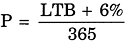
(1) [Section 129 Subsection (1) amended by No. 8 of 1995, s. 20 ]A ratepayer may apply to the council for remission of all or part of any rates paid or payable by the ratepayer or any penalty imposed or interest charged under section 128 .(2) An application is to be –(a) made in writing; and(b) lodged with the general manager.(3) [Section 129 Subsection (3) amended by No. 8 of 1995, s. 20 ]A council, by absolute majority, may grant a remission of all or part of any rates, penalty or interest paid or payable by the ratepayer.(4) [Section 129 Subsection (4) amended by No. 8 of 1995, s. 20 ]A council, by absolute majority, may grant a remission of any rates, penalty or interest paid or payable by a class of ratepayers.(5) The general manager is to keep a record of the details of any remission granted under this section.
130. Discount for early payment
(1) A council may offer to all ratepayers a discount not exceeding 10% on any rate specified in a rates notice for payment of that rate before the date specified in the rates notice.(2) Subsection (1) only applies in respect of rates which are not paid in instalments.
Any amount received or recovered by a council in respect of rates is to be applied as follows:(a) firstly – in payment of any costs awarded to, or recoverable by, the council in any court proceedings undertaken by the council for the recovery of the rates;(b) secondly – in discharging any liability for interest;(c) thirdly – in payment of any penalty;(d) fourthly – in discharging liabilities for rates in the order in which those liabilities arose.
132. Certificate of liabilities
(1) [Section 132 Subsection (1) amended by No. 8 of 2005, s. 86, Applied:01 Jul 2005] A person referred to in subsection (2) may apply to the general manager for a certificate stating–(a) the amount of any liability for rates, whether due or not on the land and outstanding interest or penalty payable in relation to the land;(b) any amount received on account of rates that is held in credit against future liabilities for rates in relation to the land; and(c) the amount of any charge on the land recoverable by the council.(2) The following persons may apply for a certificate under subsection (1) :(a) the owner of a registered estate or interest in the land;(b) an occupier of the land;(c) a person who has entered or proposes to enter into a contract to purchase the land;(d) a mortgagee or prospective mortgagee of the land;(e) a person authorized to act on behalf of any person referred to in paragraph (a) , (b) , (c) or (d) .(3) An application is to –(a) [Section 132 Subsection (3) amended by No. 8 of 2005, s. 86, Applied:01 Jul 2005] be in writing; and(b) identify the land to which the application relates; and(c) state the nature of the applicant's interest in the land; and(d) [Section 132 Subsection (3) amended by No. 8 of 2005, s. 86, Applied:01 Jul 2005] be lodged with the general manager.(e) [Section 132 Subsection (3) amended by No. 8 of 2005, s. 86, Applied:01 Jul 2005] . . . . . . . .(4) [Section 132 Subsection (4) amended by No. 52 of 2013, s. 15, Applied:19 Nov 2013] [Section 132 Subsection (4) amended by No. 8 of 2005, s. 86, Applied:01 Jul 2005] On receipt of an application, the general manager is to issue a certificate containing the details referred to in subsection (1) .(5) On the issue of a certificate in relation to land, the council may not claim that a liability, other than a liability disclosed in the certificate, exists in relation to the land at the date of the certificate.(6) A council incurs no liability for a certificate issued under this section.(7) [Section 132 Subsection (7) inserted by No. 8 of 2005, s. 86, Applied:01 Jul 2005] A prescribed fee is payable in respect of the issue of a certificate.
Division 10 - Recovery
(1) [Section 133 Subsection (1) amended by No. 8 of 1995, s. 21 ]A council may recover in a court of competent jurisdiction as a debt due to it –(a) any outstanding unpaid rates; and(b) . . . . . . . .(c) any additional amount payable as a result of an objection under this Part.(2) A council must give the ratepayer notice in writing of its intention to recover any debt under this section.(2A) [Section 133 Subsection (2A) inserted by No. 8 of 2005, s. 87, Applied:01 Jul 2005] An action for recovery of any debts may include debts relating to any land owned in the municipal area by the ratepayer.(3) An action for recovery of any debts must not be instituted until at least 14 days after the date of a notice referred to in subsection (2) .(4) [Section 133 Subsection (4) amended by No. 73 of 2001, Sched. 1, Applied:01 Jul 2002] The right of a council to recover rates is not affected by any objection or review under this Act.
134. Recovery from certain persons
A council may recover rates from any of the following persons:(a) [Section 134 Amended by No. 38 of 2000, s. 31, Applied:14 Jul 2000] the ratepayer or owner of the land;(b) [Section 134 Amended by No. 38 of 2000, s. 31, Applied:14 Jul 2000] the occupier of the land, with his or her agreement;(c) [Section 134 Amended by No. 38 of 2000, s. 31, Applied:14 Jul 2000] the ratepayer or owner of the land at the time the rates were made.
135. Rents under leases, &c., for unpaid rates
A council, by notice in writing, may require a person who holds a lease or licence relating to land in respect of which rates are due to pay to the council any rent or other consideration payable under the lease or licence in satisfaction of any unpaid rates.
(1) If rates are paid by a person who is a lessee or licensee, or recovered from a person who is not the ratepayer liable to pay those rates, that person may –(a) recover the amount so paid as a debt from the ratepayer who is liable to pay; or(b) set off the amount so paid against a liability to a person under a lease or licence.(2) A person against whom an amount is set off under subsection (1) (b) may set off the amount against another person from whom the interest in the land is derived.(3) [Section 136 Subsection (3) omitted by No. 8 of 1995, s. 22 ]. . . . . . . .
Division 11 - Sale of land
137. Sale of land for unpaid rates
(1) [Section 137 Subsection (1) substituted by No. 38 of 2000, s. 32, Applied:14 Jul 2000] If any rates in respect of land that is not Crown land have been outstanding for 3 years or more, the council may –(a) sell that land or part of that land as if it were the owner of the land –(i) by public auction; or(ii) if the proceeds of the sale are unlikely to meet the costs of the public auction, by direct sale; or(b) apply to the Minister for an order that the land be transferred to the council if it is not possible after reasonable inquiry to identify the owner of the land or the whereabouts of the owner.(1A) [Section 137 Subsection (1A) inserted by No. 38 of 2000, s. 32, Applied:14 Jul 2000] The Minister may require a council to provide any information the Minister considers necessary to support an application under subsection (1) .(1B) [Section 137 Subsection (1B) inserted by No. 38 of 2000, s. 32, Applied:14 Jul 2000] The provisions of section 140(3) and (4) apply to an order under subsection (1) as if it were an order under that section.(2) For the purposes of selling land, the council may –(a) subdivide, change the use of or otherwise develop the land; and(b) carry out any work on the land; and(ba) [Section 137 Subsection (2) amended by No. 34 of 1999, s. 52, Applied:30 Jun 1999] require any occupier of the land who is not the owner of the land to vacate the land; and(bb) [Section 137 Subsection (2) amended by No. 34 of 1999, s. 52, Applied:30 Jun 1999] do anything a mortgagee can do under the Land Titles Act 1980 in the case of default of payment of money owing under a mortgage; and(c) grant any easements or enter into covenants in respect of the land.(3) [Section 137 Subsection (3) amended by No. 8 of 2005, s. 88, Applied:01 Jul 2005] Before a council sells land or takes any action under subsection (2) , the general manager must serve a notice in writing on the ratepayer stating–(a) the period for which the rates have been in arrears; and(b) the amount of the total rates outstanding in relation to the land; and(c) that if that amount is not paid in full within 90 days the council intends to sell the land for non-payment of rates.(4) [Section 137 Subsection (4) amended by No. 8 of 2005, s. 88, Applied:01 Jul 2005] The general manager is to send a copy of the notice to–(a) any owner of the land who is not the ratepayer; and(b) any registered mortgagee of the land; and(c) any other person who has a registered interest in the land.(5) [Section 137 Subsection (5) amended by No. 8 of 2005, s. 88, Applied:01 Jul 2005] The general manager is to cause the details of the notice as specified in subsection (5A) to be advertised on at least 2 occasions in a daily newspaper circulating in the municipal area.(5A) [Section 137 Subsection (5A) inserted by No. 8 of 2005, s. 88, Applied:01 Jul 2005] A notice referred to in subsection (5) is to specify –(a) the land or lands to which the notice relates; and(b) the owner or owners of the land or lands; and(c) the matters referred to in subsection (3) .(6) [Section 137 Subsection (6) amended by No. 8 of 2005, s. 88, Applied:01 Jul 2005] The general manager may effect service of the notice by leaving it in a conspicuous place on the land if the general manager–(a) having made reasonable enquiries cannot ascertain the name or address of the person on whom the notice is to be served; or(b) considers it unlikely that the notice would otherwise come to the attention of the person on whom it is to be served.(7) If the outstanding amount –(a) is not paid within 90 days, a council may sell the land in accordance with this Division; or(b) [Section 137 Subsection (7) amended by No. 8 of 2005, s. 88, Applied:01 Jul 2005] is paid within 90 days, the general manager must cancel the auction.(7A) [Section 137 Subsection (7A) inserted by No. 8 of 2005, s. 88, Applied:01 Jul 2005] If the ratepayer pays the outstanding amount within 90 days, the council may recover any costs incurred by it under this Division in relation to the matter as a debt owed to it under this Part.(8) [Section 137 Subsection (8) amended by No. 52 of 2013, s. 16, Applied:19 Nov 2013] [Section 137 Subsection (8) substituted by No. 38 of 2000, s. 32, Applied:14 Jul 2000] If the land fails to be sold, the council may take steps under section 140 in relation to the land.
(1) If land is sold under this Division, the registration of a memorandum of transfer or the execution of the indenture of conveyance vests the title to the land in the purchaser.(2) The title vested in a purchaser is freed of –(a) all mortgages and charges; and(ab) [Section 138 Subsection (2) amended by No. 34 of 1999, s. 53, Applied:30 Jun 1999] any caveat that if not removed would forbid the registration of the memorandum of transfer or execution of the indenture of conveyance; and(ac) [Section 138 Subsection (2) amended by No. 34 of 1999, s. 53, Applied:30 Jun 1999] any other encumbrances or interests; and(b) all leases and licences.(3) A memorandum of transfer or indenture of conveyance by a council is evidence that the requirements of the Division in relation to the sale of the land have been complied with.
139. Application of money from sale
[Section 139 Substituted by No. 36 of 2004, s. 34, Applied:01 Jul 2005](1) Any money received on the sale of land is to be applied as follows:(a) firstly – in paying the costs of the sale and any other costs incurred in proceeding under this Division;(b) secondly – in discharging any liabilities to the council and the Crown in respect of the land, the money, if it is insufficient to discharge the liabilities in full, being applied between the council and the Crown in the same proportions as the respective liabilities bear to the total amount of the liabilities combined;(c) thirdly – in discharging any liabilities secured by registered mortgages, encumbrances or charges;(d) fourthly – in discharging any other mortgages, encumbrances and charges of which the council has notice;(e) [Section 139 Subsection (1) amended by No. 17 of 1996, Applied:19 Jun 2007] fifthly – in payment to the previous owner of the land if that person becomes known within 3 years of the sale.(2) This section prevails over section 10(3) of the Land Tax Act 2000 .
[Section 139A Inserted by No. 8 of 2005, s. 90, Applied:01 Jul 2005](1) The general manager is to keep a register of any money remaining after payments and discharges are made under section 139 .(2) The register is to include details of the previous owner of the land.(3) The general manager is to cause prescribed details of the register in respect of prescribed amounts to be published at least once a year in a daily newspaper circulating in the municipal area.(4) Any money received by a council from the sale of land that is not claimed by the owner of the land within 3 years of the sale vests in the council.
140. Procedure if council cannot sell land
(1) If, after a council has made reasonable attempts to sell land, it appears that there are no reasonable prospects of selling the land within a reasonable time, the council may apply to the Minister for an order under this section.(2) On the receipt of an application by a council, the Minister, after consultation with the council and being satisfied that it is appropriate to do so, may by notice in writing order that the land be transferred to the council.(3) An order made under subsection (2) operates as a memorandum of transfer.(4) If an order is made under this section –(a) the land to which the order relates is freed of any charge against the land that exists in favour of the council; and(b) any outstanding liability to the council in respect of the land is discharged.
PART 9A - . . . . . . . .[Part 9A Repealed by No. 52 of 2008, Sched. 1, Applied:01 Jul 2009]
Division 1 - . . . . . . . .[Division 1 Inserted by No. 8 of 2005, s. 91, Applied:01 Jul 2005] [Division 1 of Part 9A Repealed by No. 52 of 2008, Sched. 1, Applied:01 Jul 2009] [Section 140A Repealed by No. 52 of 2008, Sched. 1, Applied:01 Jul 2009] . . . . . . . . [Section 140B Repealed by No. 52 of 2008, Sched. 1, Applied:01 Jul 2009] . . . . . . . . [Section 140C Repealed by No. 52 of 2008, Sched. 1, Applied:01 Jul 2009] . . . . . . . . [Section 140D Repealed by No. 52 of 2008, Sched. 1, Applied:01 Jul 2009] . . . . . . . . [Section 140E Repealed by No. 52 of 2008, Sched. 1, Applied:01 Jul 2009] . . . . . . . . [Section 140F Repealed by No. 52 of 2008, Sched. 1, Applied:01 Jul 2009] . . . . . . . . [Section 140G Repealed by No. 52 of 2008, Sched. 1, Applied:01 Jul 2009] . . . . . . . .
Division 2 - . . . . . . . .[Division 2 Inserted by No. 8 of 2005, s. 91, Applied:01 Jul 2005] [Division 2 of Part 9A Repealed by No. 52 of 2008, Sched. 1, Applied:01 Jul 2009] [Section 140H Repealed by No. 52 of 2008, Sched. 1, Applied:01 Jul 2009] . . . . . . . .
Division 3 - . . . . . . . .[Division 3 Inserted by No. 8 of 2005, s. 91, Applied:01 Jul 2005] [Division 3 of Part 9A Repealed by No. 52 of 2008, Sched. 1, Applied:01 Jul 2009] [Section 140I Repealed by No. 52 of 2008, Sched. 1, Applied:01 Jul 2009] . . . . . . . . [Section 140J Repealed by No. 52 of 2008, Sched. 1, Applied:01 Jul 2009] . . . . . . . . [Section 140K Repealed by No. 52 of 2008, Sched. 1, Applied:01 Jul 2009] . . . . . . . . [Section 140L Repealed by No. 52 of 2008, Sched. 1, Applied:01 Jul 2009] . . . . . . . . [Section 140M Repealed by No. 52 of 2008, Sched. 1, Applied:01 Jul 2009] . . . . . . . .
PART 10 - . . . . . . . .[Part 10 Repealed by No. 65 of 2003, s. 13, Applied:01 Jul 2004] [Section 141 Repealed by No. 65 of 2003, s. 13, Applied:01 Jul 2004] . . . . . . . . [Section 142 Repealed by No. 65 of 2003, s. 13, Applied:01 Jul 2004] . . . . . . . . [Section 143 Repealed by No. 65 of 2003, s. 13, Applied:01 Jul 2004] . . . . . . . . [Section 144 Repealed by No. 65 of 2003, s. 13, Applied:01 Jul 2004] . . . . . . . .
PART 11 - By-laws
Division 1 - General provisions
145. General power to make by-laws
(1) A council may make by-laws in respect of any act, matter or thing for which a council has a function or power under this or any other Act.(2) By-laws under this Part may be made so as to apply differently according to matters, limitations or restrictions, whether as to time, circumstance or otherwise, specified in the by-laws.
By-laws may –(a) be made to apply to the whole, or separately to a part or parts of, a municipal area; and(b) make provision for matters or things to be referred to in general terms.
147. Incorporation by reference
(1) A by-law may apply, adopt or incorporate any matter contained in any document, code, standard, rule, specification or method formulated, issued, prescribed or published by any authority or body –(a) either wholly or partially; or(b) with or without modifications; or(c) either specifically or by reference.(2) If, after the application, adoption or incorporation, the document, code, standard, rule, specification or method is amended or rescinded or replaced, the by-law remains unaltered and its reference is not up-dated except by an amending by-law.(3) In any proceedings in relation to any by-law, any printed or mechanically or electronically copied book, booklet, pamphlet, sheet or card purporting to contain the code, standard, rule, specification or method referred to is presumed to be issued by the specified body or association.
148. Penalties and recovery of expenses
(1) By-laws may –(a) provide that a contravention of, or a failure to comply with, any of the by-laws is an offence; and(b) in respect of such an offence, provide for the imposition of a fine not exceeding 20 penalty units and, in the case of a continuing offence, a further fine not exceeding 2 penalty units for each day during which the offence continues.(2) By-laws may provide that, in addition to a penalty imposed in relation to a failure to comply with or a contravention of the by-laws, an expense incurred by a council in consequence of that failure or contravention is recoverable by the council as a debt payable by the person so failing to comply or contravening.
149. Infringement notices and fines
(1) By-laws may provide that a council –(a) may issue infringement notices in respect of offences specified in the by-laws; and(b) may issue one infringement notice in respect of more than one offence; and(c) [Section 149 Subsection (1) amended by No. 72 of 2007, Sched. 1, Applied:28 Apr 2008] may impose a monetary penalty for an offence in respect of which an infringement notice is issued.(2) [Section 149 Subsection (2) amended by No. 72 of 2007, Sched. 1, Applied:28 Apr 2008] A monetary penalty is a penalty payable to the council as an alternative to prosecution and any penalty that may be imposed as a result of the prosecution.(3) [Section 149 Subsection (3) amended by No. 72 of 2007, Sched. 1, Applied:28 Apr 2008] By-laws which provide for the issue of an infringement notice and the monetary penalty are to specify–(a) [Section 149 Subsection (3) amended by No. 72 of 2007, Sched. 1, Applied:28 Apr 2008] the amount of the monetary penalty; and(b) the person who may issue a notice of infringement; and(c) [Section 149 Subsection (3) amended by No. 72 of 2007, Sched. 1, Applied:28 Apr 2008] the person to whom payment of the monetary penalty may be made; and(d) [Section 149 Subsection (3) amended by No. 72 of 2007, Sched. 1, Applied:28 Apr 2008] the period within which the monetary penalty is to be paid in order to avoid the infringement notice being referred to the Director, MPES.(4) [Section 149 Subsection (4) substituted by No. 72 of 2007, Sched. 1, Applied:28 Apr 2008] An infringement notice is to be in accordance with section 14 of the Monetary Penalties Enforcement Act 2005 .
150. Restrictions on making of by-laws
(1) A council must not make a by-law which –(a) applies retrospectively; or(b) shifts the burden of proof unless any Act specifically provides for this; or(c) [Section 150 Subsection (1) amended by No. 34 of 1999, s. 54, Applied:30 Jun 1999] [Section 150 Subsection (1) amended by No. 8 of 2005, s. 92, Applied:01 Jul 2005] . . . . . . . .(d) is contrary to law or is in conflict with any planning scheme in the municipal area; or(da) [Section 150 Subsection (1) amended by No. 34 of 1999, s. 54, Applied:30 Jun 1999] restricts competition or has a significant impact on business unless the outcome is justified in the public interest; or(e) exempts a person from prosecution for nuisance at common law; or(f) exempts the council from any liability; or(g) permits a rate, charge, fee or fine to be determined, altered or substituted otherwise than by amendment to the by-law.(2) [Section 150 Subsection (2) amended by No. 88 of 1995, s. 17 ]Any provision of a by-law which contravenes this section is invalid.
(1) If a new council is created or a council is created as the result of 2 or more municipal areas or parts of municipal areas being combined, the council so created may resolve by an absolute majority to adopt any by-law previously in force in any of those areas or parts of those areas.(2) [Section 151 Subsection (2) substituted by No. 34 of 1999, s. 55, Applied:30 Jun 1999] The resolution adopting a by-law may –(a) provide for the repeal of any other by-law dealing with a matter provided for by the adopted by-law; or(b) make minor changes to the adopted by-law that are necessary to reflect the newly created municipal area.(3) Notification of a resolution under subsection (2) is to be published in the Gazette.(4) On publication of the resolution in the Gazette, the adopted by-law has the same effect as if it had been made by the new council or combined councils.(5) A by-law which is not adopted by a council under subsection (1) within a period of 14 days after that council is created ceases to have effect from the end of that period.
(1) By-laws may authorize employees of a council –(a) to remove any person from land owned by, or under the control of the council whom they reasonably believe is offending against a by-law; and(b) to remove anything which is on such land without the approval of the council.(2) By-laws may authorize a police officer –(a) [Section 152 Subsection (2) amended by No. 38 of 2000, s. 33, Applied:14 Jul 2000] to carry out any action under subsection (1) ; and(b) [Section 152 Subsection (2) amended by No. 38 of 2000, s. 33, Applied:14 Jul 2000] to arrest a person who is on land owned by, or under the control of, the council and whom the police officer reasonably believes is offending against a by-law.
152A. Requirement to give name and address
[Section 152A Inserted by No. 34 of 1999, s. 56, Applied:30 Jun 1999] An employee of, or a person authorised by, a council may require a person to give his or her name and address if the employee or authorised person reasonably believes that the person is offending or has offended against a by-law.
[Section 153 Substituted by No. 8 of 2005, s. 93, Applied:01 Jul 2005](1) [Section 153 Subsection (1) amended by No. 52 of 2013, s. 17, Applied:19 Nov 2013] A council must cause a by-law made or adopted by it to be published in the Gazette.(2) [Section 153 Subsection (2) amended by No. 52 of 2013, s. 17, Applied:19 Nov 2013] A by-law, made by a council, that is not published in the Gazette is of no effect.
154. Repeal and amendment of by-laws
(1) [Section 154 Subsection (1) amended by No. 52 of 2013, s. 18, Applied:19 Nov 2013] [Section 154 Subsection (1) amended by No. 38 of 2000, s. 34, Applied:14 Jul 2000] A by-law (other than a by-law adopted by a council under section 172 ) may be repealed or amended–(a) by another by-law; or(b) on the recommendation of the Minister, by an order of the Governor.(2) [Section 154 Subsection (2) omitted by No. 38 of 2000, s. 34, Applied:14 Jul 2000] . . . . . . . .(3) [Section 154 Subsection (3) amended by No. 52 of 2013, s. 18, Applied:19 Nov 2013] If a by-law, or a part of a by-law, that is made by a council is disallowed under section 47 of the Acts Interpretation Act 1931 , the Minister, by notice in the Gazette, is to notify–(a) the fact of the disallowance; and(b) the date of the disallowance.
[Section 155 Amended by No. 8 of 2005, s. 94, Applied:01 Jul 2005] [Section 155 Substituted by No. 34 of 1999, s. 57, Applied:30 Jun 1999] [Section 155 Amended by No. 52 of 2013, s. 19, Applied:19 Nov 2013] A by-law made, or adopted, by a council, whether later amended or not, expires 10 years after the date on which it takes effect unless it is expressed to expire sooner.
Division 2 - Procedural provisions
156. Motion of intention to make by-law
(1) A council which intends to make a by-law is to pass a resolution by an absolute majority to that effect.(2) A by-law which is made without the resolution referred to in subsection (1) is invalid.
156A. Regulatory impact statement
[Section 156A Inserted by No. 34 of 1999, s. 58, Applied:30 Jun 1999](1) [Section 156A Subsection (1) amended by No. 38 of 2000, s. 35, Applied:14 Jul 2000] A council is to prepare a regulatory impact statement in respect of any by-law it intends to make.(1A) [Section 156A Subsection (1A) inserted by No. 38 of 2000, s. 35, Applied:14 Jul 2000] Subsection (1) does not apply to any by-law –(a) the whole purpose of which is to repeal another by-law; or(b) that is an amendment to an existing by-law that –(i) [Section 156A Subsection (1A) amended by No. 52 of 2013, s. 20, Applied:19 Nov 2013] is of a minor and technical nature; or(ii) does not significantly alter the purpose or effect of the existing by-law; or(iii) [Section 156A Subsection (1A) amended by No. 52 of 2013, s. 20, Applied:19 Nov 2013] does not significantly alter the impact on the public of the existing by-law.(2) A regulatory impact statement is to include the following:(a) [Section 156A Subsection (2) amended by No. 8 of 2005, s. 95, Applied:01 Jul 2005] the objectives of the by-law and the means by which the by-law is intended to achieve them;(b) the nature of any restriction on competition;(c) an assessment of the costs and benefits of –(i) any restriction on competition; or(ii) any impact on the conduct of business;(d) any alternative option considered by the council;(e) an assessment of the greatest net benefit or least net cost to the community;(f) an assessment of the direct and indirect economic, social and environmental impact of the by-law;(g) [Section 156A Subsection (2) amended by No. 8 of 2005, s. 95, Applied:01 Jul 2005] details of the proposed public consultation process.(3) If a council assesses that a proposed by-law is unlikely to impact on business or restrict competition, it is to state in the regulatory impact statement the reasons for that assessment.(4) If a council assesses that a proposed by-law is likely to impact on business or restrict competition, it is to state in the regulatory impact statement whether or not the benefits of the impact or restriction outweigh the costs.(5) A council is to submit the regulatory impact statement to the Director.(5A) [Section 156A Subsection (5A) inserted by No. 52 of 2013, s. 20, Applied:19 Nov 2013] A council may only submit to the Director a regulatory impact statement in relation to a proposed by-law if a motion of intention to make the proposed by-law has been passed by the council under section 156(1) .(6) [Section 156A Subsection (6) amended by No. 8 of 2005, s. 95, Applied:01 Jul 2005] On receipt of the regulatory impact statement, if satisfied as to the statement, the Director is to issue to the council a certificate –(a) [Section 156A Subsection (6) amended by No. 8 of 2005, s. 95, Applied:01 Jul 2005] certifying that the statement is satisfactory; and(b) stating that the council may commence the public consultation process.
157. Notice of proposed by-law
(1) [Section 157 Subsection (1) amended by No. 8 of 2005, s. 96, Applied:01 Jul 2005] On receipt of a certificate issued under section 156A(6) , the general manager is to give notice in accordance with this section.(1A) [Section 157 Subsection (1A) inserted by No. 8 of 2005, s. 96, Applied:01 Jul 2005] The notice must state the prescribed matters.(2) The notice must be –(a) published at least once in a daily newspaper circulating in the municipal area; and(ab) [Section 157 Subsection (2) amended by No. 52 of 2013, s. 21, Applied:19 Nov 2013] made available for viewing at a website of the council from the day when the notice is first published in the newspaper until the end of the day specified in the notice as the earliest day by which the notice may be removed from the website; and(b) displayed in a conspicuous place in the public office of the council from the day when the notice is first published in the newspaper until the end of the day specified in the notice.(3) [Section 157 Subsection (3) amended by No. 34 of 1999, s. 59, Applied:30 Jun 1999] [Section 157 Subsection (3) omitted by No. 8 of 2005, s. 96, Applied:01 Jul 2005] . . . . . . . .(4) The day specified in the notice must be no earlier than 21 days after publication of the notice in the newspaper.(5) If a notice is published more than once in a newspaper, a reference to publication of the notice is a reference to its first such publication.(6) [Section 157 Subsection (6) amended by No. 34 of 1999, s. 59, Applied:30 Jun 1999] The price of a copy of a proposed by-law and a copy of the regulatory impact statement must not exceed the approximate cost to the council of having the copy available for purchase and, if the copy is supplied to a purchaser by post, the cost of the postage.
158. Proposed by-laws open to inspection and may be purchased
The general manager must make available –(a) [Section 158 Amended by No. 34 of 1999, s. 60, Applied:30 Jun 1999] [Section 158 Amended by No. 52 of 2013, s. 22, Applied:19 Nov 2013] a copy of a by-law the council proposes to make and the regulatory impact statement prepared under section 156A for inspection by the public until the date specified in the notice referred to in section 157 ; and(ab) [Section 158 Amended by No. 52 of 2013, s. 22, Applied:19 Nov 2013] a copy of a by-law the council proposes to make, and a copy of the regulatory impact statement, for viewing at a website of the council as soon as practicable after publication of the notice referred to in section 157 until the day specified in the notice; and(b) [Section 158 Amended by No. 34 of 1999, s. 60, Applied:30 Jun 1999] [Section 158 Amended by No. 52 of 2013, s. 22, Applied:19 Nov 2013] copies of a by-law the council proposes to make and the regulatory impact statement for purchase at the public office as soon as practicable after publication of the notice until the date specified in the notice referred to in section 157 .
159. Submissions in respect of proposed by-law
(1) [Section 159 Subsection (1) amended by No. 52 of 2013, s. 23, Applied:19 Nov 2013] Any person may make a submission in respect of the making of a by-law a council proposes to make.(2) A council must consider every submission properly made to it.
160. Alterations to proposed by-law
[Section 160 Amended by No. 34 of 1999, s. 61, Applied:30 Jun 1999] [Section 160 Amended by No. 8 of 2005, s. 97, Applied:01 Jul 2005] [Section 160 Amended by No. 52 of 2013, s. 24, Applied:19 Nov 2013] If a council decides to alter a by-law it proposes to make–(a) it may do so by absolute majority; and(b) [Section 160 Amended by No. 8 of 2005, s. 97, Applied:01 Jul 2005] does not need to give public notice unless the alteration substantially changes the purpose, or the effect on the public, of the proposed by-law.
[Section 161 Substituted by No. 34 of 1999, s. 62, Applied:30 Jun 1999] [Section 161 Substituted by No. 8 of 2005, s. 98, Applied:01 Jul 2005] A council may only make a by-law under its common seal.
[Section 162 Amended by No. 88 of 1995, s. 18 ][Section 162 Substituted by No. 34 of 1999, s. 62, Applied:30 Jun 1999] [Section 162 Substituted by No. 8 of 2005, s. 98, Applied:01 Jul 2005](1) A by-law made by a council is to be certified by –(a) a legal practitioner that its provisions are in accordance with the law; and(b) the general manager of the council that it is made in accordance with this Act.(2) A by-law that is not certified in accordance with subsection (1) is of no effect.
[Section 163 Amended by No. 52 of 2013, s. 25, Applied:19 Nov 2013] [Section 163 Amended by No. 34 of 1999, s. 63, Applied:30 Jun 1999] [Section 163 Substituted by No. 8 of 2005, s. 98, Applied:01 Jul 2005] A by-law that is made or adopted by a council commences –(a) on the day on which it is published in the Gazette; or(b) on a later day specified in the by-law.
[Section 164 Amended by No. 52 of 2013, s. 26, Applied:19 Nov 2013] [Section 164 Substituted by No. 8 of 2005, s. 98, Applied:01 Jul 2005] A council that makes a by-law is to forward to the Director –(a) a sealed copy of the by-law; and(b) the certification under section 162 ; and(c) a statement explaining –(i) the purpose and effect of the by-law; and(ii) the outcomes of public consultations in respect of the by-law.
165. Title and numbering of by-laws
[Section 165 Amended by No. 52 of 2013, s. 27, Applied:19 Nov 2013] A by-law that is made or adopted by a council is to–(a) have in its title a reference–(i) to the municipal area to which it relates; and(ii) to the subject matter of the by-law; and(iii) [Section 165 Amended by No. 52 of 2013, s. 27, Applied:19 Nov 2013] to the year in which it is made or adopted; and(b) be numbered so that no other by-law relating to that municipal area and subject matter has the same number in that year.
(1) [Section 166 Subsection (1) amended by No. 52 of 2013, s. 28, Applied:19 Nov 2013] [Section 166 Subsection (1) amended by No. 8 of 2005, s. 99, Applied:01 Jul 2005] The general manager is to keep a sealed copy of every by-law in force and make available copies for inspection or purchase by the public and for viewing at a website of the council.(2) The purchase price is to be no greater than the approximate cost to the council of providing the document.
(1) A council is to place at appropriate locations notices advising of any by-law affecting the conduct of the public.(2) A notice is to include –(a) the purpose and effect of the relevant by-law; and(b) the penalty for a contravention of, or failure to comply with, the by-law.(3) A person cannot use as a defence the failure of a council to comply with these provisions.
Division 3 - By-laws in respect of certain matters
A council may make by-laws prescribing –(a) fees, charges and rents in relation to a service, works, undertaking, property, matter or thing; and(b) the purposes for which, and the conditions on which –(i) permits, licences, authorities and registrations may be granted by the council; and(ii) a service, product, commodity or information may be given by the council; and(c) the manner in which applications may be made for permits, licences, authorities and registrations; and(d) the fee payable for the permits, licences, authorities and registrations and for their renewal.
(1) By-laws may –(a) [Section 169 Subsection (1) amended by No. 34 of 1999, s. 64, Applied:30 Jun 1999] require work to be executed or a thing to be done by a person to whom the by-laws apply in or of such materials, within the periods and in the manner the council or an employee or agent of the council directs; and(b) require work to be executed only by a person with the appropriate qualifications; and(c) provide that the council may carry out work required by this or any other Act to be carried out by another person if that person defaults.(2) The power to direct the manner of execution of work includes the power to require the person carrying out the work to pay to the council, or enter into a bond for payment to the council of, an amount it thinks fit to provide security against costs which it may incur as a result of the execution of the work.
(1) A council may make by-laws in respect of the parking of vehicles on land owned by it or under its control.(2) [Section 170 Subsection (2) substituted by No. 90 of 1999, Sched. 1, Applied:14 Aug 2000] In respect of by-laws which create an offence concerning a vehicle, the following provisions apply:(a) the registered operator is taken to have committed the offence unless he or she was not in control of the vehicle at the time the offence was committed and –(i) not later than 14 days after being served with a notice of infringement furnishes the general manager with a statutory declaration which, in the general manager's opinion, proves the facts specified in subsection (3) ; or(ii) establishes those facts to the satisfaction of the court;(b) a notice of infringement may be addressed to –(i) the registered operator; or(ii) a person apparently in charge of the vehicle by the person's name; or(iii) if the name is not known when the notice of infringement is being made out – by the person's designation as the registered operator of the vehicle or person apparently in charge of it, identifying the vehicle by the number plate affixed to it, or, where there is no number plate, by other sufficient description;(c) evidence that –is evidence that the person whose name and address were shown was at the time they were shown the registered operator of that vehicle.(i) the name and address of a person were shown painted on or affixed to the outside of a vehicle; or(ii) the name and address of a person purporting to be the name and address of the registered operator of a vehicle were shown in any manner in or on that vehicle –(3) The facts to be specified in a statutory declaration are as follows:(a) that some other person was in control of the vehicle at the time when the offence was committed and that the name and address of residence of that other person are as set out in the statutory declaration;(b) that the vehicle was sold before the offence was committed on the date specified in the statutory declaration to a person whose name and address are as set out in the statutory declaration;(c) if the sale was made through an agent, that the name and address of the agent are as set out in the statutory declaration;(d) that at the time when the offence was committed he or she was unable to exercise any control over the vehicle because it had been stolen or was being used unlawfully without consent.(4) [Section 170 Subsection (4) substituted by No. 90 of 1999, Sched. 1, Applied:14 Aug 2000] In this section,registered operator –(a) in relation to a motor vehicle or trailer, has the same meaning as in the Vehicle and Traffic Act 1999 ; and(b) in relation to a bicycle, means the owner of the bicycle.
Division 4 - Model by-laws
170A. Regulatory impact statement in respect of model by-law
[Section 170A Inserted by No. 52 of 2013, s. 29, Applied:19 Nov 2013](1) The Minister is to ensure that a regulatory impact statement is prepared in respect of any model by-law (including a model by-law that amends another model by-law) he or she intends to make under section 171(1) .(2) Subsection (1) does not apply to any model by-law that is an amendment, to an existing model by-law, that –(a) is of a minor and technical nature; or(b) does not significantly alter the purpose or effect of the existing model by-law; or(c) does not significantly alter the impact on the public of the existing model by-law, as adopted by a council.(3) A regulatory impact statement in relation to a model by-law is to include the following:(a) the objectives of the model by-law and the means by which the model by-law is intended to achieve them;(b) the nature of any restriction on competition;(c) an assessment of the costs and benefits of –(i) any restriction on competition; or(ii) any impact on the conduct of business;(d) an identification of the alternative options by which the objectives can be achieved (whether wholly or substantially);(e) an assessment of the greatest net benefit or least net cost to the community;(f) an assessment of the direct and indirect economic, social and environmental impact of the model by-law;(g) details of the proposed public consultation process, if any.(4) The regulatory impact statement is to state whether the model by-law is likely to have an impact on business or restrict competition and, if it is, the reason why.
170B. Consultation in respect of model by-laws
[Section 170B Inserted by No. 52 of 2013, s. 29, Applied:19 Nov 2013] The Minister may, if he or she thinks fit, arrange for public consultation to be conducted in respect of –(a) a regulatory impact statement; or(b) a proposed model by-law; or(c) a proposal to amend a model by-law under section 171 .
(1) [Section 171 Subsection (1) amended by No. 52 of 2013, s. 30, Applied:19 Nov 2013] The Minister may make or amend model by-laws (including model by-laws that amend other model by-laws) dealing with any or all of the subjects on which any council has power to make by-laws.(2) A model by-law made under subsection (1) is to be –(a) [Section 171 Subsection (2) amended by No. 52 of 2013, s. 30, Applied:19 Nov 2013] published in the Gazette together with a copy of the regulatory impact statement prepared under section 170A , if such a statement is required under that section to be prepared in relation to the model by-law; and(b) [Section 171 Subsection (2) amended by No. 34 of 1999, s. 65, Applied:30 Jun 1999] [Section 171 Subsection (2) amended by No. 52 of 2013, s. 30, Applied:19 Nov 2013] laid before both Houses of Parliament together with the regulatory impact statement, if any, within 10 sitting days after publication.(3) Either House of Parliament may pass a resolution disallowing a model by-law within 15 sitting days after the by-law has been laid before it.(4) A by-law which has been disallowed under subsection (3) may not be adopted by any council.(5) The Minister, by notice in the Gazette, is to notify –(a) that a model by-law has not been disallowed; or(b) that a model by-law has been disallowed.
172. Council may adopt model by-laws
(1) A council, by an absolute majority, may resolve to adopt any model by-law which has not been disallowed under section 171 .(2) The council must adopt the whole of the model by-law.(3) The resolution adopting the model by-law may provide for the repeal of any other by-law dealing with any of the matters provided for by the model by-law.(4) The council must cause a notice to be published in the Gazette that a model by-law has been adopted by the council.(5) [Section 172 Subsection (5) substituted by No. 52 of 2013, s. 31, Applied:19 Nov 2013] A model by-law that is adopted by a council has, on and from the date on which notice is given under subsection (4) in relation to the model by-law, effect, according to the terms of the model by-law, as if it were a by-law made by the council, except that sections 162 and 164 do not apply in relation to it.(5A) [Section 172 Subsection (5A) inserted by No. 52 of 2013, s. 31, Applied:19 Nov 2013] If a model by-law (the amending model by-law) amends another model by-law that has been adopted by a council, the amending model by-law –(a) is, on and from the date on which notice is given under section 171(5) that the amending model by-law has not been disallowed, to be taken to be a model by-law adopted by the council; and(b) despite section 163 , commences on the day on which it is published in accordance with section 153 .(5B) [Section 172 Subsection (5B) inserted by No. 52 of 2013, s. 31, Applied:19 Nov 2013] A council that adopts, or is to be taken under subsection (5A) to have adopted, a model by-law is to affix its common seal to 2 copies of the model by-law and is to forward one of them to the Director.(6) A council, by an absolute majority, may resolve to repeal any model by-laws adopted by the council.(7) The repeal of a model by-law is to be notified in the Gazette.
173. Model by-law may allow additions
(1) A model by-law may allow blank spaces in which words may be inserted by a council which do not alter the intent of the by-law but indicate names and matters pertinent to the particular municipal area.(2) The addition of these details does not amount to an amendment of the by-law.
(1) The Minister may, by notification in the Gazette, repeal a model by-law.(1A) [Section 174 Subsection (1A) inserted by No. 52 of 2013, s. 32, Applied:19 Nov 2013] A notification under subsection (1) may specify that the repeal to which the notice relates is a self-executing repeal.(2) [Section 174 Subsection (2) amended by No. 52 of 2013, s. 32, Applied:19 Nov 2013] The repeal of a model by-law adopted by a council does not affect its operation as adopted, unless the repeal is a self-executing repeal.(3) [Section 174 Subsection (3) inserted by No. 52 of 2013, s. 32, Applied:19 Nov 2013] If a notification of the repeal of a model by-law under subsection (1) specifies that the repeal is a self-executing repeal, a model by-law, adopted by a council, that consists of the repealed model by-law (as amended, if at all, under this Part), is repealed on and from the date of the notification.
PART 12 - Special Powers
Division 1 - Purchase, acquisition, sale and lease of property
175. Purchase or lease of land
[Section 175 Amended by No. 8 of 2005, s. 100, Applied:01 Jul 2005] A council may purchase or lease land for any purpose which it considers to be of benefit to the council or the community.
A council may acquire land for prescribed purposes in accordance with the Land Acquisition Act 1993 .
177. Sale and disposal of land
(1) [Section 177 Subsection (1) amended by No. 34 of 1999, s. 66, Applied:30 Jun 1999] A council may sell, lease, donate, exchange or otherwise dispose of land owned by it, other than public land, in accordance with this section.(2) [Section 177 Subsection (2) amended by No. 101 of 2001, s. 23, Applied:28 Jun 2002] [Section 177 Subsection (2) amended by No. 34 of 1999, s. 66, Applied:30 Jun 1999] Before a council sells, leases, donates, exchanges or otherwise disposes of any land, it is to obtain a valuation of the land from the Valuer-General or a person who is qualified to practise as a land valuer under section 4 of the Land Valuers Act 2001 .(3) A council may sell –(a) any land by auction or tender; or(b) any specific land by any other method it approves.(4) A council may exchange land for other land –(a) if the valuations of each land are comparable in value; or(b) in any other case, as it considers appropriate.(5) [Section 177 Subsection (5) amended by No. 8 of 2005, s. 101, Applied:01 Jul 2005] A contract pursuant to this section for the sale, lease, donation, exchange or other disposal of land which is public land is of no effect.(6) [Section 177 Subsection (6) inserted by No. 8 of 2005, s. 101, Applied:01 Jul 2005] A decision by a council under this section must be made by absolute majority.
[Section 177A Inserted by No. 8 of 2005, s. 102, Applied:01 Jul 2005](1) The following land owned by a council is public land:(a) a public pier or public jetty;(b) any land that provides health, recreation, amusement or sporting facilities for public use;(c) any public park or garden;(d) any land acquired under section 176 for the purpose of establishing or extending public land;(e) any land shown on a subdivision plan as public open space that is acquired by a council under the Local Government (Building and Miscellaneous Provisions) Act 1993 ;(f) any other land that the council determines is public land;(g) any other prescribed land or class of land.(2) The general manager is to –(a) keep lists or maps of all public land within the municipal area; and(b) make the lists and maps available for public inspection at any time during normal business hours.
178. Sale, exchange and disposal of public land
(1) [Section 178 Subsection (1) amended by No. 34 of 1999, s. 67, Applied:30 Jun 1999] A council may sell, lease, donate, exchange or otherwise dispose of public land owned by it in accordance with this section.(2) [Section 178 Subsection (2) substituted by No. 8 of 2005, s. 103, Applied:01 Jul 2005] Public land that is leased for any period by a council remains public land during that period.(3) [Section 178 Subsection (3) amended by No. 8 of 2005, s. 103, Applied:01 Jul 2005] A resolution of the council to sell, lease, donate, exchange or otherwise dispose of public land is to be passed by an absolute majority.(4) [Section 178 Subsection (4) amended by No. 8 of 2005, s. 103, Applied:01 Jul 2005] [Section 178 Subsection (4) amended by No. 34 of 1999, s. 67, Applied:30 Jun 1999] If a council intends to sell, lease, donate, exchange or otherwise dispose of public land, the general manager is to–(a) [Section 178 Subsection (4) amended by No. 8 of 2005, s. 103, Applied:01 Jul 2005] publish that intention on at least 2 separate occasions in a daily newspaper circulating in the municipal area; and(ab) [Section 178 Subsection (4) amended by No. 8 of 2005, s. 103, Applied:01 Jul 2005] display a copy of the notice on any boundary of the public land that abuts a highway; and(b) [Section 178 Subsection (4) amended by No. 34 of 1999, s. 67, Applied:30 Jun 1999] [Section 178 Subsection (4) amended by No. 8 of 2005, s. 103, Applied:01 Jul 2005] notify the public that objection to the proposed sale, lease, donation, exchange or disposal may be made to the general manager within 21 days of the date of the first publication.(5) [Section 178 Subsection (5) amended by No. 34 of 1999, s. 67, Applied:30 Jun 1999] [Section 178 Subsection (5) substituted by No. 8 of 2005, s. 103, Applied:01 Jul 2005] If the general manager does not receive any objection under subsection (4) and an appeal is not made under section 178A , the council may sell, lease, donate, exchange or otherwise dispose of public land in accordance with its intention as published under subsection (4) .(6) [Section 178 Subsection (6) substituted by No. 8 of 2005, s. 103, Applied:01 Jul 2005] The council must –(a) consider any objection lodged; and(b) by notice in writing within 7 days after making a decision to take or not to take any action under this section, advise any person who lodged an objection of –(i) that decision; and(ii) the right to appeal against that decision under section 178A .(7) [Section 178 Subsection (7) substituted by No. 8 of 2005, s. 103, Applied:01 Jul 2005] The council must not decide to take any action under this section if –(a) any objection lodged under this section is being considered; or(b) an appeal made under section 178A has not yet been determined; or(c) the Appeal Tribunal has made a determination under section 178B(b) or (c) .(8) [Section 178 Subsection (8) substituted by No. 34 of 1999, s. 67, Applied:30 Jun 1999] [Section 178 Subsection (8) omitted by No. 8 of 2005, s. 103, Applied:01 Jul 2005] . . . . . . . .
[Section 178A Inserted by No. 8 of 2005, s. 104, Applied:01 Jul 2005][Section 178B Inserted by No. 8 of 2005, s. 104, Applied:01 Jul 2005] [Section 178B Repealed by No. 18 of 2021, s. 245, Applied:05 Nov 2021] . . . . . . . .(1) Any person who lodged an objection under section 178 may appeal to the Appeal Tribunal against the decision of a council under section 178(6) within 14 days after receipt of notice of that decision under section 178(6)(b) .(2) [Section 178A Subsection (2) substituted by No. 18 of 2021, s. 244, Applied:05 Nov 2021] An appeal must be made in accordance with the Tasmanian Civil and Administrative Tribunal Act 2020 .(3) An appeal may only be made on the ground that the decision of the council is not in the public interest in that –(a) the community may suffer undue hardship due to the loss of access to, and the use of, the public land; or(b) there is no similar facility available to the users of that facility.(4) [Section 178A Subsection (4) substituted by No. 18 of 2021, s. 244, Applied:05 Nov 2021] The Appeal Tribunal is to hear and determine an appeal in accordance with the Tasmanian Civil and Administrative Tribunal Act 2020 .(5) [Section 178A Subsection (5) substituted by No. 18 of 2021, s. 244, Applied:05 Nov 2021] The decision of the Appeal Tribunal on hearing an appeal is final and section 136 of the Tasmanian Civil and Administrative Tribunal Act 2020 does not apply.
179. Lease of public land for less than 5 years
[Section 179 Substituted by No. 8 of 2005, s. 105, Applied:01 Jul 2005] A council may lease public land for a period not exceeding 5 years without complying with section 178 .[Section 180 Repealed by No. 8 of 2005, s. 106, Applied:01 Jul 2005] . . . . . . . .
A council may hold land on trust subject to any conditions on which it is to be so held.
Division 2 - Fences, land repairs and trees
[Section 182 Amended by No. 8 of 2005, s. 107, Applied:01 Jul 2005] The general manager, by notice in writing served on the owner or occupier of land, may require the owner or occupier to fence the land if–(a) a dangerous operation is being carried out on that land; or(b) because of the state of the land or the buildings or structures on that land, it is dangerous for persons to enter onto that land; or(c) domestic animals are kept on the land.
[Section 184 Repealed by No. 8 of 2005, s. 109, Applied:01 Jul 2005] . . . . . . . .(1) [Section 183 Subsection (1) amended by No. 8 of 2005, s. 108, Applied:01 Jul 2005] The general manager, by notice in writing served on the owner or occupier of land, may require the owner or occupier to rehabilitate land from which soil, rock, sand or material has been extracted at any time after the commencement of this Act.(2) [Section 183 Subsection (2) amended by No. 8 of 2005, s. 108, Applied:01 Jul 2005] The general manager, by notice in writing, may undertake not to make a requirement under subsection (1) in respect of any soil, rock, sand or material extracted before the date of that notice.
(1) A person served with a notice under this Division must undertake any work required to be done under the notice in accordance with the terms of the notice and within the period specified in the notice.(2) If the work is not undertaken within the period specified in the notice, the council may –(a) have the work done; and(b) charge the owner or occupier for the cost of that work.(3) A charge under subsection (2) is a charge on the land and is recoverable in the same manner as rates and charges.(4) [Section 185 Subsection (4) amended by No. 8 of 2005, s. 110, Applied:01 Jul 2005] If the council has work done under subsection (2) (a) the general manager is to notify the person accordingly.
Division 3 - Towns
[Section 186 Substituted by No. 8 of 2005, s. 111, Applied:01 Jul 2005](1) The Minister, at the request of a council and by order, may –(a) create a town and establish its boundaries; and(b) abolish a town; and(c) [Section 186 Subsection (1) amended by No. 34 of 2018, s. 21, Applied:10 Dec 2018] adjust the boundaries of a town.(2) [Section 186 Subsection (2) amended by No. 1 of 2020, Sched. 3, Applied:01 Jul 2020] The Minister, at the request of a council and on the recommendation of the Place Names Advisory Panel established by the Place Names Act 2020 and by order, may –(a) assign a name to a town; or(b) alter the name of a town.
A council requesting the creation, abolition, naming or a change of name of a town is to provide the Minister with evidence that –(a) an elector poll has been conducted in the locality in relation to the request; and(b) the majority of electors in the locality is in favour of the council making the request.
(1) [Section 188 Subsection (1) amended by No. 34 of 2018, s. 22, Applied:10 Dec 2018] Before requesting the creation of a town or adjustment of the boundaries of a town, a council is to ensure that–(a) the boundaries of the existing or proposed town are identifiable; and(b) a plan of those boundaries is lodged in the prescribed manner.(2) Houses which are not separated from the rest of the town by a substantial unbuilt area are to be included within the boundaries of the town.(3) In creating a town, the Minister must ensure that its boundaries are wholly within the one municipal area.
Division 4 - Markets
189. Closure of local highways
[Section 189 Substituted by No. 38 of 2000, s. 36, Applied:14 Jul 2000](1) A council in respect of land or premises under its control or management may –(a) allow any person to operate a market subject to any terms and conditions it determines or operate a market itself; and(b) close a local highway or part of a local highway to general traffic for that purpose.(2) [Section 189 Subsection (2) amended by No. 8 of 2005, s. 112, Applied:01 Jul 2005] If a council intends to close a local highway or part of a local highway under subsection (1) , the general manager is to publish a notice of intention in a daily newspaper circulating in the municipal area.(3) The notice is to specify –(a) the details of the closure of the local highway or part of the local highway; and(b) any other matter which may affect the rights of the community.
[Section 190 Substituted by No. 38 of 2000, s. 36, Applied:14 Jul 2000][Section 191 Repealed by No. 38 of 2000, s. 37, Applied:14 Jul 2000] . . . . . . . . [Section 192 Repealed by No. 38 of 2000, s. 37, Applied:14 Jul 2000] . . . . . . . .(1) A person may object to any matter specified in a notice of intention published under section 189 within 14 days after its publication.(2) An objection is to be by notice in writing to the relevant general manager.(3) A council is to consider any objection before closing a local highway or part of a local highway.
Division 5 - Impounding of animals
(1) A council may establish pounds for the detention of stray animals.(2) A council is to ensure that –(a) a pound is kept clean; and(b) all necessary action is taken to prevent the spread of disease within and from a pound; and(c) all animals kept in a pound are given sufficient food and water for their needs.
[Section 194 Amended by No. 8 of 2005, s. 113, Applied:01 Jul 2005] The general manager may impound any animal found straying or at large–(a) on any highway; or(b) on any land owned by, or under the control of, the council.
(1) [Section 195 Subsection (1) amended by No. 8 of 2005, s. 114, Applied:01 Jul 2005] If an animal has not been claimed by its owner or a person on behalf of the owner within 48 hours of it being impounded, the general manager is to give notice to the owner of the animal.(2) [Section 195 Subsection (2) amended by No. 29 of 2015, s. 10, Applied:13 Apr 2016] A notice is to contain the following information, details and statements:(a) a description of the animal and any brands or marks;(b) the place from which it was impounded;(c) the date on which it was impounded;(d) [Section 195 Subsection (2) amended by No. 29 of 2015, s. 10, Applied:13 Apr 2016] a statement that fees, costs and charges may be payable to the council in relation to its impounding, maintenance and treatment;(e) [Section 195 Subsection (2) amended by No. 29 of 2015, s. 10, Applied:13 Apr 2016] if any fee, cost or charge referred to in paragraph (d) is ascertainable at the time the notice is prepared, the amount of that fee, cost or charge;(f) [Section 195 Subsection (2) amended by No. 29 of 2015, s. 10, Applied:13 Apr 2016] a statement that the animal may be sold, given away or destroyed if –(i) the animal is not claimed within 14 days after its impounding; or(ii) any fee, cost or charge referred to in paragraph (d) is not paid within 14 days after the date of the notice;(g) [Section 195 Subsection (2) amended by No. 29 of 2015, s. 10, Applied:13 Apr 2016] the date on or the period during which, and the place at which, the animal may be sold, given away or destroyed if it is not claimed.(3) [Section 195 Subsection (3) amended by No. 8 of 2005, s. 114, Applied:01 Jul 2005] A notice is to be given in writing and delivered to the owner by any means the general manager considers appropriate.(4) [Section 195 Subsection (4) amended by No. 8 of 2005, s. 114, Applied:01 Jul 2005] If the owner of an impounded animal cannot be ascertained or found, the general manager is to publish on at least one occasion a notice containing the particulars specified in subsection (2) in a daily newspaper circulating in the municipal area.
(1) [Section 196 Subsection (1) amended by No. 8 of 2005, s. 115, Applied:01 Jul 2005] [Section 196 Subsection (1) substituted by No. 29 of 2015, s. 11, Applied:13 Apr 2016] The owner of an impounded animal is liable to pay the fees, costs and charges incurred by the council in respect of the impounding, maintenance and treatment of the animal.(2) [Section 196 Subsection (2) omitted by No. 29 of 2015, s. 11, Applied:13 Apr 2016] . . . . . . . .(3) Any unpaid fees, costs and charges is a debt due to the council and may be recovered by the council in a court of competent jurisdiction.(4) [Section 196 Subsection (4) amended by No. 8 of 2005, s. 115, Applied:01 Jul 2005] The general manager may detain an impounded animal until any fees, costs and charges specified in a notice are paid.
197. Sale or destruction of unclaimed animals
(1) A council may sell, give away free of charge or destroy any impounded animal if –(a) no one has claimed it within 14 days after its impounding; or(b) [Section 197 Subsection (1) amended by No. 29 of 2015, s. 12, Applied:13 Apr 2016] any fee, cost or charge payable by the owner has not been paid within 14 days of the date of the notice given under section 195 .(2) [Section 197 Subsection (2) amended by No. 8 of 2005, s. 116, Applied:01 Jul 2005] [Section 197 Subsection (2) omitted by No. 29 of 2015, s. 12, Applied:13 Apr 2016] . . . . . . . .(3) [Section 197 Subsection (3) omitted by No. 29 of 2015, s. 12, Applied:13 Apr 2016] . . . . . . . .
(1) [Section 198 Subsection (1) amended by No. 8 of 2005, s. 117, Applied:01 Jul 2005] The general manager may arrange for an impounded animal to be destroyed if, in the opinion of a qualified veterinary surgeon, the animal is–(a) seriously diseased; or(b) so injured or disabled as to be apparently in continual pain.(2) [Section 198 Subsection (2) amended by No. 8 of 2005, s. 117, Applied:01 Jul 2005] If an animal is destroyed under subsection (1) within 14 days after its impounding, the general manager must notify the owner of the animal as soon as possible if the owner can be ascertained or found.
198A. Operation of private pounds
[Section 198A Inserted by No. 34 of 1999, s. 68, Applied:30 Jun 1999](1) A person may apply to a council for a permit to operate a pound, on his or her own behalf or on behalf of the council, for the detention of stray animals.(2) The provisions of this Division apply to a person who operates a pound as if the person were a council.
Division 6 - Nuisances
199. Interpretation of Division 6
[Section 199 Substituted by No. 82 of 1994, s. 4 ][Section 199 Substituted by No. 8 of 1998, s. 8, Applied:31 Jul 1998] In this Division –land, in relation to a public health matter, includes premises;nuisance includes anything that –(a) [Section 199 Amended by No. 8 of 2005, s. 118, Applied:01 Jul 2005] causes, or is likely to cause, danger or harm to the health, safety or welfare of the public; or(b) causes, or is likely to cause, a risk to public health; or(c) gives rise to unreasonable or excessive levels of noise or pollution; or(d) [Section 199 Amended by No. 34 of 1999, s. 69, Applied:30 Jun 1999] is, or is likely to be, a fire risk; or(e) [Section 199 Amended by No. 34 of 1999, s. 69, Applied:30 Jun 1999] constitutes an unsightly article or rubbish.
(1) [Section 200 Subsection (1) amended by No. 8 of 2005, s. 119, Applied:01 Jul 2005] If a council is satisfied that a nuisance exists, the general manager must serve a notice on–(a) [Section 200 Subsection (1) amended by No. 52 of 2013, s. 33, Applied:19 Nov 2013] any person whose act or default contributes to or causes the nuisance whether or not that act or default occurs wholly or only partly in the municipal area; or(b) if the person cannot be ascertained or found, on the owner or occupier of the land on, or from which, the nuisance arises.(1A) [Section 200 Subsection (1A) amended by No. 8 of 2005, s. 119, Applied:01 Jul 2005] [Section 200 Subsection (1A) inserted by No. 8 of 1998, s. 9, Applied:31 Jul 1998] If the owner or occupier of land on or from which a nuisance arises cannot be ascertained or found, the general manager is to display a copy of a notice referred to in subsection (1) in a prominent position on that land.(2) A notice under subsection (1) is to state –(a) the nature of the nuisance; and(b) any reasonably necessary action to be taken to abate the nuisance; and(c) [Section 200 Subsection (2) amended by No. 8 of 1998, s. 9, Applied:31 Jul 1998] the period within which such action is to be taken; and(d) [Section 200 Subsection (2) amended by No. 8 of 1998, Applied:31 Jul 1998] the person or persons responsible for ensuring that such action is taken; and(e) [Section 200 Subsection (2) amended by No. 8 of 1998, Applied:31 Jul 1998] [Section 200 Subsection (2) amended by No. 34 of 1999, s. 70, Applied:30 Jun 1999] [Section 200 Subsection (2) amended by No. 8 of 2005, s. 119, Applied:01 Jul 2005] that the council may take action under section 201 .(f) [Section 200 Subsection (2) amended by No. 8 of 1998, Applied:31 Jul 1998] [Section 200 Subsection (2) amended by No. 34 of 1999, s. 70, Applied:30 Jun 1999] . . . . . . . .(3) [Section 200 Subsection (3) amended by No. 8 of 2005, s. 119, Applied:01 Jul 2005] [Section 200 Subsection (3) amended by No. 8 of 1998, Applied:31 Jul 1998] A person served with, or specified in, an abatement notice must comply with the notice, unless the person lodges an appeal under subsection (5) .Penalty: Fine not exceeding 20 penalty units.(4) [Section 200 Subsection (4) amended by No. 8 of 2005, s. 119, Applied:01 Jul 2005] For the purpose of ascertaining whether a nuisance exists, the general manager may–(a) enter and remain on land; and(b) do any thing reasonably necessary for that purpose.(5) [Section 200 Subsection (5) inserted by No. 8 of 2005, s. 119, Applied:01 Jul 2005] A person served with, or specified in, an abatement notice may appeal to a magistrate within 14 days after service of the notice on any one or more of the following grounds:(a) that a nuisance does not exist;(b) that an action required by the abatement notice is unreasonable;(c) that the period stated in the abatement notice is unreasonable.(6) [Section 200 Subsection (6) inserted by No. 8 of 2005, s. 119, Applied:01 Jul 2005] A magistrate may –(a) order that the person is to comply with the abatement notice; or(b) modify the abatement notice and order that the person and the council are to comply with the modified notice; or(c) order that the council withdraw the abatement notice.
201. General manager may take necessary action
(1) [Section 201 Subsection (1) amended by No. 8 of 2005, s. 120, Applied:01 Jul 2005] [Section 201 Subsection (1) amended by No. 82 of 1994, s. 5 ]The general manager may take the necessary action to abate a nuisance if–(a) there is an immediate danger to any person or property; or(b) the person causing the nuisance cannot be ascertained or found; or(c) an abatement notice has not been complied with.(2) [Section 201 Subsection (2) amended by No. 8 of 2005, s. 120, Applied:01 Jul 2005] If the general manager takes action under subsection (1) , the general manager is to notify the owner and occupier of the land on, or from which, the nuisance arises accordingly.(3) [Section 201 Subsection (3) amended by No. 8 of 2005, s. 120, Applied:01 Jul 2005] For the purpose of abating a nuisance under subsection (1) , the general manager may authorise a person to–(a) enter and remain on any land; and(b) close off or fence any place; and(c) do anything reasonably necessary for that purpose.(4) [Section 201 Subsection (4) amended by No. 8 of 2005, s. 120, Applied:01 Jul 2005] [Section 201 Subsection (4) inserted by No. 82 of 1994, s. 5 ]The council may charge the owner or occupier of land for the cost of any action taken under subsection (1) .(5) [Section 201 Subsection (5) inserted by No. 82 of 1994, s. 5 ]A charge under subsection (4) is a charge on the land and is recoverable in the same manner as rates and charges.
202. Appeal against general manager's action
[Section 202 Amended by No. 82 of 1994, s. 6 ][Section 202 Substituted by No. 8 of 2005, s. 121, Applied:01 Jul 2005](1) If general manager takes action pursuant to section 201(1)(a) or (b) , the owner or occupier of the land on or from which the nuisance arises may appeal within 30 days after service of a notice under section 200 to a magistrate on any one or more of the following grounds:(a) that the action was unreasonable or unnecessary in the circumstances;(b) that the danger to any person or property was not so immediate as to justify the action.(2) A magistrate may –(a) uphold the appeal; or(b) dismiss the appeal.(3) If a magistrate upholds an appeal, the magistrate may –(a) award damages to the person who appealed for any loss suffered; and(b) make an order in respect of any charges under section 201 ; and(c) make an order requiring the council to undertake specified works.
A court, in addition to, or instead of, imposing a fine under section 200 (3) , may make an order –(a) requiring the defendant –(i) to comply with the abatement notice within a period specified in the order or any other period the court determines; and(ii) to take such further action as may be necessary to prevent the likelihood of the nuisance recurring; or(b) requiring the council to take the necessary action to abate the nuisance.
(1) In proceedings under this Division, a court may give any orders in relation to costs it thinks reasonable, including an order –(a) for the person on whom an abatement notice is served to pay the council any costs incurred by it –(i) in the proceedings before it; and(ii) in taking any action to abate a nuisance under section 200 or 201 ; or(b) [Section 204 Subsection (1) amended by No. 8 of 2005, s. 122, Applied:01 Jul 2005] for a council to pay any costs incurred by the owner or occupier of land in respect of which the council took action under section 200 or 201 .(2) If any costs awarded to a council are not paid within 3 years, the council may sell the land in respect of which an abatement notice is served in accordance with Division 11 of Part 9 as if the unpaid costs were unpaid rates.
204A. Infringement notice for non-compliance with abatement notice
[Section 204A Inserted by No. 52 of 2013, s. 34, Applied:19 Nov 2013](1) An authorised officer of a council may issue and serve an infringement notice on a person if the authorised officer reasonably believes that the person has committed an offence against section 200(3) .(2) An infringement notice may not be served on an individual who has not attained the age of 18 years.(3) An infringement notice –(a) is to be in accordance with section 14 of the Monetary Penalties Enforcement Act 2005 ; and(b) is not to relate to more than 3 offences against section 200(3) .(4) The penalty payable under an infringement notice for an offence against section 200(3) to which the infringement notice relates is 3 penalty units.
Division 7 - Fees and charges
(1) In addition to any other power to impose fees and charges but subject to subsection (2) , a council may impose fees and charges in respect of any one or all of the following matters:(a) the use of any property or facility owned, controlled, managed or maintained by the council;(b) services supplied at a person's request;(c) carrying out work at a person's request;(d) providing information or materials, or providing copies of, or extracts from, records of the council;(e) any application to the council;(f) any licence, permit, registration or authorization granted by the council;(g) any other prescribed matter.(2) A council may not impose a fee or charge in respect of a matter if –(a) a fee or charge is prescribed in respect of that matter; or(b) this or any other Act provides that a fee or charge is not payable in respect of that matter.(3) Any fee or charge under subsection (1) need not be fixed by reference to the cost to the council.
A general manager of a council is to –(a) keep a list of all fees and charges fixed under this Division; and(b) make the list available for public inspection during ordinary hours of business at the public office.
207. Remission of fees and charges
A council may remit all or part of any fee or charge paid or payable under this Division.
Division 8 - Council maps
(1) [Section 208 Subsection (1) amended by No. 8 of 2005, s. 123, Applied:01 Jul 2005] The general manager is to keep up to date a map of its municipal area showing the following:(a) [Section 208 Subsection (1) amended by No. 8 of 2005, s. 123, Applied:01 Jul 2005] all local highways maintainable by the council;(b) all other highways, other than State highways, made, formed, paved or otherwise made good;(c) [Section 208 Subsection (1) amended by No. 8 of 2005, s. 123, Applied:01 Jul 2005] all roads that an owner is liable to maintain;(d) [Section 208 Subsection (1) amended by No. 8 of 2005, s. 123, Applied:01 Jul 2005] all streets that the council has resolved to construct under Part V of the Local Government (Highways) Act 1982 ;(e) all roads leased under section 63 (2) of the Local Government (Highways) Act 1982 ;(f) all lands not wholly subject to a highway;(g) all declared landslip areas.(2) [Section 208 Subsection (2) amended by No. 71 of 2013, Sched. 2, Applied:19 Dec 2013] [Section 208 Subsection (2) amended by No. 52 of 2008, Sched. 1, Applied:01 Jul 2009] One combined map may be used for the purposes of this section and section 12 of the Urban Drainage Act 2013 .(3) A map –(a) may be on one sheet or several sheets and different information may be shown on different sheets of the same area; and(ab) [Section 208 Subsection (3) amended by No. 38 of 2000, s. 38, Applied:14 Jul 2000] may be in an electronic form; and(b) may be inspected, free of charge, by any person; and(c) is evidence of the matters mentioned in subsection (1) (a) , (b) and (c) .(4) Subsection (3) does not operate to fix accurately –(a) the boundary of a highway unless it is indicated on the map that the relevant information was obtained by a registered surveyor or from a plan prepared by a registered surveyor; or(b) a boundary other than the boundary of a highway.
(1) An owner who is aggrieved by any matter included in the map under section 208 (1) (a) , (b) or (c) may, by notice in writing, request the council to correct the map.(2) A notice is to –(a) state the grounds for the request for correction; and(b) be lodged with the general manager.(3) [Section 209 Subsection (3) amended by No. 73 of 2001, Sched. 1, Applied:01 Jul 2002] If the council does not correct the map as requested within 120 days after the owner has lodged a notice, the owner may apply to the Magistrates Court (Administrative Appeals Division) for a review of the decision.(4) [Section 209 Subsection (4) substituted by No. 73 of 2001, Sched. 1, Applied:01 Jul 2002] If the council does not make a decision on whether or not to correct the map within 120 days after the owner has lodged a notice, the council is taken to have made a decision refusing to correct the map on the last day of that period.
PART 12A - Local Government Board[Part 12A Inserted by No. 8 of 2005, s. 124, Applied:01 Jul 2005]
Division 1 - Local Government Board[Division 1 of Part 12A Inserted by No. 8 of 2005, s. 124, Applied:01 Jul 2005]
[Section 210 Substituted by No. 8 of 2005, s. 124, Applied:01 Jul 2005](1) The Local Government Board is established.(2) The Board consists of –(a) one person nominated by the Local Government Association of Tasmania; and(b) [Section 210 Subsection (2) amended by No. 34 of 2018, s. 23, Applied:10 Dec 2018] one person nominated by the Local Government Professionals Australia (Tasmania); and(c) one person who is the chairperson; and(d) [Section 210 Subsection (2) amended by No. 32 of 2009, s. 4, Applied:01 Jan 2011] . . . . . . . .(e) the Director of Local Government or his or her nominee.(3) [Section 210 Subsection (3) amended by No. 32 of 2009, s. 4, Applied:01 Jan 2011] The persons referred to in subsection (2)(a) , (b) and (c) are appointed by the Minister.(4) If a nomination under subsection (2) is not made within 60 days after it is required to be made by the Minister, the Minister may appoint a person without such a nomination.(5) If a body referred to in subsection (2) ceases to exist or changes its name, the Governor, by order, may amend that subsection by substituting –(a) the name of a body which the Governor is satisfied substantially represents the interests represented by the body which has ceased to exist; or(b) the name of the body as changed.(5A) [Section 210 Subsection (5A) inserted by No. 32 of 2009, s. 4, Applied:01 Jan 2011] The Minister may, by instrument of appointment, appoint one or 2 additional persons to be members of the Board for the purposes of a review under this Part that is specified in the instrument.(6) Schedule 1 has effect with respect to membership of the Board.(7) Schedule 2 has effect with respect to meetings of the Board.
211. Functions and powers of Board
[Section 211 Substituted by No. 8 of 2005, s. 124, Applied:01 Jul 2005](1) The Board has the following functions:(a) to carry out reviews;(b) to advise the Minister on any other matters the Minister may determine.(2) The Board may do anything necessary or convenient to perform its functions.
[Section 212 Substituted by No. 8 of 2005, s. 124, Applied:01 Jul 2005] The Board may make arrangements with the Head of a State Service Agency for State Service officers and State Service employees employed in that Agency to be made available to the Board to enable it to perform its functions under this Act.
[Section 213 Amended by No. 32 of 2009, s. 5, Applied:01 Jan 2011] [Section 213 Substituted by No. 8 of 2005, s. 124, Applied:01 Jul 2005] The Board, in carrying out a review under this Part, may delegate in writing to any person any of its functions relating to that review.
Division 2 - Reviews of councils[Division 2 of Part 12A Inserted by No. 8 of 2005, s. 124, Applied:01 Jul 2005]
[Section 214 Substituted by No. 8 of 2005, s. 124, Applied:01 Jul 2005](1) [Section 214 Subsection (1) substituted by No. 32 of 2009, s. 6, Applied:01 Jan 2011] The Minister may require the Board to carry out a general review of a council.(2) The Minister may require the Board to carry out a specific review relating to one or more of the matters specified in section 214A –(a) at any time; or(b) at the request of a council; or(c) on a petition proposed in accordance with section 57(2) of at least 20% of the electors in the municipal area.(3) Before carrying out a review of a council, the Board must give the council at least 30 days' notice of the date on which the review is to start, unless the council requests otherwise.(4) The Board may carry out any review in respect of more than one council.
[Section 214A Amended by No. 47 of 2017, s. 19, Applied:22 Nov 2017] [Section 214A Inserted by No. 8 of 2005, s. 124, Applied:01 Jul 2005] Any review may take into account any one or more of the following matters, in whole or in part:(a) [Section 214A Amended by No. 47 of 2017, s. 19, Applied:22 Nov 2017] the operation of a council, including the performance and exercise of the council's functions and powers, the administrative operation of the council, the governance of the council and the decision making of the council;(b) the boundaries of the municipal area and any electoral district;(c) the naming of the municipal area, council and electoral district;(d) the declaration of a municipal area or part of a municipal area as a city;(e) the naming, or changing of the name, of a city;(f) the creation or abolition of a municipal area or electoral district;(g) the division of the municipal area into electoral districts;(h) the combining of 2 or more municipal areas, parts of 2 or more municipal areas or 2 or more electoral districts;(i) the creation or abolition of councils;(j) the election of councillors of a municipal area;(k) the total numbers of persons to be elected as councillors of a municipal area or in respect of each electoral district;(l) any other factor;(m) any matter referred to it by the Minister.
[Section 214B Inserted by No. 8 of 2005, s. 124, Applied:01 Jul 2005](1) The Board may recommend to the Minister that a supplementary review of a council be carried out to follow up on any matter arising from a general review.(2) The Minister may –(a) accept the recommendation; or(b) refuse to accept the recommendation.
[Section 214C Inserted by No. 8 of 2005, s. 124, Applied:01 Jul 2005](1) The Board may carry out any review in any manner it thinks appropriate.(2) In carrying out any review, the Board must provide –(a) reasonable opportunity for public consultation; and(b) reasonable opportunity for any council affected by the review to make any submissions.(3) The Board is to publish in a daily newspaper circulating in the municipal area a statement –(a) specifying that a review is being carried out; and(b) if it is a specific review, specifying any matter being reviewed; and(c) inviting submissions relating to any matter referred to in section 214A or in the specific review.(4) Section 8 and Part 3 of the Commissions of Inquiry Act 1995 apply to a review carried out by the Board as if –(a) the Board were a Commission established under section 4 of that Act; and(b) the review were the inquiry being conducted by that Commission under that Act.
[Section 214D Inserted by No. 8 of 2005, s. 124, Applied:01 Jul 2005](1) The Board is to submit to the Minister a written report of any review it carries out together with its recommendations.(2) The Board must not make any recommendation relating to an electoral district unless satisfied that –(a) it is in the best interests of the municipal area concerned; and(b) it would lead to a fair representation of the community in the municipal area.(3) The Board must not make any recommendation relating to the declaration of a municipal area or part of a municipal area as a city except in prescribed circumstances.(4) On receipt of a report, the Minister is to –(a) forward a copy of the report to –(i) the council in respect of which the review was carried out; and(ii) any other council the Minister considers may be affected by the recommendations of the Board; and(b) invite any such council to make submissions to the Minister on any matter covered by the report within a specified period.(5) After considering any submissions, the Minister may –(a) accept any or all of the Board's recommendations; or(b) request the Board to reconsider any or all of its recommendations; or(c) refer to the Board any alterations to its report requested by a council; or(d) reject any or all of the Board's recommendations.(6) If the Minister rejects any of the Board's recommendations in respect of a review, the Minister may not make a recommendation under section 214E relating to that recommendation in respect of that review.(7) The council is to keep all matters contained in the report and recommendations of the Board forwarded by the Minister confidential until the report is published under subsection (8) .(8) [Section 214D Subsection (8) amended by No. 54 of 2009, Sched. 1, Applied:01 Jul 2010] The Minister is to cause to be published the report and recommendations of the Board, excluding any matter that the Board advises is confidential and the Minister considers is exempt information under the Right to Information Act 2009 .
[Section 214E Inserted by No. 8 of 2005, s. 124, Applied:01 Jul 2005](1) As a result of any review, the Governor, by order and on the recommendation of the Minister, may do any one or more of the following:(a) create a municipal area;(b) abolish a municipal area;(c) [Section 214E Subsection (1) amended by No. 34 of 2018, s. 24, Applied:10 Dec 2018] adjust and define the boundaries of a municipal area;(d) combine 2 or more municipal areas or parts of such areas to form one municipal area;(e) divide a municipal area into 2 or more municipal areas or parts of 2 or more municipal areas;(f) name or change the name of a municipal area;(g) declare a municipal area or part of a municipal area to be a city;(h) name or change the name of a city;(i) create a council;(j) abolish a council;(k) dismiss all the councillors of a council;(l) name or change the name of a council;(m) determine the total number of persons to be elected as councillors of a municipal area;(n) determine the number of persons to be elected in respect of each electoral district;(o) divide a municipal area into 2 or more electoral districts;(p) abolish the division of a municipal area into electoral districts;(q) [Section 214E Subsection (1) amended by No. 34 of 2018, s. 24, Applied:10 Dec 2018] adjust the boundaries of an electoral district;(r) combine 2 or more electoral districts in a municipal area to form one electoral district;(s) name or change the name of an electoral district;(t) declare that an election is to be held.(2) In an order under subsection (1) , the Governor may fix a closing day, within the meaning of Part 15 , for an election to be held.(3) An election fixed to be held under subsection (2) may be conducted in respect of any proposed municipal area or areas.(4) An order under subsection (1)(k) may be made only in conjunction with an order made under subsection (1)(a) , (b) , (c) , (d) , (e) , (j) , (m) , (n) , (o) , (p) , (q) or (r) .(5) The Governor, on the recommendation of the Minister and in relation to an order under subsection (1) , may make –(a) an order in respect of any appropriate savings and transitional matters; and(b) an order in respect of employees of a council that is affected by an order under subsection (1) ; and(c) an order relating to the requirements of the first meeting of a council of a proposed municipal area; and(d) any other order necessary or expedient.(6) An order made under subsection (5) that is inconsistent with any provision of this Act or any other Act, other than section 45C of the Constitution Act 1934 , prevails over that provision to the extent of that inconsistency.(7) An election for an existing or a proposed municipal area to be held as a result of an order made under this section is to be held in accordance with Part 15 and any regulations made for the purpose of that Part.
214F. Transfer and vesting of assets
[Section 214F Inserted by No. 8 of 2005, s. 124, Applied:01 Jul 2005] If, as a result of an order under section 214E , a municipal area is abolished and combined with an existing or a newly created municipal area –(a) any assets of the council of the abolished municipal area are transferred to, and vest in, the council of the existing or newly created municipal area with effect from the day specified in that order; and(b) any legal proceedings by or against the council of the abolished municipal area in respect of those assets not determined before that day may be continued, on or after that day, by or against the council of the existing or newly created municipal area; and(c) a judgment or order of a court obtained before that day by or against the council of the abolished municipal area in respect of those assets may be enforced by or against the council of the existing or newly created municipal area; and(d) a document addressed to the council of the abolished municipal area in respect of those assets may be served on the council of the existing or newly created municipal area; and(e) a contract made or entered into by the council of an abolished municipal area in respect of those assets before that day but not performed or discharged before that day is taken to have been made or entered into by the council of the existing or newly created municipal area.
214G. Apportionment between councils
[Section 214G Inserted by No. 8 of 2005, s. 124, Applied:01 Jul 2005](1) If, as a result of an order under section 214E , part of a municipal area is or is to be combined with an existing or a newly created municipal area, the Minister may require the councils of the municipal areas affected by the order to make an agreement in respect of the parts of the municipal area to be combined as to the apportionment of the assets between those councils or any proposed council.(2) The Minister may determine the apportionment as between the councils or proposed councils if the existing councils –(a) fail to make an agreement in relation to the apportionment; or(b) fail to agree on the apportionment of one or more assets.(3) The Minister may require an agreement to be made on or before a specified day.(4) The Minister may refer any matter that is in dispute between councils to an arbitrator appointed by the Minister for that purpose.(5) A decision of the Minister is final.(6) Any apportionment takes effect –(a) on the day on which the order under section 214E takes effect; or(b) on a later day if the Minister so determines.(7) Any assets apportioned under this section are vested in the relevant council on the day –(a) specified in the agreement; or(b) if there is no agreement, specified in the determination under subsection (2) .
[Section 214H Inserted by No. 8 of 2005, s. 124, Applied:01 Jul 2005](1) A council created or directly affected by an order under section 214E is to pay the costs and expenses in relation to that order or any transfer or vesting under sections 214F and 214G .(2) The Minister may apportion the costs and expenses among more than one council in any manner the Minister considers appropriate.
Division 3 - Reviews of single and joint authorities[Division 3 of Part 12A Inserted by No. 8 of 2005, s. 124, Applied:01 Jul 2005]
214I. Review of single or joint authorities
[Section 214I Inserted by No. 8 of 2005, s. 124, Applied:01 Jul 2005](1) The Board –(a) is to carry out a review of a single authority or a joint authority if the Minister so directs; or(b) may carry out the review if it so determines.(2) The review may cover any one or more of the following:(a) the structure and rules of a single authority or joint authority;(b) the relationship between the authority and the single authority council or a participating council;(c) the management and operations of the authority;(d) any other relevant matter.
[Section 214J Inserted by No. 8 of 2005, s. 124, Applied:01 Jul 2005](1) The Board may carry out a review in any manner it considers appropriate.(2) Before carrying out a review of a single authority or joint authority, the Board is to give the single authority, joint authority, single authority council or participating councils at least 30 days' notice of the date on which the review is to start.(3) In carrying out the review, the Board must provide –(a) reasonable opportunity for public consultation; and(b) reasonable opportunity for a single authority, joint authority, single authority council or participating council to make any submissions.(4) Section 8 and Part 3 of the Commissions of Inquiry Act 1995 apply to a review carried out by the Board as if –(a) the Board were a Commission established under section 4 of that Act; and(b) the review were the inquiry being conducted by that Commission under that Act.
[Section 214K Inserted by No. 8 of 2005, s. 124, Applied:01 Jul 2005](1) The Board is to submit to the Minister a written report of any review it carries out together with its recommendations.(2) On receipt of a report, the Minister is to –(a) forward a copy of the report to –(i) the single authority or joint authority concerned; and(ii) in relation to a joint authority, the participating councils; and(iii) in relation to a single authority, the single authority council; and(b) invite submissions on any matter in the forwarded report within a specified period.(3) After considering any submissions, the Minister may –(a) accept any or all of the Board's recommendations; or(b) request the Board to reconsider any or all of its recommendations; or(c) refer to the Board any alterations to its report requested by the single authority, joint authority, single authority council or participating councils; or(d) reject any or all of the Board's recommendations.(4) The single authority, joint authority, single authority council or each participating council is to keep all matters contained in the report and recommendations of the Board forwarded by the Minister confidential until published under subsection (5) .(5) [Section 214K Subsection (5) amended by No. 54 of 2009, Sched. 1, Applied:01 Jul 2010] The Minister is to cause to be published the report and the recommendations of the Board, excluding any matter that the Board advises is confidential and the Minister considers is exempt information under the Right to Information Act 2009 .
PART 12B - Performance Improvement Directions
214L. Recommendation for issuing performance improvement direction
[Section 214L Inserted by No. 47 of 2017, s. 20, Applied:22 Nov 2017](1) The Director may recommend to the Minister that he or she issue a performance improvement direction to a council or councillor.(2) Without limiting the situations in which the Director may make a recommendation under subsection (1) , the Director may make a recommendation under that subsection if, in the Director's opinion, the council or councillor –(a) has failed to comply with a statutory requirement under this or any other Act or under subordinate legislation made under this or any other Act and the Director considers that the failure is not of a minor nature; or(b) has failed on a number of occasions to comply with a statutory requirement, or a number of different statutory requirements, under this or any other Act or under subordinate legislation made under this or any other Act, regardless of whether any such failure is of a minor nature.(3) The recommendation is to include the grounds on which the recommendation is based.
214M. Minister may issue performance improvement direction
[Section 214M Inserted by No. 47 of 2017, s. 20, Applied:22 Nov 2017](1) On receipt of the recommendation of the Director provided under section 214L , the Minister may –(a) issue to a council or a councillor a direction requiring the council or councillor to take, refrain from taking or cease taking an action for the purpose of complying with the statutory obligations of the council or councillor under this or any other Act; or(b) refuse to issue such a direction.(2) The Minister may issue a direction to a council or councillor only if satisfied that it is appropriate to do so after considering any submissions made under section 214N(3)(e) and the recommendation of the Director provided under section 214L .(3) A direction may require the council or councillor –(a) to take, refrain from taking or cease taking an action within the period specified in the direction; and(b) to notify the Minister, in writing and within the period specified in the direction, of the steps that the council or councillor has taken, or proposes to take, to comply with the direction.(4) A direction may set out the consequences of failing to comply with the direction.
214N. Right of council or councillor to make submissions
[Section 214N Inserted by No. 47 of 2017, s. 20, Applied:22 Nov 2017](1) If the Minister is proposing to issue a performance improvement direction to a council, the Minister is to notify the council of that fact.(2) If the Minister is proposing to issue a performance improvement direction to a councillor, the Minister is to notify the councillor and the relevant council of that fact.(3) The notice provided under subsection (1) or (2) is to –(a) be in writing; and(b) include a draft of the proposed performance improvement direction; and(c) include the grounds for the making of the performance improvement direction; and(d) in the case of a notice issued to a council, notify the council that it may make written submissions to the Minister on the matter within the period, of not less than 14 days, specified in the notice; and(e) in the case of a notice issued to a councillor and the relevant council, notify both the councillor and the council that he or she and it may make written submissions to the Minister on the matter within the period, of not less than 14 days, specified in the notice.(4) The council or councillor may make written submissions to the Minister in relation to the proposed performance improvement direction within the period specified in the notice provided under subsection (1) or (2) .
214O. Consequences of failing to comply with performance improvement direction
[Section 214O Inserted by No. 47 of 2017, s. 20, Applied:22 Nov 2017](1) If a council or councillor fails to comply with a performance improvement direction, the Minister may do one or more of the following:(a) suspend all of the councillors or the councillor from office for a period not exceeding 6 months;(b) under section 214 , require the Board to carry out a general review, or a specific review, of the council;(c) under section 215 , establish a Board of Inquiry to investigate the council.(2) If the Minister suspends all of the councillors of a council, the Governor, under Division 2 of Part 13 , may appoint a person as commissioner for that council during that suspension and that Division applies in relation to the appointment of the commissioner.
Division 9 - . . . . . . . .[Division 9 of Part 12 Repealed by No. 8 of 2005, s. 124, Applied:01 Jul 2005]
PART 13 - Inquiries
Division 1 - Board of Inquiry
(1) [Section 215 Subsection (1) amended by No. 34 of 1999, s. 71, Applied:30 Jun 1999] The Minister may establish a Board of Inquiry to investigate a council, single authority or joint authority or any matter relating to the administration of this Act if–(a) [Section 215 Subsection (1) amended by No. 34 of 1999, s. 71, Applied:30 Jun 1999] [Section 215 Subsection (1) amended by No. 38 of 2000, s. 39, Applied:14 Jul 2000] . . . . . . . .(b) the Minister is satisfied that a matter justifies its establishment.(2) [Section 215 Subsection (2) amended by No. 34 of 1999, s. 71, Applied:30 Jun 1999] The Minister is to notify a council, single authority or joint authority of–(a) [Section 215 Subsection (2) amended by No. 34 of 1999, s. 71, Applied:30 Jun 1999] the establishment of a Board of Inquiry to investigate the council, single authority or joint authority; and(b) the reason for the inquiry; and(c) the subject matter of the inquiry.(3) A Board of Inquiry consists of one or more persons appointed by the Minister.(4) A member of a Board of Inquiry is entitled to such allowances as the Minister determines.(5) [Section 215 Subsection (5) substituted by No. 47 of 2017, s. 21, Applied:22 Nov 2017] If the Minister establishes a Board of Inquiry to investigate a council, the Minister, at any time during the inquiry, may suspend all the councillors, or any of the councillors, from office for the period ending on the day on which –(a) the Minister gives a direction under section 225(2) ; or(b) an order under section 226 dismissing all the councillors or any councillor takes effect.
215A. Operation during investigation
[Section 215A Inserted by No. 34 of 1999, s. 72, Applied:30 Jun 1999] If the Minister establishes a Board of Inquiry to investigate a single authority or joint authority, the Minister may –(a) order the suspension of operations of the authority; or(b) suspend all the members of the board of management of the authority for a period not exceeding 6 months and appoint a person to carry out the functions and powers of the board of management.
216. Functions of Board of Inquiry
(1) The functions of a Board of Inquiry are –(a) to conduct an inquiry into any matter referred to it by the Minister; and(b) to make recommendations to the Minister as a result of its inquiry.(2) A Board of Inquiry may do anything necessary or convenient to carry out its functions.
217. Powers of Board of Inquiry
(1) A Board of Inquiry may –(aa) [Section 217 Subsection (1) amended by No. 47 of 2017, s. 22, Applied:22 Nov 2017] require any person to provide, in writing and within the time specified in the requirement, answers to the questions asked, or the information specified, in the requirement; and(a) summon any person to appear before it to give evidence and produce any such documents as are specified in the summons; and(b) require any person appearing before it to produce any document; and(c) require any person appearing before it to give evidence on oath or affirmation; and(d) require any person appearing before it to answer questions; and(e) adjourn the inquiry from time to time.(2) A person must not, without reasonable excuse –(aa) [Section 217 Subsection (2) amended by No. 47 of 2017, s. 22, Applied:22 Nov 2017] fail to comply with a requirement referred to in subsection (1)(aa) ; or(a) fail to attend an inquiry as required by summons or from day to day during the inquiry; or(b) fail to produce a document when required to do so; or(c) fail to answer questions required to be answered; or(d) fail to comply with the requirement to affirm or be sworn.Penalty: [Section 217 Subsection (2) amended by No. 47 of 2017, s. 22, Applied:22 Nov 2017] Fine not exceeding 50 penalty units.
218. Procedure of Board of Inquiry
(1) A Board of Inquiry –(a) is to conduct an inquiry with as little formality and technicality as a proper consideration of the matter before it permits; and(b) is not bound by the rules of evidence and may inform itself on any matter in any way it considers appropriate; and(c) must observe the rules of natural justice.(2) Subject to subsection (1) , a Board of Inquiry may regulate its own procedure.(3) [Section 218 Subsection (3) inserted by No. 47 of 2017, s. 23, Applied:22 Nov 2017] Nothing in this section requires a Board of Inquiry to –(a) hold a public hearing; or(b) permit the cross-examination of a witness.
[Section 219 Amended by No. 34 of 1999, s. 73, Applied:30 Jun 1999] [Section 219 Amended by No. 8 of 2005, s. 125, Applied:01 Jul 2005] A Board of Inquiry must provide adequate opportunity for a council, councillor (whether suspended or not), single authority or joint authority or any person directly affected by the inquiry to make submissions relating to the subject matter of the inquiry of the Board of Inquiry.
(1) A person summoned to attend before a Board of Inquiry may, with the approval of the Board of Inquiry, be represented by a legal practitioner or agent.(2) A legal practitioner or agent who represents any person may examine witnesses and address the Board of Inquiry on behalf of the person.(3) [Section 220 Subsection (3) inserted by No. 47 of 2017, s. 24, Applied:22 Nov 2017] Nothing in this section –(a) entitles a legal practitioner or agent who represents a person to cross-examine a witness without the permission of the Board of Inquiry; or(b) requires the Board of Inquiry to permit the cross-examination of a witness by such a legal practitioner or agent.
A summons is to be served –(a) personally; or(b) by leaving it at the usual place of residence or business of the person to whom it is addressed.
(1) For the purposes of investigating any matter which is the subject of an inquiry, a Board of Inquiry or a person authorized by a Board of Inquiry for the purpose, may –(a) [Section 222 Subsection (1) amended by No. 47 of 2017, s. 25, Applied:22 Nov 2017] [Section 222 Subsection (1) amended by No. 34 of 2018, s. 25, Applied:10 Dec 2018] require any person to produce, or give access to, any documents or records which the Board of Inquiry considers may be relevant to the inquiry and which are in the possession or control of the person; and(b) inspect and take copies of or take extracts from any such document or record; and(c) require any person to give such assistance as may be required.(1A) [Section 222 Subsection (1A) inserted by No. 47 of 2017, s. 25, Applied:22 Nov 2017] A person must not refuse or fail to comply with a requirement made under subsection (1) .Penalty: Fine not exceeding 50 penalty units.(2) A person must not obstruct or hinder another person in the exercise of a power or the performance of a function under this section.Penalty: Fine not exceeding 10 penalty units.
223. Disclosure of information
(1) A person authorized by a Board of Inquiry under section 222 must not disclose any information acquired in the exercise of any powers under that section except to a member of the Board of Inquiry.Penalty: Fine not exceeding 10 penalty units.(2) A member of a Board of Inquiry must not disclose any information acquired in the exercise of any powers or performance of any functions except in the exercise of those powers or the performance of those functions as may be required under this Act.Penalty: Fine not exceeding 10 penalty units.
223A. Disclosure of confidential information provided by Board of Inquiry
[Section 223A Inserted by No. 47 of 2017, s. 26, Applied:22 Nov 2017](1) Except as required, or allowed, by this Act, another Act or any other law, a person must not disclose information provided to him or her by the Board of Inquiry in the course of an inquiry and on the condition that the person keep that information private and confidential.Penalty: Fine not exceeding 50 penalty units.(2) In addition to, or in substitution for, the imposition of a penalty under subsection (1) , a court may make one or more of the following orders:(a) if the defendant is a councillor, an order dismissing the councillor (whether suspended or not);(b) if the defendant is a councillor (whether suspended or not) or any other person, an order barring the councillor or person from nominating as a candidate for any election for a period not exceeding 7 years.
(1) A Board of Inquiry is to submit a report of its findings and recommendations to the Minister.(2) The Minister may direct a Board of Inquiry to reconsider its report if, in the opinion of the Minister, its findings or recommendations –(a) were made as a result of an inquiry conducted contrary to law; or(b) are unjust, oppressive, discriminatory or unreasonable; or(c) are based, wholly or partly, on a mistake of fact.
224A. Board of Inquiry to provide report, &c., to Director
[Section 224A Inserted by No. 34 of 2018, s. 26, Applied:10 Dec 2018] If a Board of Inquiry submits a report of its findings and recommendations to the Minister and the Minister does not direct the Board of Inquiry to reconsider its report, the Board of Inquiry is to provide to the Director copies of the report and all documentation and other evidence on which the findings and recommendations in the report were based.
(1) After considering a report from a Board of Inquiry, the Minister, by notice in writing, must –(a) [Section 225 Subsection (1) amended by No. 34 of 1999, s. 74, Applied:30 Jun 1999] [Section 225 Subsection (1) amended by No. 8 of 2005, s. 126, Applied:01 Jul 2005] advise the council, councillor (whether suspended or not), single authority or joint authority affected by the report of the findings and recommendations of the Board of Inquiry; and(b) [Section 225 Subsection (1) amended by No. 34 of 1999, s. 74, Applied:30 Jun 1999] [Section 225 Subsection (1) amended by No. 8 of 2005, s. 126, Applied:01 Jul 2005] invite the council, councillor (whether suspended or not), single authority or joint authority to make any further submissions within 14 days of the notice or such other period the Minister may allow.(2) [Section 225 Subsection (2) amended by No. 47 of 2017, s. 27, Applied:22 Nov 2017] [Section 225 Subsection (2) amended by No. 34 of 1999, s. 74, Applied:30 Jun 1999] After considering any submissions, the Minister may direct a council, councillor, single authority or joint authority to take any one or more of the following actions within the period specified in that direction:(a) [Section 225 Subsection (2) amended by No. 34 of 1999, s. 74, Applied:30 Jun 1999] [Section 225 Subsection (2) amended by No. 47 of 2017, s. 27, Applied:22 Nov 2017] that the council, councillor, single authority or joint authority rectify or mitigate the effects of its, his or her action;(b) [Section 225 Subsection (2) amended by No. 34 of 1999, s. 74, Applied:30 Jun 1999] [Section 225 Subsection (2) amended by No. 47 of 2017, s. 27, Applied:22 Nov 2017] that the council, councillor, single authority or joint authority discontinue its, his or her action;(c) [Section 225 Subsection (2) amended by No. 34 of 1999, s. 74, Applied:30 Jun 1999] [Section 225 Subsection (2) amended by No. 47 of 2017, s. 27, Applied:22 Nov 2017] that the council, councillor, single authority or joint authority give reasons for its, his or her action;(d) [Section 225 Subsection (2) amended by No. 34 of 1999, s. 74, Applied:30 Jun 1999] [Section 225 Subsection (2) amended by No. 47 of 2017, s. 27, Applied:22 Nov 2017] that the council, councillor, single authority or joint authority take such other steps as the Minister thinks necessary.(3) [Section 225 Subsection (3) amended by No. 47 of 2017, s. 27, Applied:22 Nov 2017] [Section 225 Subsection (3) amended by No. 34 of 1999, s. 74, Applied:30 Jun 1999] In giving a direction to a council, councillor, single authority or joint authority, the Minister may require the council, councillor, single authority or joint authority to notify, within a specified period–(a) [Section 225 Subsection (3) amended by No. 34 of 1999, s. 74, Applied:30 Jun 1999] [Section 225 Subsection (3) amended by No. 47 of 2017, s. 27, Applied:22 Nov 2017] the steps the council, councillor, single authority or joint authority has taken or proposes to take; or(b) [Section 225 Subsection (3) amended by No. 34 of 1999, s. 74, Applied:30 Jun 1999] [Section 225 Subsection (3) amended by No. 47 of 2017, s. 27, Applied:22 Nov 2017] the reasons why the council, councillor, single authority or joint authority has not taken, or is not proposing to take, any steps.
(1) [Section 226 Subsection (1) amended by No. 47 of 2017, s. 28, Applied:22 Nov 2017] [Section 226 Subsection (1) amended by No. 34 of 1999, s. 75, Applied:30 Jun 1999] Instead of making a direction to a council or councillor under section 225 (2) , the Minister may recommend that the Governor by order dismiss any councillor or all councillors if, in the opinion of the Minister–(a) [Section 226 Subsection (1) amended by No. 47 of 2017, s. 28, Applied:22 Nov 2017] the failure of the councillor or council to perform any function has seriously affected the operation of the council; or(b) [Section 226 Subsection (1) amended by No. 47 of 2017, s. 28, Applied:22 Nov 2017] the irregularity of the conduct of the councillor or council has seriously affected the operation of the council.(1A) [Section 226 Subsection (1A) inserted by No. 47 of 2017, s. 28, Applied:22 Nov 2017] In subsection (1) –operation of the council includes the performance and exercise of the council's functions and powers, the administrative operation of the council, the governance of the council and the decision making of the council.(2) [Section 226 Subsection (2) amended by No. 47 of 2017, s. 28, Applied:22 Nov 2017] If a councillor or council fails to comply with a direction under section 225 (2) within the specified period the Minister may recommend that the Governor by order dismiss the councillor or all councillors.(2A) [Section 226 Subsection (2A) inserted by No. 34 of 2018, s. 27, Applied:10 Dec 2018] On receipt of a recommendation by the Minister, the Governor, by order, may dismiss the councillor or all councillors.(3) [Section 226 Subsection (3) amended by No. 47 of 2017, s. 28, Applied:22 Nov 2017] [Section 226 Subsection (3) amended by No. 8 of 2005, s. 127, Applied:01 Jul 2005] An order for dismissal of a councillor or all councillors made by the Governor as a result of a recommendation by the Minister under this section may specify that the dismissal takes effect–(a) on the date specified in the order; or(b) on the happening of an event specified in the order.
[Section 226A Inserted by No. 34 of 1999, s. 76, Applied:30 Jun 1999](1) Instead of making a direction to a single authority or joint authority under section 225(2) , the Minister may wind up a single authority or joint authority.(2) If the Minister winds up a single authority or joint authority, the Minister may –(a) dispose, or arrange the disposal, of any assets and liabilities of the authority; and(b) deal with any other matter arising out of the report of a Board of Inquiry.(3) A single authority or joint authority that is wound up under this section is liable to pay the costs incurred by a Board of Inquiry investigating the authority.
227. Immunity in publishing reports
(1) An action does not lie against a person who publishes in good faith and for the information of the public –(a) a copy or abstract of, or an extract from, a report made by a Board of Inquiry; or(b) any accurate report of any proceedings before a Board of Inquiry held in public.(2) A person publishes in good faith if the publication is not motivated by ill will or any other improper motive.
[Section 228 Amended by No. 54 of 2009, Sched. 1, Applied:01 Jul 2010] [Section 228 Amended by No. 34 of 2018, s. 28, Applied:10 Dec 2018] Any records and documents of a Board of Inquiry are exempt from the provisions of the Right to Information Act 2009 other than those used by the Director for the purposes of an investigation under section 339EA .
228A. Board of Inquiry to provide information to Director
[Section 228A Inserted by No. 34 of 2018, s. 29, Applied:10 Dec 2018] A Board of Inquiry is to provide the Director with any information arising from the Board's investigation if requested by the Director for the purposes of an inquiry under section 339EA .
The Minister may require a council to pay any costs associated with an inquiry into its affairs under this Part.
Division 2 - Commissioners[Division 2 of Part 13 Heading amended by No. 8 of 2005, s. 128, Applied:01 Jul 2005]
230. Appointment of commissioner on suspension
[Section 230 Amended by No. 8 of 2005, s. 129, Applied:01 Jul 2005] [Section 230 Amended by No. 47 of 2017, s. 29, Applied:22 Nov 2017] If the Minister suspends all of the councillors of a council, the Governor may appoint a person as commissioner for that council during that suspension.
231. Appointment of commissioner on dismissal
(1) [Section 231 Subsection (1) amended by No. 47 of 2017, s. 30, Applied:22 Nov 2017] [Section 231 Subsection (1) amended by No. 8 of 2005, s. 130, Applied:01 Jul 2005] On the dismissal of all of the councillors of a council, the Governor may appoint a person as commissioner for the council for a period not exceeding 12 months.(2) [Section 231 Subsection (2) amended by No. 8 of 2005, s. 130, Applied:01 Jul 2005] One person may be appointed as commissioner in respect of more than one council.(3) [Section 231 Subsection (3) amended by No. 8 of 2005, s. 130, Applied:01 Jul 2005] The Governor, on the recommendation of the Minister, may extend the appointment of a commissioner for any further period or periods of 12 months.
232. Powers and functions of commissioner
[Section 232 Amended by No. 8 of 2005, s. 131, Applied:01 Jul 2005] A commissioner of a council may exercise the powers and perform the functions of the councillors.
233. Remuneration of commissioner
(1) [Section 233 Subsection (1) amended by No. 8 of 2005, s. 132, Applied:01 Jul 2005] A commissioner is entitled to such remuneration and allowances as are specified in the instrument of appointment.(2) [Section 233 Subsection (2) amended by No. 8 of 2005, s. 132, Applied:01 Jul 2005] The council in respect of which a commissioner is appointed is to pay the remuneration and allowances of the commissioner.
234. Termination of appointment as commissioner
(1) The Governor, on the recommendation of the Minister, may –(a) [Section 234 Subsection (1) amended by No. 8 of 2005, s. 133, Applied:01 Jul 2005] terminate the appointment of a commissioner at any time; and(b) [Section 234 Subsection (1) amended by No. 8 of 2005, s. 133, Applied:01 Jul 2005] appoint another commissioner for the balance of the term of that appointment.(2) [Section 234 Subsection (2) amended by No. 8 of 2005, s. 133, Applied:01 Jul 2005] If the appointment of a commissioner is terminated otherwise than as a result of holding an election, the Governor may restore the council in respect of which the commissioner was appointed by re-appointing all of the councillors for the balance of their terms.
PART 14 - Legal Proceedings
Division 1 - Proof and evidence
In any proceedings instituted by or against a council under this or any other Act it is not necessary to prove any of the following:(a) the name of the council;(b) any person who is or has been a councillor or a member of the council;(c) the election or appointment of its councillors;(d) the boundaries of any municipal area, town or electoral district;(e) the authority of a person to institute or carry on proceedings on behalf of the council.
In any proceedings instituted by or against a council, an averment in a complaint of any one or more of the following is evidence of the fact so averred:(a) that a person is, or is not, the holder of a licence under this Act;(b) that premises are, or are not, registered or licensed under this Act;(c) that a person is or is not, or was or was not, the owner or occupier of any specified premises or land;(d) that a person is, or is not, the owner of an animal;(e) in respect of an offence relating to highways, waterworks, sewers or drains that any fact is as averred;(f) that the council is the owner of, or has the control of, land;(g) in respect of the use of water on land to which water is supplied by the council, that the water used was supplied by the council.
237. Authentication of certain documents
Any summons, notice or other document requiring authentication by the council is sufficiently authenticated, without the seal of the council, if it is signed –(a) by 2 councillors; or(b) by the general manager; or(c) in accordance with any by-law.
(1) Any of the following is evidence of any election or appointment of a councillor or employee or proceedings at a meeting of a council or council committee:(a) a duly confirmed entry in the minutes of the council or committee; or(b) a certified copy of, or extract from, an entry in the minutes of the council sealed with the seal of the council and signed by one of the following:(i) the mayor;(ii) the chairperson;(iii) the general manager.(2) For a document to be evidence under this section, it is not necessary to prove any of the following:(a) that a meeting referred to in the document was duly convened or held;(b) that the persons attending the meeting were councillors or members of the committee to which the entry relates;(c) the signature of the mayor, deputy mayor, chairperson or general manager;(d) that any person is or was the mayor, deputy mayor or general manager.
A copy of the Gazette containing any statement required under this Act to be notified in the Gazette is evidence of any fact so notified.
Division 2 - Actions by or against councils
(1) A council may appear before any court or in any proceedings by –(a) its general manager; or(b) any other person authorized by the council or general manager.(2) A person referred to in subsection (1) may, on behalf of a council, institute and carry on any proceedings which the council may institute and carry on under this or any other Act.
Any penalties recovered by a council in proceedings brought by it under this or any other Act are payable to the council.
Division 3 - Validations and presumptions
(1) A person named in any resolution of, or notice or other document issued by, a council as the owner of the land is taken to be the owner of the land for the purposes of this Act unless that person shows to the satisfaction of the general manager that he or she is not the owner.(2) Any resolution, notice or other document is not invalidated by reason only that –(a) it names as owner of land a person who is not the owner of the land; or(b) the name of a person has been altered or struck out and another name has been substituted.
243. Validation of proclamations, &c.
(1) Any proclamation or order purporting to be made under this Act is not invalidated by reason only of a non-compliance with any preliminary requirement of this Act.(2) Any proclamation, order, by-law, notice or other document under this Act is not invalidated by reason only of a defect in its form.
Division 4 - Mutual rights of owners and occupiers
Nothing in this Division operates inconsistently with any other enactment or with any contract between persons whose rights would otherwise be affected.
245. Rights against owner enforceable against occupier
(1) If the owner of land is primarily liable to pay the council any amount of money, the occupier of the land is liable to pay the council that amount.(2) Unless the occupier refuses to disclose the amount of rent and the name and address of the person to whom it is payable, the occupier is not required under subsection (1) to pay any greater amount than the amount of the rent –(a) for the time being due; or(b) which became payable after demand by the council without first deducting the amount demanded.(3) The burden of proving that he or she is not liable by reason of subsection (2) to pay the full amount lies on the occupier.(4) The person entitled to receive the rent from the occupier is to allow the occupier to withhold any money which is recoverable under this section.(5) The council's receipt is a good discharge of the occupier's liability to pay the rent.(6) In this section rent means rent-service.
246. Certain notices to be passed on
An occupier of land who holds as tenant or licensee of another person and who receives any order, notice or other document –(a) addressed to the owner of the land, is to give it to the owner; or(b) requiring the occupier to do any work on the land which may affect the land after occupation ceases, is to give a copy of it to the owner.
(1) If any work is to be carried out by the owner or occupier of land under this Act –(a) which does not affect the land after the occupier's occupation ceases, the occupier is, if not bound to carry out the work, entitled to do so; or(b) which may affect the land, the owner is, if not bound to carry out the work, entitled to do so.(2) If the person entitled to carry out work elects to do so the person –(a) [Section 247 Subsection (2) amended by No. 8 of 2005, s. 134, Applied:01 Jul 2005] is to notify the general manager accordingly in writing; and(b) is liable to all the provisions of the Act relating to the work as if bound in the first instance to carry it out; and(c) is entitled to recover costs and expenses of carrying out the work from the person otherwise bound to carry it out, except for any part which might otherwise be recovered from him or her.(3) If any dispute arises between any person carrying out any work and another person or person's agent affected by the manner or form in which it is carried out, the dispute may be referred –(a) if the parties agree –(i) to any justice; or(ii) to any engineer and architect, who are to decide the matter between them; or(b) if an amount in excess of $1 000 appears to be involved, to a magistrate.(4) The person or court deciding a dispute under subsection (3) may decide which party is to bear the expense of doing anything in dispute.(5) If a dispute is decided under subsection (3) , the rights of the parties are as if the party carrying out the work had covenanted with the other party or, if he or she is acting as agent, his or her principal, to carry out the work in accordance with the decision.(6) [Section 247 Subsection (6) amended by No. 8 of 2005, s. 134, Applied:01 Jul 2005] If a dispute arises under this section, the general manager may direct that time for carrying out the work does not run until the dispute is determined and may revoke any such direction.
248. Right of occupier to act in certain cases on default of owner
[Section 248 Amended by No. 8 of 2005, s. 135, Applied:01 Jul 2005] If an owner fails to carry out any work required under this Act, the occupier, if not entitled under section 247 , may carry out the work with the approval of the general manager.
249. Primary right of occupier bearing owner's liability
(1) If an occupier is compelled under this or any other Act to do any work or pay any money which ought primarily to be done or paid by the owner or does any work pursuant to section 248 –(a) the expense of the work or the money paid is to be repaid to the occupier by the owner; and(b) the occupier may deduct the amount out of the rent or other money becoming due to the owner.(2) If any money leviable by distress for which, as between owner and occupier, the owner is wholly liable, has been demanded from the occupier by the council, the occupier is entitled to recover from the owner double the value of the goods so sold with costs as between solicitor and client if –(a) the occupier does not owe any rent or other money in respect of the occupation and has given notice of the demand to the owner; and(b) the occupier's goods are distrained or seized and sold for the satisfaction of the money demanded.
Subject to any express provision to the contrary in any enactment and notwithstanding any provision for primary liability, the liability to pay for any work required under this Act as between owner and occupier, if the reason for requiring the work was –(a) a default of the occupier, is to be borne by the occupier; or(b) a defect of or in the land which the occupier was not bound to the owner to rectify, is to be borne by the owner; or(c) the improvement of the land, its neighbourhood or the municipal area –(i) to be borne by the occupier, if the benefit of the work may not necessarily outlast the occupation; and(ii) to be borne by the owner, in any other case.
(1) In this section –mesne means any person having a present estate or interest in the land derived from that of the owner and from which that of the occupier is derived;occupier means a person in actual occupation of land who is not owner of the land;owner means the Crown or a person holding the land as tenant in chief in fee, whether or not the person has a good title.(2) If there is one mesne or more between the occupier and the owner, this Division applies as if –(a) in respect of the occupier and the mesne, or the next mesne, if more than one, that mesne were the owner; and(b) in respect of the owner and the mesne, or the next mesne, if more than one, that mesne were the occupier; and(c) in respect of 2 mesnes not having a third between them, as if the superior were the owner and the inferior were the occupier.(3) The council is not bound if there are owner, occupier and mesne to have any regard to the mesne, but no act of the council is prejudiced by its treating the mesne as either owner or occupier.
(1) If any sum of money is payable to the council under this Act by the owner of any land, and the rights of ownership of the land belong jointly, severally or successively, to more persons than one –(a) the council may proceed –(i) against each of those persons severally in respect of the ultimate liability under this section; or(ii) against any of those persons who are known to it and may be conveniently served with the writ or other process jointly in respect of the whole sum; or(iii) against the person seized in possession of the land in respect of the whole sum; and(b) each of those persons is liable in the last resort to contribute in proportion to the value of the interest in the land; and(c) if any of those persons cannot be found or made a party to the proceedings for contribution, the others are liable rateably for that person's contribution.(2) [Section 252 Subsection (2) amended by No. 102 of 2001, Sched. 2, Applied:28 Jun 2002] Any person may obtain valuations under the Valuation of Land Act 2001 of all interests in land which affect the prosecution or defence of a claim to which this section applies.(3) Nothing in this section affects the operation of the rules of equity or the Settled Land Act 1884 .
Division 5 - Proceedings for offences
252A. Proceedings for offences
[Section 252A of Part 14 Inserted by No. 8 of 2005, s. 136, Applied:01 Jul 2005](1) Notwithstanding any provision of any other Act, any proceedings for an offence under this Act may be instituted within 2 years after the offence is alleged to have been committed.(2) This section only applies to an offence that allegedly has been committed on or after the commencement of the relevant provision of the Local Government Amendment Act 2005 .
PART 15 - Council Elections
Division 1 - Preliminary[Section 253 Amended by No. 88 of 1995, s. 19 ][Section 253 Amended by No. 41 of 1998, s. 12, Applied:18 Dec 1998] [Section 253 Amended by No. 53 of 2004, Sched. 1, Applied:16 Feb 2005] [Section 253 Amended by No. 41 of 1998, s. 12, Applied:18 Dec 1998] [Section 253 Amended by No. 53 of 2004, Sched. 1, Applied:16 Feb 2005] [Section 253 Amended by No. 8 of 2005, s. 137, Applied:01 Jul 2005] [Section 253 Amended by No. 41 of 1998, s. 12, Applied:18 Dec 1998] [Section 253 Amended by No. 8 of 2005, s. 137, Applied:01 Jul 2005] [Section 253 Amended by No. 41 of 1998, s. 12, Applied:18 Dec 1998] [Section 253 Amended by No. 82 of 2000, Sched. 1, Applied:13 Dec 2000] [Section 253 Amended by No. 41 of 1998, s. 12, Applied:18 Dec 1998] [Section 253 Repealed by No. 52 of 2013, s. 35, Applied:19 Nov 2013] . . . . . . . .
[Section 253A Amended by No. 53 of 2004, Sched. 1, Applied:16 Feb 2005] [Section 253A Inserted by No. 41 of 1998, s. 13, Applied:18 Dec 1998] The Electoral Commissioner may nominate a person to exercise the powers and perform the functions of a general manager under this Part in relation to an election for a proposed municipal area.
253B. Prescribed procedures for certain elections
[Section 253B Inserted by No. 8 of 2005, s. 138, Applied:01 Jul 2005] Regulations may provide for different procedures than specified in this Part for the purpose of an election for an existing municipal area or proposed municipal area to be held as a result of an order made under section 214E .
Division 2 - Electors
254. Entitlement to be on list of electors and to vote in election
[Section 254 Subsection (2) amended by No. 33 of 1996, Sched. 1, Applied:01 Sep 1997] [Section 254 Subsection (2) amended by No. 32 of 1996, Sched. 1, Applied:01 Nov 1999] [Section 254 Subsection (2A) inserted by No. 19 of 2013, s. 8, Applied:20 Jun 2013] [Section 254 Substituted by No. 52 of 2013, s. 36, Applied:19 Nov 2013](1) A person is entitled to be enrolled on the electoral roll kept under section 258(7) in respect of an electoral area if the person is enrolled on the electoral roll for the House of Assembly in respect of an address within that electoral area.(2) A person, other than a person referred to in subsection (1) , is entitled to be enrolled on the electoral roll kept under section 258(1) in respect of an electoral area if the person –(a) is an owner or occupier of land in the electoral area; and(b) is over the age of 18; and(c) is not serving a term of imprisonment; and(d) [Section 254 Subsection (2) amended by No. 69 of 2013, Sched. 1, Applied:17 Feb 2014] is not subject to an assessment order or treatment order under the Mental Health Act 2013 or an order under the Guardianship and Administration Act 1995 .(3) A person is entitled to be enrolled on the electoral roll kept under section 258(1) in respect of an electoral area if a nomination of the person to vote in respect of the electoral area on behalf of a corporate body has effect under section 255 .(4) A person is entitled to vote in an election in respect of an electoral area if the person –(a) is on a list of electors kept under section 261(2) in respect of the electoral area; and(b) is, or will be, 18 years old or more before the closing day for the election.(5) A person is entitled to vote in an election in respect of an electoral area if the person is on a list of electors kept under section 261(1) in respect of the electoral area.(6) A person is entitled to vote, on behalf of a corporate body, in an election in respect of an electoral area, if –(a) a nomination of the person to vote in respect of the electoral area on behalf of the corporate body has effect under section 255 ; and(b) the person is on a list of electors kept under section 261(1) in respect of the electoral area.(7) A person who is a resident in one municipal area and is also an owner or occupier of land in one or more other municipal areas, is entitled to vote, in an election, in respect of each of those municipal areas in respect of which the person is on a list of electors kept under section 261(1) or (2) .
(1) A corporate body which owns or occupies any land in a municipal area is entitled to nominate one person in any municipal area to vote on its behalf at an election in that municipal area.(2) A nomination under subsection (1) is to be –(a) in an approved form; and(b) signed by the person nominated; and(c) lodged with the general manager.(3) [Section 255 Subsection (3) amended by No. 52 of 2013, s. 37, Applied:19 Nov 2013] The general manager must do one of the following in respect of a nomination:(a) [Section 255 Subsection (3) amended by No. 52 of 2013, s. 37, Applied:19 Nov 2013] accept the nomination, unless paragraph (b) or (c) applies in respect of the nomination;(b) [Section 255 Subsection (3) amended by No. 52 of 2013, s. 37, Applied:19 Nov 2013] reject the nomination if satisfied that the corporate body is not the owner or occupier of the land;(c) reject the nomination if satisfied that the person nominated–(i) is not over the age of 18; or(ii) is serving a term of imprisonment; or(iia) [Section 255 Subsection (3) amended by No. 52 of 2013, s. 37, Applied:19 Nov 2013] is a person whose nomination in respect of another corporate body is in force in respect of the municipal area; or(iii) [Section 255 Subsection (3) amended by No. 33 of 1996, Sched. 1, Applied:01 Sep 1997] [Section 255 Subsection (3) amended by No. 32 of 1996, Sched. 1, Applied:01 Nov 1999] [Section 255 Subsection (3) amended by No. 69 of 2013, Sched. 1, Applied:17 Feb 2014] is subject to an assessment order or treatment order under the Mental Health Act 2013 or an order under the Guardianship and Administration Act 1995 .(4) [Section 255 Subsection (4) omitted by No. 52 of 2013, s. 37, Applied:19 Nov 2013] . . . . . . . .(5) A nomination has effect until –(a) a fresh nomination is made by the body corporate; or(b) it appears to the general manager that –(i) there has been a change in the ownership or occupation of the land in respect of which the entitlement to vote arises; or(ii) the nominated person is no longer entitled to be nominated; or(ba) [Section 255 Subsection (5) amended by No. 52 of 2013, s. 37, Applied:19 Nov 2013] the name of the person is deleted under section 258(6) ; or(c) the nomination has been revoked.(6) Subject to section 256 , a person may vote on behalf of a corporate body without prejudice to any other entitlement to vote.(7) A corporate body may only nominate one person to vote on its behalf at an election in amunicipal area regardless of whether it owns or occupies land in several locations in that municipal area.
(1) An elector, in an election in respect of one municipal area, has no more than 2 votes of which –(a) only one vote is in his or her own right; and(b) only one vote is on behalf of a corporate body under section 255 .(2) In an election for a divided municipal area, an elector has no more than 2 votes, even though more than one election for councillors is to be held, of which –(a) only one vote is in his or her own right; and(b) only one vote is on behalf of a corporate body under section 255 .
[Section 257 Substituted by No. 19 of 2013, s. 9, Applied:20 Jun 2013](1) [Section 257 Subsection (1) substituted by No. 52 of 2013, s. 38, Applied:19 Nov 2013] A person who is entitled under section 254 (2) to be enrolled on the electoral roll kept under section 258(1) in respect of an electoral area may lodge with the general manager an electoral enrolment form in respect of the electoral area.(2) An electoral enrolment form lodged under subsection (1) is to be in an approved form.
(1) [Section 258 Subsection (1) amended by No. 53 of 2004, Sched. 1, Applied:16 Feb 2005] [Section 258 Subsection (1) substituted by No. 52 of 2013, s. 39, Applied:19 Nov 2013] The general manager is to keep, in a manner determined by the Electoral Commissioner, an electoral roll in respect of each electoral area.(2) [Section 258 Subsection (2) amended by No. 52 of 2013, s. 39, Applied:19 Nov 2013] An electoral roll kept under subsection (1) in respect of an electoral area by the general manager is to contain–(a) [Section 258 Subsection (2) amended by No. 52 of 2013, s. 39, Applied:19 Nov 2013] a list of persons –(i) who are entitled under section 254(2) to be enrolled on the electoral roll and who have lodged under section 257 an electoral enrolment form in respect of the electoral area; or(ii) who are entitled under section 254(3) to be enrolled on the electoral roll; and(b) [Section 258 Subsection (2) amended by No. 52 of 2013, s. 39, Applied:19 Nov 2013] the address or location of the land in respect of which the person is entitled to be enrolled on the electoral roll; and(c) [Section 258 Subsection (2) amended by No. 53 of 2004, Sched. 1, Applied:16 Feb 2005] any other matter the Electoral Commissioner considers appropriate.(3) [Section 258 Subsection (3) amended by No. 41 of 1998, s. 14, Applied:18 Dec 1998] The general manager is to make any alterations and additions to the electoral roll necessary to keep the roll accurate and up to date.(4) The general manager may, either on application or at his or her discretion, delete or exclude a person's address from the electoral roll if satisfied that the safety of the person or the person's family, may be at risk.(5) The general manager, by notice in writing, may require –(a) a person to confirm in writing that the person is an occupier or owner of land in the municipal area; and(b) a corporate body to confirm in writing that –(i) the corporate body is an occupier or owner of land in the municipal area; and(ii) the nominated person is still entitled to be nominated.(6) If a person or corporate body has not complied with a requirement under subsection (5) within the period specified in the notice, the general manager must –(a) delete the name and address of that person or person nominated to vote on behalf of that body from the electoral roll; and(b) advise that person or body in an approved form.(7) [Section 258 Subsection (7) amended by No. 53 of 2004, Sched. 1, Applied:16 Feb 2005] [Section 258 Subsection (7) substituted by No. 52 of 2013, s. 39, Applied:19 Nov 2013] The Electoral Commissioner is to keep in respect of an electoral area an electoral roll of persons entitled to be enrolled on the electoral roll under section 254 (1) .
259. Inspection of electoral roll
(1) [Section 259 Subsection (1) amended by No. 52 of 2013, s. 40, Applied:19 Nov 2013] Any person may, at any reasonable time and free of charge, inspect the electoral roll kept under section 258 (1) .(2) [Section 259 Subsection (2) substituted by No. 52 of 2013, s. 40, Applied:19 Nov 2013] A person who is entitled to be enrolled on an electoral roll in respect of an electoral area may, by notice in writing to the general manager, object to –(a) an error, in the electoral roll, in the particulars in respect of any person or body corporate; or(b) the omission of the name of any person from the electoral roll, if –(i) the person whose name has been omitted has lodged an electoral enrolment form under section 257 in respect of the electoral area; or(ii) a nomination, to vote on behalf of a corporate body in the electoral area, of the person whose name has been omitted, has effect under section 255 .(3) [Section 259 Subsection (3) amended by No. 52 of 2013, s. 40, Applied:19 Nov 2013] On receipt of an objection, the general manager may make any adjustments necessary to correct the electoral roll kept under section 258(1) .
260. Closure of electoral roll
[Section 260 Amended by No. 88 of 1995, s. 20 ][Section 260 Amended by No. 41 of 1998, s. 15, Applied:18 Dec 1998] [Section 260 Amended by No. 8 of 2005, s. 139, Applied:01 Jul 2005] [Section 260 Amended by No. 47 of 2017, s. 31, Applied:22 Nov 2017] The electoral rolls kept under section 258 are to be closed at 6.00 p.m. on the 7th Thursday before the closing day in the electoral area in respect of which the electoral roll is kept, unless otherwise determined under section 308(3A)(c) .
(1) The general manager is to –(a) prepare and keep a list of electors from the electoral roll kept under section 258 (1) as at the time of closure referred to in section 260 ; and(b) certify that the list is correct.(2) [Section 261 Subsection (2) amended by No. 53 of 2004, Sched. 1, Applied:16 Feb 2005] The Electoral Commissioner is to–(a) prepare and keep a list of electors from the electoral roll kept under section 258 (7) for the House of Assembly as at the time of closure referred to in section 260 ; and(b) certify that the list is correct.(3) The lists of electors prepared under subsections (1) and (2) form one list but may consist of 2 or more parts.(4) [Section 261 Subsection (4) amended by No. 53 of 2004, Sched. 1, Applied:16 Feb 2005] The Electoral Commissioner is to provide the relevant returning officer with a copy of the certified list of electors.(5) [Section 261 Subsection (5) amended by No. 41 of 1998, s. 16, Applied:18 Dec 1998] Until after the closing day–(a) no further names or details may be included on the list of electors except names omitted in error; and(b) no other alterations or cancellations may be made to the list of electors except to correct any error.(6) [Section 261 Subsection (6) amended by No. 41 of 1998, s. 16, Applied:18 Dec 1998] The returning officer on request is to provide each candidate in an electoral area with one copy of the list of electors free of charge as soon as practicable after the roll closure day.(7) [Section 261 Subsection (7) inserted by No. 52 of 2013, s. 41, Applied:19 Nov 2013] A person, body or organisation must not, without reasonable excuse, use information obtained from a list of electors provided under subsection (6) , unless the information is used for purposes connected with an election.Penalty: Fine not exceeding 50 penalty units.
261A. Inspection of list of electors
[Section 261A Inserted by No. 52 of 2013, s. 42, Applied:19 Nov 2013] Any person may, at any reasonable time and free of charge, inspect the list of electors kept under section 261(1) and (2) .
(1) [Section 262 Subsection (1) amended by No. 73 of 2001, Sched. 1, Applied:01 Jul 2002] A corporate body or person may apply to the Magistrates Court (Administrative Appeals Division) for a review of the general manager's–(a) rejection of a nomination under section 255 (3) ; or(b) failure to delete or exclude the person's address from the electoral roll under section 258 (4) ; or(c) failure to make an adjustment under section 259 (3) .(2) [Section 262 Subsection (2) amended by No. 73 of 2001, Sched. 1, Applied:01 Jul 2002] [Section 262 Subsection (2) amended by No. 41 of 1998, s. 17, Applied:18 Dec 1998] If the review is not determined on or before the roll closure day, the decision of the Court determining the review does not affect the holding or result of an election.(3) [Section 262 Subsection (3) amended by No. 52 of 2013, s. 43, Applied:19 Nov 2013] [Section 262 Subsection (3) amended by No. 73 of 2001, Sched. 1, Applied:01 Jul 2002] [Section 262 Subsection (3) amended by No. 41 of 1998, s. 17, Applied:18 Dec 1998] If the Magistrates Court (Administrative Appeals Division) varies an adjustment made by the general manager under section 259 (3) after the roll closure day, the electoral roll kept under section 258(1) is not to be altered until it is reopened.(4) [Section 262 Subsection (4) amended by No. 52 of 2013, s. 43, Applied:19 Nov 2013] [Section 262 Subsection (4) amended by No. 73 of 2001, Sched. 1, Applied:01 Jul 2002] If the variation by the Magistrates Court (Administrative Appeals Division) would entitle the objector to vote at an election in the relevant electoral area, the objector may vote at the forthcoming election in that electoral area as provided in section 286 .
Division 2A - Compulsory voting
262A. Voting compulsory for certain persons entitled to vote
[Section 262A of Part 15 Inserted by No. 15 of 2022, s. 4, Applied:16 Jun 2022] A person who is entitled to vote in an electoral area by virtue of section 254(1) must vote in an election in the electoral area.
262B. Offence of failing to vote where voting compulsory
[Section 262B of Part 15 Inserted by No. 15 of 2022, s. 4, Applied:16 Jun 2022](1) An elector who must, in accordance with section 262A , vote in an election in an electoral area must not, without a valid and sufficient reason, fail to vote in the election.Penalty: Fine not exceeding one penalty unit.(2) Without limiting the generality of subsection (1) , an elector has a valid and sufficient reason for failing to vote in an election if the elector –(a) was incapable of voting in the election; or(b) was not entitled to vote in the election; or(c) believes it is part of the elector’s religious duty to abstain from voting in an election.(3) Proceedings for an offence against subsection (1) may be instituted only by the Tasmanian Electoral Commission or the Director of Public Prosecutions.
262C. Notice of failure to vote
[Section 262C of Part 15 Inserted by No. 15 of 2022, s. 4, Applied:16 Jun 2022](1) After each election in an electoral area, the Electoral Commissioner is to prepare a list of names and addresses of electors –(a) who must, in accordance with section 262A , vote in the election; and(b) who have failed to vote in the election.(2) As soon as practicable after an election, the Electoral Commissioner is to send, by post, a notice to each elector whose name appears on a list prepared under subsection (1) .(3) Despite subsection (2) , if the Electoral Commissioner is satisfied that an elector, whose name appears on a list prepared under subsection (1) in relation to an election, had a valid and sufficient reason for failing to vote at the election, the Electoral Commissioner is not to send a notice under that subsection to the elector.(4) A notice under subsection (2) in relation to an elector –(a) is to be in an approved form; and(b) is to specify a date (the response date) that is not less than 21 days after the notice is sent to the elector; and(c) is to include a statement about compulsory voting.(5) A statement about compulsory voting included in a notice under subsection (2) sent to an elector is a statement to the effect that –(a) the elector appears to be a person who must vote in an election in an electoral area and who has failed to vote in that election; and(b) it is an offence for an elector to fail, without a valid and sufficient reason, to vote in an election in an electoral area in which the elector must, under section 262A , vote; and(c) if the elector believes that the elector voted in the election, the elector may, on or before the response date, provide the Electoral Commissioner with particulars in writing as to why the elector believes that the elector voted in the election; and(d) if the elector failed to vote in the election, the elector may, on or before the response date –(i) provide the Electoral Commissioner with particulars in writing as to any reason why the elector failed to vote in the election; or(ii) pay to the Electoral Commissioner the notice of failure to vote penalty in accordance with section 262G .
262D. Second notice if no response from elector
[Section 262D of Part 15 Inserted by No. 15 of 2022, s. 4, Applied:16 Jun 2022](1) If an elector who has been sent a notice under section 262C(2) in relation to an election does not, by the response date specified in the notice –the Electoral Commissioner, as soon as practicable, is to send to the elector, by post, a second notice.(a) provide the Electoral Commissioner with particulars in writing as to why the elector believes that the elector voted in the election; or(b) take an action referred to in section 262C(5)(d) –(2) A second notice in relation to an elector is to –(a) be in an approved form; and(b) specify a date (the second response date) that is not less than 14 days after the notice is sent to the elector; and(c) include the statement about compulsory voting referred to in section 262C(5) ; and(d) include a relevant statement.(3) A relevant statement in a second notice in relation to an elector is –(a) a statement to the effect that a notice was sent by post to the elector under section 262C(2) and the elector has not –(i) provided the Electoral Commissioner with particulars in writing as to why the elector believes that the elector voted in the election; or(ii) provided the Electoral Commissioner with particulars in writing as to any reason why the elector failed to vote in the election; or(iii) paid to the Electoral Commissioner the notice of failure to vote penalty in accordance with section 262G ; and(b) a statement to the effect that, if the elector does not, by the second response date –the Electoral Commissioner may issue to the elector an infringement notice under section 262H .(i) provide the Electoral Commissioner with particulars in writing as to why the elector believes that the elector voted in the election; or(ii) provide the Electoral Commissioner with particulars in writing as to any reason why the elector failed to vote in the election; or(iii) pay to the Electoral Commissioner the notice of failure to vote penalty in accordance with section 262G –
262E. Determination of valid and sufficient reason for failure to vote
[Section 262E of Part 15 Inserted by No. 15 of 2022, s. 4, Applied:16 Jun 2022](1) If the Electoral Commissioner receives –particulars in writing as to any reason why the elector failed to vote in the election, the Electoral Commissioner is to determine whether, in the Electoral Commissioner’s opinion, the elector has a valid and sufficient reason for having failed to vote in the election.(a) before the response date specified in a notice sent to an elector under section 262C(2) ; or(b) before the second response date specified in a notice sent to an elector under section 262D(1) –(2) If the Electoral Commissioner determines under subsection (1) that an elector has a valid and sufficient reason for having failed to vote in an election, the Electoral Commissioner is to take no further action under this Division in relation to the failure to vote.
262F. Determination notice where reason for failure to vote not accepted
[Section 262F of Part 15 Inserted by No. 15 of 2022, s. 4, Applied:16 Jun 2022](1) If –the Electoral Commissioner, as soon as practicable, is to send to the elector, by post, a determination notice.(a) an elector has been sent a notice under section 262C(2) or section 262D(1) ; and(b) the Electoral Commissioner receives –particulars in writing from the elector as to any reason why the elector failed to vote in the election; and(i) before the response date specified in the notice under section 262C(2) ; or(ii) before the second response date specified in the notice under section 262D(1) –(c) the Electoral Commissioner determines under section 262E that the reason is not a valid and sufficient reason for having failed to vote in the election –(2) A determination notice in relation to an elector is to –(a) be in an approved form; and(b) specify a date (the determination response date) that is not less than 14 days after the notice is sent to the elector; and(c) include a relevant statement.(3) A relevant statement in a determination notice in relation to an elector is a statement to the effect that –(a) the Electoral Commissioner has determined that the reason provided by the elector is not a valid and sufficient reason for failing to vote in the election to which the notice relates; and(b) it is an offence for an elector to fail, without a valid and sufficient reason, to vote in an election in an electoral area in which the elector must, under section 262A , vote; and(c) if the elector does not wish to be issued with an infringement notice under section 262H , the elector may, on or before the determination response date, pay to the Electoral Commissioner the notice of failure to vote penalty in accordance with section 262G .
262G. Elector may pay failure to vote penalty
[Section 262G of Part 15 Inserted by No. 15 of 2022, s. 4, Applied:16 Jun 2022](1) An elector may pay to the Electoral Commissioner a notice of failure to vote penalty of 0.2 penalty units.(2) If an elector fails to vote in an election and pays a notice of failure to vote penalty of 0.2 penalty units –(a) any liability of the elector under section 262B(1) in respect of the failure to vote is discharged; and(b) proceedings for an offence against that section are not to be instituted against the elector in respect of the failure; and(c) an infringement notice in accordance with section 262H is not to be issued against the elector in respect of the failure.
[Section 262H of Part 15 Inserted by No. 15 of 2022, s. 4, Applied:16 Jun 2022](1) If –the Electoral Commissioner may issue to the elector an infringement notice.(a) an elector has been sent, in accordance with section 262D(1) , a second notice in relation to an election; and(b) the elector has not, by the second response date specified in the notice –(i) provided the Electoral Commissioner with particulars in writing as to why the elector believes that the elector voted in the election; or(ii) provided the Electoral Commissioner with particulars in writing as to any reason why the elector failed to vote in the election; or(iii) paid to the Electoral Commissioner the notice of failure to vote penalty in accordance with section 262G –(2) If –the Electoral Commissioner may issue to the elector an infringement notice.(a) an elector has been sent, in accordance with section 262F(1) , a determination notice in relation to an election; and(b) the elector has not, by the determination response date specified in the notice, paid to the Electoral Commissioner the notice of failure to vote penalty in accordance with section 262G –(3) An infringement notice is to be in accordance with section 14 of the Monetary Penalties Enforcement Act 2005 and include either –(a) a statement that the elector has failed to respond to a second notice sent to the elector in accordance with section 262D(1) ; or(b) a statement that the elector has failed to pay to the Electoral Commissioner, in accordance with section 262G , the notice of failure to vote penalty, on or before the determination response date specified in the determination notice sent to the elector under section 262F(1) .(4) A notice sent under section 262C(2) , a second notice sent under section 262D(1) , or a determination notice sent under section 262F(1) , is not an infringement notice for the purposes of the Monetary Penalties Enforcement Act 2005 .(5) For the purposes of an infringement notice, the penalty is 0.4 penalty units.
Division 3 - Issuing places and electoral officials[Division 3 of Part 15 Heading amended by No. 41 of 1998, s. 18, Applied:18 Dec 1998]
(1) [Section 263 Subsection (1) amended by No. 53 of 2004, Sched. 1, Applied:16 Feb 2005] [Section 263 Subsection (1) substituted by No. 41 of 1998, s. 19, Applied:18 Dec 1998] The Electoral Commissioner may appoint any place to be an issuing place for an election in respect of a council for a municipal area where supplementary ballot material may be issued and ballot material received.(2) [Section 263 Subsection (2) amended by No. 53 of 2004, Sched. 1, Applied:16 Feb 2005] [Section 263 Subsection (2) amended by No. 41 of 1998, s. 19, Applied:18 Dec 1998] The Electoral Commissioner may appoint a vehicle as an issuing place.(3) [Section 263 Subsection (3) amended by No. 53 of 2004, Sched. 1, Applied:16 Feb 2005] [Section 263 Subsection (3) substituted by No. 41 of 1998, s. 19, Applied:18 Dec 1998] The Electoral Commissioner is to determine the hours of operation of an issuing place.(4) [Section 263 Subsection (4) substituted by No. 41 of 1998, s. 19, Applied:18 Dec 1998] An election is not void if an issuing place is not open during its hours of operation.(5) [Section 263 Subsection (5) amended by No. 41 of 1998, s. 19, Applied:18 Dec 1998] Once a notice of election is given, an issuing place appointed under this section is to remain an issuing place for the purpose of the election.
(1) [Section 264 Subsection (1) amended by No. 53 of 2004, Sched. 1, Applied:16 Feb 2005] In respect of any election, the Electoral Commissioner is to appoint a person as returning officer for that election.(2) [Section 264 Subsection (2) amended by No. 53 of 2004, Sched. 1, Applied:16 Feb 2005] The Electoral Commissioner may issue directions to the returning officer.(3) [Section 264 Subsection (3) amended by No. 53 of 2004, Sched. 1, Applied:16 Feb 2005] The returning officer is to carry out such duties as the Electoral Commissioner determines.(4) [Section 264 Subsection (4) amended by No. 53 of 2004, Sched. 1, Applied:16 Feb 2005] If the returning officer is unable to perform any functions under this Part, the Electoral Commissioner is to appoint a substitute to act as returning officer.
(1) [Section 265 Subsection (1) amended by No. 53 of 2004, Sched. 1, Applied:16 Feb 2005] The returning officer, in consultation with the Electoral Commissioner, may in writing appoint persons to act as electoral officers to assist in conducting the poll in an electoral area.(2) [Section 265 Subsection (2) amended by No. 53 of 2004, Sched. 1, Applied:16 Feb 2005] [Section 265 Subsection (2) amended by No. 41 of 1998, s. 20, Applied:18 Dec 1998] The returning officer, in consultation with the Electoral Commissioner, may appoint an electoral officer as electoral officer in charge of an issuing place.(3) [Section 265 Subsection (3) amended by No. 53 of 2004, Sched. 1, Applied:16 Feb 2005] If an electoral officer in charge is unable to perform any functions under this Part, the returning officer, in consultation with the Electoral Commissioner, may make any arrangement for a substitute to act as electoral officer in charge.(4) [Section 265 Subsection (4) amended by No. 28 of 2011, s. 33, Applied:31 Oct 2011] [Section 265 Subsection (4) amended by No. 42 of 1996, s. 3 and Sched. 1 ]An electoral officer is a worker within the meaning and for the purposes of the Workers Rehabilitation and Compensation Act 1988 and the Asbestos-Related Diseases (Occupational Exposure) Compensation Act 2011 .
266. Powers of electoral officers in charge
(1) [Section 266 Subsection (1) amended by No. 41 of 1998, s. 21, Applied:18 Dec 1998] An electoral officer in charge of an issuing place is to maintain and enforce order and to keep the peace at the issuing place.(2) [Section 266 Subsection (2) amended by No. 41 of 1998, s. 21, Applied:18 Dec 1998] The electoral officer in charge of an issuing place may remove a person whom the officer reasonably suspects has committed an offence under this Part.(3) [Section 266 Subsection (3) amended by No. 41 of 1998, s. 21, Applied:18 Dec 1998] Any police officer is to assist an electoral officer in charge of an issuing place in removing a person under subsection (2) .
An electoral officer is not debarred from voting at an election by virtue of his or her office in relation to that election.
[Section 268 Amended by No. 53 of 2004, Sched. 1, Applied:16 Feb 2005] All expenses incurred by a returning officer and the Electoral Commissioner in respect of an election in a municipal area are to be paid by the council of that municipal area.
Division 4 - Notices of elections and nominations
268A. Closing day and polling period
[Section 268A Inserted by No. 88 of 1995, s. 21 ](1) [Section 268A Subsection (1) amended by No. 19 of 2013, s. 10, Applied:20 Jun 2013] [Section 268A Subsection (1) amended by No. 8 of 2005, s. 140, Applied:01 Jul 2005] [Section 268A Subsection (1) substituted by No. 41 of 1998, s. 22, Applied:18 Dec 1998] The day on which the poll closes for an election in any year in respect of all councils is the last Tuesday in October in the year unless the Governor, by an order made under this section or section 214E –(a) fixes another day in another month or year; or(b) determines that an election in respect of all or specified councils is to be postponed.(1A) [Section 268A Subsection (1A) inserted by No. 41 of 1998, s. 22, Applied:18 Dec 1998] The Governor, by order, may –(a) fix any day in any month in any year as a closing day for an election in respect of one or more specified councils; or(b) determine that an election in respect of all or specified councils is to be postponed.(1B) [Section 268A Subsection (1B) inserted by No. 41 of 1998, s. 22, Applied:18 Dec 1998] The Governor, if a notice of election has been issued and an election is being conducted, by order, may –(a) fix another closing day for that election; or(b) declare the election to be abandoned.(2) [Section 268A Subsection (2) amended by No. 53 of 2004, Sched. 1, Applied:16 Feb 2005] The Electoral Commissioner may determine the hours of a polling period.
(1) [Section 269 Subsection (1) amended by No. 47 of 2017, s. 32, Applied:22 Nov 2017] [Section 269 Subsection (1) amended by No. 53 of 2004, Sched. 1, Applied:16 Feb 2005] [Section 269 Subsection (1) amended by No. 41 of 1998, s. 23, Applied:18 Dec 1998] [Section 269 Subsection (1) substituted by No. 29 of 2007, s. 5, Applied:13 Sep 2007] On the 8th Saturday before closing day, the Electoral Commissioner is to cause notice of an election to be advertised prominently in a daily newspaper circulating in the relevant municipal area.(2) A notice under subsection (1) is to state –(a) the date and time of the closure of the electoral roll of the electoral area to which the election relates; and(b) the vacancies to be filled; and(c) the details of entitlement to vote; and(d) [Section 269 Subsection (2) amended by No. 53 of 2004, Sched. 1, Applied:16 Feb 2005] any other matter the Electoral Commissioner considers appropriate.(3) [Section 269 Subsection (3) amended by No. 53 of 2004, Sched. 1, Applied:16 Feb 2005] If more than one election is required for a municipal area or several municipal areas at the same time, the Electoral Commissioner may advertise a single notice in respect of all the elections.(4) The returning officer is to display a copy of a notice of an election at the public office.
270. Eligibility for nomination as councillor
(1) [Section 270 Subsection (1) amended by No. 52 of 2013, s. 44, Applied:19 Nov 2013] A person is eligible to nominate as a candidate for the office of councillor in respect of a municipal area if the person–(a) [Section 270 Subsection (1) amended by No. 52 of 2013, s. 44, Applied:19 Nov 2013] is enrolled on an electoral roll in respect of the municipal area; and(ab) [Section 270 Subsection (1) amended by No. 29 of 2015, s. 13, Applied:13 Apr 2016] has his or her principal place of residence in Tasmania; and(b) is not a councillor of another council whose term of office is to end after the certificate of election is issued in respect of that other council's elections; and(c) [Section 270 Subsection (1) amended by No. 8 of 2005, s. 141, Applied:01 Jul 2005] [Section 270 Subsection (1) amended by No. 34 of 2018, s. 30, Applied:10 Dec 2018] has not been barred by a court under section 48(6) , 223A , 338A , 339 or 339A from nominating as a candidate at any election; and(d) is not an employee of the council in that municipal area; and(e) has not been removed from the office of councillor because of inadequacy or incompetency; and(f) is not a bankrupt; and(g) [Section 270 Subsection (1) amended by No. 33 of 1996, Sched. 1, Applied:01 Sep 1997] [Section 270 Subsection (1) amended by No. 32 of 1996, Sched. 1, Applied:01 Nov 1999] [Section 270 Subsection (1) amended by No. 69 of 2013, Sched. 1, Applied:17 Feb 2014] is not subject to an assessment order or treatment order under the Mental Health Act 2013 or an order under the Guardianship and Administration Act 1995 ; and(h) is not undergoing a term of imprisonment.(2) A person is not eligible to nominate as a candidate for the office of councillor if the person has been sentenced for a crime but the sentence has not been executed.(3) [Section 270 Subsection (3) amended by No. 52 of 2013, s. 44, Applied:19 Nov 2013] If a municipal area is divided into electoral districts, a candidate is not required to be enrolled on an electoral roll in respect of the particular electoral district for which the candidate is nominated.(4) A person may not be a candidate for the office of councillor in more than one electoral district in a municipal area or in more than one municipal area.
(1) A person who is eligible to nominate as a candidate for the office of councillor in a municipal area may lodge at, or post or send by facsimile to, the returning officer –(a) a notice of nomination in an approved form; and(b) if the person's name has changed from that which appears on the electoral roll –(i) evidence in writing of the change of name; and(ii) a statement specifying the form in which the person's name is to appear on the ballot papers for the poll, if a poll is required to be conducted for that election.(2) A notice of nomination is to be –(a) [Section 271 Subsection (2) amended by No. 52 of 2013, s. 45, Applied:19 Nov 2013] signed by at least 2 persons enrolled on an electoral roll for the municipal area; and(b) signed by the candidate; and(c) lodged, posted or sent by facsimile so as to be received by the returning officer before the end of the nomination period.(3) The returning officer may accept a second notice of nomination up to 24 hours after the end of the nomination period if satisfied that the first notice –(a) needs to be altered, completed, corrected or substituted; and(b) was lodged, posted or sent by facsimile and received by the end of the nomination period.
272. Acceptance or rejection of nomination
(1) The returning officer is to consider a notice of nomination immediately on receipt of the nomination and may accept the nomination if satisfied that –(a) the notice has been fully completed; and(b) the name of the person is on the electoral roll for the municipal area; and(c) the name of that person is –(i) normally used by that person; and(ii) not obscene, frivolous or assumed for an ulterior purpose.(2) If the returning officer is not satisfied as to the matters specified in subsection (1) , the returning officer is to reject that nomination.(3) The returning officer is to advise a person whether a nomination is accepted or rejected immediately on making the decision.(4) [Section 272 Subsection (4) amended by No. 52 of 2013, s. 46, Applied:19 Nov 2013] [Section 272 Subsection (4) amended by No. 53 of 2004, Sched. 1, Applied:16 Feb 2005] A person may appeal to the Tasmanian Electoral Commission against the rejection of a nomination no later than 24 hours after the end of the nomination period.(5) [Section 272 Subsection (5) amended by No. 52 of 2013, s. 46, Applied:19 Nov 2013] [Section 272 Subsection (5) amended by No. 53 of 2004, Sched. 1, Applied:16 Feb 2005] In considering an appeal, the Tasmanian Electoral Commission may–(a) direct the returning officer to accept the nomination; or(b) confirm the rejection of the nomination.(6) [Section 272 Subsection (6) amended by No. 52 of 2013, s. 46, Applied:19 Nov 2013] [Section 272 Subsection (6) amended by No. 53 of 2004, Sched. 1, Applied:16 Feb 2005] A decision of the Tasmanian Electoral Commission is final.
273. Withdrawal of nomination or death of candidate
(1) A candidate may withdraw his or her nomination for an election by lodging, posting or sending by facsimile a notice in an approved form to be received by the returning officer before the end of the nomination period.(2) [Section 273 Subsection (2) amended by No. 41 of 1998, s. 24, Applied:18 Dec 1998] If a candidate dies before the end of the nomination period–(a) the candidate is not capable of being elected at the election; and(b) [Section 273 Subsection (2) amended by No. 53 of 2004, Sched. 1, Applied:16 Feb 2005] the returning officer, with the approval of the Electoral Commissioner, may extend the nomination period for no longer than 24 hours.(2A) [Section 273 Subsection (2A) amended by No. 53 of 2004, Sched. 1, Applied:16 Feb 2005] [Section 273 Subsection (2A) inserted by No. 38 of 2000, s. 40, Applied:14 Jul 2000] If a candidate for the office of mayor or deputy mayor dies between the end of the nomination period for an election and the end of the polling period, the Electoral Commissioner is to –(a) declare that election to be abandoned; and(b) fix another day as the closing day for a new election in respect of that office.(3) [Section 273 Subsection (3) amended by No. 38 of 2000, s. 40, Applied:14 Jul 2000] [Section 273 Subsection (3) amended by No. 41 of 1998, s. 24, Applied:18 Dec 1998] If, on the death of a candidate for the office of councillor between the end of the nomination period and the end of the polling period, the number of candidates remaining exceeds the number required to be elected–(a) the returning officer is to publicize the death; and(b) a poll is to be conducted under Division 6 ; and(c) the votes cast for the deceased candidate on the ballot papers are to be counted as votes cast for the candidate shown as the elector's next preference on the ballot papers.(4) [Section 273 Subsection (4) amended by No. 38 of 2000, s. 40, Applied:14 Jul 2000] [Section 273 Subsection (4) substituted by No. 41 of 1998, s. 24, Applied:18 Dec 1998] If, on the death of a candidate for the office of councillor between the end of the nomination period and the end of the polling period, the number of candidates remaining does not exceed the number required to be elected–(a) those candidates are to be declared to be elected; and(b) the returning officer is to proceed in the manner specified in section 274(2) .(5) [Section 273 Subsection (5) inserted by No. 41 of 1998, s. 24, Applied:18 Dec 1998] If a candidate dies after the end of the polling period and before the declaration of the poll the returning officer is to conduct or continue to conduct a count of the votes as if the candidate had not died.(6) [Section 273 Subsection (6) inserted by No. 41 of 1998, s. 24, Applied:18 Dec 1998] If a candidate referred to in subsection (5) received sufficient votes to be elected, the position the candidate would have been elected to is to be treated as if it were a casual vacancy.(7) [Section 273 Subsection (7) inserted by No. 41 of 1998, s. 24, Applied:18 Dec 1998] If a candidate referred to in subsection (5) did not receive sufficient votes to be elected, the successful candidates are to be declared elected.
(1) If, at the end of the nomination period, the number of candidates for an office whose nominations have been accepted and not withdrawn does not exceed the number required to be elected, those candidates are duly elected.(2) [Section 274 Subsection (2) amended by No. 88 of 1995, s. 22 ]If candidates are duly elected, the returning officer –(a) as soon as practicable, is to make a declaration of the poll; and(b) [Section 274 Subsection (2) amended by No. 41 of 1998, s. 25, Applied:18 Dec 1998] is to give a certificate of election on or after closing day; and(c) [Section 274 Subsection (2) amended by No. 53 of 2004, Sched. 1, Applied:16 Feb 2005] is to advise the Electoral Commissioner of the candidates duly elected.(3) [Section 274 Subsection (3) omitted by No. 88 of 1995, s. 22 ][Section 274 Subsection (3) inserted by No. 8 of 2005, s. 142, Applied:01 Jul 2005] If the number of candidates for an office whose nominations have been accepted and not withdrawn is less than the number required to be elected –(a) the Electoral Commissioner may call for new nominations for the unfilled vacancies; and(b) [Section 274 Subsection (3) amended by No. 10 of 2014, s. 5, Applied:11 Sep 2014] [Section 274 Subsection (3) amended by No. 47 of 2017, s. 33, Applied:22 Nov 2017] the period during which the new nominations may be made ends at noon on the 5th Monday immediately before the closing day.(c) [Section 274 Subsection (3) amended by No. 10 of 2014, s. 5, Applied:11 Sep 2014] . . . . . . . .
(1) If, at the end of the nomination period, the number of candidates exceeds the number required to be elected, a poll is to be conducted under Division 6 .(2) [Section 275 Subsection (2) amended by No. 53 of 2004, Sched. 1, Applied:16 Feb 2005] If a poll is required, the returning officer as soon as practicable is to advise the Electoral Commissioner accordingly.(3) [Section 275 Subsection (3) amended by No. 53 of 2004, Sched. 1, Applied:16 Feb 2005] The Electoral Commissioner is to cause a notice to be advertised in a daily newspaper circulating in the relevant electoral area and displayed at all public offices stating–(a) [Section 275 Subsection (3) amended by No. 41 of 1998, s. 26, Applied:18 Dec 1998] the names, and localities of the residences, of the candidates; and(b) the offices to be voted for; and(c) [Section 275 Subsection (3) amended by No. 41 of 1998, s. 26, Applied:18 Dec 1998] the polling period; and(d) [Section 275 Subsection (3) amended by No. 41 of 1998, s. 26, Applied:18 Dec 1998] the addresses of issuing places and the hours during which they are open; and(e) [Section 275 Subsection (3) amended by No. 53 of 2004, Sched. 1, Applied:16 Feb 2005] any other matter the Electoral Commissioner considers appropriate.(4) [Section 275 Subsection (4) amended by No. 53 of 2004, Sched. 1, Applied:16 Feb 2005] If more than one election is required for a municipal area or several municipal areas at the same time, the Electoral Commissioner may advertise a single notice in respect of all the elections.
276. Display of notice of nominations
(1) [Section 276 Subsection (1) amended by No. 41 of 1998, s. 27, Applied:18 Dec 1998] As soon as possible after 12 noon on the day after the end of the nomination period, the returning officer is to–(a) display at the public office a notice specifying the name, and address if not deleted or excluded from the electoral rolls under section 258 , of each person whose nomination for the election has been accepted; and(b) [Section 276 Subsection (1) amended by No. 53 of 2004, Sched. 1, Applied:16 Feb 2005] promptly advise the Electoral Commissioner of those details.(2) The returning officer is not to disclose any information of any nomination until after the end of the nomination period.
Division 5 - Advertising in respect of elections[Section 277 Repealed by No. 8 of 2005, s. 143, Applied:01 Jul 2005] . . . . . . . .
(1) [Section 278 Subsection (1) amended by No. 8 of 2005, s. 144, Applied:01 Jul 2005] [Section 278 Subsection (1) amended by No. 53 of 2004, Sched. 1, Applied:16 Feb 2005] [Section 278 Subsection (1) substituted by No. 52 of 2013, s. 47, Applied:19 Nov 2013] A person must not, during the relevant period, use, otherwise than in accordance with the regulations, electoral advertising with a view to promoting or procuring the election of any candidate at an election.Penalty: Fine not exceeding 100 penalty units.(2) [Section 278 Subsection (2) amended by No. 8 of 2005, s. 144, Applied:01 Jul 2005] If a court convicts under this section a candidate who is successful at an election, the court must declare that candidate's election void, unless the court is satisfied that there are special circumstances that make it undesirable or inappropriate for it to make such a declaration.(3) [Section 278 Subsection (3) amended by No. 47 of 2017, s. 34, Applied:22 Nov 2017] [Section 278 Subsection (3) omitted by No. 88 of 1995, s. 23 ][Section 278 Subsection (3) inserted by No. 8 of 2005, s. 144, Applied:01 Jul 2005] A person, within the relevant period, must not print, publish or distribute any electoral advertising that contains the name, photograph or a likeness of a candidate or intending candidate at an election without the written consent of the candidate or intending candidate.Penalty: Fine not exceeding 50 penalty units.(4) [Section 278 Subsection (4) inserted by No. 8 of 2005, s. 144, Applied:01 Jul 2005] Subsection (3) does not apply to –(a) any matter printed, published or distributed by or on behalf of the Electoral Commissioner in the exercise or performance of his or her powers and functions; or(b) [Section 278 Subsection (4) amended by No. 47 of 2017, s. 34, Applied:22 Nov 2017] any electoral advertising by means of any broadcast by radio or television or by a repeat on the internet of any such broadcast.(5) [Section 278 Subsection (5) inserted by No. 29 of 2007, s. 6, Applied:13 Sep 2007] A person, within the relevant period, must not print, publish, keep on display, broadcast or distribute any electoral advertising that refers to the offering, promising or giving by a candidate or intending candidate of a gift, donation or prize to or for any specific club, association or body or to or for clubs, associations or bodies generally.Penalty: Fine not exceeding 50 penalty units.(6) [Section 278 Subsection (6) inserted by No. 52 of 2013, s. 47, Applied:19 Nov 2013] A person must not use or display the arms of a council, or a logo of a council, in any electoral advertising.Penalty: Fine not exceeding 20 penalty units.(7) [Section 278 Subsection (7) inserted by No. 52 of 2013, s. 47, Applied:19 Nov 2013] Subsection (6) does not apply to –(a) any matter printed, published or distributed by or on behalf of the Electoral Commissioner in the exercise or performance of his or her powers or functions; or(b) any electoral advertising by means of any broadcast by television.
279. Return in relation to electoral advertising
(1) [Section 279 Subsection (1) amended by No. 29 of 2007, s. 7, Applied:13 Sep 2007] [Section 279 Subsection (1) amended by No. 53 of 2004, Sched. 1, Applied:16 Feb 2005] Within 45 days after the day on which the returning officer gives a certificate of election, every candidate must sign and declare before a justice or a commissioner for declarations and lodge with the Electoral Commissioner a return in an approved form stating the candidate's relevant electoral advertising.Penalty: Fine not exceeding 30 penalty units.(2) A return under subsection (1) is to be accompanied by any invoice, account or receipt in respect of electoral advertising.(3) [Section 279 Subsection (3) amended by No. 29 of 2007, s. 7, Applied:13 Sep 2007] [Section 279 Subsection (3) amended by No. 53 of 2004, Sched. 1, Applied:16 Feb 2005] Any person who prints, publishes or broadcasts electoral advertising is to lodge a return in an approved form with the Electoral Commissioner within 45 days after the day on which the returning officer gives a certificate of election.Penalty: Fine not exceeding 30 penalty units.
[Section 280 Amended by No. 53 of 2004, Sched. 1, Applied:16 Feb 2005] If the Electoral Commissioner is not satisfied that the return is authentic and accurate and that all particulars that ought to have been included in the return have been included, the Electoral Commissioner may require any person to give further information.
281. Returns open for inspection
(1) [Section 281 Subsection (1) amended by No. 53 of 2004, Sched. 1, Applied:16 Feb 2005] The Electoral Commissioner is to give a copy of any return to the general manager.(2) [Section 281 Subsection (2) amended by No. 53 of 2004, Sched. 1, Applied:16 Feb 2005] The Electoral Commissioner and the general manager are to–(a) keep returns or copies of returns for a period of 12 months; and(b) during that period, make those returns or copies available for inspection, free of charge, by a member of the public.(3) [Section 281 Subsection (3) amended by No. 53 of 2004, Sched. 1, Applied:16 Feb 2005] At the end of 12 months, the Electoral Commissioner and the general manager are to destroy the returns or copies unless proceedings have been instituted concerning the relevant election.
282. Electoral Commissioner may require information
(1) [Section 282 Subsection (1) amended by No. 53 of 2004, Sched. 1, Applied:16 Feb 2005] If the Electoral Commissioner has reason to believe that a person is in possession of information or records relating to electoral advertising, the Electoral Commissioner may, by written notice, require–(a) the person to provide that information; or(b) the person to produce for inspection any of those records, at a specified time and place; or(c) the person to answer any question relating to that advertising; or(d) any person who was a party to the compilation of those records to make a statement providing an explanation of them.(2) [Section 282 Subsection (2) amended by No. 53 of 2004, Sched. 1, Applied:16 Feb 2005] The Electoral Commissioner may make and retain copies of any records produced or of any parts of those records.(3) A person must not, without reasonable excuse, fail to comply with a requirement made under subsection (1) .Penalty: Fine not exceeding 10 penalty units.(4) Any information provided, answer given or statement made by a person in response to a requirement made under subsection (1) may not be used in any proceedings against that person except proceedings under subsection (6) in relation to that information, answer or statement.(5) [Section 282 Subsection (5) amended by No. 53 of 2004, Sched. 1, Applied:16 Feb 2005] A person is not obliged to provide any information, produce records, answer a question or make a statement under this section unless that person has first been informed by the Electoral Commissioner that he or she is required to do so.(6) A person must not provide information, produce records, give an answer or make a statement which is, to that person's knowledge, false or misleading.Penalty: Fine not exceeding 10 penalty units or imprisonment for a term not exceeding 3 months.(7) In any proceedings for an offence under this section, a copy of a record or part of a record made under subsection (2) is admissible in evidence in those proceedings and, in the absence of evidence to the contrary, the contents of the copy are presumed to be the same as those on the original record or part.(8) In this section records includes books, accounts, minutes, registers, deeds, writings or documents and any other sources of information compiled, recorded or stored in written form, on micro-film or by electronic process, or in any other manner or by any other means.
Division 6 - Postal voting[Division 6 of Part 15 Substituted by No. 41 of 1998, s. 28, Applied:18 Dec 1998]
[Section 283 Substituted by No. 41 of 1998, s. 28, Applied:18 Dec 1998] Voting is to be carried out during the polling period in accordance with this Division.
[Section 284 Substituted by No. 41 of 1998, s. 28, Applied:18 Dec 1998](1) [Section 284 Subsection (1) amended by No. 53 of 2004, Sched. 1, Applied:16 Feb 2005] The Electoral Commissioner is to send or deliver during the polling period to each elector, to the address shown on the list of electors, the following:(a) ballot material;(b) [Section 284 Subsection (1) amended by No. 53 of 2004, Sched. 1, Applied:16 Feb 2005] any other document the Electoral Commissioner considers appropriate.(2) Any envelopes used for the issue or return of ballot papers are to –(a) be approved; and(b) make provision on one of those envelopes for the voter to sign a declaration; and(c) be designed to protect the secrecy of the vote.(3) A declaration under subsection (2) is to state that the voter –(a) is the person named on the envelope; and(b) voted on the ballot paper in the envelope.(4) [Section 284 Subsection (4) inserted by No. 38 of 2000, s. 41, Applied:14 Jul 2000] Statements of candidates are to be –(a) in accordance with any approved requirements; and(b) printed in an approved format.(5) [Section 284 Subsection (5) inserted by No. 52 of 2013, s. 48, Applied:19 Nov 2013] The Tasmanian Electoral Commission may display, on a website, the statements of the candidates for an election.
[Section 285 Substituted by No. 41 of 1998, s. 28, Applied:18 Dec 1998] The elector, in accordance with the instructions, is to –(a) mark the ballot paper; and(b) place it in the envelope or envelopes provided; and(c) sign the declaration; and(d) send it by post or deliver it so that it is received before the end of the polling period by –(i) the returning officer; or(ii) the electoral officer in charge of an issuing place.
286. Supplementary issue of ballot material
[Section 286 Substituted by No. 41 of 1998, s. 28, Applied:18 Dec 1998](1) [Section 286 Subsection (1) amended by No. 52 of 2013, s. 49, Applied:19 Nov 2013] [Section 286 Subsection (1) amended by No. 53 of 2004, Sched. 1, Applied:16 Feb 2005] The Electoral Commissioner, the returning officer or an electoral officer in charge of an issuing place, if there is reasonable time to do so, is to send or deliver, or provide in person, supplementary ballot material in respect of an electoral area to a person if satisfied that the person–(a) [Section 286 Subsection (1) amended by No. 52 of 2013, s. 49, Applied:19 Nov 2013] is an elector in respect of the electoral area and has not received the original documents; or(b) [Section 286 Subsection (1) amended by No. 52 of 2013, s. 49, Applied:19 Nov 2013] is an elector in respect of the electoral area and has spoiled any of the original ballot material sent to him or her; or(c) [Section 286 Subsection (1) amended by No. 52 of 2013, s. 49, Applied:19 Nov 2013] claims to be entitled under section 254(1) , (2) or (3) to be enrolled on the electoral roll in respect of the electoral area; or(d) is to be absent from the address shown on the list of electors for part or all of the polling period.(2) [Section 286 Subsection (2) amended by No. 52 of 2013, s. 49, Applied:19 Nov 2013] Supplementary ballot material is to be sent or delivered to the address shown on the list of electors unless a person referred to in subsection (1)(c) or (d) nominates another address.(3) A record is to be kept in an approved form of –(a) the name and address of a person issued with supplementary ballot material; and(b) the reason for that issue.
286A. When ballot paper sent as supplementary election material may be accepted
[Section 286A Inserted by No. 52 of 2013, s. 50, Applied:19 Nov 2013] A ballot paper issued to a person in accordance with section 286(1)(c) in respect of an electoral area may be accepted if –(a) the person's name has been omitted in error from the list of electors in respect of that electoral area; or(b) the person's name has been omitted in error from an electoral roll kept under section 258(1) ; or(c) the person's name has been on the electoral roll for the House of Assembly in respect of an address within the municipal area at any time since the closure of that roll for the most recent ordinary election under this Act for the electoral area and the person appears to have continuously resided in the municipal area since that closure.
287. Ballot papers not to be accepted
[Section 287 Substituted by No. 41 of 1998, s. 28, Applied:18 Dec 1998] A ballot paper is not to be accepted if it is –(a) received by the returning officer or the electoral officer in charge of an issuing place after the end of the polling period; or(b) contained in an envelope on which the declaration has not been signed as required under section 285 ; or(c) not contained in an envelope; or(d) received from a person who is not entitled to vote.
[Section 288 Substituted by No. 41 of 1998, s. 28, Applied:18 Dec 1998](1) [Section 288 Subsection (1) amended by No. 53 of 2004, Sched. 1, Applied:16 Feb 2005] Ballot papers are to be prepared and printed by the Electoral Commissioner in the format specified in Schedule 6 .(2) [Section 288 Subsection (2) amended by No. 8 of 2005, s. 145, Applied:01 Jul 2005] [Section 288 Subsection (2) amended by No. 38 of 2000, s. 42, Applied:14 Jul 2000] The names of the candidates for the office of councillor, mayor or deputy mayor are to be printed on each batch of ballot papers in the prescribed order.(3) [Section 288 Subsection (3) inserted by No. 38 of 2000, s. 42, Applied:14 Jul 2000] [Section 288 Subsection (3) omitted by No. 8 of 2005, s. 145, Applied:01 Jul 2005] . . . . . . . .
289. Instructions on ballot papers
[Section 289 Substituted by No. 41 of 1998, s. 28, Applied:18 Dec 1998] [Section 289 Substituted by No. 15 of 2022, s. 5, Applied:16 Jun 2022] Instructions on the ballot paper in relation to an election –(a) are to include a statement to the effect that the elector is to mark the ballot paper by numbering the boxes, from 1 to the same number of boxes as there are candidates, in the order that the elector chooses; and(b) are to include –(i) if there are fewer than 5 candidates required to be elected – a statement to the effect that the elector's vote will not count unless the elector numbers at least the same number of boxes as there are candidates required to be elected; or(ii) if there are 5 or more candidates required to be elected – a statement to the effect that the elector's vote will not count unless the elector numbers at least 5 boxes.
[Section 290 Substituted by No. 41 of 1998, s. 28, Applied:18 Dec 1998](1) In respect of an election for mayor, deputy mayor or a single councillor, an elector –(a) must mark the ballot paper by placing the number 1 in the box next to the name of the candidate of the elector's first preference; and(b) may mark the ballot paper further by placing further consecutive numbers in any or all of the remaining boxes next to the names of the remaining candidates.(2) [Section 290 Subsection (2) substituted by No. 15 of 2022, s. 6, Applied:16 Jun 2022] In respect of an election –(a) for more than one councillor but fewer than 5 councillors –(i) an elector must mark the ballot paper by placing consecutive numbers, in the boxes next to the names of the candidates, in order of preference from number 1 to the number of candidates required to be elected; and(ii) an elector may place further consecutive numbers, in any or all of the remaining boxes, next to the names of the remaining candidates; or(b) for 5 or more councillors –(i) an elector must mark the ballot paper by placing consecutive numbers, in the boxes next to the names of the candidates, in order of preference from number 1 to 5; and(ii) an elector may place further consecutive numbers, in any or all of the remaining boxes, next to the names of the remaining candidates.
[Section 291 Amended by No. 53 of 2004, Sched. 1, Applied:16 Feb 2005] [Section 291 Substituted by No. 41 of 1998, s. 28, Applied:18 Dec 1998] The Electoral Commissioner may approve any procedures that are reasonable and appropriate to assist an elector whose sight is so impaired or who is so physically incapacitated or illiterate that the elector is unable to vote without assistance.
292. Appointment of scrutineers
[Section 292 Substituted by No. 41 of 1998, s. 28, Applied:18 Dec 1998](1) A candidate at an election may appoint one or more persons who are not candidates at that election to be scrutineers on his or her behalf.(2) The appointment of a scrutineer is to be –(a) in an approved form; and(b) signed by the candidate and the scrutineer.
[Section 293 Substituted by No. 41 of 1998, s. 28, Applied:18 Dec 1998](1) A scrutineer is entitled to be present at any place where ballot material is sorted, checked or counted.(2) The returning officer is to determine the number of scrutineers that may be present on behalf of a candidate at a place referred to in subsection (1) .(3) A scrutineer, before acting as such, is to produce to an electoral officer his or her appointment as a scrutineer.(4) An electoral officer is to supply a scrutineer with an identity badge to be worn or displayed by the scrutineer while scrutineering.
[Section 294 Substituted by No. 41 of 1998, s. 28, Applied:18 Dec 1998](1) A scrutineer may bring to the attention of an electoral officer any matter the scrutineer believes may be out of order.(2) A scrutineer must not –(a) fail to comply with a reasonable direction given to the scrutineer by an electoral officer; or(b) interfere with, or attempt to influence, an elector or other person; or(c) communicate with a person except if necessary to do so while scrutineering; or(d) without the authority of the electoral officer, touch or interfere with any ballot material; or(e) otherwise misconduct himself or herself.Penalty: Fine not exceeding 5 penalty units.
295. Persons entitled to be present at place
[Section 295 Substituted by No. 41 of 1998, s. 28, Applied:18 Dec 1998] The only persons who are entitled to be present at any place where ballot material is sorted, checked or counted are –(a) the electoral officers appointed for that place; and(b) scrutineers; and(c) [Section 295 Amended by No. 53 of 2004, Sched. 1, Applied:16 Feb 2005] any other person authorised by the Electoral Commissioner, the returning officer or an electoral officer.
296. Procedures for voting by persons outside Tasmania
[Section 296 Repealed by No. 41 of 1998, s. 28, Applied:18 Dec 1998] [Section 296 Inserted by No. 52 of 2013, s. 51, Applied:19 Nov 2013](1) The Tasmanian Electoral Commission, for the purposes of this section, may approve procedures to enable approved electors to vote in accordance with this section.(2) An electronic copy of a ballot paper, and an electronic copy of a declaration document, in respect of an election may be obtained by an approved elector in accordance with the approved procedures.(3) An approved elector may vote in an election by sending –so that the completed electronic copies or completed paper copies are received by the relevant person before the end of the polling period in respect of the election.(a) by an electronic means specified in the approved procedures, completed electronic copies of each of the downloaded documents; or(b) by mail, completed paper copies of each of the downloaded documents –(4) If completed electronic copies, or completed paper copies, of the downloaded documents, that are sent by an approved elector are received by the relevant person before the end of the polling period in respect of the election in accordance with subsection (3) –(a) a person approved by the Electoral Commissioner is to transcribe onto a ballot paper the voting indicated on the completed electronic copy, or completed paper copy, of the electronic ballot paper; and(b) the ballot paper on which the voting is transcribed under paragraph (a) is to be dealt with as a ballot paper received by post; and(c) a person approved by the Electoral Commissioner is to print a paper copy of the completed electronic copy of the electronic declaration document; and(d) the paper copy, of the completed electronic copy of the electronic declaration document, that is sent by mail under subsection (3)(b) or printed under paragraph (c) is to be taken to be a declaration by the approved elector that is signed on an envelope as required under section 285 .(5) An electronic record is to be made of the persons and the electronic address from whom or which completed electronic copies or completed paper copies were received in accordance with subsection (3) .(6) An electronic record kept under subsection (5) in respect of an election is to be kept until the election can no longer be questioned.(7) A person does not commit an offence against a provision of this Part in relation to an action taken by the person if the action is taken in good faith for the purposes of this section or the approved procedures.(8) In this section –approved elector means a person who is –(a) an elector in respect of an electoral area; and(b) outside Tasmania; and(c) a member of a class of electors to which the approved procedures apply;approved procedures means procedures approved for the purposes of this section;completed electronic copy, in relation to a downloaded document, means an electronic copy of the downloaded document that is completed by the person in accordance with the instructions on the downloaded document;completed paper copy, in relation to a downloaded document, means a paper copy of the downloaded document that is completed by the person in accordance with the instructions on the downloaded document;declaration document means an electronic document, to be completed by a person, stating that the person is the person who received ballot material electronically and is voting using procedures approved under this section;downloaded documents means an electronic copy of a ballot paper, and an electronic copy of a declaration document, that are obtained under subsection (2) ;electronic ballot paper means an electronic copy of a ballot paper obtained under subsection (2) ;electronic declaration document means an electronic copy of a declaration document obtained under subsection (2) ;relevant person means –(a) the returning officer; or(b) the electoral officer in charge of an issuing place.
Division 7 - . . . . . . . .[Division 7 of Part 15 Repealed by No. 41 of 1998, s. 28, Applied:18 Dec 1998] [Section 297 Subsection (1) substituted by No. 88 of 1995, s. 24 ][Section 297 Repealed by No. 41 of 1998, s. 28, Applied:18 Dec 1998] . . . . . . . . [Section 298 Subsection (3) substituted by No. 88 of 1995, s. 25 ][Section 298 Repealed by No. 41 of 1998, s. 28, Applied:18 Dec 1998] . . . . . . . .
Division 8 - Determination of result of elections
[Section 299 Substituted by No. 41 of 1998, s. 29, Applied:18 Dec 1998](1) At the end of the polling period, the electoral officer in charge of an issuing place is to –(a) seal any ballot box at the issuing place; and(b) deliver any ballot box as directed by the returning officer.(2) The counting of votes is to be carried out by the returning officer in accordance with –(a) Part 2 of Schedule 7 , if the ballot paper set out in Part 1 of Schedule 6 is used; or(b) Part 3 of Schedule 7 , if the ballot paper set out in Part 2 of Schedule 6 is used.
[Section 301 Repealed by No. 41 of 1998, s. 31, Applied:18 Dec 1998] . . . . . . . . [Section 302 Repealed by No. 41 of 1998, s. 31, Applied:18 Dec 1998] . . . . . . . .(1) A ballot paper is informal if –(a) it is not authenticated by at least one of the following:(i) the initials of the electoral officer who issues the ballot papers; or(ii) the signature of that electoral officer; or(iii) an approved mark; or(b) there is no vote recorded on the ballot paper; or(c) [Section 300 Subsection (1) amended by No. 41 of 1998, s. 30, Applied:18 Dec 1998] [Section 300 Subsection (1) amended by No. 15 of 2022, s. 7, Applied:16 Jun 2022] subject to subsection (3) , the vote is recorded on the ballot paper otherwise than in accordance with section 290 ; or(d) there is on the ballot paper a mark or writing which identifies the elector who marked that ballot paper.(2) A ballot paper is not to be treated as informal or rejected at the counting of votes if, in the opinion of the returning officer or electoral officer in charge, the elector's intention is clearly indicated on the ballot paper.(3) [Section 300 Subsection (3) inserted by No. 15 of 2022, s. 7, Applied:16 Jun 2022] If –the numbers that are omitted or duplicated, and the numbers that are higher than the first such omission or duplication, are to be disregarded and the ballot paper is to be treated as being a formal ballot paper.(a) an elector has marked on a ballot paper one or more numbers, representing a preference of the elector, that is, or are, higher than the highest number that the elector must, under section 290 , mark on the ballot paper; and(b) one or more of the numbers, representing a preference of the voter, that is, or are, higher than the highest number that the elector must, under section 290 , mark on the ballot paper, is omitted or duplicated on the ballot paper; and(c) the ballot paper would otherwise be formal –
(1) As soon as practicable after all the votes are counted, the returning officer is to –(a) declare the names of the persons elected at an election; and(b) issue a certificate of the result of the election.(2) If elections of councillors, mayor and deputy mayor are held at the same time, the order in which the returning officer is to declare the names of the persons elected is as follows:(a) councillor;(b) mayor;(c) deputy mayor.
(1) [Section 304 Subsection (1) amended by No. 53 of 2004, Sched. 1, Applied:16 Feb 2005] The returning officer is to forward to the Electoral Commissioner the certificate of the result of the election.(2) [Section 304 Subsection (2) amended by No. 53 of 2004, Sched. 1, Applied:16 Feb 2005] [Section 304 Subsection (2) amended by No. 41 of 1998, s. 32, Applied:18 Dec 1998] The Electoral Commissioner is to cause a copy of the certificate of election to be published in a daily newspaper circulating generally in the relevant electoral area.(3) [Section 304 Subsection (3) amended by No. 8 of 2005, s. 146, Applied:01 Jul 2005] Any elector or candidate may dispute the result of an election by lodging an application with the Supreme Court within 90 days of the date on which the certificate of election is published under subsection (2) .(4) A dispute is to be heard and determined in the prescribed manner.
(1) A candidate at the election may, before the declaration of a poll, request a recount of the votes cast at the election.(2) The returning officer may –(a) agree to recount the votes; or(b) refuse to recount the votes.(3) [Section 305 Subsection (3) amended by No. 52 of 2013, s. 52, Applied:19 Nov 2013] [Section 305 Subsection (3) amended by No. 53 of 2004, Sched. 1, Applied:16 Feb 2005] If the returning officer refuses to recount the votes, the candidate may appeal to the Tasmanian Electoral Commission.(4) [Section 305 Subsection (4) amended by No. 52 of 2013, s. 52, Applied:19 Nov 2013] [Section 305 Subsection (4) amended by No. 53 of 2004, Sched. 1, Applied:16 Feb 2005] The Tasmanian Electoral Commission may direct the returning officer to recount the votes.(5) A recount under this section of the votes at an election is conclusive of the results of the counting of the votes at that election and no further request for a recount of those votes may be made.
306. Keeping of electoral material
(1) The returning officer is to parcel and seal all electoral material in an approved manner.(2) [Section 306 Subsection (2) amended by No. 53 of 2004, Sched. 1, Applied:16 Feb 2005] The returning officer is to give in the approved manner to the Electoral Commissioner–(a) all used ballot papers; and(b) [Section 306 Subsection (2) amended by No. 41 of 1998, s. 33, Applied:18 Dec 1998] [Section 306 Subsection (2) amended by No. 53 of 2004, Sched. 1, Applied:16 Feb 2005] any other sealed parcels of electoral material or other material the Electoral Commissioner may require.(3) [Section 306 Subsection (3) omitted by No. 41 of 1998, s. 33, Applied:18 Dec 1998] . . . . . . . .(4) [Section 306 Subsection (4) omitted by No. 41 of 1998, s. 33, Applied:18 Dec 1998] . . . . . . . .(5) [Section 306 Subsection (5) amended by No. 8 of 2005, s. 147, Applied:01 Jul 2005] [Section 306 Subsection (5) amended by No. 53 of 2004, Sched. 1, Applied:16 Feb 2005] [Section 306 Subsection (5) amended by No. 88 of 1995, s. 26 ]The Electoral Commissioner is to keep all used ballot papers in respect of councillors until the certificate of election is issued for the next ordinary election for those councillors and other electoral material until at least any dispute may be determined.(6) [Section 306 Subsection (6) amended by No. 52 of 2013, s. 53, Applied:19 Nov 2013] Ballot papers are only to be examined for the purpose of filling a vacancy or another purpose approved by the Electoral Commissioner.(7) [Section 306 Subsection (7) omitted by No. 41 of 1998, s. 33, Applied:18 Dec 1998] . . . . . . . .
Division 9 - Casual vacancies[Division 9 of Part 15 Heading amended by No. 41 of 1998, s. 34, Applied:18 Dec 1998]
(1) [Section 307 Subsection (1) amended by No. 38 of 2000, s. 43, Applied:14 Jul 2000] [Section 307 Subsection (1) substituted by No. 88 of 1995, s. 27 ]A casual vacancy in the office of a councillor is to be filled by a recount, carried out under Schedule 8 , of the ballot papers of the election at which the councillor causing the vacancy was elected.(2) For the purpose of a recount, only the ballot papers containing the votes of the vacating councillor are to be counted for candidates who remain eligible and who consent to be included when the recount is carried out.(3) [Section 307 Subsection (3) amended by No. 53 of 2004, Sched. 1, Applied:16 Feb 2005] [Section 307 Subsection (3) amended by No. 41 of 1998, s. 35, Applied:18 Dec 1998] [Section 307 Subsection (3) substituted by No. 38 of 2000, s. 43, Applied:14 Jul 2000] The Electoral Commissioner is not to carry out a recount if a vacancy occurs during the period commencing 6 months before, and ending on the Thursday before, the day on which the notice of election for a forthcoming election is to be given.(3A) [Section 307 Subsection (3A) amended by No. 53 of 2004, Sched. 1, Applied:16 Feb 2005] [Section 307 Subsection (3A) inserted by No. 38 of 2000, s. 43, Applied:14 Jul 2000] The Electoral Commissioner is to carry out a recount if a vacancy occurs during the period referred to in subsection (3) if the number of remaining councillors of a council is not sufficient to constitute a quorum.(3B) [Section 307 Subsection (3B) amended by No. 53 of 2004, Sched. 1, Applied:16 Feb 2005] [Section 307 Subsection (3B) inserted by No. 38 of 2000, s. 43, Applied:14 Jul 2000] [Section 307 Subsection (3B) omitted by No. 52 of 2013, s. 54, Applied:19 Nov 2013] . . . . . . . .(4) [Section 307 Subsection (4) amended by No. 53 of 2004, Sched. 1, Applied:16 Feb 2005] The Electoral Commissioner is to notify that a recount to fill a casual vacancy is to take place by–(a) notice in writing sent or delivered to each eligible candidate; or(b) an advertisement published in a daily newspaper circulating in the relevant municipal area.(5) [Section 307 Subsection (5) amended by No. 53 of 2004, Sched. 1, Applied:16 Feb 2005] An eligible candidate who wishes to be included in a recount must consent in the approved form by lodging the form with the Electoral Commissioner by noon on the 8th day after the date of a notice or advertisement referred to in subsection (4) .(6) [Section 307 Subsection (6) amended by No. 8 of 2005, s. 148, Applied:01 Jul 2005] The term of office of a councillor elected by means of a recount ends on the date of issue of the certificate of election for the next ordinary election.(7) [Section 307 Subsection (7) inserted by No. 52 of 2013, s. 54, Applied:19 Nov 2013] The Electoral Commissioner must not disclose to a person the results, of a recount in respect of a hypothetical casual vacancy, that may be obtained by performing an electronic calculation based on any electronic records of ballot papers, completed by electors or former electors, that are held in an electronic form by the Electoral Commissioner.
[Section 309 Repealed by No. 41 of 1998, s. 37, Applied:18 Dec 1998] . . . . . . . .(1) [Section 308 Subsection (1) amended by No. 88 of 1995, s. 28 ]A by-election for a vacancy in the office of councillor is to be held if –(a) it is not possible to carry out a recount of votes; or(ab) [Section 308 Subsection (1) amended by No. 52 of 2013, s. 55, Applied:19 Nov 2013] . . . . . . . .(ac) [Section 308 Subsection (1) amended by No. 38 of 2000, s. 44, Applied:14 Jul 2000] [Section 308 Subsection (1) amended by No. 52 of 2013, s. 55, Applied:19 Nov 2013] . . . . . . . .(ad) [Section 308 Subsection (1) amended by No. 29 of 2007, s. 8, Applied:13 Sep 2007] [Section 308 Subsection (1) amended by No. 52 of 2013, s. 55, Applied:19 Nov 2013] . . . . . . . .(b) not all the offices have been filled at an election.(1AA) [Section 308 Subsection (1AA) inserted by No. 8 of 2005, s. 149, Applied:01 Jul 2005] A by-election is not to be held during the period specified in section 307(3) .(1A) [Section 308 Subsection (1A) amended by No. 53 of 2004, Sched. 1, Applied:16 Feb 2005] [Section 308 Subsection (1A) amended by No. 41 of 1998, s. 36, Applied:18 Dec 1998] [Section 308 Subsection (1A) inserted by No. 88 of 1995, s. 28 ]The Electoral Commissioner may fix a day as the closing day for a by-election.(2) [Section 308 Subsection (2) amended by No. 88 of 1995, s. 28 ][Section 308 Subsection (2) amended by No. 53 of 2004, Sched. 1, Applied:16 Feb 2005] [Section 308 Subsection (2) amended by No. 41 of 1998, s. 36, Applied:18 Dec 1998] [Section 308 Subsection (2) amended by No. 38 of 2000, s. 44, Applied:14 Jul 2000] [Section 308 Subsection (2) substituted by No. 8 of 2005, s. 149, Applied:01 Jul 2005] [Section 308 Subsection (2) substituted by No. 29 of 2007, s. 8, Applied:13 Sep 2007] [Section 308 Subsection (2) omitted by No. 52 of 2013, s. 55, Applied:19 Nov 2013] . . . . . . . .(3) [Section 308 Subsection (3) amended by No. 8 of 2005, s. 149, Applied:01 Jul 2005] Except as provided in subsection (3A) , a by-election is to be held in accordance with this Part as if it were an election.(3A) [Section 308 Subsection (3A) amended by No. 52 of 2013, s. 55, Applied:19 Nov 2013] [Section 308 Subsection (3A) inserted by No. 8 of 2005, s. 149, Applied:01 Jul 2005] The Electoral Commissioner, in consultation with the relevant general manager in relation to a by-election, may determine –(a) the day on which notice of the by-election is to be given; and(b) the nomination period; and(c) the closure of electoral rolls.(4) [Section 308 Subsection (4) amended by No. 52 of 2013, s. 55, Applied:19 Nov 2013] [Section 308 Subsection (4) amended by No. 8 of 2005, s. 149, Applied:01 Jul 2005] [Section 308 Subsection (4) inserted by No. 88 of 1995, s. 28 ][Section 308 Subsection (4) substituted by No. 38 of 2000, s. 44, Applied:14 Jul 2000] A vacancy in the office of mayor is to be filled by a by-election held in accordance with subsections (1A) , (3) and (3A) .(5) [Section 308 Subsection (5) inserted by No. 38 of 2000, s. 44, Applied:14 Jul 2000] The deputy mayor is eligible to nominate at a by-election as a candidate for the office of mayor without having to resign the office of deputy mayor and, if so elected, ceases to hold the office of deputy mayor.(6) [Section 308 Subsection (6) inserted by No. 38 of 2000, s. 44, Applied:14 Jul 2000] If a mayor vacates office as both mayor and councillor, the vacancy in the office of councillor is to be filled by a by-election held concurrently with the by-election for the office of mayor.(7) [Section 308 Subsection (7) inserted by No. 38 of 2000, s. 44, Applied:14 Jul 2000] The term of office of a councillor or mayor at a by-election to fill a casual vacancy is the remainder of the term of office of the councillor or mayor who caused the vacancy.
(1) [Section 310 Subsection (1) amended by No. 52 of 2013, s. 56, Applied:19 Nov 2013] [Section 310 Subsection (1) amended by No. 53 of 2004, Sched. 1, Applied:16 Feb 2005] [Section 310 Subsection (1) amended by No. 88 of 1995, s. 29 ][Section 310 Subsection (1) substituted by No. 41 of 1998, s. 38, Applied:18 Dec 1998] The Tasmanian Electoral Commission may adjourn a poll for a period not exceeding 30 days if satisfied that it is necessary to ensure the proper conduct of the poll.(2) [Section 310 Subsection (2) amended by No. 52 of 2013, s. 56, Applied:19 Nov 2013] [Section 310 Subsection (2) amended by No. 53 of 2004, Sched. 1, Applied:16 Feb 2005] [Section 310 Subsection (2) omitted by No. 88 of 1995, s. 29 ][Section 310 Subsection (2) substituted by No. 41 of 1998, s. 38, Applied:18 Dec 1998] The Tasmanian Electoral Commission, by public notice, is to specify –(a) the period of the adjournment; and(b) the reasons for the adjournment.(3) [Section 310 Subsection (3) omitted by No. 41 of 1998, s. 38, Applied:18 Dec 1998] . . . . . . . .
310A. Non-application of Division
[Section 310A Inserted by No. 34 of 2018, s. 31, Applied:10 Dec 2018] This Division does not apply in relation to the vacancies in the offices of councillors of a council caused by the dismissal of all the councillors under this, or any other, Act.
Division 10 - Offences relating to elections
311. Electoral articles to be signed
(1) [Section 311 Subsection (1) amended by No. 29 of 2007, s. 9, Applied:13 Sep 2007] [Section 311 Subsection (1) amended by No. 8 of 2005, s. 150, Applied:01 Jul 2005] [Section 311 Subsection (1) amended by No. 41 of 1998, s. 39, Applied:18 Dec 1998] A person must not, during the prescribed period, print, publish, keep on display or distribute an article relating to an election that does not contain the true name and address of the responsible person at the end of the article.Penalty: Fine not exceeding 5 penalty units.(1A) [Section 311 Subsection (1A) inserted by No. 29 of 2007, s. 9, Applied:13 Sep 2007] An article is published or kept on display by a person if the publication or display is published or kept on display with that person's consent.(2) This section does not apply to the printing or publication of –(a) a leading article; or(b) an article that consists solely of a report of a meeting and does not contain any comment (other than comment made by a speaker at the meeting) on a candidate at an election or on the issues being submitted to the electors at the election.(3) [Section 311 Subsection (3) amended by No. 41 of 1998, s. 39, Applied:18 Dec 1998] [Section 311 Subsection (3) omitted by No. 8 of 2005, s. 150, Applied:01 Jul 2005] . . . . . . . .(4) In this section –[Section 311 Subsection (4) amended by No. 8 of 2005, s. 150, Applied:01 Jul 2005] address means an address, other than a post office box or an electronic address –(a) at which the responsible person resides; or(b) at or through which the responsible person may be readily contacted;article includes any advertisement, direct mail item, sign, circular, pamphlet, handbill, poster, sticker, dodger and report;[Section 311 Subsection (4) amended by No. 41 of 1998, s. 39, Applied:18 Dec 1998] prescribed period means the period commencing on the day on which the notice of election is advertised and ending on the closing day;[Section 311 Subsection (4) amended by No. 8 of 2005, s. 150, Applied:01 Jul 2005] responsible person means the person taking responsibility for causing the matter to be printed or published.
312. Offences related to polling
(1) [Section 312 Subsection (1) amended by No. 88 of 1995, s. 30 ]A person must not –(a) vote at an election if not entitled to do so; or(b) [Section 312 Subsection (1) amended by No. 41 of 1998, s. 40, Applied:18 Dec 1998] obtain or attempt to obtain more ballot papers at an election than that to which he or she is entitled.(c) [Section 312 Subsection (1) amended by No. 41 of 1998, s. 40, Applied:18 Dec 1998] . . . . . . . .(d) [Section 312 Subsection (1) amended by No. 41 of 1998, s. 40, Applied:18 Dec 1998] . . . . . . . .(e) . . . . . . . .Penalty: Fine not exceeding 5 penalty units.(2) A person is not –(a) to obstruct an elector when the elector is marking a ballot paper; or(b) by any word or action, to directly or indirectly aid in discovering the name of a person for whom an elector has voted or intends to vote.Penalty: Fine not exceeding 10 penalty units.(3) [Section 312 Subsection (3) amended by No. 88 of 1995, s. 30 ]A person must not –(a) personate or attempt to personate any elector; or(b) vote, offer to vote or attempt to vote more than once in his or her own right at the same election; or(c) attempt to vote by means of a ballot paper that has been handed or delivered to another person; or(d) [Section 312 Subsection (3) amended by No. 41 of 1998, s. 40, Applied:18 Dec 1998] personally attempt to induce an elector within the elector's residence during the polling period to vote or not to vote for a particular person; or(e) . . . . . . . .(f) [Section 312 Subsection (3) amended by No. 41 of 1998, s. 40, Applied:18 Dec 1998] steal, misdirect, hide, destroy or otherwise tamper or interfere with any of the documents sent or delivered under section 284 or 286 .(g) [Section 312 Subsection (3) amended by No. 41 of 1998, s. 40, Applied:18 Dec 1998] . . . . . . . .(h) [Section 312 Subsection (3) amended by No. 41 of 1998, s. 40, Applied:18 Dec 1998] . . . . . . . .(i) [Section 312 Subsection (3) amended by No. 41 of 1998, s. 40, Applied:18 Dec 1998] . . . . . . . .(j) [Section 312 Subsection (3) amended by No. 41 of 1998, s. 40, Applied:18 Dec 1998] . . . . . . . .(k) [Section 312 Subsection (3) amended by No. 41 of 1998, s. 40, Applied:18 Dec 1998] . . . . . . . .Penalty: Fine not exceeding 50 penalty units.
313. Offences in violation of secrecy of ballot
A person must not –(a) at an election, attempt to find out, or directly or indirectly aid in finding out, the person for whom a vote is given; or(b) disclose any knowledge of the person for whom an elector has voted at an election that he or she has obtained in the exercise of his or her office at that election.Penalty: Fine not exceeding 10 penalty units.
314. Bribery and undue influence
(1) A person must not –(a) promise or offer any money or valuable consideration, advantage, recompense, reward or benefit in relation to –(i) a nomination for an election; or(ii) a withdrawal of nomination from an election; or(iii) a vote or an abstention from voting at a poll; or(iv) support of, or opposition to, a candidate; or(v) a promise of any such vote, abstention, support or opposition; or(b) give or take any money or valuable consideration, advantage, recompense, reward or benefit in relation to a nomination, withdrawal, vote, abstention, support, opposition or promise.Penalty: Fine not exceeding 20 penalty units or imprisonment for a term not exceeding 12 months.(2) [Section 314 Subsection (2) amended by No. 29 of 2007, s. 10, Applied:13 Sep 2007] A person who instigates the commission of an offence under this section is punishable in the same manner as if that person had committed the offence.(3) [Section 314 Subsection (3) amended by No. 41 of 1998, s. 41, Applied:18 Dec 1998] [Section 314 Subsection (3) substituted by No. 29 of 2007, s. 10, Applied:13 Sep 2007] An offence under this section includes the supply of food, drink or entertainment with a view to influencing the vote of an elector at an election if the supply is made during the relevant period.(4) [Section 314 Subsection (4) amended by No. 41 of 1998, s. 41, Applied:18 Dec 1998] [Section 314 Subsection (4) substituted by No. 29 of 2007, s. 10, Applied:13 Sep 2007] A candidate or intending candidate must not directly or indirectly offer, promise or give a gift, donation or prize to or for any specific club, association or body or to or for clubs, associations or bodies generally during the relevant period.Penalty: Fine not exceeding 5 penalty units.(5) [Section 314 Subsection (5) substituted by No. 29 of 2007, s. 10, Applied:13 Sep 2007] In proceedings for an offence under subsection (4) , it is a defence for the person charged to show that gifts, donations or prizes similar in nature and in amount or value are regularly given by that person to the specific club, association or body.(6) A person must not directly or indirectly threaten, offer, suggest, use, cause, inflict or instigate violence, punishment, damage, loss or disadvantage to another person in relation to –(a) a nomination for an election; or(b) a withdrawal of a nomination from an election; or(c) a vote, or any abstention from voting at a poll; or(d) support of, or opposition to, a candidate; or(e) a promise of any such vote, abstention, support or opposition.Penalty: Fine not exceeding 10 penalty units.(7) A declaration of public policy or promise of public action is not an offence against subsection (6) .
315. False or misleading statements
[Section 315 Amended by No. 29 of 2015, s. 14, Applied:13 Apr 2016] A person must not, in giving any information, making a notice of nomination under section 271 , filing a return or making an application under this Part–(a) make a statement knowing it to be false or misleading; or(b) omit any matter from a statement knowing that without that matter the statement is misleading.Penalty: Fine not exceeding 10 penalty units or imprisonment for a term not exceeding 6 months.
Division 11 - Miscellaneous
316. Formal defects not to invalidate elections
An election is not invalid by reason only –(a) of any defect in the title, or want of title, of the person by or before whom the election, or any polling in it, has been held or conducted; or(b) of any formal error or defect in any notice, advertisement, notification, list, declaration, application, statement or envelope, or in any publication of any of them; or(c) that any such publication was out of time; or(d) of any delay in holding the election; or(e) the failure to provide any electoral material; or(f) of any defect, impediment or omission of a merely formal nature.
317. Orders in respect of elections
[Section 317 Amended by No. 53 of 2004, Sched. 1, Applied:16 Feb 2005] The Minister, by order and on the recommendation of the Electoral Commissioner, may–(a) provide for such matters as the Minister considers desirable to enable a particular election or elections at a particular time, to be held; or(b) validate a defect or an informality in an election or an irregularity in the holding of an election that appears to the Minister not to affect materially the result of the election.
318. Invalidity of election not to affect proceedings
The invalidity of an election or a court's declaration that a candidate's election is void does not affect –(a) any action or other proceedings by or against the council; or(b) any decision made by the council or council committee.
(1) [Section 319 Subsection (1) amended by No. 53 of 2004, Sched. 1, Applied:16 Feb 2005] The returning officer is to report all alleged offences under this Part to the Electoral Commissioner.(2) [Section 319 Subsection (2) amended by No. 53 of 2004, Sched. 1, Applied:16 Feb 2005] The Electoral Commissioner is to determine whether or not proceedings are to be instituted in respect of any offence under this Part.
320. Inquiries and investigations
(1) [Section 320 Subsection (1) amended by No. 53 of 2004, Sched. 1, Applied:16 Feb 2005] The Electoral Commissioner, or a person authorized by the Electoral Commissioner for the purpose, may make any inquiries or carry out any investigation necessary to ensure that an election is being, or has been, conducted in accordance with this Part.(2) [Section 320 Subsection (2) amended by No. 53 of 2004, Sched. 1, Applied:16 Feb 2005] In making inquiries or carrying out any investigation under subsection (1) , the Electoral Commissioner or authorized person may–(a) [Section 320 Subsection (2) amended by No. 41 of 1998, s. 42, Applied:18 Dec 1998] enter any issuing place or place where electoral material is stored; and(b) examine, make copies of and take possession of, records and any electoral material; and(c) question any electoral officer, candidate or candidate's election agent in relation to the conduct of the election; and(d) question the general manager in relation to the keeping of the electoral roll.
(1) Any person elected as councillor must make a prescribed declaration in a prescribed manner.(2) [Section 321 Subsection (2) amended by No. 8 of 2005, s. 151, Applied:01 Jul 2005] A person elected as a councillor who has not made a declaration must not–(a) act in the office of councillor, mayor or deputy mayor; or(b) take part in the proceedings of any meeting of the council or a committee.(3) A council is to acknowledge the making of a declaration at its meeting and the general manager is to record that fact in the minutes of that meeting.
321A. Vacancy of office on failure to make declaration
[Section 321A Inserted by No. 8 of 2005, s. 152, Applied:01 Jul 2005] The office of a councillor becomes vacant if the councillor fails to make the prescribed declaration within 60 days of the issue of the certificate of election for the election at which the councillor was elected.
[Section 322 Amended by No. 54 of 2009, Sched. 1, Applied:01 Jul 2010] The provisions of the Right to Information Act 2009 do not apply to any electoral material.
323. Role of Electoral Commissioner
[Section 324 Subsection (2A) inserted by No. 88 of 1995, s. 31 ][Section 324 Repealed by No. 41 of 1998, s. 43, Applied:18 Dec 1998] . . . . . . . .(1) [Section 323 Subsection (1) amended by No. 53 of 2004, Sched. 1, Applied:16 Feb 2005] The Electoral Commissioner may–(a) require any person to provide information or advice in relation to any matter arising under this Part; and(b) use that information and advice for the purposes of this Part.(2) [Section 323 Subsection (2) amended by No. 53 of 2004, Sched. 1, Applied:16 Feb 2005] The Electoral Commissioner may–(a) prepare and publish information and statistics in respect of elections; and(b) promote public awareness and understanding of elections; and(c) encourage enrolment and voting for elections.
PART 16 - Miscellaneous
Division 1 - Local Government Association of Tasmania[Div. 1 of Part 16 Heading amended by No. 88 of 1995, s. 32 ]
325. Interpretation of Division 1
[Section 325 Amended by No. 88 of 1995, s. 33 ]In this Division –Association means the Local Government Association of Tasmania continued under section 326 ;member council means a council which is a member of the Local Government Association of Tasmania.
326. Local Government Association of Tasmania
(1) [Section 326 Subsection (1) amended by No. 88 of 1995, s. 34 ]The Local Government Association of Tasmania is continued as a body corporate with perpetual succession and a common seal.(2) The common seal is to be kept and used as authorized by the Association.(3) The Association may –(a) acquire, hold, dispose of and otherwise deal with property; and(b) sue and be sued in its corporate name.(4) The execution of a document sealed by the Association is to be attested by 2 officers of the Association.(5) All courts and persons acting judicially must take judicial notice of the imprint of the common seal on a document and presume that it was duly sealed by the Association.
(1) The Association consists of any council which agrees to become a member and pays the annual subscription as determined by the Association.(2) The Association may refuse to renew the membership of a council which –(a) has not paid the due subscription; or(b) fails to comply with, or contravenes, any rules of the Association.
328. Functions and powers of Association
(1) The functions of the Association are as follows:(a) to protect and represent the interests and rights of councils in Tasmania;(b) to promote an efficient and effective system of local government in Tasmania;(c) to provide services to member councils, councillors and employees of councils.(2) The Association has power to do any thing necessary or convenient to be done in connection with the performance of its functions.
[Section 329 Amended by No. 88 of 1995, s. 35 ]The Association may make rules relating to –(a) the management of the Association; and(b) the appointment of a general management committee; and(c) the membership of the Association; and(d) any other matter relating to any of its powers or functions under this Division or Division 1A of this Part.
[Section 330 Amended by No. 88 of 1995, s. 36 ]The Association may appoint and employ such persons and on such terms and conditions as it considers necessary to perform its functions under this Division or Division 1A of this Part.[Section 331 Repealed by No. 50 of 2008, Sched. 2, Applied:01 Jul 2010] . . . . . . . .
Division 1A - Employee assurance schemes[Div. 1A of Part 16 Inserted by No. 88 of 1995, s. 37 ]
331A. Interpretation of Division 1A
[Section 331A Inserted by No. 88 of 1995, s. 37 ]In this Division –Association means the Local Government Association of Tasmania;Committee means the General Management Committee of the Association;Commonwealth superannuation law means the following Acts of the Commonwealth:(a) Superannuation Industry (Supervision) Act 1993 ;(b) Income Tax Assessment Act 1936 ;(c) Superannuation Entities Taxation Act 1987 ;(d) Superannuation (Resolution of Complaints) Act 1993 ;existing scheme means a scheme of assurance referred to in section 331B ;member means a person admitted to membership of an existing scheme or new scheme;new scheme means a scheme of assurance established under section 331C .
[Section 331B Inserted by No. 88 of 1995, s. 37 ](1) A scheme of assurance operating and in force under Division 2 of Part 7 of the Local Government (Building and Miscellaneous Provisions) Act 1993 immediately before the commencement of the Local Government Amendment Act 1995 continues as the existing scheme under this Division.(2) Any right, benefit, entitlement, liability or obligation of any members of the existing scheme and their employers continues.
[Section 331C Inserted by No. 88 of 1995, s. 37 ](1) The Committee may establish a new scheme of assurance and appoint trustees for that scheme under Commonwealth superannuation law in addition to, or in substitution for, an existing scheme.(2) If the Committee establishes a new scheme, a member participating in the existing scheme may stay in the existing scheme or transfer to the new scheme.
[Section 331D Inserted by No. 88 of 1995, s. 37 ]Any new scheme or existing scheme is to be managed in accordance with a trust deed executed under Commonwealth superannuation law.[Section 331E Inserted by No. 88 of 1995, s. 37 ][Section 331E Subsection (4) inserted by No. 34 of 1999, s. 77, Applied:30 Jun 1999] [Section 331E Repealed by No. 95 of 1993, s. 113E, Applied:31 Dec 1999] . . . . . . . .
Division 2 - Queen Victoria Museum and Art Gallery
(1) By way of permanent endowment for the Queen Victoria Museum and Art Gallery, there is to be paid out of money provided by Parliament to the Launceston City Council in each year an amount to be used by the Launceston City Council towards –(a) the salaries of persons employed by the Launceston City Council in relation to the Queen Victoria Museum and Art Gallery; and(b) the maintenance, management and other charges in respect of the Queen Victoria Museum and Art Gallery; and(c) obtaining specimens of natural history, goods, chattels, paintings and works of art for the Queen Victoria Museum and Art Gallery.(2) The Launceston City Council may supplement that fund in each year as it thinks fit.
(1) The Launceston City Council has the management and control of the Queen Victoria Museum and Art Gallery and its contents and may sell and exchange the contents and generally act in such manner as appears best calculated to advance the objects of the institution.(2) [Section 333 Subsection (2) amended by No. 40 of 2017, Sched. 4, Applied:14 Feb 2018] [Section 333 Subsection (2) amended by No. 34 of 1999, s. 78, Applied:30 Jun 1999] The Launceston City Council, once in every year, is to report the proceedings and progress of the institution to the Minister responsible for the administration of the Tasmanian Museum and Art Gallery Act 2017 , and a copy of every report is to be laid before Parliament within 14 sitting days after it is received.
Division 2A - Tenders and contracts for goods and services
[Section 333A of Part 16 Inserted by No. 8 of 2005, s. 154, Applied:01 Jul 2005](1) A council must invite tenders for any contract it intends to enter into for the supply or provision of goods or services valued at or above the prescribed amount.(2) Tenders must be invited and made in a prescribed manner.(3) Subsection (1) does not apply to prescribed situations or prescribed contracts.
333B. Code for tenders and contracts
[Section 333B of Part 16 Inserted by No. 8 of 2005, s. 154, Applied:01 Jul 2005](1) A council must adopt a code relating to tenders and contracts under this Division by 1 January 2006.(2) The code must –(a) be consistent with this Act; and(b) include any prescribed matter; and(c) promote any prescribed principles; and(d) be reviewed at least once every 4 years.(3) A council must comply with its code.(4) The general manager is to make a copy of the council's code and any amendments to the code available –(a) for public inspection at the public office during ordinary office hours; and(b) for purchase at a reasonable charge; and(c) on its internet site free of charge.
Division 3 - General provisions
334. Director of Local Government
[Section 334 Amended by No. 86 of 2000, Sched. 1, Applied:01 May 2001] [Section 334 Substituted by No. 29 of 2006, s. 4, Applied:18 Dec 2006] The Governor may appoint a State Service officer or State Service employee to be Director of Local Government and that officer or employee may hold the office of Director of Local Government in conjunction with State Service employment.
335. Functions and powers of Director
(1) The Director has the following functions:(a) to undertake the general administration of this Act subject to the direction of the Minister;(b) to undertake any other function the Minister may determine.(2) The Director has power to do anything necessary or convenient to perform any function under this or any other Act.
(1) A council may adopt arms in the form of a badge, crest or flag or a combination of these.(2) A council may display and use the arms in any manner it thinks fit.(3) A person must not use or display the arms of a council without its approval.Penalty: Fine not exceeding 10 penalty units.
[Section 336A Amended by No. 8 of 2005, s. 155, Applied:01 Jul 2005] [Section 336A Inserted by No. 34 of 1999, s. 79, Applied:30 Jun 1999] The general manager, by notice in the Gazette, is to state the address and location of the council's public office.
337. Council land information certificate
[Section 337 Substituted by No. 34 of 1999, s. 80, Applied:07 Nov 2000] [Section 337 Substituted by No. 8 of 2005, s. 156, Applied:01 Jul 2006](1) A person may apply in writing to the general manager for a certificate in respect of information relating to land specified and clearly identified in the application.(2) The general manager, on receipt of an application made in accordance with subsection (1) , is to issue a certificate in the prescribed form with answers to prescribed questions that are attached to the certificate.(3) A certificate under subsection (2) relates only to information that the council has on record as at the date of issue of the certificate.(4) A prescribed fee is payable in respect of the issue of a certificate.(5) The general manager, on request, may provide in or with the certificate any other information or document relating to the land that the general manager considers relevant.(6) A council does not incur any liability in respect of any information provided in good faith from sources external to the council.(7) A person, with the consent of the occupier or owner of specified land, may request in writing to the general manager that an inspection be carried out of that land to obtain supplementary information relevant to that land.(8) If the general manager agrees to a request under subsection (5) or (7) , the general manager may impose any reasonable charges and costs incurred.(9) In this section –land includes –(a) any buildings and other structures permanently fixed to land; and(b) land covered with water; and(c) water covering land; and(d) any estate, interest, easement, privilege or right in or over land.
[Section 338 Amended by No. 88 of 1995, s. 38 ][Section 338 Substituted by No. 34 of 2018, s. 32, Applied:10 Dec 2018](1) In this section –relevant person or body means the Minister, the Treasurer, the Director or the Board.(2) A relevant person or body may –(a) require a council to provide to the relevant person or body information in relation to the activities of the council; and(b) require a council to produce, or give access to, any documents, or records, that are in the possession or control of the council; and(c) inspect and take copies of, or take extracts from, any such information, document or record.(3) A council on which a requirement is imposed under subsection (2) must comply with the requirement as soon as practicable.Penalty: Fine not exceeding 50 penalty units.
338AA. Director may require information, &c., for purposes of investigation
[Section 338AA Inserted by No. 34 of 2018, s. 32, Applied:10 Dec 2018](1) For the purposes of investigating any matter under section 339EA , the Director may –(a) require any person to produce, or give access to, any information, documents or records that the Director considers may be relevant to the investigation and that are in the possession or control of the person; and(b) inspect and take copies of, or take extracts from, any such information, document or record; and(c) require any person to give such assistance as the Director requires.(2) A person on whom a requirement is imposed under subsection (1) must comply with the requirement as soon as practicable.Penalty: Fine not exceeding 50 penalty units.
338A. Disclosure of information
[Section 338A Inserted by No. 8 of 2005, s. 157, Applied:01 Jul 2005](1) [Section 338A Subsection (1) amended by No. 29 of 2015, s. 15, Applied:13 Apr 2016] Except as required, or allowed, by this Act, another Act or any other law, a councillor must not disclose information –(a) seen or heard by the councillor at a meeting or part of a meeting of a council or council committee that is closed to the public that is not authorised by the council or council committee to be disclosed; or(b) [Section 338A Subsection (1) amended by No. 34 of 2018, s. 33, Applied:10 Dec 2018] that is, on the condition that it be kept confidential, given to the councillor by the mayor, deputy mayor, chairperson of a meeting of the council or council committee or the general manager.Penalty: Fine not exceeding 50 penalty units.(2) In addition to any penalty imposed under subsection (1) , a court may make an order –(a) barring the councillor from nominating as a candidate at any election for a period not exceeding 7 years; or(b) dismissing the councillor.(3) [Section 338A Subsection (3) amended by No. 47 of 2017, s. 35, Applied:22 Nov 2017] [Section 338A Subsection (3) amended by No. 29 of 2015, s. 15, Applied:13 Apr 2016] Except as required, or allowed, by this Act, another Act or any other law, a member or a member of an audit panel must not disclose information acquired as such a member on the condition that it be kept confidential.Penalty: Fine not exceeding 50 penalty units.(4) [Section 338A Subsection (4) amended by No. 29 of 2015, s. 15, Applied:13 Apr 2016] Except as required, or allowed, by this Act, another Act or any other law, an employee of a council, single authority or joint authority must not disclose information acquired as such an employee on the condition that it be kept confidential.Penalty: Fine not exceeding 50 penalty units.
339. Improper use of information
[Section 339 Subsection (5) amended by No. 88 of 1995, s. 39 ][Section 339 Substituted by No. 34 of 1999, s. 81, Applied:30 Jun 1999](1) [Section 339 Subsection (1) amended by No. 34 of 2018, s. 34, Applied:10 Dec 2018] [Section 339 Subsection (1) amended by No. 47 of 2017, s. 36, Applied:22 Nov 2017] A councillor, a member or a member of an audit panel, or a former councillor, former member or former member of an audit panel, must not make improper use of any information acquired as a councillor, member or member of an audit panel.Penalty: Fine not exceeding 50 penalty units.(2) [Section 339 Subsection (2) amended by No. 34 of 2018, s. 34, Applied:10 Dec 2018] An employee or former employee of a council, single authority or joint authority must not make improper use of any information acquired as an employee of the council or authority.Penalty: Fine not exceeding 50 penalty units.(2A) [Section 339 Subsection (2A) inserted by No. 34 of 2018, s. 34, Applied:10 Dec 2018] A person must not make improper use of any information acquired by the person in relation to a code of conduct investigation.Penalty: Fine not exceeding 50 penalty units.(3) Improper use of information includes using the information –(a) to gain, directly or indirectly, an advantage or to avoid, directly or indirectly, a disadvantage for oneself, a member of one's family or a close associate; or(b) to cause any loss or damage to any council, controlling authority, single authority, joint authority or person.(4) In addition to any penalty imposed under this section, a court may make an order –(a) barring the councillor from nominating as a candidate at any election for a period not exceeding 7 years; or(b) [Section 339 Subsection (4) amended by No. 47 of 2017, s. 36, Applied:22 Nov 2017] dismissing the councillor, member or member of an audit panel from office.
[Section 339A Inserted by No. 34 of 1999, s. 81, Applied:30 Jun 1999](1) A councillor, an employee or a member must not procure the doing or not doing of anything by the council to gain, directly or indirectly, an advantage or to avoid, directly or indirectly, a disadvantage for –(a) the councillor, employee or member; or(b) a close associate of the councillor, employee or member; or(c) a member of the councillor's, employee's or member's family.Penalty: Fine not exceeding 50 penalty units.(2) In addition to any penalty imposed under this section, a court may make an order –(a) barring the councillor from nominating as a candidate at any election for a period not exceeding 7 years; or(b) dismissing the councillor or member from office.(3) [Section 339A Subsection (3) inserted by No. 47 of 2017, s. 37, Applied:22 Nov 2017] In this section –member includes a member of an audit panel.
339B. Offences relating to petitions
[Section 339B Inserted by No. 34 of 1999, s. 81, Applied:30 Jun 1999](1) A person must not include in, or delete from, a petition the name of another person without that other person's consent.Penalty: Fine not exceeding 50 penalty units.(2) A person must not include in a petition a statement knowing it to be false or misleading.Penalty: Fine not exceeding 50 penalty units.(3) A person must not make a statement knowing it to be false or misleading to induce or attempt to induce another person to sign a petition.Penalty: Fine not exceeding 50 penalty units.
339C. Offence to perform functions or exercise powers of councillor
[Section 339C Inserted by No. 8 of 2005, s. 158, Applied:01 Jul 2005](1) A person specified in subsection (2) must not –(a) perform any function or exercise any power of a councillor; or(b) attempt to perform any function or exercise any power of a councillor.Penalty: Fine not exceeding 50 penalty units.(2) Subsection (1) applies to the following:(a) a person who is not a councillor;(b) a councillor who is suspended;(c) a councillor who has not made the prescribed declaration of office.
[Section 339D Inserted by No. 8 of 2005, s. 158, Applied:01 Jul 2005] A person, without reasonable excuse, must not obstruct or attempt to obstruct an authorised person in the performance or exercise of his or her functions or powers under this Act.Penalty: Fine not exceeding 50 penalty units.
339E. Complaints against non-compliance or offence
[Section 339E Inserted by No. 8 of 2005, s. 158, Applied:01 Jul 2005](1) A person may make a complaint to the Director –(a) that a council, councillor or general manager has failed to comply with requirements under this or any other Act; or(b) that a councillor, general manager or employee of a council may have committed an offence under this Act.(2) A complaint must –(a) be in writing; and(b) identify the complainant and the person against whom the complaint is made; and(c) give particulars of the grounds of the complaint; and(d) be verified by statutory declaration; and(e) be lodged with the Director.(3) The Director may require a complainant to give further particulars of the complaint supported by a statutory declaration.(4) [Section 339E Subsection (4) substituted by No. 47 of 2017, s. 38, Applied:22 Nov 2017] The Director may determine the procedure for handling complaints, including –(a) the acceptance and rejection of complaints or any parts of a complaint; and(b) whether or not an investigation is to be held and, if so, whether to investigate the whole or part only of the complaint; and(c) the dismissal of complaints.(5) [Section 339E Subsection (5) substituted by No. 47 of 2017, s. 38, Applied:22 Nov 2017] Without limiting the power of the Director under subsection (4) to determine the procedure for handling complaints, the Director may dismiss a complaint at any time after receiving it if the Director considers that the complaint is frivolous or vexatious.(6) [Section 339E Subsection (6) inserted by No. 29 of 2015, s. 16, Applied:13 Apr 2016] [Section 339E Subsection (6) substituted by No. 47 of 2017, s. 38, Applied:22 Nov 2017] If the Director rejects a complaint, the Director is to notify the complainant, in writing, of the rejection and the reasons for it.
339EA. Investigations of complaints and other matters
[Section 339EA Inserted by No. 47 of 2017, s. 39, Applied:22 Nov 2017](1) The Director may carry out an investigation in respect of a complaint received under section 339E .(2) The Director, without receiving a complaint under section 339E , may carry out an investigation in respect of –(a) any matter which could be the subject of a complaint under section 339E ; or(b) any other matter relating to compliance with, or the administration of, this Act.(3) The Director may determine the procedure for investigations.(4) The Director may provide any information obtained from the conduct of an investigation in respect of a complaint made under section 339E or any matter referred to in subsection (2) to such authority as he or she considers appropriate, including but not limited to –(a) the Integrity Commission established by section 7 of the Integrity Commission Act 2009 ; and(b) the Auditor-General; and(c) a law enforcement agency within the meaning of the Personal Information Protection Act 2004 .
339F. Customer service charter
[Section 339F Inserted by No. 8 of 2005, s. 158, Applied:01 Jul 2005](1) A council must adopt a customer service charter on or before 1 January 2006.(2) The customer service charter is to –(a) specify the principles relating to services provided by the council; and(b) specify a procedure for dealing with complaints relating to services provided by the council; and(c) include any prescribed matter.(3) The general manager is to make the customer service charter available –(a) for public inspection at the public office during ordinary office hours; and(b) on the council's internet site free of charge; and(c) for purchase at a reasonable charge.(4) [Section 339F Subsection (4) amended by No. 34 of 2018, s. 35, Applied:10 Dec 2018] A council is to review its customer service charter within 12 months after a council election.(5) The general manager is to provide the council with a report at least once a year of the number and nature of complaints received.
339G. Electronic collection or inspection of information, records or documents in an emergency
[Section 339G Inserted by No. 30 of 2023, s. 7, Applied:20 Nov 2023](1) Subject to subsection (2) and despite any other provision of this Act, if the general manager of a council is satisfied that an emergency exists that makes the collection, or inspection, of any information, record or document in person at a public office impracticable, the general manager may authorise, in writing, for any information, record or document –(a) that is required under a provision of this Act to be collected in person at a public office, to be made available for collection, free of charge, by electronic means; or(b) that is required under a provision of this Act to be inspected in person at a public office, to be made available for inspection –(i) free of charge by electronic means; and(ii) on request, by sending a paper copy to a person by post, free of charge.(2) Subsection (1)(b) does not apply to an inspection under section 259(1) or section 261A .
339H. Attestation and imprint of common seal electronically
[Section 339H Inserted by No. 30 of 2023, s. 7, Applied:20 Nov 2023] Despite any other provision of this Act, any action that is required, under a provision of this Act, to be taken by means of a physical action such as –may be taken by electronic means.(a) the attestation of the execution of a document; or(b) the imprint of a common seal on a document –
340. Interference with records and documents
[Section 340 Substituted by No. 8 of 2005, s. 159, Applied:01 Jul 2005] A person must not interfere with, alter, remove without reasonable excuse or destroy any record or document in the possession of, or under the control of, a council –(a) without the approval of –(i) the general manager; or(ii) in the case of the general manager, the council; or(b) contrary to the Archives Act 1983 .Penalty: Fine not exceeding 50 penalty units.
[Section 340A Inserted by No. 34 of 1999, s. 82, Applied:07 Nov 2000](1) A councillor is entitled to prescribed allowances.(2) A mayor and deputy mayor are entitled to prescribed allowances in addition to any allowances referred to in subsection (1) .(2A) [Section 340A Subsection (2A) inserted by No. 8 of 2005, s. 160, Applied:01 Jul 2005] Allowances are to be paid in arrears.(3) A councillor, mayor or deputy mayor may decide not to receive part or all of an allowance.(4) A decision under subsection (3) is to be by written notice to the general manager of the relevant council.(5) [Section 340A Subsection (5) amended by No. 34 of 2018, s. 36, Applied:10 Dec 2018] [Section 340A Subsection (5) amended by No. 29 of 2015, s. 17, Applied:13 Apr 2016] [Section 340A Subsection (5) inserted by No. 8 of 2005, s. 160, Applied:01 Jul 2005] Councillors who are suspended under section 28ZI(2)(e) or section 215(5) or section 214O are not entitled to any allowances during the period of suspension.(6) [Section 340A Subsection (6) inserted by No. 8 of 2005, s. 160, Applied:01 Jul 2005] A person who must not perform any function or exercise any power of a councillor under section 339C is not entitled to any allowances.
(1) [Section 341 Subsection (1) amended by No. 34 of 1999, s. 83, Applied:30 Jun 1999] [Section 341 Subsection (1) substituted by No. 52 of 2013, s. 57, Applied:19 Nov 2013] [Section 341 Subsection (1) amended by No. 29 of 2015, s. 18, Applied:13 Apr 2016] [Section 341 Subsection (1) substituted by No. 47 of 2017, s. 40, Applied:22 Nov 2017] A person who is –does not incur any personal liability in respect of any act done or omitted to be done by the person in good faith in the performance or exercise, or the purported performance or purported exercise, of any function or power under this or any other Act or in the administration or execution, or purported administration or purported execution, of this Act.(a) a councillor; or(b) a member of the Board; or(c) the Executive Officer; or(d) a member of the Code of Conduct Panel or an audit panel; or(e) a member of a Board of Inquiry; or(f) a member of a special committee or a controlling authority; or(g) a commissioner, or an employee, of a council –(2) [Section 341 Subsection (2) amended by No. 47 of 2017, s. 40, Applied:22 Nov 2017] [Section 341 Subsection (2) amended by No. 29 of 2015, s. 18, Applied:13 Apr 2016] [Section 341 Subsection (2) amended by No. 52 of 2013, s. 57, Applied:19 Nov 2013] [Section 341 Subsection (2) amended by No. 34 of 1999, s. 83, Applied:30 Jun 1999] A liability that would, but for subsection (1) , lie against a councillor, an employee of the council, or a member of a special committee, an audit panel or a controlling authority, lies against the council which established the committee, panel or authority.(3) [Section 341 Subsection (3) inserted by No. 52 of 2013, s. 57, Applied:19 Nov 2013] [Section 341 Subsection (3) omitted by No. 29 of 2015, s. 18, Applied:13 Apr 2016] [Section 341 Subsection (3) inserted by No. 47 of 2017, s. 40, Applied:22 Nov 2017] A liability that would, but for subsection (1) , lie against a member of the Board, the Executive Officer, a member of the Code of Conduct Panel, a member of a Board of Inquiry or a commissioner lies against the Crown.
342. Validity of proceedings, &c.
(1) Any act or proceeding of the Board, a council, council committee, controlling authority or any person acting under any direction of the Board, a council, council committee or controlling authority is not invalid by reason only that at the time when the act or proceeding was done, taken or commenced there was a vacancy in the office of a councillor.(2) An act or proceeding of the Board, a council, council committee, controlling authority or a person acting under the direction of the Board, a council, council committee or controlling authority is valid even if –(a) the appointment of a member of the Board, council, council committee or controlling authority was defective; or(b) a person appointed as a member of the Board, council or council committee was disqualified from acting as, or incapable of being, such a member.
In any proceedings by or against the Board, a council or council committee, unless evidence is given to the contrary, proof is not required of –(a) the constitution of the Board, council or council committee; or(b) any resolution of the Board, council or council committee; or(c) the appointment or election of any member of the Board, council or council committee; or(d) the presence of a quorum at any meeting of the Board, council or council committee.
(1) [Section 344 Subsection (1) amended by No. 8 of 2005, s. 161, Applied:01 Jul 2005] The general manager may round up any amount payable under this Act if–(a) a ratepayer offers a cash payment in excess of that amount; and(b) no change is available because the appropriate coins or notes are no longer in circulation.(2) [Section 344 Subsection (2) amended by No. 8 of 2005, s. 161, Applied:01 Jul 2005] The general manager may, in a rates notice, round down any amount payable under this Act to an amount for which there is exact legal tender in circulation.
345. False and misleading statements
A person must not, in giving any information under this Act –[Section 346 Repealed by No. 8 of 2005, s. 162, Applied:01 Jul 2005] . . . . . . . .(a) make a statement knowing it to be false or misleading; or(b) omit any matter from a statement knowing that without that matter the statement is misleading.Penalty: Fine not exceeding 50 penalty units.
[Section 347 Substituted by No. 88 of 1995, s. 40 ][Section 347 Amended by No. 59 of 1996, s. 8 ]A council is exempted from the payment of any fees and charges in respect of –but this section does not affect the liability of a joint authority to which Part 3A applies to pay any such fee or charge.(a) searches of any record or document relating to land in its municipal area; and(b) copies of, and extracts from, any such record or document –
348. Orders to be Statutory Rules
[Section 348 Amended by No. 52 of 2011, s. 15, Applied:22 Dec 2011] Any order made under this Act, including a rectification order made under section 109J , is a statutory rule within the meaning of the Rules Publication Act 1953 .
[Section 348A Inserted by No. 47 of 2017, s. 41, Applied:22 Nov 2017] A reference to this Act includes a reference to any regulations, rules, by-laws and orders made under this Act.
(1) The Governor may make regulations for the purposes of this Act.(2) [Section 349 Subsection (2) omitted by No. 41 of 1998, s. 44, Applied:18 Dec 1998] [Section 349 Subsection (2) inserted by No. 38 of 2000, s. 45, Applied:14 Jul 2000] The regulations may apply, adopt or incorporate any provisions of a code, standard, guideline or rule relating to local government.(3) Regulations may be made so as to apply differently according to matters, limitations or restrictions, whether as to time, circumstance or otherwise, specified in the regulations.(4) Regulations made under this section may –(a) provide that a contravention of, or a failure to comply with, any of the regulations is an offence; and(b) in respect of such an offence, provide for the imposition of a fine not exceeding 10 penalty units and, in the case of a continuing offence, a further fine not exceeding 2 penalty units for each day during which the offence continues.
349A. Savings and transitional provisions consequent on Local Government Amendment (Code of Conduct) Act 2015
[Section 349A Inserted by No. 29 of 2015, s. 19, Applied:13 Apr 2016] The savings and transitional provisions set out in Schedule 8A have effect.
349B. Transitional provisions consequent on Local Government Amendment (Miscellaneous) Act 2018
[Section 349B Inserted by No. 34 of 2018, s. 37, Applied:10 Dec 2018](1) In this section –commencement day means the day on which the Local Government Amendment (Miscellaneous) Act 2018 commences.(2) A complaint received by a general manager before the commencement day but not finalised before that day is to be dealt with as if the Local Government Amendment (Miscellaneous) Act 2018 had not commenced.(3) A complaint received by a general manager on or after the commencement day is to be dealt with in accordance with this Act as amended by the Local Government Amendment (Miscellaneous) Act 2018 .
The Acts specified in Schedule 9 are repealed.
350A. Validation, &c., of certain rates and charges
[Section 350A Inserted by No. 52 of 2011, s. 16, Applied:22 Dec 2011] Schedule 10 has effect.
350B. Validation of certain rate notices
[Section 350B Inserted by No. 19 of 2017, s. 9, Applied:23 Jun 2017](1) In this section –introduction day means the day on which a bill entitled the Local Government Amendment (Rates) Bill 2017 is presented to the House of Assembly;rates notice has the same meaning as it has in Part 9 .(2) A rates notice issued, before the introduction day, in relation to land, is not to be taken to be invalid by reason only that –(a) all or part of the land was land to which section 87(1)(b) , as in force immediately before the introduction day, applied; or(b) part of the land was not within a municipal area.(3) Subsection (2) does not apply in relation to a rates notice issued to the Crown.(4) Subsection (2) does not affect any order or determination made by a court before this section comes into effect.(5) If –the proceedings, and any proceedings for a review, or appeal, of a decision in relation to the proceedings, are to be dealt with and determined as if subsection (2) has not come into effect.(a) an instrument commencing proceedings in a court has been lodged with the court before the introduction day; and(b) the proceedings relate to a claim that a rates notice was invalid for a reason referred to in subsection (2) –
Until provision is made in relation to this Act by order under section 4 of the Administrative Arrangements Act 1990 –(a) the administration of this Act is assigned to the Minister for Local Government; and(b) the Department responsible to the Minister for Local Government in relation to the administration of this Act is the Department of Environment and Land Management.
SCHEDULE 1 - Membership of Local Government Board
1. Interpretation[Schedule 1 Amended by No. 8 of 2005, s. 163, Applied:01 Jul 2005] [Schedule 1 Amended by No. 32 of 2009, s. 7, Applied:01 Jan 2011] In this Schedule –appointed member means a general member or a review member;general member means a member of the Board referred to in section 210(2)(a) , (b) or (c) who is appointed by the Minister under section 210(3) ;review member means a member of the Board appointed under section 210(5A) .
2. Term and scope of office[Schedule 1 Amended by No. 32 of 2009, s. 7, Applied:01 Jan 2011](1) A general member is to be appointed for the period of not more than 3 years that is specified in the member's instrument of appointment.(2) A review member is a member of the Board only in respect of the review specified in the member's instrument of appointment.
3. Holding other officeThe holder of an office who is required under any Act to devote the whole of his or her time to the duties of that office, is not disqualified from –(a) holding that office and also the office of an appointed member; or(b) accepting any remuneration payable to an appointed member.
4. Remuneration of membersAn appointed member is entitled to be paid such remuneration (including travelling and subsistence allowances) as the Minister and the member may agree.
5. Vacation of office(1) An appointed member may resign from office by written notice addressed to the Minister.(2) An appointed member vacates office if he or she –(a) dies; or(b) resigns; or(c) is removed from office under subclause (3) , (4) or (5) .(3) The Minister may remove an appointed member from office if the member –(a) [Schedule 1 Amended by No. 32 of 2009, s. 7, Applied:01 Jan 2011] being a general member, is absent from 2 consecutive meetings of the Board without the permission of the Board; or(ab) [Schedule 1 Amended by No. 32 of 2009, s. 7, Applied:01 Jan 2011] being a review member, is absent, without the permission of the Board, from 2 consecutive meetings of the Board that relate to the review for the purposes of which the member was appointed; or(b) becomes bankrupt, applies to take the benefit of any law for the relief of bankrupt or insolvent debtors, compounds with the member's creditors or makes an assignment of the member's remuneration or estate for their benefit; or(c) has been convicted, in Tasmania of any crime or offence punishable by imprisonment for 12 months or longer or elsewhere of any crime or offence which if committed in Tasmania would be punishable by imprisonment for 12 months or longer; or(d) is convicted of an offence against this Act.(4) The Minister may remove an appointed member from office if satisfied that the member is unable to perform adequately or competently the duties of office.(5) The Minister may remove an appointed member from office if –(a) the Minister is satisfied, having regard to the information supplied by the body which nominated that member, that the member is no longer qualified to be a member of the Board; or(b) the Board recommends the removal of that member.
6. Filling of vacancies(1) [Schedule 1 Amended by No. 32 of 2009, s. 7, Applied:01 Jan 2011] If the office of a general member becomes vacant, the Minister may appoint a person to the vacant office for the remainder of that member's term of office.(1A) [Schedule 1 Amended by No. 32 of 2009, s. 7, Applied:01 Jan 2011] If a review member vacates office, the Minister may appoint a person to the vacant office for the remainder of the review for the purposes of which the member was appointed.(2) [Schedule 1 Amended by No. 32 of 2009, s. 7, Applied:01 Jan 2011] [Schedule 1 Amended by No. 38 of 2000, s. 46, Applied:14 Jul 2000] The Minister may appoint a suitable person to act as a substitute for a general member while that member –(a) in respect of any matter that is subject to a review or advice to the Minister, is excluded from any discussion on that matter because of a declared interest; or(b) is unable for any reason to perform the functions as such a member; or(c) is absent for any reason.
SCHEDULE 2 - Meetings of Local Government Board
1. InterpretationIn this Schedule, member means a member of the Board.
2. Procedure at meetings(1) [Schedule 2 Amended by No. 32 of 2009, s. 8, Applied:01 Jan 2011] The quorum at any meeting of the Board is 3 of the members of the Board referred to in section 210(2) .(2) A meeting of the Board may only transact business if there is a quorum present.(3) A question arising at a meeting of the Board is determined by a majority of votes of the members present and voting.
3. Chairperson(1) The chairperson of the Board is to preside at all meetings of the Board.(2) If the chairperson of the Board is not present at a meeting of the Board, the members present are to elect one of their number to preside at that meeting.(3) The person presiding at a meeting of the Board has a deliberative vote and, in the event of an equality of votes, also has a casting vote.
4. Disclosure of interest(1) A member is to disclose at a meeting of the Board any interest in a matter being considered by the Board.(2) A disclosure of interest is to be recorded in the minutes of the meeting of the Board.(3) Subject to subclause (4) , the member who made the disclosure must –(a) not take part in any debate or vote in respect of the matter; and(b) leave the meeting.(4) The Minister may allow a member to remain at a meeting if –(a) the member is required to be present to make up a quorum; or(b) the Minister considers that the interest disclosed by the member is too remote to influence the debate or vote.
5. General procedureSubject to this Schedule, the procedure for the calling of, and for the conduct of business at, meetings of the Board are as determined by the Board.
SCHEDULE 2A - Membership of Code of Conduct Panel[Schedule 2A Inserted by No. 29 of 2015, s. 20, Applied:13 Apr 2016]
1. InterpretationIn this Schedule –member means a member of the Code of Conduct Panel.
2. Term of office(1) A member is to be appointed for a period of not more than 4 years that is specified in the member's instrument of appointment.(2) If a member becomes a councillor or employee of a council, that member's appointment is terminated.
3. Holding other officeThe holder of an office who is required under any Act to devote the whole of his or her time to the duties of that office, is not disqualified from –(a) holding that office and also the office of a member; or(b) accepting any remuneration payable to an appointed member unless the holder's office is the office of a State Service officer or a State Service employee.
4. State Service Act(1) A person may hold the office of a member in conjunction with the office of a State Service officer or a State Service employee.(2) The State Service Act 2000 does not apply to a person referred to in subclause (1) in his or her capacity as a member.
5. Vacation of office(1) A member may resign from office by written notice provided to the Minister.(2) A member vacates office if he or she –(a) dies; or(b) resigns; or(c) is removed from office under subclause (3) .(3) The Minister may remove a member from office if –(a) the Minister is satisfied that the member is no longer qualified to be a member of the Code of Conduct Panel; or(b) the Minister is satisfied that the member is unable, because of absence, illness or any other reason, to perform adequately or completely the duties of the office of a member; or(c) the member becomes bankrupt, applies to take the benefit of any law for the relief of bankrupt or insolvent debtors, compounds with the member's creditors or makes an assignment of the member's remuneration or estate for their benefit; or(d) the member has been convicted in Tasmania of any offence punishable by imprisonment for a term of 12 months or longer or elsewhere of any offence which, if committed in Tasmania, would be punishable by imprisonment for a term of 12 months or longer; or(e) the Minister is satisfied that the member is no longer a fit and proper person to be a member of the Code of Conduct Panel.
SCHEDULE 3 - Municipal Areas, Councils and Electoral Districts[Schedule 3 Substituted by S.R. 1994 No. 2 ][Schedule 3 Amended by S.R. 1994 No. 24 ][Schedule 3 Amended by S.R. 1994 No. 232 ][Schedule 3 Amended by S.R. 1996 No. 125 ]
Sections 16 (5) , 16 (6) , 17 (2) , 17 (3) , 18 (2) , 18 (4) , 25 (3) , 25 (4) and 45 (3)
[Schedule 3 Amended by S.R. 1999, No. 3, Applied:04 Feb 1999] [Schedule 3 Amended by S.R. 2000, No. 169, Applied:14 Sep 2000] [Schedule 3 Amended by S.R. 2002, No. 99, Applied:31 Oct 2002] [Schedule 3 Amended by S.R. 2005, No. 29, Applied:28 Oct 2005] [Schedule 3 Amended by S.R. 2013, No. 38, Applied:26 Jun 2013] [Schedule 3 Amended by S.R. 2014, No. 21, Applied:12 Feb 2014] [Schedule 3 Amended by S.R. 2017, No. 26, Applied:31 May 2017] [Schedule 3 Amended by S.R. 2018, No. 87, Applied:26 Dec 2018]COLUMN 1 | COLUMN 2 | COLUMN 3 | COLUMN 4 | COLUMN 5 | Municipal Areas | Council Names | No. of Councillors | Electoral Districts | No. of Councillors for each electoral district | Break O'Day CPR 2470 | Break O'Day Council | 9 | ... | ... | Brighton CPR 2477 | Brighton Council | 9 | ... | ... | Burnie CPR 2049 | Burnie City Council | 9 | ... | ... | Central Coast CPR 2614 | Central Coast Council | (a) 12 until immediately before the day on which the certificate of election is issued in respect of the next ordinary election held after the day on which the Local Government (Number of Councillors) Order 2013 takes effect | ... | ... | (b) 9 on and after the day on which the certificate of election is issued in respect of the next ordinary election held after the day on which the Local Government (Number of Councillors) Order 2013 takes effect | Central Highlands CPR 2463 | Central Highlands Council | 9 | ... | ... | Circular Head CPR 2465 | Circular Head Council | 9 | ... | ... | Clarence CPR 2976 | Clarence City Council | 12 | ... | ... | Derwent Valley CPR 2481 | Derwent Valley Council | (a) 9 until immediately before the day on which the certificate of election is issued in respect of the next ordinary election held after the day on which the Local Government (Number of Councillors) Order 2014 takes effect | ... | ... | (b) 8 on and after the day on which the certificate of election is issued in respect of the next ordinary election held after the day on which the Local Government (Number of Councillors) Order 2014 takes effect | Devonport CPR 3658 | Devonport City Council | (a) 12 until immediately before the day on which the certificate of election is issued in respect of the next ordinary election held after the day on which the Local Government (Number of Councillors) Order 2013 takes effect | ... | ... | (b) 9 on and after the day on which the certificate of election is issued in respect of the next ordinary election held after the day on which the Local Government (Number of Councillors) Order 2013 takes effect | Dorset CPR 2484 | Dorset Council | 9 | ... | ... | Flinders CPR 2978 | Flinders Council | 7 effective from October 2000 | ... | ... | George Town CPR 10734 | George Town Council | 9 | ... | ... | Glamorgan-Spring Bay CPR 2473 | Glamorgan-Spring Bay Council | (a) 9 until immediately before the day on which the certificate of election is issued in respect of the next ordinary election held after the day on which the Local Government (Number of Councillors) Order 2013 takes effect | ... | ... | (b) 8 on and after the day on which the certificate of election is issued in respect of the next ordinary election held after the day on which the Local Government (Number of Councillors) Order 2013 takes effect | Glenorchy CPR 9815 | Glenorchy City Council | (a) 12 until immediately before the day on which the certificate of election is issued in respect of the next ordinary election held after the day on which the Local Government (Number of Councillors) Order 2013 takes effect | ... | ... | (b) 10 on and after the day on which the certificate of election is issued in respect of the next ordinary election held after the day on which the Local Government (Number of Councillors) Order 2013 takes effect | Hobart CPR 9814 | Hobart City Council | 12 | ... | ... | Huon Valley CPR 2469 | Huon Valley Council | 9 | ... | ... | Kentish CPR 2979 | Kentish Council | 9 | ... | ... | Kingborough CPR 2478 | Kingborough Council | (a) 12 until immediately before the day on which the certificate of election is issued in respect of the next ordinary election held after the day on which the Local Government (Number of Councillors) Order 2013 takes effect | ... | ... | (b) 10 on and after the day on which the certificate of election is issued in respect of the next ordinary election held after the day on which the Local Government (Number of Councillors) Order 2013 takes effect | King Island CPR 1790 | King Island Council | 9 | ... | ... | Latrobe CPR 3657 | Latrobe Council | 9 | ... | ... | Launceston CPR 10733 | Launceston City Council | 12 | ... | ... | Meander Valley CPR 2467 | Meander Valley Council | 9 | ... | ... | Northern Midlands CPR 2482 | Northern Midlands Council | 9 | ... | ... | Sorell CPR 3510 | Sorell Council | (a) 11 following election due in March 1999 | ... | ... | (b) 9 following election due in October 2000 | Southern Midlands CPR 2486 | Southern Midlands Council | (a) 9 until immediately before the day on which the certificate of election is issued in respect of the next ordinary election held after the day on which the Local Government (Number of Councillors) Order 2014 takes effect | ... | ... | (b) 7 on and after the day on which the certificate of election is issued in respect of the next ordinary election held after the day on which the Local Government (Number of Councillors) Order 2014 takes effect | Tasman CPR 2981 | Tasman Council | (a) 9 until immediately before the day on which the certificate of election is issued in respect of the next ordinary election held after the day on which the Local Government (Number of Councillors) Order 2013 takes effect | ... | ... | (b) 7 on and after the day on which the certificate of election is issued in respect of the next ordinary election held after the day on which the Local Government (Number of Councillors) Order 2013 takes effect | Waratah-Wynyard CPR 2488 | Waratah-Wynyard Council | (a) 10 until immediately before the day on which the certificate of election is issued in respect of the next ordinary election held after the day on which the Local Government (Number of Councillors) Order 2014 takes effect | ... | ... | (b) 8 on and after the day on which the certificate of election is issued in respect of the next ordinary election held after the day on which the Local Government (Number of Councillors) Order 2014 takes effect | West Coast CPR 2489 | West Coast Council | 9 | ... | ... | West Tamar CPR 2982 | West Tamar Council | 9 | ... | ... |
SCHEDULE 3A[Schedule 3A Inserted by No. 41 of 1998, s. 45, Applied:18 Dec 1998] [Schedule 3A Repealed by No. 38 of 2000, s. 47, Applied:14 Jul 2000]
SCHEDULE 3B - Cities[Schedule 3B Inserted by No. 34 of 1999, s. 84, Applied:30 Jun 1999] [Schedule 3B Amended by S.R. 2017, No. 26, Applied:31 May 2017]
Column 1 | Column 2 | Column 3 | Municipal area | Name of city | Plan | 1. Burnie | Burnie City | CPR 2049 | 2. Clarence | Clarence City | CPR 2976 | 3. Devonport | Devonport City | CPR 3658 | 4. Glenorchy | Glenorchy City | CPR 2977 | 5. Hobart | Hobart City | CPR 2475 | 6. Launceston | Launceston City | CPR 10067 |
SCHEDULE 4[Schedule 4 Amended by No. 34 of 1999, s. 85, Applied:30 Jun 1999] [Schedule 4 Amended by No. 38 of 2000, s. 48, Applied:14 Jul 2000] [Schedule 4 Amended by No. 34 of 1999, s. 85, Applied:30 Jun 1999] [Schedule 4 Amended by No. 34 of 1999, Applied:30 Jun 1999] [Schedule 4 Amended by No. 34 of 1999, s. 85, Applied:30 Jun 1999] [Schedule 4 Repealed by No. 8 of 2005, s. 164, Applied:01 Jul 2005]
SCHEDULE 5 - Office of Councillors[Schedule 5 Amended by No. 34 of 1999, s. 86, Applied:07 Nov 2000]
Sections 25 (5) , 29 (2)
1. Expenses[Schedule 5 Amended by No. 34 of 1999, s. 86, Applied:07 Nov 2000] [Schedule 5 Amended by No. 8 of 2005, s. 165, Applied:01 Jul 2005](1) A council, on or before 1 January 2006, is to –(a) adopt a policy in respect of payment of expenses incurred by councillors in carrying out the duties of office; and(b) make a copy of the policy available for public inspection.(2) A councillor is entitled to be reimbursed for reasonable expenses in accordance with the policy adopted under subclause (1) in relation to –(a) any prescribed expenses; and(b) any other expenses the council determines appropriate.
2. Loan of services, facilities and equipment[Schedule 5 Amended by No. 34 of 1999, Applied:07 Nov 2000] [Schedule 5 Amended by No. 32 of 1996, Sched. 1, Applied:01 Nov 1999] [Schedule 5 Amended by No. 34 of 1999, Applied:07 Nov 2000] [Schedule 5 Amended by No. 8 of 2005, s. 165, Applied:01 Jul 2005] A council may decide to provide support services, facilities and equipment on loan to a councillor on any conditions it considers appropriate.
3. Vacation of office[Schedule 5 Amended by No. 8 of 2005, s. 165, Applied:01 Jul 2005](1) The office of a councillor becomes vacant if the councillor –(a) dies; or(b) resigns; or(c) is absent without leave from 3 consecutive ordinary meetings of the council; or(d) is removed or dismissed from office under this Act; or(e) becomes a paid employee of the council; or(ea) [Schedule 5 Amended by No. 19 of 2013, s. 11, Applied:20 Jun 2013] [Schedule 5 Amended by No. 34 of 2018, s. 38, Applied:10 Dec 2018] is, on the day on which he or she begins to hold that office, a member of any Parliament in Australia, and is such a member for 30 days continuously during that term of office of the councillor; or(eb) [Schedule 5 Amended by No. 19 of 2013, s. 11, Applied:20 Jun 2013] [Schedule 5 Amended by No. 34 of 2018, s. 38, Applied:10 Dec 2018] becomes, after the day on which he or she begins to hold that office, a member of any Parliament in Australia; or(f) is no longer eligible to nominate as a candidate under section 270 .(1A) [Schedule 5 Amended by No. 47 of 2017, s. 42, Applied:22 Nov 2017] Despite subclause (1)(f) , if –the councillor does not vacate the office of councillor on so ceasing to be eligible to nominate as a candidate under section 270 but, subject to subclause (1B) , vacates the office at the end of the thirtieth day after ceasing to be eligible to so nominate unless the councillor lodges an electoral enrolment form under section 257 within that 30-day period.(a) a councillor is no longer eligible to nominate as a candidate under section 270 because the councillor ceases to be entitled under section 254(1) to be enrolled on the electoral roll kept under section 258(7) for an electoral district of the electoral area in respect of which he or she is a councillor; and(b) the councillor is entitled, by reason of section 254(2) , to be enrolled on the electoral roll kept under section 258(1) in respect of that electoral area –(1B) [Schedule 5 Amended by No. 47 of 2017, s. 42, Applied:22 Nov 2017] Despite subclause (1)(f) , if a councillor referred to in subclause (1A) lodges an electoral enrolment form under section 257 before the end of the thirtieth day specified in that subclause, the councillor does not vacate the office of councillor.(2) If the general manager becomes aware of a vacancy, the general manager is to notify the Electoral Commissioner.
SCHEDULE 6 - Ballot Papers
PART 1 - Mayoral or Councillor Elections
Form
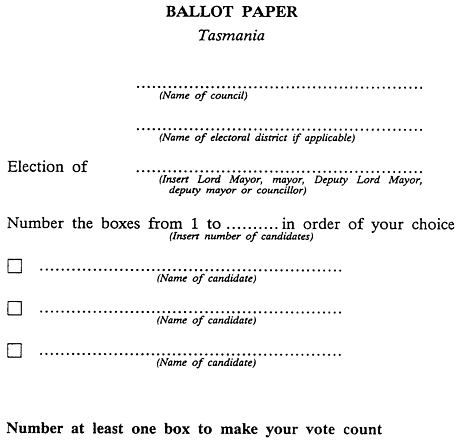
PART 2 - Councillor Elections[Part 2 of Schedule 6 Substituted by No. 15 of 2022, s. 8, Applied:16 Jun 2022]
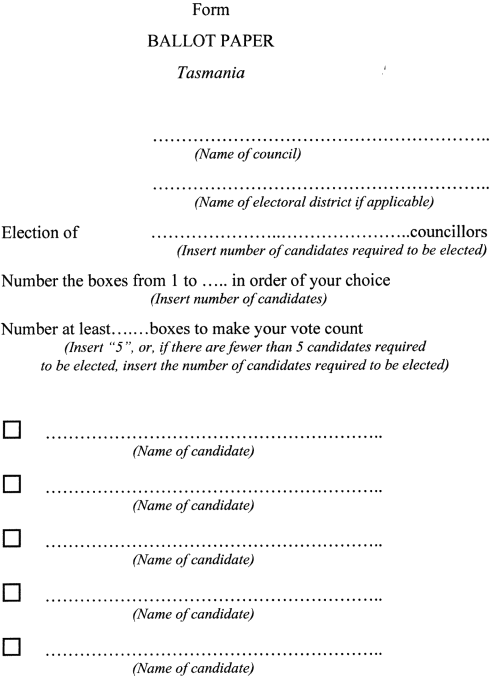
SCHEDULE 7 - Counting of Votes
Sections 299 and 301
PART 1 - General
1. Interpretation(1) In this Schedule –absolute majority of votes, in relation to a candidate, is a number of votes which is greater than one-half of the total number of ballot papers, other than exhausted and informal ballot papers, on which electors have recorded their votes for the candidate;informal ballot paper means a ballot paper which is informal as specified in section 300 ;quota means the number of votes sufficient to elect a candidate;second preference recorded for a candidate means the preference on a ballot paper recorded by the number "2" in the square opposite the name of the candidate on the ballot paper;surplus means the number of votes which a candidate obtained at any stage of the counting of votes in excess of the quota;transfer value means that portion of a vote which is unused by –(a) an elected candidate who has obtained a surplus; or(b) a candidate excluded on account of being lowest on the poll and which is transferred to the candidate next in the order of the elector's preference.(2) For the purpose of the definition of "transfer value", the transfer value is either one or a fraction of one.
PART 2 - Mayoral or Councillor Elections
2. First preferences(1) The number of first preferences recorded for each candidate is to be counted and all informal ballot papers are to be rejected.(2) The candidate who obtains an absolute majority of votes is to be elected.
3. Second and subsequent preferences(1) If no candidate has an absolute majority of votes, the candidate who has the fewest votes is to be excluded and each ballot paper counted to that candidate, unless exhausted, is to be counted to the unexcluded candidate next in the order of the elector's preference.(2) The process specified in subclause (1) is to be repeated until one candidate has an absolute majority of votes.
4. Ballot paper counted and exhausted(1) Every ballot paper, not rejected as informal, is to be counted in every count until it becomes exhausted, when it is to be rejected in all further counts.(2) If a candidate is excluded, any ballot paper counted to the candidate is exhausted if there is not indicated on it a consecutive preference for one or more unexcluded candidates.
5. Returning officer to decide exclusion and election(1) If, on any count, 2 or more candidates have an equal number of votes and one of them has to be excluded, the returning officer is to decide which candidate is to be excluded by the drawing or casting of lots in the prescribed manner.(2) If in the final count, 2 candidates have an equal number of votes, the returning officer is to decide which of them is to be elected by the drawing or casting of lots in the prescribed manner.
PART 3 - Councillor Elections
6. Quota(1) [Part 3 of Schedule 7 Amended by No. 38 of 2000, s. 49, Applied:14 Jul 2000] The quota is calculated in accordance with the following formula:where –Q is the quota;FP is the total number of first preferences;C is the total number of candidates to be elected.(2) Any remainder in calculating the quota is to be disregarded.(3) Subject to clause 13 (6) , a candidate is not to be elected until the candidate obtains a number of votes equal to or greater than the quota.
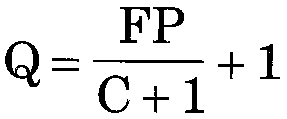
7. First preferences(1) The number of first preferences recorded for each candidate is to be counted and all informal ballot papers are to be rejected.(2) [Part 3 of Schedule 7 Amended by No. 38 of 2000, s. 49, Applied:14 Jul 2000] . . . . . . . .(3) A candidate who, after the first preferences have been counted, has a number of preferences equal to or greater than the quota, is to be elected.
8. First preferences equal to quotaIf the number of first preferences obtained by a candidate is equal to the quota, all the ballot papers on which a first preference is recorded for that candidate are to be set aside as finally dealt with.
9. First preferences in excess of quotaIf the number of first preferences obtained by a candidate exceeds the quota, the proportion of those preferences in excess of the quota is to be transferred to the other candidates not yet elected next in the order of the electors' respective preferences in the following manner:(a) all the ballot papers on which a first preference is recorded for the elected candidate are to be re-examined and the number of second preferences, or in the case provided for in clause 10 , third or next consecutive preferences, recorded for each unelected candidate are to be counted.(b) the surplus of the elected candidate is to be divided by the total number of votes obtained by the candidate on the counting of the first preferences and the resulting fraction is the transfer value;(c) the number of second or other preferences recorded for each unelected candidate is to be multiplied by the transfer value;(d) [Part 3 of Schedule 7 Amended by No. 38 of 2000, s. 49, Applied:14 Jul 2000] the resulting number of votes, truncated to 2 decimal places, is to be transferred to each unelected candidate and added to the number of votes obtained by the candidate on the counting of the first preferences.
10. Surplus(1) If, on the counting of the first preferences or on a transfer, more than one candidate has a surplus, the largest surplus is to be dealt with first.(2) If at that stage more than one candidate has a surplus, the then largest surplus is to be dealt with next, and so on.(3) If one candidate has obtained a surplus at a count or transfer previous to that at which another candidate obtains a surplus, the surplus of the former is to be dealt with first.(4) If 2 or more surpluses are equal, the surplus of the candidate who was the highest at the count or transfer at which they last had an unequal number of votes is to be dealt with first.(5) If the 2 or more candidates had an equal number of votes at all preceding counts or transfers, the returning officer is to decide which candidate's surplus is to be dealt with first.
11. Quota by transfer(1) If the number of votes obtained by a candidate is increased to a number which is equal to, or exceeds, the quota by a transfer, the candidate is to be elected.(2) Notwithstanding the fact that the candidate has reached the quota, the transfer is to be completed and all the votes to which the candidate is entitled from the transfer are to be transferred to the candidates, but no votes of any other candidate are to be transferred to the candidate.(3) If the number of votes obtained by a candidate is increased by a transfer to a number which is equal to the quota, all of the ballot papers on which the votes are recorded are to be set aside as finally dealt with.(4) If the number of votes obtained by a candidate is increased by a transfer to a number which exceeds the quota, the surplus is to be transferred to the candidates next in the order of the voters' respective preferences, in the following manner:(a) the ballot papers on which are recorded the votes obtained by the elected candidate in the last transfer are to be re-examined and the number of third preferences, or in the case provided for in clause 10 , next consecutive preferences, recorded for each unelected candidate counted;(b) the surplus of the elected candidate is to be divided by the total number of ballot papers mentioned in paragraph (a) and the resulting fraction is the transfer value;(c) the number of third or other preferences recorded for each unelected candidate is to be multiplied by the transfer value;(d) [Part 3 of Schedule 7 Amended by No. 38 of 2000, s. 49, Applied:14 Jul 2000] the resulting number, truncated to 2 decimal places, is to be credited to each unelected candidate and added to the number of votes previously obtained by the candidate.
12. Transfer of votes(1) If, after the first preferences have been counted and any surplus has been transferred, no candidate, or less than the number of candidates required to be elected, has obtained the quota –(a) the candidate who at that time, has the least number of first preference votes transferred is to be excluded; and(b) all the votes obtained by that candidate are to be transferred to the candidates next in the order of the electors' respective preferences in the same manner as provided by clause 4 .(2) [Part 3 of Schedule 7 Amended by No. 41 of 1998, s. 46, Applied:18 Dec 1998] The votes received by the excluded candidate are to be sorted into groups according to their transfer values when received by that candidate.(3) [Part 3 of Schedule 7 Amended by No. 41 of 1998, s. 46, Applied:18 Dec 1998] The groups are to be transferred at the transfer value at which they were received in the following order:(a) firstly, the group with the highest transfer value;(b) secondly, the remaining groups in descending order of transfer value.(4) [Part 3 of Schedule 7 Amended by No. 41 of 1998, s. 46, Applied:18 Dec 1998] Each transfer under subclause (3) is a separate transfer.
13. Votes increased by transfer(1) If the number of votes obtained by a candidate by a transfer is increased to a number which is equal to, or exceeds, the quota the candidate is to be elected.(2) Notwithstanding that the candidate has reached the quota, the transfer is to be completed and all the votes to which the candidate is entitled from the transfer are to be transferred to the candidate, but no other votes are to be transferred.(3) If the number of votes obtained by a candidate is increased by a transfer to a number of votes which is equal to, but does not exceed, the quota, all the ballot papers on which those votes are recorded are to be set aside as finally dealt with.(4) If the number of votes obtained by a candidate is increased by a transfer to a number which exceeds the quota, the surplus is to be transferred to the candidates next in the order of the electors' respective preferences in the same manner as provided by clause 11 (4) , but that surplus is not to be dealt with until all the votes of the excluded candidate have been transferred.(5) If there is a surplus, it is to be dealt with before any other candidate is excluded.(6) The process of excluding the candidate who has polled the next lowest number of votes and transferring the vote to other candidates is to be repeated until all the candidates, except the number required to be elected, have been excluded and the unexcluded candidates who have not already been elected are then elected.
14. Order of preferenceIn determining which candidate is next in the order of an elector's preference –(a) any candidate who has been elected or excluded is not to be considered; and(b) the order of the elector's preference is to be determined as if the names of those candidates had not been on the ballot paper.
15. Exclusion of candidates(1) If it is necessary to exclude a candidate, and 2 or more candidates have an equal number of votes, having at that time the least number of first preference votes transferred to them, whichever of those candidates was the lowest on the poll at the last count or transfer at which they had an unequal number of votes is excluded first.(2) If the candidates had an equal number of votes at all preceding counts or transfers, the returning officer is to decide which candidate is to be excluded first by the drawing or casting of lots in the prescribed manner.
16. Exhausted ballot paperIf, on a transfer, it is found that on a ballot paper there is no candidate opposite whose name a number is placed, other than a candidate whose name has already been elected or excluded, the ballot paper is to be set aside as exhausted.
17. Order of election[Part 3 of Schedule 7 Amended by No. 38 of 2000, s. 49, Applied:14 Jul 2000](1) The order of election of councillors is the order in which the candidates receive a quota.(2) If more than one candidate receives a quota at the same count or transfer, the candidate with the highest number of votes is elected first, the candidate with the next highest number of votes is elected second and so on.(3) If under clause 13(6) one candidate is elected without a quota, that candidate is elected last.(4) If under clause 13(6) more than one candidate is elected without a quota and it is necessary to determine the order of election of those candidates for any reason, the votes received by the remaining unelected candidates are to be distributed until only one candidate has received less than a quota.
SCHEDULE 8 - Recount to Fill a Casual Vacancy
PART 1 - General
1. InterpretationIn this Schedule –completed ballot papers counted means –(a) if, after the first preferences were counted at the relevant election, the number of first preferences recorded for the vacating councillor was equal to or exceeded the quota, all the ballot papers on which those first preferences were recorded; and(b) in any other case, all the ballot papers counted for that councillor at the time of that councillor's election, including ballot papers relating to votes that were transferred to the councillor;consenting candidate means a candidate not elected at the relevant election who consents to be included in a recount for a vacancy;[Part 1 of Schedule 8 Amended by No. 38 of 2000, s. 50, Applied:14 Jul 2000] consent period means the period within which a consent form is to be lodged under section 307(5) ;relevant election means the election last held to fill the office of the vacating councillor;quota means the number of votes sufficient to elect a candidate;vacating councillor means a councillor who is vacating the office of councillor.
PART 2 - Original Election Was For More Than One Councillor
2. One consenting candidate[Part 2 of Schedule 8 Amended by No. 53 of 2004, Sched. 1, Applied:16 Feb 2005] If there is only one consenting candidate, the Electoral Commissioner is to–(a) declare the candidate elected; and(b) notify the Minister in writing of the election of the candidate.
3. More than one consenting candidate[Part 2 of Schedule 8 Amended by No. 53 of 2004, Sched. 1, Applied:16 Feb 2005] If there are 2 or more consenting candidates, the Electoral Commissioner, within 7 days after the end of the consent period, is to ascertain in accordance with this Schedule which consenting candidate is to be elected.
4. Transfer of votes(1) If –so many of those votes as would have been transferred to that vacating councillor, if the votes of the excluded candidate had been transferred to the candidates next in the order of the electors' representative preferences, are taken to have been so transferred to, and to be obtained by, that vacating councillor and the completed ballot papers representing those votes are to be counted for that councillor.(a) a vacating councillor was, by virtue of clause 13 (6) of Schedule 7 , elected at the relevant election after the candidate who was lowest on the poll at that election had been excluded from the counting; and(b) the votes obtained by the excluded candidate were not required to be transferred to the candidates next in the order of the electors' preferences –(2) The ballot papers counted for the vacating councillor are to be examined, and all the votes obtained by the councillor are to be transferred to and counted for the consenting candidates first or next in the order of the electors' respective preferences.(3) [Part 2 of Schedule 8 Amended by No. 41 of 1998, s. 47, Applied:18 Dec 1998] The votes received by the vacating councillor as first preferences are to be transferred at the transfer value as determined under subclause (5) .(4) [Part 2 of Schedule 8 Amended by No. 41 of 1998, s. 47, Applied:18 Dec 1998] The other votes received by the vacating councillor that are not first preferences are to be transferred at the transfer value as determined under subclause (6) .(4A) [Part 2 of Schedule 8 Amended by No. 41 of 1998, s. 47, Applied:18 Dec 1998] All the votes received by the vacating councillor are to be –(a) sorted into groups according to their transfer values; and(b) transferred in the following order:(i) firstly, the group with the highest transfer value;(ii) secondly, the remaining groups in descending order of transfer value.(5) If the votes obtained as first preferences by the vacating councillor –(a) were sufficient to elect the councillor, the transfer value of those votes is the fraction determined by dividing the number of votes sufficient to elect the councillor by the total number of votes obtained by the councillor; or(b) were insufficient to elect the councillor, the transfer value of those votes is one.(6) If the number of votes obtained by the vacating councillor at an individual count, other than the votes obtained as first preferences –(a) were not sufficient to elect the councillor, the transfer value of the votes obtained on that count is that at which they were obtained by the councillor; or(b) were sufficient to elect the councillor, the transfer value of the votes received at that count is that which would have been sufficient to elect the councillor immediately before that count.(7) [Part 2 of Schedule 8 Amended by No. 41 of 1998, s. 47, Applied:18 Dec 1998] Each transfer under subclause (4A) is a separate transfer.
5. Counting of votes(1) After the number of votes for each consenting candidate has been ascertained, the method of counting votes set out in Part 2 or 3 of Schedule 7 applies with the necessary modifications.(2) [Part 2 of Schedule 8 Amended by No. 53 of 2004, Sched. 1, Applied:16 Feb 2005] The Electoral Commissioner is to declare the consenting candidate who obtains an absolute majority of the votes within the meaning of that Schedule to be elected.(3) [Part 2 of Schedule 8 Amended by No. 53 of 2004, Sched. 1, Applied:16 Feb 2005] As soon as practicable after declaring a consenting candidate to be elected, the Electoral Commissioner is to notify the Minister in writing of the election of the candidate.
6. Exclusion of candidate(1) If it is necessary to exclude a consenting candidate, and 2 or more consenting candidates have an equal number of votes and are lowest on the poll, whichever of those candidates was lowest on the poll at the last count or transfer at which they had an unequal number of votes is excluded first.(2) If the candidates had an equal number of votes at all preceding counts or transfers, the returning officer is to decide which consenting candidate is to be excluded first.
7. Previous election under Schedule[Part 2 of Schedule 8 Amended by No. 53 of 2004, Sched. 1, Applied:16 Feb 2005] If a vacating councillor was elected under the provisions of this Schedule, the Electoral Commissioner is to–(a) examine the ballot papers that at the relevant election were counted for the councillor in whose place the vacating councillor was elected (including votes transferred to the last-mentioned councillor); and(b) ascertain which consenting candidate is to be elected in accordance with this Schedule.
8. Order of preferencesTo determine which consenting candidate is first or next in the order of the electors' preferences –(a) the name of, and the first preferences recorded at the relevant election for, an excluded candidate who is a consenting candidate is not to be omitted from any completed ballot papers transferred to the vacating councillor, but is to be counted for that consenting candidate; and(b) any candidates who were elected at the relevant election or who are not consenting candidates are to be disregarded and the order of the electors' preferences are to be determined as if the names of those candidates had not been included on the ballot papers.
9. Ballot papers exhaustedA complete ballot paper is exhausted if there is no candidate next to whose name a number has been placed other than a candidate –(a) who has already been elected; or(b) who is not a consenting candidate.
PART 3[Part 3 of Schedule 8 Repealed by No. 38 of 2000, s. 50, Applied:14 Jul 2000] . . . . . . . .
SCHEDULE 8A - Savings and Transitional Provisions Consequent on Local Government Amendment (Code of Conduct) Act 2015[Schedule 8A Inserted by No. 29 of 2015, s. 21, Applied:13 Apr 2016]
1. Interpretation(1) In this Schedule –commencement day means the day on which the Local Government Amendment (Code of Conduct) Act 2015 commences;new Act means this Act as in force on and after the commencement day;previous Act means this Act as in force immediately before the commencement day;previous Code of Conduct Panel means a Code of Conduct Panel as defined in the previous Act;previous Regulations means –(a) if the Local Government (General) Regulations 2005 are in force immediately before the commencement day, those regulations as in force immediately before that day; or(b) if the Local Government (General) Regulations 2015 are in force immediately before the commencement day, those regulations as in force immediately before that day;Standards Panel means a Standards Panel as defined in the previous Act.(2) A reference in this Schedule to regulation 22C of the previous Regulations is a reference to –as appropriate, and a reference to the application of the previous Regulations in relation to that regulation is a reference to the Local Government (General) Regulations 2005 or the Local Government (General) Regulations 2015 , also as appropriate.(a) regulation 22C of the Local Government (General) Regulations 2005 ; or(b) the regulation in the Local Government (General) Regulations 2015 that substantially corresponds to that regulation 22C –
2. Code of conductOn and after the commencement day until a council adopts the model code of conduct under section 28T , the code of conduct of the council that was in force under the previous Act immediately before the commencement day continues in force and is taken to be the council's code of conduct within the meaning of this Act.
3. Complaints under previous Act(1) If –the complaint is to be dealt with, investigated and determined as a code of conduct complaint under the new Act.(a) before the commencement day, a complaint against a councillor is made under section 28F of the previous Act; but(b) immediately before the commencement day, the mayor or deputy mayor has not, under regulation 22C of the previous Regulations, notified the councillor against whom the complaint is made of the complaint –(2) If –the previous Act and previous Regulations continue to apply in relation to the complaint until the end of that 7-day period.(a) before the commencement day, a complaint against a councillor is made under section 28F of the previous Act and the mayor or deputy mayor has, under regulation 22C of the previous Regulations, notified the councillor against whom the complaint is made of the complaint; but(b) the 7-day period within which, under regulation 22C of the previous Regulations, the councillor may lodge an election to have the complaint referred to the Local Government Association of Tasmania to be dealt with by a Standards Panel has not expired –(3) If –the previous Act and previous Regulations continue to apply in relation to the complaint, its hearing and a determination.(a) before the commencement day, a complaint against a councillor is made under section 28F of the previous Act; and(b) the councillor, either before the commencement day or as allowed by subclause (2) and under regulation 22C of the previous Regulations, has lodged an election to have the complaint referred to the Local Government Association of Tasmania to be dealt with by a Standards Panel –(4) If –the complaint is to be dealt with as a code of conduct complaint under the new Act.(a) before the commencement day, a complaint against a councillor is made under section 28F of the previous Act; and(b) the councillor, either before the commencement day or as allowed by subclause (2) and under regulation 22C of the previous Regulations, has not lodged an election to have the complaint referred to the Local Government Association of Tasmania to be dealt with by a Standards Panel; and(c) the mayor or deputy mayor has not referred the complaint to a previous Code of Conduct Panel –(5) If –the previous Act and previous Regulations continue to apply in relation to the complaint, its hearing and determination and in relation to an appeal made under section 28F of the previous Act against the decision of the previous Code of Conduct Panel.(a) before the commencement day, a complaint against a councillor is made under section 28F of the previous Act; and(b) the councillor, either before the commencement day or as allowed by subclause (2) and under regulation 22C of the previous Regulations, has not lodged an election to have the complaint referred to the Local Government Association of Tasmania to be dealt with by a Standards Panel; and(c) the mayor or deputy mayor has referred the complaint to a previous Code of Conduct Panel –
4. Continuation of, and termination of membership of, previous Code of Conduct Panel(1) At any time on or after the commencement day, a council is to terminate the appointments of the members of its previous Code of Conduct Panel once the council is satisfied that the Panel will not be required, by reason of clause 3 , to deal with, hear and determine a complaint made under section 28F of the previous Act.(2) On and after the commencement day until the appointment of a member of a previous Code of Conduct Panel that was in force immediately before the commencement day is terminated under subclause (1) , that appointment continues and for that purpose the previous Act applies to that appointment.(3) If, on or after the commencement day, a previous Code of Conduct Panel is required, by reason of clause 3 , to deal with, hear and determine a complaint made under section 28F of the previous Act and it is necessary to appoint a new member to the Panel, the previous Act continues to apply –(a) so as to allow the appointment of the new member to the Code of Conduct Panel; and(b) to the appointment of the new member until the appointment is terminated under subclause (1) .(4) A member of the previous Code of Conduct Panel is not entitled to receive any benefit in respect of the termination of his or her appointment as such a member under subclause (1) .
5. Continuation of, and termination of membership of, Standards Panel(1) At any time on or after the commencement day, the Local Government Association of Tasmania is to terminate the appointments of the members of its Standards Panel once that Association is satisfied that the Panel will not be required, by reason of clause 3 , to deal with, hear and determine –(a) a complaint made under section 28F of the previous Act; or(b) an appeal against the determination of such a complaint by a previous Code of Conduct Panel.(2) On and after the commencement day until the appointment of a member of a Standards Panel that was in force immediately before the commencement day is terminated under subclause (1) , that appointment continues and for that purpose the previous Act applies to that appointment.(3) If, on or after the commencement day, the Standards Panel is required, by reason of clause 3 , to deal with, hear and determine a complaint under section 28F of the previous Act or an appeal against the determination of such a complaint by a previous Code of Conduct Panel and it is necessary to convene the Standards Panel or appoint new members to the Standards Panel, the previous Act continues to apply –(a) so as to allow the convening of the Standards Panel and the appointments of members, or new members, to the Standards Panel; and(b) to the appointment of each of those members and new members until the appointment is terminated under subclause (1) .(4) A member of a Standards Panel is not entitled to receive any benefit in respect of the termination of his or her appointment as such a member under subclause (1) .
SCHEDULE 9 - Repeals
Hobart Corporation Act 1963 (No. 81 of 1963) | Hobart Corporation Act 1976 (No. 39 of 1976) | Hobart Corporation Act 1977 (No. 26 of 1977) | Hobart Corporation Amendment Act 1990 (No. 10 of 1990) | Launceston Corporation Act 1963 (No. 82 of 1963) | Local Government Act 1962 (No. 67 of 1962) | Local Government Amendment (Administrative Amendments) Act 1983 (No. 91 of 1983) | Local Government Amendment (Building Regulations Board) Act 1985 (No. 80 of 1985) | Local Government Amendment (Crown Lands) Act 1989 (No. 1 of 1989) | Local Government Amendment (Development and Building) Act 1985 (No. 91 of 1985) | Local Government Amendment (Elections) Act 1992 (No. 56 of 1992) | Local Government Amendment (Health Surveyors) Act 1984 (No. 83 of 1984) | Local Government Amendment (Local Government Advisory Board) Act 1987 (No. 29 of 1987) | Local Government Amendment (Local Government Advisory Board) Amendment Act 1991 (No. 18 of 1991) | Local Government Amendment (Master Planning Authorities) Act 1984 (No. 46 of 1984) | Local Government Amendment (Municipal Association) Act 1990 (No. 51 of 1990) | Local Government Amendment (Municipal Caravan Parks and Camping Grounds) Act 1982 (No. 76 of 1982) | Local Government Amendment (Municipal Elections) Act 1991 (No. 32 of 1991) | Local Government Amendment (Planning and Development) Act 1990 (No. 50 of 1990) | Local Government Amendment (Planning Fees) Act 1990 (No. 36 of 1990) | Local Government Amendment (Rates and Charges) Act 1985 (No. 28 of 1985) | Local Government (City of Launceston Reorganization) Act 1985 (No. 29 of 1985) | Local Government (Municipality of Lyell) Act 1986 (No. 28 of 1986) | Local Government Amendment (Building and Plumbing) Act 1993 (No. 37 of 1993) |
SCHEDULE 10 - Validation[Schedule 10 Inserted by No. 52 of 2011, s. 17, Applied:22 Dec 2011]
1. Interpretation of Schedule 10In this Schedule –charge means a charge made under Part 9 ;introduction day means the day on which a bill entitled the Local Government Amendment Bill (No.2) 2011 is presented to the House of Assembly;rate means a general rate, a separate rate, a construction rate, or a service rate, each within the meaning of Part 9 ;rates notice has the same meaning as it has in Part 9 .
2. Validation of certain rates and charges(1) A rate or charge made, or purportedly made, under Part 9 on a day ("the relevant day") before the introduction day is to be taken to have been validly made on the relevant day, and to have always been validly made on the relevant day, under this Act.(2) A variation, of a rate or charge, made, or purportedly made, under section 94(3) , section 94(3A) , section 106A(1) or section 107 on a day ("the relevant day") before the introduction day is to be taken to have been validly made on the relevant day, and to have always been validly made on the relevant day, under this Act.(3) A minimum amount payable set, or purportedly set, under section 90(4) , section 93(3) or section 107 on a day ("the relevant day") before the introduction day is to be taken to have been validly set on the relevant day, and to have always been validly set on the relevant day, under this Act.(4) If, on a day ("the relevant day") before the introduction day, a council purported to vary under section 107 a minimum amount payable set, or purportedly set, under section 90(4) , section 93(3) or section 107 , the minimum amount as so varied is to be taken to have been validly set on the relevant day, and to have always been validly set on the relevant day, under this Act.
3. Effect of validation on current proceedings, &c.(1) In this clause, a reference to the relevant proceedings, in relation to a council, is a reference to proceedings, in a court, relating to a decision of the council, if –whether or not the proceedings have been determined by the court.(a) the proceedings include or involve a relevant claim; and(b) an instrument commencing the proceedings in the court has been lodged with the court before the introduction day –(2) A relevant claim is a claim to the effect that –(a) a rate or a charge made, or purportedly made, under Part 9 was invalidly made or the making of it was attended by legal error or in any event was unauthorised by law; or(b) a variation, of a rate or charge, made, or purportedly made, under section 94(3) , section 94(3A) , section 106A(1) or section 107 , was invalidly made or the making of it was attended by legal error or in any event was unauthorised by law; or(c) a minimum amount payable set, or purportedly set, under section 90(4) , section 93(3) or section 107 was invalidly set or the setting of it was attended by legal error or in any event was unauthorised by law; or(d) a variation made, or purportedly made, under section 107 , of a minimum amount payable set, or purportedly set, under section 90(4) , section 93(3) or section 107 , was invalidly made or the making of it was attended by legal error or in any event was unauthorised by law.(3) Clause 2 does not affect any order or determination made by a court before that clause comes into effect.(4) If relevant proceedings in relation to a council are not finally determined before clause 2 comes into effect, the proceedings, and any proceedings for a review, or appeal, of a decision in relation to such proceedings, are to be dealt with and determined as if that clause had not come into effect.(5) A council may not, after this subclause comes into effect, issue, in relation to the particular rateable land to which relevant proceedings relate, a rates notice in relation to a rate or charge in respect of the 2011-2012 financial year, or any preceding financial year, if the rate or charge could not, but for clause 2 , be imposed in respect of the rateable land.